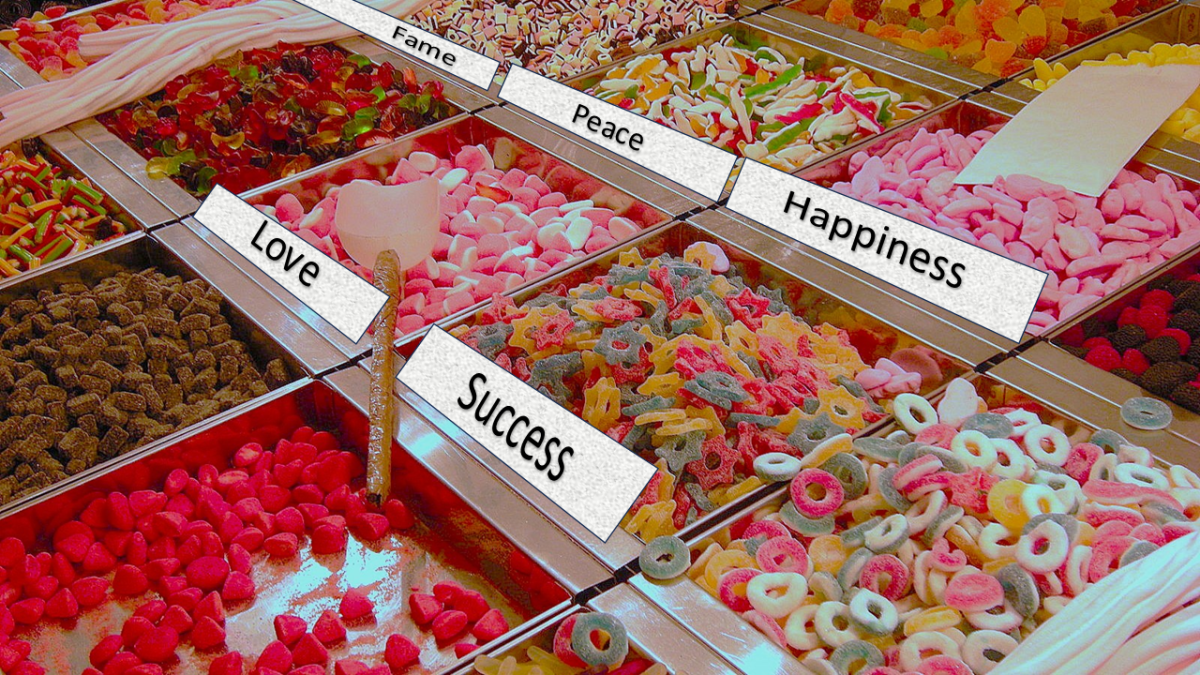
The Essence of Nominalism

Is happiness, love – sadness, hatred just the names we have given certain things? Is that why after achieving something great we fill empty and become clueless about what’s next? Is there something common, universal, essential characteristic shared across things that create reality? Or are we just putting labels on things so we can put them in our brains effectively?
Nominalism says that there is nothing common shared between all the objects existing in reality. Love could be anything for anyone, you cannot pinpoint an object absolute, consistent and repetitive nature across reality and put it in a box and call it love. Same for hatred. Nominalism thus sheds light on how things are more than just their labels and why it is dangerous to chase things if their labels/ tags are the sole motivation for you. There is more to reality of things we are chasing than meets the eye.

Are we just chasing labels, tags in life until we die?

Question- What does Success, Love, Happiness and God mean to you?

Is Reality Same for Everyone?

Do We Share a Common Reality?

Human intelligence is one interesting thing. We can perceive things in better ways, classify them, observe them and use all those understandings to predict the outcome of events in satisfactorily good way, we can create non-existent things out of current given resources which elevate the ways we carry out our living – our lifestyle. The ability to develop various fields of knowledge and understand the reality is the basis of human civilization.

So, we can say that anything which gets distilled down to a specific understanding – an understanding which is consistent throughout our existence can be called as knowledge – knowledge with experience further gets distilled down to wisdom. Even though the knowledge of certain things is not consistent we at least know why it isn’t consistent or we have a well-rounded explanation that ‘this’ is an exception with fair justifications. Knowledge helps us to perceive how the things, ideas around us can be used to build things, the life we want.

The ability to see commonalities and differences between things, objects, ideologies is one important part of how we build our understanding about reality in which we exist. We have notions of right and wrong, black and white, past, present and future, tall and short, thick and thin, good and evil, strong and weak. These attributions help us to identify certain common aspects in things and certain uncommon aspects in the same things.

So, when I am saying Rose – you will understand that I am talking about a flower which looks red, has a particular fragrance. Words thereby names are at the core of how we build knowledge of the surrounding and the reality.

There is one more interesting thing happening here –

When I would say Rose – it is a possibility that someone would understand it as a girl he/she knows, someone would imagine it as a color which somewhat is red but richer in shades, someone would imagine the prickly thorns instead of the gentle nature of the flower.

What’s happening here? The moment I am trying to specify something – some object with a word – a name which shows some common attribute that object shares with others, in that same moment I am failing to describe that object, that idea in its complete capacity.

In our example, the word Rose on surface seems to indicate just a flower, but Rose could mean almost anything to anyone. Rose is just a simple object we are talking about; now imagine how would we define the reality we live in? The reality is multifaceted. People have different experiences, meanings, understandings of reality based on their personal experiences. Does that mean that there is nothing common between the reality we live in? Do we live in our own realities?

Does that mean that words assigned to the things are not what the things are? That the name of objects are just names? Everything that is there is one and only individual rendition of its own? If nothing is same then how do we agree on something common and set our lives to that way? How come we agree to certain religion and follow that? How come we agree that certain things are bad and we should avoid those? How come we appreciate what is happiness and try to achieve that in our existence?

I mean what if happiness is just of name something and goodness is name of the other which does not exist in reality and we are just blindly chasing it? (and we don’t even make out of it alive in the end!) What if we are just chasing names and “there exists nothing like it” – is our realization when we actually achieve that?

Is “the reality” really made of something very fundamental and shared qualities? Or are we just carrying our lives in the chaos of dissimilar (but seemingly similar on surface) things? Even though we call ourselves as humans how come some humans create examples out of their lives that they don’t deserve to be called as humans? How come some humans are so great that calling them humans is disrespecting their life?

Is there something really common among everything or are we just labeling things on whim (or intentionally) to solve the confusions of our minds? Are we living in a matrix and reality is totally different place than where we exist? Are hell and heaven more real that the earth we are living in?

Have we been robbed of the real understanding of reality and cursed to live in an illusion called life?

I mean I could have called the Rose an egg right from the beginning and everybody would have been fine with it. It’s just that now the egg is a flower, has red petals, has thorns and has fragrance. (Shakespeare would have also used egg for Juliet’s dialogue and everybody would have been fine with it. As everyone now knows and agrees what an egg is!)

Now you should appreciate how strongly we are conditioned right from the beginning. Calling an egg a Rose feels unnatural but if someone right from the beginning of the beginning would have called it an egg, we would be comfortable with egg in Shakespeare’s dialogue.  

Is there really anything like “Red” color, “Grey” color?

A simple experiment

Look at the picture below:

It’s easy to tell that the cube has one white and one grey colored side.

Now see what happens when I put a blind along the edge of the sides:

There is no manipulation in this image, I have just put a colored box to hide the edges. You can blind the main image with finger and see the same result.

This is popularly called as “Cornsweet Illusion” or “Craik-O’Brien-Cornsweet effect”. This illusion works because our brains try to fill the unavailable information to make sense of the things observed. In this case of the cube example our visual interpretation system tries to determine the edges/ sides of the object by the sudden changes in the illumination of the surfaces.

From this example, you can appreciate how our brain tries to fill in the gaps between the information we are collecting.

Does that mean that there is nothing like what I call grey or white? that there is something totally different for which I am yet to assign a name just to make its identification easy. If that is the case, then are we just naming things in the name of knowledge and don’t have actual hold of the reality? Are we just pretending to be smart just because we can name the things?

Keep in mind we are not simply talking about naming things. If my brain tries to fill the gaps by itself to create a sense of understanding, some part of truth or reality which I carry in my beliefs – are they real or were they some gaps filled by my brain itself?

Following the same train of thought, here is an important question –

Obviously, no one by birth knows what is the “real” nature of reality is? (Otherwise, we would not be discussing all this). You will see that people know reality for how their life experiences turned out to be. They know what reality is, but not all have one singular, absolute concurrence, alignment and unanimous opinion about the nature of reality.

An important idea in philosophy called nominalism tried to question reality in this way (there is a part when the opposite of Nominalism is Realism! I will cover realism in next post). For that we will try to understand what Nominalism tries to solve.

Is there something common characteristic shared across things that create reality? Or are we just putting labels on things so we can differentiate?

Nominalism – There Are Just Names No Essences

William of Ockham is the guy responsible to popularize Nominalism in philosophy although he is not the originator of it. Ockham’s Razor is one very mainstream idea still useful in our pursuits of knowledge. I have covered Ockham’s Razor in separate post.

I think, it is a high possibility that Nominalism and Ockham’s Razor have strong connection not just because they were popularized by the same person but how they align themselves with each other to create a consistent argument.

Ockham’s Razor goes like this –

“Plurality should not be posited without necessity”

In simple words, do not interpret, do not deduce unnecessary things unless they are presented or experienced. (I have somewhat twisted the meaning to align the Ockham’s Razor to align with the train of thoughts and there is hardly anything mistaken here.)

My purpose to rephrase Ockham’s Razor is to connect our brain’s habit to fill unknown gaps with our pursuit of the real nature of reality we live in.

Nominalism thus calls out for the reality which individuals experience for themselves. There is nothing common between the life that we are sharing. Every object existing is an individual, special object in itself. Objects never share something common between them, it may be just our brains filling in the unknown gaps to make sense out of reality and have peace of mind. The labels like Red, Love, Justice, Truth, Loyalty, Happiness are not physical entities, absolute entities which exist in reality. We have created these labels so that we can sort certain thing in certain groups to create a model of reality in our energy optimizing brains.

This is really important point – that things we call real are just labels given by us. A Rose could have been an egg from its creation and nobody would have objected it.

Consequences of Nominalism

Nominalism – in simple words says that there is nothing common shared between all the objects existing in reality. Love could be anything for anyone, you cannot pinpoint an object absolute, consistent and repetitive across reality and put it in a box and call it love. Same for hatred. Same goes for the notion of beauty, fear, justice, truth and what not. Justice is not some type of molecule or an element which can be physically hunted, mined, rigged in reality. It is a label we have created for certain way of things. But, upon full magnification we will see that that certain way of things grouped together are highly individualistic – seeming that they are not same in any way.

Nominalism pointed one interesting observation – the things exist in their individual ways; we are just labeling certain aspects of them so that they can be grouped together or compared against one another.

Do you understand what this leads to? For me it is chaos.

It means that there is no such thing like love, justice, joy, happiness, affection, truth, utopia, passion, enthusiasm, redness, whiteness.

It also means that there is nothing like hatred, unfairness, fear, sadness, fakeness, lie.

These are only labels we are chasing in some scenes and in some scenes running away from or avoiding.

This leads to the conclusion that there is no pivot to the life we are living and the reality in which we exist. This is unsettling – this unsettling feeling leads to existential crisis.

One can here say that Nominalism bridges Phenomenology and Existentialism in better ways in philosophy.

Phenomenology talks about objectively understanding and interpreting reality through subjective experiences. (The one where objective and subjective appear in the same sentence!) It calls for the truth to be one which is realized through personal experiences – phenomenon happening with the individual.

Existentialism talks about the idea that there is no center or pivot to the reality we live in. This is a freedom in such an intense dosage that if we are not creating our own pivot for our own life the sheer possibilities emerging from freedom will overwhelm us concluding that there really isn’t such meaning or sense to life.

Nominalism says that there is no real common thing which can be distilled down between seemingly same things, things were never the same – there is no “essence” which exists across certain seemingly same things. There is no such thing like “universal” which is consistent across the objects in reality. Everything exists individually on its own. One has to experience things for themselves to see their real nature.

It is just your urge to rationalize things so that your brains will save energy. Rationalization is all about making sense of the things, and if everything has its own way of being our minds cannot store each and every aspect of those individual things all the time, thus we have resorted to the pursuit of “essence”, “universality” and hence “labels”.

Conclusion

William of Ockham’s Nominalism from medieval philosophy is reiterated in modern philosophy through Existentialism, Absurdism.

Jean-Paul Sartre – the French Existential philosopher thus talks about how labels are always fooling us. We think our life made to be defined by the achievements of certain labels where upon deeper inspection we see that the labels are mere a creation of our minds, they are how we interpret reality. They are not reality in themselves. Reality was already there even when labels were not there.

This is how Sartre call out Existential philosophy – “Existence precedes essence” and not the reverse “Essence precedes existence”. The later one is just a construct of our mind to create meaning in this meaningless world.

The very freedom granted to us becomes our enemy because we are clueless when we realise that we can do anything. This is where Absurdism peeks in.

Boundaries of Nominalism

There will be different reactions to the explanation of nominalism and that itself will show you how varying types of people exist and their individual renditions of the reality. But interestingly you will find “type” of reactions in people.

One will not immediately agree but everyone on deep inspection will accept this that we always crave for justification for everything that happens with us, it could be in our favor or against us. We crave for justification which will bring peace to our mind, in happiness this peace will amplify happiness and in challenging situations it will give us something to blame.

Once you start appreciating our habit to justify every damn thing you will suddenly see that Nominalism is pretty much good concept in philosophy. Nominalism when says that essences, shared attributes are just labels and nothing real, it warns us that the justification you are trying to give for your situation might just be your construct of mind and not real. Nominalism feels attractive because it feeds attitude of skepticism, which is the first tool of the person in the quest for the absolute truth.

On the other side, nominalism has its innate limitations too. If nominalism is true then it is not there as nominalism itself is our “labeling” to the concept of “not labeling everything together”.

This is where paradoxes begin. If there really was nothing common “essence” among certain grouped things, then it was impossible to group them in first place. So, essence must exist already (this feels even more paradoxical.)

We will search for resolution of these paradoxes in next post on Realism.

Related reading:

A Trade-off Between Simplicity & The Reality

A Trade-off Between Simplicity & The Reality

In spite of being originated from medieval philosophy, the law of parsimony which famously goes as Ockham’s Razor still remains practical in the modern times of AI and the pursuit of artificial general intelligence. Ockham’s Razor asks to cut all the unnecessary things while understanding any system to reduce complexity. This idea is a part of creating efficient ML algorithms. The tool of parsimony has its limitations too and these limitations can create an objective fake picture of the reality, and can be used to twist the facts.
People most of the times miss the point of parsimony which is to make a realistic attempt to check how and why our understanding of things which we have and the real nature of things differ, how can we fill the gap between what we theorize, what we can test and what real there exists.
Context thus plays very important role in every pursuit of knowledge, even in the knowledge of the self. It is important to understand the boundary conditions of our knowledge. One should know where their beliefs (even if they are true) can be limited, can be challenged, can be difficult to prove. That is why parsimony in any pursuit of knowledge needs to be handled with utmost care while studying the real nature of things.

Medieval Idea of Ockham’s Razor For The Modern World

Craving for Simplicity

One of the key driving factors for humans is to have complete understanding of how things work. The reason behind this is to maximize the chances of survival. Now in modern times those odds have become better. The urge to understand the working of things has been evolved into improving the quality of the survival or the existence.

The key events in the quest to understand everything that is there could be summarized as follows:

  1. There is some unexpected event which causes pain, suffering, loss (it can be opposite too, like extreme favorable growth, happiness, high gains. But the human tendency is to be more concerned about uncertain losses.)

Curiosity actually emerges from the urge to control everything that can be controlled and identifying what cannot be controlled and then working towards how to control uncontrollable things by understanding them in depth.

This is how we try to assign meaning to life, our very existence.  

  1. Then we try to observe similar events associated with such experiences, record them. We try to recreate them until we have clarity on the factors which are responsible for such events. We experiment the events repeatedly so that we can have a proper theoretical understanding or a concrete reasoning behind such events.
  2. The key factor for the reasoning to be accepted as the practical one is its consistency with another unconnected or remotely connected events. There is some “universality” in that reason or that theory.

This is roughly how we try to understand the existence. If one asks why we are always on the quest of understanding the existence the answers are diverse.

The simple answer I think is that our brain prefers simplicity so that it can spend the saved energy to maximize its chances of survival. Our brain hates complexity because once the complexity is accepted the uncertainty has to be accepted and then the brain would start to invest its energy into those things which won’t even get materialized but could get materialized because of the non-zero probability.       

Our brain craves certainty of survival.

This trait of brain to prefer simplicity might not be the nature of the reality in which it exists and tries to survive but if doing so maximizes the chances of its existence then it is a pretty much the best way.

In epistemology, the philosophy – the theory of knowledge this trait is investigated in depth. We will try to see one dimension of this thought which goes popularly as the law of parsimony and even more famously as Ockham’s Razor   

William of Ockham and Ockham’s Razor

William of Ockham was an important medieval philosopher, theologian who brought the law of parsimony into the focus. Although the idea was already in existence from Aristotle.

Aristotle believed that nature always works in efficient ways possible and thus the explanation for the events in nature ought to be the efficient ones.

Although Medieval, Ockham’s razor is one crucial idea in the age of Artificial Intelligence and Machine Learning.

Ockham’s Razor emerges from his writing called “Summa Totius Logicae” exactly as:

“Pluralitas non est ponenda sine necessitate” meaning “Plurality should not be posited without necessity”.

In modern Science, philosophy, the idea “simply” goes like this:

“Do not mix unnecessary things”

OR

“All things being equal the simplest solution is the best.”

Consequences of Ockham’s Razor

The principle of parsimony (lex parsimoniae in Latin) thereby Ockham’s Razor helps us to not complicate things when we are investigating them. It is used as a thumb rule or heuristic to generate theories having better predictability. The moment we are saying that the preferences should be to ‘the simpler theory with better predictability’ is the moment when people most of the times misinterpret the Ockham’s razor. Razor implying that chopping off everything unnecessary, if not chopped would contribute to the increase in the complexity thereby compromising the predictability. We will see how Ockham’s Razor affects positively and negatively when we are trying to understand the things around us.

Good consequences:

Search for the theory of everything

Aristotle’s belief that nature always chooses the efficient route to decide the fate of anything reinforced the idea that the theories which would explain the nature are the best if they involve the least possible variables.

Einstein’s theory of relativity and the equation of energy connecting to the mass is the best example to explain this. An elegant equation with mere 1 inch length encompasses all the big secrets of the universe.

The theory of relativity is elegant in a way that it covers Newton’s understanding of motion and gravity and furthermore extends it to the understanding of the black holes where Newton’s same theory would become limited.

Quantum mechanics explains everything that atom can create. It justifies why the earlier models of atoms were perceived in those particular ways (like atom being a solid sphere, a plum pudding, a thing with nucleus at center and electrons in their orbits).

Quantum mechanics thus is the most efficient way to explain what we observed and why we interpreted those observations in a particular way. Please note that the goal is not to falsify something, prove something wrong; the goal of knowledge or science is to understand why we theorized something in wrong way and why it doesn’t align with the reality we are trying to observe and understand.

Efficient Machine Learning Models – Generalization Error

In the age of AI, the efficiency of Machine Learning Algorithms is one crucial decision maker of the investments to be made to evolve it further. The key goal of any Machine Learning algorithm is to create a mathematical equation (or layers of mathematical equations) which would understand the data provided, make sense of it and now predict the outcomes after understanding the data.

This sounds simple while establishing theoretically but the real-life data one provides ML algorithms is filled with variety of noises – unwanted, unconnected, irrelevant data points.

If the ML algorithm would try to fit the noise too, it would add too many variables in its mathematical equations. Now the model would fit each and every data point but at the same point it loses confidence to predict the outcomes because the noise is not really connected to the system one is trying to define.

That is why a complex ML algorithm fitting all the data points (R2=1) is an ideal situation – ideal meaning practically impossible because it is exposed to a very limited dataset. An ideal ML algorithm has a “generalized” idea of the data points on which it was not trained. Meaning that this ML algorithm has such an effective understanding of what is happening in the dataset with least number of equations that it is now able to understand what could happen if something is to be predicted outside of its training dataset (Q2 – algorithm’s ability to predict the unseen data – should be maximum). L1, L2 regularization techniques used in ML are example of that. Now the ML algorithm is not just interpolating proportionally the points in between, it has its own mathematical justifications to decide whether and how to interpolate aggressively or not – in order to predict the realistic outcome.

Ockham’s Razor thus proves to be important in the age of AI to select efficient algorithms, efficient algorithms ensure efficient use of power, resources thereby the investments.

Parsimony in Psychology – Morgan’s Canon

In very simple words, I would say three words to explain what this means – “Life of Pie”.

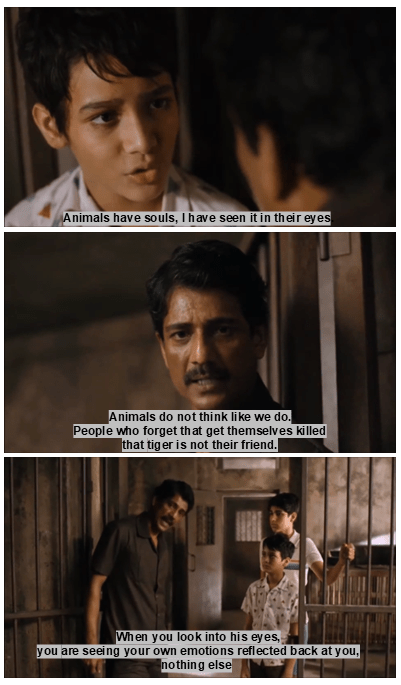
The movie Life of Pie has a moment when Pie’s father tells him that the emotions which Pie is seeing in the Tiger Richard Parker’s eyes are mere the reflection of how Pie feels the tiger would be feeling i.e., hungry in that specific case.

In animal psychology (Comparative Psychology) researches, Morgan’s Canon asks scientist to not over-attribute any human quality that humans possess to animals without any concrete basis.

“In no case is an animal activity to be interpreted in terms of higher psychological processes if it can be fairly interpreted in terms of processes which stand lower in the scale of psychological evolution and development.”

The scene from Life of Pie strongly resonates with Morgan’s canon.

There is a reason why Morgan established this idea. We humans have a tendency to see human form in everything that is not even human – this is anthropomorphism. While studying animals, these anthropomorphic tendencies would mislead each and every study because other animals and human share many common things. Unless there is no strong evidence to justify the human like intelligent behavior the simplest explanation should be selected to justify the behavior of the animal in their psychological studies.

These are some of the examples where Ockham’s razor proves to be very valuable.

Bad Consequences (limitations of Ockham’s Razor)

There is other side to simplification of things, we will now see how people misinterpret the principle of parsimony thereby Ockham’s Razor.

Universe might prefer complexity to exist

In the pursuit of the theory of everything, Einstein himself was confused that “how could God play the dices?” How can one bridge the gap that exists between the theory of relativity and the quantum mechanics. One explains the heavenly objects and the other explains what lies at the bottom of the bottom of particles which make the universe existent.

One will realize that there is more than what we are using in current theory which needs to be considered to explain the reality in a better way.

One reason why Einstein was genius of all times is because he knew that something was missing in his theory. He was not ashamed of the complexity the theory of everything may carry. Even while speaking about his elegant theory of relativity Einstein had this opinion:

Artificial General Intelligence (AGI)

Those who are actually working in the field of AI would explain this to you that how difficult it is to create an Artificial General Intelligence (AGI). Even though we have some of the greatest chat-bots, AI assistants, AI agents, they are experts in executing specific tasks only. They can immediately get biased, they can be fooled easily, bypassed easily.

The key reasons behind these shortcomings are many. The AI tools perform the best when they are designed to perform specific tasks, they lack common sense like the humans do, they lack the emotional dimension in the decision making (one of the important aspects of how humans generalize the understanding of their surrounding), they cannot directly build the bridges between their algorithms unless enough data is provided. AI doesn’t have intuition which humans have developed over the thousands of years of natural evolution.

It is also important to understand how greatly we underestimate the computation and decision-making capability of our brains and how much power it takes to replicate the same in machines. 

So, maybe complexity is prerequisite for AGI and thus the enormous number of resources that will be required to achieve it.

Human like intelligence in Animals

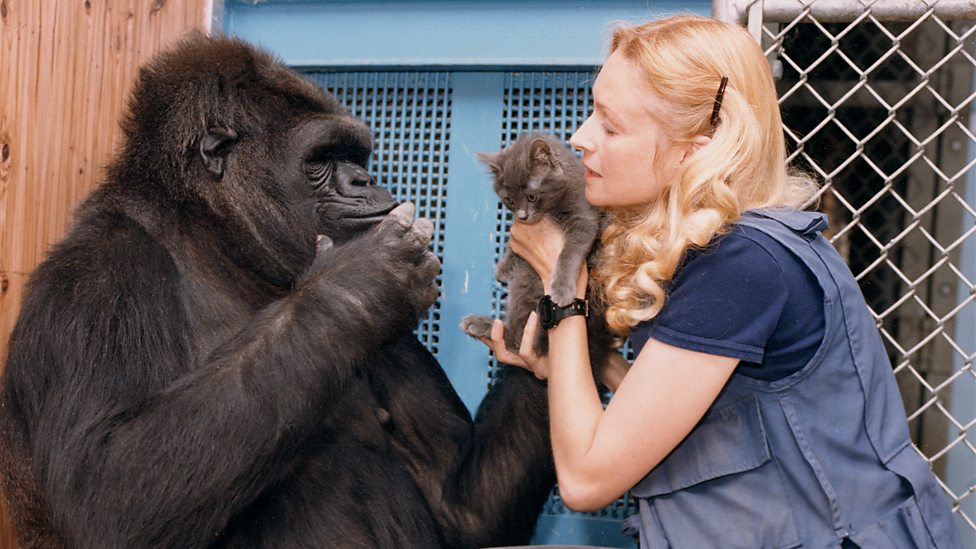
The story of Koko and Robin Williams could be good example to explain this. Koko – a female gorilla was trained in American Sign Language (ASL) by Francine “Penny” Patterson. Penny called this language as Gorilla Sign Language (GSL).

Penny with Koko

There is a very famous video of the meeting between the movie actor Robin Williams and Koko. Soon after the death of her gorilla friend Michael, Koko met Robin Williams and she laughed after a long time along with Robin, she played with him, she even recognized Robin from his movie cassette cover.

Robin Williams having fun with Koko

When the instructors of Koko told her about the death of Robin Williams, she expressed her grief by signaling the instructors if she could cry, her lips were trembling in grief. See the emotional depth she had just like normal humans do.

Dolphins are also one good example to demonstrate human like intelligence in animals.

This means that Ockham’s Razor, Principle of parsimony or Morgan’s canon are of no use. What is happening here? What goes missing during the oversimplification? What are we misunderstanding?    

What goes missing in simplification?

The main problem with Ockham’s razor or its any other equivalent philosophies is the convenience they bring. Just like by collecting a biased data you can actually prove anything wrong which in reality is right, in the same way people misinterpreted the principle of parsimony.

The key reason for William of Ockham to support the principle of parsimony was because he was a nominalist. “Nominalism” says that there is nothing common between anything and everything that is there in reality. Everything has its own individual nature and what we see common in many things collectively are just the ‘names’ given to them. The red which we see in blood and in rose is just the name of the color and there is nothing like red which actually exists on its own.

This means that the color which we see in things, there is no such thing as color in its absoluteness, it is just some signal our eyes generate to tell brain the difference between the light absorbed and light reflected or the temperature of the surface of the object.

So, William of Ockham posed that as everything has its own attributes individually, when you are trying to create a philosophy for a group of things, you should consider only those individual attributes which are necessary to create a theory.

(William of Ockham himself drifted away in his ideas of Parsimony and Nominalism; I will discuss that specifically in the Philosophy of Nominalism next time.)

What people still misinterpret today when they talk about Ockham’s razor is “to select the simplest explanation to things”. This is not what he meant actually.

Same is the story with Morgan’s Canon. Morgan’s main intent was to have a concrete justification when someone is explaining human-like behavior in animals. His idea was that the conclusions should be reasoning-based and not based on the observation that animals in the study had that specific type of intelligence. The idea was to observe without any preconditioning, prejudice or any impression or expectation.

I have already explained how Einstein was a genius; he was very well aware that during creating the very elegant understanding of the universe he might have missed something on the expense of simplification.

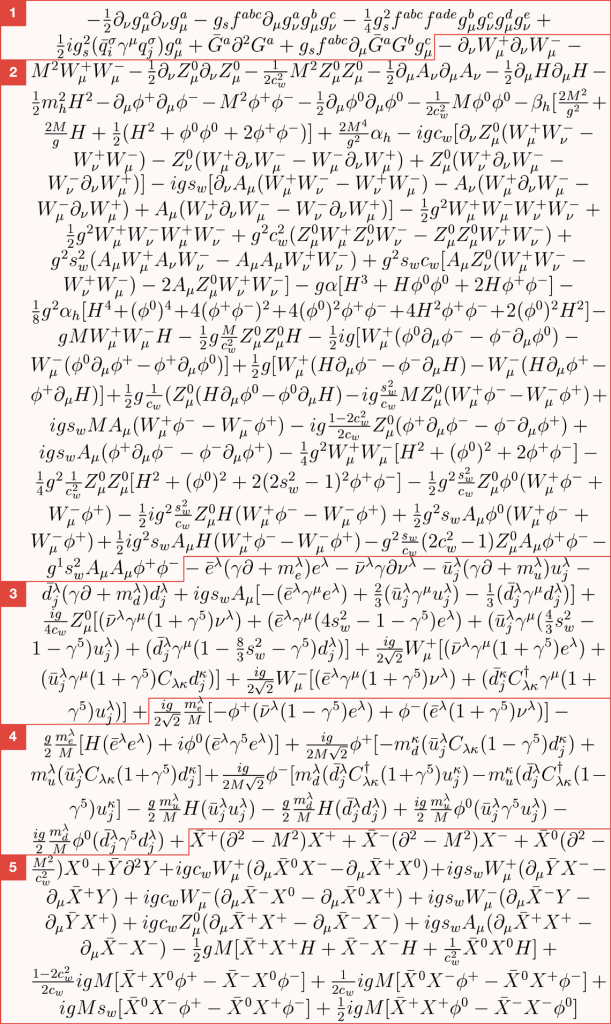
The standard mathematical model in particle physics looks like this (maybe sometime in future I will be able to appreciate and explain it to its core):

Context is everything

Now you will be able to appreciate why Ockham’s razor is a tool and not the final truth. People exploit Ockham’s Razor to demonstrate their philosophical grandeur and simplify the meaning to their favors consciously (sometimes unconsciously).

What people ignore is the purpose of the chopping unnecessary parts in any process to develop understanding, philosophy or theory. The goal was never to simplify things, the goal was to remove things which would interfere in the process of testing our hypotheses.

People most of the times miss the point of parsimony which is to make a realistic attempt to check how and why our understanding of things which we have and the real nature of things differ, how can we fill the gap between what we theorize, what we can test and what real there exists.

Context thus plays very important role in every pursuit of knowledge, even in the knowledge of the self. It is important to understand the boundary conditions of our knowledge. One should know where their beliefs (even if they are true) can be limited, can be challenged, can be difficult to prove because what we know is just a drop, what we cannot know is ocean.    

I think what people miss in simplification or parsimony is the context and context varies from situation to situation.

Scientifically, Newton’s laws of gravitation have no problem when we are talking about our solar system. In fact, they are so accurate that modern space missions still rely on these laws. There rarely is any need to use the science of black holes in most of such missions.

The context is the precision of deciding the trajectory of objects in solar system.

But, when it comes to Global Positioning System (GPS), the theory of relativity becomes important. The bending of space time due to earth’s mass and the slowing down of time for navigation satellites from it and the time adjustments for atomic clocks at these two points matters a lot. Newton’s laws cannot explain that.  

The context is how precise can the time be measured and how the difference in time can be connected to the understanding of the position of the object around the globe.

It is very easy to demonstrate how Ockham’s razor still remains important in scientific community and how scientists are aware of its limitations.

It becomes problematic when we try to understand and justify life with it.

The problem is that we get to decide the context (most of the times)

Call it a blessing because scientific community is always in the state of its own renewal because it relies on objective evidences, but it is still not immune to missing context or wishful context. (The falsified biased scientific studies published to create confusions are best example of that.)

The best example of losing context while still being scientific or unbiased is the Debates on News channels or any debate (sadly) that exists on popularity. Soon you will realize that the context of most of such debates is to entertain people, create controversies and not find the ultimate truth or facts.

In the very opening of this discussion, I had explained how our brains try to optimize processing to save energy for better tasks to guarantee better survival. The death of our own beliefs, our identity is also failure to survive. Psychological, ideological death is as equal as the actual death, maybe it is more painful than real death for almost all of us. Religion is one stream of such ideologies where people are ready to die physically just because the religious beliefs, they live for should remain alive. Most of the people are scared of mathematics not because it is too complicated, they fear math because it shows them the vulnerabilities in their process of step-wise thinking, same people can be expert dancers, master artists, master instrument players which involve rather more complicated mathematical manipulations – music in a simple way is manipulation of certain sound wave-forms. The music theory, harmony, color theory, physiological manipulation of body with the rhythm, and sound are all purely mathematical concepts. It’s just that we don’t want ourselves to remain in the states of vulnerabilities for longer times. It’s equivalent of exposing cover to our enemy thereby reducing our chances of survival.

The thing is that the tendency of nature to choose the path of least resistance gets reflected in our own nature too. Which is why simplification and Ockham’s Razor seems attractive. But at the same time, we forget that it is the same nature whose deliberate and continuous actions against the adversities made us who we are, made impossible things possible for us.

Daniel Kahneman has explained the two cognitive systems our brain uses in his book Thinking Fast and Slow.

System 1 is fast and intuitive good for repetitive tasks but bad at finding biases, errors, hostile to new and complicated scenarios.

System 2 is slow and deliberate for analytical and reasoning-based tasks but is not effective for routine tasks.

The people who exploit Ockham’s Razor (even William of Ockham himself! –  this story will show up in post on nominalism!) are oversimplifying things because the belief they have is justified through it. It will stand some limited tests but the moment it is exposed to universal tests they fail. And that is how religions, sects, faiths operate when they are blinding people from the real truths. I am not saying religion is bad, I am saying how objectivity in religion can be used to show its scientific nature and still fool the people. Same can happen in scientific communities, all of the pseudo-scientific concepts are one great examples of that.

Now you can see the problem. People want to create understanding of the surrounding not because they really want to understand it. They want to do it because it will feed the beliefs they already have and Ockham’s Razor or the principle of Parsimony is a great tool to facilitate that. In the end, it is just a tool. How it impacts the creation is solely based on the intent of the one who is using it.

That is exactly why when you are questioning something or are standing against something or supporting something ask yourself this one question:

Are you doing this for understanding the reality or to feed your own wishful picture of reality?

So, whenever you are trying to understand something make sure that your context is to really understand the thing and not expect it to be in certain thing you wish. Remember, you are the controller of the context and it is very easy to fool ourselves.

Further reading:
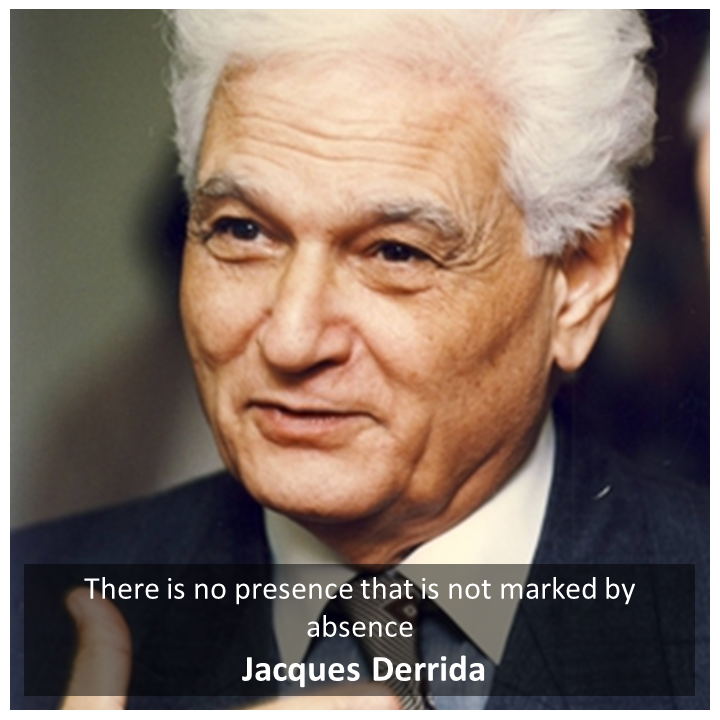
The Essence of Nominalism

Minding The Gap Between Ego & Reality

We are so tied to our minds, our self, our ego that we can only see what our mind is conditioned to see; and the expanse of mind is so vast, that we consider the inability to gauge its limit to its infinite-ness. But, in self-observation we will see that reality is far bigger than our mind. Mind cannot be bigger than reality although it can create a perfect illusion of it being bigger than reality. When we realise how reactive our mind is, how conditioned our mind is we see that it’s the reality in which we are existing and not the mind. Mind is just a facilitator to create a sense of security. The real creativity thus begins when one lets go of their minds, thoughts and observe reality for what it is.
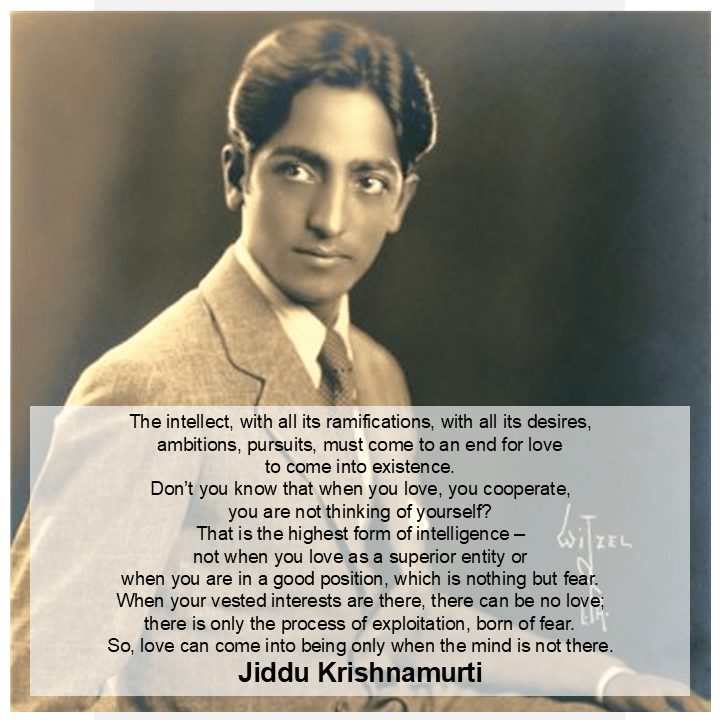
The real intelligence is to be able to see how you are fooling yourselves and how it is twisting your world view. This is possible only when we let go of the self. Love is the fastest and the most direct way to let go of self. Love is the way to get rid of the ego. Loving something, loving someone is the first step towards rejecting the very ego which is responsible for self-deception.
Jiddu Krishnamurti thus encouraged everyone to let go of their egos through self-less love; this itself is enough to solve all the existential conflicts inside us and out there in the world.

Part 3 – Jiddu Krishnamurti’s legacy of self-knowledge

What do you do when you realize fundamentally or deeply that thought cannot end itself? What happens? Watch yourself. When you are fully aware if ‘this fact’, what happens?

(‘this fact’ here refers to an observation that ‘discipline’ doesn’t destroy the self, rather it strengthens it because ‘the self’ created that discipline in the first place)

You understand that any reaction is conditioned and that, through conditioning, there can be no freedom either at the beginning or at the end – and freedom is always at the beginning and not at the end.”

– J Krishnamurti, The function of the Mind

We, the humans are driven by curiosity. The curiosity to survive – to put in few words. One might say that people are driven by fear, greed, envy, anxiety, power, love, money, fame, glory, sacrifice, humility, honesty, trust, legacy, mania, chaos, terror, and what not. The list is never ending. If you start questioning the origin all such attributes, you will see that humans can be driven by anything, I mean any anything. There is no connecting link per say; the only common thing between all the things which drive people is the people themselves. So, in the last question (possibly the last one) we end up questioning ourselves. We see that along with physical survival we are highly conscious of our non-physical survival. Some may call it the mental survival, some may call it ideological survival, some may even call it spiritual survival. In the end, what we are trying to preserve is the eternal existence of our consciousness. How to preserve this? becomes the question then. That is why in final question we see that we are curious to preserve our own being. That is the ultimate survival. Whatever can facilitate that preservation is the driving force for our existence. If you are scared of something, the fear of that thing will create a curiosity to look out for the ways in which you can avoid it.

Now you will realise that the attributes which are many and driving people in different ways are highly related to the ways people think about themselves and about their surroundings. The identities, the consciousness which we are trying to preserve forever is highly the function of the society we grew up in, the religion we followed, the ideals we admired, the enemies we despised, the culture we cultivated and carried over to the newer generations.

I might be making an overstatement here-

Only those who have undergone unlearning, un-conditioning or at least appreciated the process of unlearning can clearly see how badly we are tied to our thoughts and ultimately our minds.

Death of thinking is death of mind. When they say that ideas live forever – it is also an attempt to ensure eternal survival of a certain type of mind, for mind is not a physical entity to us. Realizing the perishable nature of our body, the mind becomes the most potent entity to ensure the survival of our being.

Then, what’s wrong in ensuring the eternal survival our consciousness?

We will see how Jiddu Krishnamurti showed the reality of our existence. As I have already said, he is the perfect person at perfect time to ask the perfect question.

Short answer is – we are so tied to our minds that we can only see what our mind is conditioned to see; and the expanse of mind is so vast, that we consider the inability to gauge its limit to its infinite-ness. But, in self-observation we will see that reality is far bigger than our mind. Mind cannot be bigger than reality although it can create a perfect illusion of it being bigger than reality. When we realise how reactive our mind is, how conditioned our mind is we see that it’s the reality in which we are existing and not the mind. Mind is just a facilitator to create a sense of security. The real creativity thus begins when one lets go of their minds, thoughts and observe reality for what it is.     

In Part 1, I have explained J Krishnamurti’s views on our urge for safety thereby happiness, how we use our thoughts to conveniently justify anything and everything to create that sense of safety, the ways in which our thoughts are stealing the actual reality holding multitudes of possibilities.

In Part 2, I have explained how thoughts originate, how curiosity drives them. It contains Krishnamurti’s observations on how we try to separate thinking to glorify ‘our version’ of wishful reality. Krishnamurti shows us that the moment we reject the separation of our thoughts from ourselves, that is the moment we see that we were just reactive to everything around us. We become observer of the reality for what it is, once we let go the glorification of ‘our thoughts’ – the self.

Now, we will question the very originator of the self – our Mind. Krishnamurti’s observations were revolutionary about the mind. This Part 3 will focus on that and also tie up the previous 2 parts together with it.

Existence Of The Mind – What Is The Mind?

“When you observe your own thinking, you will see it is an isolated, fragmentary process. You are thinking according to your reactions, the reactions of your memory, of your experiences, of your knowledge, of your belief.”

J Krishnamurti, The function of the Mind

When we are truly in the territory of observation without any preconception, prejudice, we see what thoughts actually do. Thoughts just try to hook on to something that we are familiar with – it could be good or bad. Thoughts literally create a chain. One link creates sense – logic – connection to another, one train of thought after another. Then we create the whole understanding. Thinking is always reactive. Keep this in mind – thinking is always reactive. If you let thoughts build on themselves, it is amazing to observe what world we create just by our thoughts. The moment you inject certain intent, desire to this world, it immediately deviates from the reality. But, as this world of thoughts has your intent, your desire, it creates that world of safety; we don’t want to lose that familiarity, that comfort. Now as this world contains our desires it becomes our second identity. As the thoughts keep building on, you start associating these set of your thoughts as who you are. This is your non-physical identity now. You now strive to make sure that this non-physical identity lives till eternity.

After seeing this you will see that the mind is the custodian of thoughts, desires, wishes. A wish to be safe to prolong survival, desire to make that prolonged existence happier one, thoughts to support those wishes – desires. Mind is thus picking desirable ideologies, disciplines which will keep feeding the train of thoughts, the chain of thoughts. Thoughts want to ensure their own survival because we have assumed survival of our thoughts as our survival. (Keep in mind we haven’t even started the discussion about reality.)

So, mind is a sieve which keeps on separating the desirable and undesirable parts of reality. There is nothing wrong in that. What happens here which is problematic is our tendency to lean towards the desirable reality only. When mind would see desirable reality, it will start using the power of compounding of thoughts to create a wishful reality which we call as our identity – our self. We want to preserve self to ensure that things that we desire survive. Whatever is not the self, it is the others – the undesirable. The moment mind makes this separation – ego intensifies.

“Our whole tendency is to be separated. Can the mind do anything else but that? Is it possible for the mind not to think separately in a self-enclosed manner, fragmentarily? That is impossible. So, we worship the mind; the mind is extraordinarily important.”   

J Krishnamurti, The function of the Mind

Without separation, our mind fails to recognize itself. If it is not able to separate itself from rest of the things, it cannot feed the desires. If desires are not fed, we will be constantly looking cluelessly for a sense of belonging, a place of security.

Here, I see one tragedy of being human rather an animal. I will explain it:

See there is a possibility that we are free from all the desires. One can be free from all the desires of the world. So, it is a real possibility that man is free from the cage of thoughts, mind and desires and fully observant of the reality around him without any imposition or prejudice right from the birth.

What is the tragedy of every animal is that they are born with the tendency to live (otherwise how would they get in the world in first place, maybe the baby doesn’t even know what is required to survive, so possibly the sense of survival naturally gets transferred from parents to the baby). Have you seen a baby who wants to die the moment he is born? Rather the baby starts crying the moment it senses absence of parental presence or absence of security. By birth we have a survival urge. Evolution has pushed this urge in us from physical to non-physical one. As we have better chances to ensure physical survival we now care more about the survival of our non-physical version. Mind thus becomes very important, thereby consciousness becomes important. That is why if physical survival is not guaranteed, we wish that at least our consciousness lives forever. That is exactly why we praise the minds we have.

Over the time, our desires take over this mind and we then keep on conditioning it with culture, religion, society, community in a certain way. The familiarity of physical body gets further amplified in familiarity of certain way of thinking, certain religion, certain philosophy, certain profession, certain degree, certain community, certain country. The more we find ideas, thoughts familiar to ours the more we want to cling to them. The more we want to reinforce that version of self. We are always separating what reality shows in terms of whether it is favorable to us or not. That is why even if mind and consciousness seem infinite, you will observe that our thoughts have compounded in such an extreme way that we are unable to measure their limits. We have attributed this inability of those compounded thoughts to the infinite-ness of our mind.

If our mind truly is infinite then we should be able to predict the reality or at least handle the undesirability that reality may present in better ways. We all know how disappointed we are with the reality. This shows how strongly we have conditioned our minds towards certain way – that certain way we call our identity, our self, our ego.

“Until we understand how to transcend this separative thinking, this process of giving emphasis to the ‘me’ and the ‘mine’, whether in the collective form or in individual form, we shall not have peace; we shall have constant conflict and wars. Our problem is how to bring an end to the separative process of thought. Can the thought ever destroy the self, thought being the process of verbalization and of reaction? Thought is nothing else but reaction; thought is not creative.”

-J Krishnamurti, The function of the Mind

Now you will appreciate what un-learning can do to our life. It opens a completely different and real world in front of us. Un-learning is the rejection of what we assumed to be true to support our identity. Although it feels uncomfortable, sometimes completely hostile but there is no bigger freedom than the acceptance and implementation of unlearning. It is renewal, evolution of our very being.

The key point is to understand that we are not our mind, we can be bigger than our mind. That needs the rejection of the idea of self. Once we are observant of how dangerously conditioned, prejudices, favored our minds are we will see how we through the agency of our mind are twisting the reality to create the sense of security. The more we twist it, more deviated we are from reality.

And as I already explained that somehow this sense of separation and thereby self-preservation is in our genes by birth, we have to train ourselves to get rid of that sense. Keep in mind that this does not mean self-jeopardization. This plainly means that not imposing our ways on reality to create the sense of security thereby higher chances of preservation of self. That is why unlearning is extremely important.

Reactive Mind Vs Objective Reality

“Do not superimpose what it should do, how it should think or act and so on: that would amount to making mere statements.”

-J Krishnamurti, The function of the Mind

Once you think that you have full control of your mind, the mind will use this sense of its separation from you to build chains of thoughts to support itself. In the end, it all started from you. The moment you see that you and your mind are the same, you accept its conditioning. Now you have a baseline to see the reality. Now you know how your mind is bending the reality. This is the freedom, to see things as they are. 

Now that we are understanding that sense of safety was the goal of everything that we are doing all along, we see that our conditioning thereby our thinking and thus our mind in the end are the reason behind all the suffering we go through. Once we see that our mind was the main culprit, we realise that it will be difficult rather impossible to punish my mind, discipline my mind because the more I try to control my mind – more I try to discipline it, the more it reacts, the more it creates thoughts and evades away from the reality. It tries to preserve its identity.

Only when you observe that you are your mind conditioned in certain way to preserve the non-physical existence then you understand the reality you live in. You still have those conditioned thoughts but now you neither want to promote them or suppress them. You are now an observer of the reality. This is an interesting observation.  

“When I want to understand, look at something. I don’t’ have to think about it – I look at it. The moment I begin to think, to have ideas, opinions about it, I am already in a state of distraction, looking away from the thing which I must understand.”

J Krishnamurti, Can thinking solve our problems?

There is one important confusion we must address here:

If I am rejecting the thoughts that I have, the mind that I have, the consciousness that I have – what remains of me? Wouldn’t I end up in an existential crisis? Won’t that shatter my compass? If I am not associated with certain things, how would I make sense of my actions? If I am not able to make sense of my actions or at least the things happening around me, how would I prepare myself to survive in this world? This will completely jeopardize my existence.

The answer is pretty simple if you have read till this sentence:

Rejection of mind as a separate entity is the answer. Unlearning the process of isolation to understand the reality is the answer. Wishful observation is the key problem in the ways we are trying to live the life. Thinking is the second name for wishful observation. You are expecting reality to become something in your ways so you attach certain justification to extract that desirable meaning from the reality you are observing. You are doing this to generate sense of safety, which further ensures eternal survival.

So, it’s not about rejecting mind or the thoughts. It’s observing how our mind, thoughts are already conditioned before we are trying to understand the reality. It’s like we are seeing the reality with certain tint of prejudices and expectations. We have to let go of that filter. We are so attached to this filter because world looks the way we want in this filter, that this tinted illusion has become our reality. The moment someone shatters that filter we end in existential crisis.

You must appreciate that it’s not about hating the prejudices, conditioning or sacrificing yourselves completely to a selfless act. It’s being aware that you have those prejudices when you are observing reality. This self-awareness is what Krishnamurti focused on.

The moment you will try to reject certain thing and accept the another i.e., your mind – you will create certain framework of justifications and you will deceive yourself.

The idea is to know how you are fooling yourselves which is preventing you from understanding the reality.

Delulu is not the solulu. Rather delulu is the best way to reject the very life you are living.

“To have blank mind is to be in a state of stupor, idiocy or what you will, and your instinctive reaction is to reject it. But surely a mind that is very quiet, a mind that is not distracted by its own thought, a mind that is open, can look a t the problem very directly and very simply. And it is this capacity to look without any distraction at our problems that Is the only solution. For that there must be a quiet, tranquil mind.”

J Krishnamurti, Can thinking solve our problems?

Love – Cure To Self-Deception And Surrender To Reality

You know that moment in any pop culture media where the final answer is love? Let me spoil everything for you. The answer to everything is love.

(Be cautious while reading next part, it’s not just that type of love and I am definitely not conditioned to prefer love as the answer. Even for a skeptic, love being the final answer has worthy support. It also guarantees that we can understand the reality for what it is.)

I always had this cringe feeling when everything grand in the narrative ended up with a justification of love. Even the great authors, logical authors, great scientists, great atheists never feel shame to express the power of love and it being the answer to everything. Trust me, I have made every attempt to find the evidences where love might not be the final answer to everything. But turns out that I would never find any evidence against love being the final answer.

The core reason is that we ourselves are the final problem. Let us see how Krishnamurti came to the conclusion of love being the ultimate answer:

“When you realize that any reaction is a form of conditioning and therefore gives continuity to the self in different ways, what actually takes place? You must be very clear in this matter. Belief, knowledge, discipline, experience, the whole process of achieving a result, or an end ambition, becoming something in this life or in future life – all these area process of isolation, a process which brings destruction, misery, wars from which there is no escape through collective action, however much you may be threatened with concentration camp and all the rest of it.”

J Krishnamurti, The Function of Mind

Now that you have come to the last part of the discussion, it is not a new understanding when I say that our sense of self is reinforced by the desire to support certain way of our conditioning. This steals from us the ability to perceive reality in the way it presents itself. We are always seeing the reality with certain conditioning and trying to change it so that it favors our ways. But as we have illusioned, conditioned understanding of reality, the reality rarely presents itself in the ways we desire it to be. Then we end up in sadness and sorrow and start questioning the futility of our existence. That is why ‘what is the purpose of my existence?’ is the common format of the existential questions for all of us.

What Krishnamurti tried to focus on is different question –

Why am I not experiencing life the way it is?

What is preventing me to live the life the way it is, living the life to its fullest?

The answer is pretty simple now. It’s our conditioning which urges us to prefer certain ways and reject the others. This brings the happiness and sadness. In the efforts to maximize happiness and minimize sadness we have created a system of mind and thoughts to alleviate the pains of suffering – thoughts justify everything. We deceive ourselves with justifications.   

“So long as we deceive ourselves in any form, there can be no love. So long as the mind is capable of creating and imposing upon itself a delusion, it obviously separates itself from collective or integrated understanding.”

-J Krishnamurti, The function of the Mind

What does the love do in all this confusion?

Love is the direct way to let go of self. Love is the way to get rid off the ego. Loving something, loving someone is the first steps towards rejecting the very ego which is responsible for self-deception. Even if you are delusional, your actions influenced by those delusions towards the things you love, the people you love will yield unwanted outcomes; and if you truly love them, you will be compelled to let go of the delusion for the benefit of your loved ones.  Thus, being selfless through love in true sense ensures real freedom.

Conclusion – Why Is Love Answer To Everything?

“We see the ways of the intellect but we do not see the way of love. The way of love is not to be found through the intellect.”

-J Krishnamurti, The function of the Mind

We saw in Part 1 how and why we crave for safety, familiarity. It ensures our physical and non-physical survival with better odds and most importantly with better satisfaction.

We saw in Part 2 how we dissociate ourselves from our mind and thoughts to create a false sense of safety if the reality does not turn out the way we want. We may delude ourselves if the reality is hurting us. We use thoughts to justify unfairness the reality presents. Our religions, politics, our ideals, everything that we have created now has an innate purpose of creating a safety net. We want to remain in this net because we don’t want the happiness to end. We have intellectualized our minds in such a way that we have justification for every ridiculous illusion and tragedy is that we call it the limitlessness of the mind, infinite nature of the mind.

I am not erasing the idea that the mind is limitless. If our minds – we – ourselves are truly limitless then we should immediately be able to see beyond the seemingly adverse revelations of the reality. Which is the holy gist of all these detailed inquiries of the self.

Then what was the problem with the mind?

The very limitless nature of reality would enable us to become limitless. But is it our delusional clinging to certain way of life for safety which is stealing the real understanding and appreciation of limitless reality. We are clinging to highly complicated and highly compounded thoughts, the way of thinking just because it reinforces the ego.

The real intelligence is to be able to see how you are fooling yourselves and how it is twisting your world view.   

After going through what Krishnamurti made us observe, you will realise that whatever must be said has been said already. We have just accepted our delusions because we are fully clung to the way have been living our lives, the way we have been conditioned.

When you are loving someone, there is very slim chance that they will be exactly the way you want them to be. There is plausible reason to say this because the infinite possibilities of reality mold people in different ways. There may be many things in common but the more you know the sooner you will realise that people are filled with different types of conditioning. This will first push you to reject their point of view naturally, then you will try to impose your way on them, your ideologies on them, your conditioning on them. In the final analysis, you will see your ways of worldview failing on them. This is the moment when you will reject your own world view, thereby your ego. Now you will neither reject or accept other people’s worldviews nor will you cling to your ego. Now for the sake of love, you will objectively observe the reality for what it is.

This is how love compels you to let go of your ego. That is why love is the answer to everything because you are the last question of all the investigations of the existence. You will let go of the concept of the self once you start to appreciate things other than you and accept the reality the way it is. What a beautiful way to live!    

“Only when you discard completely, through understanding, the whole structure of the self, can that which is eternal, timeless, immeasurable, come into being. You cannot go to it; it comes to you.”   

-J Krishnamurti, The function of the Mind

References and further reading:
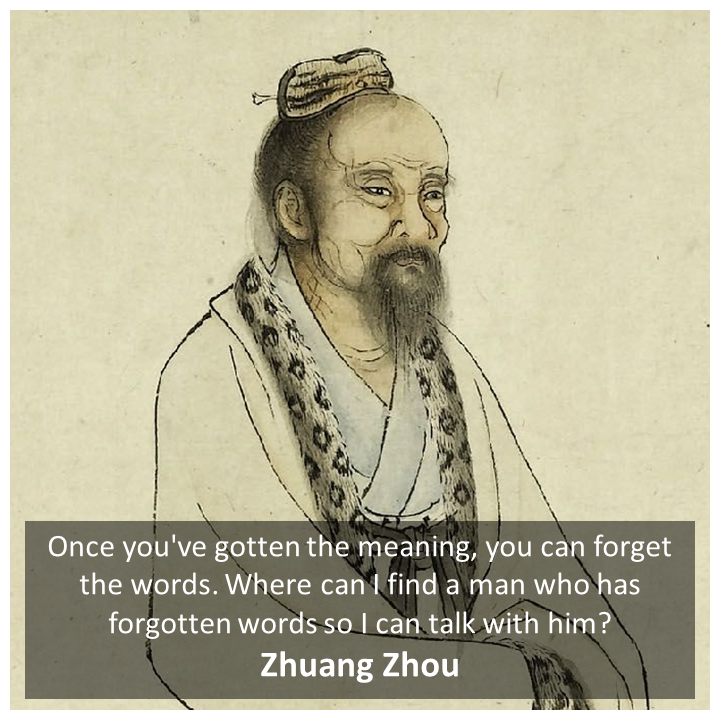
  1. Truth is a pathless land – J Krishnamurti
  2. The First and Last Freedom – J Krishnamurti
  3. Jiddu Krishnamurti’s Legacy Of Self-Knowledge : Part 1 – The Liberation From Thinking and Thoughts
  4. Jiddu Krishnamurti’s Legacy Of Self-Knowledge: Part 2 – Being Watchful Of The Ebb And Flow Of Life
  5. Featured Image of Phantom Galaxy M74 by James Web Space Telescope

Being Watchful Of The Ebb And Flow Of Life

In the constant pursuit of eternal happiness what man forgets is that nothing is everlasting, the sadness exactly like the happiness too shall pass. But, the urge to remain eternally happy and safe, steals the man from actual sense of reality. The illusions of thoughts filled with prejudices, conditioning and the escape from the reality by justifying the same thoughts becomes the endless cycle for such man. The moment man rejects the separation between him and his thoughts and sees that he himself is the originator of every thought is when he starts observing reality for what it truly is. Now there is no urge to seek happiness or the aversion to sadness. The man who is able to observe the reality for what it is and denies the wishfulness has understood what it really means to become free from ‘ego’ – ‘the self’. This is how the man becomes free and fearless.
It is really underrated how much we overvalue our thinking, thoughts, ideologies – for they always create an escape when reality is not how we want it. The man who is able to see through this can appreciate how life is always a continuous flow and not a starting point or destination.
Krishnamurti thus taught about the ability to observe the reality for what it is and without any preconditioning, thinking or prejudices.

Part 2- Jiddu Krishnamurti’s Legacy Of Self-Knowledge

Because I am free, unconditioned, whole – not the part, not the relative, but the whole Truth that is eternal – I desire those, who seek to understand me to be free; not to follow me, not to make out of me a cage which will become a religion, a sect. Rather should they be free from all fears – from the fear of religion, from fear of salvation from the fear of spirituality, from the fear of love, from the fear of death, the fear of life itself.

– J Krishnamurti, Truth Is A Pathless Land

Jiddu Krishnamurti – one of the greatest philosophers, one of the greatest humans paved a pathway to the modern worldview of the real truth, the real freedom, the real meaning of life, real love and the real life itself. His life story talks for his legacy.

Krishnamurti for me is the perfect person at perfect time to ask the perfect question.

I will focus on how Krishnamurti’s teachings – how his ways to dissect our curiosity paves way to understand what it means to be a conscious human being. The further writing is an attempt to address what is thinking and why we think and if not thinking then what makes us real human beings.

In Part 1 on Krishnamurti’s teachings, we touched on following important aspects of what it means to be a human and how distracted we are from our human side:

Krishnamurti most importantly taught how we are trying to bring peace to our lives by associating it with some meaning or purpose. Those who have fair understanding of the gap between what is thought and what is real, they can understand that the world in which we live – the reality in which we exist is constantly changing. Whereas we as human animals are always in the search of stability, that is how we will be able to optimize our energy and efforts to maximize the chances of survival. We crave for longer and peaceful existence in the continuously changing world.

The very continuously changing nature of the reality goes against our wish to live a peaceful, safe and predictable thereby fully controllable, maneuverable life. This resistance between wish and reality splits our thinking, our thoughts from ourselves. This split of ‘we’ – ourselves and our thoughts is the root of all the existential confusion and false sense of happiness – the gratification.

First, we realize that reality will not bend to our wishes, then we give up on real happiness and create our own world of thoughts filled with our facts, our knowledge, personal point of views, prejudices to create certain worldview. This worldview then keeps on feeding itself to grant us gratification. But there comes a point when we see – confront the reality we were masking and running away from, it brings more pain than ever before. It is painful because we distracted ourselves from it, because it never guaranteed eternal happiness – our thoughts granted that eternal happiness while wearing the coat of wishful thinking – gratification. We have separated ourselves from our thoughts in such way that whenever something bad, wrong, unpleasant happens, the blame can be immediately thrown on these thoughts. Thought which we have assumed to be the result of our upbringing, our culture, the unfairness happened to us. We use our thoughts as a separate entity just because we can conveniently find an escape from reality to create a newer one. it has become a tool to find a justification for everything that is unfair to us.

Once we accept how effectively we are deceiving ourselves we come to know that we ourselves are the thoughts, then responsibility follows. We see however painful it may be, this too shall never be constant. We reject the convenience of self-deception, accept who we are and observe the reality for what it is and not how we want it to be.

The moment we become responsible for our thoughts is when we start to see the reality, we start to see the world for what it is, without prejudices. All deceptions are stripped off. We also realise that thinking was mere swaying between acceptance and rejection of two ends – happiness or sadness. We see how much we were bounded due to this swaying – due to this isolation.

The moment we let go the urge to become happy, we let go urge for gratification, then we let go the wishful thinking, then the self-deception dissolves. Once self-deception dissolves, we start to accept our thoughts are our own, then we start to improve ourselves just for the sake of the real truth not for happiness. The life is unshackled from two possibilities of happy or sad into the infinitely many possibilities the reality can offer.

Touching to these ideas we saw in Part 1, how we assign the purpose of our lives just for the sake of gratification, how we separate thinker and thought to reject responsibility, then how the self-deception keeps this cycle going.

Now moving on to the other teachings by J Krishnamurti, I felt a need to understand the quest for happiness. I mean there is nothing wrong in people wishing to feel happy, safe in their lives. 

Then I realized what the real problem is; it’s not the wish to become happy, it is the acceptance of certain illusions to become happy. I will throw light on how that happens unknowingly and then we will again come back to Krishnamurti’s ideas on those areas.

The Curious Animal

I think what separates humans from animals is the incessant curiosity for anything and everything that is there to experience; sometimes we are curious about non-existent things too. The extent of curiosity might be different in everyone but it is safe to say that we are way more curious than animals. This curiosity always needs the food of thoughts and reality checks to arrive at a conclusion – that is how we are always reinforcing our consciousness. I think one cannot maintain their conscience or consciousness (call it what you want) if you cannot maintain at least small amount of curiosity in life. Animals have natural routines for survival exactly like we do but I think we are more aware of our own being than the animals do. (might be an overstatement, but you get the point)

Curiosity is not just about some sophisticated questioning to certain sophisticated, complicated part of philosophy, it can be rather very simple. A person thinking about what should be done to get the next meal? – is also one type of curiosity – let us call it the curiosity of ways to get the next meal. This curiosity to get next meal is common for both human and rest of the animals but over the time we have found totally innovative ways, the ways in which animals have not found how to address the same curiosity. So much that now we don’t even consider the curiosity of getting the next meal as a curious problem. Being human thus means that our curiosities also keep on evolving faster than the animals. What was peak curiosity for a primitive man is now a low-level curiosity, we now have much high level and more complicated – sophisticated curiosities.  

Starting right from birth till death we carry many curiosities – some of them get answered some remain mysterious, unanswered. The key attribute which remains common in all of us is how satisfied are we when it comes to our curiosities, our personal curiosities? The more curiosities you have found answers to, the more satisfied you will feel. You will have sense of fulfilment; your wishes, ambitions, wants all are connected to your own curiosities. Take one simple example – why do you want that specific job? For some people their curiosity was why some people are happier than others? They see that doing this job gives more money, for some people they see that doing this job will give them happiness, for others this job will wipe away their sorrows. In every possible sense, you can link the curiosity to the very reason of our being.     

The Conscious Thinker

If you look closely to the curiosity, you will immediately accept that thoughts are the most important aspect of who we are. We keep on thinking to address our curiosities until they are addressed satisfactorily. That is exactly why thinking is crucial for humans; it shapes our character, our lives and then the lives of everyone around. Now that I have brought in the point of “thinking” you will feel that thoughts play bigger role than curiosity in our lives. And it is right to feel so. But I have reason to weigh curiosity heavier than thoughts or thinking. You will see that smartness can be found in good spirited people and evil people too. When we can develop technologies to save lives, we have developed technologies to bring about mass destruction too. Looking at the current situations the later look more sophisticated. So, if the good person has better curiosities, he will have his curiosities answered in better ways than the lower curiosities of the evil person. See, both sides can have same curiosities as the purpose of their lives but the ways in which their individual thoughts answer that common curiosity gives us either godly men or evil men. So, curiosity supersedes thinking. How you will address that curiosity is how you will be. That is exactly why thoughts are so important. How consciously you think is how you will have your curiosity answered.

Thinking Is Useless

(Just now that we said that thoughts are important.)

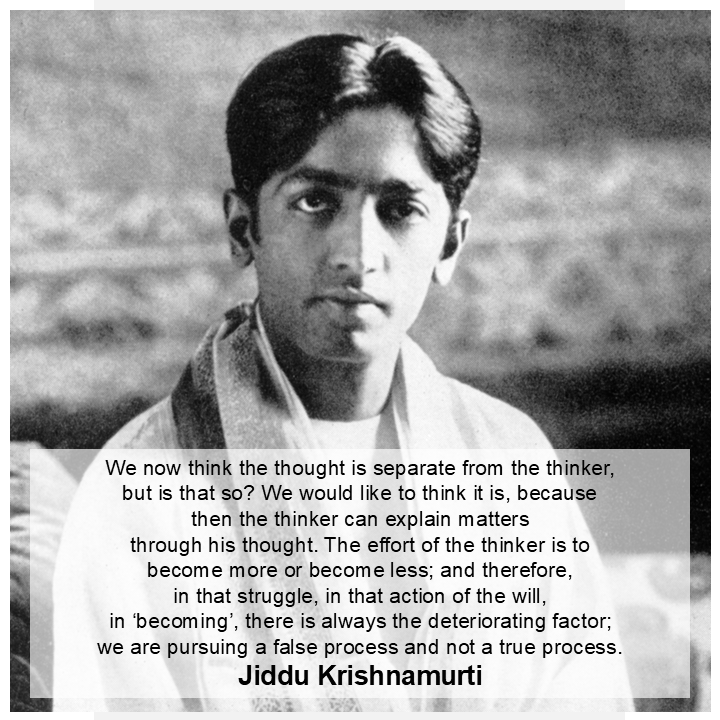
The self is a problem that thought cannot solve.

– J Krishnamurti, Can thinking solve our problems?

When you will appreciate different ways of thinking; the process to create thoughts to answer same type of curiosity and the ways that can create totally different human beings you will see that curiosity is mostly the innocent aspect of who we are but the thoughts take shape, color, aspect of who we are, what our experiences are, how we are treated by the people around us, how we treat others. It is not an understatement when I say that thoughts rarely create the true understanding of the reality. And the farther our thoughts are from the reality the more we experience failure and unfulfillment of expectations, sadder we are. Thoughts can create an excellent sense of reality but if not built properly can make people despise the very reality they live in. The closer you are to reality realer will be your curiosities, the realer will be your thoughts and faster will be your satisfaction to the curiosities. Otherwise, we will keep on playing the games of thinking in certain ways and would never be able to satisfactorily answer the greater curiosities of our lives. Every illusion will create next illusion.

Krishnamurti advises to let go of this game of thinking where every illusion reaps newer and more potent illusion, dragging us away from reality.

Thought has not solved our problems and I don’t think it ever will. We have relied on the intellect to show us the way out of our complexity. The more cunning, the more hideous, the more subtle the intellect is, the greater the variety of systems, of theories, of ideas. And ideas do not solve any of our human problems; they never have and they never will.

– J Krishnamurti, Can thinking solve our problems?

The main intent is to understand how self-protecting our thoughts and thinking are. You must appreciate this. The essence is to understand the fact that if thinking would have really solved our problems, we would have immediately stopped the process of thinking. We would have stopped it because it gave us the final solution to the real problem.

You may in thinking out certain facets of the problem, see more clearly another person’s point of view, but thought cannot see the completeness and fullness of the problem – it can only see partially and a partial answer is not a complete answer, therefore it is not a solution

-J Krishnamurti, Can thinking solve our problems?

Thinking can create false sense of solution but to certain extent, the reality holds more possibilities than that.

We would see that the more we think about something even fundamental the more complicated it becomes. Thinking may help us to understand perspectives but it never serves us the truth of reality as a whole rather it always gives certain dimensional information. Now this certain dimensional information can be easily poisoned with prejudices and not the facts. Thinking actually steals us from the multiple possibilities of the reality. As the problems from thinking multiply themselves, we are now entangled in the problems which are not even there in reality. We are just multiplying thoughts and problems because we know they give instant happiness for reality doesn’t guarantee eternal happiness. We are running away from truth by treating thoughts in superior ways.

Does that mean that thinking steals away the creativity? It seems counterintuitive! Thinking is the reason why we are creative. So, what exactly is going wrong?

The thing that is going wrong is our habit of separating things and comparing them with our previous knowledge; it’s our habit of grouping things in our old understandings. We try to understand newer things with our older understandings. We keep on filling our knowledge bank. We rarely unlearn anything with completely new perspective.

We fail to unlearn, because of our urge to happen things in certain ways. If you want the reality to happen in certain way, you will always be blinded to the reality which could have had better possibilities, better and beyond the limits of your thoughts.

This is why Krishnamurti focused on self-knowledge. Your pivot becomes you rather that the ways in which you want things to be. Once you understand who you are, you see how cunning your mind is, it always tries to create justifications to escape through a never-ending chain of illusive thoughts.

Once you accept who you are, you will see how the reactive thought got generated from you, that thought is you yourself. Now you see who you are. Once you see who you are, you don’t rely on thoughts to understand the reality. This is what builds the bridge between thinker and thought. This is where thinking is no longer required. You see reality for what it is. You become fearless, free from expectations and free from thoughts. Your actions now have intent instead of a wish.

Now, let us see how to maintain the awareness of self and be free from the illusion of never-ending chain of thoughts.

The Real Baseline – Non-Isolation

It seems to me that before we set out on a journey to find reality, to find God, before we can act, before we can have any relationship with another, which is society, it is essential that we begin to understand ourselves first.

… And it does not mean obviously, that self-knowledge is opposed to, or isolated from relationship. It does not mean, obviously, emphasis on the individual, the me, as opposed to the mass, as opposed to another.

-J Krishnamurti, What are we seeking?

Krishnamurti paved the way to break out of the vicious cycle of self-deception. When ending up in self-referential paradox the basic question one can ask is how the reference is getting created. We see that we do not actually have an eternal, unchanging baseline. The baseline keeps evolving as our beliefs, experiences keep on changing. To understand ourselves is thus one difficult task. It’s like aiming a moving target, a target which keeps on changing all of its attributes. We realize that what we were calling our baseline – our core was just our thought conditioned by our urge for safety, peace and happiness.

Many think that in order to understand self, one has to isolate themselves from others. The rejection of isolation itself is the purpose of understanding self. Rather the more isolated you will be from others more your thoughts and mind would dominate you. The real purpose of self-knowledge is understanding of ourselves as the whole not as the isolated one.

Self-knowledge thus means the rejection of selfishness and the sense of ego. Then the person starts to understand what it means to think about the events and what it means to see the event. Former is limited because we are wishing for it to happen in certain way, latter hold any possibilities because we are not expecting or imposing what should happen.

Because we are craving for certain anticipation, trying to have certain expectation – we try to isolate our experiences to only those expectation. We blind ourselves by isolation. We see that our experiences create a reaction in us which we try to connect with certain memories, feelings. Then they lead to acceptance or rejection based on the sad or happy feeling generated. Then if that feeling is happy, we crave for more of it; if that feeling is bad, we try to suppress it. And the cycle keeps on going. We get tangled in our own thoughts.

Until and unless I don’t accept that ‘I’ am the originator of my thought I can’t really find that which lies beyond that thought. My thought will create another thought based on my urge to find the sense of security. The thinker has to just observe the thought and not expect it to be desirable or undesirable. This is one difficult task. But it guarantees eternal truth.    

So long as effort is divided into the experiencer and the experience, there must be deterioration. Integration is only possible when the thinker is no longer the observer. That is, we know at present there are the thinker and the thought. The observer and the observed, the experiencer and the experienced; there are two different states. Our effort is to bridge the two.

– J Krishnamurti, Can thinking solve our problems?

Krishnamurti explained why our thoughts do so and why we refuse to let go of our thoughts (even though deep down we use our thoughts as a way to justify anything to our convenience, security and peace.) In the pursuit to bring “peace of mind”, the mind created two ends of every thought. The thinker who has already considered himself different from the thought now assumes one side of that thought and then measures his/her worth, goodness/badness by the extent of deterioration from that assumed baseline.

In reality, the very assumptions of either one of the ends of the thought prevents the person to have exposure to the real possibilities lying on the other end rather beyond the whole horizon.

The answer to come out of such bias is to observe that the originator of the thought is the thought itself. There are no two entities – thinker and thought are exactly same. This is where the observer and observed stare into each other’s eyes. Now the observer is not expecting the observed to become a certain way. Observer is now just observing that what it is. There is no need to move to next thought. Only thing that remains is to observe things for what they are. 

We now think the thought is separate from the thinker, but is that so? We would like to think it is, because then the thinker can explain matters through his thought. The effort of the thinker is to become more or become less; and therefore, in that struggle, in that action of the will, in ‘becoming’, there is always the deteriorating factor; we are pursuing a false process and not a true process.

-J Krishnamurti, The thinker and the thought

When one starts truly observing there is no need to select one side of a thought, so there is no urge to favor one outcome, rather there is no wish to have certain expectation. As there is no wish to a certain way the mind does not work towards cultivation of one side and deterioration of the another one. Now mind just sees that which is there.

I divide myself into the high and the low in order to continue.

-J Krishnamurti, The thinker and the thought

Earlier there were only two possibilities – either cultivation of that which is desired and suppression/ deterioration of that which was undesirable. But now that when thinker and thought are bridged there are no side, no prejudices, no expectations. This opens totally new possibilities, and these possibilities are as real as the reality we are observing, the reality we are trying to understand.

You will realize how limited we were by our thoughts.

You will see how illusive the thinking loop seems, even though you “thought” your imagination was infinite. Your imagination now feels limited because of your prejudices, biases, memories, culture, knowledge.

Our imagination is way more limited than we think. That is exactly why observing without any prejudice becomes more important. We just refuse to do it because we don’t want to get overwhelmed by the infinite seemingly life-threatening possibilities. We are fearful. We think we are not ready.

 Be Watchful Of The Isolation – The division

If I am aware that I am greedy, what happens? I make an effort not to be greedy, either for sociological reasons or for religious reasons; that effort will always be in a small limited circle; I may extend the circle but it is always limited. Therefore, the deteriorating factor is there. But when I look a little more deeply ad closely, I see that the maker of the effort is the cause of greed and he is greed itself; and I also see that there is no ‘me’ and greed, existing separately, but that there is only greed. If I realize that I am greedy, that there is not the observer who is greedy but I am myself greed, then our whole question is entirely different; our response to it is entirely different; then our effort is not destructive.

-J Krishnamurti, The thinker and the thought

This is revolutionary in many senses. As we are dependent on thoughts to understand reality. This dependence is filled with preconditioning right from the moment we are born. Therefore, we always try to mold our observation in the shapes of what we wish to become. If I wish to become a world known robber, I will see the act of stealing as a good one – a stepping stone in my “career”, if I wish to become a world known cop/detective I will see the act of stealing as a wrong one.

But if I have no wish to either become a robber or a cop, I now will have totally new concept of what stealing is. If I am observing a robbery right now with no prejudices, I am seeing the desperation, fear of getting caught in the eyes of the robber. I am seeing the mental stress that cop is going through to solve the case; if the cop is a smart one, I am seeing how he feels sorry for the robbers and how happy he feels that he can easily catch them.

Without prejudices you see that the reality morphs according to the wishes of its observers – the observers having certain expectations from it, certain prejudices.

It is that problem which is creative, in which there is no sense of ‘I’ dominating, becoming, positively or negatively. We must come to that state if we would be creative.

-J Krishnamurti, The thinker and the thought

You have to thus let go of the what is expected and observe what is happening without any preconditions. Then you will see that the negativity or positivity of the same reality became in that certain way because you had already picked either one of the sides. If you wanted to behave like a cop – a successful robbery is nightmare for you; if you wanted to behave life a thief same is the happiest moment of your life.

But if you just want to observe what is there in reality, you will see the desperation in the eyes of the robber and the ways cop chooses to hunt the thief down – even if it would steal his ideals.

You see people degrading themselves to have an illusion of the life they desire. You will feel like helping both of them. You will not feel of favoring either one of them.

This may seem like a person who has let go of life or like a sage, but trust me once you have this real worldview, you will see that you are more than yourself. You will see yourself extending to others, you will have this innate urge to reach out to others, to help them to come out of the illusion of happiness and sadness. You will help people in surprisingly different ways – not just right or wrong ways.  

What is important is to see that the maker of effort and the object towards which he is making effort are the same. That requires enormously great understanding, watchfulness, to see how the mind divides itself into the high and the low – the high being the security, the permanent entity – but still remaining a process of thought and therefore of time.

-J Krishnamurti, The thinker and the thought

Once you accept yourself in such way you no longer have craving for happiness and aversion towards sadness. You will see that this current happiness is short lived and so will be the sadness arriving after it. You will see that reality is just a tide of happiness and sadness, we are just swaying in between.

Rather you will start seeing that reality is not just a wave between sadness and happiness – it has other attributes for which words like happiness or sadness would fall short to describe them. You are existing between the superposition of many such waves. This is the real journey towards a creative and realest real life.

You will see that you are not affected by these waves. Not affected does not mean that you are insensitive or numb to these aspects of life, rather now you are more sensitive and open to infinite possibilities of life. You don’t get tangled in thoughts, you now act to pass through the life, instead of attempting to control it. You become fearless. You don’t start any journey to achieve freedom in the end. You become free in the first place before you start the journey to experience the life lying ahead. You truly become free in reality.

We will see in detail why Krishnamurti said that freedom is at the beginning in next part.

“Until we understand how to transcend this separative thinking, this process of giving emphasis to the ‘me’ and the ‘mine’, whether in the collective form or in individual form, we shall not have peace”

J Krishnamurti

References and further reading:
  1. Truth is a pathless land – J Krishnamurti
  2. The First and Last Freedom – J Krishnamurti
  3. Jiddu Krishnamurti’s Legacy Of Self-Knowledge : Part 1 – The Liberation From Thinking and Thoughts
  4. Jiddu Krishnamurti’s Legacy Of Self-Knowledge : Part 3 – Minding The Gap Between Ego & Reality

The Liberation From Thinking and Thoughts

Remembering J Krishnamurti on his birthday.
The major focus of J Krishnamurti’s teaching was the awareness of how thoughts are created from ourselves and our constant pursuit to make things happen in a certain way, most preferably in our own ways.
The tragedy of human life can be given in one simple sentence: Man, the thinking animal – has deceived himself so much in the pursuit of happiness that he has given up on the reality in which he was born just for the sake of false sense of short-lived peace. The silver lining of this tragedy is that we ourselves hold the key to our peace. Self-knowledge holds the key to the peace.
We can only understand and appreciate reality and come out of the self-deception once we let go of the separation between the thinker and thought. The rejection of the convenience of self-deceptions paves the way to the real freedom. J Krishnamurti’s teaching thus shows us the path to experience the life in our own truest ways.

Part 1 – Jiddu Krishnamurti’s Legacy Of Self-Knowledge

Jiddu Krishnamurti – one of the greatest philosophers, one of the greatest humans paved a pathway to the modern worldview of the real truth, the real freedom, the real meaning of life, real love and the real life itself. His life story talks for his ideology. Right from his childhood he was nurtured to be the chosen one – the spiritual guide for the world – “the World Teacher”. Certain influential people were already anticipating the coming of the world teacher who will show the way of life to people and bring light into their lives. This society was called the “Theosophical Society”. The Order of the Star in the East (OSE) was the theosophical society which was responsible to let the world know that the world teacher – Maitreya has arrived on earth to show the real path of our very being.

What has created a deep impact on me is the way Krishnamurti handled this matter. That is exactly why his place in my heart is immovable. When the time was right Krishnamurti dissolved the order (keep in mind he was the leader of the OSE). He was groomed to be the chosen one. He had every chance to utilize that for the benefit of the mankind. Krishnamurti dissolved the order and asked every member of the order to not follow him and create their own path to the truth. His talk “Truth is a pathless land” given on the occasion of dissolution of the order of the star in the east is a testimony on what greatness the humanity awaits at the end of their individual journey of their very being. It strengthens the belief that we were really made for something simple yet great.

“I do not want you to agree with me, I do not want you to follow me, I want you to understand what I am saying. This understanding is necessary because your belief has not transformed you but only complicated you, and because you are not willing to face things as they are.”

– J Krishnamurti, Truth Is A Pathless Land

This is me remembering Krishnamurti on his birthday. Krishnamurti for me it the perfect person at perfect time to ask the perfect question. My explanation for the train of concepts and ideas is really long (I apologize for that) so the discussion is split into few parts. Lucky that we had J Krishnamurti who simplified life for us but I think it’s an interesting exercise to connect the dots on how Krishnamurti can remain relevant for the eternity of humanity.

I will focus on how Krishnamurti’s teachings – how the ways to dissect our curiosity paves way to understand what it means to be a conscious human being. The further writing is an attempt to address what is thinking and why we think and if not thinking then what makes us real human beings. Trust me, thinking feels the most unnecessary part when you understand what Krishnamurti taught throughout his life.

Purpose of Life – The Safety And Peace In My Existence

“What is it that most of us are seeking? What is it that each one of us wants? Especially in this restless world, where everybody is trying to find some kind of peace, some kind of happiness, a refuge, surely it is important to find out, isn’t it? what it is that we are trying to discover?”

– J Krishnamurti, What are we seeking

Krishnamurti tried to answer the curiosity of all curiosities. When we are trying to address curiosities, we find our very own existence at the focal point of the discussion. Then we ask if I am here why am I here? What should I be doing now that I exist?

It is fairly simple yet fundamental question. Krishnamurti was the expert of creating a chain of questions and everyone seeking the reality could create a path of their own to the truth when they honestly started answering these questions. Instead of bringing horse to the water and forcing it to drink the water even if it is not thirsty Krishnamurti’s talks have this way that the horse first becomes aware what it means to be thirsty, then it sees that it is really thirsty, it sees what it is thirsty for and then Krishnamurti’s questions send that horse on its own path to the waters. In the end whether horse finds water or not that is the matter of what the reality is. Horse is fine with that.

Krishnamurti called out that we all want our suffering to end eventually and be happy. But he pointed out that the moment we sense that happiness – every type of happiness is not permanent then we seek for the gratification. Because happiness being a byproduct of process cannot be artificially created whereas gratification can be easily and artificially created. We can create gratification immediately by fooling ourselves. Trust me everyone is ready to fool themselves if it guarantees peace, comfort, safety and thereby gratification – a false sense of happiness.    

“I am afraid most of us are seeking gratification. We want to be gratified; we want to find a sense of fullness at the end of our search.”

-J Krishnamurti, What are we seeking

We create this gratification by isolating ourselves from certain parts of truth which are painful to accept. That is why we have this notion that our thoughts are what we are, if you are happy inside then everything around you will seem happy. So, our thoughts start creating their own reality. This is done by isolation and division. Deep down we know that the uncomfortable truth is the realest reality but we choose to ignore it for the gratification.

“Mere isolation in an enclosing idea is not a release from conflict.”

-J Krishnamurti, What are we seeking

The moment we start building new understandings based on the thoughts responsible for our current gratification we again find those sidelined uncomfortable truths to be the part of the bigger problem, bigger curiosity – now a bigger conflict.

Unless we are not embracing the reality however uncomfortable it may seem we will never find the real peace. It feels really counterintuitive and paradoxical. How can I be happy, peaceful when I recognize that uncomfortable thing? I mean this is the exact uncomfortable thing that steals my peace.

The answer is the inherent nature of our thoughts to divide, split, segregate things/values/attributes to understand the reality.

Thinker Is The Thought

“We do not know ourselves. We know a lot about facts, what the books have said; but we do not know for ourselves, we do not have a direct experience.”

-J Krishnamurti, What are we seeking

Krishnamurti always tried to put a special emphasis on how our own thinking is designed to fool ourselves – the thinker. As we have already appreciated that when the truth – the reality is painful we try to find peace not by the pursuit of truth but by grouping, focusing on thoughts, biases which create gratification and then happiness. We fool ourselves through our own structured thought process however deviating it might be from reality. We create such belief system and accept, follow only those thoughts which keep on feeding those belief systems.

There always comes a time in life when this belief system gets challenged by the very reality we ignored just for the peace of our mind.

So, it is clear that however painful it may seem the truth will always be there. If not eternal peace the next best thing we can have, is the eternal awareness of how that truth, that reality will create pain, how we would react to it (or don’t even react to it) and the way to pass through that pain. This is not possible when we are seeking gratification. In gratification, we just want our wishes to somehow align with our thinking, so we start bluffing ourselves through certain set of thoughts.

“Truth may be something entirely different; and I think it is utterly different from what you can see, conceive, formulate.”

-J Krishnamurti, What are we seeking

The real peace is knowing that peace is not eternal. Best we can do is to at least be aware what it is instead of what it should be. This is possible when we question the origin of thoughts.

And as I have said before, Krishnamurti was master of questioning the very question! Now he questions the questioner – the thinker. The one from whom thought gets created.

“When you say, ‘I am seeking happiness’, is the seeker different from the thought? Are they not a joint phenomenon, rather than separate processes? Therefore, it is essential, is it not? To understand the seeker, before you try to find out what it is he seeking.”

-J Krishnamurti, What are we seeking

You can say that whole purpose of Krishnamurti’s teaching, the purpose of his whole life was to make people understand themselves first, to make the thinkers aware of themselves. Then only it is possible to see how the thought gets created from thinker. One has to do this themselves, there is no external agency to understand this.

Krishnamurti understood the impact of truth being conveyed through direct experience. You can read many truths, hear many truths, believe many truths but the truth that you experience yourselves will have bigger impact on how you understand everything.

(That is also why empathy is very important. That could be topic for another day.)

“Does self-knowledge come through search, through following someone else, through belonging to any particular organization, through reading books, and so on? After all, that is the main issue, is it not? that so long as I do not understand myself, I have no basis for thought, and all my search will be in vain. I can escape into illusions, I can run away from contention, strife, struggle; I can worship another; I can look for my salvation through somebody else. But so long as I am ignorant of myself, I have no basis for thought, for affection, for action.

But that is the last thing we want: to know ourselves. Surely that is the only foundation on which we can build. But, before we can build, before we can transform, before we can condemn or destroy, we must know that which we are.”

-J Krishnamurti, What are we seeking

Here Krishnamurti solved the self-referential paradox of truth. When we are using our thoughts to create an understanding of reality which could give us happiness in the mid journey, we realize that reality is actually painful, so we condition our thoughts to certain aspects so that we would at least mask the portion of reality that creates uncomfortable situation. Then for the next quest. the ‘so-called’ suppressed truth brings its head up, so we further keep on masking it. Now we are far away from what is real and what we believe.

That is why Krishnamurti talks about a baseline. A baseline which is not created from external agency. A baseline created from within, created by direct experiences. This baseline can only be created when we see how we ourselves are the generator, originator of our thoughts.

The Convenience Of Self-Deception

“We now think the thought is separate from the thinker; but is that so? We would lie to think it is, because then the thinker can explain matters through his thought. The effort of the thinker is to become more or become less; and therefore, in that struggle, in that action of the will, in ‘becoming’, there is always the deteriorating factor; we are pursuing a false process and not a true process.”

-J Krishnamurti, The Thinker And The Thought

What Krishnamurti spotted and beautifully explained is that we separate our thoughts from ourselves because it becomes easy to disown their consequences when we see that those thoughts may not give us the happiness, peace we wanted. That is why the separation of thoughts from their thinker is one convenient trick we keep on playing to feed gratification. This process leads to self-deception. Then we end up in a thought process where we are so desperate for gratification (because happiness is not eternal so we try to create some convenient form of happiness i.e., gratification) that we are always in a hurry to achieve that which we wished, that which we desired. This self-deception for false security keeps on building until the reality hits hard. Then that pain brings grave hopelessness.

“The seeker is always imposing this deception upon himself; no one can impose it upon him; he himself does it. We create deception and then we become slaves to it.”

-J Krishnamurti, Self-deception

There is a reason why the ultimate face-off with reality hits hard. It’s because our process of separation of thought from ourselves is so potent and self-feeding that it leaves no responsibility on thinker and also gives ways to the thinker to run away from the painful reality through asserting any convenient justification. The cycle of self-deception keeps on feeding itself.  Then this same person starts deceiving others who are also desperately in the search of gratification. (These are the false leaders, messiahs who claim to have found the ultimate eternal truth.)

“…the more we deceive ourselves the greater is the strength in the deception; for it gives us a certain vitality, a certain energy, a certain capacity which entails the imposing of our deception on others.”

-J Krishnamurti, Self-deception

(And that is how religions work.)

That is exactly why Krishnamurti was against the formalization of any religious, spiritual society. Even one self-deceiving person can create a complete cage for the people around him and once people sense the security and peace even if it is not the reality people start worshiping that false truth because somehow it easily provides gratification.

Conclusion to Part-1

The major focus of J Krishnamurti’s teaching was the awareness of how thoughts are created from ourselves and our constant pursuit to make things happen in a certain way, most preferably in our own ways. The tragedy of human life can be given in one simple sentence: Man, the thinking animal – has deceived himself so much in the pursuit of happiness that he has given up on the reality in which he was born just for the sake of false sense of short-lived peace. The silver lining of this tragedy is that we ourselves hold the key to our peace. Self-knowledge holds the key to the peace.

Krishnamurti’s teachings help us to come out of the cycle of suffering and fear.

Once we start walking on the chain of ideas presented by J Krishnamurti, we realize that we conveniently created a barrier between our sense of being – the thinker and the thoughts because the moment we sense that things won’t go our way we can disown our current thought and bend it into something else through self-deception. This creates an easiest way to gratification – a false sense of happiness but that is not the reality. We can only understand and appreciate reality and come out of the self-deception once we let go of the separation between the thinker and thought. The rejection of the convenience of self-deceptions paves the way to the real freedom. 

We will see how isolation creates bias in our thinking, what is the role of mind, how can we unlock the infinite possibilities in reality and the real meaning of being a conscious human being in the next part as taught by J Krishnamurti.

Remembering J Krishnamurti on his birthday. 
The major focus of J Krishnamurti’s teaching was the awareness of how thoughts are created from ourselves and our constant pursuit to make things happen in a certain way, most preferably in our own ways. 
The tragedy of human life can be given in one simple sentence: Man, the thinking animal - has deceived himself so much in the pursuit of happiness that he has given up on the reality in which he was born just for the sake of false sense of short-lived peace. The silver lining of this tragedy is that we ourselves hold the key to our peace. Self-knowledge holds the key to the peace. 
We can only understand and appreciate reality and come out of the self-deception once we let go of the separation between the thinker and thought. The rejection of the convenience of self-deceptions paves the way to the real freedom. J Krishnamurti's teaching thus shows us the path to experience the life in our own truest ways.

References:

  1. Truth is a pathless land – J Krishnamurti
  2. The First and Last Freedom – J Krishnamurti
  3. Jiddu Krishnamurti’s Legacy Of Self-Knowledge: Part 2 – Being Watchful Of The Ebb And Flow Of Life
  4. Jiddu Krishnamurti’s Legacy Of Self-Knowledge : Part 3 – Minding The Gap Between Ego & Reality

Deconstruction – reading between the lines

Logic always talks about ones and zeros. But when logical, philosophical arguments end up in a paradox we discover a totally new understanding about reality which is neither one nor zero but a spectrum. Jacques Derrida’s basic urge through deconstruction is the rejection of the duality or presumption, and seeing beyond what is shown using the limitations of language. Deconstruction helps to come out of the duality of any argument by putting relative meaning at the center instead of loyalty towards the signs used to show the meaning.

Jacques Derrida’s philosophy for the better understanding of the reality

Language and its purpose

Questioning is at the core of philosophy. Philosophy’s main pursuit is always to create an understanding about the subject of interest. It provides a way to create a basic and concrete understanding of the subject. It is a way to understand the creation and things that are beyond creation. Philosophy is the process of formalizing any concrete understanding so that a new evolved, more absolute understanding could be built upon that foundation.

The means to create such understandings are languages; it could be any language, of symbols, pictures, sounds, geometries, etc. Language serves as the most important tool to formalize any thought, idea, proof, postulate. So, every component of the language has to mean something to create a bigger meaning; like in speech, every word means something. When I say ‘child’ you will see a human young-ling, when I say ‘apple’ you see a red fruit of that particular shape, and when I am saying apple, you are sure that I am not talking about ‘oranges’, because orange is associated with something different looking ‘fruit’ (some would even think of an iphone when I say apple!). This shows that just like how atoms create molecules thereby the object, in similar sense, words of basic meaning create an expression and thereby some context which shows what we mean when we are saying them together to convey a bigger meaning.

Just like atoms of different elements from the periodic table come together in different permutations and combinations to create variety of compounds and infinite objects rather the whole universe, in the same sense every component of given language carries a value – a meaning which builds a narrative, an expression to create a context, a logical statement; a set of such logical statements together can point to some truth, some fact. If used in smart ways, it can help us to discover the hidden sides of our understanding. That is roughly how science and mathematics work.

But you know what? When we are investigating the boundaries of our understanding, we see that they all end in paradoxes, some self-referential paradoxes. Take for example, Epimenides paradox (the Cretan philosopher Epimenides of Knossos) as follows:

Epimenides, a Cretan says, “All Cretans are liars”.

Now what does this convey? Prima facie it feels like all Cretan people are liars, but then you see that person who is saying this is also a Cretan that makes him a liar, so he too is a liar. But if Epimenides himself is liar then what he said is also a lie, meaning that Cretans are not liars rather they are veracious. If Cretan’s are veracious then what Epimenides says is truth meaning that all Cretan’s are liars and this means Epimenides is also a liar. We end up in a loop, a self-referential paradox.

In the end, the sentence does not make sense, logic, the sentence is meaningless.

What happened here?

We used a language medium to create a meaning which helped to create newer understanding but that new understanding led us to bigger confusion, meaninglessness.

Here, I pose a very important question –

if the context of the sentence is meaningless does that mean that the words from which that sentence is made – words which have their own individual identity, their own absolute meaning a context are also absolutely meaningless?

What if we encounter same situation in the philosophical endeavors? as they are the building blocks our overall understanding of the creation and things beyond creation.

This is where the philosophy of deconstruction given by Jacques Derrida comes into light. I will try to explain deconstruction by building on some ideas. (you will see in the end that nothing “absolute” makes any sense or doesn’t even exist. That is also why deconstruction was rejected by many great philosophers but it has a valid point to prove.)

The flow of thought presented hereon is roughly like building an understanding and then challenging that idea because it does not present the best model of how our reality, our consciousness work.

Logocentrism

Western philosophy is based on the foundations of ‘the reason’. The Greek word logos (λόγος) literally means word, discourse, or reason. So, logocentrism considers language as the expression of reality and hence stands as a mediator between conscious and reality.

It is very important to understand that every type of understanding, knowledge building, sharing, communicating activity is associated with language. You need a medium to give a proper structure to what you are thinking and let others comprehend it. Logocentrism focuses on that.

As we have seen already that use of language in certain way could create meaninglessness, self-referential paradox, does that mean language is failing to create better truths? What exactly is happening? If language and logic is paradoxical then the reality which they are explaining must also be paradoxical but that is not the reality we live in (if it would be paradoxical, then reality would not exist, the paradoxical elements would annihilate each other)

This means that there is something lying beyond the territories of language which we are not able to comprehend and translate which could solve this paradox of language.

(Park this first thought in your mind for some time)

Plato’s definition of reality – Platonism and The theory of forms

Plato called out for “essence” of everything that exists. Essence represents that absolute truth which we try to define using ‘forms’, the forms are ideas which are non-physical, timeless, absolute. The forms create reality but they are beyond our grasp because of our physical limitations.

So, building on the theory of forms Platonism believes that in surety that there is something truly pure and absolute at the bottom – at the root of existence. It supports the existence of abstract objects which are believed to exist in the realm which is different from sensible external world and our internal consciousness.

So, when you try to comprehend the Platonism and logocentrism together, you will appreciate that language and the logic it conveys, the meaning, the context it conveys is the foundation of how we understand the creation, the philosophy itself and the products of philosophy.

Language creates an objective pivot to create absolute ideas whose correlation yields into higher truths. Language creates ‘meaning’, ‘context’, ‘logic’ according to the Platonism.

(Park this second thought)

Semiotics – Language as signs

If language is so important to understand the true reality, it becomes very important to create a structure, rules, grammar to use it effectively. Semiotics deals with these ideas.

A sign is an important part of any language, one can say that any language is made up of signs. Ferdinand de Saussure, one of the two founders of Semiology established the two components of sign as signified and signifier. As these both words are self-explanatory – signified is the one which is of interest (also known as the ‘plane of content’) and signifier is how we are observing thereby expressing the object of interest (also known as the ‘plane of expression’).

So, in written language when I am saying apple, you know I am talking about the fruit called apple which looks red, tastes tart-sweet, is crispy-crunchy in texture when one takes its bite.

(This is the third thought to be parked)

Aufhebung – the sublation

In the modern western philosophy, which considered the language as the path leading to ultimate truth the idea of sublation created ‘logical’ revolution. The language as a tool to develop logic and this logic then leading to the investigation and discovery of the ultimate truth became really vital. For logic to remain ‘logical’ one needs to define the basic objective sides like right or wrong. A given idea must be right to exist in reality otherwise, it is wrong and is invalid. We build many arguments of right and wrong to lead us to the absolute understanding. Georg Wilhelm Friedrich Hegel is known to develop the idea of sublation. Aufhebung literally means ‘to suspend’, ‘to abolish’.

For example, darkness is the condition when there is no light. If a place is called ‘lit’ it means that there is no darkness. So, this dualism created through sublation gave the greatest philosophical power to language and thereby logocentrism. When something is not good it is called as bad, when there are enough logical arguments like such ‘binary oppositions’, one can reach to the absolute truth as far the logocentrism goes. The process almost becomes objective, self-sufficient, and mechanical, there are no chances of human error when we are handling philosophical treatise; this is the same foundation through which judicial systems created the structure of law.

(the fourth thought to be parked)

Deconstruction

What came first – chicken or the egg? meaning or language?

Just recall the four ideas which we parked before.

Jacques Derrida is the philosopher who developed the ideas of deconstruction who solved the paradox of the logic in the logocentric philosophy.

It is important to accept that wherever a paradox arises there lies an opportunity of the creation of a new branch in our knowledge system. The deconstruction is that new branch which got created here. Derrida rejected the idea of Platonism. His work in deconstruction is highly inspired from the philosophy of phenomenology. Phenomenology is the study of fundamental nature of subjective consciousness and experience.

One would get confused to appreciate the matter of subjectivity in a philosophical discourse but phenomenology presents some valid points when we are questioning the reality and developing its understanding. How can subjectivity guarantee absolute truth?

Life was always there even before chicken and egg and also in both of them

Did you get my point?

The moment we separated egg from chicken and posed them as two distinct objects the famous question about their existence in timeline becomes meaningless. In the same sense, other similar questions have exactly same meaningless fate – what is life and death? what is good and bad? what is right and wrong? what is truth and lie?

Derrida pointed out that the moment we create duality in any argument we are losing some important information which could have showed us the ‘real’ reality. Maybe reality is not just two sides of the coin, maybe absoluteness itself is not ‘absolute’. In the attempt to create purely logical arguments, we lost the possibilities to see the real context behind the existence of these arguments.

Derrida strongly promoted the idea that meaning was always there, language is just a way to convey that meaning. Using language to find out new meaning does not lead to newer meaning because this ‘structured’, ‘logical’ language has already submitted itself to the already established two sides of the result – it will either be ‘right’ and if it is not right it will be ‘wrong’.

(Now bring that first parked thought of logocentrism – idea that language is the expression of the reality)

As the logocentrism goes, language is the mediator between consciousness and reality.     

Now read the lines below:

This is an example taken from internet. Fact is that every average, normal person can read and understand this. Our brain is always on energy optimization mode. It never reads each and every letter to make a meaning out of the given word, it looks at the bunch of symbols to make sense out of it. This is small example to show that meaning is more important than the symbols, signs used to convey that meaning.

If we were to strictly submit to the rules of English vocabulary and grammar, this presented sentence is senseless to all of us. That is why complete loyalty to language instead of meaning is of no use as Derrida says while explaining deconstruction.

(now bring the remaining thoughts parked in your mind)

Meaning is relative

In deconstruction, Derrida talks about how we understand anything, any idea and how logocentrism, structuralism limited our understanding. The example of scrambled words helps to identify the idea of difference – Derrida called it Différence (as in French pronunciation). Whether I call it difference in english or différence in french, you understand what I am talking about because you get the context (that we are comparing something and this is the word to establish the gap between that comparison)

When I say apple how do you know what I am talking about?

You understand that I am talking about a fruit based on the context of my speech. Otherwise, there are definitely some people who would thing of an apple as an iPhone. So, when I say an apple, you think of a class of fruits, compare other fruits with ‘this’ one, this happens really fast and we are unaware of it after some time. This is true because when I am saying apple you are sure that I am not talking about oranges or any other fruits.

When I am saying dog, you know it is dog because it is different from cats, cows, horses. You are sure of the dog ‘animal’ because it is different in some sense than other animals.

Do you see what is happening here?

Our association of given word to any object whether it may be tangible or intangible is not absolute and self-reliant. It is relative. It is built based on how it differs from another objects. This is really important to understand and appreciate when one is trying to understand deconstruction.

The logocentric and linguistic tool that we are tying to use to understand the absolute truth has its limitations of preconception. The logic has already defined its two states of existence. That is why the language based on such logic will be filled with paradoxes and will never yield newer truths.

Derrida posed validity of his idea of deconstruction by showing the limitations of semiotics.

Take speech as the language of philosophy to find the absolute truth. There is a moment in Christopher Nolan’s movie inception.

We always initiate our thinking by creating certain arbitrary point as a pivot to build logic upon it. Here, the person was told to not think about elephants and in order to not think about elephants he had first defined what elephants are – where he paradoxically first thinks about elephants – to not think about them! Did you see what happened here?

Derrida says that even though the ‘sign’ which goes as the fundamental block of language as semiotics show, it is not self-reliant, self-established. For a sign to signify something specific, it has to differ from the other objects on certain attributes, the meaning of that sign will be relative.

The Swastika used by Nazi is a holy symbol in Hindu culture which signifies well-being. (you definitely are aware of its meaning in western civilizations)

Meaning of signs is always relative, contextual.

It is our complete loyalty to symbols which misleads us, where in reality the symbols are mere media to convey the meaning, context and not the other way around. Meaning created signs, language, language does not create meaning. That is exactly why complete and blind submission to language in the pursuit of truth leads to dead end.

The purpose of language/ signs in deconstruction

(recall the fourth idea of sublation, duality in logic)

Derrida attacked the semiotics by showing its limitations.

Now, we already understand what is signifier and signified. Derrida argued that if there was no difference between signifier and signified there would not be any purpose of existence of the ‘sign’.

To explain this argument in simple words, if you are not told about the varieties in the citrus fruits, you cannot tell which one is Lemon, which one is Mandarin, which one is Lime, Pomelo, Kumquat, Grapefruit, Bergamot and Citron.    

If you don’t know the difference, everything would be lemon and orange

The relative difference between objects and ideas gives them their meaning. That is exactly why surrendering to strictly assigned meaning would steal the idea of its real nature. The idea would lose its other aspect due to the loss of information during formalization.   

So, deconstruction shows that meaning is relative. When a sign is presented, a language is used to build an idea,  it invites all its attributes and its contradictions. Again, Derrida says that blind surrender to formal attribute would never help in revealing the true nature of reality.

That is exactly why deconstruction also challenges sublation. According to deconstruction, there are never two extremes of any idea, attribute, sign. If we give into the idea of good-bad, black white, right-wrong we are losing the crucial information which lies in the spectrum that exists between these two ends. If we are able to create different levels in between these extremes of sublation we will discover new ideas.

When we talk about darkness, we know what brightness is, the relation between these two extremes helps us to understand each other. It is also true that there is some limitation in our vision which makes it impossible to perceive the constituents of the darkness, darkness is not darkness in itself, it is made up of other spectrums of light like infrared, ultraviolet. (This is just a scientific example but same can be implemented in purely philosophical treatise)

Deconstruction

So, Jacques Derrida’s deconstruction challenges the logical dualism and the purity, absoluteness of language – a powerful tool and foundation of the philosophy.

Derrida attacked logocentrism by showing the flaws in the structuralism, Derrida showed that language is actually fluid while conveying the meaning instead of being completely static.

Derrida proved his point by showing our preferences for the languages. For discussion he took preference of speech over writing.

Speech involves various modulation while expression which is not possible through writing. Even though writing has certain symbols to signify those periodic gaps they cannot replace the advantages of speech.

Now, when an overly complex idea is to be presented, in order to review the train of thoughts again and again, written language is more effective than speech. Wherever you have to ‘technically’ present a thought, written communication is better, when you want to preserve an idea forever written communication is better than speech.

This is where we realize that there is nothing like the best and the worst. Each language has its own characteristics which can be only understood and appreciated once we see the difference between them. The differences between them show that there is no hierarchy among them. There value proposition is relative.

Now the moment I bring in today’s recorded audio-visual medium which is the most popular language of documentation, writing and speech will seem trivial, but they still hold their value in certain aspects.

The meaning of deconstruction as Derrida says is to break down the language to understand what is also does not mean. Our human instinct and training in language pushes us to stick to the predefined notion of the language whereas we forget that our understanding of that very notion emerged from its comparison to other parts. Derrida through deconstruction urged that while looking at something to understand seeing what lies beyond its appearance will give you the real understanding.

Why seeing beyond what is shown is important? Because the understanding with which we are trying to interpret what is shown was never absolute, it was created only because of the difference between what it is and what it is not.

This is where deconstruction starts to confuse everyone. Derrida called this puzzlement “Aporia”.

Why the idea of deconstruction felt wrong? And is it really wrong?

The tool Derrida used to explain the notion called deconstruction itself becomes the weapon to destroy that same idea.

The very first thing to understand deconstruction is to remove the presumption which logical language, logocentrism gives that these are fully defined, singular objects which are being discussed. The moment object of discussion becomes singular, we lose the possibilities to see its other attributes. To deconstruct is to remove the preconception that there is something really absolute that we are trying to discover.

It’s like searching for star emitting only infrared light by using the camera which only works in the visible spectrum of light, because you assumed that there is only visible light and where the light is not there it is only dark. You won’t even be able to appreciate that there are some stars which emit different type of light. You presumption of duality of dark and light prevented that different knowledge of your reality. Only relative understanding of the light waves can help you appreciate that there are some waves which are different from others, which are on a ‘spectrum’.   

Derrida’s ideas were controversial because most of the critical ideas in philosophy, mathematics are built upon clear distinction between objects and their fixated meaning and attribution.

Even for the word deconstruction, people attributed it to rejecting what the language conveys and accepting rather its opposite.

Deconstruction is not just breaking down any idea to expose its flaws. Deconstruction rejects the complete loyalty to the focal point of discussion while inviting the references which created our so called ‘focal point’. Most of the times our trained brain seeks for exact opposite which is where deconstruction gets misinterpreted.

Conclusion

Derrida’s basic urge through deconstruction is the rejection of the duality or presumption, and seeing beyond what is shown through the language. When we are talking about something we interpret what is our ‘subject matter’ because we know the differences between other subjects and ‘this’ subject. When we appreciate such differences the meaning becomes fluid instead of static, the thinking becomes analogue instead of digital ones and zeros. Possibilities open-up instead on being ended in the paradoxes. Whatever we are thinking about and establishing as the singular truth is inherently non-singular because it always needs its other counterparts to justify its position.

Many religious wars were waged because of remaining loyal to the religious languages, script and not understanding what they actually meant, many laws were exploited because the loopholes were discovered based on understanding only what they meant. This keeps on happening.

Deconstruction becomes very important tool to critique the ideas given in any discussion where the final pursuit is meaning and not the formality.

For Derrida’s deconstruction the ‘Aporia’, the puzzlement is not a sign of weakness rather it is the sign of maturity.

Derrida’s deconstruction thus showed that only fancy formalization of philosophy will not help us to understand the reality. We have to get rid of our loyalty to the idea that there is something really singular out there which would define everything in the end. Meaning is not what the language is conveying structurally, it is also what lies beyond that which is not conveyed.  The things which are not conveyed are the line of comparison to define the worth of the things being conveyed.  

“The fish trap exists because of the fish. Once you’ve gotten the fish you can forget the trap. The rabbit snare exists because of the rabbit. Once you’ve gotten the rabbit, you can forget the snare. Words exist because of meaning. Once you’ve gotten the meaning, you can forget the words. Where can I find a man who has forgotten words so I can talk with him?”

Zhuangzi, Chuang Tsu: Inner Chapters

P.S. You will appreciate the ideas of deconstruction more if you watch Denis Villeneuve’s movie Arrival (2016). The movie beautifully shows the gap between language and meaning and also how potent the ideas of deconstruction are!