The Book of Five Rings – The Fire Book

Miyamoto Musashi’s ‘The Fire Book’ from the Book of Five Rings focuses on detailed one-to-one combat strategies and warfare tactics. But, it is not limited to enemy warfare and combat. The Fire Book dives deep into the true grit, the consistency and the perseverance required to fight and win the greatest battle – the battle of life, the battle of survival.

Miyamoto Musashi’s philosophy for 21st century

Miyamoto-san in his ‘The Fire Book’ amongst the Book of Five Rings explains in detail about combat and war tactics. We already saw how he explained the importance of fundamentals, importance of managing skills and resources in the Ground Book; the importance of habits, behaviors, small steps and fluidity in the Water Book. The Fire Book explained hereafter is about the fierce attitude of living a life full of challenges. Although, initial reading gives the impression of clear fighting instructions but do not get fooled by the limited words/ sentence choices of Miyamoto Musashi. As he has already explained in the previous books, the reader has to see greater ways in the limited knowledge Miyamoto-san has presented in these books.

As the name goes, it is about keeping that fire of fierceness in you alive until you win your fight. On surface, it may seem like a set of clear instructions to adopt and implement combat and war strategies but it is important to understand that this is the wisdom to win the battle of life, battle of survival which the ultimate fight for every person.

By using only their fingertips, they only know the benefit of three of the five inches of the wrist.”

Miyamoto-san make the readers aware that how some people think that they can achieve everything when they know some set of the techniques. He wants readers to appreciate the vast expanse and extents of the true wisdom. He expects everyone to not cling to their favorite techniques only. Miyamoto-san thus highlights the fact that one should strive to understand and imbibe anything and everything that is there to know in order to perfect the art of survival. This is only possible when one has urge to deep dive into the things happening around them. Miyamoto-san in some sense, abhors the superficiality of learning process and knowledge involved in it.

“In my strategy, the training for killing enemies is by way of many contests, fighting for survival, discovering the meaning of life, learning the Way of the sword, judging the strength of attacks and understanding the Way of the “edge and the ridge” of the sword.”

There is no single and only way to your goal. Going into the depths of the techniques gives the real advantage over the enemy and also in your own development. 

“You cannot profit from small techniques particularly when full armor is worn.”

When you are at some disadvantage, only one technique won’t help. You need to have multiple skill set to confirm your victory.

Any man who wants to master the essence of my strategy must research this diligently, training morning and evening. Thus, can he polish his skill, become free from self, and realize extraordinary ability. “

Becoming ‘free from self’ actually refers to overcoming the physical limitations one has as a person, as a human being.

Then one by one Miyamoto dives deep into each and every combat technique and explains wherever required. As already seen in his previous books the Ground Book, the Water Book, Miyamoto-san always instructs readers to study and explore the wisdom presented on their own level and words will fail to explain the intricacies of the wisdom.

  • Depending on the Place

Stand in the sun; that is, take up an attitude with the sun behind you. If the situation does not allow this, you must try to keep the sun on your right side. In buildings, you must stand with the entrance behind you or to your right. Make sure that you rear us unobstructed and that there is free space on your left, your right side being occupied with your side attitude. At night, if the enemy can be seen, keep the fire behind you and the entrance to your right and otherwise take up your attitude as above. You must look down on the enemy, and take up you attitude on slightly higher places.

For what is written here, the idea is to clear the corners while entering any hostile environment. Taking the light source behind gives clear advantage of not getting overwhelmed by the intense light thus immediately giving you an edge over the enemy’s attack. It will be difficult for the enemy to understand your strokes if he is already overwhelmed by the intense light behind you. Furthermore, keeping the dominant side – right side ready for attack with space on the left will help to execute clean cut, clean attack. Keeping entrance to the right will help to counter the surprise attacks. Remaining on the top means always try to have as many as possible updates about the enemy moves. Top location will also help to plan surprise attack on the enemy.

When the fight comes, always endeavor to chase the enemy around you left side. Chase him towards awkward places and try to keep him with his back to awkward places.”

Keeping enemy on the left will help to strike with dominant hand effectively. Miyamoto-san very smartly instructs to get the enemy in awkward corners where his attacks, blows will definitely fail thereby crushing his confidence.   

“In houses chase the enemy into the thresholds, lintels, doors, verandas, pillars and so on, again not letting him see his situation.

  • Three Methods to Forestall the Enemy – 1) Ken No Sen 2) Tai No Sen 3) Tai Tai No Sen

Miyamoto-san very clearly establishes that when you will be in a combat there are only three possibilities. Either you will strike first or your enemy will strike first or you both will strike simultaneously. There is no other possibility. The idea is to forestall – to intentionally slow down and confuse enemy so that he can be dealt with easily. Miyamoto-san focuses on these ideas because one can win quickly by taking the lead. It’s like the first mover’s advantage.

Ken No Sen means to set the enemy up.

  1. When you attack the enemy first, make sure that you have one more intent to strike next- which is called as ‘reserved spirit’ by Miyamoto-san. Your first strike will be powerful but the next reserved strike will overwhelm your enemy, thereby crushing his confidence. 
  2. Or strike continuously to crush the enemy
  3. Or strike with a strong intent for once

The idea is to not let the enemy think of attacking you next, to overwhelm him

Tai No Sen means to wait for the initiative i.e., to let the enemy attack first. 

  1. When enemy attacks first, let him think that you are weak. Let him know that you don’t want to pursue this fight. When he becomes sure of such attitude from you then strike strongly on the moment the enemy relaxes
  2. Or when he attacks at first, counter it with even more strength thereby disturbing his rhythm and crushing his main planned intentions

Tai Tai No Sen means to accompany him and forestall him

  1. When enemy instantly starts attacking don’t stall in thinking the right attack; just attack strongly and then look out for the weak spot to attack
  2. Or if enemy is equivalent to you then let go with the flow. Accompany him to understand his movements, timings – float with him. When the rhythm is set then attack him strongly.

The intention to specially focus on these techniques is because, Miyamoto-san thinks that once you forestall the enemy it instantly crushes his spirit thereby making victory quick and possible.

  • To Hold Down a Pillow

This means not allowing enemy’s head to rise.

Miyamoto-san establishes that it is bad for you if the enemy leads you, controls your moves. In order to win you must always lead on either side. On one side, you will lead your people to correct moves and on the other side you will lead the enemy by promoting his mistakes.   

The important thing in strategy is to suppress the enemy’s useful actions but allow his useless actions.

There is one more beautiful line where Miyamoto-san plays the game of words to convey his message to the students.

The spirit is to check his attack at the syllable “at…,” when he jumps check his jump at the syllable “ju…” and check his cut at “cu…”

Simply meaning that if you see something wrong happening with you, make sure that you do something before it comes to its fruition, its completion. Try to predict things and get ready to respond at the moment they happen in a combat.

  • Crossing at a Ford

Miyamoto-san explicitly wants to give a life lesson here. He used the analogy of the vast sea and one’s journey through it. Even though you have your friends at harbor, even though you are aware of the travel routes, condition of your ship, you should go out to explore the expanses of the sea. The conditions will not be favorable sometimes but you should try to defeat the vastness of the sea to achieve that which nobody has achieved yet.

The vast sea can be easily crossed by crossing area where it narrows the area called “a strait”, “a ford”. “The ford” is the weakest, narrow part of the vast sea.

Similarly, when in combat against a far superior and stronger enemy, don’t focus on his capabilities rather focus on your capabilities and try to cross at his weak point by using your strengths.

If you succeed in crossing at the best place, you may take your ease. To cross at ford means to attack the enemy’s weak point and to put yourself in an advantageous position.

  • To Know the Times

The idea is to understand the mentality, the nature, the habits or the way of thinking of the enemy and his people. When you will understand how the enemy involuntarily behaves, responds, then it becomes very easy for you to gain the advantage of the predictability.

Even in duels Miyamoto-san urges to identify the fighting style of the opponent during the act of forestalling. Once his school of style is known, you can easily take over on his weaknesses. The nature or the habits of the enemy are the involuntary clue that even the enemy himself cannot control and they are the mirrors of his intentions, so the idea is to understand his intentions, find weak spots in them and attack there.

If you are thoroughly conversant with strategy, you will recognize the enemy’s intentions and thus have many opportunities to win.”

  • To Tread Down the Sword

The spirit is to attack quickly while the enemy is still shooting with bows and guns.”

Miyamoto-san very cleverly gives a warfare strategy here. When the opponent first attacks with the bows and arrows or with the guns and cannons, you should not waste your time in drawing the arrows or filling the barrels with gun powder to counterattack. Instead, you should react instantly treading down i.e., use your brute force to avoid your confidence from going down. If you waste your time in drawing the arrows and filing the barrels, most of the damage would already weaken you in the process. Treading down means using the swift reacting forces, you have to not let enemy come up with second attack. If he is unable to come up with second attack then definitely, he will count his first successful attack only as a lucky one and will start doubting himself already. 

You must achieve the spirit of not allowing the enemy to attack the second time this is the spirit of forestalling in every sense once at the enemy you should not aspire just to strike him but to cling after the attack.”

  • To Know “Collapse”

Everything can collapse – houses bodies and enemies collapse when their rhythm becomes deranged.”

The idea is to spot the chaos among the enemy and let that chaos increase further to defeat him without investing many resources and efforts.

Fix your eye on the enemy’s collapse and chase him attacking so that you do not let him recover.”

  • To Become the Enemy

Becoming the enemy is not only about thinking the way enemy thinks. Miyamoto-san wants the students to understand that if you see yourself as something you become that thing. So even if the enemy is practically strong and if you let yourself convince that you cannot defeat him then, surely you won’t be able to defeat him.

So, it is about your mindset to defeat the enemy.   

He who is shut inside is a peasant, he enters to arrest is a hawk.”

It is also one way to say that any type of confidence is good confidence in modern and more relevant sense.

“In large-scale strategy, people are always under the impression that the enemy is strong so tend to become cautious. But if you have good soldiers, and if you understand the principles of strategy, and if you know how to beat the enemy, there is nothing to worry about.”

Becoming the enemy is about considering the whole world against ourselves and then using all that you have to win over the world. It is a strong personal advice from Miyamoto-san.

If you think here is a master of the way who knows the principles of strategy then you will surely lose.”

  • To Release Four Hands

To release 4 hands is used when you and the enemy are contending with the same spirit and the issue cannot be decided abandon the spirit and win through an alternative resource.”

When you realize that the enemy you are fighting is exactly you or equivalent of you then think out of the box. Do things which you won’t do normally. Such abnormal and creative ways of attacks will break the rhythm of your equivalent enemy.

Immediately throw away the spirit and win with the technique the enemy does not expect.”

So, “releasing four hands” is the indication to create some unfair advantage through unconventional practices.

We must defeat the enemy by changing our mind and applying a suitable technique according to his condition.”

  • To Move the Shade

When you cannot see the enemy’s position, indicate that you are about to attack strongly to discover his resources. It is easy then to defeat him with a different method once you see his resources.”

This is one cunning and smart advice by Miyamoto-san. When you are unable to gauge the moves of the enemy or the enemy himself doesn’t want to leave any traces, you should create some fake opportunities of victory for the enemy so that he will expose all his capabilities to you. Once he is lured into such fake victories then you can gauge the strategies and plan a worthy surprise counterattack secretly.

  • To Hold Down a Shadow

When the enemy embarks on an attack, if you make a show of strongly suppressing his technique, he will change his mind. Then altering your spirit, defeat him by forestalling him with a Void spirit.

The idea is to embarrass the enemy if you are going for a strong counterattack. This saves you resources in next attack because the enemy would never come out to counterattack because of the embarrassment.

  • To Pass On

Miyamoto-san makes a very smart observation on some involuntary human habits like sleepiness, yawning. These can be passed on human to human. Even today’s neuroscience agrees that these are the habits which are easy to pass on because of the herd mentality, group behavior of humans.

Miyamoto-san advises as follows:

Make a show of complete calmness and the enemy will be taken by this and will become relaxed when you see that this. Has been passed on you can bring about the enemies defeat by attacking strongly with a Void spirit.

The idea is to pass on your careless, weak attitude on the surface to your enemy and once he is relaxed the bring out you real fierce attacking inner spirit to defeat him.

  • To Cause the Loss of Balance

Without allowing him space for breath to recover from the fluctuation of spirit you must grasp the opportunity to win.”

In simple words, not giving an opportunity to recover the enemy from last attack. The enemy can be made to lose his balance by bringing in danger, creating difficulties and bringing in the surprise. Miyamoto-san speaks here very clearly as an experienced and seasoned teacher.

  • To Frighten

“Fright often occurs, caused by the unexpected.”

Miyamoto-san knows very well about the basic human mentality. We don’t like uncomfortable situations. The enemy’s confidence, spirit can be easily crushed by making him uncomfortable, by scaring him. Scary, unnerving, unsettling and panicky battle cries/ battle drums/ battle horns are one great example of that.

  • To Soak In

When you have come to grips and are striving together with the enemy and you realize that you cannot advance you soak in and become one with the enemy.

It is simply remaining in touch with the enemy to understand his moves. The moment you draw apart from your enemy, you will lose the advantage of the predictability.

  • To Injure the Corners

“It is difficult to move strong things by pushing directly so you should injure the corners.”

When the enemy is big in size and strength, the best way to start is to injure his corners as in his extended and weak parts. Once you bring down his morale then, even the big things will collapse down.

“In large-scale strategy it is beneficial to strike at the corners of the enemy’s force”

In the same sense if the opponent has strong army, start attacks from the most beneficial and weak spots, facing the initial defeats from such “corners” can bring down the spirit of the remaining strong forces.

  • To Throw in Confusion

Victory is certain when the enemy is caught up in a rhythm which confuses his spirit

Creating confusion is all about not letting enemy think that he has understood you. When he will be confused about your intentions, he will be less focused and then it will be easy to take him down. Miyamoto-san smartly establishes this idea for both one on one combat and a large-scale war.

Feint a trust or cut or make the enemy think you are going to close with him and when he is confused you can easily win.

  • The Three Shouts

Earlier Miyamoto-san suggested to scare the enemy with voices. He again highlights how voice can be incorporated into the fights to create rhythm. He divides the shouts in three seemingly obvious but smart by implementations as shouts before, during and after.

“The voice shows energy

The attitude you want to present to the enemy can be easily demonstrated to the enemy simply just by your shouts instead of deploying valuable assets and resources into the battle or fights.

Shouting before the fight creates the rhythm, shouting during the battle in low pitch projects the effectiveness of our attack and the shouting at the end of the war can build instant morale boost and an escalating defeat of the enemy due to downgrading spirit.

  • To Mingle

Mingling is all about sticking and advancing into the enemy forces. If you are continuously stuck with the enemy forces and see that they are defeated at certain position then you attack their remaining sides with same strength thereby making space to advance through them. Once you see crushing at a location you build upon that to advance ahead.

What is meant by mingling if the spirit of advancing and becoming engaged with the enemy and not withdrawing even one step.

  • To Crush

Crushing is all about not giving even single opportunity to the enemy to recover from the last attack. When you sense his ultimate weakness getting exposed then crushing will ensure the last blow to get the victory in the battle.

When we see that enemy has few men or if he has many men but his spirit is weak and disordered, we knock the hat over his eyes crushing him utterly. If we crush lightly, he may recover.”

  • The Mountain-Sea Change

The mountain sea spirit means that it is bad to repeat the same thing several times when fighting the enemy there may be not hell but to do something twice but do not try it a third time.”

Miyamoto-san knows that every person, every fighter has preferences, comfortable, favorite moves. Playing such moves again and again can make the person predictable thereby vulnerable. He thus wants the warrior to demonstrate the spectrum of moves, moves of contradictions to effectively confuse the enemy.    

If the enemy thinks of mountains attack like the sea and if he thinks of a sea attack like the mountains.”

  • To Penetrate the Depths

If his spirit is not extinguished, he may be beaten superficially yet undefeated in spirit deeps inside.

Miyamoto-san very well knows the psychology of revenge and coming back with more preparedness to avenge the last fight. Thus, he wants the warrior to not only physically defeat the enemy but also to defeat them in their minds. 

“Penetrating the depths means penetrating with the long sword penetrating with the body and penetrating with the spirit.”

This shows how Miyamoto-san is serious about the mindset of warrior. He knows that you can easily defeat an enemy physically but if he is not defeated in his mind then surely, he will rise up again with possibly stronger counterattack.

If the enemy remains spirited it is difficult to crush him.

  • To Renew

““To renew” applies when we are fighting with the enemy and entangled spirit arises where there is no possible resolution, we must abandon our efforts, think of the situation in a fresh spirit then win the new rhythm.”

A great teacher with strongest techniques knows that there will be chances when his pupils may stand against each other. There may be chances when exactly same great techniques will be presented in front of each other. The great and smart teacher knows that such tie-making conditions will require new ways, new perspectives of thinking.

In simple words, when one feels stuck in repetition, the best way to solve such problems is to start from something new, unconventional and out of the box ideas.

This also shows how Miyamoto-san was open to accepting the idea that even his fool-proof, seasoned techniques will sometimes be challenged with equally potent different techniques. Thus, he demands creative thinking while solving such issues which is really smart for the times and personality he was.

  • Rat’s Head, Ox’s Neck

This is about leveraging the small details to bigger advantages in warfare. History has many examples where even a seemingly small thing changes the bigger course of the warfare, battles. Miyamoto-san here, similarly expects a warrior, a strategist to think with the ability of Rat to see at small levels and use that detail to strike back with the power of the Ox’s neck. One has to appreciate how Miyaomoto-san has distilled small-small details of everyday observations into his nectar of war strategies. 

Whenever we have become preoccupied with small detail, we must suddenly change into a large spirit, interchanging large with small.

  • The Commander Knows the Troops

Using the wisdom of strategy, think of the enemy as your own troops.

Miyamoto-san explains this idea in very few words, because he wants this idea to be understood only by those people who actually have grasped the thought process behind his Way of Strategy. Miyamoto-san implies here that if you understand the troops of the enemies well, then you can direct those troops in your ways thereby saving your resources. The various ideas explained before in the Fire Book relate to the human tendencies, psyche, group dynamics, group behavior. Using this knowledge if one becomes successful in understanding the mindset of his enemy troops, then is is impossible to defeat him.

  • To Let Go the Hilt

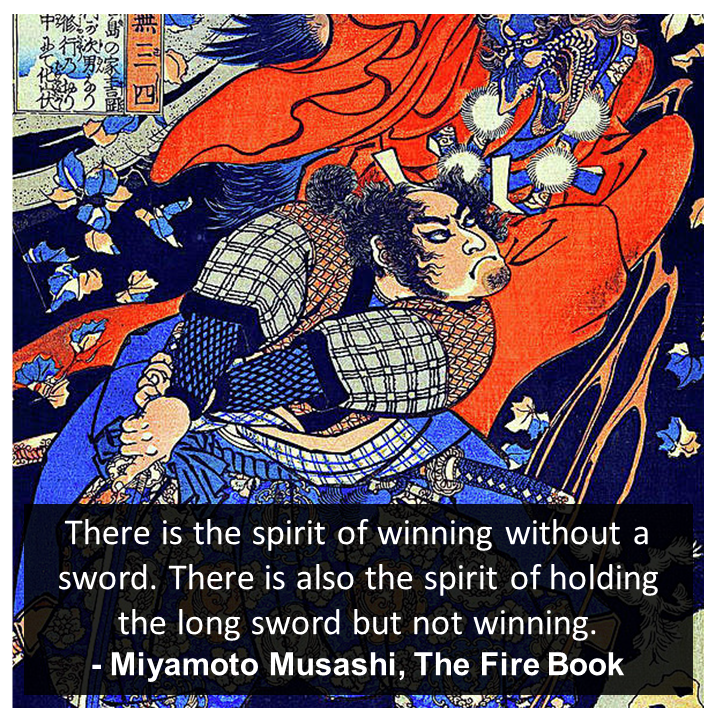
There is the spirit of winning without a sword. There is also the spirit of holding the long sword but not winning.

Hilt means the handle – the grip of the weapon. Here again Miyamoto-san is limiting his words but the message to be conveyed is precise. He implies that having the greatest weapon in your hands does not guarantee absolute victory. You can win the fight without the weapon too. It is all about the mindset. If you have that mindset of the fierceness of the fire in your fights then, it is nearly impossible to defeat you. Don’t become too much attached to your lavish, expensive, sophisticated equipment and tools. Understand that you can be easily defeated in exceptions when you won’t have these tools. So, accept that in order to win – sometimes you may have to let go of your priced possessions. It should be always you deciding the fate of your battles and not the tools, weapons that you use to win those battles. Detachments from such tools will bring out the real fighter within you.

  • The Body of a Rock

The body of rock is implied to the feeling of not getting disturbed by what is happening around you. This mindset will not only defeat one on one enemy but will also build the attitude of fierce fire when the warrior will face thousands of enemies alone. Again, it is all about mindset.

Conclusion

Miyamoto-san in the Fire Book gives almost 27 techniques to win in a one-to-one combat, in a battle or in a long-term, large scale warfare. The consistencies of these techniques and ideas with some real-world examples and practical advises show the true scholar of Miyamoto-san.

Creating breathing space to fight aggressively, rising on the top locations in the battle places, to engulf the enemy even from small advantages, to have the ability to spread swiftly and influence immediately, to have the ability to begin again even from a small spark or embers, to remain unpredictable, to remain attached to the enemy are the tendencies of the fire. These minute behaviors of the fire are closely studied and imbibed into the real life by Miyamoto Musashi, they are the key to the Fire Book.  

You must understand why this section is called the Fire Book. Obviously as the name goes the techniques are built around the behavior of the Fire. The important thing is that everyone would have seen a fire many times in their lives but it is the observant and thoughtful mind of the warrior like Miyamoto-san who extracted the wisdom of Combat and warfare from the Fire. Please bear in mind that these tactics are still relevant in modern warfare and battle strategies.

Of course, men who study in this way thing that they are training the body and spirit, but it is an obstacle to true Way, and its bad influence remains forever. Thus, the true way of strategy is becoming decadent and dying out.

Thus, the Fire Book is about the grit, the perseverance in fighting and winning the greatest battle – the battle of life, the battle of survival.
Links for further reading:
  1. The Book of Five Rings – The Ground Book
  2. The Book of Five Rings – The Water Book
  3. The Book of Five Rings – The Fire Book
  4. The Book of Five Rings – The Wind Book
  5. The Book of Five Rings – The Book of the Void

The Book of Five Rings – The Water Book

Miyamoto Musashi’s Book of Water from the Book of Five Rings is about the ideas of form-ability, fluidity of water. The way we live and control our lives, the decisions we make, the actions we do are solely based on the behaviors and the routines we follow. It is really an understatement to call this book as a Guide for Sword-Fighters.

Miyamoto Musashi’s philosophy for 21st century

Ancient combat strategies for the modern competitions  

After understanding the Ground Book which builds the foundation of the Book of Five Rings by Miyamoto Musashi, we will deep dive into the next book called the Water Book. The general idea is to understand how water behaves, how it tries to bring in consistency throughout, how it tries to level even in disturbances, how a drop to drop creates an oceanic impact, how it flows and remains unobstructed of the challenges. The Water Book is about the the spirit of the warrior, the attitude, the way of looking at things and handling them, making decisions about them.  

“The principle of strategy is to have one thing, to know ten thousand things.

In short, know the ocean from single drop. Miyamoto Musashi wants to highlight the effectiveness of his strategy of Water by showing the consistency in these principles. Once a warrior understands a consistent idea, it becomes very easy for him to implement it everywhere effectively. Thus, by learning this consistent way of water if a warrior defeats his single enemy, he thereby also gains the ability to defeat the thousands of enemies singly. That is how effective these ideas from the Water Book are!

Language does not extend to explaining the Way in detail, but it can be grasped intuitively. Study this book; read a word and then ponder on it. If you interpret the meaning loosely you will mistake the Way.

This is exactly what has been already established in modern philosophy as the Language Theory of Philosophy by Ludwig Wittgenstein. An ancient, age-old warrior already understood this knowledge way ahead of his time. Miyamoto-san knew that a novice self-learner will take every word literally and hence will fail to actually grasp the depths of the wisdom he has shared. He wants readers to inculcate every word in their own lives. These are not ideas just for battling, killing and fighting. These are the ideas to handle any type of situations, people, systems in your everyday lives.    

The principles of strategy are written down here in terms of single combat, but you must think broadly so that you attain an understanding for ten-thousand-a-side battles.

The wisdom is so distilled and ubiquitous that it can be used in any battle, any problem solving.

If you merely read this book, you will not reach the Way of Strategy.

Again, this Book of Water rather the Book of Five Rings is not to be taken literally.

Spirituality – The Way of Life

In strategy your spiritual bearing must not be any different from normal. Both in fighting and in everyday life you should be determined though calm. Meet the situation without tenseness yet not recklessly, your spirit settled yet unbiased. Even when your spirit is calm do not let you spirit slacken. Do not let your spirit be influenced by your body, or your body be influenced by your spirit. Be neither insufficiently spirited nor over spirited. An elevated spirit is weak and a low spirit is weak. Do not let your enemy see your spirit.”

One has to now understand that Miyamoto-san even though explicitly talks about sword fights it is not only about sword fights. He wants readers to understand that the true greatness does not come from following special regime or following some trick or knowing some secrets. Actually, the secret to a great life is that there is no secret!

Miyamoto-san doesn’t want a warrior to force things. He wants everyone to be at their optimum, neither less nor more, neither in excess nor in scarce – just the perfect amount. Once this happens in a person’s daily routine then it becomes part of him, his way of life. Then even an extraordinary situation, a bad event doesn’t affect him. This is what discovering spirituality is!  

With your spirit open and un-constricted, look at things from a high point of view. You must cultivate your wisdom and spirit. Polish your wisdom: learn public justice, distinguish between good and evil, study the Ways of different arts one by one. When you cannot be deceived by men you will have realized the wisdom of strategy.

Miyamoto-san though promotes his “Way of Strategy” in the Book of Five Rings, he wants the readers to expand their vision, their perspectives to different arts too. The idea is that when you become aware of many things, many arts it becomes really difficult to fool you, to trick you. That is also a superpower in a way.    

Stance

Please mind that it is not just about how a warrior should stand in a fight. Stance here also means about your attitude in the situations of hardships and challenges. Here it goes:

  1. Adopt a stance with head erect, neither hanging down, nor looking up, nor twisted – Don’t project yourself as too proud or too peasant and helpless. Be at peace with yourself.
  2. Your forehead and the space between your eyes should not be wrinkled – Control and hide your anger and project it effectively when and where required
  3. Do not roll your eyes nor allow them to blink – Don’t fiddle, observe your surrounding with a calm and focused mind
  4. With your features composed, keep the line of your nose straight with a feeling of slightly flaring your nostrils – Be in the moment. Breath.
  5. Hold the line of the rare of the neck straight: instill your vigor into your hairline, and in the same way from the shoulders down through your entire body – Concentrate all your energy to your torso, your vital organs in order to handle what is to come next
  6. Lower both shoulders and, without the buttocks jutting out, put strength into your legs from the knees to the tips of your toes. Brace your abdomen so that you do not bend at the hips – Don’t tighten your body, don’t be stressed from the fear of your enemy. Loosen up your body to make it pliable to respond enemy attacks effectively.
  7. Wedge your companion sword in your belt against your abdomen, so that your belt s not slack – this is called “wedging in” – Prepare yourself to attack, tighten your core body, your weapons, your tools/ equipment to face any situation

“In all forms of strategy, it is necessary to maintain the combat stance in everyday life and make your everyday stance your combat stance.

Here you must understand that these are not the recommendations to warriors only. Miyamoto-san wants these to be the way of life. One has to really appreciate the depths of his wisdoms through these teaching.

Gaze – Don’t just look, have a vision

In strategy it is important to see distant things as if they were close and to take a distanced view of close things.

While doing all of these stances Miyamoto-san suggests to not get fooled by the appearances only. He recommended these mentioned stances in order to project strong warrior in front of his opponent. But what if the enemy also projects the same stances nevertheless, he is strong in reality? At these moments, Miyamoto-san guides to understand the big picture and the details to decide effective strategies based on the enemy’s behavior.  

Holding the Long Sword

Miyamoto-san beautifully explains the role of each finger on the grip of sword. It can only be experienced on personal level of reader and cannot be expressed in words only. But the overall idea is not just grab the sword with all five fingers rather make it an extension of your body which has its own reflexes.

Fixedness means a dead hand. Pliability is a living hand.

It is again a reminder to not blindly and mechanically follow the rule, tricks, or techniques. Become agile and formless, shapeless like water (..my friend!)

Be water my friend!
Footwork

Whether you move fast or slow, with large or small steps, your feet must always move as in normal walking.

Miyamoto-san here again says that there is nothing like “special technique” to defeat any enemy. When you are not forcing things to be there, you break the patterns, mechanical nature of your moves. Your moves, decisions become natural.   

You should not move on one foot preferentially.

If you have preferences, then it becomes easy to defeat you by attacking on your preferences, your preferences will make you more predictable.

“If you try to wield the long sword quickly you will mistake the Way. To wield the long sword well you must wield it calmly.

Any big responsibility, any big authority, any big decision, any big power should be handled wisely, calmly with a focused mind.

Way of the Long Sword

Miyamoto-san then exactly points out each and every technique to the student. The details with which everything is explained deserves great attention of every reader. The information is clear, concise and just enough.

a. The Five Attitudes

The great thing about a true master is that he is the ultimate simplifier. A true master knows how to teach complicated and intertwined knowledge points in simplified ways without losing the essence of the concept. Miyamoto-san thus incorporates his exact learning into small chunks of wisdom where every word is just enough to grasp the whole concept.

Miyamoto-san at the very beginning makes clear as to where exactly the sword is supposed to be used. The five attitudes he describes seem very simple. The five attitudes are:

  1. The Middle attitude – it is about hitting (and killing) the enemy by striking on torso and vital organs with sword against his face  
  2. The Upper attitude – it is about exactly striking upper blow of sword when enemy attacks and when he escapes this cut Miyamoto-san guides to follow the flow on line and scoop from below
  3. The Lower attitude – it is about hitting the hands of enemy from below, Miyamoto-san also suggests that this is the most encountered stance from enemy
  4. The Left-side attitude – it is about hitting the hands of enemy from below and parrying the same attack to cut from his left side
  5. The Right-side attitude – it is about crossing enemy’s sword attack from below and swinging it further and using upper strike from the right side

These are in simple and no-nonsense words, the five directions in which you can swing a sword to kill your enemy. You really have to understand that the reader of this book especially the pupil learning swordfight are supposed to have that innate natural excitement of learning something special from the great master – his tricks and secrets to become invincible. But the great Sword-master Miyamoto-san delivers his wisdom in the ways of common sense. And believe me it is not sarcasm, rather Miyamoto-san is very serious while discussing the five attitudes here. The whole idea of five attitudes is that, there are mere five vital regions where one has to focus to defeat his enemy. And in those five the Middle Attitude is the most vital. (Logically, the middle region, the torso of human body consists most of the vital organs in human body so it already makes more sense)

“To understand attitude, you must thoroughly understand the middle attitude. The middle attitude is the heart of the attitudes. If we look at strategy on a broad scale, the Middle attitude is the seat of the commander, with the other four attitudes following the commander. You must appreciate this.

The attitudes are not there only to explain the parts of human body, it also represents the whole organization of the enemy’s battalion. All the vital weaponry, the best of the best soldiers, the best diplomats, the best strategists are the middle part of every commander on battle-field. Miyamoto-san suggests to focus on this middle part while defeating enemies in masses. Such hidden and smart instructions are hidden and scattered all over the Book of the Five Rings.     

b. The “Attitude No-attitude” teaching

Miyamoto-san gives five attitudes to fight at first and then instructs to forget about them here.  Please understand that the five attitudes are not just “A Guide to Basic Human Anatomy” for the sword-fighters. There is deeper meaning in Miyamoto-san’s advice.

Whatever attitude you are in, do not be conscious of making the attitude; think only of cutting. Your attitude should be large or small according to the situation.

One can understand it like this – Do not get overwhelmed by the thought of deciding which approach to select to kill the enemy. Actually, if one gets tangled and confused in selecting the right approach, he will immediately loose his life to his opponent as the enemy has already stricken him.

One should only focus on intent to kill the enemy and let the right attitudes come out of those attitudes. Even though five attitudes are defined that does not mean that they are supposed to followed mechanically. This way of mechanistic selection and confusion from it disappears when one does enough practice which is what Miyamoto-san focuses and instructs everywhere.

Fixed formation is bad

Again, Miyamoto-san suggests to be fluid, non-fixated, agile, flowable like water.

c. To Hit the Enemy “In One Timing”

The idea is to not hesitate to act on right opportunity with the full intent of killing the enemy

d. The “Abdomen Timing of Two”

Don’t spare your enemy even when you see him retreating, when you see him relaxing follow him up with a cut

e. No Design, No Conception

Go fully “in” when you see enemy going fully “in”. Use everything you have, don’t follow the structuredness and rigidity of some tricks you learned elsewhere. Again, be fluid in nature, respond accordingly.

f. The Flowing Water Cut

When your strike fails, when you fail (in anything in your real life too) widen your perspective, expand your spirit and this time strike your next blow slowly but decisively, thoughtfully. Miyamoto-san understands that when the enemy sees his strike winning, the true warrior must make a conscious effort to not let his enemy’s morale raise high with this small win. Miyamoto-san call it like “Stagnant water”, when you blow fails, pause-think-come back with full intent of focus.

g. Continuous Cut

When you realize that the enemy- opponent is equivalent to you and it is difficult to defeat (kill) him; then you should attack in such way that it will harm the enemy at multiple locations. Try to hit as many birds as possible in single stone when you are fighting an equal opponent. It is about effectiveness and efficiency of your single stroke.

h. The Fire and Stones

When fight goes one-to-one make sure that it hits different parts of the enemy.

i. The Red Leaves Cut

Force the enemy to lose his sword, his vital and important tools, weapons like a falling and dying red leaf of fall. Disable the enemy by capturing his resources.

j. The Body in Place of the Long Sword

Don’t just be too focused on your weapon, your sword, your tools and resources. Use your body to attack the enemy. If you can focus on getting the control of enemy’s sword, he can think of you similarly. So, with sword use your body too.

k. Cut and Slash

Miyamoto-san here clarifies that cutting is about cutting with full intent of killing but slashing is just touching the enemy, injuring him.

Be decisive about your moves before attacking and be ready to accept the consequences.

Miyamoto-san explicitly clarifies additional thing here:

“Even if you slash strongly, and even if the enemy dies instantly, it is slashing.

I would like to highlight one very important bias that every learner every, student faces in their learning process, especially when they are leaning on their own which is the “Outcome Bias”. Many a times we make some hypothesis on the inner working of the things which we are trying to understand and it eventually happen in the end but in somewhat different ways- in a way we didn’t expect but it happens. Does that mean that we have completely understood everything? The answer is “No”. This is known as the “Outcome Bias” where you decide whether a certain action is right or wrong based on the outcome and the outcome might be just luck. So, it might be a possibility that your hypothesis is wrong.

The outcome bias is dominant in self-learners which Miymoto-san expertly points out here.

l. Chinese Monkey’s Body

Don’t extend yourself partially in enemy’s territory just like Chinese Monkey’s body in Miyamoto-san’s words. If you extend your arms towards the enemy, the enemy will grab you by your arms and pull you in completely.

m. Glue and Lacquer Emulsion Body

When you engage with the enemy make sure that you engage fully. As in do not lose the contact with your enemy when you are really in the fight. Otherwise, you will be unable to anticipate and react to your enemy’s next blows.

n. To Strive for Height

Once engaged with enemy in fight, establish dominance in every possible way, don’t let your enemy’s morale rise up and take the high ground. (That’s exactly what Obi-Wan Kenobi did)

o. To Apply Stickiness

When fully engaged, stick with the enemy; don’t lose touch of him and his sword. Reduce the strength of the strike but keep in touch with his blade, that will help you to gauge his moves immediately.

p. The Body Strike

Find the weakness of the armor and directly attack the body through that weakness.

q. Three Ways to Parry His Attack

When enemy blows attack, target his important areas first for counter attack. First way is to attack on his eyes-his vision; second on his neck, the part which connects the mind and the tools of any organization, any battalion; third on his face, on the image and perception of the organization, the battalion.

r. To Stab at the Face

Stabbing at face means to destroy the senses and the mind of the opponent. Face as in head is eyes, ears, nose, tongue, skin and mind all in single spot which is another vital region of the body. Once you drive the head, the complete body will follow thereby making enemy predictable to attack and kill effectively.

Try to control enemy’s moves by explicitly targeting his most important parts with full intent.

s. To Stab at the Heart

When you are tired, just blow single and focused strike on the vital part of the enemy.

t. To Scold “Tut-TUT!”  

Make sure that your enemy understands that your counterattack was intended to hurt, kill him. Try to bring down his morale. Don’t let him think that he has won.

u. The Smacking Parry

If you develop a rhythm of attacks in your fight, you can still handle the coming blows from enemy and simultaneously hurt him with counterattacks. It’s about developing a sense of timing.

v. There are Many Enemies

When you are alone and surrounded by many, don’t hesitate and wait; attack with the intent to kill many in single strikes. Don’t attack and strike from front or head on; approach and attack from sides.

Whatever you do, you must drive the enemy together, as if tying a line of fishes, and when they are seen to be piled up, cut them down strongly without giving them room to move.

w. The Advantage when Coming to Blows

Go out, practice, and implement your truths, your learnings in reality.

x. One Cut

Become a master in such way that it looks effortless to others. (like Saitama!!!)

While actually reading all these ways to kill the enemy with sword, you will feel like you are actually witnessing these iconic sword strikes in a sword fight or like an intense sword fight in an anime. Miyamoto-san creates a live picture of strokes of sword in his writing while writing all this, which itself is a great experience for readers.

Closing remarks of the Book of Water

In the closing remarks of the Book of Water, Miyamoto-san instructs to make these ideas the way of life. He wants these ideas to become part of your habits. When they will get reflected in your habits the body will react naturally to the challenges as if these techniques are second nature for it. Miyamoto-san expects a flow, a harmony like water in the rhythm, spirit of the readers while handling sword or any situation in their life.

“Step by step walk the thousand-mile road

Miyamoto-san is aware that the novice will get overwhelmed by the details and the number of the teachings from the Book of Water alone. He wants the student, the warrior, the reader to learn one by one, one at a time and imbibe it in their lives.

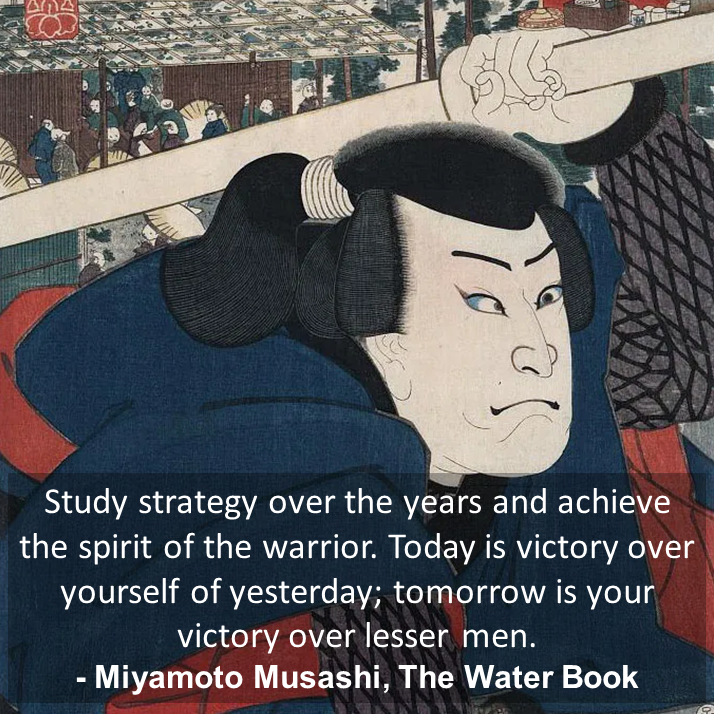
“Study strategy over the years and achieve the spirit of the warrior. Today is victory over yourself of yesterday; tomorrow is your victory over lesser men.

It is about practicing, relearning and distilling down the wisdom over the period. This is only possible by discipline. Only discipline will bring out the best version of you from your personality of times gone, once you become something different and greater from your previous version nobody can stop you. Discipline is the way.

Even if you kill an enemy, if it is not based on what you have learned – it is not the true Way.

In the end of the Book of Water, Miyamoto-san explains the only way to develop wisdom. Knowledge can be transferred, can be taught from one person to another but wisdom always develops from inside. And as it develops from inside, there is very high possibility that it will be full of biases as these are self-truths. Hence clearing the biases in your learning process by continuously practicing them with reality is the way. One must be always be sure about the hypotheses in their knowledge building process in order to create the real wisdom.

Miyamoto Musashi’s Book of Water from the Book of Five Rings is about the ideas of formability, fluidity of water. The way we live and control our lives, the decisions we make, the actions we do are solely based on the behaviors and the routines we follow. The ideas expressed in the Book of Water are can also be connected to Game theory, Corporate Strategies, Principles of War Strategies and Diplomacy, Human psyche, Competitiveness, Lifestyle, Resources and Manpower Management, Spirituality and nonetheless Philosophy of Life and Knowledge. It is really an understatement to call this book as a Guide for Sword-Fighters.

What is special about water? That it is so omnipresent that it is not that special. It is so formless, shapeless that it takes shape of anything. Water has ability to make impact even when it is in drop and even when it in the form of ocean. The specialty of water is that it is not special, or at least no specialty can be assigned to it. It is water’s fluidity, pliability to the situations which enables it to take their forms which is what makes water so special. That is exactly what Miyamoto-san establishes here for the ways to live life thereby with the battles and fights in it.  

Links for further Reading:

  1. The Book of Five Rings – The Ground Book
  2. The Book of Five Rings – The Water Book
  3. The Book of Five Rings – The Fire Book
  4. The Book of Five Rings – The Wind Book
  5. The Book of Five Rings – The Book of the Void

Kantara – Breaking The Illusion of Materialistic Possession

Almost everyone is aware of the impact created by Rishabh Shetty’s blockbuster “Kantara”. The movie is an epitome of the huge power that cinema holds. Not only content/ story-line but the whole ensemble Kantara carries is a lifetime dream of every true movie maker. The movie stands out on cast, characters, cinematography, music, action, emotions, the balance between fact and fiction and what not. Not only as a great entertainer but also as a conveyor of the cultural heritage we Indians hold – Kantara shines out. The movie can truly become the flag bearer of both the Indian Movie Industry and the Indian heritage/ Indian culture. This will not be a movie review or the explanation of the story or the connections Kantara carries to the real life events or traditions. . We will try to find the hidden layer Kantara carries which is common in our very human nature.

The following content will be more relevant to those who have watched Kantara already and may be spoiling to those who haven’t.  

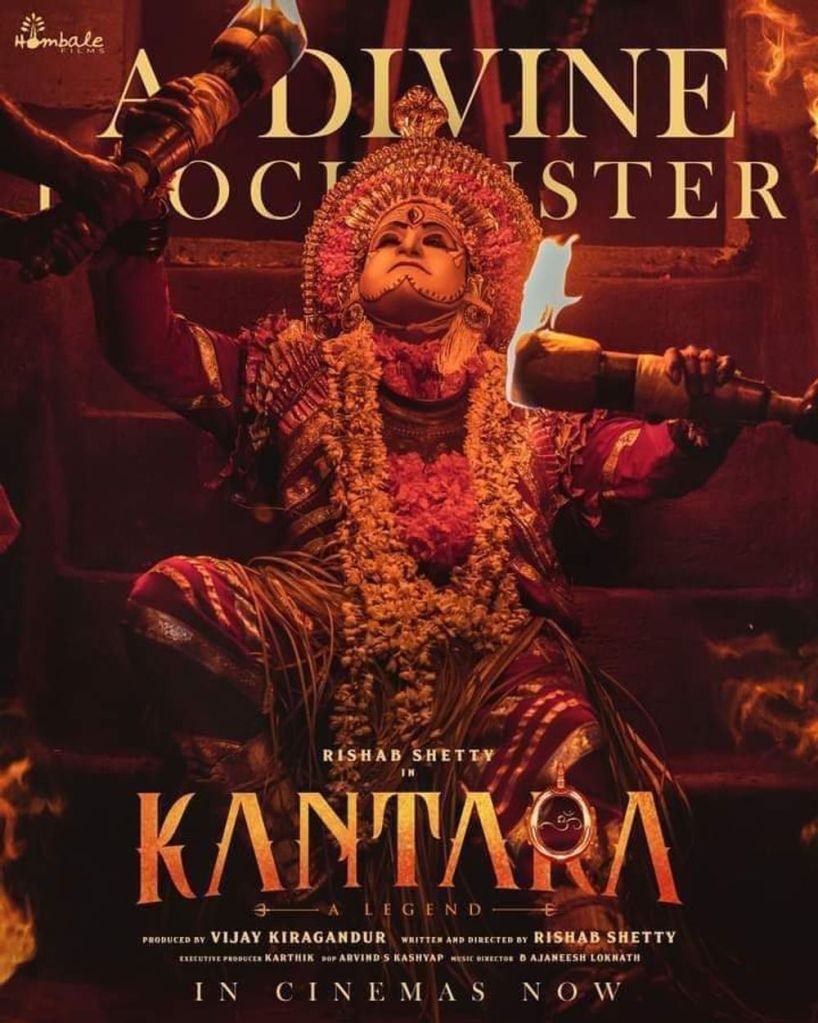
Movie Poster of Rishab Shetty’s “Kantara” (2022)

Kantara- the mystical forest and the folklore

As the literal meaning goes, the story is created in the forest in order to carry the suspense and create a curiosity in the minds of the characters of the story and the audience. And this mystical nature of the forest is effectively used in Kantara to show what faith is actually made up of. Faith, I would say here is used to understand the limits of our own existence and respectful fear of the unknown. There is a moment when the faith of people is questioned through questioning the existence of Panjurli – The Demigod, which is answered through the sudden disappearance of the person/ performer who carries the demigod through him.

The thing about folklores is that they lose some obvious and vital details as they are passed from one generation onto the next generation. When repeated enough most of the details are lost but the core of the folklore remains the same. This loss of details and the loss of information in the story actually makes it a great folklore. This also creates the feeling of irrelevance with the current generations which leads to doubts of what could have actually happened.

Faith becomes the ultimate tool to convey the unknown nature of the unknown- the one which cannot be interpreted or understood with the current understandings we carry. Faith is responsible for the livelihood of the villagers in Kantara and the same faith (in a reverse and negative way) is also responsible for the sad endings in the family of the landlords.

The evolution of real story of the first meet of the King and the Panjurli to the folklore creates faith in villagers but at the same time creates arrogance in the generations of the landlords.

The revisions of the same story – History repeats itself

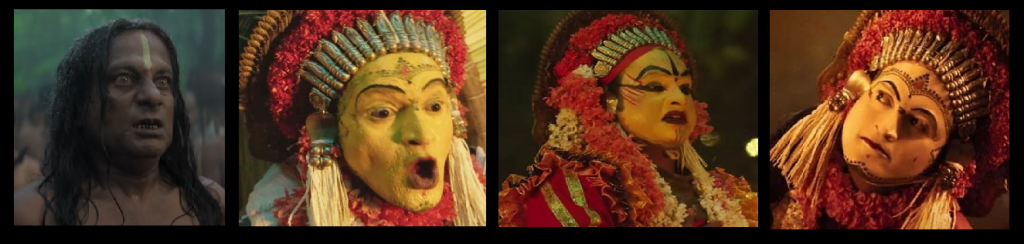
To understand the complete world of Kantara we need to have some pivot in the story. The four Panjurli – holy demigods are the best pivot to explain the transition of folklore through each generation. If the story of Kantara is understood through each generation of the persons carrying the holy presence of Panjurli, you will find that the story is actually repeating itself.

The real meaning from “Kantara” reveals itself when understood from four cycles

At first, the story is folklore hence one should accept that many details are lost in the handing over from generations. The idea folklore actually conveys is the urge of the king to spread his presence by claiming as large as possible part of land and have an authority over it. This pursuit is never ending as there is no end to greed of land which is the main reason for the insomnia the King suffers from. The pursuit of greed actually makes him to lose his peace of mind. The meet with the villagers and the Panjurli is the treaty of King with nature to settle down the turbulence in his mind. (Otherwise, which king would like to portray himself as the defeated one in his own folklore) The resistance for acquisition of villagers from the forest and the unrest due this resistance to the king are the real part which gets lost from the folklore during its evolution. The very first demigod of the story solves this problem and carries the symbol of the eternal promise between the protector and the consumers of the land.

The next demigod carrier is Shiva’s father where again due to the inherent nature of landlord’s son (who will be the next protector of the land) questions the treaty, the promise by questioning the presence of the demigod. The cycle of establishing explicit ownership is again repeated here, but ends in bad way. The King at first is smart and humble enough to accept his defeat against the very nature which created him but the modern son of landlord misses the point by taking the folklore literally. Hence, the reason Shiva’s father had to prove the presence of God in a mystical way. (If one thinks deeply enough and for those who still don’t want to accept the explanation of mystical disappearance there is one way to explain what could have actually happened. Shiva’s father sacrificed his life to the unknown and cruel animals of the forest in order to prove the presence of the unknown. The landlord’s son anyway could have died of natural death but the events of disappearance of Shiva’s father would never allow or put enough further to question the villager’s faith. Which also proves the point and does not create any contradiction.)

The next demigod carrier is Guruva where there is already one landlord called Devendra Suttooru. Devendra is also as smart as the ancestral King but is cunning enough to fool the innocent and forgiving holy demigod. In addition to this, the Forest officer Murali also thinks that he can establish control over the forest by using the government power. The beautiful thing to understand that the situation depicted this time is very complicated hence Shiva’s influence also adds indirect presence of the demigod in the story. Where the demigods share their characteristics in two different persons. Guruva officially represents the innocent and honest side of the demigod thereby resisting the authority of landlord Devendra in a soft manner and on the other hand Shiva already carries the honest, innocent but strong and dominating side of demigod Panjurli and sometimes like Guliga. (One must understand that Guliga only presents himself when the landlord’s intentions and acts become clear)

So, two cycles of the repeating story we are watching simultaneously in the movie in detail. Where in the end, people with the desire to control the nature either lose their lives or lose their intention of authority and develop the respect for the creator.

The point of highlighting the four repeating cycles in the Kantara is that even though each generation in every cycle has enough knowledge of what is right and wrong, even though they have knowledge of what has happened before, most of them try to challenge/ overthrow the past learnings in spite of knowing their consequences. I think, this is human nature. Even though we have done progress from the caves to the mars and solar system through hundred maybe thousands of the generations, some of the fundamental personal, societal problems are always repeating in every generation. Which is why such problems though are already solved remain unsolved for each generation.

History is never antiquated, because humanity is always fundamentally the same.

Walter Rauschenbusch

Illusion of authority, possession and ownership

All four cycles of repeating the histories confirm one consistent human trait that is the authority or ownership of something. At first, the king expects to own as many lands as possible thereby landing in misery. Then the modern son of landlord thinks that whatever land there is his own by ancestry and he should enjoy the perks of it. This also has a bad ending. The next generation one is more evolved and actually addresses two aspects of authority. One is the ownership of the possession of materialistic goods and the another one the possession of power to do anything and control everything.

You will see that the landlord Devendra Suttooru has greed for his “so called” ancestral land but is cunning enough to figure out different and unconventional ways to acquire it. But this ultimately ends in him exploiting the limits of the patience and innocent nature of the demigods. He fails to realize real power of the respect, authority, guardianship villagers thereby the demigods had granted him.

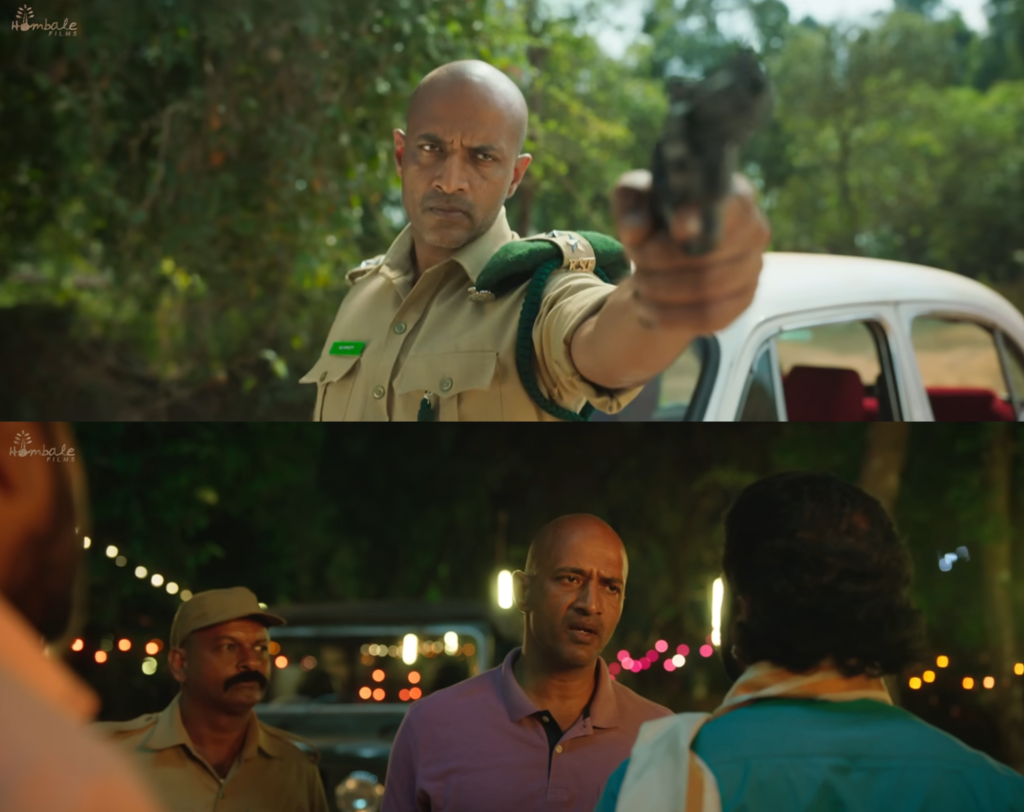
The interesting and mostly unnoticed one is the lust of Murali for the power of authority he would hold over the forest. You need to understand that Murali is Deputy Range Forest Officer. The main Range Forest Officer is not there to control the government matters.  Now, Murali has full chance to use and implement his power and enjoy the perks of it. That is why he is seen beating the villagers who present him their hunt in order to project who has the real power here. The arrogance or strict nature he carries with his staff and villagers is not only because he is a top officer, it is also because he wants to present is power dominance. You will see that when Murali visits Devendra Suttooru, he keeps all the gifts offered and also establishes that he as a government representative will not shake hands with devendra. Murali objecting the traditions of the Bhoota Kola further highlights that the power of authority government has given him enables him to control everything according to his desires. The initial intentions of Murali and Devendra are nothing but the same- the intentions of authority and intentions of possession.

The power of government authority that Murali carries
Rishab Shetty’s “Kantara” (2022)

The exploiters in each of the cycles – The King, The Modern landlord, Devendra Suttooru and Murali forgot that the things they are trying to claim actually don’t belong to them. These things don’t even belong to the villagers of the forest. They belong to the nature who is just allowing them to use them for their existence. The faith of the King and changes in Murali in the final stages makes us aware of breaking their illusion.

The King carried the lands and he was not at peace with himself, Murali even after having government authority faced death and hardships, modern landlord/ Devendra Suttooru having lordship and respect of the villagers faced bad consequences. They thought that the things which were handed to them as a duty belonged to them and exploited them for their own benefit which has no limits and exactly this degraded them. It is only with the villagers you will find that the use of minimal means and resources actually represents the respect for the one who offers everything. This is seen as a reality in their lifestyles and symbolically shown in the Bhoota Kola.

There is also one more interesting illusion of ownership which is Shiva’s ownership on himself.

Acceptance of the truth- the liberation

The ownership of Shiva is multifaceted and hence deserves special explanation. You have to understand that the nonchalant nature, the careless attitude of Shiva is not because of not having a father figure. Rather his mother is depicted more capable of filling that gap. The real reason of Shiva’s careless attitude is because of the life he will enjoy having. The sudden disappearance of his father into the mystical forest and not being able to find his body has deep impact on the initial character of Shiva. Shiva thinks that once he accepts himself as a demigod carrier for Bhoota Kola, there are huge chances of him losing himself from the body thereby distancing from the pleasures of living a life. Shiva fears that just like his father he will disappear into nothing without enjoying the life to wildly extents. Shiva completely wants to own his body, his life and hence also exploits this ownership. That is the exact reason you will find Shiva doing unholy activities like forbidden boar hunting, trees cutting. Shiva thinks that he will easily run away from the holy responsibility by doing such activities.

Shiva’s degrading activities ensure that he will never become the holy carrier.
Rishab Shetty’s “Kantara” (2022)

If you observe the character of our protagonist Shiva carefully, you will realize that even before accepting himself as a carrier of Panjurli and Guliga, he demonstrates all of their characteristics. He is the only person whom villagers will approach when they are questioned about their existence in the forest and the use of the resources available in it. You must understand that his cousin Guruva (who is the carrier of the holy demigods by then) should be the one whom villagers should actually approach but that is not happening in the story. Someone would say that Shiva carries the blood of his father who was the previous Panjurli and hence people believe in him but that is not the case. People already believe in Shiva because he is the only one who has demonstrated all the characteristics of the protector and has the guts to confront the unknown amongst all in the village.

If you remove the Shiva from the initial parts of the Kantara, you will realize that it was very easy for the landlord to fool the villagers to acquire the forest lands, it was really easy for forest officer Murali to use the power of government to bring forest under his control in his absence. Only the presence of Shiva makes the intentions of landlord and the forest officer to last longer in the test of time. Shiva was already the Holy Panjurli for his generation even though Guruva was carrying the godly presence and even before people and he himself realized this.

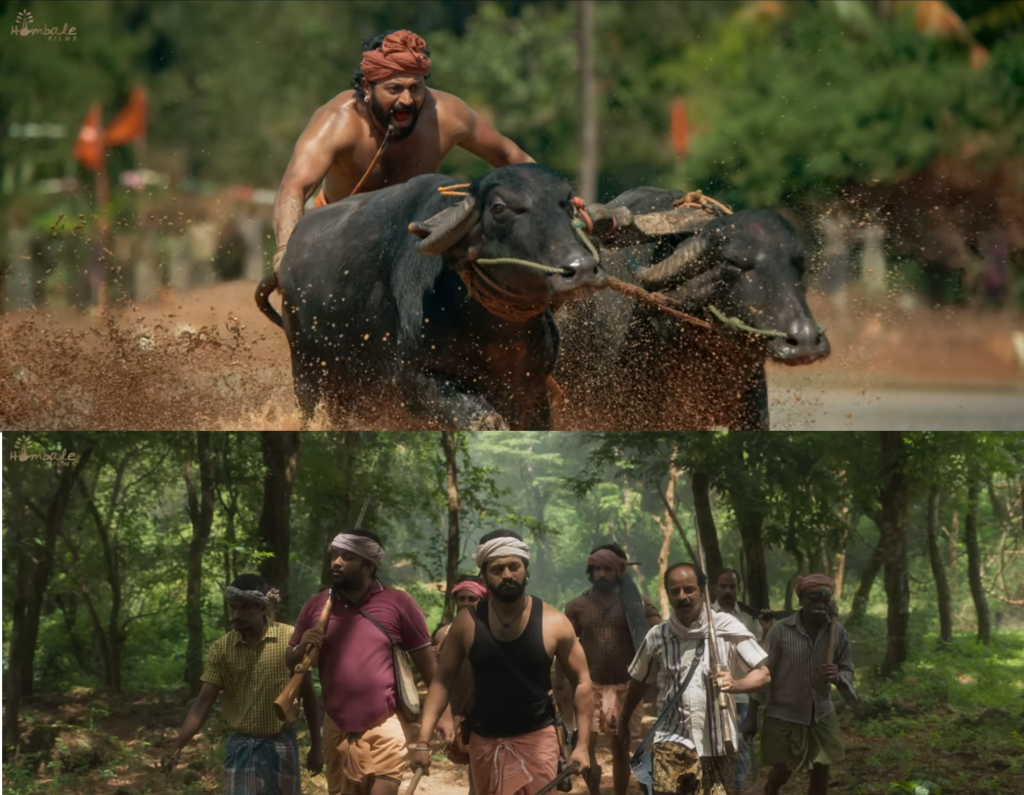
When Shiva finally bears his father’s torch and understands the ultimate vision of the creator
Rishab Shetty’s “Kantara” (2022)

It is at the end of the story Shiva has to accept the possession (rather directly gets possessed) of Guliga thereby understanding the ultimate fact that not even his body is owned by him. His body belongs to nature, the unknown and the greatest one who remains at the end of every cycle, at the end of everything. Shiva as a Panjurli at the end of the story is not because last Panjurli – his cousin Guruva is dead; no one is there to carry the tradition further. It is only because Shiva accepts the truth that the body in which he exists is owned by nature and not him.

The true value of a human being can be found in the degree to which he has attained liberation from the self.

Albert Einstein

That is why you will find Shiva uniting with his father in the final pursuit of real freedom – liberation at the end of the story. The real freedom for Shiva becomes renouncing his body, his materialistic way of existing. This is the real takeaway of the story. Every main character in Kantara is behind owning things whereas the reality is that nothing belongs to anyone. They are just allowed by nature to use the things and the authority for their own existence. Renouncing the illusion of owning everything, renouncing the feeling of being entitled for everything and accepting the nature of reality thereby existing humbly, sustainably, harmoniously with and within it is the real liberation. This is what Kantara represents- the humbling nature of reality, the nature and the extents of what we can know- what we can never know.

“Possession of material riches, without inner peace, is like dying of thirst while bathing in a lake. If material poverty is to be avoided, spiritual poverty is to be abhorred! It is spiritual poverty, not material lack, that lies at the core of all human suffering.”

– Paramahansa Yogananda