Suffering – The North Star of Existence

People have tried to justify their existence with happiness, fulfillment, satisfaction, service, love, hope, devotion and what not. But those who have existed in full spirit, lived it to the fullest have realized the effect of sufferings on our lives and even after overcoming them are ready to endure them again in the hope that they will become better than what they were before. These are the people who might have solved the query to justify the life. Overcoming the sufferings in life and continuing the journey ahead could be the answer.

On Charles Dickens’s short story –  A Child’s Dream of A Star

The Impact of Suffering in the Pursuit of Happiness

Question- what would you choose of the following?

A short life filled with happiness and satisfaction? or A long life filled with pain and suffering?

I will assume that you have selected one.

Charles Dickens’s short story – A Child’s Dream of A Star

I came across a short story “A Child’s Dream of A Star” by Charles Dickens which shows what it means to pass through the suffering of the lost loved ones.

This is a story of a boy who loses many loved ones throughout his whole life. Whenever he is losing someone, he dreams of a star where he sees the souls of his loved ones meeting and coming together. First, he loses his little sister in childhood, then his baby brother. When he grows young, he loses his mother, while being adult he loses his own daughter. Every time, when the boy loses his people, he dreams of the same star and wishes that he too could join them. But, when grown adult and losing his daughter he is somewhat soothed that his daughter is not alone, she has the angels of his sister, mother and brother to accompany her.

When he realizes the arrival of his last moment, he accepts the death for the joy that he will join the souls of his loved ones now.

The Suffering of Watching People Leave

Charles Dickens in a very impactful way shows what it means to live life. On surface analysis, one can say that this short story of a boy dreaming about the people he lost and asking for his own death in the hope to join them is about the pain of losing the loved ones and dissatisfaction of not getting enough time to spend time with them and love them. Deep down it is about how one endures pain and I think the only way to endure such pain is to pass through it. Any attempt to alleviate or even control it, leads to more pain.  

Enduring the Suffering

The great thing about this story is that it delicately captures what a beauty that life we live in is and how we connect same attributes of life to the afterlife (even when we are unsure whether it truly exists, even when it exists in our minds and dreams) also how fragile our existence is.

Charles Dickens used the innocence of the child’s mind to show how we carry that innocence throughout our life to use every chance to stay closer to the people we love. The opening of the story also talks about the sorrow that is felt by everyone when someone dies.

“They used to say to one another, sometimes, supposing all the children upon the earth were to die, would the flowers and the water and the sky be sorry? They believed they would be sorry. For, said they, the buds are the children of the flowers, and the little playful streams that gambol down the hillsides are the children of the water; and the smallest bright specks playing at hide-and-seek in the sky all night must surely be the children of the stars and they would all be grieved to see their playmates, the children of men no more.”

It shows that even for children the suffering had a bigger meaning not even when they had faced any such suffering from loss in their tender age.  It shows how by default we are hardwired for the sensitivity towards suffering. Maybe we are more sensitive to suffering than love.

Then we see that the boy is exposed to multiple losses and you will see over the time his dreams are evolving gradually. In early childhood loss of his sister, he is totally devastated that he could not join his sister, then he is again agitated with the thought that his younger brother has to join her in the starry heaven. Then when he is young, he is somewhat settled that his mother could join his sister and the brother.

Now when being adult and losing the beloved daughter, the same boy has made peace with her death in the thought that she has enough people to take care of her and maybe love her more. Now he has made amends with the death.

“My daughter’s head is on my sister’s bosom, and her arm is round my mother’s neck, and at her feet is the baby of old time, and I can bear the parting from her, God be praised!”

You must understand how the boy from childhood till his old-age sees the death in different ways. At first, he has intense sorrow for his sister but over the time he sees that even after death the people he loves have each other’s company.

He cannot do anything to join them in the afterlife and death is the only way to join them. Please note that there is not even single mention or any indirect indication that boy wishes to end his existence just to meet his loved ones in afterlife.

So, it’s a story of how a person builds himself towards the suffering. You will see that the boy never gets numbed because of the series of losses, he is hopeful that at least someone is there in afterlife for them to love each other. Death along with love is the only constant in this story.

We are well aware of the love from the very beginning of our existence but it takes time to appreciate that just like love, death too is eternal. It’s just that our minds find it difficult to bring together the idea of eternal nature of love and never-ending series of death in single thought. Maybe that is why not everything exists at exactly the same time and ends at exactly the same time, otherwise there would be no one to witness and appreciate what one existed in and carry that forward.

The Eternal Curiosity, Innocence and Love

I am adding the concept of eternity, endlessness in this story of involving series of deaths, ends and sadness with it, because that is how the life is. The symbolism of star used in this short story by Charles Dickens also points to that idea.

You should notice that in the opening it is about how everything that is there in existence will feel sad for loss of the children of men. The boy feels that sorrow in his childhood; later on, we realise that he holds these unfulfilled emotions, feelings of not getting enough time to spend with the people he has lost. These emotions are continuously getting reflected in his dreams. In the end, we see that he is dying happily while feeling that he can love them again in the afterlife.

But you should now notice that the dream is limited to the boy only. What is real is the star in this story; the star shining on little sister’s grave and was still shining on her brother’s grave who died at old-age.

Just like the children’s curiosity about whether the nature grieved for the losses in the beginning of the story, we can say that the star (being the child of nature) would also grieve for the people he saw dying. But that is not where the story is going. The boy had learned to handle the grief over time and that is why is mature emotionally with the death of his daughter and even his own death. This became possible because his love for his sister increased multiple folds, got intense over the time.

The maturity that comes to such sorrow is worth noticing, the boy now an old-age man is not sad because he will be leaving his children behind. He is neither happy that he will join his loved ones in the afterlife (although what he says while dying means that he is eager to join afterlife).

The star was a construct of his mind to move over the grief and be assured that no one – not even him will never be left unloved. He had a strong belief that at least love is eternal in some or other forms. The star still shining upon his grave in the last sentence of the story is thus the symbol of the child’s innocence and love.      

The last words of the boy/ man are these:

“…My age is falling from me like a garment, and I move towards the star as a child. And O my Father, now I thank thee that it has so often opened to receive those dear ones who await me!”

We all can appreciate that the afterlife’s notion is only in the boy/ man’s dreams but that does not invalidate his feelings. He is grateful that he had someone to love (although he couldn’t love them to the fullest while living). The childhood innocence and curiosity he carried throughout his life helped him to endure the suffering. Curiosity because of the urge to understand what would happen to the people who die gets materialized in the dreams of the boy and thus he builds his understanding around it. This curiosity emerged because he cared for them so strongly that he was concerned about what would happen to people after they die. Innocence because from childhood till old-age he deeply believes that just like the children of nature, everyone and not only him cared for people, loved them in some or other ways.   

Conclusion

Most of the existential queries on human life point to one single question of meaning or purpose or at least worth of the life. Once started, if it is destined to end then why is this everything existing? And this question is not just about life. It is about everything attached to the life itself. If everything in existence is attached to something and everything at any time will be lost forever, disconnected forever then why does everything exist in first place? Once you appreciate this question, you will see that existence is majorly a series of detachments, losses – literally and figuratively. It is just that some things detach faster than others, some things stay for longer time but are lost in the end; we are just existing in these gaps of losses and detachments. Maybe how we felt about those things especially the innocent emotions we had for everything that is there (which are neither good/ bad, pure/ impure) are eternal. If not eternal, I would say that they evolve in better ways, get refined, gain maturity and get transferred to our next generations through our legacy. Maybe they too would have an ending but what can we say about the human spirit! The spirit to exist in spite of the sufferings! The ability to exist in full spirit and endure multiple sufferings over the time while maintaining that innocent child alive inside you is what justifies our existence in the end. And even that is to end in the end, I have no complaints.

So, when I asked to select one of options at the start, if you felt that selecting only one of these is foolish (or difficult/ meaningless) then welcome to the club!

People have tried to justify their existence with happiness, fulfillment, satisfaction, service, love, hope, devotion and what not. But those who have existed in full spirit, lived it to the fullest have realized the effect of sufferings on our lives and even after overcoming them are ready to endure them again in the hope that they will become better than what they were before. These are the people who might have solved the query to justify the life. Overcoming the sufferings in life and continuing the journey ahead could be the answer.

The Free Spirit – Beyond Good and Evil

The journey to the freedom demands solitude thereby making man responsible, accountable for the consequences of his every thought and action. Friedrich Nietzsche in his book Beyond Good and Evil paved a way for future philosophers to establish their own new perspectives about the truth where there are no two sides – good-bad, sad-happy, moral-immoral, beautiful-ugly, calm-disturbing but a revised and better version of the older truth. Nietzsche in this book focused on the refinement of our perspectives, our versions of truths for the real freedom because immediately surrendering to already established versions of ideologies is the worst imprisonment any man can have. Nietzsche showed how badly our ignorance creates an illusion of freedom and how to come out of it. This is to remember Friedrich Nietzsche on his death anniversary.

Remembering Friedrich Nietzsche on his death anniversary

Friedrich Nietzsche is one of the most impactful philosophers we as a humanity have ever seen. Reading Nietzsche is a task in itself. But the moment you start getting hold of the things that Nietzsche is trying point to, you will literally undergo transformation. The path that Nietzsche paved inspired many modern philosophers, thinkers, writers. To not mention Nietzsche is to do injustice with our understanding of ourselves as the human beings. This is one attempt to revisit Nietzsche’s ideas in his famous book called “Beyond Good and Evil”, especially his ideas on free Spirit.

Nietzsche in his special style clarified what it means to be really free and how we develop our perceptions, philosophies about the world around us and ourselves.

This is me remembering Nietzsche on his death anniversary. His ideas will keep on living forever.

Oversimplification kills the nuances thereby changing the big picture

Nietzsche strikes powerfully on the idea of understanding the life as simple and easy. It’s a humorous way in which he tried to convey how we consider living life as way to goodness, happiness, pleasure and freedom. The sentences that Nietzsche used to put his ideas about life are built in such a way that you will start questioning the happy nature of the life we desire. You will realize that during the process of understanding life as a pleasurable, happy experience we have submitted our thought process only to the side of pleasure, happiness, and truth. This presumption about life always deviates our search for the truth – “the happiness” that we lookout for as a biased pursuit. Here Nietzsche is not saying that if ‘this’ which you are trying to justify life with is true then it’s opposite is wrong; he is trying to point us towards the idea that as we have attributed life to a happy and pleasurable experience, this attribution has oversimplified what life actually is. Oversimplification has happened because not everyone can understand complex ideas on equal level. It’s not because people are dumb, it is because we have our own ways of interpreting the world around us and the ways through which we interpret the world are totally subjective. Thus, the truth if it exists, it will never be absolute but based on perspectives one has.

“We have contrived to retain our ignorance in order to enjoy an almost inconceivable freedom, thoughtlessness, imprudence, heartiness, and gaiety – in order to enjoy life!”

In order to make everyone appreciate given idea of life on same level we have oversimplified what life is and such oversimplified foundation has led to building even more oversimplified versions of so-called truth. In the pursuit of clarity and ease of interpretation and communication our lives have become false!

That is why Nietzsche here tried to attack the very fundamental way in which we try to break down the things we come across when we live through them. See it in this way, if life by default was supposed to be simple then it is implied that we would have grip on every aspect of life and existence. We know that’s is not the reality. So, if it is not simple then it must be complicated is our next thought. Thus, if life is complicated in reality then oversimplification eliminates certain aspects of life which we keep on missing in the search of truth.

You know what, Nietzsche further explains that when we are denying that life is not simple and happy that also should not invite it being opposite of what was earlier thought i.e., sad and complicated. Nietzsche rejects the idea of polar opposite to portray the lives we live. He calls life, knowledge as the process of “refinement”.

It’s not duality of any aspect of the philosophy, good and bad side of life but the ways and times they have refined themselves which should be the parameter of their worth.

The Death of Philosopher

Nietzsche had his way to express verbal anguish. The sentences are so dense that the prose feels literally repulsive. I think it was intentional. His writings were never meant to be read while sipping coffee or to romanticize the philosophy or the idea of life. They will make sense to those who really want to understand what he is trying to say. Nietzsche in his next idea talks about how every philosopher is trying to find the meaning of life and thereby his/her truth of life. He despises the idea of life or philosophy being explained with a single idea. That is why he sarcastically calls philosophers as the protectors of truth, the thing which itself doesn’t need protection in first place!

Nietzsche thus calls out to the philosopher to get ready accept the martyrdom, the death of their idea of philosophy. The philosopher can only carry his point forward for further refinement but he/she must not – cannot define the life in whole with that simple idea. That idea has to die in the process so that newer refined ideas can be built out of its broken pieces.

In order for philosophy to exist it has to end, it has to kill its older version – that is what is the tragedy of philosophy is as Nietzsche goes.

The Freedom Paradox

When Nietzsche is trying to initiate treatise on freedom, he starts with what it means to be free for any person. One important observation he puts in front is how we get freedom on personal level. On surface it feels if the person is free on personal level, then it is easy to be free in society as a whole. But Nietzsche shows that these ideas of freedom are paradoxical! Man goes inward for the freedom because he/she knows that there is no one else to tie, bound him/her inside his privacy. The man seeking freedom when interacts with the crowd soon realizes that his experiences of life are bound to how crowd handles him, reacts to him, treats him, shapes him. That is unsettling, the burden is difficult to carry for single person hence the man again resorts to privacy, in order to do that he has to let go of certain truths and create his own little lies so that the external crowd won’t disturb his “freedom”.     

(the man) he was not made, he was not predestined for knowledge”

The point Nietzsche is trying to make here is that the taste of freedom comes with the unsettling feeling of existence. But as a man we are not seeking that freedom for us; freedom is some citadel, a happy place where we expect to have control over course of things. The real freedom as Nietzsche explains will be gained by being in touch with crowd (which sounds paradoxical again) It’s like saying you will understand what you real singular identity is when you start mixing yourselves with the crowd!

Nietzsche further advises philosophers of the future to not turn away from the unsettling ideas about philosophy. He takes support of cynicism to make his point. Cynicism bases itself on the idea that people are selfish, self-interested (so in simple words if anything doesn’t go the way a cynic wants, they would whine and create reasons to justify it.) Nietzsche expects the future philosophers to understand the difference between ill-speaker and bad speaker. The lovers of knowledge should also be able to understand what is unsettling, maybe their lies the next opportunity for better version of their philosophy.

The Freedom of Expression

Nietzsche had already explained how things lose their essence in oversimplification. In same fashion it becomes difficult to interpret what a fast thinker is thinking and then explain it to the relatively slow thinkers and make them appreciate the same idea on same level. Even in our thinking we are not free. You can create an explanation for others to understand what you are thinking but they themselves have to climb up (or climb down sometimes) to your level to appreciate what you are thinking, you may succeed in expression but interpretation, comprehension and its appreciation gets limited by the levels on which others are thinking. (My question, if this is the case then even if you are a free thinker, are you truly a free thinker? I know Nietzsche is paradoxical most of the times)

“What is most difficult to render from one language into another is the tempo of its style, which has its basis in the character of the race, or to speak more physiologically, in the average tempo of the assimilation of its nutriment.”

Nietzsche further builds this “so called” freedom of expression using the limitations of the language. Language is the culmination and mirror of the culture it originated from. So, naturally each language has its own style, flow, breaks, rules and ways to highlight certain aspects of narration. When such languages is used to express an individual’s ideas, the speaker has to let go of the nuances of his culture, his primary way of life so that others having another culture, another way of life can appreciate and understand what he is trying to convey, but what if the nuances were the only thing which made that idea influential? Then the influence of the idea would be lost because of the translation. (This is Nietzsche’s way saying lost in translation!)

The Tragedy of Independence

Another way to become free is to become independent. The very few lines Nietzsche uses to explain independence are equivalent of an atomic bomb! (trust me it is still not an overstatement!!!)

People who become independent are few as Nietzsche says and those who are strong can easily achieve it. This independence is also one way to be free. When a man becomes independent, he is on his own, there is no one like him – he is alone. Nothing is anything alike him – he is alone. Thus the whole world becomes a puzzle for him as he is on his own. Any direction becomes new path for him. As he is the only one like himself, there is no one who would reach to his level and match his thinking. And in such case if he needs sympathy, people cannot even sympathize with him because they are not on his level. What a tragedy! The sadness he has in his heart, mind is rendered useless because others around him are not able to comprehend it – sympathizing gets ruled out automatically.

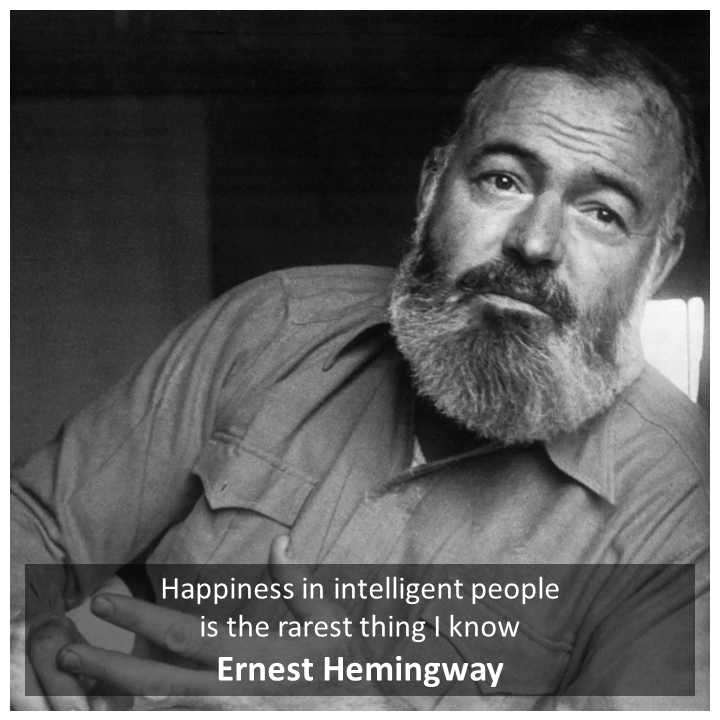
This is Nietzsche’s way of saying what Hemingway said. (I mean both meant the same although Hemingway came later, but you get the point) You must understand that happiness is not the real pursuit of life, then you won’t feel tragic about what Hemingway is trying to convey here, same is what Nietzsche trying to convey here. Freedom by independence can be a tragedy for the person who was expecting glory out of it.

Foolishness Hides Chances For New Insights

Nietzsche here is trying to remove the lines between what is good and what is bad, what is allowed and what is forbidden.

“That which serves the higher class of men for nourishment or refreshment, must be almost poison to an entirely different and lower order of human beings”

In modern crude sense, Nietzsche says “one man’s trash is another man’s treasure”!

Same idea, same act will have different perception of morality, scale of right and wrong. A rebel thinker in common poor public could be attributed to a philosopher amongst the riches. A murderer who killed an evil landlord could become a saint among the people who were victims of this landlord’s oppression.

So, Nietzsche’s attribution of foolishness is a way to point out the exceptional, outlier acts, prohibited acts, crimes to find the better truths. That will make you freer than others.

The Freedom of Youth   

 The stage of youth feels like the freest stage of all the stages of life and it is so because it has let go of the nuances. It also feels free because the youth in the stage of exploration never submits to right or wrong, yes or no to the life as Nietzsche says. But as the time passes when the youth is exposed to disillusions, broken expectations they try to modify themselves in a way that will get things done the way they wanted – the compromise starts to enter. The moment this happens the same youth tries to punish themselves as Nietzsche says. The freedom exists no more, so is the youth.

The Freedom of Actions

(Again, this a hydrogen bomb on morality!!!)

How can we say that the given action is right or wrong?

Nietzsche has very interesting thought process on this question. In the starting times the action was right or wrong based on what it led to – its consequences – the effect. The problem with this thinking is that one has to wait to let the action happen to decide its rightness or wrongness. If the stakes are high, such attribution of right or wrong can be devastating.

So, Nietzsche takes support of Chinese idea where the parents are responsible for the betterment of their child. Meaning that the origin of the thought which led to that action should be the decider of whether the action is right or wrong. Nietzsche called this pre-moral period of mankind. And sarcastically he points out that we have made a total turn around the idea of right or wrong action. Earlier it was what happened after the action i.e., consequences; now it is what led to that action, meaning what was happening before that action i.e., the origin which is the decider of right and wrong of any action!

This is where the origin of action gets named as ‘moral’ which is generated from self- knowledge. Later these morals evolved into “intentions”. As Nietzsche says, intentions serve as the origin of any action.

“people were agreed in the belief that the value of an action lay in the value of its intention. The intention as the sole origin and antecedent history of an action: under the influence of this prejudice moral praise and blame have been bestowed, and men have judged and even philosophized almost up to the present day”

Nietzsche then drops another bomb called – unintentional actions. We are clear that whether action is right or wrong can be decided by the intent. But what if there was no intent or there are no other ways to pinpoint the intent behind certain actions? There is a possibility that the intent may get mistranslated, misinterpreted during the unfolding of events, then how would you decide the attribution of given action.

In such case we would again go to the effect- the consequences of that action!!! You see what is happening here? We might have to resort to that older measuring system of action based on their consequences.

This is Nietzsche’s style to question how we think of morality in general and also on deeper level.

(I can’t resist praising Nietzsche lesser but deep down I know he would question his own worship too!)

The next attack Nietzsche does by using morality is the sentiment of sacrifice. The basis of his thought process is that you should question everything that gives you pleasure at least once. Here, he shows how fake the feeling of sacrifice for others, surrender could be if it is intended to display how moral and virtuous you are!

“There is far too much witchery and sugar in the sentiments “for others” and “not for myself””

In simple words, you are saying that I like to help others because it makes me happy. So, in order to help others you have to become selfless, but if becoming selfless to help others makes you happy, doesn’t that make you selfish? You are selfless because you are selfish!!! (Disclaimer: Nietzsche is paradoxical.) The paradox is resolved when you accept that you are just taking support of morality to display you higher value. Being selfless is just a better excuse to display your high morality. It there was any cruel way to display your high morality no wonder you would have gone for that!!!

In modern ways, it’s fox’s way to say the grapes are sour or I am a virgin because I am waiting for someone special (In reality fox cannot reach the grapes and the person is not able to appreciate other person or people rejected that person continuously – please note that I am not blaming someone’s character – it’s the limitation of language that prevents me from expressing what I am thinking for oversimplification. As Nietzsche has already shown that oversimplification kills the nuances. You get the point!)

The Immoral Philosopher – The Free Philosopher

Building upon the ideas of nuances lost in translation, right and wrong in morality Nietzsche calls the future philosophers to go beyond the dichotomy of philosophy and also distrust the morality in the development of new philosophy, new truth.

“In all seriousness the innocence of thinkers has something touching and respect-inspiring in it, which even nowadays permits them to wait upon the consciousness with the request that it will give them honest answers”

This is Nietzsche’s way to show that in order to find the new truth new philosophy, new philosophers have submitted themselves childishly and blindly to the principles of morality hoping that morality will give them new answers. But it is the same tinted glass of morality that prevents them from getting new perspectives. Hence, he calls them naïve here. They must let go of this childishness.

“The belief in “immediate certainties” is a moral naivete which does honor to us philosophers; but – we have now to cease being “merely moral” men!”

This is Nietzsche’s way of saying it’s good to be bad!

For Nietzsche, morality shows only two sides of reality- right or wrong, this works fine if reality is really dichotomized. But we know there is no such thing as right or wrong for every real-life scenario. So, in order to find the real truth, you have to let go of morality, then you will see that reality has its spectrum and people residing on different biases of such reality have their own attribution of right and wrong for the same action. Morality is the subset of newer truth, not the other way around.

‘il ne cherche le vrai que pour faire le bien

(he who searches truth to do good) – I wager he finds nothing!

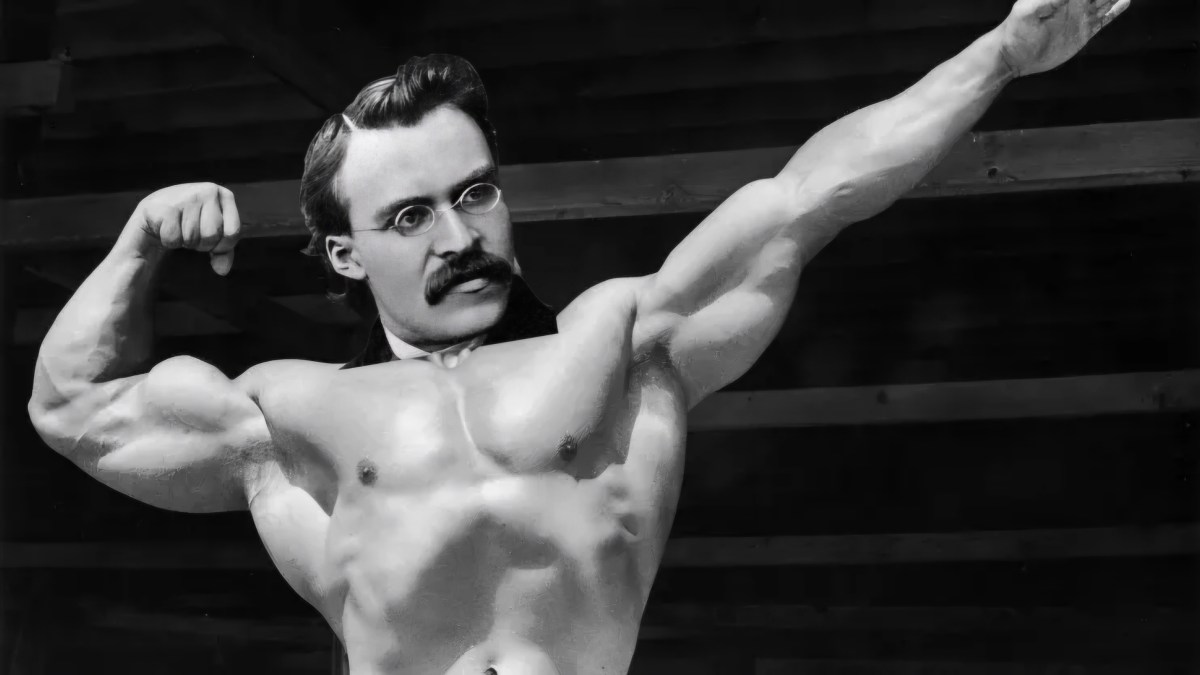
 Nietzsche make his point by him being the first bad-philosopher!!! (This is why I am loving him more and more. It’s like a brainiac with full grown muscles if you want to picture him thematically!)

The Freedom From Passions and Reality – Will to Power

Nietzsche makes an attempt to show that the reality could also be made up of something totally different that we can even comprehend. What if the world is more real than what we can experience? And if such reality exists, our senses will limit us from experiencing it. So, in order to be free in such reality we have to rise above our senses. That would be the new freedom. Our senses are bound to desires and passions whose interactions – impulses are creating thoughts.  

So, building on these impulses Nietzsche says that many emotions, processes are created in “our reality”. What would make any of such impulses, process free from others? He introduces the idea of causality to show the flow and root of everything. If cause leads to an effect and further that effect becomes cause to newer effect then it is possible that the root cause of all would make us really free. Nietzsche further explains that it can also be one of the processes which would overpower others to become free and not the root one. (For example, the first unicellular organisms would be the most powerful organisms on earth today, that is not the case.)

Here Nietzsche introduces the concept of Will to Power. Whatever overpowers the other processes has the potential to remain in the big game and thus has real chance to be free. Will to power in any process allows it to gain more freedom.

This is Nietzsche’s Darwinian theory of evolution – the survival of the fittest. (I know it is a bastardized translation, but again I summon the loss of nuances during translation.)   

Then Nietzsche puts the idea that by this way of thinking the originator does not necessarily be the most powerful one, thereby questioning the existence of the God! Because if the God was the originator, then then he/she would exist only if he/she has the highest Will to Power. That also does not mean that if God does not exist then devil exists or has the highest Will to Power. It could be anything! We are not sure for now. (typical philosophical answer!)

Using causality, Nietzsche also questions the morality of French revolution. If for the locals the royalty was cruel that is why the revolution happened then why didn’t the remotely located people who considered them noble in first place considered them cruel too? In the eyes of remotely located people the French royalty had a noble past. (The question is intended to think on it not to find the right and wrong. It shows how flawed our thinking becomes when we stick to morality blindly.) Whoever came in power overthrew the less powerful. That is one way to explain Nietzsche’s Will to Power. According to Nietzsche, if Napoleon would have been continuously invested in the morality of his actions he wouldn’t have become the great emperor.

Freedom From Truth

Here Nietzsche starts with the very obvious and common fact that some truths are unsettling. Not every truth ensures happiness. Only an idealist, as Nietzsche says would submit the idea of truth that brings joy, happiness, and beauty.

Here comes Nietzsche’s biggest drop-

“the strength of a mind might be measured by the amount of “truth” it could endure – or to speak more plainly, by the extent to which it required truth attenuated, veiled, sweetened, damped, and falsified”

This is self-explanatory. It is just our unsettlement that we need to take care of while looking for the truth. We are thinking animals and thinking is a result of our impulses, desires, and passions. So, not every truth is destined to bring us peace. ‘We would die if we eat poison’ – is a truth which unsettles everyone but that is not how we react to such truths, we prepare for such bad events, that is the wisdom what Nietzsche is talking about in a crude way here.

“There is no doubt that for the discovery of certain portions of truth the wicked and unfortunate are more favorably situated and have greater likelihood of success; not to speak wicked of who are happy- a species about whom moralist are silent. Perhaps severity and craft are more favorable conditions for the development of strong, independent spirits and philosophers than gentle, refined, yielding good-nature, and habit of taking things easily, which are prized, and rightly prized in a learned man.”

Nietzsche prefers learned man more than the moralistic or the virtuous one. A learned man knows the consequences of learning new truth, or sometimes even unaware of it but he does not pivot his happiness on the discovery of new truth. What else could you make freer when you are ready to accept the truth in its crude and real form! This freedom will bring clarity, new perspective and not happiness or sadness or chaos or calmness.

Truth will not decide how and what you are. You just will have added new tinted glass in your collection of perspectives towards life and reality and the philosophy behind all of them.  If your Will to Power is good your truth may become the truth for all others.

Freedom From Identity

The profoundness demands the rejection of submission to any side of existence. If one promotes certain ideology the people around him/ her will try to comprehend that person using the tags they have in their own minds for that idea. The mask thus brings in that ambiguity where people are not associating, tagging you to one definite truth. Even your mind can start creating bias if you let it. That is why Nietzsche focuses on mask in profoundness.

“A man who has depths in his shame meets his destiny and his delicate decisions upon paths which few ever reach, and with regard to the existence of which his nearest and most intimate friends may be ignorant; his mortal danger conceals itself from their eyes, and equally so his regained security.”

The mask frees you from attribution thereby biases and even the socio-economical influences. You will never let honor or shame, right or wrong, good or bad, happy or sad justify the events in your life. You will never ever flinch to enter an unsettling adventure which guarantees your growth personally. Embarrassment, failure will just be another emotional response for you (please note that this does not mean that you will be emotionless, it means that you will be able to recognize your emotions and let them pass.)

This is exactly why I would force everyone to understand Nietzsche on their own level!!!    

“Every profound spirit needs a mask; nay, more, around every profound spirit there continually grows a mask, owing to the constantly false, that is to say, superficial interpretation of every word he utters, every step he takes, every sign of life he manifests”

This could also be one reason why some the greatest personality humanity has ever seen had a layer of controversial ambiguity around them.

From the idea of mask, Nietzsche moves to the idea of its conservation. The conservation is meant to define the philosophy of containing who you are rather that you submitting to some ideology. Whatever you have collected as an individual, whatever you are on philosophical level personally, how you have upgraded – refined your philosophy you must conserve that instead of giving to some ideology. The mask helps to conserve who you are.

“One must know how to conserve oneself – the best test of independence”

(this could be the reason why superheroes wear masks!!!  Joke aside but it is one powerful thought)   

Further Nietzsche warns new future philosophers to not be people pleaser or submitter to temptations. That will steal them of their judgement and independence.

Freedom From Your Version of Truth

The ways in which Nietzsche is trying to close his arguments are really beautiful. He knows that when the future philosophers will have discovered their new truths in their journey of blood, sweat and tears, it is natural that they will get attached to it. Such is the human tendency. He wants us to get rid of the obsession with this new truth. This truth even if it’s the newer one will create boundaries in your perception, you won’t be free anymore! Nietzsche wants to let the future philosophers let go of the dogma.

“In the end things must be as they are and have always been – the great things remain for the great, the abysses for the profound, the delicacies and thrills for the refined, and, to sum up shortly, everything rare for the rare”

Freedom From Illusion of Freedom

On closing notes Nietzsche has advised new philosophers to be careful of the “freedom” they are being offered under new socio-political ideas. Nietzsche focuses here on the ways new philosophers are embarking on the journey to new truths. He tells that having fluency in speech and effective grip on written communication will not define you as the new philosophers, even though they are one aspect of it. But the systems having higher Will to Power will use same tools to control new philosophers and change the course to their versions of truth.

New philosophers will be misled with words like “Equality of Rights”, “Sympathy with All Sufferers”, “Modern Ideas” but they should be careful about them. They should be aware that the moment they create a thought process the people on different levels with different Will to Power will interpret these same ideas for their own benefit especially the ideas which are polar opposites of your ideas. Once such separation happens nobody, not even you cannot get the real freedom.  

Nietzsche offers the rule of solitude while embarking on such journey. Only you can free yourself.  

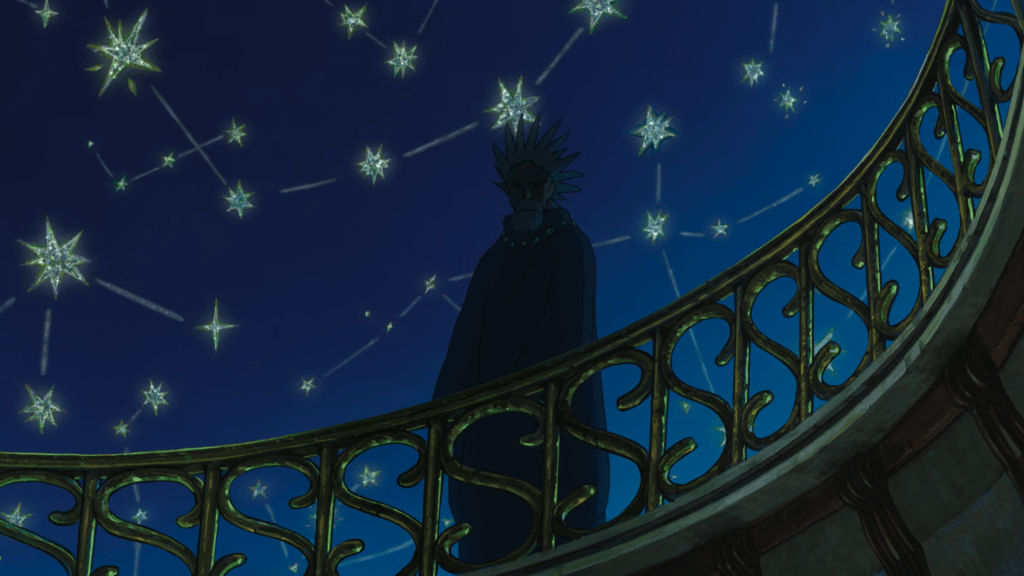
The Boy and the Heron (君たちはどう生きるか) – Bittersweet Reality of the Artistic Legacy

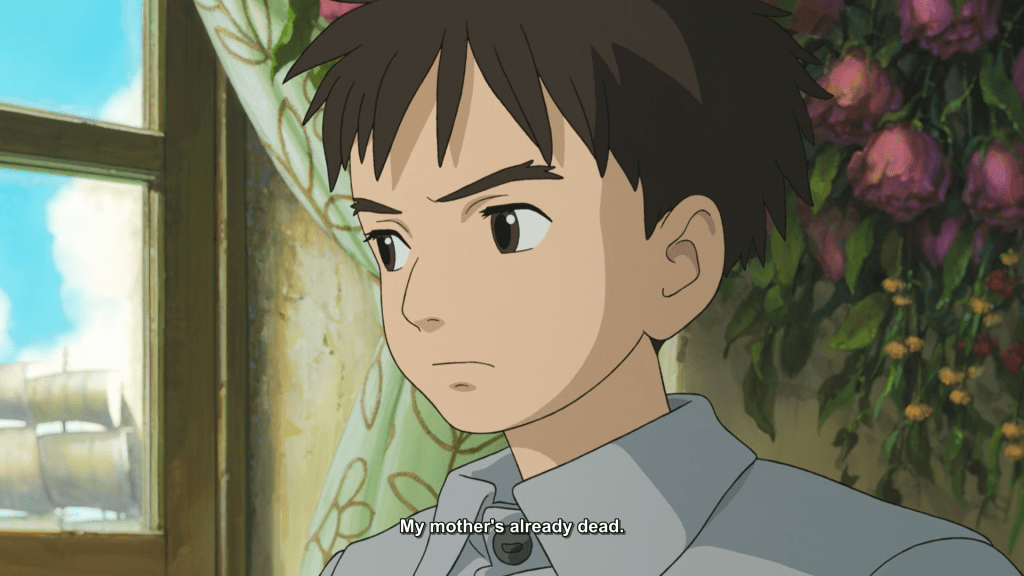
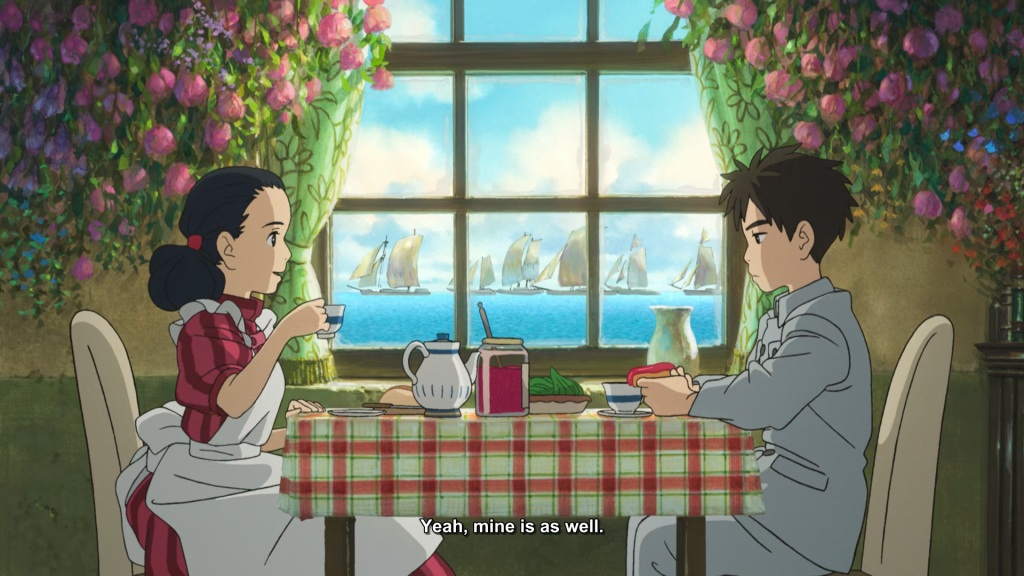
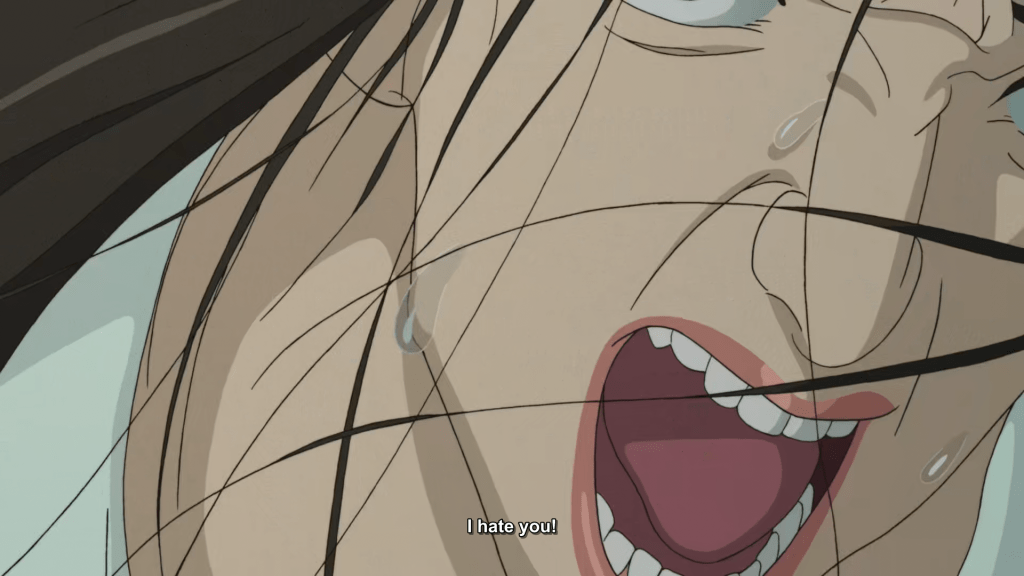
Studio Ghibli’s masterpiece The Boy and the Heron (君たちはどう生きるか, How do you live?) tries to answer one complicated question on artistic legacy. On surface, it is a story of boy coming out of the melancholy of his mother’s death and his new beginnings. Deep down it is a love letter from a creative father on his creative legacy to his son who wants to go on his own journey. It shows how difficult it is to make others appreciate a personal piece of creation, emotion and how to leave a truly influential legacy behind.

A creative father’s love-letter on his legacy to his beloved son

We are always in a pursuit of creation of something to ensure better coming days. Survival is one aspect of it but as the time moved on, we have comfortably brought ourselves to ensure our sustenance. Most of us can live a basic life and rarely worry about what to eat tomorrow. Once such stage is achieved, you will see that our efforts to create and accumulate still have never stopped. Now we are creating and accumulating for even better days than other, once this is achieved, we continue creating and accumulating so that our new generation will see better days. This act of creating a legacy is not just a matter of survival, it is also matter of preserving some part of ourselves even when we won’t physically exist in this world.

It is easy to see what happens to the materialistic legacy like wealth, but it becomes very tricky to handover the moralistic, value based, character-based legacy to the next generation because of the differences in the ways to live and understand the life. The passage of time alters some truths to the new generations thereby changing their mindsets and moral compasses. Even though our animal drives, emotions are exactly the same the motivations behind them change over time.

Now, imagine that you created such precious legacy which is close to you, which defines you, people appreciate it adore it but your next generation is unable to carry it forward. How do you handle such rejections? what is the resolution? Is it good? Is it bad? Is there any way around? As you love your legacy, should you force them to see the value in your legacy? And if you truly love them, should you force them in the first place to carry that legacy?

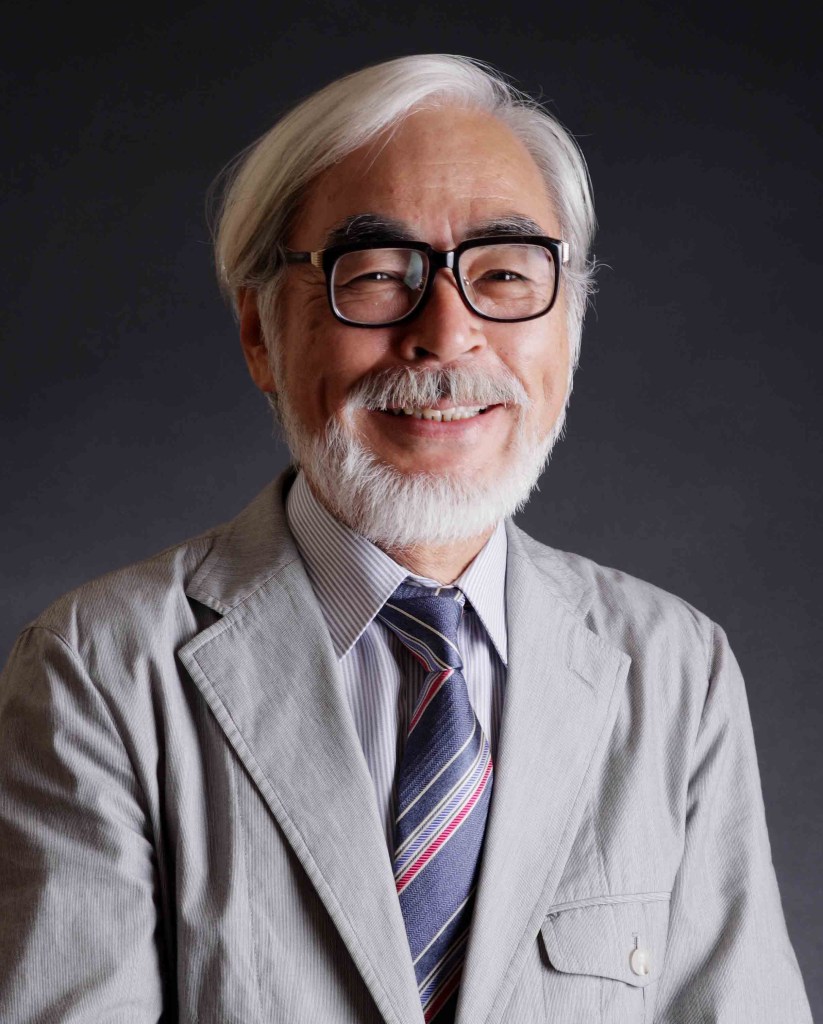
Studio Ghibli’s recent movie The Boy and the Heron (君たちはどう生きるか, How do you live?) is an attempt to answer one such complicated question on artistic legacy. Hayao Miyazaki-san has again given a masterstroke by creating a very personal yet relatable artistic narrative.

I have tried to explain the overall purpose of the narrative in this movie and will try to uncover what was the real core of movie based on the events in the life of Hayao Miyazaki-san.

The story and the meanings behind it

You will find megatons of explanations on the symbolism, personal connection of Hayao Miyazaki-san, his life, his childhood, his parents, and his colleagues from Studio Ghibli in this movie. There are many theories and cross references between the previous Ghibli movies too. I will not go into those details. I will focus on what the narrative stands as a whole.

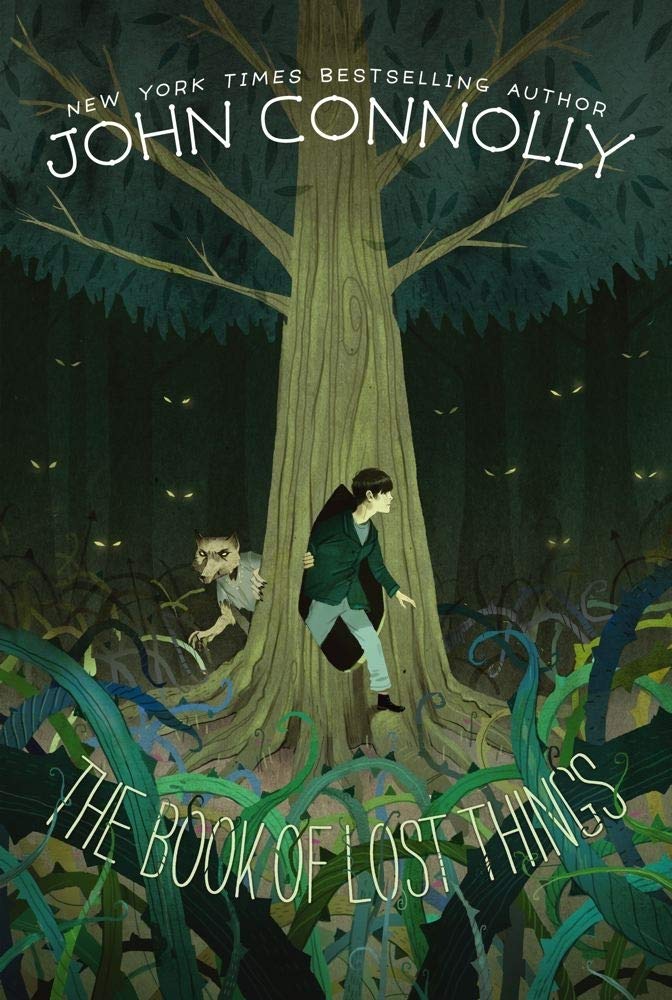
It is obvious that it is a story of a boy who lost his mother and his journey of getting over that melancholia of her loss and acceptance of his new mother. You will also notice in the end credits that the creators have thanked a book called “The book of lost things” by John Conolly. Once you check out what this book is all about, I think you will get new perspective beyond the symbolism and references in the movie. Miyasaki leveraged the narrative of this book to create the structure of his narrative. The book also draws inspiration from Genzaburo Yoshino’s book “How Do You Live?” (君たちはどう生きるか, Kimi-tachi wa Dō Ikiru ka)

Two books which inspired ‘The Boy and The Heron’

This is the story of the all emotions that are invoked when a person loses their loved ones. The first question that comes in mind when such loss happens is “How Do You Live?”

This is how the story is built –

The tower created around the rock is a portal where you can physically access your emotions. Just like in Interstellar how Astronaut Cooper was able to physically access the dimension of time.

Birds are representation of the free flying feelings, emotions we have.

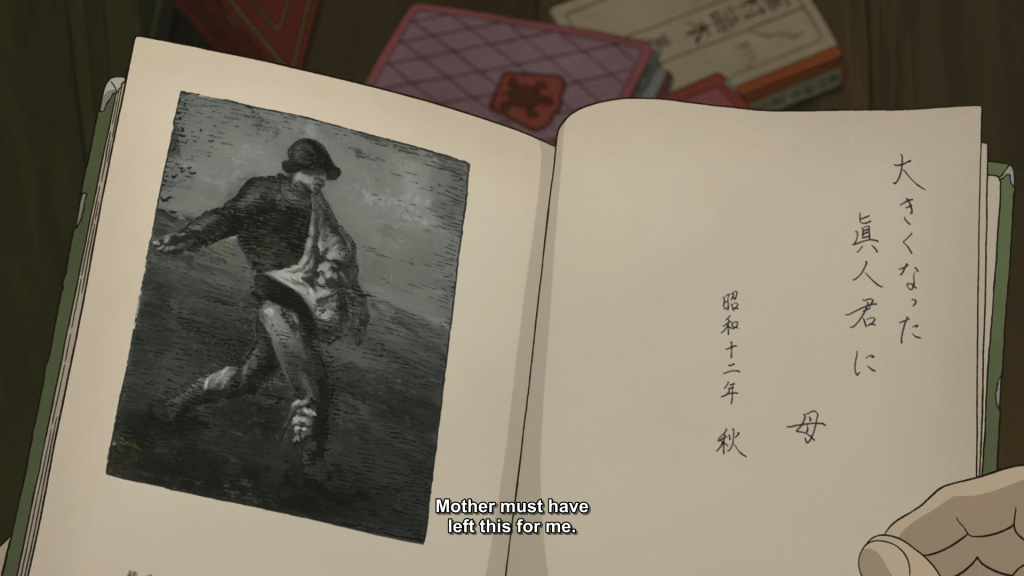
The book that the great granduncle left unread is the same book Mahito’s mother read and then it got handed over to Mahito, which is the book called “How do you live?” The book is about the conversations of a boy who lost his father and the boy’s uncle.

The great granduncle already knew that the rock from space can allow him to create the world of his dreams. That is exactly why he built a tower around it for protection. Upon going through the loss of loved person in his life, he saw himself in the role of the person who will lead and help his descendants to handle their own pain of loss. But as the great grand uncle was always into books and had his own internal dreamy world, he used the powers of the rock from space to create his own world.

The act of leaving the book unread to disappearing into something is pointing towards that intense moment when you have to act on things because the author said exactly what you believe in. You feel this urge to act and create that thing because the author, the person who you don’t even know feels exactly the same. You feel an unexplained deep connection.

So, the rock from space and tower built around it is a portal where things can enter and exit in space, time. The moment when Himi lost her mother, she accessed the portal, confronted her emotions but also met her future son Mahito.

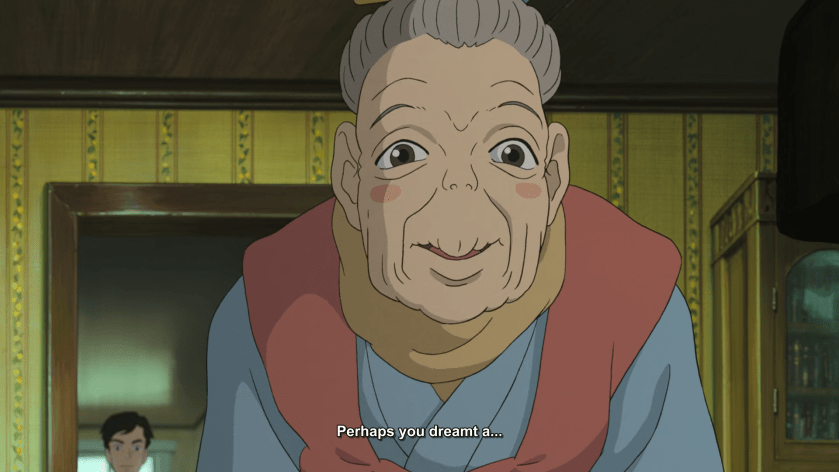
She realized that even though she lost her beloved mother, she will have an opportunity to have her own son who will love her deeply. Even when she will not be there with Mahito, her sister will love him equally. This gives her peace. That is exactly why when grannies are telling the story from Himiko’s childhood to Shoichi (Himiko’s husband and Mahito’s father) they say that she was grinning to ears – happy like anything when she came out of the mysterious tower.

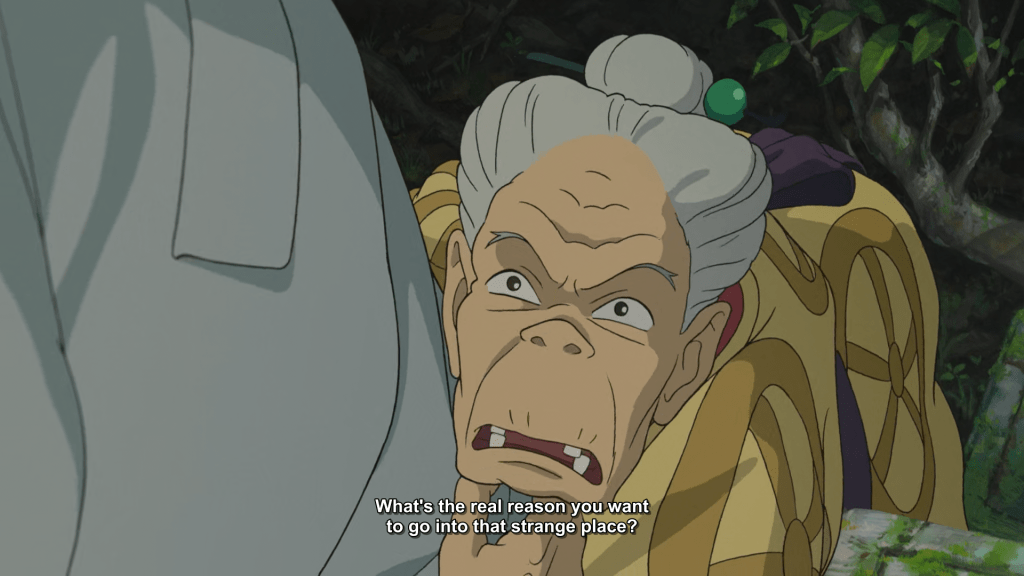
The great grand uncle can call anyone to enter the tower. That is why grannies are scared if Mahito gets taken by the tower in the start of the story.

Kiriko has also accessed the portal in the search for young Himi before, that is why her younger version is available in this dreamy world and knows the ways of this world. Her older version entering into the portal along with Mahito closes the loop of time paradox if you think it through.

Natsuko is called into the portal to make young Himi aware that her future son will have a caretaker and lover when she will not be there for him. This helps young Himi to get over her own loss of mother. It’s that feeling of love you create for your people when you realize how deeply you loved the person you lost. You realize that your people also deserve to get the love that you received from your lost loved ones. That brings the person out of the melancholy of the loss of loved ones.

Natsuko is called into the portal to make up her mind that Mahito is also her son. She is also called into the portal to make Mahito accept that his step mother also deserves the same love that he has for his own mother. The great grand uncle is the orchestrater of all these events.

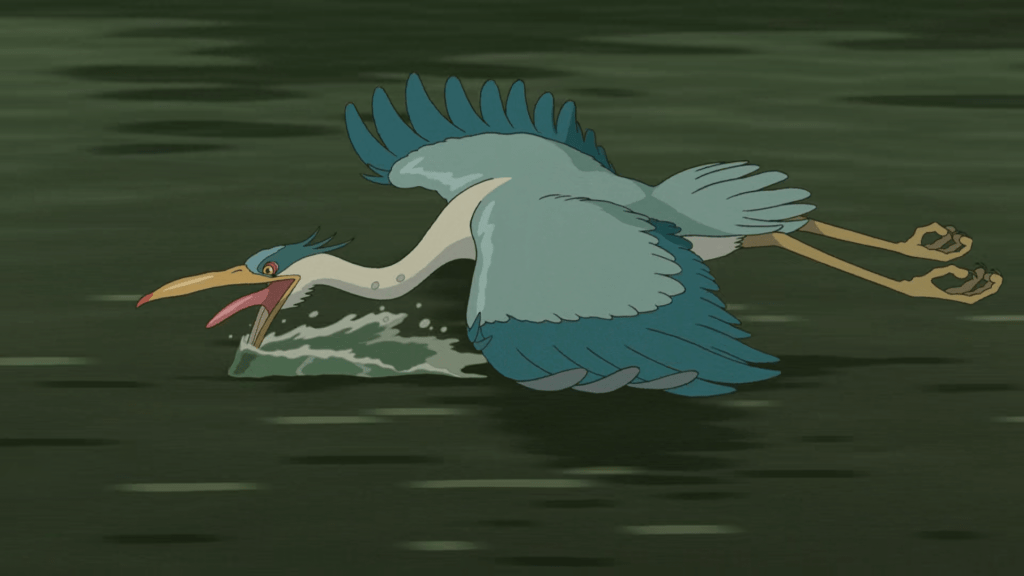
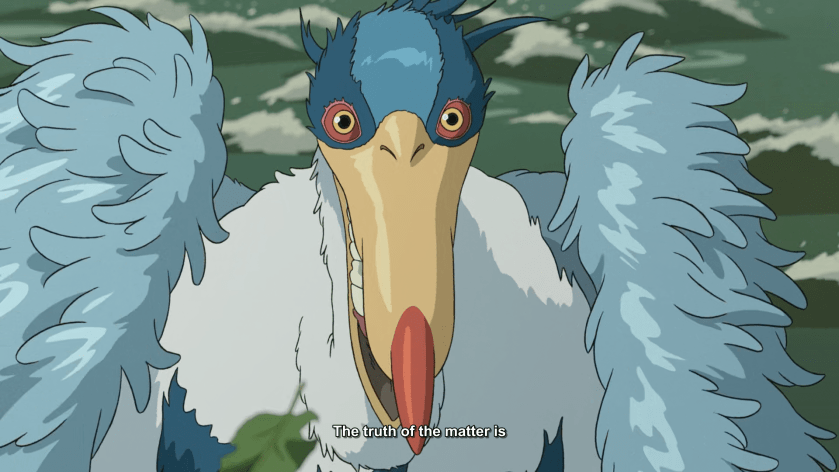
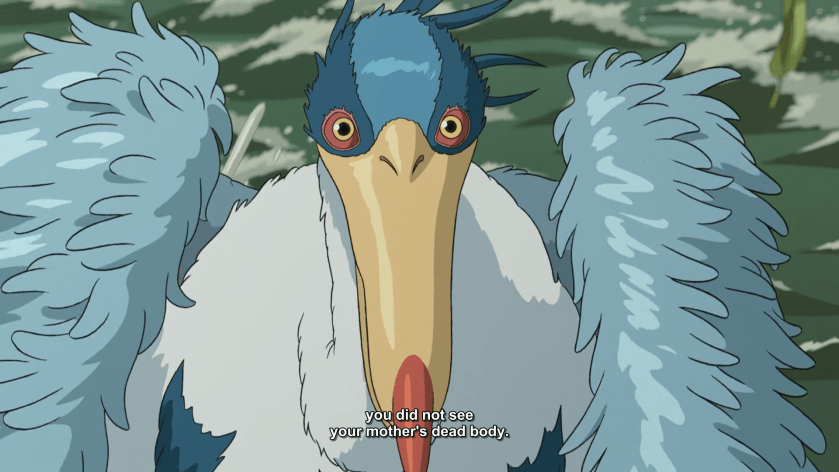
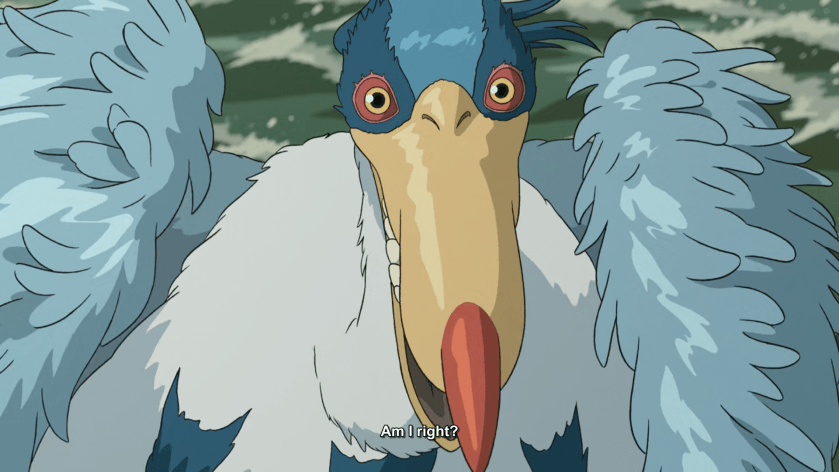
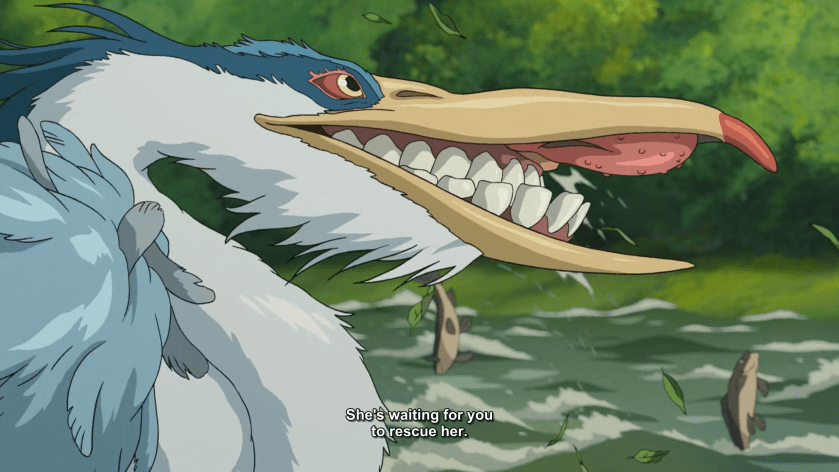
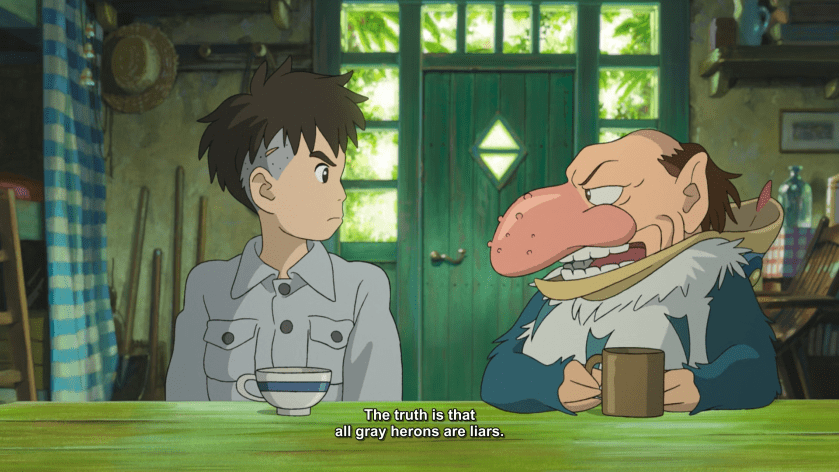
The grey heron is Mahito’s mind personified, his conscience. Heron is always guiding, helping Mahito. Mahito has this feeling that his mother is alive somewhere because he never saw her dead body. Heron attracts, teases Mahito using same understanding. Somewhere in a hidden corner of Mahito’s mind he thinks that there is still a chance to save his mother and bring her back. He is just looking out for an opportunity. Heron teases this opportunity to Mahito.

Heron like every person’s mind is paradoxical in nature. Heron is equivalent of Jiminy Cricket from the story of Pinocchio.

Most of the events between Mahito and the grey heron are Mahito’s dreams until he personally enters the tower where all his emotions can be accessed physically. That is where he is able to get the hold of the Heron, that is where the power of the seventh feather is functional, because Mahito has heightened awareness and access to his emotions.

The illusion of his mother in bed is a reminder to Mahito that she only exists in his dreams not in reality.

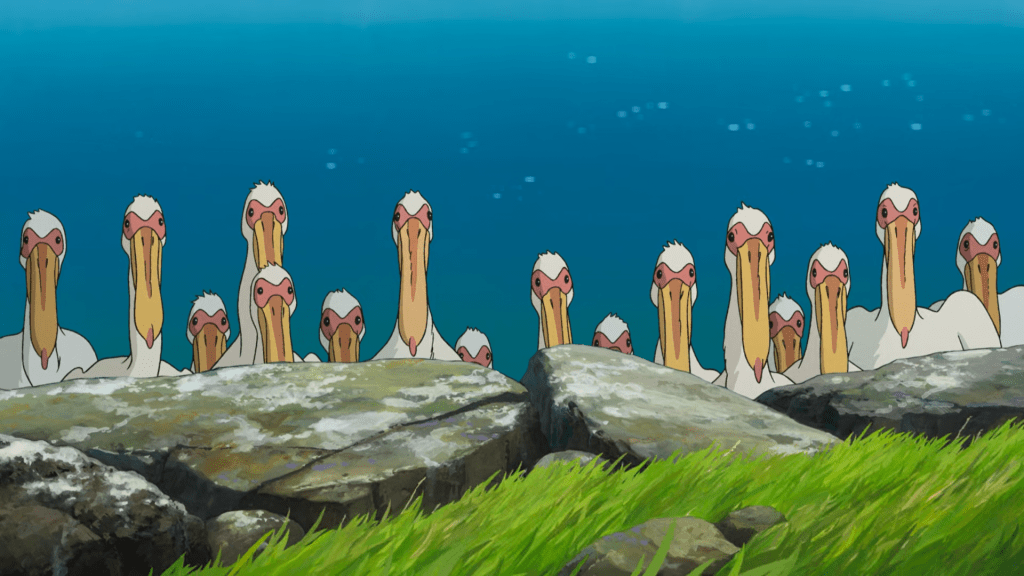
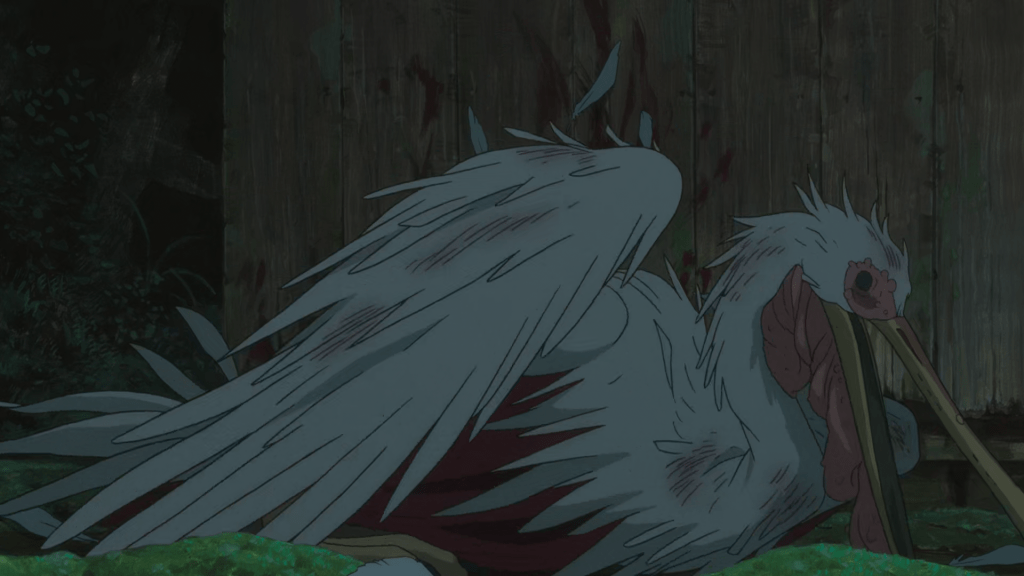
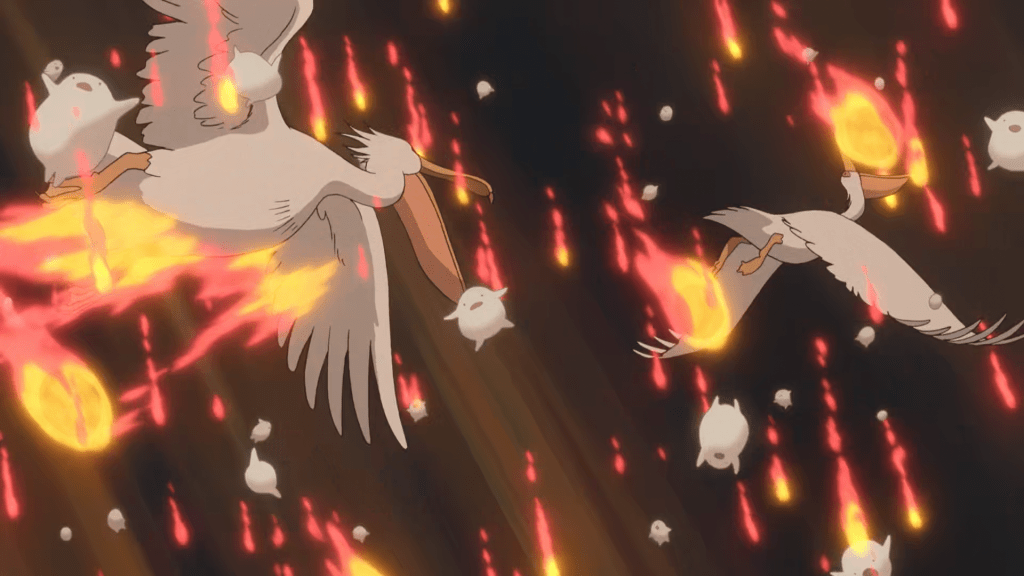
The starving Pelicans are the feeling one gets when they realize that they won’t be loved in the ways and to levels they used to before because of the loss of loved ones. These feeling to be loved, the huger to be loved by that person pushes the person to meet his loved one in afterlife. You will see the pelicans pushing Mahito in graveyard so that he can meet his mother. Pelicans are his feelings from the void of love which are pushing him to die to meet his mother in afterlife.  

Kiriko saves Mahito from his urge to die, maybe she has done same to Himi in past too. The mark left on Kiriko’s head by swamp thrasher is intentional creation to make Mahito comfortable. The fact that they both share some common pain brings comfort to Mahito. The thrasher bird is a symbol of self-reflection, it is like upon getting settled and being calm Mahito realizes that dying is not the solution to meet his mother – Himi.

Warawara and the phantoms are the attempts of great grand uncle to show everyone entering this world that life and death are part of existence. The person must accept and will have to support both, feed both to ensure that the reality remains ‘real’.

The event of giving proper burial to the dead severely injured pelican is Mahito’s acceptance to detach himself from the urge to be loved by his dead mother. This is him making amends with death and urge of being loved.

The moment Mahito accepts the weird and paradoxical nature of heron is the moment when he gets a clear direction to meet Natsuko. He literally repairs his conscience to get the clarity.

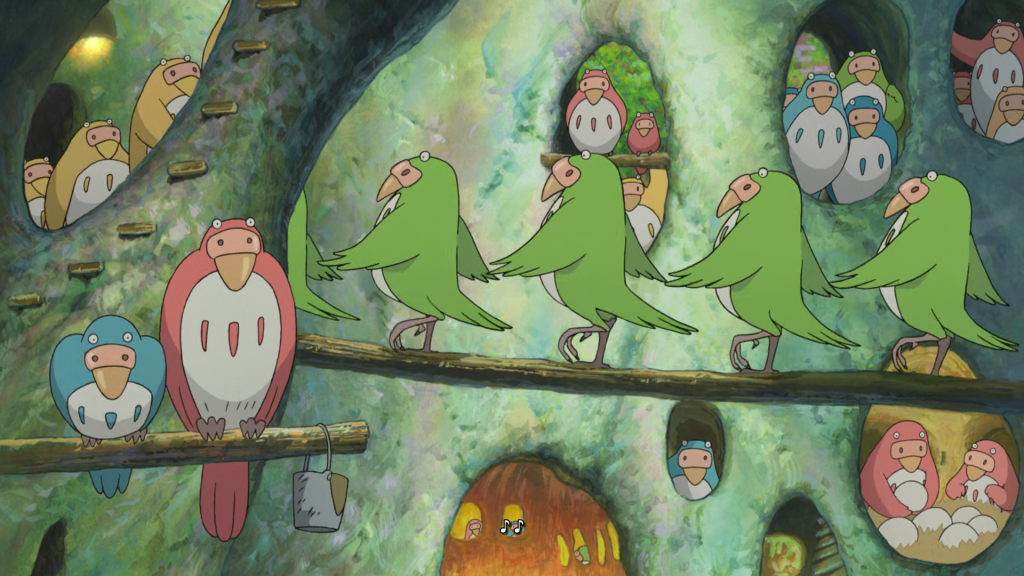
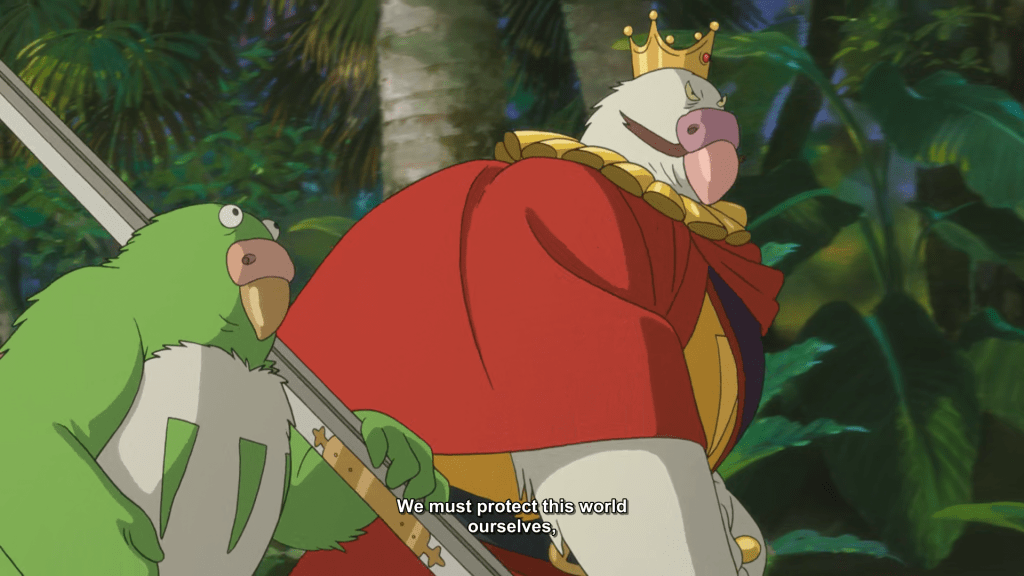
The Parakeets are the defense system of mind. They are the logical emotions, feelings that we use to defend from the sad feelings, they make sure that the system of our mind remains intact. Parakeets are the indicators of love and colors in life, when we are deeply saddened these emotions of love and colors become intense, defensive to save our mind. Here in the extreme case, they have become so strong, disciplined, and militarized that they are ready to consume their own host – Mahito. Parakeets show life, colors, happiness, anti-sad emotions, and the defense mechanism to create good for everything. That is why they have rules, moral values – the indication of what is allowed and what is not for the betterment of the host. They make sure that the person remains sane by choosing what is best for him instead of getting overwhelmed by all other emotions.

Parakeet king is the ultimate personification of such defense mechanism, he just wants to make sure that the world inside the host’s mind remains intact otherwise the host will go mad, this world will collapse.

The important conflict Mahito must resolve is to find his mother. Where the great grand uncle gives him the test. You should appreciate the role of great grand uncle in this whole narrative. The very first time when Mahito is inside the tower with Kiriko, the great grand uncle could have immediately met him and resolved everything in his mind.

But he makes Mahito to go through whole journey because you cannot force any emotion on the person just by telling the truth. His/ her defense mechanism will strongly and willfully reject that truth. Only when that person will go through personal experience, then only he/ she can appreciate the value of truth. Uncle thus gives Mahito this final test of truth once he overcomes the obstacles in his mind.

Mahito is given the taste of truth by showing him that even though he could not save his mother Himi he can now save another mother Natsuko. This is the Natsuko who enters the portal with a feeling if she would ever truly be able to love Mahito while having her own baby. This is conflict resolution for Natsuko too. She develops true love for Mahito when Mahito lets go of his attachment to mother Himi to save Natsuko because he doesn’t want that to happen again. And Natsuko also realizes that it’s her loving sister’s son in the end who deserves the same love like her coming baby deserves.

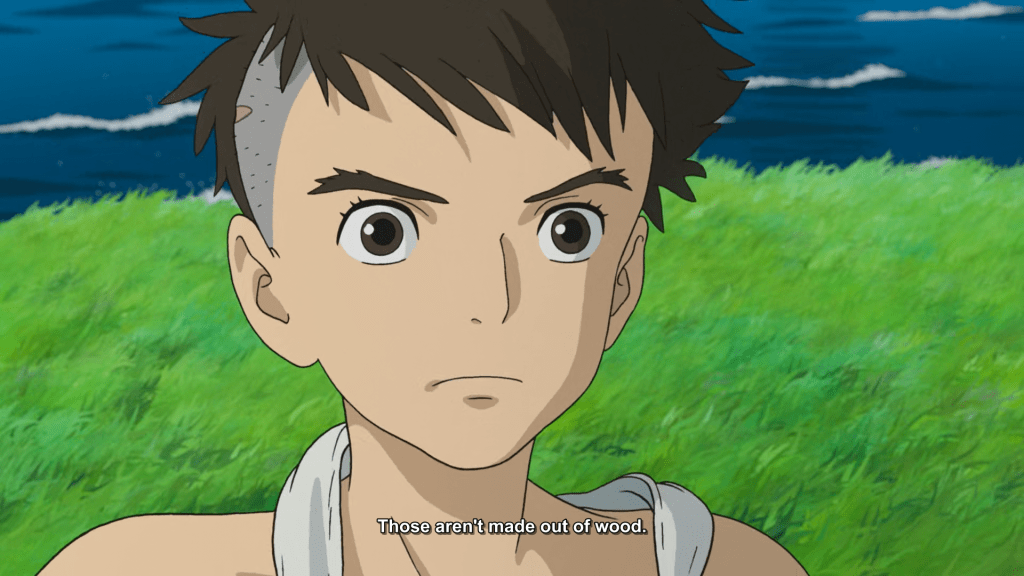
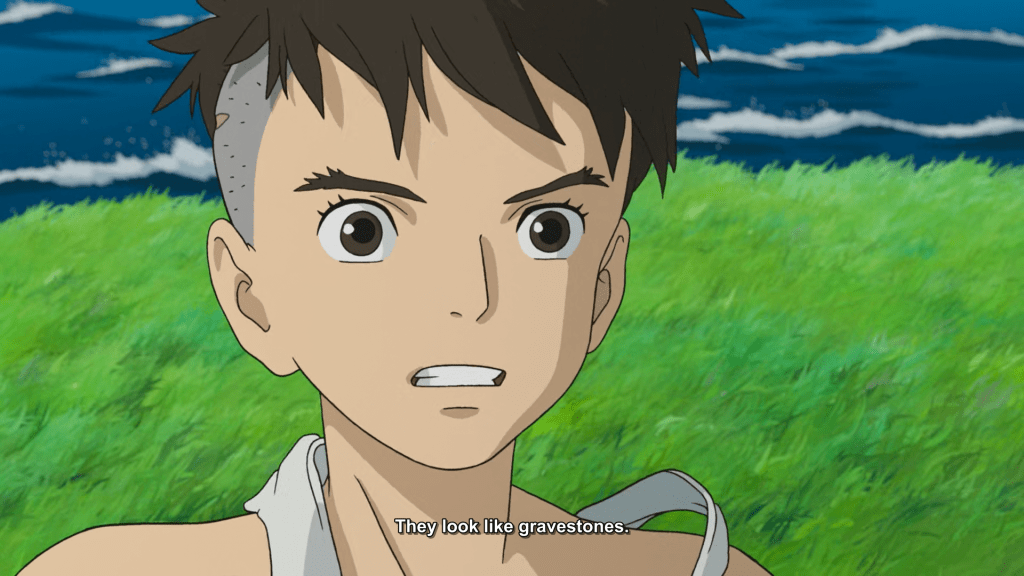
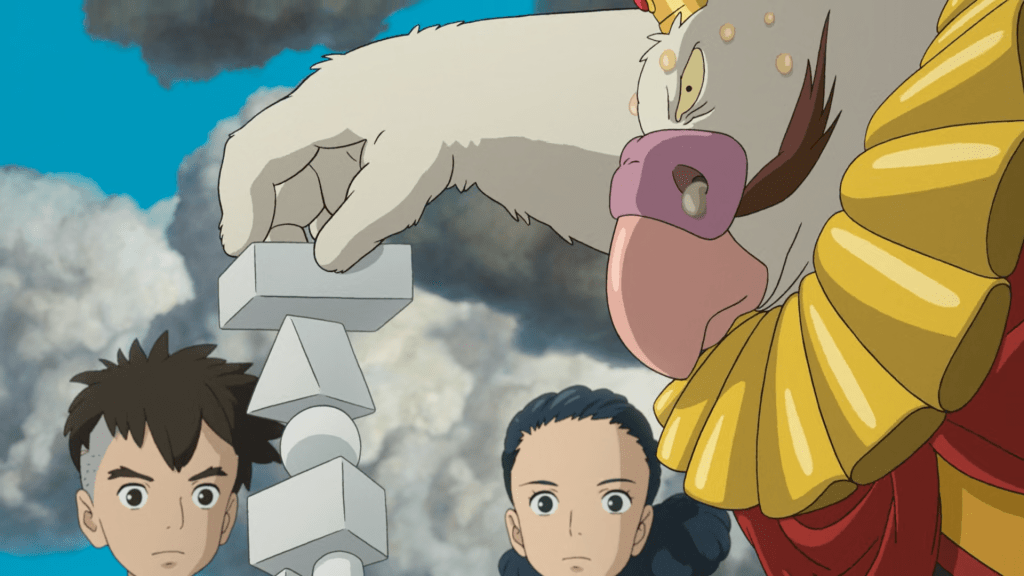
Only upon the resolution of this conflict when Mahito gets the access to the portal to meet the great grand uncle. 13 grave stones are the 13 movies created by Hayao Miyazaki-san. Which arranged in many styles create different world. They create an escape to different reality where people can manifest and physically live their dreams. For uncle these 13 gravestones are the purpose of his life, they define who he is and are his legacy. Great grand uncle asking Mahito to arrange these 13 gravestones is Miyazaki-san’s way to order his son Goro-san to carry his legacy in the exact ways Miyazaki-san intended. Mahito noticing the difference between wooden blocks and the gravestones is an indication that his life interests do not lie there, wood here as a part of tree – the life against the gravestones show that this is not how Mahito would live his life.

As a punishment uncle sends Mahito to parakeets. Parakeets are the structured constructs, rule, laws which ensure that the world has order even though the person may hate them. Goro Miyazaki-san chose the career of an architect because he wanted to do something different from his father. Hayao Miyazaki-san asked Goro-san to create artistic movies exactly in his “Ghibli” style but Goro-san’s artistic creations never matched the Hayao Miyazaki-san’s Ghibli vibes. It’s like his creative powers were restricted due to the parakeet like strict construct, high expectations and extreme criticism of Hayao Miyazaki-san. The great grand uncle had some hope that Mahito will accept what he wants him to appreciate.   

Mahito’s own conscience – the Heron comes to rescue him in the end. Grand uncle asks Himi to leave this world and also tells that Mahito should also leave with her. He is hoping that there is one more chance to convince Mahito to take care of what he had created. When Mahito and Himi meet the great grand uncle to bid goodbye the uncle presents Mahito some stone without malice. It is uncle’s attempt to show Mahito that even though his creations have their challenges, rules, restrictions Mahito still has freedom to do anything with these new stones free from Malice. It’s uncle’s attempt to convince Mahito to not lose the grip on the legacy. It is Hayao Miyazaki-san’s desperate way to reconvince his son Goro-san that he just needs to create for the studio Ghibli by using some new things – new experiments but just keep studio Ghibli alive. He wants Goro-san to create so that the world of Ghibli will bring bounty, peace and beauty into people’s lives. It’s not just a selfish request for continuing the legacy. It is a request to maintain the core of his legacy – Miyazaki-san’s legacy.

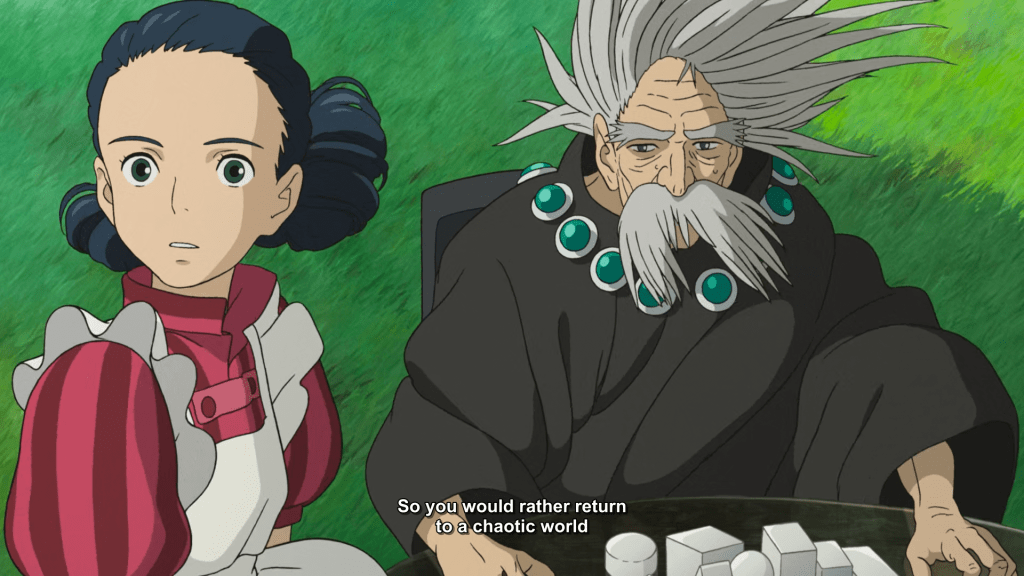
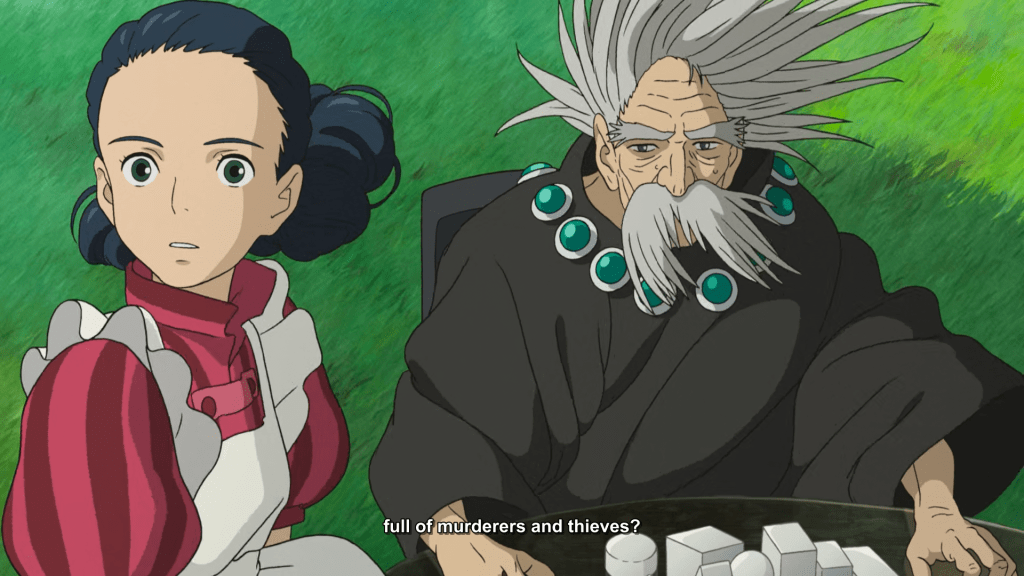
Mahito responds to great grand uncle by saying that he has his own challenges, his own malice, his own limitations which make it difficult to carry this legacy. Mahito wants to return to his own real world even when it has some darkness, bad things. When uncle asks him that Mahito’s reality is a chaotic world full of murderers and thieves Mahito responds by showing that he has good, caring, and loving people along with the heron – his conscience to support him there.

This is also important moment for Himi where she is relieved that even when her son will lose her, Mahito will have enough support system to take care of him. This is one more reason for young Himi to return happy to her reality.

Uncle then ordering Mahito to just stack the stones for last time would be equivalent of the discussion happened between Hayao Miyazaki-san and Goro-san on the creation of one last project for Miyazaki-san’s peace of mind. Maybe Miyazaki-san just like the great grand uncle wanted to play a trick on Mahito – Goro-san to convince him to continue the legacy.

Finally, the Parakeet king trying to arrange the blocks by himself is the futile attempts of the admirer of great grand uncle’s creation to ensure their own survival. But as there is no personal connect between them, the Parakeet king doesn’t know the ‘art’ of arranging the stones. When the attempt fails and the world collapses as the great grand uncle had already expected, he instructs everyone to leave the tower and return to their respective reality.   

You must appreciate that there would have been a proper intimate discussion between Hayao Miyazaki-san and Goro-san on how to take over this legacy and continue the future of studio Ghibli. Rearrangement of 13 blocks shows advice to use the styles and ideas of Hayao Miyazaki-san’s movies to create further new stories.

The resolution of Mahito returning to reality is Hayao Miyazaki-san’s way to show that the path has already been chosen and good thing is that it is more real than anything possible. It could be ugly, full of malice, murderers, death, grief and detachment but is far better than dreamy and perfect world. Looks like Goro-san successfully convinced his father Hayao Miyazaki-san that his father’s reality of Studio Ghibli is not the only reality, only legacy which deserves to exist. Hayao Miyazaki-san also realized that if he truly loves his son, he would let him go on his own path, to create his own art. Just because he is too attached to his creation does not entitle his son to carry it forward, especially as a burden.

It’s poignant to come to this fact but it is what it is. That also doesn’t stop either Hayao or Goro-san to create the world they want. (there is a rumor that Miyazaki-san is working on his next film.)  

The Curse of the Intangible Value of an Artistic Creation

For any true artist, it is the expression through creation which matters him/ her the most. The art they create is exactly who they are, it is a part of who they are. For such artist who has realized that they will have to leave all this creation behind in the end, search for the true successor who can appreciate their creation is crucial.

And the problem with artistic creation is that they are very intimately connected to the person who created them – the artist. It’s like the bond of a mother and child – she has carried that child for 9 months in her belly, it’s a piece of her body and soul. In similar sense, that art held its root in the artist’s mind and the artist kindled it in his mind to finally bring it into the reality. The fundamental problem with emotions is that you have to pass through those feelings to appreciate them in true sense. You can intellectualize other person’s emotions, write about them, create narratives/ stories out of them. You can make philosophies about how and why people have certain emotions, why they feel sad, happy, melancholic. You can also simulate pain to induce the feelings of emotions in a person, you can simulate happiness by triggering certain chemicals and suppressing others. But, you must accept that unless and until you yourself don’t pass through that real-life emotional experience, you will never be able to appreciate and understand how others felt when they had similar feelings. You can be highly empathetic, sympathetic but they too are bound by the limitations of you own mind. You can be a highly intellectual person who has already figured out what action would lead to what emotion, what is good for your mind, what is bad for you, you may create a whole internal defense system to handle the anticipated emotional responses but the experience you will have when you pass through that emotion will be very personal and the art created after the passage through such emotions cannot be attributed to any tangible value.

Now think of handing over such a creative legacy to you descendants. You are confident about this handover to your children because they are your immediate physical extension and if you are lucky then maybe your immediate mental extension too. But, as I already clarified in previous paragraph about the curse of intangibility, the intangible subjectivity of any artistic creation, there is no guaranty that you descendants will resonate with what you believed that art to represent.

It feels cruel to realize this fact but believe me it is the reality. Others, especially the people you call yours are not entitled to appreciate the things exactly to the levels you appreciate. I agree that they should at least not disrespect it but you can never force other people to appreciate ‘your’ valuable things at your exact same level. This journey has to be made solely by themselves which will never be in your control. You may force them, influence them, punish them- abuse them mentally, physically but you cannot force others to generate the same respect, same value for the things you love. It’s purely an internal and voluntary journey.

That is why having people who resonate with how you appreciate certain common objects and common emotions is a blessing. This also does not mean that people who perceive something different for the same objects are bad. There can be cases where they perceive something even better than what you perceive and where they do not even care but that’s not your fault. In order to find clarity in these cases you have to accept that emotions are double edged sword. It will cut both ways. Even when you have anticipated, planned, intellectualized them, you cannot escape your emotional responses. What you can do is to observe them sincerely and let them pass. You are not your selective emotions; you are above them. Emotions are not your creator rather you are the creator of your emotions. The moment you accept this you will see the truth that not everyone, not even your own blood is bound to experience the life around you in the exact ways you want them to. The moment you will appreciate what I am trying to put down in words, I think you will feel liberated. Please understand that this is not just about any artistic creation, it is about everything you call your life – mental, physical, tangible, intangible. To live a life with this intensity could be a blessing (on personal level if this intensity is not anticipated well in advance or not controlled then it is one cruel curse to carry.)

I think this is exactly what Hayao Miyazaki-san was struggling with. But as the movie resolves I think there is still hope for him, for the studio and in the end for all of us rooting for his next movies. It definitely is not a sad ending and even if it is a sad one we know what great things they made us feel about ourselves, how they gave us better perspectives towards life. I think that his true legacy is all his admirer, we people altogether whose lives he changed through his creation. Even though his movies won’t be there, what they have made us feel – that legacy of having a perspective towards life will keep on affecting new generation through us.   

To be honest, for me it’s a love letter of a father to his son who doesn’t want to follow his father’s legacy and wishes to go on his own journey.       

The Father Son – Hayao Miyazaki and Goro Miyazaki

  • All movie scenes from Studio Ghibli – Hayao Miyazaki’s movie The Boy and the Heron

The Book of Five Rings – The Fire Book

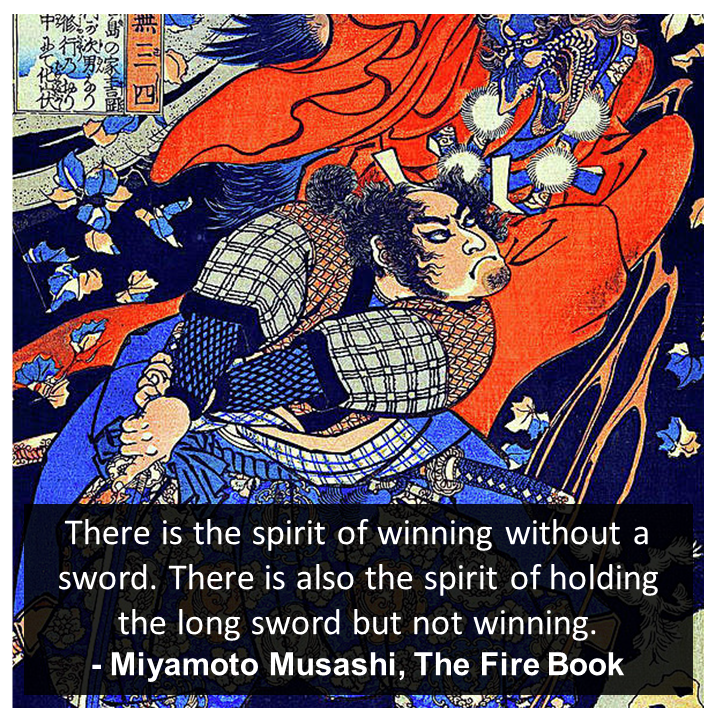
Miyamoto Musashi’s ‘The Fire Book’ from the Book of Five Rings focuses on detailed one-to-one combat strategies and warfare tactics. But, it is not limited to enemy warfare and combat. The Fire Book dives deep into the true grit, the consistency and the perseverance required to fight and win the greatest battle – the battle of life, the battle of survival.

Miyamoto Musashi’s philosophy for 21st century

Miyamoto-san in his ‘The Fire Book’ amongst the Book of Five Rings explains in detail about combat and war tactics. We already saw how he explained the importance of fundamentals, importance of managing skills and resources in the Ground Book; the importance of habits, behaviors, small steps and fluidity in the Water Book. The Fire Book explained hereafter is about the fierce attitude of living a life full of challenges. Although, initial reading gives the impression of clear fighting instructions but do not get fooled by the limited words/ sentence choices of Miyamoto Musashi. As he has already explained in the previous books, the reader has to see greater ways in the limited knowledge Miyamoto-san has presented in these books.

As the name goes, it is about keeping that fire of fierceness in you alive until you win your fight. On surface, it may seem like a set of clear instructions to adopt and implement combat and war strategies but it is important to understand that this is the wisdom to win the battle of life, battle of survival which the ultimate fight for every person.

By using only their fingertips, they only know the benefit of three of the five inches of the wrist.”

Miyamoto-san make the readers aware that how some people think that they can achieve everything when they know some set of the techniques. He wants readers to appreciate the vast expanse and extents of the true wisdom. He expects everyone to not cling to their favorite techniques only. Miyamoto-san thus highlights the fact that one should strive to understand and imbibe anything and everything that is there to know in order to perfect the art of survival. This is only possible when one has urge to deep dive into the things happening around them. Miyamoto-san in some sense, abhors the superficiality of learning process and knowledge involved in it.

“In my strategy, the training for killing enemies is by way of many contests, fighting for survival, discovering the meaning of life, learning the Way of the sword, judging the strength of attacks and understanding the Way of the “edge and the ridge” of the sword.”

There is no single and only way to your goal. Going into the depths of the techniques gives the real advantage over the enemy and also in your own development. 

“You cannot profit from small techniques particularly when full armor is worn.”

When you are at some disadvantage, only one technique won’t help. You need to have multiple skill set to confirm your victory.

Any man who wants to master the essence of my strategy must research this diligently, training morning and evening. Thus, can he polish his skill, become free from self, and realize extraordinary ability. “

Becoming ‘free from self’ actually refers to overcoming the physical limitations one has as a person, as a human being.

Then one by one Miyamoto dives deep into each and every combat technique and explains wherever required. As already seen in his previous books the Ground Book, the Water Book, Miyamoto-san always instructs readers to study and explore the wisdom presented on their own level and words will fail to explain the intricacies of the wisdom.

  • Depending on the Place

Stand in the sun; that is, take up an attitude with the sun behind you. If the situation does not allow this, you must try to keep the sun on your right side. In buildings, you must stand with the entrance behind you or to your right. Make sure that you rear us unobstructed and that there is free space on your left, your right side being occupied with your side attitude. At night, if the enemy can be seen, keep the fire behind you and the entrance to your right and otherwise take up your attitude as above. You must look down on the enemy, and take up you attitude on slightly higher places.

For what is written here, the idea is to clear the corners while entering any hostile environment. Taking the light source behind gives clear advantage of not getting overwhelmed by the intense light thus immediately giving you an edge over the enemy’s attack. It will be difficult for the enemy to understand your strokes if he is already overwhelmed by the intense light behind you. Furthermore, keeping the dominant side – right side ready for attack with space on the left will help to execute clean cut, clean attack. Keeping entrance to the right will help to counter the surprise attacks. Remaining on the top means always try to have as many as possible updates about the enemy moves. Top location will also help to plan surprise attack on the enemy.

When the fight comes, always endeavor to chase the enemy around you left side. Chase him towards awkward places and try to keep him with his back to awkward places.”

Keeping enemy on the left will help to strike with dominant hand effectively. Miyamoto-san very smartly instructs to get the enemy in awkward corners where his attacks, blows will definitely fail thereby crushing his confidence.   

“In houses chase the enemy into the thresholds, lintels, doors, verandas, pillars and so on, again not letting him see his situation.

  • Three Methods to Forestall the Enemy – 1) Ken No Sen 2) Tai No Sen 3) Tai Tai No Sen

Miyamoto-san very clearly establishes that when you will be in a combat there are only three possibilities. Either you will strike first or your enemy will strike first or you both will strike simultaneously. There is no other possibility. The idea is to forestall – to intentionally slow down and confuse enemy so that he can be dealt with easily. Miyamoto-san focuses on these ideas because one can win quickly by taking the lead. It’s like the first mover’s advantage.

Ken No Sen means to set the enemy up.

  1. When you attack the enemy first, make sure that you have one more intent to strike next- which is called as ‘reserved spirit’ by Miyamoto-san. Your first strike will be powerful but the next reserved strike will overwhelm your enemy, thereby crushing his confidence. 
  2. Or strike continuously to crush the enemy
  3. Or strike with a strong intent for once

The idea is to not let the enemy think of attacking you next, to overwhelm him

Tai No Sen means to wait for the initiative i.e., to let the enemy attack first. 

  1. When enemy attacks first, let him think that you are weak. Let him know that you don’t want to pursue this fight. When he becomes sure of such attitude from you then strike strongly on the moment the enemy relaxes
  2. Or when he attacks at first, counter it with even more strength thereby disturbing his rhythm and crushing his main planned intentions

Tai Tai No Sen means to accompany him and forestall him

  1. When enemy instantly starts attacking don’t stall in thinking the right attack; just attack strongly and then look out for the weak spot to attack
  2. Or if enemy is equivalent to you then let go with the flow. Accompany him to understand his movements, timings – float with him. When the rhythm is set then attack him strongly.

The intention to specially focus on these techniques is because, Miyamoto-san thinks that once you forestall the enemy it instantly crushes his spirit thereby making victory quick and possible.

  • To Hold Down a Pillow

This means not allowing enemy’s head to rise.

Miyamoto-san establishes that it is bad for you if the enemy leads you, controls your moves. In order to win you must always lead on either side. On one side, you will lead your people to correct moves and on the other side you will lead the enemy by promoting his mistakes.   

The important thing in strategy is to suppress the enemy’s useful actions but allow his useless actions.

There is one more beautiful line where Miyamoto-san plays the game of words to convey his message to the students.

The spirit is to check his attack at the syllable “at…,” when he jumps check his jump at the syllable “ju…” and check his cut at “cu…”

Simply meaning that if you see something wrong happening with you, make sure that you do something before it comes to its fruition, its completion. Try to predict things and get ready to respond at the moment they happen in a combat.

  • Crossing at a Ford

Miyamoto-san explicitly wants to give a life lesson here. He used the analogy of the vast sea and one’s journey through it. Even though you have your friends at harbor, even though you are aware of the travel routes, condition of your ship, you should go out to explore the expanses of the sea. The conditions will not be favorable sometimes but you should try to defeat the vastness of the sea to achieve that which nobody has achieved yet.

The vast sea can be easily crossed by crossing area where it narrows the area called “a strait”, “a ford”. “The ford” is the weakest, narrow part of the vast sea.

Similarly, when in combat against a far superior and stronger enemy, don’t focus on his capabilities rather focus on your capabilities and try to cross at his weak point by using your strengths.

If you succeed in crossing at the best place, you may take your ease. To cross at ford means to attack the enemy’s weak point and to put yourself in an advantageous position.

  • To Know the Times

The idea is to understand the mentality, the nature, the habits or the way of thinking of the enemy and his people. When you will understand how the enemy involuntarily behaves, responds, then it becomes very easy for you to gain the advantage of the predictability.

Even in duels Miyamoto-san urges to identify the fighting style of the opponent during the act of forestalling. Once his school of style is known, you can easily take over on his weaknesses. The nature or the habits of the enemy are the involuntary clue that even the enemy himself cannot control and they are the mirrors of his intentions, so the idea is to understand his intentions, find weak spots in them and attack there.

If you are thoroughly conversant with strategy, you will recognize the enemy’s intentions and thus have many opportunities to win.”

  • To Tread Down the Sword

The spirit is to attack quickly while the enemy is still shooting with bows and guns.”

Miyamoto-san very cleverly gives a warfare strategy here. When the opponent first attacks with the bows and arrows or with the guns and cannons, you should not waste your time in drawing the arrows or filling the barrels with gun powder to counterattack. Instead, you should react instantly treading down i.e., use your brute force to avoid your confidence from going down. If you waste your time in drawing the arrows and filing the barrels, most of the damage would already weaken you in the process. Treading down means using the swift reacting forces, you have to not let enemy come up with second attack. If he is unable to come up with second attack then definitely, he will count his first successful attack only as a lucky one and will start doubting himself already. 

You must achieve the spirit of not allowing the enemy to attack the second time this is the spirit of forestalling in every sense once at the enemy you should not aspire just to strike him but to cling after the attack.”

  • To Know “Collapse”

Everything can collapse – houses bodies and enemies collapse when their rhythm becomes deranged.”

The idea is to spot the chaos among the enemy and let that chaos increase further to defeat him without investing many resources and efforts.

Fix your eye on the enemy’s collapse and chase him attacking so that you do not let him recover.”

  • To Become the Enemy

Becoming the enemy is not only about thinking the way enemy thinks. Miyamoto-san wants the students to understand that if you see yourself as something you become that thing. So even if the enemy is practically strong and if you let yourself convince that you cannot defeat him then, surely you won’t be able to defeat him.

So, it is about your mindset to defeat the enemy.   

He who is shut inside is a peasant, he enters to arrest is a hawk.”

It is also one way to say that any type of confidence is good confidence in modern and more relevant sense.

“In large-scale strategy, people are always under the impression that the enemy is strong so tend to become cautious. But if you have good soldiers, and if you understand the principles of strategy, and if you know how to beat the enemy, there is nothing to worry about.”

Becoming the enemy is about considering the whole world against ourselves and then using all that you have to win over the world. It is a strong personal advice from Miyamoto-san.

If you think here is a master of the way who knows the principles of strategy then you will surely lose.”

  • To Release Four Hands

To release 4 hands is used when you and the enemy are contending with the same spirit and the issue cannot be decided abandon the spirit and win through an alternative resource.”

When you realize that the enemy you are fighting is exactly you or equivalent of you then think out of the box. Do things which you won’t do normally. Such abnormal and creative ways of attacks will break the rhythm of your equivalent enemy.

Immediately throw away the spirit and win with the technique the enemy does not expect.”

So, “releasing four hands” is the indication to create some unfair advantage through unconventional practices.

We must defeat the enemy by changing our mind and applying a suitable technique according to his condition.”

  • To Move the Shade

When you cannot see the enemy’s position, indicate that you are about to attack strongly to discover his resources. It is easy then to defeat him with a different method once you see his resources.”

This is one cunning and smart advice by Miyamoto-san. When you are unable to gauge the moves of the enemy or the enemy himself doesn’t want to leave any traces, you should create some fake opportunities of victory for the enemy so that he will expose all his capabilities to you. Once he is lured into such fake victories then you can gauge the strategies and plan a worthy surprise counterattack secretly.

  • To Hold Down a Shadow

When the enemy embarks on an attack, if you make a show of strongly suppressing his technique, he will change his mind. Then altering your spirit, defeat him by forestalling him with a Void spirit.
The idea is to embarrass the enemy if you are going for a strong counterattack. This saves you resources in next attack because the enemy would never come out to counterattack because of the embarrassment.

  • To Pass On

Miyamoto-san makes a very smart observation on some involuntary human habits like sleepiness, yawning. These can be passed on human to human. Even today’s neuroscience agrees that these are the habits which are easy to pass on because of the herd mentality, group behavior of humans.

Miyamoto-san advises as follows:

Make a show of complete calmness and the enemy will be taken by this and will become relaxed when you see that this. Has been passed on you can bring about the enemies defeat by attacking strongly with a Void spirit.

The idea is to pass on your careless, weak attitude on the surface to your enemy and once he is relaxed the bring out you real fierce attacking inner spirit to defeat him.
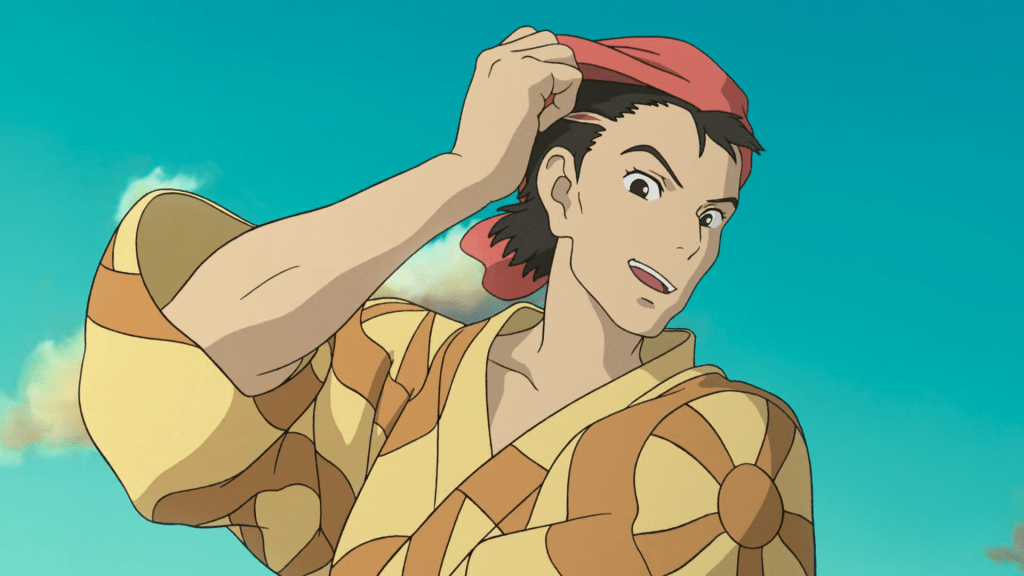
  • To Cause the Loss of Balance

Without allowing him space for breath to recover from the fluctuation of spirit you must grasp the opportunity to win.”

In simple words, not giving an opportunity to recover the enemy from last attack. The enemy can be made to lose his balance by bringing in danger, creating difficulties and bringing in the surprise. Miyamoto-san speaks here very clearly as an experienced and seasoned teacher.

  • To Frighten

“Fright often occurs, caused by the unexpected.”

Miyamoto-san knows very well about the basic human mentality. We don’t like uncomfortable situations. The enemy’s confidence, spirit can be easily crushed by making him uncomfortable, by scaring him. Scary, unnerving, unsettling and panicky battle cries/ battle drums/ battle horns are one great example of that.

  • To Soak In

When you have come to grips and are striving together with the enemy and you realize that you cannot advance you soak in and become one with the enemy.

It is simply remaining in touch with the enemy to understand his moves. The moment you draw apart from your enemy, you will lose the advantage of the predictability.

  • To Injure the Corners

“It is difficult to move strong things by pushing directly so you should injure the corners.”

When the enemy is big in size and strength, the best way to start is to injure his corners as in his extended and weak parts. Once you bring down his morale then, even the big things will collapse down.

“In large-scale strategy it is beneficial to strike at the corners of the enemy’s force”

In the same sense if the opponent has strong army, start attacks from the most beneficial and weak spots, facing the initial defeats from such “corners” can bring down the spirit of the remaining strong forces.

  • To Throw in Confusion

Victory is certain when the enemy is caught up in a rhythm which confuses his spirit

Creating confusion is all about not letting enemy think that he has understood you. When he will be confused about your intentions, he will be less focused and then it will be easy to take him down. Miyamoto-san smartly establishes this idea for both one on one combat and a large-scale war.

Feint a trust or cut or make the enemy think you are going to close with him and when he is confused you can easily win.

  • The Three Shouts

Earlier Miyamoto-san suggested to scare the enemy with voices. He again highlights how voice can be incorporated into the fights to create rhythm. He divides the shouts in three seemingly obvious but smart by implementations as shouts before, during and after.

“The voice shows energy

The attitude you want to present to the enemy can be easily demonstrated to the enemy simply just by your shouts instead of deploying valuable assets and resources into the battle or fights.

Shouting before the fight creates the rhythm, shouting during the battle in low pitch projects the effectiveness of our attack and the shouting at the end of the war can build instant morale boost and an escalating defeat of the enemy due to downgrading spirit.

  • To Mingle

Mingling is all about sticking and advancing into the enemy forces. If you are continuously stuck with the enemy forces and see that they are defeated at certain position then you attack their remaining sides with same strength thereby making space to advance through them. Once you see crushing at a location you build upon that to advance ahead.

What is meant by mingling if the spirit of advancing and becoming engaged with the enemy and not withdrawing even one step.

  • To Crush

Crushing is all about not giving even single opportunity to the enemy to recover from the last attack. When you sense his ultimate weakness getting exposed then crushing will ensure the last blow to get the victory in the battle.

When we see that enemy has few men or if he has many men but his spirit is weak and disordered, we knock the hat over his eyes crushing him utterly. If we crush lightly, he may recover.”

  • The Mountain-Sea Change

The mountain sea spirit means that it is bad to repeat the same thing several times when fighting the enemy there may be not hell but to do something twice but do not try it a third time.”

Miyamoto-san knows that every person, every fighter has preferences, comfortable, favorite moves. Playing such moves again and again can make the person predictable thereby vulnerable. He thus wants the warrior to demonstrate the spectrum of moves, moves of contradictions to effectively confuse the enemy.    

If the enemy thinks of mountains attack like the sea and if he thinks of a sea attack like the mountains.”

  • To Penetrate the Depths

If his spirit is not extinguished, he may be beaten superficially yet undefeated in spirit deeps inside.

Miyamoto-san very well knows the psychology of revenge and coming back with more preparedness to avenge the last fight. Thus, he wants the warrior to not only physically defeat the enemy but also to defeat them in their minds. 

“Penetrating the depths means penetrating with the long sword penetrating with the body and penetrating with the spirit.”

This shows how Miyamoto-san is serious about the mindset of warrior. He knows that you can easily defeat an enemy physically but if he is not defeated in his mind then surely, he will rise up again with possibly stronger counterattack.

If the enemy remains spirited it is difficult to crush him.

  • To Renew

““To renew” applies when we are fighting with the enemy and entangled spirit arises where there is no possible resolution, we must abandon our efforts, think of the situation in a fresh spirit then win the new rhythm.”

A great teacher with strongest techniques knows that there will be chances when his pupils may stand against each other. There may be chances when exactly same great techniques will be presented in front of each other. The great and smart teacher knows that such tie-making conditions will require new ways, new perspectives of thinking.

In simple words, when one feels stuck in repetition, the best way to solve such problems is to start from something new, unconventional and out of the box ideas.

This also shows how Miyamoto-san was open to accepting the idea that even his fool-proof, seasoned techniques will sometimes be challenged with equally potent different techniques. Thus, he demands creative thinking while solving such issues which is really smart for the times and personality he was.

  • Rat’s Head, Ox’s Neck

This is about leveraging the small details to bigger advantages in warfare. History has many examples where even a seemingly small thing changes the bigger course of the warfare, battles. Miyamoto-san here, similarly expects a warrior, a strategist to think with the ability of Rat to see at small levels and use that detail to strike back with the power of the Ox’s neck. One has to appreciate how Miyaomoto-san has distilled small-small details of everyday observations into his nectar of war strategies. 

Whenever we have become preoccupied with small detail, we must suddenly change into a large spirit, interchanging large with small.

  • The Commander Knows the Troops

Using the wisdom of strategy, think of the enemy as your own troops.

Miyamoto-san explains this idea in very few words, because he wants this idea to be understood only by those people who actually have grasped the thought process behind his Way of Strategy. Miyamoto-san implies here that if you understand the troops of the enemies well, then you can direct those troops in your ways thereby saving your resources. The various ideas explained before in the Fire Book relate to the human tendencies, psyche, group dynamics, group behavior. Using this knowledge if one becomes successful in understanding the mindset of his enemy troops, then is is impossible to defeat him.

  • To Let Go the Hilt

There is the spirit of winning without a sword. There is also the spirit of holding the long sword but not winning.

Hilt means the handle – the grip of the weapon. Here again Miyamoto-san is limiting his words but the message to be conveyed is precise. He implies that having the greatest weapon in your hands does not guarantee absolute victory. You can win the fight without the weapon too. It is all about the mindset. If you have that mindset of the fierceness of the fire in your fights then, it is nearly impossible to defeat you. Don’t become too much attached to your lavish, expensive, sophisticated equipment and tools. Understand that you can be easily defeated in exceptions when you won’t have these tools. So, accept that in order to win – sometimes you may have to let go of your priced possessions. It should be always you deciding the fate of your battles and not the tools, weapons that you use to win those battles. Detachments from such tools will bring out the real fighter within you.

  • The Body of a Rock

The body of rock is implied to the feeling of not getting disturbed by what is happening around you. This mindset will not only defeat one on one enemy but will also build the attitude of fierce fire when the warrior will face thousands of enemies alone. Again, it is all about mindset.

Conclusion

Miyamoto-san in the Fire Book gives almost 27 techniques to win in a one-to-one combat, in a battle or in a long-term, large scale warfare. The consistencies of these techniques and ideas with some real-world examples and practical advises show the true scholar of Miyamoto-san.

Creating breathing space to fight aggressively, rising on the top locations in the battle places, to engulf the enemy even from small advantages, to have the ability to spread swiftly and influence immediately, to have the ability to begin again even from a small spark or embers, to remain unpredictable, to remain attached to the enemy are the tendencies of the fire. These minute behaviors of the fire are closely studied and imbibed into the real life by Miyamoto Musashi, they are the key to the Fire Book.  

You must understand why this section is called the Fire Book. Obviously as the name goes the techniques are built around the behavior of the Fire. The important thing is that everyone would have seen a fire many times in their lives but it is the observant and thoughtful mind of the warrior like Miyamoto-san who extracted the wisdom of Combat and warfare from the Fire. Please bear in mind that these tactics are still relevant in modern warfare and battle strategies.

Of course, men who study in this way thing that they are training the body and spirit, but it is an obstacle to true Way, and its bad influence remains forever. Thus, the true way of strategy is becoming decadent and dying out.

Thus, the Fire Book is about the grit, the perseverance in fighting and winning the greatest battle – the battle of life, the battle of survival.

Links for further reading:

  1. The Book of Five Rings – The Ground Book
  2. The Book of Five Rings – The Water Book
  3. The Book of Five Rings – The Fire Book
  4. The Book of Five Rings – The Wind Book
  5. The Book of Five Rings – The Book of the Void