
Part 3 – Jiddu Krishnamurti’s legacy of self-knowledge
“What do you do when you realize fundamentally or deeply that thought cannot end itself? What happens? Watch yourself. When you are fully aware if ‘this fact’, what happens?
(‘this fact’ here refers to an observation that ‘discipline’ doesn’t destroy the self, rather it strengthens it because ‘the self’ created that discipline in the first place)
You understand that any reaction is conditioned and that, through conditioning, there can be no freedom either at the beginning or at the end – and freedom is always at the beginning and not at the end.”
– J Krishnamurti, The function of the Mind
We, the humans are driven by curiosity. The curiosity to survive – to put in few words. One might say that people are driven by fear, greed, envy, anxiety, power, love, money, fame, glory, sacrifice, humility, honesty, trust, legacy, mania, chaos, terror, and what not. The list is never ending. If you start questioning the origin all such attributes, you will see that humans can be driven by anything, I mean any anything. There is no connecting link per say; the only common thing between all the things which drive people is the people themselves. So, in the last question (possibly the last one) we end up questioning ourselves. We see that along with physical survival we are highly conscious of our non-physical survival. Some may call it the mental survival, some may call it ideological survival, some may even call it spiritual survival. In the end, what we are trying to preserve is the eternal existence of our consciousness. How to preserve this? becomes the question then. That is why in final question we see that we are curious to preserve our own being. That is the ultimate survival. Whatever can facilitate that preservation is the driving force for our existence. If you are scared of something, the fear of that thing will create a curiosity to look out for the ways in which you can avoid it.
Now you will realise that the attributes which are many and driving people in different ways are highly related to the ways people think about themselves and about their surroundings. The identities, the consciousness which we are trying to preserve forever is highly the function of the society we grew up in, the religion we followed, the ideals we admired, the enemies we despised, the culture we cultivated and carried over to the newer generations.
I might be making an overstatement here-
Only those who have undergone unlearning, un-conditioning or at least appreciated the process of unlearning can clearly see how badly we are tied to our thoughts and ultimately our minds.
Death of thinking is death of mind. When they say that ideas live forever – it is also an attempt to ensure eternal survival of a certain type of mind, for mind is not a physical entity to us. Realizing the perishable nature of our body, the mind becomes the most potent entity to ensure the survival of our being.
Then, what’s wrong in ensuring the eternal survival our consciousness?
We will see how Jiddu Krishnamurti showed the reality of our existence. As I have already said, he is the perfect person at perfect time to ask the perfect question.
Short answer is – we are so tied to our minds that we can only see what our mind is conditioned to see; and the expanse of mind is so vast, that we consider the inability to gauge its limit to its infinite-ness. But, in self-observation we will see that reality is far bigger than our mind. Mind cannot be bigger than reality although it can create a perfect illusion of it being bigger than reality. When we realise how reactive our mind is, how conditioned our mind is we see that it’s the reality in which we are existing and not the mind. Mind is just a facilitator to create a sense of security. The real creativity thus begins when one lets go of their minds, thoughts and observe reality for what it is.

In Part 1, I have explained J Krishnamurti’s views on our urge for safety thereby happiness, how we use our thoughts to conveniently justify anything and everything to create that sense of safety, the ways in which our thoughts are stealing the actual reality holding multitudes of possibilities.
In Part 2, I have explained how thoughts originate, how curiosity drives them. It contains Krishnamurti’s observations on how we try to separate thinking to glorify ‘our version’ of wishful reality. Krishnamurti shows us that the moment we reject the separation of our thoughts from ourselves, that is the moment we see that we were just reactive to everything around us. We become observer of the reality for what it is, once we let go the glorification of ‘our thoughts’ – the self.
Now, we will question the very originator of the self – our Mind. Krishnamurti’s observations were revolutionary about the mind. This Part 3 will focus on that and also tie up the previous 2 parts together with it.
Existence Of The Mind – What Is The Mind?
“When you observe your own thinking, you will see it is an isolated, fragmentary process. You are thinking according to your reactions, the reactions of your memory, of your experiences, of your knowledge, of your belief.”
–J Krishnamurti, The function of the Mind
When we are truly in the territory of observation without any preconception, prejudice, we see what thoughts actually do. Thoughts just try to hook on to something that we are familiar with – it could be good or bad. Thoughts literally create a chain. One link creates sense – logic – connection to another, one train of thought after another. Then we create the whole understanding. Thinking is always reactive. Keep this in mind – thinking is always reactive. If you let thoughts build on themselves, it is amazing to observe what world we create just by our thoughts. The moment you inject certain intent, desire to this world, it immediately deviates from the reality. But, as this world of thoughts has your intent, your desire, it creates that world of safety; we don’t want to lose that familiarity, that comfort. Now as this world contains our desires it becomes our second identity. As the thoughts keep building on, you start associating these set of your thoughts as who you are. This is your non-physical identity now. You now strive to make sure that this non-physical identity lives till eternity.
After seeing this you will see that the mind is the custodian of thoughts, desires, wishes. A wish to be safe to prolong survival, desire to make that prolonged existence happier one, thoughts to support those wishes – desires. Mind is thus picking desirable ideologies, disciplines which will keep feeding the train of thoughts, the chain of thoughts. Thoughts want to ensure their own survival because we have assumed survival of our thoughts as our survival. (Keep in mind we haven’t even started the discussion about reality.)
So, mind is a sieve which keeps on separating the desirable and undesirable parts of reality. There is nothing wrong in that. What happens here which is problematic is our tendency to lean towards the desirable reality only. When mind would see desirable reality, it will start using the power of compounding of thoughts to create a wishful reality which we call as our identity – our self. We want to preserve self to ensure that things that we desire survive. Whatever is not the self, it is the others – the undesirable. The moment mind makes this separation – ego intensifies.
“Our whole tendency is to be separated. Can the mind do anything else but that? Is it possible for the mind not to think separately in a self-enclosed manner, fragmentarily? That is impossible. So, we worship the mind; the mind is extraordinarily important.”
–J Krishnamurti, The function of the Mind
Without separation, our mind fails to recognize itself. If it is not able to separate itself from rest of the things, it cannot feed the desires. If desires are not fed, we will be constantly looking cluelessly for a sense of belonging, a place of security.
Here, I see one tragedy of being human rather an animal. I will explain it:
See there is a possibility that we are free from all the desires. One can be free from all the desires of the world. So, it is a real possibility that man is free from the cage of thoughts, mind and desires and fully observant of the reality around him without any imposition or prejudice right from the birth.
What is the tragedy of every animal is that they are born with the tendency to live (otherwise how would they get in the world in first place, maybe the baby doesn’t even know what is required to survive, so possibly the sense of survival naturally gets transferred from parents to the baby). Have you seen a baby who wants to die the moment he is born? Rather the baby starts crying the moment it senses absence of parental presence or absence of security. By birth we have a survival urge. Evolution has pushed this urge in us from physical to non-physical one. As we have better chances to ensure physical survival we now care more about the survival of our non-physical version. Mind thus becomes very important, thereby consciousness becomes important. That is why if physical survival is not guaranteed, we wish that at least our consciousness lives forever. That is exactly why we praise the minds we have.
Over the time, our desires take over this mind and we then keep on conditioning it with culture, religion, society, community in a certain way. The familiarity of physical body gets further amplified in familiarity of certain way of thinking, certain religion, certain philosophy, certain profession, certain degree, certain community, certain country. The more we find ideas, thoughts familiar to ours the more we want to cling to them. The more we want to reinforce that version of self. We are always separating what reality shows in terms of whether it is favorable to us or not. That is why even if mind and consciousness seem infinite, you will observe that our thoughts have compounded in such an extreme way that we are unable to measure their limits. We have attributed this inability of those compounded thoughts to the infinite-ness of our mind.
If our mind truly is infinite then we should be able to predict the reality or at least handle the undesirability that reality may present in better ways. We all know how disappointed we are with the reality. This shows how strongly we have conditioned our minds towards certain way – that certain way we call our identity, our self, our ego.
“Until we understand how to transcend this separative thinking, this process of giving emphasis to the ‘me’ and the ‘mine’, whether in the collective form or in individual form, we shall not have peace; we shall have constant conflict and wars. Our problem is how to bring an end to the separative process of thought. Can the thought ever destroy the self, thought being the process of verbalization and of reaction? Thought is nothing else but reaction; thought is not creative.”
-J Krishnamurti, The function of the Mind
Now you will appreciate what un-learning can do to our life. It opens a completely different and real world in front of us. Un-learning is the rejection of what we assumed to be true to support our identity. Although it feels uncomfortable, sometimes completely hostile but there is no bigger freedom than the acceptance and implementation of unlearning. It is renewal, evolution of our very being.
The key point is to understand that we are not our mind, we can be bigger than our mind. That needs the rejection of the idea of self. Once we are observant of how dangerously conditioned, prejudices, favored our minds are we will see how we through the agency of our mind are twisting the reality to create the sense of security. The more we twist it, more deviated we are from reality.
And as I already explained that somehow this sense of separation and thereby self-preservation is in our genes by birth, we have to train ourselves to get rid of that sense. Keep in mind that this does not mean self-jeopardization. This plainly means that not imposing our ways on reality to create the sense of security thereby higher chances of preservation of self. That is why unlearning is extremely important.
Reactive Mind Vs Objective Reality
“Do not superimpose what it should do, how it should think or act and so on: that would amount to making mere statements.”
-J Krishnamurti, The function of the Mind
Once you think that you have full control of your mind, the mind will use this sense of its separation from you to build chains of thoughts to support itself. In the end, it all started from you. The moment you see that you and your mind are the same, you accept its conditioning. Now you have a baseline to see the reality. Now you know how your mind is bending the reality. This is the freedom, to see things as they are.
Now that we are understanding that sense of safety was the goal of everything that we are doing all along, we see that our conditioning thereby our thinking and thus our mind in the end are the reason behind all the suffering we go through. Once we see that our mind was the main culprit, we realise that it will be difficult rather impossible to punish my mind, discipline my mind because the more I try to control my mind – more I try to discipline it, the more it reacts, the more it creates thoughts and evades away from the reality. It tries to preserve its identity.
Only when you observe that you are your mind conditioned in certain way to preserve the non-physical existence then you understand the reality you live in. You still have those conditioned thoughts but now you neither want to promote them or suppress them. You are now an observer of the reality. This is an interesting observation.
“When I want to understand, look at something. I don’t’ have to think about it – I look at it. The moment I begin to think, to have ideas, opinions about it, I am already in a state of distraction, looking away from the thing which I must understand.”
–J Krishnamurti, Can thinking solve our problems?
There is one important confusion we must address here:
If I am rejecting the thoughts that I have, the mind that I have, the consciousness that I have – what remains of me? Wouldn’t I end up in an existential crisis? Won’t that shatter my compass? If I am not associated with certain things, how would I make sense of my actions? If I am not able to make sense of my actions or at least the things happening around me, how would I prepare myself to survive in this world? This will completely jeopardize my existence.
The answer is pretty simple if you have read till this sentence:
Rejection of mind as a separate entity is the answer. Unlearning the process of isolation to understand the reality is the answer. Wishful observation is the key problem in the ways we are trying to live the life. Thinking is the second name for wishful observation. You are expecting reality to become something in your ways so you attach certain justification to extract that desirable meaning from the reality you are observing. You are doing this to generate sense of safety, which further ensures eternal survival.
So, it’s not about rejecting mind or the thoughts. It’s observing how our mind, thoughts are already conditioned before we are trying to understand the reality. It’s like we are seeing the reality with certain tint of prejudices and expectations. We have to let go of that filter. We are so attached to this filter because world looks the way we want in this filter, that this tinted illusion has become our reality. The moment someone shatters that filter we end in existential crisis.
You must appreciate that it’s not about hating the prejudices, conditioning or sacrificing yourselves completely to a selfless act. It’s being aware that you have those prejudices when you are observing reality. This self-awareness is what Krishnamurti focused on.
The moment you will try to reject certain thing and accept the another i.e., your mind – you will create certain framework of justifications and you will deceive yourself.
The idea is to know how you are fooling yourselves which is preventing you from understanding the reality.
Delulu is not the solulu. Rather delulu is the best way to reject the very life you are living.
“To have blank mind is to be in a state of stupor, idiocy or what you will, and your instinctive reaction is to reject it. But surely a mind that is very quiet, a mind that is not distracted by its own thought, a mind that is open, can look a t the problem very directly and very simply. And it is this capacity to look without any distraction at our problems that Is the only solution. For that there must be a quiet, tranquil mind.”
–J Krishnamurti, Can thinking solve our problems?
Love – Cure To Self-Deception And Surrender To Reality
You know that moment in any pop culture media where the final answer is love? Let me spoil everything for you. The answer to everything is love.
(Be cautious while reading next part, it’s not just that type of love and I am definitely not conditioned to prefer love as the answer. Even for a skeptic, love being the final answer has worthy support. It also guarantees that we can understand the reality for what it is.)
I always had this cringe feeling when everything grand in the narrative ended up with a justification of love. Even the great authors, logical authors, great scientists, great atheists never feel shame to express the power of love and it being the answer to everything. Trust me, I have made every attempt to find the evidences where love might not be the final answer to everything. But turns out that I would never find any evidence against love being the final answer.
The core reason is that we ourselves are the final problem. Let us see how Krishnamurti came to the conclusion of love being the ultimate answer:
“When you realize that any reaction is a form of conditioning and therefore gives continuity to the self in different ways, what actually takes place? You must be very clear in this matter. Belief, knowledge, discipline, experience, the whole process of achieving a result, or an end ambition, becoming something in this life or in future life – all these area process of isolation, a process which brings destruction, misery, wars from which there is no escape through collective action, however much you may be threatened with concentration camp and all the rest of it.”
–J Krishnamurti, The Function of Mind
Now that you have come to the last part of the discussion, it is not a new understanding when I say that our sense of self is reinforced by the desire to support certain way of our conditioning. This steals from us the ability to perceive reality in the way it presents itself. We are always seeing the reality with certain conditioning and trying to change it so that it favors our ways. But as we have illusioned, conditioned understanding of reality, the reality rarely presents itself in the ways we desire it to be. Then we end up in sadness and sorrow and start questioning the futility of our existence. That is why ‘what is the purpose of my existence?’ is the common format of the existential questions for all of us.
What Krishnamurti tried to focus on is different question –
Why am I not experiencing life the way it is?
What is preventing me to live the life the way it is, living the life to its fullest?
The answer is pretty simple now. It’s our conditioning which urges us to prefer certain ways and reject the others. This brings the happiness and sadness. In the efforts to maximize happiness and minimize sadness we have created a system of mind and thoughts to alleviate the pains of suffering – thoughts justify everything. We deceive ourselves with justifications.
“So long as we deceive ourselves in any form, there can be no love. So long as the mind is capable of creating and imposing upon itself a delusion, it obviously separates itself from collective or integrated understanding.”
-J Krishnamurti, The function of the Mind
What does the love do in all this confusion?
Love is the direct way to let go of self. Love is the way to get rid off the ego. Loving something, loving someone is the first steps towards rejecting the very ego which is responsible for self-deception. Even if you are delusional, your actions influenced by those delusions towards the things you love, the people you love will yield unwanted outcomes; and if you truly love them, you will be compelled to let go of the delusion for the benefit of your loved ones. Thus, being selfless through love in true sense ensures real freedom.
Conclusion – Why Is Love Answer To Everything?
“We see the ways of the intellect but we do not see the way of love. The way of love is not to be found through the intellect.”
-J Krishnamurti, The function of the Mind
We saw in Part 1 how and why we crave for safety, familiarity. It ensures our physical and non-physical survival with better odds and most importantly with better satisfaction.
We saw in Part 2 how we dissociate ourselves from our mind and thoughts to create a false sense of safety if the reality does not turn out the way we want. We may delude ourselves if the reality is hurting us. We use thoughts to justify unfairness the reality presents. Our religions, politics, our ideals, everything that we have created now has an innate purpose of creating a safety net. We want to remain in this net because we don’t want the happiness to end. We have intellectualized our minds in such a way that we have justification for every ridiculous illusion and tragedy is that we call it the limitlessness of the mind, infinite nature of the mind.
I am not erasing the idea that the mind is limitless. If our minds – we – ourselves are truly limitless then we should immediately be able to see beyond the seemingly adverse revelations of the reality. Which is the holy gist of all these detailed inquiries of the self.
Then what was the problem with the mind?
The very limitless nature of reality would enable us to become limitless. But is it our delusional clinging to certain way of life for safety which is stealing the real understanding and appreciation of limitless reality. We are clinging to highly complicated and highly compounded thoughts, the way of thinking just because it reinforces the ego.
The real intelligence is to be able to see how you are fooling yourselves and how it is twisting your world view.
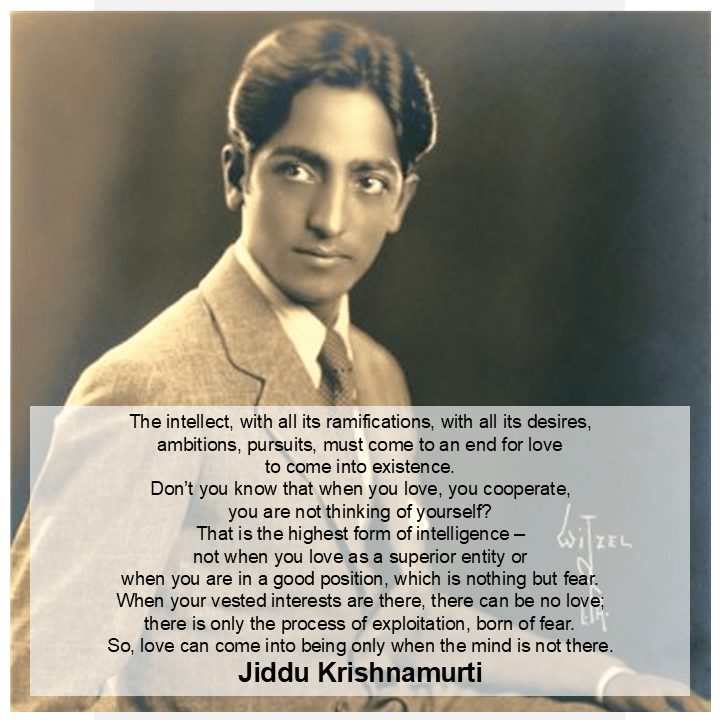
After going through what Krishnamurti made us observe, you will realise that whatever must be said has been said already. We have just accepted our delusions because we are fully clung to the way have been living our lives, the way we have been conditioned.
When you are loving someone, there is very slim chance that they will be exactly the way you want them to be. There is plausible reason to say this because the infinite possibilities of reality mold people in different ways. There may be many things in common but the more you know the sooner you will realise that people are filled with different types of conditioning. This will first push you to reject their point of view naturally, then you will try to impose your way on them, your ideologies on them, your conditioning on them. In the final analysis, you will see your ways of worldview failing on them. This is the moment when you will reject your own world view, thereby your ego. Now you will neither reject or accept other people’s worldviews nor will you cling to your ego. Now for the sake of love, you will objectively observe the reality for what it is.
This is how love compels you to let go of your ego. That is why love is the answer to everything because you are the last question of all the investigations of the existence. You will let go of the concept of the self once you start to appreciate things other than you and accept the reality the way it is. What a beautiful way to live!
“Only when you discard completely, through understanding, the whole structure of the self, can that which is eternal, timeless, immeasurable, come into being. You cannot go to it; it comes to you.”
-J Krishnamurti, The function of the Mind

References and further reading:
- Truth is a pathless land – J Krishnamurti
- The First and Last Freedom – J Krishnamurti
- Jiddu Krishnamurti’s Legacy Of Self-Knowledge : Part 1 – The Liberation From Thinking and Thoughts
- Jiddu Krishnamurti’s Legacy Of Self-Knowledge: Part 2 – Being Watchful Of The Ebb And Flow Of Life
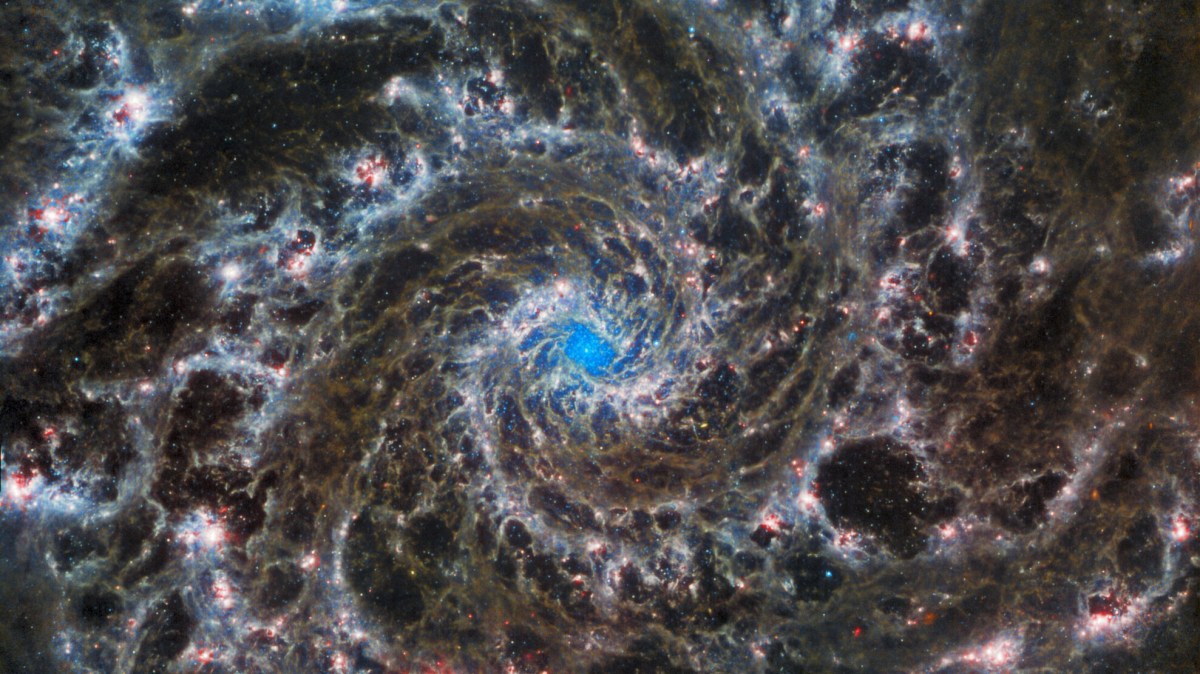
- Featured Image of Phantom Galaxy M74 by James Web Space Telescope





 Parts Per Billion