Risk and Rationality in Uncertainty

We have many philosophical ideas about how money is not everything in life but deep down, everyone knows how money constitutes to a bigger portion of who we are. Although money can’t buy everything, the unexplainable value it holds behind presence of almost everything in our lives will never go unnoticed. We know that this importance of money/ resources/ assets is highly dependent on how much of those we have right now and how much of those may get lost in an uncertain event. This perception of value drives our decision making in risky situations. The Expected Utility Theory (EUT) in economics deals with the modelling of such scenarios. The mathematical formalization of the perception of wealth and our risk profile is facilitated by this fundamental theory. EUT lies at the foundation of actuarial science/ insurance, financial risk management, decision making under budget restrictions, asset management, and investment management.

EXPECTED UTILITY THEORY

We live in an uncertain world. Timing events where too many interactions are happening could be risky especially when it comes to money or the basic resources for sustenance. In crisis situations, our survival instincts have always kicked in to ensure preservation of life and the resources required to ensure its longevity. They need not to be always rational, they are just meant to save life somehow, that is why most of the acts of survival seem extraordinary. Interesting thing to understand here is that when such extraordinary survival instincts kick in as a mass effect the whole mass effect becomes irrational, unexplainable, incoherent. There is no sane explanation to justify these mass events. When such events badly affect the resources responsible for basic life of every being, it can be catastrophic. Huge sudden falls in stock market are good indicators of such disasters, crises. Insurance on the other hand could prepare person to handle the disasters in a preventive way. Stock market and insurance are one of the best examples to understand how people assess risk and maintain/ reject rationality while making important decisions. We will see what formal ideas from economics lie behind these events of uncertainty.

Expected Utility Theory (EUT) in Economics

Expected utility theory lays the foundation of how a rational person would make decision in an uncertainty where valuable resources like money are involved. The whole idea is based on the quantification of that uncertainty and connecting that uncertainty with the individual gains from individual uncertain event. Expected utility also creates a formal structure of how person perceives risk in given scenario. This helps to quantify the value generated from any economic event.

Origin – St. Petersburg Paradox

Daniel Bernoulli is credited to establish the expected utility theory which is one of the foundations of economics. The theory emerged from the St. Petersburg Paradox which goes like this:

You have $2 and we toss a coin. Heads, the amount you have now is doubled and tails then the game stops and you leave with whatever amount you have right now. The game continues till its always heads in series and stops when the coin shows tails.

The question is how much will you be willing to pay to enter this bet?

The probability of heads and tails is 50-50% which is ½ . If it is a series of heads (heads followed by heads) then the events are dependent on each other, so the probability of this event is intertwined with the probability of the previous one. If there happens a game where you start with $2 and every time heads comes, and the money goes on doubling the equation of gain would be:
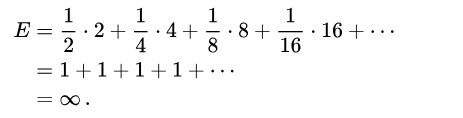
As this math goes, a person should pay infinite amount as he will be gaining infinite amount from such game. ‘E’ value here is identified as expected value. Even if one such possible game would happen in reality, people won’t pay infinite amount in reality to enter this bet. 

Bernoulli resolved this paradox by creating the concept of Expected utility. People will pay not what actual value it delivers (as in the $s of money); they will pay according to how actually it will be useful to them, ‘utilizable’ to them – that is where the utility and thus expected utility comes in picture.

Expected utility is calculated by the amount one would gain and the chances of gaining that amount. The expected utility thus is sum of all the gains connected with the probabilities of gaining them.

Daniel Bernoulli
The determination of the value of an item must not be based on its price, but rather on the utility it yields.

1st Tenet of EUT: Expectation

The overall utility of a prospect, is the expected utility of its outcomes.

In very simple words, for a given scenario you will weigh the chances of its constituent events and connect them with their respective gains. The sum of the all connections of each gain with their chance of realization is the usefulness – utility of that scenario.

Mathematically,

Expectation:

In our example we need to assume something that is the usability of the money – utility.

We assume $10 has utility of 1 unit. (This is just an assumption to understand the concept. When multiple objects are involved, their utilities will be different.)

So, the expected utility of this scenario is:

E = ((1000/10)x0.2) + ((50/10)x0.65) + (10000)x0.15) =

20 + 3.25 + 150 = 173.25 units

So, the expected utility – the usefulness of this event is 173.25 units.

The unit of value which we assumed in this calculation is sometimes called ‘utils’ – the basic unit of utility. It will change based on how one perceives the value in given scenario. 

You will realize that the expected utility is the weighted average of utility of events and their individual probabilities.

Four Axioms of Utility Theory

Later John von Neumann and Oskar Morgenstern expanded the concept of EUT with the idea of rationality. The agents involved in such uncertain economic exchanges are ‘econs’-the rational beings.

Oskar Morgenstern & John von Neumann

They have clear preferences among the options provided in every economic decision which comes under the idea of “completeness”. If out of the given set they select multiple options at a time, then it is said that they are ‘indifferent’ to these options. Whatever might be the internal distribution of constituent they might have. It’s about the final utility they perceive. When presented with choices, a rational person has clear preferences for those choices.

For all given uncertain events there is a hierarchy of preferences. If A is preferred over B and B is preferred over C, then A is always preferred over C. Which goes as transitivity.

Suppose we have been presented three events where event A is preferred over B and B is preferred over C. Now if one introduces a new event N which is slightly less preferred than B and more preferred over C then event B and N would be indifferent. In simple words, the choices between options would never directly jump, they will align as per the preferences in line.

So, A>B>C and B>N>C then A>B>C and A>N>C mean the same.

This is continuity. Graphically, the utility function is always a smooth curve.

Why do A>B>C and A>N>C mean the same even when the calculated numeric value would differ? It is because utility is never an absolute value it is just used to arrange the preferences by quantifying them. Ground rules used to define usability from the given resources i.e., the utility function of given scenario will be different for different scenarios and different sets of people. This is simplification of the concept called ordinality of utility. You can rank utility but not say that event A is this many percent better than event B.

When you have set the preferences of A over B and if you are offered another totally different/ irrelevant event M with new utility. You would still prefer A over B. Introduction of M will not affect the preferences as if A and B are independent of M. This is called ‘independence‘ in EUT.

So, completeness, transitivity, continuity and independence are the four axioms of EUT. Note that they are not ‘complete’ representation of reality. It’s just that they bring in simplicity to treat given scenarios and evaluate them. That is why you will find contradictions to these axioms. (Maybe a topic for another time.) The axioms are there to create a formal mathematical structure to draw useful inferences.  

2nd Tenet of Expected Utility Theory: Asset Integration

In EUT, asset integration is an idea based on the assumption that all people making economic decisions are rational. So, in uncertainty or risky scenarios a rational person will look at the overall gains instead of focusing on one certain gain and neglecting other unsure gains. A rational person will look at the risks of scenarios in a collective way and decide to enter only if the expected utility improves his assets’ position. A rational person will only enter the given scenario if the collective utility is better than the individual utility of its sub-events or sub-gains.

A rational person will not focus on an individual more probable gain even when his overall gains are becoming low.  

3rd Tenet of Expected Utility Theory: Risk

The beautiful insight EUT creates is about the mathematical formalization of risk profile. For that we will understand some ideas in advance.

Utility function – it is a mathematical relation between how one sees the value of given object/ resource. The value of resources is different for different people. A crude example would be how a beggar values money for one time meal compared to a filthy rich person. The value of $25 would be different for different people based on the conditions they are in.

This is where marginal utility comes in picture.

Marginal utility talks about what difference it makes in your perception of the value of a given thing if one would give you more of that in the next event. Roughly speaking the more we have something, the less we value it, so marginal utility is always diminishing. If I already have 10 packets of chocolates which are enough for the day to me, the next 11th packet of chocolate won’t make that much difference in my current excitement of having 10 packets. (Please note that we are talking about rationality here, although nobody is rational when it comes to chocolates.) A rational version of me would trade that 11th packet for something else with a person who hasn’t received even a single packet. A person who has no chocolate would perceive that single packet with higher value than how I perceived it (provided that he loves chocolates).

Alfred Marshall – the British Economist brought the concept of
‘Marginal Utility’ through his book ‘Principles of Economics’ in 1890.

So, utility function is a mathematical transformation of objects in given event to a unitary value so that the results can be easily compared with each other because the transformation converts everything to single unit system. These single unit of value is called ‘util’.

Utility function can be any possible mathematical relation. Generally, it is expected to be simple to not invite the complexities in modeling of given economic scenario. It should be simple enough to draw realistic conclusions.

An understanding of utility function gives insight into how the person evaluates risk with respect to the resources they hold.

Consider a scenario:

Event 1 – You enter a lottery where there is 50% chance that you will win $100 and 50% chance that you win nothing.

Event 2 – You are given $50 for sure, unconditionally just for playing the lottery.

Assume we have three differently thinking people to make choices in this scenario. Different thinking means how they assess the risk of entering the lottery which has some uncertainty and the surety of winning $50. Difference in assessment of risk means difference in the perception of utility. It further means that the utility function will be characteristic to each person.

Person 1 has the following utility function:
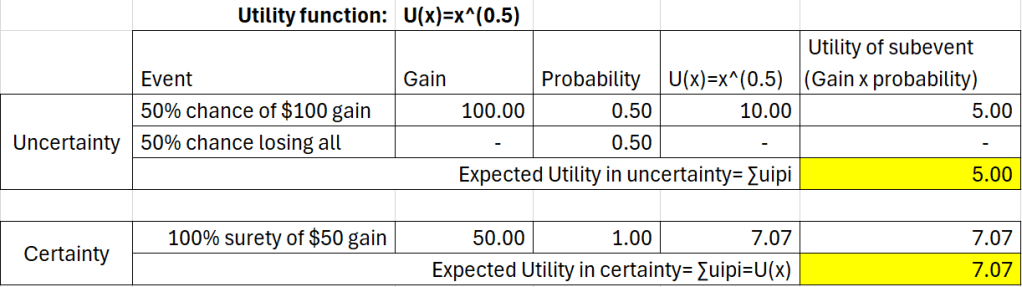
So, for Person 1 the utility of certainty (7.07 utils) is higher than the uncertainty (5 utils). He is happy to walk away with sure $50 gain instead of betting for $100 lottery.

Person 1 doesn’t want to take risk by entering the Event 1 of betting when he is sure about gain of $50 in Event 2. This is risk-averse behavior. The utility function mathematically models that risk averse behavior. Utility function is concave in risk aversion.

Now comes Person 2 with the following utility function:

You will see that the utility of certain and uncertain choices is the same. It means that it doesn’t matter for this guy if he enters the lottery having uncertainty or gets $50 for sure. This is risk-neutral behavior. The person 2 doesn’t care about certainty or uncertainty. He values both events the same. As mathematically both have similar utilities. Person 2 is indifferent to both events.

Now see the Person 3 with following utility function:

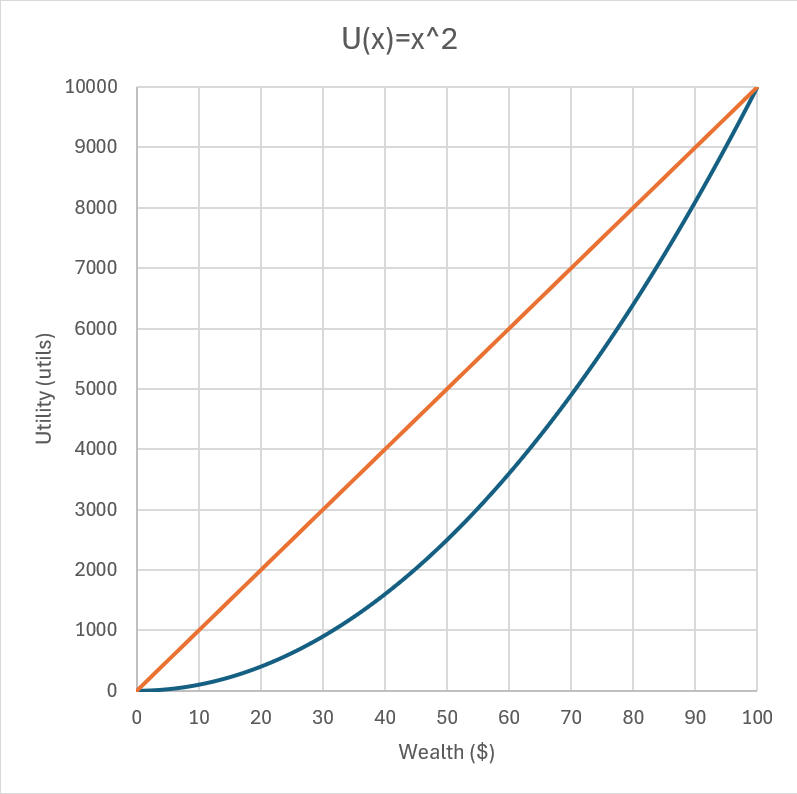
This guy has a radical view, he perceives the worth of entering the lottery (5000 utils) better than gaining $50 for sure (2500 utils). This guy is gambler! He finds it more interesting to enter the bet instead of gaining $50 for sure. He is happy to take the risk in uncertainty.

Looking at these three people you should note that the scenarios/ events they are presented are exactly the same. The only thing which is different is how they see the value in lottery and the sure gain.

So, the first person demonstrates risk averse behavior. He wants surety of gain rather than gambling for higher but unsure gain.

The second person demonstrates risk neutral behavior. Bet or no bet he doesn’t care. Just be done with it.

The third person demonstrates risk loving behavior. He wants the thrill of uncertainty in betting, so he sees more value in uncertainty of lottery.

This is how Expected Utility Theory can be implemented to mathematically model how different sets of people/fund managers will make decisions based on the risk profile. The relation between expected utility (which is the weighted average of gains) and utility function (which shows how one values the gain) can show us the risk profile.

Risk Averse Utility Function
Risk Neutral Utility Function
Risk Loving Utility Function

In the graphs shown, blue lines show utility function and the orange lines show expected utility. The orange line in our case connects the utility of $100 and $0 which is Event 1. This orange line connects any points on utility curve and it will give the expected utility value for that scenario of uncertain gain. In simple words, it’s the line of weighted average exactly like the definition of expected utility. This line is used to find out the certainty equivalent (CE). A certainty equivalent is the utility of an uncertain gain if it was certain.  

Almost all the time, people are risk averse. People want to avoid uncertainty about higher gains when they are presented with some lower but sure gain. This is where marginal utility becomes important. (This point deserves broad explanation which we will cover another time under Prospect Theory)

Marginal Utility

In risk averse people, you will see that the utility function starts to flatten out once the value gained increases. The more value someone already has the less he values the next addition of bunch into the preexisting bulk. Remember the chocolate box example?

One with 10 boxes of chocolate perceives one additional box with less value, whereas some with no chocolate will see it as a precious one as he has nothing right now. The perceived value of the additional next lot goes on reducing. This is known as diminishing marginal utility. Marginal utility is always diminishing.

So, a safe playing person would stop entering the next gamble because he now has enough. The next uncertainty in gambling has less value for him.

EUT in actuarial

Now it is obvious that only a risk averse person would go for conservative approach in uncertainty. This also means that risk aversion will also invite preventive measure against loss of certain assets, resources. Insurance thus comes into the picture. EUT here helps to mathematically formalize the probability of the risks which would compromise current gains, the perceived value of asset/ property/ resource and losses one can bear. We can now calculate the premium for the insurance against uncertainty of loss of something.

So, we will look into a scenario where risk aversion exists thus marginal utility is always diminishing.

We have the utility function of a man has a property giving revenue of $100K/year as:

u(x)=ln x

Now will see the risk scenario. Suppose this person does a fire audit of his property and the auditing agency finds out that there is 50% chance that he will suffer a loss of $60K/year due to fire hazard and 50% chance that nothing will happen.

After rephrasing, the gains from the property would look this:

50% chance that the income is $40K/year and 50% chance that income is $100K/ year.

Using the tenets of EUT the mathematical expression becomes:

Now, what we are doing differently here is to find out what this expected utility in uncertainty means when there is complete effect of loss with some chance and gain of some chance. In earlier examples we had second event of certainty against which we compared to understand the risk profile. Now it’s reverse calculation, we know the risk profile, we know the perceived overall value i.e., EUT of the property. Now we will find the certainty equivalent (CE) using the risk profile which can be explained by the utility function of the person.

How much is this 11.05 utils in terms of money from the property for this guy? We can find this from utility function of the person.

ln(x)=11.05, thus x=$63245.55

Now, think the fire hazard as a lottery where you gain $63245.55 money as per EUT calculation. Whether the fire will happen or not, the possible overall earning from this property would be $63245.55.

Now, if the property without any fire hazard was giving me $100k and the insurer guarantees me that same earning for the losses due to hazard. How much maximum amount should I pay to the insurance agency?

I will pay only that much amount which falls short to the $100k when compared to perceived earning calculated from the combined effect of certainty and uncertainty as given by EUT.

My earing due to uncertainty is $63.2k/year, I would receive $100 for a fine year so in order to continue that $100k even for a worse year I would pay insurance agency = $100000 – $63245 = $36754.45.

Anything I am paying above $36754.45/ year for insurance premium is loss for me. I would not go above this amount to insure my property which guarantees income of $100k per year. This is how the insurance premium is decided.

Conclusion:

We have many philosophical ideas about how money is not everything in life but deep down everyone knows that money constitutes a bigger portion of who we are. Although money can’t buy everything, the unexplainable value it holds behind presence of almost everything in our lives will never go unnoticed. We know that this importance of money/ resources/ assets is highly dependent on how much of these we have right now and how much of those may get lost. This perception of value drives our decision making in risky situations. The mathematical formalization of the perception of wealth, our risk profile is facilitated by expected utility theory. Although this theory has its own limitations it lies at the foundation of the economics.

For further reading:

  1. Von Neumann, John, and Oskar Morgenstern. “Theory of games and economic behavior: 60th anniversary commemorative edition.” Theory of games and economic behavior. Princeton university press, 2007
  2. Kahneman, Daniel., and Amos Tversky. “Prospect theory: An analysis of decision under risk.” Econometrica 47.2 (1979): 363-391
  3. Thinking fast and slow – Daniel Kahneman
  4. Connecting money with sentiments – Behavioral Economics
  5. Settling accounts with the losses – On Prospect Theory
Anxiety – Ugly (But Precious) Gift From Evolution

Anxiety serves to prepare a person for threats. Anxiety just like pain is one uncomfortable but effective way to cope up with the adversities in life, that’s how we build strength, resistance and deeper understanding of the surrounding for better and more precisely predictable future.
The remarkable concepts like smoke detector principal and optimal threshold in signal detection theory developed by modern psychologists/ psychiatrists help us to draw a line between a healthy anxiety (adaptive function) and unhealthy anxiety (pathology) and show ways to handle/treat them effectively.

Anxiety’s like a rocking chair. It gives you something to do, but it doesn’t get you very far

Jodi Picoult

Survival, Fear, and Anxiety

Every living thing if not have any goal in their lifetime would at least have sole goal of existing, surviving. Nobody wants to die and all of us always yearn to live forever but we know our limitations and hence are always on the quest of justifying the finite existence granted to us. Even if we are certain of the end closing in, our instincts are evolved in such way that many of the times, we bear the ability to cheat death. Humans have further extended cheating the death using science and technology.  Technology augmented our lives, reduced the risks of death, created a safe environment to grow, increased our chances of survival.

The fear of death and uncertainty of future is the key driver in our improved survival instincts and excessive use of technology to achieve it. We plan for things in advance, create backup plans if something would go wrong, have risk assessments before the execution, understand and decide according to the cost benefit analysis. That is what makes us humans and also separates from other species (although rest of the surviving species are also smart in their own ways to increase their chances of survival like viruses – but hopefully humans have other ways to overcome them)      

So, fear in a way triggers the actions to ensure survival. Anxiety – a sophisticated form of fear which prepares us in advance even before the fear causing scenario is supposed to happen. Simply put anxiety is an anticipatory type of fear to increase the chances of survival.

I am talking about fear and anxiety because they are bugging my mind for many days. Recently I watched Inside Out 2 movie and the it really delivers. The narrative has successfully presented how all emotions play a vital role in creating our personality in whole. Anxiety was new and important emotion presented in this movie. Every moment where anxiety came in focus it was fully relatable to me. Once I was done crying in the end the anxiety never left me (figuratively!), I felt a strong urge to understand the anxiety on deeper levels and what the domain experts have to say about anxiety.

The discussion heron is not a movie review rather I have made some attempt to summarize what the real-world scientists have to say about anxiety. I won’t be giving you the tricks, counseling and recommending any medicines to cure anxiety disorders. (Trained professional, experts are the best people to do that – “I AM NO EXPERT”)

My focus of the discussion is to question why anxiety exists in first place when we have an emotion called fear, another question is how to interpret the anxious emotions and what leads to anxiety disorder, where does the root of anxiety lie and is anxiety a bad or negative emotion? If it is so then why? and if not – then why?

While posing such questions and researching articles I came across some beautiful ideas, experiments and theories established by professionals in the field. I will throw light on these ideas in the coming discussion.    

The fear is real! – is it? – Defining anxiety

As I already mentioned that fear of death, the unknown and urge to live long are always fighting with each other. Humans rather every species existing today in nature mastered this battle to some extent and have ridden on chariots of evolution to augment – change themselves to adapt with the surroundings and improve the chances of survival.

A deer completely aware of its surrounding, grazing in the open grass fields can distinguish the rusting of leaves due to winds and rustling due to sudden movements of an apex predator like tiger. When the exams are on top of tomorrow, we are ready to sacrifice the night sleep to crack them (engineers would resonate more with this!) We know that the pain of failing, fear of failing is worse than painfully covering syllabus overnight! The fear is there and the anticipatory response is also there, only the level of sophistication is different.

Why I say sophistication? It is because due to the advancements in our lifestyles humans are rarely exposed to the real life-threatening scenarios like animal do (still today). Our fears are now more anticipatory. I would say most of our fears are now classified as anxiety.

Wikipedia goes like this for anxiety –

“Anxiety is an emotion which is characterized by an unpleasant state of inner turmoil and includes feelings of dread over anticipated events.”

So, the key differentiating aspect between fear and anxiety is the anticipation. Anxiety is a prospective emotion and a forward-looking emotion. Whereas fear is the emotional response to current threat. Fear makes us act immediately; anxiety keeps us ready for future threats. Fear will immediately decide fight or flight whereas anxiety will create plans, strategies for both and also calculate which one is more probable. (now you can appreciate why anxiety is more intense in over-thinkers, the analysis paralysis is one mild example of this.)

Anxiety is also an emotion important from evolutionary perspective as it has helped the current existing species to remain existent. The ability to anticipate future and preparing for it in advance gives competitive edge in survival.  

Why Is Anxiety Good?

While reading about anxiety I came across a very good paper by Dr. Randolph M. Nesse.

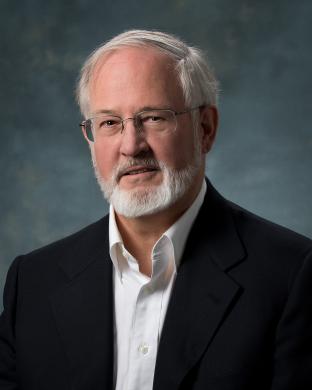
Dr. Randolph M. Nesse, UoM

Randolph M. Nesse is a Professor Emeritus of Psychiatry and Psychology in University of Michigan. The ideas and theory he created to understand and identify anxiety and its intensity are very important and interesting.  

Dr. Ness developed the smoke detector principle to control and quantify the medication used to fight with anxiety disorder. (He poses very simple but important question the opening of the paper that “Is he medicating his patients too much? is he harming them?”) The fundamental doubt Dr. Ness had was if the anxiety is evolved during evolution to improve our chances of survival, then why are we forced to reduce its symptoms and effects? Why are we using medications, therapies to reduce these symptoms, effects of anxiety. What if the patient is too anxious for given thing and that thing is too real to happen but the doctor dumbed that emotion down? (Dr. Ness calls it down-regulating the mechanisms causing anxiety)

The core of his thinking is that if we keep on “down-regulating” our anxiety which is an evolutionary gift to us, we might never be able to gauge the future in better way and prepare for it in advance to improve our chances of survival. (this is an exaggeration of the scenario but it proves a point)  

This calls for the quantification of anxiety. Which Dr. Ness did through the smoke detector principle.

The Smoke Detector Principle – How Much Anxiety Is Too Much?

Dr. Ness in another paper talks about the mechanism which is a feed-back system between the animal and its surroundings, which selects the emotional response to improve the chances of survival. The emotions we have today are the result of such evolution to maintain “homeostasis” – the balance among our bodily system to survive and function properly.

According to his ideas, anxiety works like a smoke detector.

The anxiety response is always trying to maximize the chances of survival and escape from a life-threatening situation. When we set a smoke detector it will go off even when the fire is not that extreme or if there is just some smoke which can be a controllable one. The smoke detector is designed to never miss a single fire causing situation. This ensures complete confidence in smoke detector that it will save people from every life taking fire scenario. But, it’s the same mechanism of smoke detector which forces people to evacuate frequently even when the fire or smoke where controllable or life threatening.

The frequent emergency evacuation even when it is not required is the same problem with the extreme intensity cases of anxiety. Always having armor ready for combat may sometimes make the soldier to lose the agility.

The patients with anxiety disorder have lowered sense of real threat. Their system triggers too many false alarms.

Dr. Ness established various techniques to quantify the levels of anxiety. The responses from anxiety include increased heart rate, rise in certain bodily chemicals – stress hormone secretion which can be easily measured as signals using instruments. Thus, the smoke detector principal paved a way to quantify the anxiety and understand what triggers the anxiety disorders in patients. It helps to understand how and why a level of anxiety is healthy in normal person and what level of anxiety is unhealthy and needs drug administration, therapy, how it can be administered by altering the setting within and around the person.

The core reasons why we need not to be intensely anxious about common life threats are as follows as Dr. Ness explains in his papers:

  1. Regulatory mechanisms have tendency to make errors and be extra defensive about situations
  2. We do not need to always be extra defensive to avoid given threat. (A machine gun in a bulletproof enclosure is not required to kill a mosquito.)
  3. Our body and surroundings have multiple layers of defense for almost all common threats. We are evolved and have survived in that way.
  4. Our environment is much safer than it was at the time we evolved

Types of Anxiety Disorders

Now that we have understood what is the nature of anxiety and what is its mechanism. Here are some important anxiety disorders to outline. Huge amount of information is available in literature, internet websites on these:  

  1. Generalized anxiety disorder (GAD) – too much worrying about ordinary things, problems like money, work, health, relations, family, and anything possible or imaginable, it may not exist in reality.
  2. Hypochondriasis – People suffering from this often worry about the health condition when nothing is wrong with their body. The word comes from feeling of stomach pain the person experiences even when everything is alright.
  3. Specific phobia – fear of anything but specific without any reason. It’s the fear for certain thing even when it does not pose threat.
  4. Social anxiety disorder (SAD) – In this scenario people intensely fear the public situations, humiliations, embarrassments, criticisms.
  5. Separation anxiety disorder (SepAD) – People in this case intensely fear the loss of person or a place
  6. Agoraphobia – it is fear of being in situation where there is no exit door, or escape strategy. Fear of using public transportation, being in large crowds are some examples.
  7. Panic disorder – these are outburst of all the collective or intensive fears, they come quickly and last for short time.
  8. Selective mutism (SM) – in this case the person is extremely fearful of initiating a conversation, does not speak to specific people or in specific situations or conditions even when they are forced to talk by humiliation or mocking.  

Post traumatic syndrome disorder (PTSD) and Obsessive-compulsive disorder (OCD) were once classified under anxiety disorders (now not under anxiety disorder in DSM – Diagnostic and Statistical Manual of mental disorders)

Signal Detection Theory For Interpreting ‘Anxiety Like Responses’
One good paper in the Canadian Journal of Psychiatry by Bateson et al. shows how the smoke detector principal can be used to decide the boundaries of different levels of “anxiety like-responses”. This paper talks about signal detection theory and optimal threshold. The beauty of this paper for me is the mathematical model it establishes to explain psychological events. A single formula will help you understand the difference between normal anxiety and anxiety disorder.  

With the smoke detector principal, we can now appreciate that not every common threat needs full armored protection. The signal detection theory in this paper shows where a person draws line when they overestimate or underestimate anxiety.

It talks about “optimal threshold” to show a threat response in given situation. Optimal threshold is a mathematical parameter which is function of probability of the occurrence real event and vulnerability of the individual.

The signal detection theory says that the superposition of response signals for given background noise and response signal from real threat give us the quantified judgement of how intensely the anxiety is triggered compared to the practicality of the threat – this quantified judgement is called optimal threshold (λ). Lower the threshold more intensely the anxiety will be triggered for given disturbance – background noise.

Figure 1 : Signal detection problem, how the optimal threshold can be calculated. (Credit: Anxiety: An Evolutionary Approach, 2011, Bateson et al., Canadian Journal of Psychiatry)

Equation 1: optimum threshold (Credit: Anxiety: An Evolutionary Approach, 2011, Bateson et al.,Canadian Journal of Psychiatry)

Here,

 λ = optimal threshold

 pnt= probability that there is no threat

 pt= probability that there is real threat

wfa= cost of false alarm

wmiss = cost of a miss

Once this equation comes in focus the discussion becomes interesting. The ratio of pnt to pt mathematically quantifies how practical the threat is. The ratio of wfa to wmiss mathematically quantifies what will be the cost if the anxiety trigger is accepted or rejected – will the subject live or die. This ratio shows how we trigger anxiety response. If the cost of responding is nothing for even a simple threat scenario, we will choose to trigger that response, same would happen if the cost of losing is ultimately the loss of life, we would trigger any possible anxiety response to avoid it. The authors call this ratio as individual’s vulnerability.

The ratio (pnt/pt) can be seen like this. If the surrounding really is hostile and consists of events which cause many life altering events than the safety ensuring events then the pt (probability of threat) will be way higher than pnt (probability of no threat and safer environment). In war situation where multiple bombings, gun firings are happening around you the probability of threat happening (pt) is way high than it not happening (pnt). The optimal threshold will drop immediately and anxiety triggered will be very high.

The ratio (wfa / wmiss) can be seen like this. If the person is way stronger to handle given threat, then the person will need no effort, investment or cost to trigger any reaction alarm to even a false threat. Consider the example where you are about to be bit by mosquito, you know the efforts to slap many times until the mosquito dies are not worthless, you will try many times to kill it even when you know it will swiftly escape, you are less vulnerable in this scenario. But now when you are about to be killed by John Wick (!?) you know for sure that even a pencil will do the job for him, any environment is hostile for you, you are vulnerable here, the value of losing life (wmiss)is way high than the cost of attempts to save it (wfa). Your optimal threshold will immediately drop down thus triggering intense anxiety.

Once you generate enough data for such optimal frequencies you can easily distinguish the healthy anxiety responses and anxiety disorders. I loved how these two factors (probability of threat and vulnerability of an individual) can predict the levels of anxiety in a person. This equation explains and can also quantify why pregnant women have heightened awareness of their surroundings, why people get insomniac after constant mental stress, why restless people are always in the mode of action and fight, why reclusive people hesitate to visit foreign, unknown places.    

Your Surroundings and Mindset Matter!

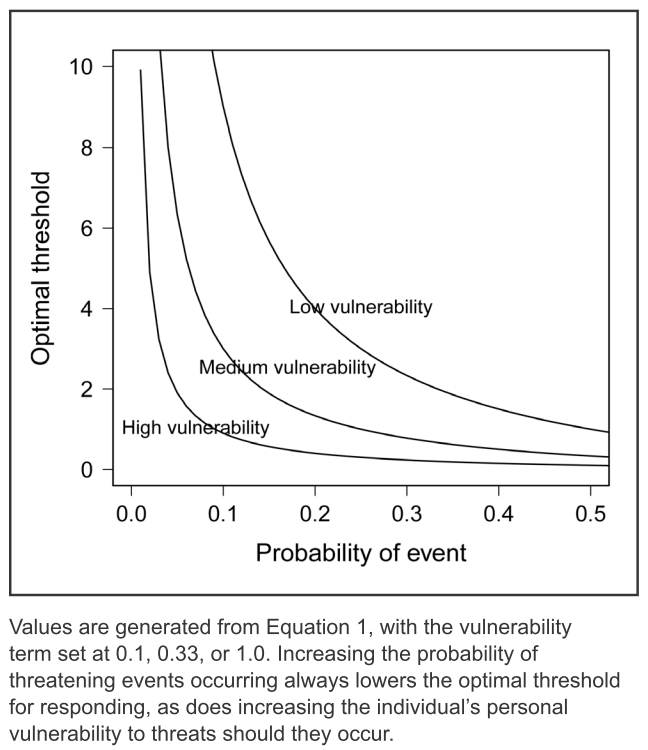
Figure 2 : Three levels of vulnerability, here optimal threshold and probability of event can be correlated for difference in the anxiety responses (Credit: Anxiety: An Evolutionary Approach, 2011, Bateson et al., Canadian Journal of Psychiatry)

It is really interesting what the authors have achieved and established in this research. They compared three different levels of vulnerability and explained them using given plot.  The thing to highlight here for anxiety disorders is that they emerge from the environments which always keep on presenting high probabilistic practically threatening scenarios. The anxiety disorders also emerge when the individual feels more vulnerable.

Higher the vulnerability lower will be the optimal threshold and intense will be the anxiety response.

As shown in research, in the uncertain times of Covid-19 people who were locked in their home had no disorders, were not exposed to the virus also felt anxious and faced some anxiety disorders because of the environment they were in.

If the person feels less vulnerable and stronger then even for given strong life-threatening events the optimal threshold will be higher thus the anxiety triggered will be lower.

Are you noticing where this is going?

This is a mathematical model which shows how a healthy, supportive, and safe environment and also a strong mindset and better judgment of reality is important for handling challenging situations.

For a person suffering from anxiety disorder, it becomes very important to make sure that they know that they are in a safer environment and are cared for. It is very important to make them feel safe and understood. Creating a system of critical thinking and reasoning can also help the person to have a sense of strength and high resistance to vulnerability, this also goes for physical strength. The vulnerability is not only mental it is also physical when it comes to reality.

You will now appreciate why teenagers and trauma patients are more exposed to anxiety disorders. Mostly and generally in teenagers it is due to the uncertainty of many new things happening with them simultaneously and in trauma patients it’s the constant bombardment of life-threatening events in hostile environments.

Conclusion

Anxiety serves to prepare a person for threats. The emotion called anxiety is an evolutionary gift to ensure long survival of our species but as it is also related to our primitive instincts, we mostly let anxiety overpower other emotions in seemingly safer scenarios. Strategy and anticipation are the gifts of anxiety but if overused they will end up in imparting unnecessary caution and overprotective attitude which inhibits adaptation to changes there by slowing evolution of our species. Anxiety just like pain is one uncomfortable but effective way to cope up with the adversities in life, that’s how we build strength, resistance and deeper understanding of the surrounding for better and more precisely predictable future.   

The remarkable concepts like smoke detector principal and optimal threshold in signal detection theory developed by modern psychologists/ psychiatrists help us to draw a line between a healthy anxiety (adaptive function) and unhealthy anxiety (pathology) and ways to handle/ treat them effectively.      

These theories show how we can quantify seemingly intangible emotions like anxiety and way to handle them. If you can measure something effectively you can control and predict it effectively. All credit goes to such brilliant minds!

References, Image sources and further reading:

  1. Fear of the unknown: One fear to rule them all?, 2016, R. Nicholas Carleton, Journal of Anxiety Disorders
  2. Natural selection and the regulation of defenses: A signal detection analysis of the smoke detector principle, 2005, Randolph M. Nesse,Evolution and Human Behavior
  3. Natural Selection and the Regulation of Defensive Responses, ANNALS NEW YORK ACADEMY OF SCIENCES, Randolph M. Nesse
  4. Anxiety: An Evolutionary Approach, 2011, Bateson et al., Canadian Journal of Psychiatry
  5. The relationship between perceived stress and emotional distress during the COVID-19 outbreak: Effects of boredom proneness and coping style, 2021, Yan et al., Journal of Anxiety Disorders
  6. Long-term effectiveness of cognitive behavioral therapy for youth with anxiety disorders, 2018, Kodal et al., Journal of Anxiety Disorders
  7. Anxiety, National Library of Medicine, www.medlineplus.gov
  8. Anxiety Disorders, National Institute of Mental Health
  9. What are Anxiety Disorders?, American Psychiatric Association
  10. Anxiety – Wikipedia
  11. Randolph M. Nesse, M.D., Professor Emeritus of Psychiatry, Professor Emeritus of Psychology, Department of Psychiatry, University of Michigan
  12. Everything You Need to Know About Anxiety – www.healthline.com

Halo in F1 – One simple hoop design to save them all

A simple hoop design of HALO saved many precious lives in adrenaline filled, thrilling motorsport like F1. The story of evolution of halo in F1 tells us about the minimalist and functional design for safety. Not even single part of halo is in excess, unnecessary or unwanted. The designers and engineers deserve special recognition for saving important lives and maintaining the spirit of the sport.

Formula 1 is the pinnacle of the motorsports on the planet. It is the most intense, most tech-intensive, strategy packed and the richest sport in the world. Important thing to understand here is that Formula 1 is not just about driving fast cars and securing the first position on grid out of all the competitors. There is a reason why it is called “Formula” One. All the cars and teams competing in this sport must abide to certain set of rules on car design, sporting conditions and (now) stringent budget restrictions. The cars are supposed to be “formulated” thus designed within certain rules defined by FIA (Fédération Internationale de l’Automobile as in International Automobile Federation) to ensure that no team gets an unfair advantage. Now with the technological advancements the complexity in this motorsport has touched new heights.

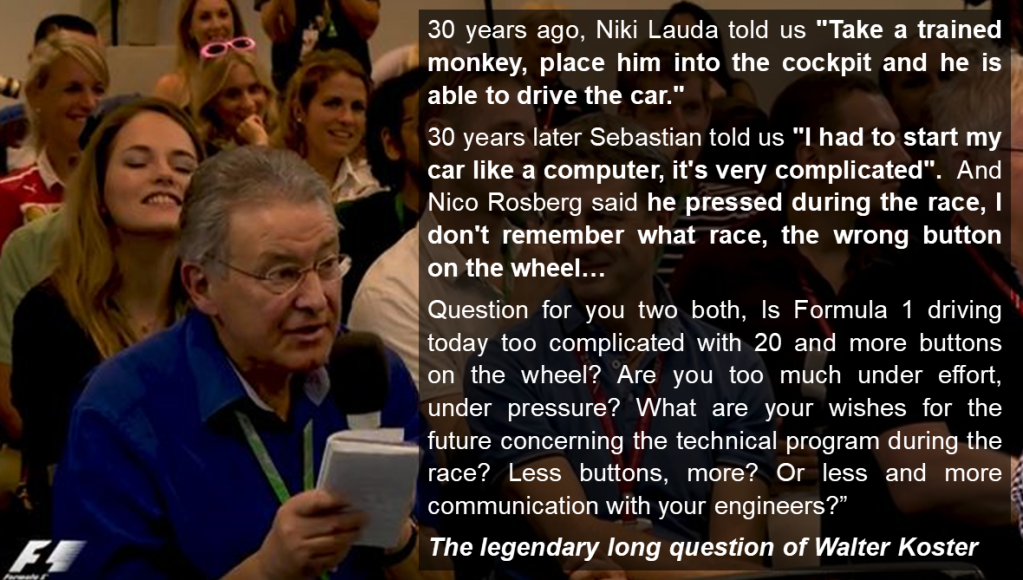
Here is an excerpt from Walter Koster – famous F1 Journalist in his world famous “short” interview question to explain the complexity and F1 drivers dealing with it –

The question posed here is very important. Many of the innovations and technologies we see and use in our routine motor vehicles have emerged from the competitive motorsports like Formula 1. The technologies well known and common today like ABS (Anti-Lock or Anti-Skid Breaking System), Traction Control, Active Suspension, Advanced aerodynamics to improve the effectiveness and efficiency of power from power units, Hybrid power units, Incorporation of various sensors and using the data from such sensors to optimize the vehicles behavior are some of the notable examples. As newer and newer technologies are developing, F1 is getting more and more complex. Real F1 fans want exactly that in some sense. In this way the game is not only about racing on the circuit rather now it encompasses the initial car design, machine building, people management, policy management, finance and strategy on and off the racing circuit.

In this whole organized chaos what one must understand is the risks F1 driver faces while driving at such high speeds. One must understand that F1 cars are totally different from the cars that we use in our day-to-day life. The RPMs of F1 cars operate generally above 10000 RPM (for normal cars even the RPM of 2000- 4000 is really high), the highest speeds an F1 car can achieve is around 350 km/h to 390 km/h. The power rating of these F1 cars is around 1000 HP. The current engines used in an F1 car is 1.6L V6 engine. You must understand that a normal car with 1.6L engine has power rating of roughly 150 HP which is used in medium sized SUVs and family hatchbacks. The engineering marvel with which this high performance is extracted is one interesting topic in itself. With such machine and top speeds, for an F1 driver any moment missed during the blink of an eye can lead to a fatal injury, permanent disability and even instant death. F1 is also known for some serious injuries and fatalities. Hence, maintaining and improving the overall safety of everyone involved in the sports is important for FIA.

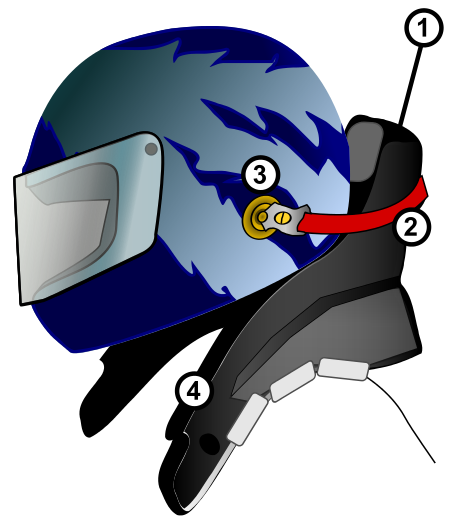
We will see one such simple yet effective design decision that FIA implemented in F1 which has saved many important and invaluable lives of the drivers in the recent times. That is the incorporation of Additional Frontal Protection (AFP) also known as Halo. It may sound exaggerated, but one can say that after the usage seat-belts, Halo is the second-best innovation which can be credited to immediately save many lives in F1 and its equivalent motorsports like F2, F3, IndyCar racing. It is also important to note that the incorporation of Halo was not an instant decision, rather FIA has always evolved and taken many decisions in improving the safety of the drivers in F1. Detachable headrest and padding and HANS are two notable decisions of them.

Formula 1 and Safety

If one looks back at the incident histories in F1, they will immediately realize that instant dangers are deeply rooted in the sports format itself. Ayrton Senna – 3 times world champion known as the greatest F1 driver in the history died from an accident in 1994 which triggered many safety decisions in F1. Senna’s Williams F1 car crashed into the concrete barrier at the speed of 304 km/h at Tamburello Corner of the Autodromo Internazionale Enzo e Dino Ferrari in Imola, Italy. The lateral crash resulted in severe injuries and complete disfigurement of the car in crash. Stricter standards for helmets, changes in circuits to eliminate dangerous corners/ turns, changes in the circuit barriers, stringent impact tests with stringent tolerances, speed limits in the pit lanes and practice sessions were incorporated after this incident.

The story does not end here. In order to improve the safety further, in 1995 lateral crash tests were incorporated, by 1999 high cockpit heights to save the head injuries and wheel tethers to avoid the lose wheels flying off in crash were incorporated. By 2003, Head And Neck Support (HANS) device was made mandatory. Senna’s accident completely changed the safety regulations in F1 and this can also be seen in the reduced number of serious and major accidents in those times.     

HANS device mandated for F1 drivers

Need for Halo

In 2014, one incident shook the whole motorsport world. Jules Bianchi – an emerging F1 driver lost the control of his Marussia F1 car on Suzuka Circuit during 2014 Japanese Grand Prix. Due to unfavorable weather conditions – heavy rainfall his car lost grip and he crashed into a recovery vehicle which was trying to recover another crashed F1 car. Jules went into coma after suffering a diffused axonal injury and could not win the fight with death. After Senna’s loss in 1994 the world shook to the core with the loss of a young driver in 2014. The incident investigation demanded various changes in whole system and FIA realized the need for a closed cockpit-like solution to save the lives of drivers from frontal collisions.

FIA evaluated a closed canopy design like fighter jets and some tests were already ongoing in 2011-12. But the closed canopy had some practical limitations which prevented their immediate implementation in the F1 cars.

Limitations of the Closed Canopy-

  1. One can accept that the closed canopy will prevent the direct contact of projectiles from front on the drivers. The closed canopy will also relatively interfere less with the aerodynamics of the car. But when there will be need of instant extraction of driver during crash or internal fire, the canopy will increase the extraction time and would make the job of fire/ emergency marshals more difficult. According to the standards, driver should be extracted from the car within 7 seconds.
  2. An F1 car is just a machine, a wild animal with humongous power. Human controller brings that discipline, that life into such beastly machine. Driving in such extreme machine tests the human limits of the driver. The closed cockpit would limit all the airflow through the driver thereby making him more uncomfortable which would further increase the probability of incidents.

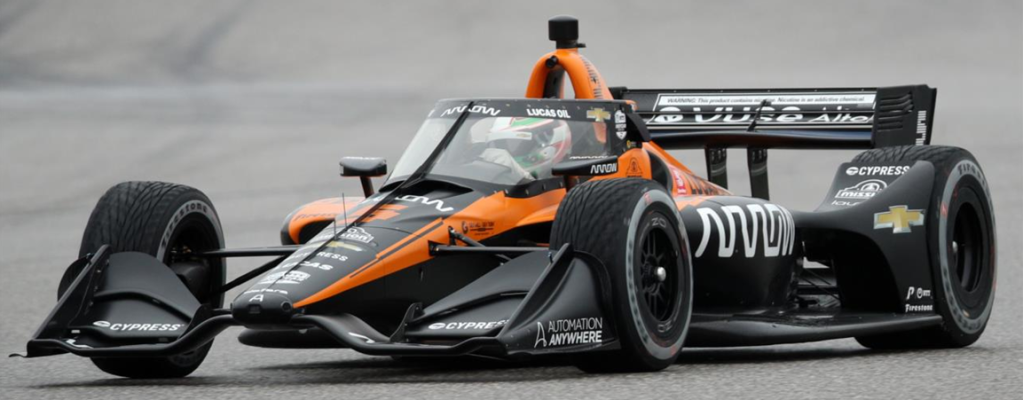
Closed canopy was tested in IndyCar designs with the help of Red Bull designers and engineers. The issue with the extraction was solved by keeping the canopy open from the top. But that does not address the issue fully. Even after keeping the canopy open from the top the airflow would anyways will be restricted to the driver. This issue was solved by nostril design of the canopy. Air intake gaps on the canopy’s leading edge would allow air inlet for the driver. Even some dedicated air channels were designed through the driver’s helmet to allow the airflow to ventilate driver sufficiently. IndyCar adopted these designs at first and there was still a long way for F1 to adopt these changes in their format.

IndyCar aeroscreen design with nostril

Problems and Challenges

The closed cockpit design faced big resistance in F1 due to some really obvious reasons. You cannot completely have a fully closed cockpit for immediate extraction of driver from cockpit. If one goes for top open i.e., aeroscreen cockpit, driver ventilation is one issue.

When dedicated ventilation is incorporated it will add extra weight and devices/instrumentation on car. Please note that F1 car designers are accounting for single gram of the extra weight of the vehicle. It is very common to go for the fastest lap attempt in the last lap of F1 racing only for the reason that the car bears lowest fuel weight and thereby lowest overall weight in the last laps providing more horsepower per gram to the car (now the cars are fueled only once in the whole race).

One more and the most important problem with the aeroscreen is the interference it would create in the aerodynamics of the car. The air intake of the F1 car engine just lies to the back and over the head of the driver. The aeroscreen canopy would not only affect and reduce the air input to the engine but it would also create the “dirty air” which results in the net performance reduction in the car.

To understand this, one should know that F1 car is not just about putting a high power unit in the low weight carbon composite car. When a car is running on the track with high speeds the air resistance is significantly higher, the car is literally punching a hole through the air. The car cutting through such high speeds bears the ability to literally get lifted and fly in the air with the same principle the an airplane takes off. According to Bernoulli’s principle if one creates net difference in the velocities of a fluid over a body it results in net pressure difference over the body. When this pressure difference becomes significant enough with the weight of the body it can provide lift to the body, it will cause the body to fly. As airplanes are designed to fly up, the F1 cars are designed to not fly up and remain glued to the track. This is done by creating down-force in the car. Simply put, its like rotating the wing of an airplane upside down to keep it glued down to the track instead of lifting up. More the down-force, more the car will remain glued to the track, more traction it will have which will make high speed turns on the cars possible. But down-force generation also comes with one design challenge called drag. When a continuous, uniform airflow is traveling over the car imparting net down-force the moment this steady-like airflow gets detached from the surface of the car it gets disturbed, turbulent air containing relatively high velocity loops of air or “eddies” are generated. This air turbulence is known as “the dirty air” in F1. Due to this, the air velocities at the back of the car become higher than the air velocities to the front of the car which creates net pressure difference thereby net low pressure zones are created behind the car. The car experiences a resisting force called “drag” which reduces the speed of the car. So, design of a good performing F1 car is always about finding that sweet spot of balance between down-force, drag and lift.

Now back to the cockpit design. The fully closed cockpit design ensures streamlined airflow over the car but it also compromises the extraction of the driver in emergency. If one puts aeroscreen cockpit in the car, the streamline passing over the would be disturbed before it even exits the overall car’s body. It will create a “wake” of air which will not be dense, streamlined thereby adding the drag to the car. It will reduce the speed of the car substantially. Please note that the differences of speeds and lap times in F1 are really close to the 10th of a second.

The biggest problem with incorporation of cockpits was related to the chaos in the aerodynamics of an F1 car which is one of the only things F1 teams can have larger overall control on. 

If such design standards are related to safety, then they are supposed to be mandatory to every team which would reduce the net speeds of all F1 cars thereby removing the thrill of the game, the soul of the sports. Hence everyone opposed this idea of open canopy cockpit – aeroscreen design.

The Emergence of Halo

After the tragic death of Jules Bianchi in 2014 FIA realized that the front-end protection is also important aspect to improve the overall safety in the motorsport. As FIA were already in the process of frontal protection from 2011-12 testing fighter jet level closed canopies, it became apparent that some immediate and more practical solution is required for the F1 cars. This resulted in the design of Halo.

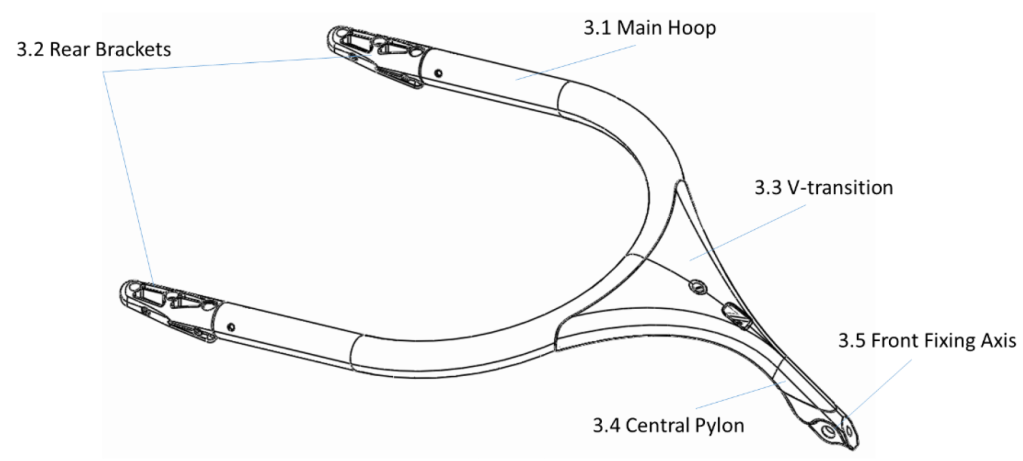
A halo also known as additional frontal protection (AFP) is a hoop made from aerospace grade Titanium alloy – Grade 5 Titanium (an alloy of titanium with aluminum and vanadium) with has 3 joints to enable connection to the car. It was designed by Mercedes.

The parts of Halo (FIA Standard 8869-2018)

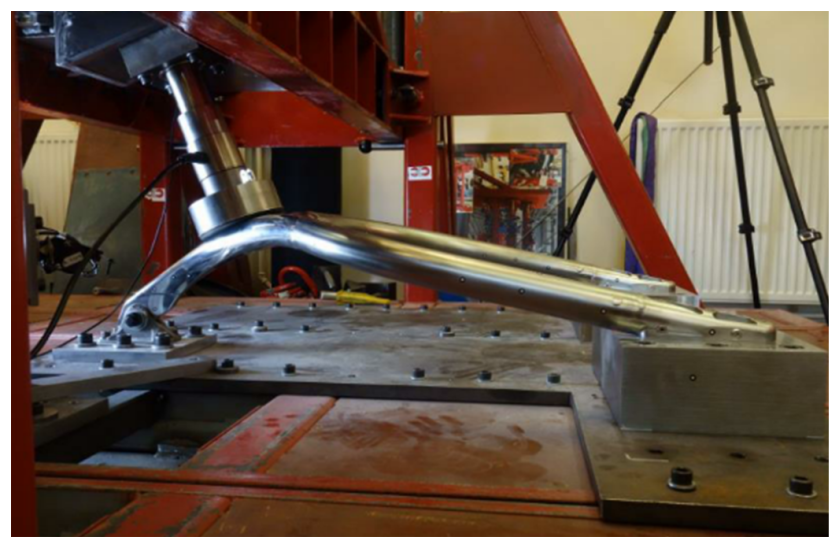
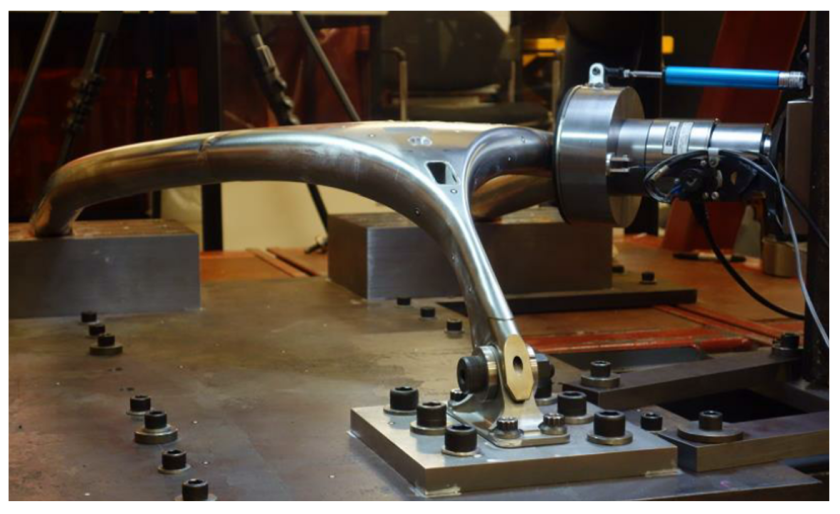
The halo weighs just 7 kg but can handle the loads of 12000-15000 kg (yes, those are 12-15 tons). Precisely speaking, according to FIA standard 8869-2018, a halo is made up of Ti6Al4V Grade 5 alloy weighing 7.0kg, +0.05kg, -0.15kg and should withstand quasi-static (simply put – slow and steady enough to seem unnoticeable movement) load of at least 125 kN with deflection less that 17.5 mm in Test 1 and deflection less that 45 mm in Test 2. (125 kN = 12.7464 metric ton, average weight of a Double-Decker bus). You have to understand that its not just about the integrity of the structure of halo. When halo is attached to the F1 car, the car chassis should also be able the withstand such loads transferred from the halo. Otherwise only halo would withstand the impact but the whole chassis may fail, resulting in many complicated failures, damage, injuries even fatality.

Test 1 with front load (Source – FIA Standard for AFP 8869-2018)
Test 2 with lateral load (Source – FIA Standard for AFP 8869-2018)

Halo is a standard supply part meaning that everyone must have the same part in their car obtained from the FIA certified and approved manufacturer. No modification is allowed on halo.

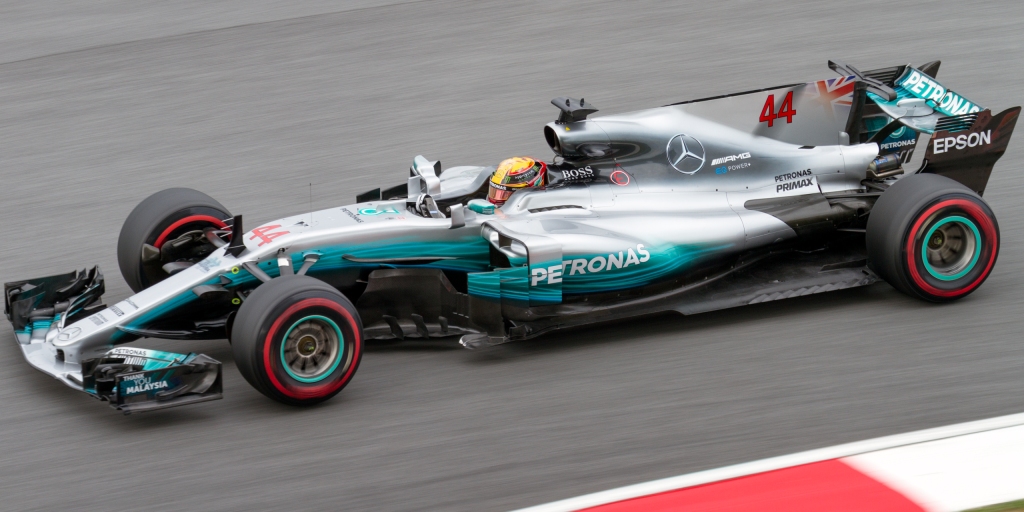
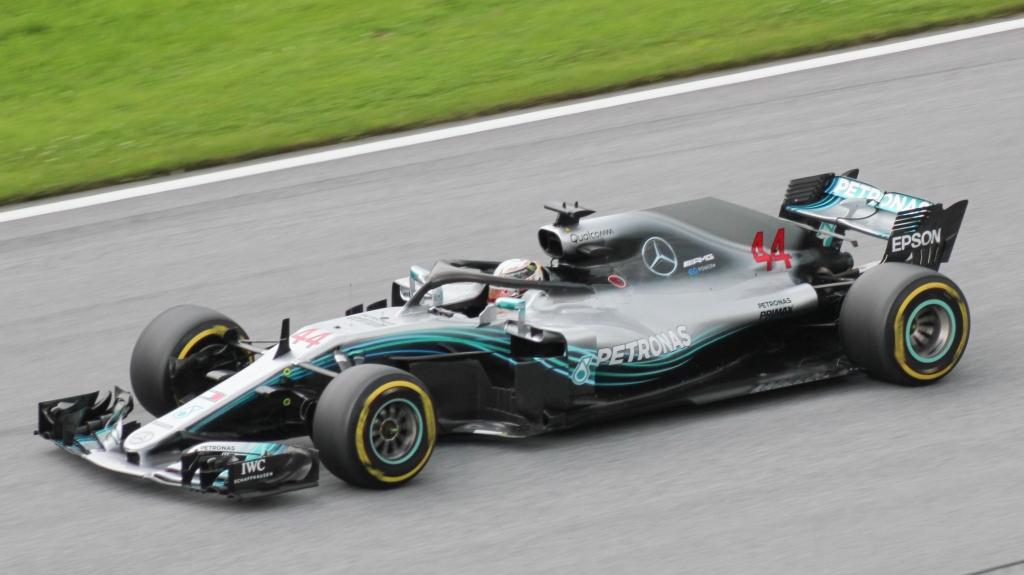
Mercedes AMG W08 F1 car in 2017 without halo
Mercedes AMG W09 F1 car in 2018 with halo

Challenges with Halo

The biggest outburst from F1 fans, F1 teams, F1 designers/ engineers and even F1 drivers for halo was due the reason that it is the ugliest part of the F1 car. Many said that it destroys the whole look, beauty of the car.

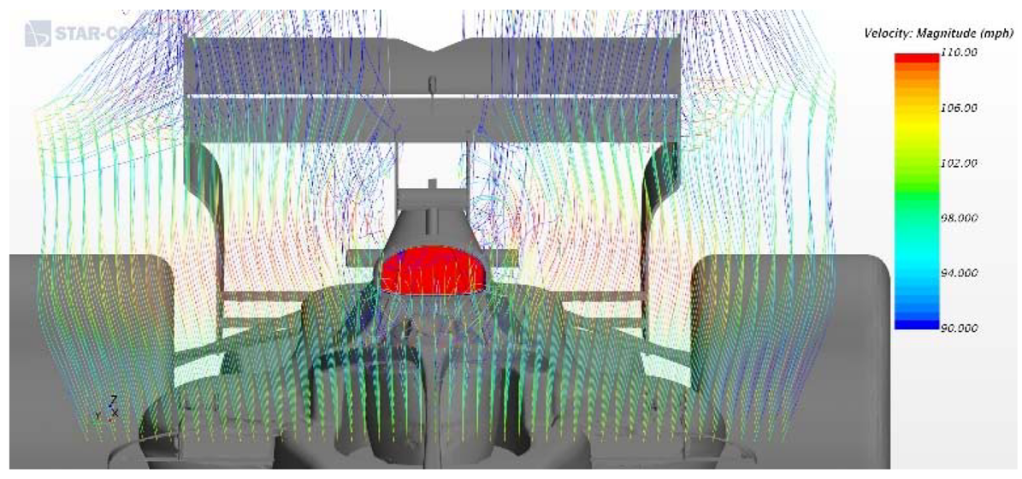
Second and more practical reason to resist halo was the disturbance in the aerodynamics of the car. Though the disturbances in airflow are lesser than the canopy it still meddles with the performance of the car in total. The top hoop of the halo disturbs the airflow creating a wake of dirty air over the rear wing thereby increasing the drag on car and reduced speeds.

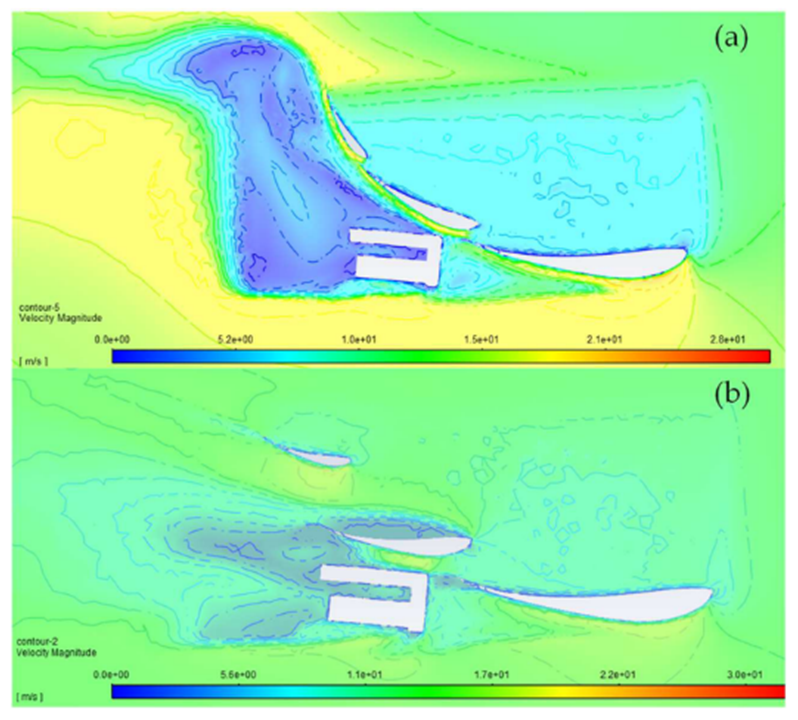
Drag Reduction System (DRS) became less effective due to incorporation of halo. DRS consists of a moving flap on the rear wing of the car which alters the airflow over the rear end of car thus when this flap is lifts up while the car is on straights the down-force thereby drag on car is reduced hence gaining the speed.

When the DRS flap lifts up the drag on the car is reduced.
(Source- See reference 8)
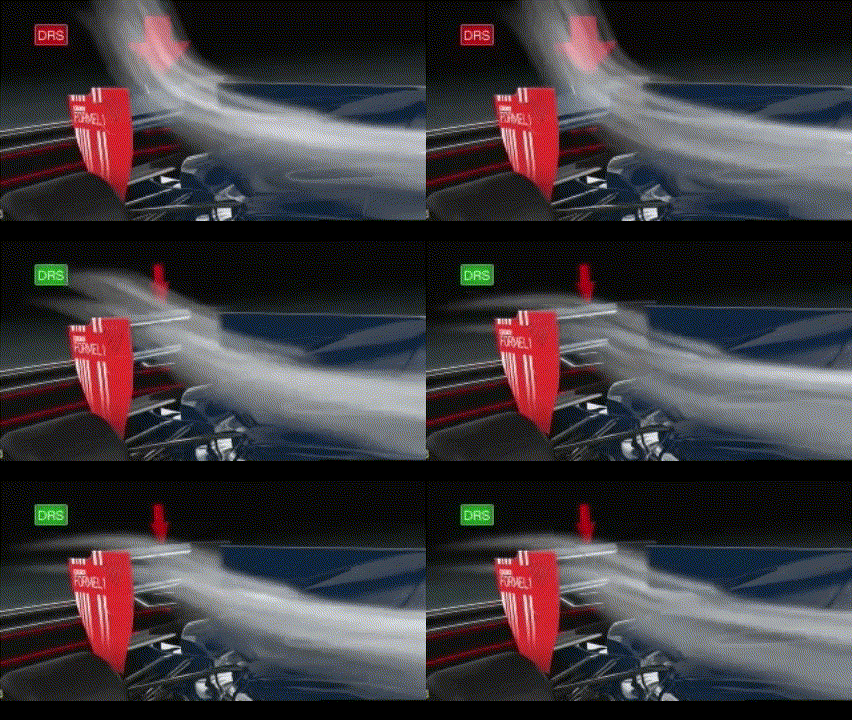
DRS in action

Now due to the incorporation of halo, the streamlined airflow which was expected to get extended over the rear wing of the car during the DRS was already getting disturbed thereby making the DRS less effective. (F1 fans know the madness and thrill of chase upon DRS activation on straights of the circuits)

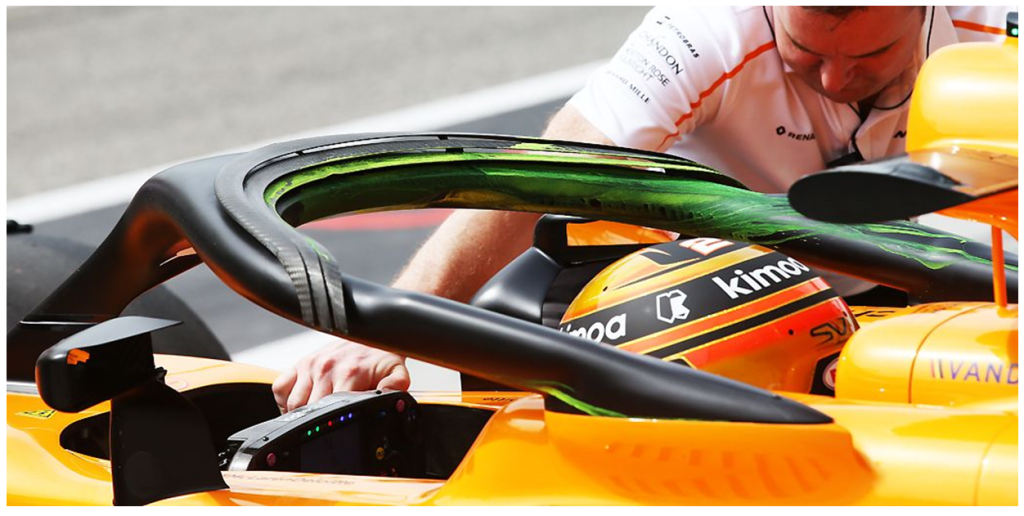
Halo messes with the streamline flow over the DRS on tail and engine intake. You can see in this image the streamlined – parallel airflow lines are disturbed due to halo’s leading edge causing eddies (Source- See reference 7)

Third reason for resisting halo was the obstruction in the vision of an F1 driver. The central pylon of the halo connects just in front of the eyesight of the driver. Such immediate frontal obstruction in vision is big red alarm for everyone. The implementation of halo was tested in 2017 free practice session and every driver hated it as it was the immediate blockage in vision. Still the updated 2018 FIA standards mandated installation of halo.

One design to save them all

Despite the negative reception, halo has proved its effectiveness right from its year of implementation.

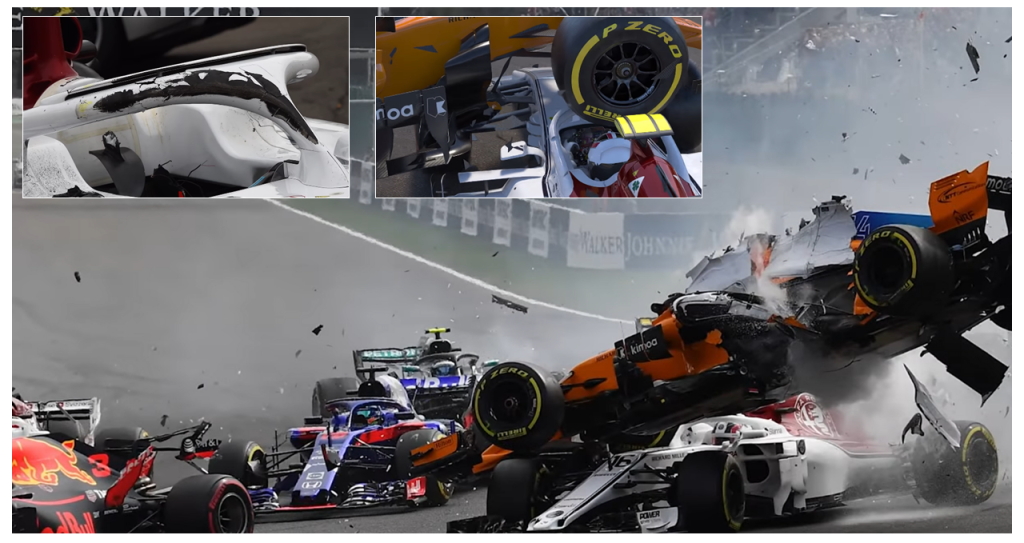
In 2018 Belgian Grand Prix on the circuit of Spa. Fernando Alonso’s McLaren car rolled over Charles Leclerc’s Sauber F1 car. The possible direct impact of rear tire and read wing would have caused permanent neck damage or possible death to Charles but it didn’t happen due to the protection from halo. According the simulations from the data of the accelerometers and other sensors from the cars, the impact force was of 56 kN (5.7 ton of weight)

Damaged air fairing in inset, halo remained undamaged during the crash. Simulated tire contact from Alonso’s car on Leclerc’s helmet eye-shield that halo saved in second inset image

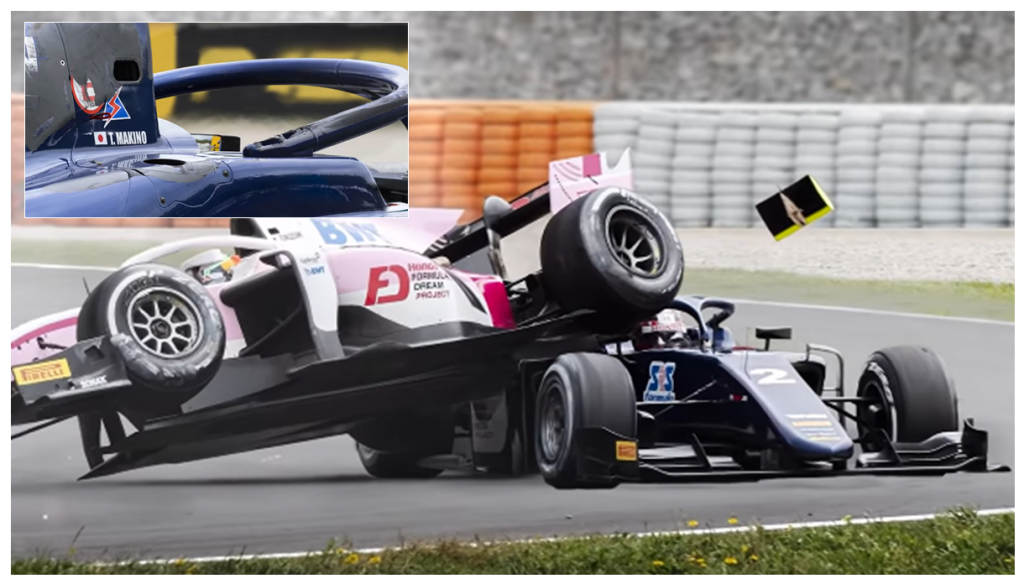
In the same year in an F2 race in Catalunya, Spain Tadasuke Makino’s life was saved during the accidental crash landing of rival car.

Halo prevented the contact of sweeping rear end with Makino’s head

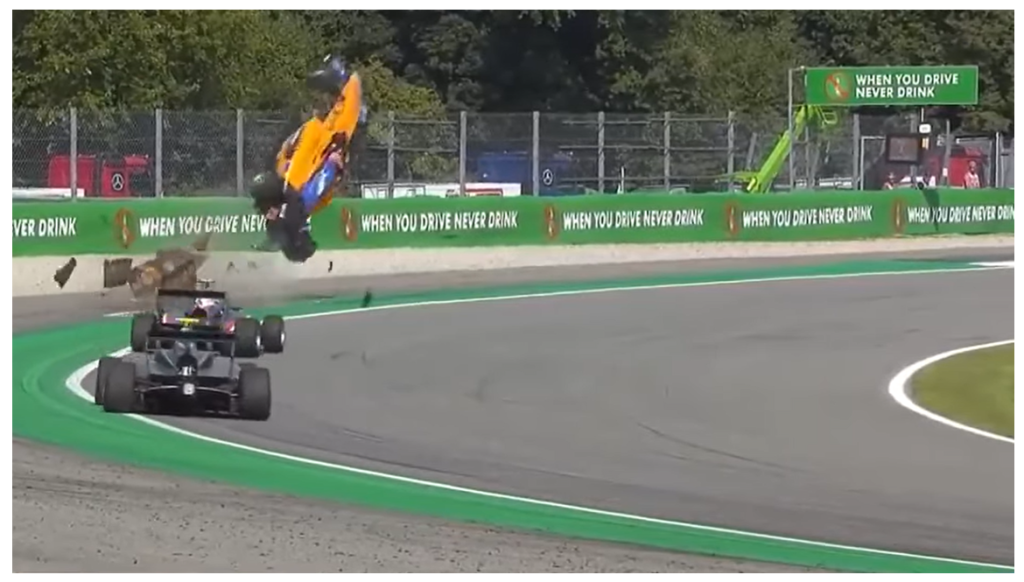
In 2019, F3 race in Monza, Italy Alex Peroni’s car went airborne, flipped in the air, rotated thrice and car landed upside down on his head. If it was not for halo, Alex would have been dead, the impact was directly on his head if halo wouldn’t have provided the barrier.

We do have flying cars. Peroni’s car landed on the halo part during crash and saved him from severe injuries

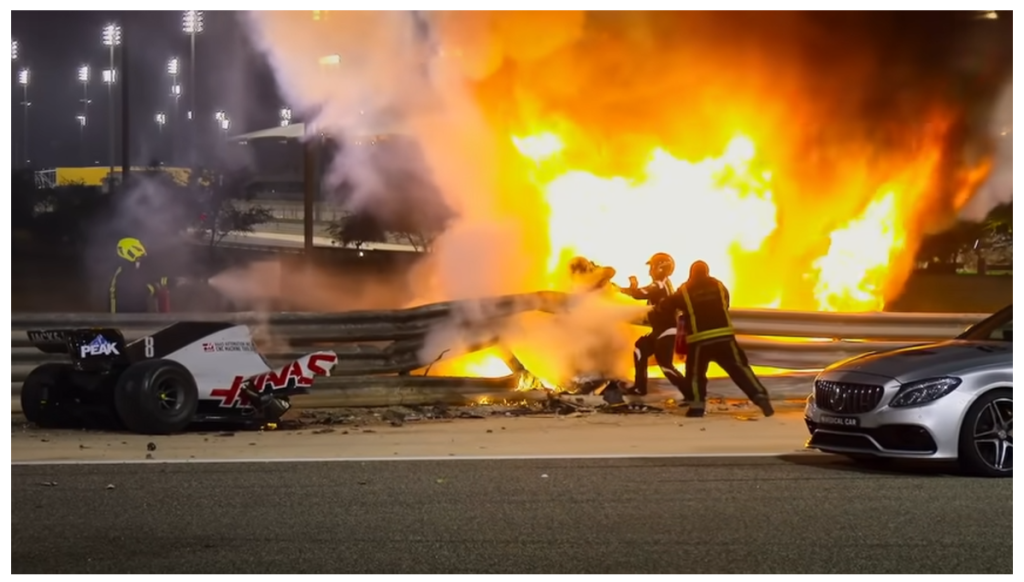
In 2020, Romain Grosjean driving Haas F1 car directly crashed into the barrier in Bahrain Grand Prix. The crash was so dangerous that it split the car in two pieces which was nearly impossible for a modern Formula 1 car. The collision was head on from the front end of the car. Romain experience 53 G force when he crashed through the barrier at the speed of 250 km/h. The halo protected his head from such intense front collision. People called it a miracle of god but it was one safety decision evolved from simple yet effective engineering solution which saved a man’s invaluable life from an unimaginable incident.

The impact so powerful that it split the modern F1 car in two. The halo saved Grosjean’s life from from powerful front crash into barrier. The man on fire emerging from the yellow fire can be seen here.

In 2021, Max Verstappen’s Red Bull F1 car crash landed over Lewis Hamilton’s Mercedes F1 car. The Red Bull car’s rear tire (or tyre) literally traveled over Lewis’s head. The halo prevented this direct contact otherwise it was definitely for 7 times world champion’s neck and life.

The halo that saved 7 times world champion

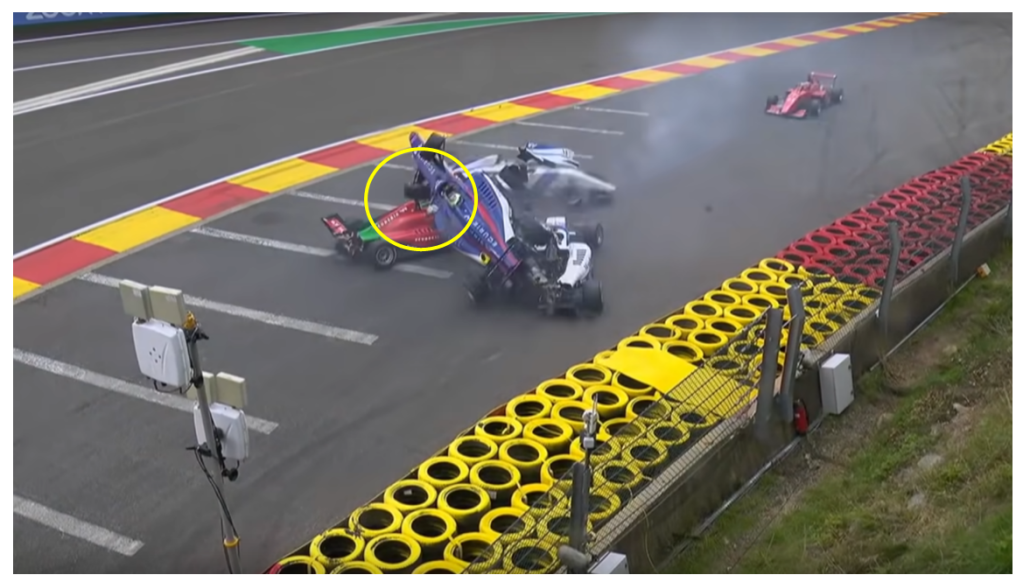
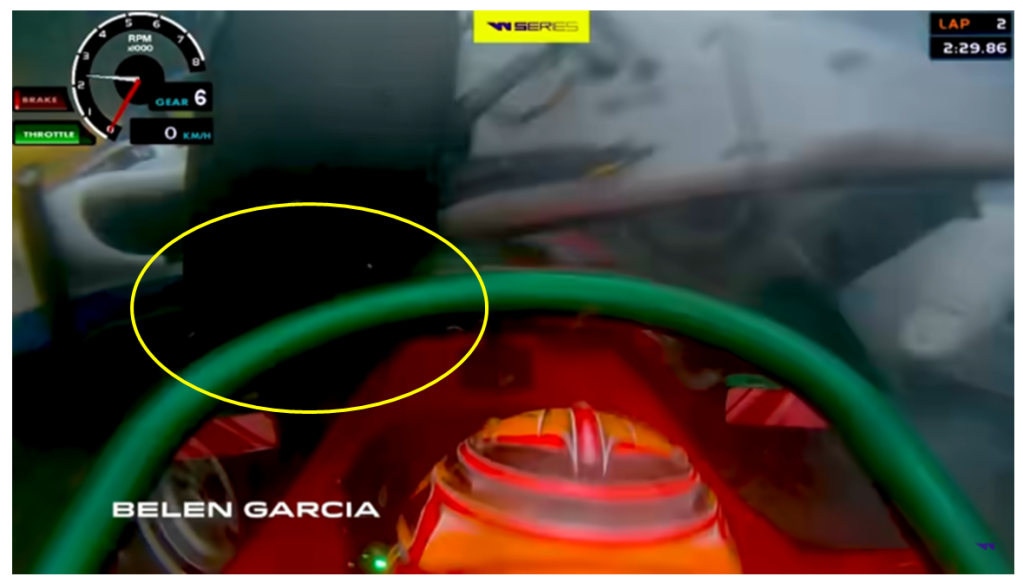
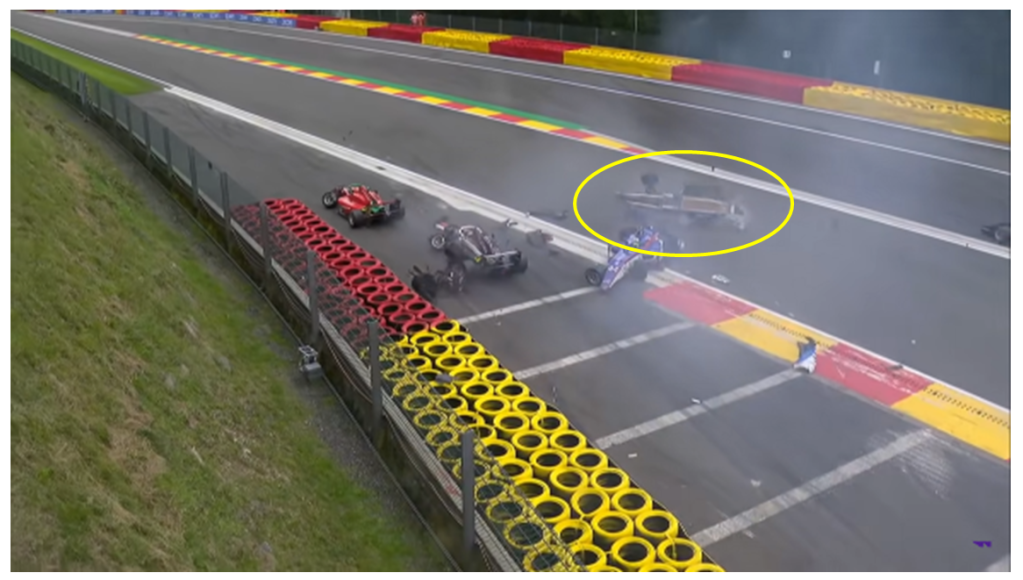
In 2021, in W Series qualifying session at Spa, Belgium a really weird accident caused 6 cars to pile up within few seconds. In this multiple collision pile up the halo of Sarah Moore’s car deflected a flying wheel saving her life from instant impact. In the same incident Beitske Visser’s car landed on the halo upside down which saved her life. Belen Garcia was also saved from frontal impact in this crash.

Moore’s head saved from loose tire contact
Garcia saved from the contact with loose tire from front
Visser saved from multiple flips and dangerous landing on head

In 2022, British F2 race in Silverstone the car of Denis Haugher’s car went airborne, just like a vehicle jumping off a ramp on a corner and it went cross through the car of Roy Nissany’s head. The halo experienced side impact and only because of the implementation of halo Roy Nissany was saved from literal decapitation. It was a great save only due to halo.

Nissany’s stars were bright on this ramp flight contact

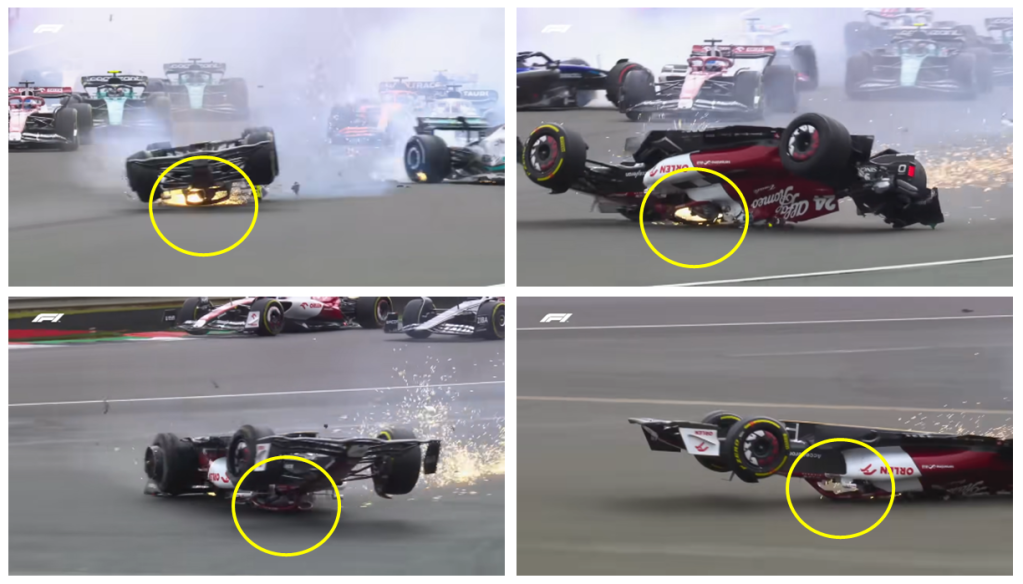
In 2022, British Grand Prix at Silverstone, in the start and the first corner of the first lap Pierre Gasly’s Alfa Tauri F1 Car touched George Russel’s Mercedes F1 car on rear which resulted in his crash with Zhou Guanyu’s Alfa Romeo F1 car. The crash caused the Zhou’s car to flip upside down and in the same orientation the car went off track skidding only on the support of the halo over the gravel till the barriers. Zhou did not suffer any injury and was safe in all this accident, as if nothing happened.   

Guanyu’s crash tested halo from all possible angles. Halo was the angel which brought him back from the doors of death.

Are design decisions all about aesthetics?

Here are some highlights of halo-

Halo solved most of the problems related to the closed canopy and aeroscreen.

There is no moving part in halo thereby eliminating the unpredictable failures in extreme cases.

The problem of visual obstruction was more related to the development of habit in drivers. We can see our own nose with our own eyes (which is relatively easy to check for people with big and pointy nose) when we make a conscious attempt to see it. Our brain is normally ignoring our nose in routine vision. When you hold a pencil in front of your face and close, if you try to focus on distant objects the eyes can see what there is behind the pencil too. As if the pencil doesn’t exist. In the same sense drivers became comfortable with halo’s obstruction after some learning curve.

Regarding the aerodynamics, FIA is always in development to establish new design standards to maintain competitiveness in the sports. FIA in 2022 established some design changes to enable close chases between cars. Air fairing is allowed over halo, so teams have found out the ways to minimize the dirty air created due to halo.

FIA allows air-fairing to reduce the dirty air from halo

The implementation of halo was one of the most resisted decisions of the famous and important motorsport like F1. The reasons behind halo’s rejection seemed fair until it proved its effectiveness. Halo saved at least 10 lives in three years immediately. FIA simulation analysis predicted that there would be 1 incident in 1 – 2 years where halo will play key role. After such incidents in series, it became clear that halo is the life saver.

The major backlash for halo was for the reason that it would mess with the aesthetics of the F1 cars. F1 cars are known for their slick aesthetics. But there is more to it. The slickness, sophistication in an F1 car is not just about its design looks or its visual beauty it is also about the functional design. For a design to become perfect, there should always be some intent for certain part to remain there. The implementation of halo and the developments that resulted it show us some really interesting ideas about what a design should be. Development of halo also shows that the process to design a simple yet effective engineering piece is really complex, rigorous, thoughtful, precise and continuously evolving process.  

The story of evolution of halo in F1 tells us about the minimalist and functional design for safety. Not even single part of halo is in excess, unnecessary or unwanted. The designers and engineers deserve special recognition for saving important lives and maintain the spirit of the sport. Maybe halo is truly the best design and safety decision after the design of seat belt. And there will always be scope for evolution and improvements. Given that the simplest, most effective design of halo is to stay forever in motorsports like F1, whatever comes after halo will be and has to be groundbreaking.     

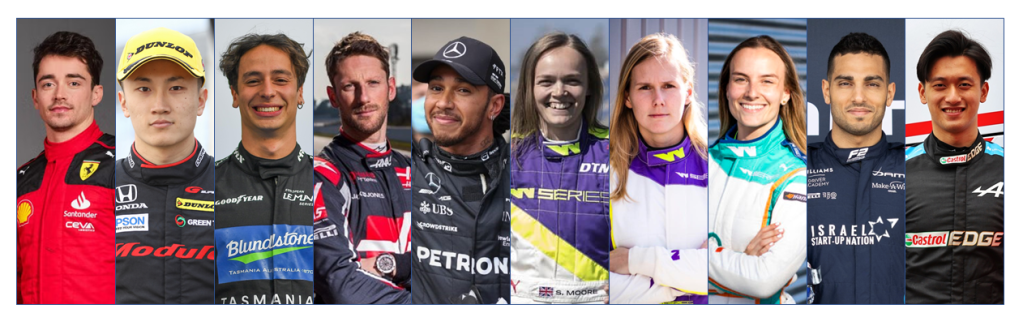
The precious lives that halo saved:

The story of evolution of halo in F1 tells us about the minimalist and functional design for safety. Not even single part of halo is in excess, unnecessary or unwanted. The designers and engineers deserve special recognition for saving important lives and maintain the spirit of the sport.

Starting from left – Charles Leclerc, Tadasuke Makino, Alex Peroni, Romain Grosjean, Lewis Hamilton, Sarah Moore, Beitske Visser, Belen Garcia, Roy Nissany, Zhou Guanyu.

References and further reading:

  1. Ferdinand Porsche
  2. FIA Standard 8869-2018 SINGLE-SEATER ADDITIONAL FRONTAL PROTECTION – HALO
  3. 2018 FORMULA ONE TECHNICAL REGULATIONS
  4. 2023 FORMULA ONE TECHNICAL REGULATIONS
  5. Technical F 1 Dictionary
  6. A Critical Review of the ‘Halo’ Device in Formula One by Charmian Monroe – Oxford Brookes University
  7. Effect of Halo Protection Device on the Aerodynamic Performance of Formula Racecar by Mark Lin, Periklis Papadopoulos, International Journal of Mechanical and Mechatronics Engineering  Vol:14, No:1, 2020
  8. Aerodynamic Study of a Drag Reduction System and Its Actuation System for a Formula Student Competition Car, Loução, R.; Duarte, G.O.; Mendes, M.J.G.C., Fluids, 2022, 7, 309. https://doi.org/10.3390/fluids7090309
  9. Crash images from telecasts of F1, F2, F3 and W series