Can we extend our experiences beyond the limitations of our senses?
A picture is worth thousand words, they say. You try to explain something to your friends and they get confused then you show them the photo/ video of the same thing and the need to explain things disappears. Visual media is literally ruling over all other types of media. This also highlights our dominant way of consuming information, any information. Hence, we can definitely say that vision is the most important of all the senses we use to interact with our surroundings. Important thing to understand is that we can perceive only certain range of light obviously known as the visible spectrum. What if we could extend this sense of vision?
Extending human vision
There are already good attempts for us to see in ultraviolet and infrared region which lie on the both sides of visible spectrum. Special optical filters and thermal sensors can create visuals in ultraviolet and infrared which normal human vision cannot see. In a way, we have achieved UV, IR vision which can increase our understanding about surrounding. This story goes good for people with normal vision. But how does a blind person can understand this highly visual world? Many of us would have experienced and will agree that the lack of a sense for a long time elevates the other senses in such differently-abled persons which helps them to perceive same object with different attributes of senses. We will see one such interesting story of a person who is not completely blind but the way in which he solved the problems in his vision have created a totally different understanding about our ideas on vision and our senses.
Neil Harbisson – the cyborg with antenna
Neil Harbisson has a condition called ‘Achromatopsia’ also known as ‘Total Color Blindness’ where he cannot perceive the color of objects. The whole world is like black and white television for him. There are some types of spectacles available in market for partially color-blind people which effectively help them to distinguish different colors but there is no such solution for people with total color blindness. Neil solved this problem in a different way.
Neil Harbisson World’s First Cyborg
The problem of perception of different colors of objects was solved by converting the light into the sound. This simply means that certain sound frequency is assigned to certain color. When a digital camera scans such color, it will create auditory feedback which can be heard by the ears of the person. Now it becomes a learning for the color-blind person to differentiate between different sounds to understand the respective color. With the help of Adam Montadon, a computer scientist, Neil developed an antenna which is physically connected to his head – the rear part of skull – occipital bone. This antenna was further upgraded by Peter Kese and Matias Lizana. The early model of this eyeborg developed for Neil was like a headset with camera and later on it evolved to an antenna, reduced computer weight to computer integrated to a chip. Now, Neil has one tentacle-like antenna over his head.
The “eyeborg” and its feedback
Not only the design and evolution of eyeborg is fascinating but the feedback it provides is very interesting. As we know already that the different frequencies of color are converted to different sound frequencies. Whenever the camera in the antenna is pointed to any object, it gives sound feedback to Neil which enables him to distinguish and experience the color in a different way.
In the early version of eyeborg the sound was fed to Neil through the headphones to his ears. This blocked the ambient sounds for Neil making him unaware of the surroundings. It was like he sacrificed the ambient sound to understand the colors of surrounding objects. The smart update Neil did was to integrate the auditory feedback of eyeborg directly through his skull bones. This eliminated the over the ear feedback of eyeborg thereby freeing his ears for ambient sound. Now Neil hears ambient sound through his ears and the sound for color feedback is heard through bone conduction! Everyone can understand the difference between bone conducted sound and the ambient sound actually. When you hear your voice through a recording you always hate it (maybe this doesn’t happen with good singers!) because it sounds so weird and creepy. This happens because you have always heard your voice through bone conduction and others hear your voice as an ambient sound.
This doesn’t stop here. Neil was unable to understand the saturation in the color in the early versions so he assigned loudness of the frequency to the saturation of the color. The antenna containing camera serves as a Bluetooth/ Internet connection so that he can receive and transfer data to other devices.
Hearing music from a painting
Neuroplasticity of our brain has allowed Neil to understand the world in a different manner. The sonochromatic scale developed to understand the colors through the sound has elevated Neil’s understanding about colors to next level. First obvious thing is that his brain perceives the surrounding colors in terms of different sounds; this allows his brain to associate certain sound to certain objects. For normal humans when we say bus, we generally picture a red bus, when one says an airplane, we generally picture a white airplane, when someone says an ocean, we generally picture a blue ocean. Interestingly, Neil’s brain has developed itself to associate the objects to certain sounds which creates different synaptic feedback in his mind. His perception for general objects is totally different than all the people who can experience color.
We should understand how deeply colors are rooted into our fundamental understanding of nature. And when this understanding is changed to feedback of different sense which is a sound in Neil’s case the experiences are totally different and otherworldly. Even his dreams are filled of sounds for different colors, this is how deeply the ‘hybrid sense’ has been developed in Neil.
NASA released some images from James Webb Space Telescope where they assigned certain sounds to certain colors and tones to stars in the image. When tracked in a pattern you can experience the image in terms of sound which is on crude way of understanding the image through sound (crude way as in it is nowhere closer to the actual sound of the location, it is just conversion of image data to sound date with one to one replacement)
Sound from an image Source:JWST, NASA
The colors from a song
Turns out, that the reverse of feedback from the eyeborg is equally interesting. The process of association of sound to a color has gifted Neil to understand the sounds in different way. Though the initial purpose was to comprehend the color through different sensorial feedback, it has given Neil a different type of intellect. Now, when he listens to a song, sound or music he can picture some series of colors. In simple words, he can create a visual and colorful output of an audio array. Though we visualize the sounds or music through complicated waveform, they were never associated to colors to the scale that Neil has experienced before. According to Neil’s experiences now he has a color scheme for certain music pieces, world famous speeches, musical symphonies.
Neil’s Eyeborg and Synesthesia
Actually, there is one human condition which is much closer to the experiences of Neil. There is one condition where a person associates the feedback of a sense to a totally different sensorial experience. The feedback from a sense stimulates some different type of experience. For example, for people with a synesthesia, they may associate certain color to certain number, some people associate the sound to certain color. This stimulation of totally different cognitive pathway by the experience of a cognitive pathway is called as synesthesia. Synesthesia is a natural and rare condition. Neil has artificially developed this condition in him to heighten his awareness of the colors. There are different types of synesthesia based on the association of cognitive stimuli.
In Grapheme–color synesthesia person associated a color for a letter as in A will stimulate the color red in his mind, in Spatial sequence synesthesia people associate events to certain stimuli so that they have exact memory of events as in with exact date and time, in Auditory–tactile synesthesia people experience touch or sensation in certain body parts when they hear certain sounds, in Ordinal linguistic personification synesthesia the person associates some objects, sequences like number sequences, calendar months to certain people or genders, in Misophonia synesthesia the person invokes certain emotions like anger, happiness, fear when certain sounds are heard, in Mirror-touch synesthesia the person are said to have heightened empathy so heightened that they experience the touches to the person in front of them as if someone has touched them actually, in Lexical–gustatory synesthesia the person experiences certain taste upon hearing certain words.
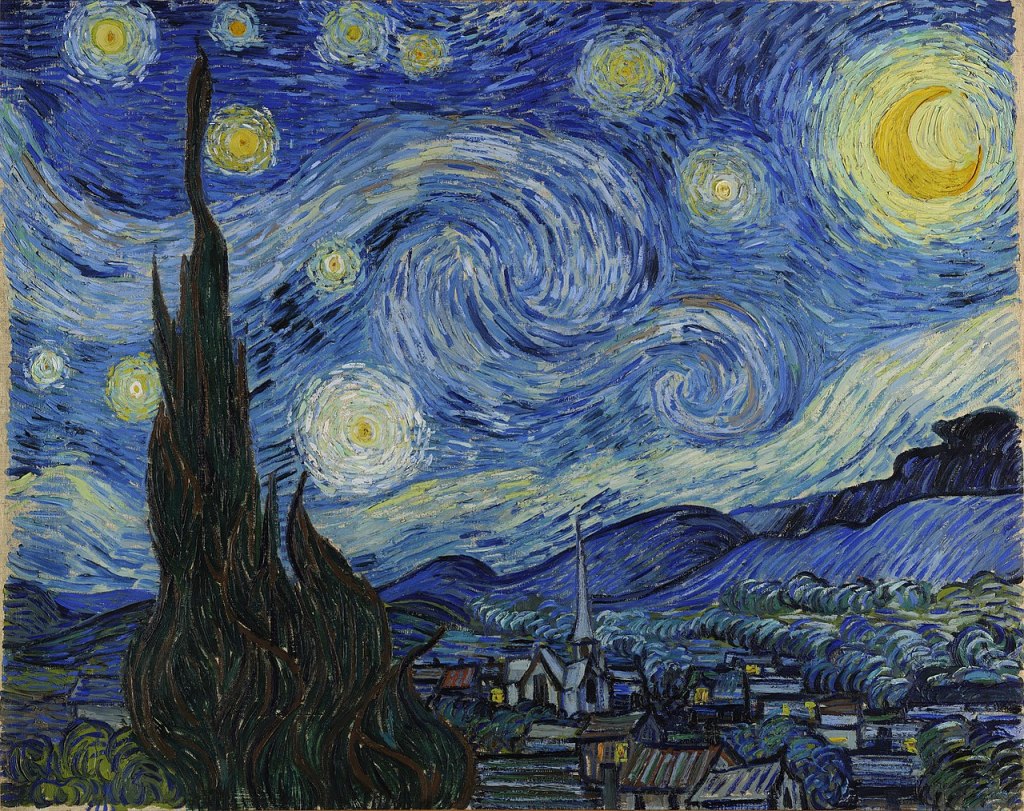
Chromesthesia is the synesthesia which deserves separate explanation for our discussion. In Chromesthesia, the person assigns a color to the sound they hear. Which exactly what is happening in the case of Neil but artificially. According to art historians the famous artist Vincent Van Gogh has Chromesthesia which made his paintings so vibrant. According to one such comment Vincent tried to learn Piano but left it midway because the notes of piano invoked different colors in his mind thereby overwhelming him.
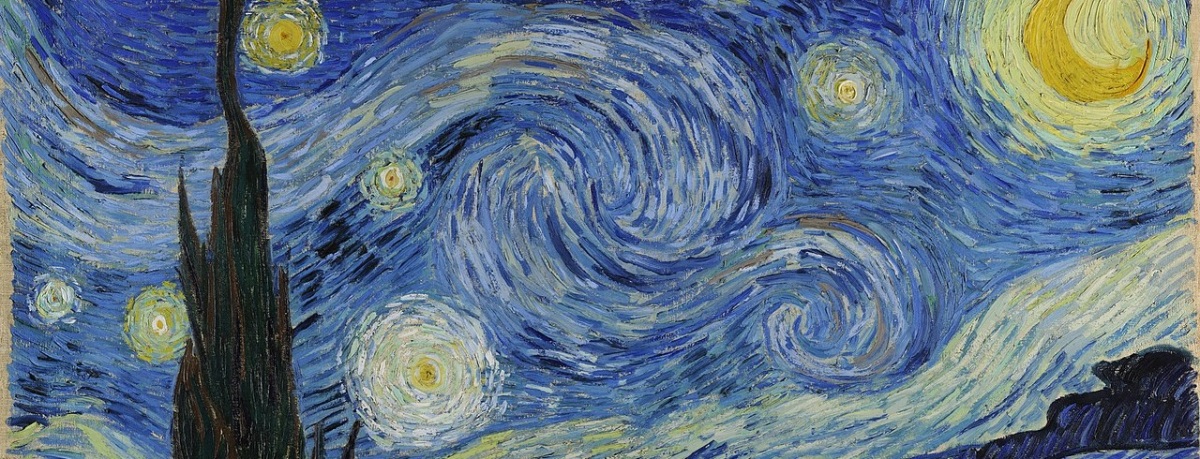
Van Gogh’s The Starry Night
Jack Coulter – one of the artists of our generation has Chromesthesia. He is known for his abstract art pieces which reflect the way he interprets the sounds and music. In simple words, he paints the songs. Jack’s paintings of are such an experience. You can find his paintings on some famous songs on his official Instagram page which includes ‘Love of My Life’ by Harry Styles, ‘The Best Day’ by Taylor Swift, ‘Running Up That Hill’ by Kate Bush, ‘Don’t Tell Me’ by Avril Lavigne, ‘Take me Home Country Roads’ by John Denver, ‘As It Was’ by Harry Styles. He even has created an art piece for the world famous ‘Cornfield Chase’ soundtrack from Christopher Nolan’s Interstellar.
Jack Coulter’s ‘Mr. Bad Guy’ painting based on Freddie Mercury’s song of same name
A mix-tape of senses and the hidden reality – philosophical implications
This crisscross of our senses and the stimulus actually questions the nature of our reality. If we question the nature of evolution by question like why can only eyes see color and why can only ears hear the sound which are very fundamental philosophical questions (so fundamental that the person who poses them may be called a mental person), then we will understand that it is the nature of light to impart the color to the object, it is the nature of sound to impart the vibration of the object which developed such organs in a way.
But if we dig deeper and question the limitations of our perception of sound and light then we will realize that what we perceive or feel through our senses is just a sample or small piece of all the experiences presented by the reality. For simple example, though sound (mechanical) and light (electromagnetic) are all but vibrations, the extent of their experience or the ranges in which they exist or the things they are made up of cause them to collapse into two distinct sensorial experiences.
And when we are trying to resolve such questions about the senses, the conditions like Synesthesia or the cyborg movement created by people like Neil try to modify our understanding of the reality that we live in. If these people can interpret the colors into sounds and sounds into colors, are our senses limiting us from a different type of awareness? Are we missing some extra information from reality due the limitation of our senses? In simple words, even though there are many colors around us we cannot see in dark but most of the animals have awareness of infra-red spectrum or night vision which gives them extra information of the same surrounding where we all coexist. Bees, butterflies, insects can detect ultraviolet light to understand the pollen part of the flowers which we cannot see by or normal vision. This questions the reality and our experiences from it
For a no person with complete awareness of his/her senses, the cognitive stimulus and feedback is almost hardwired. This stimulus and feedback are what create reality for us. We cannot experience even a common thing without experiencing the interactions of our senses with the surrounding. And when we realize that there are other ways to experience the same reality by connecting it to totally different sense and stimulus, this opens a new chapter in our understanding of the nature. It’s like being aware of the ultrasonic sounds as same as owls experience it. This opens a totally different universe for all of us – the hidden one which was already there. Maybe this is the sixth sense many people talk about. Actually, our lives and the experiences that we have, are always being dictated by the five senses that we experience.
Bertrand Russel had made some attempts to crack such question in his world-famous book called ‘The Problems of Philosophy’. In the very first chapter called “Appearance and Reality” of this book Russel concludes that this can be a question which may remain unsolved forever. He uses a concept called ‘sense-data’ as in the information which we immediately know from our senses as in smell, color, sound. Russel clarifies based on a structured thought process that what we perceive as a reality is mere the what it appears to us based on the senses we experience (also known as sense-data). If our sense-data gets limited our understanding of reality will be limited. As the reality we experienced through our limited senses will be a reality for us, it will not be the complete reality as in “the reality” – “the ultimate/absolute reality”. (I know this gets confusing from hereon) And if the reality through our senses is not complete reality that how could we transcend to the realization of “the ultimate/absolute reality” by extending our senses? Or is it a completely different pathway? Russel leaves that idea to the power, need and importance of philosophy.
There is definitely much more information that we are missing only because of the limitation of our senses. So, the reality is not we experience through our senses only, it is more than that which maybe is impossible for us to grasp for now. Maybe in near or distant future we will be able to understand reality in different way like Neil, Jack and many people like them.
P.S. – Most of the artists have mastered this transcendence of senses in their own ways, which is what makes art so special for humanity. Maybe it is the only way we have right now to extend our senses.
References:
“A picture is worth a thousand words” – image by ElizabethHudy from flickr
Bell’s Inequality and The Completeness of Quantum Mechanics
“The Nobel Prize in Physics for 2022 to Alain Aspect, John F. Clauser, Anton Zeilinger is important in the sense of how we understand the nature. The works of these three Nobel Laureates have confirmed that the fundamental things which make up the whole Universe follow the rules which are not consistent with the reality we experience”
“If you think you understand quantum mechanics, you don’t understand quantum mechanics.”
Richard Feynman
Ever since that damn apple fell off frw3om the tree on Newton’s head the world of science has exploded and expanded faster than maybe the Universe in which we are continuously questioning the nature of our existence, the nature of reality. Although if one really tries to understand how Newton worked out his ideas on the laws of motion, law of gravity, the calculus, they will know that it surely wasn’t the apple that did all the trick. (Given that “apples” have already contributed to change the course of the humanity in different ways)
Classical Mechanics
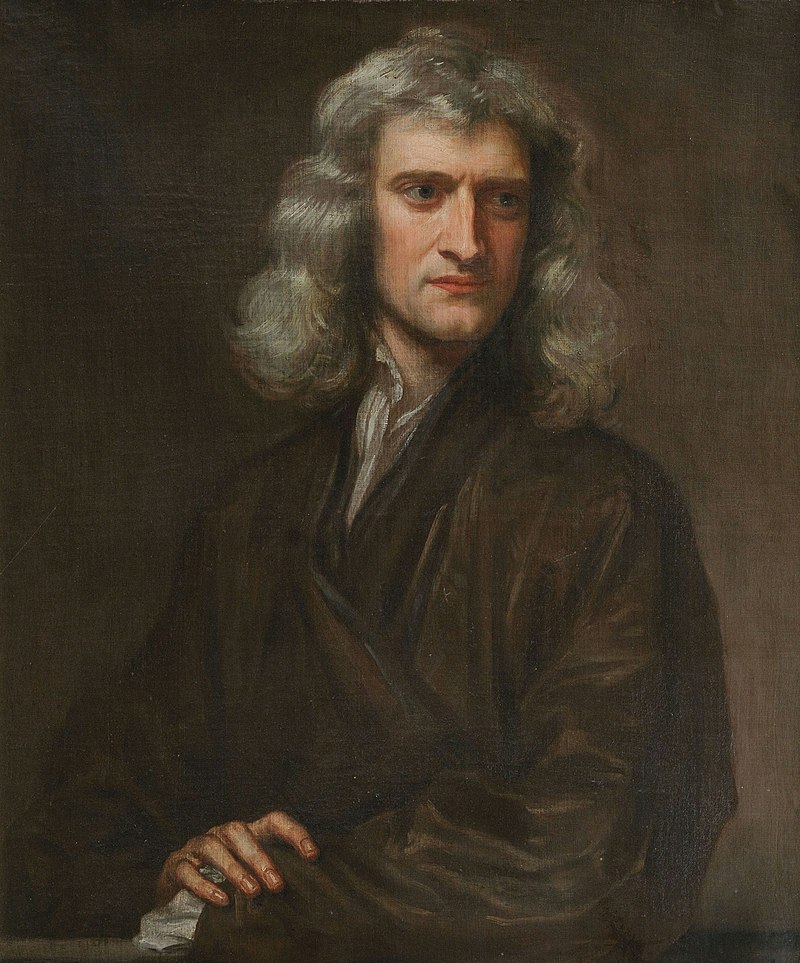
Sir Isaac Newton The discovery of Gravity was not a coincidence
What made Newton’s work great is the predictability, structured-ness of the theories he developed. Newton described gravity as the force of attraction between each and every object in the universe. Higher the masses, closer the objects stronger will be the gravity. These theories make predictions which can be tested and then checked to be right or wrong. And for a long time, they were true. Then there came a time – the time. The time of Albert Einstein, where some people say that he proved Newton wrong. I will say Einstein found more generalized form for Newton’s theory of gravity. The ideas of Newton’s theory of gravity are a chunk of the bigger picture of Einstein’s theory of relativity. The theory of relativity considers the gravity not a force but rather curvature of the fabric of space-time. The mass of the object causes the space-time to curve around it hence causing the nearby objects to fall towards it. It’s like a trampoline where a heavy object is curving the elastic sheet around it wherein if other smaller objects are brought in this elastic sheet, they will be eventually pushed into the heavier objects. Newton thought of gravity as an attraction- a pull, whereas Einstein’s gravity pushes. Like Newton, the Einstein’s theory of general relativity makes predictions which can be tested by doing experiments and are proved to be right. Newton’s gravity could not predict the motion of planet Mercury around the Sun due to its limitations. Einstein’s theory of relativity predicted it accurately. Thereby proving it’s superiority.
Albert Einstein Gravity is the bending of the fabric of Space-Time
The most important thing about Einstein’s theory of relativity is that it created the awareness of the fourth dimension and made it accessible to humanity in some indirect ways. Although, multiple dimensions are possible in abstract mathematics, but they were never accessible to humanity before the establishment of the theory of relativity. Einstein’s theory of relativity is still standing strong and predicting some of the wonders only universe can manifest.
But you know what, Einstein’s theory of relativity is not the generalized theory of our understanding of the universe. Einstein’s theory of relativity though fits for heavenly bodies, even to the grain of sand but it cannot explain the behavior of the subatomic particles making the atoms of the same grain of the sand. There are still some missing pieces in our understanding of the universe. Meaning that Einstein’s theory of relativity is applicable some special case of the reality we exist.
Rise of Quantum Mechanics and the EPR Paper
Einstein’s attempt to formulate the theory of everything sets the Quantum mechanics in motion. The basic idea is that Newton’s and Einstein’s approaches were top-down approaches to understand the nature whereas the approaches of quantum mechanics are bottom up where the discussion starts from the subatomic particles and the fields responsible for the generation of the fundamental forces (Electromagnetic force, Strong force, Weak force) in nature. One must understand that gravity is still not explained by quantum mechanics. Which is what in a way was the point of concern for Einstein. The theory of relativity breaks at subatomic levels.
This is the part where the EPR paradox comes in picture.
In order to understand the comments in the EPR Paper, one needs to understand some basic ideas in quantum mechanics.
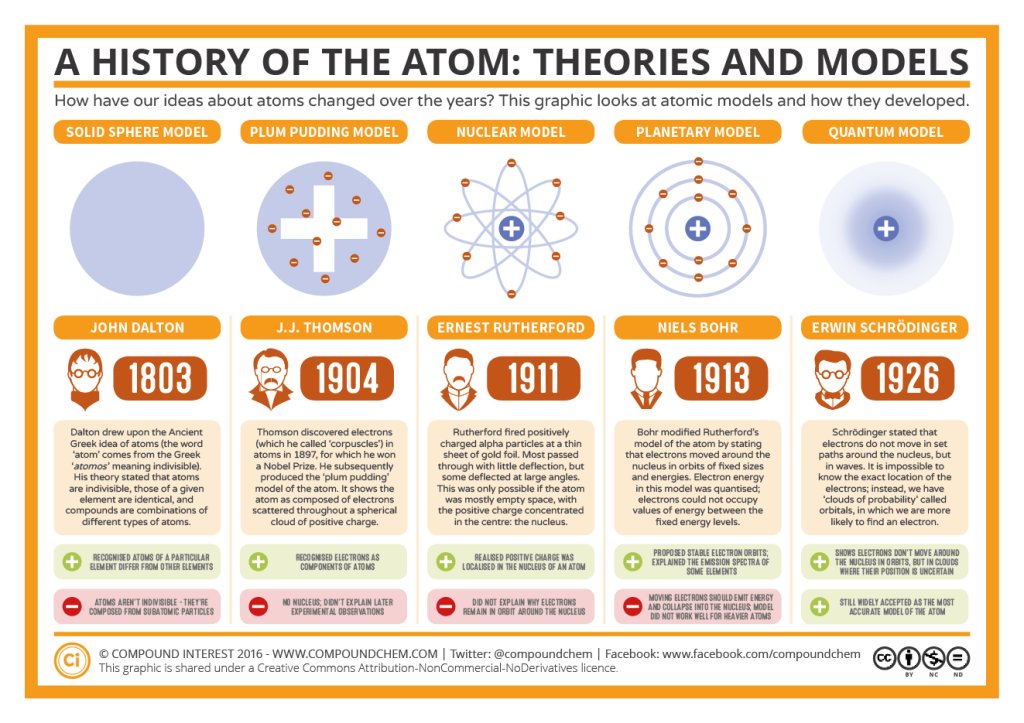
The model of an atom has evolved greatly over time which also showcases how we improved our understanding of the universe.
John Dalton thought that matter on many divisions will end up in its smallest indivisible part called atom. Which established different elements will have their own characteristic atoms. This idea helped to establish the weight of an atom of each element. Combination of elements would give weight of the molecule made from that specific combination of atoms. With this idea one can exactly tell the molecular weight of product formed by the chemical reaction of two reactants.
J J Thomson in his experiments on Cathode Ray tube (exactly similar technology used in our old heavy box TVs) found out that if a high voltage is applied between two metal electrodes in a vacuum there is formation of a ray which gets attracted to the positively charged terminal thereby showing the negatively charged particles in this ray “The Cathode Ray”. Stronger the magnetic field stronger the cathode ray will deflect. And based on the relationship between the strength of magnetic field and the extent of deflection ray, Thomson found out that the weight of the particles in the Cathode Ray is very small compared to the weight the atoms. In this way the Dalton’s atomic model was revised to Plum Pudding. Where the electrons are scattered throughout the positively charged environment (Literally like the plum pieces randomly scattered in the pudding)
On further experimentation, Rutherford found out that there is vastly bigger space between the positively charged nucleus and the negatively charged electrons. This was a sort of weird plum pudding. The atom’s plum pudding has all the dough at center which positively charged and is the heaviest part of the atom. The plum pieces i.e., electrons are actually floating around this nucleus which are negatively charged. This devised the planetary model of an atom.
From here on now the real fun begins,
If the electrons are floating around the nucleus, how do they always remain in contact with their own nucleus. What makes them remain “attached” to their nucleus? If they are remaining attached to their own nucleus and are floating around it, after some time the tired light weight negative electron should get attracted towards the strong and dense positive nucleus, thereby becoming unstable. And this doesn’t happen in reality, otherwise nothing would exist from such atom as it will not hold itself longer. Technically, an accelerated electrically charged particle emits electromagnetic energy thereby losing its energy – getting “tired” and eventually falling into the nucleus.
The Quantum Leap
Niels Bohr further sophisticated the model of Rutherford by assigning circular highways to the electrons around the nucleus. Each highway/freeway (autobahn!) has its speed limit which here in atomic model is the energy level. The difference between energy level of each highway is “quantized”. Meaning that there is no middle lane between each highway, no lane cutting/ lane crossing and no overtaking. The energy gap between each highway i.e., “orbit” is fixed. The change in highway is only possible when the electron gains or losses this fixed “quantized energy”. This jump of electron from on orbit to other coined the term the “Quantum Leap”.
Bohr’s idea was usable for simple atoms like hydrogen but it could not explain the behavior of heavier atoms and hence there was still something missing in the model of atom.
The Wave Particle Duality
Erwin Schrödinger formulated that the electrons don’t actually have discrete highways around the nucleus. Electrons are the particles that behave like a wave around the nucleus. This idea was inspired from the Louis de Broglie’s hypothesis that the subatomic particles like electron actually are the waves around the nucleus. Meaning that you cannot pinpoint the electron around the nucleus. The electron will be anywhere in the space around the nucleus, but it follows certain schedule/ timetable which is the famous Schrödinger Wave Equation.
The schedule of electron is always tightly packed. Electron is not that person who confirms his arrival to a party by immediately saying Yes or No. An electron is that friend in your group who will always has his plans and will ditch you at the last moment. To meet such type of an “electronic friend” i.e., the electron itself you have to study its behavior, its routine which is its waveform. The waveform will give you an idea where your electron hangs out the most. Such hangout places where you have largest chance of finding your electron are the “clouds of high probability” called the orbitals.
This is where the real problems start to happen. You thought you knew everything about your dear “electronic friend”. The whole foundations of quantum mechanics are based on wave particle duality of subatomic particles.
Spin of an electron
Spin of an electron is actually term used to signify the angular momentum of an electron. Please note that spin of electron does establish that an electron is exactly a ball or a top which is spinning around the nucleus. Rather, spin only represents that there is some measurable angular momentum for an electron.
Quantum measurements are never “Gentle”
The first and most important idea in quantum mechanics is that on subatomic levels the measurements disturb the state they are trying to measure.
The Heisenberg’s Uncertainty principle tells that if you go for the measurement of the spin of an electron the interaction between your measuring equipment and the electron will change its location. Same thing will happen when you go for the measurement of the position of an electron. The interaction between the equipment measuring the position will change the angular momentum of the electron.
Means, the effects we are trying to measure at such subatomic levels are so interaction sensitive that mere the interaction of measurement will disturb the state of the subatomic particle. Thus, you can either measure the momentum of an electron or position of an electron at a time.
The famous American physicist Leonard Susskind’s own words say,
“You can learn nothing about a quantum system without changing something else”
The quantum measurements are so interaction sensitive that they will change the state of the subatomic particle by merely interacting with the measuring equipment.
It’s like the measuring rotations of a ball in the air where you are physically flying with the ball with tachometer in hand in contact with the ball’s surface. The frictional interaction between tachometer and ball will either change the position or the rotation. Hence, you will only know about either the spin of ball or the position of the ball correctly at once. (I agree that it is one exhausting way to perform such measurements, but it serves the purpose here!)
Interaction during quantum measurements will change the state of the quantum particles
Einstein’s problem with the probabilistic nature of quantum mechanics
The wave nature of electron, the so called “fault” to measure the exact conditions of the subatomic particles all at once, the probabilistic nature of the quantum mechanics puzzled Einstein. Please note that the ideas discussed in quantum mechanics are not just some wild thoughts, these are legitimate mathematical proofs which are conceptually established in place. Einstein despised the idea of entanglement, which was not consistent with the reality he had already developed.
The entanglement- the bizarre child of an innocent mother
One bizarre concept born from an innocent concept is entanglement. As far as nature’s fundamental laws go- for creation of anything, something has to be invested in first place. This is called “conservation”. Law of conservation of energy says that the net energy of a system remains same, remains conserved always, it will change its forms but will always remain same in total. Conservation of mass says that one mass can change to other mass with totally different properties but the net mass of the system will always remain the same. Law of conservation of momentum says that if two objects of different momentum come in contact – collide, the total momentum before collision will be equal to the total momentum after collision.
In the same sense, angular momentum is also conserved in the natural phenomena.
So, now consider that two particles are generated from a particle with certain spin. In order to conserve the angular momentum of the system, the two particles will have exactly opposite spin of each other. This nullifying spin with the spin of the object they are created from will give the net constant spin to the system, thereby conserving the angular momentum of the system.
For any system the momentum is conserved
This type of connection between the new two particles from a system is called as the entanglement in quantum mechanics. (This may be, is the exact cinematic love that transcends all the barriers, all the dimensions in your favorite SCI-FI movies and fantasy movies!)
God does not play dice
In quantum mechanics, when one tries to measure the state of a subatomic particle, the act of measurement gives a state of that particle, but this act of measurement for getting the information about that particle also fixes the state of another particle entangled with it.
Meaning that if you separate the two entangled particles at a distance and measure the spin of one particle then spin of another particle gets fixed at the moment of measurement. The question is that, how does the other particle get the information of the first particle being measured and its state? Einstein called this idea as “spooky action at a distance”.
The EPR Paper
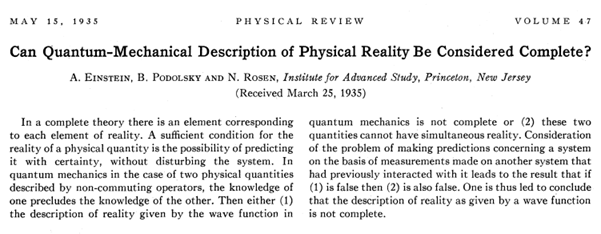
Einstein was so sure that there is something lacking in the theory of quantum mechanics that he published his idea about the incompleteness of quantum mechanics today famously known as the EPR Paper. Albert Einstein with Boris Podolsky and Nathan Rosen published the paper to explain why theory of quantum mechanics was still incomplete.
The abstract of this paper itself is intriguing:
“The EPR Paper”
Einstein debates that the reality is bound with all variables perfectly known. Hence, for a theory to be complete and to perfectly explain the reality there has to be one variable for each behavior. Hence, according to Einstein, as the quantum theory is completely based on wave function thereby becoming probabilistic (because wave function only gives the probability of measuring the information of the electron and does not pinpoint it) it is not giving the certain, definite, sure answers to the questions thrown at it. In simple words, if you ask a quantum physicist to pinpoint the electron around a nucleus, she/he won’t pinpoint the electron, instead they will tell that in this area there are high chances that you will find electron. As if, the quantum physicists have not studied the system completely, there is some unknown behavior that they haven’t identified yet which will complete the whole theory. Knowing this unknown variable will remove the tolerances in the theory, will remove the probabilistic nature of the theory.
Hence, Einstein puts the argument in two pieces:
First one attacks the lack of awareness of the all the variables in the quantum theory
The second one attacks on the reality, reality implying that the condition of having a definite state.
In short, either we don’t know completely about what is happening in quantum world or the quantum world does not have a real state.
Where the determinism and theory of relativity breaks
You have to understand the implications of the ideas put forth by Einstein and his colleagues in this paper. Einstein debated that the entangled particles when getting entangled secretly decide the state they are going to be. Hence, when one measures the information of the entangled particles, they seem to have been decided already. As if they have conspired about their states and our quantum theory is lacking to explain this conspiracy. The idea of fixing this state already established the concept of determinism. That every behavior in nature is already decided, it is only our lack of knowledge about nature which actually surprised us about the outcomes we experienced. If we have complete model of nature’s behavior we will not be surprised by the outcome, rather we will predict the outcome in advance. This was the heart of Einstein’s debate.
One more reason for Einstein’s debate on incompleteness of quantum mechanics was his own theory of relativity. According to Einstein’s theory of relativity, nothing in the universe can travel faster than the speed of light. The clever trick quantum mechanics holds it that even after being separated at larger distance where the light will take significant time to travel from one particle to its entangled counterpart the information of the first particle being measured is instantaneously transferred to the another entangled one. If this is happening instantaneously, then the information of one particle being measured has to travel faster than light to the another entangled one. This was also one point of concern for Einstein.
The concept of locality becomes important here. According to the principle of locality, only the immediate surrounding can affect the state of an object thereby limiting the speed information lesser than the speed of light. But, in quantum mechanics the information transfer is instantaneous irrespective of the distance, meaning that the state of one object even after not being in immediate surrounding is affecting the state of its entangled counterpart. (Park this idea of “locality” for one interesting concept called Quantum Cryptography). This meant that quantum effects if are true then they are non-local. Which established the concept of “non-locality” – challenging and exposing the limits of Einstein’s theory of Relativity. That is why Einstein always argued about the incompleteness of Quantum Mechanics. There were some practical explanations to believe so.
The understanding of Einstein about the incompleteness of quantum mechanics was not just a random philosophical pursuit or some complicated thinking done in the air which was incomprehensible for comparatively dumb people of the times. His idea of reality was influenced by the famous mathematician of his time called Jon von Neumann who was obsessed with structuredness of the fundamental theories. Rather he was the one who defined the standards of a good fundamental theory.
Einstein was unsettled with the idea of the probabilistic nature of the quantum mechanics.
This is the only reason which got Einstein into formulating “The Theory of Everything”. A theory which will combine the gravity from his theory of relativity to the theory of generation of fundamental forces of nature from quantum mechanics (if proven right in his time). Even in his last moments of his life, Einstein was working on “The Theory of Everything”. Today String theory and Loop Quantum Gravity are two strongest contenders for theory of everything. Humanity’s most brilliant minds are working on these theories. The problem is that these theories are completely abstract, conceptual to date and still in incubation mode to design a measurable experiment to check and validate the predictions.
The Nobel Prize in Physics for year 2022 is actually awarded to the contributions made for the real- life experimentation done to prove the completeness of the Quantum Mechanics and its implementation in real world.
The Nobel Pursuit- Bell’s Inequality
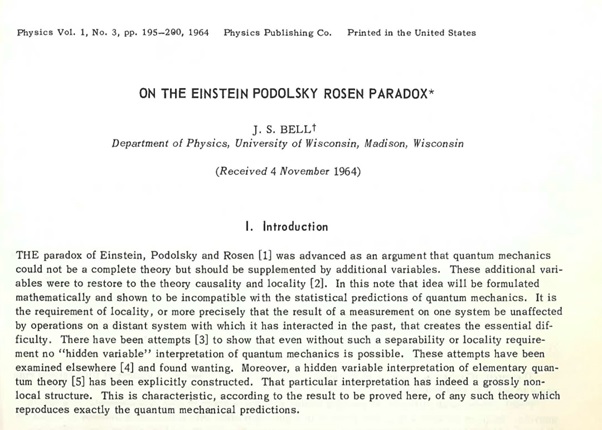
The EPR paper went in hibernation for years but, this actually became a reality in near future. The paper attracted the attention of one of the physicists at CERN called John Stewart Bell. Bell formulated a mathematical argument to explain the idea of hidden local variable in system. If this mathematical argument is proved to be right then this would also prove that Einstein was right all the time.
The Bell’s Paper where he established the inequality due to hidden variable
The beauty of Bell’s inequality is that that it gathers the intangible ideas and inspirations from EPR paper and probabilistic nature of quantum mechanics, wave function into a one definite, measurable and quantifiable equation. The equation given by Bell was testable in real world so that some concrete conclusions could be drawn about the completeness of quantum mechanics.
Bell developed a mathematical expression which was based on the assumption that the quantum mechanics has to be “Locally Real”. Where, Local means that the phenomena in quantum mechanics are not faster than the speed of light as explained and proven by theory of relativity; Real means that quantum mechanics is actually deterministic meaning that every measurement done in quantum mechanical system will give an exact answer, a definite value, a surety, it is only our lack of understanding of some hidden variables which cause the quantum mechanics to not be real.
Once the hidden variable/s in the quantum mechanics are identified, then theory will become consistent with the Classical Mechanics.
Smart thing about Bell’s equation is that it used the ideas of probability to show that quantum mechanics is not probabilistic.
Here is simplification of the idea explained by Bell:
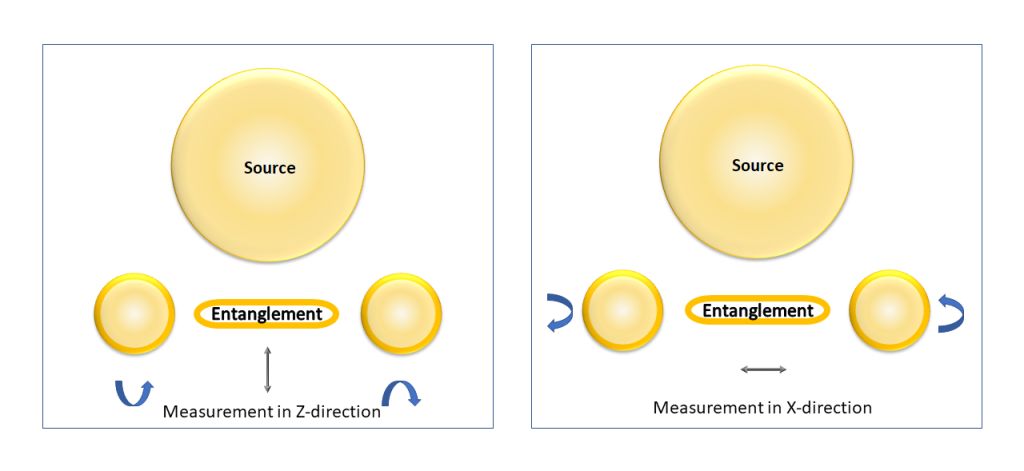
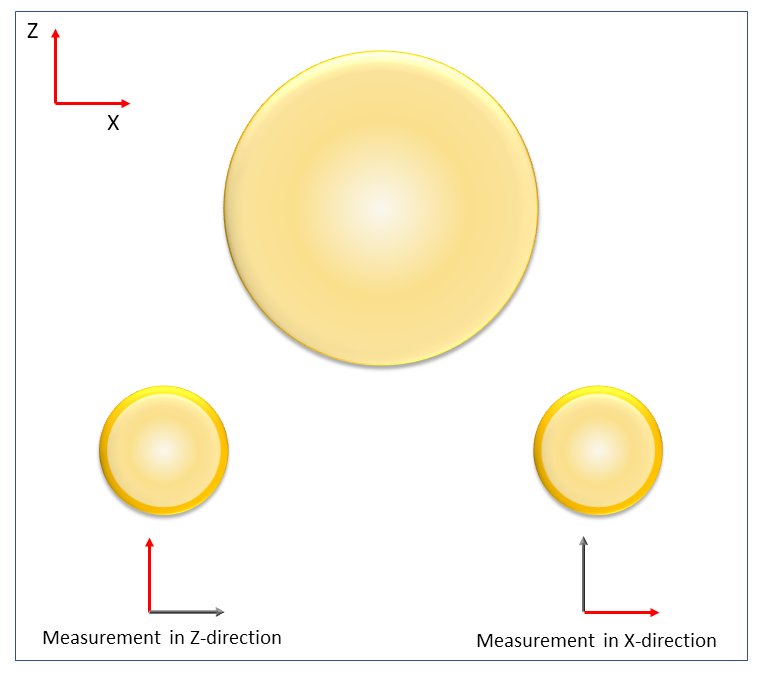
We will set up an experiment where we will measure the spin of two entangled particles. You have to understand that in quantum mechanics the act of measurement itself changes the state of the quantum particle. So, when you are measuring the spin of a particle in say Z-direction, after measurement it spin value will no longer be the same as the measured value.
Now what we will do is that we will measure Z-direction component of the spin of one particle in Lab 1 and X-directional component of the spin of the another one which is entangled with the previous particle in Lab 2. Please note that the distance can be as large as possible on the condition that both labs receive undisturbed, un-interacted entangled quantum particles. The measurements will be exactly simultaneous.
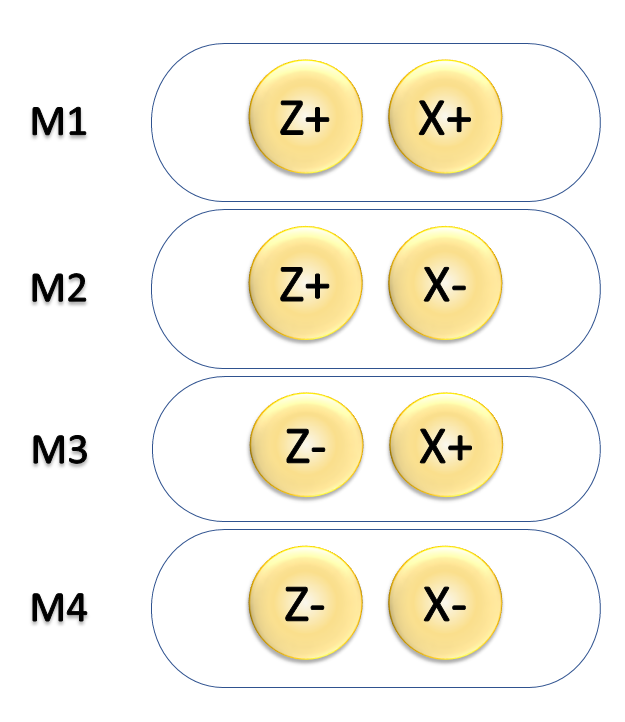
So, the possible measurements we will get from the experiments where we only measure two variables are as follows:
The set of measurements when there are only two variables will be:
Here, M1, M2, M3, M4 are the measurements taken. Thus, for set of all measurements:
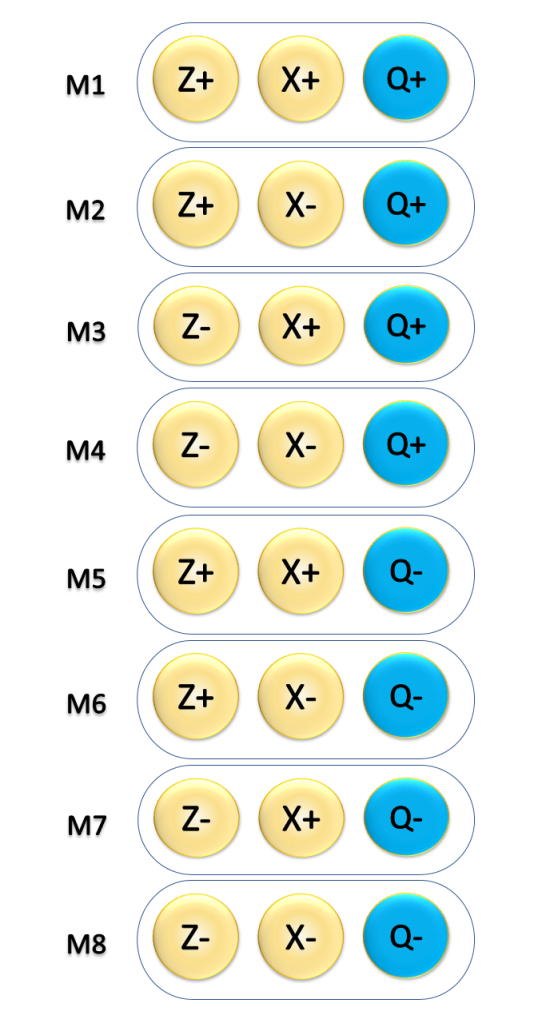
Now, the real game begins. According to EPR paper, if there are additional hidden variable/s in the model of quantum mechanics which we are not considering, the number of possible outcomes from the same experiment will increase. Say, if there is one hidden variable which we had not considered before while devising the Quantum theory called Q1, and now we are measuring this additional variable in the experiment then the number of possible states of entangled particles increase as follows:
When a new hidden variable is present in the system and if we measure that additional measurement as Q the number of possible combinations of measurement will increase. See below:
The set of measurements will be:
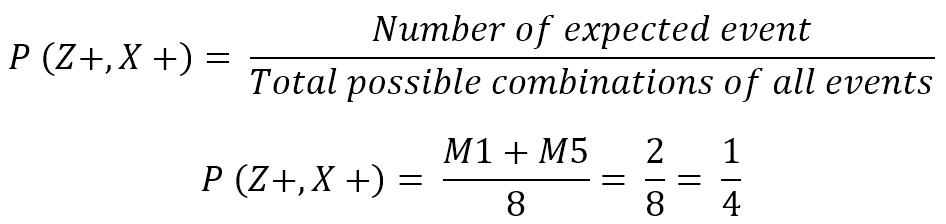
So, what will be the probability, the chance of getting Z directional spin positive and X-directional spin positive? i.e., What will be P (Z+, X+)?
Now, if there is one hidden variable and we are measuring that hidden variable then for the person who measures Z and Q the value of P (Z+,Q+) will be:
Similarly, for the person measuring X with hidden variable Q the value of P (X+,Q+) will be:
Now pay attention,
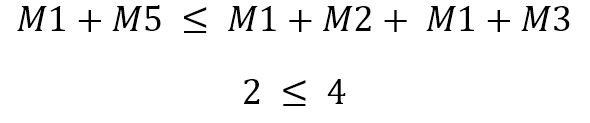
If we combine these three equations to establish the relation between them, the equation will be as follows:
Which is the Bell’s Inequality.
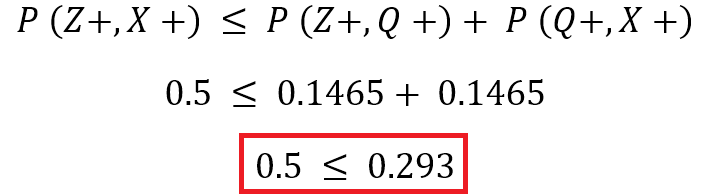
And is true, if we put the exact values,
In simple words, more variables driving the system, more will be the combinations of the measurements and thereby more complex the equation need to be to completely explain the system.
If there is hidden variable in the system, the number of possible combinations of measurements will be more than the system with lesser variables considered in the study. Which in turn will affect the balance of the possibilities of the events.
Now understand where does the quantum mechanics starts playing its tricks.
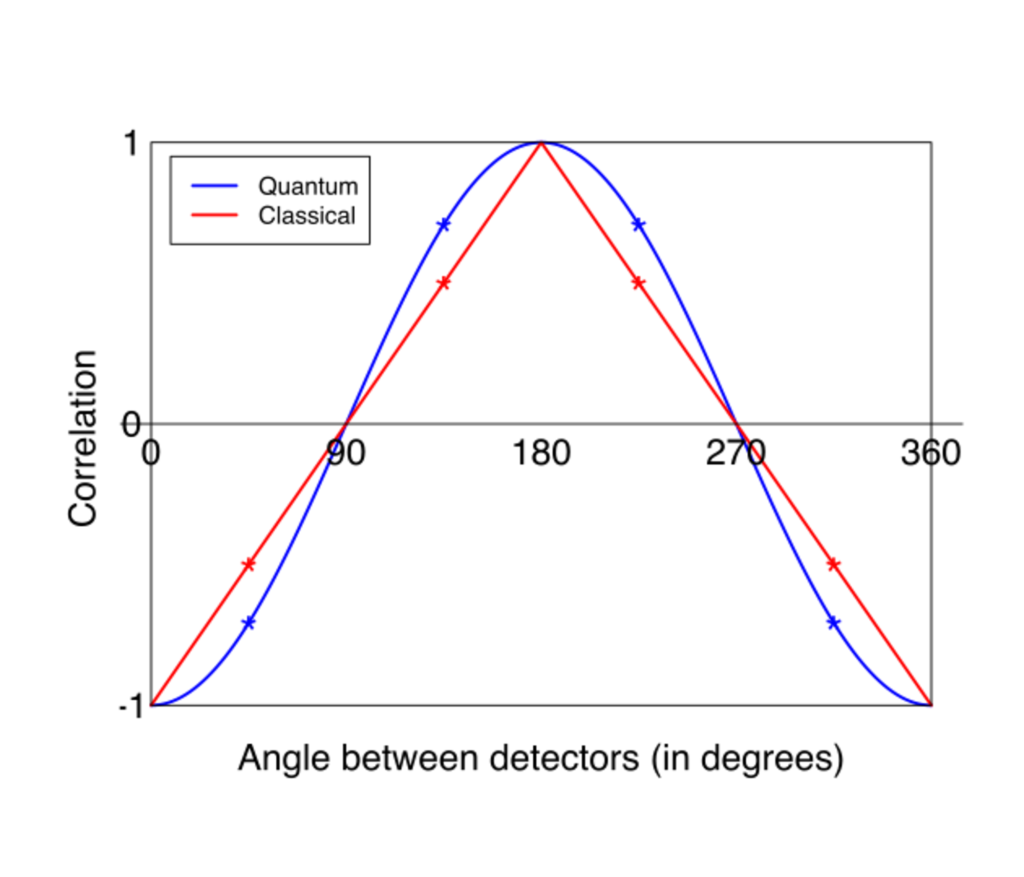
When we start to put the one-to-one values in this equation, we will realize what probabilistic nature can do. Due to the probabilistic nature of the quantum system, the measurements will not have a discrete value which lies on a straight line, rather it follows a sine wave, and if we substitute the values of the measurements from the sine wave function the inequality actually breaks.
The wave function in quantum mechanics actually tell what value it will have for measurement at certain angle. Which is indicated by the blue line in the graph below. The wave function only tells that what will the possibility that the spin will be +1 or the possibility that the spin will be – 1. The red line indicates that the measurements will be discrete (either up spin (+1) or down spin (-1)).
Wave function does not give discrete values
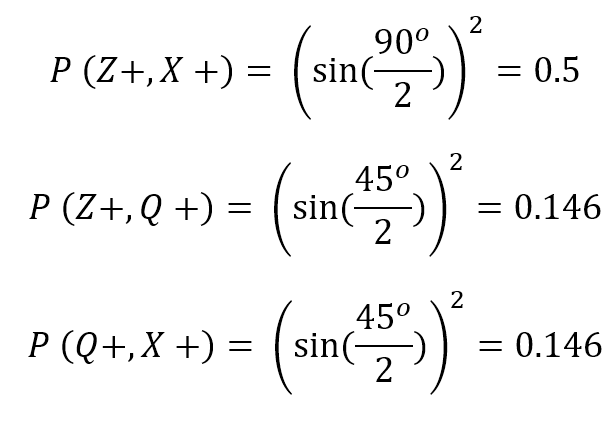
For our example, if one makes a measurement of so-called hidden variable between Z- component and X-component i.e., along Q axis lying between 45 degrees from both Z and X axes the outcome will break the equality as follows:
The values for the Bell’s Inequality for quantum mechanical measurements is given by using the sine wave given in the graph above:
Hence, from the Wave Function in Quantum Mechanics:
Hence, for Bell’s Theorem in Quantum Mechanical System the inequality breaks as follows:
Which is not possible, indicating that Bell’s inequality does not hold true for quantum mechanics. Proving mathematically that there is no hidden variable in Quantum Mechanics. Quantum measurements are not discrete and give definite values, rather the measurements can take any value until we are measuring them, we can only give the probability of how the measurement will be.
This was a shock for those who considered reality as a very sophisticated and definite. The wave function of quantum mechanics does not follow the Bell’s Inequality. There was a strong need for devising an experiment to check and confirm what actually is true. But you must appreciate the power of mathematics and the intellectual level of human mind which can give such deep insight about the nature of reality.
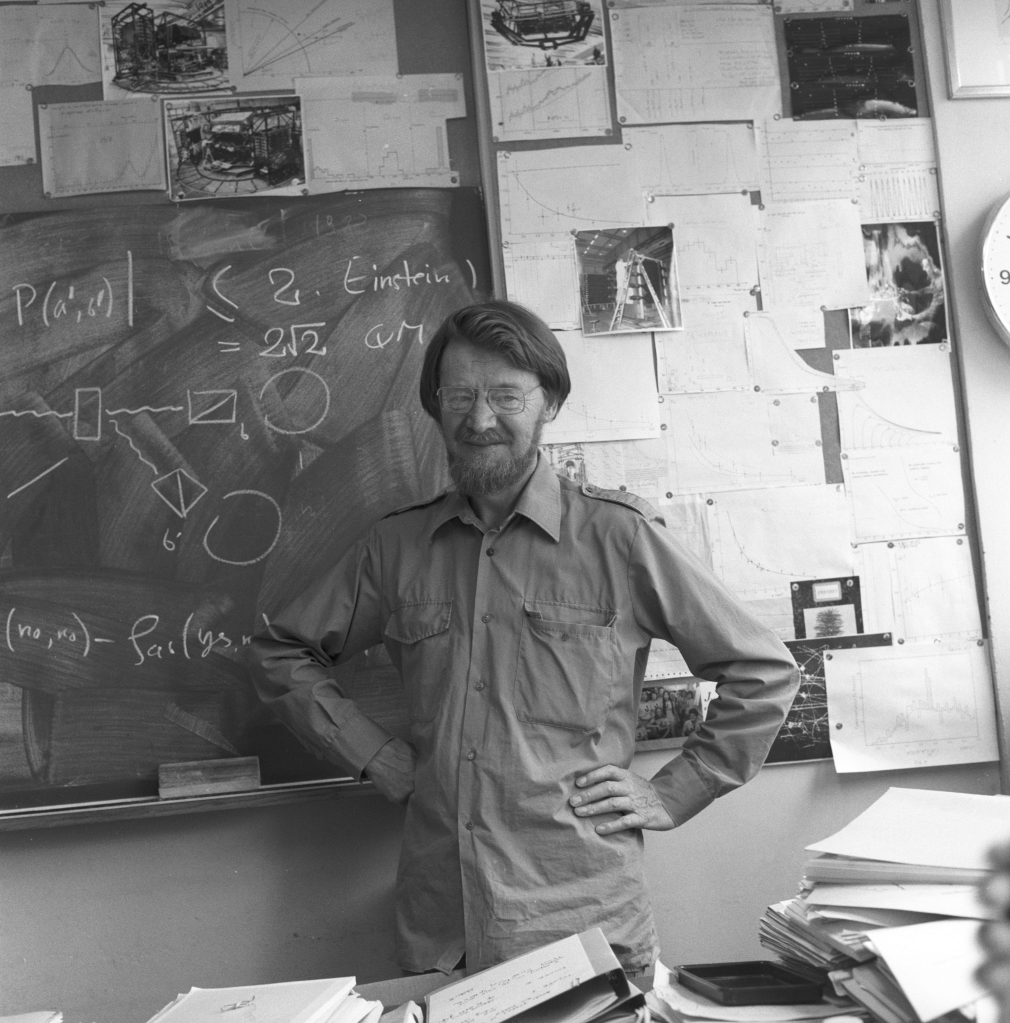
John Stewart Bell You can see that he has written the outcomes by classical way as 2 and by quantum way as 2 multiplied by square root of 2
The CHSH inequality
The first person with Nobel Prize in Physics of 2022 called Jon Clauser devised an actual experiment to check the Bell’s Theorem and to confirm whether there is any hidden variable in quantum mechanics. Jon Clauser, Michael Horne, Abner Shimony, and Richard Holt created the experiment and the CHSH inequality for the experiment from the Bell’s inequality.
The setup for experiment is as follows:
Two experimenter Alice and Bob (two important people in quantum cryptography. We will discuss about them in upcoming part) will receive a quantum particle simultaneously. The particles are entangled. Meaning that if Alice measures the Z-directional spin of her particle the spin will change in that direction so Bob again measuring the Z-directional spin of his particle which is entangled with Alice’s particle will give new and changed spin value in Z-direction thereby making the measurement meaningless.
Bell’s Test
So, what Bob will do is that he will measure the X – directional spin of his particle exactly when Alice measures the Z-directional spin of her particle. As the two particles are entangled with each other, we will know two states of the entangled quantum particles simultaneously (which seems like some type of cheating but is a pure possibility). The CHSH inequality for the system becomes as follows:
For any number of measurements, when spin of Alice’s particle in Z-direction indicates +1 then the Bob’s entangled one will have spin -1 in X-direction and vice versa. So, according the spin measurements, the maximum possible outcome of the equation is 2. When the experiment is repeated multiple times to converge to a fixed value, we get the statistical average of the measurements (remember that the wave function is probabilistic in nature, hence only statistical average of the measurements will yield a definite value for the equation)
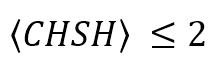
Thus, for hidden variable in quantum mechanics,
Where the angular brackets indicate the statistical average of the measurements known as Dirac’s bracket notation.
But, from actual experiments done by John Clauser the CHSH inequality breaks. And the result is:
This proved that quantum mechanics does not follow the local realism as conventional classical mechanics do. Quantum mechanics does not have any hidden variable which are causing its probabilistic nature. Rather the reality is probabilistic instead of deterministic, predefined.
In the experiment done by John Clauser and his colleagues, they measured the polarization of entangled photons in two directions.
There was one loophole in the experiment of John Clauser. The angles of polarizers were preset or fixed before the entangled particles were sent out to observers from the source. This adds additional determinism in the experiment thereby making “Locally Real” to some extent, therefore the observations were to some extent discrete. I simple words, the experiment done by John Clauser and his colleagues proved a special case of for inconsistency of Bell’s inequality in Quantum Mechanics.
What Alain Prospect the second Nobel Laureate for Physics in 2022 did, that he closed this “loophole of locality”. Alain Prospect and his colleagues devised an experiment where it was possible to switch the detector settings after the entangled particles are released from the source. In simple words, Alain Aspect’s experiment increased the randomness of the combinations and the removed deterministic, predefined nature of measurement.
Quantum Teleportation and Quantum Cryptography
So, now know that the quantum entanglement is real phenomena and not only mathematics but the experiments also follow the principles, it demands the value addition to the society. The third Nobel Laureate for Physics in 2022 – Anton Zeilinger used these principles for transfer of encrypted information.
It is now established that if one particle’s state is measured in a setup at that exact moment the state of the particle entangled with it gets fixed irrespective of the distance. It shows that the information of the first particle being measured is transferred with the speed faster than the speed of the light.
But there is one more catch,
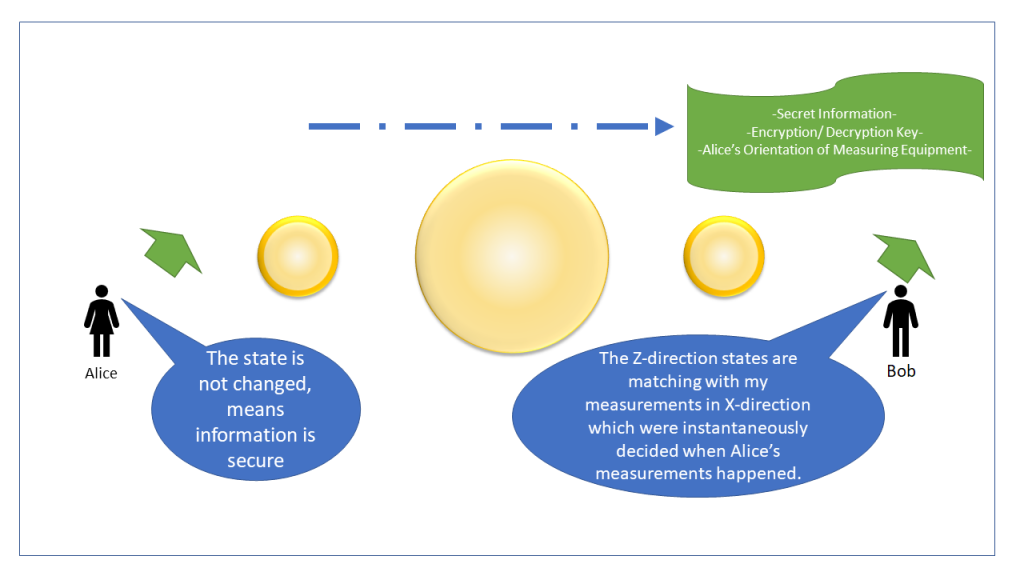
If we have to check the state of the second entangled particle to understand how the first particle behaved, we need to understand in what orientation of the equipment the first particle was measured. This information of the orientation of the equipment cannot be shared to the other end beyond the speed of light. But there is still use of this information. If only the people at both the ends measuring the entangled particles know the settings, orientation of measuring equipment, then only they can understand what the states of particle are.
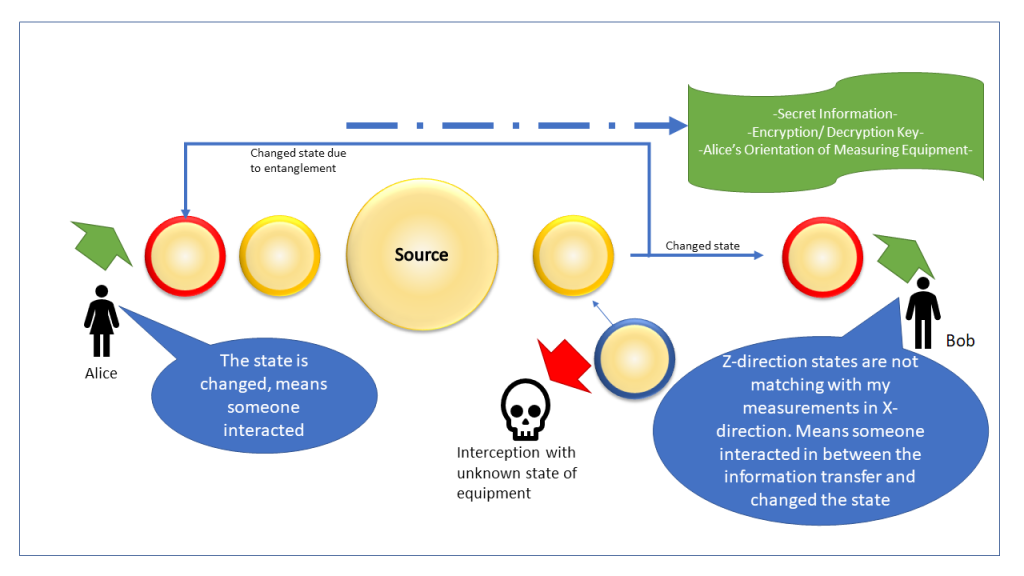
If the entangled particles interact with some other particles or are intercepted by some enemy, there states will no longer remain the same. The information of the orientation of the equipment will show that.
Hence, the orientation of the equipment for measuring the state of entangled particles becomes a secret key for two observers- one of them is sender and another one is the receiver.
And this is exactly called as Quantum Cryptography. Quantum Teleportation refers to the transfer of information irrespective of the distances as the entanglement is instantaneous.
This implementation of quantum teleportation was done Anton Zeilinger and his colleagues using photons.
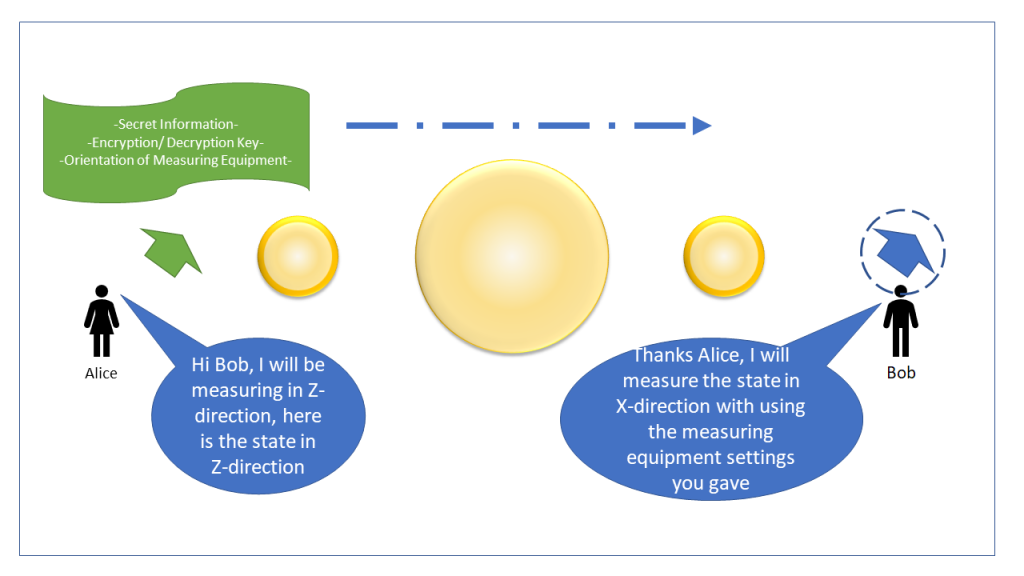
Alice will decide the equipment orientation while measuring the state
Bob will use the information of Alice’s equipment orientation for decryption
The one where someone tried to intercept
The name Alice and Bob- The “Power-couple of Quantum Cryptography” first appeared in a paper. The Alice and Bob characters were invented by Ron Rivest, Adi Shamir, and Leonard Adleman in their 1978 paper “A Method for Obtaining Digital Signatures and Public-key Cryptosystems”. Instead of using some boring name Machine A and Machine B they used Alice and Bob. (Some say that the secret message is Valentine’s Day Poem). The names became popular in no time and for any experiment in quantum mechanics you need to involve Alice and Bob. (Given that the love they have for each other!)
Philosophical implications of Bell’s inequality
The breaking of Bell’s Inequality shows that the quantum mechanical system has no hidden variables. Please note that the quantum mechanical systems are the most fundamental systems to date for the whole humanity’s understanding of the universe. This implies that even though the fundamental nature our reality is consistently changing, there are ways to completely understand. One can know the complete system without understanding it’s hidden variables.
The breaking of this inequality both theoretically and experimentally proves that the reality is not definite, predefined. This shows that nature is not deterministic. The idea that reality is mere superposition of infinite possibilities and the one of them becomes apparent only when you interact with them measure is really enlightening. The approach of your measuring equipment, the way you approach the things in nature is like the perspective you hold. The things will define their states their nature according to your perspective is such a humbling idea and learning from all these efforts of humanities greatest minds.
The EPR Paper – Can Quantum-Mechanical Description of Physical Reality Be Considered Complete? A. Einstein, B. Podolsky, and N. Rosen Phys. Rev. 47, 777 – Published 15 May 1935



















 Parts Per Billion