Minding The Gap Between Ego & Reality

We are so tied to our minds, our self, our ego that we can only see what our mind is conditioned to see; and the expanse of mind is so vast, that we consider the inability to gauge its limit to its infinite-ness. But, in self-observation we will see that reality is far bigger than our mind. Mind cannot be bigger than reality although it can create a perfect illusion of it being bigger than reality. When we realise how reactive our mind is, how conditioned our mind is we see that it’s the reality in which we are existing and not the mind. Mind is just a facilitator to create a sense of security. The real creativity thus begins when one lets go of their minds, thoughts and observe reality for what it is.
The real intelligence is to be able to see how you are fooling yourselves and how it is twisting your world view. This is possible only when we let go of the self. Love is the fastest and the most direct way to let go of self. Love is the way to get rid of the ego. Loving something, loving someone is the first step towards rejecting the very ego which is responsible for self-deception.
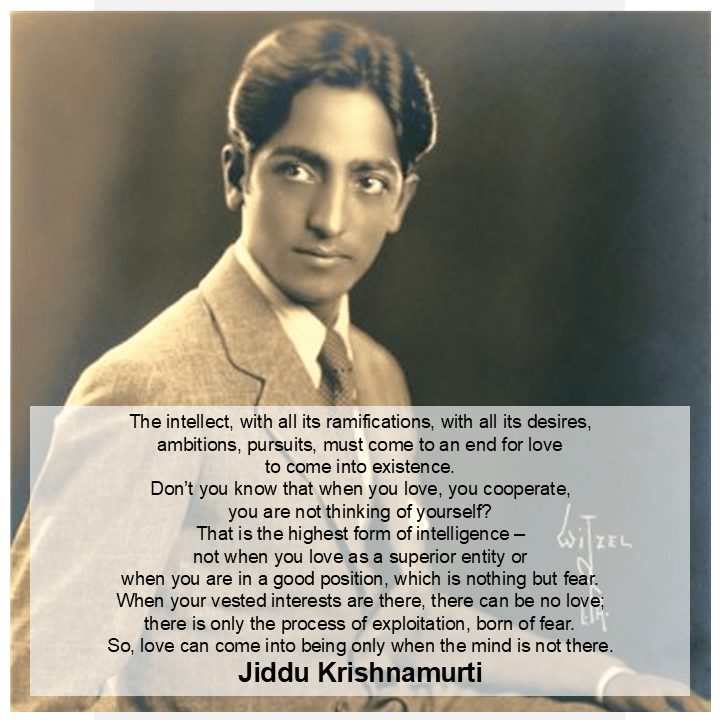
Jiddu Krishnamurti thus encouraged everyone to let go of their egos through self-less love; this itself is enough to solve all the existential conflicts inside us and out there in the world.

Part 3 – Jiddu Krishnamurti’s legacy of self-knowledge

What do you do when you realize fundamentally or deeply that thought cannot end itself? What happens? Watch yourself. When you are fully aware if ‘this fact’, what happens?

(‘this fact’ here refers to an observation that ‘discipline’ doesn’t destroy the self, rather it strengthens it because ‘the self’ created that discipline in the first place)

You understand that any reaction is conditioned and that, through conditioning, there can be no freedom either at the beginning or at the end – and freedom is always at the beginning and not at the end.”

– J Krishnamurti, The function of the Mind

We, the humans are driven by curiosity. The curiosity to survive – to put in few words. One might say that people are driven by fear, greed, envy, anxiety, power, love, money, fame, glory, sacrifice, humility, honesty, trust, legacy, mania, chaos, terror, and what not. The list is never ending. If you start questioning the origin all such attributes, you will see that humans can be driven by anything, I mean any anything. There is no connecting link per say; the only common thing between all the things which drive people is the people themselves. So, in the last question (possibly the last one) we end up questioning ourselves. We see that along with physical survival we are highly conscious of our non-physical survival. Some may call it the mental survival, some may call it ideological survival, some may even call it spiritual survival. In the end, what we are trying to preserve is the eternal existence of our consciousness. How to preserve this? becomes the question then. That is why in final question we see that we are curious to preserve our own being. That is the ultimate survival. Whatever can facilitate that preservation is the driving force for our existence. If you are scared of something, the fear of that thing will create a curiosity to look out for the ways in which you can avoid it.

Now you will realise that the attributes which are many and driving people in different ways are highly related to the ways people think about themselves and about their surroundings. The identities, the consciousness which we are trying to preserve forever is highly the function of the society we grew up in, the religion we followed, the ideals we admired, the enemies we despised, the culture we cultivated and carried over to the newer generations.

I might be making an overstatement here-

Only those who have undergone unlearning, un-conditioning or at least appreciated the process of unlearning can clearly see how badly we are tied to our thoughts and ultimately our minds.

Death of thinking is death of mind. When they say that ideas live forever – it is also an attempt to ensure eternal survival of a certain type of mind, for mind is not a physical entity to us. Realizing the perishable nature of our body, the mind becomes the most potent entity to ensure the survival of our being.

Then, what’s wrong in ensuring the eternal survival our consciousness?

We will see how Jiddu Krishnamurti showed the reality of our existence. As I have already said, he is the perfect person at perfect time to ask the perfect question.

Short answer is – we are so tied to our minds that we can only see what our mind is conditioned to see; and the expanse of mind is so vast, that we consider the inability to gauge its limit to its infinite-ness. But, in self-observation we will see that reality is far bigger than our mind. Mind cannot be bigger than reality although it can create a perfect illusion of it being bigger than reality. When we realise how reactive our mind is, how conditioned our mind is we see that it’s the reality in which we are existing and not the mind. Mind is just a facilitator to create a sense of security. The real creativity thus begins when one lets go of their minds, thoughts and observe reality for what it is.     

In Part 1, I have explained J Krishnamurti’s views on our urge for safety thereby happiness, how we use our thoughts to conveniently justify anything and everything to create that sense of safety, the ways in which our thoughts are stealing the actual reality holding multitudes of possibilities.

In Part 2, I have explained how thoughts originate, how curiosity drives them. It contains Krishnamurti’s observations on how we try to separate thinking to glorify ‘our version’ of wishful reality. Krishnamurti shows us that the moment we reject the separation of our thoughts from ourselves, that is the moment we see that we were just reactive to everything around us. We become observer of the reality for what it is, once we let go the glorification of ‘our thoughts’ – the self.

Now, we will question the very originator of the self – our Mind. Krishnamurti’s observations were revolutionary about the mind. This Part 3 will focus on that and also tie up the previous 2 parts together with it.

Existence Of The Mind – What Is The Mind?

“When you observe your own thinking, you will see it is an isolated, fragmentary process. You are thinking according to your reactions, the reactions of your memory, of your experiences, of your knowledge, of your belief.”

J Krishnamurti, The function of the Mind

When we are truly in the territory of observation without any preconception, prejudice, we see what thoughts actually do. Thoughts just try to hook on to something that we are familiar with – it could be good or bad. Thoughts literally create a chain. One link creates sense – logic – connection to another, one train of thought after another. Then we create the whole understanding. Thinking is always reactive. Keep this in mind – thinking is always reactive. If you let thoughts build on themselves, it is amazing to observe what world we create just by our thoughts. The moment you inject certain intent, desire to this world, it immediately deviates from the reality. But, as this world of thoughts has your intent, your desire, it creates that world of safety; we don’t want to lose that familiarity, that comfort. Now as this world contains our desires it becomes our second identity. As the thoughts keep building on, you start associating these set of your thoughts as who you are. This is your non-physical identity now. You now strive to make sure that this non-physical identity lives till eternity.

After seeing this you will see that the mind is the custodian of thoughts, desires, wishes. A wish to be safe to prolong survival, desire to make that prolonged existence happier one, thoughts to support those wishes – desires. Mind is thus picking desirable ideologies, disciplines which will keep feeding the train of thoughts, the chain of thoughts. Thoughts want to ensure their own survival because we have assumed survival of our thoughts as our survival. (Keep in mind we haven’t even started the discussion about reality.)

So, mind is a sieve which keeps on separating the desirable and undesirable parts of reality. There is nothing wrong in that. What happens here which is problematic is our tendency to lean towards the desirable reality only. When mind would see desirable reality, it will start using the power of compounding of thoughts to create a wishful reality which we call as our identity – our self. We want to preserve self to ensure that things that we desire survive. Whatever is not the self, it is the others – the undesirable. The moment mind makes this separation – ego intensifies.

“Our whole tendency is to be separated. Can the mind do anything else but that? Is it possible for the mind not to think separately in a self-enclosed manner, fragmentarily? That is impossible. So, we worship the mind; the mind is extraordinarily important.”   

J Krishnamurti, The function of the Mind

Without separation, our mind fails to recognize itself. If it is not able to separate itself from rest of the things, it cannot feed the desires. If desires are not fed, we will be constantly looking cluelessly for a sense of belonging, a place of security.

Here, I see one tragedy of being human rather an animal. I will explain it:

See there is a possibility that we are free from all the desires. One can be free from all the desires of the world. So, it is a real possibility that man is free from the cage of thoughts, mind and desires and fully observant of the reality around him without any imposition or prejudice right from the birth.

What is the tragedy of every animal is that they are born with the tendency to live (otherwise how would they get in the world in first place, maybe the baby doesn’t even know what is required to survive, so possibly the sense of survival naturally gets transferred from parents to the baby). Have you seen a baby who wants to die the moment he is born? Rather the baby starts crying the moment it senses absence of parental presence or absence of security. By birth we have a survival urge. Evolution has pushed this urge in us from physical to non-physical one. As we have better chances to ensure physical survival we now care more about the survival of our non-physical version. Mind thus becomes very important, thereby consciousness becomes important. That is why if physical survival is not guaranteed, we wish that at least our consciousness lives forever. That is exactly why we praise the minds we have.

Over the time, our desires take over this mind and we then keep on conditioning it with culture, religion, society, community in a certain way. The familiarity of physical body gets further amplified in familiarity of certain way of thinking, certain religion, certain philosophy, certain profession, certain degree, certain community, certain country. The more we find ideas, thoughts familiar to ours the more we want to cling to them. The more we want to reinforce that version of self. We are always separating what reality shows in terms of whether it is favorable to us or not. That is why even if mind and consciousness seem infinite, you will observe that our thoughts have compounded in such an extreme way that we are unable to measure their limits. We have attributed this inability of those compounded thoughts to the infinite-ness of our mind.

If our mind truly is infinite then we should be able to predict the reality or at least handle the undesirability that reality may present in better ways. We all know how disappointed we are with the reality. This shows how strongly we have conditioned our minds towards certain way – that certain way we call our identity, our self, our ego.

“Until we understand how to transcend this separative thinking, this process of giving emphasis to the ‘me’ and the ‘mine’, whether in the collective form or in individual form, we shall not have peace; we shall have constant conflict and wars. Our problem is how to bring an end to the separative process of thought. Can the thought ever destroy the self, thought being the process of verbalization and of reaction? Thought is nothing else but reaction; thought is not creative.”

-J Krishnamurti, The function of the Mind

Now you will appreciate what un-learning can do to our life. It opens a completely different and real world in front of us. Un-learning is the rejection of what we assumed to be true to support our identity. Although it feels uncomfortable, sometimes completely hostile but there is no bigger freedom than the acceptance and implementation of unlearning. It is renewal, evolution of our very being.

The key point is to understand that we are not our mind, we can be bigger than our mind. That needs the rejection of the idea of self. Once we are observant of how dangerously conditioned, prejudices, favored our minds are we will see how we through the agency of our mind are twisting the reality to create the sense of security. The more we twist it, more deviated we are from reality.

And as I already explained that somehow this sense of separation and thereby self-preservation is in our genes by birth, we have to train ourselves to get rid of that sense. Keep in mind that this does not mean self-jeopardization. This plainly means that not imposing our ways on reality to create the sense of security thereby higher chances of preservation of self. That is why unlearning is extremely important.

Reactive Mind Vs Objective Reality

“Do not superimpose what it should do, how it should think or act and so on: that would amount to making mere statements.”

-J Krishnamurti, The function of the Mind

Once you think that you have full control of your mind, the mind will use this sense of its separation from you to build chains of thoughts to support itself. In the end, it all started from you. The moment you see that you and your mind are the same, you accept its conditioning. Now you have a baseline to see the reality. Now you know how your mind is bending the reality. This is the freedom, to see things as they are. 

Now that we are understanding that sense of safety was the goal of everything that we are doing all along, we see that our conditioning thereby our thinking and thus our mind in the end are the reason behind all the suffering we go through. Once we see that our mind was the main culprit, we realise that it will be difficult rather impossible to punish my mind, discipline my mind because the more I try to control my mind – more I try to discipline it, the more it reacts, the more it creates thoughts and evades away from the reality. It tries to preserve its identity.

Only when you observe that you are your mind conditioned in certain way to preserve the non-physical existence then you understand the reality you live in. You still have those conditioned thoughts but now you neither want to promote them or suppress them. You are now an observer of the reality. This is an interesting observation.  

“When I want to understand, look at something. I don’t’ have to think about it – I look at it. The moment I begin to think, to have ideas, opinions about it, I am already in a state of distraction, looking away from the thing which I must understand.”

J Krishnamurti, Can thinking solve our problems?

There is one important confusion we must address here:

If I am rejecting the thoughts that I have, the mind that I have, the consciousness that I have – what remains of me? Wouldn’t I end up in an existential crisis? Won’t that shatter my compass? If I am not associated with certain things, how would I make sense of my actions? If I am not able to make sense of my actions or at least the things happening around me, how would I prepare myself to survive in this world? This will completely jeopardize my existence.

The answer is pretty simple if you have read till this sentence:

Rejection of mind as a separate entity is the answer. Unlearning the process of isolation to understand the reality is the answer. Wishful observation is the key problem in the ways we are trying to live the life. Thinking is the second name for wishful observation. You are expecting reality to become something in your ways so you attach certain justification to extract that desirable meaning from the reality you are observing. You are doing this to generate sense of safety, which further ensures eternal survival.

So, it’s not about rejecting mind or the thoughts. It’s observing how our mind, thoughts are already conditioned before we are trying to understand the reality. It’s like we are seeing the reality with certain tint of prejudices and expectations. We have to let go of that filter. We are so attached to this filter because world looks the way we want in this filter, that this tinted illusion has become our reality. The moment someone shatters that filter we end in existential crisis.

You must appreciate that it’s not about hating the prejudices, conditioning or sacrificing yourselves completely to a selfless act. It’s being aware that you have those prejudices when you are observing reality. This self-awareness is what Krishnamurti focused on.

The moment you will try to reject certain thing and accept the another i.e., your mind – you will create certain framework of justifications and you will deceive yourself.

The idea is to know how you are fooling yourselves which is preventing you from understanding the reality.

Delulu is not the solulu. Rather delulu is the best way to reject the very life you are living.

“To have blank mind is to be in a state of stupor, idiocy or what you will, and your instinctive reaction is to reject it. But surely a mind that is very quiet, a mind that is not distracted by its own thought, a mind that is open, can look a t the problem very directly and very simply. And it is this capacity to look without any distraction at our problems that Is the only solution. For that there must be a quiet, tranquil mind.”

J Krishnamurti, Can thinking solve our problems?

Love – Cure To Self-Deception And Surrender To Reality

You know that moment in any pop culture media where the final answer is love? Let me spoil everything for you. The answer to everything is love.

(Be cautious while reading next part, it’s not just that type of love and I am definitely not conditioned to prefer love as the answer. Even for a skeptic, love being the final answer has worthy support. It also guarantees that we can understand the reality for what it is.)

I always had this cringe feeling when everything grand in the narrative ended up with a justification of love. Even the great authors, logical authors, great scientists, great atheists never feel shame to express the power of love and it being the answer to everything. Trust me, I have made every attempt to find the evidences where love might not be the final answer to everything. But turns out that I would never find any evidence against love being the final answer.

The core reason is that we ourselves are the final problem. Let us see how Krishnamurti came to the conclusion of love being the ultimate answer:

“When you realize that any reaction is a form of conditioning and therefore gives continuity to the self in different ways, what actually takes place? You must be very clear in this matter. Belief, knowledge, discipline, experience, the whole process of achieving a result, or an end ambition, becoming something in this life or in future life – all these area process of isolation, a process which brings destruction, misery, wars from which there is no escape through collective action, however much you may be threatened with concentration camp and all the rest of it.”

J Krishnamurti, The Function of Mind

Now that you have come to the last part of the discussion, it is not a new understanding when I say that our sense of self is reinforced by the desire to support certain way of our conditioning. This steals from us the ability to perceive reality in the way it presents itself. We are always seeing the reality with certain conditioning and trying to change it so that it favors our ways. But as we have illusioned, conditioned understanding of reality, the reality rarely presents itself in the ways we desire it to be. Then we end up in sadness and sorrow and start questioning the futility of our existence. That is why ‘what is the purpose of my existence?’ is the common format of the existential questions for all of us.

What Krishnamurti tried to focus on is different question –

Why am I not experiencing life the way it is?

What is preventing me to live the life the way it is, living the life to its fullest?

The answer is pretty simple now. It’s our conditioning which urges us to prefer certain ways and reject the others. This brings the happiness and sadness. In the efforts to maximize happiness and minimize sadness we have created a system of mind and thoughts to alleviate the pains of suffering – thoughts justify everything. We deceive ourselves with justifications.   

“So long as we deceive ourselves in any form, there can be no love. So long as the mind is capable of creating and imposing upon itself a delusion, it obviously separates itself from collective or integrated understanding.”

-J Krishnamurti, The function of the Mind

What does the love do in all this confusion?

Love is the direct way to let go of self. Love is the way to get rid off the ego. Loving something, loving someone is the first steps towards rejecting the very ego which is responsible for self-deception. Even if you are delusional, your actions influenced by those delusions towards the things you love, the people you love will yield unwanted outcomes; and if you truly love them, you will be compelled to let go of the delusion for the benefit of your loved ones.  Thus, being selfless through love in true sense ensures real freedom.

Conclusion – Why Is Love Answer To Everything?

“We see the ways of the intellect but we do not see the way of love. The way of love is not to be found through the intellect.”

-J Krishnamurti, The function of the Mind

We saw in Part 1 how and why we crave for safety, familiarity. It ensures our physical and non-physical survival with better odds and most importantly with better satisfaction.

We saw in Part 2 how we dissociate ourselves from our mind and thoughts to create a false sense of safety if the reality does not turn out the way we want. We may delude ourselves if the reality is hurting us. We use thoughts to justify unfairness the reality presents. Our religions, politics, our ideals, everything that we have created now has an innate purpose of creating a safety net. We want to remain in this net because we don’t want the happiness to end. We have intellectualized our minds in such a way that we have justification for every ridiculous illusion and tragedy is that we call it the limitlessness of the mind, infinite nature of the mind.

I am not erasing the idea that the mind is limitless. If our minds – we – ourselves are truly limitless then we should immediately be able to see beyond the seemingly adverse revelations of the reality. Which is the holy gist of all these detailed inquiries of the self.

Then what was the problem with the mind?

The very limitless nature of reality would enable us to become limitless. But is it our delusional clinging to certain way of life for safety which is stealing the real understanding and appreciation of limitless reality. We are clinging to highly complicated and highly compounded thoughts, the way of thinking just because it reinforces the ego.

The real intelligence is to be able to see how you are fooling yourselves and how it is twisting your world view.   

After going through what Krishnamurti made us observe, you will realise that whatever must be said has been said already. We have just accepted our delusions because we are fully clung to the way have been living our lives, the way we have been conditioned.

When you are loving someone, there is very slim chance that they will be exactly the way you want them to be. There is plausible reason to say this because the infinite possibilities of reality mold people in different ways. There may be many things in common but the more you know the sooner you will realise that people are filled with different types of conditioning. This will first push you to reject their point of view naturally, then you will try to impose your way on them, your ideologies on them, your conditioning on them. In the final analysis, you will see your ways of worldview failing on them. This is the moment when you will reject your own world view, thereby your ego. Now you will neither reject or accept other people’s worldviews nor will you cling to your ego. Now for the sake of love, you will objectively observe the reality for what it is.

This is how love compels you to let go of your ego. That is why love is the answer to everything because you are the last question of all the investigations of the existence. You will let go of the concept of the self once you start to appreciate things other than you and accept the reality the way it is. What a beautiful way to live!    

“Only when you discard completely, through understanding, the whole structure of the self, can that which is eternal, timeless, immeasurable, come into being. You cannot go to it; it comes to you.”   

-J Krishnamurti, The function of the Mind

References and further reading:

  1. Truth is a pathless land – J Krishnamurti
  2. The First and Last Freedom – J Krishnamurti
  3. Jiddu Krishnamurti’s Legacy Of Self-Knowledge : Part 1 – The Liberation From Thinking and Thoughts
  4. Jiddu Krishnamurti’s Legacy Of Self-Knowledge: Part 2 – Being Watchful Of The Ebb And Flow Of Life
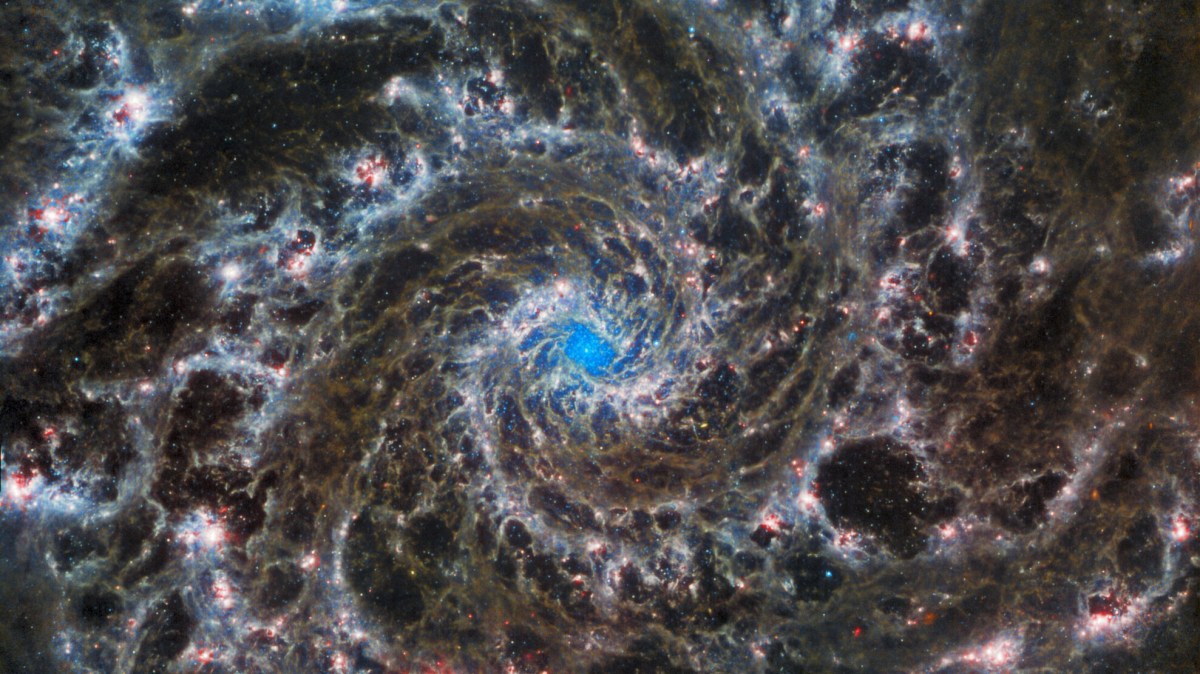
  5. Featured Image of Phantom Galaxy M74 by James Web Space Telescope

Being Watchful Of The Ebb And Flow Of Life

In the constant pursuit of eternal happiness what man forgets is that nothing is everlasting, the sadness exactly like the happiness too shall pass. But, the urge to remain eternally happy and safe, steals the man from actual sense of reality. The illusions of thoughts filled with prejudices, conditioning and the escape from the reality by justifying the same thoughts becomes the endless cycle for such man. The moment man rejects the separation between him and his thoughts and sees that he himself is the originator of every thought is when he starts observing reality for what it truly is. Now there is no urge to seek happiness or the aversion to sadness. The man who is able to observe the reality for what it is and denies the wishfulness has understood what it really means to become free from ‘ego’ – ‘the self’. This is how the man becomes free and fearless.
It is really underrated how much we overvalue our thinking, thoughts, ideologies – for they always create an escape when reality is not how we want it. The man who is able to see through this can appreciate how life is always a continuous flow and not a starting point or destination.
Krishnamurti thus taught about the ability to observe the reality for what it is and without any preconditioning, thinking or prejudices.

Part 2- Jiddu Krishnamurti’s Legacy Of Self-Knowledge

Because I am free, unconditioned, whole – not the part, not the relative, but the whole Truth that is eternal – I desire those, who seek to understand me to be free; not to follow me, not to make out of me a cage which will become a religion, a sect. Rather should they be free from all fears – from the fear of religion, from fear of salvation from the fear of spirituality, from the fear of love, from the fear of death, the fear of life itself.

– J Krishnamurti, Truth Is A Pathless Land

Jiddu Krishnamurti – one of the greatest philosophers, one of the greatest humans paved a pathway to the modern worldview of the real truth, the real freedom, the real meaning of life, real love and the real life itself. His life story talks for his legacy.

Krishnamurti for me is the perfect person at perfect time to ask the perfect question.

I will focus on how Krishnamurti’s teachings – how his ways to dissect our curiosity paves way to understand what it means to be a conscious human being. The further writing is an attempt to address what is thinking and why we think and if not thinking then what makes us real human beings.

In Part 1 on Krishnamurti’s teachings, we touched on following important aspects of what it means to be a human and how distracted we are from our human side:

Krishnamurti most importantly taught how we are trying to bring peace to our lives by associating it with some meaning or purpose. Those who have fair understanding of the gap between what is thought and what is real, they can understand that the world in which we live – the reality in which we exist is constantly changing. Whereas we as human animals are always in the search of stability, that is how we will be able to optimize our energy and efforts to maximize the chances of survival. We crave for longer and peaceful existence in the continuously changing world.

The very continuously changing nature of the reality goes against our wish to live a peaceful, safe and predictable thereby fully controllable, maneuverable life. This resistance between wish and reality splits our thinking, our thoughts from ourselves. This split of ‘we’ – ourselves and our thoughts is the root of all the existential confusion and false sense of happiness – the gratification.

First, we realize that reality will not bend to our wishes, then we give up on real happiness and create our own world of thoughts filled with our facts, our knowledge, personal point of views, prejudices to create certain worldview. This worldview then keeps on feeding itself to grant us gratification. But there comes a point when we see – confront the reality we were masking and running away from, it brings more pain than ever before. It is painful because we distracted ourselves from it, because it never guaranteed eternal happiness – our thoughts granted that eternal happiness while wearing the coat of wishful thinking – gratification. We have separated ourselves from our thoughts in such way that whenever something bad, wrong, unpleasant happens, the blame can be immediately thrown on these thoughts. Thought which we have assumed to be the result of our upbringing, our culture, the unfairness happened to us. We use our thoughts as a separate entity just because we can conveniently find an escape from reality to create a newer one. it has become a tool to find a justification for everything that is unfair to us.

Once we accept how effectively we are deceiving ourselves we come to know that we ourselves are the thoughts, then responsibility follows. We see however painful it may be, this too shall never be constant. We reject the convenience of self-deception, accept who we are and observe the reality for what it is and not how we want it to be.

The moment we become responsible for our thoughts is when we start to see the reality, we start to see the world for what it is, without prejudices. All deceptions are stripped off. We also realise that thinking was mere swaying between acceptance and rejection of two ends – happiness or sadness. We see how much we were bounded due to this swaying – due to this isolation.

The moment we let go the urge to become happy, we let go urge for gratification, then we let go the wishful thinking, then the self-deception dissolves. Once self-deception dissolves, we start to accept our thoughts are our own, then we start to improve ourselves just for the sake of the real truth not for happiness. The life is unshackled from two possibilities of happy or sad into the infinitely many possibilities the reality can offer.

Touching to these ideas we saw in Part 1, how we assign the purpose of our lives just for the sake of gratification, how we separate thinker and thought to reject responsibility, then how the self-deception keeps this cycle going.

Now moving on to the other teachings by J Krishnamurti, I felt a need to understand the quest for happiness. I mean there is nothing wrong in people wishing to feel happy, safe in their lives. 

Then I realized what the real problem is; it’s not the wish to become happy, it is the acceptance of certain illusions to become happy. I will throw light on how that happens unknowingly and then we will again come back to Krishnamurti’s ideas on those areas.

The Curious Animal

I think what separates humans from animals is the incessant curiosity for anything and everything that is there to experience; sometimes we are curious about non-existent things too. The extent of curiosity might be different in everyone but it is safe to say that we are way more curious than animals. This curiosity always needs the food of thoughts and reality checks to arrive at a conclusion – that is how we are always reinforcing our consciousness. I think one cannot maintain their conscience or consciousness (call it what you want) if you cannot maintain at least small amount of curiosity in life. Animals have natural routines for survival exactly like we do but I think we are more aware of our own being than the animals do. (might be an overstatement, but you get the point)

Curiosity is not just about some sophisticated questioning to certain sophisticated, complicated part of philosophy, it can be rather very simple. A person thinking about what should be done to get the next meal? – is also one type of curiosity – let us call it the curiosity of ways to get the next meal. This curiosity to get next meal is common for both human and rest of the animals but over the time we have found totally innovative ways, the ways in which animals have not found how to address the same curiosity. So much that now we don’t even consider the curiosity of getting the next meal as a curious problem. Being human thus means that our curiosities also keep on evolving faster than the animals. What was peak curiosity for a primitive man is now a low-level curiosity, we now have much high level and more complicated – sophisticated curiosities.  

Starting right from birth till death we carry many curiosities – some of them get answered some remain mysterious, unanswered. The key attribute which remains common in all of us is how satisfied are we when it comes to our curiosities, our personal curiosities? The more curiosities you have found answers to, the more satisfied you will feel. You will have sense of fulfilment; your wishes, ambitions, wants all are connected to your own curiosities. Take one simple example – why do you want that specific job? For some people their curiosity was why some people are happier than others? They see that doing this job gives more money, for some people they see that doing this job will give them happiness, for others this job will wipe away their sorrows. In every possible sense, you can link the curiosity to the very reason of our being.     

The Conscious Thinker

If you look closely to the curiosity, you will immediately accept that thoughts are the most important aspect of who we are. We keep on thinking to address our curiosities until they are addressed satisfactorily. That is exactly why thinking is crucial for humans; it shapes our character, our lives and then the lives of everyone around. Now that I have brought in the point of “thinking” you will feel that thoughts play bigger role than curiosity in our lives. And it is right to feel so. But I have reason to weigh curiosity heavier than thoughts or thinking. You will see that smartness can be found in good spirited people and evil people too. When we can develop technologies to save lives, we have developed technologies to bring about mass destruction too. Looking at the current situations the later look more sophisticated. So, if the good person has better curiosities, he will have his curiosities answered in better ways than the lower curiosities of the evil person. See, both sides can have same curiosities as the purpose of their lives but the ways in which their individual thoughts answer that common curiosity gives us either godly men or evil men. So, curiosity supersedes thinking. How you will address that curiosity is how you will be. That is exactly why thoughts are so important. How consciously you think is how you will have your curiosity answered.

Thinking Is Useless

(Just now that we said that thoughts are important.)

The self is a problem that thought cannot solve.

– J Krishnamurti, Can thinking solve our problems?

When you will appreciate different ways of thinking; the process to create thoughts to answer same type of curiosity and the ways that can create totally different human beings you will see that curiosity is mostly the innocent aspect of who we are but the thoughts take shape, color, aspect of who we are, what our experiences are, how we are treated by the people around us, how we treat others. It is not an understatement when I say that thoughts rarely create the true understanding of the reality. And the farther our thoughts are from the reality the more we experience failure and unfulfillment of expectations, sadder we are. Thoughts can create an excellent sense of reality but if not built properly can make people despise the very reality they live in. The closer you are to reality realer will be your curiosities, the realer will be your thoughts and faster will be your satisfaction to the curiosities. Otherwise, we will keep on playing the games of thinking in certain ways and would never be able to satisfactorily answer the greater curiosities of our lives. Every illusion will create next illusion.

Krishnamurti advises to let go of this game of thinking where every illusion reaps newer and more potent illusion, dragging us away from reality.

Thought has not solved our problems and I don’t think it ever will. We have relied on the intellect to show us the way out of our complexity. The more cunning, the more hideous, the more subtle the intellect is, the greater the variety of systems, of theories, of ideas. And ideas do not solve any of our human problems; they never have and they never will.

– J Krishnamurti, Can thinking solve our problems?

The main intent is to understand how self-protecting our thoughts and thinking are. You must appreciate this. The essence is to understand the fact that if thinking would have really solved our problems, we would have immediately stopped the process of thinking. We would have stopped it because it gave us the final solution to the real problem.

You may in thinking out certain facets of the problem, see more clearly another person’s point of view, but thought cannot see the completeness and fullness of the problem – it can only see partially and a partial answer is not a complete answer, therefore it is not a solution

-J Krishnamurti, Can thinking solve our problems?

Thinking can create false sense of solution but to certain extent, the reality holds more possibilities than that.

We would see that the more we think about something even fundamental the more complicated it becomes. Thinking may help us to understand perspectives but it never serves us the truth of reality as a whole rather it always gives certain dimensional information. Now this certain dimensional information can be easily poisoned with prejudices and not the facts. Thinking actually steals us from the multiple possibilities of the reality. As the problems from thinking multiply themselves, we are now entangled in the problems which are not even there in reality. We are just multiplying thoughts and problems because we know they give instant happiness for reality doesn’t guarantee eternal happiness. We are running away from truth by treating thoughts in superior ways.

Does that mean that thinking steals away the creativity? It seems counterintuitive! Thinking is the reason why we are creative. So, what exactly is going wrong?

The thing that is going wrong is our habit of separating things and comparing them with our previous knowledge; it’s our habit of grouping things in our old understandings. We try to understand newer things with our older understandings. We keep on filling our knowledge bank. We rarely unlearn anything with completely new perspective.

We fail to unlearn, because of our urge to happen things in certain ways. If you want the reality to happen in certain way, you will always be blinded to the reality which could have had better possibilities, better and beyond the limits of your thoughts.

This is why Krishnamurti focused on self-knowledge. Your pivot becomes you rather that the ways in which you want things to be. Once you understand who you are, you see how cunning your mind is, it always tries to create justifications to escape through a never-ending chain of illusive thoughts.

Once you accept who you are, you will see how the reactive thought got generated from you, that thought is you yourself. Now you see who you are. Once you see who you are, you don’t rely on thoughts to understand the reality. This is what builds the bridge between thinker and thought. This is where thinking is no longer required. You see reality for what it is. You become fearless, free from expectations and free from thoughts. Your actions now have intent instead of a wish.

Now, let us see how to maintain the awareness of self and be free from the illusion of never-ending chain of thoughts.

The Real Baseline – Non-Isolation

It seems to me that before we set out on a journey to find reality, to find God, before we can act, before we can have any relationship with another, which is society, it is essential that we begin to understand ourselves first.

… And it does not mean obviously, that self-knowledge is opposed to, or isolated from relationship. It does not mean, obviously, emphasis on the individual, the me, as opposed to the mass, as opposed to another.

-J Krishnamurti, What are we seeking?

Krishnamurti paved the way to break out of the vicious cycle of self-deception. When ending up in self-referential paradox the basic question one can ask is how the reference is getting created. We see that we do not actually have an eternal, unchanging baseline. The baseline keeps evolving as our beliefs, experiences keep on changing. To understand ourselves is thus one difficult task. It’s like aiming a moving target, a target which keeps on changing all of its attributes. We realize that what we were calling our baseline – our core was just our thought conditioned by our urge for safety, peace and happiness.

Many think that in order to understand self, one has to isolate themselves from others. The rejection of isolation itself is the purpose of understanding self. Rather the more isolated you will be from others more your thoughts and mind would dominate you. The real purpose of self-knowledge is understanding of ourselves as the whole not as the isolated one.

Self-knowledge thus means the rejection of selfishness and the sense of ego. Then the person starts to understand what it means to think about the events and what it means to see the event. Former is limited because we are wishing for it to happen in certain way, latter hold any possibilities because we are not expecting or imposing what should happen.

Because we are craving for certain anticipation, trying to have certain expectation – we try to isolate our experiences to only those expectation. We blind ourselves by isolation. We see that our experiences create a reaction in us which we try to connect with certain memories, feelings. Then they lead to acceptance or rejection based on the sad or happy feeling generated. Then if that feeling is happy, we crave for more of it; if that feeling is bad, we try to suppress it. And the cycle keeps on going. We get tangled in our own thoughts.

Until and unless I don’t accept that ‘I’ am the originator of my thought I can’t really find that which lies beyond that thought. My thought will create another thought based on my urge to find the sense of security. The thinker has to just observe the thought and not expect it to be desirable or undesirable. This is one difficult task. But it guarantees eternal truth.    

So long as effort is divided into the experiencer and the experience, there must be deterioration. Integration is only possible when the thinker is no longer the observer. That is, we know at present there are the thinker and the thought. The observer and the observed, the experiencer and the experienced; there are two different states. Our effort is to bridge the two.

– J Krishnamurti, Can thinking solve our problems?

Krishnamurti explained why our thoughts do so and why we refuse to let go of our thoughts (even though deep down we use our thoughts as a way to justify anything to our convenience, security and peace.) In the pursuit to bring “peace of mind”, the mind created two ends of every thought. The thinker who has already considered himself different from the thought now assumes one side of that thought and then measures his/her worth, goodness/badness by the extent of deterioration from that assumed baseline.

In reality, the very assumptions of either one of the ends of the thought prevents the person to have exposure to the real possibilities lying on the other end rather beyond the whole horizon.

The answer to come out of such bias is to observe that the originator of the thought is the thought itself. There are no two entities – thinker and thought are exactly same. This is where the observer and observed stare into each other’s eyes. Now the observer is not expecting the observed to become a certain way. Observer is now just observing that what it is. There is no need to move to next thought. Only thing that remains is to observe things for what they are. 

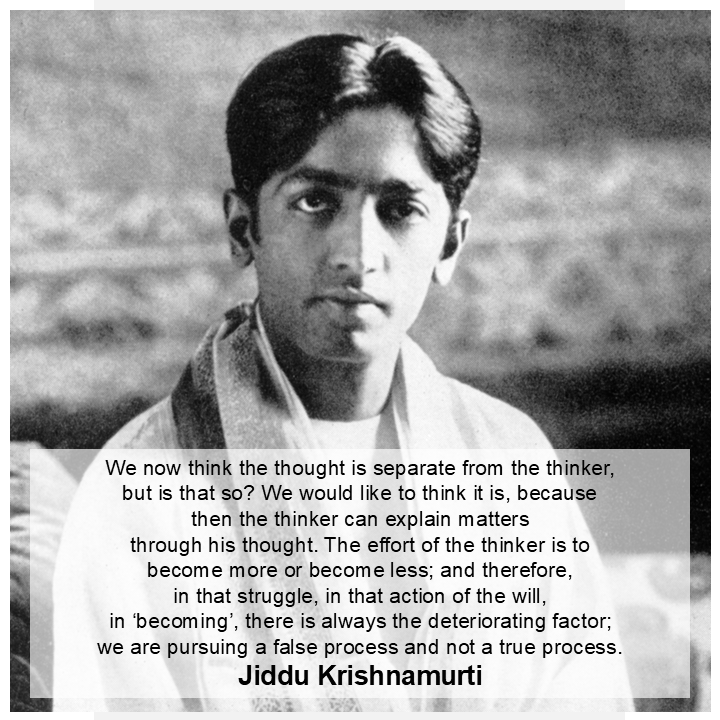
We now think the thought is separate from the thinker, but is that so? We would like to think it is, because then the thinker can explain matters through his thought. The effort of the thinker is to become more or become less; and therefore, in that struggle, in that action of the will, in ‘becoming’, there is always the deteriorating factor; we are pursuing a false process and not a true process.

-J Krishnamurti, The thinker and the thought

When one starts truly observing there is no need to select one side of a thought, so there is no urge to favor one outcome, rather there is no wish to have certain expectation. As there is no wish to a certain way the mind does not work towards cultivation of one side and deterioration of the another one. Now mind just sees that which is there.

I divide myself into the high and the low in order to continue.

-J Krishnamurti, The thinker and the thought

Earlier there were only two possibilities – either cultivation of that which is desired and suppression/ deterioration of that which was undesirable. But now that when thinker and thought are bridged there are no side, no prejudices, no expectations. This opens totally new possibilities, and these possibilities are as real as the reality we are observing, the reality we are trying to understand.

You will realize how limited we were by our thoughts.

You will see how illusive the thinking loop seems, even though you “thought” your imagination was infinite. Your imagination now feels limited because of your prejudices, biases, memories, culture, knowledge.

Our imagination is way more limited than we think. That is exactly why observing without any prejudice becomes more important. We just refuse to do it because we don’t want to get overwhelmed by the infinite seemingly life-threatening possibilities. We are fearful. We think we are not ready.

 Be Watchful Of The Isolation – The division

If I am aware that I am greedy, what happens? I make an effort not to be greedy, either for sociological reasons or for religious reasons; that effort will always be in a small limited circle; I may extend the circle but it is always limited. Therefore, the deteriorating factor is there. But when I look a little more deeply ad closely, I see that the maker of the effort is the cause of greed and he is greed itself; and I also see that there is no ‘me’ and greed, existing separately, but that there is only greed. If I realize that I am greedy, that there is not the observer who is greedy but I am myself greed, then our whole question is entirely different; our response to it is entirely different; then our effort is not destructive.

-J Krishnamurti, The thinker and the thought

This is revolutionary in many senses. As we are dependent on thoughts to understand reality. This dependence is filled with preconditioning right from the moment we are born. Therefore, we always try to mold our observation in the shapes of what we wish to become. If I wish to become a world known robber, I will see the act of stealing as a good one – a stepping stone in my “career”, if I wish to become a world known cop/detective I will see the act of stealing as a wrong one.

But if I have no wish to either become a robber or a cop, I now will have totally new concept of what stealing is. If I am observing a robbery right now with no prejudices, I am seeing the desperation, fear of getting caught in the eyes of the robber. I am seeing the mental stress that cop is going through to solve the case; if the cop is a smart one, I am seeing how he feels sorry for the robbers and how happy he feels that he can easily catch them.

Without prejudices you see that the reality morphs according to the wishes of its observers – the observers having certain expectations from it, certain prejudices.

It is that problem which is creative, in which there is no sense of ‘I’ dominating, becoming, positively or negatively. We must come to that state if we would be creative.

-J Krishnamurti, The thinker and the thought

You have to thus let go of the what is expected and observe what is happening without any preconditions. Then you will see that the negativity or positivity of the same reality became in that certain way because you had already picked either one of the sides. If you wanted to behave like a cop – a successful robbery is nightmare for you; if you wanted to behave life a thief same is the happiest moment of your life.

But if you just want to observe what is there in reality, you will see the desperation in the eyes of the robber and the ways cop chooses to hunt the thief down – even if it would steal his ideals.

You see people degrading themselves to have an illusion of the life they desire. You will feel like helping both of them. You will not feel of favoring either one of them.

This may seem like a person who has let go of life or like a sage, but trust me once you have this real worldview, you will see that you are more than yourself. You will see yourself extending to others, you will have this innate urge to reach out to others, to help them to come out of the illusion of happiness and sadness. You will help people in surprisingly different ways – not just right or wrong ways.  

What is important is to see that the maker of effort and the object towards which he is making effort are the same. That requires enormously great understanding, watchfulness, to see how the mind divides itself into the high and the low – the high being the security, the permanent entity – but still remaining a process of thought and therefore of time.

-J Krishnamurti, The thinker and the thought

Once you accept yourself in such way you no longer have craving for happiness and aversion towards sadness. You will see that this current happiness is short lived and so will be the sadness arriving after it. You will see that reality is just a tide of happiness and sadness, we are just swaying in between.

Rather you will start seeing that reality is not just a wave between sadness and happiness – it has other attributes for which words like happiness or sadness would fall short to describe them. You are existing between the superposition of many such waves. This is the real journey towards a creative and realest real life.

You will see that you are not affected by these waves. Not affected does not mean that you are insensitive or numb to these aspects of life, rather now you are more sensitive and open to infinite possibilities of life. You don’t get tangled in thoughts, you now act to pass through the life, instead of attempting to control it. You become fearless. You don’t start any journey to achieve freedom in the end. You become free in the first place before you start the journey to experience the life lying ahead. You truly become free in reality.

We will see in detail why Krishnamurti said that freedom is at the beginning in next part.

“Until we understand how to transcend this separative thinking, this process of giving emphasis to the ‘me’ and the ‘mine’, whether in the collective form or in individual form, we shall not have peace”

J Krishnamurti

References and further reading:

  1. Truth is a pathless land – J Krishnamurti
  2. The First and Last Freedom – J Krishnamurti
  3. Jiddu Krishnamurti’s Legacy Of Self-Knowledge : Part 1 – The Liberation From Thinking and Thoughts
  4. Jiddu Krishnamurti’s Legacy Of Self-Knowledge : Part 3 – Minding The Gap Between Ego & Reality

The Liberation From Thinking and Thoughts

Remembering J Krishnamurti on his birthday.
The major focus of J Krishnamurti’s teaching was the awareness of how thoughts are created from ourselves and our constant pursuit to make things happen in a certain way, most preferably in our own ways.
The tragedy of human life can be given in one simple sentence: Man, the thinking animal – has deceived himself so much in the pursuit of happiness that he has given up on the reality in which he was born just for the sake of false sense of short-lived peace. The silver lining of this tragedy is that we ourselves hold the key to our peace. Self-knowledge holds the key to the peace.
We can only understand and appreciate reality and come out of the self-deception once we let go of the separation between the thinker and thought. The rejection of the convenience of self-deceptions paves the way to the real freedom. J Krishnamurti’s teaching thus shows us the path to experience the life in our own truest ways.

Part 1 – Jiddu Krishnamurti’s Legacy Of Self-Knowledge

Jiddu Krishnamurti – one of the greatest philosophers, one of the greatest humans paved a pathway to the modern worldview of the real truth, the real freedom, the real meaning of life, real love and the real life itself. His life story talks for his ideology. Right from his childhood he was nurtured to be the chosen one – the spiritual guide for the world – “the World Teacher”. Certain influential people were already anticipating the coming of the world teacher who will show the way of life to people and bring light into their lives. This society was called the “Theosophical Society”. The Order of the Star in the East (OSE) was the theosophical society which was responsible to let the world know that the world teacher – Maitreya has arrived on earth to show the real path of our very being.

What has created a deep impact on me is the way Krishnamurti handled this matter. That is exactly why his place in my heart is immovable. When the time was right Krishnamurti dissolved the order (keep in mind he was the leader of the OSE). He was groomed to be the chosen one. He had every chance to utilize that for the benefit of the mankind. Krishnamurti dissolved the order and asked every member of the order to not follow him and create their own path to the truth. His talk “Truth is a pathless land” given on the occasion of dissolution of the order of the star in the east is a testimony on what greatness the humanity awaits at the end of their individual journey of their very being. It strengthens the belief that we were really made for something simple yet great.

“I do not want you to agree with me, I do not want you to follow me, I want you to understand what I am saying. This understanding is necessary because your belief has not transformed you but only complicated you, and because you are not willing to face things as they are.”

– J Krishnamurti, Truth Is A Pathless Land

This is me remembering Krishnamurti on his birthday. Krishnamurti for me it the perfect person at perfect time to ask the perfect question. My explanation for the train of concepts and ideas is really long (I apologize for that) so the discussion is split into few parts. Lucky that we had J Krishnamurti who simplified life for us but I think it’s an interesting exercise to connect the dots on how Krishnamurti can remain relevant for the eternity of humanity.

I will focus on how Krishnamurti’s teachings – how the ways to dissect our curiosity paves way to understand what it means to be a conscious human being. The further writing is an attempt to address what is thinking and why we think and if not thinking then what makes us real human beings. Trust me, thinking feels the most unnecessary part when you understand what Krishnamurti taught throughout his life.

Purpose of Life – The Safety And Peace In My Existence

“What is it that most of us are seeking? What is it that each one of us wants? Especially in this restless world, where everybody is trying to find some kind of peace, some kind of happiness, a refuge, surely it is important to find out, isn’t it? what it is that we are trying to discover?”

– J Krishnamurti, What are we seeking

Krishnamurti tried to answer the curiosity of all curiosities. When we are trying to address curiosities, we find our very own existence at the focal point of the discussion. Then we ask if I am here why am I here? What should I be doing now that I exist?

It is fairly simple yet fundamental question. Krishnamurti was the expert of creating a chain of questions and everyone seeking the reality could create a path of their own to the truth when they honestly started answering these questions. Instead of bringing horse to the water and forcing it to drink the water even if it is not thirsty Krishnamurti’s talks have this way that the horse first becomes aware what it means to be thirsty, then it sees that it is really thirsty, it sees what it is thirsty for and then Krishnamurti’s questions send that horse on its own path to the waters. In the end whether horse finds water or not that is the matter of what the reality is. Horse is fine with that.

Krishnamurti called out that we all want our suffering to end eventually and be happy. But he pointed out that the moment we sense that happiness – every type of happiness is not permanent then we seek for the gratification. Because happiness being a byproduct of process cannot be artificially created whereas gratification can be easily and artificially created. We can create gratification immediately by fooling ourselves. Trust me everyone is ready to fool themselves if it guarantees peace, comfort, safety and thereby gratification – a false sense of happiness.    

“I am afraid most of us are seeking gratification. We want to be gratified; we want to find a sense of fullness at the end of our search.”

-J Krishnamurti, What are we seeking

We create this gratification by isolating ourselves from certain parts of truth which are painful to accept. That is why we have this notion that our thoughts are what we are, if you are happy inside then everything around you will seem happy. So, our thoughts start creating their own reality. This is done by isolation and division. Deep down we know that the uncomfortable truth is the realest reality but we choose to ignore it for the gratification.

“Mere isolation in an enclosing idea is not a release from conflict.”

-J Krishnamurti, What are we seeking

The moment we start building new understandings based on the thoughts responsible for our current gratification we again find those sidelined uncomfortable truths to be the part of the bigger problem, bigger curiosity – now a bigger conflict.

Unless we are not embracing the reality however uncomfortable it may seem we will never find the real peace. It feels really counterintuitive and paradoxical. How can I be happy, peaceful when I recognize that uncomfortable thing? I mean this is the exact uncomfortable thing that steals my peace.

The answer is the inherent nature of our thoughts to divide, split, segregate things/values/attributes to understand the reality.

Thinker Is The Thought

“We do not know ourselves. We know a lot about facts, what the books have said; but we do not know for ourselves, we do not have a direct experience.”

-J Krishnamurti, What are we seeking

Krishnamurti always tried to put a special emphasis on how our own thinking is designed to fool ourselves – the thinker. As we have already appreciated that when the truth – the reality is painful we try to find peace not by the pursuit of truth but by grouping, focusing on thoughts, biases which create gratification and then happiness. We fool ourselves through our own structured thought process however deviating it might be from reality. We create such belief system and accept, follow only those thoughts which keep on feeding those belief systems.

There always comes a time in life when this belief system gets challenged by the very reality we ignored just for the peace of our mind.

So, it is clear that however painful it may seem the truth will always be there. If not eternal peace the next best thing we can have, is the eternal awareness of how that truth, that reality will create pain, how we would react to it (or don’t even react to it) and the way to pass through that pain. This is not possible when we are seeking gratification. In gratification, we just want our wishes to somehow align with our thinking, so we start bluffing ourselves through certain set of thoughts.

“Truth may be something entirely different; and I think it is utterly different from what you can see, conceive, formulate.”

-J Krishnamurti, What are we seeking

The real peace is knowing that peace is not eternal. Best we can do is to at least be aware what it is instead of what it should be. This is possible when we question the origin of thoughts.

And as I have said before, Krishnamurti was master of questioning the very question! Now he questions the questioner – the thinker. The one from whom thought gets created.

“When you say, ‘I am seeking happiness’, is the seeker different from the thought? Are they not a joint phenomenon, rather than separate processes? Therefore, it is essential, is it not? To understand the seeker, before you try to find out what it is he seeking.”

-J Krishnamurti, What are we seeking

You can say that whole purpose of Krishnamurti’s teaching, the purpose of his whole life was to make people understand themselves first, to make the thinkers aware of themselves. Then only it is possible to see how the thought gets created from thinker. One has to do this themselves, there is no external agency to understand this.

Krishnamurti understood the impact of truth being conveyed through direct experience. You can read many truths, hear many truths, believe many truths but the truth that you experience yourselves will have bigger impact on how you understand everything.

(That is also why empathy is very important. That could be topic for another day.)

“Does self-knowledge come through search, through following someone else, through belonging to any particular organization, through reading books, and so on? After all, that is the main issue, is it not? that so long as I do not understand myself, I have no basis for thought, and all my search will be in vain. I can escape into illusions, I can run away from contention, strife, struggle; I can worship another; I can look for my salvation through somebody else. But so long as I am ignorant of myself, I have no basis for thought, for affection, for action.

But that is the last thing we want: to know ourselves. Surely that is the only foundation on which we can build. But, before we can build, before we can transform, before we can condemn or destroy, we must know that which we are.”

-J Krishnamurti, What are we seeking

Here Krishnamurti solved the self-referential paradox of truth. When we are using our thoughts to create an understanding of reality which could give us happiness in the mid journey, we realize that reality is actually painful, so we condition our thoughts to certain aspects so that we would at least mask the portion of reality that creates uncomfortable situation. Then for the next quest. the ‘so-called’ suppressed truth brings its head up, so we further keep on masking it. Now we are far away from what is real and what we believe.

That is why Krishnamurti talks about a baseline. A baseline which is not created from external agency. A baseline created from within, created by direct experiences. This baseline can only be created when we see how we ourselves are the generator, originator of our thoughts.

The Convenience Of Self-Deception

“We now think the thought is separate from the thinker; but is that so? We would lie to think it is, because then the thinker can explain matters through his thought. The effort of the thinker is to become more or become less; and therefore, in that struggle, in that action of the will, in ‘becoming’, there is always the deteriorating factor; we are pursuing a false process and not a true process.”

-J Krishnamurti, The Thinker And The Thought

What Krishnamurti spotted and beautifully explained is that we separate our thoughts from ourselves because it becomes easy to disown their consequences when we see that those thoughts may not give us the happiness, peace we wanted. That is why the separation of thoughts from their thinker is one convenient trick we keep on playing to feed gratification. This process leads to self-deception. Then we end up in a thought process where we are so desperate for gratification (because happiness is not eternal so we try to create some convenient form of happiness i.e., gratification) that we are always in a hurry to achieve that which we wished, that which we desired. This self-deception for false security keeps on building until the reality hits hard. Then that pain brings grave hopelessness.

“The seeker is always imposing this deception upon himself; no one can impose it upon him; he himself does it. We create deception and then we become slaves to it.”

-J Krishnamurti, Self-deception

There is a reason why the ultimate face-off with reality hits hard. It’s because our process of separation of thought from ourselves is so potent and self-feeding that it leaves no responsibility on thinker and also gives ways to the thinker to run away from the painful reality through asserting any convenient justification. The cycle of self-deception keeps on feeding itself.  Then this same person starts deceiving others who are also desperately in the search of gratification. (These are the false leaders, messiahs who claim to have found the ultimate eternal truth.)

“…the more we deceive ourselves the greater is the strength in the deception; for it gives us a certain vitality, a certain energy, a certain capacity which entails the imposing of our deception on others.”

-J Krishnamurti, Self-deception

(And that is how religions work.)

That is exactly why Krishnamurti was against the formalization of any religious, spiritual society. Even one self-deceiving person can create a complete cage for the people around him and once people sense the security and peace even if it is not the reality people start worshiping that false truth because somehow it easily provides gratification.

Conclusion to Part-1

The major focus of J Krishnamurti’s teaching was the awareness of how thoughts are created from ourselves and our constant pursuit to make things happen in a certain way, most preferably in our own ways. The tragedy of human life can be given in one simple sentence: Man, the thinking animal – has deceived himself so much in the pursuit of happiness that he has given up on the reality in which he was born just for the sake of false sense of short-lived peace. The silver lining of this tragedy is that we ourselves hold the key to our peace. Self-knowledge holds the key to the peace.

Krishnamurti’s teachings help us to come out of the cycle of suffering and fear.

Once we start walking on the chain of ideas presented by J Krishnamurti, we realize that we conveniently created a barrier between our sense of being – the thinker and the thoughts because the moment we sense that things won’t go our way we can disown our current thought and bend it into something else through self-deception. This creates an easiest way to gratification – a false sense of happiness but that is not the reality. We can only understand and appreciate reality and come out of the self-deception once we let go of the separation between the thinker and thought. The rejection of the convenience of self-deceptions paves the way to the real freedom. 

We will see how isolation creates bias in our thinking, what is the role of mind, how can we unlock the infinite possibilities in reality and the real meaning of being a conscious human being in the next part as taught by J Krishnamurti.

Remembering J Krishnamurti on his birthday. 
The major focus of J Krishnamurti’s teaching was the awareness of how thoughts are created from ourselves and our constant pursuit to make things happen in a certain way, most preferably in our own ways. 
The tragedy of human life can be given in one simple sentence: Man, the thinking animal - has deceived himself so much in the pursuit of happiness that he has given up on the reality in which he was born just for the sake of false sense of short-lived peace. The silver lining of this tragedy is that we ourselves hold the key to our peace. Self-knowledge holds the key to the peace. 
We can only understand and appreciate reality and come out of the self-deception once we let go of the separation between the thinker and thought. The rejection of the convenience of self-deceptions paves the way to the real freedom. J Krishnamurti's teaching thus shows us the path to experience the life in our own truest ways.

References:

  1. Truth is a pathless land – J Krishnamurti
  2. The First and Last Freedom – J Krishnamurti
  3. Jiddu Krishnamurti’s Legacy Of Self-Knowledge: Part 2 – Being Watchful Of The Ebb And Flow Of Life
  4. Jiddu Krishnamurti’s Legacy Of Self-Knowledge : Part 3 – Minding The Gap Between Ego & Reality

The Free Spirit – Beyond Good and Evil

The journey to the freedom demands solitude thereby making man responsible, accountable for the consequences of his every thought and action. Friedrich Nietzsche in his book Beyond Good and Evil paved a way for future philosophers to establish their own new perspectives about the truth where there are no two sides – good-bad, sad-happy, moral-immoral, beautiful-ugly, calm-disturbing but a revised and better version of the older truth. Nietzsche in this book focused on the refinement of our perspectives, our versions of truths for the real freedom because immediately surrendering to already established versions of ideologies is the worst imprisonment any man can have. Nietzsche showed how badly our ignorance creates an illusion of freedom and how to come out of it. This is to remember Friedrich Nietzsche on his death anniversary.

Remembering Friedrich Nietzsche on his death anniversary

Friedrich Nietzsche is one of the most impactful philosophers we as a humanity have ever seen. Reading Nietzsche is a task in itself. But the moment you start getting hold of the things that Nietzsche is trying point to, you will literally undergo transformation. The path that Nietzsche paved inspired many modern philosophers, thinkers, writers. To not mention Nietzsche is to do injustice with our understanding of ourselves as the human beings. This is one attempt to revisit Nietzsche’s ideas in his famous book called “Beyond Good and Evil”, especially his ideas on free Spirit.

Nietzsche in his special style clarified what it means to be really free and how we develop our perceptions, philosophies about the world around us and ourselves.

This is me remembering Nietzsche on his death anniversary. His ideas will keep on living forever.

Oversimplification kills the nuances thereby changing the big picture

Nietzsche strikes powerfully on the idea of understanding the life as simple and easy. It’s a humorous way in which he tried to convey how we consider living life as way to goodness, happiness, pleasure and freedom. The sentences that Nietzsche used to put his ideas about life are built in such a way that you will start questioning the happy nature of the life we desire. You will realize that during the process of understanding life as a pleasurable, happy experience we have submitted our thought process only to the side of pleasure, happiness, and truth. This presumption about life always deviates our search for the truth – “the happiness” that we lookout for as a biased pursuit. Here Nietzsche is not saying that if ‘this’ which you are trying to justify life with is true then it’s opposite is wrong; he is trying to point us towards the idea that as we have attributed life to a happy and pleasurable experience, this attribution has oversimplified what life actually is. Oversimplification has happened because not everyone can understand complex ideas on equal level. It’s not because people are dumb, it is because we have our own ways of interpreting the world around us and the ways through which we interpret the world are totally subjective. Thus, the truth if it exists, it will never be absolute but based on perspectives one has.

“We have contrived to retain our ignorance in order to enjoy an almost inconceivable freedom, thoughtlessness, imprudence, heartiness, and gaiety – in order to enjoy life!”

In order to make everyone appreciate given idea of life on same level we have oversimplified what life is and such oversimplified foundation has led to building even more oversimplified versions of so-called truth. In the pursuit of clarity and ease of interpretation and communication our lives have become false!

That is why Nietzsche here tried to attack the very fundamental way in which we try to break down the things we come across when we live through them. See it in this way, if life by default was supposed to be simple then it is implied that we would have grip on every aspect of life and existence. We know that’s is not the reality. So, if it is not simple then it must be complicated is our next thought. Thus, if life is complicated in reality then oversimplification eliminates certain aspects of life which we keep on missing in the search of truth.

You know what, Nietzsche further explains that when we are denying that life is not simple and happy that also should not invite it being opposite of what was earlier thought i.e., sad and complicated. Nietzsche rejects the idea of polar opposite to portray the lives we live. He calls life, knowledge as the process of “refinement”.

It’s not duality of any aspect of the philosophy, good and bad side of life but the ways and times they have refined themselves which should be the parameter of their worth.

The Death of Philosopher

Nietzsche had his way to express verbal anguish. The sentences are so dense that the prose feels literally repulsive. I think it was intentional. His writings were never meant to be read while sipping coffee or to romanticize the philosophy or the idea of life. They will make sense to those who really want to understand what he is trying to say. Nietzsche in his next idea talks about how every philosopher is trying to find the meaning of life and thereby his/her truth of life. He despises the idea of life or philosophy being explained with a single idea. That is why he sarcastically calls philosophers as the protectors of truth, the thing which itself doesn’t need protection in first place!

Nietzsche thus calls out to the philosopher to get ready accept the martyrdom, the death of their idea of philosophy. The philosopher can only carry his point forward for further refinement but he/she must not – cannot define the life in whole with that simple idea. That idea has to die in the process so that newer refined ideas can be built out of its broken pieces.

In order for philosophy to exist it has to end, it has to kill its older version – that is what is the tragedy of philosophy is as Nietzsche goes.

The Freedom Paradox

When Nietzsche is trying to initiate treatise on freedom, he starts with what it means to be free for any person. One important observation he puts in front is how we get freedom on personal level. On surface it feels if the person is free on personal level, then it is easy to be free in society as a whole. But Nietzsche shows that these ideas of freedom are paradoxical! Man goes inward for the freedom because he/she knows that there is no one else to tie, bound him/her inside his privacy. The man seeking freedom when interacts with the crowd soon realizes that his experiences of life are bound to how crowd handles him, reacts to him, treats him, shapes him. That is unsettling, the burden is difficult to carry for single person hence the man again resorts to privacy, in order to do that he has to let go of certain truths and create his own little lies so that the external crowd won’t disturb his “freedom”.     

(the man) he was not made, he was not predestined for knowledge”

The point Nietzsche is trying to make here is that the taste of freedom comes with the unsettling feeling of existence. But as a man we are not seeking that freedom for us; freedom is some citadel, a happy place where we expect to have control over course of things. The real freedom as Nietzsche explains will be gained by being in touch with crowd (which sounds paradoxical again) It’s like saying you will understand what you real singular identity is when you start mixing yourselves with the crowd!

Nietzsche further advises philosophers of the future to not turn away from the unsettling ideas about philosophy. He takes support of cynicism to make his point. Cynicism bases itself on the idea that people are selfish, self-interested (so in simple words if anything doesn’t go the way a cynic wants, they would whine and create reasons to justify it.) Nietzsche expects the future philosophers to understand the difference between ill-speaker and bad speaker. The lovers of knowledge should also be able to understand what is unsettling, maybe their lies the next opportunity for better version of their philosophy.

The Freedom of Expression

Nietzsche had already explained how things lose their essence in oversimplification. In same fashion it becomes difficult to interpret what a fast thinker is thinking and then explain it to the relatively slow thinkers and make them appreciate the same idea on same level. Even in our thinking we are not free. You can create an explanation for others to understand what you are thinking but they themselves have to climb up (or climb down sometimes) to your level to appreciate what you are thinking, you may succeed in expression but interpretation, comprehension and its appreciation gets limited by the levels on which others are thinking. (My question, if this is the case then even if you are a free thinker, are you truly a free thinker? I know Nietzsche is paradoxical most of the times)

“What is most difficult to render from one language into another is the tempo of its style, which has its basis in the character of the race, or to speak more physiologically, in the average tempo of the assimilation of its nutriment.”

Nietzsche further builds this “so called” freedom of expression using the limitations of the language. Language is the culmination and mirror of the culture it originated from. So, naturally each language has its own style, flow, breaks, rules and ways to highlight certain aspects of narration. When such languages is used to express an individual’s ideas, the speaker has to let go of the nuances of his culture, his primary way of life so that others having another culture, another way of life can appreciate and understand what he is trying to convey, but what if the nuances were the only thing which made that idea influential? Then the influence of the idea would be lost because of the translation. (This is Nietzsche’s way saying lost in translation!)

The Tragedy of Independence

Another way to become free is to become independent. The very few lines Nietzsche uses to explain independence are equivalent of an atomic bomb! (trust me it is still not an overstatement!!!)

People who become independent are few as Nietzsche says and those who are strong can easily achieve it. This independence is also one way to be free. When a man becomes independent, he is on his own, there is no one like him – he is alone. Nothing is anything alike him – he is alone. Thus the whole world becomes a puzzle for him as he is on his own. Any direction becomes new path for him. As he is the only one like himself, there is no one who would reach to his level and match his thinking. And in such case if he needs sympathy, people cannot even sympathize with him because they are not on his level. What a tragedy! The sadness he has in his heart, mind is rendered useless because others around him are not able to comprehend it – sympathizing gets ruled out automatically.

This is Nietzsche’s way of saying what Hemingway said. (I mean both meant the same although Hemingway came later, but you get the point) You must understand that happiness is not the real pursuit of life, then you won’t feel tragic about what Hemingway is trying to convey here, same is what Nietzsche trying to convey here. Freedom by independence can be a tragedy for the person who was expecting glory out of it.

Foolishness Hides Chances For New Insights

Nietzsche here is trying to remove the lines between what is good and what is bad, what is allowed and what is forbidden.

“That which serves the higher class of men for nourishment or refreshment, must be almost poison to an entirely different and lower order of human beings”

In modern crude sense, Nietzsche says “one man’s trash is another man’s treasure”!

Same idea, same act will have different perception of morality, scale of right and wrong. A rebel thinker in common poor public could be attributed to a philosopher amongst the riches. A murderer who killed an evil landlord could become a saint among the people who were victims of this landlord’s oppression.

So, Nietzsche’s attribution of foolishness is a way to point out the exceptional, outlier acts, prohibited acts, crimes to find the better truths. That will make you freer than others.

The Freedom of Youth   

 The stage of youth feels like the freest stage of all the stages of life and it is so because it has let go of the nuances. It also feels free because the youth in the stage of exploration never submits to right or wrong, yes or no to the life as Nietzsche says. But as the time passes when the youth is exposed to disillusions, broken expectations they try to modify themselves in a way that will get things done the way they wanted – the compromise starts to enter. The moment this happens the same youth tries to punish themselves as Nietzsche says. The freedom exists no more, so is the youth.

The Freedom of Actions

(Again, this a hydrogen bomb on morality!!!)

How can we say that the given action is right or wrong?

Nietzsche has very interesting thought process on this question. In the starting times the action was right or wrong based on what it led to – its consequences – the effect. The problem with this thinking is that one has to wait to let the action happen to decide its rightness or wrongness. If the stakes are high, such attribution of right or wrong can be devastating.

So, Nietzsche takes support of Chinese idea where the parents are responsible for the betterment of their child. Meaning that the origin of the thought which led to that action should be the decider of whether the action is right or wrong. Nietzsche called this pre-moral period of mankind. And sarcastically he points out that we have made a total turn around the idea of right or wrong action. Earlier it was what happened after the action i.e., consequences; now it is what led to that action, meaning what was happening before that action i.e., the origin which is the decider of right and wrong of any action!

This is where the origin of action gets named as ‘moral’ which is generated from self- knowledge. Later these morals evolved into “intentions”. As Nietzsche says, intentions serve as the origin of any action.

“people were agreed in the belief that the value of an action lay in the value of its intention. The intention as the sole origin and antecedent history of an action: under the influence of this prejudice moral praise and blame have been bestowed, and men have judged and even philosophized almost up to the present day”

Nietzsche then drops another bomb called – unintentional actions. We are clear that whether action is right or wrong can be decided by the intent. But what if there was no intent or there are no other ways to pinpoint the intent behind certain actions? There is a possibility that the intent may get mistranslated, misinterpreted during the unfolding of events, then how would you decide the attribution of given action.

In such case we would again go to the effect- the consequences of that action!!! You see what is happening here? We might have to resort to that older measuring system of action based on their consequences.

This is Nietzsche’s style to question how we think of morality in general and also on deeper level.

(I can’t resist praising Nietzsche lesser but deep down I know he would question his own worship too!)

The next attack Nietzsche does by using morality is the sentiment of sacrifice. The basis of his thought process is that you should question everything that gives you pleasure at least once. Here, he shows how fake the feeling of sacrifice for others, surrender could be if it is intended to display how moral and virtuous you are!

“There is far too much witchery and sugar in the sentiments “for others” and “not for myself””

In simple words, you are saying that I like to help others because it makes me happy. So, in order to help others you have to become selfless, but if becoming selfless to help others makes you happy, doesn’t that make you selfish? You are selfless because you are selfish!!! (Disclaimer: Nietzsche is paradoxical.) The paradox is resolved when you accept that you are just taking support of morality to display you higher value. Being selfless is just a better excuse to display your high morality. It there was any cruel way to display your high morality no wonder you would have gone for that!!!

In modern ways, it’s fox’s way to say the grapes are sour or I am a virgin because I am waiting for someone special (In reality fox cannot reach the grapes and the person is not able to appreciate other person or people rejected that person continuously – please note that I am not blaming someone’s character – it’s the limitation of language that prevents me from expressing what I am thinking for oversimplification. As Nietzsche has already shown that oversimplification kills the nuances. You get the point!)

The Immoral Philosopher – The Free Philosopher

Building upon the ideas of nuances lost in translation, right and wrong in morality Nietzsche calls the future philosophers to go beyond the dichotomy of philosophy and also distrust the morality in the development of new philosophy, new truth.

“In all seriousness the innocence of thinkers has something touching and respect-inspiring in it, which even nowadays permits them to wait upon the consciousness with the request that it will give them honest answers”

This is Nietzsche’s way to show that in order to find the new truth new philosophy, new philosophers have submitted themselves childishly and blindly to the principles of morality hoping that morality will give them new answers. But it is the same tinted glass of morality that prevents them from getting new perspectives. Hence, he calls them naïve here. They must let go of this childishness.

“The belief in “immediate certainties” is a moral naivete which does honor to us philosophers; but – we have now to cease being “merely moral” men!”

This is Nietzsche’s way of saying it’s good to be bad!

For Nietzsche, morality shows only two sides of reality- right or wrong, this works fine if reality is really dichotomized. But we know there is no such thing as right or wrong for every real-life scenario. So, in order to find the real truth, you have to let go of morality, then you will see that reality has its spectrum and people residing on different biases of such reality have their own attribution of right and wrong for the same action. Morality is the subset of newer truth, not the other way around.

‘il ne cherche le vrai que pour faire le bien

(he who searches truth to do good) – I wager he finds nothing!

 Nietzsche make his point by him being the first bad-philosopher!!! (This is why I am loving him more and more. It’s like a brainiac with full grown muscles if you want to picture him thematically!)

The Freedom From Passions and Reality – Will to Power

Nietzsche makes an attempt to show that the reality could also be made up of something totally different that we can even comprehend. What if the world is more real than what we can experience? And if such reality exists, our senses will limit us from experiencing it. So, in order to be free in such reality we have to rise above our senses. That would be the new freedom. Our senses are bound to desires and passions whose interactions – impulses are creating thoughts.  

So, building on these impulses Nietzsche says that many emotions, processes are created in “our reality”. What would make any of such impulses, process free from others? He introduces the idea of causality to show the flow and root of everything. If cause leads to an effect and further that effect becomes cause to newer effect then it is possible that the root cause of all would make us really free. Nietzsche further explains that it can also be one of the processes which would overpower others to become free and not the root one. (For example, the first unicellular organisms would be the most powerful organisms on earth today, that is not the case.)

Here Nietzsche introduces the concept of Will to Power. Whatever overpowers the other processes has the potential to remain in the big game and thus has real chance to be free. Will to power in any process allows it to gain more freedom.

This is Nietzsche’s Darwinian theory of evolution – the survival of the fittest. (I know it is a bastardized translation, but again I summon the loss of nuances during translation.)   

Then Nietzsche puts the idea that by this way of thinking the originator does not necessarily be the most powerful one, thereby questioning the existence of the God! Because if the God was the originator, then then he/she would exist only if he/she has the highest Will to Power. That also does not mean that if God does not exist then devil exists or has the highest Will to Power. It could be anything! We are not sure for now. (typical philosophical answer!)

Using causality, Nietzsche also questions the morality of French revolution. If for the locals the royalty was cruel that is why the revolution happened then why didn’t the remotely located people who considered them noble in first place considered them cruel too? In the eyes of remotely located people the French royalty had a noble past. (The question is intended to think on it not to find the right and wrong. It shows how flawed our thinking becomes when we stick to morality blindly.) Whoever came in power overthrew the less powerful. That is one way to explain Nietzsche’s Will to Power. According to Nietzsche, if Napoleon would have been continuously invested in the morality of his actions he wouldn’t have become the great emperor.

Freedom From Truth

Here Nietzsche starts with the very obvious and common fact that some truths are unsettling. Not every truth ensures happiness. Only an idealist, as Nietzsche says would submit the idea of truth that brings joy, happiness, and beauty.

Here comes Nietzsche’s biggest drop-

“the strength of a mind might be measured by the amount of “truth” it could endure – or to speak more plainly, by the extent to which it required truth attenuated, veiled, sweetened, damped, and falsified”

This is self-explanatory. It is just our unsettlement that we need to take care of while looking for the truth. We are thinking animals and thinking is a result of our impulses, desires, and passions. So, not every truth is destined to bring us peace. ‘We would die if we eat poison’ – is a truth which unsettles everyone but that is not how we react to such truths, we prepare for such bad events, that is the wisdom what Nietzsche is talking about in a crude way here.

“There is no doubt that for the discovery of certain portions of truth the wicked and unfortunate are more favorably situated and have greater likelihood of success; not to speak wicked of who are happy- a species about whom moralist are silent. Perhaps severity and craft are more favorable conditions for the development of strong, independent spirits and philosophers than gentle, refined, yielding good-nature, and habit of taking things easily, which are prized, and rightly prized in a learned man.”

Nietzsche prefers learned man more than the moralistic or the virtuous one. A learned man knows the consequences of learning new truth, or sometimes even unaware of it but he does not pivot his happiness on the discovery of new truth. What else could you make freer when you are ready to accept the truth in its crude and real form! This freedom will bring clarity, new perspective and not happiness or sadness or chaos or calmness.

Truth will not decide how and what you are. You just will have added new tinted glass in your collection of perspectives towards life and reality and the philosophy behind all of them.  If your Will to Power is good your truth may become the truth for all others.

Freedom From Identity

The profoundness demands the rejection of submission to any side of existence. If one promotes certain ideology the people around him/ her will try to comprehend that person using the tags they have in their own minds for that idea. The mask thus brings in that ambiguity where people are not associating, tagging you to one definite truth. Even your mind can start creating bias if you let it. That is why Nietzsche focuses on mask in profoundness.

“A man who has depths in his shame meets his destiny and his delicate decisions upon paths which few ever reach, and with regard to the existence of which his nearest and most intimate friends may be ignorant; his mortal danger conceals itself from their eyes, and equally so his regained security.”

The mask frees you from attribution thereby biases and even the socio-economical influences. You will never let honor or shame, right or wrong, good or bad, happy or sad justify the events in your life. You will never ever flinch to enter an unsettling adventure which guarantees your growth personally. Embarrassment, failure will just be another emotional response for you (please note that this does not mean that you will be emotionless, it means that you will be able to recognize your emotions and let them pass.)

This is exactly why I would force everyone to understand Nietzsche on their own level!!!    

“Every profound spirit needs a mask; nay, more, around every profound spirit there continually grows a mask, owing to the constantly false, that is to say, superficial interpretation of every word he utters, every step he takes, every sign of life he manifests”

This could also be one reason why some the greatest personality humanity has ever seen had a layer of controversial ambiguity around them.

From the idea of mask, Nietzsche moves to the idea of its conservation. The conservation is meant to define the philosophy of containing who you are rather that you submitting to some ideology. Whatever you have collected as an individual, whatever you are on philosophical level personally, how you have upgraded – refined your philosophy you must conserve that instead of giving to some ideology. The mask helps to conserve who you are.

“One must know how to conserve oneself – the best test of independence”

(this could be the reason why superheroes wear masks!!!  Joke aside but it is one powerful thought)   

Further Nietzsche warns new future philosophers to not be people pleaser or submitter to temptations. That will steal them of their judgement and independence.

Freedom From Your Version of Truth

The ways in which Nietzsche is trying to close his arguments are really beautiful. He knows that when the future philosophers will have discovered their new truths in their journey of blood, sweat and tears, it is natural that they will get attached to it. Such is the human tendency. He wants us to get rid of the obsession with this new truth. This truth even if it’s the newer one will create boundaries in your perception, you won’t be free anymore! Nietzsche wants to let the future philosophers let go of the dogma.

“In the end things must be as they are and have always been – the great things remain for the great, the abysses for the profound, the delicacies and thrills for the refined, and, to sum up shortly, everything rare for the rare”

Freedom From Illusion of Freedom

On closing notes Nietzsche has advised new philosophers to be careful of the “freedom” they are being offered under new socio-political ideas. Nietzsche focuses here on the ways new philosophers are embarking on the journey to new truths. He tells that having fluency in speech and effective grip on written communication will not define you as the new philosophers, even though they are one aspect of it. But the systems having higher Will to Power will use same tools to control new philosophers and change the course to their versions of truth.

New philosophers will be misled with words like “Equality of Rights”, “Sympathy with All Sufferers”, “Modern Ideas” but they should be careful about them. They should be aware that the moment they create a thought process the people on different levels with different Will to Power will interpret these same ideas for their own benefit especially the ideas which are polar opposites of your ideas. Once such separation happens nobody, not even you cannot get the real freedom.  

Nietzsche offers the rule of solitude while embarking on such journey. Only you can free yourself.  

The Boy and the Heron (君たちはどう生きるか) – Bittersweet Reality of the Artistic Legacy

Studio Ghibli’s masterpiece The Boy and the Heron (君たちはどう生きるか, How do you live?) tries to answer one complicated question on artistic legacy. On surface, it is a story of boy coming out of the melancholy of his mother’s death and his new beginnings. Deep down it is a love letter from a creative father on his creative legacy to his son who wants to go on his own journey. It shows how difficult it is to make others appreciate a personal piece of creation, emotion and how to leave a truly influential legacy behind.

A creative father’s love-letter on his legacy to his beloved son

We are always in a pursuit of creation of something to ensure better coming days. Survival is one aspect of it but as the time moved on, we have comfortably brought ourselves to ensure our sustenance. Most of us can live a basic life and rarely worry about what to eat tomorrow. Once such stage is achieved, you will see that our efforts to create and accumulate still have never stopped. Now we are creating and accumulating for even better days than other, once this is achieved, we continue creating and accumulating so that our new generation will see better days. This act of creating a legacy is not just a matter of survival, it is also matter of preserving some part of ourselves even when we won’t physically exist in this world.

It is easy to see what happens to the materialistic legacy like wealth, but it becomes very tricky to handover the moralistic, value based, character-based legacy to the next generation because of the differences in the ways to live and understand the life. The passage of time alters some truths to the new generations thereby changing their mindsets and moral compasses. Even though our animal drives, emotions are exactly the same the motivations behind them change over time.

Now, imagine that you created such precious legacy which is close to you, which defines you, people appreciate it adore it but your next generation is unable to carry it forward. How do you handle such rejections? what is the resolution? Is it good? Is it bad? Is there any way around? As you love your legacy, should you force them to see the value in your legacy? And if you truly love them, should you force them in the first place to carry that legacy?

Studio Ghibli’s recent movie The Boy and the Heron (君たちはどう生きるか, How do you live?) is an attempt to answer one such complicated question on artistic legacy. Hayao Miyazaki-san has again given a masterstroke by creating a very personal yet relatable artistic narrative.

I have tried to explain the overall purpose of the narrative in this movie and will try to uncover what was the real core of movie based on the events in the life of Hayao Miyazaki-san.

The story and the meanings behind it

You will find megatons of explanations on the symbolism, personal connection of Hayao Miyazaki-san, his life, his childhood, his parents, and his colleagues from Studio Ghibli in this movie. There are many theories and cross references between the previous Ghibli movies too. I will not go into those details. I will focus on what the narrative stands as a whole.

It is obvious that it is a story of a boy who lost his mother and his journey of getting over that melancholia of her loss and acceptance of his new mother. You will also notice in the end credits that the creators have thanked a book called “The book of lost things” by John Conolly. Once you check out what this book is all about, I think you will get new perspective beyond the symbolism and references in the movie. Miyasaki leveraged the narrative of this book to create the structure of his narrative. The book also draws inspiration from Genzaburo Yoshino’s book “How Do You Live?” (君たちはどう生きるか, Kimi-tachi wa Dō Ikiru ka)

Two books which inspired ‘The Boy and The Heron’

This is the story of the all emotions that are invoked when a person loses their loved ones. The first question that comes in mind when such loss happens is “How Do You Live?”

This is how the story is built –

The tower created around the rock is a portal where you can physically access your emotions. Just like in Interstellar how Astronaut Cooper was able to physically access the dimension of time.

Birds are representation of the free flying feelings, emotions we have.

The book that the great granduncle left unread is the same book Mahito’s mother read and then it got handed over to Mahito, which is the book called “How do you live?” The book is about the conversations of a boy who lost his father and the boy’s uncle.

The great granduncle already knew that the rock from space can allow him to create the world of his dreams. That is exactly why he built a tower around it for protection. Upon going through the loss of loved person in his life, he saw himself in the role of the person who will lead and help his descendants to handle their own pain of loss. But as the great grand uncle was always into books and had his own internal dreamy world, he used the powers of the rock from space to create his own world.

The act of leaving the book unread to disappearing into something is pointing towards that intense moment when you have to act on things because the author said exactly what you believe in. You feel this urge to act and create that thing because the author, the person who you don’t even know feels exactly the same. You feel an unexplained deep connection.

So, the rock from space and tower built around it is a portal where things can enter and exit in space, time. The moment when Himi lost her mother, she accessed the portal, confronted her emotions but also met her future son Mahito.

She realized that even though she lost her beloved mother, she will have an opportunity to have her own son who will love her deeply. Even when she will not be there with Mahito, her sister will love him equally. This gives her peace. That is exactly why when grannies are telling the story from Himiko’s childhood to Shoichi (Himiko’s husband and Mahito’s father) they say that she was grinning to ears – happy like anything when she came out of the mysterious tower.

The great grand uncle can call anyone to enter the tower. That is why grannies are scared if Mahito gets taken by the tower in the start of the story.

Kiriko has also accessed the portal in the search for young Himi before, that is why her younger version is available in this dreamy world and knows the ways of this world. Her older version entering into the portal along with Mahito closes the loop of time paradox if you think it through.

Natsuko is called into the portal to make young Himi aware that her future son will have a caretaker and lover when she will not be there for him. This helps young Himi to get over her own loss of mother. It’s that feeling of love you create for your people when you realize how deeply you loved the person you lost. You realize that your people also deserve to get the love that you received from your lost loved ones. That brings the person out of the melancholy of the loss of loved ones.

Natsuko is called into the portal to make up her mind that Mahito is also her son. She is also called into the portal to make Mahito accept that his step mother also deserves the same love that he has for his own mother. The great grand uncle is the orchestrater of all these events.

The grey heron is Mahito’s mind personified, his conscience. Heron is always guiding, helping Mahito. Mahito has this feeling that his mother is alive somewhere because he never saw her dead body. Heron attracts, teases Mahito using same understanding. Somewhere in a hidden corner of Mahito’s mind he thinks that there is still a chance to save his mother and bring her back. He is just looking out for an opportunity. Heron teases this opportunity to Mahito.

Heron like every person’s mind is paradoxical in nature. Heron is equivalent of Jiminy Cricket from the story of Pinocchio.

Most of the events between Mahito and the grey heron are Mahito’s dreams until he personally enters the tower where all his emotions can be accessed physically. That is where he is able to get the hold of the Heron, that is where the power of the seventh feather is functional, because Mahito has heightened awareness and access to his emotions.

The illusion of his mother in bed is a reminder to Mahito that she only exists in his dreams not in reality.

The starving Pelicans are the feeling one gets when they realize that they won’t be loved in the ways and to levels they used to before because of the loss of loved ones. These feeling to be loved, the huger to be loved by that person pushes the person to meet his loved one in afterlife. You will see the pelicans pushing Mahito in graveyard so that he can meet his mother. Pelicans are his feelings from the void of love which are pushing him to die to meet his mother in afterlife.  

Kiriko saves Mahito from his urge to die, maybe she has done same to Himi in past too. The mark left on Kiriko’s head by swamp thrasher is intentional creation to make Mahito comfortable. The fact that they both share some common pain brings comfort to Mahito. The thrasher bird is a symbol of self-reflection, it is like upon getting settled and being calm Mahito realizes that dying is not the solution to meet his mother – Himi.

Warawara and the phantoms are the attempts of great grand uncle to show everyone entering this world that life and death are part of existence. The person must accept and will have to support both, feed both to ensure that the reality remains ‘real’.

The event of giving proper burial to the dead severely injured pelican is Mahito’s acceptance to detach himself from the urge to be loved by his dead mother. This is him making amends with death and urge of being loved.

The moment Mahito accepts the weird and paradoxical nature of heron is the moment when he gets a clear direction to meet Natsuko. He literally repairs his conscience to get the clarity.

The Parakeets are the defense system of mind. They are the logical emotions, feelings that we use to defend from the sad feelings, they make sure that the system of our mind remains intact. Parakeets are the indicators of love and colors in life, when we are deeply saddened these emotions of love and colors become intense, defensive to save our mind. Here in the extreme case, they have become so strong, disciplined, and militarized that they are ready to consume their own host – Mahito. Parakeets show life, colors, happiness, anti-sad emotions, and the defense mechanism to create good for everything. That is why they have rules, moral values – the indication of what is allowed and what is not for the betterment of the host. They make sure that the person remains sane by choosing what is best for him instead of getting overwhelmed by all other emotions.

Parakeet king is the ultimate personification of such defense mechanism, he just wants to make sure that the world inside the host’s mind remains intact otherwise the host will go mad, this world will collapse.

The important conflict Mahito must resolve is to find his mother. Where the great grand uncle gives him the test. You should appreciate the role of great grand uncle in this whole narrative. The very first time when Mahito is inside the tower with Kiriko, the great grand uncle could have immediately met him and resolved everything in his mind.

But he makes Mahito to go through whole journey because you cannot force any emotion on the person just by telling the truth. His/ her defense mechanism will strongly and willfully reject that truth. Only when that person will go through personal experience, then only he/ she can appreciate the value of truth. Uncle thus gives Mahito this final test of truth once he overcomes the obstacles in his mind.

Mahito is given the taste of truth by showing him that even though he could not save his mother Himi he can now save another mother Natsuko. This is the Natsuko who enters the portal with a feeling if she would ever truly be able to love Mahito while having her own baby. This is conflict resolution for Natsuko too. She develops true love for Mahito when Mahito lets go of his attachment to mother Himi to save Natsuko because he doesn’t want that to happen again. And Natsuko also realizes that it’s her loving sister’s son in the end who deserves the same love like her coming baby deserves.

Only upon the resolution of this conflict when Mahito gets the access to the portal to meet the great grand uncle. 13 grave stones are the 13 movies created by Hayao Miyazaki-san. Which arranged in many styles create different world. They create an escape to different reality where people can manifest and physically live their dreams. For uncle these 13 gravestones are the purpose of his life, they define who he is and are his legacy. Great grand uncle asking Mahito to arrange these 13 gravestones is Miyazaki-san’s way to order his son Goro-san to carry his legacy in the exact ways Miyazaki-san intended. Mahito noticing the difference between wooden blocks and the gravestones is an indication that his life interests do not lie there, wood here as a part of tree – the life against the gravestones show that this is not how Mahito would live his life.

As a punishment uncle sends Mahito to parakeets. Parakeets are the structured constructs, rule, laws which ensure that the world has order even though the person may hate them. Goro Miyazaki-san chose the career of an architect because he wanted to do something different from his father. Hayao Miyazaki-san asked Goro-san to create artistic movies exactly in his “Ghibli” style but Goro-san’s artistic creations never matched the Hayao Miyazaki-san’s Ghibli vibes. It’s like his creative powers were restricted due to the parakeet like strict construct, high expectations and extreme criticism of Hayao Miyazaki-san. The great grand uncle had some hope that Mahito will accept what he wants him to appreciate.   

Mahito’s own conscience – the Heron comes to rescue him in the end. Grand uncle asks Himi to leave this world and also tells that Mahito should also leave with her. He is hoping that there is one more chance to convince Mahito to take care of what he had created. When Mahito and Himi meet the great grand uncle to bid goodbye the uncle presents Mahito some stone without malice. It is uncle’s attempt to show Mahito that even though his creations have their challenges, rules, restrictions Mahito still has freedom to do anything with these new stones free from Malice. It’s uncle’s attempt to convince Mahito to not lose the grip on the legacy. It is Hayao Miyazaki-san’s desperate way to reconvince his son Goro-san that he just needs to create for the studio Ghibli by using some new things – new experiments but just keep studio Ghibli alive. He wants Goro-san to create so that the world of Ghibli will bring bounty, peace and beauty into people’s lives. It’s not just a selfish request for continuing the legacy. It is a request to maintain the core of his legacy – Miyazaki-san’s legacy.

Mahito responds to great grand uncle by saying that he has his own challenges, his own malice, his own limitations which make it difficult to carry this legacy. Mahito wants to return to his own real world even when it has some darkness, bad things. When uncle asks him that Mahito’s reality is a chaotic world full of murderers and thieves Mahito responds by showing that he has good, caring, and loving people along with the heron – his conscience to support him there.

This is also important moment for Himi where she is relieved that even when her son will lose her, Mahito will have enough support system to take care of him. This is one more reason for young Himi to return happy to her reality.

Uncle then ordering Mahito to just stack the stones for last time would be equivalent of the discussion happened between Hayao Miyazaki-san and Goro-san on the creation of one last project for Miyazaki-san’s peace of mind. Maybe Miyazaki-san just like the great grand uncle wanted to play a trick on Mahito – Goro-san to convince him to continue the legacy.

Finally, the Parakeet king trying to arrange the blocks by himself is the futile attempts of the admirer of great grand uncle’s creation to ensure their own survival. But as there is no personal connect between them, the Parakeet king doesn’t know the ‘art’ of arranging the stones. When the attempt fails and the world collapses as the great grand uncle had already expected, he instructs everyone to leave the tower and return to their respective reality.   

You must appreciate that there would have been a proper intimate discussion between Hayao Miyazaki-san and Goro-san on how to take over this legacy and continue the future of studio Ghibli. Rearrangement of 13 blocks shows advice to use the styles and ideas of Hayao Miyazaki-san’s movies to create further new stories.

The resolution of Mahito returning to reality is Hayao Miyazaki-san’s way to show that the path has already been chosen and good thing is that it is more real than anything possible. It could be ugly, full of malice, murderers, death, grief and detachment but is far better than dreamy and perfect world. Looks like Goro-san successfully convinced his father Hayao Miyazaki-san that his father’s reality of Studio Ghibli is not the only reality, only legacy which deserves to exist. Hayao Miyazaki-san also realized that if he truly loves his son, he would let him go on his own path, to create his own art. Just because he is too attached to his creation does not entitle his son to carry it forward, especially as a burden.

It’s poignant to come to this fact but it is what it is. That also doesn’t stop either Hayao or Goro-san to create the world they want. (there is a rumor that Miyazaki-san is working on his next film.)  

The Curse of the Intangible Value of an Artistic Creation

For any true artist, it is the expression through creation which matters him/ her the most. The art they create is exactly who they are, it is a part of who they are. For such artist who has realized that they will have to leave all this creation behind in the end, search for the true successor who can appreciate their creation is crucial.

And the problem with artistic creation is that they are very intimately connected to the person who created them – the artist. It’s like the bond of a mother and child – she has carried that child for 9 months in her belly, it’s a piece of her body and soul. In similar sense, that art held its root in the artist’s mind and the artist kindled it in his mind to finally bring it into the reality. The fundamental problem with emotions is that you have to pass through those feelings to appreciate them in true sense. You can intellectualize other person’s emotions, write about them, create narratives/ stories out of them. You can make philosophies about how and why people have certain emotions, why they feel sad, happy, melancholic. You can also simulate pain to induce the feelings of emotions in a person, you can simulate happiness by triggering certain chemicals and suppressing others. But, you must accept that unless and until you yourself don’t pass through that real-life emotional experience, you will never be able to appreciate and understand how others felt when they had similar feelings. You can be highly empathetic, sympathetic but they too are bound by the limitations of you own mind. You can be a highly intellectual person who has already figured out what action would lead to what emotion, what is good for your mind, what is bad for you, you may create a whole internal defense system to handle the anticipated emotional responses but the experience you will have when you pass through that emotion will be very personal and the art created after the passage through such emotions cannot be attributed to any tangible value.

Now think of handing over such a creative legacy to you descendants. You are confident about this handover to your children because they are your immediate physical extension and if you are lucky then maybe your immediate mental extension too. But, as I already clarified in previous paragraph about the curse of intangibility, the intangible subjectivity of any artistic creation, there is no guaranty that you descendants will resonate with what you believed that art to represent.

It feels cruel to realize this fact but believe me it is the reality. Others, especially the people you call yours are not entitled to appreciate the things exactly to the levels you appreciate. I agree that they should at least not disrespect it but you can never force other people to appreciate ‘your’ valuable things at your exact same level. This journey has to be made solely by themselves which will never be in your control. You may force them, influence them, punish them- abuse them mentally, physically but you cannot force others to generate the same respect, same value for the things you love. It’s purely an internal and voluntary journey.

That is why having people who resonate with how you appreciate certain common objects and common emotions is a blessing. This also does not mean that people who perceive something different for the same objects are bad. There can be cases where they perceive something even better than what you perceive and where they do not even care but that’s not your fault. In order to find clarity in these cases you have to accept that emotions are double edged sword. It will cut both ways. Even when you have anticipated, planned, intellectualized them, you cannot escape your emotional responses. What you can do is to observe them sincerely and let them pass. You are not your selective emotions; you are above them. Emotions are not your creator rather you are the creator of your emotions. The moment you accept this you will see the truth that not everyone, not even your own blood is bound to experience the life around you in the exact ways you want them to. The moment you will appreciate what I am trying to put down in words, I think you will feel liberated. Please understand that this is not just about any artistic creation, it is about everything you call your life – mental, physical, tangible, intangible. To live a life with this intensity could be a blessing (on personal level if this intensity is not anticipated well in advance or not controlled then it is one cruel curse to carry.)

I think this is exactly what Hayao Miyazaki-san was struggling with. But as the movie resolves I think there is still hope for him, for the studio and in the end for all of us rooting for his next movies. It definitely is not a sad ending and even if it is a sad one we know what great things they made us feel about ourselves, how they gave us better perspectives towards life. I think that his true legacy is all his admirer, we people altogether whose lives he changed through his creation. Even though his movies won’t be there, what they have made us feel – that legacy of having a perspective towards life will keep on affecting new generation through us.   

To be honest, for me it’s a love letter of a father to his son who doesn’t want to follow his father’s legacy and wishes to go on his own journey.       

The Father Son – Hayao Miyazaki and Goro Miyazaki

  • All movie scenes from Studio Ghibli – Hayao Miyazaki’s movie The Boy and the Heron

Losing the ‘Grip’ on Escapism

Escapism creates a void in our perception of reality so that new ideas, creative ideas would populate this void for living life with a new perspective, new approach. The healthy escapism is the most important tool, a therapy for many successful creative people our world has ever seen. Once this escapism takes extreme side it may lead to addiction, procrastination and delusion. Freud’s ‘desire to destruction’ and René Girard’s theory of mimetic desire help us to understand escapism in better ways to face the reality head on.

Reality is merely an illusion, albeit a very persistent one

Albert Einstein

It is very interesting when we start questioning how we understand, feel and interpret the reality. The reality in which we live in has infinitely many facets which we experience through equally diverse emotions. We as human beings are hardwired for seeking happiness, happiness creates the environment to nurture, grow and multiply. Bear in mind that only growing and multiplying is not enough to guaranty the survival of our species. Adaptation is one aspect to ensure the sustenance over the course of time. Adaptation means getting exposed to adversities, sadness, imperfections of reality to create the strong enough coping mechanisms. What would happen if are continuously in the phase of seeking pleasure and turning our faces away from the challenges of the reality? How we justify our own death (figurative) by our own hands when we submit ourselves to such dark pleasures, addictions, dark temptations in spite of knowing that they are harming us? There is just one perfect song to point us towards such emotions.  The song is called “Grip” by Seeb and Bastille.

The song was written by Espen Berg, Dan Smith, Thomas Eriksen, Mark Crew, Simen Eriksrud and Joakim Haukaas.

Album art for Grip by Seeb, Bastille

Grip – The Lyrics

As the night time leads into the day
And tomorrow spills across the sky
While the sun's a harsh reminder why
We are feeling barely human

The overall emotions this person is experiencing are the emotions of distaste and hatred towards the things which are inevitable. He knows already that it is going to be day after this night, the sun will rise up and he will have to face the day helplessly. The “harsh reminder” here highlights that the person doesn’t want to face the day, the reality, the responsibility and wants to escape to the night where he was someone better than human – someone invincible.

 ‘Tomorrow spills’ shows that the thing/s which this person was trying to postpone, avoid has finally come. The spilling action shows the unwanted eventuality. The things which the person is trying to avoid are the sufferings and problems which for this person are mocking him for his humanistic limitations.  

This rise of the day is a reminder of his humanly limitations and the sufferings which never end. The person is well aware of the sufferings and hence is cursing the Sun for reminding him about his limitations as a human being. The transition of night into a sunny day is also a metaphor for the veil falling down. The veil of enjoyment which was masking the suffering, imperfections, sorrows, problems of the reality.

I really loved the word play to show how the person hates the day which never comes – ‘tomorrow’. It kind of points towards the ‘procrastination’ to avoid the pain of imperfections and the pain, the suffering accompanying with the life itself.

We don't know what's good for us
'Cause if we did, we might not do it
Who knows where our limits lie?
We won't discover 'til we push it

These lines explain the expression “Ignorance is a bliss” in the most perfect way. The person wants to ignore the things which are good because deep down he knows that they come with hardships. That is exactly why he says that even if he knew what is really good for him, he won’t do it; he knows doing the right is always the most difficult path. It’s like running away from the reality and reject it because it is full of pain, problems, unsettling consequences and imperfect.

The next lines show that the person is not completely delusional and detached from the reality. He knows that being a human being with unlimited capacity in the world of infinite possibilities, he can do anything and succeed at it. He is aware of the fact that he just has to expand his boundary to make impossible things possible. This is the moment when you will appreciate that the person expressing his feelings here is aware of everything that is right and wrong. It’s just that he just wants to be happy and maintain that state by rejecting the painful reality.    

I should just walk away, walk away
But it grips me, it grips me
But I should call it a day
And make my way
Oh, it grips me
'Cause the devil's got my arms
And it pulls me back into the dark
But I should just walk away
Walk away, oh it grips me
Cause the devil's got my arms

The person knows that he should completely let go of the things which are deviating his life from reality but now he has found one pity excuse. The person thinks that it is difficult to lose the hold of joyous, illusive but pleasurable darkness. He is ready to ‘call it a day’ get over with this pleasurable but illusive, dreamy life but somehow his mind has found an excuse of the devil which holds him back. It shows how addictive the dreamy, pleasurable alternate reality which is far from the ‘real’ reality, the life his mind has created which is full of pleasure, happiness and he is whatever he wants to be in this dreamy world. Grip of the Devil is just an excuse for him to tell others that he is not solely responsible to stay in this ‘unreal’ illusive life, this shows his lack of accountability. He is blaming the devil for him not facing the reality and taking charge of the course of his life.   

We got drunk on this unholy wine
To deliver us from our old minds
A promise of a better time
'Til we're feeling barely human

Wine in Christianity is a symbol of abundance, enlightenment, celebration, and blessings of the God. The ‘unholiness’ of the wine shows the overuse of this abundance which points to the addiction. Addiction is the worst use of the means preferred to gain pleasure. That is why the holy wine once intended for enlightenment becomes unholy when exploited and overused unnecessarily. The promise of better time is the reflection of what a person suffering from addiction feels, he tries to repeat the act to extract the pleasure – a short lived one. This short-lived pleasure makes him feel something better than human. Once the effect starts to fade out and the person regain the consciousness of weakness of human nature, he again resorts to this short-lived pleasure to regain the better humanly experience.

These are the exact emotions an addictive person goes through – this could be any addiction.

I would rather forget
And wash my memory clean
Oh, I would rather forget
And wash my memory clean

The person knows what mess he is in and the escape is also difficult. He just wants to remove all the traces of what he really is and surrender to the world of the devil.  (‘Cause the devil’s got his arms). He is helpless and just want to reject the painful reality while remaining into dark but pleasurable devil’s night. It an intentional submission the “dark side” to avert the pain of reality brightened with the Sun.

Escapism – Sadness, pain, procrastination and addiction

Escapism lies as the core theme of this song. We humans are pleasure-seeking animals. Remaining in joyful conditions promotes safety, continuation of the species from the evolutionary point of view. That is why we are hardwired to escape from adverse, life threatening, sadness inducing, fear inducing events. Fortunately, we are rarely exposed to wild animals and life-threatening situations as our primal ancestors did. But this instinct has not left us completely. Any event which simulates sadness, fear, great challenge – our response is somewhat still primitive. But as the technology as progressed so much, our ways to escape the hardships of the real, imperfect life have evolved drastically.

Please understand that escapism is not a bad word. But once it shifts to extreme use, abuse then addiction takes over and the person starts hating reality and submits to dreamy, delusional world created by him or someone else.

Reading, writing, painting, doing some happiness inducing activities/ tasks are simple examples of a “healthy escapism”. Such escapism creates a void in our perception of reality so that new ideas, creative ideas would populate this void for living life with a new perspective, new approach. The healthy escapism is the most important tool, a therapy for many successful creative people our world has ever seen.

Now coming to the other (dark) side of escapism – it’s a highway to addiction and constant search for dopamine hits. Deep down we know how we are all addicted to something. It’s just matter of who is affected by them in worse ways. Social media, their algorithms, the culture of overconsumption, the capitalistic urge to prioritize wants for getting social approval, submission to addiction to escape the problems are the real-life challenges that we are facing today due to the technology.  Technology is meant to provide an exoskeleton, an augmentation to improve our lifestyle but this same exoskeleton is weakening our muscles thereby crippling us. (The crippling of our minds.)

Escapism is not a new phenomenon, rather is has an age-old history only the ways in which we try to escape the reality have changed over the course of the time. Creating an alternate reality was always one way to alleviate the painful effects of reality. But, the tools that we have today are more potent and can immediately lead to the state of addiction.

You will see in the lyrics of the song the that the person is well aware of what wrong choices he is making, that it is not good to submit to the devil and the night but now he is so addicted to this alternate reality that he has started hating the reality and don’t want to experience it.

Such is also the way of procrastination. We try to delay the activities knowing that the had to be done anyways but won’t yield the perfect, beautiful results that you want. Procrastination thus creates an illusion of safety until the threat becomes imminent. Procrastination is also healthy unto certain limits to create a space of new approaches but if your fear of creation, action is preventing yourself to postpone their impact on reality thereby residing yourself into your dreamy world then such alternate reality is useless.

Reality is painful – but that is not the only thing it is!

We escape from reality so that we can come back to fight the reality with better tools and ideas not to completely run away from it because in the end reality will catch up with us with far gruesome, dreadful face and consequences.

We are highly prone to our conscious submission to the alternate reality because it creates a potent illusion of safety and comfort. This is because we think that living a fulfilled life means living a life of happiness, whereas upon close inspection you will appreciate that life has never given itself to either sides of the existence – neither good nor bad. Life keeps oscillating between these two and creation, destruction, growth, adaptation happens in between those waves. Buddhism talks about the roots of suffering in attachment. We humans are highly susceptible to immediate attachment to any living or non-living things (which are the parts of reality). Our attachment to such things then leads to the fear of their loss and thereby loss of familiarity and comfort which projects the ultimate fate of the reality as imperfect, painful and hostile one. Once we let of such attachments, we can have a full control on the escapism in our lives.

Once we start to see happiness as a process instead of a stage, we will truly appreciate the beauty in the prima facie unsettling imperfection of reality – this is the same real life, the reality where we actually exist and can truly contribute to affect our and other lives in better ways. It is not that painful as we have thought in our minds.

Also, even when you have achieved that only goal in your life, that full happiness, in the end you will again be miserable because you are going to be clueless about what comes next, what to do next!

I think confrontation is the opposite of the escapism because of the same reasons. Instead of the escaping from unsettling reality for short time again and again, and it catching up with us in the end, why not face it in first place and be done with it! This requires the attitude of rejecting the ultimate purpose of life attributed to the search for happiness. The reality is neither happy nor sad.   

Sigmund Freud – Beyond Pleasure and Desire to Destruction

Sigmund Freud in his early developments of psychanalysis was the strong proponent of the ideas of human beings as the pleasure-seeking animals. Freud actively promoted his ideas of psychology based on the thought that our actions are always intended to maximize pleasure, procreation, and preservation and avoiding pain. He called this force as “Eros”

Freud’s early ideas hence are always pointing towards that continuous search for pleasure (Lustprinzip). But once the world war started Freud went under immense emotional pressure as his two sons were soldiers in war, he also saw soldiers residing to traumatic war experiences. In coming years, Freud lost his beloved daughter to Spanish flue. Here he felt really miserable, guilty and painful that he is able to survive while his daughter died.   

This is where Freud brought in the idea that humans also have a death drive, destruction (Thanatos) where doing nothing helps to cope up with the intense sadness of the reality. This idea was introduced by Sabina Nikolayevna Spielrein – one of the first female psychoanalysts. Under extreme pressure humans may chose to do nothing as doing anything will end in pain.

So, Freud evolved his idea of human psyche as an interplay between the urge to live and urge to die.

The person in the song submitting to the dark, harrowing addictive pleasures shows this same urge to destruction even though he knows that they are not good. We are ready to submit ourselves to darker illusions because of this same desire to die, to destruct ourselves because sometimes reality feels more brutal than death.

When one is exposed to unknown events in life, the urge to pleasure will seek excitement, adventure and adrenaline, dopamine, knowledge from it while for same life event the urge to destruction will resort to confusion, danger, fear and submission to familiar, warm and comfortable environments.

Freud received huge criticism for these ideas too. Freud also mentioned that this death could also be figurative – as the complete distaste towards everything in life and becoming inanimate – a living dead body.

The idea of clearing memory in the end of the song shows this side of desire to destruction to me.

Important thing to come out of these ideas is to appreciate that life never favored any side – good or bad. Life is always multifaceted. There is always something good in bad and bad in something good. Good and bad always coexist.       

Mimetic Desire – Responsibility and accountability

René Girard a French philosopher of social science pointed towards a very innate pattern in human thinking which is called as “Mimetic Desire” in philosophy of social science. He pointed out that even though we may think that our drives are totally created from inside and we are the sole, absolute creator of such desires (like calling ourselves God, the Creator) these are mere effect of our surrounding, they are not created from something absolute. We are always sorting people, things around us to create a place where we say that “we belong”. This helps us to create and justify our identity. The moment someone creates and points towards something as problematic, unsettling then rest of the people also use it as a “scapegoat” to put the blame of anything bad, wrong happening with them.   

We as human beings and social animals are always looking for something to blame which creates an object to blame for difficulties in our life. This grows faster when it happens in group.

According to the ideas of Mimetic Desire given by René Girard, people make scapegoats when the truth, the reality makes them uncomfortable – the reality they don’t want to acknowledge. They desperately lookout for things, groups, people to put blame and make this illusion their reality where they find comfort. People do this because they somehow want to release their anger, tension.

The creation of devil is the same thought. The person in this song is well aware of the truth of reality but as his desires are to always seek pleasure in any possible ways, he finds a scapegoat of “the grip of the devil” to justify his addiction and bad actions. Religious, political beliefs have many examples of such scapegoats.

Responsibility and accountability are very important aspects when we are talking of such ideas. That is why it is very important to rethink our ideas when we are trying to justify them with something delusional.

Conclusion

The key idea to tackle extreme escapism is to accept the imperfect nature of reality. The reality may be fearsome, difficult and unsettling but it is also hopeful, happy and comfortable. Your actions in reality will bring you closer to good experiences rather than submitting to unreal, delusional short acts of pleasure. It’s not the grip of the devil that is holding you in the night, it is you yourself who contain this devil inside who is holding you back. Let your angel overpower your devil to bring you back into the reality. May you grow with every pain inflicted upon you to make you even stronger than you were before. May the creation provide you the physical and especially mental adaptability to handle and appreciate the reality – the only real place where you truly exist.     

Official video shows the transitory phase of a teenage boy who is trying multiple ways to gain pleasure thereby moving away from the awkwardness of reality to become “cool”. But once the balance of pleasurable acts tips to the wrong side, he submits to the pleasurable but dark and devilish side of his personality. This is where he submits himself to the devil.

The video intricately shows the fragile nature of adolescence and the high impact of the choices made in this phase which could have lifelong effect of the personality.   

There a also one lyrical video for this song where you will see fruit butchering (I don’t know why but the producers have made it look very tempting!)

Also, the credit goes to SeeB for adding their iconic style of falsettos to make the listeners feel the grip of the devil in a fantastic way.

The creators of “Grip” Seeb and Dan Smith from Bastille

The song video

Lyrical “fruity and juicy” video

Listen on spotify

Deconstruction – reading between the lines

Logic always talks about ones and zeros. But when logical, philosophical arguments end up in a paradox we discover a totally new understanding about reality which is neither one nor zero but a spectrum. Jacques Derrida’s basic urge through deconstruction is the rejection of the duality or presumption, and seeing beyond what is shown using the limitations of language. Deconstruction helps to come out of the duality of any argument by putting relative meaning at the center instead of loyalty towards the signs used to show the meaning.

Jacques Derrida’s philosophy for the better understanding of the reality

Language and its purpose

Questioning is at the core of philosophy. Philosophy’s main pursuit is always to create an understanding about the subject of interest. It provides a way to create a basic and concrete understanding of the subject. It is a way to understand the creation and things that are beyond creation. Philosophy is the process of formalizing any concrete understanding so that a new evolved, more absolute understanding could be built upon that foundation.

The means to create such understandings are languages; it could be any language, of symbols, pictures, sounds, geometries, etc. Language serves as the most important tool to formalize any thought, idea, proof, postulate. So, every component of the language has to mean something to create a bigger meaning; like in speech, every word means something. When I say ‘child’ you will see a human young-ling, when I say ‘apple’ you see a red fruit of that particular shape, and when I am saying apple, you are sure that I am not talking about ‘oranges’, because orange is associated with something different looking ‘fruit’ (some would even think of an iphone when I say apple!). This shows that just like how atoms create molecules thereby the object, in similar sense, words of basic meaning create an expression and thereby some context which shows what we mean when we are saying them together to convey a bigger meaning.

Just like atoms of different elements from the periodic table come together in different permutations and combinations to create variety of compounds and infinite objects rather the whole universe, in the same sense every component of given language carries a value – a meaning which builds a narrative, an expression to create a context, a logical statement; a set of such logical statements together can point to some truth, some fact. If used in smart ways, it can help us to discover the hidden sides of our understanding. That is roughly how science and mathematics work.

But you know what? When we are investigating the boundaries of our understanding, we see that they all end in paradoxes, some self-referential paradoxes. Take for example, Epimenides paradox (the Cretan philosopher Epimenides of Knossos) as follows:

Epimenides, a Cretan says, “All Cretans are liars”.

Now what does this convey? Prima facie it feels like all Cretan people are liars, but then you see that person who is saying this is also a Cretan that makes him a liar, so he too is a liar. But if Epimenides himself is liar then what he said is also a lie, meaning that Cretans are not liars rather they are veracious. If Cretan’s are veracious then what Epimenides says is truth meaning that all Cretan’s are liars and this means Epimenides is also a liar. We end up in a loop, a self-referential paradox.

In the end, the sentence does not make sense, logic, the sentence is meaningless.

What happened here?

We used a language medium to create a meaning which helped to create newer understanding but that new understanding led us to bigger confusion, meaninglessness.

Here, I pose a very important question –

if the context of the sentence is meaningless does that mean that the words from which that sentence is made – words which have their own individual identity, their own absolute meaning a context are also absolutely meaningless?

What if we encounter same situation in the philosophical endeavors? as they are the building blocks our overall understanding of the creation and things beyond creation.

This is where the philosophy of deconstruction given by Jacques Derrida comes into light. I will try to explain deconstruction by building on some ideas. (you will see in the end that nothing “absolute” makes any sense or doesn’t even exist. That is also why deconstruction was rejected by many great philosophers but it has a valid point to prove.)

The flow of thought presented hereon is roughly like building an understanding and then challenging that idea because it does not present the best model of how our reality, our consciousness work.

Logocentrism

Western philosophy is based on the foundations of ‘the reason’. The Greek word logos (λόγος) literally means word, discourse, or reason. So, logocentrism considers language as the expression of reality and hence stands as a mediator between conscious and reality.

It is very important to understand that every type of understanding, knowledge building, sharing, communicating activity is associated with language. You need a medium to give a proper structure to what you are thinking and let others comprehend it. Logocentrism focuses on that.

As we have seen already that use of language in certain way could create meaninglessness, self-referential paradox, does that mean language is failing to create better truths? What exactly is happening? If language and logic is paradoxical then the reality which they are explaining must also be paradoxical but that is not the reality we live in (if it would be paradoxical, then reality would not exist, the paradoxical elements would annihilate each other)

This means that there is something lying beyond the territories of language which we are not able to comprehend and translate which could solve this paradox of language.

(Park this first thought in your mind for some time)

Plato’s definition of reality – Platonism and The theory of forms

Plato called out for “essence” of everything that exists. Essence represents that absolute truth which we try to define using ‘forms’, the forms are ideas which are non-physical, timeless, absolute. The forms create reality but they are beyond our grasp because of our physical limitations.

So, building on the theory of forms Platonism believes that in surety that there is something truly pure and absolute at the bottom – at the root of existence. It supports the existence of abstract objects which are believed to exist in the realm which is different from sensible external world and our internal consciousness.

So, when you try to comprehend the Platonism and logocentrism together, you will appreciate that language and the logic it conveys, the meaning, the context it conveys is the foundation of how we understand the creation, the philosophy itself and the products of philosophy.

Language creates an objective pivot to create absolute ideas whose correlation yields into higher truths. Language creates ‘meaning’, ‘context’, ‘logic’ according to the Platonism.

(Park this second thought)

Semiotics – Language as signs

If language is so important to understand the true reality, it becomes very important to create a structure, rules, grammar to use it effectively. Semiotics deals with these ideas.

A sign is an important part of any language, one can say that any language is made up of signs. Ferdinand de Saussure, one of the two founders of Semiology established the two components of sign as signified and signifier. As these both words are self-explanatory – signified is the one which is of interest (also known as the ‘plane of content’) and signifier is how we are observing thereby expressing the object of interest (also known as the ‘plane of expression’).

So, in written language when I am saying apple, you know I am talking about the fruit called apple which looks red, tastes tart-sweet, is crispy-crunchy in texture when one takes its bite.

(This is the third thought to be parked)

Aufhebung – the sublation

In the modern western philosophy, which considered the language as the path leading to ultimate truth the idea of sublation created ‘logical’ revolution. The language as a tool to develop logic and this logic then leading to the investigation and discovery of the ultimate truth became really vital. For logic to remain ‘logical’ one needs to define the basic objective sides like right or wrong. A given idea must be right to exist in reality otherwise, it is wrong and is invalid. We build many arguments of right and wrong to lead us to the absolute understanding. Georg Wilhelm Friedrich Hegel is known to develop the idea of sublation. Aufhebung literally means ‘to suspend’, ‘to abolish’.

For example, darkness is the condition when there is no light. If a place is called ‘lit’ it means that there is no darkness. So, this dualism created through sublation gave the greatest philosophical power to language and thereby logocentrism. When something is not good it is called as bad, when there are enough logical arguments like such ‘binary oppositions’, one can reach to the absolute truth as far the logocentrism goes. The process almost becomes objective, self-sufficient, and mechanical, there are no chances of human error when we are handling philosophical treatise; this is the same foundation through which judicial systems created the structure of law.

(the fourth thought to be parked)

Deconstruction

What came first – chicken or the egg? meaning or language?

Just recall the four ideas which we parked before.

Jacques Derrida is the philosopher who developed the ideas of deconstruction who solved the paradox of the logic in the logocentric philosophy.

It is important to accept that wherever a paradox arises there lies an opportunity of the creation of a new branch in our knowledge system. The deconstruction is that new branch which got created here. Derrida rejected the idea of Platonism. His work in deconstruction is highly inspired from the philosophy of phenomenology. Phenomenology is the study of fundamental nature of subjective consciousness and experience.

One would get confused to appreciate the matter of subjectivity in a philosophical discourse but phenomenology presents some valid points when we are questioning the reality and developing its understanding. How can subjectivity guarantee absolute truth?

Life was always there even before chicken and egg and also in both of them

Did you get my point?

The moment we separated egg from chicken and posed them as two distinct objects the famous question about their existence in timeline becomes meaningless. In the same sense, other similar questions have exactly same meaningless fate – what is life and death? what is good and bad? what is right and wrong? what is truth and lie?

Derrida pointed out that the moment we create duality in any argument we are losing some important information which could have showed us the ‘real’ reality. Maybe reality is not just two sides of the coin, maybe absoluteness itself is not ‘absolute’. In the attempt to create purely logical arguments, we lost the possibilities to see the real context behind the existence of these arguments.

Derrida strongly promoted the idea that meaning was always there, language is just a way to convey that meaning. Using language to find out new meaning does not lead to newer meaning because this ‘structured’, ‘logical’ language has already submitted itself to the already established two sides of the result – it will either be ‘right’ and if it is not right it will be ‘wrong’.

(Now bring that first parked thought of logocentrism – idea that language is the expression of the reality)

As the logocentrism goes, language is the mediator between consciousness and reality.     

Now read the lines below:

This is an example taken from internet. Fact is that every average, normal person can read and understand this. Our brain is always on energy optimization mode. It never reads each and every letter to make a meaning out of the given word, it looks at the bunch of symbols to make sense out of it. This is small example to show that meaning is more important than the symbols, signs used to convey that meaning.

If we were to strictly submit to the rules of English vocabulary and grammar, this presented sentence is senseless to all of us. That is why complete loyalty to language instead of meaning is of no use as Derrida says while explaining deconstruction.

(now bring the remaining thoughts parked in your mind)

Meaning is relative

In deconstruction, Derrida talks about how we understand anything, any idea and how logocentrism, structuralism limited our understanding. The example of scrambled words helps to identify the idea of difference – Derrida called it Différence (as in French pronunciation). Whether I call it difference in english or différence in french, you understand what I am talking about because you get the context (that we are comparing something and this is the word to establish the gap between that comparison)

When I say apple how do you know what I am talking about?

You understand that I am talking about a fruit based on the context of my speech. Otherwise, there are definitely some people who would thing of an apple as an iPhone. So, when I say an apple, you think of a class of fruits, compare other fruits with ‘this’ one, this happens really fast and we are unaware of it after some time. This is true because when I am saying apple you are sure that I am not talking about oranges or any other fruits.

When I am saying dog, you know it is dog because it is different from cats, cows, horses. You are sure of the dog ‘animal’ because it is different in some sense than other animals.

Do you see what is happening here?

Our association of given word to any object whether it may be tangible or intangible is not absolute and self-reliant. It is relative. It is built based on how it differs from another objects. This is really important to understand and appreciate when one is trying to understand deconstruction.

The logocentric and linguistic tool that we are tying to use to understand the absolute truth has its limitations of preconception. The logic has already defined its two states of existence. That is why the language based on such logic will be filled with paradoxes and will never yield newer truths.

Derrida posed validity of his idea of deconstruction by showing the limitations of semiotics.

Take speech as the language of philosophy to find the absolute truth. There is a moment in Christopher Nolan’s movie inception.

We always initiate our thinking by creating certain arbitrary point as a pivot to build logic upon it. Here, the person was told to not think about elephants and in order to not think about elephants he had first defined what elephants are – where he paradoxically first thinks about elephants – to not think about them! Did you see what happened here?

Derrida says that even though the ‘sign’ which goes as the fundamental block of language as semiotics show, it is not self-reliant, self-established. For a sign to signify something specific, it has to differ from the other objects on certain attributes, the meaning of that sign will be relative.

The Swastika used by Nazi is a holy symbol in Hindu culture which signifies well-being. (you definitely are aware of its meaning in western civilizations)

Meaning of signs is always relative, contextual.

It is our complete loyalty to symbols which misleads us, where in reality the symbols are mere media to convey the meaning, context and not the other way around. Meaning created signs, language, language does not create meaning. That is exactly why complete and blind submission to language in the pursuit of truth leads to dead end.

The purpose of language/ signs in deconstruction

(recall the fourth idea of sublation, duality in logic)

Derrida attacked the semiotics by showing its limitations.

Now, we already understand what is signifier and signified. Derrida argued that if there was no difference between signifier and signified there would not be any purpose of existence of the ‘sign’.

To explain this argument in simple words, if you are not told about the varieties in the citrus fruits, you cannot tell which one is Lemon, which one is Mandarin, which one is Lime, Pomelo, Kumquat, Grapefruit, Bergamot and Citron.    

If you don’t know the difference, everything would be lemon and orange

The relative difference between objects and ideas gives them their meaning. That is exactly why surrendering to strictly assigned meaning would steal the idea of its real nature. The idea would lose its other aspect due to the loss of information during formalization.   

So, deconstruction shows that meaning is relative. When a sign is presented, a language is used to build an idea,  it invites all its attributes and its contradictions. Again, Derrida says that blind surrender to formal attribute would never help in revealing the true nature of reality.

That is exactly why deconstruction also challenges sublation. According to deconstruction, there are never two extremes of any idea, attribute, sign. If we give into the idea of good-bad, black white, right-wrong we are losing the crucial information which lies in the spectrum that exists between these two ends. If we are able to create different levels in between these extremes of sublation we will discover new ideas.

When we talk about darkness, we know what brightness is, the relation between these two extremes helps us to understand each other. It is also true that there is some limitation in our vision which makes it impossible to perceive the constituents of the darkness, darkness is not darkness in itself, it is made up of other spectrums of light like infrared, ultraviolet. (This is just a scientific example but same can be implemented in purely philosophical treatise)

Deconstruction

So, Jacques Derrida’s deconstruction challenges the logical dualism and the purity, absoluteness of language – a powerful tool and foundation of the philosophy.

Derrida attacked logocentrism by showing the flaws in the structuralism, Derrida showed that language is actually fluid while conveying the meaning instead of being completely static.

Derrida proved his point by showing our preferences for the languages. For discussion he took preference of speech over writing.

Speech involves various modulation while expression which is not possible through writing. Even though writing has certain symbols to signify those periodic gaps they cannot replace the advantages of speech.

Now, when an overly complex idea is to be presented, in order to review the train of thoughts again and again, written language is more effective than speech. Wherever you have to ‘technically’ present a thought, written communication is better, when you want to preserve an idea forever written communication is better than speech.

This is where we realize that there is nothing like the best and the worst. Each language has its own characteristics which can be only understood and appreciated once we see the difference between them. The differences between them show that there is no hierarchy among them. There value proposition is relative.

Now the moment I bring in today’s recorded audio-visual medium which is the most popular language of documentation, writing and speech will seem trivial, but they still hold their value in certain aspects.

The meaning of deconstruction as Derrida says is to break down the language to understand what is also does not mean. Our human instinct and training in language pushes us to stick to the predefined notion of the language whereas we forget that our understanding of that very notion emerged from its comparison to other parts. Derrida through deconstruction urged that while looking at something to understand seeing what lies beyond its appearance will give you the real understanding.

Why seeing beyond what is shown is important? Because the understanding with which we are trying to interpret what is shown was never absolute, it was created only because of the difference between what it is and what it is not.

This is where deconstruction starts to confuse everyone. Derrida called this puzzlement “Aporia”.

Why the idea of deconstruction felt wrong? And is it really wrong?

The tool Derrida used to explain the notion called deconstruction itself becomes the weapon to destroy that same idea.

The very first thing to understand deconstruction is to remove the presumption which logical language, logocentrism gives that these are fully defined, singular objects which are being discussed. The moment object of discussion becomes singular, we lose the possibilities to see its other attributes. To deconstruct is to remove the preconception that there is something really absolute that we are trying to discover.

It’s like searching for star emitting only infrared light by using the camera which only works in the visible spectrum of light, because you assumed that there is only visible light and where the light is not there it is only dark. You won’t even be able to appreciate that there are some stars which emit different type of light. You presumption of duality of dark and light prevented that different knowledge of your reality. Only relative understanding of the light waves can help you appreciate that there are some waves which are different from others, which are on a ‘spectrum’.   

Derrida’s ideas were controversial because most of the critical ideas in philosophy, mathematics are built upon clear distinction between objects and their fixated meaning and attribution.

Even for the word deconstruction, people attributed it to rejecting what the language conveys and accepting rather its opposite.

Deconstruction is not just breaking down any idea to expose its flaws. Deconstruction rejects the complete loyalty to the focal point of discussion while inviting the references which created our so called ‘focal point’. Most of the times our trained brain seeks for exact opposite which is where deconstruction gets misinterpreted.

Conclusion

Derrida’s basic urge through deconstruction is the rejection of the duality or presumption, and seeing beyond what is shown through the language. When we are talking about something we interpret what is our ‘subject matter’ because we know the differences between other subjects and ‘this’ subject. When we appreciate such differences the meaning becomes fluid instead of static, the thinking becomes analogue instead of digital ones and zeros. Possibilities open-up instead on being ended in the paradoxes. Whatever we are thinking about and establishing as the singular truth is inherently non-singular because it always needs its other counterparts to justify its position.

Many religious wars were waged because of remaining loyal to the religious languages, script and not understanding what they actually meant, many laws were exploited because the loopholes were discovered based on understanding only what they meant. This keeps on happening.

Deconstruction becomes very important tool to critique the ideas given in any discussion where the final pursuit is meaning and not the formality.

For Derrida’s deconstruction the ‘Aporia’, the puzzlement is not a sign of weakness rather it is the sign of maturity.

Derrida’s deconstruction thus showed that only fancy formalization of philosophy will not help us to understand the reality. We have to get rid of our loyalty to the idea that there is something really singular out there which would define everything in the end. Meaning is not what the language is conveying structurally, it is also what lies beyond that which is not conveyed.  The things which are not conveyed are the line of comparison to define the worth of the things being conveyed.  

“The fish trap exists because of the fish. Once you’ve gotten the fish you can forget the trap. The rabbit snare exists because of the rabbit. Once you’ve gotten the rabbit, you can forget the snare. Words exist because of meaning. Once you’ve gotten the meaning, you can forget the words. Where can I find a man who has forgotten words so I can talk with him?”

Zhuangzi, Chuang Tsu: Inner Chapters

P.S. You will appreciate the ideas of deconstruction more if you watch Denis Villeneuve’s movie Arrival (2016). The movie beautifully shows the gap between language and meaning and also how potent the ideas of deconstruction are!

Questioning Our Consciousness – Solipsism

Solipsism warns about the impossibility to know everything in absolute manner but if appreciated in a proper way it guides us to seek for continuous up-gradation from existing lesser absolute truths to newer and better absolute truths. A pure solipsist would be delusional, neurotic but a practical solipsist would bring about a revolution in his own world thereby in the worlds of the others and even in the whole world altogether!

The problem of other minds – do they exist in reality or the reality just exists in my mind?

Have you ever felt that words are failing to express the joy you have? Do you feel uncomfortable when you are unable to understand the vibe of your environment? Is it just you or is it the surrounding? Do you sometimes feel that everyone is treating you in a certain way and then you realize that actually it was you who was behaving differently? Do you get the feeling that someone is behaving in a way but thinking in a completely different way? Am I unable to get early in the bed because I don’t wish so or the weather is cozy?  As if they are hiding something and you would never know what and how they feel? Could you make others feel your exact experiences in the exactly the same way? If yes, then how? If not, then why is impossible? How come our senses have practical limitations? Are those the limitations of our mind? Is empathy a real thing or is it just the construct of my mind to mirror the people in front of me? Why my experiences are so private?

The questions posed through Solipsism may clarify the origin of these ideas.      

Where solus means “alone” and ipse means “self” in Latin

A philosophical idea that only one’s mind is sure to exist

Origin of Philosophy – Knowledge is power

Everyone of us is born with a tendency to have control over the surrounding. This is closely connected to our survival instincts. Though our survival instincts are mainly primitive what differentiates us from rest of the animals is our reasoning ability. Almost every animal is proven to have emotions, many of them can think logically at least from survival perspective, some of these animals have shown signs of intelligence closer to humans when trained properly. Our reasoning ability is some sort of highly evolved survival instinct. Reasoning introduces understanding, awareness of the surrounding in which we live, this understanding increases the predictability of the future thereby increasing the chances of the survival of the species. So, we can say that the better we understand the system which w are part of the better will be our chances of anticipating the risks of the environment; the better we anticipate the upcoming risks the better we can be prepared for to handle them to procreate further thereby ensuring the survival.

That is why we have many fields of knowledge to understand the establish different aspects of the reality we live in. When there were no boundaries between different fields of knowledge everything would start from simple question (even today single important and specific question can establish a completely independent field of knowledge) We are always one question away from a completely new perspective towards reality. (See Gödel’s Incompleteness theorem if you are interested in this idea)

Philosophy could be attributed to the most primitive, original, and the crudest field of knowledge. Although most part of philosophy is properly structured, it is crude due to the plethora of unanswered questions it has. Once the fundamental questions in any domain of understanding are answered, once the paradoxes lying at the end of an established field of knowledge are solved then a new field gets created and separates from the fundamental philosophy.

(The primitive man survived on whatever nature provided then the humans realized that one can sow the seeds to get certain crop from certain soil in certain season in this much quantity thus came farming – Botany, Geography, Mathematics and many more. When we were unable to understand the Newton’s theory of gravitation to some heavenly bodies (the perihelion of Mercury) then Einstein’s theory of relativity disrupted our existing understanding of the universe. It has literally affected every field of modern knowledge.)

Skepticism – Keep on questioning until you get consistency in understanding

So, in nutshell, the job of philosophy is to ask those questions which would challenge the complete domain of a certain field of knowledge, once you get the proof of this question then it becomes the part of that field of knowledge or a completely independent field of knowledge. They detach from the Philosophy. Philosophy was never meant to provide answers, if certain philosophy is providing proper answers, proper predictability then it is a field of knowledge.  

What happens to the questions which remain unanswered?

What if there are unresolved paradoxes at the end of the a fully established field of knowledge?

I would say the philosophy carries the unanswerable, paradoxical nature – the imperfections in our understanding until they are formally, satisfactorily, and most importantly – coherently answered. That is exactly why philosophy always seems crude, as if it is carrying all the imperfections in our understanding of the reality.       

Skepticism lies at the base of the philosophy. Once you get consistent answers to the questions posed, you keep on questioning that consistency. Everything (and I mean it) will end at a point of paradox or inconsistency. (If one finds exceptions then it is better to upgrade that theory otherwise soon it will get replaced with better theory.) There are ways to deal with such paradoxes/ inconsistencies (See Agrippa’s Trilemma if it interests you.)

Solipsism – Extreme skepticism – Questioning the existence of the question and the questioner!

So now we that we are familiar with the nature of questioning everything to establish consistent answers thereby to create knowledge, it is important to know how we do so. What make us answer these questions in a consistent manner. Our experiences, observations of the surrounding, our interaction with one another and the results of these interactions give us the fundamental model of reality. This model is developed by our minds – bunch of neuron connections physically per say – the collection of the sensorial feedback from the body.

Now the question is, as we go on questioning the reality, the final question is come like this –

If there are still some gaps in my absolute understanding of the reality which are creating this uncertainty somewhere, which is creating paradoxes, inconsistencies; what exactly is absolute? What exactly is the most certain thing in the world? What is the most real thing, real measuring scale with which I could measure and understand my surrounding?

Solipsism says that only the existence of your mind is certain, the existence of other minds will always be uncertain. As the presence of other minds is uncertain, you can be sure of only what you experience as “the reality”. As only you absolutely and fully realize the reality through your mind, the reality is just mere figment of your mind and imagination (when stretched too far!) When you try to transfer your minds realization of the reality to others you will always see that something got lost in translation. If reality is just the construct of my mind, then what exactly is existence?

Why Solipsism stands strong? – Why idea of living in the Matrix fascinates us?

Is the creator playing with my mind to show me a false reality for something different which is beyond my access?

The earliest evidence to ask such question is found in the writing of a Roman skeptic Sextus Empiricus quoting Gorgias (c. 483–375 BC) as follows:

  1. Nothing exists
  2. Even if something exists, nothing can be known about it
  3. Even if something could be known about it, knowledge about it cannot be communicated to others.

Then René Descartes (the one who established Cartesian coordinates) came up with one of the famous quotes/ ideas about the absoluteness of the reality.

Cogito, ergo sum.  

I think, therefore I am.

René Descartes

Simply put, Descartes argued that, the most certain knowledge one can have is through personal experiences because knowledge transferred from others are never perfect also there is no way to measure where the translation was perfect. The existence and experience will always be discrete – separate; it will vary mind to mind, so what is reality for you is the only absolute reality; that is why absolute knowledge is private property. As you can be only certain of your experiences only your mind is the reality, everyone else’s minds don’t exist. (OR should I say others are mindless! Jokes apart!)

George Berkeley – Bishop Berkeley is also one famous philosopher who developed the ideas of immaterial-ism. He is known for the famous analogy of “a falling tree” although his writings never explicitly mentioned such analogy but let us say in a crude way, he pointed towards it. (See, even here we can see the gap that is created during the communication of an idea, a simple analogy someone established before us!)

So, the idea is, if a tree falls in a forest and nobody saw it falling, nobody heard it falling, nobody felt the vibrations of fall how come we be sure that a tree fell down somewhere? Unless and until someone observes the fall through their senses one can never be sure that the really fell. So, if no one noticed it and in the end even you didn’t notice the fall, then the tree never fell down!

Your mind, you consciousness and you had to exist absolutely to observe, experience the fall of the tree. If you weren’t there to see and experience the fall, how could you be so absolutely sure that the tree fell?

Solipsism – Trust no one but yourself!

Now, you would have understood what may be going wrong with Solipsism!

Modern day answers would be like “I would have been presented with a video to prove the fall.” OR “I would have been presented with the person who cut down the tree”

But the counterargument would go like this “What if the video was faked? (by using deepfake!!!)” OR the witness found to be forged – I wouldn’t know if the person is lying with confidence (even polygraphs tests can be fooled, false alibis can be created!!!)

Jokes aside, these are mere representative examples to demonstrate the point. When you start formally questioning the nature of reality by using the most consistent tools that we have in modern science, then this question again peeks out in a bizarre way!!!

According to quantum mechanics, the moment we measure the state of a quantum object, its state changes. So, the measurement of that instance will never refer to the actual state of the quantum object. Meaning that you could never be sure of what actually happened before or at the instance of measurement. You can have a probability but you will never be sure.

Your observation had to exist to define the state of the quantum object, if you weren’t there were infinite state of the quantum object to exist. Your observation assigned it a definite, objective, absolute state. Your observation made it a real “reality” otherwise it was always possibility rather probability of many events. Please note that these are not just the flights of minds by the most compelling specimens of humanity, these are actually mathematically, experimentally proven ideas.

The one liner to understand solipsism is –

Your personal experience is more dependable than common sense!

I understand that how is it even possible to question common sense, common experiences. Solipsism is such a foolish idea rather the most foolish idea one can have! But, bare with me when we try to answer the paradoxes which lie in solipsism. Any person who is having existential crisis has been warned hereon!

Different ideologies in Solipsism

Metaphysical solipsism – the most extreme solipsism – the external world doesn’t exist. My mind creates the reality for me. (A rude adamant philosopher made it clear!)

Quick Joke – Unless I didn’t observe the tree falling, it is still there (and maybe giving fruits if it is a Mango tree!)

Epistemological solipsism – The reality around me is absolute and objective, but we cannot know it directly as it is through our sense and experiences. It is the limitation of my senses which inhibit my understanding of the reality. (This is a humble approach I would say!)

Sensory organs are not the experiences from the reality rather they are just the interpreters of the reality with practical limitations. There is no direct agency to experience what others are experiencing, to know other minds.

Quick Joke – A person drinking tea finds a fly in his tea asks the waiter to replace the tea. Waiter helplessly trying to convince his of not having any fly in that tea gives up and replaces the tea. After few same complaints from same person and replacing many cups, it is discovered that the fly was in the guest’s spectacles!

It’s like I cannot hear certain sound frequencies but certain animals can hear those frequencies. I can see only the light in visible spectrum, but other animals can see in another spectrum. It’s the limitation of my senses which dulls down the objectivity of the reality. You have to be ‘the God’ to understand all the spectrum of the reality! (excuse my introduction of some spiritual power here but we will come back to this again!)

This is the most practical, plausible and calming version of solipsism.

Methodological solipsism – Every logic is fallible, that is why you could never know what the absolute looks like. There is nothing like ‘the God’, if there is something supreme you won’t even understand how supreme it is and why it is so! (I know we are getting spiritual to go away from early religious epistemological solipsism but that is how it works)

It says that even our brain, our mind is the part of external reality. (I am feeling uncomfortable here.)

Quick Joke – A criminal was convicted for murder. He went scot-free because he didn’t do that murder, his had hand – rather the knife did the murder.

Jokes apart, but consider cognitive dissonance. Many things which we learned in our childhood as the absolute concept, as the ultimate truth gets replaced by something life changing and even more true and absolute. So, what is real truth is beyond our understanding.

Paradoxes at the end – Where Solipsism would break down!

The paradoxes of the solipsism are the most fun part which explain why solipsism deserves any explanation.

Here are some doubts,

1

If my mind is the absolute reality I live in, then why can’t I convince myself to survive by just imagining that I have eaten a lot today (while not eating even single crumb!)

I could just survive by thinking of eating the best food I could “think” of.

Everyone knows that this is not the real case. A person with that much will power and fasting will barely survive.

Now, the counterargument for this (and I love this part due to pop-culture reference!) –

What if your brain is kept in a container giving some electrical impulses exactly like in movie The Matrix. The matrix is programmed in such way that not eating will kill you definitely.

Solipsism ends in a matrix, a simulated reality beyond our experiences!

2

If there no such thing like matrix then how come all of us would die if we face the same degree of starvation? How come the experiences (even though not purely translatable to others but still the same based on the objective, consistent observations) we have in such cases match?

Many of the knowledge established as the most absolute, consistent and closer to the reality is developed because all of us had same experience (at least objective experience, ideally fully efficient translatable experience) in every one of our lives.

The answer is that we all share a common consciousness which enable us to experience the same scenario. We all are living a common and shared dream.

Our reality is a shared dream! Our consciousness is a shared dream! We all are connected by something so common and absolute thing. A spiritual person would call it the soul, a scientist would call it the energy.

This is technically known as the Solipsistic idealism – the best answer we have which will not blow our brains and will not give us the existential crisis!

3

The bizarre one comes here –

Even if the matrix is real, you would never be able to get the absolute understanding of it. Existence of external absolute reality is uncertain. You won’t even know if it is called matrix or a chewing gum or something else!   

Pro tip – don’t over-love solipsism

You must understand that the arguments in solipsism are quite good. (It is just my failure of communicating those to you if you are not convinced till this point. I apologize for that.)

If the reality is just created by my mind/ in my mind then there is no way to verify that from external agency.

But, our experiences, emotions (at least some of them) always feel common. René Descartes Descartes posed that the experiences, sensory feed-backs are purely created by our mind but modern science proves that babies are not born with absolute ideas of reality (it is possible that they are exposed to certain sensorial experiences from their mother right from the conception) The absolute experiences they get are from their interaction with the surrounding objects and people. Our personalities, identities are created from mutual interactions. We cannot be ourselves without the people around us and the environments we are exposed to.

Only a completely isolated person would have the polarized inclination towards solipsism.

But again, what if it is just a construct beyond our understanding? There is no way for us to know that.     

Even if there lies a construct beyond our understanding, there are some practical ways to purposefully ignore extreme ideas of solipsism rather leverage the ideas of solipsism.

If you are bound to the existing construct of reality which is practically within the reach of your experiences, your mind then you must abide by the laws of that reality. If you only stick to only the reality of your mind, then your so called “absolute truths” will immediately be challenged by the truth of others. It will be a blood bath but let your older absolute truths die to let the newer ones be born. They won’t be ideally absolute but at least they will be better than the previous one.

Even if the illusion of reality is shared among all of us as a common dream, we would never be able to escape that. Meaning, again play by the laws of the land. Ignore the existential crisis on the absoluteness of reality. At least try to get closer to the reality.

I think this is exactly why even though the pursuit of solipsism may feel worthless in the end but it’s understanding and appreciation gives us a hope to continuously keep on improving our version of the reality – private or shared whatever they may be.

Solipsism warns about the impossibility to know everything in absolute manner but if appreciated in a proper way it guides us to seek for continuous up-gradation from existing lesser absolute truths to newer and better absolute truths.

Learn the rules to break them in a better and glorious way!  

The acceptance of Solipsism (in a positive way) can also create an urge in person to seek for the real freedom. Solipsism in positive way urges the person to take that inner route in order to create the world of their desires through disciplined thinking (in a healthy way and not in a delusional way!) A pure solipsist would be delusional, neurotic but a practical solipsist would bring about a revolution in his own world thereby in the worlds of the others and even in the whole world altogether!

The Model Millionaire – Attributes of True Wealth

Oscar Wilde’s short story “The Model Millionaire” is a story depicting the boomerang of kindness. It also tries to fuse the importance of tangible assets like money and intangible/ non-physical assets like kindness/ love/ art in our lives. It shows how the balance between these separate attributes can create a true rich life.

Oscar Wilde’s short story called “The Model Millionaire”

Fiction is the lie through which we tell the truth.

Albert Camus

Stories we cherish – especially short stories which tickle our brains have huge impact on our personality. The shortness of tightly woven multiple events inherently brings out the simplicity and invite intrigue in readers. All of us have such favorite stories which we would love to remember forever for the lessons they provide, the happiness they create. Most of such stories we love belong to the chapters in our textbooks, school books. There are many short stories which fall into exactly similar category of being a textbook chapters as if they are not that deep enough and simply convey what is to be conveyed. They get the job done within few pages thereby giving readers a worthy payoff.

It is a cakewalk for readers to enjoy such short stories and interpret the message which author/ writer is trying to convey. Sometimes there is nothing to learn or any hidden message to covey through the story, the intent is to invoke certain emotion in readers. It is a joy to appreciate such stories from readers’ perspective.

It is also crucial and highly underrated to understand what was going in the writers’ mind when they penned down such stories, especially for the of case short stories. This happens frequently in terms of short stories due to their simple, short presentation. You read, get entertained and move on to the next one. 

It is very important to understand the simplicity of such stories and so called- “entertaining” word-play. The writers of such stories make every conscious effort to simplify the narrative and convey the meaning. The simplicity is not inherent rather it is intentional and full of efforts – the hidden tediousness. If you are reading an interesting story, it’s not because writer just wrote what came to his mind showcasing his brilliance; it is interesting because writer had created multiple perspectives, personalities – I would say pseudo- readers to establish the narrative and remove the confusion from the story. Writers just wear this mask of the characters from their stories to fearlessly express what they feel about the reality.

Man is least himself when he talks in his own person. Give him a mask, and he will tell you the truth.

Oscar Wilde

We will see one such simple, high school textbook-worthy yet an interesting short story written by Oscar Wilde called “The Model Millionaire”. The story is flawless in such a way that the plot can be explained in 10-15 lines. The real beauty lies in how Oscar Wilde saw the world and expressed it through the characters in this story.

Plot

Hughie Erskin is a young, good looking but incompetent (according to the mainstream social standards) – a kind of below average man. As he has not proven his worth, has no money he is struggling to find the rhythm of life and marry his love of life – Laura Merton. One day he finds his painter friend – Alan Trevor – painting a life size beggar-man. Hughie feels very sad about how the beggar has to go through this sitting session where he won’t get just few shillings whereas the painter would earn in thousands by selling this painting. Feeling pity for the beggar-man Hughie gives him most of the money he has – to take care of the matters. Later, Hughie founds out that this beggar-man was actually an exceedingly rich “Baron”, an important person capable of influencing a continent. Hughie feels ashamed of his deeds because he thinks he has insulted the Baron by handing some petty alms.

In the climax, when Hughie feels the moment of confrontation, he prepares to apologize the Baron for what he did. Turns out that all that money, all that power had not polluted the Baron and rewards Hughie for his good deed by offering enough money to get married with Laura. The millionaire who earlier was a portrait model also proves his humble personality as a “model” millionaire.

Opening – Your love and charm will not fill your belly

“Unless one is really wealthy there is no use in being a charming fellow. Romance is the privilege of the rich, not the profession of the unemployed. The poor should be practical and prosaic. It is better to have a permanent income than to be fascinating.”

Oscar is trying to establish some pragmatic thoughts to intensify how big a failure his character is in real life. He uses this established foundation to create a contrasting climax of the story in the end

Oscar Wilde in first few lines depicts the contrast between the attitude of Hughie and how the world around him is constructed. As if Hughie was never meant to live in this world. In the opening of the story Oscar makes every effort to show Hughie’s futile attempts in making a pragmatic living. In every sense Hughie is a failure. Every venture, business (Stock Exchange, trading Tea and Dry Sherry) he tried ended in failure. The legacy of his ancestors (his father’s cavalry sword and 15 volumes of the History of the Peninsular War) is worthless in those modern times. (Even luck is not on his side!)

“Ultimately, he became nothing, a delightful, ineffectual young man with a perfect profile and no profession”

Oscar Wilde is trying to portray a very practical picture of life. One must understand that things are exactly the same today in 21st century. 

When one has not established themselves at least as an average earning independent man then every new luxury, wish is burden. Love is a luxury for a man who hasn’t established himself in society (at least financially).

“To make matters worse, he was in love”

Hughie’s lover’s (Laura’s) father – Retired Colonel Merton likes Hughie but is not ready to hand over his daughter to Hughie for the same practical reasons – Hughie cannot offer Laura a stable life.

“Come to me boy, my boy, when you have got ten thousand pounds of your own, and we will see about it”

Oscar Wilde is trying to show the brutal nature of reality which is extra brutal for daydreaming people like Hughie. (Please keep in mind that the opening is mere single dimension of Hughie’s character, more things about who he is at the core unfold in the later part of the story)

Post opening – Intangible things like art must surrender to physical/tangible media in order to remain relevant in practical world

Hughie has an artist friend called Alan Trevor who paints for living. Oscar shows us that Alan truly is a gifted artist and he earns well through his painting profession. He befriended Hughie (a real-life failure) because he liked his generous and reckless spirit. Being an artist Alan appreciates a kind-hearted and good-looking people irrespective of their social and practical status.

“The only people a painter should know are the people who are bête and beautiful, people who are an artistic pleasure to look at and an intellectual repose to talk to. Men who are dandies and who are darlings rule the world, at least they should do so.”

Whatever Alan thinks, we all know what the reality is.

Middle – An act of kindness

Hughie meets Alan in a session where he is painting a beggar. Hughie feels sad for the beggar for how life is treating him. He somewhere feels that the beggar is more helpless than himself. At least he is in a better condition than the beggar who is modelling for Alan’s painting. He argues with Alan that he should pay the beggar in percentage as Alan will earn a big chunk of money through selling this painting for thousands. The beggar deserves more. Alan argues that he definitely has to put more efforts to paint the beggar than the beggar by just standing still there.

“…there are moments when Art almost attains to the dignity of manual labor…”

This expression by Alan shows that the art may just invoke intangible, non-real things in a person but the process of creation an art is very difficult as it tries to express things which know no bounds/limits through the physical media which have inherent real-life limitations.

Realizing the correctness of Alan’s opinion and at the same time feeling pity for the beggar Hughie gives whatever money he had to the beggar.

This shows another side of Hughie where he is sensitive, he is not just a naïve person who cannot handle the practicality of brutal real life thereby getting labelled as a failure as per the social norms.     

Climax – Kindness is a boomerang

Hughie through his friend Alan realizes that the beggar to whom he donated the money was actually a crazy rich person called Baron Hausberg. A rich person who holds potential, is powerful enough to change the course of every possible thing in society.  Now Hughie feels ashamed of his act. Even though his intent was pure it may get projected as an act of disrespect to Baron Hausberg.

But turns out that Baron Hausberg is a down to earth personality and he returns Hughie’s act of kindness by offering him 10000 pounds required to marry his love of life.

Closing – Artistic, Emotional and Materialistic wealth all can coexist; it narrows down to what kind of human being you are.

Alan expresses that despite having loads of money, Baron Hausberg understands the difference between “having lots of money/ power” and “being wealthy”. That is why this millionaire who was a model for a portrait was also an ideal millionaire – a rare “model millionaire”.     

Baron Hausberg is not the only “Model Millionaire” in this story

This might be my overthinking or over-analysis of the story but bear with me.

Oscar Wild through his cheeky narration and the expressions from his character tries to create a picture of a pragmatic life we human beings live. One must earn money to live in the society. But that is not the only thing which will define him as a model man as an ideal human being.

Baron Hausberg while having loads of money is rich in morals too. He appreciates Hughie’s act of kindness and returns that kindness with the same spirit. The materialistic wealth does not pollute his mindset. That is what makes him the “model” one. Baron Hausberg is the obvious model millionaire of the story, but you must appreciate that the word “millionaire” frees itself from its association with only money. That is exactly what the wordplay between “millionaire model” and “millionaire model” conveys. Being rich was never only associated with having loads of money and possessions.  

That is why Hughie is also a “model millionaire” thereby “a model rich” person. Hughie’s intent to help the helpless people even in the case of not possessing any basic wealth shows his richness in humanistic values. It is just that our mind is not ready to define Hughie as a rich person because the concept of being rich is mostly bound by the quantification of materialistic possessions. Emotional awareness, intellectual awareness, and proficiency in communicating the intangible things are also another versions of wealth.

Talking about the proficiency in communicating the intangibles – Alan is also another “model millionaire” of the story. He is rich in life. He knows how to identify a high spirited yet worthless (by societal definition) person like Alan and befriends him. He can also capitalize his intangible art through painting venture. He respects the labor he has to endure to translate intangible aspects of life into physical reality. (Imagine the reaction of an average art connoisseur when he/she sees a painting of beggar and finds out that the model was crazy rich person! At least from the description, that painting seems a masterpiece with an interesting backstory.) Even the last wordplay between “model” and “millionaire” portrays the artistic wealth that Alan carries.

Baron Hausberg despite being rich can only appreciate the art and is cannot create it (he can ask an artist to create it). Hughie too appreciates the worth of art but cannot create it. That is why I think Alan becomes the most balanced “model millionaire” of the story.

An “Aesthetic” Proof By Contradiction – Love, Kindness And Art Are As Important As Money.

Oscar Wilde in the writing of this short story’s opening establishes very practical aspects of life and the necessity to have enough materialistic possessions. In the beginning, Oscar makes it clear that intangible things like love, affection or good looks cannot solely help a person to meet the ends in this society. Hughie is a complete failure even though he is good looking and kind-hearted. Hughie has found true love and is ready to commit but that is not enough and practical for his future father-in-law. He knows that until and unless he does not get the hold of sufficient money, he will lose his love. Hughie also has two antiques as a legacy from his father but they are described as useless and non-liquid-able assets.

When we read through the event of Alan’s painting session with the beggar model, it is pretty much confirmed that even a seasoned artist like Alan (a person who is much closer to the art and similar intangible things than average masses) understands how important it is to sell the paintings to sustain his artistic profession. Oscar adds Hughie’s point of view in this scene to show that the sufferings of the beggar which brought him to this condition, his efforts to stand still for the painting despite being weak and old are as important as Alan’s painting skills, that is exactly why Hughie demands percentage share for the beggar model.

Alan is successful because he can translate his intangible skill of painting by selling paintings thereby into real money. It’s not because he is artistic or appreciates art. Hughie can appreciate a good art, knows what goes into the laborious process of its creation but doesn’t hold the skill that Alan has.  

Hughie also receives scolding for his extravagant charity from his love Laura. This also shows that pragmatism mostly prevails over intangible emotions.

And to comment on Baron Hausberg, he is the only person in the story who knows the importance of capital possessions, is capable of compounding them for the influence and power – I mean he is filthy rich and respects money. Otherwise, why would he commission a painting of himself as a beggar? He understands what he would become if he doesn’t have that money. If he truly wanted to mock the poverty and beggars, he would have paid some model for the painting assignment. He would not have wasted his valuable time in this assignment.    

Can you see it now?

Oscar Wilde first puts the mind of readers in the practical aspects of living a life. He establishes that emotions, art, love will not put food in your plate at the end of the day, you must go out and do something practical to earn money.

And then Oscar starts showing you the other side of the same people, same events which are fully in contradiction with what he had established as “practical and tangible”.

You will see Hughie getting rewarded for his emotions, kindness and act of charity. Only a fool who is poor will give all he has to another poor person but that does not happen here. Hughie knows what it means to be poor and helpless. It is Hughie’s empathy which makes him rich – a millionaire at heart. Oscar through Hughie’s character shows his readers that love and kindness are also the attributes of a true rich person. Hughie is wealthy by his character. (Hughie could have turned to some malpractices to get the money but Oscar does not inject this intent into the character of Hughie)

Alan Trevor is a kind of bridge in this story. Oscar Wilde developed Alan’s character in such way that he is a double-edged sword in this proof that there are other important things than only capital possessions. Alan can not only appreciate art but also create it and capitalize it. If we are to rank the millionaires by the balance between the possession of tangibles and intangibles in life, then Alan Trevor is the richest of them all. He also knows to identify and befriend kind people like Hughie. Alan has enough money, a skill in hands and company of good people like Hughie and Baron – the ideal and balanced wealth. (There are no ways in which Alan’s character would have become polluted – that is also why his character is the most balanced character of all- he knows ends of the both sides of the society)

Baron Hausberg intends to see himself as a beggar not because he is mocking the poor people, it is his attitude of attributing importance to things which are not money. Oscar Wilde attributes the wish of ‘a rich man to see himself as a beggar’ in a very conscious and artistic way. Baron wishing to picture himself as a beggar through a piece of art shows how much he values art when he is crazy rich. Again, the choice of modelling himself instead of some paid model is his artistic interest. He knows his reality and the depiction in painting will elevate the artistic value of the piece. Also, Baron doesn’t consider the Alan’s act of charity as an insult to his wealth which shows that monetary wealth has not touched his soul. (Baron Hausberg could have been an arrogant filthy rich old man, but Oscar did not projected him in that way)

It is funny how the story turns out in the end. The Model Millionaire is not just about how a good-hearted but helpless person like Hughie got rewarded for his act of kindness by a filthy rich person like Baron Hausberg. It also shows how different non-physical attributes like kindness, love and art equally contribute the a truly wealthy life.

That is where aestheticism come in picture and Oscar Wilde is hailed as ‘the Father of Aestheticism’.

The dictionary definition of aestheticism goes like this:

“A late 19th-century European arts movement which centered on the doctrine that art exists for the sake of its beauty alone, and that it need serve no political, didactic, or other purpose.”

There is this famous quote by Oscar Wilde

“All art is useless”

Oscar Wilde

I think it is an antiphrasis (the rhetorical device of saying the opposite of what is actually meant in such a way that it is obvious what the true intention is)

It’s not just art but its also about intangible things which the art tries to convey i.e., emotions of all sorts. You will realize that when we remove these art-like non-physical attributes from our lives even when we are materialistically filthy rich, that riches would be worthless. I think that is why he creates these contradictions in his story “The Model Millionaire” to show that the balance of tangible and intangible assets makes the person a truly wealthy person. Oscar Wilde fuses the importance of tangible assets like money and intangible assets like kindness/ love/ art through this story.

Oscar also makes a conscious effort to show this fusion through Alan Trevor’s comment on art and manual labor.

In simple words,

What good is being nice if the man has no money to achieve what he desires?

What good is money if the man is not nice?

An extremely emotional poor and an extremely insensitive rich person both are the wrong ends of the reality.

I mean, if Oscar really meant that art is useless then it is literally useless of him to contribute to the prosaic artistry through his writings. He was just messing with our head to prove the importance of the given thing by showing the effect after its absence. It is indeed one smart trick!    

Time in a Bottle – Making The Finite Life Last Forever

The moment we realize that we are in a possession of something truly valuable is the moment when we start fearing for its loss, even the idea of losing it haunts us. The urgency created by the finiteness of our lives is the reason why we could and should truly appreciate the people and things around us, it is the same urgency which pushes us to dare to live the life we want. Jim Croce’s Time in a Bottle exposes this vulnerability as well as the strength of human beings in his song “Time in a Bottle”.

Remembering one the soulful artists – Jim Croce

Sometimes what poets, writers wish for is weird, quirky. Through this weirdness they are trying to overcome the realistic limitations we have as the human beings. Poets, songwriters are very well known to express their flights of imagination through their writings. They can make a man walk barefoot on the surface of the sun or make an elephant fly in the air making it light as feather or make a wild beast fall in love or make donkey sing like a tenor and list goes on. What makes these imaginations or these wishes special is that the imperfection these wishes’ originator wants to remove from the reality. When the poet makes a person walk barefoot on the sun, he/she wants that person to be able to tolerate and experience that hotness of the sun, when the poet makes the elephants fly, he/she wants them to have the bird’s perspective towards the world and there can be many interpretations depending on the core idea to be conveyed.

Wishes are one integral part of every person’s existence. Facts represent what the reality actually is and the wishes represent how we expect the reality to be. That is why every fact can be a wish but every wish cannot be a reality – a fact. That is where ideas like wishful thinking, false hope originate from. Even though wishes might not be the exact representation of reality – sometimes really far or exactly opposite it, they represent a hidden dimension of how we think and manage our expectations in day-to-day life. In simple words, we always wish everything to happen according to our ways but at the same time, we are also aware that “That’s not how things work in reality!”. And funny enough or given that our stubbornness to have control over the course of our lives, we still keep on wishing things to happen in certain way – our way.  Wishes represent the bridge between how we understand the world and how the world really is (and trust me very few or almost none of us have real understanding of how the world is!) You wish a thing to be like this and exactly that happens, now that reality originated from your wish is your understanding of how the world is. When this wish does not come to fruition, the exact opposite of that wish is how the world is for you.

In simple words, a wish is the most powerful tool of how we want our world to be; practical or impractical, it still exists for us through our wishes. Even when it does not come to fruition, it the only existent and personal thing that brings us calmness, peace in the world full of uncertainties. Having too many unrealistic wishes makes one delusional and having too much realism makes one emotionless, mechanical; so there exists a spectrum of how we manage our expectations.

Now that we have established what wishes mean and what should be their dosage in our daily life. Let us move on to a special wish a man had for his loved ones – especially for his baby and his wife. This guy was Jim Croce, an American folk and rock singer-songwriter. The date 20 September 2023 marks 50 years since we lost one of the most original and soulful artists and human beings. Jim’s “Time in a Bottle” song is the embodiment of the tragedy of his life which also point towards the tragedy of being a human; furthermore, it also shows an optimistic and truly important perspective towards living a limited, fragile but fulfilled life. Jim’s words – Jim’s wishes in this song are simple, just in exactly enough quantity but the ideas and thoughts expressed transcend the borders of the infinity.

If I could save time in a bottle 

The first thing that I'd like to do

Is to save every day 'til eternity passes away

Just to spend them with you

Jim wants to have total control over the time he can have. The moment he will have hold over time of his life he wishes all that time to be with his loved ones. Using as simple object as a bottle to contain such an intangible, uncapturable and extremely powerful object like the time shows how desperately he wishes to have control over the time just to have the company of his loved ones – his wife and his son.

It is only the daring of the songwriter’s imagination to make the concept of time as the ‘one with ends of start and finish’ thereby making it finite and “contain”-able in a bottle even after knowing that it is impossible.

The wish to save every day, to have hold over the time to spend shows how time is the most valuable currency we have as the mortal beings. Jim’s wish to transcend even the eternity furthermore intensifies his wish ‘to spend the life with loved ones’.

They say time is an illusion, but we know how treating time as an illusion or as an expendable item can make our mortal lives suffer even more. Even though we have a grasp on the theory of time travel, we have barely scratched on the surface of how to perceive time and control it. This inseparable and highly influential impact of time on our lives make them fragile and irreplaceable too. Jim knew this; that is exactly why when he says that he wants to contain time and eternity to spend them with his loved ones. He is realistically implying that he does not want to waste even a single moment of his life. It’s a good advice for every one of us too. 

If I could make days last forever

If words could make wishes come true

I'd save every day like a treasure, and then

Again, I would spend them with you

When Jim will get complete hold on eternity, he would still use that time fully with his family. The repetition of the idea expresses the urgency to not even waste the immediate next moment.

There is innate purpose in Jim’s wish to get hold on the things like eternity and time; things which do not have any boundaries or limits, things which cannot be contained into finiteness. The intent is to signify the incomparable value of the finite time we have in everyone’s life. Spending these moments in doing things we love, have passion for, and with our loved ones is the highest value one can extract from such an incomparable asset. This also a simple way to express how intensely and passionately Jim loves and cares for his family.

But there never seems to be enough time

To do the things you want to do once you find them

The wishes and imagination expressed by Jim show how immediately he wants to live his life lying ahead. The moment he introduces the word “but” here brings all of us from his imaginary world into the harsh reality of life that we live in. He expresses a common yet unexpressed feeling all of us carry inside every one of us.

We are always trying to find the perfect timing, perfect moment until we realize that the time we have here, is finite. There is no option but to make every moment count. If you look at the words of people who have realized that the time they have on this earth is really limited, you will understand how the value of time for them shoots up exponentially.

The moment we realize that we are in a possession of something truly valuable – the moment when we appreciate what an important thing we own, is the moment when we start fearing for its loss, even the idea of losing it haunts us. The moment we find the true happiness is the exact moment when we start doubting that this happiness will instantly perish and something bad will start happening. This is human nature, there is nothing wrong in it. It also highlights how loss of certain thing actually makes us appreciate the true value of that lost thing.

“Remembering that I’ll be dead soon is the most important tool I’ve ever encountered to help me make the big choices in life. Because almost everything — all external expectations, all pride, all fear of embarrassment or failure — these things just fall away in the face of death, leaving only what is truly important. Remembering that you are going to die is the best way I know to avoid the trap of thinking you have something to lose. You are already naked. There is no reason not to follow your heart.”

Steve jobs, Stanford Commencement Address, 2005

A true artist is an expert of bringing out such very common yet unexpressed emotions out to the masses through his /her creations. It creates this common ground where people from different walks of life – different levels of life share their common personal, intimate experiences. Jim beautifully puts down the tragedy of the finiteness of life and the urgency to live it, experience it thoroughly, inside -out. It is really heartbreaking to know that you won’t be there around your loved ones forever. And most importantly, the feeling of loss is more intense, dreadful than actual loss itself but that is what the reality is.

I've looked around enough to know

That you're the one I want to go through time with

Now what Jim says here is about how you can express your intense love, passion with practicality. He assures his loved ones that even though the time he has, the time all of us have is finite, we can still make it worth of our life by being with the people we love, by valuing them. This finiteness of our existence pushes us to appreciate everything, every person we have close to us.

You can see in the early part of the song, Jim expresses naïve, highly romanticized and somewhat foolish thoughts of being eternal forever to express the passionate love, affection towards his love. This early part of the song also indirectly reveals how carelessly we handle some important aspects and important people in our life, in our youth where we literally feel like immortals with infinite energy.

There comes a moment when we have to actually make decisions solely by ourselves which would alter the upcoming course of our very own life and there is no escape from these choices, at that same moment we understand what we hold dear to us, what actually matters, what is noise and what illusions we were following till that moment. Some would say that we become mature and more realistic. The perfect veil of illusions drops down showing the imperfect, crude reality. This is the moment we understand that even though the illusion was pleasing, the reality is where we actually exist and what could be more worthwhile than being with those who are special to us in this good and real time even though it is finite.

If I had a box just for wishes

And dreams that had never come true

The box would be empty

Except for the memory of how they were answered by you

The realization of the value of people, things, and moments in which we interacted with them makes us appreciate their real beauty. The time we must live may not be infinite but even in this limited time the memories we create with our loved ones make us truly immortal. These memories are the linkages which get carried on from one person to another sometimes from one generation to the next one.

When a person is granted with immortality but if he/she has no one to love, to care for or nobody cares for or loves him/her, then what realistic purpose does this eternal life serve? It is exactly equivalent to death.

Our existence is valid and real only when other people recognize it. It is a tough pill to swallow. Many would argue that the life comes from within, you are a whole universe existing inside you, you don’t need others to validate your life – your existence but please understand that these statements are valid only for the people whose value of life lies with the opinions of others. When I am expressing about the validity of our own life upon the recognition of others, it is the value creation and upliftment of the humanity inside of us due to the interactions we get involved into. You are a universe into yourselves but if you are not making other people’s lives better, affecting the objects, people in a constructive way you are an isolated universe which is exactly equivalent to living in your own imaginary world. It will still exist as a sole but that is one selfish way to live. Many undiscovered wonders are revealed when things interact with each other.

It might seem overly philosophical but when faced with the “existential crisis”, “existential angst”, “chaos of the reality and its imperfections” everyone needs an identity, a pivot to stick to make this life worthwhile. This feeling of making our life worthwhile is created only because of the urgency to live. And this urgency to live to its fullest is created due to the finiteness of the life.

Jim expressed this philosophy in his very simple yet powerful song. He appreciates that every purpose of his life found a direction towards completion, every wish he had was fulfilled at the exact moment when he decided to create memories with his loved ones. You must appreciate that most of the times our wishes create an illusive, deceptive reality in our head where everything is perfect, it is only upon exposure of these wishes to reality when the facts are revealed. These facts may not be perfect but they are the only real thing. That why memories are really very important.

Memories have similar nature to the imagination and wishes we have but they are the outcomes of we passing through the time. So, our memories are the next best things we have to the reality in which we live and not our imagination or wishes. Memories are the embodiment of the realistic imagination and wished realized. That is why we can make these memories eternal by creating them with our loved ones and engaging in the doing thing we love.     

But there never seems to be enough time

To do the things you want to do once you find them

I've looked around enough to know

That you're the one I want to go through time with

The needs and wants are less important than the moments we have with our loved ones. It is this irreplaceability of any other materialistic thing with the memories and moments in the company of the loved ones which Jim wants to highlight through his song.

There is one important story attached with the song “Time in a bottle”.  Jim wrote this song when he came to know that he was going to be a father. He was a struggling artist enjoying the artwork he created with the support of his wife. You can say that he was in the bliss of his artistic creations which he loved creating. When he understood the start of his fatherhood, he came to truly know and appreciate the reality of life and the finiteness it has. This made him serious about his art which inspired him to create his world-famous album “You don’t mess around with Jim”. Next time when you will listen to this song with the knowledge of what actually inspired him to write this song, then you will appreciate how deeply he loved his son and his wife. He wanted every moment from thereon to be filled with their memories and that was enough to justify his finite life, finite yet truly invaluable. One can call it poetic, sad, tragic or poignant- Jim died in a plane crash aged 30. It feels like Jim had some foresight about his upcoming life when he wrote “Time in a bottle”. Even with the lifespan of mere 30 years, you will appreciate his life through this song “Time in a Bottle”. His life, thus becomes an example of creating a long-lasting life – finite yet long lasting, eternal and irreplaceable life.   

The urgency created by the finiteness of our lives is the reason why we could and should truly appreciate the people and things around us.    

Who knows, in coming eon or maybe in coming millennium we might actually be able to contain time in a bottle, then Jim’s all wishes might become a reality. Until then let us appreciate what we have as this incomparable precious life.