Risk and Rationality in Uncertainty

We have many philosophical ideas about how money is not everything in life but deep down, everyone knows how money constitutes to a bigger portion of who we are. Although money can’t buy everything, the unexplainable value it holds behind presence of almost everything in our lives will never go unnoticed. We know that this importance of money/ resources/ assets is highly dependent on how much of those we have right now and how much of those may get lost in an uncertain event. This perception of value drives our decision making in risky situations. The Expected Utility Theory (EUT) in economics deals with the modelling of such scenarios. The mathematical formalization of the perception of wealth and our risk profile is facilitated by this fundamental theory. EUT lies at the foundation of actuarial science/ insurance, financial risk management, decision making under budget restrictions, asset management, and investment management.

EXPECTED UTILITY THEORY

We live in an uncertain world. Timing events where too many interactions are happening could be risky especially when it comes to money or the basic resources for sustenance. In crisis situations, our survival instincts have always kicked in to ensure preservation of life and the resources required to ensure its longevity. They need not to be always rational, they are just meant to save life somehow, that is why most of the acts of survival seem extraordinary. Interesting thing to understand here is that when such extraordinary survival instincts kick in as a mass effect the whole mass effect becomes irrational, unexplainable, incoherent. There is no sane explanation to justify these mass events. When such events badly affect the resources responsible for basic life of every being, it can be catastrophic. Huge sudden falls in stock market are good indicators of such disasters, crises. Insurance on the other hand could prepare person to handle the disasters in a preventive way. Stock market and insurance are one of the best examples to understand how people assess risk and maintain/ reject rationality while making important decisions. We will see what formal ideas from economics lie behind these events of uncertainty.

Expected Utility Theory (EUT) in Economics

Expected utility theory lays the foundation of how a rational person would make decision in an uncertainty where valuable resources like money are involved. The whole idea is based on the quantification of that uncertainty and connecting that uncertainty with the individual gains from individual uncertain event. Expected utility also creates a formal structure of how person perceives risk in given scenario. This helps to quantify the value generated from any economic event.

Origin – St. Petersburg Paradox

Daniel Bernoulli is credited to establish the expected utility theory which is one of the foundations of economics. The theory emerged from the St. Petersburg Paradox which goes like this:

You have $2 and we toss a coin. Heads, the amount you have now is doubled and tails then the game stops and you leave with whatever amount you have right now. The game continues till its always heads in series and stops when the coin shows tails.

The question is how much will you be willing to pay to enter this bet?

The probability of heads and tails is 50-50% which is ½ . If it is a series of heads (heads followed by heads) then the events are dependent on each other, so the probability of this event is intertwined with the probability of the previous one. If there happens a game where you start with $2 and every time heads comes, and the money goes on doubling the equation of gain would be:
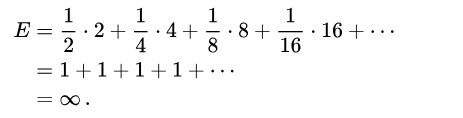
As this math goes, a person should pay infinite amount as he will be gaining infinite amount from such game. ‘E’ value here is identified as expected value. Even if one such possible game would happen in reality, people won’t pay infinite amount in reality to enter this bet. 

Bernoulli resolved this paradox by creating the concept of Expected utility. People will pay not what actual value it delivers (as in the $s of money); they will pay according to how actually it will be useful to them, ‘utilizable’ to them – that is where the utility and thus expected utility comes in picture.

Expected utility is calculated by the amount one would gain and the chances of gaining that amount. The expected utility thus is sum of all the gains connected with the probabilities of gaining them.

Daniel Bernoulli
The determination of the value of an item must not be based on its price, but rather on the utility it yields.

1st Tenet of EUT: Expectation

The overall utility of a prospect, is the expected utility of its outcomes.

In very simple words, for a given scenario you will weigh the chances of its constituent events and connect them with their respective gains. The sum of the all connections of each gain with their chance of realization is the usefulness – utility of that scenario.

Mathematically,

Expectation:

In our example we need to assume something that is the usability of the money – utility.

We assume $10 has utility of 1 unit. (This is just an assumption to understand the concept. When multiple objects are involved, their utilities will be different.)

So, the expected utility of this scenario is:

E = ((1000/10)x0.2) + ((50/10)x0.65) + (10000)x0.15) =

20 + 3.25 + 150 = 173.25 units

So, the expected utility – the usefulness of this event is 173.25 units.

The unit of value which we assumed in this calculation is sometimes called ‘utils’ – the basic unit of utility. It will change based on how one perceives the value in given scenario. 

You will realize that the expected utility is the weighted average of utility of events and their individual probabilities.

Four Axioms of Utility Theory

Later John von Neumann and Oskar Morgenstern expanded the concept of EUT with the idea of rationality. The agents involved in such uncertain economic exchanges are ‘econs’-the rational beings.

Oskar Morgenstern & John von Neumann

They have clear preferences among the options provided in every economic decision which comes under the idea of “completeness”. If out of the given set they select multiple options at a time, then it is said that they are ‘indifferent’ to these options. Whatever might be the internal distribution of constituent they might have. It’s about the final utility they perceive. When presented with choices, a rational person has clear preferences for those choices.

For all given uncertain events there is a hierarchy of preferences. If A is preferred over B and B is preferred over C, then A is always preferred over C. Which goes as transitivity.

Suppose we have been presented three events where event A is preferred over B and B is preferred over C. Now if one introduces a new event N which is slightly less preferred than B and more preferred over C then event B and N would be indifferent. In simple words, the choices between options would never directly jump, they will align as per the preferences in line.

So, A>B>C and B>N>C then A>B>C and A>N>C mean the same.

This is continuity. Graphically, the utility function is always a smooth curve.

Why do A>B>C and A>N>C mean the same even when the calculated numeric value would differ? It is because utility is never an absolute value it is just used to arrange the preferences by quantifying them. Ground rules used to define usability from the given resources i.e., the utility function of given scenario will be different for different scenarios and different sets of people. This is simplification of the concept called ordinality of utility. You can rank utility but not say that event A is this many percent better than event B.

When you have set the preferences of A over B and if you are offered another totally different/ irrelevant event M with new utility. You would still prefer A over B. Introduction of M will not affect the preferences as if A and B are independent of M. This is called ‘independence‘ in EUT.

So, completeness, transitivity, continuity and independence are the four axioms of EUT. Note that they are not ‘complete’ representation of reality. It’s just that they bring in simplicity to treat given scenarios and evaluate them. That is why you will find contradictions to these axioms. (Maybe a topic for another time.) The axioms are there to create a formal mathematical structure to draw useful inferences.  

2nd Tenet of Expected Utility Theory: Asset Integration

In EUT, asset integration is an idea based on the assumption that all people making economic decisions are rational. So, in uncertainty or risky scenarios a rational person will look at the overall gains instead of focusing on one certain gain and neglecting other unsure gains. A rational person will look at the risks of scenarios in a collective way and decide to enter only if the expected utility improves his assets’ position. A rational person will only enter the given scenario if the collective utility is better than the individual utility of its sub-events or sub-gains.

A rational person will not focus on an individual more probable gain even when his overall gains are becoming low.  

3rd Tenet of Expected Utility Theory: Risk

The beautiful insight EUT creates is about the mathematical formalization of risk profile. For that we will understand some ideas in advance.

Utility function – it is a mathematical relation between how one sees the value of given object/ resource. The value of resources is different for different people. A crude example would be how a beggar values money for one time meal compared to a filthy rich person. The value of $25 would be different for different people based on the conditions they are in.

This is where marginal utility comes in picture.

Marginal utility talks about what difference it makes in your perception of the value of a given thing if one would give you more of that in the next event. Roughly speaking the more we have something, the less we value it, so marginal utility is always diminishing. If I already have 10 packets of chocolates which are enough for the day to me, the next 11th packet of chocolate won’t make that much difference in my current excitement of having 10 packets. (Please note that we are talking about rationality here, although nobody is rational when it comes to chocolates.) A rational version of me would trade that 11th packet for something else with a person who hasn’t received even a single packet. A person who has no chocolate would perceive that single packet with higher value than how I perceived it (provided that he loves chocolates).

Alfred Marshall – the British Economist brought the concept of
‘Marginal Utility’ through his book ‘Principles of Economics’ in 1890.

So, utility function is a mathematical transformation of objects in given event to a unitary value so that the results can be easily compared with each other because the transformation converts everything to single unit system. These single unit of value is called ‘util’.

Utility function can be any possible mathematical relation. Generally, it is expected to be simple to not invite the complexities in modeling of given economic scenario. It should be simple enough to draw realistic conclusions.

An understanding of utility function gives insight into how the person evaluates risk with respect to the resources they hold.

Consider a scenario:

Event 1 – You enter a lottery where there is 50% chance that you will win $100 and 50% chance that you win nothing.

Event 2 – You are given $50 for sure, unconditionally just for playing the lottery.

Assume we have three differently thinking people to make choices in this scenario. Different thinking means how they assess the risk of entering the lottery which has some uncertainty and the surety of winning $50. Difference in assessment of risk means difference in the perception of utility. It further means that the utility function will be characteristic to each person.

Person 1 has the following utility function:
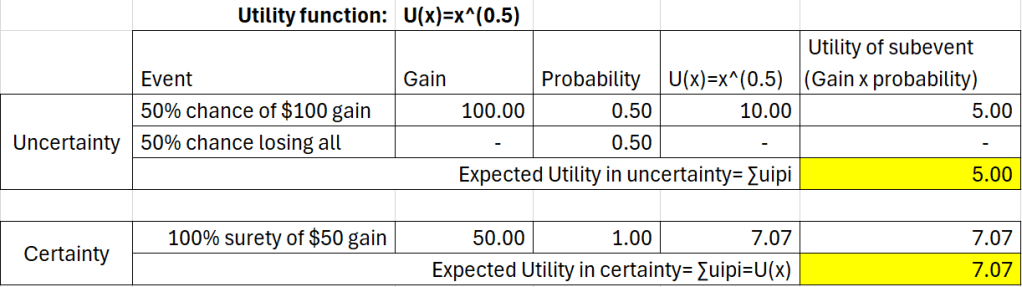
So, for Person 1 the utility of certainty (7.07 utils) is higher than the uncertainty (5 utils). He is happy to walk away with sure $50 gain instead of betting for $100 lottery.

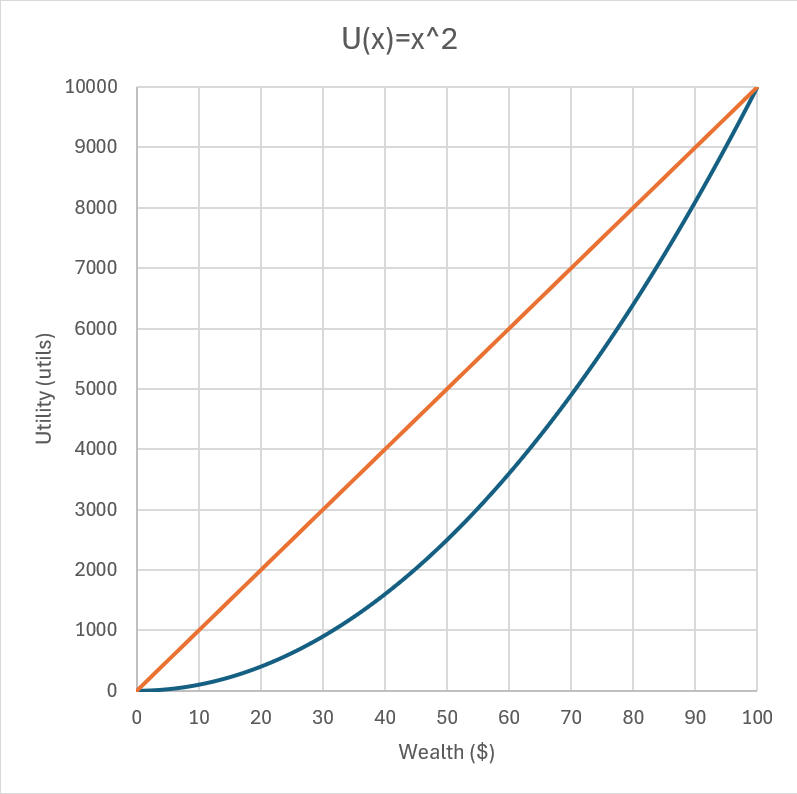
Person 1 doesn’t want to take risk by entering the Event 1 of betting when he is sure about gain of $50 in Event 2. This is risk-averse behavior. The utility function mathematically models that risk averse behavior. Utility function is concave in risk aversion.

Now comes Person 2 with the following utility function:

You will see that the utility of certain and uncertain choices is the same. It means that it doesn’t matter for this guy if he enters the lottery having uncertainty or gets $50 for sure. This is risk-neutral behavior. The person 2 doesn’t care about certainty or uncertainty. He values both events the same. As mathematically both have similar utilities. Person 2 is indifferent to both events.

Now see the Person 3 with following utility function:

This guy has a radical view, he perceives the worth of entering the lottery (5000 utils) better than gaining $50 for sure (2500 utils). This guy is gambler! He finds it more interesting to enter the bet instead of gaining $50 for sure. He is happy to take the risk in uncertainty.

Looking at these three people you should note that the scenarios/ events they are presented are exactly the same. The only thing which is different is how they see the value in lottery and the sure gain.

So, the first person demonstrates risk averse behavior. He wants surety of gain rather than gambling for higher but unsure gain.

The second person demonstrates risk neutral behavior. Bet or no bet he doesn’t care. Just be done with it.

The third person demonstrates risk loving behavior. He wants the thrill of uncertainty in betting, so he sees more value in uncertainty of lottery.

This is how Expected Utility Theory can be implemented to mathematically model how different sets of people/fund managers will make decisions based on the risk profile. The relation between expected utility (which is the weighted average of gains) and utility function (which shows how one values the gain) can show us the risk profile.

Risk Averse Utility Function
Risk Neutral Utility Function
Risk Loving Utility Function

In the graphs shown, blue lines show utility function and the orange lines show expected utility. The orange line in our case connects the utility of $100 and $0 which is Event 1. This orange line connects any points on utility curve and it will give the expected utility value for that scenario of uncertain gain. In simple words, it’s the line of weighted average exactly like the definition of expected utility. This line is used to find out the certainty equivalent (CE). A certainty equivalent is the utility of an uncertain gain if it was certain.  

Almost all the time, people are risk averse. People want to avoid uncertainty about higher gains when they are presented with some lower but sure gain. This is where marginal utility becomes important. (This point deserves broad explanation which we will cover another time under Prospect Theory)

Marginal Utility

In risk averse people, you will see that the utility function starts to flatten out once the value gained increases. The more value someone already has the less he values the next addition of bunch into the preexisting bulk. Remember the chocolate box example?

One with 10 boxes of chocolate perceives one additional box with less value, whereas some with no chocolate will see it as a precious one as he has nothing right now. The perceived value of the additional next lot goes on reducing. This is known as diminishing marginal utility. Marginal utility is always diminishing.

So, a safe playing person would stop entering the next gamble because he now has enough. The next uncertainty in gambling has less value for him.

EUT in actuarial

Now it is obvious that only a risk averse person would go for conservative approach in uncertainty. This also means that risk aversion will also invite preventive measure against loss of certain assets, resources. Insurance thus comes into the picture. EUT here helps to mathematically formalize the probability of the risks which would compromise current gains, the perceived value of asset/ property/ resource and losses one can bear. We can now calculate the premium for the insurance against uncertainty of loss of something.

So, we will look into a scenario where risk aversion exists thus marginal utility is always diminishing.

We have the utility function of a man has a property giving revenue of $100K/year as:

u(x)=ln x

Now will see the risk scenario. Suppose this person does a fire audit of his property and the auditing agency finds out that there is 50% chance that he will suffer a loss of $60K/year due to fire hazard and 50% chance that nothing will happen.

After rephrasing, the gains from the property would look this:

50% chance that the income is $40K/year and 50% chance that income is $100K/ year.

Using the tenets of EUT the mathematical expression becomes:

Now, what we are doing differently here is to find out what this expected utility in uncertainty means when there is complete effect of loss with some chance and gain of some chance. In earlier examples we had second event of certainty against which we compared to understand the risk profile. Now it’s reverse calculation, we know the risk profile, we know the perceived overall value i.e., EUT of the property. Now we will find the certainty equivalent (CE) using the risk profile which can be explained by the utility function of the person.

How much is this 11.05 utils in terms of money from the property for this guy? We can find this from utility function of the person.

ln(x)=11.05, thus x=$63245.55

Now, think the fire hazard as a lottery where you gain $63245.55 money as per EUT calculation. Whether the fire will happen or not, the possible overall earning from this property would be $63245.55.

Now, if the property without any fire hazard was giving me $100k and the insurer guarantees me that same earning for the losses due to hazard. How much maximum amount should I pay to the insurance agency?

I will pay only that much amount which falls short to the $100k when compared to perceived earning calculated from the combined effect of certainty and uncertainty as given by EUT.

My earing due to uncertainty is $63.2k/year, I would receive $100 for a fine year so in order to continue that $100k even for a worse year I would pay insurance agency = $100000 – $63245 = $36754.45.

Anything I am paying above $36754.45/ year for insurance premium is loss for me. I would not go above this amount to insure my property which guarantees income of $100k per year. This is how the insurance premium is decided.

Conclusion:

We have many philosophical ideas about how money is not everything in life but deep down everyone knows that money constitutes a bigger portion of who we are. Although money can’t buy everything, the unexplainable value it holds behind presence of almost everything in our lives will never go unnoticed. We know that this importance of money/ resources/ assets is highly dependent on how much of these we have right now and how much of those may get lost. This perception of value drives our decision making in risky situations. The mathematical formalization of the perception of wealth, our risk profile is facilitated by expected utility theory. Although this theory has its own limitations it lies at the foundation of the economics.

For further reading:

  1. Von Neumann, John, and Oskar Morgenstern. “Theory of games and economic behavior: 60th anniversary commemorative edition.” Theory of games and economic behavior. Princeton university press, 2007
  2. Kahneman, Daniel., and Amos Tversky. “Prospect theory: An analysis of decision under risk.” Econometrica 47.2 (1979): 363-391
  3. Thinking fast and slow – Daniel Kahneman
  4. Connecting money with sentiments – Behavioral Economics
  5. Settling accounts with the losses – On Prospect Theory

The Body Snatcher – Weighing Intent Against Action

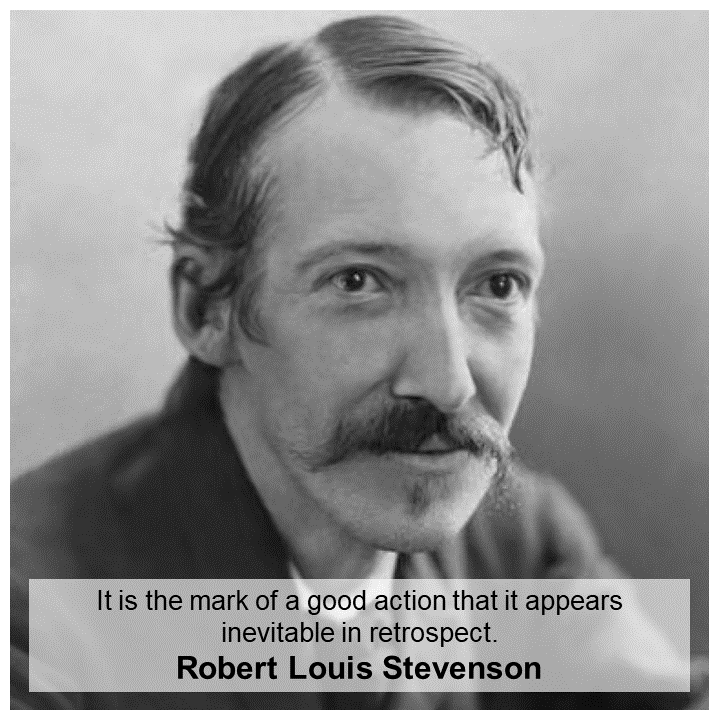
Robert Louis Stevenson is known for his world-famous novels ‘Treasure Island’ and ‘Strange case of Dr Jekyll and Mr Hyde’ . His short story called “The Body Snatcher” throws light on the mentality and evolution of the dangerous psychopaths. The false sense of greater good, the ability to ‘suppress destructive thoughts’, ‘destructive actions’ to justify superiority keeps driving certain types of criminals to cross the limits of humanity, ethics, morality. It shows that even though the consequences of wrong actions may not get punished due to the limitations of the laws of the respective times, the punishment of wrong thought is almost instant which is the degradation of the person’s psyche through ‘guilt’ and ‘fear’ – and most of the time it goes unnoticed and builds over time resulting in even more grave dangerous acts. It shows how thought and action are equally important in the overall personality. The wrong act may not get punished but the wrong thought has already punished the mind.

Robert Louis Stevenson’s famous short story “The Body Snatcher”

The difficulty of literature is not to write, but to write what you mean; not to affect your reader, but to affect him precisely as you wish.

Robert Louis Stevenson

In storytelling, especially in visual storytelling media, there is an expression – “Show! Don’t tell.” It is very impactful because it makes the viewers to put their minds consciously in the narrative thereby it increases their engagement in the story; this makes them to consider the narrative as their own story. The emotional impact is very high. It is furthermore potent if the story is horror or thriller. More the viewers feel engaged, more scared they will be.

But there are some stories especially, some unconventional crime stories where there is no point of relatability because not every one of us is a criminal, not every mind thinks the way given psychopath, criminal is thinking in the story. 

Now the impact of such stories is solely dependent on how they are written, expressed. The mastermind depicting, writing such stories knows that being a human we have all the tendencies of whatever good there is in the world and whatever bad there is in the world. It is just matter of which of those we give chance to flourish and which of those we suppress to make our ultimate personality. The master author uses that fine thread of slight ‘unnatural’ tendencies we have suppressed to make us simulate the real horrors the villains of his story would commit. These stories create impact and relatability through our urge to simulate the events to understand the end truth of the narrative. Inspiration from real events adds further more spice in such stories. (That is exactly why “Based on real incidents’ has remained an impactful (but still a cliché) opening for any horror story. We know that it’s a cliché but it creates a space in our minds that there could be a possibility of this happening in real life)  

R L Stevenson wrote one such short story which feels like a normal depiction of a crime but in the very last sentences the horror of the story unfolds thereby leaving the readers shocked and scared. We will deep dive into this famous story written by Robert Louis Stevenson.

The Body Snatcher – Synopsis

This is a story of two young men who studied in the school of medicine in Edinburgh in early 1800s.

Macfarlane is now a Doctor and Fettes – old drunken but literate man was his companion in the past academic times. The main story starts unfolding as Dr. Macfarlane and Fettes see each other after long time unexpectedly which revives the memories of their wrongdoings in their shared past at the school of medicine.

Being a good and sincere lad, Mr. Fettes gets the job of maintaining the dissecting room held by Mr. K_, the teacher of anatomy. Macfarlane was assistant to Mr. K_. So, Fettes and Macfarlane were responsible for ensuring the smooth demonstrations of anatomy to the class by Mr. K_. In order to ensure the duty and credibility, Fettes and Macfarlane had crossed the limits in the ways they would source such dead bodies. There comes a day when Fettes is shocked to find out that the dead body he received is of Jane Galbraith – a lady he met in a good health just a day before. He tries to bring sanity in this matter by asking Macfarlane but Macfarlane rejects that idea of identifying and informing Police about the possible murder because that suspicion opens the possibility that all the dead-bodies they receive for dissection in the class of anatomy are results of crimes thereby making them immediate criminals.

Here we come to know that whenever there is shortage of dead bodies, Fettes and Macfarlane went to dig out the graves in the graveyards around Edinburgh.

One day Fettes discovers that Macfarlane has one acquaintance called Gray who has some sort of control over the behaviour of Macfarlane as if Gray knew something really dark about Macfarlane and revealing it would jeopardize Macfarlane’s reputation. Gray uses this trick of black-mailing to have a feast on Macfarlane’s money even though Macfarlane was not into it.

Upon the passing of night, Fettes understands that Macfarlane took care of the Gray Problem when he sees the dead body of Gray as a new subject for the dissection class. Macfarlane himself delivers that body to Fettes and it is now clear that he himself murdered him. But there is no chance to inform authorities and bring more trouble for Fettes. Macfarlane is not bothered by all this and rather feels free as the axe of Gray no more exists on his neck. He ensures Fettes that its just a matter of time that these dreadful memories will fade away and they both will be on their way as if nothing happened.

Fettes feels the same but both Macfarlane and Fettes have the event of Gray etched on the back of their minds as they now consciously avoid any direct or indirect conversations leading to Gray.

One day due to the shortage of subjects for dissection they go on the ‘resurrection’ hunt to a graveyard to dig out a dead body of an old farmer lady. They take a halt before going on to the main task of ‘resurrection’. They are caught in rain and darkness when they start to remove the dead body of the lady from the grave. They load that body in their small, congested cart in darkness. The body lies partly on their shoulders, is bothering them and is shifting continuously due to the uneven roads.

The uneasy dark and rainy environment, the dogs following the cart makes Macfarlane uneasy as if someone, something unnatural is watching them. So, Macfarlane asks Fettes to light the lamp so that they can at least check the dead body and keep it, adjust it properly in the cart so that they would continue the journey. Upon lighting the lamp both Macfarlane and Fettes are shocked to discover that the dead body they retrieved from the grave of the old lady is a dead body of Gray – a dissected dead body of Gray.

Inspiration From Real Incident

William Hare (left) and William Burke (right)

Robert Louis Stevenson’s short story “The Body Snatcher” was published in December 1884 and was based on infamous and real “Burke and Hare Murders” in 1828. Burke and Hare were owners of a lodging facility. Burke and Hare committed 16 murders to supply dead bodies in exchange of money to Dr. Knox who used them for dissections. This event led Dr. Knox to lose his credibility and fame. Dr. Robert Knox was a famous anatomist of his time. He was not convicted because he was not directly involved in the dealings of the dead bodies from Burke and Hare. Burke was hanged in public and Hare got immunity because he supported the state’s evidences and testified against Burke.   

The way in which R L Stevenson knitted the story is what made the story interesting. He calls the anatomist doctor Mr. K_ when the readers had an informed notion of Burke and Hare Murders and Dr. Knox in those times. So, it makes the readers to find out themselves that mystery around “Mr. K_”. Mr. K_ of the story is no other than Dr. Knox of Edinburgh.  

Psychopathic Tendencies – How Criminals Justify Their Crimes

For any average person, committing single murder is a huge, seemingly unnatural, inhumane and in the end an illegal act to fully commit. The consequences are dangerous. Then how come Burke and Hare committed 16 repetitions of this crime? They were just some small business owners.

In similar sense, Mr. Fettes and Mr. Macfarlane were just students of medicine and were doing their duties to ensure the supply of subjects for dissections. What made them to go on the streak of multiple illegal activities in the story? They were just doing their due diligence to Mr. K_.

Upon looking at the depths of the investigation of Burke and Hare Murder Case we will find that the first time they sold a dead body was for totally different reason. One of their lodgers died of old age while leaving a debt of 4 Sterling Pounds. Burke and Hare decided to sell the dead body to settle the debt. Note that dead bodies in those times were scarce for dissection and demonstration. They sold the body to Dr. Knox’s Private Anatomy School. Professor Doctor was not directly involved in the dealing. Burke and Hare received 7 Sterling Pounds for the body.

From hereon they decided to take the control of people’s lives for such beneficial business of dead bodies and started murdering the people who lodged in their facility. They killed 16 people in this way to deal for money in exchange of dead bodies. The careless murder they committed was to kill a beggar with clubfoot and his dead body was easily identified by a student due to this disability which made him to limp. Knox is said to make that body unidentifiable by removing the head and feet.

They had differences in their partnership which made them to split these acts for themselves. During an attempt to forcefully shift the lodgers to Hare’s establishment, Burke killed a lady and the lodgers who were shifting found the body while they returned to retrieve their belongings from Bare’s establishment. This was reported to Police but the dead body was already sold.

Looking at these events you will see that it is the rejection of morality and false sense of greater good and self-betterment which drives the criminal to commit the crime again and again. Burke and Hare got involved in these acts for the monetary benefits where it was easy to bypass the system and provisions like Dr. Knox’s anatomy demonstrations. Dr. Knox was driven to improve his credibility by flaunting his skills and demonstrations of dissections in the medical community.

R L Stevenson took this fine thread of reality to create Mr. Fettes and Mr. Macfarlane in his story. We will see that Mr. Fettes is shocked when he identifies a dead body of the lady he just met, that too in good health. Mr. Fettes had raised concern to Macfarlane but as Macfarlane was experienced and conditioned knowing that dead bodies once dissected were beyond any identification and legal jurisdiction. Actually, being a student of medicine, Macfarlane was expected to have a sense of the importance of life for any human being. The false sense that this will not get discovered by anyone practically and all of this was being done to maintain the reputation of his teacher thereby improving his credibility created a false sense of greater good in Macfarlane.

There is a section in this story where Macfarlane expresses how he feels about all these matters of dead bodies and Gray’s murder. He expresses following to Fettes in the story –  

“The great thing is not to be afraid. Now, between you and me, I don’t want to hang-that’s practical; but for all cant, Macfarlane, I was born with a contempt. Hell, God, Devil, right, wrong, sin, crime, and all the old gallery of curiosities- they may frighten boys, but men of the world, like you and me, despise them. Here’s to the memory of Gray!”    

The way he says all this shows that his mind has developed a false sense of greatness to justify his wrong-doings. Now he wants to prove his manliness. It’s like a defense mechanism to cover all the guilt which comes from committing such crimes. The criminal considers the motivations behind his criminal acts are way superior than the moral weight of what is right and what is wrong. (The word ‘CANT’ use in expression “for all cant” means a criminal act, deceitful act, falsehood. Macfarlane very well knew that what he was doing was a crime.)

In case of Burke and Hare it started with settling the debt for ensuring proper monetary gains for stable business of lodging. Then it snowballed into series of murders because they were never caught in action and had a way to come out of the murders. They created that ‘ecosystem’.

Same ecosystem can be seen in this story.

What could have actually made difference is the sense of reality and integrity. Integrity is the behavior which we carry when no one is watching. Fettes had chance to expose all this system when he discovered the young Lady’s dead body. But only because he felt that this action came with lot of difficult consequences and impossible to favor him in the end, he keeps mum.

Fettes found that exposing Macfarlane and Mr. K_ and getting them punishment is the most impractical and impossible event – the inevitable and that is where he made his first mistake. He went with the flow, the wrong one.  

The same would be the case for Burke and Hare. They could have asked authorities for the settlement of the debt from the old dead lodger. But, considering it a tedious route they considered the ill- route to sell it.

However difficult it may seem; impractical it may seem there is always a right way to do right things. The environment in which you are deciding your action is also playing a huge role in your choices. First helplessness shows you the path, then guilt follows and in order to mask that guilt the person creates a sense of greatness which demands sacrifices. This is real and constant in every generation of humanity. Most of the times right things are the toughest one to act on and accept.   

Stevenson beautifully brought these human tendencies in his story which go hand in hand with the reality we live even today.

The Ending Of The Story – Real Or Supernatural?

What hangs people…is the unfortunate circumstance of guilt.

Robert Louis Stevenson

Many readers argue that the ending is supernatural and spooky.  Robert Louis Stevenson in a masterful way maintains the realism of the story till the end. And in the last few closing sentences he mentions dead and dissected body of Gray which was completely destroyed many days ago in the reality of Fettes and Macfarlane. It is practically impossible for a body completely dissected to show itself in deep grave at completely different location. So that body definitely was not of dead Gray.

There are evidences to support this. Before going to the ‘resurrection’ job, Fettes and Macfarlane had stay in Fisher’s Tryst where they had drinks. So, it’s pretty much possible that whatever happened was under the influence of alcohol.

There is one more doubt that if it was real then at least one of them would have noticed the reality of the dead body. How can two men would have a shared delusion? A shared delusion can only be explained by a supernatural intervention.

The justification to opt out shared delusion is the shared guilt Fettes and Macfarlane had. It is a human tendency to make sense out of bunch of things which don’t make sense collectively when conditions are hostile. This sense is heightened when one is in hyperalert state, when one is in full fight or flight mode. Deep down Macfarlane knew the acts he is performing. The surrounding events just fuelled this sense of guilt and Stevenson beautifully created this environment in the minds of the readers.

You will notice that Macfarlane is completely unsettled and repulsive of minor things happening to him once they load the dead body. He hates the jumps that the body makes while going on an uneven track, he hates that ice-cold sackcloth flapping on his face, dogs following the cart on the road is unsettling to him (in reality we all know dogs would follow every vehicle going through their territory, especially in night), he also feels that the body has grown in shape (how would he know this if there was not enough light, as the lamp was not working?).

In this exact moment Stevenson injects this sentence for us readers which is a money shot –

“…and it grew and grew upon his mind that some unnatural miracle had been accomplished, that some nameless change had befallen the dead body, and that it was in fear of their unholy burden that the dogs were howling”

“The unholy burden” they both were carrying was the guilt they had suppressed long ago and not acted on it in rightful manner.    

This guilt and intoxication are the main reasons behind the spooky conclusion of the story.

What Should Be Punished – The Action Or The Intent?

The Body Snatcher as a story and even the reality of Burke and Hare crime to which it is associated poses a very interesting question. What are the limits of judicial system, law and order?  

As this statement from Kant goes, in order to be called a criminal in the eyes of the public, one must be seen to perform the crime or the evidences should support so. Thus ‘Law’ becomes more of a sociological term – ‘to arrest the degradation of human as a society’. On the other hand, Kant beautifully highlighted the unitary role of a person in the society. Simple logic says how a society is made of many ‘individuals’ coming together to interact for mutual benefit. Kant consciously asks for preservation of rights of others while achieving benefit otherwise society collapses (what is beneficial for one will not necessarily always be beneficial to others.) Which is why ethics prevent the degradation of the person on individual level. That is exactly where morality and integrity become more influential.    

So, even though our generalized and biased, conditioned thinking makes us to weigh the wrong acts heavier than just their thinking about doing them, in the end they both weigh the same. Sometimes, even though these thoughts don’t get in the fruition of realised actions, they keep on affecting minor, seemingly insignificant decisions we make which ultimately create our personality and our psyche. Act of crime and thought of committing the same crime are same.

Friedrich Nietzsche posed this same dilemma of “what weighs heavy – action or intent?” in his book “Beyond Good and Evil”. I have discussed that in depth in the section “The Freedom of Actions” in my other blog post “The Free Spirit – Beyond Good and Evil “.

The gist of the things is that we will be able to appreciate the crime of ill-thinking when the stakes are really high as in any decision would have grave dangerous scale of destruction. If we will wait for the actions to be presented as wrong while we already know that it leads to wrong then even the thought of doing that action was wrong in the first place, even before the action’s ends were realized.

The Real Punishment – Where And How Does It Happen?

So, now that I have established that even the thought of doing wrong action is a crime then, one would definitely say that I must be a fool.  Every one of us is always thinking of such ideas all the time – consciously and unconsciously. (Not of murdering someone obviously. Just recall the last time you cursed someone because they made your life miserable, or the thought that why bad things always happen with good people – especially ME!)

The answer is “It is really easy to fool our mind”. This is also where the core of the fiction in Robert Louis Stevenson’s short story The Body Snatcher and the reality of ‘Burke and hare Crime’ is overlapping.

Burke and Hare thought that their crimes were justified because of the profits of their business. Fettes and Macfarlane thought that their acts were justified for their survival and reputation.

Deep down they were completely engulfed in the guilt of their wrongdoings. So, if we follow the before-explained thought of Immanuel Kant, we will see that real actions from law will ensure realistic punishment but the punishment of the mind is instant, the guilt is injected immediately. This guilt if is “real”, it will immediately start eroding your personality and psyche. Which will eventually lead to unnatural events and acts of crime in real world.

I am saying the feeling of guilt to be “real”, because (again) it is really easy to fool our mind. One has to train mind to distinguish the difference between impulses, responses and their encouragement or suppression. One will realize that whenever there is suppression of wrong thought like guilt in this case, it leads to the defense mechanism – creating a cover up with false sense of greater good or the false security of not getting caught in action, on not having enough evidences. Even though they are not caught in society, the guilt has already passed its sentence on their personality, their self-image and psyche. Now such persons have just accepted what they have become. (This is how a psychopath would start their journey to justify all their crimes).  

I am posing this also from the other perspective of ‘false-guilt’. Sometimes we consider ourselves guilty when in reality we were not responsible for those events. This false guilt will start taking even the good things you have.

The only way I see to handle any wrong thought is to not let it grow out of its own boundary of creation, not to feed it further. Not to mask it or suppress it but just let it remain there. The overgrowth and flourishing of good thoughts will eventually diminish its influence. It’s natural to have right or wrong thoughts for given stimulus. Response, reaction lies in our territory. You must understand that even the act of suppression demands extra efforts which requires extra involvement, this extra involvement is unconsciously feeding that wrong thought, thus suppression on mental level is not suppression rather it’s a feed. Which exactly what we keep on missing when judging between an action and its mere thought.    

Egg Or Chicken? – Action Or Thought?

You will appreciate the dilemma created due the practical limitations of the world we live in. As it is really difficult to enter immediately into the mentality, psyche of the others – we have to always go by the external attributes of everyone around us to measure the rightness or wrongness. That is why act imposing guilt must also be supported by the thought of guilt. This is very important when the psyche, the mind of person is not normal or completely evolved. So, one may think that the importance of ill-intent is less important, it also plays equally important role in judiciary decisions.

In court, the thing we punish is the criminal intention. -the mens rea, the guilty mind. There is an ancient rule: actus non facit reum nisi mens sit rea – “the act does not create guilt unless the mind is also guilty.” That is why we do not convict children, drunks, and schizophrenics: they are incapable of deciding to commit their crimes with a true understanding of the significance of their actions. Free will is as important to the law as it is to religion or any other code of morality.

William Landay, Defending Jacob

Conclusion

Robert Louis Stevenson is known for his world-famous novels Treasure Island and Strange case of Dr Jekyll and Mr Hyde. The short story called “The Body Snatcher” throws light on the mentality and evolution of the dangerous psychopaths. The false sense of greater good, the ability to ‘suppress destructive thoughts’, ‘destructive actions’ to justify superiority keeps driving certain types of criminals to cross the limits of humanity, ethics, morality. It shows that even though the consequences of wrong actions may not get punished due to the limitations of the laws of the respective times, the punishment of wrong thought is almost instant which is the degradation of the psyche through ‘guilt’ and ‘fear’ – and most of the time it goes unnoticed and build over time resulting in even more grave dangerous acts. It shows how thought and action are equally important in the overall personality of a person. The wrong act may not get punished but the wrong thought has already punished the mind.    

References-

A Modern Prayer to Perceive ‘The Silver Linings’

The acceptance of our dark side is the only way to start a new journey to the real happiness, fulfillment. Achieving real fulfillment becomes way easier and manageable once we start acknowledging our dark emotions, feelings of sadness and sorrow. Running away from such “low” lying emotions actually intensifies them in the abyss. Actually, such emotions have great contribution in the refinement of our character. Empire of the Sun’s new song called ‘Happy Like You’ talks about the acceptance of our dark side to make our personality whole for creating a newer and better version of ourselves.

Empire of the Sun’s song “Happy Like You”

The best piece of art can be attributed to the multiple perceptions, interpretations it creates in the mind of its subjects despite keeping its physical structure constant.

The beauty of a masterpiece is that people have their own opinion about that piece and nobody is wrong. The mere subjectivity and the possibility to invoke personal feeling in the mind of the observer or the enjoy-er of the art is the power every one of us has naturally. Most of the time very few of us unlock that power in a better sense. Music is one such power.

Recently, I came across newly released album named “Ask that God” by an Australian electronic duo called Empire of the Sun. All the songs on this album are banger and are complete redefinition of what the Empire of the Sun stands for. In my personal opinion, it is a crime to compare all the songs to choose the best one, (but you already know why I am writing this). One song that is looping in my head continuously and has occupied a larger portion of my brain for many days is “Happy like you” (this only shows that the song has conjured me thereby maintaining my previous point of not comparing good songs with each other).

Luke Steele and Nicholas Littlemore of Empire of the Sun

Actually, bringing the poetry into the bastardized territory of prose should be a crime, for it de-beautifies the very reason for it being so wonderful. But, in order for everyone to appreciate the multiple subjective point of views and its connections with the multiple facets of life it is trying to explain, a poetry must undergo its ‘deconstruction’ into prose.

That is the crime I am committing here. If there is any songwriting, poetry, lyrics meaning police anywhere, tell them that I am here waiting for them to tolerate all this prose I have written hereon.  

Jokes aside, I am deep diving into the song and its music video.

The song

The song is written by Luke Steele and Nick Littlemore of Empire of the Sun.

Happy Like You lyrics © Universal Music Publishing Group

You’re revolutionary
You’re like a phantom taking a leap
You’re heart is legendary
Bet you are feeling so high
You have a higher power
Telepathic talk to me
Make me whole again
Whole again whole like I used to be

Happy like you
Happy

The poet is asking the higher power for something that would make him feel complete like he was before. He is praising the power of this higher power so that it can bless him.

The words used by poet like revolutionary, taking leap, legendary heart are used to describe this higher power reflects what he exactly wants from the higher power. He wants to regain a lost part of his personality he was before going through this hardship. He wants the higher power to take the leap to come out of the sorrow, transcend the current state and bring about an “internal” revolution in a way.

Telepathic ability indicates the poet’s trust in the higher power. Poet knows that this higher power is his final resort to all that exists. That is why this power knows everything already and there is nothing required to be expressed formally to get things done.

Ultimately, it is a request to regain that precious part of the poet’s personality, that happiness which defined his whole personality.

Won’t you humanize me
Use all your wisdom
Show me joy in everything
I’ve been clouded by machines
Lost my way deep inside another screen

The rhetorical question posed by the poet is a slight indication of what he lost during his difficult times. He lost the things which made him human. He lost the ability to see the silver linings.

This is the exact spot we must understand that the person lost his personality in depression and mental battles. But why? and how?

Immediate forthcoming lines show what happened. The screens and “machines” indicate the influences of the mechanical world on our daily lives and the added powerful effect of social media which led to a dreadful state of depression.

It’s an irony that when we are ‘liking’ certain things on social media from other people’s lives, a deep-rooted sadness, envy, hatred is getting born out of the one-to-one comparison of lives. Everyone is conscious of these emotions due to social media but the penetration of social media, screens everywhere is so regular and normal that we are subconsciously (now mechanically) ignoring these emotions which take a toll on our minds when we are shocked with something really sorrowful.   

All I wanna be is happy happy happy like you 
All I wanna be is happy happy happy like you

 Once you pass through such horrible emotions of sadness and depression you start appreciating the person you were, how happiness made you the better version of yourself. This happiness made you feel like the greater, higher power itself. That happiness actually made you feel closer to the higher power. The poet urges the higher power to make him who he was before and just in the ways the higher power carries itself.  

You’re revolutionary 
Telepathic talk to me
You are imaginary
Bet you are feeling so high

Wish is a dream that comes true

The most difficult part of coming out of the depression is that it starts in mind of a person with such an intangible, non-physical thought/ idea and then it starts to affect the real events, objects, people around him/ her. So, even though fixing the reality around such person can help to come out of the depression; uprooting the deeply settled feelings of sadness, grief, sorrow has immense impact in the person’s fight against depression.

That is exactly why the wish to become happy shows that the poet whole-heartedly wants feel happy. The ‘wish’ indicates is readiness from inside to be realize happiness from intangibility to reality thereby highlighting the use of the expression “dreams that come true” here.

Time is a song that forms you 
Oh I hope you

The expression of ‘time’ which formed this higher power implies the time which need to given to person to heal when he/ she is in hardships. Give it some time, it will pass too. The poet has understood that over the time even though it will seem difficult but over the time every sadness will fade away. It’s just an ask from poet to the higher power to get the patience, courage for passing through this hard time.    

Won’t you humanize me
Use all your wisdom
Show me joy in everything
I’ve been clouded by machines
Lost my way deep inside another screen

All I wanna be is happy happy happy like you

Ultimately the influence of social media on our lives and the mere algorithmic, mechanical nature of our lifestyle is leading lives of many really happy people to a depressed, sorrowful life. The poet asks the higher power to make such people complete again and happy again just like the supreme power is. It also means that once we become happy and complete, we will become that supreme higher power again.   

From a simple explanatory point of view on any poetry/ songwriting, the song gives an impression of the man’s urge to regain his happiness, his identity when he is in the conundrum of depressive emotions and thoughts. The impact of depression is great because the factors causing it are within our hands (or I may say fingers’) reach – the social media and the screens.

I think the songwriters have taken this excuse of the depression from social media to show what an urge to overcome any depression means for any human being; what it means to redefine the personality and also complete the human being in a bigger picture.  

The video and its symbolism

The phone call –

The video starts with a phone call. The girl receives a call on her landline and then the frame shifts to a guy (Luke Steele – Emperor Steele) in a dark with a red hue and dark hat. This is indication of her having a call with her inner self. The low-lit room shown throughout the video is the metaphor of she having discussion with herself and her inner thoughts and emotions. The phone call is proof of she handling her emotions by herself, it is her own conscience calling her.

Frame from Empire of the Sun’s Happy Like You MV
A low-lit room –

Watching reflection in mirror and hand movements on her own body shows she is interacting with herself. It is like a self-talk one has with themselves while figuring out what needs to be done. The low-lit room shows that dark part of our personality which also need acknowledgement. Even though the song calls for the person to be happy, this low-lit room has bigger significance. It is an indication that the real happiness comes with our acknowledgement of our darker side. Darker not in the sense of negativity but more in the sense of left out emotions which also need proper attention.

Frame from Empire of the Sun’s Happy Like You MV
The colors –  

Even though the music video looks colorful with some dark theme, the choice of colors used in this video are specific; there are characters, colors to the people shown in the video. Hot, cold, and warm / Red, blue, yellow, greens sometimes – indicate respective emotions and the interaction of the girl with those emotions. It is like she is trying to understand them and accept their presence to find the answers.

Frame from Empire of the Sun’s Happy Like You MV
The window –

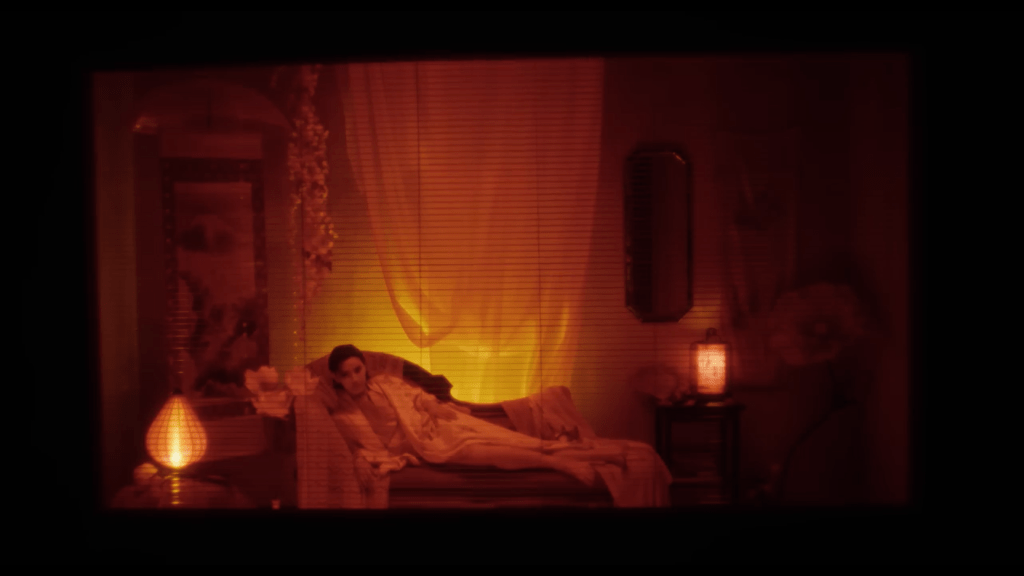
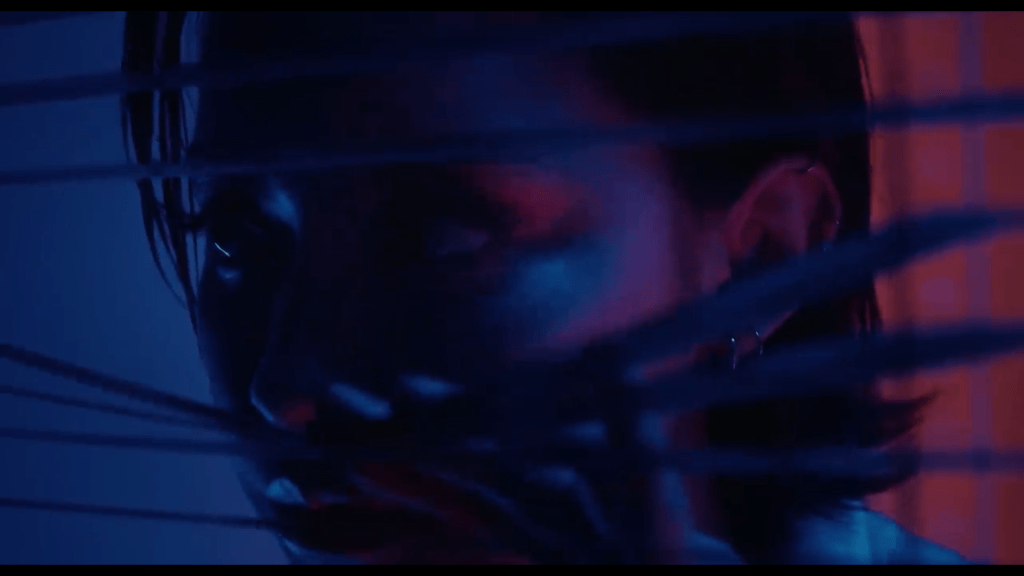
In the early part of the song, you will see the girl peeking through the blinds to see what’s behind the glass. It’s literally her peeking into her dark side of the mind.

There is a glass window with blinds between a person and the girl. The person can see her doing all her activities. What girl sees is only her reflection, this absolutely support the symbolism of her having an internal conversation about the overall depressive state of her mind.

Frame from Empire of the Sun’s Happy Like You MV
The sadness, grief –

You will see one person (Nick Littlemore – Lord Littlemore) with the black tears seemingly away from the window in certain snippets of the video, who appears and goes withing few moments. This is that deep rooted feeling of sadness which the girl is trying to acknowledge. One person closer to the glass window observing the girl’s activity is her conscience and the grief is away from the glass lying in the deep abyss of her mind. I say the guy closer to the window is her conscience because it has symbolically shown with multiple colors and hues showing the variety of emotions one carries in themselves.  

Frame from Empire of the Sun’s Happy Like You MV

The rain in the end symbolizes new beginning, renewal.

Frame from Empire of the Sun’s Happy Like You MV

The creators of Music video deserve special applause

A deep dive into this ‘prayer’

For me this is not a simple song, it’s a prayer and I have a very strong reason to justify my point. A prayer from a literal, grammatical point of view is a request to higher powers which have better control of the reality than us. We surrender to such higher powers to show that we are humbled and are in a need for help through such prayers.

This song may not have that feel of “conventional” prayers, hymns due to its electronic and not so ‘religious-feeling’ notes, melodies but there is no written rule on the ways to compose a prayer anyways.

On first thought it’s weird, how can a prayer in electronic music make sense spiritually?

I say why not! I would say the composition itself dares the modern listener to appreciate the feeling of awareness of our higher self – hidden inside our own selves. It is like tapping into that unconventional, unexplored hidden, darker part of our own conscience.

The song mainly focuses on visiting and acknowledging the darker parts of our mind, especially when we are in deep sorrow. Abandoning such dark emotions thinking that they are not part of your personality actually intensifies them and when you are feeling weak and defeated – these emotions will easily cover your whole personality.

My point to call this song a pious prayer is that it makes the listener, the singer acknowledge their emotions. Good or bad whatever they are, they together make the personality whole. It also makes them to accept their urge to improve themselves in life. Even though we are asking the higher powers to grant us the powers to become our better version it is actually we – ourselves acknowledging our darker side to improve and build upon them for the better and evolved version of our selves.

The most important act to come out of any negative, depressed feeling is the acceptance of the fact that they are an inseparable part of our personality and only this time they have charge over our personality and we can take control from them anytime we want. You can only cure a person who really want to be cured and live ahead. The feeling to come out of such sorrows has to come from inside and it becomes easy once we accept our darker side of emotions, feelings.

So, the best way to handle any challenging emotional state, any darker emotional state is to first acknowledge them. Acceptance of something wrong or abnormal is the first step to effectively work on handling them. It becomes very difficult to accept that we ourselves are the originator of our emotional responses and its totally normal. We just feel that it is difficult to control our emotions because mostly they are triggered by the external stimuli and that is where the real trick happens. You see, the illusion that our emotions are uncontrollable is created by the assumptions that one need to control his/her surroundings to achieve what they want to become happy. That is why when such person fails, they are immediately drowned into the feelings of sadness. This also does not mean that you should always control your emotions and avoid expressing yourselves.

What I am trying to make point about is that the moment we start segregating our emotions as good and bad we end up in an illusion of happiness instead of the real happiness. Instead of avoiding and dumping, controlling your sad, dark emotions deep down, their acceptance as one more normal part of our personality helps us in a better way to achieve the real happiness.

Being sad justifies the moments of happiness and that also does not mean that you must remain sad – suffer more to be happy in bigger ways. You see, all happinesses in the world are same. Actually, they are not even same, they are subjective – to be precise, there is nothing to compare between any type of happiness. But due to the social media and the screens, we are always trying to compare our happiness with other people’s happiness. That is where the origin of the problem lies.

Looking on the other side of the shore same goes with the sadness; no two sadness must be compared. Acknowledgement itself is more than enough.

Working on sadness is like hugging an annoying crying kid; just a tight hug without any intent. The kid will stop crying.

Once we have accepted all our emotions as a natural part of our personality then only can we have the chance to recreate our personality. This requires humbleness and in most cases when people are thrashed with the reality and the sadness, when they are helpless the final resort is the spirituality where the help from almighty is requested. The moment you attribute this power to any object especially human-like object the religion starts taking shape (that would be topic or another discussion!) But without diverting the topic, only when we are humbled then we seek help from others. Prayer allows you to do that without any feeling of shame. That is exactly why I feel this song is a prayer. It allows you to accept your darkness, understand it and asks you to use it to create new happiness.  

I will stick to Kierkegaard on this, we have to understand that when we are praying to the higher powers to handle our lives in a better way, we are actually asking the forces lying inside our own selves which hold the capacity to create the better version of ourselves.

We are capable of creating better times for ourselves on a condition that we acknowledge every part of who we are. It is just our mechanical nature to categorize certain things as good or bad sad and happy which takes charge of our whole personality.  You will appreciate this more once you closely observe the stories behind the creation of all types of the masterpiece humanity has ever seen. All those great things had that unconventional, hidden dark side which triggered the creation of something totally new and radical.

So, in order to become truly happy, one must accept their dark sides that is where the potential to have completely new beginnings lies.

Appreciation For the Flow of Life

We, the population of billions round the globe are always trying to create our own version perfect life. What is perfect is purely subjective and thereby has infinite interpretations but there is something very fundamental – common which flows through all of us. It can help us to find the real perfect life. Wim Wender’s masterpiece “Perfect Days” shows how we can appreciate the inherent imperfections that life has and how to appreciate the life and the consciousness to experience it in better ways.

Wim Wender’s Masterpiece – Perfect Days

Seeing life through the lens of practical optimism

What Is a Perfect Life?

The answer is very personal and subjective. Someone (rather most of us) wants to retire with huge corpus, someone wants true love, someone wants their dream job in that dream company, someone wants to travel the whole world, someone wants to follow their passion, someone wants to create something, someone wants the ultimate power/ strength, someone just wants happiness, someone wants knowledge of everything, someone just want their neighbor to turn down that noisy speaker, someone wants to spend time with their loved ones, someone just wants to be left alone, someone wants a fixed routine where there is predictability , someone wants surprises every day, someone just want to lay down in the bed for the whole day, someone wants to eat whatever they want (without gaining weight!), someone wants a healthy body, someone wants to remain young forever. Billions of people and their infinite definitions of perfect life!

In short, even though we have our associations of a perfect life with certain objects, things, qualities, people in life, the common thing about them is that we want them in the way we desire.

So, a perfect life for anyone is a life on their own terms, things would happen in the way they want.

Is your life perfect? I am sure that there are very few people (rather gods, saints, sages, divine people) who would agree that they have perfect life.

Wim Wender’s Perfect Days Movie

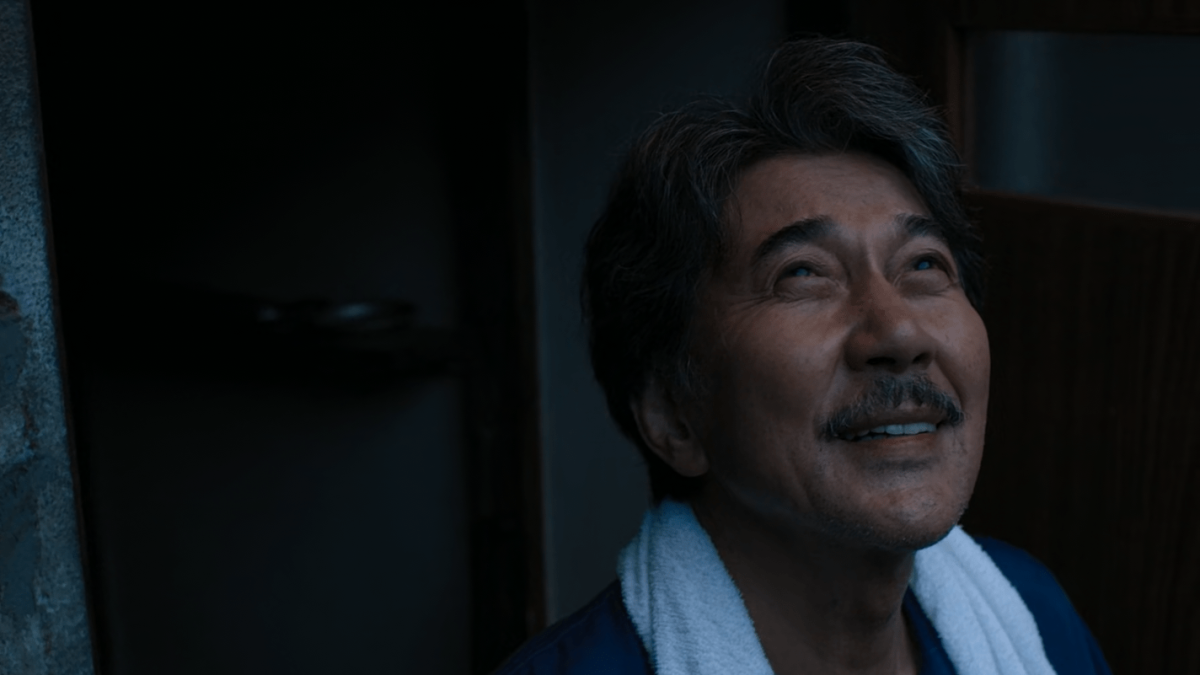
From Wim Wenders’ Perfect Days

This Japanese masterpiece led by Kōji Yakusho as Hirayama-san is the perfect depiction of how we try to define our life as a perfect life in our own ways. The personalities, the characters, their choices, and the life they have is designed, intertwined in the narrative in such subtle ways that the whole movie could be discussed as a philosophy of life and the time will fall short. And even after that you would think that it is just a documentation of a normal life of a public toilet cleaner.

Even though the movie is multifaceted like life and can be discussed in greater depths, I will try to touch on the core and simple idea of the perfection in life in the forthcoming discussion.

The discussion will make more sense if you have watched the movie before, this is not a movie synopsis. Even though there will be spoilers ahead, the movie is all about how it made you feel, rather than what you knew about it. (Which is also why movies/ stories are so important, they make us feel that part in us which we never knew we had already)

The discussion will be driven by the major noticeable events in Hirayama-san’s life. 

What We See From Surface? – A Life of Complete Failure

The (Mundane) Routine and the (most) Disgusting Job

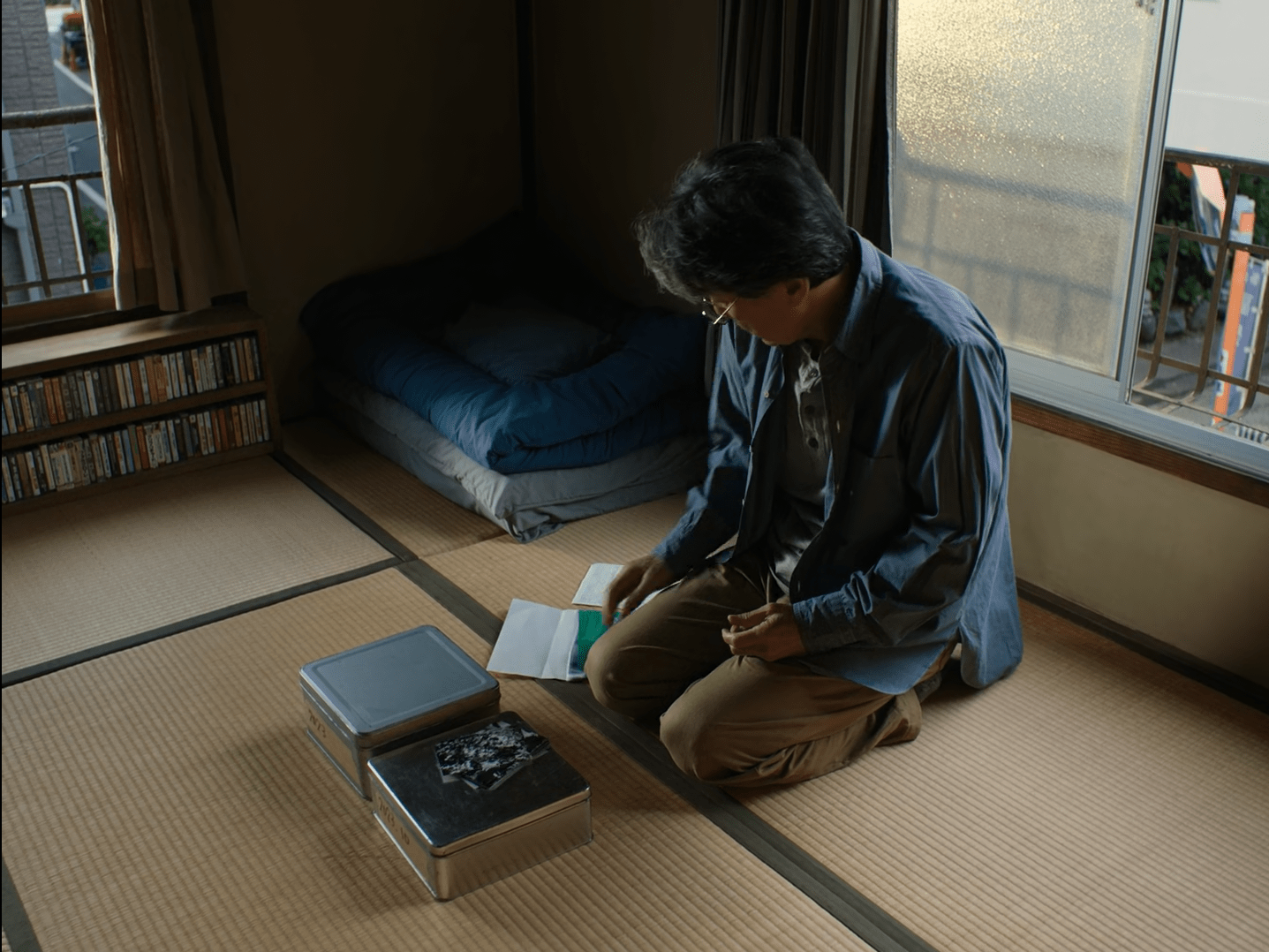
Hirayama-san works as a public toilet cleaner in Tokyo. There is nothing else to describe anything exciting about this job! He travels from location to location to clean the toilets where you will see the interaction between Hirayama-san and the people around him in such ‘workplaces’ as belittling, demeaning. It’s a job that no one appreciates. 

When we understand that Hirayama-san lives alone, you will find this routine more boring, mundane; being a toilet cleaner adds another weirdness to it. It’s a low paying, thankless job where you will never get recognized for the job you do.

There comes a moment when his junior, his subordinate – Takashi resigns from his job without giving any notice and Hirayama-san has to cover all his locations that day. It’s a disgusting low paying job with possible non-rewarding overwork.        

Low on Money

Money-wise Hirayama-san looks like a person with below average necessities and below average job to fulfill them. Even though he is not poor, he is not hopelessly broke; it is just a very basic life lived on basic income. But you will see that his life is just on the edge of poverty the day when he pays his junior – Takashi to go on a date with his love interest – Aya-chan. As Hirayama-san pays Takashi all the amount he has and when his car stops in the middle of the road due to low gas, he has to sell his cassette to get some money to reach home. On the same evening he eats the cup noodles as he has no money. He stays in the low lying, cheap house, the only coffee he drinks is the regular vending machine coffee.

Failed Relationships

Hirayama-san is a loner. There is nothing exciting about his life from the relationships point of view. No wife, no children, no one to take care of him if something goes wrong. There is a moment when we realize that his father suffering from dementia is in nursing home and he never pays him a visit. Hirayama-san also doesn’t go well with his sister – Kieko. There is certain disagreement (probably the toilet cleaning job) between him and his sister which is why his niece – Niko is prohibited to meet him.

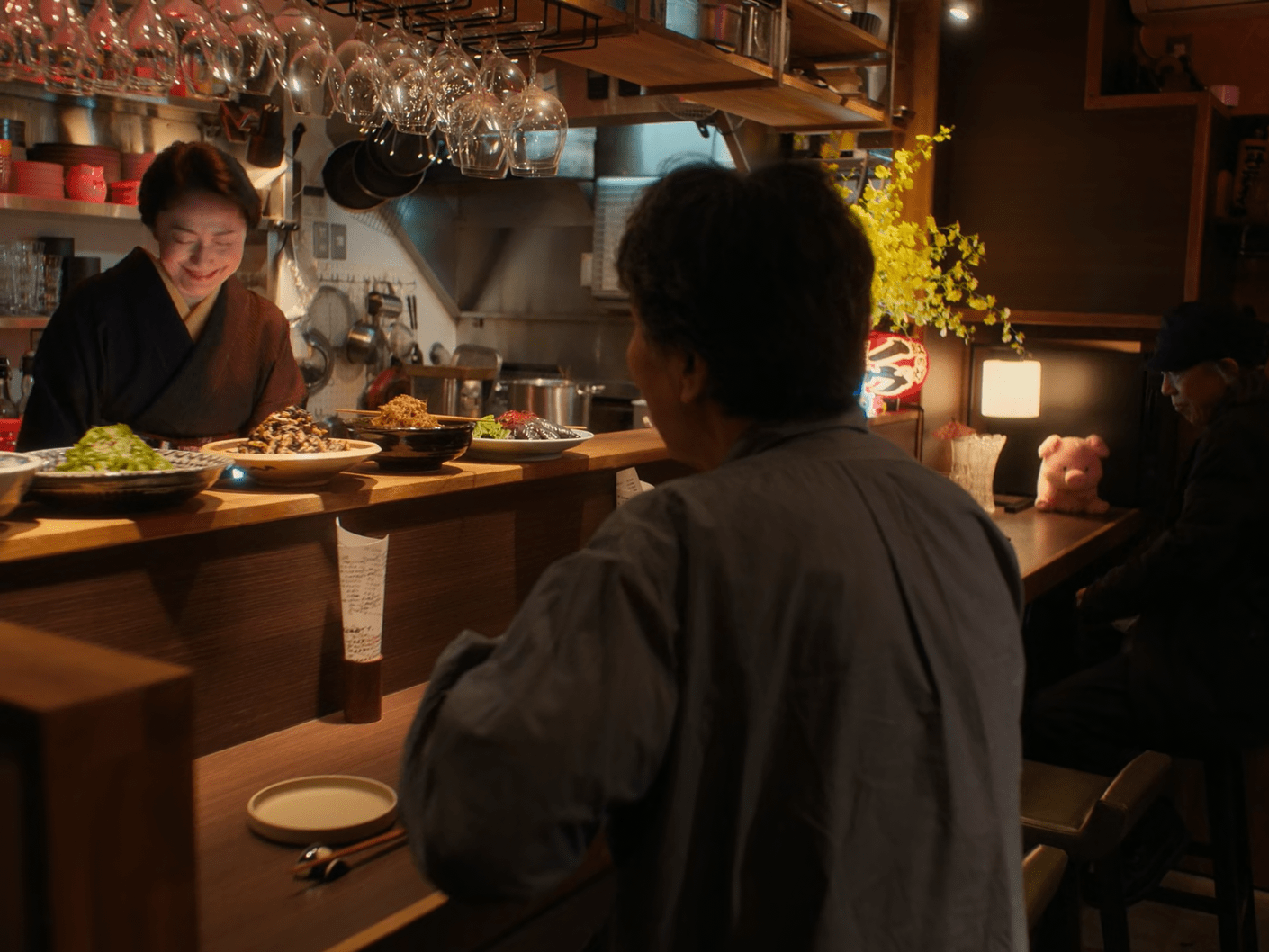
There comes a moment when Hirayama-san sees his (supposedly) love interest – the owner of the restaurant – Mama hugging some man affectionately. Hirayama-san is not shown openly in love with Mama but the interactions between them show that they have some deep connection, deep affection for each other. Hirayama-san’s heart gets broken when he sees that there is already a man in her life. Heartbroken Hirayama-san buys beer and cigarettes that day to numb that pain.

If you go by the standard definition of a perfect life – Hirayama-san’s life is not perfect. It is not even a good life per say.

What is the Reality? – A Life filled with Richness in Every Experience
The Discipline and The Dedication

You will notice that Hirayama-san is a very diligent and disciplined person who cleans the public toilets in Tokyo. Even though he is a toilet cleaner he has a discipline and routine like an army general. Whatever may happen he always sticks to his routine, even on holidays. His van is equipped with every possible cleaning equipment to make sure that he does his job with perfection. There is same level of dedication for every cleaning job he does. He is never ashamed of the job he is doing.

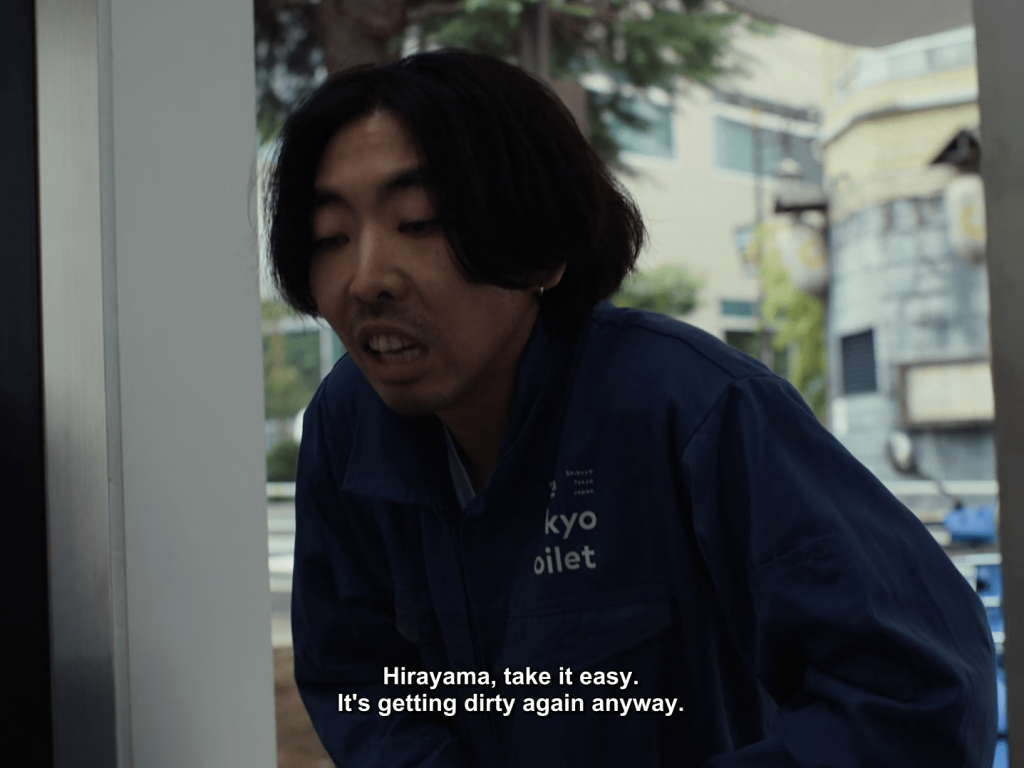
You will appreciate this more when Takashi asks him that even if the toilet is getting cleaned now it will eventually get dirty. You must note that this is the same discipline why Takashi respects Hirayama-san and considers him dependable (although Takashi himself is reluctant to remain in that job)

From Wim Wenders’ Perfect Days

But, imagine if no one cleans the toilet regularly, how dirty will it get. Same is about life. Pardon my analogy of toilet with life but even though seemingly full of randomness our life needs a routine diligence, a routine discipline to take care of our overall health – mental, physical and/or materialistic. These seemingly small, insignificant routines decide our habits and these habits eventually decide who we are – especially when the times are difficult. Our responses to random, unplanned, unfavorable events in life are completely dependent on the how we react to routines. Our habits are the baselines to decide the reaction to unfavorable events.

You must appreciate that even when there are many sad moments in Hirayama-san’s life he always sticks to his routine. This ‘boring’ routine ensures the mental peace that even though many things in life are going wrong there are certain things which have gone perfectly in the given day.

You know what they say, “If you want to change the world, start by making your bed.”

That is why routine is very important psychologically, it is like a subconscious support system to tell our brain that at least some things are going well.   

The Hobbies

Even when Hirayama-san is continuously busy in his toilet cleaning job, he is always in sync with his surroundings. He has that eye of a professional photographer where he is always trying to capture a perfect moment of light and shadows and reflections around him. His job is not preventing him from pursuing his passion.

What this shows is that one must have access to certain intangible experiences which are present all around us to have a healthy living.

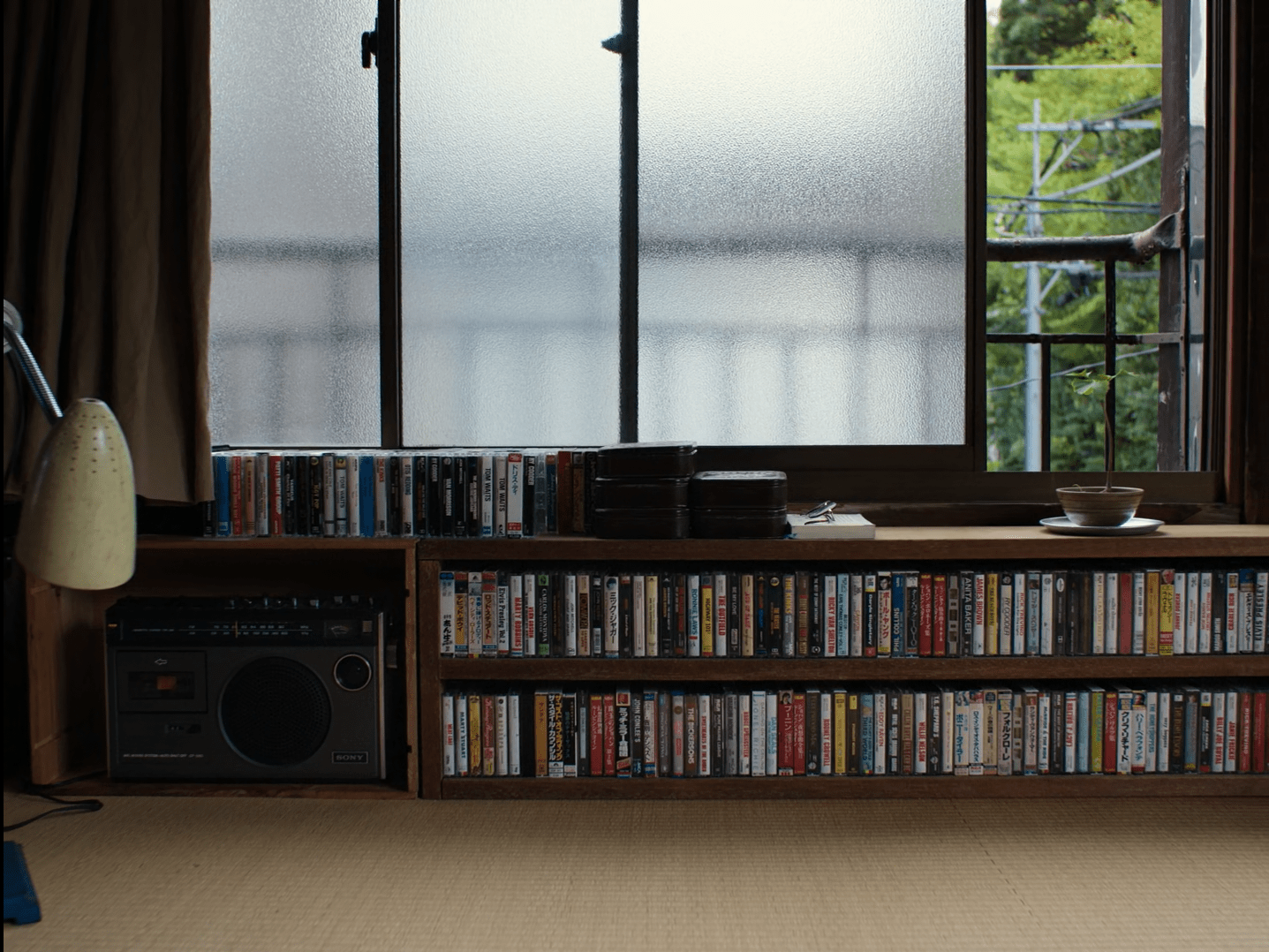
So, an ideal hobby is the activity which is accessible to us in any form to elevate our perspective about the world we live in. If listening to music is your hobby, even when you lose your music player, or you have to lose your cassettes (like when Hirayama-sells his cassette for gas) the music in you cannot be sold, you can still reminisce that tune and hum to it.

Even when you have the cheap, outdated camera you can still appreciate the picturesque beauty of nature and the interplay of things in it with your eyes and creativity.    

Hirayama-san’s cassette collection is not an outdated relic, rather it is shown as a valuable classic item. It is wonderful because our hobbies provide this unfair advantage through their intangible nature to outweigh the tangible, materialistic possession. (it’s like as seemingly nonsensical painting made from paints and canvas worth some hundred bucks becomes invaluable because how it touches that intangible aspect of your life.)

Hobbies thus are a powerful tool to bring real wealth in life – this wealth can also create materialistic advantages if used in proper ways. (Some people turn their passions into a career)

Please note that hobbies are not always meant to bring in some materialistic benefit. In Hirayama-san’s case collecting saplings, watering plants is just for his mental satisfaction, it also shows his caring – nurturing side. Some hobbies, most hobbies are meant to carve out your best version. This best version can take care of everything materialistic and non-materialistic.   

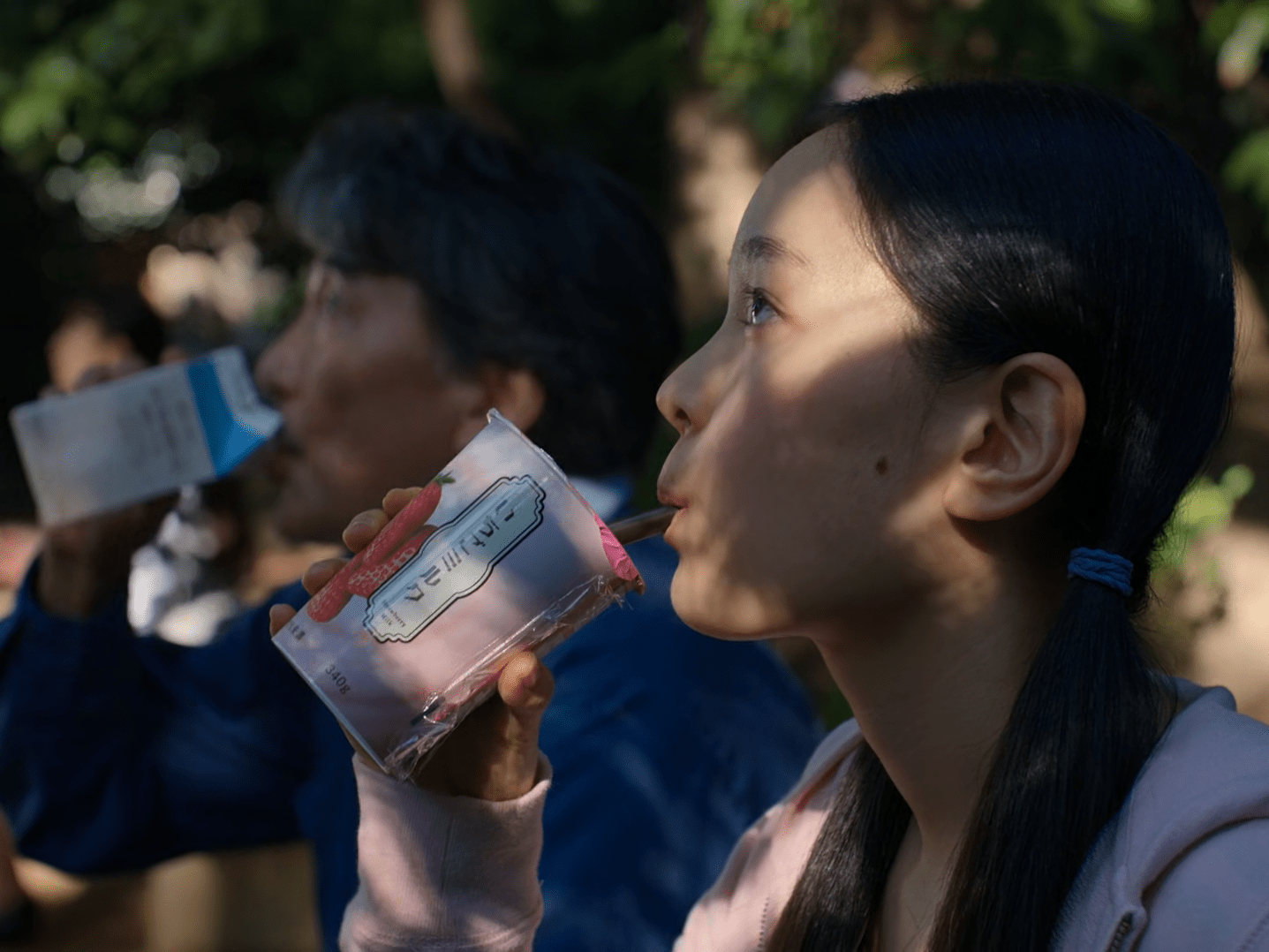
Hobbies also help you to create a deep meaningful relationship with the people from different walks of life. You will see young Aya-chan’s appreciation for Hirayama-san on his taste in music. His niece truly values her uncle for making her aware about photography, reading and music, the restaurant owner Mama appreciates his intelligence for his reading habit.

Hobbies provide an access to the pleasures – priceless pleasures which are difficult to trade with anything that is materialistic in nature. Habits make you passionate about something, anything. We are human beings because we are passionate.

Routines bring in that predictability, certainty and thereby comfort in difficult times whereas hobbies ensure that we are always open to appreciate the beauty in novelty, randomness when our routines become mundane. 

Meaningful Connections – Loneliness vs Solitude

A relationship can be predetermined or could be in our hand. And both are equally important in life.

Even though Hirayama-san does not go well with his sister he knows that their worlds are totally different. It does not become a reason to envy his sister. (His sister is shown having a car with Chauffeur) He also teaches his niece about the closeness of relationships despite having differences very well.

Hirayama-san is depicted as lonely person but there are many relationships which are an integral part of his life. The restaurant owner – Mama who is always appreciating him for his intellectual ways despite knowing that he is a toilet cleaner, his deep connection with his niece who hasn’t met him for many years (he almost finds it difficult to recognize her when they first meet)

You must appreciate that despite being a complete introvert, a lonesome person – Hirayama is very effective in establishing immediate and intimate connections with unknown people. Being an introvert does not mean that the person is shy, it just means that they are highly selective and they mean it when they do or say it. (hence, this is one of the most consistent depiction of introverts in movies.)

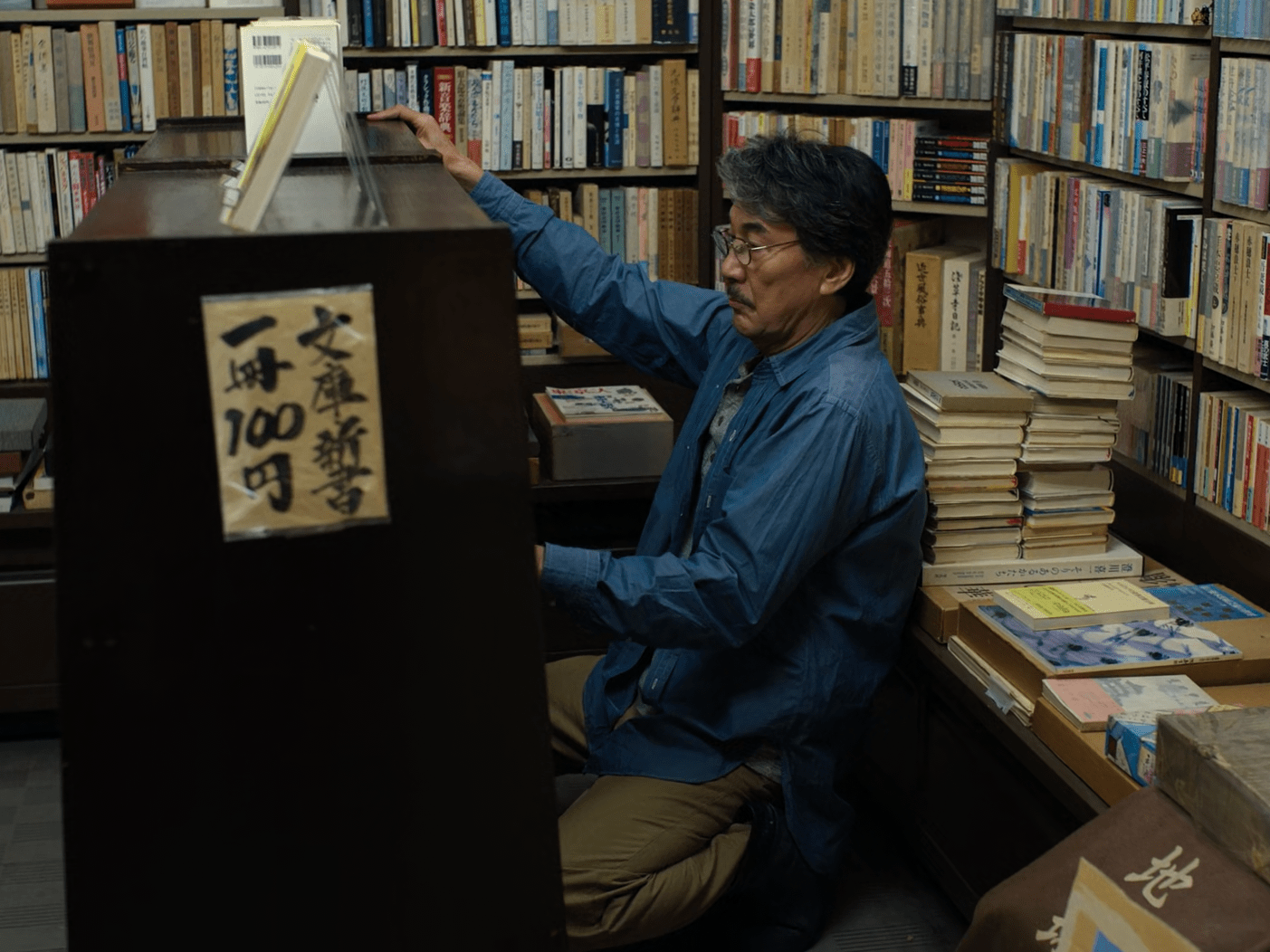
You will see Hirayama-san immediately comforting the lost boy in garden (even though the boy’s mom treats him badly indirectly), playing tic-tac-toe with some unknown person, recognizing the homeless person whenever he appears, having good relations with the caretaker of the garden where his has his routine work time lunch, the bookshop lady appreciating him for his taste while selecting the books, he is also able to bring calmness to the cancer diagnosed Tomoyama – the ex-husband of Mama –  the restaurant lady.

This shows that you can remain as a single existent person and still you won’t miss life. You will not miss life because you are at peace with who you are and what you want to do with your life, otherwise this same single existent person is engulfed into loneliness. 

Hints of Stoicism

There are many instances in the character of Hirayama-san where you will find the principles of stoicism. Stoicism appreciates the order of nature and not resisting that order. One must be flexible to appreciate the ebb and the flow of the life which is the core of stoicism. If it is in the nature of the given thing, it will eventually happen, how you respond to such things is the only thing in your control.

Conclusion

As the life is multifaceted so is the interpretation of the movie perfect days, but I will try to highlight certain important takeaways.

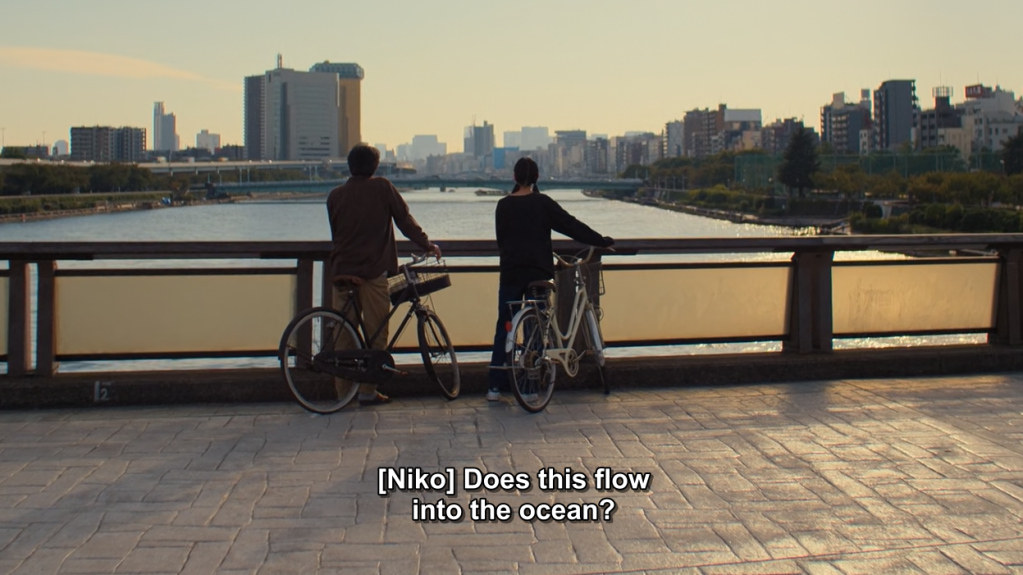
A River will eventually end into the vast sea, but that doesn’t stop it from flowing

From Wim Wenders’ Perfect Days

When Hirayama-san is talking to Niko about the difference in his and his sister’s world, he gives Niko a life lesson. This simple message has become the popular highlight of the movies all over.

Next time is next time. Now is now.

But this statement comes from the following discussion where Niko is trying to find her place in the world of her uncle and her mother.

The world is made up of many worlds. Some are connected some are not.

And the analogy of river and the sea/ocean is used to justify this scene.

So, even though our lives, our worlds are sometimes connected and sometimes not they are eventually meant to end into the vastness of the overall one existence thereby losing their own identity. But that should also not bring in the fear for the end of our distinct existence. Because even when the destiny of the river is to meet the ocean in the end that does not stop it from flowing.

That is exactly why Hirayama-san tells Niko that you will eventually find the world where you belong and maybe you will have you own isolated world but that should not remain your concern, your concern should be – “are you living in the current moment?” that is where you belong.  

If you keep on justifying your life based on how and where it started from and how and where it will end you will miss many precious things, unnoticed and underrated things, moments, people in current reality which would have made your life actually beautiful.  

Instead of fearing for the end in the future, let us first appreciate the current moment.

One Suffering is equal to many sufferings and many sufferings combined is one suffering

The discussions that happened between the ex-husband of Mama called Tomoyama and Hirayama-san is the most unnoticed message of the movie I would say. Actually, the movie is filled with so many messages that this is normal.

Tomoyama tells Hirayama that he regrets that the terminal cancer he has will prohibit him to live the life to the fullest. There were so many things Tomoyama wanted to know but won’t be able to know only because of this cancer. He also feels sorry that he left Mama and come to realize her worth only when he is diagnosed with terminal cancer. It’s like only when the life is getting snatched away from us is then we start appreciating life of others especially the people we loved.

The doubt Tomoyama presents to Hirayama hence is very symbolic here.

Tomoyama - Shadows...
Do they get darker when they overlap?
From Wim Wenders’ Perfect Days

I think the gist of whole narrative of the movie lies in this moment, where they both find out that even when the shadows overlap the darkness remains the same!

Do you see what is happening here? It is like ‘even the darkest clouds have silver lining’ – type message that is portrayed here.

The shadows represent the suffering in our life.

You will feel sad when you have a problem in your life, you will be sad on the same level when you are having multiple sufferings/ problems. I have a proof for this.

You cry on one problem as the biggest problem of your life and then you see another person having practically bigger problem than yours which pushes you to think that yours was nothing given to the suffering that person has right now. It is all about how we define abundance, how we define satisfaction where the life itself is infinitely abundant like the light.  Any single shadow of suffering or many shadows of suffering will create same darkness when they overlap but the light of life is far brighter than that.

And where there is light of life there will be shadows of suffering.  

So, this works both ways,

When you have one suffering it will affect only this current moment. If you remain in this moment, you can certainly work over it. 

And when there are many sufferings combined together, they too can affect only this current moment. If you act on the current moment then only can you pass to the next one. It’s one moment at a time. That’s how you live. There will always be many problems, shadows while we live but to live is the highest privilege, the light of our existence.

This is why the movie ends with the term:

KOMOREBI – the shimmering of light and shadows that is created by the leaves swaying in the wind. It only exists once, at that moment.

From Wim Wenders’ Perfect Days

Whatever big problem/suffering, whatever big victory/ happiness/ fulfillment/ satisfaction there is, they both exist only in that moment. You just have to pass through them all the time and appreciate the life granted to you.

This too shall pass.

Nobody can steal from you how you experience life

When we say that many sufferings and one suffering actually impact our lives similarly, we are allowing infinite possibilities, infinite perspectives to take action which are far more positive than these tiny, petty problems.

The problems seem big than the infinite possibilities because we try to limit our lives to remain in our defined ways, our own set standards which we create by comparing ours with the lives of others.

We try to fit the aspects of life on some measuring scales defined by this materialistic society where many beautiful dimensions of life are lost forever.

That is why you must try to create the places, moments, people, habits of your own choices which are not soiled, stained by the comparisons with other lives. Try to connect you moments with something intangible using your hobbies, routines, relationships. You will lose things associated with them but you will never lose how they made you feel. You can share that, amplify that with others but nobody can steal it from you, because you were the originator of that experience.      

Any type of Life and the consciousness of it being granted to us is a privilege

We are always trying to justify our pain as the bigger pain than others and glorify our own best experiences over the experiences of the others but we keep on forgetting that it is the same life flowing through all of us.

A perfect life is a life of appreciation for the privilege of getting a passage through life and its awareness instead of valuing the materialistic privileges like money, fame, career, relationships, lifestyles, possessions.

The life is a spectrum not a side.

We will always have many reasons to cry about our lives over other people’s seemingly better lives but believe me only one reason is enough to justify the grandeur of the life that is granted to you and through you. The so-called imperfections assigned by us to our own life look really petty in front of the infinite possibilities that the same life has to offer.

That is exactly why, appreciation of what good life has offered and the courage to deal with what bad there is in the life is important. Appreciating the imperfections of life is the perfect life. You live it through moments one by one thereby creating your perfect days.   

Cover image from Wim Wenders’ Perfect Days