The Body Snatcher – Weighing Intent Against Action

Robert Louis Stevenson is known for his world-famous novels ‘Treasure Island’ and ‘Strange case of Dr Jekyll and Mr Hyde’ . His short story called “The Body Snatcher” throws light on the mentality and evolution of the dangerous psychopaths. The false sense of greater good, the ability to ‘suppress destructive thoughts’, ‘destructive actions’ to justify superiority keeps driving certain types of criminals to cross the limits of humanity, ethics, morality. It shows that even though the consequences of wrong actions may not get punished due to the limitations of the laws of the respective times, the punishment of wrong thought is almost instant which is the degradation of the person’s psyche through ‘guilt’ and ‘fear’ – and most of the time it goes unnoticed and builds over time resulting in even more grave dangerous acts. It shows how thought and action are equally important in the overall personality. The wrong act may not get punished but the wrong thought has already punished the mind.

Robert Louis Stevenson’s famous short story “The Body Snatcher”

The difficulty of literature is not to write, but to write what you mean; not to affect your reader, but to affect him precisely as you wish.

Robert Louis Stevenson

In storytelling, especially in visual storytelling media, there is an expression – “Show! Don’t tell.” It is very impactful because it makes the viewers to put their minds consciously in the narrative thereby it increases their engagement in the story; this makes them to consider the narrative as their own story. The emotional impact is very high. It is furthermore potent if the story is horror or thriller. More the viewers feel engaged, more scared they will be.

But there are some stories especially, some unconventional crime stories where there is no point of relatability because not every one of us is a criminal, not every mind thinks the way given psychopath, criminal is thinking in the story. 

Now the impact of such stories is solely dependent on how they are written, expressed. The mastermind depicting, writing such stories knows that being a human we have all the tendencies of whatever good there is in the world and whatever bad there is in the world. It is just matter of which of those we give chance to flourish and which of those we suppress to make our ultimate personality. The master author uses that fine thread of slight ‘unnatural’ tendencies we have suppressed to make us simulate the real horrors the villains of his story would commit. These stories create impact and relatability through our urge to simulate the events to understand the end truth of the narrative. Inspiration from real events adds further more spice in such stories. (That is exactly why “Based on real incidents’ has remained an impactful (but still a cliché) opening for any horror story. We know that it’s a cliché but it creates a space in our minds that there could be a possibility of this happening in real life)  

R L Stevenson wrote one such short story which feels like a normal depiction of a crime but in the very last sentences the horror of the story unfolds thereby leaving the readers shocked and scared. We will deep dive into this famous story written by Robert Louis Stevenson.

The Body Snatcher – Synopsis

This is a story of two young men who studied in the school of medicine in Edinburgh in early 1800s.

Macfarlane is now a Doctor and Fettes – old drunken but literate man was his companion in the past academic times. The main story starts unfolding as Dr. Macfarlane and Fettes see each other after long time unexpectedly which revives the memories of their wrongdoings in their shared past at the school of medicine.

Being a good and sincere lad, Mr. Fettes gets the job of maintaining the dissecting room held by Mr. K_, the teacher of anatomy. Macfarlane was assistant to Mr. K_. So, Fettes and Macfarlane were responsible for ensuring the smooth demonstrations of anatomy to the class by Mr. K_. In order to ensure the duty and credibility, Fettes and Macfarlane had crossed the limits in the ways they would source such dead bodies. There comes a day when Fettes is shocked to find out that the dead body he received is of Jane Galbraith – a lady he met in a good health just a day before. He tries to bring sanity in this matter by asking Macfarlane but Macfarlane rejects that idea of identifying and informing Police about the possible murder because that suspicion opens the possibility that all the dead-bodies they receive for dissection in the class of anatomy are results of crimes thereby making them immediate criminals.

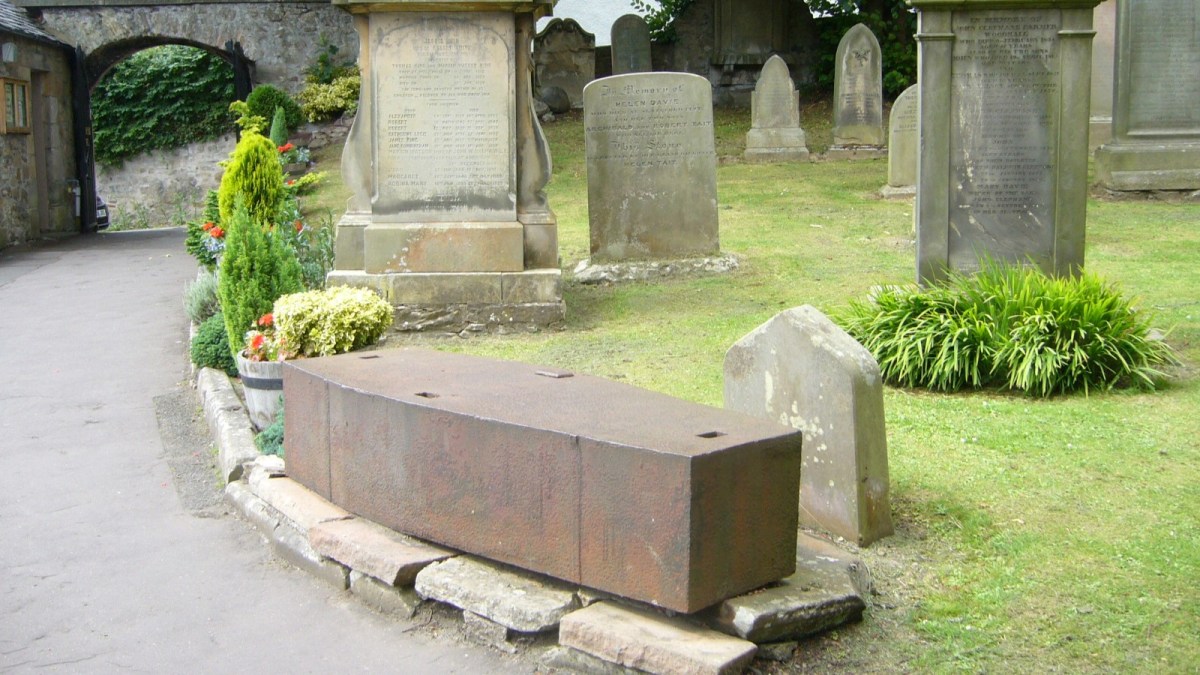
Here we come to know that whenever there is shortage of dead bodies, Fettes and Macfarlane went to dig out the graves in the graveyards around Edinburgh.

One day Fettes discovers that Macfarlane has one acquaintance called Gray who has some sort of control over the behaviour of Macfarlane as if Gray knew something really dark about Macfarlane and revealing it would jeopardize Macfarlane’s reputation. Gray uses this trick of black-mailing to have a feast on Macfarlane’s money even though Macfarlane was not into it.

Upon the passing of night, Fettes understands that Macfarlane took care of the Gray Problem when he sees the dead body of Gray as a new subject for the dissection class. Macfarlane himself delivers that body to Fettes and it is now clear that he himself murdered him. But there is no chance to inform authorities and bring more trouble for Fettes. Macfarlane is not bothered by all this and rather feels free as the axe of Gray no more exists on his neck. He ensures Fettes that its just a matter of time that these dreadful memories will fade away and they both will be on their way as if nothing happened.

Fettes feels the same but both Macfarlane and Fettes have the event of Gray etched on the back of their minds as they now consciously avoid any direct or indirect conversations leading to Gray.

One day due to the shortage of subjects for dissection they go on the ‘resurrection’ hunt to a graveyard to dig out a dead body of an old farmer lady. They take a halt before going on to the main task of ‘resurrection’. They are caught in rain and darkness when they start to remove the dead body of the lady from the grave. They load that body in their small, congested cart in darkness. The body lies partly on their shoulders, is bothering them and is shifting continuously due to the uneven roads.

The uneasy dark and rainy environment, the dogs following the cart makes Macfarlane uneasy as if someone, something unnatural is watching them. So, Macfarlane asks Fettes to light the lamp so that they can at least check the dead body and keep it, adjust it properly in the cart so that they would continue the journey. Upon lighting the lamp both Macfarlane and Fettes are shocked to discover that the dead body they retrieved from the grave of the old lady is a dead body of Gray – a dissected dead body of Gray.

Inspiration From Real Incident

William Hare (left) and William Burke (right)

Robert Louis Stevenson’s short story “The Body Snatcher” was published in December 1884 and was based on infamous and real “Burke and Hare Murders” in 1828. Burke and Hare were owners of a lodging facility. Burke and Hare committed 16 murders to supply dead bodies in exchange of money to Dr. Knox who used them for dissections. This event led Dr. Knox to lose his credibility and fame. Dr. Robert Knox was a famous anatomist of his time. He was not convicted because he was not directly involved in the dealings of the dead bodies from Burke and Hare. Burke was hanged in public and Hare got immunity because he supported the state’s evidences and testified against Burke.   

The way in which R L Stevenson knitted the story is what made the story interesting. He calls the anatomist doctor Mr. K_ when the readers had an informed notion of Burke and Hare Murders and Dr. Knox in those times. So, it makes the readers to find out themselves that mystery around “Mr. K_”. Mr. K_ of the story is no other than Dr. Knox of Edinburgh.  

Psychopathic Tendencies – How Criminals Justify Their Crimes

For any average person, committing single murder is a huge, seemingly unnatural, inhumane and in the end an illegal act to fully commit. The consequences are dangerous. Then how come Burke and Hare committed 16 repetitions of this crime? They were just some small business owners.

In similar sense, Mr. Fettes and Mr. Macfarlane were just students of medicine and were doing their duties to ensure the supply of subjects for dissections. What made them to go on the streak of multiple illegal activities in the story? They were just doing their due diligence to Mr. K_.

Upon looking at the depths of the investigation of Burke and Hare Murder Case we will find that the first time they sold a dead body was for totally different reason. One of their lodgers died of old age while leaving a debt of 4 Sterling Pounds. Burke and Hare decided to sell the dead body to settle the debt. Note that dead bodies in those times were scarce for dissection and demonstration. They sold the body to Dr. Knox’s Private Anatomy School. Professor Doctor was not directly involved in the dealing. Burke and Hare received 7 Sterling Pounds for the body.

From hereon they decided to take the control of people’s lives for such beneficial business of dead bodies and started murdering the people who lodged in their facility. They killed 16 people in this way to deal for money in exchange of dead bodies. The careless murder they committed was to kill a beggar with clubfoot and his dead body was easily identified by a student due to this disability which made him to limp. Knox is said to make that body unidentifiable by removing the head and feet.

They had differences in their partnership which made them to split these acts for themselves. During an attempt to forcefully shift the lodgers to Hare’s establishment, Burke killed a lady and the lodgers who were shifting found the body while they returned to retrieve their belongings from Bare’s establishment. This was reported to Police but the dead body was already sold.

Looking at these events you will see that it is the rejection of morality and false sense of greater good and self-betterment which drives the criminal to commit the crime again and again. Burke and Hare got involved in these acts for the monetary benefits where it was easy to bypass the system and provisions like Dr. Knox’s anatomy demonstrations. Dr. Knox was driven to improve his credibility by flaunting his skills and demonstrations of dissections in the medical community.

R L Stevenson took this fine thread of reality to create Mr. Fettes and Mr. Macfarlane in his story. We will see that Mr. Fettes is shocked when he identifies a dead body of the lady he just met, that too in good health. Mr. Fettes had raised concern to Macfarlane but as Macfarlane was experienced and conditioned knowing that dead bodies once dissected were beyond any identification and legal jurisdiction. Actually, being a student of medicine, Macfarlane was expected to have a sense of the importance of life for any human being. The false sense that this will not get discovered by anyone practically and all of this was being done to maintain the reputation of his teacher thereby improving his credibility created a false sense of greater good in Macfarlane.

There is a section in this story where Macfarlane expresses how he feels about all these matters of dead bodies and Gray’s murder. He expresses following to Fettes in the story –  

“The great thing is not to be afraid. Now, between you and me, I don’t want to hang-that’s practical; but for all cant, Macfarlane, I was born with a contempt. Hell, God, Devil, right, wrong, sin, crime, and all the old gallery of curiosities- they may frighten boys, but men of the world, like you and me, despise them. Here’s to the memory of Gray!”    

The way he says all this shows that his mind has developed a false sense of greatness to justify his wrong-doings. Now he wants to prove his manliness. It’s like a defense mechanism to cover all the guilt which comes from committing such crimes. The criminal considers the motivations behind his criminal acts are way superior than the moral weight of what is right and what is wrong. (The word ‘CANT’ use in expression “for all cant” means a criminal act, deceitful act, falsehood. Macfarlane very well knew that what he was doing was a crime.)

In case of Burke and Hare it started with settling the debt for ensuring proper monetary gains for stable business of lodging. Then it snowballed into series of murders because they were never caught in action and had a way to come out of the murders. They created that ‘ecosystem’.

Same ecosystem can be seen in this story.

What could have actually made difference is the sense of reality and integrity. Integrity is the behavior which we carry when no one is watching. Fettes had chance to expose all this system when he discovered the young Lady’s dead body. But only because he felt that this action came with lot of difficult consequences and impossible to favor him in the end, he keeps mum.

Fettes found that exposing Macfarlane and Mr. K_ and getting them punishment is the most impractical and impossible event – the inevitable and that is where he made his first mistake. He went with the flow, the wrong one.  

The same would be the case for Burke and Hare. They could have asked authorities for the settlement of the debt from the old dead lodger. But, considering it a tedious route they considered the ill- route to sell it.

However difficult it may seem; impractical it may seem there is always a right way to do right things. The environment in which you are deciding your action is also playing a huge role in your choices. First helplessness shows you the path, then guilt follows and in order to mask that guilt the person creates a sense of greatness which demands sacrifices. This is real and constant in every generation of humanity. Most of the times right things are the toughest one to act on and accept.   

Stevenson beautifully brought these human tendencies in his story which go hand in hand with the reality we live even today.
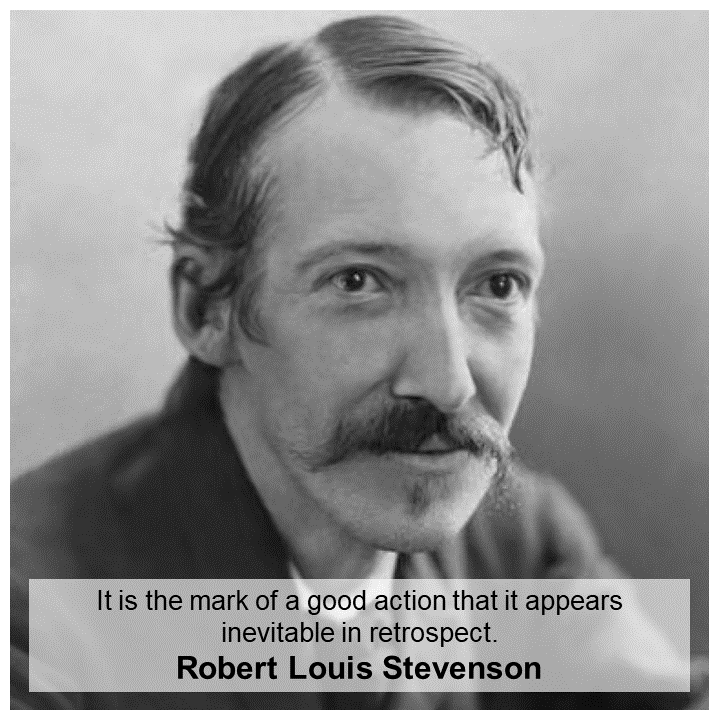
The Ending Of The Story – Real Or Supernatural?

What hangs people…is the unfortunate circumstance of guilt.

Robert Louis Stevenson

Many readers argue that the ending is supernatural and spooky.  Robert Louis Stevenson in a masterful way maintains the realism of the story till the end. And in the last few closing sentences he mentions dead and dissected body of Gray which was completely destroyed many days ago in the reality of Fettes and Macfarlane. It is practically impossible for a body completely dissected to show itself in deep grave at completely different location. So that body definitely was not of dead Gray.

There are evidences to support this. Before going to the ‘resurrection’ job, Fettes and Macfarlane had stay in Fisher’s Tryst where they had drinks. So, it’s pretty much possible that whatever happened was under the influence of alcohol.

There is one more doubt that if it was real then at least one of them would have noticed the reality of the dead body. How can two men would have a shared delusion? A shared delusion can only be explained by a supernatural intervention.

The justification to opt out shared delusion is the shared guilt Fettes and Macfarlane had. It is a human tendency to make sense out of bunch of things which don’t make sense collectively when conditions are hostile. This sense is heightened when one is in hyperalert state, when one is in full fight or flight mode. Deep down Macfarlane knew the acts he is performing. The surrounding events just fuelled this sense of guilt and Stevenson beautifully created this environment in the minds of the readers.

You will notice that Macfarlane is completely unsettled and repulsive of minor things happening to him once they load the dead body. He hates the jumps that the body makes while going on an uneven track, he hates that ice-cold sackcloth flapping on his face, dogs following the cart on the road is unsettling to him (in reality we all know dogs would follow every vehicle going through their territory, especially in night), he also feels that the body has grown in shape (how would he know this if there was not enough light, as the lamp was not working?).

In this exact moment Stevenson injects this sentence for us readers which is a money shot –

“…and it grew and grew upon his mind that some unnatural miracle had been accomplished, that some nameless change had befallen the dead body, and that it was in fear of their unholy burden that the dogs were howling”

“The unholy burden” they both were carrying was the guilt they had suppressed long ago and not acted on it in rightful manner.    

This guilt and intoxication are the main reasons behind the spooky conclusion of the story.

What Should Be Punished – The Action Or The Intent?

The Body Snatcher as a story and even the reality of Burke and Hare crime to which it is associated poses a very interesting question. What are the limits of judicial system, law and order?  

As this statement from Kant goes, in order to be called a criminal in the eyes of the public, one must be seen to perform the crime or the evidences should support so. Thus ‘Law’ becomes more of a sociological term – ‘to arrest the degradation of human as a society’. On the other hand, Kant beautifully highlighted the unitary role of a person in the society. Simple logic says how a society is made of many ‘individuals’ coming together to interact for mutual benefit. Kant consciously asks for preservation of rights of others while achieving benefit otherwise society collapses (what is beneficial for one will not necessarily always be beneficial to others.) Which is why ethics prevent the degradation of the person on individual level. That is exactly where morality and integrity become more influential.    

So, even though our generalized and biased, conditioned thinking makes us to weigh the wrong acts heavier than just their thinking about doing them, in the end they both weigh the same. Sometimes, even though these thoughts don’t get in the fruition of realised actions, they keep on affecting minor, seemingly insignificant decisions we make which ultimately create our personality and our psyche. Act of crime and thought of committing the same crime are same.

Friedrich Nietzsche posed this same dilemma of “what weighs heavy – action or intent?” in his book “Beyond Good and Evil”. I have discussed that in depth in the section “The Freedom of Actions” in my other blog post “The Free Spirit – Beyond Good and Evil “.

The gist of the things is that we will be able to appreciate the crime of ill-thinking when the stakes are really high as in any decision would have grave dangerous scale of destruction. If we will wait for the actions to be presented as wrong while we already know that it leads to wrong then even the thought of doing that action was wrong in the first place, even before the action’s ends were realized.

The Real Punishment – Where And How Does It Happen?

So, now that I have established that even the thought of doing wrong action is a crime then, one would definitely say that I must be a fool.  Every one of us is always thinking of such ideas all the time – consciously and unconsciously. (Not of murdering someone obviously. Just recall the last time you cursed someone because they made your life miserable, or the thought that why bad things always happen with good people – especially ME!)

The answer is “It is really easy to fool our mind”. This is also where the core of the fiction in Robert Louis Stevenson’s short story The Body Snatcher and the reality of ‘Burke and hare Crime’ is overlapping.

Burke and Hare thought that their crimes were justified because of the profits of their business. Fettes and Macfarlane thought that their acts were justified for their survival and reputation.

Deep down they were completely engulfed in the guilt of their wrongdoings. So, if we follow the before-explained thought of Immanuel Kant, we will see that real actions from law will ensure realistic punishment but the punishment of the mind is instant, the guilt is injected immediately. This guilt if is “real”, it will immediately start eroding your personality and psyche. Which will eventually lead to unnatural events and acts of crime in real world.

I am saying the feeling of guilt to be “real”, because (again) it is really easy to fool our mind. One has to train mind to distinguish the difference between impulses, responses and their encouragement or suppression. One will realize that whenever there is suppression of wrong thought like guilt in this case, it leads to the defense mechanism – creating a cover up with false sense of greater good or the false security of not getting caught in action, on not having enough evidences. Even though they are not caught in society, the guilt has already passed its sentence on their personality, their self-image and psyche. Now such persons have just accepted what they have become. (This is how a psychopath would start their journey to justify all their crimes).  

I am posing this also from the other perspective of ‘false-guilt’. Sometimes we consider ourselves guilty when in reality we were not responsible for those events. This false guilt will start taking even the good things you have.

The only way I see to handle any wrong thought is to not let it grow out of its own boundary of creation, not to feed it further. Not to mask it or suppress it but just let it remain there. The overgrowth and flourishing of good thoughts will eventually diminish its influence. It’s natural to have right or wrong thoughts for given stimulus. Response, reaction lies in our territory. You must understand that even the act of suppression demands extra efforts which requires extra involvement, this extra involvement is unconsciously feeding that wrong thought, thus suppression on mental level is not suppression rather it’s a feed. Which exactly what we keep on missing when judging between an action and its mere thought.    

Egg Or Chicken? – Action Or Thought?

You will appreciate the dilemma created due the practical limitations of the world we live in. As it is really difficult to enter immediately into the mentality, psyche of the others – we have to always go by the external attributes of everyone around us to measure the rightness or wrongness. That is why act imposing guilt must also be supported by the thought of guilt. This is very important when the psyche, the mind of person is not normal or completely evolved. So, one may think that the importance of ill-intent is less important, it also plays equally important role in judiciary decisions.

In court, the thing we punish is the criminal intention. -the mens rea, the guilty mind. There is an ancient rule: actus non facit reum nisi mens sit rea – “the act does not create guilt unless the mind is also guilty.” That is why we do not convict children, drunks, and schizophrenics: they are incapable of deciding to commit their crimes with a true understanding of the significance of their actions. Free will is as important to the law as it is to religion or any other code of morality.

William Landay, Defending Jacob

Conclusion

Robert Louis Stevenson is known for his world-famous novels Treasure Island and Strange case of Dr Jekyll and Mr Hyde. The short story called “The Body Snatcher” throws light on the mentality and evolution of the dangerous psychopaths. The false sense of greater good, the ability to ‘suppress destructive thoughts’, ‘destructive actions’ to justify superiority keeps driving certain types of criminals to cross the limits of humanity, ethics, morality. It shows that even though the consequences of wrong actions may not get punished due to the limitations of the laws of the respective times, the punishment of wrong thought is almost instant which is the degradation of the psyche through ‘guilt’ and ‘fear’ – and most of the time it goes unnoticed and build over time resulting in even more grave dangerous acts. It shows how thought and action are equally important in the overall personality of a person. The wrong act may not get punished but the wrong thought has already punished the mind.    

References-

The Utility of Human Life and Morality

Why doesn’t Batman kill all his villains once for all? Why the sentence passed by judicial systems in certain heinous and extraordinary crimes feel unjust for the pain victim went through? How one can tell that given person was right or wrong when he/she had no intent of doing it? Can you just look at the end consequences of the actions and decide right or wrong for such scenes? Jeremy Bentham’s philosophy of Utilitarianism tried to answer some of these questions but it revealed certain flaws in our ways of judgement. Even though hedonism and utilitarian philosophy create an objective model of morality, they fail to address the subjective and human aspect of any moral discussion. It reveals that the purpose of living is not mere happiness but self-improvement thereby mutual and overall improvement.

How to judge morality and its impact on human life?

The Moral Dilemma

A healthy sense of good and bad makes a society livable. There are some special, rare events that happen in the society we live which challenge our idea of what is good and what is bad. There are uncountable offenses and also in varying types which create problem of who should actually be punished and what should be the punishment.

An eye for an eye will make the whole world blind.

Mahatma Gandhi

If this is really the case, the law and order should punish the victim in such a way that it prohibits the future perpetrators to not do such crimes again. But again, as this above mentioned quote goes if the punishment given for the crime is equally dangerous then what exactly are we trying to establish through such punishment?

It’s like that scenario where murdering a murderer creates a new murderer so the net number of murderers in the society remain the same. An Italian philosopher called Cesare Bonesana di Beccaria had given a thought on this. In his book ‘Of Crimes and Punishments’ he discusses that if the punishments grow on crueler and crueler the net mindset of people also grows crueler. It’s like how water levels itself irrespective of the depths. The baseline of what is right and wrong furthermore what is more wrong and what is more right shifts up. Crueler and crueler crimes reduce the sensibility of people of that society. This could be one reason why people always argue that the judicial system does not provide equivalent punishment as a justice to the victims of certain heinous, exceptional cases of crimes. (Although there are many other factors to make such decisions.)

“In proportion as punishments become crueler, the minds of men, as a fluid rises to the same height with that which surrounds it, grow hardened and insensible; and the force of the passions still continuing, in the space of a hundred years the wheel terrifies no more than formerly the prison. That a punishment may produce the effect required, it is sufficient that the evil it occasions should exceed the good expected from the crime, including in the calculation the certainty of the punishment, and the privation of the expected advantage. All severity beyond this is superfluous, and therefore tyrannical.”

Cesare Beccaria, Of the Mildness of Punishments from ‘Of Crimes and Punishments’

In similar spirit, the relationship between Batman and Joker can be understood. Joker never cares about killing people he will try to stretch the limits of batman in every possible sense where innocent lives are at stake. Batman has one solution to stop all this – to kill the Joker. But with a high moral ground Batman would never kill Joker. What is the motivation behind such character design of Batman. Batman knows that killing Joker would solve the problem once for all. Believe me, this is not just a fictional comic book scenario. The reality that we live in has uncountable such scenarios where exactly same decision dilemmas occur.  

The famous trolley problem also points to somewhat similar moral dilemma. Where should the trolley be directed if one track has single person and another has 5 people tied to the track? Nobody wants blood on their hands.

But the same trolley problem becomes interesting if you start adding additional attributes to the people who are on track.

What if the single person tied to the track is a scientist with the cure for cancer and the track with five people are criminals? Then definitely you would kill the five criminals instead of the single scientist.

Did you notice what change made us to decide faster? The moment we understood the consequences of our actions we had the clarity of what is right and what is wrong. Our moral compass pointed to North the moment we foresaw the consequences of our actions.

The foundation of some of the principles of morality are based on similar ideas. Utilitarianism and Jeremy Bentham’s an English Philosophers ideas have contributed to the ideas of morality for humanity, especially when we are talking about the human society as a whole. The ideas put by Jeremy Bentham also faced severe criticism, we will see those in detail too. But the key intention of my exploration is to understand how we create the meaning of Morality and how subjectivity, objectivity totally change the way we perceive morality. In the end we may reach to rock bottom questioning the morality itself to be nonexistent – and if morality is non-existent then what separates human beings from animals? (I hope to enter in this territory with some optimism, I don’t know where will it end.)

Utilitarianism

As I already explained in the trolley problem that by adding one simple, short part of information shifted our moral compass in (supposedly) proper direction. What did this information add in the dilemma to make it solvable?

The answer is the foresight of consequence. Once you saw the consequence it leads to you got the hold of what is right and what is wrong. You decided one side to be right and other one to be wrong. This foresight of consequence helped you to weigh the ‘right’-ness of your decision.

Utilitarianism is based on the measurement of morals based on the consequences of the actions you take. What is the other side of taking actions? It is ‘the intent’. This is where the fun game begins.

Many philosophers are always fighting over morals based on the intent of the person and the consequences of the actions they take. For example, thinking of murder (pardon my thinking) makes me less of convict than really murdering someone. My thinking has not led to the loss of the person I hate. Utilitarianism thus calls out for the construct of morality based on the actual actions and their consequences; it’s like saying ‘what a man is more about what he does instead of what he thinks’.

Hedonism, Utilitarianism and Jeremy Bentham

Happiness is a very pretty thing to feel, but very dry to talk about.

Jeremy Bentham

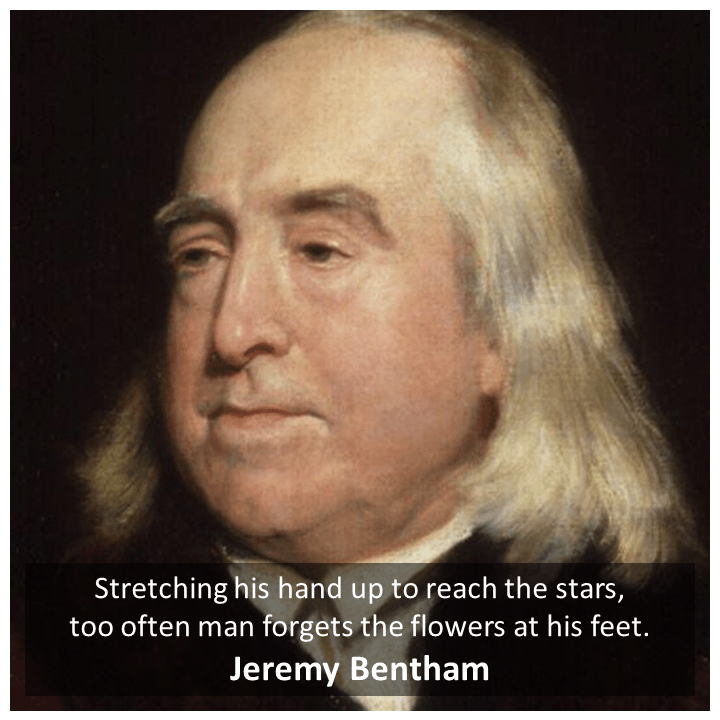
Jeremy Bentham an English philosopher contributed to the utilitarian ideas of morality. He was not well appreciated in his home country due to the misalignment of his ideas of socio-political reforms with the British sovereignty of those times. The French translation of his works on law, governance gave him popularity in Frenchmen. Bentham was one of the people who pushed the political reforms during French revolution.

While reading Joseph Priestly’s Essay on the First Principles of Government, Bentham came across the idea of “greatest happiness for the greatest number” which motivated him to expand the ideas of utilitarianism.

Priestly brought the idea of “Laissez-faire” (‘allow to do’ in French)- a policy of minimum governmental interference in the economic affairs of individuals and society. Joseph Priestly developed his ideas of politics, economics and government based on the ideas created by Adam Smith (Author of the Wealth of Nations – the holy grail of classical Economics).

The Greek philosopher called Epicurus was the supporter, creator of hedonism. Hedonism defines ethics to pleasure or pain. According to hedonism that which gives pleasure is morally good and that which give pain is morally wrong. The idea behind hedonism is the aversion of pain to live an undisturbed life because anyways this all won’t make sense once you are dead. According to Epicurus – fear of death, retribution is pushing people to collect more wealth, more power thereby causing more painful life. The collection of wealth, power is done thinking that they can avert the death but that is not the reality. So, worrying about the death sucks out the pleasure of living the life which itself is equivalent of death.

Non fui, fui, non-sum, non-curo
(“I was not; I was; I am not; I do not care”)

Epicurus

So, epicurean hedonistic morality tries to maximize the pleasure. The other end of this idea is that if everyone tries to maximize their own pleasure (egoistic hedonism) wouldn’t it disturb others?

If I want to listen to a song on loud speaker while bothering my neighbors, what is the moral standpoint here?

The answer is the overall good of the system. So, if you neighbor also wants to listen music loud and overall loud music is good for the group then we are morally right to play loud music. (Just pray that the group has same music interests!)

So, Jeremy Bentham is known to rejuvenate this ancient philosophy of egoistic hedonism through his philosophy of utilitarianism.

The basic idea behind Utilitarianism is to maximize the utility of anything, value of anything. The utility can be increased by doing what is right which can be done by doing what gives more pleasure or by avoiding those things which increase or give pain.

Utility is a property which tends

  1. To produce benefit, advantage, pleasure, good or happiness
  2. To prevent happening of mischief, pain, evil or happiness

So, the right action is the one that produces and/ or maximizes overall happiness. Please understand that the word “overall” is important for Jeremy Bentham’s philosophy of Utilitarianism. Because from selfish point of views, what is pleasurable for one may not be pleasurable for others. (This is also where the certain philosophical problems of Utilitarianism are hiding, save this point for later.)

To solve this bottleneck of clarity, there are two types of pleasure in human life – one is happiness from senses, physical experiences and one is from intellect. The intellectual happiness is higher than the pleasure from senses. So, on personal moral dilemmas these two attributes can solve the problem.

All good on personal level but what about the moral decisions for the group, for society? Here, Bentham solved the moral dilemma by using the idea of “greater good for all”. When we don’t agree on what makes us happy together, making sacrifices in your happiness to make others happy is the solution. (Keep this idea parked in your mind.)

“Nature has placed mankind under the governance of two sovereign masters – pain and pleasure. They govern us in all we do, all we say and all we think.”  

Jeremy Bentham

Felicific Calculus – Measuring happiness

Jeremy Bentham is known as the Issac Newton of the Morality for developing the felicific calculus/ hedonistic calculus. Bentham pointed out the key factors which affect the net happiness and using this factors’ effect as a whole, one can quantify the happiness.

Following are the factors which affect the happiness:

  1. Intensity – how strong is the pleasure from the given action?
  2. Duration – how long does the happiness remain from given action?
  3. Certainty – what is the likelihood of given pleasure to occur?
  4. Propinquity – how soon/ immediate is the occurrence of the pleasure?
  5. Fecundity – what is the possibility that this pleasure will also lead to the newer pleasure(s)?
  6. Purity – what is the change that this pleasure will not bring some opposite sensation?
  7. Extent – how many people are affected?

If one considers these factors and the principle to maximize the communal happiness, most of the social moral dilemmas can be effectively solved.

So, according to this felicific calculus,

  1. Batman should kill the Joker for the greater good of the Gotham
  2. The trolley should go over the group/ person which creates more pain for the society
  3. Baby Hitler should be killed once we get the chance to travel back in time

You must appreciate the clarity which the felicific calculus brings. This clarity is very important for the policymakers, politicians while deciding the fate of the group, state, nation as a whole.

Now a simple question –

If batman keeps on killing the villains, won’t he become the greatest killer of them all? What would differentiate Batman from other villains?

What would happen if you were given false information about the nature of the people tied on track while riding that trolley? Could your wrong decision be undone? If it was the wrong decision then now ‘you’ are morally wrong, with the blood of the innocents.

You would kill baby Hitler only because you have vision that this baby will grow up to be the mass murderer tyrant. The mass murder hasn’t happened yet. So, now you are the killer of a ‘now’ innocent baby.

Maintaining same emotion, now you would appreciate why even for a strong judicial system giving capital punishment for rapists, terrorists is difficult morally. You would solve the problem for now because the act has been already done, the consequences have already happened (which is why moral judgement is effective as it relies on the consequences). Killing the perpetrators or punishing them with equal pain would definitely bring peace of mind using the principles of morality but that also degrades the morality of innocents who fell down from that morality. It is not matter of what one deserves because what bad happened to them, it is about how less human you will become once you perform that act of punishment.

Recall the quote of Beccaria in the early part of my discussion.

Killing joker will create fear among other villains but it also creates chance for the creation of even dangerous villain in future.

Killing baby Hitler doesn’t guarantee prevention of World War and mass murders, as our personalities are the result of our surroundings – another Hitler-like person would have emerged in such given circumstances. (I honestly don’t know if he/she would be worse or less harsh than the original one but you get the point – conditions anyways would have created another cruel person.)

Jumping out of the trolley seems the best way to run away from the pain of murder of other unknown people (joking). The trolley dilemma remains dilemma.

Also, the felicific calculus allows pain for small groups for the betterment/ pleasure of the bigger society. For example, according to this utilitarian idea killing few healthy convicted prisoners to save lives of many innocent people by harvesting the prisoners’ organ is justified. It is for the good in the end.

You see where this goes?

See the level to which any human or a group could go if they start justifying their moral rightness using these ideas. Using these principles any big group can overpower the minorities in morally right way. It is just a matter of time that the felicific calculus principles would get exploited for other “immoral” gains.

That is exactly why many people criticized the felicific calculus saying that a pig laying in the mud for his whole life would be happiest than a human being (Socrates to be specific) if Bentham’s calculus is used to decide morality.

In a crude way, there are two type of Utilitarianism which help to solve the problem to certain extent, but it is not a complete solution:

  1. Act Utilitarianism – to act for the greater good of all
  2. Rule Utilitarianism – to set rules in such way that no one inherently gets the pain or everyone is happy because actions and their consequences are bound by certain set rules in first place now

Happiness is not the ‘only’ and the ultimate goal – the limitations of Jeremy Bentham’s Utilitarian Philosophy

What people were not ‘happy’ with Jeremy Bentham’s felicific calculus was that it made humans more like machines and very objective. People don’t always want happiness for their or the group’s greater good. Exercising daily, reducing fat-sugar maybe painful but that guarantees healthy, illness free long life. Doing drugs isolates the person from pain but it impacts the long-term physical and mental health of the person. Hardships and pain make people to reach their difficult goals which is what is the real and ultimate happiness for them.       

Happiness is not always the goal of life, if one is completely tangled in the pleasures of life and if everyone is having same mentality then in the end no one will be happy, because as a group we all would never agree on what makes us happy; different environments in which we grew, our personal experiences, our upbringing, our motivations prevent us from creating a common definition of happiness.

The subjective factor of pleasure or pain is not present in Bentham’s philosophy of Utilitarianism. Building further upon that, the victim who has suffered from the morally wrong action will only be satisfied when he/she gets justice, not when they are made happier than their perpetrators. (This justice must again not be mechanical and objective like the felicific calculus.)

One more flaw of the Bentham’s utilitarianism is the imbalance between personal scenarios and the communal scenarios. In most cases, it demands personal sacrifice irrespective of their subjective morality for the betterment of the group. (that is exactly how many past cruel dictators have justified their moral correctness on their acts against the minorities.)

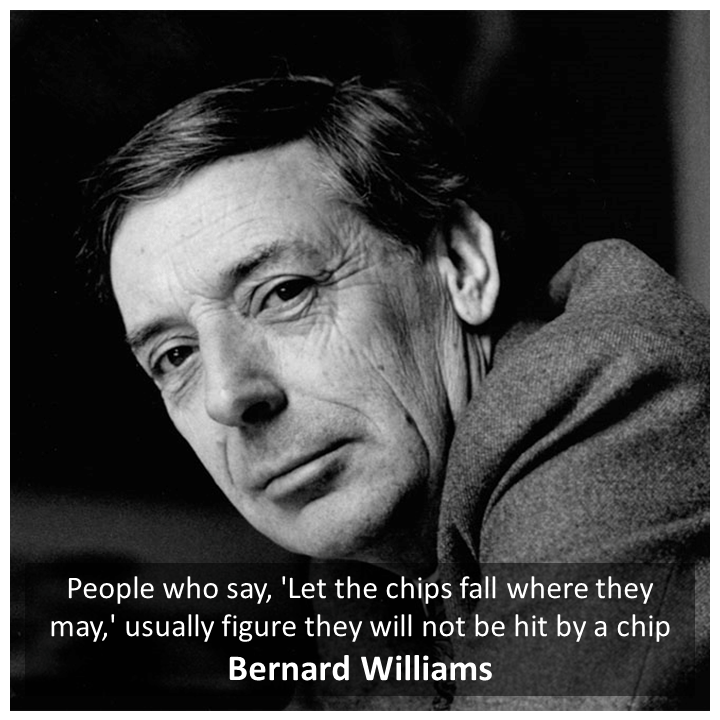
A British philosopher, Bernard Williams presented a thought experiment to highlight such flaw of the Utilitarianism.

In this thought experiment:

A botanist on his South American expedition is ordered by the cruel regime soldiers to kill one of the Indian tribe people. If the botanist fails to kill one Indian the soldiers would execute all of the tribe members.

So, if we implement utilitarian principles, then the botanist should kill one Indian to save the remaining all. That is morally right.

But on the other hand, one must also understand that the botanist has nothing to do with the cruel regime and even with the indigenous tribe members. He is under no moral obligation to do anything. The consequences are in such a way that whatever he will do he will be called morally wrong. Which in the end is wrong.

The utilitarian philosophy neglects this subjectivity and consequentialism while we are deciding morality of anything.

Maybe that is also why even when we have all the rules in place, penal code in place for all types of offenses, similar crimes – we have a judge – a subjective, consequential observer to grant the final justice.

You must understand that the discussion does not want to pose Utilitarianism as completely wrong idea. The intent of this discussion is to understand how to de-clutter a complex moral scenario and how to inject subjectivity in it so that the correct person will get the justice in the end. As we are human beings and not machines, every day brings new subjective scenarios with new subjective moral dilemmas. Direct implementation of utilitarianism may bring in the transparency in the moral puzzle but it is at the expense of oversimplification and loss of personal subjectivity, consequential personal point of view and also freedom of person to exist.

The ways in which Utilitarianism brings immediate clarity by elimination of some important subjective aspects is dangerous and limits the judgement of real morality. Friedrich Nietzsche had warned new philosophers in his book beyond good and evil about the philosophies which create such “immediate certainties” like Utilitarian philosophy creates-

“The belief in “immediate certainties” is a moral naivete which does honor to us philosophers; but – we have now to cease being “merely moral” men!”

Friedrich Nietzsche

Conclusion – If not happiness then what is the goal of being human?

Jeremy Bentham’s philosophy of Utilitarianism and the felicific calculus can help to decide the morality of what is good for all but it ignores the presence and worth of personal integrity, the well being of the minorities, subjectivity of the person in given consequences. It by default eliminates the possibility of humans remaining human beings instead it attributes them as the machine maximizing a targeted outcome (which is pleasure here).

So, the question remains – If we are not meant to maximize pleasure during our tenure in life because in the end after death there will not be anything to experience or gain happiness – if our existence and final purpose does not align with being happy then what exactly is the purpose of being a human being?

Based on my understanding on what many great people have commented about the purpose of life, I found that most of them point to remaining the human being you always were. I am not saying that the personality should remain the same, rather it should change and keep on upgrading itself till the end but the core should remain same or it should not degrade at least.

Some wrong events, injustice, oppression, cruelty will make you suffer, but that should also not vilify your human spirit. Once we let go the pursuit of happiness and chase the goal of being a better human being (or at least remain the human being you are) we can fulfill the purpose of our lives and also make other people’s lives better.

Once you will let go of such utilitarian, mechanistic setups of morality you will realize that people don’t need gods, religions, governments, judicial systems to keep in the check of right and wrong. Our inner compass is more than enough to take care of what makes us human beings, this inner compass is not about what is right and wrong, for me it is about what better version of yourself you would become if you act in that certain way. It takes care of what you are thinking and what would be the consequences of actions thereby resolving the dilemma of morality which got separated on the basis of either intent or the consequences.

I am highlighting the importance of inner personal human compass because the rules designed to keep morality in check would always need revision and the utilitarian philosophy would wait for the consequences to happen to decide the morality. The goal of human struggle to improve their current version to a better one does not need either of the metrics to decide the morality.

Imagine what the world would become if everyone started appreciating this inner human compass!

(For now, we can only imagine, but I am optimistic on this.)        

P.S. –

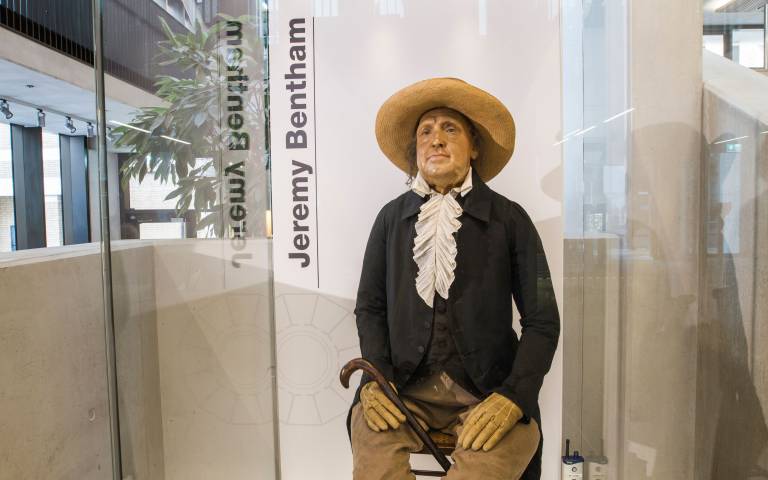
Even though the Utilitarian philosophy had many flaws, Jeremy Bentham contributed largely to bring in new political reforms, improve governance, establish penal codes in judicial systems, define sovereignty, reduce the influence of religious institutions on the lives of people and governments. His works were strategically maligned by some lobbies to lessen the impact of his other notable works. He was the proponent of liberty and freedom from religious influences on lives of people. The pushed for the establishment of a secular educational institute in London – now famously known as University College London. Jeremy Betham’s fully clothed wax statue containing his original skeleton remains in the entrance hall of the University main building upon his request.