Risk and Rationality in Uncertainty

We have many philosophical ideas about how money is not everything in life but deep down, everyone knows how money constitutes to a bigger portion of who we are. Although money can’t buy everything, the unexplainable value it holds behind presence of almost everything in our lives will never go unnoticed. We know that this importance of money/ resources/ assets is highly dependent on how much of those we have right now and how much of those may get lost in an uncertain event. This perception of value drives our decision making in risky situations. The Expected Utility Theory (EUT) in economics deals with the modelling of such scenarios. The mathematical formalization of the perception of wealth and our risk profile is facilitated by this fundamental theory. EUT lies at the foundation of actuarial science/ insurance, financial risk management, decision making under budget restrictions, asset management, and investment management.

EXPECTED UTILITY THEORY

We live in an uncertain world. Timing events where too many interactions are happening could be risky especially when it comes to money or the basic resources for sustenance. In crisis situations, our survival instincts have always kicked in to ensure preservation of life and the resources required to ensure its longevity. They need not to be always rational, they are just meant to save life somehow, that is why most of the acts of survival seem extraordinary. Interesting thing to understand here is that when such extraordinary survival instincts kick in as a mass effect the whole mass effect becomes irrational, unexplainable, incoherent. There is no sane explanation to justify these mass events. When such events badly affect the resources responsible for basic life of every being, it can be catastrophic. Huge sudden falls in stock market are good indicators of such disasters, crises. Insurance on the other hand could prepare person to handle the disasters in a preventive way. Stock market and insurance are one of the best examples to understand how people assess risk and maintain/ reject rationality while making important decisions. We will see what formal ideas from economics lie behind these events of uncertainty.

Expected Utility Theory (EUT) in Economics

Expected utility theory lays the foundation of how a rational person would make decision in an uncertainty where valuable resources like money are involved. The whole idea is based on the quantification of that uncertainty and connecting that uncertainty with the individual gains from individual uncertain event. Expected utility also creates a formal structure of how person perceives risk in given scenario. This helps to quantify the value generated from any economic event.

Origin – St. Petersburg Paradox

Daniel Bernoulli is credited to establish the expected utility theory which is one of the foundations of economics. The theory emerged from the St. Petersburg Paradox which goes like this:

You have $2 and we toss a coin. Heads, the amount you have now is doubled and tails then the game stops and you leave with whatever amount you have right now. The game continues till its always heads in series and stops when the coin shows tails.

The question is how much will you be willing to pay to enter this bet?

The probability of heads and tails is 50-50% which is ½ . If it is a series of heads (heads followed by heads) then the events are dependent on each other, so the probability of this event is intertwined with the probability of the previous one. If there happens a game where you start with $2 and every time heads comes, and the money goes on doubling the equation of gain would be:
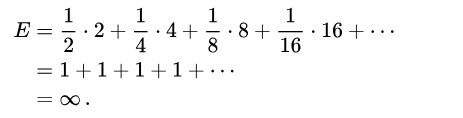
As this math goes, a person should pay infinite amount as he will be gaining infinite amount from such game. ‘E’ value here is identified as expected value. Even if one such possible game would happen in reality, people won’t pay infinite amount in reality to enter this bet. 

Bernoulli resolved this paradox by creating the concept of Expected utility. People will pay not what actual value it delivers (as in the $s of money); they will pay according to how actually it will be useful to them, ‘utilizable’ to them – that is where the utility and thus expected utility comes in picture.

Expected utility is calculated by the amount one would gain and the chances of gaining that amount. The expected utility thus is sum of all the gains connected with the probabilities of gaining them.

Daniel Bernoulli
The determination of the value of an item must not be based on its price, but rather on the utility it yields.

1st Tenet of EUT: Expectation

The overall utility of a prospect, is the expected utility of its outcomes.

In very simple words, for a given scenario you will weigh the chances of its constituent events and connect them with their respective gains. The sum of the all connections of each gain with their chance of realization is the usefulness – utility of that scenario.

Mathematically,

Expectation:

In our example we need to assume something that is the usability of the money – utility.

We assume $10 has utility of 1 unit. (This is just an assumption to understand the concept. When multiple objects are involved, their utilities will be different.)

So, the expected utility of this scenario is:

E = ((1000/10)x0.2) + ((50/10)x0.65) + (10000)x0.15) =

20 + 3.25 + 150 = 173.25 units

So, the expected utility – the usefulness of this event is 173.25 units.

The unit of value which we assumed in this calculation is sometimes called ‘utils’ – the basic unit of utility. It will change based on how one perceives the value in given scenario. 

You will realize that the expected utility is the weighted average of utility of events and their individual probabilities.

Four Axioms of Utility Theory

Later John von Neumann and Oskar Morgenstern expanded the concept of EUT with the idea of rationality. The agents involved in such uncertain economic exchanges are ‘econs’-the rational beings.

Oskar Morgenstern & John von Neumann

They have clear preferences among the options provided in every economic decision which comes under the idea of “completeness”. If out of the given set they select multiple options at a time, then it is said that they are ‘indifferent’ to these options. Whatever might be the internal distribution of constituent they might have. It’s about the final utility they perceive. When presented with choices, a rational person has clear preferences for those choices.

For all given uncertain events there is a hierarchy of preferences. If A is preferred over B and B is preferred over C, then A is always preferred over C. Which goes as transitivity.

Suppose we have been presented three events where event A is preferred over B and B is preferred over C. Now if one introduces a new event N which is slightly less preferred than B and more preferred over C then event B and N would be indifferent. In simple words, the choices between options would never directly jump, they will align as per the preferences in line.

So, A>B>C and B>N>C then A>B>C and A>N>C mean the same.

This is continuity. Graphically, the utility function is always a smooth curve.

Why do A>B>C and A>N>C mean the same even when the calculated numeric value would differ? It is because utility is never an absolute value it is just used to arrange the preferences by quantifying them. Ground rules used to define usability from the given resources i.e., the utility function of given scenario will be different for different scenarios and different sets of people. This is simplification of the concept called ordinality of utility. You can rank utility but not say that event A is this many percent better than event B.

When you have set the preferences of A over B and if you are offered another totally different/ irrelevant event M with new utility. You would still prefer A over B. Introduction of M will not affect the preferences as if A and B are independent of M. This is called ‘independence‘ in EUT.

So, completeness, transitivity, continuity and independence are the four axioms of EUT. Note that they are not ‘complete’ representation of reality. It’s just that they bring in simplicity to treat given scenarios and evaluate them. That is why you will find contradictions to these axioms. (Maybe a topic for another time.) The axioms are there to create a formal mathematical structure to draw useful inferences.  

2nd Tenet of Expected Utility Theory: Asset Integration

In EUT, asset integration is an idea based on the assumption that all people making economic decisions are rational. So, in uncertainty or risky scenarios a rational person will look at the overall gains instead of focusing on one certain gain and neglecting other unsure gains. A rational person will look at the risks of scenarios in a collective way and decide to enter only if the expected utility improves his assets’ position. A rational person will only enter the given scenario if the collective utility is better than the individual utility of its sub-events or sub-gains.

A rational person will not focus on an individual more probable gain even when his overall gains are becoming low.  

3rd Tenet of Expected Utility Theory: Risk

The beautiful insight EUT creates is about the mathematical formalization of risk profile. For that we will understand some ideas in advance.

Utility function – it is a mathematical relation between how one sees the value of given object/ resource. The value of resources is different for different people. A crude example would be how a beggar values money for one time meal compared to a filthy rich person. The value of $25 would be different for different people based on the conditions they are in.

This is where marginal utility comes in picture.

Marginal utility talks about what difference it makes in your perception of the value of a given thing if one would give you more of that in the next event. Roughly speaking the more we have something, the less we value it, so marginal utility is always diminishing. If I already have 10 packets of chocolates which are enough for the day to me, the next 11th packet of chocolate won’t make that much difference in my current excitement of having 10 packets. (Please note that we are talking about rationality here, although nobody is rational when it comes to chocolates.) A rational version of me would trade that 11th packet for something else with a person who hasn’t received even a single packet. A person who has no chocolate would perceive that single packet with higher value than how I perceived it (provided that he loves chocolates).

Alfred Marshall – the British Economist brought the concept of
‘Marginal Utility’ through his book ‘Principles of Economics’ in 1890.

So, utility function is a mathematical transformation of objects in given event to a unitary value so that the results can be easily compared with each other because the transformation converts everything to single unit system. These single unit of value is called ‘util’.

Utility function can be any possible mathematical relation. Generally, it is expected to be simple to not invite the complexities in modeling of given economic scenario. It should be simple enough to draw realistic conclusions.

An understanding of utility function gives insight into how the person evaluates risk with respect to the resources they hold.

Consider a scenario:

Event 1 – You enter a lottery where there is 50% chance that you will win $100 and 50% chance that you win nothing.

Event 2 – You are given $50 for sure, unconditionally just for playing the lottery.

Assume we have three differently thinking people to make choices in this scenario. Different thinking means how they assess the risk of entering the lottery which has some uncertainty and the surety of winning $50. Difference in assessment of risk means difference in the perception of utility. It further means that the utility function will be characteristic to each person.

Person 1 has the following utility function:
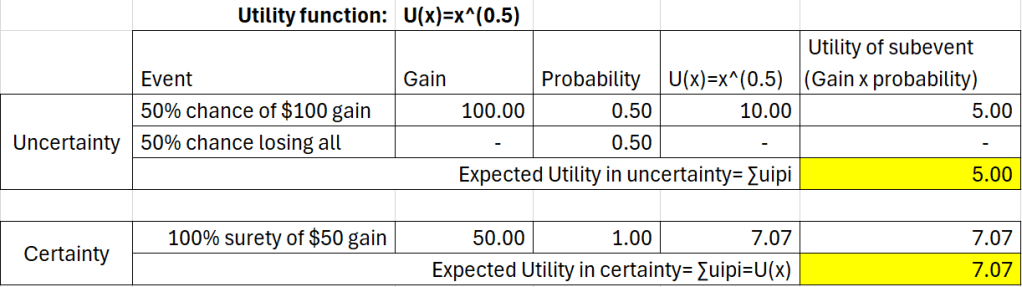
So, for Person 1 the utility of certainty (7.07 utils) is higher than the uncertainty (5 utils). He is happy to walk away with sure $50 gain instead of betting for $100 lottery.

Person 1 doesn’t want to take risk by entering the Event 1 of betting when he is sure about gain of $50 in Event 2. This is risk-averse behavior. The utility function mathematically models that risk averse behavior. Utility function is concave in risk aversion.

Now comes Person 2 with the following utility function:

You will see that the utility of certain and uncertain choices is the same. It means that it doesn’t matter for this guy if he enters the lottery having uncertainty or gets $50 for sure. This is risk-neutral behavior. The person 2 doesn’t care about certainty or uncertainty. He values both events the same. As mathematically both have similar utilities. Person 2 is indifferent to both events.

Now see the Person 3 with following utility function:

This guy has a radical view, he perceives the worth of entering the lottery (5000 utils) better than gaining $50 for sure (2500 utils). This guy is gambler! He finds it more interesting to enter the bet instead of gaining $50 for sure. He is happy to take the risk in uncertainty.

Looking at these three people you should note that the scenarios/ events they are presented are exactly the same. The only thing which is different is how they see the value in lottery and the sure gain.

So, the first person demonstrates risk averse behavior. He wants surety of gain rather than gambling for higher but unsure gain.

The second person demonstrates risk neutral behavior. Bet or no bet he doesn’t care. Just be done with it.

The third person demonstrates risk loving behavior. He wants the thrill of uncertainty in betting, so he sees more value in uncertainty of lottery.

This is how Expected Utility Theory can be implemented to mathematically model how different sets of people/fund managers will make decisions based on the risk profile. The relation between expected utility (which is the weighted average of gains) and utility function (which shows how one values the gain) can show us the risk profile.

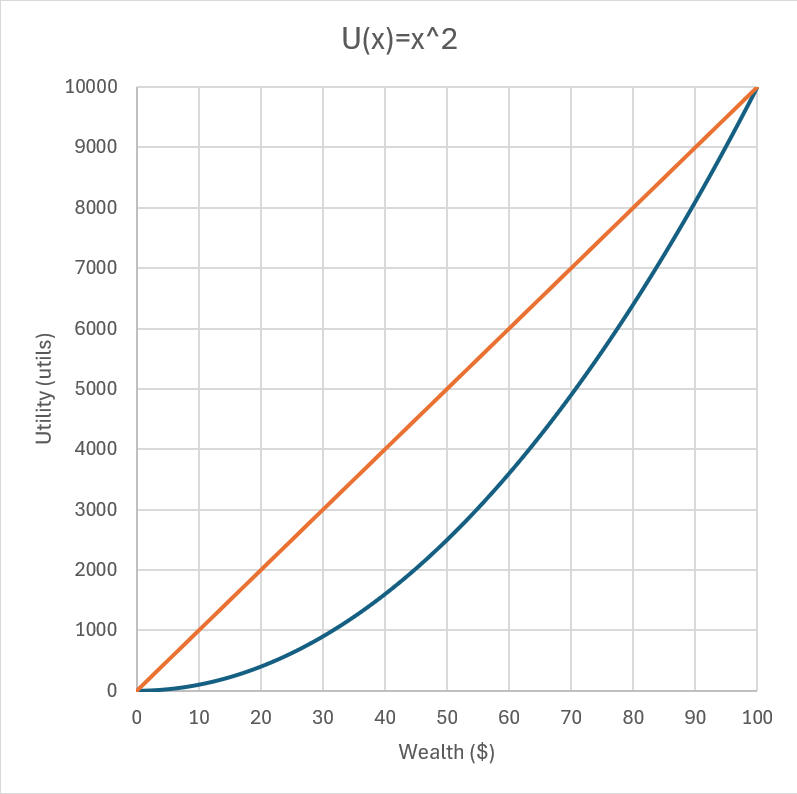
Risk Averse Utility Function
Risk Neutral Utility Function
Risk Loving Utility Function

In the graphs shown, blue lines show utility function and the orange lines show expected utility. The orange line in our case connects the utility of $100 and $0 which is Event 1. This orange line connects any points on utility curve and it will give the expected utility value for that scenario of uncertain gain. In simple words, it’s the line of weighted average exactly like the definition of expected utility. This line is used to find out the certainty equivalent (CE). A certainty equivalent is the utility of an uncertain gain if it was certain.  

Almost all the time, people are risk averse. People want to avoid uncertainty about higher gains when they are presented with some lower but sure gain. This is where marginal utility becomes important. (This point deserves broad explanation which we will cover another time under Prospect Theory)

Marginal Utility

In risk averse people, you will see that the utility function starts to flatten out once the value gained increases. The more value someone already has the less he values the next addition of bunch into the preexisting bulk. Remember the chocolate box example?

One with 10 boxes of chocolate perceives one additional box with less value, whereas some with no chocolate will see it as a precious one as he has nothing right now. The perceived value of the additional next lot goes on reducing. This is known as diminishing marginal utility. Marginal utility is always diminishing.

So, a safe playing person would stop entering the next gamble because he now has enough. The next uncertainty in gambling has less value for him.

EUT in actuarial

Now it is obvious that only a risk averse person would go for conservative approach in uncertainty. This also means that risk aversion will also invite preventive measure against loss of certain assets, resources. Insurance thus comes into the picture. EUT here helps to mathematically formalize the probability of the risks which would compromise current gains, the perceived value of asset/ property/ resource and losses one can bear. We can now calculate the premium for the insurance against uncertainty of loss of something.

So, we will look into a scenario where risk aversion exists thus marginal utility is always diminishing.

We have the utility function of a man has a property giving revenue of $100K/year as:

u(x)=ln x

Now will see the risk scenario. Suppose this person does a fire audit of his property and the auditing agency finds out that there is 50% chance that he will suffer a loss of $60K/year due to fire hazard and 50% chance that nothing will happen.

After rephrasing, the gains from the property would look this:

50% chance that the income is $40K/year and 50% chance that income is $100K/ year.

Using the tenets of EUT the mathematical expression becomes:

Now, what we are doing differently here is to find out what this expected utility in uncertainty means when there is complete effect of loss with some chance and gain of some chance. In earlier examples we had second event of certainty against which we compared to understand the risk profile. Now it’s reverse calculation, we know the risk profile, we know the perceived overall value i.e., EUT of the property. Now we will find the certainty equivalent (CE) using the risk profile which can be explained by the utility function of the person.

How much is this 11.05 utils in terms of money from the property for this guy? We can find this from utility function of the person.

ln(x)=11.05, thus x=$63245.55

Now, think the fire hazard as a lottery where you gain $63245.55 money as per EUT calculation. Whether the fire will happen or not, the possible overall earning from this property would be $63245.55.

Now, if the property without any fire hazard was giving me $100k and the insurer guarantees me that same earning for the losses due to hazard. How much maximum amount should I pay to the insurance agency?

I will pay only that much amount which falls short to the $100k when compared to perceived earning calculated from the combined effect of certainty and uncertainty as given by EUT.

My earing due to uncertainty is $63.2k/year, I would receive $100 for a fine year so in order to continue that $100k even for a worse year I would pay insurance agency = $100000 – $63245 = $36754.45.

Anything I am paying above $36754.45/ year for insurance premium is loss for me. I would not go above this amount to insure my property which guarantees income of $100k per year. This is how the insurance premium is decided.

Conclusion:

We have many philosophical ideas about how money is not everything in life but deep down everyone knows that money constitutes a bigger portion of who we are. Although money can’t buy everything, the unexplainable value it holds behind presence of almost everything in our lives will never go unnoticed. We know that this importance of money/ resources/ assets is highly dependent on how much of these we have right now and how much of those may get lost. This perception of value drives our decision making in risky situations. The mathematical formalization of the perception of wealth, our risk profile is facilitated by expected utility theory. Although this theory has its own limitations it lies at the foundation of the economics.

For further reading:

  1. Von Neumann, John, and Oskar Morgenstern. “Theory of games and economic behavior: 60th anniversary commemorative edition.” Theory of games and economic behavior. Princeton university press, 2007
  2. Kahneman, Daniel., and Amos Tversky. “Prospect theory: An analysis of decision under risk.” Econometrica 47.2 (1979): 363-391
  3. Thinking fast and slow – Daniel Kahneman
  4. Connecting money with sentiments – Behavioral Economics
  5. Settling accounts with the losses – On Prospect Theory

Entrepreneurship and Poverty

We are surrounded by many entrepreneurs which go unnoticed and have nothing to do with the keywords like technology, unicorn, angel investors. A high chunk of these unnoticed entrepreneurs are poor entrepreneurs, almost a billion around the world. Nobel laureate economists Abhijit Banerjee and Esther Duflo studied such poor entrepreneurs which has created deep insights and answered many questions. Providing supporting capital – microcredit to such poor entrepreneurs is not the final answer to this riddle.

Paying close attention to the larger fraction of the poor entrepreneurs

Monthly Revenue of a ‘Chai-wala’

It is very common discussion among group of youngsters to roughly estimate revenue of their “Snacks n’ Tea” seller while enjoying that short break. The discussion ends when the earnings estimate from that seller’s business reaches to a figure which is far bigger than what these “highly qualified” youngsters actually earn thereby inspiring them to think about pursuing their own business, start-up. What actually happens after such short surge of inspiration is also a common knowledge. Very few of such people actually work on entrepreneurship, their business idea and again very few of these truly taste the success. Social media, mainstream media have also positively affected and boosted the startup mentality, entrepreneur mentality among the youngsters through TV-series, reality shows, success stories, popular talk shows, podcasts and nonetheless video platforms like YouTube. The “F.I.R.E. culture” (Financially independent, Retire early) is also one wave of thought which inspires such entrepreneurs to create something of value, turn it into a business and sell it at higher valuation to gain financial independence early in life. (Although, FIRE is not limited to financial freedom through entrepreneurship only). Following their passion and working over it to create a start-up and then becoming a wealthy person is also one famous new career route for today’s youngsters.

In short, for our generation, entrepreneurship holds the key to financial independence thereby key to the freedom (materialistic freedom to be more specific) – life living on their own terms, without any terms and conditions.

When looked through “the pop-cultural” lens towards entrepreneurship one will see all the glamour, money, popularity, angel investors, “unicorn startup” funds and success stories. In reality there are very few practical examples in these enterprises which successfully fit to all such criterion, which really have created value in the society; most of them are actually just publicized bubbles rather black holes sucking in the attention, time and money of the investors.

The Reality of Entrepreneurship Around the World

Start-ups represent only the early developmental part of an entrepreneurship. Even though they represent such an early and small part of the concept of entrepreneurship, start-up stands as the biggest lamp, biggest fire attracting the youth like moths.

Here are some interesting facts:

9 out of 10 startups fail

7.5 out of 10 venture-backed startups fail

2 out of 10 new businesses fail in the first year of operations

Only 1% of startups become unicorn firms like Uber, Airbnb, Slack, Stripe, and Docker

The success percentage for first-time founders is 18%

20% start-ups fail before the end of their 1st year, and almost 70% start-ups end by their 10th year.

These facts are not presented to demean the value of stat-ups or to negatively criticize start-ups thereby idea of entrepreneurship (although there are some people who also try to capitalize their failure in both the good and bad ways). When you will look at the complementary positive data on start-ups you will realize that the successful start-ups even being low in numbers created value to the society in totally different ways, they changed the ways of working and doing things through the exploitation of technology.

The glamour while portraying the concept of entrepreneurship is actually overshadowing the key idea behind it which is “ingenuity”.

Poor Entrepreneurs

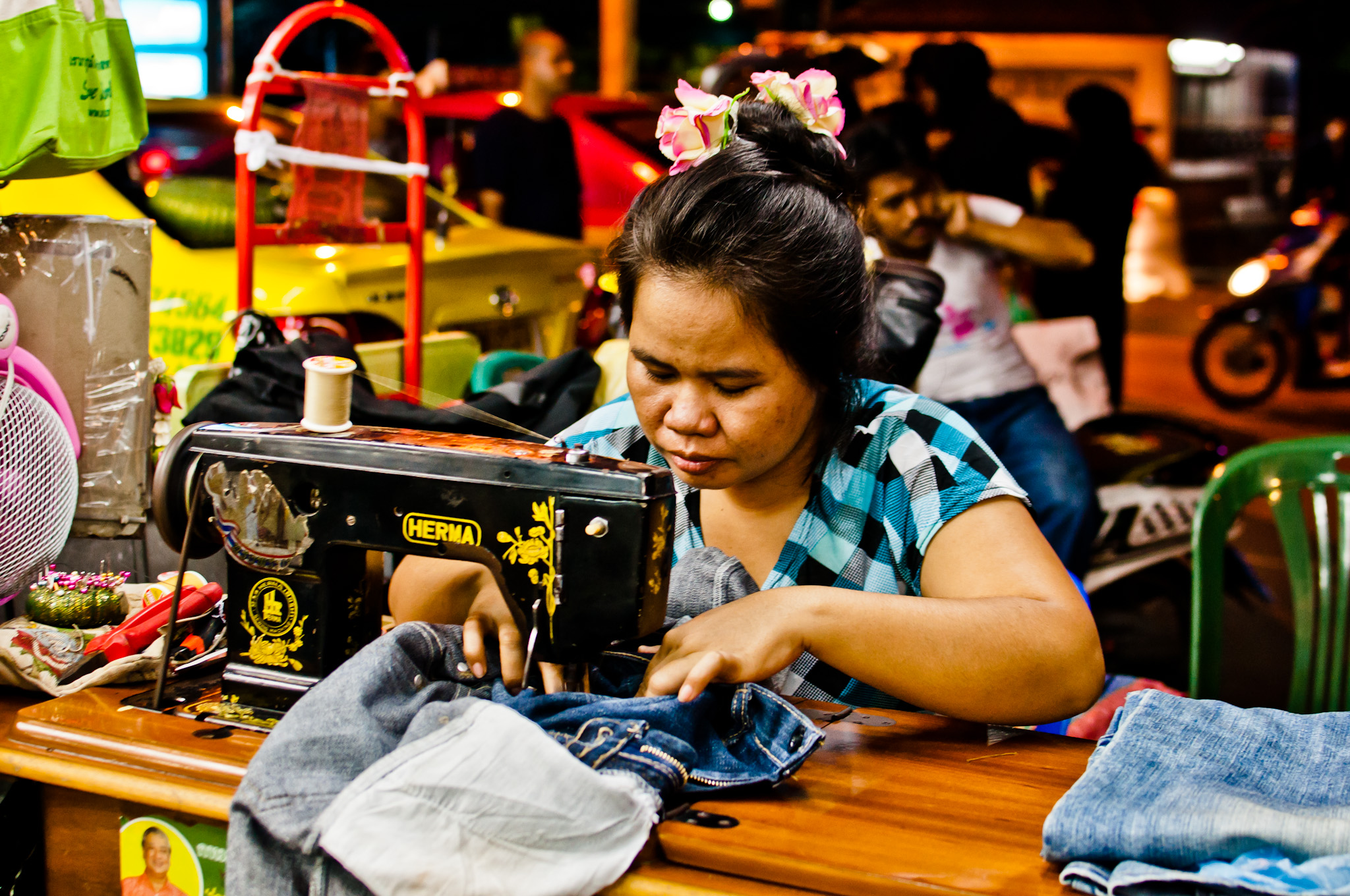
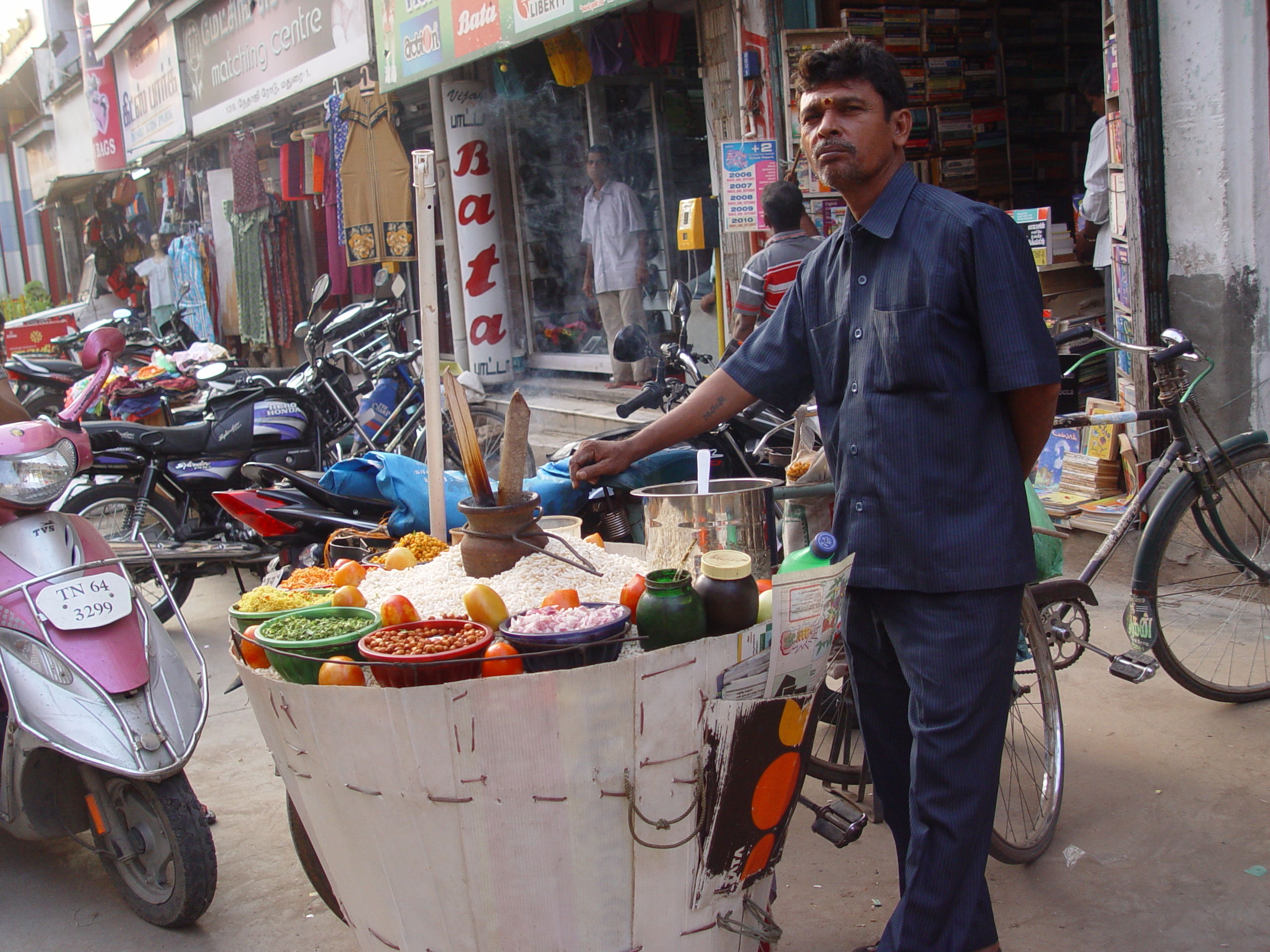
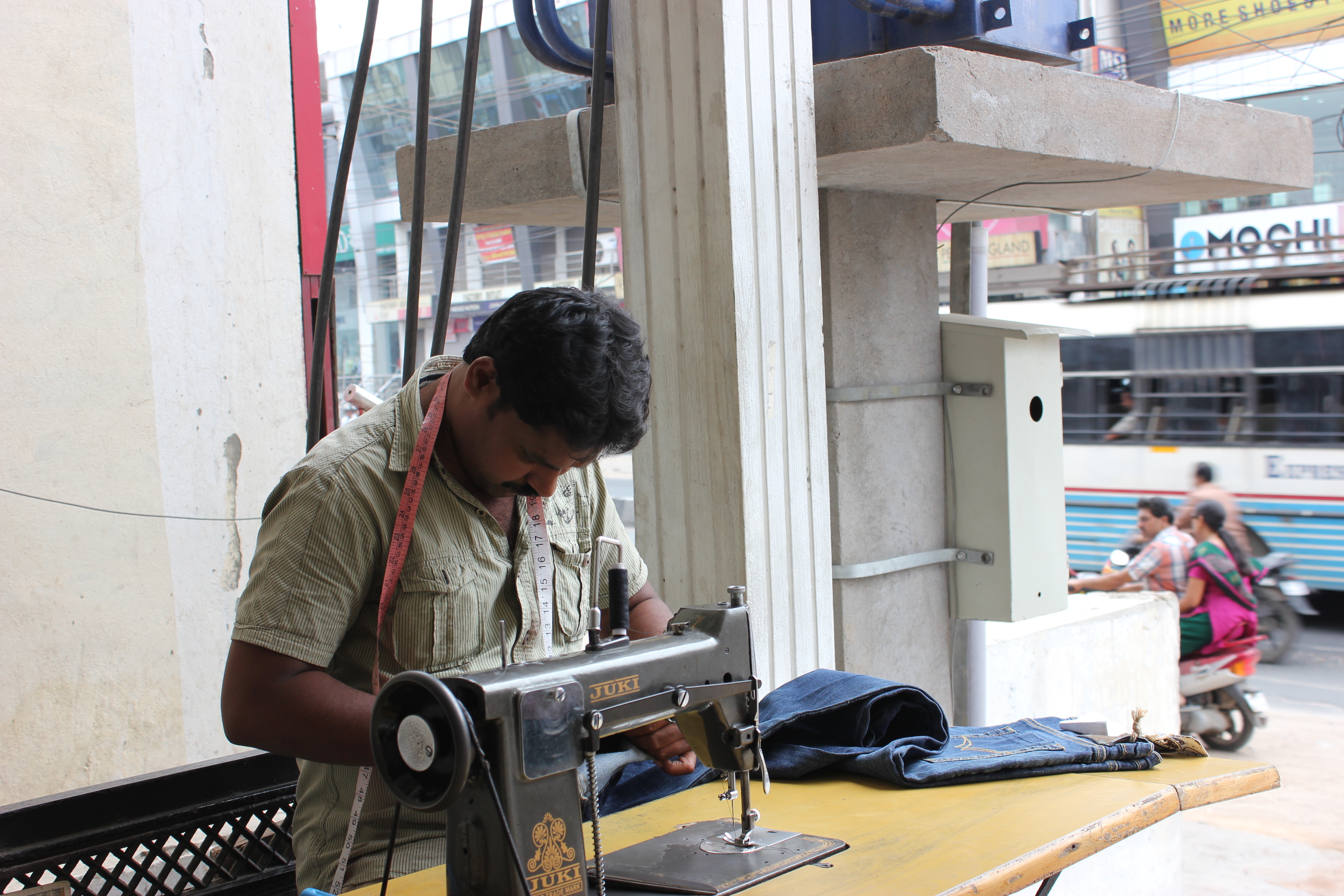
What is the definition of an entrepreneur? The dictionary definition goes like this- “a person who sets up a business or businesses, taking on financial risks in the hope of profit.” Literally, a person who runs an enterprise. Now look at the pictures above, can you tell which one of these is an entrepreneur?

This will make us realize that how the glamour built around the word entrepreneur is actually a mirage. The basic idea in entrepreneurship is the risk taking for the gaining profit. We are surrounded by such small entrepreneurs in our day-to-day life, most of these are poor entrepreneurs. World renowned Nobel laureate economists Abhijit Banerjee and Esther Duflo have contributed to uncover the reality of such poor entrepreneurs and many questions associated with such poverty.

Why should one be interested in poor entrepreneurs?

According to the data collected by Abhijit Banerjee and his team roughly 12% of the population in rich countries calls themselves as self-employed i.e., entrepreneurs. The interesting thing is that the poor countries have far higher percentage of self-employed people. Nearly 70% people call themselves entrepreneurs – self-employed in poor countries. These are the people who are mostly single person entrepreneurs like tailors, bricklayers, auto-drivers, street-vendors, shopkeepers.

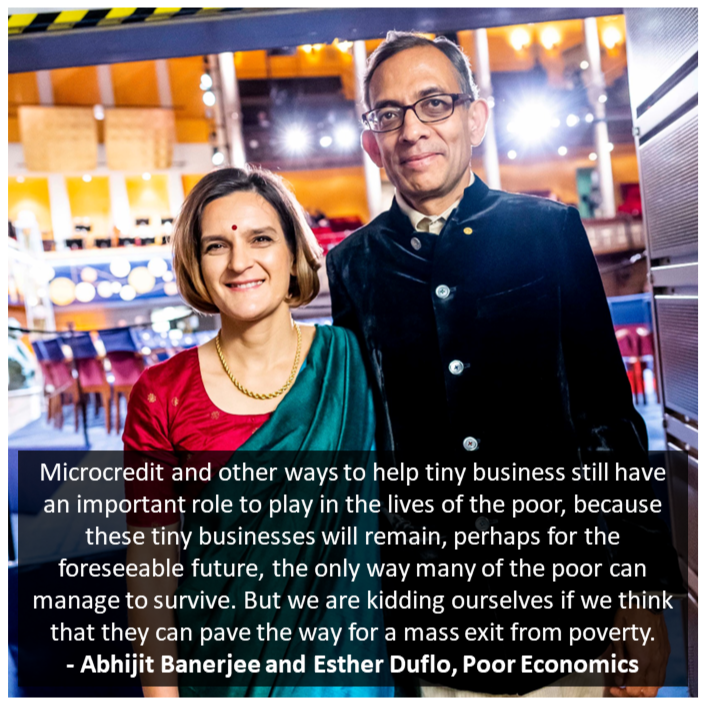
“…most income groups in poor countries seem to be more entrepreneurial than their counterparts in the developed world-the poor no less so than others… ”

Abhijit Banerjee and Esther Duflo, Poor Economics – rethinking poverty and the ways to end it

Looks like bigger chunk of the entrepreneurial population of the world is not really glamorous and full of revenues, capital and resources. The intention to focus on this information is not to degrade entrepreneurship, rather it is to understand why the percentage of entrepreneurship is huge in poor countries where availability of resources and capital is already hitting rock bottom low? How do they manage such ventures in low margins? Do these entrepreneurial ventures bring them out of the poverty? If yes then, how? If not then why?

If entrepreneurship is supposed to give people freedom to operate on their own conditions, freedom to be their own boss, freedom to take control over their own lives, bring their ideas into the society then why poor countries where the entrepreneurial fraction is huge are not coming out of poverty? Why most of such poor entrepreneurs remain poor even after embarking on the journey of self-employment?

Trust me the answer is not related to ‘lower rates of returns’ only!

Ingenuity of the Poor Entrepreneurs

Let us understand the challenges faced by the poor entrepreneurs listed as below:

  1. Being poor, they are inherently low on capital (obviously)
  2. They have low or no access to formal financing institutions like banks, insurance companies
  3. As they have no access to formal finance, they approach local moneylenders and borrow with high rates of interest
  4. They have very low risk-taking capacity because any investment other than that for sustenance is a survival challenge
  5. They have very crude social support in terms of materialistic and emotional levels. They are surrounded by people having same difficult lives. They rarely have good connections with people who will trust them, people who will have access to better conditions capital-wise or relation-wise   

Even after having these challenges, the fraction of entrepreneurs in poor countries is surprisingly high. How is this possible?

As Abhijit Banerjee explains, the poor entrepreneurs have clever ideas to run their businesses even at low capital. The unavailability of resources, material/ capital means forces them to find out new creative ways to make living. You will see many such innovative entrepreneurs around who try to make living by using some really interesting ideas e.g., the human hair collectors roaming around town to exchange with utensils/toys, the scrap collectors who collect specific types of waste only and sell them to bigger scrap dealers in bulk, there are some dust collectors in the gold markets of many cities in India where poor people collect road dust around the gold shops and try to extract tiny amount of gold from such collected dust to sell it.

But how many of these innovative, creative and ventures with true ingenuity actually turn into a unicorn or a big company? In simple words, one knows how costly are the hair extensions/ wigs are then why the hair collectors are not getting rich with their business? If gold is that precious then why these dust collectors are not getting rich with this gold dust collection ventures?

This is where the insights created by Abhijit Banerjee play a very vital role. In his book “Poor Economics – rethinking poverty and ways to end it” co-authored by Esther Duflo, he has given very important insights into the world of poor people, the challenges they face and ways to uplift them.

Let us deep dive into the key concepts to understand the economics of such entrepreneurs.

Representation of the Poverty

Figure 1 The S-shaped curve and the poverty trap
Source: Poor Economics – rethinking poverty and the ways to end it by Abhijit Banerjee and Esther Duflo

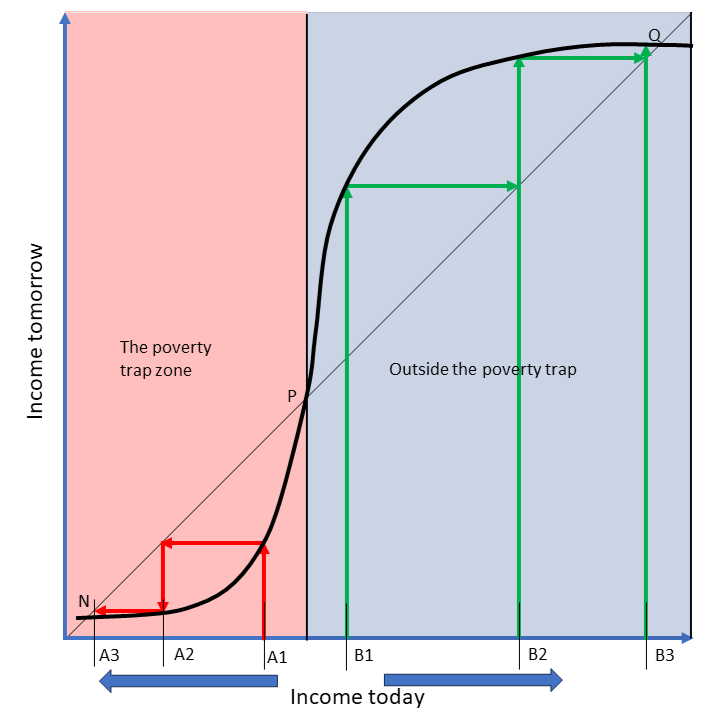
Economists use the diagram shown above to indicate the relation between income of today and the income a person will earn in the future. You will see an S -shaped curve forming. The red zone indicates the poverty trap zone where a poor person starts from A1 earns a meager amount which is not enough to sustain making the net income negative thereby proceeding to A2 which is backward directed/ decline in income. This reduced income restricts his/her freedom to choose (as the words go “beggars cannot be choosers”), risk-taking ability, reduction in available capital thereby scarcity of capital disposable to meet the daily basic requirements. So, the ventures in which poor people are engaged are down-valuing ventures according to this representation – which is used to represent “The Poverty Trap”. For those who think that the ventures of poor people always end up in losses thereby degrading their existing states, this curve in red zone represents that vicious cycle.

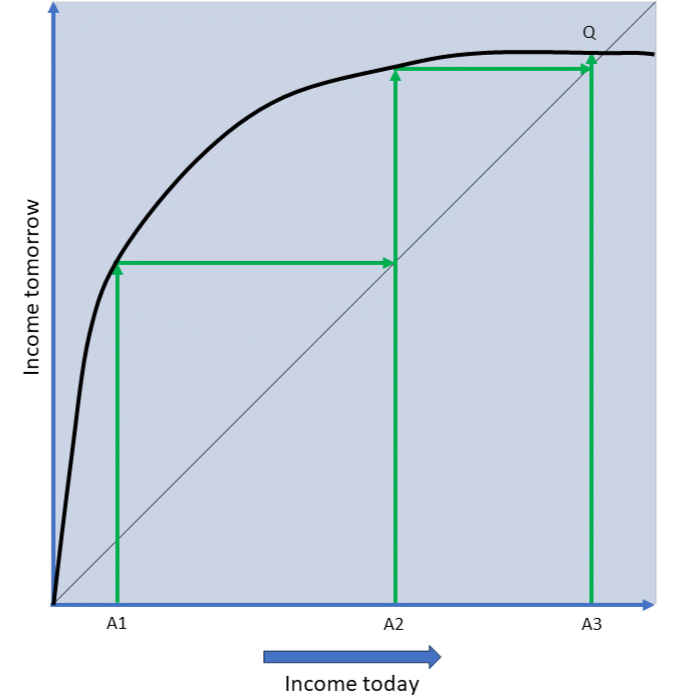
Most of the economists think that poverty is not a vicious cycle. By providing minimum enough capital/ resources to the lowermost group, their lives can be kick-started where the ventures will give net positive incomes, thereby gradually increasing their income over the time. That is why the world around us is explained by blue shaded part of the diagram, known as inverted L-shaped curve.

Figure 2 The inverted L-shaped curve
Source: Poor Economics – rethinking poverty and the ways to end it by Abhijit Banerjee and Esther Duflo

Please note one interesting detail in this diagram which we will bring further in our discussion. The initial slope of the curve is steep indicating substantial valuation increase in income but as the curve proceeds slope of the curve ends into flat thereby indicating less or no increase in valuation of the income over the longer period.

 In very simple words, a venture can only sustain over the time if there is some net gain over the time (always remaining net positive, even if it becomes smaller and stagnant over time). Very few people and actually no one would engage in a venture where they see their future valuation, future earnings dropping over the long-time horizon. That why most of the economist accept Figure 2 to represent the incomes of today and tomorrow for anyone.

Asking the Right Questions

Now that we have realized that it will take very small amount of effort and capital to uplift the poor entrepreneurs why doesn’t that help them immediately? Abhijit Banerjee in his studies asked some important questions which reveal why just giving poor enough money won’t solve the complete problem. Abhijit Banerjee clarifies that it is the inherent nature of the enterprises/ businesses, societal conditions and even the mindset of the poor entrepreneurs that makes them stagnant in their ventures. Even if they are running their small businesses successfully, they will always make just enough to sustain in long time horizon, very few will be the outliers which come out of this stagnancy.

Abhijit Banerjee pointed out that most of the poor entrepreneurs repay their loans on high interest rates. The high returns rates are attributed to the lending from informal financiers like local money lenders, relatives. If poor entrepreneurs are successfully repaying such high interest loans while sustaining through the business, then that means that their overall rate/ fraction of earning for the capital invested is also very high.

So, why don’t they become relatively wealthy even after running business with high rate of overall returns?  

Here we can take support of the inverted L-shaped curve for poor entrepreneurs and build on that further.

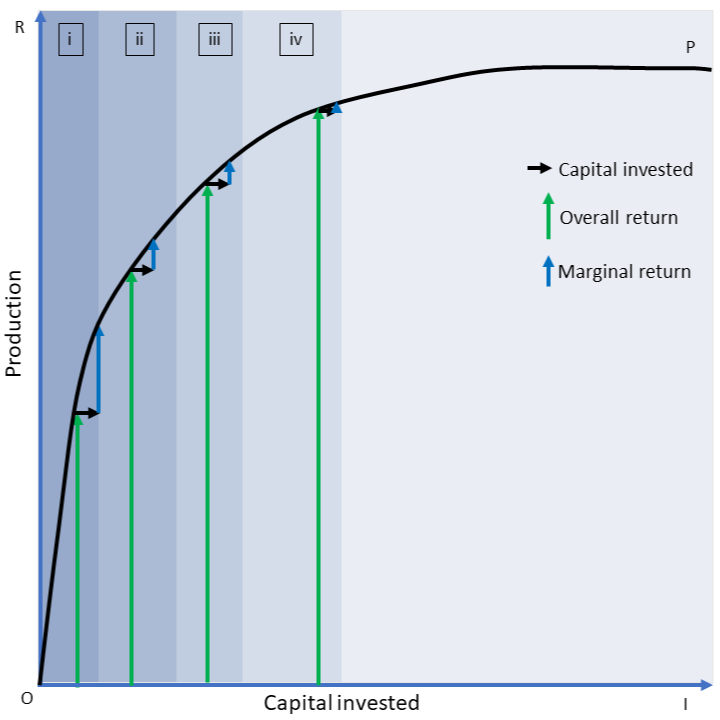
Figure 3 Diminishing marginal returns in poor enterprises
Figure created from the explanation in the book Poor Economics – rethinking poverty and the ways to end it by Abhijit Banerjee and Esther Duflo

Abhijit Banerjee explained the reasons for the stagnancy in poor enterprises in practical ways based on his field research. He explains the important behavior of marginal returns in terms of the poor enterprises. Marginal returns are the what left after an entrepreneur pays off everything – like payment on tools, payment of the wages to the workers, payment of the things bought to sell. Marginal return is take-home money after the business is done.

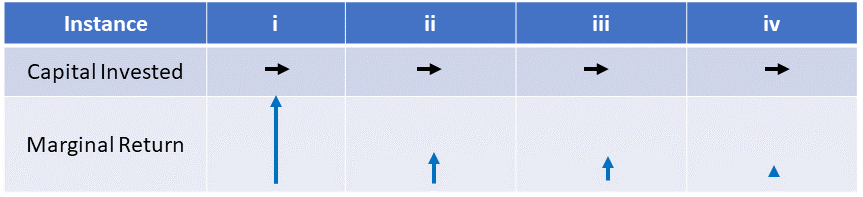
Now let us see the inverted L-shaped curve in figure 3 for poor enterprises. At the start of the business the marginal returns (shown as the height of the vertical blue arrow) are very high for the extra capital invested (shown as the length of the black horizontal arrow). The early investments in the business yields higher returns – higher marginal returns.

But, as the curve proceeds, due to the inherent nature of the businesses poor entrepreneurs are involved in as the capital investment goes on increasing, for every unit increase in such investment the marginal returns go on reducing and diminish further.

You can see in the figure 3, there are four different instances of extra capital investment in the poor enterprises. The L-shaped curve increases rapidly at early investment stage but as the capital investment goes on increasing the curve quickly flattens out, indicating the stagnancy.

In poor enterprises any new unit capital investment will give diminished marginal returns over the time

This behavior can be explained by the example of local fruits and vegetable vendors. First a person starts out with very few 2 or 3 vegetables (potato, tomato, onions for example). Being the commodity vegetables, they are sold very easily, fast and margins are also pretty good for the amount invested to buy them in wholesale. So, with those good returns he/she now buys different vegetables and now provide more options to his/ her customers. Now you will realize that not everyone buys every vegetable he/she has to offer, the sell of potato, tomato, onions may still remain good. But in order to expand he/she cannot depend on selling those only, and as he/ she expands into new varieties there comes the uncertainty of not everyone buying it. Perishable nature of these products is also one problem over which he/she has no control. The overall return may increase by incorporating more variety of items or by buying a cart to access many customers but for every new investment further done to grow this business, the guarantee of higher returns is very low.

So, the vegetable/ fruit vendor realizes this at a stage in his/her business that buying only those items which would sell, items which will not perish immediately with limited customer accessibility through cart is the only option to survive. You have to understand the limitations created by the nature of the businesses poor entrepreneurs are invested in.

That is exactly why only giving money to poor entrepreneurs won’t bring them out of the poverty. The businesses they can perform stagnate very rapidly.

Now, someone should ask the question for the case of the vegetable/ fruit vendor.

The questions could be asked as follows,

  1. The vendor should buy a vehicle so that he will contact more customers, why doesn’t he / she do so?
  2. The vendor should go to the wholesale market to buy the vegetables and fruits even at low rates to increase his margins, what stops him/ her?
  3. The vendor should rent a place in cold storage to maintain his items fresh till they are sold to the end customer, what is the hurdle?

Now, let us assume ourselves as this vendor and try to answer these questions.

  1. If the sell is stagnant even with a cart, why should one put exceedingly high amount in a vehicle purchase. This will be a big capital step. As the accessibility to formal lending is difficult, it brings capital in but the returns will be very low due to the borrowing at higher rates of interest.
  2. In order to buy at wholesale low rates connections with the wholesale tycoons are vital. Such connections are based on mutual benefits which the poor entrepreneurs hardly have access to.
  3. Cold storage rentals are significantly high for the amounts they earn so that goes there.

You must understand that these are not some contrived examples created to prove certain points. These are real life challenges and questions faced by poor entrepreneurs. It is only because of such challenges the poor entrepreneurs have that creative mindset, low cost, less capital-intensive problem-solving mindset. This also the reason economists found that poor entrepreneurs have very low number of people involved per business, they cannot afford to employ others due to the stagnancy.

As the study done by Abhijit Banerjee indicates, even if you provide some extra marginal income to the poor entrepreneurs so that they can access such options where extra capital is required, they will still choose to not invest that extra amount in the business because they know that for that extra investment the returns will not be that high over the longer period. (Abhijit Banerjee experimented with such extra capital provisions to poor entrepreneurs in Sri Lanka through lottery system, these entrepreneurs chose to invest that extra money in their livelihoods instead of businesses)  

The Big Gap to Fill

Now you should understand that even when extra capital is provided, that extra capital definitely won’t go into the growth of the poor enterprises. The question now comes that why poor entrepreneurs don’t have wide mindset? Why can’t they think big? Looks like the horizons and the mindset of poor entrepreneurs are so narrow that they are scared of risk taking. For the exact reasons the micro-financing institutions have tried to disseminate finance education, entrepreneurial education to the poor entrepreneur they lent money. But economists found that it is the inherent nature of the enterprises that poor can and are involved in, which makes them to think so.

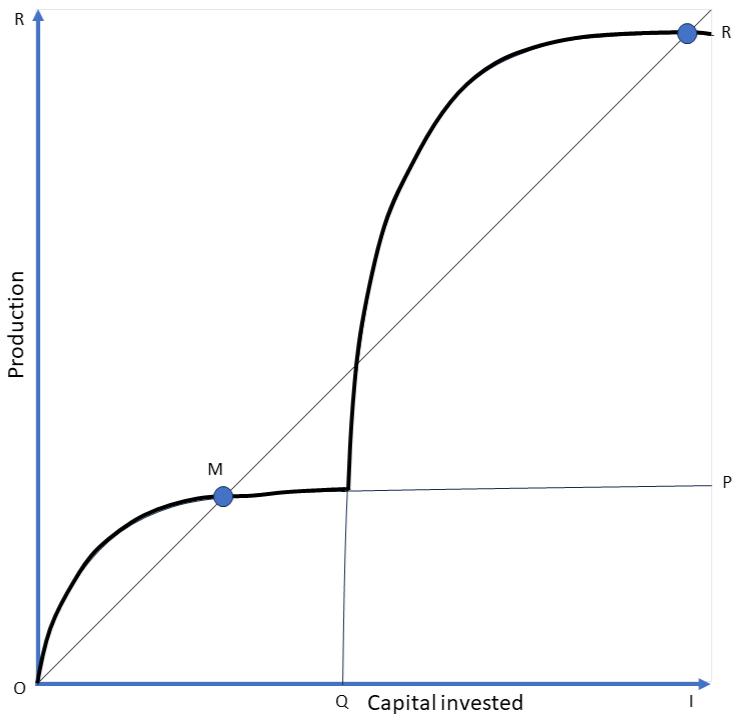
Abhijit Banerjee here clarifies what exactly is the difference between the poor entrepreneurs and the rich entrepreneurs. For that let us look at the figure 4

Figure 4 Combining technologies and S-shaped curve of entrepreneurship
Source: Poor Economics – rethinking poverty and the ways to end it by Abhijit Banerjee and Esther Duflo

You must appreciate the beauty with which Abhijit Banerjee has explained the difference between poor and rich entrepreneurs. Any incorporation of production technology in an enterprise will improve the productivity. Buying machinery, tools, infrastructures can largely boost the business performance. This boost due to production technology is shown as curve QR.

What does the curve OP represent?

As you have already seen, curve OP starts with no to less capital investment and flatten out immediately. It is the curve of poor entrepreneurship.

Now you must understand that in order to gain marginally/ exceptionally high returns one needs to start with high up-front capital in hand (Indicated as capital OQ). The big tech startups, the big supermarket chains start exactly from here where there are high chances of success (This is also why rich start-ups or any non-poor start-ups demand high funding).

In the case of high marginal returns in poor enterprises in their early stages of development we can easily think that high marginal returns should create the foundation of a successful long-term business. These high margins will allow the person to invest more in the same business, to employ more people to expand the workforce, to purchase new machinery, new tools. But these high marginal returns could never fill that capital gap for poor. This is what majorly differentiates between poor and rich entrepreneurs.

So, one has to really appreciate the gap lying between poor and rich entrepreneurs. This gap of capital to create production technology is too large for poor entrepreneurs and for the business they run. It is not just their narrow mindset, rather they are so close to the harsh reality that they prefer not to follow such seemingly “imaginary” paths.

Conclusion

Entrepreneurship for our young generation seems like a glamorous venture with big money, new technologies, new ideas, new technologies, “angel” investors and “unicorn” start-ups but we always forget that we are surrounded by many entrepreneurs which go unnoticed and have less to nothing to do with the keywords explained here.

A high chunk of these unnoticed entrepreneurs are poor entrepreneurs. They are part of our lives in a big way – you can think of the vendors of every small thing you use in your whole day.

Most of the people in poor countries are self-employed or entrepreneurs. This proportion is far less in developed nations.

Poor entrepreneurs seem to make high returns in their business but most of those high returns go to the repayment of the loans at high interest rates due to the inaccessibility to formal financial institutes which can lend at relatively lesser rates of interest. These businesses are very small and unprofitable over the time even though the rates of returns are exceptionally high.

Providing capital and opportunities to poor to start their business is not the solution to their improvement. Even after such provisions they will engage in the enterprises which rapidly stagnate over the time.

In order to come out of such stagnation they will need to fill that huge gap capital to incorporate production technologies which is impossible without the involvement of anti-poverty policies which will create opportunities and involvement of big formal institutes to provide no risk capital.    

“The idea of the entrepreneurial poor is helping to secure a place within the overall anti-poverty policy disclosure where big business and high finance feel comfortable getting involved.”

C. K Prahlad, taken from the book Poor Economics by Abhijit Banerjee and Esther Dulfo

Poor entrepreneurs have less risk-taking ability, no to less business connections, no credit/ loan capability when compared to their rich entrepreneur counterparts. They have to fill that huge gap of up-front capital which could have brought new production technology, employed more skilled labor. Filling this high capital gap is impossible for poor entrepreneurs. That is exactly why a smart, ingenuous street vendor even while having the best and the original ideas cannot expand his/ her business into big industries, companies and malls.

When we are understanding that poor enterprises rarely promote multiple employment/ connected employments, we should understand that supporting the poor entrepreneurship won’t drastically improve the employment rates of the nation, especially the poor nations. This is also why creation of good jobs is very important.

References:

  1. Poor Economics – rethinking poverty and the ways to end it by Abhijit Banerjee and Esther Duflo
  2. MIT OpenCourseWare – 22. Entrepreneurs and workers – Lecture by Abhijit Banerjee
  3. 106 Must-Know Startup Statistics for 2023
  4. 90% Of Startups Fail: Here’s What You Need To Know About The 10%
  5. News reference – Sifting through sludge for a sprinkle of gold – The Times of India