Feminine Side of Masculinity

Most of the times, we are forgetting that when we are promoting and asking for individual freedom, individual expression, individual identity we have ignored what it means to reserve the same rights for others. Ernest Hemingway’s short story called “In Another country” from his collection called ‘Men Without Women’ shows what men lose when they have no one of their own to open up, express, share. Hemingway’s writings although were heavily influenced by his personal experiences of war, the ways in which his men handled emotions is exactly same as how modern men are still handling their own emotions. They are not handling them at all, they are suppressing them, running away from them.
Men are so strongly conditioned with the trait of showing themselves unaffected by whatever life throws at them that now they have accepted it as their second nature. There is a specific psychological term called Alexithymia which literally means “a lack of words for emotions.” You can see alexithymia in Hemingway’s “so-called” masculine characters.
The remedy to all these complications is creation of more open spaces for men. We need men to open up at least among themselves, at least a man needs to treat other man’s emotional, expressive side, others will eventually follow.

Ernest Hemingway’s Men Without Women
The Paradox of Individualism

It is always interesting to question what would happen if we were not exposed to certain things, experiences especially the people. What we would be of us if those events, those people had not crossed our life path? We definitely would have been someone else. In a sense we are what is happened to us and where we lived and with whom we lived. One can say that man himself is enough to justify his own existence, he doesn’t need anything else or anyone else to live through his life, to pass through it and there is no denying in that.

One must understand that people can spend their whole existence as an isolated being, a person unaffected by the surrounding and molded completely by his/ her own being, not by others and without the influence of the surrounding. You will see that what I explained in the last sentence seems illogical. How could a person be completely be detached throughout his whole time on earth filled with many things, events, people? The answer to this confusion is that the person assumes that he/she was alone all along the time thereby mentally erasing every instance where they had a company, such people have mastered the art of removing every influence their surrounding had on them. Human children are anyways some of the weakest off-springs among the many species on earth. A new born baby continuously needs support from parents/ surroundings to finally become self-dependent. Now, one cannot deny the fact that even if you can live on your own, what you call as “your own” which substitutes for the void of the external influences is ultimately created from that very surrounding you are trying to deny to prove your individualism. This “your own” internal support could be anything – your identity, your habits, your religion, your mind, your way of thinking, your way of seeing things. Now you must appreciate that even though we can control what we are, once we are matured/ independent we cannot completely erase what brought us here.

The concept of individualism itself needs supporting justification, there is nothing like an isolated being. In order to define isolated or individual, you have to define what it is not and that invites everything that exists out there.

The whole point of starting the discussion with the idea of futility of individualism is one short story I came across, rather the book’s whole point is the denial of individualism. It shows that even if one justifies their individualism, it immediately rips them from their real version. The person creates a defense mechanism to avoid certain unsettling feelings just to satisfy their version of self. Men need safe space of women or at least a feminine side of humanity to express, to vent out or at least to acknowledge what they are feeling in front of other human being. If men are not given such space, they are no longer men, not even human.

The book I am talking about is Ernest Hemingway’s collection of short stories called Men Without Women. These stories show how men are flawed when they try to erase or are forced from external factors the influence of women from their lives, how it steals their true masculinity, true humanity. I will deep dive into these aspects as discussion evolves.

The short story from Men Without Women which intrigued me is “In Another Country”. I like this story because is direct reflection of who Ernest Hemingway was. It is written in first person point of view and the factual details of Hemingway’s biography overlap with the locations, events mentioned in the story, so the Hemingway’s fiction brings a realism.

In Another Country – Summary

I won’t go into every nook and cranny of the story, because I want to invite you into reading that 15 min short story all for your own interest.

Even if I spoil the story here, reading the details of the story and building your own interpretations are one personal and exquisite experience. This is because of the iceberg theory attributed to Hemingway’s characteristic writing style. He will not explain everything or show everything that is there in the story. The limited narrative and limited details make the reader to evaluate multiple attributes and possibilities and thereby interpretations so Hemingway’s writing create a very subjective and personal experience in readers. I think only a piece of great art, only a masterpiece can create subjective experiences in people. And that is exactly why art is important, it makes people see what they already had but always denied because they were busy in creating something totally irrelevant – the irrelevant which they didn’t even want in first place.

So, here goes the summary –

The narrator talks about his routine to a hospital for a therapy session for those injured in the war in Milan. He is American but fighting for Italy and is decorated for his sacrifice. He is accompanied by three decorated Italian officers and one more boy who was disfigured on the very first day at the front of the war. They go to this therapy session to somehow restore their original physical functions. The narrator is always made aware through the surroundings and people around him that even though he sacrificed himself for the people he still is an outsider. It is just because he was dutiful that he deserves respect from the localites. In his therapy he is accompanied by a Major who treats the narrator good and is also helping him to improve his Italian. One day while casually discussing what their future would be, the Major gets triggered by the mention that the narrator wishes to get married. He aggressively suggests the narrator to not get married because it will bring the pain and suffering in the end. He suggests that if one knows that he is going to lose something then one must turn away from attaching to it in first place.

The Major then immediately leaves the discussion and goes to make a phone call where he receives the sad news of the demise of his wife. The major apologizes to the narrator and remains absent for few days and rejoins the therapy session although he has no expectation to fully recover from this therapy session.

Deep Analysis of In Another Country

As I have already mentioned that Hemingway’s stories are like icebergs, they reveal very little than what they carry below. I would invite you to explore Ernest Hemingway’s biography to understand why it might be so. He faced multiple injuries, illnesses, traumas throughout his whole life. If you see the list of the illnesses Hemingway went through you will definitely say that the life loved him. Tragically he ended his life by himself. On surface reading you will see that Hemingway is a strong proponent of strong masculinity but deep down just like an iceberg he was not what he showed. I have reasons to prove that just through this single short story. Just keep in mind that there is more to what Hemingway said and showed to his readers and it was truly an imagery of what was going in his own mind.

Lack Of Warmth

The ways story opens, the narrator talks about the cold season of fall in Milan. The meat of hunted animals is hanging and the foxes were just there in the snow. There are three canal crossing bridges along the path to the hospital. The narrator would prefer the bridge where woman who roasted the chestnut used to sit. The narrator mentions that her charcoal fire and the roasted chestnuts ensured enough warmth before reaching the hospital.

This is Hemingway’s way to tell that the surroundings were completely hostile for the narrator, the short-lived warmth of the charcoal fire and the hot chestnuts in pocket thereafter thus highlight how much the narrator valued warmth. Even though narrator is not ordered to go on war and perform his duty now it was not a better situation too. There was no one to provide ‘that’ warmth of familiarity, relationship, love to the narrator. If it wasn’t for the duty, he would not have got into this.

Duty murders the true identity and the ambition of men to become their true version

We are told that the narrator is accompanied by four Italian soldiers for a therapy session in the hospital. They are practiced with some machines to improve their physical movements which were the result of war injuries. A major with hand injury is also undergoing physical therapy to recover from war injury.

Three of the Italians who accompanied the narrator wished to become something different before the war started. One of them wanted to be a lawyer, one wanted to become the painter and third one wanted to become a soldier. The Major suffered from hand injury was the greatest fencer in Italy – a technique where the dexterity of hand is crucial.

There was one more boy whose face was disfigured the very first day he was sent on the war front. He had lost his nose.

You must now understand it’s not just a character introduction or description in Hemingway’s short story. Hemingway very subtly shows how men sacrifice their own ambitions to carry out their duties. Two of the three Italian soldiers wished to become something totally different than what they are now just because war demanded the sacrifice of their own ambitions, dreams. The Major sacrificed his precious, skillful hand while carrying out the same duty of war.

The boy with disfigured lost his identity even before understanding what he was entering into. The disfigured face is not mere description of the grave injuries. Hemingway shows readers that men lost their identities in the war. 

Men sacrificed their wishes to carry out the duties given to them, they did it because that is what every man should do.

Men are loved just because they are dutiful and not for who they truly are

I really appreciate how Hemingway maintained subtlety in his writing while making us feel like he is just describing the characters of his story.

The readers are now well aware that this is about a group of well decorated, brave, dutiful soldiers who were undergoing rehabilitation in the hospital. They are not some losers who just suffered because of negligence or disinterest towards going to war. Rather even though against their will and wish, they went all in with the sense of duty. Then Hemingway tells us about how the localites treated them.   

People from communist quarters of Milan actively hated them. After the therapy sessions, the group has routine to visit the café, where the narrator comes across the locals. When the narrator is asked about his medals by the locals, he is somewhat happy that people care for what he had done for them. This happiness is short lived for him and not really a happiness. The moment localites see that he is an American, they immediately changed their behavior towards him. He is immediately made to feel like an outsider.

You must understand how painful this feeling is. The moment people see treat like you are not one of them even after you sacrificed yourself for the same people is a betrayal for such man, a man of honor and duty. It’s equivalent of death for such men.

This is also one way of Hemingway to show that generally society appreciates men, loves men for what they can do for the society. Society in deeper sense never appreciated men for what they are. The moment men stop the duty towards others they are worthless. The moment men will try to show what they are very few will be appreciated for what they are, very few men are loved and liked for what they are. Hemingway also shows how the war crushed the human-ness among the people.

Together But Lonely – Alienation Among Men

Hemingway effectively shows how the military instincts or trainings have conditioned men of different personalities to come together and work toward a common duty.

“We were all a little detached, and there was nothing that held us together except that we met every afternoon at the hospital”

At first narrator shows us that there is some sense of collective-ness in this group of soldiers. Even people from the communist quarters hate them collectively.

But soon you will see that they are not quite there for each other, it’s just that the circumstances are in that way.

This is evident when the narrator calls three of the decorated officers as “hunting -hawks” and denies to be one of them.

You will also see that the narrator craves for meaningful company when he mentions how his group has to “jostle” through the crowd of men and women from the wine-shops.

For now, the only meaningful connect he has with his group is the trauma of war shared amongst these soldiers. You will see that the narrator finds it difficult to relate to the mainstream crowd – the crowd from wine-shops and the streets of the Milan.

“We felt held by there being something that had happened that they, the people who disliked us, did not understand.”

The narrator has this subconscious feeling of being unliked by the people around him. This is some sort self-rejection, self-loathing because even after sacrifice he is made to feel like an outsider.

Self-pity And Surrogate Sympathy

You will see that the narrator feels some authentic connection with the boy with disfigured face and the fencing master Major who is undergoing therapy for his hands. The reasons to feel this connection are actually not that authentic, it’s just the narrator’s psyche which is trying to find a pivot of relatability to create a sense of belonging.

You will see this when the narrator mentions that while he sees the three Italian soldiers like “hunting hawks” not counting himself like them, he feels a connect with the one who has his face disfigured. The justification is purely intellectual. It’s because the ill fate that boy faced at the war front and he wasn’t even decorated for anything. The narrator sees this as an ill-fate for the boy because he didn’t get anything in return for what he sacrificed. The narrator at least got some recognition so he sees himself in better condition than the boy. It’s that feeling where the person himself sees him in a poor condition but when he sees others in even worse condition, he creates a sense of satisfaction just because others are living way worse than they deserve. There is nothing wrong in this feeling. It’s just how a person going through trauma tries to find a sense of belonging through pity and sympathy.

Men’s Inability To Communicate And Express Emotions Clearly   

Hemingway’s iceberg style writing peaks here.

The narrator is seen to make an attempt to speak in Italian with Major. He feels that he is able to speak Italian fluently but the moment Major asks him to speak with the awareness of Italian grammar, the narrator feels that speaking Italian is difficult.

It is an indirect indication how men always fail to express their emotions as they are. The “mainstream definition” and “perception” of what masculinity prevents men to sacrifice their real version just to demonstrate superiority in the dominance hierarchy. If you cannot dominate others, how would you establish control? How would you prove your manliness?

So, men subconsciously develop a tendency to distance themselves away from what they are feeling, because they know there is no way they will get any sympathy towards such emotions. Instead, the moment they express their true emotions, it’s like blowing up their cover, exposing themselves. Society is ready to devour them, forget about dominance.

Narrator’s struggle to speak in Italian is thus a metaphor to show how men are continuously challenged when they want to express something freely. You must understand that even if they do it, every man has some bad experience of how they were betrayed when they tried to open up. Now you can only imagine how this feeling gets amplified in men with trauma. Over the time, men have trained their minds to intentionally cordon off such feelings because they know and they have experienced this before that nobody care about how they feel.

Emotional Numbness – Alexithymia – Hemingway For Today’s World

In the last part of the story you will see that the Major gets triggered the moment narrator expresses his wish to get married once this is all over. He is unsettled not out of jealousy or the pain due to the war. He is restless due to even worse pain – the pain of the loss of the loved one.

“If he is to lose everything, he should not place himself in a position to lose that. He should not place himself in a position to lose. He should find things he cannot lose.”

And in the end, we come to know that the Major always feared that he is about to lose his beloved wife. He was always scared that he will lose his beloved wife anytime and he cannot do anything about it. (Understand that this man is a disciplined and War-seasoned major who has tricked death now is feared of something).

He stood there biting his lower lip. “It is very difficult,” he said. “I cannot resign myself.”

Who says that men are rigid, tough, insensitive to emotions!

This is a tight slap to those who say that Hemingway was a strong supporter of the masculinity. People twisted Hemingway’s character to convey what they wanted for themselves.

There is a specific psychological term called Alexithymia which literally means “a lack of words for emotions.”

You can see alexithymia in Hemingway’s “so-called” masculine characters. The narrator himself is unable to express his emotions to his group in Italy, even though he is with his acquaintances he feels alienated. You will see he craves for warmth from his observations on the roasted chestnuts. The warmth is not just a matter of temperature.

The three decorated soldiers have murdered their personal ambitions for the duty to serve the nation in the war. Each of them had their own plans about their future. Hemingway gives us one detail about one of these guys. One of those three soldiers who wished to become lawyer had three medals for his valor in war, was a lieutenant. Hemingway through narrator shows us that he had seen so many deaths in war that he was isolated from his surroundings. Note that this guy had a company of at least two native faces who had gone through somewhat similar hardships. The trauma of war and in addition to inability to express what he was going through detached him. He had familiar faces to do so because of the relatability, but the trauma prevented him from openly expressing what he felt.

The narrator also shows us that these three Italian soldiers were like hunting hawks. It is a way to show how they showed off their valor and medals to prove their worth to the society. You must understand that before going to war, their ambitions were completely different than earning medals. But as the conditions forced them to show up for duty, they helplessly gave up on their dreams and accepted the life for what it was. This hawk like attitude is the reinforcement of the masculinity assigned by the society through the medals, decoration which society gave them. As they have no one intimate to open up to they assumed this display of manhood as the means to show strength.

The boy with disfigured face, who didn’t even get recognized for his sacrifice is another story in itself. You will see that there is very limited mention of his presence in this story. He is just their as an additional character. For me, upon a very meticulous style of Hemingway’s writing style – I see it as an intentional limitation. Hemingway shows us that how some of the greatest sacrificing men will always go unnoticed, how society won’t even care for them for the reason that they cannot provide back to the society. The great sacrifice of identity by this soldier feels worthless.

This is Hemingway’s way to show that a man who cannot provide is a worthless man in society, societal structure will make sure that he is perceived as worthless. There is no single person to blame why it happens in this way. People especially men are nurtured to subconsciously assume it in this way. Society will only accept men for what they provide and not what they are.

The Major has no hope to recover from his therapy session for his hand. The narrator gives us surety of that through the discussion between the Major and Doctor. The Major has suppressed his nihilistic attitude by submitting to the routine of physical therapy. This is an active indication of Alexithymia. Him trying to help the narrator to learn the Italian in proper grammatical way is his conscious choice to cast away the real emotions of his worthlessness after the injury. Narrator mentions that even though Major has no hope from the therapy machines he showed up regularly. This is definitely indicative that major rejected his real feelings with the distraction of the therapy routine.

The moment Major gets triggered by the awareness narrator’s plan to settle with marriage he realizes that he too had this suppressed wish to settle with the woman of his life. He senses that he too had same wish as the narrator but now is scared to lose someone he loved with his life. He immediately rejects that feeling by speaking “angrily and bitterly” with the narrator to not get married.

It’s not the Major despising women – some people may call it toxic masculinity. It is actually rejection of reality of the sad emotion of the loss of the loved ones to avoid the trauma and pain that follows after that. But Hemingway lets out some sadness through him to show how helpless men are.

“He looked straight past me and out through the window. Then he began to cry. “I am utterly unable to resign myself,” he said and choked. And then crying, his head up looking at nothing, carrying himself straight and soldierly, with tears on both his cheeks and biting his lips, he walked past the machines and out the door.”     

His Woman Is Everything For Any Man True To Himself

As the title of the book suggests, this is Hemingway’s attempt to show what a man loses when he has no one of his own to open up. Why women are important instead of men here? Because men are so strongly conditioned with the trait of showing themselves as unaffected by whatever life throws at them that now they have accepted it as their second nature. If you are swayed easily by hardships, you are not ‘man’ enough. If you are not able to provide, you are not ‘man’ enough. If you whine at every adversity, you are not ‘man’ enough. If you express your vulnerability, you are not ‘man’ enough, in addition to that the society will make sure that you are made joker out of your vulnerability because it is the survival of fittest.

So, the best shortcut men’s minds have started taking is to become completely numb to the sensitive emotions, expressions of those emotions and have resorted to divert to something which looks ‘manly/ masculine’ or rejecting the emotions they are having.

Now imagine how would a man would open up to another man who he knows would already be numb to what he is expressing. For that you should see how group of women discuss their personal problems Vs how men discuss their personal problem in a group of men.

That is exactly why a comfort of woman’s emotional sensitivity is important for a man to get rid of their numbness to emotions. Otherwise, men without women are not truly men, rather they cannot even become human in first place. As the times are evolving, a man may not solely need exclusively a woman to open up but the fact that men are always forced to numb their emotional sensitivity to demonstrate their masculinity still remains the fact.  

For any human being’s personality – identity, absence or withdrawal of certain aspect of life is always traumatic, insecure and unsettling. If this aspect is immediately linked to a person, then the effect is very strong. To cope with that insecurity the person undergoes rejection of the very version his/ her self which once was associated with the person they lost or the person they wished they could have been with.

For me the tragedy is the ways in which men are exposed to the world experiences. Almost all of the men have subconsciously trained their minds to ignore such exact unsettling losses, emotions under the label of masculinity.  

Conclusion – The Feminine Side Of The Real Masculinity

I would take this part to connect the Hemingway’s writing to the modern times in which we live. It is a curse to us humans that we cannot understand things unless we differentiate between them, the very process of differentiation in order to understand nature steals certain characteristic attributes of those things which made them really special.

Same happened with what society first called as masculinity, modified it to something totally different then calling it toxic masculinity – that is why men (true men) now became just the providers – not even humans in modern times.

Hemingway’s men are not that different from the modern men. The older ones suffered from the trauma of war the modern ones are suffering from the responsibility to carry forward the skewed definitions of masculinity. Nobody sees that changing times disfigured the definition of what it really means to be a man. Then there is a group who calls out that new definition as a toxic one. No wonder some people see Hemingway as a proponent of toxic masculinity.

The key thing to understand here is that it’s not about whether feminism is lesser or masculinity is getting redefined in toxic ways. It is about how fast we are losing the touch of humanity to support and justify one of these sides.

Now you will see that this is Hemingway’s lament, a call for help in a way that if there were women for such helpless men, their lives would have been completely different. You must understand that this was his silent call for help or an unexpressed, suppressed feeling when you look at Hemingway’s biography.   

That is exactly why when I am connecting the link between Hemingway’s short story “In another country” with Alexithymia, I am neither promoting masculinity and denying feminism. I fear that if this continues the world will see even worse versions of toxic masculinity. Imagine a human which has rejected what he feels, it’s not a human anymore.

Most of the times, we are forgetting that when we are promoting and asking for individual freedom, individual expression, individual identity we have ignored what it means to reserve the same rights for others. Hemingway’s writings although were heavily influenced by his personal experiences of war, the ways in which his men handled emotions is exactly same as how modern men are still handling their own emotions. They are not handling them at all, they are suppressing them, running away from them.

The remedy to all these complications is creation of more open spaces for men. We need men to open up at least among themselves, at least a man needs to treat other man’s emotional, expressive side. Women will eventually fall into it as they are naturally and also societally more open to it (e.g. see the group of ladies and their discussions). There is nothing wrong for a man to cry like a sissy.

(I know it’s hard to do than to say it in few words. Men are more comfortable in rejection of sensitivity that to be made fun for the same. But once one sees that there is nothing like only feminine or only masculine in real nature of how we pass through this life we would see that it’s better to let it flow than to accumulate it like a stagnating trash. And someone has to start somewhere even though the journey seems impossible.)

Ernest Hemingway – the greatest manly man world would ever see again. (At least he let his own emotions, expressions – whatever they may be flow through his writings. Trust me, it takes courage. You will appreciate this when you notice how unaware you are about the very man sitting next to you is going through and is successfully masking it. I hope that we will start crossing that barrier for the good of all.)    

Further reading:

  1. Alexithymia

Settling accounts with the losses

Why do we get so confused while selecting the best smartphone model and end up selecting high-costing ones? Why do people still fall for easy money schemes, Ponzi schemes, Pyramid schemes even though they are well informed about similar fraud cases? Why most of the people are ready to buy a million-dollar lottery ticket costing few pennies even when they know that the chances are very low? Why do people fall in the spiral of gambling even when they have hit the rock bottom of debts? Why retail investors are continuously losing huge amount of money in stock market when they know that it is a loss-making venture? What convinces them to continue further? Why people always lookout for complete cover while selecting insurance policies even when they know that chances of those problems are really low? Prospect theory has answers to these questions.
Daniel Kahneman and Amos Tversky’s Prospect theory shows certain behavioral effects called certainty effect, reflection effect and isolation effect while making economics related decisions. Prospect theory explains why people love certain but smaller gains and also why same people will turn into complete gamblers in a crisis situation.

Daniel Kahneman and Amos Tversky’s Prospect theory in economics

Prospect theory is one of the most important ideas of behavioral economics. It shows how people make choices when times are highly uncertain. Rationally, any person would go with the choices having the best probable outcomes in uncertain times but in real scenarios that is not the case. Real people are emotional and always have mindset of survival. That is exactly why in uncertain times, people choose anything that has complete surety, certainty of gain instead of gambling for higher gains however highly probable they may be. And when probable gains are very high than average gains people will choose higher gains even when they have very less probability. This irrational, non-economical behavior may make human decision seem illogical, inconsistent. This illogical behavior is an important part of our evolution as species which Nobel Laureate Daniel Kahneman’s Prospect theory highlights. We will throw more light on prospect theory hereon.       

Expected Utility Theory

“The agent of economic theory is rational, selfish, and his tastes do not change.”

Expected utility theory lies at the foundations of economics. It allows economists to model the scenarios to understand the dynamics between the resources, their perceived value and the risks/ uncertainties involved in any transaction.

The basic idea behind expected utility theory is that for any given set of uncertain events, a rational agent considers the weighted average of all gains based on the probabilities. The rational agent makes decision based on overall gains rather than being biased towards certain high value gains or certain highly probable gains.

For those who want more details, I have written in depth on the expected utility theory.  

Prospect Theory

Although expected utility is one of the fundamental concepts of economics, the assumptions on which it stands have their own limitations. So, expected utility theory is not a complete and absolute theory to understand and predict the behavior of agents in economics. The moment we are injecting the word “behavior” we must understand that humans are not a purely mechanical or mathematical thinkers – decision makers. Also, as per the expected utility theory, there can be different perception of the value for given same resource for different agents. What expected utility immediately does is to fully attach the perception of value of given gain only with the bulk of resource that agent already has and the value addition it would do to this already existing bunch of resource. There is no psychological element in this discussion which is a larger predictor of the behavior of the agents in economics.

So, you can call prospect theory as an augmentation of expected utility theory. Prospect theory is not meant to falsify the expected utility theory rather it helps EUT to evolve where its own assumptions fail to explain the behavioral decision of the agents.

Modern economists are making more efforts to incorporate the psychological aspects of decision making into the machine-like purely mathematical models of economics. This makes the predictions more realistic when human decision making is involved. Daniel Kahneman and Amos Tversky published their world-famous paper called ‘Prospect theory: An analysis of decision under risk’ in ‘Econometrica’ in 1979. This paper is one of the most cited papers in economics. Prospect theory thus became the cornerstone of behavioral economics.

Kahneman and Tversky pointed out one “theoretical blindness” imparted due to the EUT. We will see those details in depth. They pointed out certain effects based on the decision making of the subjects under different decision-making events. Collection of these effects makes the prospect theory important. The important point to keep in mind is that everyone is risk averse in reality. Nobody wants to choose the transaction where there expected utility is reduced. So, the utility function of agents is concave. 

Certainty effect

People overweight outcomes that are considered certain, relative to outcomes which are merely probable.

According to EUT, people will weigh out the outcomes based on their probabilities, but Kahneman-Tversky found out that people love certainty of gains. People don’t want to get involved into gambles when they know that there another way to gain something “closely valuable” for sure.

Kahneman-Tversky presented an interesting observation in their paper, here are the exact scenarios:

Choose between

A:            Gain of 2500 with probability 0.33

                Gain of 2400 with probability 0.66

                Gain of 0 with probability 0.01

OR

B:            Gain of 2400 with certainty

According to the EUT the utility equivalent of A can be calculated as

U(A) = (2500 x 0.33) + (2400 x 0.66) + (0 x 0.01) = 2409

And utility equivalent of B

U(B) = (2400 x 1) =2400

So, according to EUT the utility of A is higher than B. But you already have your answer ready in your mind. Same was observed by Kahneman- Tversky; 82% of the people choose event B where the gain was certain.

Does this mean that the more probable the gain the more preferred it will be?

The answer is complicated.

Kahneman- Tversky further posed a modified event,

Choose between

C:            Gain of 2500 with probability 0.33

                Gain of 0 with probability 0.67

OR

D:            Gain of 2400 with probability 0.34

                Gain of 0 with probability 0.66

They observed that 83% of the people chose event C over event D. This was surprising because event D is mathematically more significant (probability of 0.34 in D over 0.33 in C). This shows that it’s not just about the higher certainty which drives the preferences. The moment given options are uncertain people rarely notice the extent of the uncertainty (numerical value of probability) to choose between.

Take one more example given by Kahneman-Tversky

A:            Gain of 4000 with probability 0.80

OR

B:            Gain of 3000 for sure

Here 80% of people chose B.

But when presented following:

C:            Gain of 4000 with probability 0.20

OR

D:            Gain of 3000 with probability 0.25

Here 65% people chose C.

What exactly is happening here?

People love sure gains over any uncertain gains. But when both or all of the presented gains are uncertain, people will choose to gamble with those giving higher gain, whatever may be the possibility. This goes against EUT which says rational people would consider both the gain and the probability while making a decision. In reality when people are uncertain, they choose to go with the uncertain but higher chances of gaining.

You will now start to notice that EUT creates an objectivity in the choices by mathematically connecting the gains with their probability. But Kahneman-Tversky observed that real people will not follow EUT, they will make decisions based on the prospects they are presented. People never look at the scenarios in economics as distinct events, they look at the current trade-offs, current prospects they a have at their disposal to choose. The choice is always relative to the prospects presented and not absolute like EUT asks for in a mathematical form. That is exactly why Prospect Theory becomes important. It’s neither about the certainty nor the value, its more about what type of options – prospects you are providing to the people.

This is one important idea in marketing. We will see that in detail as the discussion evolves.

There is an interesting observation by Kahneman-Tversky when we are observing relativity of the prospects:

Choose between

A:            Gain of 6000 with probability of 0.45

OR

B:            Gain of 3000 with probability of 0.90

86% of the people chose prospect B.

If you use EUT, both prospects have same utility equivalent = (6000 x 0.45) = (3000 x 0.9) = 2700.

But people refuse to be indifferent to these prospects and choose the most certain prospect.

Now, one more – same gains but totally different probabilities,

Choose between

A:            Gain of 6000 with probability of 0.001

OR

B:            Gain of 3000 with probability of 0.002

Here, 73% of the people chose prospect A.

Again, both have same utility equivalent = (6000 x 0.001) = (3000 x 0.002) = 6. According to EUT people should be indifferent to both prospects.

And interestingly they didn’t go with the one which is more certain than other. They went the one with larger gain. This is because both prospects have very slim chances of gains.

Now it should be pretty clear that people compare prospects based on what is presented to them. Even when they are risk aversive, they would prefer bigger gambles when they realize that the chances of winning are really low and there is pretty much nothing to lose.

Reflection Effect

The risk aversion in the positive domain is accompanied by risk seeking in the negative domain

Certainty increases the aversiveness of losses as well as desirability of gains.

We saw how people choose when they have information of higher certainty or higher gains. What would happen if we inform them about lower certainty or lower gains/ higher losses?

We already saw one observation from Kahneman-Tversky:

A:            Gain of 4000 with probability 0.80

OR

B:            Gain of 3000 for sure

80% of people chose B because they preferred surety of gain.

Kahneman-Tversky posed exact negative of this prospect which looks like

A:            Loss of 4000 with probability 0.80

OR

B:            Loss of 3000 for sure

Now, 92% of the people chose option A. They don’t want a prospect where loss is certain.

Kahneman-Tversky observed that when prospects are negated people switched sides. The risk aversion in positive prospects changed to risk seeking which goes against EUT. They called it the reflection effect.

See this already discussed prospect:

Choose between

A:            Gain of 6000 with probability of 0.001

OR

B:            Gain of 3000 with probability of  

73% of the people chose prospect A.

The negative of this would be:

Choose between

A:            Loss of 6000 with probability of 0.001

OR

B:            Loss of 3000 with probability of 0.002

Kahneman-Tversky observed that 70% of the people chose prospect B.

When it came to losses, people chose prospect with more certainty of lower loss.

This is very interesting observation. If you still cannot wrap your mind around this, the simplification looks like this: People rarely care about the combined effect of gains/losses with the probabilities as the expected utility theory rationally establishes. People care about what current choices they have and choose those which guarantee highly certain gains even when they are low and choose lower losses when they are highly certain.

“…it appears that certainty increases the aversiveness of losses as well as the desirability of gains”   

Isolation effect

In order to simplify the choices between alternatives, people often disregard components that the alternatives share, and focus on the components that distinguish them.

The core of this idea is that people don’t like complexity or our brain is always trying to take shortcuts. This is one important idea and observation on human nature which Kahneman-Tversky pointed out.

What they did is creating a two-stage game:

 1st Stage-

P:            Gain of 0 with probability of 0.75

OR

Q:           Move to 2nd stage of the game with probability of 0.25

2nd Stage-

R:            Gain of 4000 with probability of 0.8

OR

S:            Gain of 3000 for certainty

The condition here is that choices must be made before the game is played i.e., before the actual outcome becomes apparent.

  Before we go to what Kahneman-Tversky observed. Let us see what EUT would prefer, what a rational person would prefer:

U(R) = The equivalent utility of gaining 4000 at the end of the game = 4000 x (probability of reaching 2nd stage from 1st stage) x (probability of gain of 4000) = 4000 x 0.25 x 0.8 = 800

U(S) = The equivalent utility of gaining 3000 at the end of the game = 3000 x (probability of reaching 2nd stage from 1st stage) x (probability of gain of 3000) = 3000 x 0.25 x 1 = 750

So, U(R) > U(S). Thus, any rational person would choose prospect R in any situation as per the EUT goes.

Pay attention here,

The added complexity due to multiple stages –

When people were presented with the above mentioned two stage scenarios, 78% of the people chose the prospect giving certain gain i.e., gain of 3000 for sure. But, according to EUT you will see that this chosen prospect has lover equivalent utility. People actually ignored (or didn’t account for) the effect of the first stage of probability which would allow them to enter the actual stage 2.

Kahneman-Tversky called this an Isolation effect where people isolate or don’t care the commonalities between presented scenarios to make the decision-making process less complicated.

Now, this 2-stage game can be reduced to single stage game as follows:

Choose between

A:            Coming to current stage with 0.25 chance where there is 0.8 chance to gain 4000

                (0.25 x 0.8) chance to gain 4000

Gain of 4000 with probability of 0.20

OR

B:            Coming to current stage with 0.25 chance where there is certainty to gain 3000

                (0.25 x 1) chance to gain 3000

Gain of 3000 with probability of 0.25

This is a reduced form of the prospect.

If EUT is applied here

U(A) = 4000 x 0.20 = 800 and U(B) = 3000 x 0.25 = 750.

The 2-stage game and its reduced form obviously will have exactly same equivalent utilities because the reduced form just combines the chances of two stages into one resultant number. So, even though these two scenarios have same outcomes of equivalent utilities, Kahneman- Tversky observed that the ways in which these scenarios are presented affect the choices of the people.

Kahneman-Tversky had already observed that when there is significantly less difference in the amounts of gains or the probability of those respective gains in two prospects, people mostly prefer the one with higher gains. So, if we present this above mentioned 2-stage scenario to its reduced single stage scenario the results are interesting. 

We have already seen what Kahneman-Tversky observed for this reduced scenario. Majority of people chose higher gain prospect even though it was relatively less probable.

Conclusion

What Kahneman-Tversky did concretely in prospect theory is to formulate the value function to mathematically explain this behavior.

The value function in prospect theory is given as follows:

The simplified idea of this value function is:

The pain of losing certain amount hurts us more that the joy of gaining the same amount.   

You just like winning and dislike losing – and you almost certainly dislike losing more than you like winning.

The importance of prospect theory is that it shows what it means to be a human. Once you start collecting the pieces of certainty effect, reflection effect and isolation effect the picture that is revealed is profound insight about our tendencies to ensure survival in any case.

Certainty effect shows that people will choose certain gains even if their size is low. They just want to be at peace with increasing their existing surplus if it is sure.

This is how the coupon codes, vouchers, discount codes, discount days work in online shopping. The provider lures you into buying something you really don’t want by giving you guarantee, surety that you surely are making profit out of this deal. One smart thing that happens here is that the sense of urgency. You might have realized that these coupons are expiring immediately like virtually now. This creates an urgency to materialize the profit.

When people are in profit making environment, they will always prefer sure profit over uncertain profits and that is exactly how scammers lure people. They create this sense of surety to attract people to invest in their schemes.

No wonder why people love easy money. Once you inject the surety of gains in any venture people will literally pile up and that is how Ponzi schemes, Pyramid schemes work.     

The moment this surety of gain is lost and when people realize that it is only the losses that they will have to face then immediately this same population craves for uncertainty in the losses. When people see that they anyways have to digest the losses they avoid certain losses over uncertain ones, even if the actual effect of certain losses was pretty low. This is reflection effect.

The stock market is the best example to explain the reflection effect. In the crisis times – bearish markets, history has evidences that people have gone with insanely foolish bets where chances of gains are slim to none. People end up in the cycles of betting, gambling even when the realistic indicators of market are pointing to inevitable crisis.

The important thing to appreciate from prospect theory is to know when and where to stop in crisis situations.

“…people become risk seeking when all their options are bad”

If you have lost this game in poker or any gamble, you always feel that I will play the next game and definitely (somehow) will recover my losses (even when I know that James Bond is sitting on my table).

You will be more relaxed if you were told in advance that you will make less money of $10000 and you will be more stressed, feel pain if you make $12000 and government cuts $2000 for some taxation at the last moment. The gain is same but the “prospects” are different.

People can be confused to choose the loss-making options even when they are completely informed. When decision making is multi-stage so that there are some common things between them, people usually neglect those shared attributes even if they are significant and move on to the differences to finalize the choice even if these differences are not significant. This is isolation effect.

Many electronics companies while creating their pricing strategies intentionally create shared features and smartly just add one low-cost additional feature in the top model to sell it at foolishly, unjustifiably higher cost. People are ready to pay higher prices for that low cost (for the manufacturer/ marketeer) because it makes that model better. (You know who I am talking about.)

For me, the isolation effect has a huge philosophical implication.

Kahneman-Tversky have attributed the behaviors pointed out by Prospect theory to the tendency for survival. If you want to survive and are living in an already good situation then you would not want to disturb the current resources you have, that is why you don’t prefer uncertain gains, you are more than happy if the gains are certain even if they are small in size because they are not disturbing the already materialized gains.

In same way when conditions to survive are hostile you would take that every chance to increase your resources, however slim the chances may be. This is some kind of indication of hope. Important thing about Prospect theory is that Kahneman-Tversky pointed out that this exact risk-taking tendency in negative environment can push people into the spiral of continuous losses.    

We are naturally evolved in this way. 

The isolation effect outlines our tendency to eliminate common/ shared attributes of given resource to make a choice. The key thing to appreciate here is that while neglecting these commonalities we are never conscious of how significant they are in our life. You must appreciate that when I am writing this, sharing this, when you are reading this, we have more than enough resources to sustain a basic life. We are living better life than most of the world population but still we are not satisfied because we have already isolated that which we have with us. The isolation effect thus points out to our tendency to lose the feeling of gratitude for everything we have right now.

We rarely appreciate things which we already have or things we are sure that we would never loose. Many times, people realize the worth of things as really significant – as truly valuable when they are lost. 

Being alive and having the ability to experience – to appreciate this life is what common to all of us, this is precious than anything else in this world, rest is just the bonus. We should not let the practice of comparison isolate this preciousness.

References and further reading:

  1. Kahneman, Daniel., and Amos Tversky. “Prospect theory: An analysis of decision under risk.” Econometrica 47.2 (1979): 363-391
  2. Thinking fast and slow – Daniel Kahneman
  3. Risk and Rationality in Uncertainty – On Expected Utility Theory
  4. Connecting money with sentiments – Behavioral Economics

Risk and Rationality in Uncertainty

We have many philosophical ideas about how money is not everything in life but deep down, everyone knows how money constitutes to a bigger portion of who we are. Although money can’t buy everything, the unexplainable value it holds behind presence of almost everything in our lives will never go unnoticed. We know that this importance of money/ resources/ assets is highly dependent on how much of those we have right now and how much of those may get lost in an uncertain event. This perception of value drives our decision making in risky situations. The Expected Utility Theory (EUT) in economics deals with the modelling of such scenarios. The mathematical formalization of the perception of wealth and our risk profile is facilitated by this fundamental theory. EUT lies at the foundation of actuarial science/ insurance, financial risk management, decision making under budget restrictions, asset management, and investment management.

EXPECTED UTILITY THEORY

We live in an uncertain world. Timing events where too many interactions are happening could be risky especially when it comes to money or the basic resources for sustenance. In crisis situations, our survival instincts have always kicked in to ensure preservation of life and the resources required to ensure its longevity. They need not to be always rational, they are just meant to save life somehow, that is why most of the acts of survival seem extraordinary. Interesting thing to understand here is that when such extraordinary survival instincts kick in as a mass effect the whole mass effect becomes irrational, unexplainable, incoherent. There is no sane explanation to justify these mass events. When such events badly affect the resources responsible for basic life of every being, it can be catastrophic. Huge sudden falls in stock market are good indicators of such disasters, crises. Insurance on the other hand could prepare person to handle the disasters in a preventive way. Stock market and insurance are one of the best examples to understand how people assess risk and maintain/ reject rationality while making important decisions. We will see what formal ideas from economics lie behind these events of uncertainty.

Expected Utility Theory (EUT) in Economics

Expected utility theory lays the foundation of how a rational person would make decision in an uncertainty where valuable resources like money are involved. The whole idea is based on the quantification of that uncertainty and connecting that uncertainty with the individual gains from individual uncertain event. Expected utility also creates a formal structure of how person perceives risk in given scenario. This helps to quantify the value generated from any economic event.

Origin – St. Petersburg Paradox

Daniel Bernoulli is credited to establish the expected utility theory which is one of the foundations of economics. The theory emerged from the St. Petersburg Paradox which goes like this:

You have $2 and we toss a coin. Heads, the amount you have now is doubled and tails then the game stops and you leave with whatever amount you have right now. The game continues till its always heads in series and stops when the coin shows tails.

The question is how much will you be willing to pay to enter this bet?

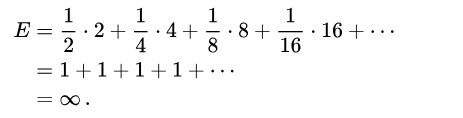
The probability of heads and tails is 50-50% which is ½ . If it is a series of heads (heads followed by heads) then the events are dependent on each other, so the probability of this event is intertwined with the probability of the previous one. If there happens a game where you start with $2 and every time heads comes, and the money goes on doubling the equation of gain would be:

As this math goes, a person should pay infinite amount as he will be gaining infinite amount from such game. ‘E’ value here is identified as expected value. Even if one such possible game would happen in reality, people won’t pay infinite amount in reality to enter this bet. 

Bernoulli resolved this paradox by creating the concept of Expected utility. People will pay not what actual value it delivers (as in the $s of money); they will pay according to how actually it will be useful to them, ‘utilizable’ to them – that is where the utility and thus expected utility comes in picture.

Expected utility is calculated by the amount one would gain and the chances of gaining that amount. The expected utility thus is sum of all the gains connected with the probabilities of gaining them.

Daniel Bernoulli
The determination of the value of an item must not be based on its price, but rather on the utility it yields.

1st Tenet of EUT: Expectation

The overall utility of a prospect, is the expected utility of its outcomes.

In very simple words, for a given scenario you will weigh the chances of its constituent events and connect them with their respective gains. The sum of the all connections of each gain with their chance of realization is the usefulness – utility of that scenario.

Mathematically,

Expectation:

In our example we need to assume something that is the usability of the money – utility.

We assume $10 has utility of 1 unit. (This is just an assumption to understand the concept. When multiple objects are involved, their utilities will be different.)

So, the expected utility of this scenario is:

E = ((1000/10)x0.2) + ((50/10)x0.65) + (10000)x0.15) =

20 + 3.25 + 150 = 173.25 units

So, the expected utility – the usefulness of this event is 173.25 units.

The unit of value which we assumed in this calculation is sometimes called ‘utils’ – the basic unit of utility. It will change based on how one perceives the value in given scenario. 

You will realize that the expected utility is the weighted average of utility of events and their individual probabilities.

Four Axioms of Utility Theory

Later John von Neumann and Oskar Morgenstern expanded the concept of EUT with the idea of rationality. The agents involved in such uncertain economic exchanges are ‘econs’-the rational beings.

Oskar Morgenstern & John von Neumann

They have clear preferences among the options provided in every economic decision which comes under the idea of “completeness”. If out of the given set they select multiple options at a time, then it is said that they are ‘indifferent’ to these options. Whatever might be the internal distribution of constituent they might have. It’s about the final utility they perceive. When presented with choices, a rational person has clear preferences for those choices.

For all given uncertain events there is a hierarchy of preferences. If A is preferred over B and B is preferred over C, then A is always preferred over C. Which goes as transitivity.

Suppose we have been presented three events where event A is preferred over B and B is preferred over C. Now if one introduces a new event N which is slightly less preferred than B and more preferred over C then event B and N would be indifferent. In simple words, the choices between options would never directly jump, they will align as per the preferences in line.

So, A>B>C and B>N>C then A>B>C and A>N>C mean the same.

This is continuity. Graphically, the utility function is always a smooth curve.

Why do A>B>C and A>N>C mean the same even when the calculated numeric value would differ? It is because utility is never an absolute value it is just used to arrange the preferences by quantifying them. Ground rules used to define usability from the given resources i.e., the utility function of given scenario will be different for different scenarios and different sets of people. This is simplification of the concept called ordinality of utility. You can rank utility but not say that event A is this many percent better than event B.

When you have set the preferences of A over B and if you are offered another totally different/ irrelevant event M with new utility. You would still prefer A over B. Introduction of M will not affect the preferences as if A and B are independent of M. This is called ‘independence‘ in EUT.

So, completeness, transitivity, continuity and independence are the four axioms of EUT. Note that they are not ‘complete’ representation of reality. It’s just that they bring in simplicity to treat given scenarios and evaluate them. That is why you will find contradictions to these axioms. (Maybe a topic for another time.) The axioms are there to create a formal mathematical structure to draw useful inferences.  

2nd Tenet of Expected Utility Theory: Asset Integration

In EUT, asset integration is an idea based on the assumption that all people making economic decisions are rational. So, in uncertainty or risky scenarios a rational person will look at the overall gains instead of focusing on one certain gain and neglecting other unsure gains. A rational person will look at the risks of scenarios in a collective way and decide to enter only if the expected utility improves his assets’ position. A rational person will only enter the given scenario if the collective utility is better than the individual utility of its sub-events or sub-gains.

A rational person will not focus on an individual more probable gain even when his overall gains are becoming low.  

3rd Tenet of Expected Utility Theory: Risk

The beautiful insight EUT creates is about the mathematical formalization of risk profile. For that we will understand some ideas in advance.

Utility function – it is a mathematical relation between how one sees the value of given object/ resource. The value of resources is different for different people. A crude example would be how a beggar values money for one time meal compared to a filthy rich person. The value of $25 would be different for different people based on the conditions they are in.

This is where marginal utility comes in picture.

Marginal utility talks about what difference it makes in your perception of the value of a given thing if one would give you more of that in the next event. Roughly speaking the more we have something, the less we value it, so marginal utility is always diminishing. If I already have 10 packets of chocolates which are enough for the day to me, the next 11th packet of chocolate won’t make that much difference in my current excitement of having 10 packets. (Please note that we are talking about rationality here, although nobody is rational when it comes to chocolates.) A rational version of me would trade that 11th packet for something else with a person who hasn’t received even a single packet. A person who has no chocolate would perceive that single packet with higher value than how I perceived it (provided that he loves chocolates).

Alfred Marshall – the British Economist brought the concept of
‘Marginal Utility’ through his book ‘Principles of Economics’ in 1890.

So, utility function is a mathematical transformation of objects in given event to a unitary value so that the results can be easily compared with each other because the transformation converts everything to single unit system. These single unit of value is called ‘util’.

Utility function can be any possible mathematical relation. Generally, it is expected to be simple to not invite the complexities in modeling of given economic scenario. It should be simple enough to draw realistic conclusions.

An understanding of utility function gives insight into how the person evaluates risk with respect to the resources they hold.

Consider a scenario:

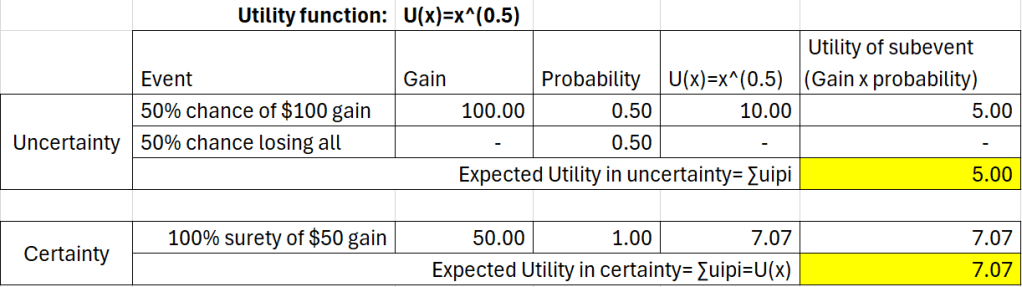
Event 1 – You enter a lottery where there is 50% chance that you will win $100 and 50% chance that you win nothing.

Event 2 – You are given $50 for sure, unconditionally just for playing the lottery.

Assume we have three differently thinking people to make choices in this scenario. Different thinking means how they assess the risk of entering the lottery which has some uncertainty and the surety of winning $50. Difference in assessment of risk means difference in the perception of utility. It further means that the utility function will be characteristic to each person.

Person 1 has the following utility function:

So, for Person 1 the utility of certainty (7.07 utils) is higher than the uncertainty (5 utils). He is happy to walk away with sure $50 gain instead of betting for $100 lottery.

Person 1 doesn’t want to take risk by entering the Event 1 of betting when he is sure about gain of $50 in Event 2. This is risk-averse behavior. The utility function mathematically models that risk averse behavior. Utility function is concave in risk aversion.

Now comes Person 2 with the following utility function:

You will see that the utility of certain and uncertain choices is the same. It means that it doesn’t matter for this guy if he enters the lottery having uncertainty or gets $50 for sure. This is risk-neutral behavior. The person 2 doesn’t care about certainty or uncertainty. He values both events the same. As mathematically both have similar utilities. Person 2 is indifferent to both events.

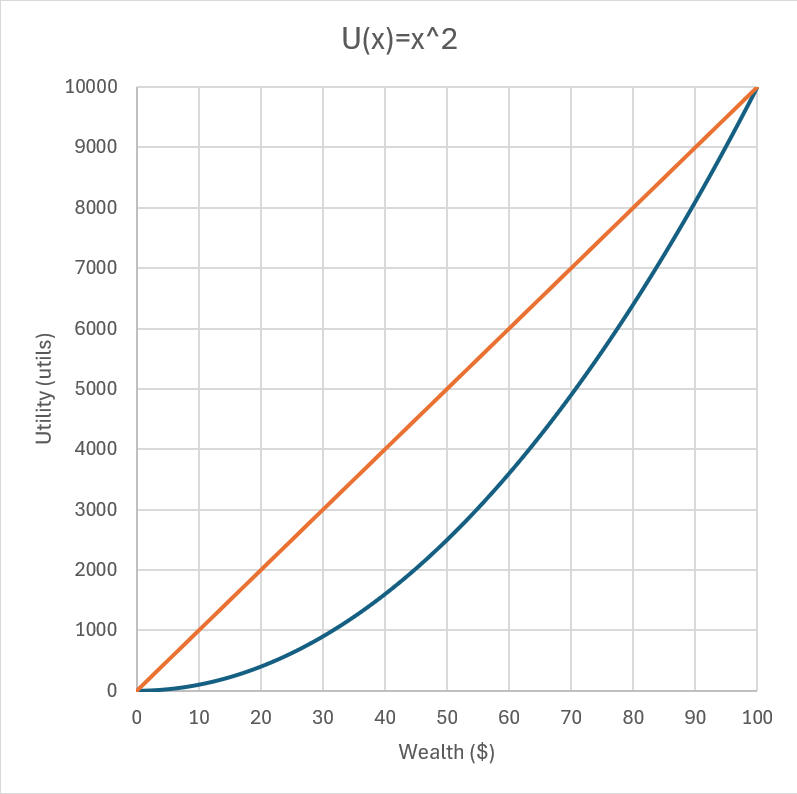
Now see the Person 3 with following utility function:

This guy has a radical view, he perceives the worth of entering the lottery (5000 utils) better than gaining $50 for sure (2500 utils). This guy is gambler! He finds it more interesting to enter the bet instead of gaining $50 for sure. He is happy to take the risk in uncertainty.

Looking at these three people you should note that the scenarios/ events they are presented are exactly the same. The only thing which is different is how they see the value in lottery and the sure gain.

So, the first person demonstrates risk averse behavior. He wants surety of gain rather than gambling for higher but unsure gain.

The second person demonstrates risk neutral behavior. Bet or no bet he doesn’t care. Just be done with it.

The third person demonstrates risk loving behavior. He wants the thrill of uncertainty in betting, so he sees more value in uncertainty of lottery.

This is how Expected Utility Theory can be implemented to mathematically model how different sets of people/fund managers will make decisions based on the risk profile. The relation between expected utility (which is the weighted average of gains) and utility function (which shows how one values the gain) can show us the risk profile.

Risk Averse Utility Function
Risk Neutral Utility Function
Risk Loving Utility Function

In the graphs shown, blue lines show utility function and the orange lines show expected utility. The orange line in our case connects the utility of $100 and $0 which is Event 1. This orange line connects any points on utility curve and it will give the expected utility value for that scenario of uncertain gain. In simple words, it’s the line of weighted average exactly like the definition of expected utility. This line is used to find out the certainty equivalent (CE). A certainty equivalent is the utility of an uncertain gain if it was certain.  

Almost all the time, people are risk averse. People want to avoid uncertainty about higher gains when they are presented with some lower but sure gain. This is where marginal utility becomes important. (This point deserves broad explanation which we will cover another time under Prospect Theory)

Marginal Utility

In risk averse people, you will see that the utility function starts to flatten out once the value gained increases. The more value someone already has the less he values the next addition of bunch into the preexisting bulk. Remember the chocolate box example?

One with 10 boxes of chocolate perceives one additional box with less value, whereas some with no chocolate will see it as a precious one as he has nothing right now. The perceived value of the additional next lot goes on reducing. This is known as diminishing marginal utility. Marginal utility is always diminishing.

So, a safe playing person would stop entering the next gamble because he now has enough. The next uncertainty in gambling has less value for him.

EUT in actuarial

Now it is obvious that only a risk averse person would go for conservative approach in uncertainty. This also means that risk aversion will also invite preventive measure against loss of certain assets, resources. Insurance thus comes into the picture. EUT here helps to mathematically formalize the probability of the risks which would compromise current gains, the perceived value of asset/ property/ resource and losses one can bear. We can now calculate the premium for the insurance against uncertainty of loss of something.

So, we will look into a scenario where risk aversion exists thus marginal utility is always diminishing.

We have the utility function of a man has a property giving revenue of $100K/year as:

u(x)=ln x

Now will see the risk scenario. Suppose this person does a fire audit of his property and the auditing agency finds out that there is 50% chance that he will suffer a loss of $60K/year due to fire hazard and 50% chance that nothing will happen.

After rephrasing, the gains from the property would look this:

50% chance that the income is $40K/year and 50% chance that income is $100K/ year.

Using the tenets of EUT the mathematical expression becomes:

Now, what we are doing differently here is to find out what this expected utility in uncertainty means when there is complete effect of loss with some chance and gain of some chance. In earlier examples we had second event of certainty against which we compared to understand the risk profile. Now it’s reverse calculation, we know the risk profile, we know the perceived overall value i.e., EUT of the property. Now we will find the certainty equivalent (CE) using the risk profile which can be explained by the utility function of the person.

How much is this 11.05 utils in terms of money from the property for this guy? We can find this from utility function of the person.

ln(x)=11.05, thus x=$63245.55

Now, think the fire hazard as a lottery where you gain $63245.55 money as per EUT calculation. Whether the fire will happen or not, the possible overall earning from this property would be $63245.55.

Now, if the property without any fire hazard was giving me $100k and the insurer guarantees me that same earning for the losses due to hazard. How much maximum amount should I pay to the insurance agency?

I will pay only that much amount which falls short to the $100k when compared to perceived earning calculated from the combined effect of certainty and uncertainty as given by EUT.

My earing due to uncertainty is $63.2k/year, I would receive $100 for a fine year so in order to continue that $100k even for a worse year I would pay insurance agency = $100000 – $63245 = $36754.45.

Anything I am paying above $36754.45/ year for insurance premium is loss for me. I would not go above this amount to insure my property which guarantees income of $100k per year. This is how the insurance premium is decided.

Conclusion:

We have many philosophical ideas about how money is not everything in life but deep down everyone knows that money constitutes a bigger portion of who we are. Although money can’t buy everything, the unexplainable value it holds behind presence of almost everything in our lives will never go unnoticed. We know that this importance of money/ resources/ assets is highly dependent on how much of these we have right now and how much of those may get lost. This perception of value drives our decision making in risky situations. The mathematical formalization of the perception of wealth, our risk profile is facilitated by expected utility theory. Although this theory has its own limitations it lies at the foundation of the economics.

For further reading:

  1. Von Neumann, John, and Oskar Morgenstern. “Theory of games and economic behavior: 60th anniversary commemorative edition.” Theory of games and economic behavior. Princeton university press, 2007
  2. Kahneman, Daniel., and Amos Tversky. “Prospect theory: An analysis of decision under risk.” Econometrica 47.2 (1979): 363-391
  3. Thinking fast and slow – Daniel Kahneman
  4. Connecting money with sentiments – Behavioral Economics
  5. Settling accounts with the losses – On Prospect Theory