Philosophical fate of AI and Humans

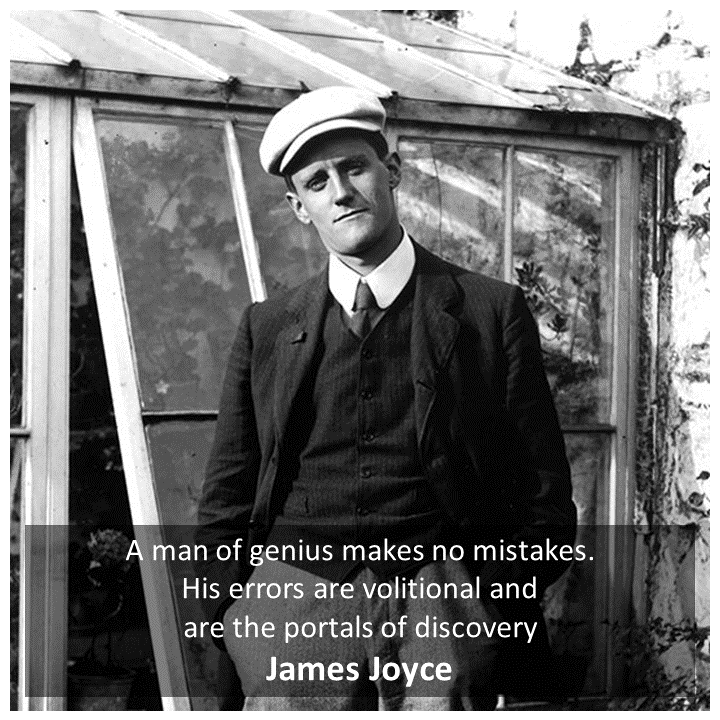
Alan Turing was the very first person in the world to formally ask- “Can machines think?” The ideas he presented in his famous paper has laid the pathways leading to the creation of modern computer science and today and tomorrow of artificial intelligence. There is no doubt that there will be a time when machines would be able to think just like humans do, but that should not be a negative aspect. There will be practical limitations to a human-like thinking machine too. So, the game would never be single sided. This should push humanity on a completely new path of evolution. That is also how we have become the humans we are today from the primitive apes.

Alan Turing’s world famous paper on future of human-like thinking ability in machines
The holy doubt – “Can machines think?”

We all know how modern machines/ computers have great abilities to make systematic thinking and take decisions accordingly; this is obviously attributed to the very programming embedded into them by us human beings. Many breakthroughs in storage capacities of computers, size of computers, efficiency of these machines, computation capabilities, evolution of programing languages, intersection of neuroscience and computer science, accessibility of these highly powerful machines to masses have shown world that such machines can do amazing marvels.

You know where I am going with this. Not mentioning Artificial Intelligence in these breakthroughs would be a straight crime. AI has unlocked a totally different capability in computing for which some are optimistic and some are fearful. In a crude sense, how AI stands out from other concepts of computing is its ability to change it programming to achieve given goal. This concept is very normal even for today’s child.

But, would you be open to such self-programming machine 75 years ago? A time when there were only mechanical calculators, electronic computers were in their infancy and were created only for certain restricted problem solving and number crunching. Even the experts of those times found this idea foolish because of the practical limitations of those times. How could a machine think like a human being when for doing some mechanical number crunching it takes such many resources, doesn’t have its own consciousness, its own soul, has no emotions to react to given stimuli? In simple words “thinking” is somehow associated as a special ability humans got because of the soul they have, the conscience they have (granted by nature, the Creator, the Almighty, the God or whatever but some higher power)

It is our tendency as human beings to have this notion of being superior species amongst all which brings in the confidence that machines cannot think. That is why this idea seemed foolish, but now we are comfortable (to some extent but not completely) with the idea of thinking machines.     

Alan Turing – a British mathematician, the code breaker of Enigma, the man who made Britain remain strategically resilient in World War 2, the Father of theoretical computer science wrote a paper which laid down the blueprint of what the future with AI would look like. For the times when this paper was published all the ideas were seemingly imaginary, impractical, and totally impossible to bring into the reality. But as the times changed, Alan’s ideas have become more and more important for the times in which we are living in and the coming future of Artificial Intelligence.

Weirdly enough, this paper which laid the foundations of artificial intelligence – thinking machines was published in journal of psychology and philosophy called “Mind”.

The world-famous concept of ‘Turing Test’ is explained by Alan in this very paper. He called this test as a game – an “Imitation Game”.

The paper reflects the genius of Alan Turing and how he had the foresight of the future – the future with thinking machine. After reading this paper you will appreciate why and how Alan was able to exactly point out every problem that would rise in future and their solutions. He was only limited by the advancements not happened in his time.

The Imitation Game   

Alan posed a simple question in this paper –

Can machines think?

The answer today (even after 75 years) is of course a straight “NO”. (Deep down we are realizing that even though machines can’t think they are way closer to copying the actions involved in thinking or “imitating” a thinking living thing)

The genius of Alan Turing was to pose practicality to find the answers to this question. He created very logical arguments in this paper where he used the technique of proof by contradiction to prove the feasibility of creating such ‘thinking machine’. The AI which has evolved today is the very result of following Alan’s blueprint for making thinking machines.

The famous Turing Test – the Imitation game is a game where an interrogator has to tell the difference between a machine and a human being by the responses they give to his/her questions.

The machine is not expected to think like humans but at least imitate them. The responses may feel completely human but it is not a condition or compulsion that machine should exactly think like a person. This practicality introduced by Alan and his arguments built upon this idea shows what are our limitations when we are actually thinking or making any decisions. This paper will change and also challenge the way we think or do anything. This paper might humble you if you think that we are superior beings because we can think and have/ express emotions. (Trust me you would also question ‘What is love?’ if love was your next answer to justify our superiority after reading this paper but that is not what Alan was focusing when he wrote this paper.)

The idea is not about creating an artificial replica of human, it is to create a machine which would respond just like humans do, the goal is to make their responses indistinguishable from ‘real’ human beings.

There are hundreds of simplified explanations on Turing test (ask Chat GPT if you want) which Alan has discussed in this paper but that is not my interest of discussion hereon.

I will be focusing only on the arguments made by Alan to prove why it is completely practical to create human-like thinking machines. My intent in doing so is that to show how we as humans can also be challenged by our practical limitations. These arguments also show a way to humans where they will get overpowered/ surpassed by AI. This does not mean that AI will eradicate humanity, rather it shows new pathways in which humanity would evolve. So, for me the arguments end on an optimistic note. Surely AI will take over the things which make us who we are but it will also push us into some completely unconventional pathways of rediscovery as the smart species.

The way in which Alan intended the Imitation game was the mode of question-answers – an interview. You would question why didn’t he think of a challenge where exact human like machine need to be created – that would be more challenging for the machines. I think, the idea behind rejecting the necessity for a machine to be in human form is like this-

The creation of human body is very similar to cloning a human body or augmenting the human parts to a mechanical skeleton. What is more difficult is to impart the consciousness and the awareness which is (supposedly) responsible to impart thinking in humans. So, even if a fully developed machine exactly looking like human being is in front of you and you are unable to tell that it is a machine, the moment that human-like machine would start expressing its thoughts everything would be easily given away.

In simple words, Alan was confident that the biological marvels, genetic engineering, cell engineering would easily take us to the physical replication of human form. What would be difficult is to create a set of logics (or self-thinking mechanism) which would demonstrate human like (thinking) capabilities. And such abilities can easily be checked by mere one on one conversation. Such was the genius of Alan Turing to bring such complexities using this simple experiment of Imitation Game.

We as human beings have certain insights, intuitions (I don’t want to use this word but don’t have any alternative word) which gives away if it is a machine or a human.

What Alan did masterfully and why he deserves full credit is that he pointed out the factors which can make machines respond and ‘think’ more like humans. While creating the confusions about the nature of human mind, consciousness, awareness, thoughts and their limitations and ambiguity, Alan also gave the possible arguments to solve these confusions.

Alan proves that human-like thinking machines can be created and he proves this by contradiction of the objections raised against this idea. I am diving deep into these objections hereon:

  1. The theological objection

The rigor that Alan used to prove his point deserves appreciation. Despite being a logical thinker and mathematician, he cared to answer the religious point of view, he wanted no stone left unturned while making an argument.

Alan aggressively (verbally) hammered the idea of God’s exclusivity to grant the immortal soul to only humans, the soul responsible to make humans think. Alan says that if soul is the reason, then animals have souls too. The true comparison then should be between living and nonliving things to support the point that machines cannot think. It is because they are nonliving things they have no soul so they cannot think.

But if the great almighty can give soul to an animal, then why this omnipotent God decided to not give same souls to the machines? Alan knew that any blind theologian would find a contrived argument to prove this idea but he clarifies his point by presenting the historical mistakes religious institutes committed because the truth was hard to swallow. Alan gives the examples of Galileo who presented that earth was not the center of the universe, against the ideas of Church. Later church was proved wrong.

So, even if the religious arguments may seem easy to understand, easy to ‘swallow’ but if they are not fitting in the logic, it makes no sense to take them forward. The theological inconsistency ‘As machines have no soul granted by the God, they cannot think like humans’ which Alan pointed out  was totally false. He justifies this point using the logic of God remaining the ultimate creator.

Alan explained that if we are stealing the powers of God to create a human-like thinking ‘thing’ its not a crime or a blasphemy. Does procreating and making children “to whom also God grants the soul for thinking” mean crime? In similar spirit ‘machines’ – thinking machines are our children whom to God should bless with his powers.    

“In attempting to construct such machines we should not be irreverently usurping His power of creating souls, any more than we are in the procreation of children: rather we are, in either case, instruments of His will providing mansions for the souls that He creates.”

No doubt he would also have been a great priest if he had thought of changing his career to theology.

  1. The ‘Heads in the Sand’ objection

Alan gives worst case scenarios on the superiority of human species out of all species. What if we are “the superior” species? If that is true then there is no reason to worry about thinking machines, they won’t surpass us.

But what if what we know is wrong? We have been proven wrong many times in history. What if we are not the superior species? Then there is no sense in blindly believing that we are superior. Rather this illusion of superiority steels us from the chances to fight the battle of superiority.

So, in either case, we cannot run out of the fate of thinking machines Vs humans. We may fake it, run from it, hide it from rest of the population but it is not in our favor if we do so.

“We like to believe that Man is in some subtle way superior to the rest of creation. It is best if he can be shown to be necessarily superior, for then there is no danger of him losing his commanding position.”
  1. The Mathematical Objection

Very beautifully Alan brought the Gödel’s incompleteness theorem to prove his mathematical argument. According to Gödel’s incompleteness theorem, if we start to prove every mathematical argument there exists in the universe, we end up into some arguments for which there exists no proof. In order to ensure that the whole mathematical system remains stable, consistent on logic one has to accept those arguments true. So, once such logically unprovable but true in existent reality statements are found in nature they create a new system of mathematical understanding.

In simple words, every mathematically logical system is inconsistent in the end, in order to remove that inconsistency a new rule must be accepted which create a new system of mathematics. (Which again would be inconsistent)

Further oversimplification goes like this,

A farmer wouldn’t know how to make a shoe. So, he would need knowledge of a cobbler. A cobbler wouldn’t know how to make metal tools, so he would need help of blacksmiths. Even if they have each other’s knowledge, skills they must accept certain thumb rules passed down from their ancestors (which are always true but unprovable) to master each other’s skills.  

So, even if you are creating a thinking machine based on purely mathematical system the mere limitation of mathematics will stop it from overpowering, surpassing humans.

This also does not mean that thinking machines are defeat-able. A machine with one mathematical system in totally different domain could support this logically inconsistent system just like the villagers with different professions.

Alan Turing’s doctoral thesis contains the ideas of Gödel’s Incompleteness theorem so it is a joy to read these arguments in this paper. They are well formed and super-intelligent.

(If you are really interested what this argument means, you can research the efforts that went into proving Fermat’s last theorem. A new field of mathematics had to be created to prove this simple to explain but difficult to prove mathematical theorem.)

There will always be something cleverer than the existing one – for humans and for thinking machines too.

“There would be no question of triumphing simultaneously over all machines. In, short, then, there might be men cleverer than any given machine, but then again there might be other machines cleverer again, and so on.”
  1. The argument from Consciousness

Even if the machine is feeling and thinking exactly like a human being, how could the “real humans” know that it does so? – Alan’s new argument.

“The only way to know that a man thinks, is to be that particular man. It is in fact the solipsistic point of view. It may be the most logical view to hold but it makes communication of ideas difficult.”

Communication between machines and the humans and its quality would be key proof to understand whether the machine thinks like human beings or not. Even if the machine is really thinking exactly like humans, it is futile if it cannot communicate so to humans.

(That is exactly why The Turing test with mere typed communication is more than enough to check the thinking ability of machines.)

It is the great philosophical mind of Alan to use the limitations of Solipsism to justify his point. According to solipsism all the world exists in the mind of the person because if the person dies then it doesn’t matter if world is there or not.

The key limitation of solipsism is that your survival is not directly connected to your mere thinking. If I think ‘I am dead’ that does not immediately kill me. If I think that I have eaten a lot without actually eating anything, that doesn’t end my hunger in ‘reality’. So, reality is not only your mind.

Also, solipsism fails to answer the common experiences we have in a group. If my mind is my world, I can create any rules for my world and things would always go as I desire. But that doesn’t happen in reality. There are certain ways, truths which are common to all of us that is why our world is not just our mind, rather it may be a shared world. You alone are not the representation of whole reality.

So, even if we accept that the machine ‘inwardly’ thinks like human being, it has to share some common truths to the interrogator to prove its humanly ways of thinking.

“I do not wish to give the impression that I think there is no mystery about consciousness. There is for instance, something of a paradox connected with any attempt to localize it. But I do not think these mysteries necessarily need to be solved before we can answer the question…. (the question – can machines think? Can they at least imitate humans? – the Imitation Game)”
  1. Argument from various disabilities

Alan is challenging the idea that even if machines are successful in thinking exactly like humans, they won’t be able to do certain things which humans can do better.

It’s like a human saying to a thinking machine –

“You machines can think like us but can you enjoy literature and poetry like we humans do, can you have sex just like humans do, enjoy it and procreate just like we (human) do? This is exactly why your thinking is not a human thinking.”

The key point Alan is trying to prove is that people always need a justification of given machine’s ability (through its ways of working, maybe its architecture, its technology, its components, its sensors) to prove that certain capability of the machine. When we are showing these justifications, we are also telling people indirectly what it cannot do thereby its disabilities. One ability would point to other disability.

People do not accept black box models in order to justify ability of the machine.

“Possibly a machine might be made to enjoy this delicious dish, but any attempt to make one do so would be idiotic. What is important about this disability is that it contributes to some of the other disabilities.”

In same fashion one argument is that even if machine could think like humans, it is difficult to have its own opinion. Alan strikes that too.

“The claim that a machine cannot be the subject if its own thought can of course only be answered if it can be shown that the machine has some thought with some subject matter.”

The key disability which was preventing Alan from creating a working thinking machine was the enormous storage space. You will appreciate this point today because you know how drastically storage capabilities have improved over the time. These improvements in storage created the AI we see today, although processing power is also on factor and there are other factors too but it boils down to the ability to simultaneously handle lot and lots of data.

Alan had this mathematical insight that once the storage ability is expanded enough the thinking machines is a practical reality. (Now researchers are not only working on to further improve storage capability but special efforts are also taken to effectively compress data. Ask Chat GPT about the Hutter Prize)

So, Alan makes a point that having variety of opinions in order to ‘think for itself’ machines don’t need logic, they need enough storage space just to process them simultaneously to create a new thought. In terms of humans, the more information and logic you can handle the crisper your understanding are. Same would be the case for thinking machines.

“The criticism that a machine cannot have much diversity of behavior is just a way of saying that it cannot have much storage capacity. “
  1. Lady Lovelace’s Objection

Charles Babbage was the first person to technically create calculator with memory – a programmable computer which they called Analytical Engine. Even though he knew how the Analytical Engine works Ada Lovelace created programs and published them to the masses to prove the effectiveness of the Analytical Engine. She was the first programmer of computer.   

Lady Lovelace’s key argument is based on the idea that the computer thereby a thinking machine cannot think for itself because it can only use what we have provided it. As we have provided whatever we know and have it cannot think outside of that information and generate new understandings, The machines cannot think “originally”.

Alan strikes down this argument easily using the idea of enough storage space. If the machine can store large enough data and instructions then it can create new inferences, original inference.

“Who can be certain that ‘original work’ that he has done was not simply growth of the seed planted in him by teaching, or the effect of following well-known general principles.”

Alan questioned the very nature of originality. Only a genius can do this in my opinion. Alan showed the world that the things which we call original are inspired, copied from something already existent. It is just matter of how unknown we are to this new thing.

He builds further upon that saying that if machines can think originally then they should surprise us. That is reality. Machines do surprise us by using unconventional approaches to our daily tasks. 

Alan links new argument for further justification, if machines can think originally then they can surprise us. In order for us to not get surprised we must get immediate understanding of what machine presents which never happens when such events happen. So, machines can think originally and can surprise us.

“The view that machines cannot give rise to surprises is due, I believe, to a fallacy to which philosophers and mathematicians are particularly subject, This is the assumption that as soon as a fact is presented to a mind all consequences of that fact spring into the mind simultaneously with it.”

What a brilliant argument!

  1. Argument from Continuity

“The nervous system is certainly not a discrete-state machine. A small error in the information about the size of a nervous impulse impinging on a neuron, may make a large difference to the size of the outgoing impulse. It may be argued that, this being so, one cannot expect to be able to mimic the behavior of the nervous system with a discrete-state system.”

Alan talks about an attempt to create thinking machines by mimicking nervous system which is a continuous system. A system which works in wave, signals (analog) and not in ones and zeros (discrete).

Alan says that even if we use such analog system in Turing test, the outputs it would give would be probabilistic instead of definite. This will actually make the interrogator difficult to distinguish human response from the machine one. Humans would be more frequently unsure and will give such probabilistic answers more frequently.  

  1. The argument from Informality of Behavior
“If each man had a definite set of rules of conduct by which be regulated his life, he would be no better than a machine. But there are not such rules, so men cannot be machines.”

The idea that machines work on certain defined rule even if they can alter their own program by themselves in order to think like humans, it feels obvious that they will be more formal and stuck to their rules while responding. This formality would give away their non-human nature.

Alan questions the very nature of what is means to have laws in a logical setup. Taking support from the Gödel’s Incompleteness theorem, not even single system – single logical system can confidently remain purely on its laws. It would assume some arbitrary point to make some sense out of given data even if it is using some mathematical frameworks. (Remember the simulations where you put garbage in and the simulations runs perfectly giving garbage out. But you know its garbage because you have certain test to judge the output with reality which are objective.)

There is no such objectivity to judge informality of a system – the word and logic itself says it all. Our search for formal laws would never end and this will always keep on creating new laws and new inconsistencies and informalities. There is no end.    

“We cannot so easily convince ourselves of the absence of complete laws of behavior as of complete rules of conduct. The only way we know of for finding such laws is scientific observation, and we certainly know of no circumstances under which we could say, ‘We have searched enough. There are no such laws.’”
  1. The Argument from Extra-sensory Perception
“The idea that our bodies move simply according to the known laws of physics, together with some others not yet discovered but somewhat similar, would be one of the first to go. This argument is to my mind quite a strong one. One can say in reply that many scientific theories seem to remain in practice, in spite of clashing with ESP; that in fact once can get along very nicely if one forgets about it.”

Again, Alan left no stone unturned. He made sure that even the pseudo-science fails to support the idea that machines cannot think like humans.

He explains that even if the human competing against the machine mimicking humans has telepathic abilities to know states of the machine or even the interrogator, it would actually confuse the interrogator. The only thing such telepathic person can do differently is to under-perform intentionally which again would confuse the interrogator.

The idea is that even when we are not sure of how such supernatural things works our current understanding of things and their workings are just fine. The supernatural things are not interfering in our formal understanding of nature and reality.

The implications of Alan Turing’s Paper on Computing Machinery and Intelligence

All the ideas explained by Alan in this paper are responsible for the modern technologies like efficient data storage, data compression, artificial neural networks, self-programming machines, black box models, machine learning algorithms, iterative learning, data storage, manipulation thereby data science, analog computing, self-learning, supervised learning algorithms, Generative Pre-Trained Transformers (GPTs) and what not.

This paper is holy grail for not only modern computer science but also for the literature and popular culture. Once you appreciate the ideas in this paper you will be able to see the traces of these ideas across all the modern science fiction we are consuming all the time.

Alan created practical ideas which were possible to implement in future based on the coming technological revolutions he foresaw. He logically knew that it is possible but the genius of him was to lay the practical foundation of what and how it needs to be done which is guiding our and will guide future generations.
Conclusion

What is there for humans if machines start thinking like humans?

For this, I will address each argument posed by Alan

  1.  The theological objection

God will actually bless us because we extended his (or her I don’t know) powers to create something like his own creation through thinking machines.

  1. The ‘Heads in the Sand’ objection

Even if thinking machines surpass us, we have to live with it and create our new ecosystem to ensure our survival. Even though for given times we are superior species, other species are existing with us in the same time with their special abilities. There is no running away from any possible outcome of this scenario.

  1. The Mathematical Objection

The mathematics itself restricts a single machine from knowing everything. So even if multiple machines come together to create superior understandings same would happen for humans. There will always be this race of superiority, sometimes machines will lead sometimes humans will lead. There is no conclusion to this race as far as the inherent flaw of mathematics goes.

  1. The argument from Consciousness

A machine has to be the communicator of its human thinking, it cannot remain in the dark abyss of self-cognizance and remain away from humans. If a machine starts thinking like humans, we all would definitely know about it. A machine has to communicate its ability of awareness to, it will a surprise but a very short lived one.

  1. Argument from various disabilities

If we don’t know how machines think like human that would not prevent them from thinking like humans. We have to accept the black boxes through which machines would think like humans. That is the only sane way out. We humans too are filled with disabilities but they are not directly linked to the ways we are able to think.

  1.  Lady Lovelace’s Objection

Machines will surprise us, they can also create original ideas, because what we call original is something that lies out of the limits of our current thinking. Rather it is an optimistic idea that if machines could think like humans do then they may give us totally new ideas for new discoveries, breakthroughs.

  1. Argument from Continuity

Continuous thinking machine or discrete thinking machine both can confuse humans if they achieve their thinking potentials. So, there is no point in creating an analogue thinker to beat digital thinker. We ourselves are an analogue thinker.

  1. The argument from Informality of Behavior

No system will have all laws already established, the system has to keep on creating new laws to justify new events, outliers. The process is never-ending. So even if machines surpass in human thinking we too have the advantage of informality to make the next move.

  1. The Argument from Extra-sensory Perception

Even if the supernatural abilities are proven be existent, they will have less to no contribution in the thinking abilities of machines. So, if you are a telepathic reader a human like thinking machine can fool you without exposing its real machine identity.

Going through all this you will appreciate how limited our human thinking is. There is no doubt that there will be a time when machines would be able to think just like humans do but that should not be a negative aspect. There will be practical limitations to a human-like thinking machine too. So, the game would never be single sided. This should push humanity on a completely new path of evolution. That is also how we have become the humans we are today.
Further references for reading:

  1. A. M. TURING, I.—COMPUTING MACHINERY AND INTELLIGENCE, Mind, Volume LIX, Issue 236, October 1950, Pages 433–460, https://doi.org/10.1093/mind/LIX.236.433
  2. Understanding the true nature of Mathematics- Gödel’s Incompleteness Theorem
  3. Questioning Our Consciousness – Solipsism
A Modern Prayer to Perceive ‘The Silver Linings’

The acceptance of our dark side is the only way to start a new journey to the real happiness, fulfillment. Achieving real fulfillment becomes way easier and manageable once we start acknowledging our dark emotions, feelings of sadness and sorrow. Running away from such “low” lying emotions actually intensifies them in the abyss. Actually, such emotions have great contribution in the refinement of our character. Empire of the Sun’s new song called ‘Happy Like You’ talks about the acceptance of our dark side to make our personality whole for creating a newer and better version of ourselves.

Empire of the Sun’s song “Happy Like You”

The best piece of art can be attributed to the multiple perceptions, interpretations it creates in the mind of its subjects despite keeping its physical structure constant.

The beauty of a masterpiece is that people have their own opinion about that piece and nobody is wrong. The mere subjectivity and the possibility to invoke personal feeling in the mind of the observer or the enjoy-er of the art is the power every one of us has naturally. Most of the time very few of us unlock that power in a better sense. Music is one such power.

Recently, I came across newly released album named “Ask that God” by an Australian electronic duo called Empire of the Sun. All the songs on this album are banger and are complete redefinition of what the Empire of the Sun stands for. In my personal opinion, it is a crime to compare all the songs to choose the best one, (but you already know why I am writing this). One song that is looping in my head continuously and has occupied a larger portion of my brain for many days is “Happy like you” (this only shows that the song has conjured me thereby maintaining my previous point of not comparing good songs with each other).

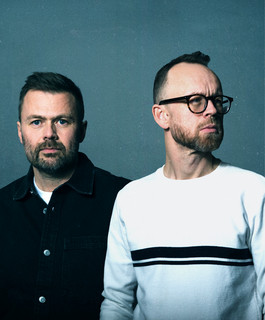
Luke Steele and Nicholas Littlemore of Empire of the Sun

Actually, bringing the poetry into the bastardized territory of prose should be a crime, for it de-beautifies the very reason for it being so wonderful. But, in order for everyone to appreciate the multiple subjective point of views and its connections with the multiple facets of life it is trying to explain, a poetry must undergo its ‘deconstruction’ into prose.

That is the crime I am committing here. If there is any songwriting, poetry, lyrics meaning police anywhere, tell them that I am here waiting for them to tolerate all this prose I have written hereon.  

Jokes aside, I am deep diving into the song and its music video.

The song

The song is written by Luke Steele and Nick Littlemore of Empire of the Sun.

Happy Like You lyrics © Universal Music Publishing Group

You’re revolutionary
You’re like a phantom taking a leap
You’re heart is legendary
Bet you are feeling so high
You have a higher power
Telepathic talk to me
Make me whole again
Whole again whole like I used to be

Happy like you
Happy

The poet is asking the higher power for something that would make him feel complete like he was before. He is praising the power of this higher power so that it can bless him.

The words used by poet like revolutionary, taking leap, legendary heart are used to describe this higher power reflects what he exactly wants from the higher power. He wants to regain a lost part of his personality he was before going through this hardship. He wants the higher power to take the leap to come out of the sorrow, transcend the current state and bring about an “internal” revolution in a way.

Telepathic ability indicates the poet’s trust in the higher power. Poet knows that this higher power is his final resort to all that exists. That is why this power knows everything already and there is nothing required to be expressed formally to get things done.

Ultimately, it is a request to regain that precious part of the poet’s personality, that happiness which defined his whole personality.

Won’t you humanize me
Use all your wisdom
Show me joy in everything
I’ve been clouded by machines
Lost my way deep inside another screen

The rhetorical question posed by the poet is a slight indication of what he lost during his difficult times. He lost the things which made him human. He lost the ability to see the silver linings.

This is the exact spot we must understand that the person lost his personality in depression and mental battles. But why? and how?

Immediate forthcoming lines show what happened. The screens and “machines” indicate the influences of the mechanical world on our daily lives and the added powerful effect of social media which led to a dreadful state of depression.

It’s an irony that when we are ‘liking’ certain things on social media from other people’s lives, a deep-rooted sadness, envy, hatred is getting born out of the one-to-one comparison of lives. Everyone is conscious of these emotions due to social media but the penetration of social media, screens everywhere is so regular and normal that we are subconsciously (now mechanically) ignoring these emotions which take a toll on our minds when we are shocked with something really sorrowful.   

All I wanna be is happy happy happy like you 
All I wanna be is happy happy happy like you

 Once you pass through such horrible emotions of sadness and depression you start appreciating the person you were, how happiness made you the better version of yourself. This happiness made you feel like the greater, higher power itself. That happiness actually made you feel closer to the higher power. The poet urges the higher power to make him who he was before and just in the ways the higher power carries itself.  

You’re revolutionary 
Telepathic talk to me
You are imaginary
Bet you are feeling so high

Wish is a dream that comes true

The most difficult part of coming out of the depression is that it starts in mind of a person with such an intangible, non-physical thought/ idea and then it starts to affect the real events, objects, people around him/ her. So, even though fixing the reality around such person can help to come out of the depression; uprooting the deeply settled feelings of sadness, grief, sorrow has immense impact in the person’s fight against depression.

That is exactly why the wish to become happy shows that the poet whole-heartedly wants feel happy. The ‘wish’ indicates is readiness from inside to be realize happiness from intangibility to reality thereby highlighting the use of the expression “dreams that come true” here.

Time is a song that forms you 
Oh I hope you

The expression of ‘time’ which formed this higher power implies the time which need to given to person to heal when he/ she is in hardships. Give it some time, it will pass too. The poet has understood that over the time even though it will seem difficult but over the time every sadness will fade away. It’s just an ask from poet to the higher power to get the patience, courage for passing through this hard time.    

Won’t you humanize me
Use all your wisdom
Show me joy in everything
I’ve been clouded by machines
Lost my way deep inside another screen

All I wanna be is happy happy happy like you

Ultimately the influence of social media on our lives and the mere algorithmic, mechanical nature of our lifestyle is leading lives of many really happy people to a depressed, sorrowful life. The poet asks the higher power to make such people complete again and happy again just like the supreme power is. It also means that once we become happy and complete, we will become that supreme higher power again.   

From a simple explanatory point of view on any poetry/ songwriting, the song gives an impression of the man’s urge to regain his happiness, his identity when he is in the conundrum of depressive emotions and thoughts. The impact of depression is great because the factors causing it are within our hands (or I may say fingers’) reach – the social media and the screens.

I think the songwriters have taken this excuse of the depression from social media to show what an urge to overcome any depression means for any human being; what it means to redefine the personality and also complete the human being in a bigger picture.  

The video and its symbolism

The phone call –

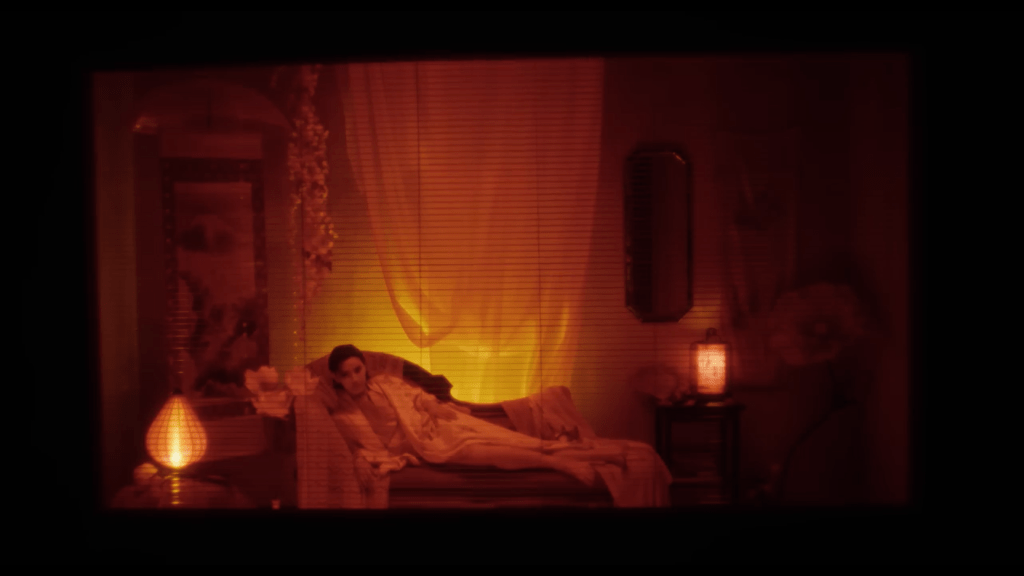
The video starts with a phone call. The girl receives a call on her landline and then the frame shifts to a guy (Luke Steele – Emperor Steele) in a dark with a red hue and dark hat. This is indication of her having a call with her inner self. The low-lit room shown throughout the video is the metaphor of she having discussion with herself and her inner thoughts and emotions. The phone call is proof of she handling her emotions by herself, it is her own conscience calling her.

Frame from Empire of the Sun’s Happy Like You MV
A low-lit room –

Watching reflection in mirror and hand movements on her own body shows she is interacting with herself. It is like a self-talk one has with themselves while figuring out what needs to be done. The low-lit room shows that dark part of our personality which also need acknowledgement. Even though the song calls for the person to be happy, this low-lit room has bigger significance. It is an indication that the real happiness comes with our acknowledgement of our darker side. Darker not in the sense of negativity but more in the sense of left out emotions which also need proper attention.

Frame from Empire of the Sun’s Happy Like You MV
The colors –  

Even though the music video looks colorful with some dark theme, the choice of colors used in this video are specific; there are characters, colors to the people shown in the video. Hot, cold, and warm / Red, blue, yellow, greens sometimes – indicate respective emotions and the interaction of the girl with those emotions. It is like she is trying to understand them and accept their presence to find the answers.

Frame from Empire of the Sun’s Happy Like You MV
The window –

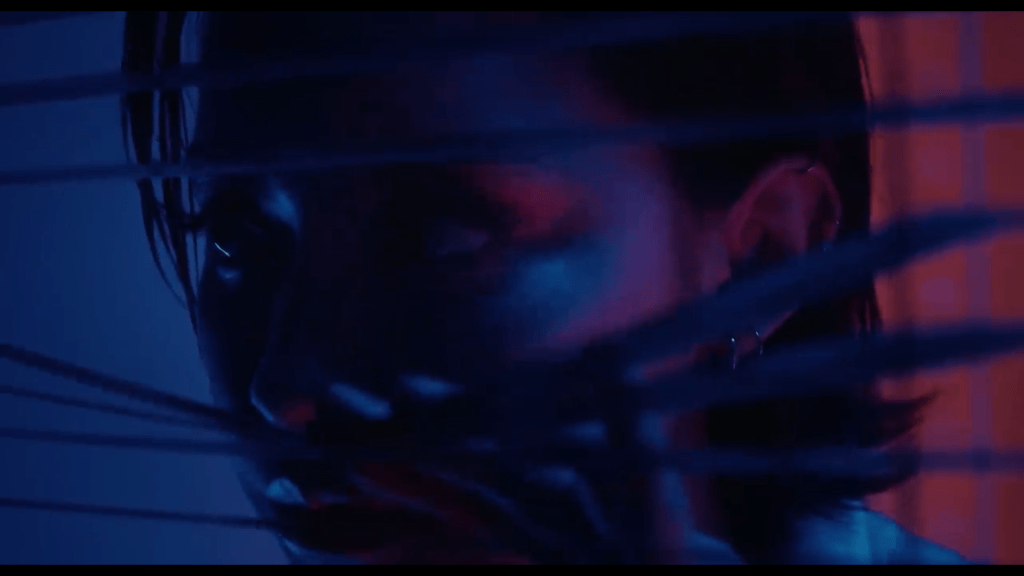
In the early part of the song, you will see the girl peeking through the blinds to see what’s behind the glass. It’s literally her peeking into her dark side of the mind.

There is a glass window with blinds between a person and the girl. The person can see her doing all her activities. What girl sees is only her reflection, this absolutely support the symbolism of her having an internal conversation about the overall depressive state of her mind.

Frame from Empire of the Sun’s Happy Like You MV
The sadness, grief –

You will see one person (Nick Littlemore – Lord Littlemore) with the black tears seemingly away from the window in certain snippets of the video, who appears and goes withing few moments. This is that deep rooted feeling of sadness which the girl is trying to acknowledge. One person closer to the glass window observing the girl’s activity is her conscience and the grief is away from the glass lying in the deep abyss of her mind. I say the guy closer to the window is her conscience because it has symbolically shown with multiple colors and hues showing the variety of emotions one carries in themselves.  

Frame from Empire of the Sun’s Happy Like You MV

The rain in the end symbolizes new beginning, renewal.

Frame from Empire of the Sun’s Happy Like You MV

The creators of Music video deserve special applause

A deep dive into this ‘prayer’

For me this is not a simple song, it’s a prayer and I have a very strong reason to justify my point. A prayer from a literal, grammatical point of view is a request to higher powers which have better control of the reality than us. We surrender to such higher powers to show that we are humbled and are in a need for help through such prayers.

This song may not have that feel of “conventional” prayers, hymns due to its electronic and not so ‘religious-feeling’ notes, melodies but there is no written rule on the ways to compose a prayer anyways.

On first thought it’s weird, how can a prayer in electronic music make sense spiritually?

I say why not! I would say the composition itself dares the modern listener to appreciate the feeling of awareness of our higher self – hidden inside our own selves. It is like tapping into that unconventional, unexplored hidden, darker part of our own conscience.

The song mainly focuses on visiting and acknowledging the darker parts of our mind, especially when we are in deep sorrow. Abandoning such dark emotions thinking that they are not part of your personality actually intensifies them and when you are feeling weak and defeated – these emotions will easily cover your whole personality.

My point to call this song a pious prayer is that it makes the listener, the singer acknowledge their emotions. Good or bad whatever they are, they together make the personality whole. It also makes them to accept their urge to improve themselves in life. Even though we are asking the higher powers to grant us the powers to become our better version it is actually we – ourselves acknowledging our darker side to improve and build upon them for the better and evolved version of our selves.

The most important act to come out of any negative, depressed feeling is the acceptance of the fact that they are an inseparable part of our personality and only this time they have charge over our personality and we can take control from them anytime we want. You can only cure a person who really want to be cured and live ahead. The feeling to come out of such sorrows has to come from inside and it becomes easy once we accept our darker side of emotions, feelings.

So, the best way to handle any challenging emotional state, any darker emotional state is to first acknowledge them. Acceptance of something wrong or abnormal is the first step to effectively work on handling them. It becomes very difficult to accept that we ourselves are the originator of our emotional responses and its totally normal. We just feel that it is difficult to control our emotions because mostly they are triggered by the external stimuli and that is where the real trick happens. You see, the illusion that our emotions are uncontrollable is created by the assumptions that one need to control his/her surroundings to achieve what they want to become happy. That is why when such person fails, they are immediately drowned into the feelings of sadness. This also does not mean that you should always control your emotions and avoid expressing yourselves.

What I am trying to make point about is that the moment we start segregating our emotions as good and bad we end up in an illusion of happiness instead of the real happiness. Instead of avoiding and dumping, controlling your sad, dark emotions deep down, their acceptance as one more normal part of our personality helps us in a better way to achieve the real happiness.

Being sad justifies the moments of happiness and that also does not mean that you must remain sad – suffer more to be happy in bigger ways. You see, all happinesses in the world are same. Actually, they are not even same, they are subjective – to be precise, there is nothing to compare between any type of happiness. But due to the social media and the screens, we are always trying to compare our happiness with other people’s happiness. That is where the origin of the problem lies.

Looking on the other side of the shore same goes with the sadness; no two sadness must be compared. Acknowledgement itself is more than enough.

Working on sadness is like hugging an annoying crying kid; just a tight hug without any intent. The kid will stop crying.

Once we have accepted all our emotions as a natural part of our personality then only can we have the chance to recreate our personality. This requires humbleness and in most cases when people are thrashed with the reality and the sadness, when they are helpless the final resort is the spirituality where the help from almighty is requested. The moment you attribute this power to any object especially human-like object the religion starts taking shape (that would be topic or another discussion!) But without diverting the topic, only when we are humbled then we seek help from others. Prayer allows you to do that without any feeling of shame. That is exactly why I feel this song is a prayer. It allows you to accept your darkness, understand it and asks you to use it to create new happiness.  

I will stick to Kierkegaard on this, we have to understand that when we are praying to the higher powers to handle our lives in a better way, we are actually asking the forces lying inside our own selves which hold the capacity to create the better version of ourselves.

We are capable of creating better times for ourselves on a condition that we acknowledge every part of who we are. It is just our mechanical nature to categorize certain things as good or bad sad and happy which takes charge of our whole personality.  You will appreciate this more once you closely observe the stories behind the creation of all types of the masterpiece humanity has ever seen. All those great things had that unconventional, hidden dark side which triggered the creation of something totally new and radical.

So, in order to become truly happy, one must accept their dark sides that is where the potential to have completely new beginnings lies.

The Free Spirit – Beyond Good and Evil

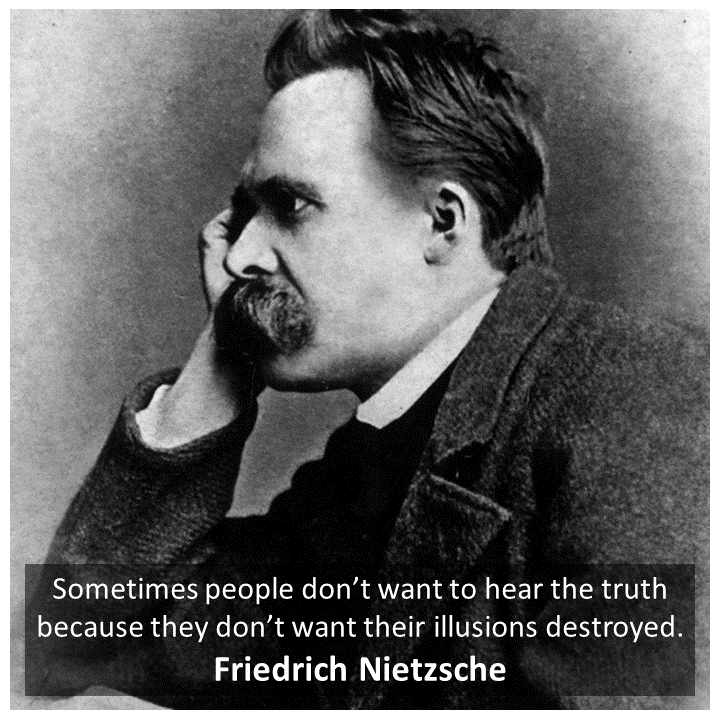
The journey to the freedom demands solitude thereby making man responsible, accountable for the consequences of his every thought and action. Friedrich Nietzsche in his book Beyond Good and Evil paved a way for future philosophers to establish their own new perspectives about the truth where there are no two sides – good-bad, sad-happy, moral-immoral, beautiful-ugly, calm-disturbing but a revised and better version of the older truth. Nietzsche in this book focused on the refinement of our perspectives, our versions of truths for the real freedom because immediately surrendering to already established versions of ideologies is the worst imprisonment any man can have. Nietzsche showed how badly our ignorance creates an illusion of freedom and how to come out of it. This is to remember Friedrich Nietzsche on his death anniversary.

Remembering Friedrich Nietzsche on his death anniversary

Friedrich Nietzsche is one of the most impactful philosophers we as a humanity have ever seen. Reading Nietzsche is a task in itself. But the moment you start getting hold of the things that Nietzsche is trying point to, you will literally undergo transformation. The path that Nietzsche paved inspired many modern philosophers, thinkers, writers. To not mention Nietzsche is to do injustice with our understanding of ourselves as the human beings. This is one attempt to revisit Nietzsche’s ideas in his famous book called “Beyond Good and Evil”, especially his ideas on free Spirit.

Nietzsche in his special style clarified what it means to be really free and how we develop our perceptions, philosophies about the world around us and ourselves.

This is me remembering Nietzsche on his death anniversary. His ideas will keep on living forever.

Oversimplification kills the nuances thereby changing the big picture

Nietzsche strikes powerfully on the idea of understanding the life as simple and easy. It’s a humorous way in which he tried to convey how we consider living life as way to goodness, happiness, pleasure and freedom. The sentences that Nietzsche used to put his ideas about life are built in such a way that you will start questioning the happy nature of the life we desire. You will realize that during the process of understanding life as a pleasurable, happy experience we have submitted our thought process only to the side of pleasure, happiness, and truth. This presumption about life always deviates our search for the truth – “the happiness” that we lookout for as a biased pursuit. Here Nietzsche is not saying that if ‘this’ which you are trying to justify life with is true then it’s opposite is wrong; he is trying to point us towards the idea that as we have attributed life to a happy and pleasurable experience, this attribution has oversimplified what life actually is. Oversimplification has happened because not everyone can understand complex ideas on equal level. It’s not because people are dumb, it is because we have our own ways of interpreting the world around us and the ways through which we interpret the world are totally subjective. Thus, the truth if it exists, it will never be absolute but based on perspectives one has.

“We have contrived to retain our ignorance in order to enjoy an almost inconceivable freedom, thoughtlessness, imprudence, heartiness, and gaiety – in order to enjoy life!”

In order to make everyone appreciate given idea of life on same level we have oversimplified what life is and such oversimplified foundation has led to building even more oversimplified versions of so-called truth. In the pursuit of clarity and ease of interpretation and communication our lives have become false!

That is why Nietzsche here tried to attack the very fundamental way in which we try to break down the things we come across when we live through them. See it in this way, if life by default was supposed to be simple then it is implied that we would have grip on every aspect of life and existence. We know that’s is not the reality. So, if it is not simple then it must be complicated is our next thought. Thus, if life is complicated in reality then oversimplification eliminates certain aspects of life which we keep on missing in the search of truth.

You know what, Nietzsche further explains that when we are denying that life is not simple and happy that also should not invite it being opposite of what was earlier thought i.e., sad and complicated. Nietzsche rejects the idea of polar opposite to portray the lives we live. He calls life, knowledge as the process of “refinement”.

It’s not duality of any aspect of the philosophy, good and bad side of life but the ways and times they have refined themselves which should be the parameter of their worth.

The Death of Philosopher

Nietzsche had his way to express verbal anguish. The sentences are so dense that the prose feels literally repulsive. I think it was intentional. His writings were never meant to be read while sipping coffee or to romanticize the philosophy or the idea of life. They will make sense to those who really want to understand what he is trying to say. Nietzsche in his next idea talks about how every philosopher is trying to find the meaning of life and thereby his/her truth of life. He despises the idea of life or philosophy being explained with a single idea. That is why he sarcastically calls philosophers as the protectors of truth, the thing which itself doesn’t need protection in first place!

Nietzsche thus calls out to the philosopher to get ready accept the martyrdom, the death of their idea of philosophy. The philosopher can only carry his point forward for further refinement but he/she must not – cannot define the life in whole with that simple idea. That idea has to die in the process so that newer refined ideas can be built out of its broken pieces.

In order for philosophy to exist it has to end, it has to kill its older version – that is what is the tragedy of philosophy is as Nietzsche goes.

The Freedom Paradox

When Nietzsche is trying to initiate treatise on freedom, he starts with what it means to be free for any person. One important observation he puts in front is how we get freedom on personal level. On surface it feels if the person is free on personal level, then it is easy to be free in society as a whole. But Nietzsche shows that these ideas of freedom are paradoxical! Man goes inward for the freedom because he/she knows that there is no one else to tie, bound him/her inside his privacy. The man seeking freedom when interacts with the crowd soon realizes that his experiences of life are bound to how crowd handles him, reacts to him, treats him, shapes him. That is unsettling, the burden is difficult to carry for single person hence the man again resorts to privacy, in order to do that he has to let go of certain truths and create his own little lies so that the external crowd won’t disturb his “freedom”.     

(the man) he was not made, he was not predestined for knowledge”

The point Nietzsche is trying to make here is that the taste of freedom comes with the unsettling feeling of existence. But as a man we are not seeking that freedom for us; freedom is some citadel, a happy place where we expect to have control over course of things. The real freedom as Nietzsche explains will be gained by being in touch with crowd (which sounds paradoxical again) It’s like saying you will understand what you real singular identity is when you start mixing yourselves with the crowd!

Nietzsche further advises philosophers of the future to not turn away from the unsettling ideas about philosophy. He takes support of cynicism to make his point. Cynicism bases itself on the idea that people are selfish, self-interested (so in simple words if anything doesn’t go the way a cynic wants, they would whine and create reasons to justify it.) Nietzsche expects the future philosophers to understand the difference between ill-speaker and bad speaker. The lovers of knowledge should also be able to understand what is unsettling, maybe their lies the next opportunity for better version of their philosophy.

The Freedom of Expression

Nietzsche had already explained how things lose their essence in oversimplification. In same fashion it becomes difficult to interpret what a fast thinker is thinking and then explain it to the relatively slow thinkers and make them appreciate the same idea on same level. Even in our thinking we are not free. You can create an explanation for others to understand what you are thinking but they themselves have to climb up (or climb down sometimes) to your level to appreciate what you are thinking, you may succeed in expression but interpretation, comprehension and its appreciation gets limited by the levels on which others are thinking. (My question, if this is the case then even if you are a free thinker, are you truly a free thinker? I know Nietzsche is paradoxical most of the times)

“What is most difficult to render from one language into another is the tempo of its style, which has its basis in the character of the race, or to speak more physiologically, in the average tempo of the assimilation of its nutriment.”

Nietzsche further builds this “so called” freedom of expression using the limitations of the language. Language is the culmination and mirror of the culture it originated from. So, naturally each language has its own style, flow, breaks, rules and ways to highlight certain aspects of narration. When such languages is used to express an individual’s ideas, the speaker has to let go of the nuances of his culture, his primary way of life so that others having another culture, another way of life can appreciate and understand what he is trying to convey, but what if the nuances were the only thing which made that idea influential? Then the influence of the idea would be lost because of the translation. (This is Nietzsche’s way saying lost in translation!)

The Tragedy of Independence

Another way to become free is to become independent. The very few lines Nietzsche uses to explain independence are equivalent of an atomic bomb! (trust me it is still not an overstatement!!!)

People who become independent are few as Nietzsche says and those who are strong can easily achieve it. This independence is also one way to be free. When a man becomes independent, he is on his own, there is no one like him – he is alone. Nothing is anything alike him – he is alone. Thus the whole world becomes a puzzle for him as he is on his own. Any direction becomes new path for him. As he is the only one like himself, there is no one who would reach to his level and match his thinking. And in such case if he needs sympathy, people cannot even sympathize with him because they are not on his level. What a tragedy! The sadness he has in his heart, mind is rendered useless because others around him are not able to comprehend it – sympathizing gets ruled out automatically.

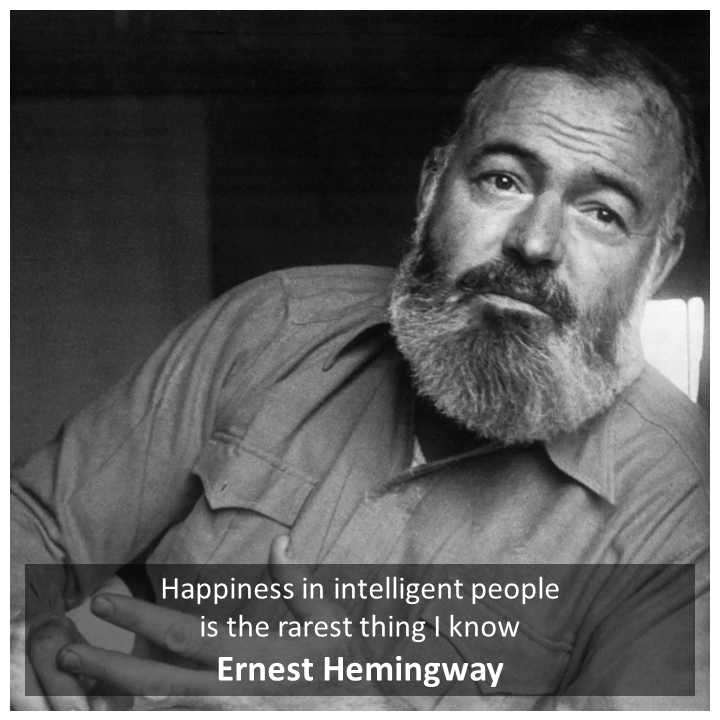
This is Nietzsche’s way of saying what Hemingway said. (I mean both meant the same although Hemingway came later, but you get the point) You must understand that happiness is not the real pursuit of life, then you won’t feel tragic about what Hemingway is trying to convey here, same is what Nietzsche trying to convey here. Freedom by independence can be a tragedy for the person who was expecting glory out of it.

Foolishness Hides Chances For New Insights

Nietzsche here is trying to remove the lines between what is good and what is bad, what is allowed and what is forbidden.

“That which serves the higher class of men for nourishment or refreshment, must be almost poison to an entirely different and lower order of human beings”

In modern crude sense, Nietzsche says “one man’s trash is another man’s treasure”!

Same idea, same act will have different perception of morality, scale of right and wrong. A rebel thinker in common poor public could be attributed to a philosopher amongst the riches. A murderer who killed an evil landlord could become a saint among the people who were victims of this landlord’s oppression.

So, Nietzsche’s attribution of foolishness is a way to point out the exceptional, outlier acts, prohibited acts, crimes to find the better truths. That will make you freer than others.

The Freedom of Youth   

 The stage of youth feels like the freest stage of all the stages of life and it is so because it has let go of the nuances. It also feels free because the youth in the stage of exploration never submits to right or wrong, yes or no to the life as Nietzsche says. But as the time passes when the youth is exposed to disillusions, broken expectations they try to modify themselves in a way that will get things done the way they wanted – the compromise starts to enter. The moment this happens the same youth tries to punish themselves as Nietzsche says. The freedom exists no more, so is the youth.

The Freedom of Actions

(Again, this a hydrogen bomb on morality!!!)

How can we say that the given action is right or wrong?

Nietzsche has very interesting thought process on this question. In the starting times the action was right or wrong based on what it led to – its consequences – the effect. The problem with this thinking is that one has to wait to let the action happen to decide its rightness or wrongness. If the stakes are high, such attribution of right or wrong can be devastating.

So, Nietzsche takes support of Chinese idea where the parents are responsible for the betterment of their child. Meaning that the origin of the thought which led to that action should be the decider of whether the action is right or wrong. Nietzsche called this pre-moral period of mankind. And sarcastically he points out that we have made a total turn around the idea of right or wrong action. Earlier it was what happened after the action i.e., consequences; now it is what led to that action, meaning what was happening before that action i.e., the origin which is the decider of right and wrong of any action!

This is where the origin of action gets named as ‘moral’ which is generated from self- knowledge. Later these morals evolved into “intentions”. As Nietzsche says, intentions serve as the origin of any action.

“people were agreed in the belief that the value of an action lay in the value of its intention. The intention as the sole origin and antecedent history of an action: under the influence of this prejudice moral praise and blame have been bestowed, and men have judged and even philosophized almost up to the present day”

Nietzsche then drops another bomb called – unintentional actions. We are clear that whether action is right or wrong can be decided by the intent. But what if there was no intent or there are no other ways to pinpoint the intent behind certain actions? There is a possibility that the intent may get mistranslated, misinterpreted during the unfolding of events, then how would you decide the attribution of given action.

In such case we would again go to the effect- the consequences of that action!!! You see what is happening here? We might have to resort to that older measuring system of action based on their consequences.

This is Nietzsche’s style to question how we think of morality in general and also on deeper level.

(I can’t resist praising Nietzsche lesser but deep down I know he would question his own worship too!)

The next attack Nietzsche does by using morality is the sentiment of sacrifice. The basis of his thought process is that you should question everything that gives you pleasure at least once. Here, he shows how fake the feeling of sacrifice for others, surrender could be if it is intended to display how moral and virtuous you are!

“There is far too much witchery and sugar in the sentiments “for others” and “not for myself””

In simple words, you are saying that I like to help others because it makes me happy. So, in order to help others you have to become selfless, but if becoming selfless to help others makes you happy, doesn’t that make you selfish? You are selfless because you are selfish!!! (Disclaimer: Nietzsche is paradoxical.) The paradox is resolved when you accept that you are just taking support of morality to display you higher value. Being selfless is just a better excuse to display your high morality. It there was any cruel way to display your high morality no wonder you would have gone for that!!!

In modern ways, it’s fox’s way to say the grapes are sour or I am a virgin because I am waiting for someone special (In reality fox cannot reach the grapes and the person is not able to appreciate other person or people rejected that person continuously – please note that I am not blaming someone’s character – it’s the limitation of language that prevents me from expressing what I am thinking for oversimplification. As Nietzsche has already shown that oversimplification kills the nuances. You get the point!)

The Immoral Philosopher – The Free Philosopher

Building upon the ideas of nuances lost in translation, right and wrong in morality Nietzsche calls the future philosophers to go beyond the dichotomy of philosophy and also distrust the morality in the development of new philosophy, new truth.

“In all seriousness the innocence of thinkers has something touching and respect-inspiring in it, which even nowadays permits them to wait upon the consciousness with the request that it will give them honest answers”

This is Nietzsche’s way to show that in order to find the new truth new philosophy, new philosophers have submitted themselves childishly and blindly to the principles of morality hoping that morality will give them new answers. But it is the same tinted glass of morality that prevents them from getting new perspectives. Hence, he calls them naïve here. They must let go of this childishness.

“The belief in “immediate certainties” is a moral naivete which does honor to us philosophers; but – we have now to cease being “merely moral” men!”

This is Nietzsche’s way of saying it’s good to be bad!

For Nietzsche, morality shows only two sides of reality- right or wrong, this works fine if reality is really dichotomized. But we know there is no such thing as right or wrong for every real-life scenario. So, in order to find the real truth, you have to let go of morality, then you will see that reality has its spectrum and people residing on different biases of such reality have their own attribution of right and wrong for the same action. Morality is the subset of newer truth, not the other way around.

‘il ne cherche le vrai que pour faire le bien

(he who searches truth to do good) – I wager he finds nothing!

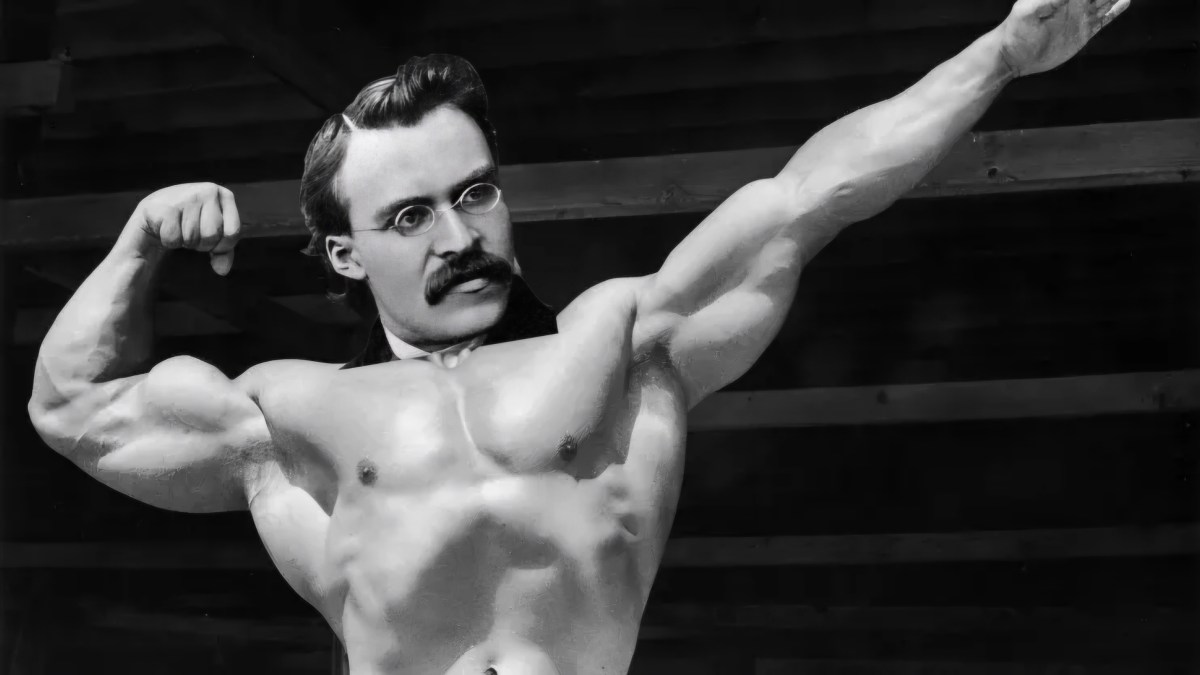
 Nietzsche make his point by him being the first bad-philosopher!!! (This is why I am loving him more and more. It’s like a brainiac with full grown muscles if you want to picture him thematically!)

The Freedom From Passions and Reality – Will to Power

Nietzsche makes an attempt to show that the reality could also be made up of something totally different that we can even comprehend. What if the world is more real than what we can experience? And if such reality exists, our senses will limit us from experiencing it. So, in order to be free in such reality we have to rise above our senses. That would be the new freedom. Our senses are bound to desires and passions whose interactions – impulses are creating thoughts.  

So, building on these impulses Nietzsche says that many emotions, processes are created in “our reality”. What would make any of such impulses, process free from others? He introduces the idea of causality to show the flow and root of everything. If cause leads to an effect and further that effect becomes cause to newer effect then it is possible that the root cause of all would make us really free. Nietzsche further explains that it can also be one of the processes which would overpower others to become free and not the root one. (For example, the first unicellular organisms would be the most powerful organisms on earth today, that is not the case.)

Here Nietzsche introduces the concept of Will to Power. Whatever overpowers the other processes has the potential to remain in the big game and thus has real chance to be free. Will to power in any process allows it to gain more freedom.

This is Nietzsche’s Darwinian theory of evolution – the survival of the fittest. (I know it is a bastardized translation, but again I summon the loss of nuances during translation.)   

Then Nietzsche puts the idea that by this way of thinking the originator does not necessarily be the most powerful one, thereby questioning the existence of the God! Because if the God was the originator, then then he/she would exist only if he/she has the highest Will to Power. That also does not mean that if God does not exist then devil exists or has the highest Will to Power. It could be anything! We are not sure for now. (typical philosophical answer!)

Using causality, Nietzsche also questions the morality of French revolution. If for the locals the royalty was cruel that is why the revolution happened then why didn’t the remotely located people who considered them noble in first place considered them cruel too? In the eyes of remotely located people the French royalty had a noble past. (The question is intended to think on it not to find the right and wrong. It shows how flawed our thinking becomes when we stick to morality blindly.) Whoever came in power overthrew the less powerful. That is one way to explain Nietzsche’s Will to Power. According to Nietzsche, if Napoleon would have been continuously invested in the morality of his actions he wouldn’t have become the great emperor.

Freedom From Truth

Here Nietzsche starts with the very obvious and common fact that some truths are unsettling. Not every truth ensures happiness. Only an idealist, as Nietzsche says would submit the idea of truth that brings joy, happiness, and beauty.

Here comes Nietzsche’s biggest drop-

“the strength of a mind might be measured by the amount of “truth” it could endure – or to speak more plainly, by the extent to which it required truth attenuated, veiled, sweetened, damped, and falsified”

This is self-explanatory. It is just our unsettlement that we need to take care of while looking for the truth. We are thinking animals and thinking is a result of our impulses, desires, and passions. So, not every truth is destined to bring us peace. ‘We would die if we eat poison’ – is a truth which unsettles everyone but that is not how we react to such truths, we prepare for such bad events, that is the wisdom what Nietzsche is talking about in a crude way here.

“There is no doubt that for the discovery of certain portions of truth the wicked and unfortunate are more favorably situated and have greater likelihood of success; not to speak wicked of who are happy- a species about whom moralist are silent. Perhaps severity and craft are more favorable conditions for the development of strong, independent spirits and philosophers than gentle, refined, yielding good-nature, and habit of taking things easily, which are prized, and rightly prized in a learned man.”

Nietzsche prefers learned man more than the moralistic or the virtuous one. A learned man knows the consequences of learning new truth, or sometimes even unaware of it but he does not pivot his happiness on the discovery of new truth. What else could you make freer when you are ready to accept the truth in its crude and real form! This freedom will bring clarity, new perspective and not happiness or sadness or chaos or calmness.

Truth will not decide how and what you are. You just will have added new tinted glass in your collection of perspectives towards life and reality and the philosophy behind all of them.  If your Will to Power is good your truth may become the truth for all others.

Freedom From Identity

The profoundness demands the rejection of submission to any side of existence. If one promotes certain ideology the people around him/ her will try to comprehend that person using the tags they have in their own minds for that idea. The mask thus brings in that ambiguity where people are not associating, tagging you to one definite truth. Even your mind can start creating bias if you let it. That is why Nietzsche focuses on mask in profoundness.

“A man who has depths in his shame meets his destiny and his delicate decisions upon paths which few ever reach, and with regard to the existence of which his nearest and most intimate friends may be ignorant; his mortal danger conceals itself from their eyes, and equally so his regained security.”

The mask frees you from attribution thereby biases and even the socio-economical influences. You will never let honor or shame, right or wrong, good or bad, happy or sad justify the events in your life. You will never ever flinch to enter an unsettling adventure which guarantees your growth personally. Embarrassment, failure will just be another emotional response for you (please note that this does not mean that you will be emotionless, it means that you will be able to recognize your emotions and let them pass.)

This is exactly why I would force everyone to understand Nietzsche on their own level!!!    

“Every profound spirit needs a mask; nay, more, around every profound spirit there continually grows a mask, owing to the constantly false, that is to say, superficial interpretation of every word he utters, every step he takes, every sign of life he manifests”

This could also be one reason why some the greatest personality humanity has ever seen had a layer of controversial ambiguity around them.

From the idea of mask, Nietzsche moves to the idea of its conservation. The conservation is meant to define the philosophy of containing who you are rather that you submitting to some ideology. Whatever you have collected as an individual, whatever you are on philosophical level personally, how you have upgraded – refined your philosophy you must conserve that instead of giving to some ideology. The mask helps to conserve who you are.

“One must know how to conserve oneself – the best test of independence”

(this could be the reason why superheroes wear masks!!!  Joke aside but it is one powerful thought)   

Further Nietzsche warns new future philosophers to not be people pleaser or submitter to temptations. That will steal them of their judgement and independence.

Freedom From Your Version of Truth

The ways in which Nietzsche is trying to close his arguments are really beautiful. He knows that when the future philosophers will have discovered their new truths in their journey of blood, sweat and tears, it is natural that they will get attached to it. Such is the human tendency. He wants us to get rid of the obsession with this new truth. This truth even if it’s the newer one will create boundaries in your perception, you won’t be free anymore! Nietzsche wants to let the future philosophers let go of the dogma.

“In the end things must be as they are and have always been – the great things remain for the great, the abysses for the profound, the delicacies and thrills for the refined, and, to sum up shortly, everything rare for the rare”

Freedom From Illusion of Freedom

On closing notes Nietzsche has advised new philosophers to be careful of the “freedom” they are being offered under new socio-political ideas. Nietzsche focuses here on the ways new philosophers are embarking on the journey to new truths. He tells that having fluency in speech and effective grip on written communication will not define you as the new philosophers, even though they are one aspect of it. But the systems having higher Will to Power will use same tools to control new philosophers and change the course to their versions of truth.

New philosophers will be misled with words like “Equality of Rights”, “Sympathy with All Sufferers”, “Modern Ideas” but they should be careful about them. They should be aware that the moment they create a thought process the people on different levels with different Will to Power will interpret these same ideas for their own benefit especially the ideas which are polar opposites of your ideas. Once such separation happens nobody, not even you cannot get the real freedom.  

Nietzsche offers the rule of solitude while embarking on such journey. Only you can free yourself.  

Losing the ‘Grip’ on Escapism

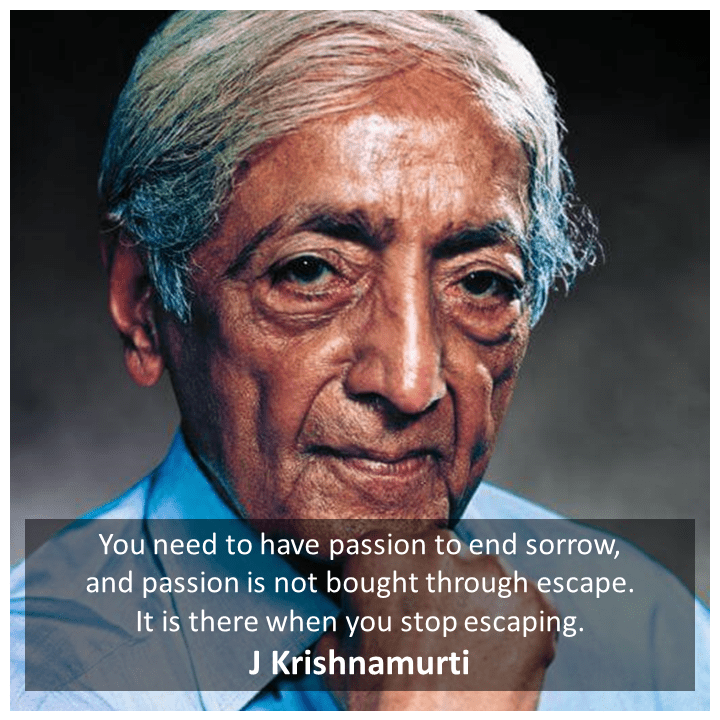
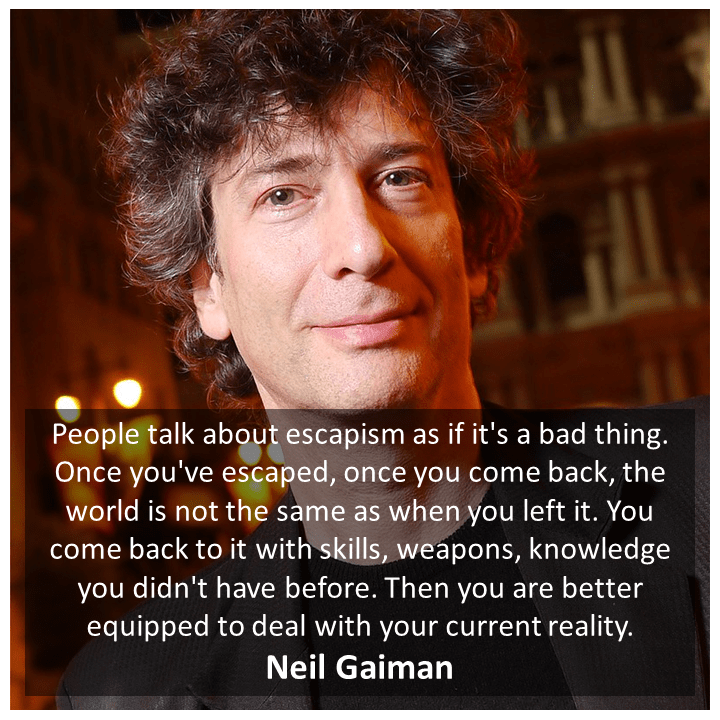
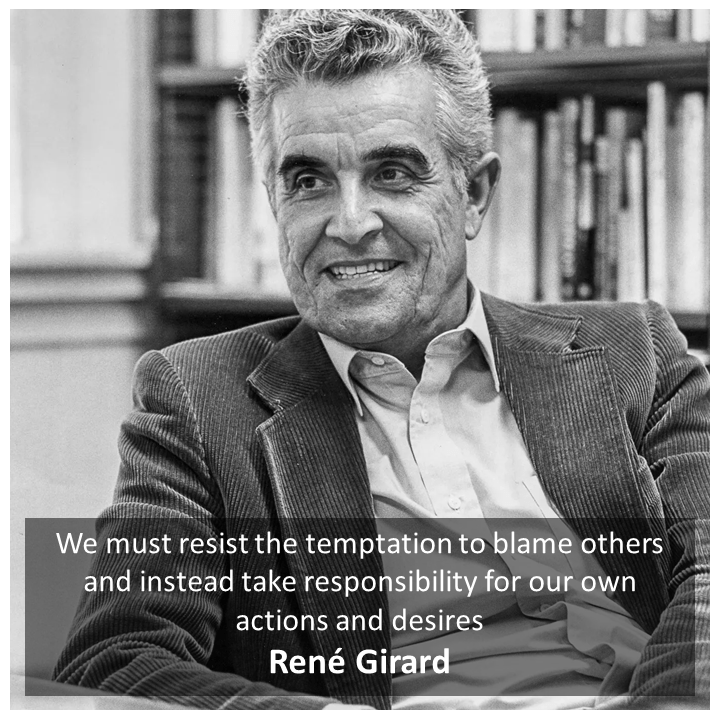
Escapism creates a void in our perception of reality so that new ideas, creative ideas would populate this void for living life with a new perspective, new approach. The healthy escapism is the most important tool, a therapy for many successful creative people our world has ever seen. Once this escapism takes extreme side it may lead to addiction, procrastination and delusion. Freud’s ‘desire to destruction’ and René Girard’s theory of mimetic desire help us to understand escapism in better ways to face the reality head on.

Reality is merely an illusion, albeit a very persistent one

Albert Einstein

It is very interesting when we start questioning how we understand, feel and interpret the reality. The reality in which we live in has infinitely many facets which we experience through equally diverse emotions. We as human beings are hardwired for seeking happiness, happiness creates the environment to nurture, grow and multiply. Bear in mind that only growing and multiplying is not enough to guaranty the survival of our species. Adaptation is one aspect to ensure the sustenance over the course of time. Adaptation means getting exposed to adversities, sadness, imperfections of reality to create the strong enough coping mechanisms. What would happen if are continuously in the phase of seeking pleasure and turning our faces away from the challenges of the reality? How we justify our own death (figurative) by our own hands when we submit ourselves to such dark pleasures, addictions, dark temptations in spite of knowing that they are harming us? There is just one perfect song to point us towards such emotions.  The song is called “Grip” by Seeb and Bastille.

The song was written by Espen Berg, Dan Smith, Thomas Eriksen, Mark Crew, Simen Eriksrud and Joakim Haukaas.

Album art for Grip by Seeb, Bastille

Grip – The Lyrics

As the night time leads into the day
And tomorrow spills across the sky
While the sun's a harsh reminder why
We are feeling barely human

The overall emotions this person is experiencing are the emotions of distaste and hatred towards the things which are inevitable. He knows already that it is going to be day after this night, the sun will rise up and he will have to face the day helplessly. The “harsh reminder” here highlights that the person doesn’t want to face the day, the reality, the responsibility and wants to escape to the night where he was someone better than human – someone invincible.

 ‘Tomorrow spills’ shows that the thing/s which this person was trying to postpone, avoid has finally come. The spilling action shows the unwanted eventuality. The things which the person is trying to avoid are the sufferings and problems which for this person are mocking him for his humanistic limitations.  

This rise of the day is a reminder of his humanly limitations and the sufferings which never end. The person is well aware of the sufferings and hence is cursing the Sun for reminding him about his limitations as a human being. The transition of night into a sunny day is also a metaphor for the veil falling down. The veil of enjoyment which was masking the suffering, imperfections, sorrows, problems of the reality.

I really loved the word play to show how the person hates the day which never comes – ‘tomorrow’. It kind of points towards the ‘procrastination’ to avoid the pain of imperfections and the pain, the suffering accompanying with the life itself.

We don't know what's good for us
'Cause if we did, we might not do it
Who knows where our limits lie?
We won't discover 'til we push it

These lines explain the expression “Ignorance is a bliss” in the most perfect way. The person wants to ignore the things which are good because deep down he knows that they come with hardships. That is exactly why he says that even if he knew what is really good for him, he won’t do it; he knows doing the right is always the most difficult path. It’s like running away from the reality and reject it because it is full of pain, problems, unsettling consequences and imperfect.

The next lines show that the person is not completely delusional and detached from the reality. He knows that being a human being with unlimited capacity in the world of infinite possibilities, he can do anything and succeed at it. He is aware of the fact that he just has to expand his boundary to make impossible things possible. This is the moment when you will appreciate that the person expressing his feelings here is aware of everything that is right and wrong. It’s just that he just wants to be happy and maintain that state by rejecting the painful reality.    

I should just walk away, walk away
But it grips me, it grips me
But I should call it a day
And make my way
Oh, it grips me
'Cause the devil's got my arms
And it pulls me back into the dark
But I should just walk away
Walk away, oh it grips me
Cause the devil's got my arms

The person knows that he should completely let go of the things which are deviating his life from reality but now he has found one pity excuse. The person thinks that it is difficult to lose the hold of joyous, illusive but pleasurable darkness. He is ready to ‘call it a day’ get over with this pleasurable but illusive, dreamy life but somehow his mind has found an excuse of the devil which holds him back. It shows how addictive the dreamy, pleasurable alternate reality which is far from the ‘real’ reality, the life his mind has created which is full of pleasure, happiness and he is whatever he wants to be in this dreamy world. Grip of the Devil is just an excuse for him to tell others that he is not solely responsible to stay in this ‘unreal’ illusive life, this shows his lack of accountability. He is blaming the devil for him not facing the reality and taking charge of the course of his life.   

We got drunk on this unholy wine
To deliver us from our old minds
A promise of a better time
'Til we're feeling barely human

Wine in Christianity is a symbol of abundance, enlightenment, celebration, and blessings of the God. The ‘unholiness’ of the wine shows the overuse of this abundance which points to the addiction. Addiction is the worst use of the means preferred to gain pleasure. That is why the holy wine once intended for enlightenment becomes unholy when exploited and overused unnecessarily. The promise of better time is the reflection of what a person suffering from addiction feels, he tries to repeat the act to extract the pleasure – a short lived one. This short-lived pleasure makes him feel something better than human. Once the effect starts to fade out and the person regain the consciousness of weakness of human nature, he again resorts to this short-lived pleasure to regain the better humanly experience.

These are the exact emotions an addictive person goes through – this could be any addiction.

I would rather forget
And wash my memory clean
Oh, I would rather forget
And wash my memory clean

The person knows what mess he is in and the escape is also difficult. He just wants to remove all the traces of what he really is and surrender to the world of the devil.  (‘Cause the devil’s got his arms). He is helpless and just want to reject the painful reality while remaining into dark but pleasurable devil’s night. It an intentional submission the “dark side” to avert the pain of reality brightened with the Sun.

Escapism – Sadness, pain, procrastination and addiction

Escapism lies as the core theme of this song. We humans are pleasure-seeking animals. Remaining in joyful conditions promotes safety, continuation of the species from the evolutionary point of view. That is why we are hardwired to escape from adverse, life threatening, sadness inducing, fear inducing events. Fortunately, we are rarely exposed to wild animals and life-threatening situations as our primal ancestors did. But this instinct has not left us completely. Any event which simulates sadness, fear, great challenge – our response is somewhat still primitive. But as the technology as progressed so much, our ways to escape the hardships of the real, imperfect life have evolved drastically.

Please understand that escapism is not a bad word. But once it shifts to extreme use, abuse then addiction takes over and the person starts hating reality and submits to dreamy, delusional world created by him or someone else.

Reading, writing, painting, doing some happiness inducing activities/ tasks are simple examples of a “healthy escapism”. Such escapism creates a void in our perception of reality so that new ideas, creative ideas would populate this void for living life with a new perspective, new approach. The healthy escapism is the most important tool, a therapy for many successful creative people our world has ever seen.

Now coming to the other (dark) side of escapism – it’s a highway to addiction and constant search for dopamine hits. Deep down we know how we are all addicted to something. It’s just matter of who is affected by them in worse ways. Social media, their algorithms, the culture of overconsumption, the capitalistic urge to prioritize wants for getting social approval, submission to addiction to escape the problems are the real-life challenges that we are facing today due to the technology.  Technology is meant to provide an exoskeleton, an augmentation to improve our lifestyle but this same exoskeleton is weakening our muscles thereby crippling us. (The crippling of our minds.)

Escapism is not a new phenomenon, rather is has an age-old history only the ways in which we try to escape the reality have changed over the course of the time. Creating an alternate reality was always one way to alleviate the painful effects of reality. But, the tools that we have today are more potent and can immediately lead to the state of addiction.

You will see in the lyrics of the song the that the person is well aware of what wrong choices he is making, that it is not good to submit to the devil and the night but now he is so addicted to this alternate reality that he has started hating the reality and don’t want to experience it.

Such is also the way of procrastination. We try to delay the activities knowing that the had to be done anyways but won’t yield the perfect, beautiful results that you want. Procrastination thus creates an illusion of safety until the threat becomes imminent. Procrastination is also healthy unto certain limits to create a space of new approaches but if your fear of creation, action is preventing yourself to postpone their impact on reality thereby residing yourself into your dreamy world then such alternate reality is useless.

Reality is painful – but that is not the only thing it is!

We escape from reality so that we can come back to fight the reality with better tools and ideas not to completely run away from it because in the end reality will catch up with us with far gruesome, dreadful face and consequences.

We are highly prone to our conscious submission to the alternate reality because it creates a potent illusion of safety and comfort. This is because we think that living a fulfilled life means living a life of happiness, whereas upon close inspection you will appreciate that life has never given itself to either sides of the existence – neither good nor bad. Life keeps oscillating between these two and creation, destruction, growth, adaptation happens in between those waves. Buddhism talks about the roots of suffering in attachment. We humans are highly susceptible to immediate attachment to any living or non-living things (which are the parts of reality). Our attachment to such things then leads to the fear of their loss and thereby loss of familiarity and comfort which projects the ultimate fate of the reality as imperfect, painful and hostile one. Once we let of such attachments, we can have a full control on the escapism in our lives.

Once we start to see happiness as a process instead of a stage, we will truly appreciate the beauty in the prima facie unsettling imperfection of reality – this is the same real life, the reality where we actually exist and can truly contribute to affect our and other lives in better ways. It is not that painful as we have thought in our minds.

Also, even when you have achieved that only goal in your life, that full happiness, in the end you will again be miserable because you are going to be clueless about what comes next, what to do next!

I think confrontation is the opposite of the escapism because of the same reasons. Instead of the escaping from unsettling reality for short time again and again, and it catching up with us in the end, why not face it in first place and be done with it! This requires the attitude of rejecting the ultimate purpose of life attributed to the search for happiness. The reality is neither happy nor sad.   

Sigmund Freud – Beyond Pleasure and Desire to Destruction

Sigmund Freud in his early developments of psychanalysis was the strong proponent of the ideas of human beings as the pleasure-seeking animals. Freud actively promoted his ideas of psychology based on the thought that our actions are always intended to maximize pleasure, procreation, and preservation and avoiding pain. He called this force as “Eros”

Freud’s early ideas hence are always pointing towards that continuous search for pleasure (Lustprinzip). But once the world war started Freud went under immense emotional pressure as his two sons were soldiers in war, he also saw soldiers residing to traumatic war experiences. In coming years, Freud lost his beloved daughter to Spanish flue. Here he felt really miserable, guilty and painful that he is able to survive while his daughter died.   

This is where Freud brought in the idea that humans also have a death drive, destruction (Thanatos) where doing nothing helps to cope up with the intense sadness of the reality. This idea was introduced by Sabina Nikolayevna Spielrein – one of the first female psychoanalysts. Under extreme pressure humans may chose to do nothing as doing anything will end in pain.

So, Freud evolved his idea of human psyche as an interplay between the urge to live and urge to die.

The person in the song submitting to the dark, harrowing addictive pleasures shows this same urge to destruction even though he knows that they are not good. We are ready to submit ourselves to darker illusions because of this same desire to die, to destruct ourselves because sometimes reality feels more brutal than death.

When one is exposed to unknown events in life, the urge to pleasure will seek excitement, adventure and adrenaline, dopamine, knowledge from it while for same life event the urge to destruction will resort to confusion, danger, fear and submission to familiar, warm and comfortable environments.

Freud received huge criticism for these ideas too. Freud also mentioned that this death could also be figurative – as the complete distaste towards everything in life and becoming inanimate – a living dead body.

The idea of clearing memory in the end of the song shows this side of desire to destruction to me.

Important thing to come out of these ideas is to appreciate that life never favored any side – good or bad. Life is always multifaceted. There is always something good in bad and bad in something good. Good and bad always coexist.       

Mimetic Desire – Responsibility and accountability

René Girard a French philosopher of social science pointed towards a very innate pattern in human thinking which is called as “Mimetic Desire” in philosophy of social science. He pointed out that even though we may think that our drives are totally created from inside and we are the sole, absolute creator of such desires (like calling ourselves God, the Creator) these are mere effect of our surrounding, they are not created from something absolute. We are always sorting people, things around us to create a place where we say that “we belong”. This helps us to create and justify our identity. The moment someone creates and points towards something as problematic, unsettling then rest of the people also use it as a “scapegoat” to put the blame of anything bad, wrong happening with them.   

We as human beings and social animals are always looking for something to blame which creates an object to blame for difficulties in our life. This grows faster when it happens in group.

According to the ideas of Mimetic Desire given by René Girard, people make scapegoats when the truth, the reality makes them uncomfortable – the reality they don’t want to acknowledge. They desperately lookout for things, groups, people to put blame and make this illusion their reality where they find comfort. People do this because they somehow want to release their anger, tension.

The creation of devil is the same thought. The person in this song is well aware of the truth of reality but as his desires are to always seek pleasure in any possible ways, he finds a scapegoat of “the grip of the devil” to justify his addiction and bad actions. Religious, political beliefs have many examples of such scapegoats.

Responsibility and accountability are very important aspects when we are talking of such ideas. That is why it is very important to rethink our ideas when we are trying to justify them with something delusional.

Conclusion

The key idea to tackle extreme escapism is to accept the imperfect nature of reality. The reality may be fearsome, difficult and unsettling but it is also hopeful, happy and comfortable. Your actions in reality will bring you closer to good experiences rather than submitting to unreal, delusional short acts of pleasure. It’s not the grip of the devil that is holding you in the night, it is you yourself who contain this devil inside who is holding you back. Let your angel overpower your devil to bring you back into the reality. May you grow with every pain inflicted upon you to make you even stronger than you were before. May the creation provide you the physical and especially mental adaptability to handle and appreciate the reality – the only real place where you truly exist.     

Official video shows the transitory phase of a teenage boy who is trying multiple ways to gain pleasure thereby moving away from the awkwardness of reality to become “cool”. But once the balance of pleasurable acts tips to the wrong side, he submits to the pleasurable but dark and devilish side of his personality. This is where he submits himself to the devil.

The video intricately shows the fragile nature of adolescence and the high impact of the choices made in this phase which could have lifelong effect of the personality.   

There a also one lyrical video for this song where you will see fruit butchering (I don’t know why but the producers have made it look very tempting!)

Also, the credit goes to SeeB for adding their iconic style of falsettos to make the listeners feel the grip of the devil in a fantastic way.

The creators of “Grip” Seeb and Dan Smith from Bastille

The song video

Lyrical “fruity and juicy” video

Listen on spotify

Alienation and Creativity

Creation for capitalism, consumerism and pleasure maligns its true purpose which actually is to create joy and a sense of belonging, comfort and safety. Alienation is the end effect of such capitalist processes where people have isolated their humans side for the rat races and FOMOs. Pure creativity, empathy, connect with nature and self can help use to preserve that human core and come out of the alienation.

How true forms of creativity can help us to reconnect with our human core

“On The Train Ride Home” by The Paper Kites

I long, as does every human being, to be at home wherever I found –

Maya Angelou

Humans – the creative animals

I think creativity is the most important quality granted to human beings. Nature in itself is the ultimate and the best creation which at the same time is also the creator of many things. Animals, non-human beings too have the gift of creativity to certain extent but human beings have outperformed in using this gift of creativity. We are always creating something, we have tools, we have automated processes to create anything we can understand. This creation of things has led us to becoming the most developed species on the planet. Creation can be in any sense – creation of music/ art/ cultures, families/ society, factories/ industries/ conglomerates, institutions/ organizations, cities/ metropolitan, governments, policies, supply chain, and what not! All these creations are intertwined to prove how advanced the human species is. You must also remember that once a process of creations starts generating fruitful outcomes it gets automated to optimize, to improve the efficiency. Most of the times we forget that some creative processes are not meant to be optimized because value of their outcomes is not materialistic. The concept of efficiency and/or optimization is purely materialistic concept. But as we are progressing ahead as the species, most of our creation processes are getting robotized, where materialistic outcomes are more important than the process of creation itself.  

Young generation has crucial role in deciding the future course of our species, especially when we have this great tool of creation – our creativity itself. People of my generation (millennials and Gen-Z to some extent) are the key creators of this time who will decide where our future will lead us. This generation is completely busy in various ventures of creation to justify their own life. But, as I have mentioned before, our creation processes have become so mechanistic, so robotic to gain more, extract more materialistic outcomes that this young generation is getting more and more detached from the real purpose of creation in its true spirit. The consumerism and (crony) capitalism has thrown today’s youth into a forced state of alienation in spite of being living in crowd, densely populated resourceful, glamorous cities. We are lonely in spite of being surrounded by the crowd.

This loss of attachment from the spirit of creation has led to the alienation of the today’s young generation – who many times go through the feelings of isolation, meaninglessness, directionless, confusion – it’s not just a normal existential crisis through which every young generation of their times goes through rather it’s the blurring of the true spirit of living in today’s young generation. Please keep in mind that it is not mistake of this same young generation. The system, society, institutions have evolved in such way that the creative processes are getting designed more for materialistic optimization instead of getting created for the real upliftment of the human civilization. Feels like we are losing touch of the real purpose of our being.

An Australian indie rock band called The Paper Kites released a song called “On the Train Ride Home” which in my opinion tries to touch those feeling of “alienation” which our today’s young generation is going through. Deep down we all know what we really want, we know what our core is but the systems in which we are living today have made our lives more and more mechanical, even though we are in the process of creation that creation no more belongs to us, that detachment, that alienation, that freedom from the vicious capitalistic cycle is what we are yearning for in the end. This is what this song for me is.

The Paper Kites
L–R: David Powys, Sam Bentley, Sam Rasmussen, Christina Lacy, Josh Bentley

I will dissect this song from the point of alienation; for me that is what it is all about.

The lyrics of the song is credited to Samuel Bentley, On the Train Ride Home lyrics copyright: Wonderlick Pty Limited

(It’s a song which needs to be treasured, hidden from others so that no one spoils it and I know I am committing a personal crime by exposing it. But such creations need more exposure and deserve proper appreciation too.)  

Waiting down at the station
I don't remember, think it was late then
Standing, always so quiet
We're like elevators filled up with strangers
No sound, no hallelujah's
Still I was praying on the train ride home

The starting of the lyrics creates an imagery of the person waiting for a train home. The complete separation from the surrounding has made this person to forget vivid details, it shows the mundane-ness, the separation from surrounding to just reach a safe, calming place which is home. The feeling of loneliness in spite of being in the crowd shows how there is no emotional connect between people. Elevator filled with strangers shows that people are closer and more connected, more accessible but they are not closer emotionally. This is exactly today’s situation, social networking and internet brought us so close that we can ‘poke’ our friend living in another hemisphere within few seconds and still we will see people craving for true connections more than ever. No hallelujah’s shows the loss of spirit, loss of soul in people who are part of this – physically close but emotionally isolated crowd.

If I can't get the things I want
Just give me what I need

Here, the person is aware of the difference between wants and needs which shows that his/ her separation from home to go to the crowded place to create a better resourceful life was not the ultimate goal. This is the only way through which this person can live a life. The system based on the cycles of consumption has narrowed down the meaning of living a life to mere survival. One can get as many things by obeying this cycle of consumption but it will not satisfy the hunger – the emotional hunger, that intimate craving of humanity. The distinction and use of wants and needs is a very smart way to show how the person is trapped in the system to survive but deep down they know what actually makes a fulfilled life. That is why person asks for basic fulfilment if not all what they desired.       

Our words fill up the pages
Fill up the days with psalms for the ages
Still those vows that we all speak
We break them like concrete
And just make our words cheap

This part of song shows how words have lost their worth. Words in the sense the sense of commitment, sense of loyalty to keep the promises. The piousness of the daily prayers, the vows are less cared for. This expression shows how insensitive we have become to just gain the materialistic means, to survive.

This is exactly where it struck me that this song is not just about average existential angst every young generation goes through; this song is more about the alienation of a person where system does not value real creativity – which gives our lives meaning. The system now has been maligned with the materialistic efficiency. Consumption has become more important than the end effect it creates. Mention of “wants” and “needs” thus highlight the culture of consumption here.    

I want someone to grow with
Songs I can sing to, and I family to cling to

The song tries to conclude with the ultimate pursuit for living a better life. Why are we all doing the things which we do? Why do we go on job? Why do we work all week, live paycheck to paycheck without any greater purpose – in spite of knowing that we hate this work at its core? Why knowingly, intentionally are we craving for more and more materialistic pleasures?

I think it is because of the recent vile cycle of consumption. I have a reason to justify this. Somewhere we know that the process of creation in which we are involved is not doing justice with our pure humanistic core.

As a human being all we crave for is the mutual growth, sense of fulfillment, love and intimacy for each other in this limited time on the earth. We know that ultimate goal of creation should be this humanistic goal, but the moment the creation loses this human touch we suffer from alienation, a sense of directionless, sense of being confused, a sense of trapped inside an infinite maze. This is the exact moment when the person craves for home, family and intimacy.

The train ride home is that craving for being the real human being who values emotions, commitment, love and happiness of the loved ones.

But If I can't get the things I want
If I can't get the things I want
Just give me what I need

The person understands that in this seemingly flashy, attractive, glamorous but mechanistic, mundane, lonely and unemotional life there is some hope that they at least will be able to preserve their human core. The request for the “need” over “wants” is the cry for that preservation of the human core.

Alienation

What urged me to completely (and maybe blindly) associate the lyrics of this song to alienation is how Socialism defines the concept of alienation. Karl Marx identified how a process of creation thereby value creation could isolate its creator from its creation. This isolation of creation and creator once intensified removes all the human, emotional attributes from the process of creation and here the brutal capitalism starts. The creation is now mere a mechanical, boring routine of materialistic revenue creation where humanity has no value.

Karl Marx on alienation

Karl Marx presented very beautifully the purpose of creation in human life. It is what separates human beings from other animals, non-humans. We are always involved in creative process which have a personal purpose, a meaning. That is why our creations and it’s end results are so intense and are way different than how other non-human creative processes. The moment such processes start demonstrating the separation of creator, the process of creation and the end-product of creation, capitalism/ consumerism start peeking their head out thereby slowly eliminating what made such things processes humanistic. This exactly is alienation, there is no sense of home, comfort or belonging.     

Marx defined four types of alienation in his discussions:

Alienation of an object –

A factory labor stitching the designer clothing does not bear the capacity to own it and enjoy it. Even though the labor holds the skill and knowledge to create that fancy clothing the system is rigged in such way that the emotional connect between creator and creation is lost forever.

Alienation of process –

The process of creation has become so mechanical, so repetitive to improve the efficiency and to increase the output that humans involved in them have also became mechanical, unemotional. Today’s young generation working in mundane jobs, the jobs they hate only for the paycheck and the job without any personal purpose is the example of that alienation. The separation of creator from objects makes the object accessible to anyone but this accessibility is not equally distributed because the input to output ratio is highly skewed. The value that is created in the creation of the object does not reward the creator in any good way thus creator – the labor remains poor. This also make the creator to lose the faith in the process thereby leading to the alienation of the process.

Alienation of species-being –  

The moment this mundane, highly optimized process does not bear any real humanistic purpose, the creator no longer follows the process to reach a better position in life spiritually, intellectually through the process of creation. It’s like the human creator has become a machine giving throughput. A sense of being a better species is lost forever – this is another form of alienation.

Alienation between humans –

Once the creator no longer has a direct connect to its creation, has no faith in the process for better pivot of meaning, has no sense of humanity, the value for another human life is lost. It is not because the creator or this person demeans or belittles others, it is because the creator himself/ herself does not consider their efforts their value of better worth, hence same treatment is given to people in their surroundings.

There is one famous snippet of a speech from Gabor Maté, a Canadian-Hungarian physician who has done work in ADHD, trauma, childhood development.

Gabor talks about broader scope of alienation which somewhat is based on the Marx’s idea of alienation.

Alienated from nature –

We as the human species no longer have that connect with nature which has resulted in its deterioration. You might have seen that there are still some tribes living in the remotest, inaccessible areas round the globe which are completely in tune with the nature and have preserved it. Today’s consumerism has detached our objects of consumption from their consequences on nature thereby destroying it.

We have to somehow re-establish that connect with nature otherwise nature has its way of adjusting things (we are seeing its effects all around the globe). And remember that this re-connection is also linked to we being the human beings. I mean, who doesn’t like lush greenery, pristine rivers and remarkable biodiversity!

One of the first condition of happiness is that the link between man and nature shall not be broken.

Leo Tolstoy
Alienated from work –

The works we are engaged in are rarely driven by a meaning or a higher purpose. Even if it has some meaning it is immediately inked to some materialistic thing, there is nothing wrong in it as far as survival is concerned but at least this awareness should push us to work for the things with higher humanistic, spiritual purpose, that is our real core as the creative beings. The alienation from work has led to depression, anxiety, emotionless feeling, numbness among every one of us. We are replacing this meaninglessness by other material means which involve how we look, what we possess. Such means of damage control are creating more damage to who we are and what we work for which defines us. You will see, the economy we live in highly focuses on associating meaningful experiences to materialistic products.

Alienated from other people –

The moment we lose the hope and connection between our surrounding we are losing some human part in ourselves which dims down our perception of humanity for others. We trust very few people or almost no one, the relationships rarely have that depth, that intimacy. Social structures based on the depth of relationship are dwindling. The mental illnesses are emerging due to the lack of social emotional support system, growing intolerance, apathy on global level are also effects of that.

The start of the song where it mentions people filled in the elevator, disinterested and having been lost their spirit is the same alienation.

We have to start forgiving people again, create safer environments where we can express ourselves without any prejudice. It is scientifically backed that putting trust in people and treating them with high worth makes them trustworthy and high performer (see Pygmalion effect) In the end, everyone of is craving for someone to rely on and also someone who will make our sacrifices worth of the hardships. Associating positivity of self-worth to being appreciated and being respected for who we are is hardwired in our human circuitry. Our existence gets redefined to higher standards the moment other people (even single person) recognize it. (History has examples where people did impossible for far lesser people who believed in them without expecting anything in return)  

The urge to cling to a family, sing a song to someone, grow with someone mentioned in the song is asking to escape from such form of alienation.

One of the oldest human needs is having someone to wonder where you are when you don’t come home at night

Margaret Mead
Alienated from ourselves-

We have lost the connect our inner self, our curiosities, our inner child in the pursuit of the consumerist ends. The disconnect with the surrounding and numbness to the processes in which we are involved is furthermore deteriorating our inner human core. We rarely listen to our gut feelings, instincts because presence of lots of data, information around us creates a false sense of understanding of the things around us. This is alienation from ourselves, we don’t even trust ourselves – a simple advertisement or targeted influence is enough to make us buy that next thing that we don’t even want.

The part in the song where it talks about making our words cheap is the alienation from self. There is no concept of morality and inner compass in such alienation.

We know deep down what exactly is happening with us and around us but the system rarely creates conditions to come out of that.

How to de-alienate?

The desire to know your soul will end all other desires

Rumi

The core reasons of alienation lie in the loss of empathy, loss of higher meaning/ purpose and loss of responsibility/ commitment (committing to something to change the course of life requires higher sense of responsibility). We are empaths by default as a human being, so it is imperative to preserve this attribute even if the surroundings force the opposite. I know this is difficult when we are responsible for multiple things and people, but you are also responsible for yourselves. It is worthless if you win, achieve something great while losing yourself in the end.

The creative processes whose outcomes are not attached to any material means are thus the purest paths to avoid such alienation in the times of high consumerism and negative effects of capitalism. High consumption is an addictive form of alienation which can be nullified by pure creation. Consumption will give pleasure but creation will give joy.

The prayer to ride home in the song is the hope that we will again meet ourselves in spite of such extreme disconnect. Pure creativity is the answer to such prayers as far as the process elimination of alienation from our life goes.

What separates human beings from rest of the animals is their creative ventures otherwise we are exactly like all other living things. We are the beings who engage in multiple activities of creation which are driven by conscious intent, a reason. This ability to create something has led us to become the technically advanced species on the planet. If we establish the connect with our inner core through meaningful creation, the victory over all forms of alienation is possible.

True creation is all about connecting to every possibility there is.

Such deep concept of alienation expressed in a wholesome and soulful song by The Paper Kites truly deserves more and more appreciation and recognition. Words failed me to express how it made me feel (that is exactly why I didn’t control my words count, where few verses of this song did the same job. No wonder poetry is highly potent than prose!)

The song-

Deconstruction – reading between the lines

Logic always talks about ones and zeros. But when logical, philosophical arguments end up in a paradox we discover a totally new understanding about reality which is neither one nor zero but a spectrum. Jacques Derrida’s basic urge through deconstruction is the rejection of the duality or presumption, and seeing beyond what is shown using the limitations of language. Deconstruction helps to come out of the duality of any argument by putting relative meaning at the center instead of loyalty towards the signs used to show the meaning.

Jacques Derrida’s philosophy for the better understanding of the reality

Language and its purpose

Questioning is at the core of philosophy. Philosophy’s main pursuit is always to create an understanding about the subject of interest. It provides a way to create a basic and concrete understanding of the subject. It is a way to understand the creation and things that are beyond creation. Philosophy is the process of formalizing any concrete understanding so that a new evolved, more absolute understanding could be built upon that foundation.

The means to create such understandings are languages; it could be any language, of symbols, pictures, sounds, geometries, etc. Language serves as the most important tool to formalize any thought, idea, proof, postulate. So, every component of the language has to mean something to create a bigger meaning; like in speech, every word means something. When I say ‘child’ you will see a human young-ling, when I say ‘apple’ you see a red fruit of that particular shape, and when I am saying apple, you are sure that I am not talking about ‘oranges’, because orange is associated with something different looking ‘fruit’ (some would even think of an iphone when I say apple!). This shows that just like how atoms create molecules thereby the object, in similar sense, words of basic meaning create an expression and thereby some context which shows what we mean when we are saying them together to convey a bigger meaning.

Just like atoms of different elements from the periodic table come together in different permutations and combinations to create variety of compounds and infinite objects rather the whole universe, in the same sense every component of given language carries a value – a meaning which builds a narrative, an expression to create a context, a logical statement; a set of such logical statements together can point to some truth, some fact. If used in smart ways, it can help us to discover the hidden sides of our understanding. That is roughly how science and mathematics work.

But you know what? When we are investigating the boundaries of our understanding, we see that they all end in paradoxes, some self-referential paradoxes. Take for example, Epimenides paradox (the Cretan philosopher Epimenides of Knossos) as follows:

Epimenides, a Cretan says, “All Cretans are liars”.

Now what does this convey? Prima facie it feels like all Cretan people are liars, but then you see that person who is saying this is also a Cretan that makes him a liar, so he too is a liar. But if Epimenides himself is liar then what he said is also a lie, meaning that Cretans are not liars rather they are veracious. If Cretan’s are veracious then what Epimenides says is truth meaning that all Cretan’s are liars and this means Epimenides is also a liar. We end up in a loop, a self-referential paradox.

In the end, the sentence does not make sense, logic, the sentence is meaningless.

What happened here?

We used a language medium to create a meaning which helped to create newer understanding but that new understanding led us to bigger confusion, meaninglessness.

Here, I pose a very important question –

if the context of the sentence is meaningless does that mean that the words from which that sentence is made – words which have their own individual identity, their own absolute meaning a context are also absolutely meaningless?

What if we encounter same situation in the philosophical endeavors? as they are the building blocks our overall understanding of the creation and things beyond creation.

This is where the philosophy of deconstruction given by Jacques Derrida comes into light. I will try to explain deconstruction by building on some ideas. (you will see in the end that nothing “absolute” makes any sense or doesn’t even exist. That is also why deconstruction was rejected by many great philosophers but it has a valid point to prove.)

The flow of thought presented hereon is roughly like building an understanding and then challenging that idea because it does not present the best model of how our reality, our consciousness work.

Logocentrism

Western philosophy is based on the foundations of ‘the reason’. The Greek word logos (λόγος) literally means word, discourse, or reason. So, logocentrism considers language as the expression of reality and hence stands as a mediator between conscious and reality.

It is very important to understand that every type of understanding, knowledge building, sharing, communicating activity is associated with language. You need a medium to give a proper structure to what you are thinking and let others comprehend it. Logocentrism focuses on that.

As we have seen already that use of language in certain way could create meaninglessness, self-referential paradox, does that mean language is failing to create better truths? What exactly is happening? If language and logic is paradoxical then the reality which they are explaining must also be paradoxical but that is not the reality we live in (if it would be paradoxical, then reality would not exist, the paradoxical elements would annihilate each other)

This means that there is something lying beyond the territories of language which we are not able to comprehend and translate which could solve this paradox of language.

(Park this first thought in your mind for some time)

Plato’s definition of reality – Platonism and The theory of forms

Plato called out for “essence” of everything that exists. Essence represents that absolute truth which we try to define using ‘forms’, the forms are ideas which are non-physical, timeless, absolute. The forms create reality but they are beyond our grasp because of our physical limitations.

So, building on the theory of forms Platonism believes that in surety that there is something truly pure and absolute at the bottom – at the root of existence. It supports the existence of abstract objects which are believed to exist in the realm which is different from sensible external world and our internal consciousness.

So, when you try to comprehend the Platonism and logocentrism together, you will appreciate that language and the logic it conveys, the meaning, the context it conveys is the foundation of how we understand the creation, the philosophy itself and the products of philosophy.

Language creates an objective pivot to create absolute ideas whose correlation yields into higher truths. Language creates ‘meaning’, ‘context’, ‘logic’ according to the Platonism.

(Park this second thought)

Semiotics – Language as signs

If language is so important to understand the true reality, it becomes very important to create a structure, rules, grammar to use it effectively. Semiotics deals with these ideas.

A sign is an important part of any language, one can say that any language is made up of signs. Ferdinand de Saussure, one of the two founders of Semiology established the two components of sign as signified and signifier. As these both words are self-explanatory – signified is the one which is of interest (also known as the ‘plane of content’) and signifier is how we are observing thereby expressing the object of interest (also known as the ‘plane of expression’).

So, in written language when I am saying apple, you know I am talking about the fruit called apple which looks red, tastes tart-sweet, is crispy-crunchy in texture when one takes its bite.

(This is the third thought to be parked)

Aufhebung – the sublation

In the modern western philosophy, which considered the language as the path leading to ultimate truth the idea of sublation created ‘logical’ revolution. The language as a tool to develop logic and this logic then leading to the investigation and discovery of the ultimate truth became really vital. For logic to remain ‘logical’ one needs to define the basic objective sides like right or wrong. A given idea must be right to exist in reality otherwise, it is wrong and is invalid. We build many arguments of right and wrong to lead us to the absolute understanding. Georg Wilhelm Friedrich Hegel is known to develop the idea of sublation. Aufhebung literally means ‘to suspend’, ‘to abolish’.

For example, darkness is the condition when there is no light. If a place is called ‘lit’ it means that there is no darkness. So, this dualism created through sublation gave the greatest philosophical power to language and thereby logocentrism. When something is not good it is called as bad, when there are enough logical arguments like such ‘binary oppositions’, one can reach to the absolute truth as far the logocentrism goes. The process almost becomes objective, self-sufficient, and mechanical, there are no chances of human error when we are handling philosophical treatise; this is the same foundation through which judicial systems created the structure of law.

(the fourth thought to be parked)

Deconstruction

What came first – chicken or the egg? meaning or language?

Just recall the four ideas which we parked before.

Jacques Derrida is the philosopher who developed the ideas of deconstruction who solved the paradox of the logic in the logocentric philosophy.

It is important to accept that wherever a paradox arises there lies an opportunity of the creation of a new branch in our knowledge system. The deconstruction is that new branch which got created here. Derrida rejected the idea of Platonism. His work in deconstruction is highly inspired from the philosophy of phenomenology. Phenomenology is the study of fundamental nature of subjective consciousness and experience.

One would get confused to appreciate the matter of subjectivity in a philosophical discourse but phenomenology presents some valid points when we are questioning the reality and developing its understanding. How can subjectivity guarantee absolute truth?

Life was always there even before chicken and egg and also in both of them

Did you get my point?

The moment we separated egg from chicken and posed them as two distinct objects the famous question about their existence in timeline becomes meaningless. In the same sense, other similar questions have exactly same meaningless fate – what is life and death? what is good and bad? what is right and wrong? what is truth and lie?

Derrida pointed out that the moment we create duality in any argument we are losing some important information which could have showed us the ‘real’ reality. Maybe reality is not just two sides of the coin, maybe absoluteness itself is not ‘absolute’. In the attempt to create purely logical arguments, we lost the possibilities to see the real context behind the existence of these arguments.

Derrida strongly promoted the idea that meaning was always there, language is just a way to convey that meaning. Using language to find out new meaning does not lead to newer meaning because this ‘structured’, ‘logical’ language has already submitted itself to the already established two sides of the result – it will either be ‘right’ and if it is not right it will be ‘wrong’.

(Now bring that first parked thought of logocentrism – idea that language is the expression of the reality)

As the logocentrism goes, language is the mediator between consciousness and reality.     

Now read the lines below:

This is an example taken from internet. Fact is that every average, normal person can read and understand this. Our brain is always on energy optimization mode. It never reads each and every letter to make a meaning out of the given word, it looks at the bunch of symbols to make sense out of it. This is small example to show that meaning is more important than the symbols, signs used to convey that meaning.

If we were to strictly submit to the rules of English vocabulary and grammar, this presented sentence is senseless to all of us. That is why complete loyalty to language instead of meaning is of no use as Derrida says while explaining deconstruction.

(now bring the remaining thoughts parked in your mind)

Meaning is relative

In deconstruction, Derrida talks about how we understand anything, any idea and how logocentrism, structuralism limited our understanding. The example of scrambled words helps to identify the idea of difference – Derrida called it Différence (as in French pronunciation). Whether I call it difference in english or différence in french, you understand what I am talking about because you get the context (that we are comparing something and this is the word to establish the gap between that comparison)

When I say apple how do you know what I am talking about?

You understand that I am talking about a fruit based on the context of my speech. Otherwise, there are definitely some people who would thing of an apple as an iPhone. So, when I say an apple, you think of a class of fruits, compare other fruits with ‘this’ one, this happens really fast and we are unaware of it after some time. This is true because when I am saying apple you are sure that I am not talking about oranges or any other fruits.

When I am saying dog, you know it is dog because it is different from cats, cows, horses. You are sure of the dog ‘animal’ because it is different in some sense than other animals.

Do you see what is happening here?

Our association of given word to any object whether it may be tangible or intangible is not absolute and self-reliant. It is relative. It is built based on how it differs from another objects. This is really important to understand and appreciate when one is trying to understand deconstruction.

The logocentric and linguistic tool that we are tying to use to understand the absolute truth has its limitations of preconception. The logic has already defined its two states of existence. That is why the language based on such logic will be filled with paradoxes and will never yield newer truths.

Derrida posed validity of his idea of deconstruction by showing the limitations of semiotics.

Take speech as the language of philosophy to find the absolute truth. There is a moment in Christopher Nolan’s movie inception.

We always initiate our thinking by creating certain arbitrary point as a pivot to build logic upon it. Here, the person was told to not think about elephants and in order to not think about elephants he had first defined what elephants are – where he paradoxically first thinks about elephants – to not think about them! Did you see what happened here?

Derrida says that even though the ‘sign’ which goes as the fundamental block of language as semiotics show, it is not self-reliant, self-established. For a sign to signify something specific, it has to differ from the other objects on certain attributes, the meaning of that sign will be relative.

The Swastika used by Nazi is a holy symbol in Hindu culture which signifies well-being. (you definitely are aware of its meaning in western civilizations)

Meaning of signs is always relative, contextual.

It is our complete loyalty to symbols which misleads us, where in reality the symbols are mere media to convey the meaning, context and not the other way around. Meaning created signs, language, language does not create meaning. That is exactly why complete and blind submission to language in the pursuit of truth leads to dead end.

The purpose of language/ signs in deconstruction

(recall the fourth idea of sublation, duality in logic)

Derrida attacked the semiotics by showing its limitations.

Now, we already understand what is signifier and signified. Derrida argued that if there was no difference between signifier and signified there would not be any purpose of existence of the ‘sign’.

To explain this argument in simple words, if you are not told about the varieties in the citrus fruits, you cannot tell which one is Lemon, which one is Mandarin, which one is Lime, Pomelo, Kumquat, Grapefruit, Bergamot and Citron.    

If you don’t know the difference, everything would be lemon and orange

The relative difference between objects and ideas gives them their meaning. That is exactly why surrendering to strictly assigned meaning would steal the idea of its real nature. The idea would lose its other aspect due to the loss of information during formalization.   

So, deconstruction shows that meaning is relative. When a sign is presented, a language is used to build an idea,  it invites all its attributes and its contradictions. Again, Derrida says that blind surrender to formal attribute would never help in revealing the true nature of reality.

That is exactly why deconstruction also challenges sublation. According to deconstruction, there are never two extremes of any idea, attribute, sign. If we give into the idea of good-bad, black white, right-wrong we are losing the crucial information which lies in the spectrum that exists between these two ends. If we are able to create different levels in between these extremes of sublation we will discover new ideas.

When we talk about darkness, we know what brightness is, the relation between these two extremes helps us to understand each other. It is also true that there is some limitation in our vision which makes it impossible to perceive the constituents of the darkness, darkness is not darkness in itself, it is made up of other spectrums of light like infrared, ultraviolet. (This is just a scientific example but same can be implemented in purely philosophical treatise)

Deconstruction

So, Jacques Derrida’s deconstruction challenges the logical dualism and the purity, absoluteness of language – a powerful tool and foundation of the philosophy.

Derrida attacked logocentrism by showing the flaws in the structuralism, Derrida showed that language is actually fluid while conveying the meaning instead of being completely static.

Derrida proved his point by showing our preferences for the languages. For discussion he took preference of speech over writing.

Speech involves various modulation while expression which is not possible through writing. Even though writing has certain symbols to signify those periodic gaps they cannot replace the advantages of speech.

Now, when an overly complex idea is to be presented, in order to review the train of thoughts again and again, written language is more effective than speech. Wherever you have to ‘technically’ present a thought, written communication is better, when you want to preserve an idea forever written communication is better than speech.

This is where we realize that there is nothing like the best and the worst. Each language has its own characteristics which can be only understood and appreciated once we see the difference between them. The differences between them show that there is no hierarchy among them. There value proposition is relative.

Now the moment I bring in today’s recorded audio-visual medium which is the most popular language of documentation, writing and speech will seem trivial, but they still hold their value in certain aspects.

The meaning of deconstruction as Derrida says is to break down the language to understand what is also does not mean. Our human instinct and training in language pushes us to stick to the predefined notion of the language whereas we forget that our understanding of that very notion emerged from its comparison to other parts. Derrida through deconstruction urged that while looking at something to understand seeing what lies beyond its appearance will give you the real understanding.

Why seeing beyond what is shown is important? Because the understanding with which we are trying to interpret what is shown was never absolute, it was created only because of the difference between what it is and what it is not.

This is where deconstruction starts to confuse everyone. Derrida called this puzzlement “Aporia”.

Why the idea of deconstruction felt wrong? And is it really wrong?

The tool Derrida used to explain the notion called deconstruction itself becomes the weapon to destroy that same idea.

The very first thing to understand deconstruction is to remove the presumption which logical language, logocentrism gives that these are fully defined, singular objects which are being discussed. The moment object of discussion becomes singular, we lose the possibilities to see its other attributes. To deconstruct is to remove the preconception that there is something really absolute that we are trying to discover.

It’s like searching for star emitting only infrared light by using the camera which only works in the visible spectrum of light, because you assumed that there is only visible light and where the light is not there it is only dark. You won’t even be able to appreciate that there are some stars which emit different type of light. You presumption of duality of dark and light prevented that different knowledge of your reality. Only relative understanding of the light waves can help you appreciate that there are some waves which are different from others, which are on a ‘spectrum’.   

Derrida’s ideas were controversial because most of the critical ideas in philosophy, mathematics are built upon clear distinction between objects and their fixated meaning and attribution.

Even for the word deconstruction, people attributed it to rejecting what the language conveys and accepting rather its opposite.

Deconstruction is not just breaking down any idea to expose its flaws. Deconstruction rejects the complete loyalty to the focal point of discussion while inviting the references which created our so called ‘focal point’. Most of the times our trained brain seeks for exact opposite which is where deconstruction gets misinterpreted.

Conclusion

Derrida’s basic urge through deconstruction is the rejection of the duality or presumption, and seeing beyond what is shown through the language. When we are talking about something we interpret what is our ‘subject matter’ because we know the differences between other subjects and ‘this’ subject. When we appreciate such differences the meaning becomes fluid instead of static, the thinking becomes analogue instead of digital ones and zeros. Possibilities open-up instead on being ended in the paradoxes. Whatever we are thinking about and establishing as the singular truth is inherently non-singular because it always needs its other counterparts to justify its position.

Many religious wars were waged because of remaining loyal to the religious languages, script and not understanding what they actually meant, many laws were exploited because the loopholes were discovered based on understanding only what they meant. This keeps on happening.

Deconstruction becomes very important tool to critique the ideas given in any discussion where the final pursuit is meaning and not the formality.

For Derrida’s deconstruction the ‘Aporia’, the puzzlement is not a sign of weakness rather it is the sign of maturity.

Derrida’s deconstruction thus showed that only fancy formalization of philosophy will not help us to understand the reality. We have to get rid of our loyalty to the idea that there is something really singular out there which would define everything in the end. Meaning is not what the language is conveying structurally, it is also what lies beyond that which is not conveyed.  The things which are not conveyed are the line of comparison to define the worth of the things being conveyed.  

“The fish trap exists because of the fish. Once you’ve gotten the fish you can forget the trap. The rabbit snare exists because of the rabbit. Once you’ve gotten the rabbit, you can forget the snare. Words exist because of meaning. Once you’ve gotten the meaning, you can forget the words. Where can I find a man who has forgotten words so I can talk with him?”

Zhuangzi, Chuang Tsu: Inner Chapters

P.S. You will appreciate the ideas of deconstruction more if you watch Denis Villeneuve’s movie Arrival (2016). The movie beautifully shows the gap between language and meaning and also how potent the ideas of deconstruction are!

Motivation and Fulfillment – Sailing Through The OCEAN of Life for Self-Actualization

Abraham Maslow’s ideas of the hierarchy of needs lost its essence due to oversimplification into the famous pyramid of needs. Those who lacked happiness in their lives will prefer to be happy by trading all valuable objects they have, whereas those who never possessed basic things for survival will endure endless pain to get them. This creates a paradox of life. What was lost through Maslow’s pyramid came back into limelight due to modern theories in psychology like the Cybernetic Big Five Theory and Sail-Boat Model. They highlight a very important fact that stability and plasticity both are necessary for a person to become whole – a complete human being.

Abraham Maslow’s ‘Hierarchy of Needs’ for The Modern World

Psychology ~ Study of mental!?!

A big part of psychology is always associated with the mental disorders – a negative aspect of human psyche. It is a common (mis)conception that students of psychology largely associate themselves with the studies and treatments of such mental people. Maybe it is our human tendency (a defensive tendency) to get immediately attracted to negative aspects immediately which creates such conception about psychology. This is not limited to only psychology; it is applicable to everything we have initial opinions about. But this is not true, we are seeing only a half part of the psychology. The other half and the positive part – is more helpful to live a better life.

Talking about good and bad part of human psyche – where would you put a selfish person? For the sake of classification, a selfish person is the one who prioritizes himself/herself first when it comes to anything. He/ she would think of themselves first, for their own benefit first to make the best out of the circumstances. Isn’t that bad?

How could it be bad if survival is the only option in front of such people? Then the roles reverse immediately. When it comes down to survival of a person every virtue falls down. If a person did something for their own betterment and jeopardized others in the process, will they be called selfish? Now the answer to this question becomes subjective and quite tricky. Were the others evil? If yes, then being selfish for self-benefit by belittling the evil others makes you a hero. If the others were good then being selfish makes you the evil one. So, is selfishness subjective?

We will find the answers to this question soon in upcoming parts.

Have you ever felt that feeling of void after achieving something great you’ve been striving for? Have you felt that emotion of not being repaid for the many good you did for others? Have you felt jealous for that simpleton who while being less competent than you got more recognition? Have you felt bad for people who devoted all their life for the betterment of society got disrespected by the society? Do you think that the modern definition of love is closer to formal transaction of things, physical acts and emotions?

Do our answers to all the questions above in a “Yes” mean that we are bad humans?

This is exactly the part where the positive aspect of psychology plays a crucial role.

Humanistic Psychology – What Makes Someone “A Whole Human”?

The humanistic psychology popularized by the ideas of an American Psychologist Abraham Maslow is also coined as the third force in psychology. (After Freud’s Psychoanalysis and Skinner’s Behaviorism)

“It is as if Sigmund Freud supplied us the sick half of psychology and now, we must fill is out with healthy half.”

-Abraham Maslow

So, simply put, Maslow asked opposite question about human psyche. What if things go right? What happens when a human mind is completely healthy? What changes can be seen in a healthy human psyche?  What are the characteristics of “a whole human”?

The ideas of humanistic psychology hence bring one spiritual aspect in the understanding of the human psyche. Maslow’s ideas from the Theory of Motivation show us that psychology is also about what good is in humans and how everyone can achieve it.

Self-Actualization – The Classical View on Being the Best Version of You

In 1938 Abraham Maslow spent six weeks with Siksika Blackfoot, the first nation (Indigenous people) in Alberta, Canada. Maslow was trying to understand the social hierarchy and dominance within these people and surprisingly he found something totally different. Siksika people ever fought for dominance or power, the definition of wealth for Siksika was sharing – the more you share the wealthier you are, children were treated same as the adults were – they had chance to put their own opinion in front of others, Siksika people were highly cooperative. Instead of a single dominant person forcing others for power, the Siksika Blackfoot society left no one behind. Even the people who committed wrong work had option to lose that attitude and join back. It was like the Siksika were highly aware of how one should behave for the betterment of everyone without compromising the personal well-being. Maslow realized that this is the highest form of being a human being.

Maslow understood that if certain basic criterion, basic needs are fulfilled for every human being, then they can immediately strive for self-betterment and also for the betterment of society. They will not exploit society for their personal betterment. Such person would be a person who has achieved self-realization where he/ she knows what is good for him/ her and how they can benefit others in the process.       

So, Maslow’s Theory of Motivation talks about achieving human potential to it’s fullest. How we can bring about the best of ourselves which will satisfy us and will also benefit others around us thereby uplifting the whole society. This theory of motivation struck hard against the individualistic ideas which were strong in capitalist America.    

The (Controversial) Pyramid

We all would have seen the famous pyramid of needs in certain forms somewhere. This pyramid is known to represent Maslow’s Hierarchy of Needs. Although the concept of hierarchy of needs is originated from Abraham Maslow, the pyramid was never drawn by him. A consulting psychologist Charles McDermid came up with this pyramid to oversimplify Maslow’s ideas and this is where the core of Theory of Motivation was lost.

Oversimplification of Maslow’s theory caused the loss of its very fundamental ideas

Theory of Motivation and Self-Actualization

According to this theory, humans need an integrated hierarchy where basic survival needs must be satisfied to realize their full potential – to become a self-actualized being.

Theory of motivation deals with what motivates people to achieve certain goal or expected outcome. The most primary theory here is Maslow’s hierarchy of Needs.

Maslow attributed 5 hierarchies for the any person to achieve their full potential:

  1. Physiological needs – Things required for survival like air, water, food, clothing, and shelter
  2. Safety needs – personal protection from surrounding hostile conditions, a safe society, secure job/ income, health
  3. Belonging needs – people who appreciate your presence in their lives, love, friendship, companionship, sense of connection/ belonging
  4. Esteem needs – respect, loyalty, status, recognition
  5. Self-actualization – the ability to reach the highest potential

Before moving on with the discussion with these hierarchy it is very important that Maslow never intended these to be linear. The mistranslation of the concept of hierarchy into pyramid lost the whole basics of Maslow’s theory of motivation. Maslow always clarified that these are not sequential.

Maslow’s classified the first four needs namely physiological, safety, belonging, and esteem as the existential motivators. These are the necessities for a person to exist in this world and are completely dependent upon external factors.

The last need for self-actualization is completely intrinsic motivator. Unless and until you feel that drive to understand the purpose of you your being, you won’t reach the stage of self-realization. The person who has satisfied all first four but not the self-actualization will feel directionless even after achieving what he/ she desired. That is exactly why doing things to prove your worth to the world mostly ends in existential confusion, such people question the void which is created after achieving everything they wanted.

That is why inner motivation is important for bringing out the best of you. So, the last need namely Self-actualization is attributed as the intrinsic motivator. This intrinsic urge will drive the person to make the sense of his/ her conditions improve further.

In this further improvement the person achieves self-transcendence. This is the purest form of the happiness. Spirituality calls it the enlightenment.

The Characteristics of Self-Actualizers

It is very important to reiterate that Maslow never intended the hierarchy of needs to be linear and always clarified that you can work of these needs simultaneously. It is not like leveling up in a game one by one. The more you satisfy lower needs, the more you are concerned with the higher needs.

Maslow’s studied such people who have achieved self-realization and found some special common traits. Some of them are listed below:

  1. They have high level humor – Low level humor is when you belittle others to create laughter. The self-actualizers will make fun of themselves to create this laughter.
  2. Self-realizers have high sense of reality – Self realizers exhibit a healthy self-esteem. A person with toxic self-esteem will feel jealous for other people’s success. They feel entitled as they were the worthier than others. But the self-actualizers appreciate other people’s success and befriend them to learn the ways to succeed.
  3. Continuous appreciation – Self-realizers are able to find joy in even the routine tasks, mundane activities. Even though they are excited for something new and challenging they equally value the mundane-ness of the events in life. It is because they carry highest sense of gratitude for everything.
  4. Problem centered – Self-actualizers understand that whatever mission they have whatever purpose they have to fulfill must always lie beyond themselves and consider the big picture and long-term vision. They are aware that once the goal is achieved, they will get exposed to that existential confusion, once you have higher and wider sense of goal it is very rare that you will end up in existential angst. These types of people are not building an empire to become billionaire, they are on a mission to contribute to the world. Most importantly this urge to contribute to the society is not to make themselves feel worthy, it is because they understand that it is what the world desperately needs. Thus, self-actualizers select their goals in such ways so that they strengthen the personal skills and contribute to the betterment of the society simultaneously.
  5. Self-realizers enjoy privacy – Solitude resonates more with such people than loneliness.
  6. Self-realizers demonstrate these values: Wholeness, perfection, completion, justice, effortlessness, aliveness, richness, simplicity, beauty, self-sufficiency, goodness, uniqueness, order, playfulness, truth
  7. Self-realizers are accepting towards oneself and others – they know that a perfect human is not the one without flaws. They understand that imperfections, sadness, grief, jealousy are also important aspect of being a human and thus try to uplift others going through same conditions instead of belittling them.
  8. Self-actualizers are more spontaneous and strive to become more natural
  9. Self-actualizers intensely look out for autonomy. It’s like micromanaging will kill their motivation to do the task.
  10. Self-actualizers have more profound relationships. The relationships are not transactional.
  11. Self-actualizers have high sense of Gemeinschaftsgefühl – meaning heightened sense of being connected to humanity.
  12. Self-actualizers always strive to create win-win situations. That is exactly what helps them to find the goals which will benefit them personally and also the society on grand scale.
  13. Self-actualizers have peak experiences. Self-actualizers are not always happy (otherwise one would surely attribute such people mental!) Instead of remaining happy with everything irrespective of is valence – intensity, self-actualizers have these small moments which make them appreciate their purpose on even higher level. They are not always drenched in the rains of happiness instead a small shower of joy elevates their sense of purposeful existence.

After going through such detailed characteristics explained by Maslow, it is tempting to ask one question. Do Self-actualizers settle for what they are given?

Self-actualization is a journey

What majorly got lost in translation due to the creation of this controversial pyramid of hierarchy of needs was Maslow’s attribution to continuous improvement in Self-actualizers.

“It is not a state of being but a process, It’s a direction, not destination. This process won’t always bring the feelings of happiness, contentment, and bliss, and it may even sometimes cause pain and heartache. It’s not for the “faint-hearted”. It requires continually stretching outside your comfort zone. It takes a lot of courage to be the best version of yourself.”           

This is the part where the theory of motivation truly becomes humanistic. That is exactly what I love about self-actualization. It is not creating a paradise free from suffering, rather it accepts the presence of negative ideas of humanity at the same level as positive ideas. That is what makes us a complete human. It is sad that in general understanding we miss this part of the theory of motivation.

Maslow’s theory of motivation for the modern world

Scott Barry Kaufman – an American psychologist conducted an experiment to fit Maslow’s theory of motivation which is more relevant in this modern world and also doesn’t mistranslate the original theory during oversimplification. I would say it is not oversimplification of the theory of motivation rather it augments the same theory to remain more relevant in modern times.  

Scott Kaufman in his famous paper discusses that the as Abraham Maslow’s ideas go, the lack of satisfaction motivates people to fill that existential i.e., external, and emotional i.e., intrinsic deficiency. This deficiency is primarily about physical existence and then about mental/ emotional existence. It can also be deficient in both aspects (external and internal simultaneously). The people who lack motivation are also very defensive when they feel danger to their basic needs – survival needs.

Scott explains that motivated people are driven more by exploration, creativity and love not for themselves but also for the humankind.

The Cybernetic Big Five Theory

Scott Kaufman bridged the concepts of cybernetic big five theory with the characteristics of self-actualized human beings as explained by Abraham Maslow through an experiment consisting of a psychrometric test. (A psychrometric test is a questionnaire to assess intelligence, abilities, potential and personality.)

The big five theory of cybernetics identifies five factors which helps to define the person’s overall personality. Cybernetics here indicates the study of systems which work with a feedback loop. After all motivation is a type of feedback loop. Any mechanism which changes its response based on the outcome can be studied under cybernetics. So, the cybernetic system we are interested here are human beings. There are five factors which indicate the major habits – traits of the person. The varying contribution from each attribute can help us to understand what motivates, influences the given person and how his/ her life can be improved.

Following are the big five:

  1. Openness to experiences – as the words themselves explains – it’s the way – the trait in which one accepts or molds/ changes to the new experiences. The more open one is to experiences the less they are susceptible to mental disorder
  2. Conscientiousness – it is the ability to care, to take things/ consequences seriously, being diligent. More conscientious a person is more he/ she is reliable; extremes would be attribute to workaholics, perfectionists.   
  3. Extraversion/ Extroversion – is related to how a person draws energy to exist. Introverts feel energetic in solitude whereas extroverts seek company to feel energetic. This is inspired from Carl Jung’s ideas.
  4. Agreeableness – it measures how considerate you are. People with low agreeableness are selfish, people with high agreeableness are kinder, sympathetic.
  5. Neuroticism – is related to how one handles negative emotions and stress. More neurotic a person more negatively they behave.

This theory is also commonly known as the OCEAN theory. But, why did we try to understand the cybernetic big five theory? What motivates people is immediately related to how people behave and what are their “traits”; So, understanding the OCEAN aspects of the personality creates a model where you can understand what motivates them.

The Metatraits – Bridging the Classical and Modern Theory of Motivation

Scott Kaufman linked the big five facets of human personality to Maslow’s theory of motivation through the bridge of Metatraits.

The five facets of human psyche – the five traits namely Openness to experiences, Conscientiousness, Extraversion, Agreeableness, and Neuroticism can be grouped into two major categories. One is Stability and the another is Plasticity.

Stability is defined through the contributions from traits of Neuroticism, Agreeableness, and Conscientiousness.

Plasticity is defined through the contributions from the traits of Openness to experiences and Extraversion.

The personality trait hierarchy
(Source: Cybernetic Big Five Theory, Colin G. DeYoung, 2014, Journal of Research in Personality)

Now, the magic starts happening.           

It’s Not A Pyramid, Rather It’s A Sail Boat

Remember that the theory of motivation had two aspects. One is the security, safety and the another one is sense of existence, meaning.

Scott Kaufman through his experiment clarified almost all aspects of Maslow’s theory of motivation. Unlike the popular mistranslated pyramidal structure of hierarchy of needs, Scott smartly utilized the fundamental idea of simultaneity of all needs into his new model. According to Scott Kaufmanns model the hierarchy of need is best represented by the Sail Boat.

Scott Barry Kaufman’s Sail Boat Model of Self Actualization

It is very wonderful to appreciate what this Sail Boat model communicates. Its beauty is that is brings the lost ideas from the classical theory of motivation into limelight and at the same time it removes that false linearity from the hierarchy. The word ‘hierarchy’ reflects that interdependence and complementary nature of the needs. The more you satisfy the lower needs, the more you will try to fulfill the higher need.

Scott presents that we are never leveling up from one need to higher one, rather we are trying to fulfill every type of need to certain extent simultaneously. Once we fill like certain need is fulfilled to a safer extent, we can fulfill other multiple need simultaneously.

We are continuously changing our needs based on the experiences we have while fulfilling other needs. Once you achieve certain goal in your life you may feel the need to upgrade you living standards, social status. If you get one life changing spiritual experience you may feel to downgrade your living standards because you feel that this is materialistic obsession.

Scotts Sail Boat model thus can be represented as follows:

The Boat is the security aspect necessary for the survival of a person. It is both physiological and psychological. Safety, Connection and Self-esteem create the boat; once you fulfill these aspects your life will be secured, your physical existence is guaranteed but this will not fill the spiritual existential void, the urge for purpose and meaning in you. You will have to attach a sail of being open to uncertainty, daring to love, daring to find the purpose which will drive that boat into the “OCEAN” of the life. (Look what I did their, actually this is how Scott explains it, you get it!)

Having a boat with holes – the lack of safety, connections, and self esteem will surely jeopardize your materialistic existence. After that having only a boat – fulfillment of safety, connections and self-esteem will give you proper survival. But only survival will instantly demotivate you to even live. Its like a boat which has taken halt, has no purpose and may collapse when a big wave collapses. Basic fulfillment of survival need does not guaranty long term sustenance, any big challenge in life, any negative event will tear down this boat of existence into pieces. You must appreciate that the boat here indicates the metatrait of stability which is supposed to the rigid trait of the personality, rigid int terms of the fundamental support to the whole being.

In order to handle the challenges, the big collapsing waves one need to explore the OCEAN, the challenges for that the motivation will be drawn from the openness to new experiences, learnability, curiosity. This learnability, urge for growth is attributed to the sails of the boat. The sails will ensure that you will move faster when you sense collapsing waves, sails will ensure that your boat will reach the destinations you want, sails will ensure that you have the goal, the purpose, the meaning to your existence. Thus, the sails represent the metatrait of Plasticity.

You must understand that Stability metatrait is how you fulfill your deficiencies in the fundamental needs for existence whereas Plasticity metatrait is about how you make sense of what existence you have established.

How strongly you will live is defined by stability, it is about how you protect your goals, its is about how you handle your impulses, how you strategize and understand the events to remain stable.

How purposeful, focused you will remain will be defined by plasticity. What new goals you create, how you learn new things to achieve these goals, hoe you strategize you r actions to demonstrate understanding, create meaning is what plasticity is.

Conclusion

Life, our existence is always proven to be filled with paradoxes and contradictions. You will see a smiling beggar lying on the roadside – begging for the food of one time and you will also see a billionaire crying in his Lamborghini because he/she lost their loved ones. Different people will weigh out these events based on what type of life they were exposed to. Those who lacked happiness in their lives will prefer to be happy by trading all valuable objects they have, whereas those who never possessed basic things for survival will endure endless pain to get them. These types of paradoxical lives are the origins to a completely different world view and most importantly what motivates human beings.

What was lost through Maslow’s pyramid of hierarchy of needs came back into limelight due to modern theories in psychology like the Cybernetic Big Five Theory and Sail-Boat Model. They highlight a very important fact that stability and plasticity both are necessary for a person to become whole – a complete human being. Scott Barry Kaufmann also found out in his study that self-actualization was more strongly related to plasticity than the mere absence of stability. It shows how intrinsic motivation weighs heavier than the materialistic stability. It is a big concept to grasp but all of us are always passing through this experience but seldom are aware of that. You will realize that this is the theory which could also join the western and eastern concepts of enlightenment and self-transcendence.

P.S. – Iron Man’s character from MCU in every sense is the best pop-cultural representation of both the classical and modern ideas of the theory of motivation.

The most selfish character in a story got motivated to sacrifice himself for the greater good

References and for further reading:

  1. A Theory of Human Motivation, A. H. Maslow (1943), Originally Published in Psychological Review, 50, 370-396
  2. Kaufman, Scott Barry. “Self-Actualizing People in the 21st Century: Integration With Contemporary Theory and Research on Personality and Well-Being.Journal of Humanistic Psychology 63 (2018): 51 – 83.
  3. https://scottbarrykaufman.com/
  4. DeYoung, Colin G. “Cybernetic big five theory.Journal of research in personality 56 (2015): 33-58.
  5. What Does It Mean to Be Self-Actualized in the 21st Century? – Beautiful Minds – by Scott Barry Kaufman in Scientific American
  6. The Untold Science of Self-Actualization by Marco Sander
  7. Featured image – A man looks at the painting Not to be Reproduced by René Magritte by Daniel Reinhardt

Questioning Our Consciousness – Solipsism
Solipsism warns about the impossibility to know everything in absolute manner but if appreciated in a proper way it guides us to seek for continuous up-gradation from existing lesser absolute truths to newer and better absolute truths. A pure solipsist would be delusional, neurotic but a practical solipsist would bring about a revolution in his own world thereby in the worlds of the others and even in the whole world altogether!
The problem of other minds – do they exist in reality or the reality just exists in my mind?

Have you ever felt that words are failing to express the joy you have? Do you feel uncomfortable when you are unable to understand the vibe of your environment? Is it just you or is it the surrounding? Do you sometimes feel that everyone is treating you in a certain way and then you realize that actually it was you who was behaving differently? Do you get the feeling that someone is behaving in a way but thinking in a completely different way? Am I unable to get early in the bed because I don’t wish so or the weather is cozy?  As if they are hiding something and you would never know what and how they feel? Could you make others feel your exact experiences in the exactly the same way? If yes, then how? If not, then why is impossible? How come our senses have practical limitations? Are those the limitations of our mind? Is empathy a real thing or is it just the construct of my mind to mirror the people in front of me? Why my experiences are so private?

The questions posed through Solipsism may clarify the origin of these ideas.      
Where solus means “alone” and ipse means “self” in Latin

A philosophical idea that only one’s mind is sure to exist

Origin of Philosophy – Knowledge is power

Everyone of us is born with a tendency to have control over the surrounding. This is closely connected to our survival instincts. Though our survival instincts are mainly primitive what differentiates us from rest of the animals is our reasoning ability. Almost every animal is proven to have emotions, many of them can think logically at least from survival perspective, some of these animals have shown signs of intelligence closer to humans when trained properly. Our reasoning ability is some sort of highly evolved survival instinct. Reasoning introduces understanding, awareness of the surrounding in which we live, this understanding increases the predictability of the future thereby increasing the chances of the survival of the species. So, we can say that the better we understand the system which w are part of the better will be our chances of anticipating the risks of the environment; the better we anticipate the upcoming risks the better we can be prepared for to handle them to procreate further thereby ensuring the survival.

That is why we have many fields of knowledge to understand the establish different aspects of the reality we live in. When there were no boundaries between different fields of knowledge everything would start from simple question (even today single important and specific question can establish a completely independent field of knowledge) We are always one question away from a completely new perspective towards reality. (See Gödel’s Incompleteness theorem if you are interested in this idea)

Philosophy could be attributed to the most primitive, original, and the crudest field of knowledge. Although most part of philosophy is properly structured, it is crude due to the plethora of unanswered questions it has. Once the fundamental questions in any domain of understanding are answered, once the paradoxes lying at the end of an established field of knowledge are solved then a new field gets created and separates from the fundamental philosophy.

(The primitive man survived on whatever nature provided then the humans realized that one can sow the seeds to get certain crop from certain soil in certain season in this much quantity thus came farming – Botany, Geography, Mathematics and many more. When we were unable to understand the Newton’s theory of gravitation to some heavenly bodies (the perihelion of Mercury) then Einstein’s theory of relativity disrupted our existing understanding of the universe. It has literally affected every field of modern knowledge.)

Skepticism – Keep on questioning until you get consistency in understanding

So, in nutshell, the job of philosophy is to ask those questions which would challenge the complete domain of a certain field of knowledge, once you get the proof of this question then it becomes the part of that field of knowledge or a completely independent field of knowledge. They detach from the Philosophy. Philosophy was never meant to provide answers, if certain philosophy is providing proper answers, proper predictability then it is a field of knowledge.  

What happens to the questions which remain unanswered?

What if there are unresolved paradoxes at the end of the a fully established field of knowledge?

I would say the philosophy carries the unanswerable, paradoxical nature – the imperfections in our understanding until they are formally, satisfactorily, and most importantly – coherently answered. That is exactly why philosophy always seems crude, as if it is carrying all the imperfections in our understanding of the reality.       

Skepticism lies at the base of the philosophy. Once you get consistent answers to the questions posed, you keep on questioning that consistency. Everything (and I mean it) will end at a point of paradox or inconsistency. (If one finds exceptions then it is better to upgrade that theory otherwise soon it will get replaced with better theory.) There are ways to deal with such paradoxes/ inconsistencies (See Agrippa’s Trilemma if it interests you.)

Solipsism – Extreme skepticism – Questioning the existence of the question and the questioner!
So now we that we are familiar with the nature of questioning everything to establish consistent answers thereby to create knowledge, it is important to know how we do so. What make us answer these questions in a consistent manner. Our experiences, observations of the surrounding, our interaction with one another and the results of these interactions give us the fundamental model of reality. This model is developed by our minds – bunch of neuron connections physically per say – the collection of the sensorial feedback from the body.

Now the question is, as we go on questioning the reality, the final question is come like this –

If there are still some gaps in my absolute understanding of the reality which are creating this uncertainty somewhere, which is creating paradoxes, inconsistencies; what exactly is absolute? What exactly is the most certain thing in the world? What is the most real thing, real measuring scale with which I could measure and understand my surrounding?

Solipsism says that only the existence of your mind is certain, the existence of other minds will always be uncertain. As the presence of other minds is uncertain, you can be sure of only what you experience as “the reality”. As only you absolutely and fully realize the reality through your mind, the reality is just mere figment of your mind and imagination (when stretched too far!) When you try to transfer your minds realization of the reality to others you will always see that something got lost in translation. If reality is just the construct of my mind, then what exactly is existence?
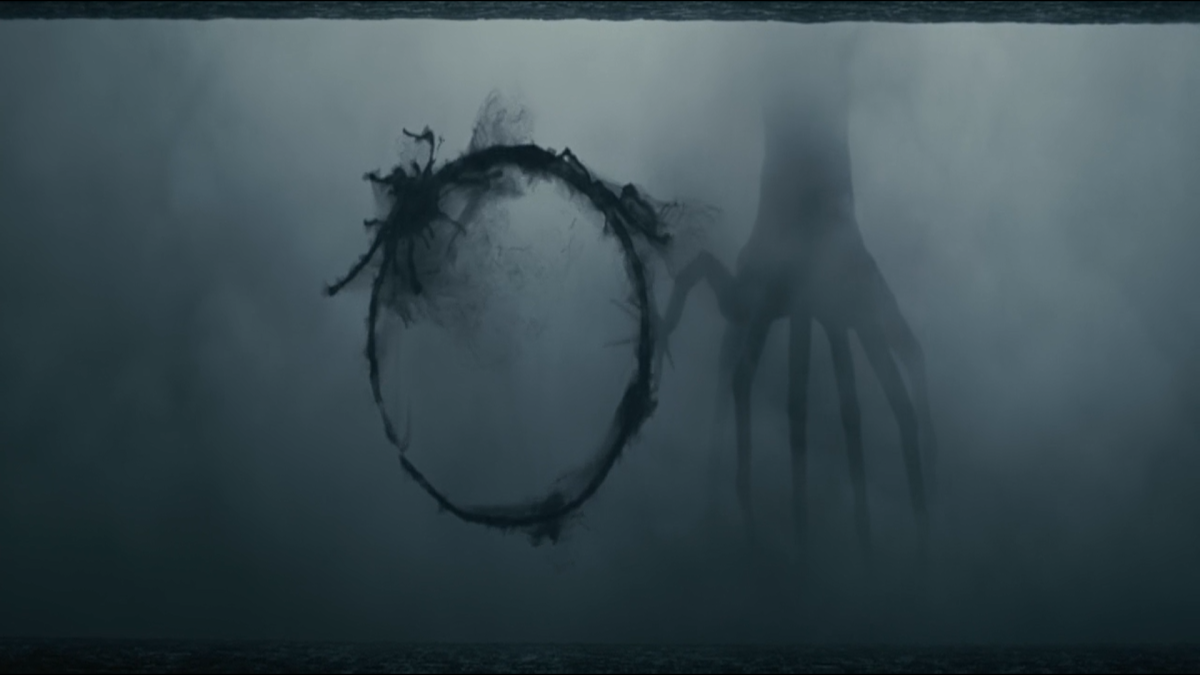
Why Solipsism stands strong? – Why idea of living in the Matrix fascinates us?
Is the creator playing with my mind to show me a false reality for something different which is beyond my access?

The earliest evidence to ask such question is found in the writing of a Roman skeptic Sextus Empiricus quoting Gorgias (c. 483–375 BC) as follows:

  1. Nothing exists
  2. Even if something exists, nothing can be known about it
  3. Even if something could be known about it, knowledge about it cannot be communicated to others.

Then René Descartes (the one who established Cartesian coordinates) came up with one of the famous quotes/ ideas about the absoluteness of the reality.

Cogito, ergo sum.  

I think, therefore I am.

René Descartes

Simply put, Descartes argued that, the most certain knowledge one can have is through personal experiences because knowledge transferred from others are never perfect also there is no way to measure where the translation was perfect. The existence and experience will always be discrete – separate; it will vary mind to mind, so what is reality for you is the only absolute reality; that is why absolute knowledge is private property. As you can be only certain of your experiences only your mind is the reality, everyone else’s minds don’t exist. (OR should I say others are mindless! Jokes apart!)

George Berkeley – Bishop Berkeley is also one famous philosopher who developed the ideas of immaterial-ism. He is known for the famous analogy of “a falling tree” although his writings never explicitly mentioned such analogy but let us say in a crude way, he pointed towards it. (See, even here we can see the gap that is created during the communication of an idea, a simple analogy someone established before us!)

So, the idea is, if a tree falls in a forest and nobody saw it falling, nobody heard it falling, nobody felt the vibrations of fall how come we be sure that a tree fell down somewhere? Unless and until someone observes the fall through their senses one can never be sure that the really fell. So, if no one noticed it and in the end even you didn’t notice the fall, then the tree never fell down!

Your mind, you consciousness and you had to exist absolutely to observe, experience the fall of the tree. If you weren’t there to see and experience the fall, how could you be so absolutely sure that the tree fell?

Solipsism – Trust no one but yourself!

Now, you would have understood what may be going wrong with Solipsism!

Modern day answers would be like “I would have been presented with a video to prove the fall.” OR “I would have been presented with the person who cut down the tree”

But the counterargument would go like this “What if the video was faked? (by using deepfake!!!)” OR the witness found to be forged – I wouldn’t know if the person is lying with confidence (even polygraphs tests can be fooled, false alibis can be created!!!)

Jokes aside, these are mere representative examples to demonstrate the point. When you start formally questioning the nature of reality by using the most consistent tools that we have in modern science, then this question again peeks out in a bizarre way!!!

According to quantum mechanics, the moment we measure the state of a quantum object, its state changes. So, the measurement of that instance will never refer to the actual state of the quantum object. Meaning that you could never be sure of what actually happened before or at the instance of measurement. You can have a probability but you will never be sure.

Your observation had to exist to define the state of the quantum object, if you weren’t there were infinite state of the quantum object to exist. Your observation assigned it a definite, objective, absolute state. Your observation made it a real “reality” otherwise it was always possibility rather probability of many events. Please note that these are not just the flights of minds by the most compelling specimens of humanity, these are actually mathematically, experimentally proven ideas.

The one liner to understand solipsism is –
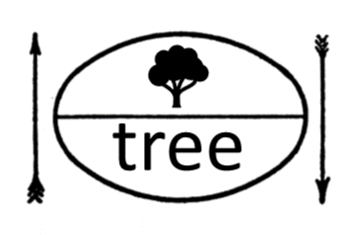
Your personal experience is more dependable than common sense!

I understand that how is it even possible to question common sense, common experiences. Solipsism is such a foolish idea rather the most foolish idea one can have! But, bare with me when we try to answer the paradoxes which lie in solipsism. Any person who is having existential crisis has been warned hereon!

Different ideologies in Solipsism
Metaphysical solipsism – the most extreme solipsism – the external world doesn’t exist. My mind creates the reality for me. (A rude adamant philosopher made it clear!)
Quick Joke – Unless I didn’t observe the tree falling, it is still there (and maybe giving fruits if it is a Mango tree!)

Epistemological solipsism – The reality around me is absolute and objective, but we cannot know it directly as it is through our sense and experiences. It is the limitation of my senses which inhibit my understanding of the reality. (This is a humble approach I would say!)

Sensory organs are not the experiences from the reality rather they are just the interpreters of the reality with practical limitations. There is no direct agency to experience what others are experiencing, to know other minds.

Quick Joke – A person drinking tea finds a fly in his tea asks the waiter to replace the tea. Waiter helplessly trying to convince his of not having any fly in that tea gives up and replaces the tea. After few same complaints from same person and replacing many cups, it is discovered that the fly was in the guest’s spectacles!

It’s like I cannot hear certain sound frequencies but certain animals can hear those frequencies. I can see only the light in visible spectrum, but other animals can see in another spectrum. It’s the limitation of my senses which dulls down the objectivity of the reality. You have to be ‘the God’ to understand all the spectrum of the reality! (excuse my introduction of some spiritual power here but we will come back to this again!)

This is the most practical, plausible and calming version of solipsism.

Methodological solipsism – Every logic is fallible, that is why you could never know what the absolute looks like. There is nothing like ‘the God’, if there is something supreme you won’t even understand how supreme it is and why it is so! (I know we are getting spiritual to go away from early religious epistemological solipsism but that is how it works)

It says that even our brain, our mind is the part of external reality. (I am feeling uncomfortable here.)

Quick Joke – A criminal was convicted for murder. He went scot-free because he didn’t do that murder, his had hand – rather the knife did the murder.

Jokes apart, but consider cognitive dissonance. Many things which we learned in our childhood as the absolute concept, as the ultimate truth gets replaced by something life changing and even more true and absolute. So, what is real truth is beyond our understanding.

Paradoxes at the end – Where Solipsism would break down!

The paradoxes of the solipsism are the most fun part which explain why solipsism deserves any explanation.

Here are some doubts,

1

If my mind is the absolute reality I live in, then why can’t I convince myself to survive by just imagining that I have eaten a lot today (while not eating even single crumb!)

I could just survive by thinking of eating the best food I could “think” of.

Everyone knows that this is not the real case. A person with that much will power and fasting will barely survive.

Now, the counterargument for this (and I love this part due to pop-culture reference!) –

What if your brain is kept in a container giving some electrical impulses exactly like in movie The Matrix. The matrix is programmed in such way that not eating will kill you definitely.

Solipsism ends in a matrix, a simulated reality beyond our experiences!

2

If there no such thing like matrix then how come all of us would die if we face the same degree of starvation? How come the experiences (even though not purely translatable to others but still the same based on the objective, consistent observations) we have in such cases match?

Many of the knowledge established as the most absolute, consistent and closer to the reality is developed because all of us had same experience (at least objective experience, ideally fully efficient translatable experience) in every one of our lives.

The answer is that we all share a common consciousness which enable us to experience the same scenario. We all are living a common and shared dream.

Our reality is a shared dream! Our consciousness is a shared dream! We all are connected by something so common and absolute thing. A spiritual person would call it the soul, a scientist would call it the energy.

This is technically known as the Solipsistic idealism – the best answer we have which will not blow our brains and will not give us the existential crisis!

3

The bizarre one comes here –

Even if the matrix is real, you would never be able to get the absolute understanding of it. Existence of external absolute reality is uncertain. You won’t even know if it is called matrix or a chewing gum or something else!   

Pro tip – don’t over-love solipsism

You must understand that the arguments in solipsism are quite good. (It is just my failure of communicating those to you if you are not convinced till this point. I apologize for that.)

If the reality is just created by my mind/ in my mind then there is no way to verify that from external agency.

But, our experiences, emotions (at least some of them) always feel common. René Descartes Descartes posed that the experiences, sensory feed-backs are purely created by our mind but modern science proves that babies are not born with absolute ideas of reality (it is possible that they are exposed to certain sensorial experiences from their mother right from the conception) The absolute experiences they get are from their interaction with the surrounding objects and people. Our personalities, identities are created from mutual interactions. We cannot be ourselves without the people around us and the environments we are exposed to.

Only a completely isolated person would have the polarized inclination towards solipsism.

But again, what if it is just a construct beyond our understanding? There is no way for us to know that.     

Even if there lies a construct beyond our understanding, there are some practical ways to purposefully ignore extreme ideas of solipsism rather leverage the ideas of solipsism.

If you are bound to the existing construct of reality which is practically within the reach of your experiences, your mind then you must abide by the laws of that reality. If you only stick to only the reality of your mind, then your so called “absolute truths” will immediately be challenged by the truth of others. It will be a blood bath but let your older absolute truths die to let the newer ones be born. They won’t be ideally absolute but at least they will be better than the previous one.

Even if the illusion of reality is shared among all of us as a common dream, we would never be able to escape that. Meaning, again play by the laws of the land. Ignore the existential crisis on the absoluteness of reality. At least try to get closer to the reality.

I think this is exactly why even though the pursuit of solipsism may feel worthless in the end but it’s understanding and appreciation gives us a hope to continuously keep on improving our version of the reality – private or shared whatever they may be.

Solipsism warns about the impossibility to know everything in absolute manner but if appreciated in a proper way it guides us to seek for continuous up-gradation from existing lesser absolute truths to newer and better absolute truths.

Learn the rules to break them in a better and glorious way!  

The acceptance of Solipsism (in a positive way) can also create an urge in person to seek for the real freedom. Solipsism in positive way urges the person to take that inner route in order to create the world of their desires through disciplined thinking (in a healthy way and not in a delusional way!) A pure solipsist would be delusional, neurotic but a practical solipsist would bring about a revolution in his own world thereby in the worlds of the others and even in the whole world altogether!

A Bet Called Life

Anton Chekhov through his short story called ‘the Bet’ establishes important gifts life grants us. The real freedom is to neither let go of life with an escapism/nihilism nor degrade it through materialistic exploitation. The real freedom is the harmony between time, resources, practical curiosity and most importantly people around us. Life has possibilities to offer, it is up to us to live our lives on the spectrum rather than polarizing them to an ideology.

Anton Chekhov’s famous short story called “the Bet”

The good life is a direction, not a destination

Bruce Lee

Quick question! Would you trade 10 years of life for 10 million? There are two important parts of this question before looking for the right answer and only a fool would think that there truly is one good answer to this question.

The first part of this question is – what is the value of time we live through our lifetime? Say, a millionaire who is bedridden in his last moments of life is still unsatisfied with the plans he had for his life. Would he trade his money with extra time?

The second part is – if we live a life with no resources – money to meet the ends then what good is to live such life?

Now if we look out for subjective answers, the diversity in answers would surprise us (and that part is not surprising, because everyone has their own definition of a good life and a bad life based on the experiences they had)

Anton Chekhov – one of the most important short story writers wrote one interesting story called “The Bet” which makes the readers question the real intent of having a life and living through it till death. What kind of life is a good life – a short but resourceful life or a long but painful life?

Synopsis

The Bet is a story of two people – A Banker and a lawyer who in their young age fix a bet to decide who among them is right. The argument of the bet is based on the morality of a death penalty. Banker thinks that instead of making the convicted suffer for a long time through lifetime imprisonment, he should be sentenced to instant- immediate death. Life – long but with suffering is inhumane punishment. Whereas the lawyer thinks that taking life in any way is inhumane as humans do not have any power to restore the life back. Taking life slowly or instantly – both are inhumane but if these two are the only options, then the best punishment is to let the convict live; even though it will be painful but he still lives.

In order to prove validity of their arguments they decide a bet where the banker agrees to pay the lawyer 2 million if the lawyer undergoes solitary confinement for five years. In the excitement of the argument the lawyer agrees to 15 years of solitary confinement for 2 million. If by any means the lawyer escapes this confinement or tries to connect with any human being, he will lose the bet and banker won’t have to pay anything to him. The lawyer would get wine, smoke, books and a musical instrument but no human contact or newspaper or a letter from someone. There was only a small window to receive anything from outer world.

As the confinement proceeds the bankers becomes more and more nervous. He anticipated that the lawyer won’t even last for 2-3 years but the bet truly goes till its completion and in the meantime the baker loses most of his money where the 2 million he pledged is the only amount he has. He now knows that the lawyer – seemingly successful to survive through the bet will now have 2 million while living out of the confinement and the banker himself would be poor. He tries to kill the lawyer on the last day of his confinement where he discovers that the lawyer has actually renounced what he was about to win from the bet, he even distastes the life itself and seeks the ultimate salvation, freedom from life. The lawyer understands that even after reading these many books, these many stories, learning many languages the death in an instant can wipe out everything that can be created.

Next day, the baker finds out that the lawyer escaped the confinement as he had planned in his letter to purposefully lose the bet. The banker is relieved knowing that he still has hold over the 2 million which was his last capital for survival. To not let discussions catch fire he locks the letter of renouncement of the prize from lawyer in a safe.

Life – granted to everyone has majorly two aspects which are continuously deciding the course everyone’s life. One is time and another is resources.

Anton Chekhov can be called as the king of short stories where his philosophy of writing was focused on to present only what is necessary to convey the intent to drive the story further, nothing seems extra in his stories which make them highly effective short stories. All of Chekhov’s stories are based on common scenarios happening with common people, there is always some realism and non-fictional touch to his stories. And hence they always deliver a profound idea about what a life really is, what it means to be a human. You will rarely find a direct message in his stories, the natural reactions of his characters will show you the mirror. Anton Chekhov truly mastered the skill of mirroring the life through is short but highly effective stories. The Bet is one such masterpiece. Let us dive deeper into this story.

The Abundance

The Bet is a story of how one values their own life and other people’s lives. Chekhov smartly shows how abundance dulls, narrows and blinds the vision and opinions one has. The banker and the lawyer in their young age while arguing over the justification to punish someone by death of life-long imprisonment are indicated to be full of adrenaline and excitement. Even though they have not gone through such experiences they have firm opinions on such experiences. The lawyer and banker both have many years of life still left to spare which leads to such an absurd bet. The banker thinks that he has enough wealth just to spare for such a silly bet. Almost all the times, we are ready to stake things we have in abundance for a silly thing which would prove our beliefs to be either right or wrong. Abundance reduces the perception of value for things, time and even life. Lawyer and banker both were young when the bet was established. Great thing about Chekhov to appreciate is how he points out the behaviour and opinions of youth on almost anything. The youth seem to have strong opinions on everything even when they haven’t gone through those experiences or lived with the people closer to such experiences. The so called “hormones” make the youth think themselves as invincible – there is nothing wrong with that as it is what makes young people turn impossible things into possible but being in a simulation where there is no relevance to the reality makes the youth delusional where they take negative and life-altering decisions carelessly. Consider if this bet was set up between two beggars or two old men, its an impossibility. In both cases they are lacking time and resources/ money.

So, the starting set up for bet shows how in early young years abundance can blindfold the person from reality.

Banker wanted the punishment to be instant as it involves no suffering also shows how greatly he values pleasures and happiness in life. A painful life is equivalent to death for him. At the same time for the lawyer morality is more important, that is why he prefers gift of life in any form rather than the instant death.

“To live anyhow is better than not at all”

The Bet

And funnily or ironically, in the end after 15 years you will see the lawyer longing for the true salvation, you will see this in his letter when the bet is about to end where he establishes that whatever knowledge, experiences, money, resources one could have in their lives – the death will render all of those useless – a more nihilistic opinion.

“You may be proud, wise, and fine, but death will wipe you off the face of the earth as though you were no more than mice burrowing under the floor, and your history, your immortal geniuses will burn or freeze together with the earthly globe”

The Bet

The Solitude – Curse or Boon?

It is really interesting how Chekhov describes the lawyer’s voluntary solitary confinement. It’s like mirroring of how we as human beings go on the quest of understanding the surroundings, the nature and the society around us when we are left alone.

As the lawyer was alone and confined to himself only, in early years of imprisonment the lawyer felt lonely and depressed. This shows how we are mostly created by our surroundings. Most of the time we are what our surroundings are. We only start understanding ourselves when we try to define our existence from inside and not outside. This becomes accelerated and intense when one accepts the solitude in the place of loneliness. The journey to solitude for lawyer started with music and romantic, thriller fiction.

It is impressive of Chekhov’s writing to highlight how our mind tries to fill in the gaps when we are alone. When people are on their own with no outward person to person interaction or person to object interaction, they try to fill that gap of loneliness with entertainment, music, poetry, literature, addiction and what not. People who are unable to fill this gap are the truest lonely people, they always will long for company of other people to fill the void.

In second year, the lawyer became more silent and started writing for long hours instead of reading anything. He is angry with what he accepted just to prove his point but is helpless to change the course of the things. This is the stage where Chekhov sneakily establishes that even though entertainment may fill the void of solitude to some extend for a person, it will not stand the test of the time. The solitude makes the person to have thoughts inside them engulf themselves. Writing is one way to blurt out all that is going inside the mind of the person thereby consoling them that whatever was inside them is now physically outside, on paper. One peculiar observation about writers inserted by Chekhov here! When your thoughts try to eat you, devour you from inside, it is good to channel them outside through your creations, that is what is the basic characteristic of the greatest artists the world has ever seen.

Chekhov then describes the sixth year of the lawyer in confinement as the seeker of the knowledge. Again, the credit goes to the genius of Chekhov where he shows that when a person rises above his own materialistic existence, he seeks the understanding of the nature that he emerged from. When the person accepts his solitude then only his search for real truth begins. It’s like this solitude removed all the noise from his existence. The lawyer in solitude studying philosophy, languages and history shows the curiosity to know oneself better. Study of languages show the curiosity to understand and comprehend that which others had already said but your inability to hear restricted you to access that knowledge. Studying philosophy shows the urge to clear the clutter of thoughts going in the head, philosophy to some extent is the re-organization of what we think, how we think and how we decide our actions accordingly. Studying history indicates the ways to understand the reasons behind the present order of things, everything that exists in present has traceability to history which justifies the way things – traditions are perceived, handled in present.

From sixth to tenth year the lawyer studied the languages and mastered them like a commoner. It is very interesting choice from Chekhov to make his character study languages after studying some heavy fields like philosophy, history. It could have been science and technology but no, all the lawyer was interested in were the languages. Please understand that this is one of the most important creative choices made by Anton Chekhov.

When a person finds the truest, purest reservoir of knowledge, his search for anything greater than that ends there (obviously), the next stage for such enlightened person is to understand and find different interpretations of this pure knowledge.

“The geniuses of all ages and of all lands speak different languages but the same flame burns in them all”

The Bet

After completing ten years, the lawyer surprisingly moved to theology and gospels – the study of religion. It is surprising for a scholar who mastered six languages and deeply understood philosophy, history of humanity. Chekhov wants to highlight one important aspect of humans and their obsession with certain goals – destinations in life. When the destination people considered the most important thing of their life are reached, at that exact moment they become meaningless. The human mind becomes clueless after this event, whatever efforts they took to reach their feel worthless as if nothing in life was worth that or was worth that value. That is the moment when the person tries to detach themselves from all these theories, logics and philosophies. This is the moment when a person realises that there is totally different order and the entity which has designed this current order in which he exists. This is the person resorting to spirituality. When a person feels hopeless during continuous sufferings, purposeless even after achieving that important goal he desired for his whole life, spirituality becomes the last stop.

“A little philosophy inclineth man’s mind to atheism: but depth in philosophy bringeth men’s minds about to religion.”

Sir Francis Bacon

In the last two years Chekhov portrays the lawyer in solitary confinement as a the one who is drifting in the ocean of existence, he is on the verge of breakdown, he is sinking thus wherever he will find support he will cling to it. It is some sort of neurosis, especially the neurosis of the genius mind.

It is the true genius of Anton Chekhov where he shows his readers the journey to find the meaning of our existence, solitude intensifies the speed of this journey. And in the end, if one forces himself to understand the meaning of life in an absolute way, then he will definitely end up being the fool – the smartest and greatest fool the world has ever seen! Too much analysis, too much knowledge and too much logic can drain humanity from the person in a very tragic way. Even nihilism will look petty in front of such condition.

“A mind all logic is like a knife all blade. It makes the hand bleed that uses it.”

Rabindranath Tagore

The Time Vs The Resources

Please understand that major events in the Bet are flashbacks of the banker. And Chekhov has written these flashbacks as if the banker is regretting his decision of setting this bet. The banker knows that he has already lost the bet. He lost all his wealth during this time of 15 year and in addition to that peace of his mind just to prove some foolish point to some group of people.

You must appreciate how Chekhov manipulates the effect of time and resources in the bet. Through this manipulation, he shows significance of both time and resource/ money in human life and also the interplay between them. You will see that the lawyer had 15 years to build his upcoming life after successfully completing the bet. He was the victorious who would have had wisdom and wealth – he would have become practically invincible. But too much knowledge and time spent with books made him think about the worthlessness of life, as his mind was always fed with the simulations, experiences from the books he never got the hold of real-life experiences. This created a detachment from reality in his life experiences. Thus, it is not surprising that he considers the gift of life (which he was ready to live anyhow in the early time of the bet) as a worthless one as death can wipe it out in no time.

For banker it is totally different story. He was the one who was so sure about the future abundance of the wealth he would have had that the pledged money was nothing for him in the early years. The lack of knowledge and the abundance created illusion for him. When the bet was about to end, he was consumed by the idea of loss of his dearly 2 million. The banker even makes an attempt to kill the lawyer in secret to win the bet. The character of banker seems shallow right from the beginning of the story but we must not forget that he too is a human being. Before the setup of bet, the banker was of the opinion that a good life must be painless life otherwise the life should not be lived. But as the bet proceeds you will find the banker in the continuous pain and fear for the loss of his money. Even with this pain he prefers living though it. He chooses painful life now.

Let us understand one scenario, what if the banker went on to become wealthier and wealthier as the bet went on to completion. He would not have felt a single regret to let the lawyer win the bet. Rather the character of the banker would have definitely honored the lawyer for his willpower and genius that he had become during his solitary confinement. The “supposedly” wealthy banker would have humbly sponsored the lawyer for the rest of his life. But Chekhov did not let that happen with the banker’s character. This shows how we human beings set our ideals, our philosophy of life, our way of making decisions, our way of thinking and our motivations based on how we feel about ourselves. Our ideals or philosophy of life never take a moral guidance system – it rather follows the pathways of how we experience life around us and how we feel about it. A cold-blooded criminal will never feel regret for killing another human being and at the same time a sage will punish himself for losing his temper on a child who broke his meditation practice. Your calls for right or wrong are heavily influenced by how you feel about yourself, others come later.

So, it is really important to understand how we decide right or wrong. Most of the time these decisions are influenced by how we were feeling in that decision making moment.  

No wonder Chekhov shows mirror to his readers through his short yet highly effective writing.

 The Conclusion

So, we will again come back to the question we asked at the start of this discussion. Can 10 years be traded for the 10 million? If these 10 years were full of pain and suffering, one would surely trade them for the money. If these 10 years were filled with happiness, joy and fulfillment then 10 million would look worthless in front of them. This shows how foolishly we are trying to justify our lives by attaching it to a single defined destination. We are always forgetting the multitudes of spectrum our lives have. We always try to justify our life with a single event – good or bad and forget that this too shall pass. The profoundness of life allows us to define the life in every possible way, that is actually a curse and a boon. That is exactly why living life with the decisions we take is the biggest bet a person can play. Anton Chekhov shows this side of life through a simple bet between a lawyer and a banker.

Life will never be a single conclusion, it will always remain multifaceted, full of possibilities. That is why whatever call we take for the life to become something ahead is going to be new trick every time. When we discuss the quality and quantity of life, we are again ignoring the spectrum of endless possibilities life has.

Salvation either through the pursuit of knowledge or through the pursuit of resources – both are foolish moves to live a fulfilled life. Life will never associate itself to single adjective, single attribute, single absolute ideology, philosophy – otherwise it will become monotonous- mechanical – lifeless. You will see that so called “enlightened” genius lawyer in the end literally becomes mad and despises everything that life can offer – the same lawyer who considered living life in any condition is good than death when the bet was to start.

“To be overly conscious is a sickness, a real, thorough sickness”

Fyodor Dostoevsky

Anton Chekhov was the master of bringing two exactly contrasting ideas through the portrayal of realistic life. That is exactly how real life is – full of paradoxes. That is what makes Chekhov’s stories so special.

“What a fine weather today! Can’t choose whether to drink tea or to hang myself.”

Anton Chekhov

Chekhov establishes these important aspects life granted us like the abundance of time and resources, the knowledge, the possibilities and pathways to self-discovery. The real freedom is neither to let go of life with an escapism/nihilism nor degrade it through materialistic exploitation. The real freedom is the harmony between time, resources, practical curiosity and most importantly people around us. Life has possibilities to offer, let us live our lives on the spectrum rather than polarizing them to an ideology. It is crime to let life take a side on a shore than to let it flow through the vast ocean of possibilities.

(There is a third part of this story which was not known to public for many years. In this newly revealed ending, the banker remained in guilt even when the lawyer had technically renounced the prize money by losing the bet. One day, the lawyer returned to the banker and asked for the money he won. The banker gave the lawyer the prize money in order to bring his mind at peace.)

Source for reading:

The Project Gutenberg eBook of The Bet, and other stories

The Trilemma of the Truth and the Skepticism

Skepticism deals with the attitude of questioning our beliefs based on an idea that our perception of reality through our senses and personal experiences may totally different from “the actual reality”. The Münchhausen Trilemma and Agrippa’s Five Tropes from epistemology may guide us on how to suspend a judgement and how assign truth value to every belief in our lives.

Why the philosophical search for the ultimate universal truth is useless?

An Existential Meme Caption and Its Resolution

Since the invention of social media, some images (especially the certain classic meme templates) have stood the test of time. These images keep on circulating and there comes a moment when that image reinvents itself in new format, it brings some new argument with different type of humor. See the following image for example:

“Just because you are right, does not mean, I am wrong. You just haven’t seen life from my side”

Funnily enough, this image always comes with a thoughtful (supposedly) caption as follows:

“Just because you are right, does not mean, I am wrong. You just haven’t seen life from my side”

Given that the argument presented in this caption demonstrates the subjectivity of the everyone’s perspective, it is really futile to discuss what to exactly extract or understand from this caption.

For example, if this was the scenario where knowing the true value would save a person’s life then knowing the truth becomes the necessity and all of us know that this wouldn’t have saved that precious life which was dependent the true answer. There is no definite answer for this argument because it invokes subjectivity in the argument. People use this image and the said caption to express their inability to prove the truth value of their argument, especially their emotions.

Now, in recent time this image resurfaced with a new argument which blew my mind the moment I saw it. The reinvented image looks like this:

“How a mathematician/ an engineer solved the conflict”

You must appreciate wit and sense of humor of the person who modified the argument presented in the original image.

There Is No Final Truth.

This simple evolution of a very common internet template invites a question. What is the real truth? What is the truest truth? What is that one answer that can answer all the questions? If something exists in truth, then how would I verify that it is “the truth”?

At first one might think that these are such foolish questions. Truth can be established by experimentation, demonstration, repeatability/ reproducibility, comparison, consistency, contradiction/ counterexamples.

Take for example,

Q1: how would one calculate the time taken by the ball dropped from certain height on the Earth to reach the ground?

A1: The answer is by using Newton’s kinematic equations.

Q2: How the kinematic equations were developed?

A2: By using Newton’s law of gravitation and the law of motion

Q3: How these laws were developed?

A3: Newton studied the motion of moon and earth, developed some mathematics to explain that behavior. That math remains consistent to explain the scenario of the motion of the ball dropped from certain height.

Now from here the real fun begins,

Q4: If Newton’s law of gravitation and laws of motion are consistent and hence true then why did they fail to explain the different/anomalous motion of the planet Mercury around the Sun?

A4: The truth presented in Newton’s laws of gravitation and motions are a special case of the higher and more inclusive, exhaustive truth of Einstein’s relativity.

Q5: Why Newton’s truth is not the complete/ ultimate truth?

A5: Newton assumed Gravitational as a universal force of attraction, inertia of every object in the universe, concepts of the balanced force.

Q6: Did Newton made mistake in “assuming” certain things for the sake of establishing the proof and its mathematics? Because, Einstein certainly didn’t assume those things and still his theory of relativity can prove the arguments covered by Newton.

A6:  Yes, looks like Newton assumed gravity as a force of attraction where things will get “pulled” towards heavier objects or fall into them. Whereas Einstein established this as wrong and proved that Gravity is actually a “push” created due the curvature in space-time.

Now from hereon, if one remains careful enough then that person can land into the territory of quantum mechanics to prove that Einstein was wrong (in a way). The failure that connect the Theory of relativity and quantum mechanics is why we are still uncertain what is the ultimate truth that will answer all the questions there exist. (Trust me the answer is definitely not “42”!)

So, if we keep on asking the question to each and every truth, will we reach the ultimate truth? Will that be the ultimate knowledge? Will that help us define the absoluteness of the knowledge?

Philosophers have argued (literally and figuratively) for centuries about the acceptability of any truth as “the truth”. Epistemology deals with the theory of knowledge, how a belief and opinion differ from the truth, if given argument is true then how it becomes the truth- what is its validity, justification?

So, when one starts to question things continuously there will be three possible cases explaining how the things will end into. This condition is famously known as Agrippa’s Trilemma or the Münchhausen trilemma in philosophy.

In really simple words, the trilemma says that it is impossible to prove whether certain truth is really true because at the last end of this truth there will always be some unjustified, non-contradictory fact which cannot be proved by using other proofs in existence.

Let see in detail what is this trilemma and the its legacy in epistemology.

The Münchhausen Trilemma

Baron Münchhausen is a fictional character created by German writer Rudolf Erich Raspe in his book “Baron Munchausen’s Narrative of his Marvelous Travels and Campaigns in Russia”. Münchhausen is a person who has done many impossible things like fighting a forty-foot crocodile, and traveling to the Moon. The book is a satire. (Baron Münchhausen is German Don Quixote per say!)

So, there is a story where Baron Münchhausen is drowning in the water while riding on his horse but soon he realizes that he can lift himself from the water just by pulling his hair. Hence, he pulls his hair and comes out of that mire/ quicksand with his horse.

Münchhausen saves himself along with the horse from drowning by pulling himself by his hair!

Do you understand how it worked? How could one pull himself out of an unsupported marshy land without any support? Where did Münchhausen pivot to rest himself? The story is foolish!

So, how did Münchhausen come out of mire without any support? If he was successful in his rescue, he would have definitely used some pivot, some support!

In the similar emotion, any argument to be proven true will need another supporting true argument. This “primary supporting true argument” will also need another “secondary supporting true argument”. You might have understood where we are going with this. If this keeps on progressing further and we keep questioning the complementary true arguments which are supporting the main truth then we will end up in three possible scenarios, which are “the trilemmas” as follows:

If we keep on questioning anything, the proofs will:

  1. Given proof will be followed by other distinct proofs which further will be proved by other more distinct proofs leading to infinite chain of proofs – The regressive argument
  2. A proof will be proved by another proof based on the prejudice that it is consistent in many cases so, as it is consistent then it must be true hence the main proof is true – The circular argument
  3. The proof will be accepted as the truth as there is no proven counterargument or any contradicting observation to falsify it – The dogmatic argument

Resolving the Trilemma

Explaining these trilemmas, we can say that these three trilemmas can be solved by following ways:

  • Infinitism: there will be an infinite chain of justifications for every truth. It will never end.

Remember that child who annoys their parents with a new question to every answer they give. That child indirectly knows infinite reasoning! (somehow!) A “patient” parent can go on answering that child’s each and every question!

  • Coherentism: there will be recurring loop of beliefs based on some other beliefs. These beliefs will prove each other.

You know your friend is telling you the truth because you have always seen him/her telling you the truth. It is consistent with his behavior. As you “believe” that he/ she tells the truth, whatever is told by them would also be true. (But who knows!)

  • Foundationalism: the chain of justifications will end at an argument which is accepted as the truth without any other proof and/or because there is no contraction available to this argument. It becomes accepted as an axiom which lies at the foundation of everything.

The matter was accepted to be made up of smallest invisible particle called atom and based on that many good theories explaining reaction stoichiometry, formation of molecules and thereby compounds was explained. We now know that atom can constitute further divisible particles thereby upgrading the theory further on to cover more generalized cases till quantum systems.

Similarly, Newton’s ideas which we discussed in the start rested on some foundation which proved many truths based on that foundation. It was the failure of that foundation which could not explain the motion of mercury. Einstein’s new foundation embraced wider foundation where Newton’s math becomes a special case. We will keep on upgrading our foundations.

Skepticism, Agrippa and the Suspension of the Judgement

There was a school of Greek philosophers who questioned the very existence of the knowledge. They were “skeptical”, “doubtful” about everything thereby forming the school of Skepticism in philosophy. The reason to question everything available around us was due to the ways through which we understand these things. There is a gap between how we experience things around us through our senses and what these things really are. (What we see in desert looking like a lake is actually a mirage) There will always be some gap between appearance and reality. So, what we are believing to be true does not necessarily requires to remain true. The reality might be totally different. Not only different but reality can be subjective meaning that what a person has experienced from a thing can be totally different from what another person has experienced, and both stand true because of the individuality of their ways of experiencing the reality. Both sides will be true due to distinct and unprovable subjectivity. Bertrand Russel in his book the Problems of Philosophy has clearly discussed this as the limitations of our senses and the nature of reality. these limitations of our senses bring in that subjectivity in our truths hence they are our versions of truths which may be the truths for others. So, the early idea was to question everything to suspend both beliefs, experiences or the versions of the truth.

The problem which is created here is that if people become doubtful about everything around them, then they will end up in questioning their own existence. This question of existence will further lead to infinite chain thereby rendering useless, worthless, and futile venture. That is exactly why Socrates pursued ethics where “Why to live?” is not that much important and where “How to live?” is much more important.

One of the important philosophers called Pyrrho ((360-270 BCE) traveled with the army of Alexander to India where he met some “naked philosophers” (gymnosophists) who explained to him the reality of life. That there is no such thing as true or false, nothing is just or unjust, neither is honorable or dishonorable. No belief or experience is true or false. From these naked philosophers (I think these were the ancient groups of “Naga Sadhus” which exist even in our time today). These learnings focus on not having any judgement thereby rejecting any judgement, suspending any judgement.

This gave rise to the formation of five tropes for suspension of judgement which were developed by Agrippa who came later and expanded the understandings of Pyrrho.

These five tropes go like this:

  1. When the views are conflicting between common people and the philosophers then we must suspend that judgement – unacceptable due to inconsistency – Dissent
  2. When one is justifying a claim then that claim must be appealed by a prior claim which will end in infinite regress, so we must suspend that judgement – Progress ad infinitum
  3. Everything is relative, things appear right or wrong based on the condition in which they were observed and the environments in which they were judged, so we must suspend that judgement – Relation
  4. When a judgment is proved to be true based on an assumption and if that assumption itself is unsupported then we must suspend that judgement – Assumption
  5. When a truth invokes another proof which creates the circularity of justifications then we must suspend that judgement – Circularity

The beauty of the Agrippa’s five tropes is that it brings in the relativity in our process of understanding the truths of our lives. I would say that Agrippa solved the problem of establishing the truth by the process of elimination. In a very smart way, instead of proving something directly to be true, we can work around the facts surrounding given argument. Eliminating the arguments in the proof by implementing these five tropes can at least reduce the size of the problem thereby keeping all the possibilities of proving it to be true always open. The beauty is in the opportunities to upgrade the foundations!

This philosophy of skepticism created the foundation of modern philosophy and thereby modern science and mathematics. Some ideas explained in this trilemma remain consistent with the Kurt Gödel’s Incompleteness Theorem which explains why mathematics rather the reality itself is inconsistent. There will always be something unprovable in given domain of system which will demand to expand that system to a totally new system of knowledge thereby upgrading the existing foundations of our understanding of the nature and the reality and thereby our fields knowledge. That is exactly why Newton’s ideas even though were limited to some special cases are important because Einstein wouldn’t have had the foundation to build upon something. We will always be creating some general understanding of the universe which later will surely become a special case in our understanding. That is also why questioning everything is important in the process of developing fundamental understanding. It is the philosophy of skepticism which empowers us to stay humble and rediscover the reality in which we already exist.