
Miyamoto Musashi’s philosophy for 21st century
Ancient combat strategies for the modern competitions
After understanding the Ground Book which builds the foundation of the Book of Five Rings by Miyamoto Musashi, we will deep dive into the next book called the Water Book. The general idea is to understand how water behaves, how it tries to bring in consistency throughout, how it tries to level even in disturbances, how a drop to drop creates an oceanic impact, how it flows and remains unobstructed of the challenges. The Water Book is about the the spirit of the warrior, the attitude, the way of looking at things and handling them, making decisions about them.
“The principle of strategy is to have one thing, to know ten thousand things.“
In short, know the ocean from single drop. Miyamoto Musashi wants to highlight the effectiveness of his strategy of Water by showing the consistency in these principles. Once a warrior understands a consistent idea, it becomes very easy for him to implement it everywhere effectively. Thus, by learning this consistent way of water if a warrior defeats his single enemy, he thereby also gains the ability to defeat the thousands of enemies singly. That is how effective these ideas from the Water Book are!
“Language does not extend to explaining the Way in detail, but it can be grasped intuitively. Study this book; read a word and then ponder on it. If you interpret the meaning loosely you will mistake the Way.“
This is exactly what has been already established in modern philosophy as the Language Theory of Philosophy by Ludwig Wittgenstein. An ancient, age-old warrior already understood this knowledge way ahead of his time. Miyamoto-san knew that a novice self-learner will take every word literally and hence will fail to actually grasp the depths of the wisdom he has shared. He wants readers to inculcate every word in their own lives. These are not ideas just for battling, killing and fighting. These are the ideas to handle any type of situations, people, systems in your everyday lives.
“The principles of strategy are written down here in terms of single combat, but you must think broadly so that you attain an understanding for ten-thousand-a-side battles.“
The wisdom is so distilled and ubiquitous that it can be used in any battle, any problem solving.
“If you merely read this book, you will not reach the Way of Strategy.“
Again, this Book of Water rather the Book of Five Rings is not to be taken literally.
Spirituality – The Way of Life
“In strategy your spiritual bearing must not be any different from normal. Both in fighting and in everyday life you should be determined though calm. Meet the situation without tenseness yet not recklessly, your spirit settled yet unbiased. Even when your spirit is calm do not let you spirit slacken. Do not let your spirit be influenced by your body, or your body be influenced by your spirit. Be neither insufficiently spirited nor over spirited. An elevated spirit is weak and a low spirit is weak. Do not let your enemy see your spirit.”
One has to now understand that Miyamoto-san even though explicitly talks about sword fights it is not only about sword fights. He wants readers to understand that the true greatness does not come from following special regime or following some trick or knowing some secrets. Actually, the secret to a great life is that there is no secret!
Miyamoto-san doesn’t want a warrior to force things. He wants everyone to be at their optimum, neither less nor more, neither in excess nor in scarce – just the perfect amount. Once this happens in a person’s daily routine then it becomes part of him, his way of life. Then even an extraordinary situation, a bad event doesn’t affect him. This is what discovering spirituality is!
“With your spirit open and un-constricted, look at things from a high point of view. You must cultivate your wisdom and spirit. Polish your wisdom: learn public justice, distinguish between good and evil, study the Ways of different arts one by one. When you cannot be deceived by men you will have realized the wisdom of strategy.“
Miyamoto-san though promotes his “Way of Strategy” in the Book of Five Rings, he wants the readers to expand their vision, their perspectives to different arts too. The idea is that when you become aware of many things, many arts it becomes really difficult to fool you, to trick you. That is also a superpower in a way.
Stance
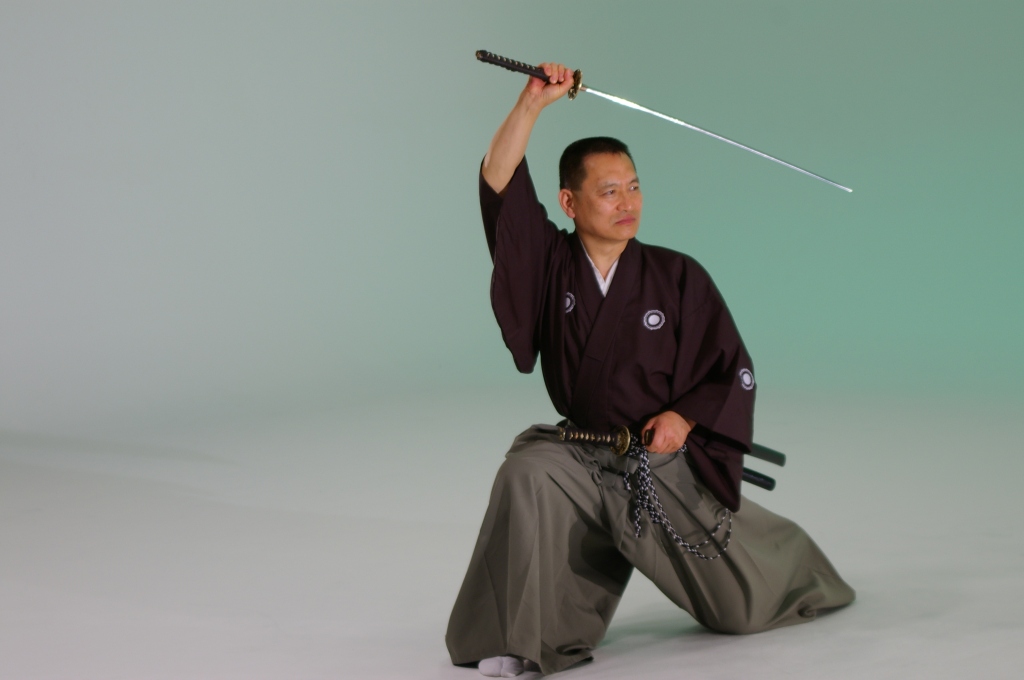
Please mind that it is not just about how a warrior should stand in a fight. Stance here also means about your attitude in the situations of hardships and challenges. Here it goes:
- Adopt a stance with head erect, neither hanging down, nor looking up, nor twisted – Don’t project yourself as too proud or too peasant and helpless. Be at peace with yourself.
- Your forehead and the space between your eyes should not be wrinkled – Control and hide your anger and project it effectively when and where required
- Do not roll your eyes nor allow them to blink – Don’t fiddle, observe your surrounding with a calm and focused mind
- With your features composed, keep the line of your nose straight with a feeling of slightly flaring your nostrils – Be in the moment. Breath.
- Hold the line of the rare of the neck straight: instill your vigor into your hairline, and in the same way from the shoulders down through your entire body – Concentrate all your energy to your torso, your vital organs in order to handle what is to come next
- Lower both shoulders and, without the buttocks jutting out, put strength into your legs from the knees to the tips of your toes. Brace your abdomen so that you do not bend at the hips – Don’t tighten your body, don’t be stressed from the fear of your enemy. Loosen up your body to make it pliable to respond enemy attacks effectively.
- Wedge your companion sword in your belt against your abdomen, so that your belt s not slack – this is called “wedging in” – Prepare yourself to attack, tighten your core body, your weapons, your tools/ equipment to face any situation
“In all forms of strategy, it is necessary to maintain the combat stance in everyday life and make your everyday stance your combat stance.“
Here you must understand that these are not the recommendations to warriors only. Miyamoto-san wants these to be the way of life. One has to really appreciate the depths of his wisdoms through these teaching.
Gaze – Don’t just look, have a vision
“In strategy it is important to see distant things as if they were close and to take a distanced view of close things.“
While doing all of these stances Miyamoto-san suggests to not get fooled by the appearances only. He recommended these mentioned stances in order to project strong warrior in front of his opponent. But what if the enemy also projects the same stances nevertheless, he is strong in reality? At these moments, Miyamoto-san guides to understand the big picture and the details to decide effective strategies based on the enemy’s behavior.
Holding the Long Sword
Miyamoto-san beautifully explains the role of each finger on the grip of sword. It can only be experienced on personal level of reader and cannot be expressed in words only. But the overall idea is not just grab the sword with all five fingers rather make it an extension of your body which has its own reflexes.
“Fixedness means a dead hand. Pliability is a living hand.“
It is again a reminder to not blindly and mechanically follow the rule, tricks, or techniques. Become agile and formless, shapeless like water (..my friend!)
Footwork
“Whether you move fast or slow, with large or small steps, your feet must always move as in normal walking.“
Miyamoto-san here again says that there is nothing like “special technique” to defeat any enemy. When you are not forcing things to be there, you break the patterns, mechanical nature of your moves. Your moves, decisions become natural.
“You should not move on one foot preferentially.“
If you have preferences, then it becomes easy to defeat you by attacking on your preferences, your preferences will make you more predictable.
“If you try to wield the long sword quickly you will mistake the Way. To wield the long sword well you must wield it calmly.“
Any big responsibility, any big authority, any big decision, any big power should be handled wisely, calmly with a focused mind.
Way of the Long Sword
Miyamoto-san then exactly points out each and every technique to the student. The details with which everything is explained deserves great attention of every reader. The information is clear, concise and just enough.
a. The Five Attitudes
The great thing about a true master is that he is the ultimate simplifier. A true master knows how to teach complicated and intertwined knowledge points in simplified ways without losing the essence of the concept. Miyamoto-san thus incorporates his exact learning into small chunks of wisdom where every word is just enough to grasp the whole concept.
Miyamoto-san at the very beginning makes clear as to where exactly the sword is supposed to be used. The five attitudes he describes seem very simple. The five attitudes are:
- The Middle attitude – it is about hitting (and killing) the enemy by striking on torso and vital organs with sword against his face
- The Upper attitude – it is about exactly striking upper blow of sword when enemy attacks and when he escapes this cut Miyamoto-san guides to follow the flow on line and scoop from below
- The Lower attitude – it is about hitting the hands of enemy from below, Miyamoto-san also suggests that this is the most encountered stance from enemy
- The Left-side attitude – it is about hitting the hands of enemy from below and parrying the same attack to cut from his left side
- The Right-side attitude – it is about crossing enemy’s sword attack from below and swinging it further and using upper strike from the right side
These are in simple and no-nonsense words, the five directions in which you can swing a sword to kill your enemy. You really have to understand that the reader of this book especially the pupil learning swordfight are supposed to have that innate natural excitement of learning something special from the great master – his tricks and secrets to become invincible. But the great Sword-master Miyamoto-san delivers his wisdom in the ways of common sense. And believe me it is not sarcasm, rather Miyamoto-san is very serious while discussing the five attitudes here. The whole idea of five attitudes is that, there are mere five vital regions where one has to focus to defeat his enemy. And in those five the Middle Attitude is the most vital. (Logically, the middle region, the torso of human body consists most of the vital organs in human body so it already makes more sense)
“To understand attitude, you must thoroughly understand the middle attitude. The middle attitude is the heart of the attitudes. If we look at strategy on a broad scale, the Middle attitude is the seat of the commander, with the other four attitudes following the commander. You must appreciate this.“
The attitudes are not there only to explain the parts of human body, it also represents the whole organization of the enemy’s battalion. All the vital weaponry, the best of the best soldiers, the best diplomats, the best strategists are the middle part of every commander on battle-field. Miyamoto-san suggests to focus on this middle part while defeating enemies in masses. Such hidden and smart instructions are hidden and scattered all over the Book of the Five Rings.
b. The “Attitude No-attitude” teaching
Miyamoto-san gives five attitudes to fight at first and then instructs to forget about them here. Please understand that the five attitudes are not just “A Guide to Basic Human Anatomy” for the sword-fighters. There is deeper meaning in Miyamoto-san’s advice.
“Whatever attitude you are in, do not be conscious of making the attitude; think only of cutting. Your attitude should be large or small according to the situation.“
One can understand it like this – Do not get overwhelmed by the thought of deciding which approach to select to kill the enemy. Actually, if one gets tangled and confused in selecting the right approach, he will immediately loose his life to his opponent as the enemy has already stricken him.
One should only focus on intent to kill the enemy and let the right attitudes come out of those attitudes. Even though five attitudes are defined that does not mean that they are supposed to followed mechanically. This way of mechanistic selection and confusion from it disappears when one does enough practice which is what Miyamoto-san focuses and instructs everywhere.
“Fixed formation is bad“
Again, Miyamoto-san suggests to be fluid, non-fixated, agile, flowable like water.
c. To Hit the Enemy “In One Timing”
The idea is to not hesitate to act on right opportunity with the full intent of killing the enemy
d. The “Abdomen Timing of Two”
Don’t spare your enemy even when you see him retreating, when you see him relaxing follow him up with a cut
e. No Design, No Conception
Go fully “in” when you see enemy going fully “in”. Use everything you have, don’t follow the structuredness and rigidity of some tricks you learned elsewhere. Again, be fluid in nature, respond accordingly.
f. The Flowing Water Cut
When your strike fails, when you fail (in anything in your real life too) widen your perspective, expand your spirit and this time strike your next blow slowly but decisively, thoughtfully. Miyamoto-san understands that when the enemy sees his strike winning, the true warrior must make a conscious effort to not let his enemy’s morale raise high with this small win. Miyamoto-san call it like “Stagnant water”, when you blow fails, pause-think-come back with full intent of focus.
g. Continuous Cut
When you realize that the enemy- opponent is equivalent to you and it is difficult to defeat (kill) him; then you should attack in such way that it will harm the enemy at multiple locations. Try to hit as many birds as possible in single stone when you are fighting an equal opponent. It is about effectiveness and efficiency of your single stroke.
h. The Fire and Stones
When fight goes one-to-one make sure that it hits different parts of the enemy.
i. The Red Leaves Cut
Force the enemy to lose his sword, his vital and important tools, weapons like a falling and dying red leaf of fall. Disable the enemy by capturing his resources.
j. The Body in Place of the Long Sword
Don’t just be too focused on your weapon, your sword, your tools and resources. Use your body to attack the enemy. If you can focus on getting the control of enemy’s sword, he can think of you similarly. So, with sword use your body too.
k. Cut and Slash
Miyamoto-san here clarifies that cutting is about cutting with full intent of killing but slashing is just touching the enemy, injuring him.
Be decisive about your moves before attacking and be ready to accept the consequences.
Miyamoto-san explicitly clarifies additional thing here:
“Even if you slash strongly, and even if the enemy dies instantly, it is slashing.“
I would like to highlight one very important bias that every learner every, student faces in their learning process, especially when they are leaning on their own which is the “Outcome Bias”. Many a times we make some hypothesis on the inner working of the things which we are trying to understand and it eventually happen in the end but in somewhat different ways- in a way we didn’t expect but it happens. Does that mean that we have completely understood everything? The answer is “No”. This is known as the “Outcome Bias” where you decide whether a certain action is right or wrong based on the outcome and the outcome might be just luck. So, it might be a possibility that your hypothesis is wrong.
The outcome bias is dominant in self-learners which Miymoto-san expertly points out here.
l. Chinese Monkey’s Body
Don’t extend yourself partially in enemy’s territory just like Chinese Monkey’s body in Miyamoto-san’s words. If you extend your arms towards the enemy, the enemy will grab you by your arms and pull you in completely.
m. Glue and Lacquer Emulsion Body
When you engage with the enemy make sure that you engage fully. As in do not lose the contact with your enemy when you are really in the fight. Otherwise, you will be unable to anticipate and react to your enemy’s next blows.
n. To Strive for Height
Once engaged with enemy in fight, establish dominance in every possible way, don’t let your enemy’s morale rise up and take the high ground. (That’s exactly what Obi-Wan Kenobi did)

o. To Apply Stickiness
When fully engaged, stick with the enemy; don’t lose touch of him and his sword. Reduce the strength of the strike but keep in touch with his blade, that will help you to gauge his moves immediately.
p. The Body Strike
Find the weakness of the armor and directly attack the body through that weakness.
q. Three Ways to Parry His Attack
When enemy blows attack, target his important areas first for counter attack. First way is to attack on his eyes-his vision; second on his neck, the part which connects the mind and the tools of any organization, any battalion; third on his face, on the image and perception of the organization, the battalion.
r. To Stab at the Face
Stabbing at face means to destroy the senses and the mind of the opponent. Face as in head is eyes, ears, nose, tongue, skin and mind all in single spot which is another vital region of the body. Once you drive the head, the complete body will follow thereby making enemy predictable to attack and kill effectively.
Try to control enemy’s moves by explicitly targeting his most important parts with full intent.
s. To Stab at the Heart
When you are tired, just blow single and focused strike on the vital part of the enemy.
t. To Scold “Tut-TUT!”
Make sure that your enemy understands that your counterattack was intended to hurt, kill him. Try to bring down his morale. Don’t let him think that he has won.
u. The Smacking Parry
If you develop a rhythm of attacks in your fight, you can still handle the coming blows from enemy and simultaneously hurt him with counterattacks. It’s about developing a sense of timing.
v. There are Many Enemies
When you are alone and surrounded by many, don’t hesitate and wait; attack with the intent to kill many in single strikes. Don’t attack and strike from front or head on; approach and attack from sides.
“Whatever you do, you must drive the enemy together, as if tying a line of fishes, and when they are seen to be piled up, cut them down strongly without giving them room to move.“
w. The Advantage when Coming to Blows
Go out, practice, and implement your truths, your learnings in reality.
x. One Cut
Become a master in such way that it looks effortless to others. (like Saitama!!!)
While actually reading all these ways to kill the enemy with sword, you will feel like you are actually witnessing these iconic sword strikes in a sword fight or like an intense sword fight in an anime. Miyamoto-san creates a live picture of strokes of sword in his writing while writing all this, which itself is a great experience for readers.
Closing remarks of the Book of Water
In the closing remarks of the Book of Water, Miyamoto-san instructs to make these ideas the way of life. He wants these ideas to become part of your habits. When they will get reflected in your habits the body will react naturally to the challenges as if these techniques are second nature for it. Miyamoto-san expects a flow, a harmony like water in the rhythm, spirit of the readers while handling sword or any situation in their life.
“Step by step walk the thousand-mile road“
Miyamoto-san is aware that the novice will get overwhelmed by the details and the number of the teachings from the Book of Water alone. He wants the student, the warrior, the reader to learn one by one, one at a time and imbibe it in their lives.
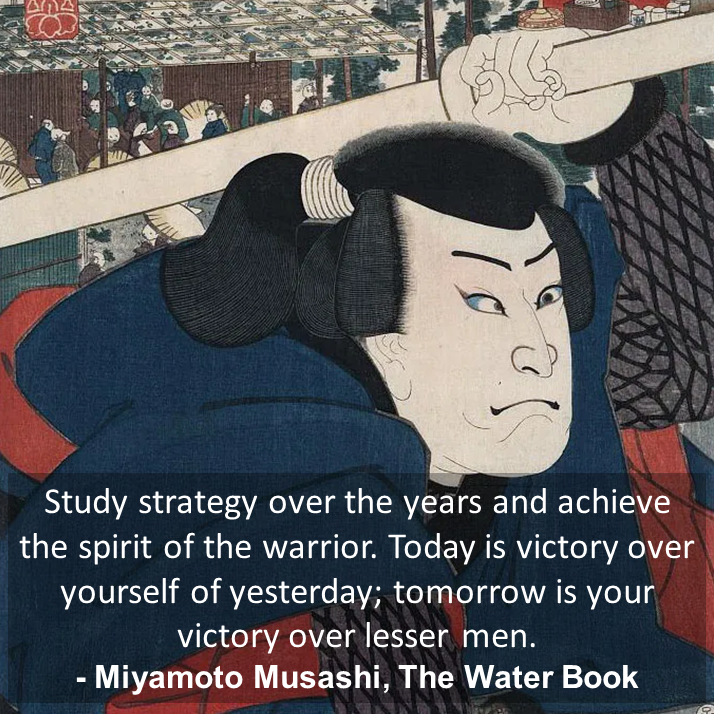
“Study strategy over the years and achieve the spirit of the warrior. Today is victory over yourself of yesterday; tomorrow is your victory over lesser men.“
It is about practicing, relearning and distilling down the wisdom over the period. This is only possible by discipline. Only discipline will bring out the best version of you from your personality of times gone, once you become something different and greater from your previous version nobody can stop you. Discipline is the way.
“Even if you kill an enemy, if it is not based on what you have learned – it is not the true Way.“
In the end of the Book of Water, Miyamoto-san explains the only way to develop wisdom. Knowledge can be transferred, can be taught from one person to another but wisdom always develops from inside. And as it develops from inside, there is very high possibility that it will be full of biases as these are self-truths. Hence clearing the biases in your learning process by continuously practicing them with reality is the way. One must be always be sure about the hypotheses in their knowledge building process in order to create the real wisdom.
Miyamoto Musashi’s Book of Water from the Book of Five Rings is about the ideas of formability, fluidity of water. The way we live and control our lives, the decisions we make, the actions we do are solely based on the behaviors and the routines we follow. The ideas expressed in the Book of Water are can also be connected to Game theory, Corporate Strategies, Principles of War Strategies and Diplomacy, Human psyche, Competitiveness, Lifestyle, Resources and Manpower Management, Spirituality and nonetheless Philosophy of Life and Knowledge. It is really an understatement to call this book as a Guide for Sword-Fighters.
What is special about water? That it is so omnipresent that it is not that special. It is so formless, shapeless that it takes shape of anything. Water has ability to make impact even when it is in drop and even when it in the form of ocean. The specialty of water is that it is not special, or at least no specialty can be assigned to it. It is water’s fluidity, pliability to the situations which enables it to take their forms which is what makes water so special. That is exactly what Miyamoto-san establishes here for the ways to live life thereby with the battles and fights in it.
Links for further Reading:





 Parts Per Billion