Minding The Gap Between Ego & Reality

We are so tied to our minds, our self, our ego that we can only see what our mind is conditioned to see; and the expanse of mind is so vast, that we consider the inability to gauge its limit to its infinite-ness. But, in self-observation we will see that reality is far bigger than our mind. Mind cannot be bigger than reality although it can create a perfect illusion of it being bigger than reality. When we realise how reactive our mind is, how conditioned our mind is we see that it’s the reality in which we are existing and not the mind. Mind is just a facilitator to create a sense of security. The real creativity thus begins when one lets go of their minds, thoughts and observe reality for what it is.
The real intelligence is to be able to see how you are fooling yourselves and how it is twisting your world view. This is possible only when we let go of the self. Love is the fastest and the most direct way to let go of self. Love is the way to get rid of the ego. Loving something, loving someone is the first step towards rejecting the very ego which is responsible for self-deception.
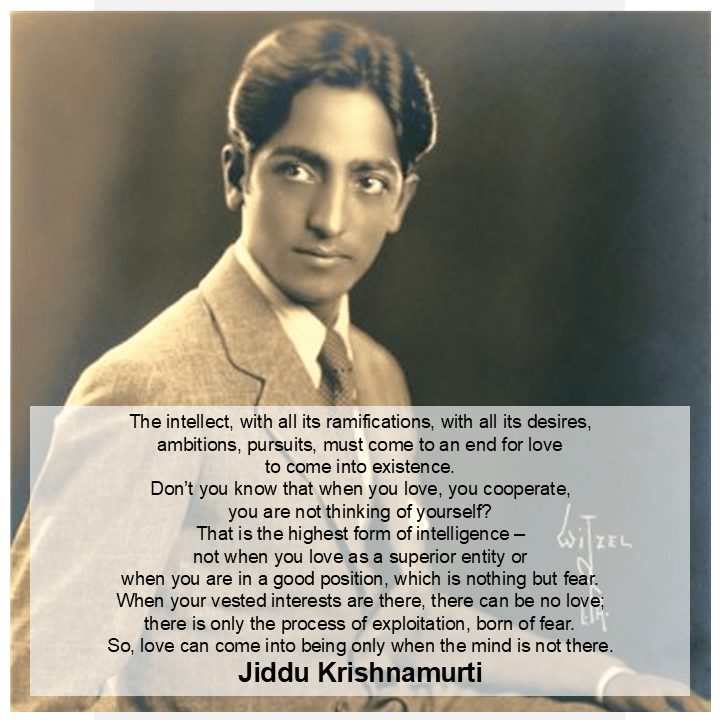
Jiddu Krishnamurti thus encouraged everyone to let go of their egos through self-less love; this itself is enough to solve all the existential conflicts inside us and out there in the world.

Part 3 – Jiddu Krishnamurti’s legacy of self-knowledge

What do you do when you realize fundamentally or deeply that thought cannot end itself? What happens? Watch yourself. When you are fully aware if ‘this fact’, what happens?

(‘this fact’ here refers to an observation that ‘discipline’ doesn’t destroy the self, rather it strengthens it because ‘the self’ created that discipline in the first place)

You understand that any reaction is conditioned and that, through conditioning, there can be no freedom either at the beginning or at the end – and freedom is always at the beginning and not at the end.”

– J Krishnamurti, The function of the Mind

We, the humans are driven by curiosity. The curiosity to survive – to put in few words. One might say that people are driven by fear, greed, envy, anxiety, power, love, money, fame, glory, sacrifice, humility, honesty, trust, legacy, mania, chaos, terror, and what not. The list is never ending. If you start questioning the origin all such attributes, you will see that humans can be driven by anything, I mean any anything. There is no connecting link per say; the only common thing between all the things which drive people is the people themselves. So, in the last question (possibly the last one) we end up questioning ourselves. We see that along with physical survival we are highly conscious of our non-physical survival. Some may call it the mental survival, some may call it ideological survival, some may even call it spiritual survival. In the end, what we are trying to preserve is the eternal existence of our consciousness. How to preserve this? becomes the question then. That is why in final question we see that we are curious to preserve our own being. That is the ultimate survival. Whatever can facilitate that preservation is the driving force for our existence. If you are scared of something, the fear of that thing will create a curiosity to look out for the ways in which you can avoid it.

Now you will realise that the attributes which are many and driving people in different ways are highly related to the ways people think about themselves and about their surroundings. The identities, the consciousness which we are trying to preserve forever is highly the function of the society we grew up in, the religion we followed, the ideals we admired, the enemies we despised, the culture we cultivated and carried over to the newer generations.

I might be making an overstatement here-

Only those who have undergone unlearning, un-conditioning or at least appreciated the process of unlearning can clearly see how badly we are tied to our thoughts and ultimately our minds.

Death of thinking is death of mind. When they say that ideas live forever – it is also an attempt to ensure eternal survival of a certain type of mind, for mind is not a physical entity to us. Realizing the perishable nature of our body, the mind becomes the most potent entity to ensure the survival of our being.

Then, what’s wrong in ensuring the eternal survival our consciousness?

We will see how Jiddu Krishnamurti showed the reality of our existence. As I have already said, he is the perfect person at perfect time to ask the perfect question.

Short answer is – we are so tied to our minds that we can only see what our mind is conditioned to see; and the expanse of mind is so vast, that we consider the inability to gauge its limit to its infinite-ness. But, in self-observation we will see that reality is far bigger than our mind. Mind cannot be bigger than reality although it can create a perfect illusion of it being bigger than reality. When we realise how reactive our mind is, how conditioned our mind is we see that it’s the reality in which we are existing and not the mind. Mind is just a facilitator to create a sense of security. The real creativity thus begins when one lets go of their minds, thoughts and observe reality for what it is.     

In Part 1, I have explained J Krishnamurti’s views on our urge for safety thereby happiness, how we use our thoughts to conveniently justify anything and everything to create that sense of safety, the ways in which our thoughts are stealing the actual reality holding multitudes of possibilities.

In Part 2, I have explained how thoughts originate, how curiosity drives them. It contains Krishnamurti’s observations on how we try to separate thinking to glorify ‘our version’ of wishful reality. Krishnamurti shows us that the moment we reject the separation of our thoughts from ourselves, that is the moment we see that we were just reactive to everything around us. We become observer of the reality for what it is, once we let go the glorification of ‘our thoughts’ – the self.

Now, we will question the very originator of the self – our Mind. Krishnamurti’s observations were revolutionary about the mind. This Part 3 will focus on that and also tie up the previous 2 parts together with it.

Existence Of The Mind – What Is The Mind?

“When you observe your own thinking, you will see it is an isolated, fragmentary process. You are thinking according to your reactions, the reactions of your memory, of your experiences, of your knowledge, of your belief.”

J Krishnamurti, The function of the Mind

When we are truly in the territory of observation without any preconception, prejudice, we see what thoughts actually do. Thoughts just try to hook on to something that we are familiar with – it could be good or bad. Thoughts literally create a chain. One link creates sense – logic – connection to another, one train of thought after another. Then we create the whole understanding. Thinking is always reactive. Keep this in mind – thinking is always reactive. If you let thoughts build on themselves, it is amazing to observe what world we create just by our thoughts. The moment you inject certain intent, desire to this world, it immediately deviates from the reality. But, as this world of thoughts has your intent, your desire, it creates that world of safety; we don’t want to lose that familiarity, that comfort. Now as this world contains our desires it becomes our second identity. As the thoughts keep building on, you start associating these set of your thoughts as who you are. This is your non-physical identity now. You now strive to make sure that this non-physical identity lives till eternity.

After seeing this you will see that the mind is the custodian of thoughts, desires, wishes. A wish to be safe to prolong survival, desire to make that prolonged existence happier one, thoughts to support those wishes – desires. Mind is thus picking desirable ideologies, disciplines which will keep feeding the train of thoughts, the chain of thoughts. Thoughts want to ensure their own survival because we have assumed survival of our thoughts as our survival. (Keep in mind we haven’t even started the discussion about reality.)

So, mind is a sieve which keeps on separating the desirable and undesirable parts of reality. There is nothing wrong in that. What happens here which is problematic is our tendency to lean towards the desirable reality only. When mind would see desirable reality, it will start using the power of compounding of thoughts to create a wishful reality which we call as our identity – our self. We want to preserve self to ensure that things that we desire survive. Whatever is not the self, it is the others – the undesirable. The moment mind makes this separation – ego intensifies.

“Our whole tendency is to be separated. Can the mind do anything else but that? Is it possible for the mind not to think separately in a self-enclosed manner, fragmentarily? That is impossible. So, we worship the mind; the mind is extraordinarily important.”   

J Krishnamurti, The function of the Mind

Without separation, our mind fails to recognize itself. If it is not able to separate itself from rest of the things, it cannot feed the desires. If desires are not fed, we will be constantly looking cluelessly for a sense of belonging, a place of security.

Here, I see one tragedy of being human rather an animal. I will explain it:

See there is a possibility that we are free from all the desires. One can be free from all the desires of the world. So, it is a real possibility that man is free from the cage of thoughts, mind and desires and fully observant of the reality around him without any imposition or prejudice right from the birth.

What is the tragedy of every animal is that they are born with the tendency to live (otherwise how would they get in the world in first place, maybe the baby doesn’t even know what is required to survive, so possibly the sense of survival naturally gets transferred from parents to the baby). Have you seen a baby who wants to die the moment he is born? Rather the baby starts crying the moment it senses absence of parental presence or absence of security. By birth we have a survival urge. Evolution has pushed this urge in us from physical to non-physical one. As we have better chances to ensure physical survival we now care more about the survival of our non-physical version. Mind thus becomes very important, thereby consciousness becomes important. That is why if physical survival is not guaranteed, we wish that at least our consciousness lives forever. That is exactly why we praise the minds we have.

Over the time, our desires take over this mind and we then keep on conditioning it with culture, religion, society, community in a certain way. The familiarity of physical body gets further amplified in familiarity of certain way of thinking, certain religion, certain philosophy, certain profession, certain degree, certain community, certain country. The more we find ideas, thoughts familiar to ours the more we want to cling to them. The more we want to reinforce that version of self. We are always separating what reality shows in terms of whether it is favorable to us or not. That is why even if mind and consciousness seem infinite, you will observe that our thoughts have compounded in such an extreme way that we are unable to measure their limits. We have attributed this inability of those compounded thoughts to the infinite-ness of our mind.

If our mind truly is infinite then we should be able to predict the reality or at least handle the undesirability that reality may present in better ways. We all know how disappointed we are with the reality. This shows how strongly we have conditioned our minds towards certain way – that certain way we call our identity, our self, our ego.

“Until we understand how to transcend this separative thinking, this process of giving emphasis to the ‘me’ and the ‘mine’, whether in the collective form or in individual form, we shall not have peace; we shall have constant conflict and wars. Our problem is how to bring an end to the separative process of thought. Can the thought ever destroy the self, thought being the process of verbalization and of reaction? Thought is nothing else but reaction; thought is not creative.”

-J Krishnamurti, The function of the Mind

Now you will appreciate what un-learning can do to our life. It opens a completely different and real world in front of us. Un-learning is the rejection of what we assumed to be true to support our identity. Although it feels uncomfortable, sometimes completely hostile but there is no bigger freedom than the acceptance and implementation of unlearning. It is renewal, evolution of our very being.

The key point is to understand that we are not our mind, we can be bigger than our mind. That needs the rejection of the idea of self. Once we are observant of how dangerously conditioned, prejudices, favored our minds are we will see how we through the agency of our mind are twisting the reality to create the sense of security. The more we twist it, more deviated we are from reality.

And as I already explained that somehow this sense of separation and thereby self-preservation is in our genes by birth, we have to train ourselves to get rid of that sense. Keep in mind that this does not mean self-jeopardization. This plainly means that not imposing our ways on reality to create the sense of security thereby higher chances of preservation of self. That is why unlearning is extremely important.

Reactive Mind Vs Objective Reality

“Do not superimpose what it should do, how it should think or act and so on: that would amount to making mere statements.”

-J Krishnamurti, The function of the Mind

Once you think that you have full control of your mind, the mind will use this sense of its separation from you to build chains of thoughts to support itself. In the end, it all started from you. The moment you see that you and your mind are the same, you accept its conditioning. Now you have a baseline to see the reality. Now you know how your mind is bending the reality. This is the freedom, to see things as they are. 

Now that we are understanding that sense of safety was the goal of everything that we are doing all along, we see that our conditioning thereby our thinking and thus our mind in the end are the reason behind all the suffering we go through. Once we see that our mind was the main culprit, we realise that it will be difficult rather impossible to punish my mind, discipline my mind because the more I try to control my mind – more I try to discipline it, the more it reacts, the more it creates thoughts and evades away from the reality. It tries to preserve its identity.

Only when you observe that you are your mind conditioned in certain way to preserve the non-physical existence then you understand the reality you live in. You still have those conditioned thoughts but now you neither want to promote them or suppress them. You are now an observer of the reality. This is an interesting observation.  

“When I want to understand, look at something. I don’t’ have to think about it – I look at it. The moment I begin to think, to have ideas, opinions about it, I am already in a state of distraction, looking away from the thing which I must understand.”

J Krishnamurti, Can thinking solve our problems?

There is one important confusion we must address here:

If I am rejecting the thoughts that I have, the mind that I have, the consciousness that I have – what remains of me? Wouldn’t I end up in an existential crisis? Won’t that shatter my compass? If I am not associated with certain things, how would I make sense of my actions? If I am not able to make sense of my actions or at least the things happening around me, how would I prepare myself to survive in this world? This will completely jeopardize my existence.

The answer is pretty simple if you have read till this sentence:

Rejection of mind as a separate entity is the answer. Unlearning the process of isolation to understand the reality is the answer. Wishful observation is the key problem in the ways we are trying to live the life. Thinking is the second name for wishful observation. You are expecting reality to become something in your ways so you attach certain justification to extract that desirable meaning from the reality you are observing. You are doing this to generate sense of safety, which further ensures eternal survival.

So, it’s not about rejecting mind or the thoughts. It’s observing how our mind, thoughts are already conditioned before we are trying to understand the reality. It’s like we are seeing the reality with certain tint of prejudices and expectations. We have to let go of that filter. We are so attached to this filter because world looks the way we want in this filter, that this tinted illusion has become our reality. The moment someone shatters that filter we end in existential crisis.

You must appreciate that it’s not about hating the prejudices, conditioning or sacrificing yourselves completely to a selfless act. It’s being aware that you have those prejudices when you are observing reality. This self-awareness is what Krishnamurti focused on.

The moment you will try to reject certain thing and accept the another i.e., your mind – you will create certain framework of justifications and you will deceive yourself.

The idea is to know how you are fooling yourselves which is preventing you from understanding the reality.

Delulu is not the solulu. Rather delulu is the best way to reject the very life you are living.

“To have blank mind is to be in a state of stupor, idiocy or what you will, and your instinctive reaction is to reject it. But surely a mind that is very quiet, a mind that is not distracted by its own thought, a mind that is open, can look a t the problem very directly and very simply. And it is this capacity to look without any distraction at our problems that Is the only solution. For that there must be a quiet, tranquil mind.”

J Krishnamurti, Can thinking solve our problems?

Love – Cure To Self-Deception And Surrender To Reality

You know that moment in any pop culture media where the final answer is love? Let me spoil everything for you. The answer to everything is love.

(Be cautious while reading next part, it’s not just that type of love and I am definitely not conditioned to prefer love as the answer. Even for a skeptic, love being the final answer has worthy support. It also guarantees that we can understand the reality for what it is.)

I always had this cringe feeling when everything grand in the narrative ended up with a justification of love. Even the great authors, logical authors, great scientists, great atheists never feel shame to express the power of love and it being the answer to everything. Trust me, I have made every attempt to find the evidences where love might not be the final answer to everything. But turns out that I would never find any evidence against love being the final answer.

The core reason is that we ourselves are the final problem. Let us see how Krishnamurti came to the conclusion of love being the ultimate answer:

“When you realize that any reaction is a form of conditioning and therefore gives continuity to the self in different ways, what actually takes place? You must be very clear in this matter. Belief, knowledge, discipline, experience, the whole process of achieving a result, or an end ambition, becoming something in this life or in future life – all these area process of isolation, a process which brings destruction, misery, wars from which there is no escape through collective action, however much you may be threatened with concentration camp and all the rest of it.”

J Krishnamurti, The Function of Mind

Now that you have come to the last part of the discussion, it is not a new understanding when I say that our sense of self is reinforced by the desire to support certain way of our conditioning. This steals from us the ability to perceive reality in the way it presents itself. We are always seeing the reality with certain conditioning and trying to change it so that it favors our ways. But as we have illusioned, conditioned understanding of reality, the reality rarely presents itself in the ways we desire it to be. Then we end up in sadness and sorrow and start questioning the futility of our existence. That is why ‘what is the purpose of my existence?’ is the common format of the existential questions for all of us.

What Krishnamurti tried to focus on is different question –

Why am I not experiencing life the way it is?

What is preventing me to live the life the way it is, living the life to its fullest?

The answer is pretty simple now. It’s our conditioning which urges us to prefer certain ways and reject the others. This brings the happiness and sadness. In the efforts to maximize happiness and minimize sadness we have created a system of mind and thoughts to alleviate the pains of suffering – thoughts justify everything. We deceive ourselves with justifications.   

“So long as we deceive ourselves in any form, there can be no love. So long as the mind is capable of creating and imposing upon itself a delusion, it obviously separates itself from collective or integrated understanding.”

-J Krishnamurti, The function of the Mind

What does the love do in all this confusion?

Love is the direct way to let go of self. Love is the way to get rid off the ego. Loving something, loving someone is the first steps towards rejecting the very ego which is responsible for self-deception. Even if you are delusional, your actions influenced by those delusions towards the things you love, the people you love will yield unwanted outcomes; and if you truly love them, you will be compelled to let go of the delusion for the benefit of your loved ones.  Thus, being selfless through love in true sense ensures real freedom.

Conclusion – Why Is Love Answer To Everything?

“We see the ways of the intellect but we do not see the way of love. The way of love is not to be found through the intellect.”

-J Krishnamurti, The function of the Mind

We saw in Part 1 how and why we crave for safety, familiarity. It ensures our physical and non-physical survival with better odds and most importantly with better satisfaction.

We saw in Part 2 how we dissociate ourselves from our mind and thoughts to create a false sense of safety if the reality does not turn out the way we want. We may delude ourselves if the reality is hurting us. We use thoughts to justify unfairness the reality presents. Our religions, politics, our ideals, everything that we have created now has an innate purpose of creating a safety net. We want to remain in this net because we don’t want the happiness to end. We have intellectualized our minds in such a way that we have justification for every ridiculous illusion and tragedy is that we call it the limitlessness of the mind, infinite nature of the mind.

I am not erasing the idea that the mind is limitless. If our minds – we – ourselves are truly limitless then we should immediately be able to see beyond the seemingly adverse revelations of the reality. Which is the holy gist of all these detailed inquiries of the self.

Then what was the problem with the mind?

The very limitless nature of reality would enable us to become limitless. But is it our delusional clinging to certain way of life for safety which is stealing the real understanding and appreciation of limitless reality. We are clinging to highly complicated and highly compounded thoughts, the way of thinking just because it reinforces the ego.

The real intelligence is to be able to see how you are fooling yourselves and how it is twisting your world view.   

After going through what Krishnamurti made us observe, you will realise that whatever must be said has been said already. We have just accepted our delusions because we are fully clung to the way have been living our lives, the way we have been conditioned.

When you are loving someone, there is very slim chance that they will be exactly the way you want them to be. There is plausible reason to say this because the infinite possibilities of reality mold people in different ways. There may be many things in common but the more you know the sooner you will realise that people are filled with different types of conditioning. This will first push you to reject their point of view naturally, then you will try to impose your way on them, your ideologies on them, your conditioning on them. In the final analysis, you will see your ways of worldview failing on them. This is the moment when you will reject your own world view, thereby your ego. Now you will neither reject or accept other people’s worldviews nor will you cling to your ego. Now for the sake of love, you will objectively observe the reality for what it is.

This is how love compels you to let go of your ego. That is why love is the answer to everything because you are the last question of all the investigations of the existence. You will let go of the concept of the self once you start to appreciate things other than you and accept the reality the way it is. What a beautiful way to live!    

“Only when you discard completely, through understanding, the whole structure of the self, can that which is eternal, timeless, immeasurable, come into being. You cannot go to it; it comes to you.”   

-J Krishnamurti, The function of the Mind

References and further reading:

  1. Truth is a pathless land – J Krishnamurti
  2. The First and Last Freedom – J Krishnamurti
  3. Jiddu Krishnamurti’s Legacy Of Self-Knowledge : Part 1 – The Liberation From Thinking and Thoughts
  4. Jiddu Krishnamurti’s Legacy Of Self-Knowledge: Part 2 – Being Watchful Of The Ebb And Flow Of Life
  5. Featured Image of Phantom Galaxy M74 by James Web Space Telescope

Being Watchful Of The Ebb And Flow Of Life

In the constant pursuit of eternal happiness what man forgets is that nothing is everlasting, the sadness exactly like the happiness too shall pass. But, the urge to remain eternally happy and safe, steals the man from actual sense of reality. The illusions of thoughts filled with prejudices, conditioning and the escape from the reality by justifying the same thoughts becomes the endless cycle for such man. The moment man rejects the separation between him and his thoughts and sees that he himself is the originator of every thought is when he starts observing reality for what it truly is. Now there is no urge to seek happiness or the aversion to sadness. The man who is able to observe the reality for what it is and denies the wishfulness has understood what it really means to become free from ‘ego’ – ‘the self’. This is how the man becomes free and fearless.
It is really underrated how much we overvalue our thinking, thoughts, ideologies – for they always create an escape when reality is not how we want it. The man who is able to see through this can appreciate how life is always a continuous flow and not a starting point or destination.
Krishnamurti thus taught about the ability to observe the reality for what it is and without any preconditioning, thinking or prejudices.

Part 2- Jiddu Krishnamurti’s Legacy Of Self-Knowledge

Because I am free, unconditioned, whole – not the part, not the relative, but the whole Truth that is eternal – I desire those, who seek to understand me to be free; not to follow me, not to make out of me a cage which will become a religion, a sect. Rather should they be free from all fears – from the fear of religion, from fear of salvation from the fear of spirituality, from the fear of love, from the fear of death, the fear of life itself.

– J Krishnamurti, Truth Is A Pathless Land

Jiddu Krishnamurti – one of the greatest philosophers, one of the greatest humans paved a pathway to the modern worldview of the real truth, the real freedom, the real meaning of life, real love and the real life itself. His life story talks for his legacy.

Krishnamurti for me is the perfect person at perfect time to ask the perfect question.

I will focus on how Krishnamurti’s teachings – how his ways to dissect our curiosity paves way to understand what it means to be a conscious human being. The further writing is an attempt to address what is thinking and why we think and if not thinking then what makes us real human beings.

In Part 1 on Krishnamurti’s teachings, we touched on following important aspects of what it means to be a human and how distracted we are from our human side:

Krishnamurti most importantly taught how we are trying to bring peace to our lives by associating it with some meaning or purpose. Those who have fair understanding of the gap between what is thought and what is real, they can understand that the world in which we live – the reality in which we exist is constantly changing. Whereas we as human animals are always in the search of stability, that is how we will be able to optimize our energy and efforts to maximize the chances of survival. We crave for longer and peaceful existence in the continuously changing world.

The very continuously changing nature of the reality goes against our wish to live a peaceful, safe and predictable thereby fully controllable, maneuverable life. This resistance between wish and reality splits our thinking, our thoughts from ourselves. This split of ‘we’ – ourselves and our thoughts is the root of all the existential confusion and false sense of happiness – the gratification.

First, we realize that reality will not bend to our wishes, then we give up on real happiness and create our own world of thoughts filled with our facts, our knowledge, personal point of views, prejudices to create certain worldview. This worldview then keeps on feeding itself to grant us gratification. But there comes a point when we see – confront the reality we were masking and running away from, it brings more pain than ever before. It is painful because we distracted ourselves from it, because it never guaranteed eternal happiness – our thoughts granted that eternal happiness while wearing the coat of wishful thinking – gratification. We have separated ourselves from our thoughts in such way that whenever something bad, wrong, unpleasant happens, the blame can be immediately thrown on these thoughts. Thought which we have assumed to be the result of our upbringing, our culture, the unfairness happened to us. We use our thoughts as a separate entity just because we can conveniently find an escape from reality to create a newer one. it has become a tool to find a justification for everything that is unfair to us.

Once we accept how effectively we are deceiving ourselves we come to know that we ourselves are the thoughts, then responsibility follows. We see however painful it may be, this too shall never be constant. We reject the convenience of self-deception, accept who we are and observe the reality for what it is and not how we want it to be.

The moment we become responsible for our thoughts is when we start to see the reality, we start to see the world for what it is, without prejudices. All deceptions are stripped off. We also realise that thinking was mere swaying between acceptance and rejection of two ends – happiness or sadness. We see how much we were bounded due to this swaying – due to this isolation.

The moment we let go the urge to become happy, we let go urge for gratification, then we let go the wishful thinking, then the self-deception dissolves. Once self-deception dissolves, we start to accept our thoughts are our own, then we start to improve ourselves just for the sake of the real truth not for happiness. The life is unshackled from two possibilities of happy or sad into the infinitely many possibilities the reality can offer.

Touching to these ideas we saw in Part 1, how we assign the purpose of our lives just for the sake of gratification, how we separate thinker and thought to reject responsibility, then how the self-deception keeps this cycle going.

Now moving on to the other teachings by J Krishnamurti, I felt a need to understand the quest for happiness. I mean there is nothing wrong in people wishing to feel happy, safe in their lives. 

Then I realized what the real problem is; it’s not the wish to become happy, it is the acceptance of certain illusions to become happy. I will throw light on how that happens unknowingly and then we will again come back to Krishnamurti’s ideas on those areas.

The Curious Animal

I think what separates humans from animals is the incessant curiosity for anything and everything that is there to experience; sometimes we are curious about non-existent things too. The extent of curiosity might be different in everyone but it is safe to say that we are way more curious than animals. This curiosity always needs the food of thoughts and reality checks to arrive at a conclusion – that is how we are always reinforcing our consciousness. I think one cannot maintain their conscience or consciousness (call it what you want) if you cannot maintain at least small amount of curiosity in life. Animals have natural routines for survival exactly like we do but I think we are more aware of our own being than the animals do. (might be an overstatement, but you get the point)

Curiosity is not just about some sophisticated questioning to certain sophisticated, complicated part of philosophy, it can be rather very simple. A person thinking about what should be done to get the next meal? – is also one type of curiosity – let us call it the curiosity of ways to get the next meal. This curiosity to get next meal is common for both human and rest of the animals but over the time we have found totally innovative ways, the ways in which animals have not found how to address the same curiosity. So much that now we don’t even consider the curiosity of getting the next meal as a curious problem. Being human thus means that our curiosities also keep on evolving faster than the animals. What was peak curiosity for a primitive man is now a low-level curiosity, we now have much high level and more complicated – sophisticated curiosities.  

Starting right from birth till death we carry many curiosities – some of them get answered some remain mysterious, unanswered. The key attribute which remains common in all of us is how satisfied are we when it comes to our curiosities, our personal curiosities? The more curiosities you have found answers to, the more satisfied you will feel. You will have sense of fulfilment; your wishes, ambitions, wants all are connected to your own curiosities. Take one simple example – why do you want that specific job? For some people their curiosity was why some people are happier than others? They see that doing this job gives more money, for some people they see that doing this job will give them happiness, for others this job will wipe away their sorrows. In every possible sense, you can link the curiosity to the very reason of our being.     

The Conscious Thinker

If you look closely to the curiosity, you will immediately accept that thoughts are the most important aspect of who we are. We keep on thinking to address our curiosities until they are addressed satisfactorily. That is exactly why thinking is crucial for humans; it shapes our character, our lives and then the lives of everyone around. Now that I have brought in the point of “thinking” you will feel that thoughts play bigger role than curiosity in our lives. And it is right to feel so. But I have reason to weigh curiosity heavier than thoughts or thinking. You will see that smartness can be found in good spirited people and evil people too. When we can develop technologies to save lives, we have developed technologies to bring about mass destruction too. Looking at the current situations the later look more sophisticated. So, if the good person has better curiosities, he will have his curiosities answered in better ways than the lower curiosities of the evil person. See, both sides can have same curiosities as the purpose of their lives but the ways in which their individual thoughts answer that common curiosity gives us either godly men or evil men. So, curiosity supersedes thinking. How you will address that curiosity is how you will be. That is exactly why thoughts are so important. How consciously you think is how you will have your curiosity answered.

Thinking Is Useless

(Just now that we said that thoughts are important.)

The self is a problem that thought cannot solve.

– J Krishnamurti, Can thinking solve our problems?

When you will appreciate different ways of thinking; the process to create thoughts to answer same type of curiosity and the ways that can create totally different human beings you will see that curiosity is mostly the innocent aspect of who we are but the thoughts take shape, color, aspect of who we are, what our experiences are, how we are treated by the people around us, how we treat others. It is not an understatement when I say that thoughts rarely create the true understanding of the reality. And the farther our thoughts are from the reality the more we experience failure and unfulfillment of expectations, sadder we are. Thoughts can create an excellent sense of reality but if not built properly can make people despise the very reality they live in. The closer you are to reality realer will be your curiosities, the realer will be your thoughts and faster will be your satisfaction to the curiosities. Otherwise, we will keep on playing the games of thinking in certain ways and would never be able to satisfactorily answer the greater curiosities of our lives. Every illusion will create next illusion.

Krishnamurti advises to let go of this game of thinking where every illusion reaps newer and more potent illusion, dragging us away from reality.

Thought has not solved our problems and I don’t think it ever will. We have relied on the intellect to show us the way out of our complexity. The more cunning, the more hideous, the more subtle the intellect is, the greater the variety of systems, of theories, of ideas. And ideas do not solve any of our human problems; they never have and they never will.

– J Krishnamurti, Can thinking solve our problems?

The main intent is to understand how self-protecting our thoughts and thinking are. You must appreciate this. The essence is to understand the fact that if thinking would have really solved our problems, we would have immediately stopped the process of thinking. We would have stopped it because it gave us the final solution to the real problem.

You may in thinking out certain facets of the problem, see more clearly another person’s point of view, but thought cannot see the completeness and fullness of the problem – it can only see partially and a partial answer is not a complete answer, therefore it is not a solution

-J Krishnamurti, Can thinking solve our problems?

Thinking can create false sense of solution but to certain extent, the reality holds more possibilities than that.

We would see that the more we think about something even fundamental the more complicated it becomes. Thinking may help us to understand perspectives but it never serves us the truth of reality as a whole rather it always gives certain dimensional information. Now this certain dimensional information can be easily poisoned with prejudices and not the facts. Thinking actually steals us from the multiple possibilities of the reality. As the problems from thinking multiply themselves, we are now entangled in the problems which are not even there in reality. We are just multiplying thoughts and problems because we know they give instant happiness for reality doesn’t guarantee eternal happiness. We are running away from truth by treating thoughts in superior ways.

Does that mean that thinking steals away the creativity? It seems counterintuitive! Thinking is the reason why we are creative. So, what exactly is going wrong?

The thing that is going wrong is our habit of separating things and comparing them with our previous knowledge; it’s our habit of grouping things in our old understandings. We try to understand newer things with our older understandings. We keep on filling our knowledge bank. We rarely unlearn anything with completely new perspective.

We fail to unlearn, because of our urge to happen things in certain ways. If you want the reality to happen in certain way, you will always be blinded to the reality which could have had better possibilities, better and beyond the limits of your thoughts.

This is why Krishnamurti focused on self-knowledge. Your pivot becomes you rather that the ways in which you want things to be. Once you understand who you are, you see how cunning your mind is, it always tries to create justifications to escape through a never-ending chain of illusive thoughts.

Once you accept who you are, you will see how the reactive thought got generated from you, that thought is you yourself. Now you see who you are. Once you see who you are, you don’t rely on thoughts to understand the reality. This is what builds the bridge between thinker and thought. This is where thinking is no longer required. You see reality for what it is. You become fearless, free from expectations and free from thoughts. Your actions now have intent instead of a wish.

Now, let us see how to maintain the awareness of self and be free from the illusion of never-ending chain of thoughts.

The Real Baseline – Non-Isolation

It seems to me that before we set out on a journey to find reality, to find God, before we can act, before we can have any relationship with another, which is society, it is essential that we begin to understand ourselves first.

… And it does not mean obviously, that self-knowledge is opposed to, or isolated from relationship. It does not mean, obviously, emphasis on the individual, the me, as opposed to the mass, as opposed to another.

-J Krishnamurti, What are we seeking?

Krishnamurti paved the way to break out of the vicious cycle of self-deception. When ending up in self-referential paradox the basic question one can ask is how the reference is getting created. We see that we do not actually have an eternal, unchanging baseline. The baseline keeps evolving as our beliefs, experiences keep on changing. To understand ourselves is thus one difficult task. It’s like aiming a moving target, a target which keeps on changing all of its attributes. We realize that what we were calling our baseline – our core was just our thought conditioned by our urge for safety, peace and happiness.

Many think that in order to understand self, one has to isolate themselves from others. The rejection of isolation itself is the purpose of understanding self. Rather the more isolated you will be from others more your thoughts and mind would dominate you. The real purpose of self-knowledge is understanding of ourselves as the whole not as the isolated one.

Self-knowledge thus means the rejection of selfishness and the sense of ego. Then the person starts to understand what it means to think about the events and what it means to see the event. Former is limited because we are wishing for it to happen in certain way, latter hold any possibilities because we are not expecting or imposing what should happen.

Because we are craving for certain anticipation, trying to have certain expectation – we try to isolate our experiences to only those expectation. We blind ourselves by isolation. We see that our experiences create a reaction in us which we try to connect with certain memories, feelings. Then they lead to acceptance or rejection based on the sad or happy feeling generated. Then if that feeling is happy, we crave for more of it; if that feeling is bad, we try to suppress it. And the cycle keeps on going. We get tangled in our own thoughts.

Until and unless I don’t accept that ‘I’ am the originator of my thought I can’t really find that which lies beyond that thought. My thought will create another thought based on my urge to find the sense of security. The thinker has to just observe the thought and not expect it to be desirable or undesirable. This is one difficult task. But it guarantees eternal truth.    

So long as effort is divided into the experiencer and the experience, there must be deterioration. Integration is only possible when the thinker is no longer the observer. That is, we know at present there are the thinker and the thought. The observer and the observed, the experiencer and the experienced; there are two different states. Our effort is to bridge the two.

– J Krishnamurti, Can thinking solve our problems?

Krishnamurti explained why our thoughts do so and why we refuse to let go of our thoughts (even though deep down we use our thoughts as a way to justify anything to our convenience, security and peace.) In the pursuit to bring “peace of mind”, the mind created two ends of every thought. The thinker who has already considered himself different from the thought now assumes one side of that thought and then measures his/her worth, goodness/badness by the extent of deterioration from that assumed baseline.

In reality, the very assumptions of either one of the ends of the thought prevents the person to have exposure to the real possibilities lying on the other end rather beyond the whole horizon.

The answer to come out of such bias is to observe that the originator of the thought is the thought itself. There are no two entities – thinker and thought are exactly same. This is where the observer and observed stare into each other’s eyes. Now the observer is not expecting the observed to become a certain way. Observer is now just observing that what it is. There is no need to move to next thought. Only thing that remains is to observe things for what they are. 

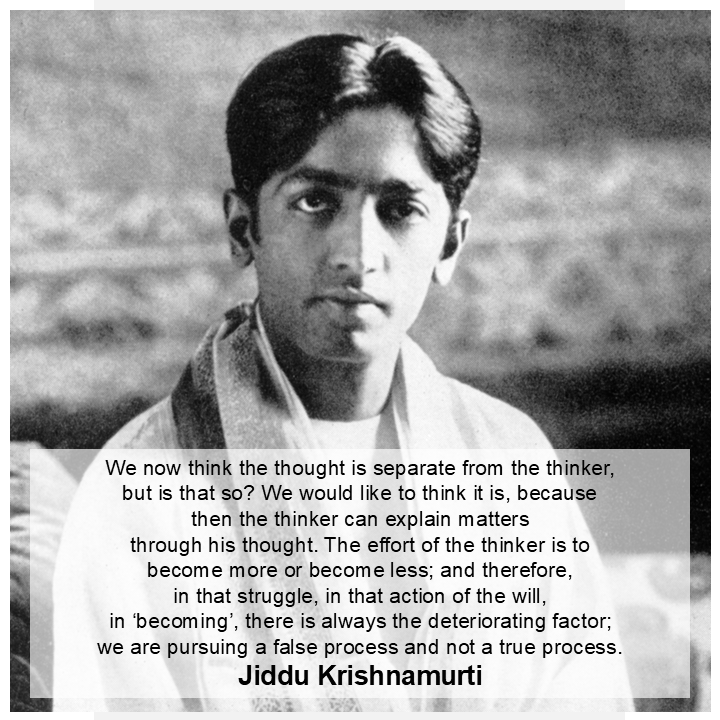
We now think the thought is separate from the thinker, but is that so? We would like to think it is, because then the thinker can explain matters through his thought. The effort of the thinker is to become more or become less; and therefore, in that struggle, in that action of the will, in ‘becoming’, there is always the deteriorating factor; we are pursuing a false process and not a true process.

-J Krishnamurti, The thinker and the thought

When one starts truly observing there is no need to select one side of a thought, so there is no urge to favor one outcome, rather there is no wish to have certain expectation. As there is no wish to a certain way the mind does not work towards cultivation of one side and deterioration of the another one. Now mind just sees that which is there.

I divide myself into the high and the low in order to continue.

-J Krishnamurti, The thinker and the thought

Earlier there were only two possibilities – either cultivation of that which is desired and suppression/ deterioration of that which was undesirable. But now that when thinker and thought are bridged there are no side, no prejudices, no expectations. This opens totally new possibilities, and these possibilities are as real as the reality we are observing, the reality we are trying to understand.

You will realize how limited we were by our thoughts.

You will see how illusive the thinking loop seems, even though you “thought” your imagination was infinite. Your imagination now feels limited because of your prejudices, biases, memories, culture, knowledge.

Our imagination is way more limited than we think. That is exactly why observing without any prejudice becomes more important. We just refuse to do it because we don’t want to get overwhelmed by the infinite seemingly life-threatening possibilities. We are fearful. We think we are not ready.

 Be Watchful Of The Isolation – The division

If I am aware that I am greedy, what happens? I make an effort not to be greedy, either for sociological reasons or for religious reasons; that effort will always be in a small limited circle; I may extend the circle but it is always limited. Therefore, the deteriorating factor is there. But when I look a little more deeply ad closely, I see that the maker of the effort is the cause of greed and he is greed itself; and I also see that there is no ‘me’ and greed, existing separately, but that there is only greed. If I realize that I am greedy, that there is not the observer who is greedy but I am myself greed, then our whole question is entirely different; our response to it is entirely different; then our effort is not destructive.

-J Krishnamurti, The thinker and the thought

This is revolutionary in many senses. As we are dependent on thoughts to understand reality. This dependence is filled with preconditioning right from the moment we are born. Therefore, we always try to mold our observation in the shapes of what we wish to become. If I wish to become a world known robber, I will see the act of stealing as a good one – a stepping stone in my “career”, if I wish to become a world known cop/detective I will see the act of stealing as a wrong one.

But if I have no wish to either become a robber or a cop, I now will have totally new concept of what stealing is. If I am observing a robbery right now with no prejudices, I am seeing the desperation, fear of getting caught in the eyes of the robber. I am seeing the mental stress that cop is going through to solve the case; if the cop is a smart one, I am seeing how he feels sorry for the robbers and how happy he feels that he can easily catch them.

Without prejudices you see that the reality morphs according to the wishes of its observers – the observers having certain expectations from it, certain prejudices.

It is that problem which is creative, in which there is no sense of ‘I’ dominating, becoming, positively or negatively. We must come to that state if we would be creative.

-J Krishnamurti, The thinker and the thought

You have to thus let go of the what is expected and observe what is happening without any preconditions. Then you will see that the negativity or positivity of the same reality became in that certain way because you had already picked either one of the sides. If you wanted to behave like a cop – a successful robbery is nightmare for you; if you wanted to behave life a thief same is the happiest moment of your life.

But if you just want to observe what is there in reality, you will see the desperation in the eyes of the robber and the ways cop chooses to hunt the thief down – even if it would steal his ideals.

You see people degrading themselves to have an illusion of the life they desire. You will feel like helping both of them. You will not feel of favoring either one of them.

This may seem like a person who has let go of life or like a sage, but trust me once you have this real worldview, you will see that you are more than yourself. You will see yourself extending to others, you will have this innate urge to reach out to others, to help them to come out of the illusion of happiness and sadness. You will help people in surprisingly different ways – not just right or wrong ways.  

What is important is to see that the maker of effort and the object towards which he is making effort are the same. That requires enormously great understanding, watchfulness, to see how the mind divides itself into the high and the low – the high being the security, the permanent entity – but still remaining a process of thought and therefore of time.

-J Krishnamurti, The thinker and the thought

Once you accept yourself in such way you no longer have craving for happiness and aversion towards sadness. You will see that this current happiness is short lived and so will be the sadness arriving after it. You will see that reality is just a tide of happiness and sadness, we are just swaying in between.

Rather you will start seeing that reality is not just a wave between sadness and happiness – it has other attributes for which words like happiness or sadness would fall short to describe them. You are existing between the superposition of many such waves. This is the real journey towards a creative and realest real life.

You will see that you are not affected by these waves. Not affected does not mean that you are insensitive or numb to these aspects of life, rather now you are more sensitive and open to infinite possibilities of life. You don’t get tangled in thoughts, you now act to pass through the life, instead of attempting to control it. You become fearless. You don’t start any journey to achieve freedom in the end. You become free in the first place before you start the journey to experience the life lying ahead. You truly become free in reality.

We will see in detail why Krishnamurti said that freedom is at the beginning in next part.

“Until we understand how to transcend this separative thinking, this process of giving emphasis to the ‘me’ and the ‘mine’, whether in the collective form or in individual form, we shall not have peace”

J Krishnamurti

References and further reading:

  1. Truth is a pathless land – J Krishnamurti
  2. The First and Last Freedom – J Krishnamurti
  3. Jiddu Krishnamurti’s Legacy Of Self-Knowledge : Part 1 – The Liberation From Thinking and Thoughts
  4. Jiddu Krishnamurti’s Legacy Of Self-Knowledge : Part 3 – Minding The Gap Between Ego & Reality

Dune: Psychology in Science Fiction

Our identity is heavily influenced by the surroundings we live in. A healthy understanding of the gap between ‘labels given to us by our surrounding’ and ‘what we consider ourselves at core’ defines how we perform, how we behave in given situations. Frank Herbert effectively used these ideas of human psyche in his Dune Saga. The antihero story of Paul Atreides indicates psychological ideas of cognitive dissonance, confirmation bias, and Pygmalion effect. It is interesting to understand how our minds are so sensitive at the levels of self and group simultaneously.

How Frank Herbert used human psyche in the creation of Dune’s antihero?

We saw how some fantastic philosophical ideas come alive in the character arc of Paul Atreides. The discussion hereon is the extension of the previous philosophical one, now we will dive deeper into the psychological aspects of Dune Part Two.

There will be heavy spoilers for Dune Part Two hereon!!!

Existentialism in Dune Part Two

As Paul gets more and more involved in the events on Arrakis with Fremen, he finds out what needs to be done, he finds clarity and purpose. He is renouncing the leadership in the early part because he does not know what to do with it. The moment he decides to become the Lisan al-Gaib, the moment he finds the purpose of his being, he gets the clarity.

According to Existentialism, there is no other meaning to the life but the meaning you give it yourself. Existentialism says that man is born free and can chose any actions to live but in the end he/ she will feel like they lived for nothing. They will remove this ‘existential angst’ only when they decide what they want to do with their life. The moment people consider themselves responsible for the events and consequences in their lives, take deliberate actions to achieve them that is the exact the moment where they find the meaning in life. Then everything, every action every decision starts to make sense. You feel like you exist for something.

This existential journey of self-discovery is exactly what we see in Paul’s journey to become the Mahdi. Avenging his father’s life becomes the ultimate goal of Paul in early moments but later on things take different turn. This is existentialism on personal level.

Fremen of Arrakis are the best example of existentialism in masses. The Fremen people are able to sustain in the hostile environment of Arrakis not because that is the only choice. They also have a strong belief, a hope that someone from outer world will save them one day and make their planet the Paradise, the Lisan al-Gaib will come to save them. Although Paul and Jessica know that it is a story properly planned by Bene Gesserit, although there are also Fremen who oppose this prophecy (Chani is one of them) still it gives them all hope, a reason to live for, a reason to survive for. Everyone makes sense of this prophecy in their own ways, their own belief systems.

Do you see what is happening here?

There is one group who is religiously putting their faith in the hope of the messiah for their survival and on the other hand there is a group who dismisses this idea and think that they themselves have to take care of their survival. The messiah will be one of them, not someone sent from the outer world.

We know what happens in the end. But from an objective point of view we see that people create there own perspective for survival. It doesn’t matter who was right and who was wrong in the end. What matters is whether is guaranteed the survival of Fremen. No wonder Jessica considers the artificially planted faith for Lisan al-Gaib among Fremen as an act of giving them a hope.

In either way, some sort of meaning would ensure survival of the Fremen.

The meaning of the life given to us is the meaning we assign to it.

The Prophecy – A Perfect Example of Confirmation Bias

The Prophecy plays key role in deciding the fate of key characters in Dune Part Two. Although we are aware that the prophecy a highly detailed plan to get the hold on Arrakis there are certain moments which fool us in believing that the prophecy might really be true. There is one justification for the correctness and validity for the prophecy. Somehow any powerful member from Bene Gesserit could have unlocked the exact power to see the future like Paul or Lady Jessica this person who could have seen the future and made this prophecy. We get no such signs in the narrative, but the story has enough resources and reasons to make it a valid point.

The event of Paul riding an elder worm, the worm stopping for Paul and Jessica in Dune Part One while crossing the dessert, Chani’s teardrop bringing back Paul alive (although she is manipulated to do that) are such events which confuse us when we try to reject the Prophecy. Either Bene Gesserit were too good to plan the people and resources for making the prophecy a reality or the person who made prophecy also unlocked the powers which Paul unlocked.

It is very interesting when Fremen come in one-to-one contact with Paul and Jessica. They are so influenced by this prophecy that whatever Paul may do, they attribute it to the prophecy. In early part at Sietch Tabr when Stilgar (who is one of the fundamentalists) is having discussion with the Fremen elders, we are given a hint of this strong Confirmatory Bias in Fremen, especially the fundamentalists.

Stilgar – I saw things.
Elder – Stilgar, your faith is playing tricks on you.  

This is an indication to how a blind faith could drive people into looking for signs and making sense from anything that supports that faith.

You must understand that, the existentialism makes life as a meaningless affair – we try to calm our mind/ our senses by assigning a meaning, a perspective to make sense out of the creation. Cognitive Bias lies on the negative extreme of such existentialism. An existence where we are only accepting the events, signs which support out beliefs. This also the transition region where spirituality is converted into pure religion. Stilgar is the perfect example of one such religious follower suffering from Cognitive Bias.

It is also very understandable for the people like Fremen who have nothing hopeful to live and nothing to pivot on, the idea of savior from outer world fuels them to continue the fight for survival.  

There is subtle hint that Paul may not be the only messiah that Arrakis might have seen. The Emperor in his discussion with Princess Irulan mentions Muad’Dib as “some new Fremen Prophet”.

Confirmation Bias is the prejudice where we try to accept the proofs which support our beliefs and reject those which don’t. Fremen people demonstrate such high levels of confirmation bias because Arrakis is the only reality they live in. People living outside the Arrakis like the emperor, Bene Geserit very well know that this is an intentionally planned act. And they very effectively implant such prophecies over the generations. It also shows how difficult it is to reject and go against the conventional beliefs especially the religious ones.

Did you ever have had an encounter with people who tell that this was already written in the older documents, scriptures? When we made certain scientific breakthroughs only then we are seeing them clearly mentioned in older writings, how is it possible? It feels counterintuitive but I would say going by the data instead of the intuition always helps to break such biases.

It feels against our mind because our mind only accepts that which will support the current beliefs. If the current belief gets falsified then our mind will start looking for another belief system which is much more like an existential angst – the existential confusion and the sadness that comes with it. If one meaning is falsified the mind must stick itself to a newer one otherwise life will feel worthless.

Image source: sketchplanations.com by Jono Hey

Cognitive Dissonance and Identity – What Makes Paul to Seek the Ultimate Power?

The confirmation bias is more powerful when it comes to the questions like ‘who you are?’, ‘what is your identity?’

Generally speaking, you are the best person who knows who you are (except your parents and some people close to you). What would happen if you are presented with the data, proofs which indicate that your parents are not your parents, your friends are not really your friends? They are just some paid actors (just like in the movie Truman Show).

Paul is portrayed as the Prince belonging to the House Atreides which is powerful and believes in fairness, justice, and the truth. The ideas associated with House Atreides support constructiveness, upliftment of those who are getting used for others’ benefits. Paul also strongly associates himself with these ideas even when his house is attacked by Harkonnens. He never tries to take advantage of the Fremen beliefs for personal gains. That can also be explained by one of the reasons he has to reject the Fremen Prophecy.

Then what makes Paul to accept this prophecy even when he knows that there are more proofs to reject the prophecy than to accept it?

It is when he knows the truth about his identity. The moment when he drinks water of life.

Upon understanding the ultimate truth, we come to know that Paul’s mother Lady Jessica is the daughter of Baron Vladimir Harkonnen. Paul understands that he is as Harkonnen as his villainous cousin Feyd-Rautha.

This is where his identity of Atreides filled with justice clashes with the cruel and much more powerful identity of Harkonnen. You can see him telling his mother that this is the way they survive – by being a Harkonnen.

When a person goes through such uncomfortable events where his/ her beliefs clash it creates a in harmony. These are the events where the person is confused about what exactly he/ she should believe in. As the early beliefs which were true for him, on which the person lived whole life were inherently false what defines him now?

Paul faces this cognitive dissonance about his identity. He himself is a Harkonnes – the Harkonnes whom he was considering the villains of his life and the lives of the Fremens.

What identity would Paul chose makes him the hero or the antihero in the end.

And Paul chooses the Harkonnen identity which make him the antihero. Please understand that he could have chosen a fair Atreides or Fremen ways to fight for the cause. The circumstances created around Paul supported him to become as ruthless as the Harkonnens. The Emperor and the great houses denying his ascension further fuel his wish to remain ruthless to justify the actions. The moment Paul associates himself with the Harkonnens, he justifies his urge for power as a valid one. Paul forgets his Atreides roots which could have made him the hero of the Dune’s story.

The Pygmalion Effect – Is Paul Really the Messiah?

The difference between a lady and a flower girl is not how she behaves, but how she’s treated.

Pygmalion by George Bernard Shaw

One factor in Paul’s journey to become the leader of the Fremen and ultimately the Emperor can be largely credited to the support system created around him. It is clear that he goes through many hardships and sacrifices to achieve his goal but you cannot deny the inherent public support he receives through Fremen. It only because of the support from the Fremen people you will see Paul build the confidence even though in Dune Part One this was the exact person who tried to deny future leadership in front of his father.

How a person refusing leadership of his own house later accepted the leadership of the most controversial group, that to in very adverse conditions? Leading house Atreides was Paul’s birthright, an easy one. But, leading Fremen in clear opposition of the House Harkonnen, the emperor and the great houses was one very daring act to follow. What gave him all this strength?

The answer is – Pygmalion Effect

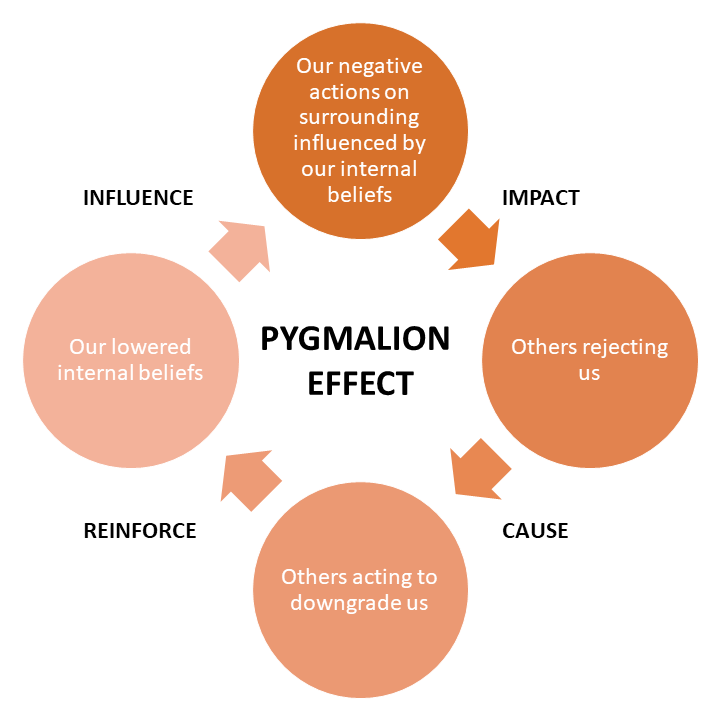
In psychology, Pygmalion Effect is the effect where high expectation from a person lead them to perform highly and effectively even in adverse condition.

Pygmalion word comes from the story of a Greek sculptor called Pygmalion who falls in love with his sculpture so much that the statue comes to life.

It’s like worshiping the rock can make it a God which could ultimately is believed to fulfill wishes.

The Bene Geserrit propaganda very smartly takes advantage of this idea. They create such support system around Paul which create one powerful leader in the universe who in his early life was not considering himself worthy.

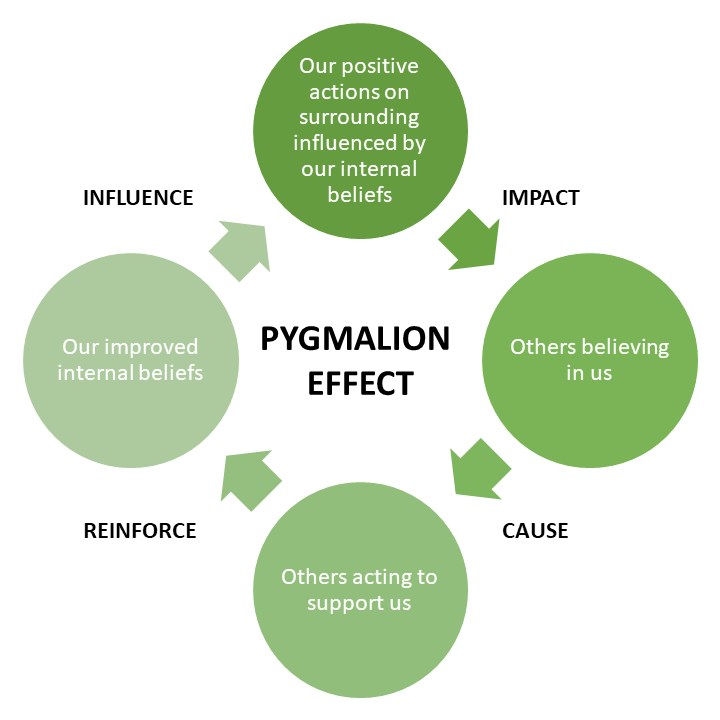
Pygmalion effect highlights how the environments in which we live, how the people around who put their trust in us can boot our performance. According to Pygmalion effect, if a high performing person can deliver poorly if the environment and people are not supportive, it also is true the opposite way, any low performing person would deliver exceptionally when he is trusted by the people and the environment around him.

Pygmalion effect is also known as Rosenthal Effect in psychology.  Robert Rosenthal and Lenore Jacobson conducted a study on classroom students where they found that the students who are inherently reinforced to be the smarter perform better whereas students who are told that they are worthless already show under-performance.

Pygmalion effect shows us that we internalize or identity based on the surroundings we live in. No wonder they say that when you want to be a great man be in the company of great people. This internalization of or beliefs lay the foundation of our performance. That is exactly why so many Fremens believing in Paul gave him the power to stand against the Harkonnens, the Emperor, the Great Houses – entire Universe.

This is exactly why Pygmalion effect is highly associated with the self-fulfilling prophecies. The declaration of such prophecy irrespective of the knowledge of the future conditions people to create ways for such prophesied person; the person who show some signs aligning with the prophecy gets a boost which ultimately follows the prophesied path as the environment now completely supports that path – that is the path of least resistance leading to the glory.

Supporting environment creates high performers

Paul could have chosen another path to fight just like Chani chooses in the end but the Pygmalion effects kicks in, leading him to become the antihero – a high performing powerful antihero.    

You should appreciate that Pygmalion effect also shows how the opposite and downgrading environment will create a villain. A famous and itching question can be answered using this explanation. If baby Hitler was killed way before, would it have prevented the occurrence of the future world war? The answer is – NO. The conditions were developed in such way that even after killing baby Hitler someone else would have risen among that much hatred who would have led to the end effect, the name would have been different but the acts would be roughly same and inhumane. That is why our environment is an important part of our identity, even if the environment is hostile, what we consider ourselves at the core is equally important.

Nonsupporting environment creates low performers

(You can see that, even in adverse nonsupporting conditions of cognitive dissonance and identity crisis, a person can chose to remain good, can choose one identity over the other. I have discussed such scenarios in pop culture before. Read more about that here.) 

The Prophecy – Does ‘Free Will’ Really Exist in Dune?

The identity which Paul chooses after a cognitive dissonance about his origin and the Pygmalion effect from his environment make his the prophesied Lisan al-Gaib. Now it feels like it truly was the plan all along. This goes against the idea of free will.

Existentialism is based on the idea that as man is born free. It is in his mind, his responsibility to assign the meaning to his/ her own life. The ways and reasons for which Paul consistently rejects the prophecy is because he knows he is not ‘the one’. He knows that he is the son of Leto Atreides and should avenge his father’s death, hence his only purpose was to use the ‘desert power’ to defeat the Harkonnens and the Emperor.

Paul despises everything that is connected to the Prophecy. It is his interest in Fremen people and purpose of completing the vision of his father which drives him into becoming one of the Fremen. You will see Paul rejecting the idea of him being the Messiah in the early discussions with Chani.

The creation of prophecy and instilling the faith into Fremen for Paul indirectly always pushes him into doing what is expected. Paul never makes any decision out of the box. There are chances where he could have created other opportunities but the people around him, his blind followers could never let that happen. Paul is center of attraction for everyone that is why he is always bound to do what they want, otherwise he knows that he will lose that advantage and desert will immediately consume him like any common outsider. The advantage of being the center of attraction of your followers is that your followers will justify your every action; But in the end, you will also be bound to their expectations.

The powers of Bene Gesserit to manipulate people to do what they want, the unfolding of events leading to the war during the Fremen rebellion against the Harkonnen, the necessity to prove injustice with Leto Atreides to the Great Houses ultimately make the realization of prophecy possible.    

That is exactly why Paul gets tied up in the expectations of Fremen, his own self-respect and his own duty as a son. He knows he can avoid this path but chooses that path because that is how he will have ultimate power.

On the other side you will see Chani, she is fighting the same war but can chose her own ways to accomplish that goal. Remaining out of the focus of the religious followers gives her more freedom.

Lady Jessica also falls victim to the prophecy. Stilgar informs her in Sietch Tabr that if she doesn’t become the Reverend Mother she would have to die and Fremen people won’t save Paul. Even when she knows that the prophecy is false, she accepts it as a way to get things done according to her wishes. But again, the pressure from the faithful Fremen followers force her to follow the prophecy. Things doesn’t go right for her in the end. Lady Jessica also faces the cognitive dissonance like Paul about her origin as Harkonnen and chooses the predefined path of being the Reverend Mother.

One must appreciate how Frank Herbert created the story of Dune where the psyche of person drives the narrative. Frank Herbert was heavily influenced by Carl Jung’s archetypes and Dune reflects those archetypes. Dune also gives the psychological justifications behind the blind hero worship through some important character arcs.

It becomes very important to notice our end goals and whether our surroundings, our people are supportive of that. We as humans, are the beings of infinite capabilities, what we consider ourselves internally at core becomes very important in the end. Otherwise, the world is already prepared to overwhelm us with its preconceived notions of living a life.  

References and further reading:

  1. Confirmation bias sketch from Sketchplanations by Jono Hey
  2. Cover Image by Johannes Havn from pexels.com
  3. Dune: Philosophy in Science Fiction
  4. The Pygmalion Effect: Definition & Examples by Ayesha Perera on Simply Psychology.org
  5. The Batman- The superhero who ‘unlearned’ – Journey of a person through cognitive dissonance
  6. Existentialism – Zima Blue and Existentialism
  7. Biases and Delusions – Steering on the borders of rationalism and insanity
  8. Answering the questions on existence of “the existence”
  9. The Existence – Why? How? And What?
  10. Dune’s Ornithopters and Biomimicry