
Turning Points – Remembering Dr. APJ Abdul Kalam’s legacy on his birthday
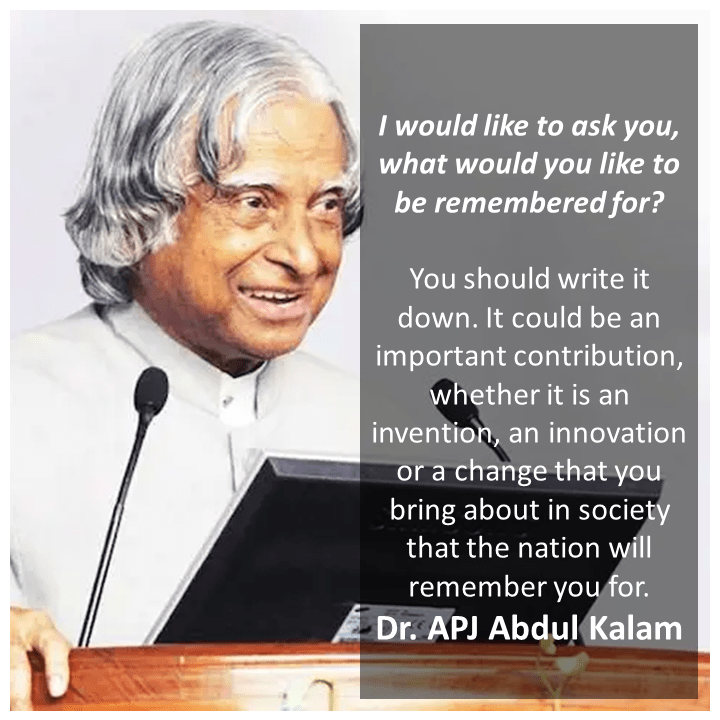
Unity in diversity lies at the heart of India as the biggest democracy in the world. This diversity also brings in various challenges from geographical, cultural, economic, governance and many more local perspectives. Bear in mind that despite having multitudes of such challenges the constitution has ensured that the machines are well oiled and keep running properly. To handle a nation with such diversity is a challenge in itself. Try convincing small group of people on an idea you have and you will realize how difficult it is to make others appreciate your vision. You will realize that people rarely resonate with completely new, unconventional ideas. The person must carry an aura to convince others for the path he is laying down. The person must carry a clear and pious vision for the masses.
Vision elevates the nation
-Dr. APJ Abdul Kalam, Turning Points
A vision must be pious because the moment people discover malice, a vision no more remains ‘the’ vision; it becomes a propaganda. Polarization is created and chaos ensues. That is one of the challenges with democratic society.
Only a self-inspired person, a person who is pure at heart, a person who can empathize with the masses, a person with emotional and intellectual intelligence and most importantly a person with humility can truly inspire people towards a common goal of the upliftment of the whole nation. Such people are blessing to the society and they appear once or maybe twice in a century. They are rare and leave an everlasting mark on society.
Dr. APJ Abdul Kalam, The Missile Man, The People’s President, and a teacher at heart was one such personality India had. Dr. Kalam was India’s 11th president. Even though he is not physically among us his ideas and his vision are with us and will keep on inspiring every Indian rather every human. He is my source of inspiration since my childhood; I will take this opportunity to unfold certain aspects of his personality hereon. This is me remembering Dr. APJ Abdul Kalam on his birthday 15th October.
Dr. Kalam wrote a book called ‘Turning Points – A Journey through challenges’ where he highlights the key events which shaped his tenure during the presidency and what really drove him to have a sense of accountability towards the people of India. If you look at the life achievements of Dr. Kalam, you will realize that overcoming challenges in spite of having multiple failures and worst conditions was his forte. His systematic logical thinking combined with result-oriented actions was the key reason for such achievements. You must also appreciate that he was not just a scientist with logical foolproof plan for results; he was a pure empath who understood what people of the nation actually wanted. He knew the pain of the masses and also made successful efforts to resolve many fundamental issues. Please understand that the position of The President in Indian Constitution although is the highest position, there are very few examples where the elected President created a significant impact on whole nation physically and ideologically. Most of the times, Prime Ministers are known to be the key drivers of the nation’s future in Indian Democracy.
You will appreciate what exactly caused Dr. Kalam to have a focused mindset towards making India a developed nation by 2020. Although we are still in developing phase, the rate is slow but we wouldn’t be here if Dr. Kalam had not envisioned the ‘Vision 2020’. The book Turning Points thus gives a glimpse into what made him to devise an action plan in making India a developed nation.
You will be surprised to know that we are literally living in the accomplished visions of Dr. Kalam and there are many those will be achieved in near future.
The Modern India
Dr. Kalam was the key originator and proponent of many facilities and policies we Indians are enjoying today. It is only because of his vision and action plans we are enjoying certain life changing benefits in our routine lives.
Dr. Kalam was responsible for successful inception of Indian space program led by Prof. Vikram Sarabhai. The SLV program (Satellite Launch Vehicle), the IGMDP (Integrated Guided Missile Development Program), Indigenous hovercraft development called ‘Nandi’, Project Smiling Buddha in Pokhran for nuclear weapon development are some of the professional achievements of Dr. Kalam.
The concepts of e-governance, e-judiciary, court hearings through video conferences, pushing for the evolution of National Litigation Pendency Clearance Mission, meetings through video conferences, incorporation of Information Communication Technology, creating more policies to become energy independent, to become stronger in defense technologies, boosting the innovation funnel throughout the country, empowering the states while leveraging their specialties in cultures and traditions, making India a Nuclear superpower, developing and promoting an indigenous nuclear power program, pushing for increased plantations and facilities in biodiesel production, pushing for solar energy production and required policies, creating an annual target driven action plans for each ministry and states to have a focused development approach, creating an action plan to work on industry relevant skill development and more exposure to higher education in science and technology, creating more opportunities for the research in the fields of nanotechnology are some of the visions Dr. Kalam had for the people of the nation. This is just a short glance into what he planned and achieved in his tenure. We are just enjoying the fruits of his well-formed result-oriented action plans.
The book Turning Point will give readers a peek into the thought process and key motivations behind Dr. Kalam’s vision for making India a developed nation.
- Dream Big
Appointment in ICSR – Indian Committee for Space Research (ICSR later became ISRO – Indian Space Research Organization)
The key moment which changed Dr. Kalam’s thought process was during his interview with Prof. Vikram Sarabhai. Dr. Kalam worked in the development of the hovercraft after which he had this interview. You will notice that Dr. Kalam was very impressed by the first-hand confidence that Prof. Sarabhai had in him because he explored the capabilities Dr. Kalam had without questioning his competencies. Dr. Kalam always told youth to dream bigger. That idea came from this exact moment. Dr. Kalam realized that what Prof. Sarabhai had dreamt was way bigger than the dreams of Dr. Kalam.
This moment inspired Dr. Kalam to dream even bigger which he always kept reiterating in his interactions with youth.
- Urge for cross implementation of technologies
Appointment in DRDO missile program
India’s first satellite Rohini RS-1 was launched by SLV. Dr. Kalam was Project Director for this program. He presented how this satellite launch vehicle put Rohini in the orbit to Dr. Ramanna who was a nuclear physicist and director of DRDO (Defense Research and Development Organization). Dr. Ramanna offered Dr. Kalam the position of DRDO. Dr. Kalam accepted this position because he wanted to implement the space technology developed from SLV program into missile development program.
You must appreciate that the missile technologies developed in-house for missiles like Agni, Akash, Prithvi, Trishul and Nag were possible because of Dr. Kalam’s approach to interdisciplinary knowledge implementation for indigenous technology development on faster speeds.
His same approach to create intersections in various unconnected fields through technology got reflected during his presidential tenure. The implementation of electronic technology for e-governance, e-judiciary are result of that. He always believed that such intersections of technologies boost the speed of growth.
- Indigenous technology is the way to self-reliance and defense
Dr. Kalam wanted to return to his passion for teaching and interacting with youth while he was Scientific Adviser to the Defense secretary. P V Narsimha Rao, then Prime Minister also Defense Minister asked him to continue as the defense minister and Kalam agreed because he was handling multiple important programs. P V Narsimha Rao’s long-term vision for indigenous defense program inspired Dr. Kalam.
I think Kalam called this moment as the turning point because if he would have been associated with teaching at that time his future would have been totally different from becoming the President. This moment is also important because it created a concrete foundation in Dr. Kalam’s mind to create a long-term vision for nation which will rely on indigenous technologies.
During his Presidential International visits Dr. Kalam always pushed for the use of indigenous ICT, BPO frameworks, pharmaceutical manufacturing technologies. This moment might be the key inspiration behind Dr. Kalam’s thought process.
- Nation first, politics later
Dr. Kalam was offered a Cabinet position under Vajpayee Government in 1998 when he was handling the Missile Program (Development of Agni Missile) and Project Smiling Buddha (Pokhran Nuclear Test). Any other normal person would have accepted the better and beneficial offer of Cabinet Minister but keeping Nation first Dr. Kalam decided to decline this offer and focused on the Indigenous Missile Program and Nuclear Weapon Program which further upon their success made India’s global presence stronger.
- Drive to Envision, Urgency to take Actions, and Having Courage to do the Impossible
Dr. Kalam stands out as one of the rarest statesmen who focused on practicality of vision and action plan for their execution; there is a reason for that attitude.
When Dr. Kalam was Principal Scientific Adviser (PSA) for Government of India when he paved the foundation of action plans and their implementation for Vision 2020. During this tenure as PSA, Dr. Kalam had a helicopter accident where for the sheer luck of the nation he was unharmed.
Even after going through such accident, he was immediately ready to connect with the locals and the youth where he asked them to recite his hymn. This shows the artistic side of Dr. Kalam. Dr. Kalam was known for inspiring poetry showing the importance of the power of youth.
Courage to think different,
Courage to invent,
Courage to travel on an unexplored path,
Courage to discover the impossible,
Courage to combat the problems and succeed,
Are the unique qualities of youth.
As a youth of my nation,
I will work and work with courage to achieve success in all the missions
Dr. APJ Abdul Kalam, Turning Points
This near-death experience gave him a totally new perspective towards the life in front of him. It created a sense of urgency for him which pushed him to write the famous book ‘Ignited Minds’. This sense of urgency inspired him to push more for PURA (Providing Urban-amenities to Rural Areas) project. Many independent village ecosystems, governance technologies, tech policies, benefit transfers which are now available in rural areas are the fruits of this PURA program.
I have always believed that cowards never make history, history is created by people with courage and wisdom. Courage is individual, wisdom comes with experience.
Dr. APJ Abdul Kalam, Turning Points
- Empowerment and Independence of the Nation
Dr. Kalam believed in the power of self-reliance and improvement in the agility between different functions of government and also between individual states. You will be surprised to know that he was the statesman who brought the idea of e-governance in the Office of the President and implemented it effectively. It later spread horizontally to the e-governance and digitization of documents that we see today. It took time because of multiple reasons but you must appreciate his vision and future outlook behind it. His dream then is now our reality.
In similar sense, Dr. Kalam created action plans for individual states based on three parameters:
- The contribution to the vision for developed India
- The heritage of particular state
- The core competency of that state
This shows how agile and practical Dr. Kalam’s thinking was. He knew how to play with the strengths of each state and also cared for their legacy thereby preserving the cultural importance of diversity in our country.
Dr. Kalam is also one of the statesmen behind the upliftment of the judicial system. He pushed for the National Litigation Pendency Clearance Mission. This mission is the origin for the e-judiciary, court hearings through video conferencing, use of ICT in litigation, age analysis of pending cases, fast track courts which we are seeing today.
- Duty Towards Nation
Dr. Kalam always created a sense of duty towards nation in the hearts of the youth and his action always reflected the same attitude. Many of his lectures were named as ‘What Can I Give To The Nation?’
Dr. Kalam’s way to guide the youth to answer this question is based on the importance of values in human life. He gave huge importance to each and every public address he would give. He revised his public addresses multiple times to ensure that the message is crisp and inspiring.
You must appreciate that human values were the core of his speeches. The ideology of ‘being a better human is the best you can offer to the nation’ is what inspired youth to follow their own dream thereby also benefiting the nation in greater sense. Dr. Kalam’s speeches always had this element of ‘call for action’ that is exactly why the question – ‘What can I give to the Nation?’ is simple yet meaningful. It made the youth to look inside them for the betterment of the nation altogether. These are the skills of a seasoned inspirational personality, they make you look inside to create a better future outside for everyone, it creates a sense of duty, accountability and also satisfaction for life well spent.
And this same sense of duty and accountability Dr. Kalam wanted to inject into the Indian Parliament and Indian Politics. He had action plans to do that too.
When politics degrades itself to political adventurism the nation would be on the calamitous road to inevitable disaster and ruination. Let us not risk it.
Dr. APJ Abdul Kalam, Turning Points
Dr. Kalam was well aware of the gaps between the lives of the common people and the events in the parliament, They were completely inconsistent and were not helping (even today they rarely help)
People are yearning for lifestyle change by preserving the cultural heritage, values, and ethos of the Indian civilization.
Dr. APJ Abdul Kalam, Turning Points
Dr. Kalam asked the parliament members to focus on key aspects of development of their own state instead of engaging into the propaganda-based politics. Dr. Kalam was one of the few proponents of the Development Politics. You might think that this word is somewhat recent concept but Dr. Kalam was the originator of the action plan and policies for development-based politics.
He gave five points to the members of parliaments to work upon:
- Agriculture and food processing
- Education and health care
- Infrastructure
- Information and communication technologies
- Self-reliance in critical technologies
You must appreciate that the world we are living in is the result of action-based plans and their results based on these ideas.
Dr. Kalam pushed for the indicator of National Prosperity Index (NPI) instead of GDP (Gross domestic Product). The idea was that GDP growth indicates net domestic product but it doesn’t reflect how this growth is affecting the quality of life in rural and urban area. Thus, associating GDP with other indicators can actually help to gauge the realistic growth of the nation.
NPI (National Prosperity Index) =
annual growth rate of GDP +
improvement of quality of life of the people particularly those below poverty line +
the adoption of a value system derived from our civilizational heritage in every walk of life which is unique to India
This shows that Dr. Kalam had the sense of importance of the cultural heritage in the growth of nation. The urge to push for the upliftment of quality of life is intentional to reduce the gap between the riches and the poor.
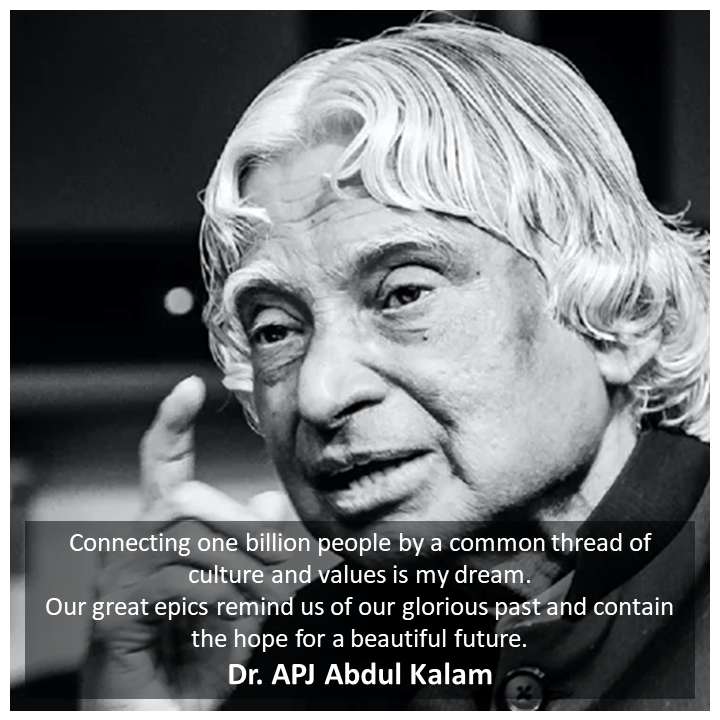
- Strong Inner Compass – Value-based character development
Dr. Kalam even though was an intelligent scientist and had many professional achievements, he was down to earth. Intellectual humility was his second name. His thoughts also showed how he valued the sense of service, honesty and compassion right from the childhood.
Dr. Kalam shares an event from his childhood where he received beating from his father for the very first time in spite of being the youngest and the most loved child. The reason was to accept the gift from others for being elected as the President of the Panchayat of Rameshwaram.
Dr. Kalam quotes his father’s words from Hadith-
“When the Almighty appoints a person to a position, He takes care of his provision. If a person takes anything beyond that, it is an illegal gain.”
That thing remained with Kalam forever. The last things that Dr. Kalam possessed were 2,500 books, a wrist watch, six shirts, four trousers, three suits and a pair of shoes. He donated his pension to the development programs for rural areas. He didn’t have any TV, fridge, AC.
Dr. Kalam was a spiritual person. You will see from his whole life journey he never submitted to a single side of the religion – he was always on the side of divinity. This shows his openness to find the real truth of what it means to be a human being. Humanity was at the core whenever he was discussing any religious topic.
“Kalam sees no conflict between science and religion. When I asked him if he believed in the Day of Judgement and rewards or penalties, we might have to pay in life hereafter, he replied evasively, ‘Heaven and hell are in mind’…”
“No rationalist can dispute Kalam’s vision of divinity. Some define God as truth; others as love, Kalam’s concept of godliness is compassion…”
Khushwant Singh, Author and columnist for Hindustan Times
- Sacrifices make any great pursuit ‘great’
Dr. Kalam was devastated after the crash of an Air Surveillance Platform which led to death of all its 8 occupants. He realized in this very incident that many people without any personal gain give away their lives to the service of the nation and their sacrifices goes unnoticed in the chaos of all the politics. This should never happen. You can sympathize with the pain of the relatives of these heroes but you would never be able to return the service they provided to the nation. Everyone must be aware of that.
This shows the sensitive side of Dr. Kalam. He was a strong proponent of dreaming big, having courage to do the impossible but this event shows that he was also aware of what sacrifices people make to achieve the impossible, these sacrifices, this service are bigger than anything and should not go unrecognized. He wanted the people of the nation to appreciate the same.

- Religion is a personal thing and so are the culture, faith, language and heritage
Dr. Kalam visited the places affected by the Gujarat Riots. His intent was to understand the ground reality and he knew that his mere presence will speed up the relief efforts. Bear in mind that visiting such sensitive areas for a President is a highly risky task.
Dr. Kalam was disheartened by the events, he expressed the reason behind that-
“…in our land, with its heritage of a highly evolved civilization and where great men were born and stood tall as role models for the entire world, communal riots with their attendant tragedy are an aberration that should never happen.”
“Each individual has the fundamental right to practice his religious, cultural and language faith. We cannot do anything to disturb that.”
Dr. APJ Abdul Kalam, Turning Points
- Building bridges to share each other’s competencies for mutual growth
Dr. Kalam is also known globally for his speech in the European Parliament. He focused on mutual growth plan for European Union and India. His poem ‘Message From Mother Earth’ won hearts of all the members of the European Parliament. Dr. Kalam’s visiting day in 2005 – 26 May to Switzerland is celebrated as Science day there. Dr. Kalam proposed to implement the electronic network to connect African nations using the IT power of India under Pan African e-network Project.
Whenever Dr. Kalam visited any country, he made sure that both countries help each other to generate mutual benefits and deepen the relationship. Dr. Kalam was always open to understand what greatness lies in others.
In meeting people, we are transformed too, though we stay the same.
Dr. APJ Abdul Kalam, Turning Points
- Real development starts from the bottom – PURA
Dr. Kalam highlighted one key observation about the developed nations. Even though their rural regions, villages in developed nations look just like our meaning not exactly, not physically meaning that the ways people carry their lives. The villages in developed countries don’t have high rising towers, big houses, big restaurants and hotels. What they exactly have are the basic amenities like power, education, transport and easy access to government to live comfortably. This inspired Dr. Kalam to work on the mission for the upliftment of rural areas of India under project PURA.
The word itself is self-explanatory.
It stands for Providing Urban-amenities to Rural Areas.
The key idea behind PURA was to solve the problems of emerging due to fast Urbanization of towns and fast migration from the villages. Towns get overwhelmed due to overpopulation and villages are empty because there is no quality of life.
If you see the other side, villages are pollution free which urban people want. Urban areas have better opportunities for earning and sustenance which rural people want.
PURA focused on addressing these exact issues on rural level.
Following were the key headers of the PURA project:
- Physical connectivity – roads and transport
- Electronic connectivity – for local knowledge preservation and transfer
- Knowledge connectivity – for skills sharing and efficiency boosting of multiple rural areas thereby creating spare time to do better things and improve quality of life
- Earning capacity – once these three connections are improved, people can work on increasing the earning capacity.
- In the end we, are all humans
Dr. Kalam also made efforts to made the Mughal Gardens in the Presidential office to become a center of discussions. He tried to improve the flora and fauna there. He coordinated between DRDO scientists who had developed high-altitude agriculture before to develop several (12) gardens in Rashtrapati Bhavan. Later biodiversity park was also developed there. This showed his connect with nature.
Dr. Kalam was reluctant on approving the capital punishment believing that it is not a human’s job to decide the fate of the life of other person, but as a duty he had to do that. Dr. Kalam made sure about the total background of the convicted person and tried to understand what will be the life of the people dependent on such convicts. Wherever he found the offenses to be too inhumane he approved the capital punishments. You must appreciate that being the President he could have approved every capital punishment but his core value system, that human side was always active. He knew that in the end the convict is also a human.
We are the creations of God. I am not sure a human system or a human being is competent to take away a life based on artificial and created evidence.
Dr. APJ Abdul Kalam, Turning Points
- Parliament functions are the heart of democracy
Dr. Kalam was the main proponent of the need for improvement in parliamentary Functions.
Constant vigilance is the price of liberty. It is important that democratic processes and functioning, however satisfactory they may appear on the surface, cannot be, and should not be frozen in time.
Dr. APJ Abdul Kalam, Turning Points
He made every practical effort and created a result-oriented action plan for giving the boost in the efficiency of the parliament. Some of them are implemented, we hope others are still under consideration.
Dr. Kalam had created a development matrix between the Cabinet Ministries and the Members of Parliament which created and intersection of resources, action plans, targets and results for each state. He made sure that his presidential powers are put in effect for the betterment of Parliament and thereby the people for which it stands.
These are few takeaways from Dr. Kalam’s 21st book – Turning Points. There are many details which show a deeper insight into the personality of Dr. Kalam. Everyone should read it. This book shows all aspects of a perfect human being. The vision that Dr. Kalam had for the developed India is the vision in which we are living today. It wouldn’t have been possible if he hadn’t devised a result-oriented action plan. Although there are many things which are yet to be achieved and speed sometimes is not that fast. Dr. Kalam was also concerned about the speed of these developments. But at least we know where to go – the right direction. It would be impossible without his vision.
In the times of the golden era of social media celebrities, film stars, TV stars, sportsmen always are at the focal point of attention. We rarely celebrate scientists on such platforms.
It is sad that we never celebrate the bright minds especially the scientists the way we celebrate film stars or sportsmen. Dr. Kalam is a rock-star if you compare with others. Not only from Science and technology point of view, Dr. Kalam was People’s President, an ideal teacher every student dream of, a kind human, a divine spiritual leader, man of values and virtues and the best of all the humans the nation, the world would ever see again.
We are just living in his dream which became the reality today. It was only because he dreamt of the Vision 2020 with a realistic action plan to execute it and make it ‘our reality’. We owe it all to Dr. Kalam. There would rarely be any leader, any human like him in future. The world will remember him forever for his contributions.

 Parts Per Billion