A Hindsight For Better Future

Morgan Housel – the famous author of ‘The Psychology of Money’ has another important book called “Same as Ever” which gives insight into things which have never changed over the course of time. Same as Ever drives the motto of objective flexibility and subjective awareness of every event happening around us and with us. It also highlights that our mind is the first and the easiest one to fool, which leads to false sense of superiority over others and creates biases. Once we accept that nothing is perfect, no one is perfect – it injects humility and forgiveness. It also makes us to be grateful for what we possess today. The ability to see every event at the same level is a superpower any one of us can have.

An important book from Morgan Housel called “Same as Ever”

Somebody, make me a time machine

Life would be easy if we had a way to accurately predict the consequences of the events/ actions.

Scenario 1 – what would be your reaction if some random person hands you a $1,000,000 lottery ticket and, in few moments, you realize that you just won that lottery?

Scenario 2 – what would happen if an ambitious project that you worked on tirelessly for many years while sacrificing your other priorities – ends into a big failure because of a seemingly impossible and insignificant event/ error?

For most of us these two scenarios are practically impossible but the odds are still non-zero. They can happen in reality.

How can we be sure that they selectively happen to certain person? Scenario 1 for ourselves and Scenario 2 for our enemies especially… (Just kidding)

If you closely observe the lives we are living right now, you will see that we are always oscillating between such events which demand certainty of outcomes even before the are realized. We have this innate urge to remain ready for such events; it is what we are always striving for.

Now, one question – are we living in a matrix? Is universe a simulation?

If the answer is ‘YES’, then it means that every outcome should be predetermined. If everything is predetermined then why things don’t happen the way we ‘want’? Does that mean that we lack the computational capabilities to precisely calculate the outcome? OR is what is destined to happen different from what we ‘want’?

If the answer is ‘NO’, then everything explodes into meaninglessness. The answers are nihilistic.

Looking at the both outcomes of this question we see that we need a baseline to make our decision making effective. Is there a formula to systematically put all the things happening around? What are somethings in nature whose knowledge will ensure our satisfactory existence. (I am being very optimistic while writing ‘satisfactory’ word here.)

In simple words, what is the formula to live a good life? whether it is predictable or not.

 Morgan Housel the famous author of the Psychology of Money wrote one important book called Same as Ever which tries to answer this same question. Same as Ever drives the motto of objective flexibility and subjective awareness of every event happening around us and with us.

This is a deep dive into Morgan Housel’s book “Same as Ever”.
I will try to keep this short. Here are some instructions:

Those who have read this book – each idea in this book is numbered in the sequence Morgan explains in the flow of the book. So, #1 is Hanging by a Thread as mentioned in book and #23 is Wounds heal, Scars last

Those who haven’t read the book – I have given short summary of what Morgan discusses in each of the 23 ideas. That should help you to wrap you head around my distilled down version of this book.

(I apologize for putting that part in the end and spoiling the conclusion/ discussion on this book.)

I would say this book has been one of the most important books I have come across. (I am an average book reader by the way. So, not sure if same would be the case for other people.) While going through each idea, you will realize that something keeps on repeating; and even though it repeats, it brings new perspective into that specific discussion. My attempt to summarize this book focuses on picking what is common but connected to all the facts mentioned in the book and also their connection to the reality we live in.

Discussions

The discussion is in 3 steps, so adjusting our understanding to previous step is key to understand the next step. The illustrative images in each step of the discussion connects the ideas from the book to a common central idea. It will be handy if you read this with the book in your hand or you can jump to the point-to-point summary (the part after conclusion) in a neighboring tab of your web browser.

Step 1 discussion:
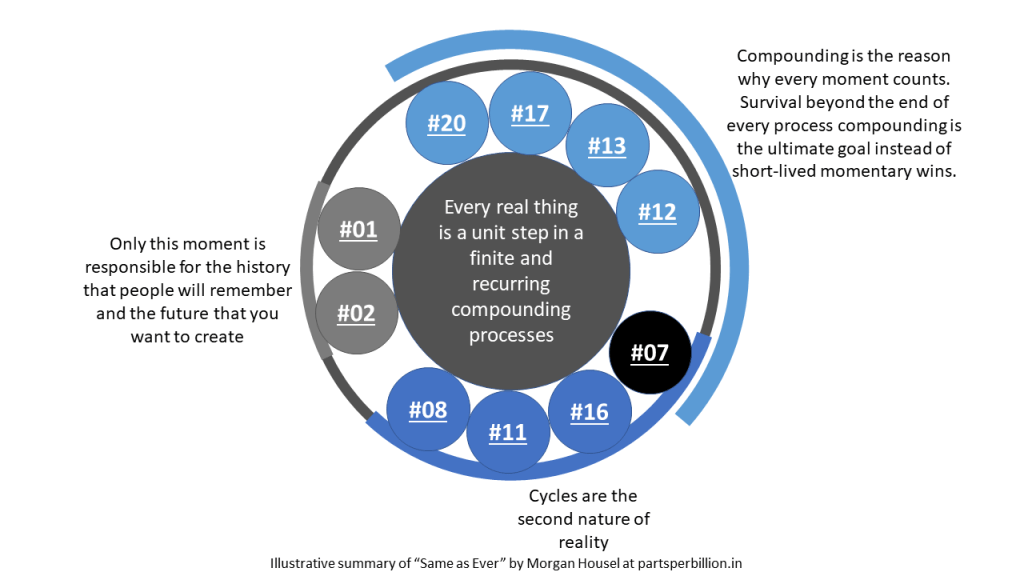
Figure 1. Finite and recurring cycle of compounding processes

You will see in the figure 1 that reality is ever changing process of infinite real events. The key to understand what is happening is to see every event containing same potential at first. Keep in mind – same potential – neither good nor bad. Once you assign every event with equal potential you will see that compounding accounts for that single event to build on and create the next event. Sometimes two big events will compound together to create an enormous event.

Now comes the fun part – the enormity of every compounded event will always be in favor of someone and against the favor of the complementary population. This makes that event good or bad for people. Some will suffer some will rejoice.

A person who knows how the world, nature or universe works will not have preferences, favor-ability towards such events. The answer lies in the cyclical nature of such events. Keeping a single event sustained for long duration demands to go many things to work in supporting ways and as every event has same potency in the infinite possibilities, it surely will lead to the downfall of that process. It’s just matter of time.

Talking about matter of time – the game of life is not about winning, rather it is about remaining in the game longer as the compounding pays off and decomposes into new start.

Our limited life span intuitively doesn’t allow us to wait till the compounding pays off. That is exactly where we make mistake. That is exactly why we are devastated by a single seeming insignificant event causing destruction of our favorite things.

Step 2 discussion:
Figure 2. Reality is far from perfect

Our urge to predict everything to ensure survival demands perfection in every entity considered for precision and accuracy of prediction. As reality is made up of many real possibilities, this count of possibilities and the errors associated with their measurements require huge resources which render the prediction process impractical for the possible outcomes.

(Keep in mind right now that we are only talking about those variables, events which we can understand; we haven’t even entered into those variables, events we don’t even understand or know in first place.)

The moment we introduce poorly known, immeasurable but significant variable – the whole game of predictability crumbles down.

That is exactly why instead of striving for better predictability, it is a smart choice to be prepared for everything. Knowing that this too shall end soon should comfort us to prepare for such things/ events. The rejection of the urge for perfection, absoluteness and full efficiency will immediately prepare us for everything that reality unfolds.     

Step 3 discussion:
Figure 3. In the end, we are only human.

Now that we know how every event is potent and can immediately contribute to a cyclical process of compounding, it is important to understand how we comprehend that compounding. As everything that we do is directly linked to our survival we are by default born with preferences. These preferences get eliminated or amplified based on the life experiences we have. Even though our urge for predictability demands objectivity we often forge the subjective parts of every narrative. The subjectivity is important, because the reasons to survive are different for different people.

Conclusion – Human behavior and laws of nature

Our mind rarely understands anything as a flow of entities. Almost all of the fundamental entities existing in nature are flow – continuum entities. But in order to understand them study them we break them into pieces which makes is practical to quantify and predict. For time as an example – we have past – present – future; we need this separation to comprehend the flow of time. This slight arrangement of separation of events just for the convenience of communication and comprehension for our minds has now become such a second nature of our realities that we could hardly come out of the idea of past and future. Past keeps on haunting and future creates anxiety due to the uncertainty. Nostalgia from past brings us joy and what advancements future will present inspires us to work harder today. We rarely notice that this works both ways.

It is really difficult and impractical for our mind to let go of this past-present-future mentality. This convenience of separation for the sake of improving our decision making and survival has imparted a sense of time being a set of discrete isolated events, independent events. This steals the feature of hyper-connectivity in our understanding of reality.

Once we come out of the discretization of time as past-present-future we will see that every event is equally important and highly interconnected and multidimensional (in the sense that it creates multiple real effects on multiple entities) Our mind being biased for survival and in energy optimization mode, it always focuses on what is required to remain alive. This sense of remaining alive now has evolved into intellectual survival – as in what things we define as our life. So, even though from objective point of view all events remain exactly the same, on our personal level certain events are highly important because they change the things we are attached to in a drastic way – in most cases our life. We are now scared to die intellectually – a mental death – the death of our truths – our identity. And trust me, this happens frequently.

Morgan in this book very beautifully noted down the factual version of the reality we live in; it is beautiful because it shows how our human nature is always affecting the seemingly objective reality of the most of the things.

This is my ultimate distilled down version of the book “Same as Ever” by Morgan Housel.  

One point summary of ‘Same as Ever’ by Morgan Housel

 It also highlights that our mind is the first and the easiest one to fool, which leads to false sense of superiority over others and creates biases. Once we accept that nothing is perfect, no one is perfect – it injects humility and forgiveness. It also makes us grateful for what we possess today. What else could be more important than this to be justified as a human being?

These points ask for detachment from predictions and end results. A sense of responsibility for the actions could be the best version of any person – this exactly is invoked when we are trying to prepare for the future instead of striving to predict it.

I think we need more ideas like this when we are fighting for survival for such unimportant things where we already know the real, practical answers but have decided to ignore them.

The ability to see every event at the same level is a superpower any one of us can have.
For those who haven’t read the book here is the point-to-point summary of the book “Same as Ever”:  

#1. If you know where we’ve been you realize, we have no idea where we’re going.

Here, Morgan gives many real-life events where a single decision led to catastrophic events causing loss of many lives and valuable resources.

When we study history even when we know what exactly happened, it is tricky to pinpoint the trigger for that event. There will be why and how behind every small-small event and when we will reach to its origin it becomes really difficult to wrap your mind around that petty thing which had led to such a big and historic event.

The absurdity of past connections should humble your confidence in predicting future ones.

#2. We are very good at predicting the future, except for the surprises – which tend to be all that matter

In very simple words, Morgan highlights the extents of our imagination and thinking. Even though they are infinite, the nature in which we are existing is equally or rather infinite in bigger and greater sense. That is exactly why even when we think we are prepared for everything, nature will always have something new in its pocket to reveal and not being ready for that exact new thing makes that event overwhelming for us because we were not ready for that exact new reveal.

It’s impossible to plan for what you can’t imagine, and the more you think you’ve imagined everything the more shocked you’ll be when something happens that you hadn’t considered.

This itself should humble us. That is why preparation is more important than forecasting.

Invest in preparedness, not in prediction

#3. The first rule of happiness is low expectations.

The most important observation Morgan puts here is in the ways we gauge our resourcefulness – it is always relative – material or immaterial – objects or emotions. We always have a baseline which is created by comparing ourselves with those around us. That is exactly why we rarely appreciate what we have at our hands.

We always crave for what ‘they’ seem to have instead of appreciating what we already and really have in our hands. Even when we are unsure about whether others actually have those things, still we crave those things for us, which is tragic!

Morgan expresses that almost all of the truly precious things in our life don’t come with a price tag that is why we never care to evaluate their importance – like good health, freedom. Same is the case with expectations.

When Morgan is asking for low expectations, it is not omission of the motivation to improve ourselves. Low expectations ask for realistic expectations. One must always be observant of the gap between what we wanted and what happened in reality.

#4. People who think about the world in unique ways you like also think about the world in unique ways you won’t like.

Here, Morgan talks about the role models, heroes, leaders we consider the best of us all. It is very important to understand that they are the best among us all because they did something in very exceptional manner which made them stand out of the well-defined ‘boring’ and ‘average’ structure of the society. If they would have followed the same paths that other followed, they would have been just like others.

In order to stand out of the masses they did something different.

Now be cautious! This different could be seen as good or bad as per the average crowd level. And keep in mind this specialty in that person is because others don’t have it in them. So, in order to create and develop something special out of the same average crowd one has to overcome a resistance of the masses where a trade-off is done with other aspects of their personality. Sometimes the exceptional conditions create exceptional personalities which many people fail to recognize.

Of course they [successful people] have abnormal characteristics. That’s why they’re successful! And there is no world in which we should assume that all those abnormal characteristics are positive, polite, endearing, or appealing.

Simple words, there is always some trade off to achieve something truly exceptional.

You gotta challenge all the assumptions. If you don’t, what is doctrine on day one becomes dogma forever after

#5. People don’t want accuracy. They want certainty.

A common trait of human behavior is the burning desire for certainty despite living in an uncertain and probabilistic world.

Morgan discusses how we are always trying to alleviate the bad results, pain in all life scenarios. The urge to survive supersedes everything. Our brain always wants a confirmed trigger on whether to fight or flight for given problem. It is always in energy optimization mode and in the uncertain world filled of infinite possibilities it wants something to act on immediately. Otherwise, brain knows that it won’t survive. The urge for certainty – that clarity of whether to fight or flight is the most important information than how precisely we are assessing the reality. It’s like brain takes a shortcut to ensure survival. That is exactly why huge load of information especially numbers overwhelm us.

The core is that people think they want an accurate view of the future but what they really crave is certainty.

#6. Stories are always more powerful than statistics.

If we continue the train of thoughts from previous point, soon we will appreciate how dearly we appreciate stories instead of boring numbers. Even when stories would tell a lie and numbers would tell the real, pure truth we would always choose a fake story over realistic numbers. Our brain doesn’t want to overwork itself to ensure survival.

Good stories tend to do that [evoking emotions and connecting the dots in millions of people’s heads]. They have extraordinary ability to inspire and evoke positive emotions, bringing insights and attention to topics that people tend to ignore when they’ve previously been presented with nothing but facts.

Stories create an emotional, empathic bridge between people which our brain already knows since the childhood. The very first think a baby does to start breathing is crying not counting. (I know the analogy is lame but it works here) we are implicitly trained to actively process emotions first and then numbers. Stories enhance this ability on next level.

That is exactly why emotional-ity will always be preferred over rationality.

We live in a world where people are bored, impatient, emotional, and need complicated things distilled into easy-to grasp scenes.

#7. The world is driven by forces that cannot be measured.

Morgan brings here more clarity on the objective nature of the numbers even when they are showing the truth, the reality. The point that our reality is made up of the infinite possibility itself shows that the sheer limitation of our computation capability will create a partial picture of the bigger reality. This happens because many of the factors which influence our reality are beyond quantification.  That is exactly why whenever we are making any decision based on objective and true data (like truest of true numbers) we should bear in mind that these numbers are not accounting for those unmeasured factors which also affect the reality we are trying to understand.

Some things are immeasurably important. They’re either impossible, or too elusive, to quantify. But they can make all the difference in the world, often because their lack of quantification causes people to discount their relevance or even their existence.

In simple words, our story loving brain is driven by intuition and safe/ familiar information which is unquantifiable most of the times.

#8 Crazy doesn’t mean broken. Crazy is normal; beyond the point of crazy is normal.

Morgan is trying to point out how we understand what is means to be at the top. He established that most of the tops we experience in life are to because we have experienced falling down from them and we would have never understood that we were at top unless we have had fall down from them.

The only way to discover the limits of what’s possible is to venture a little way past those limits.

We never appreciate summit of something unless we start climbing from down or fall down from that summit. That is exactly why what made you feel at the top will make you safe and that attachment to safety will lead to your fall, the pain of fall will motivate you to climb new heights and again the cycle will go on.

#9. A good idea on steroids quickly becomes a terrible idea.

Morgan here explains how evolution created the species around us. There was always some trade-off while evolving because of the forces of nature. In nature nothing has absolute competitive advantage otherwise a single species will take over everything that single species alone will lead to its downfall and destruction due to the lack of diversity.

Most things have a natural size and speed and backfire quickly when you push them beyond that.

In simple words, anything that is burns bright, goes out fast. Resources behind every process are limited and even if they would be available in surplus, extent of their utilization affects the outcome and overall integrity of that process.    

#10. Stress focuses your attention in ways that good times can’t.

The urge to survive makes our brain to push to its untested limits. These limits are there just for the optimum behavior so that our brain could actually use the reserve energy when it is the question of life and death. When it come down to do or die – people have always delivered in surprising and shocking ways.

The circumstances that tend to produce the biggest innovations are those that cause people to be worried, scared, and eager to move quickly because their future depends on it.

Morgan points out here that this stress should be healthy because there is always a natural size of everything as explained in point #9.

There is a delicate balance between helpful stress and crippling disaster.

#11. Good news comes from compounding, which always takes time, but bad news comes from a loss in confidence or a catastrophic error that can occur in a blink of an eye.

Growth always fights against competition that slows its rise.

Morgan here shows how things that exist today as our reality have gone through multiple iterations. They have already failed many times and started again long ago; its just that the compounding imparted grandeur and power to fight against the adversities of the life which made their realisation possible here in front of us. There will again be some simple, seemingly insignificant event which will destroy this creation and things will start again.

To enjoy peace, we need almost everyone to make good choices. By contrast, a poor choice by just one side can lead to war.

#12. When little things compound into extraordinary things.

Here Morgan points out from the examples of history how in order to avoid a big calamity people ignored some small incidents which led to even bigger calamities. It is ingrained in our mind to overlook big events because the smaller events which lead to their realization are “small and insignificant”.

Small risks weren’t the alternative to big risks; they were the trigger.

#13. Progress requires optimism and pessimism to coexist.

Morgan here talks about how our preferences for each and everything have stolen away the realism in our lives. Instead of favoring one side, life is more about appreciation of the spectrum. It was never about who wins or who loses because both are short lived. It is always about who survived and stayed in the game longer. (Simon Sinek calls it the infinite game as explained in Game theory.)

The trick in any field – from finance to careers to relationships – is being able to survive the short-run problems so you can stick around long enough to enjoy the long-term growth.

Whoever lives to see the end wins but that victory is just over those who couldn’t survive. There will always be some room at the top because conditions never remain the same.

#14. There is a huge advantage to being a little imperfect.

The more perfect you try to become, the more vulnerable you generally are

The idea of perfection immediately steals the flexibility from any given system. Because of the perfection the system is bound to certain thriving conditions and exactly when you expose this system to the reality of infinite possibilities there will always be some ‘seemingly’ trivial event which will take down that whole system.

A little imperfection makes the system to bend thereby giving place to perform in unimagined conditions and as we have already learnt that the reality is full of unimaginable but real events.

Morgan beautifully explains the ways in which natural evolution has worked out.

A species that evolves to become very good at one thing tends to become vulnerable at another.

…species rarely evolve to become perfect at anything, because perfecting one skill comes at the expense of another skill that will eventually be critical to survival.

Nature’s answer is a lot of good enough, below-potential traits across all species.

#15. Everything worth pursuing comes with a little pain. The trick is not minding that it hurts.

The really important and actually valuable things in life don’t come with a price tag and that is exactly why we are not ready to pay any price. This makes our minds to wish for such things because of the false sense of entitlement. This same entitlement blinds us from the real actions which can lead us to this achievement and we keep on whining about not achieving these things. A wishful thinking!

A unique skill, an underrated skill, is identifying the optimal amount of hassle and nonsense you should put up with to get ahead while getting along.

#16. Most competitive advantages eventually die.

A we have now already understood that even a small event can lead to collapse of any grand creation and how easy it is to undermine any event we must now accept that nothing big will stay as it is now. Same goes for any competitive advantage. As things keep changing the advantages which made their impact big will become irrelevant with the changing things. One has to keep on reinventing in order to remain relevant and effective with the changing times.

Evolution is ruthless and unforgiving – it doesn’t teach by showing you what works but by destroying what doesn’t.

#17. It always feels like we’re falling behind, and it’s easy to discount the potential of new technology.

Morgan highlights how the innovations which we consider ground-breaking, world-changing were result of multiple small-small events creating synergy to coexist.

It’s so easy to underestimate how two small things can compound into an enormous thing.

#18. The grass is greener on the side that’s fertilized with bullshit.

You never know what struggles people are hiding.

As we have already seen our urge to compare our conditions with the conditions of others and always consider ours to be the worst most of the times, it is evident that we are experts in judging everything in its entirety based on very little information. Our biases and basic mentality feed this tendency furthermore. But reality is always like the iceberg.

Most of the things are harder than they look and not as fun as they seem.

#19. When the incentives are crazy, the behavior is crazy. People can be led to justify and defend nearly anything.

Morgan here shows that beyond envy people are driven by incentives. You can make people do almost anything, make them believe them in almost any thing if their interests are aligned in that. This is strong when people are helpless and when it is about their survival.

One of the strongest pulls of incentives is the desire for the people to hear only what they want to hear and see only what they want to see.

The beauty that Morgan points out is that this can also be used to bring good out of people.

It’s easy to underestimate how much good people can do, how talented they can become, and what they can accomplish when they operate in a world where their incentives are aligned towards progress.

#20. Nothing is more persuasive than what you’ve experienced first-hand.

As we have emotional beings and we have already seen that we will always prefer emotional clarity of falsehood over the numerical, arithmetic truth it shows that every part of our understanding of life is tied to our own individual experiences. We rarely appreciate the foretold truth. But we will appreciate all those things which we experience on our own.

That is also why there are certain truths which very few people have experienced but are not generally accepted by the masses because there is no part to connect personally. We can only connect personally only when we have passed through those experiences.

That is exactly why it is difficult to convince people of something really exceptional and extraordinary personal experience, that also why it is also easy to fool people.

The next generation never learns anything from the previous one until it’s brought home with a hammer… I’ve wondered why the nest generation can’t profit from the generation before, but they never do until they get knocked in the head by experience.

#21. Saying “I’m in it for the long run” is a bit like standing at the base of Mount Everest, pointing to the top, and saying, “That’s where I’m heading.” Well, that’s nice. Now comes the test.

In simple words, Morgan shows us that we rarely will ever know what we have signed up for. Most of the times our simulative experiences and thoughts will be broken down by the unimaginable possibilities of the reality. Instead of craving for that summit one must try to stand strong while they have started this journey and remain faithful to this step they are taking ahead. This attitude has to be kept with every step which very few people maintain.

Long term is less about time horizon and more about flexibility.

#22. There are no points awarded for difficulty.

Almost all of the times people appreciate certain things, certain people because they couldn’t not have or become like them. This crates a mysticism. We are always attracted to mystical things because the urge to know better (to improve chances of survival against unknown) is our hidden trait.

Complexity creates this mysticism instantly. That is why we most of the time reject truths which are so obvious and in front of our eyes and accept that intellectually stimulating complicated lie. The complexity makes our brain to actively engage in that thing which creates an attachment just because our brain was invested in it.

Complexity gives a comforting impression of control while simplicity is hard to distinguish from cluelessness.

#23. What have you experienced that I haven’t that makes you believe what you do? And would I think about the world like you do if I experienced what you have?

Morgan points out that our lives even though we have common experiences, we associate ourselves to certain groups, certain ideologies on deeper levels and at core we are totally different and individual.

Many debates are not actual disagreements; they’re people with different experiences talking over each other.

References:

  1. Morgan Housel’s book “Same a s Ever”.
  2. Morgan Housel

The Utility of Human Life and Morality

Why doesn’t Batman kill all his villains once for all? Why the sentence passed by judicial systems in certain heinous and extraordinary crimes feel unjust for the pain victim went through? How one can tell that given person was right or wrong when he/she had no intent of doing it? Can you just look at the end consequences of the actions and decide right or wrong for such scenes? Jeremy Bentham’s philosophy of Utilitarianism tried to answer some of these questions but it revealed certain flaws in our ways of judgement. Even though hedonism and utilitarian philosophy create an objective model of morality, they fail to address the subjective and human aspect of any moral discussion. It reveals that the purpose of living is not mere happiness but self-improvement thereby mutual and overall improvement.

How to judge morality and its impact on human life?

The Moral Dilemma

A healthy sense of good and bad makes a society livable. There are some special, rare events that happen in the society we live which challenge our idea of what is good and what is bad. There are uncountable offenses and also in varying types which create problem of who should actually be punished and what should be the punishment.

An eye for an eye will make the whole world blind.

Mahatma Gandhi

If this is really the case, the law and order should punish the victim in such a way that it prohibits the future perpetrators to not do such crimes again. But again, as this above mentioned quote goes if the punishment given for the crime is equally dangerous then what exactly are we trying to establish through such punishment?

It’s like that scenario where murdering a murderer creates a new murderer so the net number of murderers in the society remain the same. An Italian philosopher called Cesare Bonesana di Beccaria had given a thought on this. In his book ‘Of Crimes and Punishments’ he discusses that if the punishments grow on crueler and crueler the net mindset of people also grows crueler. It’s like how water levels itself irrespective of the depths. The baseline of what is right and wrong furthermore what is more wrong and what is more right shifts up. Crueler and crueler crimes reduce the sensibility of people of that society. This could be one reason why people always argue that the judicial system does not provide equivalent punishment as a justice to the victims of certain heinous, exceptional cases of crimes. (Although there are many other factors to make such decisions.)

“In proportion as punishments become crueler, the minds of men, as a fluid rises to the same height with that which surrounds it, grow hardened and insensible; and the force of the passions still continuing, in the space of a hundred years the wheel terrifies no more than formerly the prison. That a punishment may produce the effect required, it is sufficient that the evil it occasions should exceed the good expected from the crime, including in the calculation the certainty of the punishment, and the privation of the expected advantage. All severity beyond this is superfluous, and therefore tyrannical.”

Cesare Beccaria, Of the Mildness of Punishments from ‘Of Crimes and Punishments’

In similar spirit, the relationship between Batman and Joker can be understood. Joker never cares about killing people he will try to stretch the limits of batman in every possible sense where innocent lives are at stake. Batman has one solution to stop all this – to kill the Joker. But with a high moral ground Batman would never kill Joker. What is the motivation behind such character design of Batman. Batman knows that killing Joker would solve the problem once for all. Believe me, this is not just a fictional comic book scenario. The reality that we live in has uncountable such scenarios where exactly same decision dilemmas occur.  

The famous trolley problem also points to somewhat similar moral dilemma. Where should the trolley be directed if one track has single person and another has 5 people tied to the track? Nobody wants blood on their hands.

But the same trolley problem becomes interesting if you start adding additional attributes to the people who are on track.

What if the single person tied to the track is a scientist with the cure for cancer and the track with five people are criminals? Then definitely you would kill the five criminals instead of the single scientist.

Did you notice what change made us to decide faster? The moment we understood the consequences of our actions we had the clarity of what is right and what is wrong. Our moral compass pointed to North the moment we foresaw the consequences of our actions.

The foundation of some of the principles of morality are based on similar ideas. Utilitarianism and Jeremy Bentham’s an English Philosophers ideas have contributed to the ideas of morality for humanity, especially when we are talking about the human society as a whole. The ideas put by Jeremy Bentham also faced severe criticism, we will see those in detail too. But the key intention of my exploration is to understand how we create the meaning of Morality and how subjectivity, objectivity totally change the way we perceive morality. In the end we may reach to rock bottom questioning the morality itself to be nonexistent – and if morality is non-existent then what separates human beings from animals? (I hope to enter in this territory with some optimism, I don’t know where will it end.)

Utilitarianism

As I already explained in the trolley problem that by adding one simple, short part of information shifted our moral compass in (supposedly) proper direction. What did this information add in the dilemma to make it solvable?

The answer is the foresight of consequence. Once you saw the consequence it leads to you got the hold of what is right and what is wrong. You decided one side to be right and other one to be wrong. This foresight of consequence helped you to weigh the ‘right’-ness of your decision.

Utilitarianism is based on the measurement of morals based on the consequences of the actions you take. What is the other side of taking actions? It is ‘the intent’. This is where the fun game begins.

Many philosophers are always fighting over morals based on the intent of the person and the consequences of the actions they take. For example, thinking of murder (pardon my thinking) makes me less of convict than really murdering someone. My thinking has not led to the loss of the person I hate. Utilitarianism thus calls out for the construct of morality based on the actual actions and their consequences; it’s like saying ‘what a man is more about what he does instead of what he thinks’.

Hedonism, Utilitarianism and Jeremy Bentham

Happiness is a very pretty thing to feel, but very dry to talk about.

Jeremy Bentham

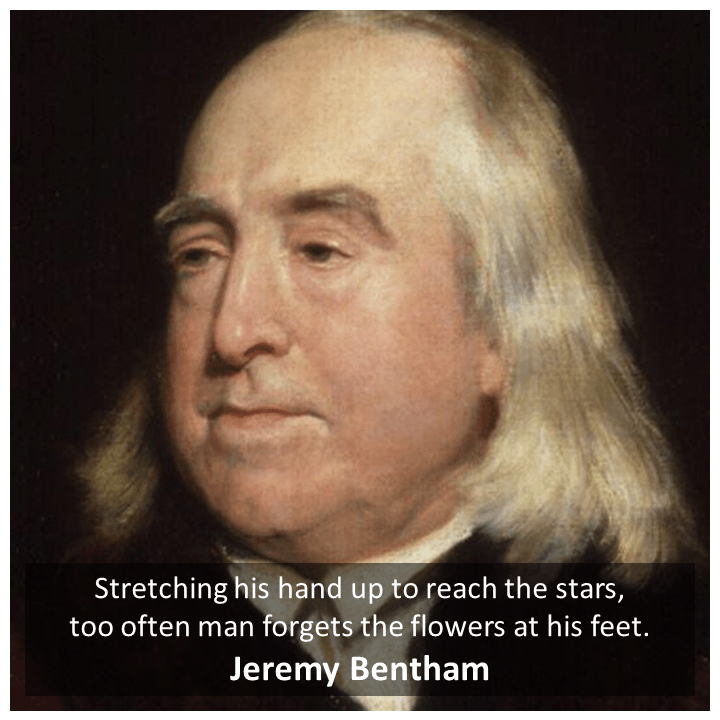
Jeremy Bentham an English philosopher contributed to the utilitarian ideas of morality. He was not well appreciated in his home country due to the misalignment of his ideas of socio-political reforms with the British sovereignty of those times. The French translation of his works on law, governance gave him popularity in Frenchmen. Bentham was one of the people who pushed the political reforms during French revolution.

While reading Joseph Priestly’s Essay on the First Principles of Government, Bentham came across the idea of “greatest happiness for the greatest number” which motivated him to expand the ideas of utilitarianism.

Priestly brought the idea of “Laissez-faire” (‘allow to do’ in French)- a policy of minimum governmental interference in the economic affairs of individuals and society. Joseph Priestly developed his ideas of politics, economics and government based on the ideas created by Adam Smith (Author of the Wealth of Nations – the holy grail of classical Economics).

The Greek philosopher called Epicurus was the supporter, creator of hedonism. Hedonism defines ethics to pleasure or pain. According to hedonism that which gives pleasure is morally good and that which give pain is morally wrong. The idea behind hedonism is the aversion of pain to live an undisturbed life because anyways this all won’t make sense once you are dead. According to Epicurus – fear of death, retribution is pushing people to collect more wealth, more power thereby causing more painful life. The collection of wealth, power is done thinking that they can avert the death but that is not the reality. So, worrying about the death sucks out the pleasure of living the life which itself is equivalent of death.

Non fui, fui, non-sum, non-curo
(“I was not; I was; I am not; I do not care”)

Epicurus

So, epicurean hedonistic morality tries to maximize the pleasure. The other end of this idea is that if everyone tries to maximize their own pleasure (egoistic hedonism) wouldn’t it disturb others?

If I want to listen to a song on loud speaker while bothering my neighbors, what is the moral standpoint here?

The answer is the overall good of the system. So, if you neighbor also wants to listen music loud and overall loud music is good for the group then we are morally right to play loud music. (Just pray that the group has same music interests!)

So, Jeremy Bentham is known to rejuvenate this ancient philosophy of egoistic hedonism through his philosophy of utilitarianism.

The basic idea behind Utilitarianism is to maximize the utility of anything, value of anything. The utility can be increased by doing what is right which can be done by doing what gives more pleasure or by avoiding those things which increase or give pain.

Utility is a property which tends

  1. To produce benefit, advantage, pleasure, good or happiness
  2. To prevent happening of mischief, pain, evil or happiness

So, the right action is the one that produces and/ or maximizes overall happiness. Please understand that the word “overall” is important for Jeremy Bentham’s philosophy of Utilitarianism. Because from selfish point of views, what is pleasurable for one may not be pleasurable for others. (This is also where the certain philosophical problems of Utilitarianism are hiding, save this point for later.)

To solve this bottleneck of clarity, there are two types of pleasure in human life – one is happiness from senses, physical experiences and one is from intellect. The intellectual happiness is higher than the pleasure from senses. So, on personal moral dilemmas these two attributes can solve the problem.

All good on personal level but what about the moral decisions for the group, for society? Here, Bentham solved the moral dilemma by using the idea of “greater good for all”. When we don’t agree on what makes us happy together, making sacrifices in your happiness to make others happy is the solution. (Keep this idea parked in your mind.)

“Nature has placed mankind under the governance of two sovereign masters – pain and pleasure. They govern us in all we do, all we say and all we think.”  

Jeremy Bentham

Felicific Calculus – Measuring happiness

Jeremy Bentham is known as the Issac Newton of the Morality for developing the felicific calculus/ hedonistic calculus. Bentham pointed out the key factors which affect the net happiness and using this factors’ effect as a whole, one can quantify the happiness.

Following are the factors which affect the happiness:

  1. Intensity – how strong is the pleasure from the given action?
  2. Duration – how long does the happiness remain from given action?
  3. Certainty – what is the likelihood of given pleasure to occur?
  4. Propinquity – how soon/ immediate is the occurrence of the pleasure?
  5. Fecundity – what is the possibility that this pleasure will also lead to the newer pleasure(s)?
  6. Purity – what is the change that this pleasure will not bring some opposite sensation?
  7. Extent – how many people are affected?

If one considers these factors and the principle to maximize the communal happiness, most of the social moral dilemmas can be effectively solved.

So, according to this felicific calculus,

  1. Batman should kill the Joker for the greater good of the Gotham
  2. The trolley should go over the group/ person which creates more pain for the society
  3. Baby Hitler should be killed once we get the chance to travel back in time

You must appreciate the clarity which the felicific calculus brings. This clarity is very important for the policymakers, politicians while deciding the fate of the group, state, nation as a whole.

Now a simple question –

If batman keeps on killing the villains, won’t he become the greatest killer of them all? What would differentiate Batman from other villains?

What would happen if you were given false information about the nature of the people tied on track while riding that trolley? Could your wrong decision be undone? If it was the wrong decision then now ‘you’ are morally wrong, with the blood of the innocents.

You would kill baby Hitler only because you have vision that this baby will grow up to be the mass murderer tyrant. The mass murder hasn’t happened yet. So, now you are the killer of a ‘now’ innocent baby.

Maintaining same emotion, now you would appreciate why even for a strong judicial system giving capital punishment for rapists, terrorists is difficult morally. You would solve the problem for now because the act has been already done, the consequences have already happened (which is why moral judgement is effective as it relies on the consequences). Killing the perpetrators or punishing them with equal pain would definitely bring peace of mind using the principles of morality but that also degrades the morality of innocents who fell down from that morality. It is not matter of what one deserves because what bad happened to them, it is about how less human you will become once you perform that act of punishment.

Recall the quote of Beccaria in the early part of my discussion.

Killing joker will create fear among other villains but it also creates chance for the creation of even dangerous villain in future.

Killing baby Hitler doesn’t guarantee prevention of World War and mass murders, as our personalities are the result of our surroundings – another Hitler-like person would have emerged in such given circumstances. (I honestly don’t know if he/she would be worse or less harsh than the original one but you get the point – conditions anyways would have created another cruel person.)

Jumping out of the trolley seems the best way to run away from the pain of murder of other unknown people (joking). The trolley dilemma remains dilemma.

Also, the felicific calculus allows pain for small groups for the betterment/ pleasure of the bigger society. For example, according to this utilitarian idea killing few healthy convicted prisoners to save lives of many innocent people by harvesting the prisoners’ organ is justified. It is for the good in the end.

You see where this goes?

See the level to which any human or a group could go if they start justifying their moral rightness using these ideas. Using these principles any big group can overpower the minorities in morally right way. It is just a matter of time that the felicific calculus principles would get exploited for other “immoral” gains.

That is exactly why many people criticized the felicific calculus saying that a pig laying in the mud for his whole life would be happiest than a human being (Socrates to be specific) if Bentham’s calculus is used to decide morality.

In a crude way, there are two type of Utilitarianism which help to solve the problem to certain extent, but it is not a complete solution:

  1. Act Utilitarianism – to act for the greater good of all
  2. Rule Utilitarianism – to set rules in such way that no one inherently gets the pain or everyone is happy because actions and their consequences are bound by certain set rules in first place now

Happiness is not the ‘only’ and the ultimate goal – the limitations of Jeremy Bentham’s Utilitarian Philosophy

What people were not ‘happy’ with Jeremy Bentham’s felicific calculus was that it made humans more like machines and very objective. People don’t always want happiness for their or the group’s greater good. Exercising daily, reducing fat-sugar maybe painful but that guarantees healthy, illness free long life. Doing drugs isolates the person from pain but it impacts the long-term physical and mental health of the person. Hardships and pain make people to reach their difficult goals which is what is the real and ultimate happiness for them.       

Happiness is not always the goal of life, if one is completely tangled in the pleasures of life and if everyone is having same mentality then in the end no one will be happy, because as a group we all would never agree on what makes us happy; different environments in which we grew, our personal experiences, our upbringing, our motivations prevent us from creating a common definition of happiness.

The subjective factor of pleasure or pain is not present in Bentham’s philosophy of Utilitarianism. Building further upon that, the victim who has suffered from the morally wrong action will only be satisfied when he/she gets justice, not when they are made happier than their perpetrators. (This justice must again not be mechanical and objective like the felicific calculus.)

One more flaw of the Bentham’s utilitarianism is the imbalance between personal scenarios and the communal scenarios. In most cases, it demands personal sacrifice irrespective of their subjective morality for the betterment of the group. (that is exactly how many past cruel dictators have justified their moral correctness on their acts against the minorities.)

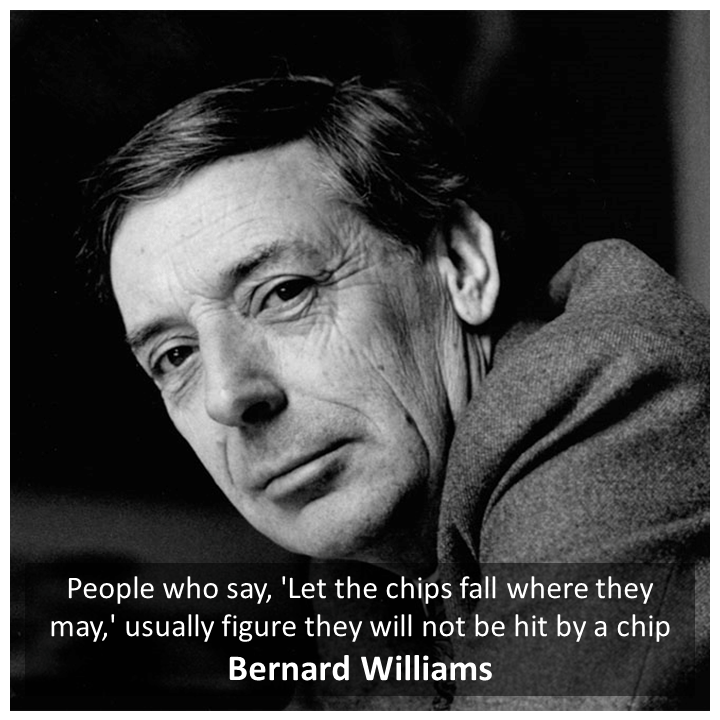
A British philosopher, Bernard Williams presented a thought experiment to highlight such flaw of the Utilitarianism.

In this thought experiment:

A botanist on his South American expedition is ordered by the cruel regime soldiers to kill one of the Indian tribe people. If the botanist fails to kill one Indian the soldiers would execute all of the tribe members.

So, if we implement utilitarian principles, then the botanist should kill one Indian to save the remaining all. That is morally right.

But on the other hand, one must also understand that the botanist has nothing to do with the cruel regime and even with the indigenous tribe members. He is under no moral obligation to do anything. The consequences are in such a way that whatever he will do he will be called morally wrong. Which in the end is wrong.

The utilitarian philosophy neglects this subjectivity and consequentialism while we are deciding morality of anything.

Maybe that is also why even when we have all the rules in place, penal code in place for all types of offenses, similar crimes – we have a judge – a subjective, consequential observer to grant the final justice.

You must understand that the discussion does not want to pose Utilitarianism as completely wrong idea. The intent of this discussion is to understand how to de-clutter a complex moral scenario and how to inject subjectivity in it so that the correct person will get the justice in the end. As we are human beings and not machines, every day brings new subjective scenarios with new subjective moral dilemmas. Direct implementation of utilitarianism may bring in the transparency in the moral puzzle but it is at the expense of oversimplification and loss of personal subjectivity, consequential personal point of view and also freedom of person to exist.

The ways in which Utilitarianism brings immediate clarity by elimination of some important subjective aspects is dangerous and limits the judgement of real morality. Friedrich Nietzsche had warned new philosophers in his book beyond good and evil about the philosophies which create such “immediate certainties” like Utilitarian philosophy creates-

“The belief in “immediate certainties” is a moral naivete which does honor to us philosophers; but – we have now to cease being “merely moral” men!”

Friedrich Nietzsche

Conclusion – If not happiness then what is the goal of being human?

Jeremy Bentham’s philosophy of Utilitarianism and the felicific calculus can help to decide the morality of what is good for all but it ignores the presence and worth of personal integrity, the well being of the minorities, subjectivity of the person in given consequences. It by default eliminates the possibility of humans remaining human beings instead it attributes them as the machine maximizing a targeted outcome (which is pleasure here).

So, the question remains – If we are not meant to maximize pleasure during our tenure in life because in the end after death there will not be anything to experience or gain happiness – if our existence and final purpose does not align with being happy then what exactly is the purpose of being a human being?

Based on my understanding on what many great people have commented about the purpose of life, I found that most of them point to remaining the human being you always were. I am not saying that the personality should remain the same, rather it should change and keep on upgrading itself till the end but the core should remain same or it should not degrade at least.

Some wrong events, injustice, oppression, cruelty will make you suffer, but that should also not vilify your human spirit. Once we let go the pursuit of happiness and chase the goal of being a better human being (or at least remain the human being you are) we can fulfill the purpose of our lives and also make other people’s lives better.

Once you will let go of such utilitarian, mechanistic setups of morality you will realize that people don’t need gods, religions, governments, judicial systems to keep in the check of right and wrong. Our inner compass is more than enough to take care of what makes us human beings, this inner compass is not about what is right and wrong, for me it is about what better version of yourself you would become if you act in that certain way. It takes care of what you are thinking and what would be the consequences of actions thereby resolving the dilemma of morality which got separated on the basis of either intent or the consequences.

I am highlighting the importance of inner personal human compass because the rules designed to keep morality in check would always need revision and the utilitarian philosophy would wait for the consequences to happen to decide the morality. The goal of human struggle to improve their current version to a better one does not need either of the metrics to decide the morality.

Imagine what the world would become if everyone started appreciating this inner human compass!

(For now, we can only imagine, but I am optimistic on this.)        

P.S. –

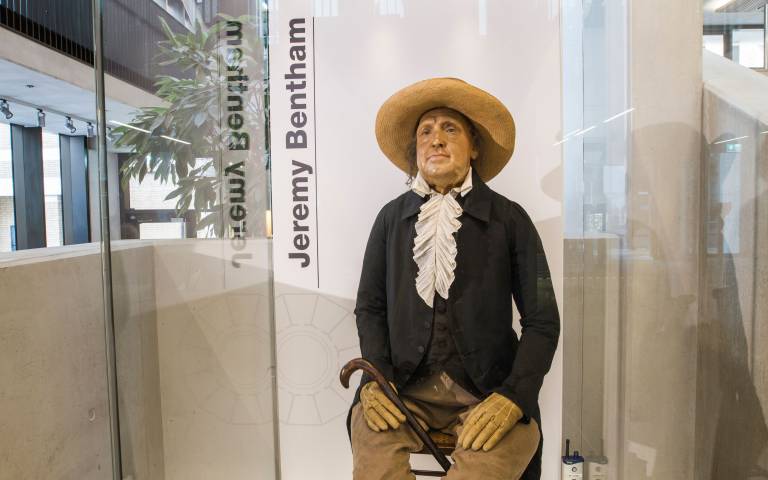
Even though the Utilitarian philosophy had many flaws, Jeremy Bentham contributed largely to bring in new political reforms, improve governance, establish penal codes in judicial systems, define sovereignty, reduce the influence of religious institutions on the lives of people and governments. His works were strategically maligned by some lobbies to lessen the impact of his other notable works. He was the proponent of liberty and freedom from religious influences on lives of people. The pushed for the establishment of a secular educational institute in London – now famously known as University College London. Jeremy Betham’s fully clothed wax statue containing his original skeleton remains in the entrance hall of the University main building upon his request.

The Free Spirit – Beyond Good and Evil

The journey to the freedom demands solitude thereby making man responsible, accountable for the consequences of his every thought and action. Friedrich Nietzsche in his book Beyond Good and Evil paved a way for future philosophers to establish their own new perspectives about the truth where there are no two sides – good-bad, sad-happy, moral-immoral, beautiful-ugly, calm-disturbing but a revised and better version of the older truth. Nietzsche in this book focused on the refinement of our perspectives, our versions of truths for the real freedom because immediately surrendering to already established versions of ideologies is the worst imprisonment any man can have. Nietzsche showed how badly our ignorance creates an illusion of freedom and how to come out of it. This is to remember Friedrich Nietzsche on his death anniversary.

Remembering Friedrich Nietzsche on his death anniversary

Friedrich Nietzsche is one of the most impactful philosophers we as a humanity have ever seen. Reading Nietzsche is a task in itself. But the moment you start getting hold of the things that Nietzsche is trying point to, you will literally undergo transformation. The path that Nietzsche paved inspired many modern philosophers, thinkers, writers. To not mention Nietzsche is to do injustice with our understanding of ourselves as the human beings. This is one attempt to revisit Nietzsche’s ideas in his famous book called “Beyond Good and Evil”, especially his ideas on free Spirit.

Nietzsche in his special style clarified what it means to be really free and how we develop our perceptions, philosophies about the world around us and ourselves.

This is me remembering Nietzsche on his death anniversary. His ideas will keep on living forever.

Oversimplification kills the nuances thereby changing the big picture

Nietzsche strikes powerfully on the idea of understanding the life as simple and easy. It’s a humorous way in which he tried to convey how we consider living life as way to goodness, happiness, pleasure and freedom. The sentences that Nietzsche used to put his ideas about life are built in such a way that you will start questioning the happy nature of the life we desire. You will realize that during the process of understanding life as a pleasurable, happy experience we have submitted our thought process only to the side of pleasure, happiness, and truth. This presumption about life always deviates our search for the truth – “the happiness” that we lookout for as a biased pursuit. Here Nietzsche is not saying that if ‘this’ which you are trying to justify life with is true then it’s opposite is wrong; he is trying to point us towards the idea that as we have attributed life to a happy and pleasurable experience, this attribution has oversimplified what life actually is. Oversimplification has happened because not everyone can understand complex ideas on equal level. It’s not because people are dumb, it is because we have our own ways of interpreting the world around us and the ways through which we interpret the world are totally subjective. Thus, the truth if it exists, it will never be absolute but based on perspectives one has.

“We have contrived to retain our ignorance in order to enjoy an almost inconceivable freedom, thoughtlessness, imprudence, heartiness, and gaiety – in order to enjoy life!”

In order to make everyone appreciate given idea of life on same level we have oversimplified what life is and such oversimplified foundation has led to building even more oversimplified versions of so-called truth. In the pursuit of clarity and ease of interpretation and communication our lives have become false!

That is why Nietzsche here tried to attack the very fundamental way in which we try to break down the things we come across when we live through them. See it in this way, if life by default was supposed to be simple then it is implied that we would have grip on every aspect of life and existence. We know that’s is not the reality. So, if it is not simple then it must be complicated is our next thought. Thus, if life is complicated in reality then oversimplification eliminates certain aspects of life which we keep on missing in the search of truth.

You know what, Nietzsche further explains that when we are denying that life is not simple and happy that also should not invite it being opposite of what was earlier thought i.e., sad and complicated. Nietzsche rejects the idea of polar opposite to portray the lives we live. He calls life, knowledge as the process of “refinement”.

It’s not duality of any aspect of the philosophy, good and bad side of life but the ways and times they have refined themselves which should be the parameter of their worth.

The Death of Philosopher

Nietzsche had his way to express verbal anguish. The sentences are so dense that the prose feels literally repulsive. I think it was intentional. His writings were never meant to be read while sipping coffee or to romanticize the philosophy or the idea of life. They will make sense to those who really want to understand what he is trying to say. Nietzsche in his next idea talks about how every philosopher is trying to find the meaning of life and thereby his/her truth of life. He despises the idea of life or philosophy being explained with a single idea. That is why he sarcastically calls philosophers as the protectors of truth, the thing which itself doesn’t need protection in first place!

Nietzsche thus calls out to the philosopher to get ready accept the martyrdom, the death of their idea of philosophy. The philosopher can only carry his point forward for further refinement but he/she must not – cannot define the life in whole with that simple idea. That idea has to die in the process so that newer refined ideas can be built out of its broken pieces.

In order for philosophy to exist it has to end, it has to kill its older version – that is what is the tragedy of philosophy is as Nietzsche goes.

The Freedom Paradox

When Nietzsche is trying to initiate treatise on freedom, he starts with what it means to be free for any person. One important observation he puts in front is how we get freedom on personal level. On surface it feels if the person is free on personal level, then it is easy to be free in society as a whole. But Nietzsche shows that these ideas of freedom are paradoxical! Man goes inward for the freedom because he/she knows that there is no one else to tie, bound him/her inside his privacy. The man seeking freedom when interacts with the crowd soon realizes that his experiences of life are bound to how crowd handles him, reacts to him, treats him, shapes him. That is unsettling, the burden is difficult to carry for single person hence the man again resorts to privacy, in order to do that he has to let go of certain truths and create his own little lies so that the external crowd won’t disturb his “freedom”.     

(the man) he was not made, he was not predestined for knowledge”

The point Nietzsche is trying to make here is that the taste of freedom comes with the unsettling feeling of existence. But as a man we are not seeking that freedom for us; freedom is some citadel, a happy place where we expect to have control over course of things. The real freedom as Nietzsche explains will be gained by being in touch with crowd (which sounds paradoxical again) It’s like saying you will understand what you real singular identity is when you start mixing yourselves with the crowd!

Nietzsche further advises philosophers of the future to not turn away from the unsettling ideas about philosophy. He takes support of cynicism to make his point. Cynicism bases itself on the idea that people are selfish, self-interested (so in simple words if anything doesn’t go the way a cynic wants, they would whine and create reasons to justify it.) Nietzsche expects the future philosophers to understand the difference between ill-speaker and bad speaker. The lovers of knowledge should also be able to understand what is unsettling, maybe their lies the next opportunity for better version of their philosophy.

The Freedom of Expression

Nietzsche had already explained how things lose their essence in oversimplification. In same fashion it becomes difficult to interpret what a fast thinker is thinking and then explain it to the relatively slow thinkers and make them appreciate the same idea on same level. Even in our thinking we are not free. You can create an explanation for others to understand what you are thinking but they themselves have to climb up (or climb down sometimes) to your level to appreciate what you are thinking, you may succeed in expression but interpretation, comprehension and its appreciation gets limited by the levels on which others are thinking. (My question, if this is the case then even if you are a free thinker, are you truly a free thinker? I know Nietzsche is paradoxical most of the times)

“What is most difficult to render from one language into another is the tempo of its style, which has its basis in the character of the race, or to speak more physiologically, in the average tempo of the assimilation of its nutriment.”

Nietzsche further builds this “so called” freedom of expression using the limitations of the language. Language is the culmination and mirror of the culture it originated from. So, naturally each language has its own style, flow, breaks, rules and ways to highlight certain aspects of narration. When such languages is used to express an individual’s ideas, the speaker has to let go of the nuances of his culture, his primary way of life so that others having another culture, another way of life can appreciate and understand what he is trying to convey, but what if the nuances were the only thing which made that idea influential? Then the influence of the idea would be lost because of the translation. (This is Nietzsche’s way saying lost in translation!)

The Tragedy of Independence

Another way to become free is to become independent. The very few lines Nietzsche uses to explain independence are equivalent of an atomic bomb! (trust me it is still not an overstatement!!!)

People who become independent are few as Nietzsche says and those who are strong can easily achieve it. This independence is also one way to be free. When a man becomes independent, he is on his own, there is no one like him – he is alone. Nothing is anything alike him – he is alone. Thus the whole world becomes a puzzle for him as he is on his own. Any direction becomes new path for him. As he is the only one like himself, there is no one who would reach to his level and match his thinking. And in such case if he needs sympathy, people cannot even sympathize with him because they are not on his level. What a tragedy! The sadness he has in his heart, mind is rendered useless because others around him are not able to comprehend it – sympathizing gets ruled out automatically.

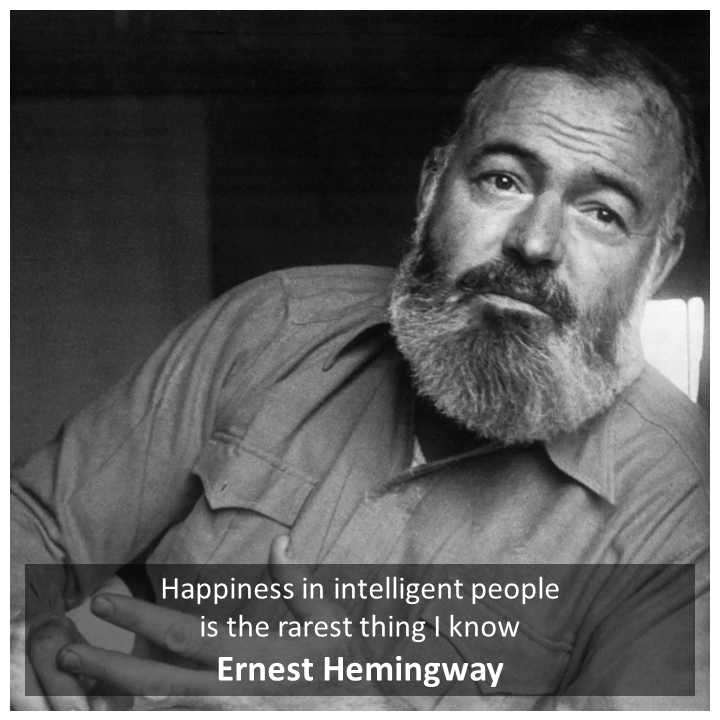
This is Nietzsche’s way of saying what Hemingway said. (I mean both meant the same although Hemingway came later, but you get the point) You must understand that happiness is not the real pursuit of life, then you won’t feel tragic about what Hemingway is trying to convey here, same is what Nietzsche trying to convey here. Freedom by independence can be a tragedy for the person who was expecting glory out of it.

Foolishness Hides Chances For New Insights

Nietzsche here is trying to remove the lines between what is good and what is bad, what is allowed and what is forbidden.

“That which serves the higher class of men for nourishment or refreshment, must be almost poison to an entirely different and lower order of human beings”

In modern crude sense, Nietzsche says “one man’s trash is another man’s treasure”!

Same idea, same act will have different perception of morality, scale of right and wrong. A rebel thinker in common poor public could be attributed to a philosopher amongst the riches. A murderer who killed an evil landlord could become a saint among the people who were victims of this landlord’s oppression.

So, Nietzsche’s attribution of foolishness is a way to point out the exceptional, outlier acts, prohibited acts, crimes to find the better truths. That will make you freer than others.

The Freedom of Youth   

 The stage of youth feels like the freest stage of all the stages of life and it is so because it has let go of the nuances. It also feels free because the youth in the stage of exploration never submits to right or wrong, yes or no to the life as Nietzsche says. But as the time passes when the youth is exposed to disillusions, broken expectations they try to modify themselves in a way that will get things done the way they wanted – the compromise starts to enter. The moment this happens the same youth tries to punish themselves as Nietzsche says. The freedom exists no more, so is the youth.

The Freedom of Actions

(Again, this a hydrogen bomb on morality!!!)

How can we say that the given action is right or wrong?

Nietzsche has very interesting thought process on this question. In the starting times the action was right or wrong based on what it led to – its consequences – the effect. The problem with this thinking is that one has to wait to let the action happen to decide its rightness or wrongness. If the stakes are high, such attribution of right or wrong can be devastating.

So, Nietzsche takes support of Chinese idea where the parents are responsible for the betterment of their child. Meaning that the origin of the thought which led to that action should be the decider of whether the action is right or wrong. Nietzsche called this pre-moral period of mankind. And sarcastically he points out that we have made a total turn around the idea of right or wrong action. Earlier it was what happened after the action i.e., consequences; now it is what led to that action, meaning what was happening before that action i.e., the origin which is the decider of right and wrong of any action!

This is where the origin of action gets named as ‘moral’ which is generated from self- knowledge. Later these morals evolved into “intentions”. As Nietzsche says, intentions serve as the origin of any action.

“people were agreed in the belief that the value of an action lay in the value of its intention. The intention as the sole origin and antecedent history of an action: under the influence of this prejudice moral praise and blame have been bestowed, and men have judged and even philosophized almost up to the present day”

Nietzsche then drops another bomb called – unintentional actions. We are clear that whether action is right or wrong can be decided by the intent. But what if there was no intent or there are no other ways to pinpoint the intent behind certain actions? There is a possibility that the intent may get mistranslated, misinterpreted during the unfolding of events, then how would you decide the attribution of given action.

In such case we would again go to the effect- the consequences of that action!!! You see what is happening here? We might have to resort to that older measuring system of action based on their consequences.

This is Nietzsche’s style to question how we think of morality in general and also on deeper level.

(I can’t resist praising Nietzsche lesser but deep down I know he would question his own worship too!)

The next attack Nietzsche does by using morality is the sentiment of sacrifice. The basis of his thought process is that you should question everything that gives you pleasure at least once. Here, he shows how fake the feeling of sacrifice for others, surrender could be if it is intended to display how moral and virtuous you are!

“There is far too much witchery and sugar in the sentiments “for others” and “not for myself””

In simple words, you are saying that I like to help others because it makes me happy. So, in order to help others you have to become selfless, but if becoming selfless to help others makes you happy, doesn’t that make you selfish? You are selfless because you are selfish!!! (Disclaimer: Nietzsche is paradoxical.) The paradox is resolved when you accept that you are just taking support of morality to display you higher value. Being selfless is just a better excuse to display your high morality. It there was any cruel way to display your high morality no wonder you would have gone for that!!!

In modern ways, it’s fox’s way to say the grapes are sour or I am a virgin because I am waiting for someone special (In reality fox cannot reach the grapes and the person is not able to appreciate other person or people rejected that person continuously – please note that I am not blaming someone’s character – it’s the limitation of language that prevents me from expressing what I am thinking for oversimplification. As Nietzsche has already shown that oversimplification kills the nuances. You get the point!)

The Immoral Philosopher – The Free Philosopher

Building upon the ideas of nuances lost in translation, right and wrong in morality Nietzsche calls the future philosophers to go beyond the dichotomy of philosophy and also distrust the morality in the development of new philosophy, new truth.

“In all seriousness the innocence of thinkers has something touching and respect-inspiring in it, which even nowadays permits them to wait upon the consciousness with the request that it will give them honest answers”

This is Nietzsche’s way to show that in order to find the new truth new philosophy, new philosophers have submitted themselves childishly and blindly to the principles of morality hoping that morality will give them new answers. But it is the same tinted glass of morality that prevents them from getting new perspectives. Hence, he calls them naïve here. They must let go of this childishness.

“The belief in “immediate certainties” is a moral naivete which does honor to us philosophers; but – we have now to cease being “merely moral” men!”

This is Nietzsche’s way of saying it’s good to be bad!

For Nietzsche, morality shows only two sides of reality- right or wrong, this works fine if reality is really dichotomized. But we know there is no such thing as right or wrong for every real-life scenario. So, in order to find the real truth, you have to let go of morality, then you will see that reality has its spectrum and people residing on different biases of such reality have their own attribution of right and wrong for the same action. Morality is the subset of newer truth, not the other way around.

‘il ne cherche le vrai que pour faire le bien

(he who searches truth to do good) – I wager he finds nothing!

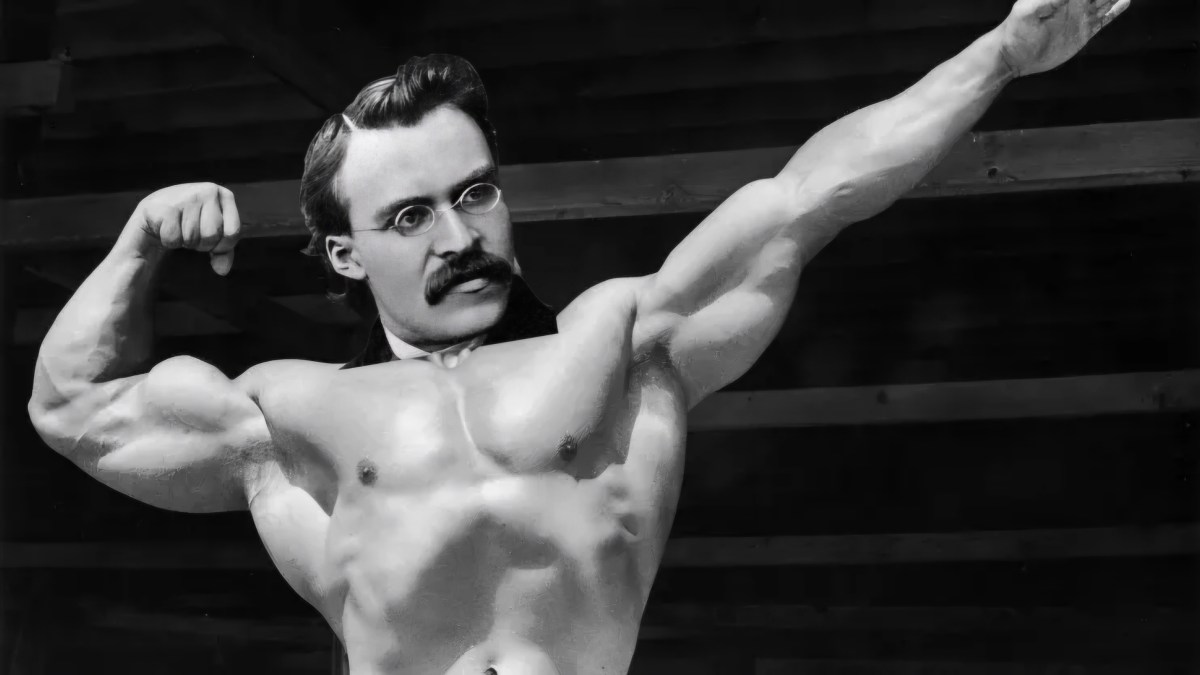
 Nietzsche make his point by him being the first bad-philosopher!!! (This is why I am loving him more and more. It’s like a brainiac with full grown muscles if you want to picture him thematically!)

The Freedom From Passions and Reality – Will to Power

Nietzsche makes an attempt to show that the reality could also be made up of something totally different that we can even comprehend. What if the world is more real than what we can experience? And if such reality exists, our senses will limit us from experiencing it. So, in order to be free in such reality we have to rise above our senses. That would be the new freedom. Our senses are bound to desires and passions whose interactions – impulses are creating thoughts.  

So, building on these impulses Nietzsche says that many emotions, processes are created in “our reality”. What would make any of such impulses, process free from others? He introduces the idea of causality to show the flow and root of everything. If cause leads to an effect and further that effect becomes cause to newer effect then it is possible that the root cause of all would make us really free. Nietzsche further explains that it can also be one of the processes which would overpower others to become free and not the root one. (For example, the first unicellular organisms would be the most powerful organisms on earth today, that is not the case.)

Here Nietzsche introduces the concept of Will to Power. Whatever overpowers the other processes has the potential to remain in the big game and thus has real chance to be free. Will to power in any process allows it to gain more freedom.

This is Nietzsche’s Darwinian theory of evolution – the survival of the fittest. (I know it is a bastardized translation, but again I summon the loss of nuances during translation.)   

Then Nietzsche puts the idea that by this way of thinking the originator does not necessarily be the most powerful one, thereby questioning the existence of the God! Because if the God was the originator, then then he/she would exist only if he/she has the highest Will to Power. That also does not mean that if God does not exist then devil exists or has the highest Will to Power. It could be anything! We are not sure for now. (typical philosophical answer!)

Using causality, Nietzsche also questions the morality of French revolution. If for the locals the royalty was cruel that is why the revolution happened then why didn’t the remotely located people who considered them noble in first place considered them cruel too? In the eyes of remotely located people the French royalty had a noble past. (The question is intended to think on it not to find the right and wrong. It shows how flawed our thinking becomes when we stick to morality blindly.) Whoever came in power overthrew the less powerful. That is one way to explain Nietzsche’s Will to Power. According to Nietzsche, if Napoleon would have been continuously invested in the morality of his actions he wouldn’t have become the great emperor.

Freedom From Truth

Here Nietzsche starts with the very obvious and common fact that some truths are unsettling. Not every truth ensures happiness. Only an idealist, as Nietzsche says would submit the idea of truth that brings joy, happiness, and beauty.

Here comes Nietzsche’s biggest drop-

“the strength of a mind might be measured by the amount of “truth” it could endure – or to speak more plainly, by the extent to which it required truth attenuated, veiled, sweetened, damped, and falsified”

This is self-explanatory. It is just our unsettlement that we need to take care of while looking for the truth. We are thinking animals and thinking is a result of our impulses, desires, and passions. So, not every truth is destined to bring us peace. ‘We would die if we eat poison’ – is a truth which unsettles everyone but that is not how we react to such truths, we prepare for such bad events, that is the wisdom what Nietzsche is talking about in a crude way here.

“There is no doubt that for the discovery of certain portions of truth the wicked and unfortunate are more favorably situated and have greater likelihood of success; not to speak wicked of who are happy- a species about whom moralist are silent. Perhaps severity and craft are more favorable conditions for the development of strong, independent spirits and philosophers than gentle, refined, yielding good-nature, and habit of taking things easily, which are prized, and rightly prized in a learned man.”

Nietzsche prefers learned man more than the moralistic or the virtuous one. A learned man knows the consequences of learning new truth, or sometimes even unaware of it but he does not pivot his happiness on the discovery of new truth. What else could you make freer when you are ready to accept the truth in its crude and real form! This freedom will bring clarity, new perspective and not happiness or sadness or chaos or calmness.

Truth will not decide how and what you are. You just will have added new tinted glass in your collection of perspectives towards life and reality and the philosophy behind all of them.  If your Will to Power is good your truth may become the truth for all others.

Freedom From Identity

The profoundness demands the rejection of submission to any side of existence. If one promotes certain ideology the people around him/ her will try to comprehend that person using the tags they have in their own minds for that idea. The mask thus brings in that ambiguity where people are not associating, tagging you to one definite truth. Even your mind can start creating bias if you let it. That is why Nietzsche focuses on mask in profoundness.

“A man who has depths in his shame meets his destiny and his delicate decisions upon paths which few ever reach, and with regard to the existence of which his nearest and most intimate friends may be ignorant; his mortal danger conceals itself from their eyes, and equally so his regained security.”

The mask frees you from attribution thereby biases and even the socio-economical influences. You will never let honor or shame, right or wrong, good or bad, happy or sad justify the events in your life. You will never ever flinch to enter an unsettling adventure which guarantees your growth personally. Embarrassment, failure will just be another emotional response for you (please note that this does not mean that you will be emotionless, it means that you will be able to recognize your emotions and let them pass.)

This is exactly why I would force everyone to understand Nietzsche on their own level!!!    

“Every profound spirit needs a mask; nay, more, around every profound spirit there continually grows a mask, owing to the constantly false, that is to say, superficial interpretation of every word he utters, every step he takes, every sign of life he manifests”

This could also be one reason why some the greatest personality humanity has ever seen had a layer of controversial ambiguity around them.

From the idea of mask, Nietzsche moves to the idea of its conservation. The conservation is meant to define the philosophy of containing who you are rather that you submitting to some ideology. Whatever you have collected as an individual, whatever you are on philosophical level personally, how you have upgraded – refined your philosophy you must conserve that instead of giving to some ideology. The mask helps to conserve who you are.

“One must know how to conserve oneself – the best test of independence”

(this could be the reason why superheroes wear masks!!!  Joke aside but it is one powerful thought)   

Further Nietzsche warns new future philosophers to not be people pleaser or submitter to temptations. That will steal them of their judgement and independence.

Freedom From Your Version of Truth

The ways in which Nietzsche is trying to close his arguments are really beautiful. He knows that when the future philosophers will have discovered their new truths in their journey of blood, sweat and tears, it is natural that they will get attached to it. Such is the human tendency. He wants us to get rid of the obsession with this new truth. This truth even if it’s the newer one will create boundaries in your perception, you won’t be free anymore! Nietzsche wants to let the future philosophers let go of the dogma.

“In the end things must be as they are and have always been – the great things remain for the great, the abysses for the profound, the delicacies and thrills for the refined, and, to sum up shortly, everything rare for the rare”

Freedom From Illusion of Freedom

On closing notes Nietzsche has advised new philosophers to be careful of the “freedom” they are being offered under new socio-political ideas. Nietzsche focuses here on the ways new philosophers are embarking on the journey to new truths. He tells that having fluency in speech and effective grip on written communication will not define you as the new philosophers, even though they are one aspect of it. But the systems having higher Will to Power will use same tools to control new philosophers and change the course to their versions of truth.

New philosophers will be misled with words like “Equality of Rights”, “Sympathy with All Sufferers”, “Modern Ideas” but they should be careful about them. They should be aware that the moment they create a thought process the people on different levels with different Will to Power will interpret these same ideas for their own benefit especially the ideas which are polar opposites of your ideas. Once such separation happens nobody, not even you cannot get the real freedom.  

Nietzsche offers the rule of solitude while embarking on such journey. Only you can free yourself.