People have tried to justify their existence with happiness, fulfillment, satisfaction, service, love, hope, devotion and what not. But those who have existed in full spirit, lived it to the fullest have realized the effect of sufferings on our lives and even after overcoming them are ready to endure them again in the hope that they will become better than what they were before. These are the people who might have solved the query to justify the life. Overcoming the sufferings in life and continuing the journey ahead could be the answer.
On Charles Dickens’s short story – A Child’s Dream of A Star
The Impact of Suffering in the Pursuit of Happiness
Question- what would you choose of the following?
A short life filled with happiness and satisfaction? or A long life filled with pain and suffering?
I will assume that you have selected one.
Charles Dickens’s short story – A Child’s Dream of A Star
I came across a short story “A Child’s Dream of A Star” by Charles Dickens which shows what it means to pass through the suffering of the lost loved ones.
This is a story of a boy who loses many loved ones throughout his whole life. Whenever he is losing someone, he dreams of a star where he sees the souls of his loved ones meeting and coming together. First, he loses his little sister in childhood, then his baby brother. When he grows young, he loses his mother, while being adult he loses his own daughter. Every time, when the boy loses his people, he dreams of the same star and wishes that he too could join them. But, when grown adult and losing his daughter he is somewhat soothed that his daughter is not alone, she has the angels of his sister, mother and brother to accompany her.
When he realizes the arrival of his last moment, he accepts the death for the joy that he will join the souls of his loved ones now.
The Suffering of Watching People Leave
Charles Dickens in a very impactful way shows what it means to live life. On surface analysis, one can say that this short story of a boy dreaming about the people he lost and asking for his own death in the hope to join them is about the pain of losing the loved ones and dissatisfaction of not getting enough time to spend time with them and love them. Deep down it is about how one endures pain and I think the only way to endure such pain is to pass through it. Any attempt to alleviate or even control it, leads to more pain.
Enduring the Suffering
The great thing about this story is that it delicately captures what a beauty that life we live in is and how we connect same attributes of life to the afterlife (even when we are unsure whether it truly exists, even when it exists in our minds and dreams) also how fragile our existence is.
Charles Dickens used the innocence of the child’s mind to show how we carry that innocence throughout our life to use every chance to stay closer to the people we love. The opening of the story also talks about the sorrow that is felt by everyone when someone dies.
“They used to say to one another, sometimes, supposing all the children upon the earth were to die, would the flowers and the water and the sky be sorry? They believed they would be sorry. For, said they, the buds are the children of the flowers, and the little playful streams that gambol down the hillsides are the children of the water; and the smallest bright specks playing at hide-and-seek in the sky all night must surely be the children of the stars and they would all be grieved to see their playmates, the children of men no more.”
It shows that even for children the suffering had a bigger meaning not even when they had faced any such suffering from loss in their tender age. It shows how by default we are hardwired for the sensitivity towards suffering. Maybe we are more sensitive to suffering than love.
Then we see that the boy is exposed to multiple losses and you will see over the time his dreams are evolving gradually. In early childhood loss of his sister, he is totally devastated that he could not join his sister, then he is again agitated with the thought that his younger brother has to join her in the starry heaven. Then when he is young, he is somewhat settled that his mother could join his sister and the brother.
Now when being adult and losing the beloved daughter, the same boy has made peace with her death in the thought that she has enough people to take care of her and maybe love her more. Now he has made amends with the death.
“My daughter’s head is on my sister’s bosom, and her arm is round my mother’s neck, and at her feet is the baby of old time, and I can bear the parting from her, God be praised!”
You must understand how the boy from childhood till his old-age sees the death in different ways. At first, he has intense sorrow for his sister but over the time he sees that even after death the people he loves have each other’s company.
He cannot do anything to join them in the afterlife and death is the only way to join them. Please note that there is not even single mention or any indirect indication that boy wishes to end his existence just to meet his loved ones in afterlife.
So, it’s a story of how a person builds himself towards the suffering. You will see that the boy never gets numbed because of the series of losses, he is hopeful that at least someone is there in afterlife for them to love each other. Death along with love is the only constant in this story.
We are well aware of the love from the very beginning of our existence but it takes time to appreciate that just like love, death too is eternal. It’s just that our minds find it difficult to bring together the idea of eternal nature of love and never-ending series of death in single thought. Maybe that is why not everything exists at exactly the same time and ends at exactly the same time, otherwise there would be no one to witness and appreciate what one existed in and carry that forward.
The Eternal Curiosity, Innocence and Love
I am adding the concept of eternity, endlessness in this story of involving series of deaths, ends and sadness with it, because that is how the life is. The symbolism of star used in this short story by Charles Dickens also points to that idea.
You should notice that in the opening it is about how everything that is there in existence will feel sad for loss of the children of men. The boy feels that sorrow in his childhood; later on, we realise that he holds these unfulfilled emotions, feelings of not getting enough time to spend with the people he has lost. These emotions are continuously getting reflected in his dreams. In the end, we see that he is dying happily while feeling that he can love them again in the afterlife.
But you should now notice that the dream is limited to the boy only. What is real is the star in this story; the star shining on little sister’s grave and was still shining on her brother’s grave who died at old-age.
Just like the children’s curiosity about whether the nature grieved for the losses in the beginning of the story, we can say that the star (being the child of nature) would also grieve for the people he saw dying. But that is not where the story is going. The boy had learned to handle the grief over time and that is why is mature emotionally with the death of his daughter and even his own death. This became possible because his love for his sister increased multiple folds, got intense over the time.
The maturity that comes to such sorrow is worth noticing, the boy now an old-age man is not sad because he will be leaving his children behind. He is neither happy that he will join his loved ones in the afterlife (although what he says while dying means that he is eager to join afterlife).
The star was a construct of his mind to move over the grief and be assured that no one – not even him will never be left unloved. He had a strong belief that at least love is eternal in some or other forms. The star still shining upon his grave in the last sentence of the story is thus the symbol of the child’s innocence and love.
The last words of the boy/ man are these:
“…My age is falling from me like a garment, and I move towards the star as a child. And O my Father, now I thank thee that it has so often opened to receive those dear ones who await me!”
We all can appreciate that the afterlife’s notion is only in the boy/ man’s dreams but that does not invalidate his feelings. He is grateful that he had someone to love (although he couldn’t love them to the fullest while living). The childhood innocence and curiosity he carried throughout his life helped him to endure the suffering. Curiosity because of the urge to understand what would happen to the people who die gets materialized in the dreams of the boy and thus he builds his understanding around it. This curiosity emerged because he cared for them so strongly that he was concerned about what would happen to people after they die. Innocence because from childhood till old-age he deeply believes that just like the children of nature, everyone and not only him cared for people, loved them in some or other ways.
Conclusion
Most of the existential queries on human life point to one single question of meaning or purpose or at least worth of the life. Once started, if it is destined to end then why is this everything existing? And this question is not just about life. It is about everything attached to the life itself. If everything in existence is attached to something and everything at any time will be lost forever, disconnected forever then why does everything exist in first place? Once you appreciate this question, you will see that existence is majorly a series of detachments, losses – literally and figuratively. It is just that some things detach faster than others, some things stay for longer time but are lost in the end; we are just existing in these gaps of losses and detachments. Maybe how we felt about those things especially the innocent emotions we had for everything that is there (which are neither good/ bad, pure/ impure) are eternal. If not eternal, I would say that they evolve in better ways, get refined, gain maturity and get transferred to our next generations through our legacy. Maybe they too would have an ending but what can we say about the human spirit! The spirit to exist in spite of the sufferings! The ability to exist in full spirit and endure multiple sufferings over the time while maintaining that innocent child alive inside you is what justifies our existence in the end. And even that is to end in the end, I have no complaints.
So, when I asked to select one of options at the start, if you felt that selecting only one of these is foolish (or difficult/ meaningless) then welcome to the club!
People have tried to justify their existence with happiness, fulfillment, satisfaction, service, love, hope, devotion and what not. But those who have existed in full spirit, lived it to the fullest have realized the effect of sufferings on our lives and even after overcoming them are ready to endure them again in the hope that they will become better than what they were before. These are the people who might have solved the query to justify the life. Overcoming the sufferings in life and continuing the journey ahead could be the answer.
The acceptance of our dark side is the only way to start a new journey to the real happiness, fulfillment. Achieving real fulfillment becomes way easier and manageable once we start acknowledging our dark emotions, feelings of sadness and sorrow. Running away from such “low” lying emotions actually intensifies them in the abyss. Actually, such emotions have great contribution in the refinement of our character. Empire of the Sun’s new song called ‘Happy Like You’ talks about the acceptance of our dark side to make our personality whole for creating a newer and better version of ourselves.
Empire of the Sun’s song “Happy Like You”
The best piece of art can be attributed to the multiple perceptions, interpretations it creates in the mind of its subjects despite keeping its physical structure constant.
The beauty of a masterpiece is that people have their own opinion about that piece and nobody is wrong. The mere subjectivity and the possibility to invoke personal feeling in the mind of the observer or the enjoy-er of the art is the power every one of us has naturally. Most of the time very few of us unlock that power in a better sense. Music is one such power.
Recently, I came across newly released album named “Ask that God” by an Australian electronic duo called Empire of the Sun. All the songs on this album are banger and are complete redefinition of what the Empire of the Sun stands for. In my personal opinion, it is a crime to compare all the songs to choose the best one, (but you already know why I am writing this). One song that is looping in my head continuously and has occupied a larger portion of my brain for many days is “Happy like you” (this only shows that the song has conjured me thereby maintaining my previous point of not comparing good songs with each other).
Luke Steele and Nicholas Littlemore of Empire of the Sun
Actually, bringing the poetry into the bastardized territory of prose should be a crime, for it de-beautifies the very reason for it being so wonderful. But, in order for everyone to appreciate the multiple subjective point of views and its connections with the multiple facets of life it is trying to explain, a poetry must undergo its ‘deconstruction’ into prose.
That is the crime I am committing here. If there is any songwriting, poetry, lyrics meaning police anywhere, tell them that I am here waiting for them to tolerate all this prose I have written hereon.
Jokes aside, I am deep diving into the song and its music video.
The song
The song is written by Luke Steele and Nick Littlemore of Empire of the Sun.
You’re revolutionary
You’re like a phantom taking a leap
You’re heart is legendary
Bet you are feeling so high
You have a higher power
Telepathic talk to me
Make me whole again
Whole again whole like I used to be

Happy like you
Happy
The poet is asking the higher power for something that would make him feel complete like he was before. He is praising the power of this higher power so that it can bless him.
The words used by poet like revolutionary, taking leap, legendary heart are used to describe this higher power reflects what he exactly wants from the higher power. He wants to regain a lost part of his personality he was before going through this hardship. He wants the higher power to take the leap to come out of the sorrow, transcend the current state and bring about an “internal” revolution in a way.
Telepathic ability indicates the poet’s trust in the higher power. Poet knows that this higher power is his final resort to all that exists. That is why this power knows everything already and there is nothing required to be expressed formally to get things done.
Ultimately, it is a request to regain that precious part of the poet’s personality, that happiness which defined his whole personality.
Won’t you humanize me
Use all your wisdom
Show me joy in everything
I’ve been clouded by machines
Lost my way deep inside another screen
The rhetorical question posed by the poet is a slight indication of what he lost during his difficult times. He lost the things which made him human. He lost the ability to see the silver linings.
This is the exact spot we must understand that the person lost his personality in depression and mental battles. But why? and how?
Immediate forthcoming lines show what happened. The screens and “machines” indicate the influences of the mechanical world on our daily lives and the added powerful effect of social media which led to a dreadful state of depression.
It’s an irony that when we are ‘liking’ certain things on social media from other people’s lives, a deep-rooted sadness, envy, hatred is getting born out of the one-to-one comparison of lives. Everyone is conscious of these emotions due to social media but the penetration of social media, screens everywhere is so regular and normal that we are subconsciously (now mechanically) ignoring these emotions which take a toll on our minds when we are shocked with something really sorrowful.
All I wanna be is happy happy happy like you
All I wanna be is happy happy happy like you
Once you pass through such horrible emotions of sadness and depression you start appreciating the person you were, how happiness made you the better version of yourself. This happiness made you feel like the greater, higher power itself. That happiness actually made you feel closer to the higher power. The poet urges the higher power to make him who he was before and just in the ways the higher power carries itself.
You’re revolutionary
Telepathic talk to me
You are imaginary
Bet you are feeling so high

Wish is a dream that comes true
The most difficult part of coming out of the depression is that it starts in mind of a person with such an intangible, non-physical thought/ idea and then it starts to affect the real events, objects, people around him/ her. So, even though fixing the reality around such person can help to come out of the depression; uprooting the deeply settled feelings of sadness, grief, sorrow has immense impact in the person’s fight against depression.
That is exactly why the wish to become happy shows that the poet whole-heartedly wants feel happy. The ‘wish’ indicates is readiness from inside to be realize happiness from intangibility to reality thereby highlighting the use of the expression “dreams that come true” here.
Time is a song that forms you
Oh I hope you
The expression of ‘time’ which formed this higher power implies the time which need to given to person to heal when he/ she is in hardships. Give it some time, it will pass too. The poet has understood that over the time even though it will seem difficult but over the time every sadness will fade away. It’s just an ask from poet to the higher power to get the patience, courage for passing through this hard time.
Won’t you humanize me
Use all your wisdom
Show me joy in everything
I’ve been clouded by machines
Lost my way deep inside another screen

All I wanna be is happy happy happy like you
All I wanna be is happy happy happy like you
Ultimately the influence of social media on our lives and the mere algorithmic, mechanical nature of our lifestyle is leading lives of many really happy people to a depressed, sorrowful life. The poet asks the higher power to make such people complete again and happy again just like the supreme power is. It also means that once we become happy and complete, we will become that supreme higher power again.
From a simple explanatory point of view on any poetry/ songwriting, the song gives an impression of the man’s urge to regain his happiness, his identity when he is in the conundrum of depressive emotions and thoughts. The impact of depression is great because the factors causing it are within our hands (or I may say fingers’) reach – the social media and the screens.
I think the songwriters have taken this excuse of the depression from social media to show what an urge to overcome any depression means for any human being; what it means to redefine the personality and also complete the human being in a bigger picture.
The video and its symbolism
The phone call –
The video starts with a phone call. The girl receives a call on her landline and then the frame shifts to a guy (Luke Steele – Emperor Steele) in a dark with a red hue and dark hat. This is indication of her having a call with her inner self. The low-lit room shown throughout the video is the metaphor of she having discussion with herself and her inner thoughts and emotions. The phone call is proof of she handling her emotions by herself, it is her own conscience calling her.
Frame from Empire of the Sun’s Happy Like You MV
A low-lit room –
Watching reflection in mirror and hand movements on her own body shows she is interacting with herself. It is like a self-talk one has with themselves while figuring out what needs to be done. The low-lit room shows that dark part of our personality which also need acknowledgement. Even though the song calls for the person to be happy, this low-lit room has bigger significance. It is an indication that the real happiness comes with our acknowledgement of our darker side. Darker not in the sense of negativity but more in the sense of left out emotions which also need proper attention.
Frame from Empire of the Sun’s Happy Like You MV
The colors –
Even though the music video looks colorful with some dark theme, the choice of colors used in this video are specific; there are characters, colors to the people shown in the video. Hot, cold, and warm / Red, blue, yellow, greens sometimes – indicate respective emotions and the interaction of the girl with those emotions. It is like she is trying to understand them and accept their presence to find the answers.
Frame from Empire of the Sun’s Happy Like You MV
The window –
In the early part of the song, you will see the girl peeking through the blinds to see what’s behind the glass. It’s literally her peeking into her dark side of the mind.
There is a glass window with blinds between a person and the girl. The person can see her doing all her activities. What girl sees is only her reflection, this absolutely support the symbolism of her having an internal conversation about the overall depressive state of her mind.
Frame from Empire of the Sun’s Happy Like You MV
The sadness, grief –
You will see one person (Nick Littlemore – Lord Littlemore) with the black tears seemingly away from the window in certain snippets of the video, who appears and goes withing few moments. This is that deep rooted feeling of sadness which the girl is trying to acknowledge. One person closer to the glass window observing the girl’s activity is her conscience and the grief is away from the glass lying in the deep abyss of her mind. I say the guy closer to the window is her conscience because it has symbolically shown with multiple colors and hues showing the variety of emotions one carries in themselves.
Frame from Empire of the Sun’s Happy Like You MV
The rain in the end symbolizes new beginning, renewal.
Frame from Empire of the Sun’s Happy Like You MV
The creators of Music video deserve special applause
A deep dive into this ‘prayer’
For me this is not a simple song, it’s a prayer and I have a very strong reason to justify my point. A prayer from a literal, grammatical point of view is a request to higher powers which have better control of the reality than us. We surrender to such higher powers to show that we are humbled and are in a need for help through such prayers.
This song may not have that feel of “conventional” prayers, hymns due to its electronic and not so ‘religious-feeling’ notes, melodies but there is no written rule on the ways to compose a prayer anyways.
On first thought it’s weird, how can a prayer in electronic music make sense spiritually?
I say why not! I would say the composition itself dares the modern listener to appreciate the feeling of awareness of our higher self – hidden inside our own selves. It is like tapping into that unconventional, unexplored hidden, darker part of our own conscience.
The song mainly focuses on visiting and acknowledging the darker parts of our mind, especially when we are in deep sorrow. Abandoning such dark emotions thinking that they are not part of your personality actually intensifies them and when you are feeling weak and defeated – these emotions will easily cover your whole personality.
My point to call this song a pious prayer is that it makes the listener, the singer acknowledge their emotions. Good or bad whatever they are, they together make the personality whole. It also makes them to accept their urge to improve themselves in life. Even though we are asking the higher powers to grant us the powers to become our better version it is actually we – ourselves acknowledging our darker side to improve and build upon them for the better and evolved version of our selves.
The most important act to come out of any negative, depressed feeling is the acceptance of the fact that they are an inseparable part of our personality and only this time they have charge over our personality and we can take control from them anytime we want. You can only cure a person who really want to be cured and live ahead. The feeling to come out of such sorrows has to come from inside and it becomes easy once we accept our darker side of emotions, feelings.
So, the best way to handle any challenging emotional state, any darker emotional state is to first acknowledge them. Acceptance of something wrong or abnormal is the first step to effectively work on handling them. It becomes very difficult to accept that we ourselves are the originator of our emotional responses and its totally normal. We just feel that it is difficult to control our emotions because mostly they are triggered by the external stimuli and that is where the real trick happens. You see, the illusion that our emotions are uncontrollable is created by the assumptions that one need to control his/her surroundings to achieve what they want to become happy. That is why when such person fails, they are immediately drowned into the feelings of sadness. This also does not mean that you should always control your emotions and avoid expressing yourselves.
What I am trying to make point about is that the moment we start segregating our emotions as good and bad we end up in an illusion of happiness instead of the real happiness. Instead of avoiding and dumping, controlling your sad, dark emotions deep down, their acceptance as one more normal part of our personality helps us in a better way to achieve the real happiness.
Being sad justifies the moments of happiness and that also does not mean that you must remain sad – suffer more to be happy in bigger ways. You see, all happinesses in the world are same. Actually, they are not even same, they are subjective – to be precise, there is nothing to compare between any type of happiness. But due to the social media and the screens, we are always trying to compare our happiness with other people’s happiness. That is where the origin of the problem lies.
Looking on the other side of the shore same goes with the sadness; no two sadness must be compared. Acknowledgement itself is more than enough.
Working on sadness is like hugging an annoying crying kid; just a tight hug without any intent. The kid will stop crying.
Once we have accepted all our emotions as a natural part of our personality then only can we have the chance to recreate our personality. This requires humbleness and in most cases when people are thrashed with the reality and the sadness, when they are helpless the final resort is the spirituality where the help from almighty is requested. The moment you attribute this power to any object especially human-like object the religion starts taking shape (that would be topic or another discussion!) But without diverting the topic, only when we are humbled then we seek help from others. Prayer allows you to do that without any feeling of shame. That is exactly why I feel this song is a prayer. It allows you to accept your darkness, understand it and asks you to use it to create new happiness.
I will stick to Kierkegaard on this, we have to understand that when we are praying to the higher powers to handle our lives in a better way, we are actually asking the forces lying inside our own selves which hold the capacity to create the better version of ourselves.
We are capable of creating better times for ourselves on a condition that we acknowledge every part of who we are. It is just our mechanical nature to categorize certain things as good or bad sad and happy which takes charge of our whole personality. You will appreciate this more once you closely observe the stories behind the creation of all types of the masterpiece humanity has ever seen. All those great things had that unconventional, hidden dark side which triggered the creation of something totally new and radical.
So, in order to become truly happy, one must accept their dark sides that is where the potential to have completely new beginnings lies.
Abraham Maslow’s ideas of the hierarchy of needs lost its essence due to oversimplification into the famous pyramid of needs. Those who lacked happiness in their lives will prefer to be happy by trading all valuable objects they have, whereas those who never possessed basic things for survival will endure endless pain to get them. This creates a paradox of life. What was lost through Maslow’s pyramid came back into limelight due to modern theories in psychology like the Cybernetic Big Five Theory and Sail-Boat Model. They highlight a very important fact that stability and plasticity both are necessary for a person to become whole – a complete human being.
Abraham Maslow’s ‘Hierarchy of Needs’ for The Modern World
Psychology ~ Study of mental!?!
A big part of psychology is always associated with the mental disorders – a negative aspect of human psyche. It is a common (mis)conception that students of psychology largely associate themselves with the studies and treatments of such mental people. Maybe it is our human tendency (a defensive tendency) to get immediately attracted to negative aspects immediately which creates such conception about psychology. This is not limited to only psychology; it is applicable to everything we have initial opinions about. But this is not true, we are seeing only a half part of the psychology. The other half and the positive part – is more helpful to live a better life.
Talking about good and bad part of human psyche – where would you put a selfish person? For the sake of classification, a selfish person is the one who prioritizes himself/herself first when it comes to anything. He/ she would think of themselves first, for their own benefit first to make the best out of the circumstances. Isn’t that bad?
How could it be bad if survival is the only option in front of such people? Then the roles reverse immediately. When it comes down to survival of a person every virtue falls down. If a person did something for their own betterment and jeopardized others in the process, will they be called selfish? Now the answer to this question becomes subjective and quite tricky. Were the others evil? If yes, then being selfish for self-benefit by belittling the evil others makes you a hero. If the others were good then being selfish makes you the evil one. So, is selfishness subjective?
We will find the answers to this question soon in upcoming parts.
Have you ever felt that feeling of void after achieving something great you’ve been striving for? Have you felt that emotion of not being repaid for the many good you did for others? Have you felt jealous for that simpleton who while being less competent than you got more recognition? Have you felt bad for people who devoted all their life for the betterment of society got disrespected by the society? Do you think that the modern definition of love is closer to formal transaction of things, physical acts and emotions?
Do our answers to all the questions above in a “Yes” mean that we are bad humans?
This is exactly the part where the positive aspect of psychology plays a crucial role.
Humanistic Psychology – What Makes Someone “A Whole Human”?
The humanistic psychology popularized by the ideas of an American Psychologist Abraham Maslow is also coined as the third force in psychology. (After Freud’s Psychoanalysis and Skinner’s Behaviorism)
“It is as if Sigmund Freud supplied us the sick half of psychology and now, we must fill is out with healthy half.”
-Abraham Maslow
So, simply put, Maslow asked opposite question about human psyche. What if things go right? What happens when a human mind is completely healthy? What changes can be seen in a healthy human psyche? What are the characteristics of “a whole human”?
The ideas of humanistic psychology hence bring one spiritual aspect in the understanding of the human psyche. Maslow’s ideas from the Theory of Motivation show us that psychology is also about what good is in humans and how everyone can achieve it.
Self-Actualization – The Classical View on Being the Best Version of You
In 1938 Abraham Maslow spent six weeks with Siksika Blackfoot, the first nation (Indigenous people) in Alberta, Canada. Maslow was trying to understand the social hierarchy and dominance within these people and surprisingly he found something totally different. Siksika people ever fought for dominance or power, the definition of wealth for Siksika was sharing – the more you share the wealthier you are, children were treated same as the adults were – they had chance to put their own opinion in front of others, Siksika people were highly cooperative. Instead of a single dominant person forcing others for power, the Siksika Blackfoot society left no one behind. Even the people who committed wrong work had option to lose that attitude and join back. It was like the Siksika were highly aware of how one should behave for the betterment of everyone without compromising the personal well-being. Maslow realized that this is the highest form of being a human being.
Maslow understood that if certain basic criterion, basic needs are fulfilled for every human being, then they can immediately strive for self-betterment and also for the betterment of society. They will not exploit society for their personal betterment. Such person would be a person who has achieved self-realization where he/ she knows what is good for him/ her and how they can benefit others in the process.
So, Maslow’s Theory of Motivation talks about achieving human potential to it’s fullest. How we can bring about the best of ourselves which will satisfy us and will also benefit others around us thereby uplifting the whole society. This theory of motivation struck hard against the individualistic ideas which were strong in capitalist America.
The (Controversial) Pyramid
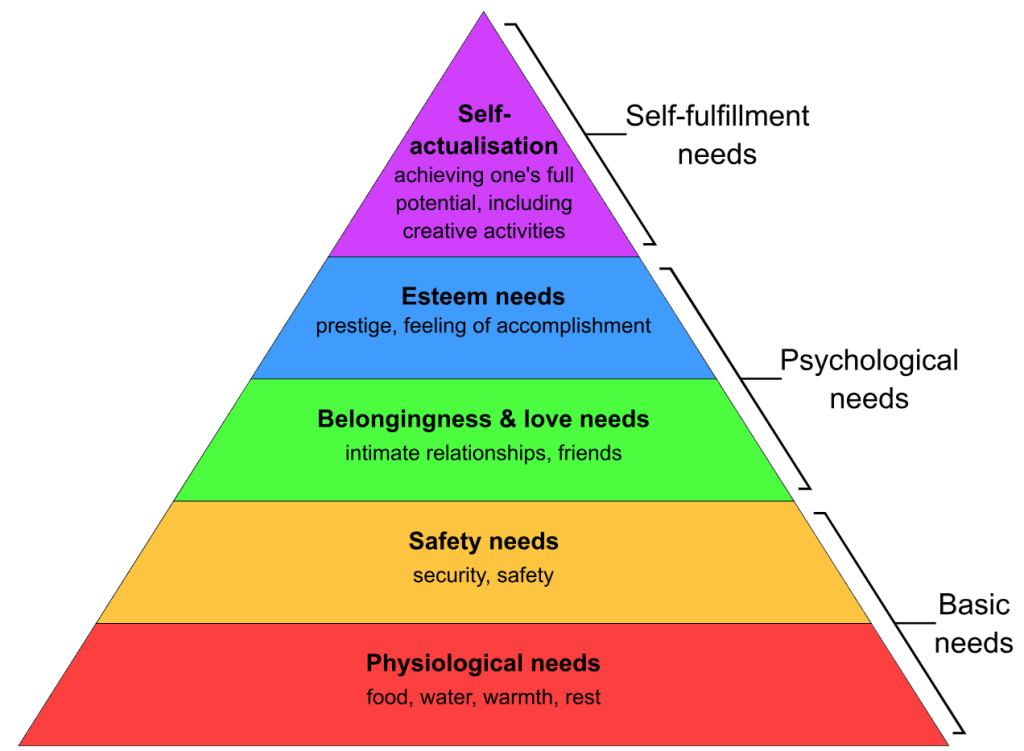
We all would have seen the famous pyramid of needs in certain forms somewhere. This pyramid is known to represent Maslow’s Hierarchy of Needs. Although the concept of hierarchy of needs is originated from Abraham Maslow, the pyramid was never drawn by him. A consulting psychologist Charles McDermid came up with this pyramid to oversimplify Maslow’s ideas and this is where the core of Theory of Motivation was lost.
Oversimplification of Maslow’s theory caused the loss of its very fundamental ideas
Theory of Motivation and Self-Actualization
According to this theory, humans need an integrated hierarchy where basic survival needs must be satisfied to realize their full potential – to become a self-actualized being.
Theory of motivation deals with what motivates people to achieve certain goal or expected outcome. The most primary theory here is Maslow’s hierarchy of Needs.
Maslow attributed 5 hierarchies for the any person to achieve their full potential:
Physiological needs – Things required for survival like air, water, food, clothing, and shelter
Safety needs – personal protection from surrounding hostile conditions, a safe society, secure job/ income, health
Belonging needs – people who appreciate your presence in their lives, love, friendship, companionship, sense of connection/ belonging
Self-actualization – the ability to reach the highest potential
Before moving on with the discussion with these hierarchy it is very important that Maslow never intended these to be linear. The mistranslation of the concept of hierarchy into pyramid lost the whole basics of Maslow’s theory of motivation. Maslow always clarified that these are not sequential.
Maslow’s classified the first four needs namely physiological, safety, belonging, and esteem as the existential motivators. These are the necessities for a person to exist in this world and are completely dependent upon external factors.
The last need for self-actualization is completely intrinsic motivator. Unless and until you feel that drive to understand the purpose of you your being, you won’t reach the stage of self-realization. The person who has satisfied all first four but not the self-actualization will feel directionless even after achieving what he/ she desired. That is exactly why doing things to prove your worth to the world mostly ends in existential confusion, such people question the void which is created after achieving everything they wanted.
That is why inner motivation is important for bringing out the best of you. So, the last need namely Self-actualization is attributed as the intrinsic motivator. This intrinsic urge will drive the person to make the sense of his/ her conditions improve further.
In this further improvement the person achieves self-transcendence. This is the purest form of the happiness. Spirituality calls it the enlightenment.
The Characteristics of Self-Actualizers
It is very important to reiterate that Maslow never intended the hierarchy of needs to be linear and always clarified that you can work of these needs simultaneously. It is not like leveling up in a game one by one. The more you satisfy lower needs, the more you are concerned with the higher needs.
Maslow’s studied such people who have achieved self-realization and found some special common traits. Some of them are listed below:
They have high level humor – Low level humor is when you belittle others to create laughter. The self-actualizers will make fun of themselves to create this laughter.
Self-realizers have high sense of reality – Self realizers exhibit a healthy self-esteem. A person with toxic self-esteem will feel jealous for other people’s success. They feel entitled as they were the worthier than others. But the self-actualizers appreciate other people’s success and befriend them to learn the ways to succeed.
Continuous appreciation – Self-realizers are able to find joy in even the routine tasks, mundane activities. Even though they are excited for something new and challenging they equally value the mundane-ness of the events in life. It is because they carry highest sense of gratitude for everything.
Problem centered – Self-actualizers understand that whatever mission they have whatever purpose they have to fulfill must always lie beyond themselves and consider the big picture and long-term vision. They are aware that once the goal is achieved, they will get exposed to that existential confusion, once you have higher and wider sense of goal it is very rare that you will end up in existential angst. These types of people are not building an empire to become billionaire, they are on a mission to contribute to the world. Most importantly this urge to contribute to the society is not to make themselves feel worthy, it is because they understand that it is what the world desperately needs. Thus, self-actualizers select their goals in such ways so that they strengthen the personal skills and contribute to the betterment of the society simultaneously.
Self-realizers enjoy privacy – Solitude resonates more with such people than loneliness.
Self-realizers demonstrate these values: Wholeness, perfection, completion, justice, effortlessness, aliveness, richness, simplicity, beauty, self-sufficiency, goodness, uniqueness, order, playfulness, truth
Self-realizers are accepting towards oneself and others – they know that a perfect human is not the one without flaws. They understand that imperfections, sadness, grief, jealousy are also important aspect of being a human and thus try to uplift others going through same conditions instead of belittling them.
Self-actualizers are more spontaneous and strive to become more natural
Self-actualizers intensely look out for autonomy. It’s like micromanaging will kill their motivation to do the task.
Self-actualizers have more profound relationships. The relationships are not transactional.
Self-actualizers have high sense of Gemeinschaftsgefühl – meaning heightened sense of being connected to humanity.
Self-actualizers always strive to create win-win situations. That is exactly what helps them to find the goals which will benefit them personally and also the society on grand scale.
Self-actualizers have peak experiences. Self-actualizers are not always happy (otherwise one would surely attribute such people mental!) Instead of remaining happy with everything irrespective of is valence – intensity, self-actualizers have these small moments which make them appreciate their purpose on even higher level. They are not always drenched in the rains of happiness instead a small shower of joy elevates their sense of purposeful existence.
After going through such detailed characteristics explained by Maslow, it is tempting to ask one question. Do Self-actualizers settle for what they are given?
Self-actualization is a journey
What majorly got lost in translation due to the creation of this controversial pyramid of hierarchy of needs was Maslow’s attribution to continuous improvement in Self-actualizers.
“It is not a state of being but a process, It’s a direction, not destination. This process won’t always bring the feelings of happiness, contentment, and bliss, and it may even sometimes cause pain and heartache. It’s not for the “faint-hearted”. It requires continually stretching outside your comfort zone. It takes a lot of courage to be the best version of yourself.”
This is the part where the theory of motivation truly becomes humanistic. That is exactly what I love about self-actualization. It is not creating a paradise free from suffering, rather it accepts the presence of negative ideas of humanity at the same level as positive ideas. That is what makes us a complete human. It is sad that in general understanding we miss this part of the theory of motivation.
Maslow’s theory of motivation for the modern world
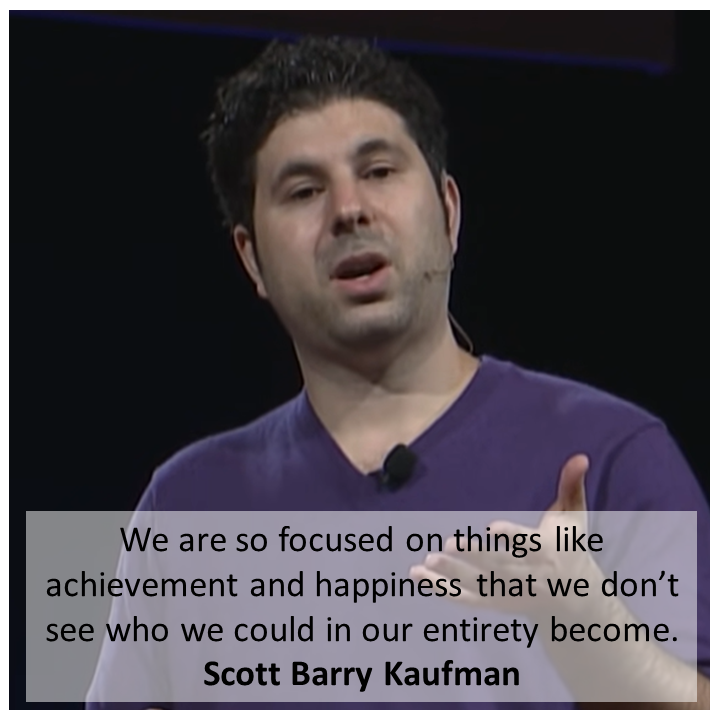
Scott Barry Kaufman – an American psychologist conducted an experiment to fit Maslow’s theory of motivation which is more relevant in this modern world and also doesn’t mistranslate the original theory during oversimplification. I would say it is not oversimplification of the theory of motivation rather it augments the same theory to remain more relevant in modern times.
Scott Kaufman in his famous paper discusses that the as Abraham Maslow’s ideas go, the lack of satisfaction motivates people to fill that existential i.e., external, and emotional i.e., intrinsic deficiency. This deficiency is primarily about physical existence and then about mental/ emotional existence. It can also be deficient in both aspects (external and internal simultaneously). The people who lack motivation are also very defensive when they feel danger to their basic needs – survival needs.
Scott explains that motivated people are driven more by exploration, creativity and love not for themselves but also for the humankind.
The Cybernetic Big Five Theory
Scott Kaufman bridged the concepts of cybernetic big five theory with the characteristics of self-actualized human beings as explained by Abraham Maslow through an experiment consisting of a psychrometric test. (A psychrometric test is a questionnaire to assess intelligence, abilities, potential and personality.)
The big five theory of cybernetics identifies five factors which helps to define the person’s overall personality. Cybernetics here indicates the study of systems which work with a feedback loop. After all motivation is a type of feedback loop. Any mechanism which changes its response based on the outcome can be studied under cybernetics. So, the cybernetic system we are interested here are human beings. There are five factors which indicate the major habits – traits of the person. The varying contribution from each attribute can help us to understand what motivates, influences the given person and how his/ her life can be improved.
Following are the big five:
Openness to experiences – as the words themselves explains – it’s the way – the trait in which one accepts or molds/ changes to the new experiences. The more open one is to experiences the less they are susceptible to mental disorder
Conscientiousness – it is the ability to care, to take things/ consequences seriously, being diligent. More conscientious a person is more he/ she is reliable; extremes would be attribute to workaholics, perfectionists.
Extraversion/ Extroversion – is related to how a person draws energy to exist. Introverts feel energetic in solitude whereas extroverts seek company to feel energetic. This is inspired from Carl Jung’s ideas.
Agreeableness – it measures how considerate you are. People with low agreeableness are selfish, people with high agreeableness are kinder, sympathetic.
Neuroticism – is related to how one handles negative emotions and stress. More neurotic a person more negatively they behave.
This theory is also commonly known as the OCEAN theory. But, why did we try to understand the cybernetic big five theory? What motivates people is immediately related to how people behave and what are their “traits”; So, understanding the OCEAN aspects of the personality creates a model where you can understand what motivates them.
The Metatraits – Bridging the Classical and Modern Theory of Motivation
Scott Kaufman linked the big five facets of human personality to Maslow’s theory of motivation through the bridge of Metatraits.
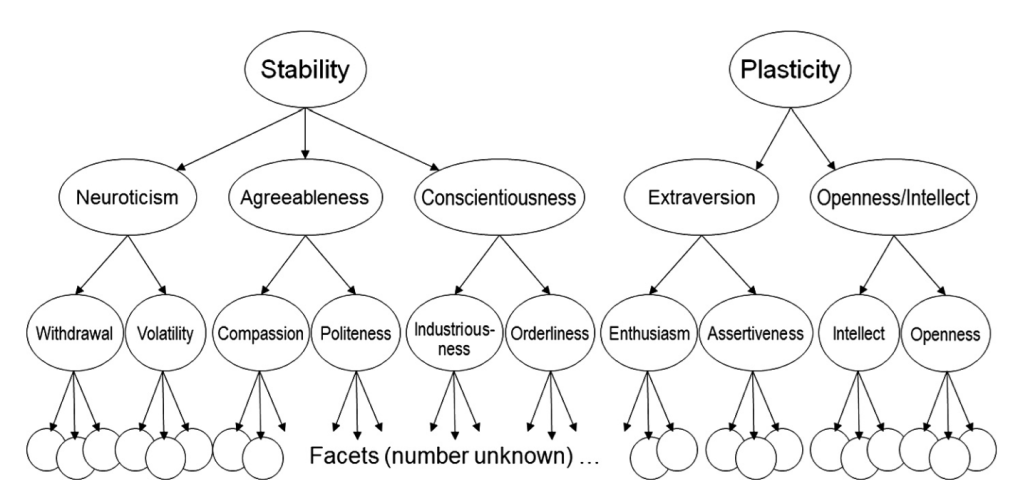
The five facets of human psyche – the five traits namely Openness to experiences, Conscientiousness, Extraversion, Agreeableness, and Neuroticism can be grouped into two major categories. One is Stability and the another is Plasticity.
Stability is defined through the contributions from traits of Neuroticism, Agreeableness, and Conscientiousness.
Plasticity is defined through the contributions from the traits of Openness to experiences and Extraversion.
The personality trait hierarchy (Source: Cybernetic Big Five Theory, Colin G. DeYoung, 2014, Journal of Research in Personality)
Now, the magic starts happening.
It’s Not A Pyramid, Rather It’s A Sail Boat
Remember that the theory of motivation had two aspects. One is the security, safety and the another one is sense of existence, meaning.
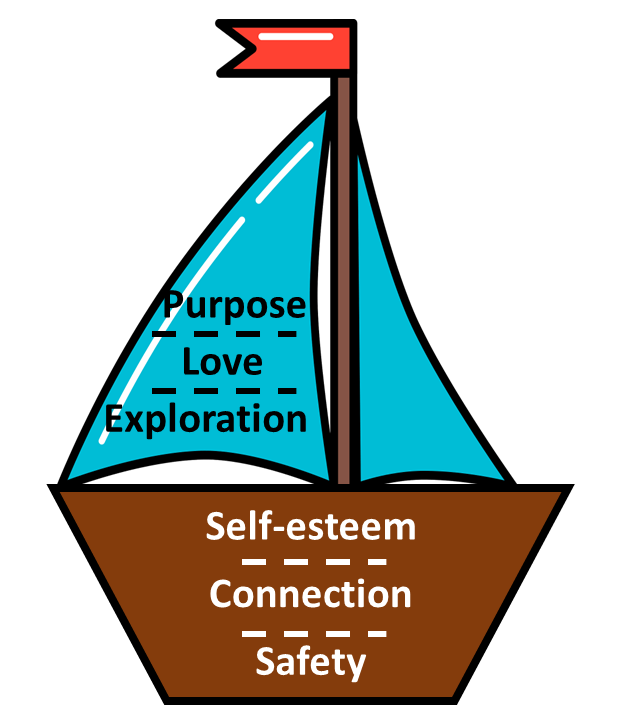
Scott Kaufman through his experiment clarified almost all aspects of Maslow’s theory of motivation. Unlike the popular mistranslated pyramidal structure of hierarchy of needs, Scott smartly utilized the fundamental idea of simultaneity of all needs into his new model. According to Scott Kaufmanns model the hierarchy of need is best represented by the Sail Boat.
Scott Barry Kaufman’s Sail Boat Model of Self Actualization
It is very wonderful to appreciate what this Sail Boat model communicates. Its beauty is that is brings the lost ideas from the classical theory of motivation into limelight and at the same time it removes that false linearity from the hierarchy. The word ‘hierarchy’ reflects that interdependence and complementary nature of the needs. The more you satisfy the lower needs, the more you will try to fulfill the higher need.
Scott presents that we are never leveling up from one need to higher one, rather we are trying to fulfill every type of need to certain extent simultaneously. Once we fill like certain need is fulfilled to a safer extent, we can fulfill other multiple need simultaneously.
We are continuously changing our needs based on the experiences we have while fulfilling other needs. Once you achieve certain goal in your life you may feel the need to upgrade you living standards, social status. If you get one life changing spiritual experience you may feel to downgrade your living standards because you feel that this is materialistic obsession.
Scotts Sail Boat model thus can be represented as follows:
The Boat is the security aspect necessary for the survival of a person. It is both physiological and psychological. Safety, Connection and Self-esteem create the boat; once you fulfill these aspects your life will be secured, your physical existence is guaranteed but this will not fill the spiritual existential void, the urge for purpose and meaning in you. You will have to attach a sail of being open to uncertainty, daring to love, daring to find the purpose which will drive that boat into the “OCEAN” of the life. (Look what I did their, actually this is how Scott explains it, you get it!)
Having a boat with holes – the lack of safety, connections, and self esteem will surely jeopardize your materialistic existence. After that having only a boat – fulfillment of safety, connections and self-esteem will give you proper survival. But only survival will instantly demotivate you to even live. Its like a boat which has taken halt, has no purpose and may collapse when a big wave collapses. Basic fulfillment of survival need does not guaranty long term sustenance, any big challenge in life, any negative event will tear down this boat of existence into pieces. You must appreciate that the boat here indicates the metatrait of stability which is supposed to the rigid trait of the personality, rigid int terms of the fundamental support to the whole being.
In order to handle the challenges, the big collapsing waves one need to explore the OCEAN, the challenges for that the motivation will be drawn from the openness to new experiences, learnability, curiosity. This learnability, urge for growth is attributed to the sails of the boat. The sails will ensure that you will move faster when you sense collapsing waves, sails will ensure that your boat will reach the destinations you want, sails will ensure that you have the goal, the purpose, the meaning to your existence. Thus, the sails represent the metatrait of Plasticity.
You must understand that Stability metatrait is how you fulfill your deficiencies in the fundamental needs for existence whereas Plasticity metatrait is about how you make sense of what existence you have established.
How strongly you will live is defined by stability, it is about how you protect your goals, its is about how you handle your impulses, how you strategize and understand the events to remain stable.
How purposeful, focused you will remain will be defined by plasticity. What new goals you create, how you learn new things to achieve these goals, hoe you strategize you r actions to demonstrate understanding, create meaning is what plasticity is.
Conclusion
Life, our existence is always proven to be filled with paradoxes and contradictions. You will see a smiling beggar lying on the roadside – begging for the food of one time and you will also see a billionaire crying in his Lamborghini because he/she lost their loved ones. Different people will weigh out these events based on what type of life they were exposed to. Those who lacked happiness in their lives will prefer to be happy by trading all valuable objects they have, whereas those who never possessed basic things for survival will endure endless pain to get them. These types of paradoxical lives are the origins to a completely different world view and most importantly what motivates human beings.
What was lost through Maslow’s pyramid of hierarchy of needs came back into limelight due to modern theories in psychology like the Cybernetic Big Five Theory and Sail-Boat Model. They highlight a very important fact that stability and plasticity both are necessary for a person to become whole – a complete human being. Scott Barry Kaufmann also found out in his study that self-actualization was more strongly related to plasticity than the mere absence of stability. It shows how intrinsic motivation weighs heavier than the materialistic stability. It is a big concept to grasp but all of us are always passing through this experience but seldom are aware of that. You will realize that this is the theory which could also join the western and eastern concepts of enlightenment and self-transcendence.
P.S. – Iron Man’s character from MCU in every sense is the best pop-cultural representation of both the classical and modern ideas of the theory of motivation.
The most selfish character in a story got motivated to sacrifice himself for the greater good















 Parts Per Billion