

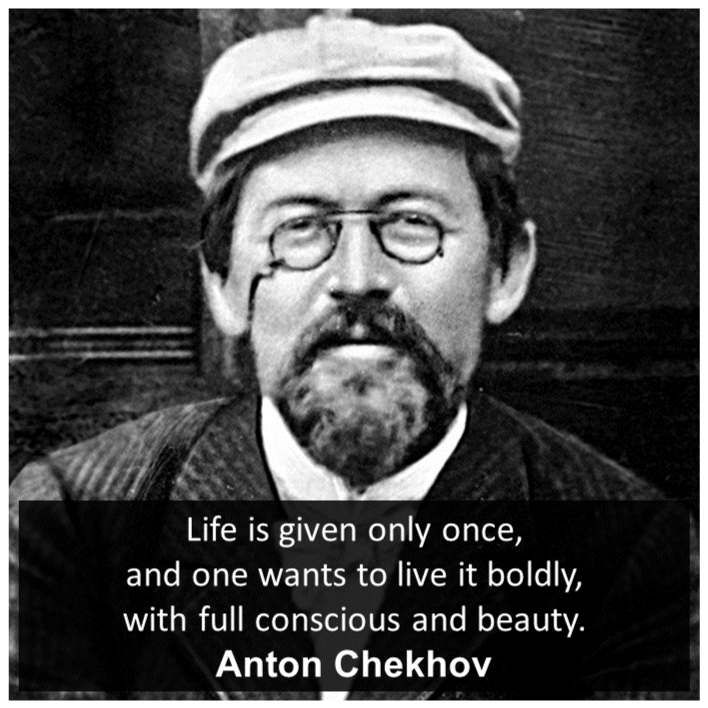
Anton Chekhov’s famous short story called “the Bet”
The good life is a direction, not a destination
Bruce Lee
Quick question! Would you trade 10 years of life for 10 million? There are two important parts of this question before looking for the right answer and only a fool would think that there truly is one good answer to this question.
The first part of this question is – what is the value of time we live through our lifetime? Say, a millionaire who is bedridden in his last moments of life is still unsatisfied with the plans he had for his life. Would he trade his money with extra time?
The second part is – if we live a life with no resources – money to meet the ends then what good is to live such life?
Now if we look out for subjective answers, the diversity in answers would surprise us (and that part is not surprising, because everyone has their own definition of a good life and a bad life based on the experiences they had)
Anton Chekhov – one of the most important short story writers wrote one interesting story called “The Bet” which makes the readers question the real intent of having a life and living through it till death. What kind of life is a good life – a short but resourceful life or a long but painful life?
Synopsis
The Bet is a story of two people – A Banker and a lawyer who in their young age fix a bet to decide who among them is right. The argument of the bet is based on the morality of a death penalty. Banker thinks that instead of making the convicted suffer for a long time through lifetime imprisonment, he should be sentenced to instant- immediate death. Life – long but with suffering is inhumane punishment. Whereas the lawyer thinks that taking life in any way is inhumane as humans do not have any power to restore the life back. Taking life slowly or instantly – both are inhumane but if these two are the only options, then the best punishment is to let the convict live; even though it will be painful but he still lives.
In order to prove validity of their arguments they decide a bet where the banker agrees to pay the lawyer 2 million if the lawyer undergoes solitary confinement for five years. In the excitement of the argument the lawyer agrees to 15 years of solitary confinement for 2 million. If by any means the lawyer escapes this confinement or tries to connect with any human being, he will lose the bet and banker won’t have to pay anything to him. The lawyer would get wine, smoke, books and a musical instrument but no human contact or newspaper or a letter from someone. There was only a small window to receive anything from outer world.
As the confinement proceeds the bankers becomes more and more nervous. He anticipated that the lawyer won’t even last for 2-3 years but the bet truly goes till its completion and in the meantime the baker loses most of his money where the 2 million he pledged is the only amount he has. He now knows that the lawyer – seemingly successful to survive through the bet will now have 2 million while living out of the confinement and the banker himself would be poor. He tries to kill the lawyer on the last day of his confinement where he discovers that the lawyer has actually renounced what he was about to win from the bet, he even distastes the life itself and seeks the ultimate salvation, freedom from life. The lawyer understands that even after reading these many books, these many stories, learning many languages the death in an instant can wipe out everything that can be created.
Next day, the baker finds out that the lawyer escaped the confinement as he had planned in his letter to purposefully lose the bet. The banker is relieved knowing that he still has hold over the 2 million which was his last capital for survival. To not let discussions catch fire he locks the letter of renouncement of the prize from lawyer in a safe.
Life – granted to everyone has majorly two aspects which are continuously deciding the course everyone’s life. One is time and another is resources.
Anton Chekhov can be called as the king of short stories where his philosophy of writing was focused on to present only what is necessary to convey the intent to drive the story further, nothing seems extra in his stories which make them highly effective short stories. All of Chekhov’s stories are based on common scenarios happening with common people, there is always some realism and non-fictional touch to his stories. And hence they always deliver a profound idea about what a life really is, what it means to be a human. You will rarely find a direct message in his stories, the natural reactions of his characters will show you the mirror. Anton Chekhov truly mastered the skill of mirroring the life through is short but highly effective stories. The Bet is one such masterpiece. Let us dive deeper into this story.
The Abundance
The Bet is a story of how one values their own life and other people’s lives. Chekhov smartly shows how abundance dulls, narrows and blinds the vision and opinions one has. The banker and the lawyer in their young age while arguing over the justification to punish someone by death of life-long imprisonment are indicated to be full of adrenaline and excitement. Even though they have not gone through such experiences they have firm opinions on such experiences. The lawyer and banker both have many years of life still left to spare which leads to such an absurd bet. The banker thinks that he has enough wealth just to spare for such a silly bet. Almost all the times, we are ready to stake things we have in abundance for a silly thing which would prove our beliefs to be either right or wrong. Abundance reduces the perception of value for things, time and even life. Lawyer and banker both were young when the bet was established. Great thing about Chekhov to appreciate is how he points out the behaviour and opinions of youth on almost anything. The youth seem to have strong opinions on everything even when they haven’t gone through those experiences or lived with the people closer to such experiences. The so called “hormones” make the youth think themselves as invincible – there is nothing wrong with that as it is what makes young people turn impossible things into possible but being in a simulation where there is no relevance to the reality makes the youth delusional where they take negative and life-altering decisions carelessly. Consider if this bet was set up between two beggars or two old men, its an impossibility. In both cases they are lacking time and resources/ money.
So, the starting set up for bet shows how in early young years abundance can blindfold the person from reality.
Banker wanted the punishment to be instant as it involves no suffering also shows how greatly he values pleasures and happiness in life. A painful life is equivalent to death for him. At the same time for the lawyer morality is more important, that is why he prefers gift of life in any form rather than the instant death.
“To live anyhow is better than not at all”
The Bet
And funnily or ironically, in the end after 15 years you will see the lawyer longing for the true salvation, you will see this in his letter when the bet is about to end where he establishes that whatever knowledge, experiences, money, resources one could have in their lives – the death will render all of those useless – a more nihilistic opinion.
“You may be proud, wise, and fine, but death will wipe you off the face of the earth as though you were no more than mice burrowing under the floor, and your history, your immortal geniuses will burn or freeze together with the earthly globe”
The Bet
The Solitude – Curse or Boon?
It is really interesting how Chekhov describes the lawyer’s voluntary solitary confinement. It’s like mirroring of how we as human beings go on the quest of understanding the surroundings, the nature and the society around us when we are left alone.
As the lawyer was alone and confined to himself only, in early years of imprisonment the lawyer felt lonely and depressed. This shows how we are mostly created by our surroundings. Most of the time we are what our surroundings are. We only start understanding ourselves when we try to define our existence from inside and not outside. This becomes accelerated and intense when one accepts the solitude in the place of loneliness. The journey to solitude for lawyer started with music and romantic, thriller fiction.
It is impressive of Chekhov’s writing to highlight how our mind tries to fill in the gaps when we are alone. When people are on their own with no outward person to person interaction or person to object interaction, they try to fill that gap of loneliness with entertainment, music, poetry, literature, addiction and what not. People who are unable to fill this gap are the truest lonely people, they always will long for company of other people to fill the void.
In second year, the lawyer became more silent and started writing for long hours instead of reading anything. He is angry with what he accepted just to prove his point but is helpless to change the course of the things. This is the stage where Chekhov sneakily establishes that even though entertainment may fill the void of solitude to some extend for a person, it will not stand the test of the time. The solitude makes the person to have thoughts inside them engulf themselves. Writing is one way to blurt out all that is going inside the mind of the person thereby consoling them that whatever was inside them is now physically outside, on paper. One peculiar observation about writers inserted by Chekhov here! When your thoughts try to eat you, devour you from inside, it is good to channel them outside through your creations, that is what is the basic characteristic of the greatest artists the world has ever seen.
Chekhov then describes the sixth year of the lawyer in confinement as the seeker of the knowledge. Again, the credit goes to the genius of Chekhov where he shows that when a person rises above his own materialistic existence, he seeks the understanding of the nature that he emerged from. When the person accepts his solitude then only his search for real truth begins. It’s like this solitude removed all the noise from his existence. The lawyer in solitude studying philosophy, languages and history shows the curiosity to know oneself better. Study of languages show the curiosity to understand and comprehend that which others had already said but your inability to hear restricted you to access that knowledge. Studying philosophy shows the urge to clear the clutter of thoughts going in the head, philosophy to some extent is the re-organization of what we think, how we think and how we decide our actions accordingly. Studying history indicates the ways to understand the reasons behind the present order of things, everything that exists in present has traceability to history which justifies the way things – traditions are perceived, handled in present.
From sixth to tenth year the lawyer studied the languages and mastered them like a commoner. It is very interesting choice from Chekhov to make his character study languages after studying some heavy fields like philosophy, history. It could have been science and technology but no, all the lawyer was interested in were the languages. Please understand that this is one of the most important creative choices made by Anton Chekhov.
When a person finds the truest, purest reservoir of knowledge, his search for anything greater than that ends there (obviously), the next stage for such enlightened person is to understand and find different interpretations of this pure knowledge.
“The geniuses of all ages and of all lands speak different languages but the same flame burns in them all”
The Bet
After completing ten years, the lawyer surprisingly moved to theology and gospels – the study of religion. It is surprising for a scholar who mastered six languages and deeply understood philosophy, history of humanity. Chekhov wants to highlight one important aspect of humans and their obsession with certain goals – destinations in life. When the destination people considered the most important thing of their life are reached, at that exact moment they become meaningless. The human mind becomes clueless after this event, whatever efforts they took to reach their feel worthless as if nothing in life was worth that or was worth that value. That is the moment when the person tries to detach themselves from all these theories, logics and philosophies. This is the moment when a person realises that there is totally different order and the entity which has designed this current order in which he exists. This is the person resorting to spirituality. When a person feels hopeless during continuous sufferings, purposeless even after achieving that important goal he desired for his whole life, spirituality becomes the last stop.
“A little philosophy inclineth man’s mind to atheism: but depth in philosophy bringeth men’s minds about to religion.”
Sir Francis Bacon
In the last two years Chekhov portrays the lawyer in solitary confinement as a the one who is drifting in the ocean of existence, he is on the verge of breakdown, he is sinking thus wherever he will find support he will cling to it. It is some sort of neurosis, especially the neurosis of the genius mind.
It is the true genius of Anton Chekhov where he shows his readers the journey to find the meaning of our existence, solitude intensifies the speed of this journey. And in the end, if one forces himself to understand the meaning of life in an absolute way, then he will definitely end up being the fool – the smartest and greatest fool the world has ever seen! Too much analysis, too much knowledge and too much logic can drain humanity from the person in a very tragic way. Even nihilism will look petty in front of such condition.
“A mind all logic is like a knife all blade. It makes the hand bleed that uses it.”
Rabindranath Tagore
The Time Vs The Resources
Please understand that major events in the Bet are flashbacks of the banker. And Chekhov has written these flashbacks as if the banker is regretting his decision of setting this bet. The banker knows that he has already lost the bet. He lost all his wealth during this time of 15 year and in addition to that peace of his mind just to prove some foolish point to some group of people.
You must appreciate how Chekhov manipulates the effect of time and resources in the bet. Through this manipulation, he shows significance of both time and resource/ money in human life and also the interplay between them. You will see that the lawyer had 15 years to build his upcoming life after successfully completing the bet. He was the victorious who would have had wisdom and wealth – he would have become practically invincible. But too much knowledge and time spent with books made him think about the worthlessness of life, as his mind was always fed with the simulations, experiences from the books he never got the hold of real-life experiences. This created a detachment from reality in his life experiences. Thus, it is not surprising that he considers the gift of life (which he was ready to live anyhow in the early time of the bet) as a worthless one as death can wipe it out in no time.
For banker it is totally different story. He was the one who was so sure about the future abundance of the wealth he would have had that the pledged money was nothing for him in the early years. The lack of knowledge and the abundance created illusion for him. When the bet was about to end, he was consumed by the idea of loss of his dearly 2 million. The banker even makes an attempt to kill the lawyer in secret to win the bet. The character of banker seems shallow right from the beginning of the story but we must not forget that he too is a human being. Before the setup of bet, the banker was of the opinion that a good life must be painless life otherwise the life should not be lived. But as the bet proceeds you will find the banker in the continuous pain and fear for the loss of his money. Even with this pain he prefers living though it. He chooses painful life now.
Let us understand one scenario, what if the banker went on to become wealthier and wealthier as the bet went on to completion. He would not have felt a single regret to let the lawyer win the bet. Rather the character of the banker would have definitely honored the lawyer for his willpower and genius that he had become during his solitary confinement. The “supposedly” wealthy banker would have humbly sponsored the lawyer for the rest of his life. But Chekhov did not let that happen with the banker’s character. This shows how we human beings set our ideals, our philosophy of life, our way of making decisions, our way of thinking and our motivations based on how we feel about ourselves. Our ideals or philosophy of life never take a moral guidance system – it rather follows the pathways of how we experience life around us and how we feel about it. A cold-blooded criminal will never feel regret for killing another human being and at the same time a sage will punish himself for losing his temper on a child who broke his meditation practice. Your calls for right or wrong are heavily influenced by how you feel about yourself, others come later.
So, it is really important to understand how we decide right or wrong. Most of the time these decisions are influenced by how we were feeling in that decision making moment.
No wonder Chekhov shows mirror to his readers through his short yet highly effective writing.
The Conclusion
So, we will again come back to the question we asked at the start of this discussion. Can 10 years be traded for the 10 million? If these 10 years were full of pain and suffering, one would surely trade them for the money. If these 10 years were filled with happiness, joy and fulfillment then 10 million would look worthless in front of them. This shows how foolishly we are trying to justify our lives by attaching it to a single defined destination. We are always forgetting the multitudes of spectrum our lives have. We always try to justify our life with a single event – good or bad and forget that this too shall pass. The profoundness of life allows us to define the life in every possible way, that is actually a curse and a boon. That is exactly why living life with the decisions we take is the biggest bet a person can play. Anton Chekhov shows this side of life through a simple bet between a lawyer and a banker.
Life will never be a single conclusion, it will always remain multifaceted, full of possibilities. That is why whatever call we take for the life to become something ahead is going to be new trick every time. When we discuss the quality and quantity of life, we are again ignoring the spectrum of endless possibilities life has.
Salvation either through the pursuit of knowledge or through the pursuit of resources – both are foolish moves to live a fulfilled life. Life will never associate itself to single adjective, single attribute, single absolute ideology, philosophy – otherwise it will become monotonous- mechanical – lifeless. You will see that so called “enlightened” genius lawyer in the end literally becomes mad and despises everything that life can offer – the same lawyer who considered living life in any condition is good than death when the bet was to start.
“To be overly conscious is a sickness, a real, thorough sickness”
Fyodor Dostoevsky
Anton Chekhov was the master of bringing two exactly contrasting ideas through the portrayal of realistic life. That is exactly how real life is – full of paradoxes. That is what makes Chekhov’s stories so special.
“What a fine weather today! Can’t choose whether to drink tea or to hang myself.”
Anton Chekhov
Chekhov establishes these important aspects life granted us like the abundance of time and resources, the knowledge, the possibilities and pathways to self-discovery. The real freedom is neither to let go of life with an escapism/nihilism nor degrade it through materialistic exploitation. The real freedom is the harmony between time, resources, practical curiosity and most importantly people around us. Life has possibilities to offer, let us live our lives on the spectrum rather than polarizing them to an ideology. It is crime to let life take a side on a shore than to let it flow through the vast ocean of possibilities.
(There is a third part of this story which was not known to public for many years. In this newly revealed ending, the banker remained in guilt even when the lawyer had technically renounced the prize money by losing the bet. One day, the lawyer returned to the banker and asked for the money he won. The banker gave the lawyer the prize money in order to bring his mind at peace.)
Source for reading:


 Parts Per Billion