Feminine Side of Masculinity

Most of the times, we are forgetting that when we are promoting and asking for individual freedom, individual expression, individual identity we have ignored what it means to reserve the same rights for others. Ernest Hemingway’s short story called “In Another country” from his collection called ‘Men Without Women’ shows what men lose when they have no one of their own to open up, express, share. Hemingway’s writings although were heavily influenced by his personal experiences of war, the ways in which his men handled emotions is exactly same as how modern men are still handling their own emotions. They are not handling them at all, they are suppressing them, running away from them.
Men are so strongly conditioned with the trait of showing themselves unaffected by whatever life throws at them that now they have accepted it as their second nature. There is a specific psychological term called Alexithymia which literally means “a lack of words for emotions.” You can see alexithymia in Hemingway’s “so-called” masculine characters.
The remedy to all these complications is creation of more open spaces for men. We need men to open up at least among themselves, at least a man needs to treat other man’s emotional, expressive side, others will eventually follow.

Ernest Hemingway’s Men Without Women
The Paradox of Individualism

It is always interesting to question what would happen if we were not exposed to certain things, experiences especially the people. What we would be of us if those events, those people had not crossed our life path? We definitely would have been someone else. In a sense we are what is happened to us and where we lived and with whom we lived. One can say that man himself is enough to justify his own existence, he doesn’t need anything else or anyone else to live through his life, to pass through it and there is no denying in that.

One must understand that people can spend their whole existence as an isolated being, a person unaffected by the surrounding and molded completely by his/ her own being, not by others and without the influence of the surrounding. You will see that what I explained in the last sentence seems illogical. How could a person be completely be detached throughout his whole time on earth filled with many things, events, people? The answer to this confusion is that the person assumes that he/she was alone all along the time thereby mentally erasing every instance where they had a company, such people have mastered the art of removing every influence their surrounding had on them. Human children are anyways some of the weakest off-springs among the many species on earth. A new born baby continuously needs support from parents/ surroundings to finally become self-dependent. Now, one cannot deny the fact that even if you can live on your own, what you call as “your own” which substitutes for the void of the external influences is ultimately created from that very surrounding you are trying to deny to prove your individualism. This “your own” internal support could be anything – your identity, your habits, your religion, your mind, your way of thinking, your way of seeing things. Now you must appreciate that even though we can control what we are, once we are matured/ independent we cannot completely erase what brought us here.

The concept of individualism itself needs supporting justification, there is nothing like an isolated being. In order to define isolated or individual, you have to define what it is not and that invites everything that exists out there.

The whole point of starting the discussion with the idea of futility of individualism is one short story I came across, rather the book’s whole point is the denial of individualism. It shows that even if one justifies their individualism, it immediately rips them from their real version. The person creates a defense mechanism to avoid certain unsettling feelings just to satisfy their version of self. Men need safe space of women or at least a feminine side of humanity to express, to vent out or at least to acknowledge what they are feeling in front of other human being. If men are not given such space, they are no longer men, not even human.

The book I am talking about is Ernest Hemingway’s collection of short stories called Men Without Women. These stories show how men are flawed when they try to erase or are forced from external factors the influence of women from their lives, how it steals their true masculinity, true humanity. I will deep dive into these aspects as discussion evolves.

The short story from Men Without Women which intrigued me is “In Another Country”. I like this story because is direct reflection of who Ernest Hemingway was. It is written in first person point of view and the factual details of Hemingway’s biography overlap with the locations, events mentioned in the story, so the Hemingway’s fiction brings a realism.

In Another Country – Summary

I won’t go into every nook and cranny of the story, because I want to invite you into reading that 15 min short story all for your own interest.

Even if I spoil the story here, reading the details of the story and building your own interpretations are one personal and exquisite experience. This is because of the iceberg theory attributed to Hemingway’s characteristic writing style. He will not explain everything or show everything that is there in the story. The limited narrative and limited details make the reader to evaluate multiple attributes and possibilities and thereby interpretations so Hemingway’s writing create a very subjective and personal experience in readers. I think only a piece of great art, only a masterpiece can create subjective experiences in people. And that is exactly why art is important, it makes people see what they already had but always denied because they were busy in creating something totally irrelevant – the irrelevant which they didn’t even want in first place.

So, here goes the summary –

The narrator talks about his routine to a hospital for a therapy session for those injured in the war in Milan. He is American but fighting for Italy and is decorated for his sacrifice. He is accompanied by three decorated Italian officers and one more boy who was disfigured on the very first day at the front of the war. They go to this therapy session to somehow restore their original physical functions. The narrator is always made aware through the surroundings and people around him that even though he sacrificed himself for the people he still is an outsider. It is just because he was dutiful that he deserves respect from the localites. In his therapy he is accompanied by a Major who treats the narrator good and is also helping him to improve his Italian. One day while casually discussing what their future would be, the Major gets triggered by the mention that the narrator wishes to get married. He aggressively suggests the narrator to not get married because it will bring the pain and suffering in the end. He suggests that if one knows that he is going to lose something then one must turn away from attaching to it in first place.

The Major then immediately leaves the discussion and goes to make a phone call where he receives the sad news of the demise of his wife. The major apologizes to the narrator and remains absent for few days and rejoins the therapy session although he has no expectation to fully recover from this therapy session.

Deep Analysis of In Another Country

As I have already mentioned that Hemingway’s stories are like icebergs, they reveal very little than what they carry below. I would invite you to explore Ernest Hemingway’s biography to understand why it might be so. He faced multiple injuries, illnesses, traumas throughout his whole life. If you see the list of the illnesses Hemingway went through you will definitely say that the life loved him. Tragically he ended his life by himself. On surface reading you will see that Hemingway is a strong proponent of strong masculinity but deep down just like an iceberg he was not what he showed. I have reasons to prove that just through this single short story. Just keep in mind that there is more to what Hemingway said and showed to his readers and it was truly an imagery of what was going in his own mind.

Lack Of Warmth

The ways story opens, the narrator talks about the cold season of fall in Milan. The meat of hunted animals is hanging and the foxes were just there in the snow. There are three canal crossing bridges along the path to the hospital. The narrator would prefer the bridge where woman who roasted the chestnut used to sit. The narrator mentions that her charcoal fire and the roasted chestnuts ensured enough warmth before reaching the hospital.

This is Hemingway’s way to tell that the surroundings were completely hostile for the narrator, the short-lived warmth of the charcoal fire and the hot chestnuts in pocket thereafter thus highlight how much the narrator valued warmth. Even though narrator is not ordered to go on war and perform his duty now it was not a better situation too. There was no one to provide ‘that’ warmth of familiarity, relationship, love to the narrator. If it wasn’t for the duty, he would not have got into this.

Duty murders the true identity and the ambition of men to become their true version

We are told that the narrator is accompanied by four Italian soldiers for a therapy session in the hospital. They are practiced with some machines to improve their physical movements which were the result of war injuries. A major with hand injury is also undergoing physical therapy to recover from war injury.

Three of the Italians who accompanied the narrator wished to become something different before the war started. One of them wanted to be a lawyer, one wanted to become the painter and third one wanted to become a soldier. The Major suffered from hand injury was the greatest fencer in Italy – a technique where the dexterity of hand is crucial.

There was one more boy whose face was disfigured the very first day he was sent on the war front. He had lost his nose.

You must now understand it’s not just a character introduction or description in Hemingway’s short story. Hemingway very subtly shows how men sacrifice their own ambitions to carry out their duties. Two of the three Italian soldiers wished to become something totally different than what they are now just because war demanded the sacrifice of their own ambitions, dreams. The Major sacrificed his precious, skillful hand while carrying out the same duty of war.

The boy with disfigured lost his identity even before understanding what he was entering into. The disfigured face is not mere description of the grave injuries. Hemingway shows readers that men lost their identities in the war. 

Men sacrificed their wishes to carry out the duties given to them, they did it because that is what every man should do.

Men are loved just because they are dutiful and not for who they truly are

I really appreciate how Hemingway maintained subtlety in his writing while making us feel like he is just describing the characters of his story.

The readers are now well aware that this is about a group of well decorated, brave, dutiful soldiers who were undergoing rehabilitation in the hospital. They are not some losers who just suffered because of negligence or disinterest towards going to war. Rather even though against their will and wish, they went all in with the sense of duty. Then Hemingway tells us about how the localites treated them.   

People from communist quarters of Milan actively hated them. After the therapy sessions, the group has routine to visit the café, where the narrator comes across the locals. When the narrator is asked about his medals by the locals, he is somewhat happy that people care for what he had done for them. This happiness is short lived for him and not really a happiness. The moment localites see that he is an American, they immediately changed their behavior towards him. He is immediately made to feel like an outsider.

You must understand how painful this feeling is. The moment people see treat like you are not one of them even after you sacrificed yourself for the same people is a betrayal for such man, a man of honor and duty. It’s equivalent of death for such men.

This is also one way of Hemingway to show that generally society appreciates men, loves men for what they can do for the society. Society in deeper sense never appreciated men for what they are. The moment men stop the duty towards others they are worthless. The moment men will try to show what they are very few will be appreciated for what they are, very few men are loved and liked for what they are. Hemingway also shows how the war crushed the human-ness among the people.

Together But Lonely – Alienation Among Men

Hemingway effectively shows how the military instincts or trainings have conditioned men of different personalities to come together and work toward a common duty.

“We were all a little detached, and there was nothing that held us together except that we met every afternoon at the hospital”

At first narrator shows us that there is some sense of collective-ness in this group of soldiers. Even people from the communist quarters hate them collectively.

But soon you will see that they are not quite there for each other, it’s just that the circumstances are in that way.

This is evident when the narrator calls three of the decorated officers as “hunting -hawks” and denies to be one of them.

You will also see that the narrator craves for meaningful company when he mentions how his group has to “jostle” through the crowd of men and women from the wine-shops.

For now, the only meaningful connect he has with his group is the trauma of war shared amongst these soldiers. You will see that the narrator finds it difficult to relate to the mainstream crowd – the crowd from wine-shops and the streets of the Milan.

“We felt held by there being something that had happened that they, the people who disliked us, did not understand.”

The narrator has this subconscious feeling of being unliked by the people around him. This is some sort self-rejection, self-loathing because even after sacrifice he is made to feel like an outsider.

Self-pity And Surrogate Sympathy

You will see that the narrator feels some authentic connection with the boy with disfigured face and the fencing master Major who is undergoing therapy for his hands. The reasons to feel this connection are actually not that authentic, it’s just the narrator’s psyche which is trying to find a pivot of relatability to create a sense of belonging.

You will see this when the narrator mentions that while he sees the three Italian soldiers like “hunting hawks” not counting himself like them, he feels a connect with the one who has his face disfigured. The justification is purely intellectual. It’s because the ill fate that boy faced at the war front and he wasn’t even decorated for anything. The narrator sees this as an ill-fate for the boy because he didn’t get anything in return for what he sacrificed. The narrator at least got some recognition so he sees himself in better condition than the boy. It’s that feeling where the person himself sees him in a poor condition but when he sees others in even worse condition, he creates a sense of satisfaction just because others are living way worse than they deserve. There is nothing wrong in this feeling. It’s just how a person going through trauma tries to find a sense of belonging through pity and sympathy.

Men’s Inability To Communicate And Express Emotions Clearly   

Hemingway’s iceberg style writing peaks here.

The narrator is seen to make an attempt to speak in Italian with Major. He feels that he is able to speak Italian fluently but the moment Major asks him to speak with the awareness of Italian grammar, the narrator feels that speaking Italian is difficult.

It is an indirect indication how men always fail to express their emotions as they are. The “mainstream definition” and “perception” of what masculinity prevents men to sacrifice their real version just to demonstrate superiority in the dominance hierarchy. If you cannot dominate others, how would you establish control? How would you prove your manliness?

So, men subconsciously develop a tendency to distance themselves away from what they are feeling, because they know there is no way they will get any sympathy towards such emotions. Instead, the moment they express their true emotions, it’s like blowing up their cover, exposing themselves. Society is ready to devour them, forget about dominance.

Narrator’s struggle to speak in Italian is thus a metaphor to show how men are continuously challenged when they want to express something freely. You must understand that even if they do it, every man has some bad experience of how they were betrayed when they tried to open up. Now you can only imagine how this feeling gets amplified in men with trauma. Over the time, men have trained their minds to intentionally cordon off such feelings because they know and they have experienced this before that nobody care about how they feel.

Emotional Numbness – Alexithymia – Hemingway For Today’s World

In the last part of the story you will see that the Major gets triggered the moment narrator expresses his wish to get married once this is all over. He is unsettled not out of jealousy or the pain due to the war. He is restless due to even worse pain – the pain of the loss of the loved one.

“If he is to lose everything, he should not place himself in a position to lose that. He should not place himself in a position to lose. He should find things he cannot lose.”

And in the end, we come to know that the Major always feared that he is about to lose his beloved wife. He was always scared that he will lose his beloved wife anytime and he cannot do anything about it. (Understand that this man is a disciplined and War-seasoned major who has tricked death now is feared of something).

He stood there biting his lower lip. “It is very difficult,” he said. “I cannot resign myself.”

Who says that men are rigid, tough, insensitive to emotions!

This is a tight slap to those who say that Hemingway was a strong supporter of the masculinity. People twisted Hemingway’s character to convey what they wanted for themselves.

There is a specific psychological term called Alexithymia which literally means “a lack of words for emotions.”

You can see alexithymia in Hemingway’s “so-called” masculine characters. The narrator himself is unable to express his emotions to his group in Italy, even though he is with his acquaintances he feels alienated. You will see he craves for warmth from his observations on the roasted chestnuts. The warmth is not just a matter of temperature.

The three decorated soldiers have murdered their personal ambitions for the duty to serve the nation in the war. Each of them had their own plans about their future. Hemingway gives us one detail about one of these guys. One of those three soldiers who wished to become lawyer had three medals for his valor in war, was a lieutenant. Hemingway through narrator shows us that he had seen so many deaths in war that he was isolated from his surroundings. Note that this guy had a company of at least two native faces who had gone through somewhat similar hardships. The trauma of war and in addition to inability to express what he was going through detached him. He had familiar faces to do so because of the relatability, but the trauma prevented him from openly expressing what he felt.

The narrator also shows us that these three Italian soldiers were like hunting hawks. It is a way to show how they showed off their valor and medals to prove their worth to the society. You must understand that before going to war, their ambitions were completely different than earning medals. But as the conditions forced them to show up for duty, they helplessly gave up on their dreams and accepted the life for what it was. This hawk like attitude is the reinforcement of the masculinity assigned by the society through the medals, decoration which society gave them. As they have no one intimate to open up to they assumed this display of manhood as the means to show strength.

The boy with disfigured face, who didn’t even get recognized for his sacrifice is another story in itself. You will see that there is very limited mention of his presence in this story. He is just their as an additional character. For me, upon a very meticulous style of Hemingway’s writing style – I see it as an intentional limitation. Hemingway shows us that how some of the greatest sacrificing men will always go unnoticed, how society won’t even care for them for the reason that they cannot provide back to the society. The great sacrifice of identity by this soldier feels worthless.

This is Hemingway’s way to show that a man who cannot provide is a worthless man in society, societal structure will make sure that he is perceived as worthless. There is no single person to blame why it happens in this way. People especially men are nurtured to subconsciously assume it in this way. Society will only accept men for what they provide and not what they are.

The Major has no hope to recover from his therapy session for his hand. The narrator gives us surety of that through the discussion between the Major and Doctor. The Major has suppressed his nihilistic attitude by submitting to the routine of physical therapy. This is an active indication of Alexithymia. Him trying to help the narrator to learn the Italian in proper grammatical way is his conscious choice to cast away the real emotions of his worthlessness after the injury. Narrator mentions that even though Major has no hope from the therapy machines he showed up regularly. This is definitely indicative that major rejected his real feelings with the distraction of the therapy routine.

The moment Major gets triggered by the awareness narrator’s plan to settle with marriage he realizes that he too had this suppressed wish to settle with the woman of his life. He senses that he too had same wish as the narrator but now is scared to lose someone he loved with his life. He immediately rejects that feeling by speaking “angrily and bitterly” with the narrator to not get married.

It’s not the Major despising women – some people may call it toxic masculinity. It is actually rejection of reality of the sad emotion of the loss of the loved ones to avoid the trauma and pain that follows after that. But Hemingway lets out some sadness through him to show how helpless men are.

“He looked straight past me and out through the window. Then he began to cry. “I am utterly unable to resign myself,” he said and choked. And then crying, his head up looking at nothing, carrying himself straight and soldierly, with tears on both his cheeks and biting his lips, he walked past the machines and out the door.”     

His Woman Is Everything For Any Man True To Himself

As the title of the book suggests, this is Hemingway’s attempt to show what a man loses when he has no one of his own to open up. Why women are important instead of men here? Because men are so strongly conditioned with the trait of showing themselves as unaffected by whatever life throws at them that now they have accepted it as their second nature. If you are swayed easily by hardships, you are not ‘man’ enough. If you are not able to provide, you are not ‘man’ enough. If you whine at every adversity, you are not ‘man’ enough. If you express your vulnerability, you are not ‘man’ enough, in addition to that the society will make sure that you are made joker out of your vulnerability because it is the survival of fittest.

So, the best shortcut men’s minds have started taking is to become completely numb to the sensitive emotions, expressions of those emotions and have resorted to divert to something which looks ‘manly/ masculine’ or rejecting the emotions they are having.

Now imagine how would a man would open up to another man who he knows would already be numb to what he is expressing. For that you should see how group of women discuss their personal problems Vs how men discuss their personal problem in a group of men.

That is exactly why a comfort of woman’s emotional sensitivity is important for a man to get rid of their numbness to emotions. Otherwise, men without women are not truly men, rather they cannot even become human in first place. As the times are evolving, a man may not solely need exclusively a woman to open up but the fact that men are always forced to numb their emotional sensitivity to demonstrate their masculinity still remains the fact.  

For any human being’s personality – identity, absence or withdrawal of certain aspect of life is always traumatic, insecure and unsettling. If this aspect is immediately linked to a person, then the effect is very strong. To cope with that insecurity the person undergoes rejection of the very version his/ her self which once was associated with the person they lost or the person they wished they could have been with.

For me the tragedy is the ways in which men are exposed to the world experiences. Almost all of the men have subconsciously trained their minds to ignore such exact unsettling losses, emotions under the label of masculinity.  

Conclusion – The Feminine Side Of The Real Masculinity

I would take this part to connect the Hemingway’s writing to the modern times in which we live. It is a curse to us humans that we cannot understand things unless we differentiate between them, the very process of differentiation in order to understand nature steals certain characteristic attributes of those things which made them really special.

Same happened with what society first called as masculinity, modified it to something totally different then calling it toxic masculinity – that is why men (true men) now became just the providers – not even humans in modern times.

Hemingway’s men are not that different from the modern men. The older ones suffered from the trauma of war the modern ones are suffering from the responsibility to carry forward the skewed definitions of masculinity. Nobody sees that changing times disfigured the definition of what it really means to be a man. Then there is a group who calls out that new definition as a toxic one. No wonder some people see Hemingway as a proponent of toxic masculinity.

The key thing to understand here is that it’s not about whether feminism is lesser or masculinity is getting redefined in toxic ways. It is about how fast we are losing the touch of humanity to support and justify one of these sides.

Now you will see that this is Hemingway’s lament, a call for help in a way that if there were women for such helpless men, their lives would have been completely different. You must understand that this was his silent call for help or an unexpressed, suppressed feeling when you look at Hemingway’s biography.   

That is exactly why when I am connecting the link between Hemingway’s short story “In another country” with Alexithymia, I am neither promoting masculinity and denying feminism. I fear that if this continues the world will see even worse versions of toxic masculinity. Imagine a human which has rejected what he feels, it’s not a human anymore.

Most of the times, we are forgetting that when we are promoting and asking for individual freedom, individual expression, individual identity we have ignored what it means to reserve the same rights for others. Hemingway’s writings although were heavily influenced by his personal experiences of war, the ways in which his men handled emotions is exactly same as how modern men are still handling their own emotions. They are not handling them at all, they are suppressing them, running away from them.

The remedy to all these complications is creation of more open spaces for men. We need men to open up at least among themselves, at least a man needs to treat other man’s emotional, expressive side. Women will eventually fall into it as they are naturally and also societally more open to it (e.g. see the group of ladies and their discussions). There is nothing wrong for a man to cry like a sissy.

(I know it’s hard to do than to say it in few words. Men are more comfortable in rejection of sensitivity that to be made fun for the same. But once one sees that there is nothing like only feminine or only masculine in real nature of how we pass through this life we would see that it’s better to let it flow than to accumulate it like a stagnating trash. And someone has to start somewhere even though the journey seems impossible.)

Ernest Hemingway – the greatest manly man world would ever see again. (At least he let his own emotions, expressions – whatever they may be flow through his writings. Trust me, it takes courage. You will appreciate this when you notice how unaware you are about the very man sitting next to you is going through and is successfully masking it. I hope that we will start crossing that barrier for the good of all.)    

Further reading:

  1. Alexithymia

Men And Their Fathers

Most of the men are poor in openly expressing their emotions, love for the men they love. Fathers are an important entity in this group.
In the vast ocean of unexpressed masculine love and the unexpressed emotions between father and son, James Blunt’s “Monsters” stands like a lighthouse. “Monsters” is not just about acceptance of father by his son or a love letter of a son to his beloved father; it is more than that. It shows how a good upbringing can create better sons for tomorrow. No doubt mothers are more than enough to create better children and better people for tomorrow but we need good fathers – sensitive fathers to create better sons for today and better fathers for tomorrow. Responsibility thus lies at the core of manliness which gets glorified through this fatherhood. It also shows the sensitive side of masculinity. This song is all about that.

On the song called “Monsters” by James Blunt

By the time a man realizes that maybe his father was right, he usually has a son who thinks he is wrong

– Charles Wadsworth

They say when you can’t tell someone what you are feeling or when words are falling short to express those unsaid emotions music is the best medium. Everyone of us has this group of songs which snugly fits with certain emotions we hold inside especially the emotions which we hesitate to express openly. Believe me that these songs are not just love songs or romantic songs, if you ask people when they are comfortable around you, you will realize that there exists a wide spectrum of emotions people never expressed or couldn’t express just because they couldn’t find proper words.

Talking about emotional people and the hesitation to express them openly, there exists a group of relationships where people rarely express their emotions even though their counterparts know that what those feelings are.

I am talking about boy-boy relation, man-man relationship, boy-man relationship – please note that its not just about romantic relationship in men. It is beyond that, and given that men hesitate to express those many times, I too am finding it difficult to write this down in a convincing way – about how men feel for other men.

In this ongoing but intentionally ignored realization, I came across a song which helped me to express the feeling that I had but never was able to connect to the reality of words. Boys, men rarely do that. That is exactly why music is so powerful, it is an enabler for those who are failing, hesitating to express what they are feeling.

I came across a song called Monsters by James Blunt where the son expresses how strongly he appreciates what his father did for him and also guarantees that his father’s legacy will live through his son by being the next responsible father figure for the family.

The lyrics is credited to Jimmy Hogarth, James Blunt, Amy Victoria Wadge.

This is about that song. You will find many references/ interviews on internet to explain why James made this song.

This is about what I saw through this song.

Oh, before they turn off all the lights
I won't read you your wrongs or your rights
The time has gone
I'll tell you goodnight, close the door
Tell you I love you once more
The time has gone
So here it is

As far as the song goes it is about a boy telling his father how he is opening his heart out in front of him. The metaphor of turning off the lights and saying good night shows that it’s the father who is going to sleep and the son is turning off the lights for him, closing the door for him and saying good night.

The use of the metaphor of the night time routine between parents (especially father in this case) and the children (the son in this case) is really beautiful here. The son turning off the lights and saying good night to his father shows how the roles have switched. It shows how the son has accepted the responsibility of fatherhood. It’s not just a normal night for his father it’s the long night and final slumber for his father. The son is very well aware of this and thus considers it as the responsibility to respect what his father trained and nurtured him for.

The realization of final moments of his father made the son express his feelings for him. The feelings which were never expressed openly before. Knowing that there is very short time left for father, the son wants to share the emotion that he really loves his father.

One important thing which is woven in the flow of emotions by the songwriters that I liked very much is the idea of completely rejecting the notion of rights and wrongs done by father (as much as the son thinks) throughout his life.    

This notion of person not being right or wrong but just a human being gets expanded more in the next verse.

I'm not your son, you're not my father
We're just two grown men saying goodbye
No need to forgive, no need to forget
I know your mistakes and you know mine
And while you're sleeping, I'll try to make you proud
So, daddy, won't you just close your eyes?
Don't be afraid, it's my turn
To chase the monsters away

It is only when the son accepts fatherhood, becomes father or at least assumes the role of father figure then he realizes that his father was just a human being who did everything that was possible in his capacity.

This is very important aspect of a son becoming father. As long as father was there especially when the son is a young adult, father was just a person who was a lost cause. This is one of the most common behaviors among young boys. Everything their father did feels wrong in this way or the other way for boys.

But it is only when the boys themselves become men (literally and/or figuratively) they understand and appreciate how their fathers raised them. This is exactly why when the son is telling his father that ‘he won’t mention rights and wrongs that his father did’ – he is actually respecting the efforts of his father – the lengths to which his father went to ensure better life for his son. He has understood that in the end we are all human beings – we are not perfect – neither right nor wrong.

When the son is telling his father to not judge each other, it is him accepting his father as a human being. It’s the evolution of that teenage boy’s mentality into a man – the father figure. The songwriters have beautifully captured this change from boy to man. A boy always sees his father’s actions decisions as foolish, unreliable and wrong but the moment he puts his feet in the shoes that his father wore he realizes that all his father did was to give the best to his son, to his family. He also realizes how wrong he was when he was judging his father from a single point of view. That is exactly why the boy is telling his father that we both know how flawed we are – how flawed we humans are but in spite of that we are living together, we are accepting each other. This is the spirit of humanity shown through the mature relationship of the son and his father. I loved how songwriters put the act of recognition of mistakes more important than the act of either forgiving them or forgetting them. It removes any type of attribution or the notion of right-ness and wrong-ness for any mistake. I feel that the moment someone starts noticing that there is always some aspect beyond right and wrong for everything is the moment when that person truly understands the reality – the nature of things, such person is able to see right through the things. Most often this is sign of maturity.

There is difference between growing old and getting matured. Songwriters have very well created that feeling here. Son even though being younger than his father has started appreciating what his father handled for him and the family. This is exactly where the song comes alive – especially lyrics for me. It truly catches the essence of fatherhood. The son tells father that now its his turn to chase the monsters away.

The monsters could be any adversity that the family would have been exposed to. For me the notion of “chasing the monsters away” is very powerful way to show essence of fatherhood and father’s love. It also shows how the nature of father’s love completely differs from mother’s love; this difference itself sometimes creates the sense of superiority of motherly love over fatherly love. No doubt mothers are supreme caregiver to their children but that also should not reduce what fathers do and feel for their children. Fathers are the doorkeepers for the adversities before they could harm their families and most of the time the family rarely notices what harm was prevented. I mean if they are not even noticing what harm could have done to them this means that the job of protection was performed in perfect manner. That is the actual job for a fatherly figure – to not even let anyone get uncomfortable because something bad will hit them.  

The son appreciates this and consoles his father that now he will take the tougher responsibilities which his father carried for the family, now he will become the man of the family and make him proud. One more beautiful thing happens here is the childhood callback between father and son. When the son is scared of the monsters under his bed and father telling him the story so that he could sleep well and telling him that he will chase those monsters away for him. Now that the son has grown up the attribution of monsters is changed, now these are the monsters that exist in the world in reality.

One beautiful thing to notice here is the moment when father confides his young son that he will chase away the monsters under his bed – he is completely aware that what real monsters he is chasing away for his son and the family. Only that the son’s young age would be scared and afraid to handle those real monsters father makes sure that he is protected from these adversities or at least the awareness of those adversities.

The bridge that the idea of “chasing away monsters” and the role reversal between son and his father shows what it means to be a man in this world.

Oh, well, I'll read a story to you
Only difference is this one is true
The time has gone
I folded your clothes on the chair
I hope you sleep well, don't be scared
The time has gone
So here it is
Sleep a lifetime
Yes, and breathe a last word
You can feel my hand on your own
I will be the last one
So I'll leave a light on
Let there be no darkness, in your heart

One important thing that men are taught right from their childhood is to become tough and strong. That tenderness, vulnerability and emotional inclination is a sign of weakness. Men have never followed this advice completely to their heart. They have just mastered the art of masking their tenderness – hiding it in a way to create an illusion of its nonexistence.

The way son is telling his father that he will read a story to him, fold his clothes shows that son’s masculinity holds that tenderness of love for his father – he has learnt that from his father.

One emotional part of this song for me is the next part. The part where the light and darkness are used as a bridge between the earlier fatherhood of the father and then the fatherhood of his son. It shows how a boy matures into father and thereby the real man. Light here signifies the hope for better times the son will keep on bringing when his father won’t be there. When the son asks father to have no darkness – it’s the darkness of the bitterness created over time between father and son due to some disagreements. It could be my overthinking playing here but the songwriters have also pointed out this common phenomenon between fathers and their sons. Right from the adolescence sons get many chances to notice and count the mistakes their father committed and consider them the most incapable, imperfect person in the world. It is only when the same sons take the responsibility of the fatherhood that they realize how hard it is and what actually their fathers sacrificed for them and the family. Men have this unrealized habit of not coming to terms with things with other men especially the men they love because of the unconscious habit of suppressing the emotions and vulnerability. Men rarely accept the mistake to other men – they will generally get along with the act of apologizing without it happening formally. The bitterness between the relationships is hidden in these deep cracks. So, when the son is telling his father to have no darkness in his heart n his last moments, he is actually apologizing to his father for always judging him for his flaws and imperfections. The father is feeling sad because he could not live up to the standards, expectations that his son had for him. This is some part of the said “darkness”. Son is finally telling his father that now that he has assumed the fatherhood, he appreciates all that his father did for the family and for him even though mistakes were made, bad decisions were taken and he couldn’t be “the perfect father” but in the end, we are all humans. The son is consoling his father that there is nothing to worry because he will be following his father’s legacy.             

But I'm not your son, you're not my father
We're just two grown men saying goodbye
No need to forgive, no need to forget
I know your mistakes and you know mine
And while you're sleeping, I'll try to make you proud
So, daddy, won't you just close your eyes?
Don't be afraid, it's my turn
To chase the monsters away

It’s the final goodbye of a son to his father when he is telling that he will try to be a better son by accepting the responsibility of fatherhood through the legacy his father gave him. His father will now through him.    

Men And Their Fathers

I have no opinion against the greatness of motherhood and the feminine capacity to express and demonstrate love for their children. What itches me is the ignorance towards the capacity of men to love their children as equal as the mothers. Maybe the reason lies in the incapability of men to actually and openly express love for their loved ones. It could have happened because men are trained to demonstrate masculinity through the attributes of strength and showing emotional neutrality. This has now been an unconscious habit among most of the men. A daughter with strong emotional sensitivity imparted due to her femininity can deeply understand what a fatherly love is but she can rarely understand and appreciate what the masculine side of that fatherly love is. A son very well knows what his father had in his mind all along this time the moment he assumes the fatherhood. It’s not necessary that the boy should bear a child or become father in reality. Mere acceptance of the responsibility triggers this mindset in boys. Most of the men are very poor in openly expressing the emotions, love for others especially other men they love. Fathers are the most difficult men in this group of loved ones (trust me on the basis of me being a man). Most often a boy could openly express his love for that girl in public in spite of being an introvert – he would cross that valley of insecurity for her. But same is not the case for men he loves – specifically a fatherly love. Boys show love for fatherly figures mostly through respect and assumption as the next responsible person in the line. “Monsters” by James Blunt is one such love letter from a son to his father. In the vast ocean of unexpressed masculine love and the unexpressed emotions between father and son, I think this song stands like a lighthouse. The most expected response for a man’s confession of love to other fatherly, manly figure (like a simple sentence “I love you father for all that you did for us, for me”) is a big laughter followed by comment similar to – “Are you OK?! What happened to you?” Men hesitate to accept the comment of being loved too. A father by default considers his execution of his responsibilities without the expectations of returned favor or appreciation or recognition. Men are rarely hardwired to accept recognition for being responsible and that is also may be why for some men in some cases it is easy to run away from the responsibilities. Fatherhood or feeling of fatherhood rarely allows that escape. It’s a commitment of a man to himself which makes him the real man.

The Monsters is not just about acceptance of father by his son or a love letter of a son to his beloved father. It is more than that. It shows how a good upbringing can create better sons for tomorrow. No doubt mothers are more than enough to create better children and better people for tomorrow but we need fathers – sensitive fathers to create better sons today and better fathers tomorrow. Responsibility thus lies at the core of manliness which gets glorified through this fatherhood. Assumption of fatherhood (sometimes physical and mental/ emotional fatherhood in each and every time) is the highest level any man can secure in this human world. So, Monsters is that handover of that legacy of true manliness from a father to his son. What could calm a father more than the awareness that his son has assumed the fatherhood, his son has grown up to be a real man! That his son has learnt to stand strong in adversities. That his son has become responsible. That his son has learnt to stand down against the short-term pleasures for the betterment of his family. That his son has mastered to chase away the monsters of his life. Fatherhood can give purpose to any directionless man. That is also why unstable society needs better fathers.

For me this is the song which answers the question – “Why the world needs good fathers along with good mothers?” It also shows why father’s role is also important in the upbringing of children especially boys.

One more thing – “I love you Pappa”

The Roadmap For A Creative & Fulfilled Life

The ten letters from an Austrian poet, novelist – Rainer Maria Rilke to a young poet undergoing the fear of mediocrity and criticism laid down a roadmap for a successful artistic and creative life. The beauty of Rilke’s letters is that they are not limited to those strictly in the creative professions; rather it is a roadmap for every person who want to live a fulfilled life involving continuous transformation of inner and outer riches. That is also why art is important in our lives. Rilke through his ten letters, implores the reader to cultivate authenticity, empathy, and patience to pass through all events of their lives.

In today’s times the written communication has become so handy and easy that you can send millions of sentences from one end of the globe to the another within few milliseconds. This convenience of communication has stolen away the sanctity, sanity and strength of the words and emotions they invoke which were actually supposed to transform our worlds in better constructive ways. After reading these letters from Rilke you will appreciate how effectively he distilled down the divine wisdom of life in few pages. A book costing less than one time meal can transform your whole life. This is the power of a true artist.

Rainer Maria Rilke’s Letters to a Young Poet

One of the biggest fears any budding artist carries inside them is the fear of mediocrity and the fear of the criticism. Creative pursuits can be followed by anyone and everyone but very of few them are able to rise-up as the real artists. At the same time, it is also true that a great master was once a starting novice. This is where lies an ambiguity; how could an artist develop his art to the greatness when today he/she is unsure about its end fate? This may feel a complicated question but the answer is simple or at least someone has already simplified the answer for us. Rainer Maria Rilke, the poet is the one of the artists who truly understood what it means to create an art or become a true artist.  

The reason to mention Rilke out of the other artists is the way he provided that answer. Very few artists carry so much artistic power that even when they would sneeze or yawn, it feels artistic. Rilke was one of those effortless artists. Pardon my example of artistic yawn, for Rilke deserves far superior analogy for his works. A true artist’s life itself is an expression of art. This is only possible due to the authenticity. Authenticity is the core of great and true art.

The reason to choose Rilke to solve the riddle of the true artistry is the letters he wrote to a budding poet for giving feedback on his poetry. You will see the inner workings of Rilke’s genius artistic mind through these ten letters. You can call these ten letters as ten advises, ten rules to become a great artist rather a great human being. You would wish that someone would have given you exactly similar advises in your journey when you will read these letters. What strikes me the most in these letters it the relevance they still have today, that is what is an attribute of true art – it stands the test of time. I will throw some light on the key moments from these ten letters and would encourage you to read them for yourself. You will understand that very few pages of paper are enough to change the way you live your whole life.    

Letter 1 – Art should fill the gap between what is felt and what is expressed

Criticism of art

Franz Kappus – a recruit in military academy felt the need to have an opinion on his poetry which is why he wrote letters to Rilke asking for his feedback. Rilke once studied in the same academy. Rilke writes following in response to Kappus.

“Things are not all as graspable and sayable as on the whole we are led to believe; most events are unsayable, occur in a space that no word has ever penetrated, and most unsayable of all are works of art, mysterious existences whose life endured alongside ours, which passes away.”

– Rainer Maria Rilke, Letters to a Young Poet

It is very interesting to see how Rilke found out the gap between the expression of any art and the interpretation of its observer, admirer. And that is exactly why art should exist and function. That is also why it is very easy to criticize given art but difficult to replicate it. Most of the pure creations of art, however fictional they may be have somehow emerged from some real-life events and are very personal. This fuels the pure artistic creation but it may also steal the perspective from the observers who haven’t gone through that real life experience in their own lives. That is exactly why criticism is the easiest task in any artistic journey. Rilke thus encourages the new poet to not worry about the criticism of others in this journey. Actually, bringing the intangibility into tangibility, unsayable and unseeable into comprehensible reality is the exact job of the artist. He would anyways face the criticism as he is the first one to bring them into the reality; others are yet to pass through the same experiences on their own level. Fear of criticism should not stop the process of artistic expression. 

Artistic style is effect of the art not the cause behind it

“Nobody can advise you and help you, nobody. There is only one way. Go into yourself. Examine the reason that bids you to write; check whether it reaches its roots into the deep regions of your heart, admit to yourself whether you would die if it should be denied you to write.”

– Rainer Maria Rilke, Letters to a Young Poet

Many artists try to copy the style of other famous artists to create their own art because it is already proven technique that others are appreciating. It is the safest way. Some try to force things so that art would be created. Art should not force you to do certain things. The style created by these routes becomes pretentious and ‘cringy’. People will like it; it will become viral but it will be short lived.

Rilke thus advises the young poet to look for the reason he has chosen to walk this path. He wants the poet to make sure that the reason to go on this journey is to express the deep sayings of the heart. The art created from this deep urge of the heart will have its own style.

Rilke was very well aware that the emergence of style is directly linked to its uniqueness of expression which is very personal thing. Hence, he suggests to go inwards. Every one of us lives their life in unique ways and if the art reflects that uniqueness, then it can easily create its own style. This is possible only when one has the urge to honestly put his own life in his art instead of copying or imitating the lives of others. This is also why one cannot separate the biography of a true artist from his art. So, study of an art is in a way the study of that human who created it, his philosophy of life.

“A work of art is good if it has risen out of necessity.”

– Rainer Maria Rilke, Letters to a Young Poet

Letter 2 – Art is more about depth than its aesthetics

“For under the influence of serious things irony will either fall away (if it is something incidental) or on the contrary (if it really belongs to you in a native way) it will gain strength and so become a serious tool and take its place among the means with which you will be bound to create your art.”

– Rainer Maria Rilke, Letters to a Young Poet

Art most of the times is meant for pleasure or to stir up the emotions. That is why aesthetics are one important part of any art. So, it is natural for any artist to work on improving the materialistic attributes of his art, the way it looks, the way it sounds, the way it smells or the way it feels to the skin – the way it triggers the senses. Rilke wants the young poet to care less for such aesthetic attributes and focus more on what needs to be said which was not said by others before. This is possible only when the artist shows his personal depth, his honest intent while expressing his emotions, thoughts, ideas through his art. If there is depth in the expression, the aesthetics would be automatically be built around it to fulfill that honest expression.

This shows why Rilke’s simple writings feel so artistic and pure to the core. Even his normal letter communication has an intent and depth.   

Letter 3 – Solitude engenders the art

The solo journey of authenticity for the creation of true art has its shortcomings (I won’t use the word ‘disadvantage’ because Rilke explains the power of such solo journey many times in his future letters). The shortcoming is that as you are on your own, you may cross the paths which others have already passed, you may commit the same mistakes which others already committed. This wastes valuable time and resources. So, anyone would obviously think that at least if they start with some preconceptions of what others have already done, it would prevent them from potential failures in their own artistic journey. Rilke prohibits the young poet from embarking on such journey. There is a reason.

“Trust yourself and your instincts; even if you go wrong in your judgement, the natural growth of your inner life will gradually, over time lead you to other insights.”

– Rainer Maria Rilke, Letters to a Young Poet

The single most common attribute of any great artform which is the authenticity is possible when the artist successfully pours his/ her unique perspective into their art. This is only possible when they go on their own journey in their own ways even if others have already done that. Rilke focuses more on how you grew out of your failures, the failure which other have gone before but never learnt from them. For an artist, failures are less important than the personal journey of gathering personal unique perspectives and insights which world has never experienced before.  

Solitude is important in such journeys because it demands the artist to go in his own ways without getting influenced by others. This isolation from the surrounding ensures the true expression of what was suppressed by the very surrounding itself. Being a social animal, we try to suppress certain aspects of our identity to melt and fit into the corners and molds of the society. Rilke implores the importance of solitude so that those hidden, personal and unique aspect will bring out the authentic perspective out of the artist.   

“It is a lesson I learn every day amid hardships I am thankful for: patience is all!”

– Rainer Maria Rilke, Letters to a Young Poet

Rilke knew that failures shatter anyone completely and that is exactly why asks for patience in this journey.

Letter 4 – Artist must be careful about the limitations in the expression of art due to the tangibility of its materialistic media

Rilke cautioned the young poet about the media of the art. The media are purely materialistic which are expressing the immaterial, intangible ideas and emotions. So the chances are high that the limitations of the media will not successfully communicate the intangible expression of the artist. The art could immediately feel mediocre because the media failed even though the artist had an impeccable picture of that piece in his mind.

“…for even the best of us get the words wrong when we want them to express such intangible and almost unsayable things.”

– Rainer Maria Rilke, Letters to a Young Poet

Many of us are pursuing certain arts because it gives us certain type of pleasure, enjoyment, and entertainment. This is also one of the aspects of the materialistic limitation of the media of expression in art. The materialistic media excite our physical senses and also the intangible parts of our personality. Most of the times the goal is to excite the physical, materialistic aspects of our personality. Rilke advices to not focus on such materialistic pleasures during the creation of the art. Such art would excite physically but as physical things have materialistic limitations these limitations will restrict the expression of intangible and truly pure, authentic attributes of given artform.

“Physical desire is a sensual experience, no different from pure contemplation or the pure sensation with which a fine fruit sates the tongue; it is a great and endless feeling which is granted to us, a way of knowing the world, the fullness and the splendor of all knowledge. And that we receive this pleasure cannot be a bad thing; what is bad is the way almost all of us misuse the experience and waste it and apply it as a stimulus to the tired parts of our lives, as a distraction instead of as a concentration of ourselves into climactic points”

– Rainer Maria Rilke, Letters to a Young Poet

(It’s like even though loud music excites you that does not mean that you will keep on listening to it forever; it will surely feel boring after some time. This ‘boring’ feeling is due the material aspects like your eardrums getting tired after repeated exposure.)

That is why Rilke asks to ignore the materialistic pleasure while creating and expressing the art. The pleasure is the byproduct of authentic art, it should first invoke that which was not realized by the person who is consuming that art. Even though the person might have gone through that experience before but it was the artist who showed this person what the observer didn’t felt before.

Letter 5 – Art is one of the very few things which could last forever

“…and you slowly learn to recognize the very few things in which something everlasting can be felt, something you can love, something solitary in which you can take part in silence.”

– Rainer Maria Rilke, Letters to a Young Poet

Rilke here was writing about his time in Rome, Italy. You will see that he describes Rome with hot weather, empty, difficult to settle in, lifeless and museum-like dead and still feeling. But Rilke then pointed out the creations of Michaelangelo which are still beautiful in this dead stillness. In a smart way Rilke shows that the art which is created in pure solitude, silence and love could still remain relevant and still express that authentic expression of the artist. Even though Rome was boring for him that day, Michaelangelo’s art inspired Rilke to redefine the artistic venture to inspire his young poet. That artistic creation in Rome was alive and inspiring people around it like Rilke. It is true still today.    

Letter 6 – The ‘final’ destination is solitude and only solitude

“What is needed is this and this alone: solitude, the great inner loneliness. Going into oneself and not meeting anyone for hours – that is what one must arrive at.”

– Rainer Maria Rilke, Letters to a Young Poet

You will find Rilke reiterating the great importance of solitude in his every letter to the young poet. And there are important reasons behind it.

Solitude makes the artist to look inwards which prevents him from copying other styles, it prevents him from mediocrity.

If the artist would depend on other external techniques for artistic creations; once these techniques fail for any reason unknown to the artist the whole journey is futile and great failure.

Failing inwardly is way important to recover because artist would know each and every reason for its end fate into failure. This creates new opportunities for improvements and learnings which lead to unique style of artistic expressions.

Solitude makes the art more personal. Even though we are all same inside and outside on human level what separates us are our unique life experiences and the unique personal perspectives created from those experiences.

Solitude prevents the artist from the hesitation of expression thereby making his art more potent. Any artist who can shake the people to their core rarely hesitates, this is possible only when he has detached himself from the influence and opinions of others. This strength comes when one submits himself to solitude.     

Letter 7 – Only solitude can create ‘real’ love.

“I believe that love remains so strong and powerful in your memory because it was your first deep experience of solitariness and the first inner work that you undertook on your life.”

– Rainer Maria Rilke, Letters to a Young Poet

Most of the art is revolving around love. There is a reason why it is so. Love allows the person to appreciate the very reason of being himself. Many would say that love makes the person complete because his other half part in his lover empowers him but that is not the case in reality. You should appreciate how Rilke points out this fantastic observation about our human nature and its definition of love.

The love which we feel for others and consider it as a fulfilling in the form of the other person who loves us back is solely a result of – we carefully and intentionally working on ourselves inwardly. We consider love as a completing emotion not because others make us feel special through it; rather it is because love inspires us to willingly work on ourselves so that our lover would appreciate our love for them and love us back.

True love inspires a person to love themselves, to work on themselves, improve themselves so that their loved ones would love them back. This is only possible when one has completely appreciated solitude. Solitude is the ultimate and authentic form of love. When you would start loving yourself honestly you would appreciate what your loved ones are looking for when they are looking for love.

So, however paradoxical it may seem, our love for others starts with our love for ourselves and only ourselves. (bear in mind that we are not talking about selfishness) Rilke pointed out this observation.

Letter 8 – Sadness is the blessing in disguise

Letter 8 is my most favorite letter. Not because it glorifies sadness or pain which is a common tool for any great art. (Some newcomers, wannabes are ready to harm themselves mentally, physically to invoke such feelings for creating true expression of their art – I feel its too pretentious and inauthentic.)

I like this letter because it asks the artist to observe his sadness in greater depth instead of running away from it. The mere nature of life as a pursuit of happiness prevents us from appreciating its other lesser known but glorious aspects which are hiding in plain sight behind sadness and pain. Rilke knew this hence he implores the young poet to study and appreciate sad experiences constructively.

“If it were possible for us to see further than our knowledge reaches, and a little beyond the outworks of our intuitions, perhaps we should then bear our sadness with greater assurance than our joys. For they are the moments when something new enters into us, something unknown to us; our feelings shy and inhibited, fall silent, everything in us withdraws, a stillness settles on us, and at the center of it is the new presence that nobody knows, making no sound.”

– Rainer Maria Rilke, Letters to a Young Poet

What a pure and real thought!

Rilke beautifully convinced us that we learn more, develop better, create better if we let new and unknown things inside ourselves. Sadness is highly associated with unfamiliarity, uncertainty which is also why it is invoked in such conditions but that is the exact reason for an artist to explore the unexplored territories of humanity. These new, unknown experiences actually develop and amplify the artistic attributes in better ways than any happiness, joy or pleasure would.

“The quieter, the more patient and open we are in our sadness, the deeper and more unerringly the new will penetrate into us, the better we shall acquire it, the more it will be our fate, and when one day in the future it ‘takes place’ (that is, steps out of us towards others) we shall feel related and close to it in our inmost hearts”

– Rainer Maria Rilke, Letters to a Young Poet

Rilke strongly proposes the creative person to not be swayed by the sadness and get carried away with it. Rilke demands patience. For patience will make the person to study this feeling of sadness and what it is actually pointing to. As we are the creatures craving for happiness and running away from sadness it is natural to consider sadness as a hostile feeling. But this less acquainted sadness is actually carrying the gifts of our better futures for when we pass through them, we are transformed. A true artist is always looking for a new perspective towards the world we are living in. And transformation is a coal mine which holds the diamonds of creative, new, and radical artistic perspectives with immense depth. Rilke wants the young artist to capitalize the sadness with the tool of patience to learn a totally different perspective towards the world.

“Perhaps everything terrifying is deep down a helpless thing that needs our help.”

– Rainer Maria Rilke, Letters to a Young Poet

Rilke also showed that the very thing we are scared of is also scared of us for it too is clueless about the unknown. The way Rilke said this shows how important empathy is for any artist. Empathy will help any creative person rather any human being to make amends with the uncomfortable, sad feelings. So, patience and empathy are the most important tools to live a life full of transformations. These transformations, especially the inner transformations will fuel your art.

“Do not think that the person who is trying to console you lives effortlessly among the simple, quiet words that sometimes make you feel better. His life is full of troubles and sadness and falls short of them. But if it were any different, he could never have found the words that he did.”

– Rainer Maria Rilke, Letters to a Young Poet

Rilke then turns the face of inner patience and empathy outwards. If you are this much careful about your inner world in a creative pursuit, think how others are feeling when they pass through similar emotions, feelings. People in your surrounding world are also transformed by such events. Especially, people who are always nice to others, extend hand to others in need, create a safe space for others to get comfortable. They are not doing it because it is nice, it makes them look good or because they want that greatness of good deeds. They do it because they know what it means to be helpless, sad, being thrashed by the events out of their control. Only because they kept their inner world alive, they underwent this constructive transformation which made them a better human they are today.

Rilke wants the artist to appreciate such people living around him. I might be overstating here but only an empath with a strong inner compass can see these qualities in all people. He can look through the people for who they are. This is important aspect of any creative journey.

Letter 9 – Life is right, whatever happens

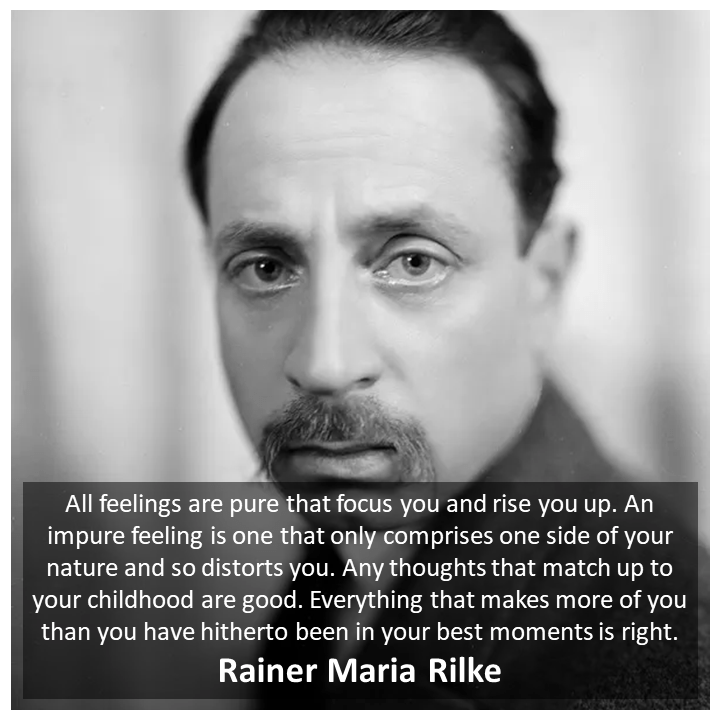
“All feelings are pure that focus you and rise you up. An impure feeling is one that only comprises one side of your nature and so distorts you. Any thoughts that match up to your childhood are good. Everything that makes more of you than you have hitherto been in your best moments is right.”

– Rainer Maria Rilke, Letters to a Young Poet

Rilke beautifully explains what is right and what is wrong. You have to appreciate that this idea of right and wrong is not based on some religious ideas or some scientific evidences. Although most of the times people resort to either of these given ideologies. What Rilke explains is the way of inner judgement born out of pure solitude. When you isolate your inner world from the external influences, you will realize that the inner child filled with all the curiosity, intrigue and innocence is still there waiting to explore the world. You will find that this is what you are actually but the outer influences made you to twist and morph your core. You will understand that you feel things differently when you are looking inwards. The feelings will remain the same but how you respond changes drastically.

In order to appreciate this I will pose an example: look out for the authors who wrote murder mysteries, psychopathic thrillers or some melodrama with tragedy. The thing to observe is how they are in real life; some actor who played a deadly sinister villain and then look how he/she is in real life. You will see that most of the times the gap between how they live and what they portray is totally different rather polar opposites. This way of artistic performance is only possible when one is aware of what emotions they are going through. They know why they are feeling this and are masters of artificially creating them too. This awareness is possible only if the person has cultivated his inner world deeply.  

Feelings are one inseparable part of this inner world. They could be of sadness, happiness, pleasure, anger, anxiety, or jealousy. On surface, it may seem that feelings emerge from external factors but what people always forget, is that one can consciously recognize those feelings and select a constructive response towards them; especially when the feelings are negative. Feelings if mishandled could be devastating and if recognized properly can bring about a revolution in the inner world and the external world thereafter. The very volatility of feelings is their strength and weakness simultaneously. What Rilke wanted is to acknowledge every such emotions for they are not there to remain forever. And that is exactly why he defines the right-ness and wrongness of feelings in completely radical ways. That is also why the childlike innocence is very important for there is no prejudice when one is passing through given emotions. Feelings are the response to reality and not a way to become sad or happy. Rilke wants every artist to use this in their creative pursuit. This is the secret of authenticity – to feel everything that you are feeling instead of getting flown away with it, let it pass but don’t get overwhelmed by them.

That is exactly why life filled with so many multitudes of emotions, feelings would make sense even when they are not on helping term with you. You will see that even such ‘bad’ feelings will open new portal to new creative journeys. For any artist cultivation of emotions especially the negative ones thus become highly important.

Letter 10 – Art is a part of life, life is bigger than art but at the same time, life is futile without art

“Art too is only a way of living, and it is possible, however one live, to prepare oneself for it without knowing; in every real situation we are nearer to it;…”

– Rainer Maria Rilke, Letters to a Young Poet

It is not compulsory to end your artistic journey into the creation of your magnum opus or the masterpiece of your life. What art should do is to make you appreciate the life around you on deeper and richer levels. Once one learns this, they will find art in every aspect of life, which by the way is also an artistic take on living life. The life you are living itself is a masterful creation. Rilke wants the creative person to honor that beautiful creation by remaining worthy of it. 

So, this is it. I would recommend every person to read through these 10 letters written by Rainer Maria Rilke to Mr. Kappus. They are not some letters intended to communicate with each other. These 10 letters are guidelines for the people on their creative journey whatever it may be.

In today’s times the written communication has become so handy and easy that you can send millions of sentences from one end of the globe to the another within few milliseconds. This convenience of communication has stolen away the sanctity, sanity and strength of the words and emotions they invoke which were actually supposed to transform our worlds in better constructive ways. After reading these letters from Rilke you will appreciate how effectively he distilled down the divine wisdom of life in few pages. A book costing less than one time meal can transform your whole life. This is the power of a true artist.

That is exactly how a simple scribble by true artist becomes a sermon to whole world. People worship it forever. Authenticity, empathy, and patience make it happen.      

The Free Spirit – Beyond Good and Evil

The journey to the freedom demands solitude thereby making man responsible, accountable for the consequences of his every thought and action. Friedrich Nietzsche in his book Beyond Good and Evil paved a way for future philosophers to establish their own new perspectives about the truth where there are no two sides – good-bad, sad-happy, moral-immoral, beautiful-ugly, calm-disturbing but a revised and better version of the older truth. Nietzsche in this book focused on the refinement of our perspectives, our versions of truths for the real freedom because immediately surrendering to already established versions of ideologies is the worst imprisonment any man can have. Nietzsche showed how badly our ignorance creates an illusion of freedom and how to come out of it. This is to remember Friedrich Nietzsche on his death anniversary.

Remembering Friedrich Nietzsche on his death anniversary

Friedrich Nietzsche is one of the most impactful philosophers we as a humanity have ever seen. Reading Nietzsche is a task in itself. But the moment you start getting hold of the things that Nietzsche is trying point to, you will literally undergo transformation. The path that Nietzsche paved inspired many modern philosophers, thinkers, writers. To not mention Nietzsche is to do injustice with our understanding of ourselves as the human beings. This is one attempt to revisit Nietzsche’s ideas in his famous book called “Beyond Good and Evil”, especially his ideas on free Spirit.

Nietzsche in his special style clarified what it means to be really free and how we develop our perceptions, philosophies about the world around us and ourselves.

This is me remembering Nietzsche on his death anniversary. His ideas will keep on living forever.

Oversimplification kills the nuances thereby changing the big picture

Nietzsche strikes powerfully on the idea of understanding the life as simple and easy. It’s a humorous way in which he tried to convey how we consider living life as way to goodness, happiness, pleasure and freedom. The sentences that Nietzsche used to put his ideas about life are built in such a way that you will start questioning the happy nature of the life we desire. You will realize that during the process of understanding life as a pleasurable, happy experience we have submitted our thought process only to the side of pleasure, happiness, and truth. This presumption about life always deviates our search for the truth – “the happiness” that we lookout for as a biased pursuit. Here Nietzsche is not saying that if ‘this’ which you are trying to justify life with is true then it’s opposite is wrong; he is trying to point us towards the idea that as we have attributed life to a happy and pleasurable experience, this attribution has oversimplified what life actually is. Oversimplification has happened because not everyone can understand complex ideas on equal level. It’s not because people are dumb, it is because we have our own ways of interpreting the world around us and the ways through which we interpret the world are totally subjective. Thus, the truth if it exists, it will never be absolute but based on perspectives one has.

“We have contrived to retain our ignorance in order to enjoy an almost inconceivable freedom, thoughtlessness, imprudence, heartiness, and gaiety – in order to enjoy life!”

In order to make everyone appreciate given idea of life on same level we have oversimplified what life is and such oversimplified foundation has led to building even more oversimplified versions of so-called truth. In the pursuit of clarity and ease of interpretation and communication our lives have become false!

That is why Nietzsche here tried to attack the very fundamental way in which we try to break down the things we come across when we live through them. See it in this way, if life by default was supposed to be simple then it is implied that we would have grip on every aspect of life and existence. We know that’s is not the reality. So, if it is not simple then it must be complicated is our next thought. Thus, if life is complicated in reality then oversimplification eliminates certain aspects of life which we keep on missing in the search of truth.

You know what, Nietzsche further explains that when we are denying that life is not simple and happy that also should not invite it being opposite of what was earlier thought i.e., sad and complicated. Nietzsche rejects the idea of polar opposite to portray the lives we live. He calls life, knowledge as the process of “refinement”.

It’s not duality of any aspect of the philosophy, good and bad side of life but the ways and times they have refined themselves which should be the parameter of their worth.

The Death of Philosopher

Nietzsche had his way to express verbal anguish. The sentences are so dense that the prose feels literally repulsive. I think it was intentional. His writings were never meant to be read while sipping coffee or to romanticize the philosophy or the idea of life. They will make sense to those who really want to understand what he is trying to say. Nietzsche in his next idea talks about how every philosopher is trying to find the meaning of life and thereby his/her truth of life. He despises the idea of life or philosophy being explained with a single idea. That is why he sarcastically calls philosophers as the protectors of truth, the thing which itself doesn’t need protection in first place!

Nietzsche thus calls out to the philosopher to get ready accept the martyrdom, the death of their idea of philosophy. The philosopher can only carry his point forward for further refinement but he/she must not – cannot define the life in whole with that simple idea. That idea has to die in the process so that newer refined ideas can be built out of its broken pieces.

In order for philosophy to exist it has to end, it has to kill its older version – that is what is the tragedy of philosophy is as Nietzsche goes.

The Freedom Paradox

When Nietzsche is trying to initiate treatise on freedom, he starts with what it means to be free for any person. One important observation he puts in front is how we get freedom on personal level. On surface it feels if the person is free on personal level, then it is easy to be free in society as a whole. But Nietzsche shows that these ideas of freedom are paradoxical! Man goes inward for the freedom because he/she knows that there is no one else to tie, bound him/her inside his privacy. The man seeking freedom when interacts with the crowd soon realizes that his experiences of life are bound to how crowd handles him, reacts to him, treats him, shapes him. That is unsettling, the burden is difficult to carry for single person hence the man again resorts to privacy, in order to do that he has to let go of certain truths and create his own little lies so that the external crowd won’t disturb his “freedom”.     

(the man) he was not made, he was not predestined for knowledge”

The point Nietzsche is trying to make here is that the taste of freedom comes with the unsettling feeling of existence. But as a man we are not seeking that freedom for us; freedom is some citadel, a happy place where we expect to have control over course of things. The real freedom as Nietzsche explains will be gained by being in touch with crowd (which sounds paradoxical again) It’s like saying you will understand what you real singular identity is when you start mixing yourselves with the crowd!

Nietzsche further advises philosophers of the future to not turn away from the unsettling ideas about philosophy. He takes support of cynicism to make his point. Cynicism bases itself on the idea that people are selfish, self-interested (so in simple words if anything doesn’t go the way a cynic wants, they would whine and create reasons to justify it.) Nietzsche expects the future philosophers to understand the difference between ill-speaker and bad speaker. The lovers of knowledge should also be able to understand what is unsettling, maybe their lies the next opportunity for better version of their philosophy.

The Freedom of Expression

Nietzsche had already explained how things lose their essence in oversimplification. In same fashion it becomes difficult to interpret what a fast thinker is thinking and then explain it to the relatively slow thinkers and make them appreciate the same idea on same level. Even in our thinking we are not free. You can create an explanation for others to understand what you are thinking but they themselves have to climb up (or climb down sometimes) to your level to appreciate what you are thinking, you may succeed in expression but interpretation, comprehension and its appreciation gets limited by the levels on which others are thinking. (My question, if this is the case then even if you are a free thinker, are you truly a free thinker? I know Nietzsche is paradoxical most of the times)

“What is most difficult to render from one language into another is the tempo of its style, which has its basis in the character of the race, or to speak more physiologically, in the average tempo of the assimilation of its nutriment.”

Nietzsche further builds this “so called” freedom of expression using the limitations of the language. Language is the culmination and mirror of the culture it originated from. So, naturally each language has its own style, flow, breaks, rules and ways to highlight certain aspects of narration. When such languages is used to express an individual’s ideas, the speaker has to let go of the nuances of his culture, his primary way of life so that others having another culture, another way of life can appreciate and understand what he is trying to convey, but what if the nuances were the only thing which made that idea influential? Then the influence of the idea would be lost because of the translation. (This is Nietzsche’s way saying lost in translation!)

The Tragedy of Independence

Another way to become free is to become independent. The very few lines Nietzsche uses to explain independence are equivalent of an atomic bomb! (trust me it is still not an overstatement!!!)

People who become independent are few as Nietzsche says and those who are strong can easily achieve it. This independence is also one way to be free. When a man becomes independent, he is on his own, there is no one like him – he is alone. Nothing is anything alike him – he is alone. Thus the whole world becomes a puzzle for him as he is on his own. Any direction becomes new path for him. As he is the only one like himself, there is no one who would reach to his level and match his thinking. And in such case if he needs sympathy, people cannot even sympathize with him because they are not on his level. What a tragedy! The sadness he has in his heart, mind is rendered useless because others around him are not able to comprehend it – sympathizing gets ruled out automatically.

This is Nietzsche’s way of saying what Hemingway said. (I mean both meant the same although Hemingway came later, but you get the point) You must understand that happiness is not the real pursuit of life, then you won’t feel tragic about what Hemingway is trying to convey here, same is what Nietzsche trying to convey here. Freedom by independence can be a tragedy for the person who was expecting glory out of it.

Foolishness Hides Chances For New Insights

Nietzsche here is trying to remove the lines between what is good and what is bad, what is allowed and what is forbidden.

“That which serves the higher class of men for nourishment or refreshment, must be almost poison to an entirely different and lower order of human beings”

In modern crude sense, Nietzsche says “one man’s trash is another man’s treasure”!

Same idea, same act will have different perception of morality, scale of right and wrong. A rebel thinker in common poor public could be attributed to a philosopher amongst the riches. A murderer who killed an evil landlord could become a saint among the people who were victims of this landlord’s oppression.

So, Nietzsche’s attribution of foolishness is a way to point out the exceptional, outlier acts, prohibited acts, crimes to find the better truths. That will make you freer than others.

The Freedom of Youth   

 The stage of youth feels like the freest stage of all the stages of life and it is so because it has let go of the nuances. It also feels free because the youth in the stage of exploration never submits to right or wrong, yes or no to the life as Nietzsche says. But as the time passes when the youth is exposed to disillusions, broken expectations they try to modify themselves in a way that will get things done the way they wanted – the compromise starts to enter. The moment this happens the same youth tries to punish themselves as Nietzsche says. The freedom exists no more, so is the youth.

The Freedom of Actions

(Again, this a hydrogen bomb on morality!!!)

How can we say that the given action is right or wrong?

Nietzsche has very interesting thought process on this question. In the starting times the action was right or wrong based on what it led to – its consequences – the effect. The problem with this thinking is that one has to wait to let the action happen to decide its rightness or wrongness. If the stakes are high, such attribution of right or wrong can be devastating.

So, Nietzsche takes support of Chinese idea where the parents are responsible for the betterment of their child. Meaning that the origin of the thought which led to that action should be the decider of whether the action is right or wrong. Nietzsche called this pre-moral period of mankind. And sarcastically he points out that we have made a total turn around the idea of right or wrong action. Earlier it was what happened after the action i.e., consequences; now it is what led to that action, meaning what was happening before that action i.e., the origin which is the decider of right and wrong of any action!

This is where the origin of action gets named as ‘moral’ which is generated from self- knowledge. Later these morals evolved into “intentions”. As Nietzsche says, intentions serve as the origin of any action.

“people were agreed in the belief that the value of an action lay in the value of its intention. The intention as the sole origin and antecedent history of an action: under the influence of this prejudice moral praise and blame have been bestowed, and men have judged and even philosophized almost up to the present day”

Nietzsche then drops another bomb called – unintentional actions. We are clear that whether action is right or wrong can be decided by the intent. But what if there was no intent or there are no other ways to pinpoint the intent behind certain actions? There is a possibility that the intent may get mistranslated, misinterpreted during the unfolding of events, then how would you decide the attribution of given action.

In such case we would again go to the effect- the consequences of that action!!! You see what is happening here? We might have to resort to that older measuring system of action based on their consequences.

This is Nietzsche’s style to question how we think of morality in general and also on deeper level.

(I can’t resist praising Nietzsche lesser but deep down I know he would question his own worship too!)

The next attack Nietzsche does by using morality is the sentiment of sacrifice. The basis of his thought process is that you should question everything that gives you pleasure at least once. Here, he shows how fake the feeling of sacrifice for others, surrender could be if it is intended to display how moral and virtuous you are!

“There is far too much witchery and sugar in the sentiments “for others” and “not for myself””

In simple words, you are saying that I like to help others because it makes me happy. So, in order to help others you have to become selfless, but if becoming selfless to help others makes you happy, doesn’t that make you selfish? You are selfless because you are selfish!!! (Disclaimer: Nietzsche is paradoxical.) The paradox is resolved when you accept that you are just taking support of morality to display you higher value. Being selfless is just a better excuse to display your high morality. It there was any cruel way to display your high morality no wonder you would have gone for that!!!

In modern ways, it’s fox’s way to say the grapes are sour or I am a virgin because I am waiting for someone special (In reality fox cannot reach the grapes and the person is not able to appreciate other person or people rejected that person continuously – please note that I am not blaming someone’s character – it’s the limitation of language that prevents me from expressing what I am thinking for oversimplification. As Nietzsche has already shown that oversimplification kills the nuances. You get the point!)

The Immoral Philosopher – The Free Philosopher

Building upon the ideas of nuances lost in translation, right and wrong in morality Nietzsche calls the future philosophers to go beyond the dichotomy of philosophy and also distrust the morality in the development of new philosophy, new truth.

“In all seriousness the innocence of thinkers has something touching and respect-inspiring in it, which even nowadays permits them to wait upon the consciousness with the request that it will give them honest answers”

This is Nietzsche’s way to show that in order to find the new truth new philosophy, new philosophers have submitted themselves childishly and blindly to the principles of morality hoping that morality will give them new answers. But it is the same tinted glass of morality that prevents them from getting new perspectives. Hence, he calls them naïve here. They must let go of this childishness.

“The belief in “immediate certainties” is a moral naivete which does honor to us philosophers; but – we have now to cease being “merely moral” men!”

This is Nietzsche’s way of saying it’s good to be bad!

For Nietzsche, morality shows only two sides of reality- right or wrong, this works fine if reality is really dichotomized. But we know there is no such thing as right or wrong for every real-life scenario. So, in order to find the real truth, you have to let go of morality, then you will see that reality has its spectrum and people residing on different biases of such reality have their own attribution of right and wrong for the same action. Morality is the subset of newer truth, not the other way around.

‘il ne cherche le vrai que pour faire le bien

(he who searches truth to do good) – I wager he finds nothing!

 Nietzsche make his point by him being the first bad-philosopher!!! (This is why I am loving him more and more. It’s like a brainiac with full grown muscles if you want to picture him thematically!)

The Freedom From Passions and Reality – Will to Power

Nietzsche makes an attempt to show that the reality could also be made up of something totally different that we can even comprehend. What if the world is more real than what we can experience? And if such reality exists, our senses will limit us from experiencing it. So, in order to be free in such reality we have to rise above our senses. That would be the new freedom. Our senses are bound to desires and passions whose interactions – impulses are creating thoughts.  

So, building on these impulses Nietzsche says that many emotions, processes are created in “our reality”. What would make any of such impulses, process free from others? He introduces the idea of causality to show the flow and root of everything. If cause leads to an effect and further that effect becomes cause to newer effect then it is possible that the root cause of all would make us really free. Nietzsche further explains that it can also be one of the processes which would overpower others to become free and not the root one. (For example, the first unicellular organisms would be the most powerful organisms on earth today, that is not the case.)

Here Nietzsche introduces the concept of Will to Power. Whatever overpowers the other processes has the potential to remain in the big game and thus has real chance to be free. Will to power in any process allows it to gain more freedom.

This is Nietzsche’s Darwinian theory of evolution – the survival of the fittest. (I know it is a bastardized translation, but again I summon the loss of nuances during translation.)   

Then Nietzsche puts the idea that by this way of thinking the originator does not necessarily be the most powerful one, thereby questioning the existence of the God! Because if the God was the originator, then then he/she would exist only if he/she has the highest Will to Power. That also does not mean that if God does not exist then devil exists or has the highest Will to Power. It could be anything! We are not sure for now. (typical philosophical answer!)

Using causality, Nietzsche also questions the morality of French revolution. If for the locals the royalty was cruel that is why the revolution happened then why didn’t the remotely located people who considered them noble in first place considered them cruel too? In the eyes of remotely located people the French royalty had a noble past. (The question is intended to think on it not to find the right and wrong. It shows how flawed our thinking becomes when we stick to morality blindly.) Whoever came in power overthrew the less powerful. That is one way to explain Nietzsche’s Will to Power. According to Nietzsche, if Napoleon would have been continuously invested in the morality of his actions he wouldn’t have become the great emperor.

Freedom From Truth

Here Nietzsche starts with the very obvious and common fact that some truths are unsettling. Not every truth ensures happiness. Only an idealist, as Nietzsche says would submit the idea of truth that brings joy, happiness, and beauty.

Here comes Nietzsche’s biggest drop-

“the strength of a mind might be measured by the amount of “truth” it could endure – or to speak more plainly, by the extent to which it required truth attenuated, veiled, sweetened, damped, and falsified”

This is self-explanatory. It is just our unsettlement that we need to take care of while looking for the truth. We are thinking animals and thinking is a result of our impulses, desires, and passions. So, not every truth is destined to bring us peace. ‘We would die if we eat poison’ – is a truth which unsettles everyone but that is not how we react to such truths, we prepare for such bad events, that is the wisdom what Nietzsche is talking about in a crude way here.

“There is no doubt that for the discovery of certain portions of truth the wicked and unfortunate are more favorably situated and have greater likelihood of success; not to speak wicked of who are happy- a species about whom moralist are silent. Perhaps severity and craft are more favorable conditions for the development of strong, independent spirits and philosophers than gentle, refined, yielding good-nature, and habit of taking things easily, which are prized, and rightly prized in a learned man.”

Nietzsche prefers learned man more than the moralistic or the virtuous one. A learned man knows the consequences of learning new truth, or sometimes even unaware of it but he does not pivot his happiness on the discovery of new truth. What else could you make freer when you are ready to accept the truth in its crude and real form! This freedom will bring clarity, new perspective and not happiness or sadness or chaos or calmness.

Truth will not decide how and what you are. You just will have added new tinted glass in your collection of perspectives towards life and reality and the philosophy behind all of them.  If your Will to Power is good your truth may become the truth for all others.

Freedom From Identity

The profoundness demands the rejection of submission to any side of existence. If one promotes certain ideology the people around him/ her will try to comprehend that person using the tags they have in their own minds for that idea. The mask thus brings in that ambiguity where people are not associating, tagging you to one definite truth. Even your mind can start creating bias if you let it. That is why Nietzsche focuses on mask in profoundness.

“A man who has depths in his shame meets his destiny and his delicate decisions upon paths which few ever reach, and with regard to the existence of which his nearest and most intimate friends may be ignorant; his mortal danger conceals itself from their eyes, and equally so his regained security.”

The mask frees you from attribution thereby biases and even the socio-economical influences. You will never let honor or shame, right or wrong, good or bad, happy or sad justify the events in your life. You will never ever flinch to enter an unsettling adventure which guarantees your growth personally. Embarrassment, failure will just be another emotional response for you (please note that this does not mean that you will be emotionless, it means that you will be able to recognize your emotions and let them pass.)

This is exactly why I would force everyone to understand Nietzsche on their own level!!!    

“Every profound spirit needs a mask; nay, more, around every profound spirit there continually grows a mask, owing to the constantly false, that is to say, superficial interpretation of every word he utters, every step he takes, every sign of life he manifests”

This could also be one reason why some the greatest personality humanity has ever seen had a layer of controversial ambiguity around them.

From the idea of mask, Nietzsche moves to the idea of its conservation. The conservation is meant to define the philosophy of containing who you are rather that you submitting to some ideology. Whatever you have collected as an individual, whatever you are on philosophical level personally, how you have upgraded – refined your philosophy you must conserve that instead of giving to some ideology. The mask helps to conserve who you are.

“One must know how to conserve oneself – the best test of independence”

(this could be the reason why superheroes wear masks!!!  Joke aside but it is one powerful thought)   

Further Nietzsche warns new future philosophers to not be people pleaser or submitter to temptations. That will steal them of their judgement and independence.

Freedom From Your Version of Truth

The ways in which Nietzsche is trying to close his arguments are really beautiful. He knows that when the future philosophers will have discovered their new truths in their journey of blood, sweat and tears, it is natural that they will get attached to it. Such is the human tendency. He wants us to get rid of the obsession with this new truth. This truth even if it’s the newer one will create boundaries in your perception, you won’t be free anymore! Nietzsche wants to let the future philosophers let go of the dogma.

“In the end things must be as they are and have always been – the great things remain for the great, the abysses for the profound, the delicacies and thrills for the refined, and, to sum up shortly, everything rare for the rare”

Freedom From Illusion of Freedom

On closing notes Nietzsche has advised new philosophers to be careful of the “freedom” they are being offered under new socio-political ideas. Nietzsche focuses here on the ways new philosophers are embarking on the journey to new truths. He tells that having fluency in speech and effective grip on written communication will not define you as the new philosophers, even though they are one aspect of it. But the systems having higher Will to Power will use same tools to control new philosophers and change the course to their versions of truth.

New philosophers will be misled with words like “Equality of Rights”, “Sympathy with All Sufferers”, “Modern Ideas” but they should be careful about them. They should be aware that the moment they create a thought process the people on different levels with different Will to Power will interpret these same ideas for their own benefit especially the ideas which are polar opposites of your ideas. Once such separation happens nobody, not even you cannot get the real freedom.  

Nietzsche offers the rule of solitude while embarking on such journey. Only you can free yourself.