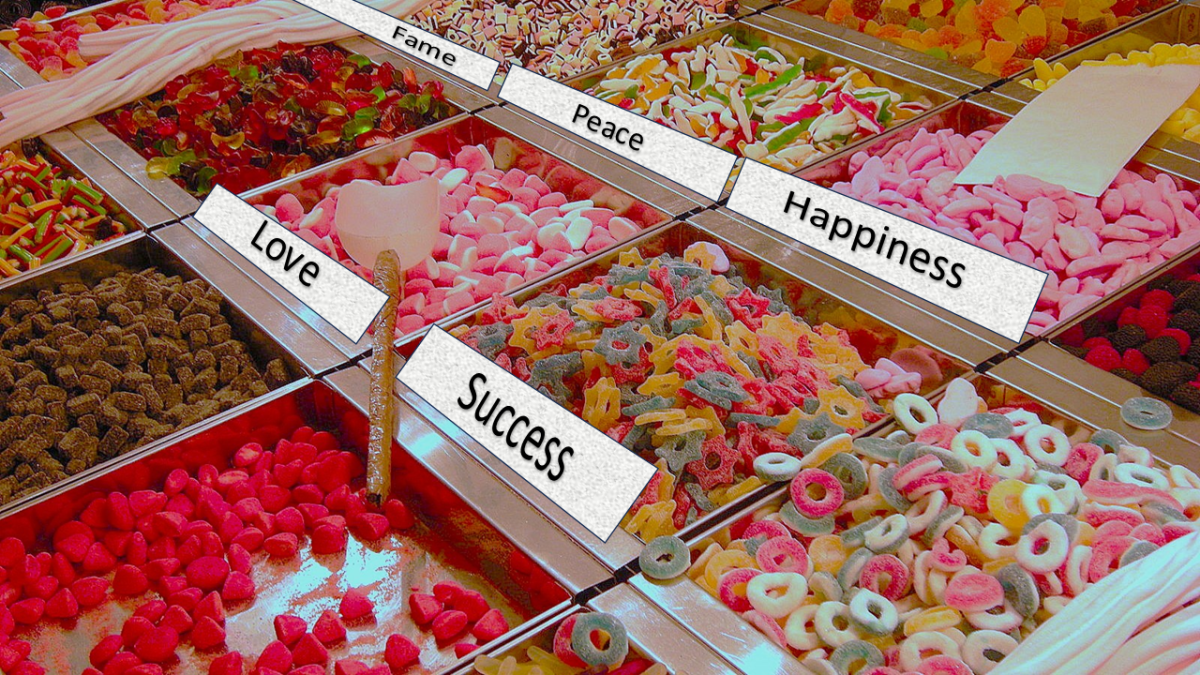
The Essence of Nominalism

Is happiness, love – sadness, hatred just the names we have given certain things? Is that why after achieving something great we fill empty and become clueless about what’s next? Is there something common, universal, essential characteristic shared across things that create reality? Or are we just putting labels on things so we can put them in our brains effectively?
Nominalism says that there is nothing common shared between all the objects existing in reality. Love could be anything for anyone, you cannot pinpoint an object absolute, consistent and repetitive nature across reality and put it in a box and call it love. Same for hatred. Nominalism thus sheds light on how things are more than just their labels and why it is dangerous to chase things if their labels/ tags are the sole motivation for you. There is more to reality of things we are chasing than meets the eye.

Are we just chasing labels, tags in life until we die?
Question- What does Success, Love, Happiness and God mean to you?

Is Reality Same for Everyone?

Do We Share a Common Reality?

Human intelligence is one interesting thing. We can perceive things in better ways, classify them, observe them and use all those understandings to predict the outcome of events in satisfactorily good way, we can create non-existent things out of current given resources which elevate the ways we carry out our living – our lifestyle. The ability to develop various fields of knowledge and understand the reality is the basis of human civilization.

So, we can say that anything which gets distilled down to a specific understanding – an understanding which is consistent throughout our existence can be called as knowledge – knowledge with experience further gets distilled down to wisdom. Even though the knowledge of certain things is not consistent we at least know why it isn’t consistent or we have a well-rounded explanation that ‘this’ is an exception with fair justifications. Knowledge helps us to perceive how the things, ideas around us can be used to build things, the life we want.

The ability to see commonalities and differences between things, objects, ideologies is one important part of how we build our understanding about reality in which we exist. We have notions of right and wrong, black and white, past, present and future, tall and short, thick and thin, good and evil, strong and weak. These attributions help us to identify certain common aspects in things and certain uncommon aspects in the same things.

So, when I am saying Rose – you will understand that I am talking about a flower which looks red, has a particular fragrance. Words thereby names are at the core of how we build knowledge of the surrounding and the reality.

There is one more interesting thing happening here –

When I would say Rose – it is a possibility that someone would understand it as a girl he/she knows, someone would imagine it as a color which somewhat is red but richer in shades, someone would imagine the prickly thorns instead of the gentle nature of the flower.

What’s happening here? The moment I am trying to specify something – some object with a word – a name which shows some common attribute that object shares with others, in that same moment I am failing to describe that object, that idea in its complete capacity.

In our example, the word Rose on surface seems to indicate just a flower, but Rose could mean almost anything to anyone. Rose is just a simple object we are talking about; now imagine how would we define the reality we live in? The reality is multifaceted. People have different experiences, meanings, understandings of reality based on their personal experiences. Does that mean that there is nothing common between the reality we live in? Do we live in our own realities?

Does that mean that words assigned to the things are not what the things are? That the name of objects are just names? Everything that is there is one and only individual rendition of its own? If nothing is same then how do we agree on something common and set our lives to that way? How come we agree to certain religion and follow that? How come we agree that certain things are bad and we should avoid those? How come we appreciate what is happiness and try to achieve that in our existence?

I mean what if happiness is just of name something and goodness is name of the other which does not exist in reality and we are just blindly chasing it? (and we don’t even make out of it alive in the end!) What if we are just chasing names and “there exists nothing like it” – is our realization when we actually achieve that?

Is “the reality” really made of something very fundamental and shared qualities? Or are we just carrying our lives in the chaos of dissimilar (but seemingly similar on surface) things? Even though we call ourselves as humans how come some humans create examples out of their lives that they don’t deserve to be called as humans? How come some humans are so great that calling them humans is disrespecting their life?

Is there something really common among everything or are we just labeling things on whim (or intentionally) to solve the confusions of our minds? Are we living in a matrix and reality is totally different place than where we exist? Are hell and heaven more real that the earth we are living in?

Have we been robbed of the real understanding of reality and cursed to live in an illusion called life?

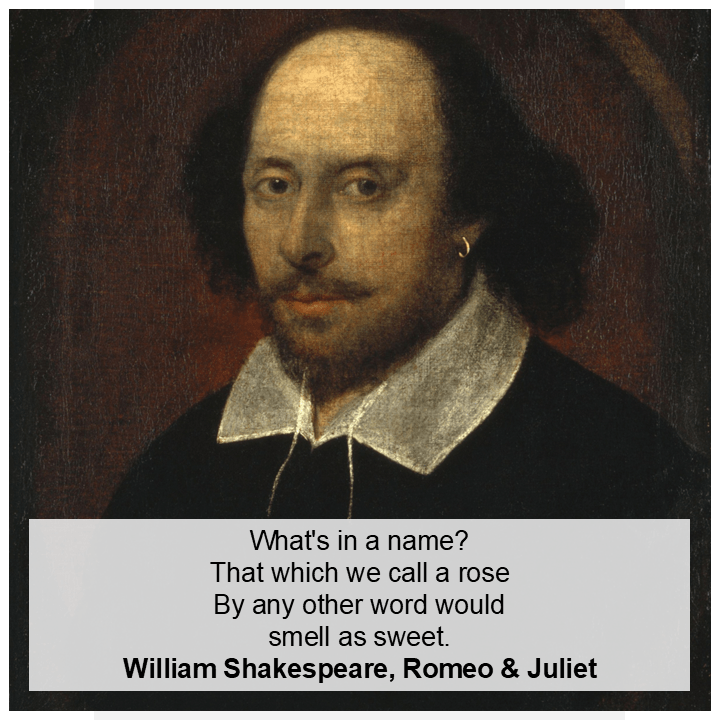
I mean I could have called the Rose an egg right from the beginning and everybody would have been fine with it. It’s just that now the egg is a flower, has red petals, has thorns and has fragrance. (Shakespeare would have also used egg for Juliet’s dialogue and everybody would have been fine with it. As everyone now knows and agrees what an egg is!)

Now you should appreciate how strongly we are conditioned right from the beginning. Calling an egg a Rose feels unnatural but if someone right from the beginning of the beginning would have called it an egg, we would be comfortable with egg in Shakespeare’s dialogue.  

Is there really anything like “Red” color, “Grey” color?

A simple experiment

Look at the picture below:

It’s easy to tell that the cube has one white and one grey colored side.

Now see what happens when I put a blind along the edge of the sides:

There is no manipulation in this image, I have just put a colored box to hide the edges. You can blind the main image with finger and see the same result.

This is popularly called as “Cornsweet Illusion” or “Craik-O’Brien-Cornsweet effect”. This illusion works because our brains try to fill the unavailable information to make sense of the things observed. In this case of the cube example our visual interpretation system tries to determine the edges/ sides of the object by the sudden changes in the illumination of the surfaces.

From this example, you can appreciate how our brain tries to fill in the gaps between the information we are collecting.

Does that mean that there is nothing like what I call grey or white? that there is something totally different for which I am yet to assign a name just to make its identification easy. If that is the case, then are we just naming things in the name of knowledge and don’t have actual hold of the reality? Are we just pretending to be smart just because we can name the things?

Keep in mind we are not simply talking about naming things. If my brain tries to fill the gaps by itself to create a sense of understanding, some part of truth or reality which I carry in my beliefs – are they real or were they some gaps filled by my brain itself?

Following the same train of thought, here is an important question –

Obviously, no one by birth knows what is the “real” nature of reality is? (Otherwise, we would not be discussing all this). You will see that people know reality for how their life experiences turned out to be. They know what reality is, but not all have one singular, absolute concurrence, alignment and unanimous opinion about the nature of reality.
An important idea in philosophy called nominalism tried to question reality in this way (there is a part when the opposite of Nominalism is Realism! I will cover realism in next post). For that we will try to understand what Nominalism tries to solve.

Is there something common characteristic shared across things that create reality? Or are we just putting labels on things so we can differentiate?

Nominalism – There Are Just Names No Essences

William of Ockham is the guy responsible to popularize Nominalism in philosophy although he is not the originator of it. Ockham’s Razor is one very mainstream idea still useful in our pursuits of knowledge. I have covered Ockham’s Razor in separate post.

I think, it is a high possibility that Nominalism and Ockham’s Razor have strong connection not just because they were popularized by the same person but how they align themselves with each other to create a consistent argument.

Ockham’s Razor goes like this –

“Plurality should not be posited without necessity”

In simple words, do not interpret, do not deduce unnecessary things unless they are presented or experienced. (I have somewhat twisted the meaning to align the Ockham’s Razor to align with the train of thoughts and there is hardly anything mistaken here.)

My purpose to rephrase Ockham’s Razor is to connect our brain’s habit to fill unknown gaps with our pursuit of the real nature of reality we live in.

Nominalism thus calls out for the reality which individuals experience for themselves. There is nothing common between the life that we are sharing. Every object existing is an individual, special object in itself. Objects never share something common between them, it may be just our brains filling in the unknown gaps to make sense out of reality and have peace of mind. The labels like Red, Love, Justice, Truth, Loyalty, Happiness are not physical entities, absolute entities which exist in reality. We have created these labels so that we can sort certain thing in certain groups to create a model of reality in our energy optimizing brains.

This is really important point – that things we call real are just labels given by us. A Rose could have been an egg from its creation and nobody would have objected it.

Consequences of Nominalism

Nominalism – in simple words says that there is nothing common shared between all the objects existing in reality. Love could be anything for anyone, you cannot pinpoint an object absolute, consistent and repetitive across reality and put it in a box and call it love. Same for hatred. Same goes for the notion of beauty, fear, justice, truth and what not. Justice is not some type of molecule or an element which can be physically hunted, mined, rigged in reality. It is a label we have created for certain way of things. But, upon full magnification we will see that that certain way of things grouped together are highly individualistic – seeming that they are not same in any way.

Nominalism pointed one interesting observation – the things exist in their individual ways; we are just labeling certain aspects of them so that they can be grouped together or compared against one another.

Do you understand what this leads to? For me it is chaos.

It means that there is no such thing like love, justice, joy, happiness, affection, truth, utopia, passion, enthusiasm, redness, whiteness.

It also means that there is nothing like hatred, unfairness, fear, sadness, fakeness, lie.

These are only labels we are chasing in some scenes and in some scenes running away from or avoiding.

This leads to the conclusion that there is no pivot to the life we are living and the reality in which we exist. This is unsettling – this unsettling feeling leads to existential crisis.

One can here say that Nominalism bridges Phenomenology and Existentialism in better ways in philosophy.

Phenomenology talks about objectively understanding and interpreting reality through subjective experiences. (The one where objective and subjective appear in the same sentence!) It calls for the truth to be one which is realized through personal experiences – phenomenon happening with the individual.

Existentialism talks about the idea that there is no center or pivot to the reality we live in. This is a freedom in such an intense dosage that if we are not creating our own pivot for our own life the sheer possibilities emerging from freedom will overwhelm us concluding that there really isn’t such meaning or sense to life.

Nominalism says that there is no real common thing which can be distilled down between seemingly same things, things were never the same – there is no “essence” which exists across certain seemingly same things. There is no such thing like “universal” which is consistent across the objects in reality. Everything exists individually on its own. One has to experience things for themselves to see their real nature.

It is just your urge to rationalize things so that your brains will save energy. Rationalization is all about making sense of the things, and if everything has its own way of being our minds cannot store each and every aspect of those individual things all the time, thus we have resorted to the pursuit of “essence”, “universality” and hence “labels”.

Conclusion

William of Ockham’s Nominalism from medieval philosophy is reiterated in modern philosophy through Existentialism, Absurdism.

Jean-Paul Sartre – the French Existential philosopher thus talks about how labels are always fooling us. We think our life made to be defined by the achievements of certain labels where upon deeper inspection we see that the labels are mere a creation of our minds, they are how we interpret reality. They are not reality in themselves. Reality was already there even when labels were not there.

This is how Sartre call out Existential philosophy – “Existence precedes essence” and not the reverse “Essence precedes existence”. The later one is just a construct of our mind to create meaning in this meaningless world.

The very freedom granted to us becomes our enemy because we are clueless when we realise that we can do anything. This is where Absurdism peeks in.

Boundaries of Nominalism

There will be different reactions to the explanation of nominalism and that itself will show you how varying types of people exist and their individual renditions of the reality. But interestingly you will find “type” of reactions in people.

One will not immediately agree but everyone on deep inspection will accept this that we always crave for justification for everything that happens with us, it could be in our favor or against us. We crave for justification which will bring peace to our mind, in happiness this peace will amplify happiness and in challenging situations it will give us something to blame.

Once you start appreciating our habit to justify every damn thing you will suddenly see that Nominalism is pretty much good concept in philosophy. Nominalism when says that essences, shared attributes are just labels and nothing real, it warns us that the justification you are trying to give for your situation might just be your construct of mind and not real. Nominalism feels attractive because it feeds attitude of skepticism, which is the first tool of the person in the quest for the absolute truth.

On the other side, nominalism has its innate limitations too. If nominalism is true then it is not there as nominalism itself is our “labeling” to the concept of “not labeling everything together”.

This is where paradoxes begin. If there really was nothing common “essence” among certain grouped things, then it was impossible to group them in first place. So, essence must exist already (this feels even more paradoxical.)

We will search for resolution of these paradoxes in next post on Realism.

Related reading:
A Trade-off Between Simplicity & The Reality

Minding The Gap Between Ego & Reality

We are so tied to our minds, our self, our ego that we can only see what our mind is conditioned to see; and the expanse of mind is so vast, that we consider the inability to gauge its limit to its infinite-ness. But, in self-observation we will see that reality is far bigger than our mind. Mind cannot be bigger than reality although it can create a perfect illusion of it being bigger than reality. When we realise how reactive our mind is, how conditioned our mind is we see that it’s the reality in which we are existing and not the mind. Mind is just a facilitator to create a sense of security. The real creativity thus begins when one lets go of their minds, thoughts and observe reality for what it is.
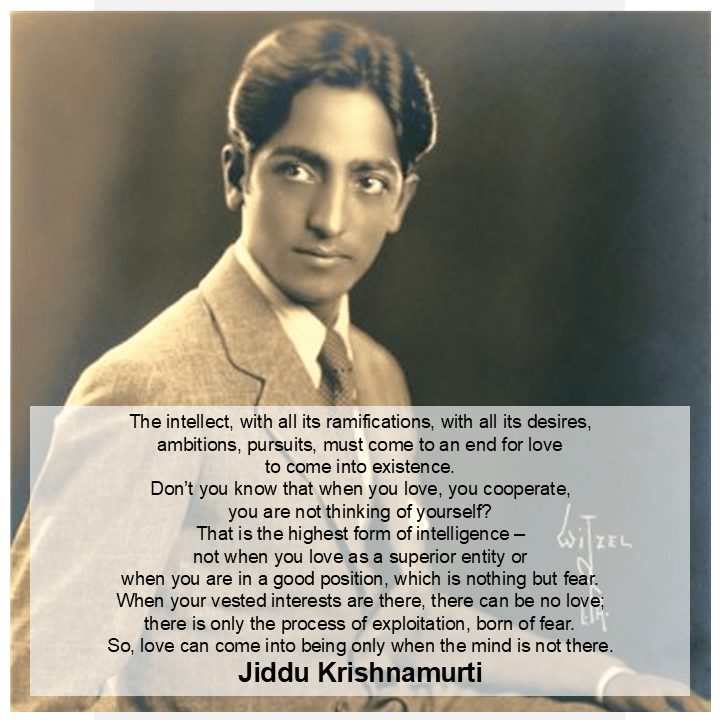
The real intelligence is to be able to see how you are fooling yourselves and how it is twisting your world view. This is possible only when we let go of the self. Love is the fastest and the most direct way to let go of self. Love is the way to get rid of the ego. Loving something, loving someone is the first step towards rejecting the very ego which is responsible for self-deception.
Jiddu Krishnamurti thus encouraged everyone to let go of their egos through self-less love; this itself is enough to solve all the existential conflicts inside us and out there in the world.

Part 3 – Jiddu Krishnamurti’s legacy of self-knowledge

What do you do when you realize fundamentally or deeply that thought cannot end itself? What happens? Watch yourself. When you are fully aware if ‘this fact’, what happens?

(‘this fact’ here refers to an observation that ‘discipline’ doesn’t destroy the self, rather it strengthens it because ‘the self’ created that discipline in the first place)

You understand that any reaction is conditioned and that, through conditioning, there can be no freedom either at the beginning or at the end – and freedom is always at the beginning and not at the end.”

– J Krishnamurti, The function of the Mind

We, the humans are driven by curiosity. The curiosity to survive – to put in few words. One might say that people are driven by fear, greed, envy, anxiety, power, love, money, fame, glory, sacrifice, humility, honesty, trust, legacy, mania, chaos, terror, and what not. The list is never ending. If you start questioning the origin all such attributes, you will see that humans can be driven by anything, I mean any anything. There is no connecting link per say; the only common thing between all the things which drive people is the people themselves. So, in the last question (possibly the last one) we end up questioning ourselves. We see that along with physical survival we are highly conscious of our non-physical survival. Some may call it the mental survival, some may call it ideological survival, some may even call it spiritual survival. In the end, what we are trying to preserve is the eternal existence of our consciousness. How to preserve this? becomes the question then. That is why in final question we see that we are curious to preserve our own being. That is the ultimate survival. Whatever can facilitate that preservation is the driving force for our existence. If you are scared of something, the fear of that thing will create a curiosity to look out for the ways in which you can avoid it.

Now you will realise that the attributes which are many and driving people in different ways are highly related to the ways people think about themselves and about their surroundings. The identities, the consciousness which we are trying to preserve forever is highly the function of the society we grew up in, the religion we followed, the ideals we admired, the enemies we despised, the culture we cultivated and carried over to the newer generations.

I might be making an overstatement here-

Only those who have undergone unlearning, un-conditioning or at least appreciated the process of unlearning can clearly see how badly we are tied to our thoughts and ultimately our minds.

Death of thinking is death of mind. When they say that ideas live forever – it is also an attempt to ensure eternal survival of a certain type of mind, for mind is not a physical entity to us. Realizing the perishable nature of our body, the mind becomes the most potent entity to ensure the survival of our being.

Then, what’s wrong in ensuring the eternal survival our consciousness?

We will see how Jiddu Krishnamurti showed the reality of our existence. As I have already said, he is the perfect person at perfect time to ask the perfect question.

Short answer is – we are so tied to our minds that we can only see what our mind is conditioned to see; and the expanse of mind is so vast, that we consider the inability to gauge its limit to its infinite-ness. But, in self-observation we will see that reality is far bigger than our mind. Mind cannot be bigger than reality although it can create a perfect illusion of it being bigger than reality. When we realise how reactive our mind is, how conditioned our mind is we see that it’s the reality in which we are existing and not the mind. Mind is just a facilitator to create a sense of security. The real creativity thus begins when one lets go of their minds, thoughts and observe reality for what it is.     

In Part 1, I have explained J Krishnamurti’s views on our urge for safety thereby happiness, how we use our thoughts to conveniently justify anything and everything to create that sense of safety, the ways in which our thoughts are stealing the actual reality holding multitudes of possibilities.

In Part 2, I have explained how thoughts originate, how curiosity drives them. It contains Krishnamurti’s observations on how we try to separate thinking to glorify ‘our version’ of wishful reality. Krishnamurti shows us that the moment we reject the separation of our thoughts from ourselves, that is the moment we see that we were just reactive to everything around us. We become observer of the reality for what it is, once we let go the glorification of ‘our thoughts’ – the self.

Now, we will question the very originator of the self – our Mind. Krishnamurti’s observations were revolutionary about the mind. This Part 3 will focus on that and also tie up the previous 2 parts together with it.

Existence Of The Mind – What Is The Mind?

“When you observe your own thinking, you will see it is an isolated, fragmentary process. You are thinking according to your reactions, the reactions of your memory, of your experiences, of your knowledge, of your belief.”

J Krishnamurti, The function of the Mind

When we are truly in the territory of observation without any preconception, prejudice, we see what thoughts actually do. Thoughts just try to hook on to something that we are familiar with – it could be good or bad. Thoughts literally create a chain. One link creates sense – logic – connection to another, one train of thought after another. Then we create the whole understanding. Thinking is always reactive. Keep this in mind – thinking is always reactive. If you let thoughts build on themselves, it is amazing to observe what world we create just by our thoughts. The moment you inject certain intent, desire to this world, it immediately deviates from the reality. But, as this world of thoughts has your intent, your desire, it creates that world of safety; we don’t want to lose that familiarity, that comfort. Now as this world contains our desires it becomes our second identity. As the thoughts keep building on, you start associating these set of your thoughts as who you are. This is your non-physical identity now. You now strive to make sure that this non-physical identity lives till eternity.

After seeing this you will see that the mind is the custodian of thoughts, desires, wishes. A wish to be safe to prolong survival, desire to make that prolonged existence happier one, thoughts to support those wishes – desires. Mind is thus picking desirable ideologies, disciplines which will keep feeding the train of thoughts, the chain of thoughts. Thoughts want to ensure their own survival because we have assumed survival of our thoughts as our survival. (Keep in mind we haven’t even started the discussion about reality.)

So, mind is a sieve which keeps on separating the desirable and undesirable parts of reality. There is nothing wrong in that. What happens here which is problematic is our tendency to lean towards the desirable reality only. When mind would see desirable reality, it will start using the power of compounding of thoughts to create a wishful reality which we call as our identity – our self. We want to preserve self to ensure that things that we desire survive. Whatever is not the self, it is the others – the undesirable. The moment mind makes this separation – ego intensifies.

“Our whole tendency is to be separated. Can the mind do anything else but that? Is it possible for the mind not to think separately in a self-enclosed manner, fragmentarily? That is impossible. So, we worship the mind; the mind is extraordinarily important.”   

J Krishnamurti, The function of the Mind

Without separation, our mind fails to recognize itself. If it is not able to separate itself from rest of the things, it cannot feed the desires. If desires are not fed, we will be constantly looking cluelessly for a sense of belonging, a place of security.

Here, I see one tragedy of being human rather an animal. I will explain it:

See there is a possibility that we are free from all the desires. One can be free from all the desires of the world. So, it is a real possibility that man is free from the cage of thoughts, mind and desires and fully observant of the reality around him without any imposition or prejudice right from the birth.

What is the tragedy of every animal is that they are born with the tendency to live (otherwise how would they get in the world in first place, maybe the baby doesn’t even know what is required to survive, so possibly the sense of survival naturally gets transferred from parents to the baby). Have you seen a baby who wants to die the moment he is born? Rather the baby starts crying the moment it senses absence of parental presence or absence of security. By birth we have a survival urge. Evolution has pushed this urge in us from physical to non-physical one. As we have better chances to ensure physical survival we now care more about the survival of our non-physical version. Mind thus becomes very important, thereby consciousness becomes important. That is why if physical survival is not guaranteed, we wish that at least our consciousness lives forever. That is exactly why we praise the minds we have.

Over the time, our desires take over this mind and we then keep on conditioning it with culture, religion, society, community in a certain way. The familiarity of physical body gets further amplified in familiarity of certain way of thinking, certain religion, certain philosophy, certain profession, certain degree, certain community, certain country. The more we find ideas, thoughts familiar to ours the more we want to cling to them. The more we want to reinforce that version of self. We are always separating what reality shows in terms of whether it is favorable to us or not. That is why even if mind and consciousness seem infinite, you will observe that our thoughts have compounded in such an extreme way that we are unable to measure their limits. We have attributed this inability of those compounded thoughts to the infinite-ness of our mind.

If our mind truly is infinite then we should be able to predict the reality or at least handle the undesirability that reality may present in better ways. We all know how disappointed we are with the reality. This shows how strongly we have conditioned our minds towards certain way – that certain way we call our identity, our self, our ego.

“Until we understand how to transcend this separative thinking, this process of giving emphasis to the ‘me’ and the ‘mine’, whether in the collective form or in individual form, we shall not have peace; we shall have constant conflict and wars. Our problem is how to bring an end to the separative process of thought. Can the thought ever destroy the self, thought being the process of verbalization and of reaction? Thought is nothing else but reaction; thought is not creative.”

-J Krishnamurti, The function of the Mind

Now you will appreciate what un-learning can do to our life. It opens a completely different and real world in front of us. Un-learning is the rejection of what we assumed to be true to support our identity. Although it feels uncomfortable, sometimes completely hostile but there is no bigger freedom than the acceptance and implementation of unlearning. It is renewal, evolution of our very being.

The key point is to understand that we are not our mind, we can be bigger than our mind. That needs the rejection of the idea of self. Once we are observant of how dangerously conditioned, prejudices, favored our minds are we will see how we through the agency of our mind are twisting the reality to create the sense of security. The more we twist it, more deviated we are from reality.

And as I already explained that somehow this sense of separation and thereby self-preservation is in our genes by birth, we have to train ourselves to get rid of that sense. Keep in mind that this does not mean self-jeopardization. This plainly means that not imposing our ways on reality to create the sense of security thereby higher chances of preservation of self. That is why unlearning is extremely important.

Reactive Mind Vs Objective Reality

“Do not superimpose what it should do, how it should think or act and so on: that would amount to making mere statements.”

-J Krishnamurti, The function of the Mind

Once you think that you have full control of your mind, the mind will use this sense of its separation from you to build chains of thoughts to support itself. In the end, it all started from you. The moment you see that you and your mind are the same, you accept its conditioning. Now you have a baseline to see the reality. Now you know how your mind is bending the reality. This is the freedom, to see things as they are. 

Now that we are understanding that sense of safety was the goal of everything that we are doing all along, we see that our conditioning thereby our thinking and thus our mind in the end are the reason behind all the suffering we go through. Once we see that our mind was the main culprit, we realise that it will be difficult rather impossible to punish my mind, discipline my mind because the more I try to control my mind – more I try to discipline it, the more it reacts, the more it creates thoughts and evades away from the reality. It tries to preserve its identity.

Only when you observe that you are your mind conditioned in certain way to preserve the non-physical existence then you understand the reality you live in. You still have those conditioned thoughts but now you neither want to promote them or suppress them. You are now an observer of the reality. This is an interesting observation.  

“When I want to understand, look at something. I don’t’ have to think about it – I look at it. The moment I begin to think, to have ideas, opinions about it, I am already in a state of distraction, looking away from the thing which I must understand.”

J Krishnamurti, Can thinking solve our problems?

There is one important confusion we must address here:

If I am rejecting the thoughts that I have, the mind that I have, the consciousness that I have – what remains of me? Wouldn’t I end up in an existential crisis? Won’t that shatter my compass? If I am not associated with certain things, how would I make sense of my actions? If I am not able to make sense of my actions or at least the things happening around me, how would I prepare myself to survive in this world? This will completely jeopardize my existence.

The answer is pretty simple if you have read till this sentence:

Rejection of mind as a separate entity is the answer. Unlearning the process of isolation to understand the reality is the answer. Wishful observation is the key problem in the ways we are trying to live the life. Thinking is the second name for wishful observation. You are expecting reality to become something in your ways so you attach certain justification to extract that desirable meaning from the reality you are observing. You are doing this to generate sense of safety, which further ensures eternal survival.

So, it’s not about rejecting mind or the thoughts. It’s observing how our mind, thoughts are already conditioned before we are trying to understand the reality. It’s like we are seeing the reality with certain tint of prejudices and expectations. We have to let go of that filter. We are so attached to this filter because world looks the way we want in this filter, that this tinted illusion has become our reality. The moment someone shatters that filter we end in existential crisis.

You must appreciate that it’s not about hating the prejudices, conditioning or sacrificing yourselves completely to a selfless act. It’s being aware that you have those prejudices when you are observing reality. This self-awareness is what Krishnamurti focused on.

The moment you will try to reject certain thing and accept the another i.e., your mind – you will create certain framework of justifications and you will deceive yourself.

The idea is to know how you are fooling yourselves which is preventing you from understanding the reality.

Delulu is not the solulu. Rather delulu is the best way to reject the very life you are living.

“To have blank mind is to be in a state of stupor, idiocy or what you will, and your instinctive reaction is to reject it. But surely a mind that is very quiet, a mind that is not distracted by its own thought, a mind that is open, can look a t the problem very directly and very simply. And it is this capacity to look without any distraction at our problems that Is the only solution. For that there must be a quiet, tranquil mind.”

J Krishnamurti, Can thinking solve our problems?

Love – Cure To Self-Deception And Surrender To Reality

You know that moment in any pop culture media where the final answer is love? Let me spoil everything for you. The answer to everything is love.

(Be cautious while reading next part, it’s not just that type of love and I am definitely not conditioned to prefer love as the answer. Even for a skeptic, love being the final answer has worthy support. It also guarantees that we can understand the reality for what it is.)

I always had this cringe feeling when everything grand in the narrative ended up with a justification of love. Even the great authors, logical authors, great scientists, great atheists never feel shame to express the power of love and it being the answer to everything. Trust me, I have made every attempt to find the evidences where love might not be the final answer to everything. But turns out that I would never find any evidence against love being the final answer.

The core reason is that we ourselves are the final problem. Let us see how Krishnamurti came to the conclusion of love being the ultimate answer:

“When you realize that any reaction is a form of conditioning and therefore gives continuity to the self in different ways, what actually takes place? You must be very clear in this matter. Belief, knowledge, discipline, experience, the whole process of achieving a result, or an end ambition, becoming something in this life or in future life – all these area process of isolation, a process which brings destruction, misery, wars from which there is no escape through collective action, however much you may be threatened with concentration camp and all the rest of it.”

J Krishnamurti, The Function of Mind

Now that you have come to the last part of the discussion, it is not a new understanding when I say that our sense of self is reinforced by the desire to support certain way of our conditioning. This steals from us the ability to perceive reality in the way it presents itself. We are always seeing the reality with certain conditioning and trying to change it so that it favors our ways. But as we have illusioned, conditioned understanding of reality, the reality rarely presents itself in the ways we desire it to be. Then we end up in sadness and sorrow and start questioning the futility of our existence. That is why ‘what is the purpose of my existence?’ is the common format of the existential questions for all of us.

What Krishnamurti tried to focus on is different question –

Why am I not experiencing life the way it is?

What is preventing me to live the life the way it is, living the life to its fullest?

The answer is pretty simple now. It’s our conditioning which urges us to prefer certain ways and reject the others. This brings the happiness and sadness. In the efforts to maximize happiness and minimize sadness we have created a system of mind and thoughts to alleviate the pains of suffering – thoughts justify everything. We deceive ourselves with justifications.   

“So long as we deceive ourselves in any form, there can be no love. So long as the mind is capable of creating and imposing upon itself a delusion, it obviously separates itself from collective or integrated understanding.”

-J Krishnamurti, The function of the Mind

What does the love do in all this confusion?

Love is the direct way to let go of self. Love is the way to get rid off the ego. Loving something, loving someone is the first steps towards rejecting the very ego which is responsible for self-deception. Even if you are delusional, your actions influenced by those delusions towards the things you love, the people you love will yield unwanted outcomes; and if you truly love them, you will be compelled to let go of the delusion for the benefit of your loved ones.  Thus, being selfless through love in true sense ensures real freedom.

Conclusion – Why Is Love Answer To Everything?

“We see the ways of the intellect but we do not see the way of love. The way of love is not to be found through the intellect.”

-J Krishnamurti, The function of the Mind

We saw in Part 1 how and why we crave for safety, familiarity. It ensures our physical and non-physical survival with better odds and most importantly with better satisfaction.

We saw in Part 2 how we dissociate ourselves from our mind and thoughts to create a false sense of safety if the reality does not turn out the way we want. We may delude ourselves if the reality is hurting us. We use thoughts to justify unfairness the reality presents. Our religions, politics, our ideals, everything that we have created now has an innate purpose of creating a safety net. We want to remain in this net because we don’t want the happiness to end. We have intellectualized our minds in such a way that we have justification for every ridiculous illusion and tragedy is that we call it the limitlessness of the mind, infinite nature of the mind.

I am not erasing the idea that the mind is limitless. If our minds – we – ourselves are truly limitless then we should immediately be able to see beyond the seemingly adverse revelations of the reality. Which is the holy gist of all these detailed inquiries of the self.

Then what was the problem with the mind?

The very limitless nature of reality would enable us to become limitless. But is it our delusional clinging to certain way of life for safety which is stealing the real understanding and appreciation of limitless reality. We are clinging to highly complicated and highly compounded thoughts, the way of thinking just because it reinforces the ego.

The real intelligence is to be able to see how you are fooling yourselves and how it is twisting your world view.   

After going through what Krishnamurti made us observe, you will realise that whatever must be said has been said already. We have just accepted our delusions because we are fully clung to the way have been living our lives, the way we have been conditioned.

When you are loving someone, there is very slim chance that they will be exactly the way you want them to be. There is plausible reason to say this because the infinite possibilities of reality mold people in different ways. There may be many things in common but the more you know the sooner you will realise that people are filled with different types of conditioning. This will first push you to reject their point of view naturally, then you will try to impose your way on them, your ideologies on them, your conditioning on them. In the final analysis, you will see your ways of worldview failing on them. This is the moment when you will reject your own world view, thereby your ego. Now you will neither reject or accept other people’s worldviews nor will you cling to your ego. Now for the sake of love, you will objectively observe the reality for what it is.

This is how love compels you to let go of your ego. That is why love is the answer to everything because you are the last question of all the investigations of the existence. You will let go of the concept of the self once you start to appreciate things other than you and accept the reality the way it is. What a beautiful way to live!    

“Only when you discard completely, through understanding, the whole structure of the self, can that which is eternal, timeless, immeasurable, come into being. You cannot go to it; it comes to you.”   

-J Krishnamurti, The function of the Mind

References and further reading:
  1. Truth is a pathless land – J Krishnamurti
  2. The First and Last Freedom – J Krishnamurti
  3. Jiddu Krishnamurti’s Legacy Of Self-Knowledge : Part 1 – The Liberation From Thinking and Thoughts
  4. Jiddu Krishnamurti’s Legacy Of Self-Knowledge: Part 2 – Being Watchful Of The Ebb And Flow Of Life
  5. Featured Image of Phantom Galaxy M74 by James Web Space Telescope

Freedom = Courage (Now + Here)

When it comes to psychology – people consider Sigmund Freud and Carl Jung as the de facto rock-stars of the field of psychology. One unnoticed person whose findings deserve equal attention rather more attention was Alfred Adler. He introduced the Individual Psychology to the world which is relevant still today and is way more sophisticated to solve the “so called” troubles of our life. Individual psychology makes a successful attempt to reach to the roots of our suffering and allows us to become truly free.
Alfred Adler’s philosophy is beautifully explained in Ichiro Kishimi and Fumitake Koga’s book “The Courage To Be Disliked”. It talks about the feedback loop of self-acceptance, confidence in others and contribution to others to live a real and fulfilled life. The great thing about individual psychology is that it urges us to break the notion of causality and thereby determinism to come out of the painful, suffering inducing cycles of life & death, cause & effect. It shows us that we live in the universe with infinite possibilities and one needs courage to break the logic of determinism to truly appreciate themselves and the infinite possibilities universe has to offer. Individual psychology given by Alfred Adler thus asks us to bear the courage to lose the false-comfort given by causality – predictability and decide our life on our own terms fearlessly and with freedom. It teaches how one can be completely involved in everything but not attached to them at the same time.

On the book – The Courage to be disliked

‘The world is simple, and life is too.’

I have a question for you,

– How is life treating you right now?

Everyone knows that the responses to this question are diverse and dynamic. The answers obviously will be subjective and so it is normal to expect huge variety.

But you know what, deep down everyone (mostly the adults) know the most frequent type of the answer to this simple question. There is innate predictability about what the answer could be.

Life is not treating me fair

Life has become too complicated for me, life is suffering, there is no hope, why can’t I have a single moment of happiness to savor for some time? why do bad things happen to only me? what have I done wrong to someone that ‘everyone’ has turned against me? what should I do – now that I have not achieved what I was supposed to achieve in spite of putting all honest efforts? why is ‘everyone’ – the society always against me when all I have for others is good will?

Deep down we have this undeclared, unexpressed notion that something wrong happened to me which I didn’t deserve. I tried so hard but couldn’t achieve that thing. Trust me every one of us is an expert of hiding these unsettling feelings, overlooking them to move ahead. But it is important to understand that unknowingly they become part of who we are. When we truly and honestly would start inspecting ourselves, we will find these feelings being the reason for the bitterness we carry inside. That is why life is suffering for most of us, being free then is out of the question. First let me be happy for now!

Psychology has always been on the quest of resolving the model of how our mind works. A bigger portion of psychology directly or indirectly works towards understanding how we see happiness and suffering. Because, end goal of how we feel, how we think, how we decide, how we interact, how our personality is created is emerged from either a happy event or sad event which affect why our psyche is in a certain way.

When it comes to psychology – people consider Sigmund Freud and Carl Jung as the de facto rock-stars of the field of psychology. One unnoticed person whose findings deserve equal attention rather more attention was Alfred Adler. He introduced the Individual Psychology (Individualpsychologie) to the world which is relevant still today and is way more sophisticated to solve the “so called” troubles of our life. Individual psychology makes a successful attempt to reach to the roots of our suffering and allows us to become truly free.

I appreciated this in deeper sense when I came across a book called “The courage to be disliked”. A single book can change your life. Although I have been changed many times before, I couldn’t help but overstate the importance of this special book. 

This is my attempt to reorganize the ideas from the book to instantly simplify the core ideas. So, the next discussion may spoil the book for you. (Although it’s not a story book having a climax at the end but the ideas are written in a conversational – dialogue format so, you peel out one layer at a time to reach to the core ideas of individual psychology.)    

I am actually spoiling the whole book and my writing on the same heron with these few sentences:

The whole thing boils down how you honor this current moment and not let it be influenced by the fear of past and the anxiety of the future. This complete dedication to the current moment is only possible if you honor yourself first, because only you can experience how this current moment will turn out for you. The moment you start to respect this moment here and now – you will be free.

If you have the ability to love, love yourself first

Carl Jung

Now that I have already explained what life ultimately boils down to, it will be important to understand why these sentences hold some gravitas. So, thanks for continuing with me hereon.

Deny trauma – Deny the comfort of causality

The core of individual psychology is the rejection of the causality. Our complete understanding of ourselves and the world we live in is based on the notion of cause and effect. It does immediately feel silly to reject that exact notion thereby making individual psychology illogical.

You will appreciate that not everything in whole can completely be justified or predicted with complete precision using the logic of cause and effect. There will always be some information that cannot be completely known for the given system (Heisenberg’s uncertainty principal points in the same direction). Our mind always makes decision, assumptions based on the current information, experiences we have till date and every one know that it is impossible to have all the information and all experiences that are there in the world for a person to understand his/her own existence.

So, in simple words – ‘who we are’ goes beyond the logic of cause and effect. You can be free once you break the chains of cause and effect. In the universe filled with infinite possibilities, there will always be something wrong and illogical, totally disconnected justification to the things happening to you and around you. It will be an injustice if you let that illogical justification define your whole upcoming life.

When we say that I became a person like this because something happened to me in past where I learned my lesson and changed myself into something else, we are just trying to convince ourselves to do things in certain way so that we will have less resistance to get things done in our ways. That is exactly where problems start emerging.

We crave for causality because it grants value to past; because it taught us some valuable outcomes and same causality can help us to predict what would happen in future. We always crave for certainty. But all of us know this by experience that we are rarely good at predicting our future. This furthermore unsettles the mind.

So, trauma is the pre-side-effect of causality (the post-side-effect of causality is the anxiety of the uncertainty of the future). We carry our traumas as badges to flaunt because these traumas feel very personal thus exclusive. The ways in which we carve out our personality from these traumatic experiences gives us a sense of special-ness. These bad experiences, traumas are a big part of our personality maybe due to a survival mechanism implying ‘I should be able to cope up with similar thing if they happen to me in future.’

See, the point is that if we stick to our traumas and fixate our personality on the same, we will never be able to explore the concepts that had better potential to improve our personality (and probably not be traumatic, bitter). We will be stuck in that loop of experiences related to that causality. Given that there are infinite possibilities, there is fair chance than we can be even better than what we were and what happened to us in the past. We are just better at finding reasons to justify our current position because we know we are comfortable here.        

No matter what has occurred in your life up to this point, it should have no bearing at all on how you live from now on.

It might seem that when we are rejecting causality, we are choosing a non-nonsensical path. In reality, we are just avoiding the ways in which we are always fooling ourselves to remain in comfort of predictability. Using the excuse of causality, we are actually ‘inventing’ non-real reasons which hide the realest reality we can actually live.

The first principle is that you must not fool yourself and you are the easiest person to fool.

Richard P. Feynman

Once you deny this causality which you think made you who you are, you will immediately see who you really are. You will leave that burden behind. You will accept yourself for who you are. You will see that you can instantly detach yourselves from your past and your future too. The untapped possibilities open up.

This is self-acceptance in individual psychology.

Once you see how important you yourself are to live your own life, you will say –

“Before past and future let me at least appreciate my own current moment”.

That is now and here. Once you come to the terms with yourself you will realize how everyone is just like you even though we are separated by many aspects of life. Then you will appreciate how others have their own current moments to live and experience in their own ways.

All problems are interpersonal relationship problems – others have their own current moments to experience in their own ways

It is fundamentally impossible for a person to live life completely alone, and it is only in social contexts that the person becomes an ‘individual’.

Nobody can deny the fact that our surroundings make us who we are. Our baselines are our surroundings. A human being is the most basic unit of any society. Our understanding and awareness of self is impossible without a response from surrounding. How would you understand who you are if you never received any reaction, feedback from your surrounding? – It will be a delusional existence. You would have had an idea of who you are but would have been far from what is real.

Thus, when you start seeing that your surrounding will always be interacting with you, you will be able to see every reaction – feedback from surrounding especially people can never be completely cut off. This again feels senseless. If you are born alone, leave this world alone then why couldn’t me being alone throughout my existence be more justified? It is because we never had any sense of absoluteness right from our birth and this sense of absoluteness always remains un-achieved, it is just an ideal condition we are always trying to reach. Our core understandings are only possible with the relativeness, comparison of baselines.

That is exactly why even when you are trying to live your life alone, that ‘loneliness’ itself cannot be justified if there is no understanding of what being ‘together’ means. So, there will always be something connecting you to your surroundings. That is where relationship comes in picture. You cannot run away from interpersonal relationship. You will be surrounded by people (or at least what made them you even when you are sitting lonely).    

So, when you are appreciating your current moment, it is natural that others will be respecting their current moments. This understanding will make you appreciate the importance of everyone’s being.

This will make the world around you seem less hostile. You will be filled with kindness for others.

So, you must first accept yourself first otherwise you will not come out of the hideous cycle of comfort of predictability, once you accept yourself to remain in now and here you start seeing here and now of others. You start valuing their here and now. That is why you start allowing people to be who they are, you stop expecting from others. You stop expecting your recognition from others, you stop pleasing people for your own good in the end.

Now that you are free from the burden and pursuit of desirable and predictable, anticipated feedback from surrounding you become tolerant of criticism and even dislike from others. That is truly when you are free. I want to focus on my now and here and nobody can stop me from experiencing that. Then you see this as the basic requirement for others too. This is exactly here the person becomes tolerant towards others. People start putting confidence in each other to create that safe space – the real safe space. People start respecting each other’s boundaries because they themselves have understood that they have their own limitations. This creates the sense of camaraderie – society.   

It is precisely because we lay a foundation of unconditional confidence that it is possible for us to build a deep relationship.

This is confidence in others in individual psychology.

Discard other people’s tasks – reject the desire for recognition and accept that you being disliked is not in your hands

When you are appreciating your own now and here to its fullest, you will notice how important it is to reject all other distractions to honor this moment. You will limit these distractions to focus more on this moment. This is where you will see that even though we are molded by our society we have limitations and so do the others. So, it is better if one sets boundaries.

Setting such boundaries helps everyone to focus on their ‘now and here’ in deeper and richer ways.     

If you are not living your life for yourself, then who is going to live it for you?

When one develops this understanding, they will clearly see what lies immediately in their own control and what not. If you are busy in trying to control what cannot be controlled by you, how would you have enough resources to appreciate your ‘here and now’? That why it is important to not focus on what you can’t control. Those will be someone else’s to control, that is not you task. That is exactly why you cannot pressurize people to do things in your ways. People can have their own reasons, limitations to not do things in your ways. It has to come from their side.

Forcing change while ignoring the person’s intention will only lead to an intense reaction.

Building on this understanding, you will start appreciating how doing what you love and not expecting anything in return is more than enough. You did what you love. Whether to appreciate it and recognize it, praise it is in other’s control not yours. Now that you have accepted yourself, you do it for yourself, then you won’t crave for attention from others, then you don’t crave for superiority, dominance. You come on level to level with your surroundings. You appreciate that whatever one wants to become that journey has to be completed by only them. Then you appreciate how we are trying to please others to get things done in our way when they were never in our control. You let go of the things which you cannot control and start focusing on what you can. That is why it is normal that some people (who were trying to get things done from you in their ways) will dislike you for not doing them in their own ways. This shows that you are honoring your ‘now and here’   

The cost of freedom in interpersonal relationship is that one is disliked by other people

Once you understand that it’s normal to be disliked, rather that indicates that we are doing our own thing you will appreciate what it really means to be genuinely be appreciated by society. Then you will feel like transferring this feeling to others too. Now that you have experienced this feeling for yourself, you would genuinely want others to feel that to. The things then you will do for others will have no intent of return because you very well know that returning favor is other people’s task.

If one’s means for gaining a feeling of contribution turns out to be ‘being recognised by others’, in the long run, one will have no choice but to walk through life in accordance with other people’s wishes.

The feeling and act of contribution has to be selfless and this selflessness is possible only when you are valuing your ‘now and here’. If you still are not valuing your ‘now and here’, it is very easy for you to get swayed by the likes of others and then you will end up in pleasing others and whether others will be pleased by what you did for that recognition is not in your control. This means the most probable fate is misery.

So, self-acceptance builds courage to do it in your way whether others like it or not. This detachment from opinions of others pushes you to do the things which were impossible before – what else is freedom them?  Then you understand the value of self-acceptance. You will then have the selfless feeling to let others experience and understand this. This selfless act for others will feed back into your sense of own being. This will support your feeling of self-acceptance. Once you close this feed-back loop, you will see what others are missing. You will help others in the real way. This will create the sense of belonging for you which further creates the real sense of meaning in life.

 This is contribution to others in individual psychology.

Where the center of the world is – there is no absolute cause and effectthere is no such thing as the first start and the last end

If you are ‘the center of the world’, you will have no thoughts whatsoever regarding commitment to the community; because everyone else is ‘someone who will do something for me’, and there is no need for you to do things yourself.  But you are not the center of the universe and neither am I.

Adler’s individual psychology thus focuses on a feedback loop of three key things:

One – Self-acceptance – you are who you are ‘now and here’, not what made you who you are

Once you accept yourself you give yourself better chances to live an earnest life 

Two – Confidence in others – now that you have appreciated how valuable, irreplaceable and incomparable living in ‘now and here’ is, you let people do their own thing because they have their own ‘now and here’. You put confidence in others, you do it not because you want something in return because returning the favor is in their control. This builds the real sense of community, belonging, safe space.

Three – Contribution to others – Once you start believing in people just like the person you are you appreciate what it means to be felt accepted. You try to support this feeling by contributing back to your safe space. You want it to be done by yourself because you now know that contributing back is in your control – your task. This further crystallizes your sense of self-acceptance.

Now that you have appreciated what it means to become truly free, it is normal to reject the false sense of superiority, false sense of being special. Every moment becomes same to you. This does not mean that you become numb to sadness or happiness. It just means that you appreciate that this too shall pass, all I have to live and experience is ‘now’. You lose the idea of a goal to be achieved and accept the real goal, the real target is to become the process.

Life goes on

For a human being, the greatest unhappiness is not being able to like oneself.

Although our existence is bound by birth and death, cause and effect. The reality filled with infinite possibilities does not follow that logic and we fail to notice that difference. Just to make the sense of the infinite possibilities we resort to certain assumptions, prejudices, reasons, past events, future expectations. We never question them with complete honesty because questioning them will bring existential crisis. We all know that our foundations really are not pure or absolute. Once you accept this you will see that it is very easy and important to accept who you are now. This further induces kindness for others. This creates the community. This is called Holism in individual psychology.

You must appreciate how causality brings in determinism in our lives. This determinism is kind of responsible for the lack of freedom in our lives. When we are suffering it is this exact determinism imparted by causality that builds helplessness. One must carry the courage to break out of this determinism. The courage is necessary because we never want to let go the comfort of predictability which determinism offers.

We resort to certain version of our life story when we are completely aware that we can totally change our life story. We are always taking the support of ‘I am like this because this happened to me’. This is how everyone’s story is. There are very few people who have dared to say – ‘I have gone through this for long but not anymore.’ This requires for you to appreciate yourselves first, when you accept who you are you move on to the path of improvement whereas when you are trying to act according to the like of people around you, you are actually proving the point that you don’t like the version that you are that is why you are ready to become the one which people would like and tragedy of this path is that the task of being liked by others is not in your control.

That is why whining about why we didn’t reach there would never help us to reach there or even embark on journey in that direction. We are hesitating to make our own move.

As long as we postpone life, we can never go anywhere, and will only pass our days one after the next in dull monotony, because we think of here and now as just a preparatory period.

Be real, not a hypocrite

People want to like themselves. They want to feel that they have worth. In order to feel that, they want a feeling of contribution that tells them ‘I am of use to someone’. And they seek recognition from others as an easy means for gaining that feeling of contribution.

The main reason Adler’s individual psychology didn’t receive enough attention is because it feels completely self-contradicting and hypocritical on surface level.

You will find these seeming contradictions everywhere in Adler’s ideas. It will say that we are social animals and are defined by society but in next moment it will say that you need to have the courage to be disliked by the people around you.

One time it says that you should not interfere in other people’s tasks and next time it says that you need to have a feeling of contribution for the same people.

One time it will say that you have to sever the relationships where others are not realizing their own tasks and making life difficult for you and on the other hand it will say that you should be unconditionally confident in others endlessly.

One time it will say that you should completely focus on yourselves and then it will say that you are part of a bigger family, bigger universe and you will be happy when you contribute to this bigger community to create a sense of belonging.

If I am being disliked then how the hell would I be happy?!?

If you inspect each of these seemingly contradicting ideas you will find one simple fact – the fact that we are walking living paradoxes and in spite of that we demand sense and logic about who we are.

The sense of self or individual cannot be appreciated well if you never know what it means to be surrounded by people. And there is always some interchange happening between individuals which makes it a society. We often see society as a group which is everything minus ‘I’. We fail to recognize that if I fix myself in certain way the others around me will fix themselves in response to that way and then most of the individuals who constitute the society will fix themselves in certain way. Means even a single person can effectively change the society.

What people actually miss when they come across the ideas put forth by Alfred Adler is the possibility that we can truly reject causality. I would call this unawareness the curse for the humanity. Our sense of ‘being’ inherently originates from some non-absolute attributes, relative references that we have to accept them as the ultimate truth right from our birth to make the sense out of all these infinite possibilities.

We are so entangled in the suffering and happiness waving between the life and death that we ignore that we are born, dead and again reborn every moment. The trick that causality plays in our life is that it tries to preserve the previous step to justify our current stage thereby freezing our present. Whereas what we should do is to just be in now and here which needs courage because there is no guaranteed layout, map to guide you. You have to walk your path all by yourself.

What people fail to notice is that the comfort of predictability is just in this moment but this sense of comfort has no control over future rather it intensifies the pain due to the randomness of the unpredictable future.

The secret to happy life is to be involved in everything and still not be attached to them.

The Lullaby of Eternal Rediscovery of Existence and Identity

Being social animals, we compare our lives with the lives of the others, we create our baselines and set our targets based on what others have achieved and done in their lives. In our current times when the life expectancy is better than ever, when we have a better cover of social safety than ever, the primitive instinct of survival from natural predators has been replaced by the modern instinct of philosophical- ideological survival which is the ‘preservation of our identity’ – the idea of our own image. The realisation of the philosophical death of our being should come with the awareness that your idea of self, your consciousness was just created by your desires and after this philosophical death you are returning to the fundamental forces of what made them. The endless possibilities for your becoming are opened in this point. This is the true eternal existence – to get broken down into the fundamental blocks of being and be recreated again. Juliet Ivy in her song ‘We’re all eating each other’ beautifully brings the sense of life that is made up of eternal creations and destructions.

Juliet Ivy’s song “We’re all eating each other”

Genuine poetry can communicate before it is understood

T S Elliot

There exists a special category of songs which sound very jolly, full of life, giving the impression of the light hearted joy, calmness, relaxation everyone desires; on close inspection you end up realizing that the lyrics of that same song is so dark that one would question the mindset in which the song was written and composed. These songs are the songs to which people would dance happily due to its music but the moment lyrics of this songs is opened for discussion you will end up questioning your existence. It feels ironic.

There are many songs to name which fall in this category, I stumbled upon one such song by Juliet Ivy called “We’re all eating each other” from her album playpen.

The song is written by Lucas Sim and Juliet Ivy Ortiz.

playpen album by Juliet Ivy

The great thing about this song is the way its melodies try to befriend you. It’s so simple yet effective and the song’s rhythm is not continuously varying which creates an impression of safe and calm space of familiarity. 

What's the point of living without dying for an ego?
So we validate our fantasies to feel like we are special inside
You know we love to lie

I was literally shocked when I started digging into the lyrics. How could one simply state a brutal fact of life as if someone is asked to simply pass salt and pepper on dining table?

For me it creates an impression of life being so simple at its core yet we always choosing the complicated version to justify “our” way of life and “our” ways of truth. Juliet beautifully and very clearly puts this observation in few words of wisdom.

The life we are living, the identity we carry is all we have when everything is taken away from us. This identity is created and molded into a specific shape and size from the life experiences we have. They are mostly subjective and are created from inside. That is exactly why we are completely attached to our identity. This identity has two facets – the identity we truly know ourselves and the identity we project on people around us to show them who we are. Trust me both could be totally different. We are always trying to preserve our identity. This is what Juliet is calling the ego here.

In order to preserve our identity – our ego, we let go of the objective truths and accept certain illusions, fantasies. This is done to create a sense of security otherwise our mind would keep running everywhere in panic. We create some lies, ignore some painful truths to calm our mind down; no wonder they say ignorance is bliss.    

The biggest lie is the lie we tell ourselves in the distorted visions we have of ourselves, blocking out some sections, enhancing others. What remains are not the cold facts of life, but how we perceive them. That’s really who we are.

Kirk Douglas

We like grabbing onto anything to feel like we're important
Not a moment that is shorter than a hiccup or a blink of an eye
You know we're scared of time

Here Juliet shows how the limited span of life brings in the urgency to justify our existence so that we will be satisfied with the feeling that we are special. But we chose to ignore the fact that the ideologies, things that we are clinging to justify our special-ness also have limited lifespan just like the lives we are living. Even though we want to live for hundreds of years, on the grand scale of creation we are not even a blink – not even blink of the blink!

This is more than enough to leave all those false things which we are trying to justify our life, our special-ness with. The moment we let go of the feeling that we are something superior than anything in the world is the moment we lose the fear of not existing. The loss of this fear of not existing would make one eternal. We don’t want to lose the identity we created when we became conscious of our existence. That is why dying without getting any recognition, remembrance is a painful idea for all of us. But that remembrance, those memories will fade away. This should humble everyone.    

The worst lies are the lies we tell ourselves. We live in denial of what we do, even what we think. We do this because we’re afraid.

We fear we will not find love, and when we find it we fear we’ll lose it. We fear that if we don’t have love, we will be unhappy.

Richard Bach

But we're all gonna die
Decompose into daffodils and dandelions
The bees will use our flowers for whatever they like
Make the honey that our grand-kids will put inside their morning tea
It's the thing of life
We're all eating each other
The thing of life
Nobody lives forever
The thing of life

The urge to ‘consciously’ exist forever is the only lie we need to let go to become truly eternal, free. We are so attached to our so called “self-created identity” that we consider everything going against is as a potential threat to our existence – the existence which eventually will fade away into nothingness. It is way better to accept the finite-ness of life and be useful to each other rather than carrying that false sense of superiority, higher ego to justify our lies of life.

Juliet puts higher perspective to sooth our confusion of “conscious existence”. We are justifying our egos because we don’t want to die, we don’t want our identity to die, we don’t want our memories to die, we want to be remembered by people even when we are not existing in the world. The urge to preserve our conscious identity thereby our personality becomes the ultimate goal of life.

I am using ‘conscious’ word here to show that we are scared of losing the “I”, “Me” from our life because that is how we experience the life. We create the sense of existence from inside that is why sense of “I” is very important for our existence but if you closely observe the way things exist in the nature it is really difficult to pinpoint what makes that “I” – the “I”. Is it my brain? Or is it my body? is it my property? is it my super-car? is it my villa? is it my designation/ salary? is it my family? What exactly defines us?

You will get the answer once you accept that this thing that you have assigned your identity to – your existence to will not remain forever. When we say it will not remain forever it means that the combinations which created that existence. The existence would crumble down into nothingness.

Now here is an interesting part. We call the crumbles of nothingness “nothing” because they do not immediately affect, improve or help the existence we were trying to hold on to – our identity. We forget that it was the same set of some “nothings” which came together in a specific way to create “something” – this something became our existence.

Juliet beautifully brings in this perspective by saying that we will end up into flowers then into the honey that our future generation will put in their morning tea.

While we are trying to hold onto our special identity which is short lived, which would disappear in a blink we are forgetting the fact that the nothingness from which we were created is more eternal than the identity we are trying to maintain. This nothingness is the truth, its that something which is getting recycled all the time. On the other hand, we are in this constant battle to justify our falsely created, mortal identity.

We should understand that we are actually eternal but this false sense of ‘being’, this false sense of ‘conscious’ steals the real eternal existence. 

We don't know how to accept we're just a product of a chance
And less like gods but more like plants
Who can't stop making up reasons we're alive
(We're alive, we're alive, we're alive)
You know we love to deny
(To deny, to deny, to deny)

Juliet is again waging war with our falsely created sense of “special”. We intentionally highlight the facts that justify our superiority and ignore the facts which actually show that we might be the result of few overlapped coincidences. Even if we have not come out of chances and coincidences our existence is not that grand in the whole scheme of existence. On the level of creation, we are as close to plants than the powers which created all of us.

So we paint our face with intellect
Pretending we're not curious
Too busy, super serious
Don't have the time to do what we like
(What we like, what we like, what we like)
Baby look at the sky

In spite of knowing that we are insignificant, knowing that the creation is way bigger than what we are trying to justify ourselves, we are always in the race to prove our superiority. Why does that happen? Why are we always trying to justify our superiority with some lies while we call ourselves the smartest species? Why ‘we’ the smartest ones fail to recognize the objective truths of the world when we know that there is not meaning to chase everything all at once? Why we are always trying to win the race and justify our worth with something?

The reason is that we think our existence is limited, our time of remaining conscious of our being is limited.

We very well know that we will die someday, that is exactly why we try to justify every moment of our conscious existence to something, some idea, some object which we call our job, duty, faith, passion. We don’t want to die with the regret that we have nothing that will remain forever after we die. We are so wound up in justifying the life, memories after our death that we have invested our present into the pursuit of lies which are creating the illusion of our specialty.

Our heads are so engrossed down into the pursuit to create that false identity of worth-ness that we are unable to look up and appreciate the beauty around us, the reality around us.

The urge to lookout for the meaning of life and then assigning that meaning to something so superficial will eventually end into the pain and regret of not enjoying the time we had to its fullest, the moments we had to fullest. We are always trading the real awareness of “present” to gain the illusive comfort of safe “future”. That is how we justify meaning.

The real meaning of life should come with the understanding that whatever it may come next, one will never attach the sense of being to something which amplifies ego. Ego too will perish in the flow of time. The rejection of ego comes when one lets go of their sense of identity being special.       

'Cause we're all gonna die
Decompose into daffodils and dandelions
The bees will use our flowers for whatever they like
Make the honey that our grand-kids will put inside their morning tea
It's the thing of life
We're all just eating each other
The thing of life
Nobody lives forever
The thing of life
We're all just eating each other
The thing of life
Nobody lives forever
The thing of life

The rejection of ego will make you free, will show you what your real worth is. Even though you are not special – in the end, you are something of value when you synergize with others. Even though your conscious being is not eternal, the things which made your conscious being are eternal and that awareness should free you from all the urges to justify your identity, your specialty.

You are given a chance to experience the universe in the most sophisticated manner possible which many of the other species might not even have. What more could sooth your existential confusion! Once you realize that you are already made up of eternity, you will let go this mortal identity which you are always trying to preserve with some subjective perspective and lies. This is the real freedom and it requires innocence. Innocence is one of the basic indicators that the person has no ulterior motive to achieve something, it brings in the sense of acting on things without expecting anything in return. Please understand that innocence does not mean that the person should become a fool. Remaining innocent in spite of knowing everything is really hard, that is how you will know that you are not fooling yourselves. This song shows us that innocence. 

Conclusion

Juliet Ivy very beautifully brings the sense of life that is made up of eternal creations and destructions. We attach the meaning of our lives, the purpose of our lives to certain things while realizing that they too will perish in the flow of time – this is what would unsettle even the dumbest person. This feeling is also experienced by the highest specimen of humans. In order to come out of this unsettling fear of unjustified – worthless living, we take support from our surrounding. We selectively choose certain aspects that will create an illusion of safety and comfort. Being social animals, we compare our lives with the lives of the others, we create our baselines and set our targets based on what others have achieved and done in their lives.

You know what? Even after achieving such goals which we defined based on our surrounding we are not happy. Even after those material victories, we see that the happiness is short lived. So, we shift our goals to something which is immaterial, something which is spiritual. Something which we think is more eternal than the material things. We make certain ideologies the meaning of our lives. Religion is one of such examples.

René Girard – a French philosopher coined the concept of Mimetic theory where he tries to answer how we decide what to do and why to do. Mimesis roughly means imitation, trying to resemble. When we are stuck with no information or loads of information in either cases, we will be overwhelmed. The best way to come out of such conditions would be to see what others are doing around you. We set our standards based on the baselines of our surroundings. We create lies to justify these baselines and goals we want to achieve. Our ego is thus created to ensure that we maintain the sanity in the times of clueless-ness. It will prioritize survival of body in materialistic races and survival of its own sense of existence its identity in the spiritual races. In the end, both victories will fade away. (That also should not mean that one should not engage in the pursuit of certain victories. It should imply that the non-eternal nature of everything should humble the person.)

The most important point to understand is the ways in which everything great (also everything worse) will be broken down to their most fundamental building blocks. The idea is to not get attached with what you created which got destroyed.

In our current times when the life expectancy is better than ever, when we have a better cover of social safety than ever, the primitive instinct of survival from natural predators has been replaced by the recently created – modern instinct of philosophical – ideological survival which is the ‘preservation of our identity’ – the idea of our own image. (Social media is the booster for such way of life. It is also how the mimesis is happening strongly.) Philosophical death seems more painful than actual death. That is why in certain cases people gather courage to do self-harm. The best way to come out of such mentality is to question the very thing which brought this philosophical death; I know it is difficult to pick on the injury which already is painful to bear. The idea to work in such confusions is to notice one important behavior every one of us maintains when we define our life. We always strive to amplify things which bring happiness and ignore things which bring sadness. We define our life selectively on such choices in spite of knowing that both hold same potential to realize in actual life. This desire to selectively attach to certain aspect brings pain in life.

The moment we accept that there is no end to the cycles of creation and destruction (of both good and bad) we will see that we are nothing but a recycled versions of everything that is there in the existence.

The realization of the actual death of our body should come with the awareness that you are returning to materials which made you.

The realization of the philosophical death of our being should come with the awareness that your idea of self, your consciousness was just created by your desires and after this philosophical death you are returning to the fundamental forces of what made them and thereby what made you. The endless possibilities for your becoming are opened in this point. This is the true eternal existence – to get broken down into the fundamental blocks of being and be recreated again.

Juliet Ivy said all this in one simple sentence “We’re all eating each other.”  

The cosmos is within us. We are made of star-stuff. We are a way for the universe to know itself.

― Carl Sagan

Undone – the hymn of Sisyphus for modern times

There are certain moments in life where everything seems meaningless while we take a look at the final fate of all things and nihilism takes over, especially in the times of great unexpected failure. A crystal-clear philosophy of absurdism can come to rescue in such unsettling moments of existential confusion. When such complicated ideas reveal themselves through a simple, soulful yet philosophical song spanning few minutes, the impact is immense. ODESZA & Yellow House’s song called ‘Undone’ from their collaborative album called ‘the flaws in our design’ is one such song which treasures the ideas from the myth of Sisyphus and the philosophy of existentialism, absurdism given by Albert Camus. Absurdism focuses on giving life our meaning through revolt, passion and freedom.

A simple, soulful song pointing towards the philosophy of Absurdism

“Man stands face to face with the irrational. He feels within him his longing for happiness and for reason. The absurd is born of this confrontation between the human need and the unreasonable silence of the world.”

Albert Camus, The Myth of Sisyphus and Other Essays

Some songs have this magic where you instantly get hooked to them, you cannot put it in words but it makes you feel good. You love the feeling this song creates, but don’t know why. Now it’s in your mind on loop and you brain is completely saturated with it.

Now, there comes a moment when you are busy with something and the same song is playing in background like an ambient noise, like a filler and suddenly you have this epiphany, a revelation about what the song really means. Has this happened with you?

I came across a song in 2023 and thought that I have checked out every corner of this song in my mind, but I was wrong. This song was on loop for almost 10 months (believe me on loop means hardcore omnipresent music) and recently I found something revelatory about this song. It was beyond my superficial interpretation of this song (as this is subjective, maybe I should consider myself a dumb fool to not recognize that important side of the song – someone might have found out that thing, that meaning in their early listening of the same song or maybe I am surely hallucinating in the lands of overthinking! – only the creators know!)

The song I am talking about is from the ODESZA and Yellow House’s EP album “The flaws in our design” called “Undone”. (Written by Clayton Joseph Knight / Harrison Gordon Mills / Emile Van Staden, © Foreign Family Collective Publishing, Gmr Foreign Family Collective)

Flaws in our design by ODESZA and Yellow House

Allow me to take you on a mind trip (what it meant for me actually and what it revealed to me recently)

There’s no time to hide from the sun
There’s no time to come undone
That’s easier said than done
Just pick your poison and run

The song starts with certain urgency – “there is no time”.

The song-writer wants you to face the day and don’t give up. The writer understands that it is difficult to start fresh when every hope is lost, the path you were on, the things you were striving for didn’t come to fruition or didn’t go the ways you wanted. The urgency to exist is far more dominating than what great things you lost. So, writer asks us to start again even though is will be painful. Whatever you will be doing, in the end you are going to die, that finiteness of life brings in the urgency to live, to survive. That is why the song-writer says that even though the poison of existence is painful you must do something stick to something because when the time of departure will come you will fill empty that you didn’t appreciate what existence had to offer. You will call your existence worthless. At least sticking to something will give a meaning to the life – your life – whatever it may be but that will be “your” meaningful life in the end.

I’m struggling to find out where I stand
I keep wrestling with God and with man
Tryna forge a little life in-between
A man can only but dream

The writers are trying to show how the person is going through tough times, this person is trapped in a fight between the natural forces and the people around him/ her.

This is about where do we stand in this grand existence. On a personal level if someone comes to attack me or my loved ones, I consider these lives so precious that I would go beyond limits to save them and yet in the grandiose of all this creation our planet is just a speck of dust. Even if the whole earth is engulfed into some giant star, black hole or is crumbled to dust or vaporized due to a man-made nuclear calamity, nothing in the universe is going to change.

So, how do I justify my worth in this grand existence? It’s somewhat philosophical interpretation of given lines in the song but even on societal level it shows a conflict of the mind. This is a struggle to justify the position of a person in this complicated and chaotic society.

This could also be called as an existential angst; one has to fight with the natural forces of creation and the people around them to create a life they desire. There is always this innate resistance to survive, anything small or large could be responsible for the termination of your existence.     

This resistance to survive and create the life we desire gets converted to the existential angst when all our attempts fail, when we lose hope, these are the difficult times of directionless-ness where we try to question our existence. It’s this confusion, this question that “even when we tried all the possible things why didn’t the come to fruition?”

Forging a little life indicates how small is the success rate when one tries to create their own perfect life. A ‘dream-like’ perfect life.

The time’s come to lay it on the line
When meaning seems so hard to find
It all weighs heavy on the mind
It’s easier to leave it behind

Writers are trying to reiterate the urgency through the finiteness of the life. When the right time comes it reveals everything and when you are facing multiple failures, tremendous hardships it leads to breakdown. This breakdown, this hopelessness puts gasoline in the fire of the existential confusion. It feels like there is no way out. The writers feel the same but they advise to leave this weight behind. This is the weight which is actually holding us back in hard times. Acceptance of the failures is the only way to calm down the mind, learn something new. Sometimes it’s not just about failures, its also about the way we wanted our life to be, even after making many attempts if the things are not turning out the way you want, its better to leave that weight behind and move on.   

There’s no time to hide from the sun
There’s no time to come undone
That’s easier said than done
Just pick your poison and run

Again, the same advice, whatever you will struggle at will eventually make you feel hopeless, directionless but you should stick to something hopeful and move on.

Life can’t be won, can’t be tamed
The point of it all goes unnamed
The lost and the gained weigh the same
When returned to dust or to flame

There is no way to justify life in certain definitive way. It’s the grandeur of life and the infinite possibilities it provides which are more than enough to confuse anyone, especially those who have faced big failures or totally lost hope. There are these moments when you feel that you are not living a better life than your peers are living, when you feel like others’ lives are more happening and interesting than yours – this is the moment when you must appreciate that many people ready to die for the life you currently have.

And in the end, nothing will matter, everything will return to dust – to nothingness. Every transaction you had during your existence will be balanced to null, Nada.

I’m struggling to find out where I stand
I keep wrestling with God and with man
Trynna forge a little life in-between
A man can only but dream

Living is a struggle, living with failures is even worse but that doesn’t stop us to create those little lively moments in difficult times because our time here is finite.  We cannot waste this limited thus precious conscious existence on things which are resisting us from living the lives to the fullest.

The time’s come to lay it on the line
When meaning seems so hard to find
It all weighs heavy on the mind
It’s easier to leave it behind

When you receive the clarity of failure and the reasons behind it, it is always better to leave that weight of guilt, confusion, hopelessness behind to begin a new journey.

There’s no time to hide from the sun
There’s no time to come undone
That’s easier said than done
Just pick your poison and run

Show up, keep your head up, do something and stick to it, you are going to die anyways but make sure that when you die you won’t regret even a single thing, look alive and live your life.

Undone and its (deep) philosophical consequences!

You can call the things mentioned hereon as the garbage generated from my overthinking but bear with me, I have a point. This exactly might be the point of the song-writers while creating this song or this is just my brain connecting some random dots to make sense out of nothingness (that is how trickster our existence and the creation is – again according to my overthinking!)

OK, enough, now to the point!

In single simple line it philosophically goes like this and you can stop reading if you don’t like it!?!!

The recent revelation I had with the song Undone by ODESZA & Yellow House is the philosophy of Absurdism by Albert Camus, so the Myth of Sisyphus comes into picture. This song has uncanny resemblance to the philosophical ideas in absurdism.

Myth of Sisyphus

In Greek mythology, Sisyphus was the king of Ephyra who was known to trick death, escape it and even trap it in its own chains. Sisyphus had tricked the Gods many times and gods were running out of the punishments to make a statement. In their one attempt Gods assigned Sisyphus a simple task – to roll a big boulder up the hill. When Sisyphus started rolling the boulder uphill and once it reached the top of the hill the boulder would roll down and again Sisyphus had to roll it uphill. This went on and on and Sisyphus got trapped in this meaningless task. Gods were relieved in the end.

Nihilism and Sisyphus

Albert Camus’s work on the philosophy of the absurd is one importance aspect of how we justify our existence in this seemingly meaningless existence. 

The meaningless task of Sisyphus is an analogous our daily mundane routines – sleep, wake up, go to job, come home, eat, sleep (then wait for weekend!). EAT, SLEEP & REPEAT. But even after this repetition, even after this boring routine when it comes to dying, we are always more scared to die than to live this meaningless, mundane life. I mean in the end it is all about coming from and returning to the dirt, even after that we crave for this conscious but repetitive, painful and “poisonous” existence.  

The lives we live are full of many small and big cycles, these cycles keep on repeating and we keep on following them. Remember the moment when you achieved something really great and in the next immediate moment you felt empty and directionless? Now that this great feat is achieved what lies next? And you become clueless, then you move on to achieving something far bigger and better and the cycle goes till you eventually die. In the end you weren’t even able to take your body with which you realized your conscious existence. What’s the purpose of all this if it is meant to end into dirt again?

Nihilism – nothingness thus rejects all the ideas which justify conscious human existence rather the existence in totality. Nothing really matters because everything starts and ends into the same worthless things. All this knowledge, all this kindness, all those relationships, all those friendships, all that discipline means nothing, there is no sense in following rules, routines, morality doesn’t make any sense, winners or losers – all end in coffins buried underground.

You must understand that these are the exact feelings many of us go through when we face some great challenges, great failures in our lives. The ideas from Nihilism may get associated to such feelings of meaninglessness. One might think that Nihilism is totally negative way for philosophy of existence but that is not the case. Nihilism also talks about non-attachment, non-possession which are the roots of suffering in life as explained in Buddhism. So, it’s not chalk and cheese scenario to be honest. Life may feel meaningless, filled of mundane routines like the task of Sisyphus and in this life, we are struggling to achieve something to realize in the end that we have to leave all that behind – what a cruel joke!

Existentialism, Absurdism and Sisyphus

What Albert Camus presented in his essays of the Myth of Sisyphus was the philosophy of the absurd.

The tendency of Sisyphus to always play tricks with death is exactly who we are. We are always trying to trick death, reject the death in many ways. Sisyphus shown as the king and having all the enjoyments of the life is who we are; everyone of us wants to live life to its fullest. Like Sisyphus, we all are tied to our routines.  

So, the philosophy of absurdism believes that the universe is meaningless and if people will try to find the meaning of the universe, then they will end up in a conflict. Absurdism calls out to the cycles we keep on repeating throughout our existence achieving nothing in the end; what came in, it went out leaving no trace behind.

The key difference between Nihilism and Absurdism is the extent of acknowledgement. Nihilism completely rejects any attribution or meaning to all aspects of life thereby rejecting the worth of life, whereas absurdism is more open ended. Absurdism believes that whatever the creation, the universe is we are not in sync with it to understand it completely. Absurdism thus is humbler and better ready to upgrade its ideology compared to nihilism.

“I don’t know whether this world has a meaning that transcends it. But I know that I cannot know that meaning and that its impossible for me just now to know it”      

Albert Camus, The Myth of Sisyphus and Other Essays

What Camus beautifully did is provide a justification for such “absurd” nature of existence.

This is exactly why the philosophy of absurdism is in sync with the ideas presented in the song Undone.

Absurdism and Undone

Camus in absurdism explains that when people face scenarios of meaninglessness, scenes of existential crisis they reject the very life they possess – thus suicide.

This suicide could be physical or philosophical.

No need to explain physical suicide in detail, the core is that continuous sufferings reduce the perception of the worth of life, what life offers for the sufferings one goes through.

Philosophical suicide is more interesting (!) people kill their own conscience and submit to some ready-made belief system in order to brutally terminate their own existential confusion. (Now you must appreciate what this philosophical suicide is pointing to – the religions spread across he world and the hatred they create is the best example)

Camus says that our urge to live the life (physically and philosophically) is much more overpowering and influential than our whining, crying excuses to reject life. We value our conscious life more than our submission to death, even if it is mundane.

“What is called a reason for living is also an excellent reason for dying.”

Albert Camus, The Myth of Sisyphus and Other Essays

As Camus says, man is condemned to death and the opposite of suicide is to revolt.

Since we cannot evade death, we must entertain death, keep it busy.

So, Albert Camus gave three possibilities of how one could make sense out of all this absurd life – Revolt, Freedom, and Passion.

– Revolt –

We must not accept any ‘final’ or ‘ultimate’ conclusion or calming justification in our unsettling struggles. Because the moment we get a proper justification to our existential angst, we surrender to that way of life (that is how extreme cases of religion work) and the process of learning and curiosity stops there.

The notion of ‘not hiding from the Sun’ in the song thus signify showing up even when the situations are difficult and unsettling. Sun indicating new day (even though being part of the routine) but with new way to look at it.

‘There is no time to come undone’ creates the urgency. Because, when a person is said to be undone – it means that the person has fallen apart, disintegrated, there is no meaningful attribution, purpose to the life they are living. The urgency to live life in spite of seeming meaningless and in spite of ending into death is a call to follow our instinct of living over suicide (philosophical). The absurdism thus focuses the subjective value of life; even though from outside our routines are mundane, only we know what exactly is happening with our lives and that surely is greatly unique; the way we experience our own life and the way other experience it is very special.

That is exactly why you must not waste your time on whining about the problems, losing hope, giving up on something.

The revolt is appreciating the meaninglessness and is also creating space to grow. Even when in final evaluation when we discover that the life is truly meaningless that should not stop us from giving it our own meaning.

That meaning could be anything, that is why ‘picking “your” poison and run’ becomes extremely powerful in the song and it is scattered throughout the song.

– Passion –

Talking about poison, absurdism talks about Passion.    

Passion calls for living life full of rich and diverse experiences. Again, just because nihilism reveals the meaningless view of life and creation, it should not stop us from appreciating what the life and creation provide us. Just because you know that you will die ultimately that does not stop you from breathing and waking up in the morning hoping that you will live another day.

Passion could be anything, that is why the songwriters figuratively attributed is as a poison. Whatever makes you feel free, liberated is your poison (bear in mind that this is philosophical). Do things that make you feel alive (again philosophically), run, sing, dance, write, fight, curse, play, work but look alive. You will appreciate that every thing you do, every passion you follow, every poison you consume have their own consequences, the moment you face these consequences of your acts – your life will have meaning. That is why this figurative poison in this song is very important.

“Creating is living doubly. The groping, anxious quest of a Proust, his meticulous collecting of flowers, of wallpapers, and of anxieties, signifies nothing else.”

Albert Camus, The Myth of Sisyphus and Other Essays

– Freedom –

Third possibility is the freedom. We are absolutely free to think and behave as we decide. The perspective of life being free is more optimistic take on nihilism. If the creation means nothing that it is exactly what we call it! We can call it whatever we want, that is what freedom is. When you think that you are free, you do whatever you want and at that very instance you will realize that even freedom has constraints.

But, as the creation is infinitely meaningless it is open to up-gradation and rebooting. A truth which holds the capacity to upgrade itself is the real ultimate truth I would say; and in the same sense the freedom which knows its boundaries truly knows the real freedom and hence is the real, pure freedom.

“Thinking is learning all over again how to see, directing one’s consciousness, making of every image a privileged place.”

Albert Camus, The Myth of Sisyphus and Other Essays

(Mathematically Godel’s incompleteness theorem, Spiritually Miyamoto Musashi’s the book of Void talk this exact freedom).

“I know simply that the sky will last longer than I.”

Albert Camus, The Myth of Sisyphus and Other Essays

‘The struggle with Gods and men to create a dreamy life in between’ is the expression where I associate this song with the Myth of Sisyphus – his actions were exactly like some Greek demigod who challenged both humans and Gods.

‘The heavy weight of meaninglessness in the moment of reckoning’ expressed in the song point towards the that nihilistic and hopeless situations in the struggles of our life. Its better to not cling to such nihilistic thought. Passion explained in absurdism thus becomes the savior in such hard times.

‘The wildness of life’ in the song thus shows the ability of our freedom to upgrade itself in the ocean of infinite possibilities.  

“The struggle itself towards the heights is enough to fill a man’s heart. One must imagine Sisyphus happy.”

Albert Camus, The Myth of Sisyphus and Other Essays

Listen to this song again with these thoughts of absurdism in the back of your mind, I am sure you will appreciate the song and its creators more. (‘The flaws in our design’ is a well justified name to this album and each song carries its own philosophy. Also pardon my over-explanation in certain places but you get the point (I hope))

You can listen to the song Undone using following links:

References

  1. ODESZA & Yellow House Team Up For New EP “Flaws in Our Design”
  2. The Myth of Sisyphus and other essays – Albert Camus

Dune: Psychology in Science Fiction

Our identity is heavily influenced by the surroundings we live in. A healthy understanding of the gap between ‘labels given to us by our surrounding’ and ‘what we consider ourselves at core’ defines how we perform, how we behave in given situations. Frank Herbert effectively used these ideas of human psyche in his Dune Saga. The antihero story of Paul Atreides indicates psychological ideas of cognitive dissonance, confirmation bias, and Pygmalion effect. It is interesting to understand how our minds are so sensitive at the levels of self and group simultaneously.

How Frank Herbert used human psyche in the creation of Dune’s antihero?

We saw how some fantastic philosophical ideas come alive in the character arc of Paul Atreides. The discussion hereon is the extension of the previous philosophical one, now we will dive deeper into the psychological aspects of Dune Part Two.

There will be heavy spoilers for Dune Part Two hereon!!!

Existentialism in Dune Part Two

As Paul gets more and more involved in the events on Arrakis with Fremen, he finds out what needs to be done, he finds clarity and purpose. He is renouncing the leadership in the early part because he does not know what to do with it. The moment he decides to become the Lisan al-Gaib, the moment he finds the purpose of his being, he gets the clarity.

According to Existentialism, there is no other meaning to the life but the meaning you give it yourself. Existentialism says that man is born free and can chose any actions to live but in the end he/ she will feel like they lived for nothing. They will remove this ‘existential angst’ only when they decide what they want to do with their life. The moment people consider themselves responsible for the events and consequences in their lives, take deliberate actions to achieve them that is the exact the moment where they find the meaning in life. Then everything, every action every decision starts to make sense. You feel like you exist for something.

This existential journey of self-discovery is exactly what we see in Paul’s journey to become the Mahdi. Avenging his father’s life becomes the ultimate goal of Paul in early moments but later on things take different turn. This is existentialism on personal level.

Fremen of Arrakis are the best example of existentialism in masses. The Fremen people are able to sustain in the hostile environment of Arrakis not because that is the only choice. They also have a strong belief, a hope that someone from outer world will save them one day and make their planet the Paradise, the Lisan al-Gaib will come to save them. Although Paul and Jessica know that it is a story properly planned by Bene Gesserit, although there are also Fremen who oppose this prophecy (Chani is one of them) still it gives them all hope, a reason to live for, a reason to survive for. Everyone makes sense of this prophecy in their own ways, their own belief systems.

Do you see what is happening here?

There is one group who is religiously putting their faith in the hope of the messiah for their survival and on the other hand there is a group who dismisses this idea and think that they themselves have to take care of their survival. The messiah will be one of them, not someone sent from the outer world.

We know what happens in the end. But from an objective point of view we see that people create there own perspective for survival. It doesn’t matter who was right and who was wrong in the end. What matters is whether is guaranteed the survival of Fremen. No wonder Jessica considers the artificially planted faith for Lisan al-Gaib among Fremen as an act of giving them a hope.

In either way, some sort of meaning would ensure survival of the Fremen.

The meaning of the life given to us is the meaning we assign to it.

The Prophecy – A Perfect Example of Confirmation Bias

The Prophecy plays key role in deciding the fate of key characters in Dune Part Two. Although we are aware that the prophecy a highly detailed plan to get the hold on Arrakis there are certain moments which fool us in believing that the prophecy might really be true. There is one justification for the correctness and validity for the prophecy. Somehow any powerful member from Bene Gesserit could have unlocked the exact power to see the future like Paul or Lady Jessica this person who could have seen the future and made this prophecy. We get no such signs in the narrative, but the story has enough resources and reasons to make it a valid point.

The event of Paul riding an elder worm, the worm stopping for Paul and Jessica in Dune Part One while crossing the dessert, Chani’s teardrop bringing back Paul alive (although she is manipulated to do that) are such events which confuse us when we try to reject the Prophecy. Either Bene Gesserit were too good to plan the people and resources for making the prophecy a reality or the person who made prophecy also unlocked the powers which Paul unlocked.

It is very interesting when Fremen come in one-to-one contact with Paul and Jessica. They are so influenced by this prophecy that whatever Paul may do, they attribute it to the prophecy. In early part at Sietch Tabr when Stilgar (who is one of the fundamentalists) is having discussion with the Fremen elders, we are given a hint of this strong Confirmatory Bias in Fremen, especially the fundamentalists.

Stilgar – I saw things.
Elder – Stilgar, your faith is playing tricks on you.  

This is an indication to how a blind faith could drive people into looking for signs and making sense from anything that supports that faith.

You must understand that, the existentialism makes life as a meaningless affair – we try to calm our mind/ our senses by assigning a meaning, a perspective to make sense out of the creation. Cognitive Bias lies on the negative extreme of such existentialism. An existence where we are only accepting the events, signs which support out beliefs. This also the transition region where spirituality is converted into pure religion. Stilgar is the perfect example of one such religious follower suffering from Cognitive Bias.

It is also very understandable for the people like Fremen who have nothing hopeful to live and nothing to pivot on, the idea of savior from outer world fuels them to continue the fight for survival.  

There is subtle hint that Paul may not be the only messiah that Arrakis might have seen. The Emperor in his discussion with Princess Irulan mentions Muad’Dib as “some new Fremen Prophet”.

Confirmation Bias is the prejudice where we try to accept the proofs which support our beliefs and reject those which don’t. Fremen people demonstrate such high levels of confirmation bias because Arrakis is the only reality they live in. People living outside the Arrakis like the emperor, Bene Geserit very well know that this is an intentionally planned act. And they very effectively implant such prophecies over the generations. It also shows how difficult it is to reject and go against the conventional beliefs especially the religious ones.

Did you ever have had an encounter with people who tell that this was already written in the older documents, scriptures? When we made certain scientific breakthroughs only then we are seeing them clearly mentioned in older writings, how is it possible? It feels counterintuitive but I would say going by the data instead of the intuition always helps to break such biases.

It feels against our mind because our mind only accepts that which will support the current beliefs. If the current belief gets falsified then our mind will start looking for another belief system which is much more like an existential angst – the existential confusion and the sadness that comes with it. If one meaning is falsified the mind must stick itself to a newer one otherwise life will feel worthless.

Image source: sketchplanations.com by Jono Hey

Cognitive Dissonance and Identity – What Makes Paul to Seek the Ultimate Power?

The confirmation bias is more powerful when it comes to the questions like ‘who you are?’, ‘what is your identity?’

Generally speaking, you are the best person who knows who you are (except your parents and some people close to you). What would happen if you are presented with the data, proofs which indicate that your parents are not your parents, your friends are not really your friends? They are just some paid actors (just like in the movie Truman Show).

Paul is portrayed as the Prince belonging to the House Atreides which is powerful and believes in fairness, justice, and the truth. The ideas associated with House Atreides support constructiveness, upliftment of those who are getting used for others’ benefits. Paul also strongly associates himself with these ideas even when his house is attacked by Harkonnens. He never tries to take advantage of the Fremen beliefs for personal gains. That can also be explained by one of the reasons he has to reject the Fremen Prophecy.

Then what makes Paul to accept this prophecy even when he knows that there are more proofs to reject the prophecy than to accept it?

It is when he knows the truth about his identity. The moment when he drinks water of life.

Upon understanding the ultimate truth, we come to know that Paul’s mother Lady Jessica is the daughter of Baron Vladimir Harkonnen. Paul understands that he is as Harkonnen as his villainous cousin Feyd-Rautha.

This is where his identity of Atreides filled with justice clashes with the cruel and much more powerful identity of Harkonnen. You can see him telling his mother that this is the way they survive – by being a Harkonnen.

When a person goes through such uncomfortable events where his/ her beliefs clash it creates a in harmony. These are the events where the person is confused about what exactly he/ she should believe in. As the early beliefs which were true for him, on which the person lived whole life were inherently false what defines him now?

Paul faces this cognitive dissonance about his identity. He himself is a Harkonnes – the Harkonnes whom he was considering the villains of his life and the lives of the Fremens.

What identity would Paul chose makes him the hero or the antihero in the end.

And Paul chooses the Harkonnen identity which make him the antihero. Please understand that he could have chosen a fair Atreides or Fremen ways to fight for the cause. The circumstances created around Paul supported him to become as ruthless as the Harkonnens. The Emperor and the great houses denying his ascension further fuel his wish to remain ruthless to justify the actions. The moment Paul associates himself with the Harkonnens, he justifies his urge for power as a valid one. Paul forgets his Atreides roots which could have made him the hero of the Dune’s story.

The Pygmalion Effect – Is Paul Really the Messiah?

The difference between a lady and a flower girl is not how she behaves, but how she’s treated.

Pygmalion by George Bernard Shaw

One factor in Paul’s journey to become the leader of the Fremen and ultimately the Emperor can be largely credited to the support system created around him. It is clear that he goes through many hardships and sacrifices to achieve his goal but you cannot deny the inherent public support he receives through Fremen. It only because of the support from the Fremen people you will see Paul build the confidence even though in Dune Part One this was the exact person who tried to deny future leadership in front of his father.

How a person refusing leadership of his own house later accepted the leadership of the most controversial group, that to in very adverse conditions? Leading house Atreides was Paul’s birthright, an easy one. But, leading Fremen in clear opposition of the House Harkonnen, the emperor and the great houses was one very daring act to follow. What gave him all this strength?

The answer is – Pygmalion Effect

In psychology, Pygmalion Effect is the effect where high expectation from a person lead them to perform highly and effectively even in adverse condition.

Pygmalion word comes from the story of a Greek sculptor called Pygmalion who falls in love with his sculpture so much that the statue comes to life.

It’s like worshiping the rock can make it a God which could ultimately is believed to fulfill wishes.

The Bene Geserrit propaganda very smartly takes advantage of this idea. They create such support system around Paul which create one powerful leader in the universe who in his early life was not considering himself worthy.

Pygmalion effect highlights how the environments in which we live, how the people around who put their trust in us can boot our performance. According to Pygmalion effect, if a high performing person can deliver poorly if the environment and people are not supportive, it also is true the opposite way, any low performing person would deliver exceptionally when he is trusted by the people and the environment around him.

Pygmalion effect is also known as Rosenthal Effect in psychology.  Robert Rosenthal and Lenore Jacobson conducted a study on classroom students where they found that the students who are inherently reinforced to be the smarter perform better whereas students who are told that they are worthless already show under-performance.

Pygmalion effect shows us that we internalize or identity based on the surroundings we live in. No wonder they say that when you want to be a great man be in the company of great people. This internalization of or beliefs lay the foundation of our performance. That is exactly why so many Fremens believing in Paul gave him the power to stand against the Harkonnens, the Emperor, the Great Houses – entire Universe.

This is exactly why Pygmalion effect is highly associated with the self-fulfilling prophecies. The declaration of such prophecy irrespective of the knowledge of the future conditions people to create ways for such prophesied person; the person who show some signs aligning with the prophecy gets a boost which ultimately follows the prophesied path as the environment now completely supports that path – that is the path of least resistance leading to the glory.

Supporting environment creates high performers

Paul could have chosen another path to fight just like Chani chooses in the end but the Pygmalion effects kicks in, leading him to become the antihero – a high performing powerful antihero.    

You should appreciate that Pygmalion effect also shows how the opposite and downgrading environment will create a villain. A famous and itching question can be answered using this explanation. If baby Hitler was killed way before, would it have prevented the occurrence of the future world war? The answer is – NO. The conditions were developed in such way that even after killing baby Hitler someone else would have risen among that much hatred who would have led to the end effect, the name would have been different but the acts would be roughly same and inhumane. That is why our environment is an important part of our identity, even if the environment is hostile, what we consider ourselves at the core is equally important.

Nonsupporting environment creates low performers

(You can see that, even in adverse nonsupporting conditions of cognitive dissonance and identity crisis, a person can chose to remain good, can choose one identity over the other. I have discussed such scenarios in pop culture before. Read more about that here.) 

The Prophecy – Does ‘Free Will’ Really Exist in Dune?

The identity which Paul chooses after a cognitive dissonance about his origin and the Pygmalion effect from his environment make his the prophesied Lisan al-Gaib. Now it feels like it truly was the plan all along. This goes against the idea of free will.

Existentialism is based on the idea that as man is born free. It is in his mind, his responsibility to assign the meaning to his/ her own life. The ways and reasons for which Paul consistently rejects the prophecy is because he knows he is not ‘the one’. He knows that he is the son of Leto Atreides and should avenge his father’s death, hence his only purpose was to use the ‘desert power’ to defeat the Harkonnens and the Emperor.

Paul despises everything that is connected to the Prophecy. It is his interest in Fremen people and purpose of completing the vision of his father which drives him into becoming one of the Fremen. You will see Paul rejecting the idea of him being the Messiah in the early discussions with Chani.

The creation of prophecy and instilling the faith into Fremen for Paul indirectly always pushes him into doing what is expected. Paul never makes any decision out of the box. There are chances where he could have created other opportunities but the people around him, his blind followers could never let that happen. Paul is center of attraction for everyone that is why he is always bound to do what they want, otherwise he knows that he will lose that advantage and desert will immediately consume him like any common outsider. The advantage of being the center of attraction of your followers is that your followers will justify your every action; But in the end, you will also be bound to their expectations.

The powers of Bene Gesserit to manipulate people to do what they want, the unfolding of events leading to the war during the Fremen rebellion against the Harkonnen, the necessity to prove injustice with Leto Atreides to the Great Houses ultimately make the realization of prophecy possible.    

That is exactly why Paul gets tied up in the expectations of Fremen, his own self-respect and his own duty as a son. He knows he can avoid this path but chooses that path because that is how he will have ultimate power.

On the other side you will see Chani, she is fighting the same war but can chose her own ways to accomplish that goal. Remaining out of the focus of the religious followers gives her more freedom.

Lady Jessica also falls victim to the prophecy. Stilgar informs her in Sietch Tabr that if she doesn’t become the Reverend Mother she would have to die and Fremen people won’t save Paul. Even when she knows that the prophecy is false, she accepts it as a way to get things done according to her wishes. But again, the pressure from the faithful Fremen followers force her to follow the prophecy. Things doesn’t go right for her in the end. Lady Jessica also faces the cognitive dissonance like Paul about her origin as Harkonnen and chooses the predefined path of being the Reverend Mother.

One must appreciate how Frank Herbert created the story of Dune where the psyche of person drives the narrative. Frank Herbert was heavily influenced by Carl Jung’s archetypes and Dune reflects those archetypes. Dune also gives the psychological justifications behind the blind hero worship through some important character arcs.

It becomes very important to notice our end goals and whether our surroundings, our people are supportive of that. We as humans, are the beings of infinite capabilities, what we consider ourselves internally at core becomes very important in the end. Otherwise, the world is already prepared to overwhelm us with its preconceived notions of living a life.  

References and further reading:

  1. Confirmation bias sketch from Sketchplanations by Jono Hey
  2. Cover Image by Johannes Havn from pexels.com
  3. Dune: Philosophy in Science Fiction
  4. The Pygmalion Effect: Definition & Examples by Ayesha Perera on Simply Psychology.org
  5. The Batman- The superhero who ‘unlearned’ – Journey of a person through cognitive dissonance
  6. Existentialism – Zima Blue and Existentialism
  7. Biases and Delusions – Steering on the borders of rationalism and insanity
  8. Answering the questions on existence of “the existence”
  9. The Existence – Why? How? And What?
  10. Dune’s Ornithopters and Biomimicry

Motivation and Fulfillment – Sailing Through The OCEAN of Life for Self-Actualization

Abraham Maslow’s ideas of the hierarchy of needs lost its essence due to oversimplification into the famous pyramid of needs. Those who lacked happiness in their lives will prefer to be happy by trading all valuable objects they have, whereas those who never possessed basic things for survival will endure endless pain to get them. This creates a paradox of life. What was lost through Maslow’s pyramid came back into limelight due to modern theories in psychology like the Cybernetic Big Five Theory and Sail-Boat Model. They highlight a very important fact that stability and plasticity both are necessary for a person to become whole – a complete human being.

Abraham Maslow’s ‘Hierarchy of Needs’ for The Modern World

Psychology ~ Study of mental!?!

A big part of psychology is always associated with the mental disorders – a negative aspect of human psyche. It is a common (mis)conception that students of psychology largely associate themselves with the studies and treatments of such mental people. Maybe it is our human tendency (a defensive tendency) to get immediately attracted to negative aspects immediately which creates such conception about psychology. This is not limited to only psychology; it is applicable to everything we have initial opinions about. But this is not true, we are seeing only a half part of the psychology. The other half and the positive part – is more helpful to live a better life.

Talking about good and bad part of human psyche – where would you put a selfish person? For the sake of classification, a selfish person is the one who prioritizes himself/herself first when it comes to anything. He/ she would think of themselves first, for their own benefit first to make the best out of the circumstances. Isn’t that bad?

How could it be bad if survival is the only option in front of such people? Then the roles reverse immediately. When it comes down to survival of a person every virtue falls down. If a person did something for their own betterment and jeopardized others in the process, will they be called selfish? Now the answer to this question becomes subjective and quite tricky. Were the others evil? If yes, then being selfish for self-benefit by belittling the evil others makes you a hero. If the others were good then being selfish makes you the evil one. So, is selfishness subjective?

We will find the answers to this question soon in upcoming parts.

Have you ever felt that feeling of void after achieving something great you’ve been striving for? Have you felt that emotion of not being repaid for the many good you did for others? Have you felt jealous for that simpleton who while being less competent than you got more recognition? Have you felt bad for people who devoted all their life for the betterment of society got disrespected by the society? Do you think that the modern definition of love is closer to formal transaction of things, physical acts and emotions?

Do our answers to all the questions above in a “Yes” mean that we are bad humans?

This is exactly the part where the positive aspect of psychology plays a crucial role.

Humanistic Psychology – What Makes Someone “A Whole Human”?

The humanistic psychology popularized by the ideas of an American Psychologist Abraham Maslow is also coined as the third force in psychology. (After Freud’s Psychoanalysis and Skinner’s Behaviorism)

“It is as if Sigmund Freud supplied us the sick half of psychology and now, we must fill is out with healthy half.”

-Abraham Maslow

So, simply put, Maslow asked opposite question about human psyche. What if things go right? What happens when a human mind is completely healthy? What changes can be seen in a healthy human psyche?  What are the characteristics of “a whole human”?

The ideas of humanistic psychology hence bring one spiritual aspect in the understanding of the human psyche. Maslow’s ideas from the Theory of Motivation show us that psychology is also about what good is in humans and how everyone can achieve it.

Self-Actualization – The Classical View on Being the Best Version of You

In 1938 Abraham Maslow spent six weeks with Siksika Blackfoot, the first nation (Indigenous people) in Alberta, Canada. Maslow was trying to understand the social hierarchy and dominance within these people and surprisingly he found something totally different. Siksika people ever fought for dominance or power, the definition of wealth for Siksika was sharing – the more you share the wealthier you are, children were treated same as the adults were – they had chance to put their own opinion in front of others, Siksika people were highly cooperative. Instead of a single dominant person forcing others for power, the Siksika Blackfoot society left no one behind. Even the people who committed wrong work had option to lose that attitude and join back. It was like the Siksika were highly aware of how one should behave for the betterment of everyone without compromising the personal well-being. Maslow realized that this is the highest form of being a human being.

Maslow understood that if certain basic criterion, basic needs are fulfilled for every human being, then they can immediately strive for self-betterment and also for the betterment of society. They will not exploit society for their personal betterment. Such person would be a person who has achieved self-realization where he/ she knows what is good for him/ her and how they can benefit others in the process.       

So, Maslow’s Theory of Motivation talks about achieving human potential to it’s fullest. How we can bring about the best of ourselves which will satisfy us and will also benefit others around us thereby uplifting the whole society. This theory of motivation struck hard against the individualistic ideas which were strong in capitalist America.    

The (Controversial) Pyramid

We all would have seen the famous pyramid of needs in certain forms somewhere. This pyramid is known to represent Maslow’s Hierarchy of Needs. Although the concept of hierarchy of needs is originated from Abraham Maslow, the pyramid was never drawn by him. A consulting psychologist Charles McDermid came up with this pyramid to oversimplify Maslow’s ideas and this is where the core of Theory of Motivation was lost.

Oversimplification of Maslow’s theory caused the loss of its very fundamental ideas

Theory of Motivation and Self-Actualization

According to this theory, humans need an integrated hierarchy where basic survival needs must be satisfied to realize their full potential – to become a self-actualized being.

Theory of motivation deals with what motivates people to achieve certain goal or expected outcome. The most primary theory here is Maslow’s hierarchy of Needs.

Maslow attributed 5 hierarchies for the any person to achieve their full potential:

  1. Physiological needs – Things required for survival like air, water, food, clothing, and shelter
  2. Safety needs – personal protection from surrounding hostile conditions, a safe society, secure job/ income, health
  3. Belonging needs – people who appreciate your presence in their lives, love, friendship, companionship, sense of connection/ belonging
  4. Esteem needs – respect, loyalty, status, recognition
  5. Self-actualization – the ability to reach the highest potential

Before moving on with the discussion with these hierarchy it is very important that Maslow never intended these to be linear. The mistranslation of the concept of hierarchy into pyramid lost the whole basics of Maslow’s theory of motivation. Maslow always clarified that these are not sequential.

Maslow’s classified the first four needs namely physiological, safety, belonging, and esteem as the existential motivators. These are the necessities for a person to exist in this world and are completely dependent upon external factors.

The last need for self-actualization is completely intrinsic motivator. Unless and until you feel that drive to understand the purpose of you your being, you won’t reach the stage of self-realization. The person who has satisfied all first four but not the self-actualization will feel directionless even after achieving what he/ she desired. That is exactly why doing things to prove your worth to the world mostly ends in existential confusion, such people question the void which is created after achieving everything they wanted.

That is why inner motivation is important for bringing out the best of you. So, the last need namely Self-actualization is attributed as the intrinsic motivator. This intrinsic urge will drive the person to make the sense of his/ her conditions improve further.

In this further improvement the person achieves self-transcendence. This is the purest form of the happiness. Spirituality calls it the enlightenment.

The Characteristics of Self-Actualizers

It is very important to reiterate that Maslow never intended the hierarchy of needs to be linear and always clarified that you can work of these needs simultaneously. It is not like leveling up in a game one by one. The more you satisfy lower needs, the more you are concerned with the higher needs.

Maslow’s studied such people who have achieved self-realization and found some special common traits. Some of them are listed below:

  1. They have high level humor – Low level humor is when you belittle others to create laughter. The self-actualizers will make fun of themselves to create this laughter.
  2. Self-realizers have high sense of reality – Self realizers exhibit a healthy self-esteem. A person with toxic self-esteem will feel jealous for other people’s success. They feel entitled as they were the worthier than others. But the self-actualizers appreciate other people’s success and befriend them to learn the ways to succeed.
  3. Continuous appreciation – Self-realizers are able to find joy in even the routine tasks, mundane activities. Even though they are excited for something new and challenging they equally value the mundane-ness of the events in life. It is because they carry highest sense of gratitude for everything.
  4. Problem centered – Self-actualizers understand that whatever mission they have whatever purpose they have to fulfill must always lie beyond themselves and consider the big picture and long-term vision. They are aware that once the goal is achieved, they will get exposed to that existential confusion, once you have higher and wider sense of goal it is very rare that you will end up in existential angst. These types of people are not building an empire to become billionaire, they are on a mission to contribute to the world. Most importantly this urge to contribute to the society is not to make themselves feel worthy, it is because they understand that it is what the world desperately needs. Thus, self-actualizers select their goals in such ways so that they strengthen the personal skills and contribute to the betterment of the society simultaneously.
  5. Self-realizers enjoy privacy – Solitude resonates more with such people than loneliness.
  6. Self-realizers demonstrate these values: Wholeness, perfection, completion, justice, effortlessness, aliveness, richness, simplicity, beauty, self-sufficiency, goodness, uniqueness, order, playfulness, truth
  7. Self-realizers are accepting towards oneself and others – they know that a perfect human is not the one without flaws. They understand that imperfections, sadness, grief, jealousy are also important aspect of being a human and thus try to uplift others going through same conditions instead of belittling them.
  8. Self-actualizers are more spontaneous and strive to become more natural
  9. Self-actualizers intensely look out for autonomy. It’s like micromanaging will kill their motivation to do the task.
  10. Self-actualizers have more profound relationships. The relationships are not transactional.
  11. Self-actualizers have high sense of Gemeinschaftsgefühl – meaning heightened sense of being connected to humanity.
  12. Self-actualizers always strive to create win-win situations. That is exactly what helps them to find the goals which will benefit them personally and also the society on grand scale.
  13. Self-actualizers have peak experiences. Self-actualizers are not always happy (otherwise one would surely attribute such people mental!) Instead of remaining happy with everything irrespective of is valence – intensity, self-actualizers have these small moments which make them appreciate their purpose on even higher level. They are not always drenched in the rains of happiness instead a small shower of joy elevates their sense of purposeful existence.

After going through such detailed characteristics explained by Maslow, it is tempting to ask one question. Do Self-actualizers settle for what they are given?

Self-actualization is a journey

What majorly got lost in translation due to the creation of this controversial pyramid of hierarchy of needs was Maslow’s attribution to continuous improvement in Self-actualizers.

“It is not a state of being but a process, It’s a direction, not destination. This process won’t always bring the feelings of happiness, contentment, and bliss, and it may even sometimes cause pain and heartache. It’s not for the “faint-hearted”. It requires continually stretching outside your comfort zone. It takes a lot of courage to be the best version of yourself.”           

This is the part where the theory of motivation truly becomes humanistic. That is exactly what I love about self-actualization. It is not creating a paradise free from suffering, rather it accepts the presence of negative ideas of humanity at the same level as positive ideas. That is what makes us a complete human. It is sad that in general understanding we miss this part of the theory of motivation.

Maslow’s theory of motivation for the modern world

Scott Barry Kaufman – an American psychologist conducted an experiment to fit Maslow’s theory of motivation which is more relevant in this modern world and also doesn’t mistranslate the original theory during oversimplification. I would say it is not oversimplification of the theory of motivation rather it augments the same theory to remain more relevant in modern times.  

Scott Kaufman in his famous paper discusses that the as Abraham Maslow’s ideas go, the lack of satisfaction motivates people to fill that existential i.e., external, and emotional i.e., intrinsic deficiency. This deficiency is primarily about physical existence and then about mental/ emotional existence. It can also be deficient in both aspects (external and internal simultaneously). The people who lack motivation are also very defensive when they feel danger to their basic needs – survival needs.

Scott explains that motivated people are driven more by exploration, creativity and love not for themselves but also for the humankind.

The Cybernetic Big Five Theory

Scott Kaufman bridged the concepts of cybernetic big five theory with the characteristics of self-actualized human beings as explained by Abraham Maslow through an experiment consisting of a psychrometric test. (A psychrometric test is a questionnaire to assess intelligence, abilities, potential and personality.)

The big five theory of cybernetics identifies five factors which helps to define the person’s overall personality. Cybernetics here indicates the study of systems which work with a feedback loop. After all motivation is a type of feedback loop. Any mechanism which changes its response based on the outcome can be studied under cybernetics. So, the cybernetic system we are interested here are human beings. There are five factors which indicate the major habits – traits of the person. The varying contribution from each attribute can help us to understand what motivates, influences the given person and how his/ her life can be improved.

Following are the big five:

  1. Openness to experiences – as the words themselves explains – it’s the way – the trait in which one accepts or molds/ changes to the new experiences. The more open one is to experiences the less they are susceptible to mental disorder
  2. Conscientiousness – it is the ability to care, to take things/ consequences seriously, being diligent. More conscientious a person is more he/ she is reliable; extremes would be attribute to workaholics, perfectionists.   
  3. Extraversion/ Extroversion – is related to how a person draws energy to exist. Introverts feel energetic in solitude whereas extroverts seek company to feel energetic. This is inspired from Carl Jung’s ideas.
  4. Agreeableness – it measures how considerate you are. People with low agreeableness are selfish, people with high agreeableness are kinder, sympathetic.
  5. Neuroticism – is related to how one handles negative emotions and stress. More neurotic a person more negatively they behave.

This theory is also commonly known as the OCEAN theory. But, why did we try to understand the cybernetic big five theory? What motivates people is immediately related to how people behave and what are their “traits”; So, understanding the OCEAN aspects of the personality creates a model where you can understand what motivates them.

The Metatraits – Bridging the Classical and Modern Theory of Motivation

Scott Kaufman linked the big five facets of human personality to Maslow’s theory of motivation through the bridge of Metatraits.

The five facets of human psyche – the five traits namely Openness to experiences, Conscientiousness, Extraversion, Agreeableness, and Neuroticism can be grouped into two major categories. One is Stability and the another is Plasticity.

Stability is defined through the contributions from traits of Neuroticism, Agreeableness, and Conscientiousness.

Plasticity is defined through the contributions from the traits of Openness to experiences and Extraversion.

The personality trait hierarchy
(Source: Cybernetic Big Five Theory, Colin G. DeYoung, 2014, Journal of Research in Personality)

Now, the magic starts happening.           

It’s Not A Pyramid, Rather It’s A Sail Boat

Remember that the theory of motivation had two aspects. One is the security, safety and the another one is sense of existence, meaning.

Scott Kaufman through his experiment clarified almost all aspects of Maslow’s theory of motivation. Unlike the popular mistranslated pyramidal structure of hierarchy of needs, Scott smartly utilized the fundamental idea of simultaneity of all needs into his new model. According to Scott Kaufmanns model the hierarchy of need is best represented by the Sail Boat.

Scott Barry Kaufman’s Sail Boat Model of Self Actualization

It is very wonderful to appreciate what this Sail Boat model communicates. Its beauty is that is brings the lost ideas from the classical theory of motivation into limelight and at the same time it removes that false linearity from the hierarchy. The word ‘hierarchy’ reflects that interdependence and complementary nature of the needs. The more you satisfy the lower needs, the more you will try to fulfill the higher need.

Scott presents that we are never leveling up from one need to higher one, rather we are trying to fulfill every type of need to certain extent simultaneously. Once we fill like certain need is fulfilled to a safer extent, we can fulfill other multiple need simultaneously.

We are continuously changing our needs based on the experiences we have while fulfilling other needs. Once you achieve certain goal in your life you may feel the need to upgrade you living standards, social status. If you get one life changing spiritual experience you may feel to downgrade your living standards because you feel that this is materialistic obsession.

Scotts Sail Boat model thus can be represented as follows:

The Boat is the security aspect necessary for the survival of a person. It is both physiological and psychological. Safety, Connection and Self-esteem create the boat; once you fulfill these aspects your life will be secured, your physical existence is guaranteed but this will not fill the spiritual existential void, the urge for purpose and meaning in you. You will have to attach a sail of being open to uncertainty, daring to love, daring to find the purpose which will drive that boat into the “OCEAN” of the life. (Look what I did their, actually this is how Scott explains it, you get it!)

Having a boat with holes – the lack of safety, connections, and self esteem will surely jeopardize your materialistic existence. After that having only a boat – fulfillment of safety, connections and self-esteem will give you proper survival. But only survival will instantly demotivate you to even live. Its like a boat which has taken halt, has no purpose and may collapse when a big wave collapses. Basic fulfillment of survival need does not guaranty long term sustenance, any big challenge in life, any negative event will tear down this boat of existence into pieces. You must appreciate that the boat here indicates the metatrait of stability which is supposed to the rigid trait of the personality, rigid int terms of the fundamental support to the whole being.

In order to handle the challenges, the big collapsing waves one need to explore the OCEAN, the challenges for that the motivation will be drawn from the openness to new experiences, learnability, curiosity. This learnability, urge for growth is attributed to the sails of the boat. The sails will ensure that you will move faster when you sense collapsing waves, sails will ensure that your boat will reach the destinations you want, sails will ensure that you have the goal, the purpose, the meaning to your existence. Thus, the sails represent the metatrait of Plasticity.

You must understand that Stability metatrait is how you fulfill your deficiencies in the fundamental needs for existence whereas Plasticity metatrait is about how you make sense of what existence you have established.

How strongly you will live is defined by stability, it is about how you protect your goals, its is about how you handle your impulses, how you strategize and understand the events to remain stable.

How purposeful, focused you will remain will be defined by plasticity. What new goals you create, how you learn new things to achieve these goals, hoe you strategize you r actions to demonstrate understanding, create meaning is what plasticity is.

Conclusion

Life, our existence is always proven to be filled with paradoxes and contradictions. You will see a smiling beggar lying on the roadside – begging for the food of one time and you will also see a billionaire crying in his Lamborghini because he/she lost their loved ones. Different people will weigh out these events based on what type of life they were exposed to. Those who lacked happiness in their lives will prefer to be happy by trading all valuable objects they have, whereas those who never possessed basic things for survival will endure endless pain to get them. These types of paradoxical lives are the origins to a completely different world view and most importantly what motivates human beings.

What was lost through Maslow’s pyramid of hierarchy of needs came back into limelight due to modern theories in psychology like the Cybernetic Big Five Theory and Sail-Boat Model. They highlight a very important fact that stability and plasticity both are necessary for a person to become whole – a complete human being. Scott Barry Kaufmann also found out in his study that self-actualization was more strongly related to plasticity than the mere absence of stability. It shows how intrinsic motivation weighs heavier than the materialistic stability. It is a big concept to grasp but all of us are always passing through this experience but seldom are aware of that. You will realize that this is the theory which could also join the western and eastern concepts of enlightenment and self-transcendence.

P.S. – Iron Man’s character from MCU in every sense is the best pop-cultural representation of both the classical and modern ideas of the theory of motivation.

The most selfish character in a story got motivated to sacrifice himself for the greater good

References and for further reading:
  1. A Theory of Human Motivation, A. H. Maslow (1943), Originally Published in Psychological Review, 50, 370-396
  2. Kaufman, Scott Barry. “Self-Actualizing People in the 21st Century: Integration With Contemporary Theory and Research on Personality and Well-Being.Journal of Humanistic Psychology 63 (2018): 51 – 83.
  3. https://scottbarrykaufman.com/
  4. DeYoung, Colin G. “Cybernetic big five theory.Journal of research in personality 56 (2015): 33-58.
  5. What Does It Mean to Be Self-Actualized in the 21st Century? – Beautiful Minds – by Scott Barry Kaufman in Scientific American
  6. The Untold Science of Self-Actualization by Marco Sander
  7. Featured image – A man looks at the painting Not to be Reproduced by René Magritte by Daniel Reinhardt

A Bet Called Life

Anton Chekhov through his short story called ‘the Bet’ establishes important gifts life grants us. The real freedom is to neither let go of life with an escapism/nihilism nor degrade it through materialistic exploitation. The real freedom is the harmony between time, resources, practical curiosity and most importantly people around us. Life has possibilities to offer, it is up to us to live our lives on the spectrum rather than polarizing them to an ideology.

Anton Chekhov’s famous short story called “the Bet”

The good life is a direction, not a destination

Bruce Lee

Quick question! Would you trade 10 years of life for 10 million? There are two important parts of this question before looking for the right answer and only a fool would think that there truly is one good answer to this question.

The first part of this question is – what is the value of time we live through our lifetime? Say, a millionaire who is bedridden in his last moments of life is still unsatisfied with the plans he had for his life. Would he trade his money with extra time?

The second part is – if we live a life with no resources – money to meet the ends then what good is to live such life?

Now if we look out for subjective answers, the diversity in answers would surprise us (and that part is not surprising, because everyone has their own definition of a good life and a bad life based on the experiences they had)

Anton Chekhov – one of the most important short story writers wrote one interesting story called “The Bet” which makes the readers question the real intent of having a life and living through it till death. What kind of life is a good life – a short but resourceful life or a long but painful life?

Synopsis

The Bet is a story of two people – A Banker and a lawyer who in their young age fix a bet to decide who among them is right. The argument of the bet is based on the morality of a death penalty. Banker thinks that instead of making the convicted suffer for a long time through lifetime imprisonment, he should be sentenced to instant- immediate death. Life – long but with suffering is inhumane punishment. Whereas the lawyer thinks that taking life in any way is inhumane as humans do not have any power to restore the life back. Taking life slowly or instantly – both are inhumane but if these two are the only options, then the best punishment is to let the convict live; even though it will be painful but he still lives.

In order to prove validity of their arguments they decide a bet where the banker agrees to pay the lawyer 2 million if the lawyer undergoes solitary confinement for five years. In the excitement of the argument the lawyer agrees to 15 years of solitary confinement for 2 million. If by any means the lawyer escapes this confinement or tries to connect with any human being, he will lose the bet and banker won’t have to pay anything to him. The lawyer would get wine, smoke, books and a musical instrument but no human contact or newspaper or a letter from someone. There was only a small window to receive anything from outer world.

As the confinement proceeds the bankers becomes more and more nervous. He anticipated that the lawyer won’t even last for 2-3 years but the bet truly goes till its completion and in the meantime the baker loses most of his money where the 2 million he pledged is the only amount he has. He now knows that the lawyer – seemingly successful to survive through the bet will now have 2 million while living out of the confinement and the banker himself would be poor. He tries to kill the lawyer on the last day of his confinement where he discovers that the lawyer has actually renounced what he was about to win from the bet, he even distastes the life itself and seeks the ultimate salvation, freedom from life. The lawyer understands that even after reading these many books, these many stories, learning many languages the death in an instant can wipe out everything that can be created.

Next day, the baker finds out that the lawyer escaped the confinement as he had planned in his letter to purposefully lose the bet. The banker is relieved knowing that he still has hold over the 2 million which was his last capital for survival. To not let discussions catch fire he locks the letter of renouncement of the prize from lawyer in a safe.

Life – granted to everyone has majorly two aspects which are continuously deciding the course everyone’s life. One is time and another is resources.

Anton Chekhov can be called as the king of short stories where his philosophy of writing was focused on to present only what is necessary to convey the intent to drive the story further, nothing seems extra in his stories which make them highly effective short stories. All of Chekhov’s stories are based on common scenarios happening with common people, there is always some realism and non-fictional touch to his stories. And hence they always deliver a profound idea about what a life really is, what it means to be a human. You will rarely find a direct message in his stories, the natural reactions of his characters will show you the mirror. Anton Chekhov truly mastered the skill of mirroring the life through is short but highly effective stories. The Bet is one such masterpiece. Let us dive deeper into this story.

The Abundance

The Bet is a story of how one values their own life and other people’s lives. Chekhov smartly shows how abundance dulls, narrows and blinds the vision and opinions one has. The banker and the lawyer in their young age while arguing over the justification to punish someone by death of life-long imprisonment are indicated to be full of adrenaline and excitement. Even though they have not gone through such experiences they have firm opinions on such experiences. The lawyer and banker both have many years of life still left to spare which leads to such an absurd bet. The banker thinks that he has enough wealth just to spare for such a silly bet. Almost all the times, we are ready to stake things we have in abundance for a silly thing which would prove our beliefs to be either right or wrong. Abundance reduces the perception of value for things, time and even life. Lawyer and banker both were young when the bet was established. Great thing about Chekhov to appreciate is how he points out the behaviour and opinions of youth on almost anything. The youth seem to have strong opinions on everything even when they haven’t gone through those experiences or lived with the people closer to such experiences. The so called “hormones” make the youth think themselves as invincible – there is nothing wrong with that as it is what makes young people turn impossible things into possible but being in a simulation where there is no relevance to the reality makes the youth delusional where they take negative and life-altering decisions carelessly. Consider if this bet was set up between two beggars or two old men, its an impossibility. In both cases they are lacking time and resources/ money.

So, the starting set up for bet shows how in early young years abundance can blindfold the person from reality.

Banker wanted the punishment to be instant as it involves no suffering also shows how greatly he values pleasures and happiness in life. A painful life is equivalent to death for him. At the same time for the lawyer morality is more important, that is why he prefers gift of life in any form rather than the instant death.

“To live anyhow is better than not at all”

The Bet

And funnily or ironically, in the end after 15 years you will see the lawyer longing for the true salvation, you will see this in his letter when the bet is about to end where he establishes that whatever knowledge, experiences, money, resources one could have in their lives – the death will render all of those useless – a more nihilistic opinion.

“You may be proud, wise, and fine, but death will wipe you off the face of the earth as though you were no more than mice burrowing under the floor, and your history, your immortal geniuses will burn or freeze together with the earthly globe”

The Bet

The Solitude – Curse or Boon?

It is really interesting how Chekhov describes the lawyer’s voluntary solitary confinement. It’s like mirroring of how we as human beings go on the quest of understanding the surroundings, the nature and the society around us when we are left alone.

As the lawyer was alone and confined to himself only, in early years of imprisonment the lawyer felt lonely and depressed. This shows how we are mostly created by our surroundings. Most of the time we are what our surroundings are. We only start understanding ourselves when we try to define our existence from inside and not outside. This becomes accelerated and intense when one accepts the solitude in the place of loneliness. The journey to solitude for lawyer started with music and romantic, thriller fiction.

It is impressive of Chekhov’s writing to highlight how our mind tries to fill in the gaps when we are alone. When people are on their own with no outward person to person interaction or person to object interaction, they try to fill that gap of loneliness with entertainment, music, poetry, literature, addiction and what not. People who are unable to fill this gap are the truest lonely people, they always will long for company of other people to fill the void.

In second year, the lawyer became more silent and started writing for long hours instead of reading anything. He is angry with what he accepted just to prove his point but is helpless to change the course of the things. This is the stage where Chekhov sneakily establishes that even though entertainment may fill the void of solitude to some extend for a person, it will not stand the test of the time. The solitude makes the person to have thoughts inside them engulf themselves. Writing is one way to blurt out all that is going inside the mind of the person thereby consoling them that whatever was inside them is now physically outside, on paper. One peculiar observation about writers inserted by Chekhov here! When your thoughts try to eat you, devour you from inside, it is good to channel them outside through your creations, that is what is the basic characteristic of the greatest artists the world has ever seen.

Chekhov then describes the sixth year of the lawyer in confinement as the seeker of the knowledge. Again, the credit goes to the genius of Chekhov where he shows that when a person rises above his own materialistic existence, he seeks the understanding of the nature that he emerged from. When the person accepts his solitude then only his search for real truth begins. It’s like this solitude removed all the noise from his existence. The lawyer in solitude studying philosophy, languages and history shows the curiosity to know oneself better. Study of languages show the curiosity to understand and comprehend that which others had already said but your inability to hear restricted you to access that knowledge. Studying philosophy shows the urge to clear the clutter of thoughts going in the head, philosophy to some extent is the re-organization of what we think, how we think and how we decide our actions accordingly. Studying history indicates the ways to understand the reasons behind the present order of things, everything that exists in present has traceability to history which justifies the way things – traditions are perceived, handled in present.

From sixth to tenth year the lawyer studied the languages and mastered them like a commoner. It is very interesting choice from Chekhov to make his character study languages after studying some heavy fields like philosophy, history. It could have been science and technology but no, all the lawyer was interested in were the languages. Please understand that this is one of the most important creative choices made by Anton Chekhov.

When a person finds the truest, purest reservoir of knowledge, his search for anything greater than that ends there (obviously), the next stage for such enlightened person is to understand and find different interpretations of this pure knowledge.

“The geniuses of all ages and of all lands speak different languages but the same flame burns in them all”

The Bet

After completing ten years, the lawyer surprisingly moved to theology and gospels – the study of religion. It is surprising for a scholar who mastered six languages and deeply understood philosophy, history of humanity. Chekhov wants to highlight one important aspect of humans and their obsession with certain goals – destinations in life. When the destination people considered the most important thing of their life are reached, at that exact moment they become meaningless. The human mind becomes clueless after this event, whatever efforts they took to reach their feel worthless as if nothing in life was worth that or was worth that value. That is the moment when the person tries to detach themselves from all these theories, logics and philosophies. This is the moment when a person realises that there is totally different order and the entity which has designed this current order in which he exists. This is the person resorting to spirituality. When a person feels hopeless during continuous sufferings, purposeless even after achieving that important goal he desired for his whole life, spirituality becomes the last stop.

“A little philosophy inclineth man’s mind to atheism: but depth in philosophy bringeth men’s minds about to religion.”

Sir Francis Bacon

In the last two years Chekhov portrays the lawyer in solitary confinement as a the one who is drifting in the ocean of existence, he is on the verge of breakdown, he is sinking thus wherever he will find support he will cling to it. It is some sort of neurosis, especially the neurosis of the genius mind.

It is the true genius of Anton Chekhov where he shows his readers the journey to find the meaning of our existence, solitude intensifies the speed of this journey. And in the end, if one forces himself to understand the meaning of life in an absolute way, then he will definitely end up being the fool – the smartest and greatest fool the world has ever seen! Too much analysis, too much knowledge and too much logic can drain humanity from the person in a very tragic way. Even nihilism will look petty in front of such condition.

“A mind all logic is like a knife all blade. It makes the hand bleed that uses it.”

Rabindranath Tagore

The Time Vs The Resources

Please understand that major events in the Bet are flashbacks of the banker. And Chekhov has written these flashbacks as if the banker is regretting his decision of setting this bet. The banker knows that he has already lost the bet. He lost all his wealth during this time of 15 year and in addition to that peace of his mind just to prove some foolish point to some group of people.

You must appreciate how Chekhov manipulates the effect of time and resources in the bet. Through this manipulation, he shows significance of both time and resource/ money in human life and also the interplay between them. You will see that the lawyer had 15 years to build his upcoming life after successfully completing the bet. He was the victorious who would have had wisdom and wealth – he would have become practically invincible. But too much knowledge and time spent with books made him think about the worthlessness of life, as his mind was always fed with the simulations, experiences from the books he never got the hold of real-life experiences. This created a detachment from reality in his life experiences. Thus, it is not surprising that he considers the gift of life (which he was ready to live anyhow in the early time of the bet) as a worthless one as death can wipe it out in no time.

For banker it is totally different story. He was the one who was so sure about the future abundance of the wealth he would have had that the pledged money was nothing for him in the early years. The lack of knowledge and the abundance created illusion for him. When the bet was about to end, he was consumed by the idea of loss of his dearly 2 million. The banker even makes an attempt to kill the lawyer in secret to win the bet. The character of banker seems shallow right from the beginning of the story but we must not forget that he too is a human being. Before the setup of bet, the banker was of the opinion that a good life must be painless life otherwise the life should not be lived. But as the bet proceeds you will find the banker in the continuous pain and fear for the loss of his money. Even with this pain he prefers living though it. He chooses painful life now.

Let us understand one scenario, what if the banker went on to become wealthier and wealthier as the bet went on to completion. He would not have felt a single regret to let the lawyer win the bet. Rather the character of the banker would have definitely honored the lawyer for his willpower and genius that he had become during his solitary confinement. The “supposedly” wealthy banker would have humbly sponsored the lawyer for the rest of his life. But Chekhov did not let that happen with the banker’s character. This shows how we human beings set our ideals, our philosophy of life, our way of making decisions, our way of thinking and our motivations based on how we feel about ourselves. Our ideals or philosophy of life never take a moral guidance system – it rather follows the pathways of how we experience life around us and how we feel about it. A cold-blooded criminal will never feel regret for killing another human being and at the same time a sage will punish himself for losing his temper on a child who broke his meditation practice. Your calls for right or wrong are heavily influenced by how you feel about yourself, others come later.

So, it is really important to understand how we decide right or wrong. Most of the time these decisions are influenced by how we were feeling in that decision making moment.  

No wonder Chekhov shows mirror to his readers through his short yet highly effective writing.

 The Conclusion

So, we will again come back to the question we asked at the start of this discussion. Can 10 years be traded for the 10 million? If these 10 years were full of pain and suffering, one would surely trade them for the money. If these 10 years were filled with happiness, joy and fulfillment then 10 million would look worthless in front of them. This shows how foolishly we are trying to justify our lives by attaching it to a single defined destination. We are always forgetting the multitudes of spectrum our lives have. We always try to justify our life with a single event – good or bad and forget that this too shall pass. The profoundness of life allows us to define the life in every possible way, that is actually a curse and a boon. That is exactly why living life with the decisions we take is the biggest bet a person can play. Anton Chekhov shows this side of life through a simple bet between a lawyer and a banker.

Life will never be a single conclusion, it will always remain multifaceted, full of possibilities. That is why whatever call we take for the life to become something ahead is going to be new trick every time. When we discuss the quality and quantity of life, we are again ignoring the spectrum of endless possibilities life has.

Salvation either through the pursuit of knowledge or through the pursuit of resources – both are foolish moves to live a fulfilled life. Life will never associate itself to single adjective, single attribute, single absolute ideology, philosophy – otherwise it will become monotonous- mechanical – lifeless. You will see that so called “enlightened” genius lawyer in the end literally becomes mad and despises everything that life can offer – the same lawyer who considered living life in any condition is good than death when the bet was to start.

“To be overly conscious is a sickness, a real, thorough sickness”

Fyodor Dostoevsky

Anton Chekhov was the master of bringing two exactly contrasting ideas through the portrayal of realistic life. That is exactly how real life is – full of paradoxes. That is what makes Chekhov’s stories so special.

“What a fine weather today! Can’t choose whether to drink tea or to hang myself.”

Anton Chekhov

Chekhov establishes these important aspects life granted us like the abundance of time and resources, the knowledge, the possibilities and pathways to self-discovery. The real freedom is neither to let go of life with an escapism/nihilism nor degrade it through materialistic exploitation. The real freedom is the harmony between time, resources, practical curiosity and most importantly people around us. Life has possibilities to offer, let us live our lives on the spectrum rather than polarizing them to an ideology. It is crime to let life take a side on a shore than to let it flow through the vast ocean of possibilities.

(There is a third part of this story which was not known to public for many years. In this newly revealed ending, the banker remained in guilt even when the lawyer had technically renounced the prize money by losing the bet. One day, the lawyer returned to the banker and asked for the money he won. The banker gave the lawyer the prize money in order to bring his mind at peace.)

Source for reading:
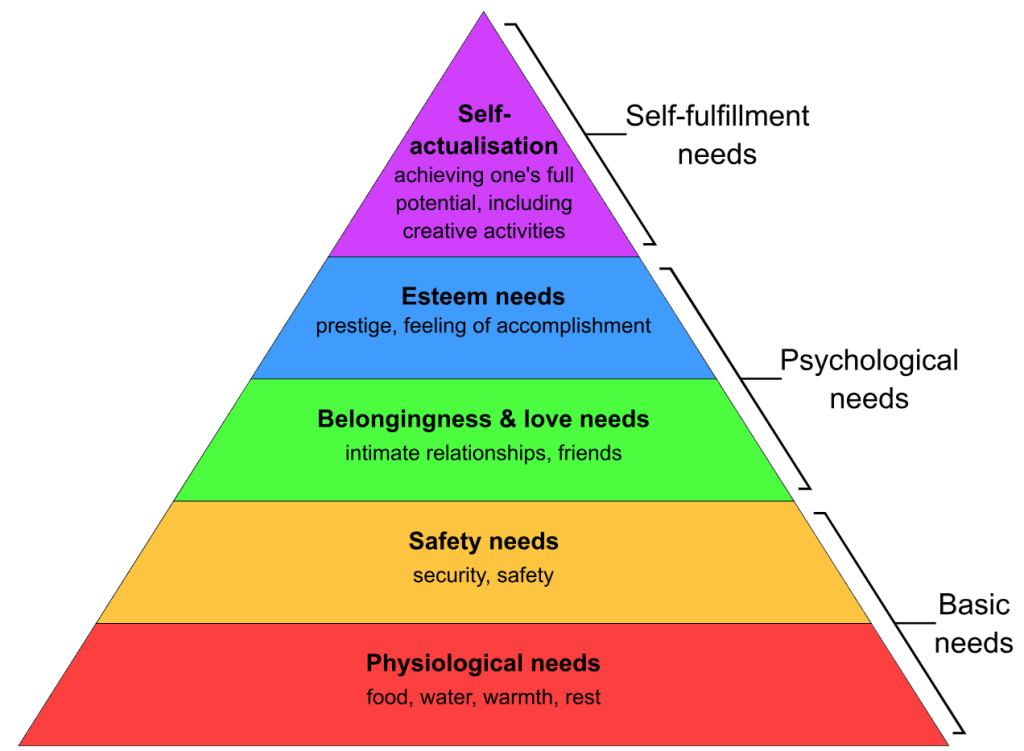
The Project Gutenberg eBook of The Bet, and other stories

Time in a Bottle – Making The Finite Life Last Forever

The moment we realize that we are in a possession of something truly valuable is the moment when we start fearing for its loss, even the idea of losing it haunts us. The urgency created by the finiteness of our lives is the reason why we could and should truly appreciate the people and things around us, it is the same urgency which pushes us to dare to live the life we want. Jim Croce’s Time in a Bottle exposes this vulnerability as well as the strength of human beings in his song “Time in a Bottle”.

Remembering one the soulful artists – Jim Croce

Sometimes what poets, writers wish for is weird, quirky. Through this weirdness they are trying to overcome the realistic limitations we have as the human beings. Poets, songwriters are very well known to express their flights of imagination through their writings. They can make a man walk barefoot on the surface of the sun or make an elephant fly in the air making it light as feather or make a wild beast fall in love or make donkey sing like a tenor and list goes on. What makes these imaginations or these wishes special is that the imperfection these wishes’ originator wants to remove from the reality. When the poet makes a person walk barefoot on the sun, he/she wants that person to be able to tolerate and experience that hotness of the sun, when the poet makes the elephants fly, he/she wants them to have the bird’s perspective towards the world and there can be many interpretations depending on the core idea to be conveyed.

Wishes are one integral part of every person’s existence. Facts represent what the reality actually is and the wishes represent how we expect the reality to be. That is why every fact can be a wish but every wish cannot be a reality – a fact. That is where ideas like wishful thinking, false hope originate from. Even though wishes might not be the exact representation of reality – sometimes really far or exactly opposite it, they represent a hidden dimension of how we think and manage our expectations in day-to-day life. In simple words, we always wish everything to happen according to our ways but at the same time, we are also aware that “That’s not how things work in reality!”. And funny enough or given that our stubbornness to have control over the course of our lives, we still keep on wishing things to happen in certain way – our way.  Wishes represent the bridge between how we understand the world and how the world really is (and trust me very few or almost none of us have real understanding of how the world is!) You wish a thing to be like this and exactly that happens, now that reality originated from your wish is your understanding of how the world is. When this wish does not come to fruition, the exact opposite of that wish is how the world is for you.

In simple words, a wish is the most powerful tool of how we want our world to be; practical or impractical, it still exists for us through our wishes. Even when it does not come to fruition, it the only existent and personal thing that brings us calmness, peace in the world full of uncertainties. Having too many unrealistic wishes makes one delusional and having too much realism makes one emotionless, mechanical; so there exists a spectrum of how we manage our expectations.

Now that we have established what wishes mean and what should be their dosage in our daily life. Let us move on to a special wish a man had for his loved ones – especially for his baby and his wife. This guy was Jim Croce, an American folk and rock singer-songwriter. The date 20 September 2023 marks 50 years since we lost one of the most original and soulful artists and human beings. Jim’s “Time in a Bottle” song is the embodiment of the tragedy of his life which also point towards the tragedy of being a human; furthermore, it also shows an optimistic and truly important perspective towards living a limited, fragile but fulfilled life. Jim’s words – Jim’s wishes in this song are simple, just in exactly enough quantity but the ideas and thoughts expressed transcend the borders of the infinity.

If I could save time in a bottle 

The first thing that I'd like to do

Is to save every day 'til eternity passes away

Just to spend them with you

Jim wants to have total control over the time he can have. The moment he will have hold over time of his life he wishes all that time to be with his loved ones. Using as simple object as a bottle to contain such an intangible, uncapturable and extremely powerful object like the time shows how desperately he wishes to have control over the time just to have the company of his loved ones – his wife and his son.

It is only the daring of the songwriter’s imagination to make the concept of time as the ‘one with ends of start and finish’ thereby making it finite and “contain”-able in a bottle even after knowing that it is impossible.

The wish to save every day, to have hold over the time to spend shows how time is the most valuable currency we have as the mortal beings. Jim’s wish to transcend even the eternity furthermore intensifies his wish ‘to spend the life with loved ones’.

They say time is an illusion, but we know how treating time as an illusion or as an expendable item can make our mortal lives suffer even more. Even though we have a grasp on the theory of time travel, we have barely scratched on the surface of how to perceive time and control it. This inseparable and highly influential impact of time on our lives make them fragile and irreplaceable too. Jim knew this; that is exactly why when he says that he wants to contain time and eternity to spend them with his loved ones. He is realistically implying that he does not want to waste even a single moment of his life. It’s a good advice for every one of us too. 

If I could make days last forever

If words could make wishes come true

I'd save every day like a treasure, and then

Again, I would spend them with you

When Jim will get complete hold on eternity, he would still use that time fully with his family. The repetition of the idea expresses the urgency to not even waste the immediate next moment.

There is innate purpose in Jim’s wish to get hold on the things like eternity and time; things which do not have any boundaries or limits, things which cannot be contained into finiteness. The intent is to signify the incomparable value of the finite time we have in everyone’s life. Spending these moments in doing things we love, have passion for, and with our loved ones is the highest value one can extract from such an incomparable asset. This also a simple way to express how intensely and passionately Jim loves and cares for his family.

But there never seems to be enough time

To do the things you want to do once you find them

The wishes and imagination expressed by Jim show how immediately he wants to live his life lying ahead. The moment he introduces the word “but” here brings all of us from his imaginary world into the harsh reality of life that we live in. He expresses a common yet unexpressed feeling all of us carry inside every one of us.

We are always trying to find the perfect timing, perfect moment until we realize that the time we have here, is finite. There is no option but to make every moment count. If you look at the words of people who have realized that the time they have on this earth is really limited, you will understand how the value of time for them shoots up exponentially.

The moment we realize that we are in a possession of something truly valuable – the moment when we appreciate what an important thing we own, is the moment when we start fearing for its loss, even the idea of losing it haunts us. The moment we find the true happiness is the exact moment when we start doubting that this happiness will instantly perish and something bad will start happening. This is human nature, there is nothing wrong in it. It also highlights how loss of certain thing actually makes us appreciate the true value of that lost thing.

“Remembering that I’ll be dead soon is the most important tool I’ve ever encountered to help me make the big choices in life. Because almost everything — all external expectations, all pride, all fear of embarrassment or failure — these things just fall away in the face of death, leaving only what is truly important. Remembering that you are going to die is the best way I know to avoid the trap of thinking you have something to lose. You are already naked. There is no reason not to follow your heart.”

Steve jobs, Stanford Commencement Address, 2005

A true artist is an expert of bringing out such very common yet unexpressed emotions out to the masses through his /her creations. It creates this common ground where people from different walks of life – different levels of life share their common personal, intimate experiences. Jim beautifully puts down the tragedy of the finiteness of life and the urgency to live it, experience it thoroughly, inside -out. It is really heartbreaking to know that you won’t be there around your loved ones forever. And most importantly, the feeling of loss is more intense, dreadful than actual loss itself but that is what the reality is.

I've looked around enough to know

That you're the one I want to go through time with

Now what Jim says here is about how you can express your intense love, passion with practicality. He assures his loved ones that even though the time he has, the time all of us have is finite, we can still make it worth of our life by being with the people we love, by valuing them. This finiteness of our existence pushes us to appreciate everything, every person we have close to us.

You can see in the early part of the song, Jim expresses naïve, highly romanticized and somewhat foolish thoughts of being eternal forever to express the passionate love, affection towards his love. This early part of the song also indirectly reveals how carelessly we handle some important aspects and important people in our life, in our youth where we literally feel like immortals with infinite energy.

There comes a moment when we have to actually make decisions solely by ourselves which would alter the upcoming course of our very own life and there is no escape from these choices, at that same moment we understand what we hold dear to us, what actually matters, what is noise and what illusions we were following till that moment. Some would say that we become mature and more realistic. The perfect veil of illusions drops down showing the imperfect, crude reality. This is the moment we understand that even though the illusion was pleasing, the reality is where we actually exist and what could be more worthwhile than being with those who are special to us in this good and real time even though it is finite.

If I had a box just for wishes

And dreams that had never come true

The box would be empty

Except for the memory of how they were answered by you

The realization of the value of people, things, and moments in which we interacted with them makes us appreciate their real beauty. The time we must live may not be infinite but even in this limited time the memories we create with our loved ones make us truly immortal. These memories are the linkages which get carried on from one person to another sometimes from one generation to the next one.

When a person is granted with immortality but if he/she has no one to love, to care for or nobody cares for or loves him/her, then what realistic purpose does this eternal life serve? It is exactly equivalent to death.

Our existence is valid and real only when other people recognize it. It is a tough pill to swallow. Many would argue that the life comes from within, you are a whole universe existing inside you, you don’t need others to validate your life – your existence but please understand that these statements are valid only for the people whose value of life lies with the opinions of others. When I am expressing about the validity of our own life upon the recognition of others, it is the value creation and upliftment of the humanity inside of us due to the interactions we get involved into. You are a universe into yourselves but if you are not making other people’s lives better, affecting the objects, people in a constructive way you are an isolated universe which is exactly equivalent to living in your own imaginary world. It will still exist as a sole but that is one selfish way to live. Many undiscovered wonders are revealed when things interact with each other.

It might seem overly philosophical but when faced with the “existential crisis”, “existential angst”, “chaos of the reality and its imperfections” everyone needs an identity, a pivot to stick to make this life worthwhile. This feeling of making our life worthwhile is created only because of the urgency to live. And this urgency to live to its fullest is created due to the finiteness of the life.

Jim expressed this philosophy in his very simple yet powerful song. He appreciates that every purpose of his life found a direction towards completion, every wish he had was fulfilled at the exact moment when he decided to create memories with his loved ones. You must appreciate that most of the times our wishes create an illusive, deceptive reality in our head where everything is perfect, it is only upon exposure of these wishes to reality when the facts are revealed. These facts may not be perfect but they are the only real thing. That why memories are really very important.

Memories have similar nature to the imagination and wishes we have but they are the outcomes of we passing through the time. So, our memories are the next best things we have to the reality in which we live and not our imagination or wishes. Memories are the embodiment of the realistic imagination and wished realized. That is why we can make these memories eternal by creating them with our loved ones and engaging in the doing thing we love.     

But there never seems to be enough time

To do the things you want to do once you find them

I've looked around enough to know

That you're the one I want to go through time with

The needs and wants are less important than the moments we have with our loved ones. It is this irreplaceability of any other materialistic thing with the memories and moments in the company of the loved ones which Jim wants to highlight through his song.

There is one important story attached with the song “Time in a bottle”.  Jim wrote this song when he came to know that he was going to be a father. He was a struggling artist enjoying the artwork he created with the support of his wife. You can say that he was in the bliss of his artistic creations which he loved creating. When he understood the start of his fatherhood, he came to truly know and appreciate the reality of life and the finiteness it has. This made him serious about his art which inspired him to create his world-famous album “You don’t mess around with Jim”. Next time when you will listen to this song with the knowledge of what actually inspired him to write this song, then you will appreciate how deeply he loved his son and his wife. He wanted every moment from thereon to be filled with their memories and that was enough to justify his finite life, finite yet truly invaluable. One can call it poetic, sad, tragic or poignant- Jim died in a plane crash aged 30. It feels like Jim had some foresight about his upcoming life when he wrote “Time in a bottle”. Even with the lifespan of mere 30 years, you will appreciate his life through this song “Time in a Bottle”. His life, thus becomes an example of creating a long-lasting life – finite yet long lasting, eternal and irreplaceable life.   

The urgency created by the finiteness of our lives is the reason why we could and should truly appreciate the people and things around us.    

Who knows, in coming eon or maybe in coming millennium we might actually be able to contain time in a bottle, then Jim’s all wishes might become a reality. Until then let us appreciate what we have as this incomparable precious life.

The Existence – Why? How? And What?

Logotherapy is not intended only to search for the purpose of life. It justifies and dignifies the human life for its capabilities to remain in the ebb and flow of existence which is the only real thing amongst the infinite yet unrealized possibilities in the universe.

Part 2 – Viktor Frankl’s Logotherapy for Humanity

“Was du erlebst, kann dir kein Gott mehr rauben.”

(No god can rob you of what you experience.)

Robert Hamerling

Answers from Logotherapy

In the Part 1 of the post, we tried to touch some ideas like – “three schools of psychology”, Freudian “will to pleasure”, Adlerian “will to power”, Viktor Frankl’s “will to meaning” as in Logotherapy, “existential vacuum”, “Noö-dynamics”, “determinism according to Logotherapy”, “Freedom according to Logotherapy” and “the responsibility that comes with the freedom”

In summary, Viktor Frankl a holocaust survivor, psychiatrist by profession witnessed and experienced the extremes of the human psyche leading to the creation of the concrete foundations of Logotherapy. According to logotherapy, it is the meaning, the purpose – which makes a man to survive through any situations in life, especially the worst ones. When there were not chances to become powerful, when there were no means to gain pleasure even then people chose to go through the hardships/ sufferings – they chose life. Not only to survival but even upon the realization of death, people accepted that death in same way one would have accepted the life. They had something inside them which made sense out of the sufferings, pain, life and even death. This “sense” was the purpose they had identified for themselves to serve. This purpose, this meaning to their own life justified the sufferings they endured which created the hope for their survival and justification to the death for the people who accepted it with dignity.  

Noö-genic neurosis is that existential blockage rather vacuum where a person’s mind itself is unsettled because it has no justification, no sense, no meaning behind the activities, decisions to live through the life. Upon realization of the real freedom, a person (and not the conditions, the objects around him) can determine his fate even in worst conditions; the person can still have that “optimal behavior”. This realization of freedom is possible because human psyche seeks for the sense of the things, the meaning, the purpose.  This freedom also calls for the sense of responsibility because human life practically has limited span, is perishable which brings that urgency to achieve the best possible outcome, the optimal outcome out of the only life one has. Responsibility brings the best out of the freedom one has; without the sense of responsibility, freedom degenerates into arbitrariness, a diffused state where the outcomes of the event have no significant impact. In simple words, freedom with responsibility gives focused and optimal outcomes whereas freedom without responsibility (still) gives results but are diffused as there is no intent to achieve anything.  

Why? Why does the life bear “a meaning”, “a purpose”?

Upon understanding what actually lies under the human psyche and the human life (i.e., the purpose, the meaning), it becomes apparent to ask the same existential question – Why does life seek for meaning only as there can be other uncountable possibilities, uncountable factors which drive the psyche, the life, the existence? Why nothing in the world – the universe but meaning only?

Viktor Frankl has excellently given the theoretical and practical proofs for the importance of meaning in a person’s life. Theoretically proof – if a person is always driven by pleasures and power then why there are examples where people chose sacrifice, where people died for their honor, where people stood fearlessly for their morals, where people rose against something really powerful, where people accepted the hardships even when there was no guarantee for them to end? These are not the exceptional cases in a human behavior. Rather when human beings are stretched to their extremes these behaviors are more common. So, unlike the pleasure and power the awareness, the urge to find the meaning is not just a secondary drive of the human life. The urge to the meaning, the purpose will always be present even in the absence of pleasure and power.

Practically Viktor Frankl presents a study to prove his point here. 89% people from a French public opinion poll and 78% of the people in an American students’ statistical survey indicated that people want “something to live for”, “finding a purpose and meaning to the life”.

I think, it is the omnipotent nature of the infinite possibilities which the real freedom grants to every person. Out of those infinite possibilities very few become realized to reality from where the freedom loses its ideal nature. Then the superposition of realized possibilities create the “real” reality which has been brought from chaos, an inconceivable, an un-understandable situation to a familiar, slightly better predictable state. This better predictable, the one “out of which some sense can be made” state is the fundamental state required for the human life to thrive upon. This urgency for predictability, for sense, for meaning, for purpose is solely because of the limited nature of the realization of life we have.

(The word predictability is not used here to imply that man wishes for everything to happen according to his wishes, rather the predictability is used in the sense for how a person will always know how he will react to the events presented to him even when they are not predictable.)

Does that mean that if a person becomes immortal, will the urge for purpose – the will to meaning ceases to exist? That is where responsibility comes into picture which Viktor Frankl has posed while defining freedom’s role in human life. Only with responsibility can the freedom be brought to the realization to possibilities out of the infinite unrealized possibilities.

In single sentence I think, a single realized possibility is more powerful than the infinite unrealized possibilities. The extraction of this power is only possible if the there is freedom with a responsibility. That is why the life exists; it exists to create the realized possibilities out of the infinite unrealized possibilities (which the universe holds or whatever ultimate there is can generate).   

How? How one discovers the purpose

The profoundness of Frankl’s logotherapy is not just about the depth of the ideas and the practicality of the experimental results. He also explained how one gains this meaning, which are as follows:

Ways to discover Meaning of Life-

  1. Creating a work or doing a deed
  2. By experiencing something or encountering someone
  3. By the attitude we take toward unavoidable suffering

1. Creating a work or doing a deed

It is very similar to figuring out what you actually love doing and how you can also benefit others (obviously including you) in the process. (Some call it following your passion, answering your inner calling to create something that you and others value)

2. By experiencing something or encountering someone – Power of love

“The second way of finding a meaning in life is by experiencing something – such as goodness, truth and beauty- by experiencing nature and culture or, last but not least, by experiencing another human being in his very uniqueness- by loving him.”

Viktor Frankl

The meaning of Love itself became very “meaningful” to me when I understood what the logotherapy stands for. Before stumbling upon the ideas of Viktor Frankl on “the meaning”- for me love was a selfish idea to gain pleasure, to have that comfort for ourselves. Something which goes like this:

“We never love anyone. What we love is the idea we have of someone. It’s our own concept – our own selves – that we love.”

Fernando Pessoa

Love is very selfish idea if we go by this statement. For me here, Pessoa meant that love emerges from inside, hence it is very “egoic” It gives us pleasure to love someone, to do everything to make them happy which ultimately will make us happy, thereby becoming selfish in the end. But then my perspectives changed. (I haven’t studied and understood the premise and the intentions behind the Pessoa’s comment on love here, which can be reserved for discussion somewhere else.)

Upon going through the ideas on Logotherapy, we become aware that there are examples where lovers (not the romantic ones only) have crossed the limits of life for other people or other things, where (again) pleasure and power were not guaranteed.

Love thus becomes a medium to realize the possibilities of the life experiences. If we are so obsessed to find the meaning of our life, then it equally becomes very meaningful to have someone who understands the same urge for meaning in you too. This love is not just a person-to-person possibility, it can also be for things and experiences.

“Friendship is unnecessary, like philosophy, like art… It has no survival value: rather it is one of those things which give value to survival.” 

C S Lewis

This is the reason you will always see why almost all the events, experiences, art forms, philosophies, cultures, religions and whatnot are immediately linked to the concept of love. It’s on a whim where things not making sense are illogically explained by love, it is innate fact in everyone which logotherapy makes apparent.

3. By the attitude we take toward unavoidable suffering

The third way one can realize the worth of life is by going through sufferings. Sufferings stretch a person to his extremes where there are clear boundaries between the existences of life and death. The urgency to make the existence of some worth becomes eminent here. The meaning discovered in such situations pushes the person to bring even the hopeless situations to his benefit by developing an attitude of optimism. The inability to change the situations makes the person change himself to bring the best out of the situation. It the way in which the person finds the meaning to his suffering.

“Suffering ceases to be suffering at the moment it finds a meaning.” 

Viktor Frankl

It is also important to understand that if suffering gives the person meaning for the life that also does not mean that everyone has to suffer to find the meaning in his own life. Viktor Frankl was very clear in these terms. Hence, he clarified the earlier two ways to find the meaning in life. The ideas communicated by Viktor Frankl are very similar to the ideas in stoicism which also discusses about focusing on things which you can control.

What? What is life according to the logotherapy?

The logotherapy explains that life is all about the tragedies, in Viktor’s words the tragic triad of three things namely pain, Guilt and Death. Why tragedies are considered to represent life is important here.  It is very easy for life to exist when these three things (pain, guilt, death) are not there, but the life still remains existent rather becomes more meaningful in the presence of the same hostile aspects. Logotherapy thus discusses that even in such hostile conditions, one can find the meaning, one can have the “optimal behavior” by following ways in the words of Viktor himself as follows:   

  1. Pain – Turning suffering into a human achievement and accomplishment.
  2. Guilt – Deriving from guilt the opportunity to change oneself for better.
  3. Death – deriving from life’s transitoriness an incentive to take responsible action.

1. Pain

Logotherapy made a successful attempt to justify what is the real nature of pleasure and pain. It established a fact that life is not just a set of tragic events of sadness for someone and a series full of happiness for others. Life is about how we as a person create meaning out of our sufferings, even when they are not in control. This is the real victory over those sufferings. Logotherapy actually balanced the concepts of happiness and sadness which both are the inseparable aspects of every life. One of them is always favored (happiness) but the realization of meaning makes the least favorable yet existent (sadness) a reality. This is very effective when people are sad even in their pursuits of happiness. They expect that doing one specific thing will bring them happiness, make them feel accomplished. After doing that thing, achieving that thing they again become clueless and sad that it was not what they expected.  

“Happiness cannot be pursued; it must ensue. A human being is not in the pursuit of happiness but rather in search of a reason to become happy, last but not least, through actualizing the potential meaning inherent and dormant in a given situation.”

Viktor Frankl

When people get overwhelmed upon the realization that happiness is not consistent for their whole life the existential vacuum peaks in and again this meaninglessness becomes dominant. Frankl effectively established that this forced urge to become happy is one of the major reasons for the depression, aggression and addiction in the newer generations.

2. Guilt

Frankl here gives one of his professional experiences with the convicted criminals- the guilty people of the society.  According to his ideas from personal experiences which are really powerful- every crime cannot be traced back to single point event, single person, single cause, single behavior. If it is impossible to pinpoint and press conviction on such singular aspects, then how can a person be considered completely guilty for the crime. For such human beings rather every person feeling guilty about something life is about rising above it. Even though Viktor’s examples are based on criminal and convicted human beings, it will be an understatement that they are not applicable to everyone of us. Every one of us considers themselves guilty for at least one thing, one mistake in their life. Finding the purpose, the meaning can help us to rise above this guilt with the feeling of responsibility. What a powerful thought!

Humanness in everyone is one important aspect of logotherapy. Rising above guilt through realization of meaning reflects that. It made the psychology more humanitarian rather that a mechanistic interaction between humans and their drives.

3. Death

We have already discussed that the perishable nature of life creates the urgency to meaning. The sense of death brings in the responsibility to optimally live the only life one has is an important aspect of every human life rather every life. 

“The opportunities to act properly, the potentialities to fulfill a meaning, are affected by the irreversibility of our lives.”

Viktor Frankl

This is where I think we can understand what actually lies under the existence of life. Our existence as a conscious life is destined to create the realities from the infinite possibilities that universe has. We are the means to bring the intangible possibilities into the reality through our lives which makes every life meaningful. Every life is meaningful and hence deserves dignity. It is dignified because by its mere existence it has successfully created the realities out of the unrealized and intangible possibilities. Our existence itself makes us dignified of the life we have even if it may not be useful for others.    

“An incurably psychotic individual may lose his usefulness but yet retain the dignity of a human being.”

Viktor Frankl

This is also the moment where Viktor has highlighted on creating real possibilities in present rather than dwindling on to past and future. Past is more important because it is where the reality existed, it is where the meaning of actions from the present are justified.

The Super-meaning – why does the meaning exist?

“What is demanded of man in not, as some existential philosophers teach, to endure the meaninglessness of life, but rather to bear his incapacity to grasp its unconditional meaningfulness in rational terms. Logos is deeper than logic.”

Viktor Frankl

It is also very important to understand that Viktor Frankl’s Logotherapy is not just about finding the sense to the life, the meaning the purpose of the life. It also makes one important argument about the limitations of human understandings. When we will go on asking “why?” to the answers of every “why?”, we will end up into some abstract idea of meaning which won’t even make sense to our existence. (And again, the same spiral of existential vacuum will start thereby rendering the question useless itself) even though there are some things which are beyond your understandings that also does not mean that your meaning should always justify unknowns, rather it is paradoxical. If the purpose of life is to create the realities from the intangible, unrealized infinite possibilities then it is very important to understand that the meaning need not to be some abstract meaning in order to justify every possibility in the universe. Logotherapy thus becomes very powerful to create a practical, real picture and purpose of human life. Logotherapy thus justifies and dignifies the human life for its capabilities to be there even in the ebb and flow of existence which is the only real thing amongst the infinite yet unrealized possibilities.

For more, read Part 1 of this blog post- Answering the questions on existence of “the existence” – Viktor Frankl’s Logotherapy for Humanity – Part 1

  • Featured Image – Jewish Museum Berlin