People have tried to justify their existence with happiness, fulfillment, satisfaction, service, love, hope, devotion and what not. But those who have existed in full spirit, lived it to the fullest have realized the effect of sufferings on our lives and even after overcoming them are ready to endure them again in the hope that they will become better than what they were before. These are the people who might have solved the query to justify the life. Overcoming the sufferings in life and continuing the journey ahead could be the answer.
On Charles Dickens’s short story – A Child’s Dream of A Star
The Impact of Suffering in the Pursuit of Happiness
Question- what would you choose of the following?
A short life filled with happiness and satisfaction? or A long life filled with pain and suffering?
I will assume that you have selected one.
Charles Dickens’s short story – A Child’s Dream of A Star
I came across a short story “A Child’s Dream of A Star” by Charles Dickens which shows what it means to pass through the suffering of the lost loved ones.
This is a story of a boy who loses many loved ones throughout his whole life. Whenever he is losing someone, he dreams of a star where he sees the souls of his loved ones meeting and coming together. First, he loses his little sister in childhood, then his baby brother. When he grows young, he loses his mother, while being adult he loses his own daughter. Every time, when the boy loses his people, he dreams of the same star and wishes that he too could join them. But, when grown adult and losing his daughter he is somewhat soothed that his daughter is not alone, she has the angels of his sister, mother and brother to accompany her.
When he realizes the arrival of his last moment, he accepts the death for the joy that he will join the souls of his loved ones now.
The Suffering of Watching People Leave
Charles Dickens in a very impactful way shows what it means to live life. On surface analysis, one can say that this short story of a boy dreaming about the people he lost and asking for his own death in the hope to join them is about the pain of losing the loved ones and dissatisfaction of not getting enough time to spend time with them and love them. Deep down it is about how one endures pain and I think the only way to endure such pain is to pass through it. Any attempt to alleviate or even control it, leads to more pain.
Enduring the Suffering
The great thing about this story is that it delicately captures what a beauty that life we live in is and how we connect same attributes of life to the afterlife (even when we are unsure whether it truly exists, even when it exists in our minds and dreams) also how fragile our existence is.
Charles Dickens used the innocence of the child’s mind to show how we carry that innocence throughout our life to use every chance to stay closer to the people we love. The opening of the story also talks about the sorrow that is felt by everyone when someone dies.
“They used to say to one another, sometimes, supposing all the children upon the earth were to die, would the flowers and the water and the sky be sorry? They believed they would be sorry. For, said they, the buds are the children of the flowers, and the little playful streams that gambol down the hillsides are the children of the water; and the smallest bright specks playing at hide-and-seek in the sky all night must surely be the children of the stars and they would all be grieved to see their playmates, the children of men no more.”
It shows that even for children the suffering had a bigger meaning not even when they had faced any such suffering from loss in their tender age. It shows how by default we are hardwired for the sensitivity towards suffering. Maybe we are more sensitive to suffering than love.
Then we see that the boy is exposed to multiple losses and you will see over the time his dreams are evolving gradually. In early childhood loss of his sister, he is totally devastated that he could not join his sister, then he is again agitated with the thought that his younger brother has to join her in the starry heaven. Then when he is young, he is somewhat settled that his mother could join his sister and the brother.
Now when being adult and losing the beloved daughter, the same boy has made peace with her death in the thought that she has enough people to take care of her and maybe love her more. Now he has made amends with the death.
“My daughter’s head is on my sister’s bosom, and her arm is round my mother’s neck, and at her feet is the baby of old time, and I can bear the parting from her, God be praised!”
You must understand how the boy from childhood till his old-age sees the death in different ways. At first, he has intense sorrow for his sister but over the time he sees that even after death the people he loves have each other’s company.
He cannot do anything to join them in the afterlife and death is the only way to join them. Please note that there is not even single mention or any indirect indication that boy wishes to end his existence just to meet his loved ones in afterlife.
So, it’s a story of how a person builds himself towards the suffering. You will see that the boy never gets numbed because of the series of losses, he is hopeful that at least someone is there in afterlife for them to love each other. Death along with love is the only constant in this story.
We are well aware of the love from the very beginning of our existence but it takes time to appreciate that just like love, death too is eternal. It’s just that our minds find it difficult to bring together the idea of eternal nature of love and never-ending series of death in single thought. Maybe that is why not everything exists at exactly the same time and ends at exactly the same time, otherwise there would be no one to witness and appreciate what one existed in and carry that forward.
The Eternal Curiosity, Innocence and Love
I am adding the concept of eternity, endlessness in this story of involving series of deaths, ends and sadness with it, because that is how the life is. The symbolism of star used in this short story by Charles Dickens also points to that idea.
You should notice that in the opening it is about how everything that is there in existence will feel sad for loss of the children of men. The boy feels that sorrow in his childhood; later on, we realise that he holds these unfulfilled emotions, feelings of not getting enough time to spend with the people he has lost. These emotions are continuously getting reflected in his dreams. In the end, we see that he is dying happily while feeling that he can love them again in the afterlife.
But you should now notice that the dream is limited to the boy only. What is real is the star in this story; the star shining on little sister’s grave and was still shining on her brother’s grave who died at old-age.
Just like the children’s curiosity about whether the nature grieved for the losses in the beginning of the story, we can say that the star (being the child of nature) would also grieve for the people he saw dying. But that is not where the story is going. The boy had learned to handle the grief over time and that is why is mature emotionally with the death of his daughter and even his own death. This became possible because his love for his sister increased multiple folds, got intense over the time.
The maturity that comes to such sorrow is worth noticing, the boy now an old-age man is not sad because he will be leaving his children behind. He is neither happy that he will join his loved ones in the afterlife (although what he says while dying means that he is eager to join afterlife).
The star was a construct of his mind to move over the grief and be assured that no one – not even him will never be left unloved. He had a strong belief that at least love is eternal in some or other forms. The star still shining upon his grave in the last sentence of the story is thus the symbol of the child’s innocence and love.
The last words of the boy/ man are these:
“…My age is falling from me like a garment, and I move towards the star as a child. And O my Father, now I thank thee that it has so often opened to receive those dear ones who await me!”
We all can appreciate that the afterlife’s notion is only in the boy/ man’s dreams but that does not invalidate his feelings. He is grateful that he had someone to love (although he couldn’t love them to the fullest while living). The childhood innocence and curiosity he carried throughout his life helped him to endure the suffering. Curiosity because of the urge to understand what would happen to the people who die gets materialized in the dreams of the boy and thus he builds his understanding around it. This curiosity emerged because he cared for them so strongly that he was concerned about what would happen to people after they die. Innocence because from childhood till old-age he deeply believes that just like the children of nature, everyone and not only him cared for people, loved them in some or other ways.
Conclusion
Most of the existential queries on human life point to one single question of meaning or purpose or at least worth of the life. Once started, if it is destined to end then why is this everything existing? And this question is not just about life. It is about everything attached to the life itself. If everything in existence is attached to something and everything at any time will be lost forever, disconnected forever then why does everything exist in first place? Once you appreciate this question, you will see that existence is majorly a series of detachments, losses – literally and figuratively. It is just that some things detach faster than others, some things stay for longer time but are lost in the end; we are just existing in these gaps of losses and detachments. Maybe how we felt about those things especially the innocent emotions we had for everything that is there (which are neither good/ bad, pure/ impure) are eternal. If not eternal, I would say that they evolve in better ways, get refined, gain maturity and get transferred to our next generations through our legacy. Maybe they too would have an ending but what can we say about the human spirit! The spirit to exist in spite of the sufferings! The ability to exist in full spirit and endure multiple sufferings over the time while maintaining that innocent child alive inside you is what justifies our existence in the end. And even that is to end in the end, I have no complaints.
So, when I asked to select one of options at the start, if you felt that selecting only one of these is foolish (or difficult/ meaningless) then welcome to the club!
People have tried to justify their existence with happiness, fulfillment, satisfaction, service, love, hope, devotion and what not. But those who have existed in full spirit, lived it to the fullest have realized the effect of sufferings on our lives and even after overcoming them are ready to endure them again in the hope that they will become better than what they were before. These are the people who might have solved the query to justify the life. Overcoming the sufferings in life and continuing the journey ahead could be the answer.
We are so tied to our minds, our self, our ego that we can only see what our mind is conditioned to see; and the expanse of mind is so vast, that we consider the inability to gauge its limit to its infinite-ness. But, in self-observation we will see that reality is far bigger than our mind. Mind cannot be bigger than reality although it can create a perfect illusion of it being bigger than reality. When we realise how reactive our mind is, how conditioned our mind is we see that it’s the reality in which we are existing and not the mind. Mind is just a facilitator to create a sense of security. The real creativity thus begins when one lets go of their minds, thoughts and observe reality for what it is.
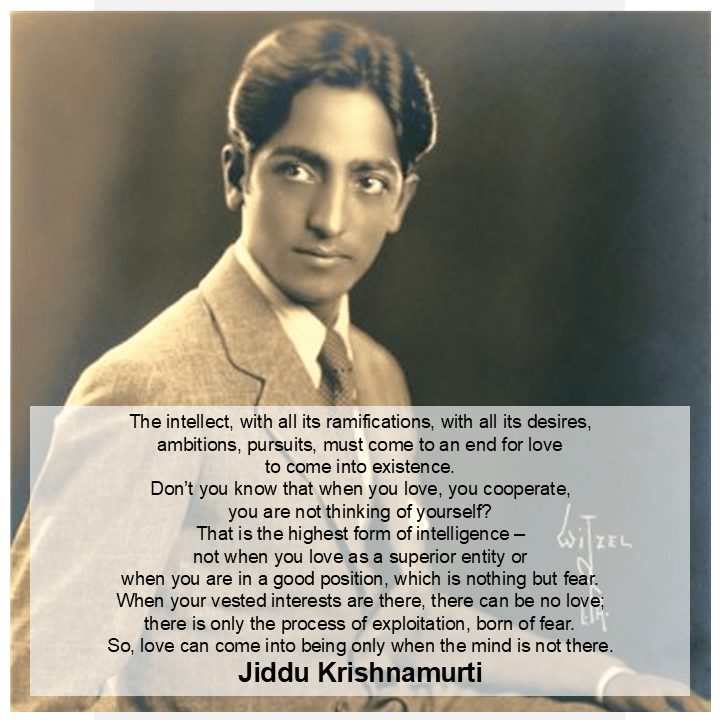
The real intelligence is to be able to see how you are fooling yourselves and how it is twisting your world view. This is possible only when we let go of the self. Love is the fastest and the most direct way to let go of self. Love is the way to get rid of the ego. Loving something, loving someone is the first step towards rejecting the very ego which is responsible for self-deception.
Jiddu Krishnamurti thus encouraged everyone to let go of their egos through self-less love; this itself is enough to solve all the existential conflicts inside us and out there in the world.
Part 3 – Jiddu Krishnamurti’s legacy of self-knowledge
“What do you do when you realize fundamentally or deeply that thought cannot end itself? What happens? Watch yourself. When you are fully aware if ‘this fact’, what happens?
(‘this fact’ here refers to an observation that ‘discipline’ doesn’t destroy the self, rather it strengthens it because ‘the self’ created that discipline in the first place)
You understand that any reaction is conditioned and that, through conditioning, there can be no freedom either at the beginning or at the end – and freedom is always at the beginning and not at the end.”
– J Krishnamurti, The function of the Mind
We, the humans are driven by curiosity. The curiosity to survive – to put in few words. One might say that people are driven by fear, greed, envy, anxiety, power, love, money, fame, glory, sacrifice, humility, honesty, trust, legacy, mania, chaos, terror, and what not. The list is never ending. If you start questioning the origin all such attributes, you will see that humans can be driven by anything, I mean any anything. There is no connecting link per say; the only common thing between all the things which drive people is the people themselves. So, in the last question (possibly the last one) we end up questioning ourselves. We see that along with physical survival we are highly conscious of our non-physical survival. Some may call it the mental survival, some may call it ideological survival, some may even call it spiritual survival. In the end, what we are trying to preserve is the eternal existence of our consciousness. How to preserve this? becomes the question then. That is why in final question we see that we are curious to preserve our own being. That is the ultimate survival. Whatever can facilitate that preservation is the driving force for our existence. If you are scared of something, the fear of that thing will create a curiosity to look out for the ways in which you can avoid it.
Now you will realise that the attributes which are many and driving people in different ways are highly related to the ways people think about themselves and about their surroundings. The identities, the consciousness which we are trying to preserve forever is highly the function of the society we grew up in, the religion we followed, the ideals we admired, the enemies we despised, the culture we cultivated and carried over to the newer generations.
I might be making an overstatement here-
Only those who have undergone unlearning, un-conditioning or at least appreciated the process of unlearning can clearly see how badly we are tied to our thoughts and ultimately our minds.
Death of thinking is death of mind. When they say that ideas live forever – it is also an attempt to ensure eternal survival of a certain type of mind, for mind is not a physical entity to us. Realizing the perishable nature of our body, the mind becomes the most potent entity to ensure the survival of our being.
Then, what’s wrong in ensuring the eternal survival our consciousness?
We will see how Jiddu Krishnamurti showed the reality of our existence. As I have already said, he is the perfect person at perfect time to ask the perfect question.
Short answer is – we are so tied to our minds that we can only see what our mind is conditioned to see; and the expanse of mind is so vast, that we consider the inability to gauge its limit to its infinite-ness. But, in self-observation we will see that reality is far bigger than our mind. Mind cannot be bigger than reality although it can create a perfect illusion of it being bigger than reality. When we realise how reactive our mind is, how conditioned our mind is we see that it’s the reality in which we are existing and not the mind. Mind is just a facilitator to create a sense of security. The real creativity thus begins when one lets go of their minds, thoughts and observe reality for what it is.
In Part 1, I have explained J Krishnamurti’s views on our urge for safety thereby happiness, how we use our thoughts to conveniently justify anything and everything to create that sense of safety, the ways in which our thoughts are stealing the actual reality holding multitudes of possibilities.
In Part 2, I have explained how thoughts originate, how curiosity drives them. It contains Krishnamurti’s observations on how we try to separate thinking to glorify ‘our version’ of wishful reality. Krishnamurti shows us that the moment we reject the separation of our thoughts from ourselves, that is the moment we see that we were just reactive to everything around us. We become observer of the reality for what it is, once we let go the glorification of ‘our thoughts’ – the self.
Now, we will question the very originator of the self – our Mind. Krishnamurti’s observations were revolutionary about the mind. This Part 3 will focus on that and also tie up the previous 2 parts together with it.
Existence Of The Mind – What Is The Mind?
“When you observe your own thinking, you will see it is an isolated, fragmentary process. You are thinking according to your reactions, the reactions of your memory, of your experiences, of your knowledge, of your belief.”
–J Krishnamurti, The function of the Mind
When we are truly in the territory of observation without any preconception, prejudice, we see what thoughts actually do. Thoughts just try to hook on to something that we are familiar with – it could be good or bad. Thoughts literally create a chain. One link creates sense – logic – connection to another, one train of thought after another. Then we create the whole understanding. Thinking is always reactive. Keep this in mind – thinking is always reactive. If you let thoughts build on themselves, it is amazing to observe what world we create just by our thoughts. The moment you inject certain intent, desire to this world, it immediately deviates from the reality. But, as this world of thoughts has your intent, your desire, it creates that world of safety; we don’t want to lose that familiarity, that comfort. Now as this world contains our desires it becomes our second identity. As the thoughts keep building on, you start associating these set of your thoughts as who you are. This is your non-physical identity now. You now strive to make sure that this non-physical identity lives till eternity.
After seeing this you will see that the mind is the custodian of thoughts, desires, wishes. A wish to be safe to prolong survival, desire to make that prolonged existence happier one, thoughts to support those wishes – desires. Mind is thus picking desirable ideologies, disciplines which will keep feeding the train of thoughts, the chain of thoughts. Thoughts want to ensure their own survival because we have assumed survival of our thoughts as our survival. (Keep in mind we haven’t even started the discussion about reality.)
So, mind is a sieve which keeps on separating the desirable and undesirable parts of reality. There is nothing wrong in that. What happens here which is problematic is our tendency to lean towards the desirable reality only. When mind would see desirable reality, it will start using the power of compounding of thoughts to create a wishful reality which we call as our identity – our self. We want to preserve self to ensure that things that we desire survive. Whatever is not the self, it is the others – the undesirable. The moment mind makes this separation – ego intensifies.
“Our whole tendency is to be separated. Can the mind do anything else but that? Is it possible for the mind not to think separately in a self-enclosed manner, fragmentarily? That is impossible. So, we worship the mind; the mind is extraordinarily important.”
–J Krishnamurti, The function of the Mind
Without separation, our mind fails to recognize itself. If it is not able to separate itself from rest of the things, it cannot feed the desires. If desires are not fed, we will be constantly looking cluelessly for a sense of belonging, a place of security.
Here, I see one tragedy of being human rather an animal. I will explain it:
See there is a possibility that we are free from all the desires. One can be free from all the desires of the world. So, it is a real possibility that man is free from the cage of thoughts, mind and desires and fully observant of the reality around him without any imposition or prejudice right from the birth.
What is the tragedy of every animal is that they are born with the tendency to live (otherwise how would they get in the world in first place, maybe the baby doesn’t even know what is required to survive, so possibly the sense of survival naturally gets transferred from parents to the baby). Have you seen a baby who wants to die the moment he is born? Rather the baby starts crying the moment it senses absence of parental presence or absence of security. By birth we have a survival urge. Evolution has pushed this urge in us from physical to non-physical one. As we have better chances to ensure physical survival we now care more about the survival of our non-physical version. Mind thus becomes very important, thereby consciousness becomes important. That is why if physical survival is not guaranteed, we wish that at least our consciousness lives forever. That is exactly why we praise the minds we have.
Over the time, our desires take over this mind and we then keep on conditioning it with culture, religion, society, community in a certain way. The familiarity of physical body gets further amplified in familiarity of certain way of thinking, certain religion, certain philosophy, certain profession, certain degree, certain community, certain country. The more we find ideas, thoughts familiar to ours the more we want to cling to them. The more we want to reinforce that version of self. We are always separating what reality shows in terms of whether it is favorable to us or not. That is why even if mind and consciousness seem infinite, you will observe that our thoughts have compounded in such an extreme way that we are unable to measure their limits. We have attributed this inability of those compounded thoughts to the infinite-ness of our mind.
If our mind truly is infinite then we should be able to predict the reality or at least handle the undesirability that reality may present in better ways. We all know how disappointed we are with the reality. This shows how strongly we have conditioned our minds towards certain way – that certain way we call our identity, our self, our ego.
“Until we understand how to transcend this separative thinking, this process of giving emphasis to the ‘me’ and the ‘mine’, whether in the collective form or in individual form, we shall not have peace; we shall have constant conflict and wars. Our problem is how to bring an end to the separative process of thought. Can the thought ever destroy the self, thought being the process of verbalization and of reaction? Thought is nothing else but reaction; thought is not creative.”
-J Krishnamurti, The function of the Mind
Now you will appreciate what un-learning can do to our life. It opens a completely different and real world in front of us. Un-learning is the rejection of what we assumed to be true to support our identity. Although it feels uncomfortable, sometimes completely hostile but there is no bigger freedom than the acceptance and implementation of unlearning. It is renewal, evolution of our very being.
The key point is to understand that we are not our mind, we can be bigger than our mind. That needs the rejection of the idea of self. Once we are observant of how dangerously conditioned, prejudices, favored our minds are we will see how we through the agency of our mind are twisting the reality to create the sense of security. The more we twist it, more deviated we are from reality.
And as I already explained that somehow this sense of separation and thereby self-preservation is in our genes by birth, we have to train ourselves to get rid of that sense. Keep in mind that this does not mean self-jeopardization. This plainly means that not imposing our ways on reality to create the sense of security thereby higher chances of preservation of self. That is why unlearning is extremely important.
Reactive Mind Vs Objective Reality
“Do not superimpose what it should do, how it should think or act and so on: that would amount to making mere statements.”
-J Krishnamurti, The function of the Mind
Once you think that you have full control of your mind, the mind will use this sense of its separation from you to build chains of thoughts to support itself. In the end, it all started from you. The moment you see that you and your mind are the same, you accept its conditioning. Now you have a baseline to see the reality. Now you know how your mind is bending the reality. This is the freedom, to see things as they are.
Now that we are understanding that sense of safety was the goal of everything that we are doing all along, we see that our conditioning thereby our thinking and thus our mind in the end are the reason behind all the suffering we go through. Once we see that our mind was the main culprit, we realise that it will be difficult rather impossible to punish my mind, discipline my mind because the more I try to control my mind – more I try to discipline it, the more it reacts, the more it creates thoughts and evades away from the reality. It tries to preserve its identity.
Only when you observe that you are your mind conditioned in certain way to preserve the non-physical existence then you understand the reality you live in. You still have those conditioned thoughts but now you neither want to promote them or suppress them. You are now an observer of the reality. This is an interesting observation.
“When I want to understand, look at something. I don’t’ have to think about it – I look at it. The moment I begin to think, to have ideas, opinions about it, I am already in a state of distraction, looking away from the thing which I must understand.”
–J Krishnamurti, Can thinking solve our problems?
There is one important confusion we must address here:
If I am rejecting the thoughts that I have, the mind that I have, the consciousness that I have – what remains of me? Wouldn’t I end up in an existential crisis? Won’t that shatter my compass? If I am not associated with certain things, how would I make sense of my actions? If I am not able to make sense of my actions or at least the things happening around me, how would I prepare myself to survive in this world? This will completely jeopardize my existence.
The answer is pretty simple if you have read till this sentence:
Rejection of mind as a separate entity is the answer. Unlearning the process of isolation to understand the reality is the answer. Wishful observation is the key problem in the ways we are trying to live the life. Thinking is the second name for wishful observation. You are expecting reality to become something in your ways so you attach certain justification to extract that desirable meaning from the reality you are observing. You are doing this to generate sense of safety, which further ensures eternal survival.
So, it’s not about rejecting mind or the thoughts. It’s observing how our mind, thoughts are already conditioned before we are trying to understand the reality. It’s like we are seeing the reality with certain tint of prejudices and expectations. We have to let go of that filter. We are so attached to this filter because world looks the way we want in this filter, that this tinted illusion has become our reality. The moment someone shatters that filter we end in existential crisis.
You must appreciate that it’s not about hating the prejudices, conditioning or sacrificing yourselves completely to a selfless act. It’s being aware that you have those prejudices when you are observing reality. This self-awareness is what Krishnamurti focused on.
The moment you will try to reject certain thing and accept the another i.e., your mind – you will create certain framework of justifications and you will deceive yourself.
The idea is to know how you are fooling yourselves which is preventing you from understanding the reality.
Delulu is not the solulu. Rather delulu is the best way to reject the very life you are living.
“To have blank mind is to be in a state of stupor, idiocy or what you will, and your instinctive reaction is to reject it. But surely a mind that is very quiet, a mind that is not distracted by its own thought, a mind that is open, can look a t the problem very directly and very simply. And it is this capacity to look without any distraction at our problems that Is the only solution. For that there must be a quiet, tranquil mind.”
–J Krishnamurti, Can thinking solve our problems?
Love – Cure To Self-Deception And Surrender To Reality
You know that moment in any pop culture media where the final answer is love? Let me spoil everything for you. The answer to everything is love.
(Be cautious while reading next part, it’s not just that type of love and I am definitely not conditioned to prefer love as the answer. Even for a skeptic, love being the final answer has worthy support. It also guarantees that we can understand the reality for what it is.)
I always had this cringe feeling when everything grand in the narrative ended up with a justification of love. Even the great authors, logical authors, great scientists, great atheists never feel shame to express the power of love and it being the answer to everything. Trust me, I have made every attempt to find the evidences where love might not be the final answer to everything. But turns out that I would never find any evidence against love being the final answer.
The core reason is that we ourselves are the final problem. Let us see how Krishnamurti came to the conclusion of love being the ultimate answer:
“When you realize that any reaction is a form of conditioning and therefore gives continuity to the self in different ways, what actually takes place? You must be very clear in this matter. Belief, knowledge, discipline, experience, the whole process of achieving a result, or an end ambition, becoming something in this life or in future life – all these area process of isolation, a process which brings destruction, misery, wars from which there is no escape through collective action, however much you may be threatened with concentration camp and all the rest of it.”
–J Krishnamurti, The Function of Mind
Now that you have come to the last part of the discussion, it is not a new understanding when I say that our sense of self is reinforced by the desire to support certain way of our conditioning. This steals from us the ability to perceive reality in the way it presents itself. We are always seeing the reality with certain conditioning and trying to change it so that it favors our ways. But as we have illusioned, conditioned understanding of reality, the reality rarely presents itself in the ways we desire it to be. Then we end up in sadness and sorrow and start questioning the futility of our existence. That is why ‘what is the purpose of my existence?’ is the common format of the existential questions for all of us.
What Krishnamurti tried to focus on is different question –
Why am I not experiencing life the way it is?
What is preventing me to live the life the way it is, living the life to its fullest?
The answer is pretty simple now. It’s our conditioning which urges us to prefer certain ways and reject the others. This brings the happiness and sadness. In the efforts to maximize happiness and minimize sadness we have created a system of mind and thoughts to alleviate the pains of suffering – thoughts justify everything. We deceive ourselves with justifications.
“So long as we deceive ourselves in any form, there can be no love. So long as the mind is capable of creating and imposing upon itself a delusion, it obviously separates itself from collective or integrated understanding.”
-J Krishnamurti, The function of the Mind
What does the love do in all this confusion?
Love is the direct way to let go of self. Love is the way to get rid off the ego. Loving something, loving someone is the first steps towards rejecting the very ego which is responsible for self-deception. Even if you are delusional, your actions influenced by those delusions towards the things you love, the people you love will yield unwanted outcomes; and if you truly love them, you will be compelled to let go of the delusion for the benefit of your loved ones. Thus, being selfless through love in true sense ensures real freedom.
Conclusion – Why Is Love Answer To Everything?
“We see the ways of the intellect but we do not see the way of love. The way of love is not to be found through the intellect.”
-J Krishnamurti, The function of the Mind
We saw in Part 1 how and why we crave for safety, familiarity. It ensures our physical and non-physical survival with better odds and most importantly with better satisfaction.
We saw in Part 2 how we dissociate ourselves from our mind and thoughts to create a false sense of safety if the reality does not turn out the way we want. We may delude ourselves if the reality is hurting us. We use thoughts to justify unfairness the reality presents. Our religions, politics, our ideals, everything that we have created now has an innate purpose of creating a safety net. We want to remain in this net because we don’t want the happiness to end. We have intellectualized our minds in such a way that we have justification for every ridiculous illusion and tragedy is that we call it the limitlessness of the mind, infinite nature of the mind.
I am not erasing the idea that the mind is limitless. If our minds – we – ourselves are truly limitless then we should immediately be able to see beyond the seemingly adverse revelations of the reality. Which is the holy gist of all these detailed inquiries of the self.
Then what was the problem with the mind?
The very limitless nature of reality would enable us to become limitless. But is it our delusional clinging to certain way of life for safety which is stealing the real understanding and appreciation of limitless reality. We are clinging to highly complicated and highly compounded thoughts, the way of thinking just because it reinforces the ego.
The real intelligence is to be able to see how you are fooling yourselves and how it is twisting your world view.
After going through what Krishnamurti made us observe, you will realise that whatever must be said has been said already. We have just accepted our delusions because we are fully clung to the way have been living our lives, the way we have been conditioned.
When you are loving someone, there is very slim chance that they will be exactly the way you want them to be. There is plausible reason to say this because the infinite possibilities of reality mold people in different ways. There may be many things in common but the more you know the sooner you will realise that people are filled with different types of conditioning. This will first push you to reject their point of view naturally, then you will try to impose your way on them, your ideologies on them, your conditioning on them. In the final analysis, you will see your ways of worldview failing on them. This is the moment when you will reject your own world view, thereby your ego. Now you will neither reject or accept other people’s worldviews nor will you cling to your ego. Now for the sake of love, you will objectively observe the reality for what it is.
This is how love compels you to let go of your ego. That is why love is the answer to everything because you are the last question of all the investigations of the existence. You will let go of the concept of the self once you start to appreciate things other than you and accept the reality the way it is. What a beautiful way to live!
“Only when you discard completely, through understanding, the whole structure of the self, can that which is eternal, timeless, immeasurable, come into being. You cannot go to it; it comes to you.”
Being social animals, we compare our lives with the lives of the others, we create our baselines and set our targets based on what others have achieved and done in their lives. In our current times when the life expectancy is better than ever, when we have a better cover of social safety than ever, the primitive instinct of survival from natural predators has been replaced by the modern instinct of philosophical- ideological survival which is the ‘preservation of our identity’ – the idea of our own image. The realisation of the philosophical death of our being should come with the awareness that your idea of self, your consciousness was just created by your desires and after this philosophical death you are returning to the fundamental forces of what made them. The endless possibilities for your becoming are opened in this point. This is the true eternal existence – to get broken down into the fundamental blocks of being and be recreated again. Juliet Ivy in her song ‘We’re all eating each other’ beautifully brings the sense of life that is made up of eternal creations and destructions.
Juliet Ivy’s song “We’re all eating each other”
Genuine poetry can communicate before it is understood
– T S Elliot
There exists a special category of songs which sound very jolly, full of life, giving the impression of the light hearted joy, calmness, relaxation everyone desires; on close inspection you end up realizing that the lyrics of that same song is so dark that one would question the mindset in which the song was written and composed. These songs are the songs to which people would dance happily due to its music but the moment lyrics of this songs is opened for discussion you will end up questioning your existence. It feels ironic.
There are many songs to name which fall in this category, I stumbled upon one such song by Juliet Ivy called “We’re all eating each other” from her album playpen.
The song is written by Lucas Sim and Juliet Ivy Ortiz.
playpen album by Juliet Ivy
The great thing about this song is the way its melodies try to befriend you. It’s so simple yet effective and the song’s rhythm is not continuously varying which creates an impression of safe and calm space of familiarity.
What's the point of living without dying for an ego?
So we validate our fantasies to feel like we are special inside
You know we love to lie
I was literally shocked when I started digging into the lyrics. How could one simply state a brutal fact of life as if someone is asked to simply pass salt and pepper on dining table?
For me it creates an impression of life being so simple at its core yet we always choosing the complicated version to justify “our” way of life and “our” ways of truth. Juliet beautifully and very clearly puts this observation in few words of wisdom.
The life we are living, the identity we carry is all we have when everything is taken away from us. This identity is created and molded into a specific shape and size from the life experiences we have. They are mostly subjective and are created from inside. That is exactly why we are completely attached to our identity. This identity has two facets – the identity we truly know ourselves and the identity we project on people around us to show them who we are. Trust me both could be totally different. We are always trying to preserve our identity. This is what Juliet is calling the ego here.
In order to preserve our identity – our ego, we let go of the objective truths and accept certain illusions, fantasies. This is done to create a sense of security otherwise our mind would keep running everywhere in panic. We create some lies, ignore some painful truths to calm our mind down; no wonder they say ignorance is bliss.
The biggest lie is the lie we tell ourselves in the distorted visions we have of ourselves, blocking out some sections, enhancing others. What remains are not the cold facts of life, but how we perceive them. That’s really who we are.
– Kirk Douglas
We like grabbing onto anything to feel like we're important
Not a moment that is shorter than a hiccup or a blink of an eye
You know we're scared of time
Here Juliet shows how the limited span of life brings in the urgency to justify our existence so that we will be satisfied with the feeling that we are special. But we chose to ignore the fact that the ideologies, things that we are clinging to justify our special-ness also have limited lifespan just like the lives we are living. Even though we want to live for hundreds of years, on the grand scale of creation we are not even a blink – not even blink of the blink!
This is more than enough to leave all those false things which we are trying to justify our life, our special-ness with. The moment we let go of the feeling that we are something superior than anything in the world is the moment we lose the fear of not existing. The loss of this fear of not existing would make one eternal. We don’t want to lose the identity we created when we became conscious of our existence. That is why dying without getting any recognition, remembrance is a painful idea for all of us. But that remembrance, those memories will fade away. This should humble everyone.
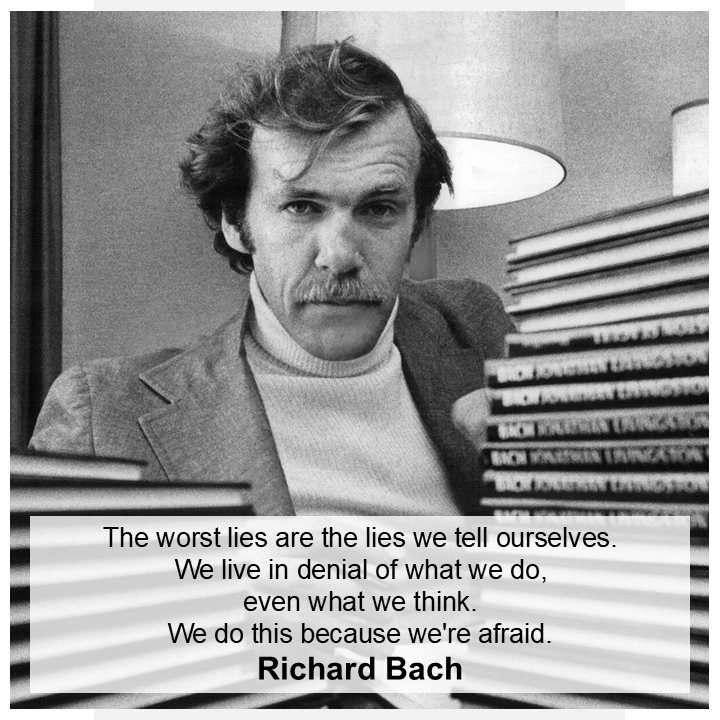
The worst lies are the lies we tell ourselves. We live in denial of what we do, even what we think. We do this because we’re afraid.
We fear we will not find love, and when we find it we fear we’ll lose it. We fear that if we don’t have love, we will be unhappy.
– Richard Bach
But we're all gonna die
Decompose into daffodils and dandelions
The bees will use our flowers for whatever they like
Make the honey that our grand-kids will put inside their morning tea
It's the thing of life
We're all eating each other
The thing of life
Nobody lives forever
The thing of life
The urge to ‘consciously’ exist forever is the only lie we need to let go to become truly eternal, free. We are so attached to our so called “self-created identity” that we consider everything going against is as a potential threat to our existence – the existence which eventually will fade away into nothingness. It is way better to accept the finite-ness of life and be useful to each other rather than carrying that false sense of superiority, higher ego to justify our lies of life.
Juliet puts higher perspective to sooth our confusion of “conscious existence”. We are justifying our egos because we don’t want to die, we don’t want our identity to die, we don’t want our memories to die, we want to be remembered by people even when we are not existing in the world. The urge to preserve our conscious identity thereby our personality becomes the ultimate goal of life.
I am using ‘conscious’ word here to show that we are scared of losing the “I”, “Me” from our life because that is how we experience the life. We create the sense of existence from inside that is why sense of “I” is very important for our existence but if you closely observe the way things exist in the nature it is really difficult to pinpoint what makes that “I” – the “I”. Is it my brain? Or is it my body? is it my property? is it my super-car? is it my villa? is it my designation/ salary? is it my family? What exactly defines us?
You will get the answer once you accept that this thing that you have assigned your identity to – your existence to will not remain forever. When we say it will not remain forever it means that the combinations which created that existence. The existence would crumble down into nothingness.
Now here is an interesting part. We call the crumbles of nothingness “nothing” because they do not immediately affect, improve or help the existence we were trying to hold on to – our identity. We forget that it was the same set of some “nothings” which came together in a specific way to create “something” – this something became our existence.
Juliet beautifully brings in this perspective by saying that we will end up into flowers then into the honey that our future generation will put in their morning tea.
While we are trying to hold onto our special identity which is short lived, which would disappear in a blink we are forgetting the fact that the nothingness from which we were created is more eternal than the identity we are trying to maintain. This nothingness is the truth, its that something which is getting recycled all the time. On the other hand, we are in this constant battle to justify our falsely created, mortal identity.
We should understand that we are actually eternal but this false sense of ‘being’, this false sense of ‘conscious’ steals the real eternal existence.
We don't know how to accept we're just a product of a chance
And less like gods but more like plants
Who can't stop making up reasons we're alive
(We're alive, we're alive, we're alive)
You know we love to deny
(To deny, to deny, to deny)
Juliet is again waging war with our falsely created sense of “special”. We intentionally highlight the facts that justify our superiority and ignore the facts which actually show that we might be the result of few overlapped coincidences. Even if we have not come out of chances and coincidences our existence is not that grand in the whole scheme of existence. On the level of creation, we are as close to plants than the powers which created all of us.
So we paint our face with intellect
Pretending we're not curious
Too busy, super serious
Don't have the time to do what we like
(What we like, what we like, what we like)
Baby look at the sky
In spite of knowing that we are insignificant, knowing that the creation is way bigger than what we are trying to justify ourselves, we are always in the race to prove our superiority. Why does that happen? Why are we always trying to justify our superiority with some lies while we call ourselves the smartest species? Why ‘we’ the smartest ones fail to recognize the objective truths of the world when we know that there is not meaning to chase everything all at once? Why we are always trying to win the race and justify our worth with something?
The reason is that we think our existence is limited, our time of remaining conscious of our being is limited.
We very well know that we will die someday, that is exactly why we try to justify every moment of our conscious existence to something, some idea, some object which we call our job, duty, faith, passion. We don’t want to die with the regret that we have nothing that will remain forever after we die. We are so wound up in justifying the life, memories after our death that we have invested our present into the pursuit of lies which are creating the illusion of our specialty.
Our heads are so engrossed down into the pursuit to create that false identity of worth-ness that we are unable to look up and appreciate the beauty around us, the reality around us.
The urge to lookout for the meaning of life and then assigning that meaning to something so superficial will eventually end into the pain and regret of not enjoying the time we had to its fullest, the moments we had to fullest. We are always trading the real awareness of “present” to gain the illusive comfort of safe “future”. That is how we justify meaning.
The real meaning of life should come with the understanding that whatever it may come next, one will never attach the sense of being to something which amplifies ego. Ego too will perish in the flow of time. The rejection of ego comes when one lets go of their sense of identity being special.
'Cause we're all gonna die
Decompose into daffodils and dandelions
The bees will use our flowers for whatever they like
Make the honey that our grand-kids will put inside their morning tea
It's the thing of life
We're all just eating each other
The thing of life
Nobody lives forever
The thing of life
We're all just eating each other
The thing of life
Nobody lives forever
The thing of life
The rejection of ego will make you free, will show you what your real worth is. Even though you are not special – in the end, you are something of value when you synergize with others. Even though your conscious being is not eternal, the things which made your conscious being are eternal and that awareness should free you from all the urges to justify your identity, your specialty.
You are given a chance to experience the universe in the most sophisticated manner possible which many of the other species might not even have. What more could sooth your existential confusion! Once you realize that you are already made up of eternity, you will let go this mortal identity which you are always trying to preserve with some subjective perspective and lies. This is the real freedom and it requires innocence. Innocence is one of the basic indicators that the person has no ulterior motive to achieve something, it brings in the sense of acting on things without expecting anything in return. Please understand that innocence does not mean that the person should become a fool. Remaining innocent in spite of knowing everything is really hard, that is how you will know that you are not fooling yourselves. This song shows us that innocence.
Conclusion
Juliet Ivy very beautifully brings the sense of life that is made up of eternal creations and destructions. We attach the meaning of our lives, the purpose of our lives to certain things while realizing that they too will perish in the flow of time – this is what would unsettle even the dumbest person. This feeling is also experienced by the highest specimen of humans. In order to come out of this unsettling fear of unjustified – worthless living, we take support from our surrounding. We selectively choose certain aspects that will create an illusion of safety and comfort. Being social animals, we compare our lives with the lives of the others, we create our baselines and set our targets based on what others have achieved and done in their lives.
You know what? Even after achieving such goals which we defined based on our surrounding we are not happy. Even after those material victories, we see that the happiness is short lived. So, we shift our goals to something which is immaterial, something which is spiritual. Something which we think is more eternal than the material things. We make certain ideologies the meaning of our lives. Religion is one of such examples.
René Girard – a French philosopher coined the concept of Mimetic theory where he tries to answer how we decide what to do and why to do. Mimesis roughly means imitation, trying to resemble. When we are stuck with no information or loads of information in either cases, we will be overwhelmed. The best way to come out of such conditions would be to see what others are doing around you. We set our standards based on the baselines of our surroundings. We create lies to justify these baselines and goals we want to achieve. Our ego is thus created to ensure that we maintain the sanity in the times of clueless-ness. It will prioritize survival of body in materialistic races and survival of its own sense of existence its identity in the spiritual races. In the end, both victories will fade away. (That also should not mean that one should not engage in the pursuit of certain victories. It should imply that the non-eternal nature of everything should humble the person.)
The most important point to understand is the ways in which everything great (also everything worse) will be broken down to their most fundamental building blocks. The idea is to not get attached with what you created which got destroyed.
In our current times when the life expectancy is better than ever, when we have a better cover of social safety than ever, the primitive instinct of survival from natural predators has been replaced by the recently created – modern instinct of philosophical – ideological survival which is the ‘preservation of our identity’ – the idea of our own image. (Social media is the booster for such way of life. It is also how the mimesis is happening strongly.) Philosophical death seems more painful than actual death. That is why in certain cases people gather courage to do self-harm. The best way to come out of such mentality is to question the very thing which brought this philosophical death; I know it is difficult to pick on the injury which already is painful to bear. The idea to work in such confusions is to notice one important behavior every one of us maintains when we define our life. We always strive to amplify things which bring happiness and ignore things which bring sadness. We define our life selectively on such choices in spite of knowing that both hold same potential to realize in actual life. This desire to selectively attach to certain aspect brings pain in life.
The moment we accept that there is no end to the cycles of creation and destruction (of both good and bad) we will see that we are nothing but a recycled versions of everything that is there in the existence.
The realization of the actual death of our body should come with the awareness that you are returning to materials which made you.
The realization of the philosophical death of our being should come with the awareness that your idea of self, your consciousness was just created by your desires and after this philosophical death you are returning to the fundamental forces of what made them and thereby what made you. The endless possibilities for your becoming are opened in this point. This is the true eternal existence – to get broken down into the fundamental blocks of being and be recreated again.
Juliet Ivy said all this in one simple sentence “We’re all eating each other.”
The cosmos is within us. We are made of star-stuff. We are a way for the universe to know itself.
Solipsism warns about the impossibility to know everything in absolute manner but if appreciated in a proper way it guides us to seek for continuous up-gradation from existing lesser absolute truths to newer and better absolute truths. A pure solipsist would be delusional, neurotic but a practical solipsist would bring about a revolution in his own world thereby in the worlds of the others and even in the whole world altogether!
The problem of other minds – do they exist in reality or the reality just exists in my mind?
Have you ever felt that words are failing to express the joy you have? Do you feel uncomfortable when you are unable to understand the vibe of your environment? Is it just you or is it the surrounding? Do you sometimes feel that everyone is treating you in a certain way and then you realize that actually it was you who was behaving differently? Do you get the feeling that someone is behaving in a way but thinking in a completely different way? Am I unable to get early in the bed because I don’t wish so or the weather is cozy? As if they are hiding something and you would never know what and how they feel? Could you make others feel your exact experiences in the exactly the same way? If yes, then how? If not, then why is impossible? How come our senses have practical limitations? Are those the limitations of our mind? Is empathy a real thing or is it just the construct of my mind to mirror the people in front of me? Why my experiences are so private?
The questions posed through Solipsism may clarify the origin of these ideas.
Where solus means “alone” and ipse means “self” in Latin
A philosophical idea that only one’s mind is sure to exist
Origin of Philosophy – Knowledge is power
Everyone of us is born with a tendency to have control over the surrounding. This is closely connected to our survival instincts. Though our survival instincts are mainly primitive what differentiates us from rest of the animals is our reasoning ability. Almost every animal is proven to have emotions, many of them can think logically at least from survival perspective, some of these animals have shown signs of intelligence closer to humans when trained properly. Our reasoning ability is some sort of highly evolved survival instinct. Reasoning introduces understanding, awareness of the surrounding in which we live, this understanding increases the predictability of the future thereby increasing the chances of the survival of the species. So, we can say that the better we understand the system which w are part of the better will be our chances of anticipating the risks of the environment; the better we anticipate the upcoming risks the better we can be prepared for to handle them to procreate further thereby ensuring the survival.
That is why we have many fields of knowledge to understand the establish different aspects of the reality we live in. When there were no boundaries between different fields of knowledge everything would start from simple question (even today single important and specific question can establish a completely independent field of knowledge) We are always one question away from a completely new perspective towards reality. (See Gödel’s Incompleteness theorem if you are interested in this idea)
Philosophy could be attributed to the most primitive, original, and the crudest field of knowledge. Although most part of philosophy is properly structured, it is crude due to the plethora of unanswered questions it has. Once the fundamental questions in any domain of understanding are answered, once the paradoxes lying at the end of an established field of knowledge are solved then a new field gets created and separates from the fundamental philosophy.
(The primitive man survived on whatever nature provided then the humans realized that one can sow the seeds to get certain crop from certain soil in certain season in this much quantity thus came farming – Botany, Geography, Mathematics and many more. When we were unable to understand the Newton’s theory of gravitation to some heavenly bodies (the perihelion of Mercury) then Einstein’s theory of relativity disrupted our existing understanding of the universe. It has literally affected every field of modern knowledge.)
Skepticism – Keep on questioning until you get consistency in understanding
So, in nutshell, the job of philosophy is to ask those questions which would challenge the complete domain of a certain field of knowledge, once you get the proof of this question then it becomes the part of that field of knowledge or a completely independent field of knowledge. They detach from the Philosophy. Philosophy was never meant to provide answers, if certain philosophy is providing proper answers, proper predictability then it is a field of knowledge.
What happens to the questions which remain unanswered?
What if there are unresolved paradoxes at the end of the a fully established field of knowledge?
I would say the philosophy carries the unanswerable, paradoxical nature – the imperfections in our understanding until they are formally, satisfactorily, and most importantly – coherently answered. That is exactly why philosophy always seems crude, as if it is carrying all the imperfections in our understanding of the reality.
Skepticism lies at the base of the philosophy. Once you get consistent answers to the questions posed, you keep on questioning that consistency. Everything (and I mean it) will end at a point of paradox or inconsistency. (If one finds exceptions then it is better to upgrade that theory otherwise soon it will get replaced with better theory.) There are ways to deal with such paradoxes/ inconsistencies (See Agrippa’s Trilemma if it interests you.)
Solipsism – Extreme skepticism – Questioning the existence of the question and the questioner!
So now we that we are familiar with the nature of questioning everything to establish consistent answers thereby to create knowledge, it is important to know how we do so. What make us answer these questions in a consistent manner. Our experiences, observations of the surrounding, our interaction with one another and the results of these interactions give us the fundamental model of reality. This model is developed by our minds – bunch of neuron connections physically per say – the collection of the sensorial feedback from the body.
Now the question is, as we go on questioning the reality, the final question is come like this –
If there are still some gaps in my absolute understanding of the reality which are creating this uncertainty somewhere, which is creating paradoxes, inconsistencies; what exactly is absolute? What exactly is the most certain thing in the world? What is the most real thing, real measuring scale with which I could measure and understand my surrounding?
Solipsism says that only the existence of your mind is certain, the existence of other minds will always be uncertain. As the presence of other minds is uncertain, you can be sure of only what you experience as “the reality”. As only you absolutely and fully realize the reality through your mind, the reality is just mere figment of your mind and imagination (when stretched too far!) When you try to transfer your minds realization of the reality to others you will always see that something got lost in translation. If reality is just the construct of my mind, then what exactly is existence?
Why Solipsism stands strong? – Why idea of living in the Matrix fascinates us?
Is the creator playing with my mind to show me a false reality for something different which is beyond my access?
The earliest evidence to ask such question is found in the writing of a Roman skeptic Sextus Empiricus quoting Gorgias (c. 483–375 BC) as follows:
Nothing exists
Even if something exists, nothing can be known about it
Even if something could be known about it, knowledge about it cannot be communicated to others.
Then René Descartes (the one who established Cartesian coordinates) came up with one of the famous quotes/ ideas about the absoluteness of the reality.
Cogito, ergo sum.
I think, therefore I am.
René Descartes
Simply put, Descartes argued that, the most certain knowledge one can have is through personal experiences because knowledge transferred from others are never perfect also there is no way to measure where the translation was perfect. The existence and experience will always be discrete – separate; it will vary mind to mind, so what is reality for you is the only absolute reality; that is why absolute knowledge is private property. As you can be only certain of your experiences only your mind is the reality, everyone else’s minds don’t exist. (OR should I say others are mindless! Jokes apart!)
George Berkeley – Bishop Berkeley is also one famous philosopher who developed the ideas of immaterial-ism. He is known for the famous analogy of “a falling tree” although his writings never explicitly mentioned such analogy but let us say in a crude way, he pointed towards it. (See, even here we can see the gap that is created during the communication of an idea, a simple analogy someone established before us!)
So, the idea is, if a tree falls in a forest and nobody saw it falling, nobody heard it falling, nobody felt the vibrations of fall how come we be sure that a tree fell down somewhere? Unless and until someone observes the fall through their senses one can never be sure that the really fell. So, if no one noticed it and in the end even you didn’t notice the fall, then the tree never fell down!
Your mind, you consciousness and you had to exist absolutely to observe, experience the fall of the tree. If you weren’t there to see and experience the fall, how could you be so absolutely sure that the tree fell?
Solipsism – Trust no one but yourself!
Now, you would have understood what may be going wrong with Solipsism!
Modern day answers would be like “I would have been presented with a video to prove the fall.” OR “I would have been presented with the person who cut down the tree”
But the counterargument would go like this “What if the video was faked? (by using deepfake!!!)” OR the witness found to be forged – I wouldn’t know if the person is lying with confidence (even polygraphs tests can be fooled, false alibis can be created!!!)
Jokes aside, these are mere representative examples to demonstrate the point. When you start formally questioning the nature of reality by using the most consistent tools that we have in modern science, then this question again peeks out in a bizarre way!!!
According to quantum mechanics, the moment we measure the state of a quantum object, its state changes. So, the measurement of that instance will never refer to the actual state of the quantum object. Meaning that you could never be sure of what actually happened before or at the instance of measurement. You can have a probability but you will never be sure.
Your observation had to exist to define the state of the quantum object, if you weren’t there were infinite state of the quantum object to exist. Your observation assigned it a definite, objective, absolute state. Your observation made it a real “reality” otherwise it was always possibility rather probability of many events. Please note that these are not just the flights of minds by the most compelling specimens of humanity, these are actually mathematically, experimentally proven ideas.
The one liner to understand solipsism is –
Your personal experience is more dependable than common sense!
I understand that how is it even possible to question common sense, common experiences. Solipsism is such a foolish idea rather the most foolish idea one can have! But, bare with me when we try to answer the paradoxes which lie in solipsism. Any person who is having existential crisis has been warned hereon!
Different ideologies in Solipsism
Metaphysical solipsism – the most extreme solipsism – the external world doesn’t exist. My mind creates the reality for me. (A rude adamant philosopher made it clear!)
Quick Joke – Unless I didn’t observe the tree falling, it is still there (and maybe giving fruits if it is a Mango tree!)
Epistemological solipsism – The reality around me is absolute and objective, but we cannot know it directly as it is through our sense and experiences. It is the limitation of my senses which inhibit my understanding of the reality. (This is a humble approach I would say!)
Sensory organs are not the experiences from the reality rather they are just the interpreters of the reality with practical limitations. There is no direct agency to experience what others are experiencing, to know other minds.
Quick Joke – A person drinking tea finds a fly in his tea asks the waiter to replace the tea. Waiter helplessly trying to convince his of not having any fly in that tea gives up and replaces the tea. After few same complaints from same person and replacing many cups, it is discovered that the fly was in the guest’s spectacles!
It’s like I cannot hear certain sound frequencies but certain animals can hear those frequencies. I can see only the light in visible spectrum, but other animals can see in another spectrum. It’s the limitation of my senses which dulls down the objectivity of the reality. You have to be ‘the God’ to understand all the spectrum of the reality! (excuse my introduction of some spiritual power here but we will come back to this again!)
This is the most practical, plausible and calming version of solipsism.
Methodological solipsism – Every logic is fallible, that is why you could never know what the absolute looks like. There is nothing like ‘the God’, if there is something supreme you won’t even understand how supreme it is and why it is so! (I know we are getting spiritual to go away from early religious epistemological solipsism but that is how it works)
It says that even our brain, our mind is the part of external reality. (I am feeling uncomfortable here.)
Quick Joke – A criminal was convicted for murder. He went scot-free because he didn’t do that murder, his had hand – rather the knife did the murder.
Jokes apart, but consider cognitive dissonance. Many things which we learned in our childhood as the absolute concept, as the ultimate truth gets replaced by something life changing and even more true and absolute. So, what is real truth is beyond our understanding.
Paradoxes at the end – Where Solipsism would break down!
The paradoxes of the solipsism are the most fun part which explain why solipsism deserves any explanation.
Here are some doubts,
1
If my mind is the absolute reality I live in, then why can’t I convince myself to survive by just imagining that I have eaten a lot today (while not eating even single crumb!)
I could just survive by thinking of eating the best food I could “think” of.
Everyone knows that this is not the real case. A person with that much will power and fasting will barely survive.
Now, the counterargument for this (and I love this part due to pop-culture reference!) –
What if your brain is kept in a container giving some electrical impulses exactly like in movie The Matrix. The matrix is programmed in such way that not eating will kill you definitely.
Solipsism ends in a matrix, a simulated reality beyond our experiences!
2
If there no such thing like matrix then how come all of us would die if we face the same degree of starvation? How come the experiences (even though not purely translatable to others but still the same based on the objective, consistent observations) we have in such cases match?
Many of the knowledge established as the most absolute, consistent and closer to the reality is developed because all of us had same experience (at least objective experience, ideally fully efficient translatable experience) in every one of our lives.
The answer is that we all share a common consciousness which enable us to experience the same scenario. We all are living a common and shared dream.
Our reality is a shared dream! Our consciousness is a shared dream! We all are connected by something so common and absolute thing. A spiritual person would call it the soul, a scientist would call it the energy.
This is technically known as the Solipsistic idealism – the best answer we have which will not blow our brains and will not give us the existential crisis!
3
The bizarre one comes here –
Even if the matrix is real, you would never be able to get the absolute understanding of it. Existence of external absolute reality is uncertain. You won’t even know if it is called matrix or a chewing gum or something else!
Pro tip – don’t over-love solipsism
You must understand that the arguments in solipsism are quite good. (It is just my failure of communicating those to you if you are not convinced till this point. I apologize for that.)
If the reality is just created by my mind/ in my mind then there is no way to verify that from external agency.
But, our experiences, emotions (at least some of them) always feel common. René Descartes Descartes posed that the experiences, sensory feed-backs are purely created by our mind but modern science proves that babies are not born with absolute ideas of reality (it is possible that they are exposed to certain sensorial experiences from their mother right from the conception) The absolute experiences they get are from their interaction with the surrounding objects and people. Our personalities, identities are created from mutual interactions. We cannot be ourselves without the people around us and the environments we are exposed to.
Only a completely isolated person would have the polarized inclination towards solipsism.
But again, what if it is just a construct beyond our understanding? There is no way for us to know that.
Even if there lies a construct beyond our understanding, there are some practical ways to purposefully ignore extreme ideas of solipsism rather leverage the ideas of solipsism.
If you are bound to the existing construct of reality which is practically within the reach of your experiences, your mind then you must abide by the laws of that reality. If you only stick to only the reality of your mind, then your so called “absolute truths” will immediately be challenged by the truth of others. It will be a blood bath but let your older absolute truths die to let the newer ones be born. They won’t be ideally absolute but at least they will be better than the previous one.
Even if the illusion of reality is shared among all of us as a common dream, we would never be able to escape that. Meaning, again play by the laws of the land. Ignore the existential crisis on the absoluteness of reality. At least try to get closer to the reality.
I think this is exactly why even though the pursuit of solipsism may feel worthless in the end but it’s understanding and appreciation gives us a hope to continuously keep on improving our version of the reality – private or shared whatever they may be.
Solipsism warns about the impossibility to know everything in absolute manner but if appreciated in a proper way it guides us to seek for continuous up-gradation from existing lesser absolute truths to newer and better absolute truths.
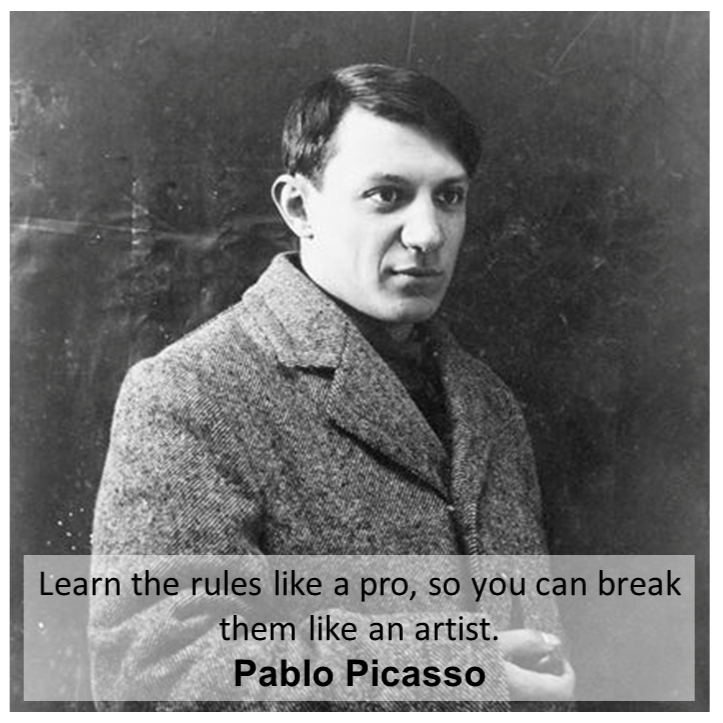
Learn the rules to break them in a better and glorious way!
The acceptance of Solipsism (in a positive way) can also create an urge in person to seek for the real freedom. Solipsism in positive way urges the person to take that inner route in order to create the world of their desires through disciplined thinking (in a healthy way and not in a delusional way!) A pure solipsist would be delusional, neurotic but a practical solipsist would bring about a revolution in his own world thereby in the worlds of the others and even in the whole world altogether!







 Parts Per Billion