Freedom = Courage (Now + Here)

When it comes to psychology – people consider Sigmund Freud and Carl Jung as the de facto rock-stars of the field of psychology. One unnoticed person whose findings deserve equal attention rather more attention was Alfred Adler. He introduced the Individual Psychology to the world which is relevant still today and is way more sophisticated to solve the “so called” troubles of our life. Individual psychology makes a successful attempt to reach to the roots of our suffering and allows us to become truly free.
Alfred Adler’s philosophy is beautifully explained in Ichiro Kishimi and Fumitake Koga’s book “The Courage To Be Disliked”. It talks about the feedback loop of self-acceptance, confidence in others and contribution to others to live a real and fulfilled life. The great thing about individual psychology is that it urges us to break the notion of causality and thereby determinism to come out of the painful, suffering inducing cycles of life & death, cause & effect. It shows us that we live in the universe with infinite possibilities and one needs courage to break the logic of determinism to truly appreciate themselves and the infinite possibilities universe has to offer. Individual psychology given by Alfred Adler thus asks us to bear the courage to lose the false-comfort given by causality – predictability and decide our life on our own terms fearlessly and with freedom. It teaches how one can be completely involved in everything but not attached to them at the same time.

On the book – The Courage to be disliked

‘The world is simple, and life is too.’

I have a question for you,

– How is life treating you right now?

Everyone knows that the responses to this question are diverse and dynamic. The answers obviously will be subjective and so it is normal to expect huge variety.

But you know what, deep down everyone (mostly the adults) know the most frequent type of the answer to this simple question. There is innate predictability about what the answer could be.

Life is not treating me fair

Life has become too complicated for me, life is suffering, there is no hope, why can’t I have a single moment of happiness to savor for some time? why do bad things happen to only me? what have I done wrong to someone that ‘everyone’ has turned against me? what should I do – now that I have not achieved what I was supposed to achieve in spite of putting all honest efforts? why is ‘everyone’ – the society always against me when all I have for others is good will?

Deep down we have this undeclared, unexpressed notion that something wrong happened to me which I didn’t deserve. I tried so hard but couldn’t achieve that thing. Trust me every one of us is an expert of hiding these unsettling feelings, overlooking them to move ahead. But it is important to understand that unknowingly they become part of who we are. When we truly and honestly would start inspecting ourselves, we will find these feelings being the reason for the bitterness we carry inside. That is why life is suffering for most of us, being free then is out of the question. First let me be happy for now!

Psychology has always been on the quest of resolving the model of how our mind works. A bigger portion of psychology directly or indirectly works towards understanding how we see happiness and suffering. Because, end goal of how we feel, how we think, how we decide, how we interact, how our personality is created is emerged from either a happy event or sad event which affect why our psyche is in a certain way.

When it comes to psychology – people consider Sigmund Freud and Carl Jung as the de facto rock-stars of the field of psychology. One unnoticed person whose findings deserve equal attention rather more attention was Alfred Adler. He introduced the Individual Psychology (Individualpsychologie) to the world which is relevant still today and is way more sophisticated to solve the “so called” troubles of our life. Individual psychology makes a successful attempt to reach to the roots of our suffering and allows us to become truly free.

I appreciated this in deeper sense when I came across a book called “The courage to be disliked”. A single book can change your life. Although I have been changed many times before, I couldn’t help but overstate the importance of this special book. 

This is my attempt to reorganize the ideas from the book to instantly simplify the core ideas. So, the next discussion may spoil the book for you. (Although it’s not a story book having a climax at the end but the ideas are written in a conversational – dialogue format so, you peel out one layer at a time to reach to the core ideas of individual psychology.)    

I am actually spoiling the whole book and my writing on the same heron with these few sentences:

The whole thing boils down how you honor this current moment and not let it be influenced by the fear of past and the anxiety of the future. This complete dedication to the current moment is only possible if you honor yourself first, because only you can experience how this current moment will turn out for you. The moment you start to respect this moment here and now – you will be free.

If you have the ability to love, love yourself first

Carl Jung

Now that I have already explained what life ultimately boils down to, it will be important to understand why these sentences hold some gravitas. So, thanks for continuing with me hereon.

Deny trauma – Deny the comfort of causality

The core of individual psychology is the rejection of the causality. Our complete understanding of ourselves and the world we live in is based on the notion of cause and effect. It does immediately feel silly to reject that exact notion thereby making individual psychology illogical.

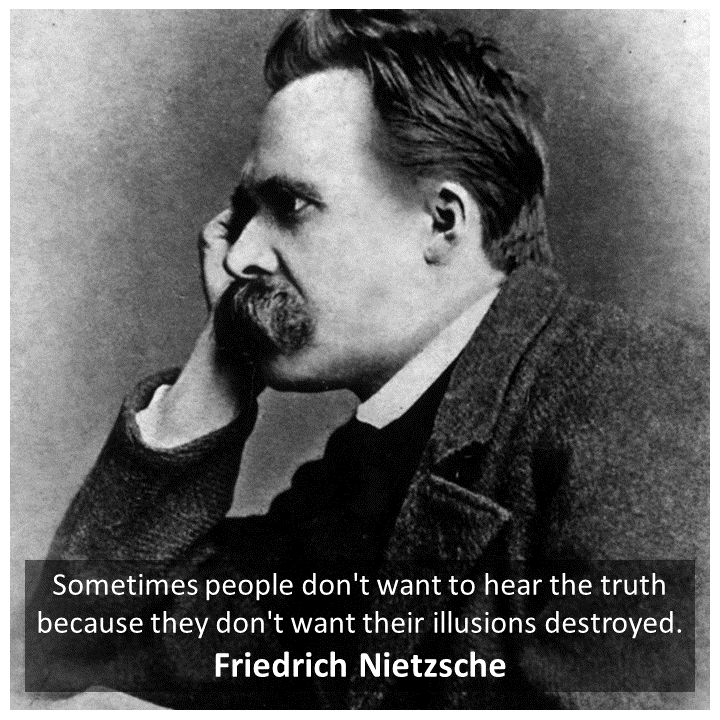
You will appreciate that not everything in whole can completely be justified or predicted with complete precision using the logic of cause and effect. There will always be some information that cannot be completely known for the given system (Heisenberg’s uncertainty principal points in the same direction). Our mind always makes decision, assumptions based on the current information, experiences we have till date and every one know that it is impossible to have all the information and all experiences that are there in the world for a person to understand his/her own existence.

So, in simple words – ‘who we are’ goes beyond the logic of cause and effect. You can be free once you break the chains of cause and effect. In the universe filled with infinite possibilities, there will always be something wrong and illogical, totally disconnected justification to the things happening to you and around you. It will be an injustice if you let that illogical justification define your whole upcoming life.

When we say that I became a person like this because something happened to me in past where I learned my lesson and changed myself into something else, we are just trying to convince ourselves to do things in certain way so that we will have less resistance to get things done in our ways. That is exactly where problems start emerging.

We crave for causality because it grants value to past; because it taught us some valuable outcomes and same causality can help us to predict what would happen in future. We always crave for certainty. But all of us know this by experience that we are rarely good at predicting our future. This furthermore unsettles the mind.

So, trauma is the pre-side-effect of causality (the post-side-effect of causality is the anxiety of the uncertainty of the future). We carry our traumas as badges to flaunt because these traumas feel very personal thus exclusive. The ways in which we carve out our personality from these traumatic experiences gives us a sense of special-ness. These bad experiences, traumas are a big part of our personality maybe due to a survival mechanism implying ‘I should be able to cope up with similar thing if they happen to me in future.’

See, the point is that if we stick to our traumas and fixate our personality on the same, we will never be able to explore the concepts that had better potential to improve our personality (and probably not be traumatic, bitter). We will be stuck in that loop of experiences related to that causality. Given that there are infinite possibilities, there is fair chance than we can be even better than what we were and what happened to us in the past. We are just better at finding reasons to justify our current position because we know we are comfortable here.        

No matter what has occurred in your life up to this point, it should have no bearing at all on how you live from now on.

It might seem that when we are rejecting causality, we are choosing a non-nonsensical path. In reality, we are just avoiding the ways in which we are always fooling ourselves to remain in comfort of predictability. Using the excuse of causality, we are actually ‘inventing’ non-real reasons which hide the realest reality we can actually live.

The first principle is that you must not fool yourself and you are the easiest person to fool.

Richard P. Feynman

Once you deny this causality which you think made you who you are, you will immediately see who you really are. You will leave that burden behind. You will accept yourself for who you are. You will see that you can instantly detach yourselves from your past and your future too. The untapped possibilities open up.

This is self-acceptance in individual psychology.

Once you see how important you yourself are to live your own life, you will say –

“Before past and future let me at least appreciate my own current moment”.

That is now and here. Once you come to the terms with yourself you will realize how everyone is just like you even though we are separated by many aspects of life. Then you will appreciate how others have their own current moments to live and experience in their own ways.
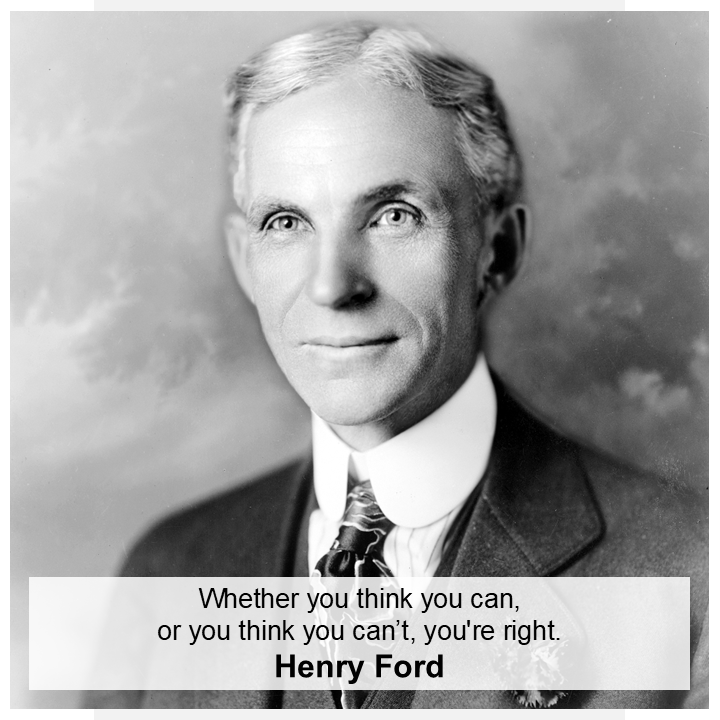
All problems are interpersonal relationship problems – others have their own current moments to experience in their own ways

It is fundamentally impossible for a person to live life completely alone, and it is only in social contexts that the person becomes an ‘individual’.

Nobody can deny the fact that our surroundings make us who we are. Our baselines are our surroundings. A human being is the most basic unit of any society. Our understanding and awareness of self is impossible without a response from surrounding. How would you understand who you are if you never received any reaction, feedback from your surrounding? – It will be a delusional existence. You would have had an idea of who you are but would have been far from what is real.

Thus, when you start seeing that your surrounding will always be interacting with you, you will be able to see every reaction – feedback from surrounding especially people can never be completely cut off. This again feels senseless. If you are born alone, leave this world alone then why couldn’t me being alone throughout my existence be more justified? It is because we never had any sense of absoluteness right from our birth and this sense of absoluteness always remains un-achieved, it is just an ideal condition we are always trying to reach. Our core understandings are only possible with the relativeness, comparison of baselines.

That is exactly why even when you are trying to live your life alone, that ‘loneliness’ itself cannot be justified if there is no understanding of what being ‘together’ means. So, there will always be something connecting you to your surroundings. That is where relationship comes in picture. You cannot run away from interpersonal relationship. You will be surrounded by people (or at least what made them you even when you are sitting lonely).    

So, when you are appreciating your current moment, it is natural that others will be respecting their current moments. This understanding will make you appreciate the importance of everyone’s being.

This will make the world around you seem less hostile. You will be filled with kindness for others.

So, you must first accept yourself first otherwise you will not come out of the hideous cycle of comfort of predictability, once you accept yourself to remain in now and here you start seeing here and now of others. You start valuing their here and now. That is why you start allowing people to be who they are, you stop expecting from others. You stop expecting your recognition from others, you stop pleasing people for your own good in the end.

Now that you are free from the burden and pursuit of desirable and predictable, anticipated feedback from surrounding you become tolerant of criticism and even dislike from others. That is truly when you are free. I want to focus on my now and here and nobody can stop me from experiencing that. Then you see this as the basic requirement for others too. This is exactly here the person becomes tolerant towards others. People start putting confidence in each other to create that safe space – the real safe space. People start respecting each other’s boundaries because they themselves have understood that they have their own limitations. This creates the sense of camaraderie – society.   

It is precisely because we lay a foundation of unconditional confidence that it is possible for us to build a deep relationship.

This is confidence in others in individual psychology.

Discard other people’s tasks – reject the desire for recognition and accept that you being disliked is not in your hands

When you are appreciating your own now and here to its fullest, you will notice how important it is to reject all other distractions to honor this moment. You will limit these distractions to focus more on this moment. This is where you will see that even though we are molded by our society we have limitations and so do the others. So, it is better if one sets boundaries.

Setting such boundaries helps everyone to focus on their ‘now and here’ in deeper and richer ways.     

If you are not living your life for yourself, then who is going to live it for you?

When one develops this understanding, they will clearly see what lies immediately in their own control and what not. If you are busy in trying to control what cannot be controlled by you, how would you have enough resources to appreciate your ‘here and now’? That why it is important to not focus on what you can’t control. Those will be someone else’s to control, that is not you task. That is exactly why you cannot pressurize people to do things in your ways. People can have their own reasons, limitations to not do things in your ways. It has to come from their side.

Forcing change while ignoring the person’s intention will only lead to an intense reaction.

Building on this understanding, you will start appreciating how doing what you love and not expecting anything in return is more than enough. You did what you love. Whether to appreciate it and recognize it, praise it is in other’s control not yours. Now that you have accepted yourself, you do it for yourself, then you won’t crave for attention from others, then you don’t crave for superiority, dominance. You come on level to level with your surroundings. You appreciate that whatever one wants to become that journey has to be completed by only them. Then you appreciate how we are trying to please others to get things done in our way when they were never in our control. You let go of the things which you cannot control and start focusing on what you can. That is why it is normal that some people (who were trying to get things done from you in their ways) will dislike you for not doing them in their own ways. This shows that you are honoring your ‘now and here’   

The cost of freedom in interpersonal relationship is that one is disliked by other people

Once you understand that it’s normal to be disliked, rather that indicates that we are doing our own thing you will appreciate what it really means to be genuinely be appreciated by society. Then you will feel like transferring this feeling to others too. Now that you have experienced this feeling for yourself, you would genuinely want others to feel that to. The things then you will do for others will have no intent of return because you very well know that returning favor is other people’s task.

If one’s means for gaining a feeling of contribution turns out to be ‘being recognised by others’, in the long run, one will have no choice but to walk through life in accordance with other people’s wishes.

The feeling and act of contribution has to be selfless and this selflessness is possible only when you are valuing your ‘now and here’. If you still are not valuing your ‘now and here’, it is very easy for you to get swayed by the likes of others and then you will end up in pleasing others and whether others will be pleased by what you did for that recognition is not in your control. This means the most probable fate is misery.

So, self-acceptance builds courage to do it in your way whether others like it or not. This detachment from opinions of others pushes you to do the things which were impossible before – what else is freedom them?  Then you understand the value of self-acceptance. You will then have the selfless feeling to let others experience and understand this. This selfless act for others will feed back into your sense of own being. This will support your feeling of self-acceptance. Once you close this feed-back loop, you will see what others are missing. You will help others in the real way. This will create the sense of belonging for you which further creates the real sense of meaning in life.

 This is contribution to others in individual psychology.

Where the center of the world is – there is no absolute cause and effectthere is no such thing as the first start and the last end

If you are ‘the center of the world’, you will have no thoughts whatsoever regarding commitment to the community; because everyone else is ‘someone who will do something for me’, and there is no need for you to do things yourself.  But you are not the center of the universe and neither am I.

Adler’s individual psychology thus focuses on a feedback loop of three key things:

One – Self-acceptance – you are who you are ‘now and here’, not what made you who you are

Once you accept yourself you give yourself better chances to live an earnest life 

Two – Confidence in others – now that you have appreciated how valuable, irreplaceable and incomparable living in ‘now and here’ is, you let people do their own thing because they have their own ‘now and here’. You put confidence in others, you do it not because you want something in return because returning the favor is in their control. This builds the real sense of community, belonging, safe space.

Three – Contribution to others – Once you start believing in people just like the person you are you appreciate what it means to be felt accepted. You try to support this feeling by contributing back to your safe space. You want it to be done by yourself because you now know that contributing back is in your control – your task. This further crystallizes your sense of self-acceptance.

Now that you have appreciated what it means to become truly free, it is normal to reject the false sense of superiority, false sense of being special. Every moment becomes same to you. This does not mean that you become numb to sadness or happiness. It just means that you appreciate that this too shall pass, all I have to live and experience is ‘now’. You lose the idea of a goal to be achieved and accept the real goal, the real target is to become the process.

Life goes on

For a human being, the greatest unhappiness is not being able to like oneself.

Although our existence is bound by birth and death, cause and effect. The reality filled with infinite possibilities does not follow that logic and we fail to notice that difference. Just to make the sense of the infinite possibilities we resort to certain assumptions, prejudices, reasons, past events, future expectations. We never question them with complete honesty because questioning them will bring existential crisis. We all know that our foundations really are not pure or absolute. Once you accept this you will see that it is very easy and important to accept who you are now. This further induces kindness for others. This creates the community. This is called Holism in individual psychology.
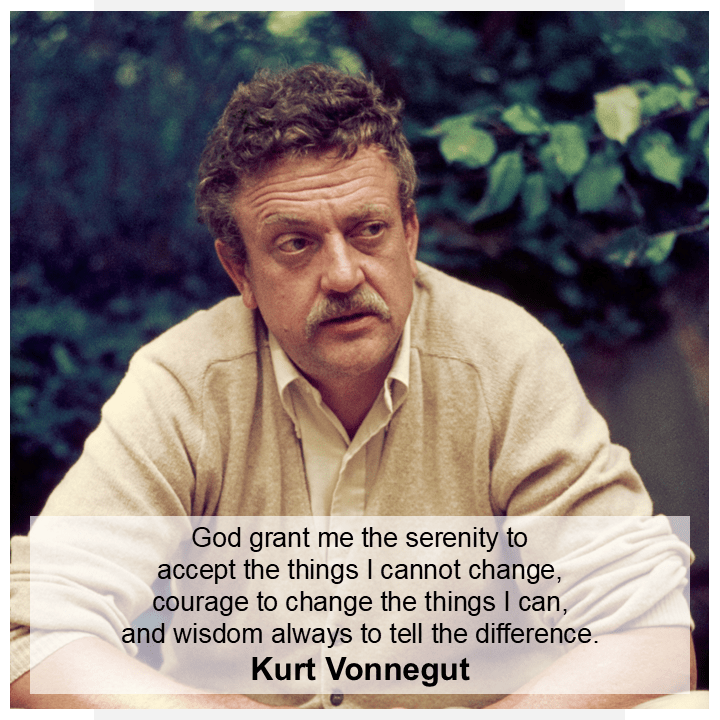
You must appreciate how causality brings in determinism in our lives. This determinism is kind of responsible for the lack of freedom in our lives. When we are suffering it is this exact determinism imparted by causality that builds helplessness. One must carry the courage to break out of this determinism. The courage is necessary because we never want to let go the comfort of predictability which determinism offers.
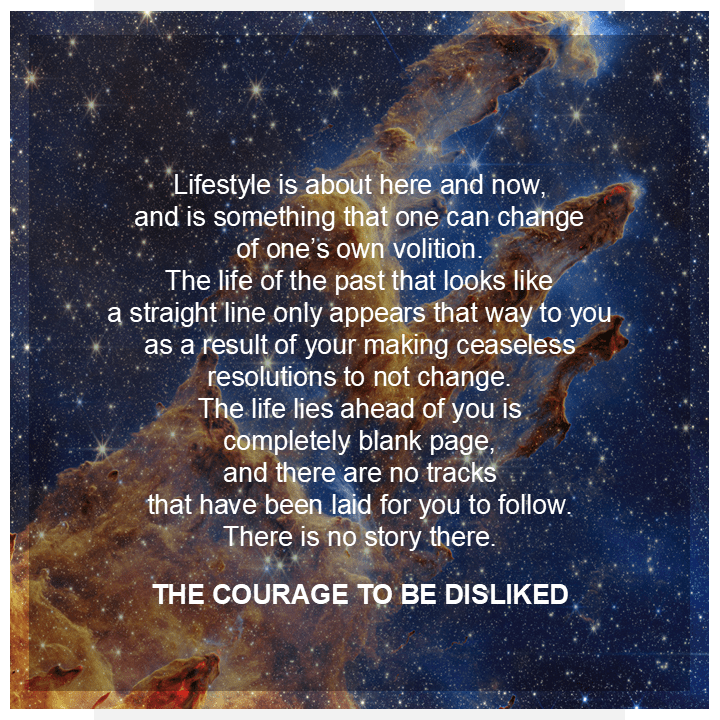
We resort to certain version of our life story when we are completely aware that we can totally change our life story. We are always taking the support of ‘I am like this because this happened to me’. This is how everyone’s story is. There are very few people who have dared to say – ‘I have gone through this for long but not anymore.’ This requires for you to appreciate yourselves first, when you accept who you are you move on to the path of improvement whereas when you are trying to act according to the like of people around you, you are actually proving the point that you don’t like the version that you are that is why you are ready to become the one which people would like and tragedy of this path is that the task of being liked by others is not in your control.

That is why whining about why we didn’t reach there would never help us to reach there or even embark on journey in that direction. We are hesitating to make our own move.

As long as we postpone life, we can never go anywhere, and will only pass our days one after the next in dull monotony, because we think of here and now as just a preparatory period.

Be real, not a hypocrite

People want to like themselves. They want to feel that they have worth. In order to feel that, they want a feeling of contribution that tells them ‘I am of use to someone’. And they seek recognition from others as an easy means for gaining that feeling of contribution.

The main reason Adler’s individual psychology didn’t receive enough attention is because it feels completely self-contradicting and hypocritical on surface level.

You will find these seeming contradictions everywhere in Adler’s ideas. It will say that we are social animals and are defined by society but in next moment it will say that you need to have the courage to be disliked by the people around you.

One time it says that you should not interfere in other people’s tasks and next time it says that you need to have a feeling of contribution for the same people.

One time it will say that you have to sever the relationships where others are not realizing their own tasks and making life difficult for you and on the other hand it will say that you should be unconditionally confident in others endlessly.

One time it will say that you should completely focus on yourselves and then it will say that you are part of a bigger family, bigger universe and you will be happy when you contribute to this bigger community to create a sense of belonging.

If I am being disliked then how the hell would I be happy?!?

If you inspect each of these seemingly contradicting ideas you will find one simple fact – the fact that we are walking living paradoxes and in spite of that we demand sense and logic about who we are.

The sense of self or individual cannot be appreciated well if you never know what it means to be surrounded by people. And there is always some interchange happening between individuals which makes it a society. We often see society as a group which is everything minus ‘I’. We fail to recognize that if I fix myself in certain way the others around me will fix themselves in response to that way and then most of the individuals who constitute the society will fix themselves in certain way. Means even a single person can effectively change the society.

What people actually miss when they come across the ideas put forth by Alfred Adler is the possibility that we can truly reject causality. I would call this unawareness the curse for the humanity. Our sense of ‘being’ inherently originates from some non-absolute attributes, relative references that we have to accept them as the ultimate truth right from our birth to make the sense out of all these infinite possibilities.

We are so entangled in the suffering and happiness waving between the life and death that we ignore that we are born, dead and again reborn every moment. The trick that causality plays in our life is that it tries to preserve the previous step to justify our current stage thereby freezing our present. Whereas what we should do is to just be in now and here which needs courage because there is no guaranteed layout, map to guide you. You have to walk your path all by yourself.

What people fail to notice is that the comfort of predictability is just in this moment but this sense of comfort has no control over future rather it intensifies the pain due to the randomness of the unpredictable future.

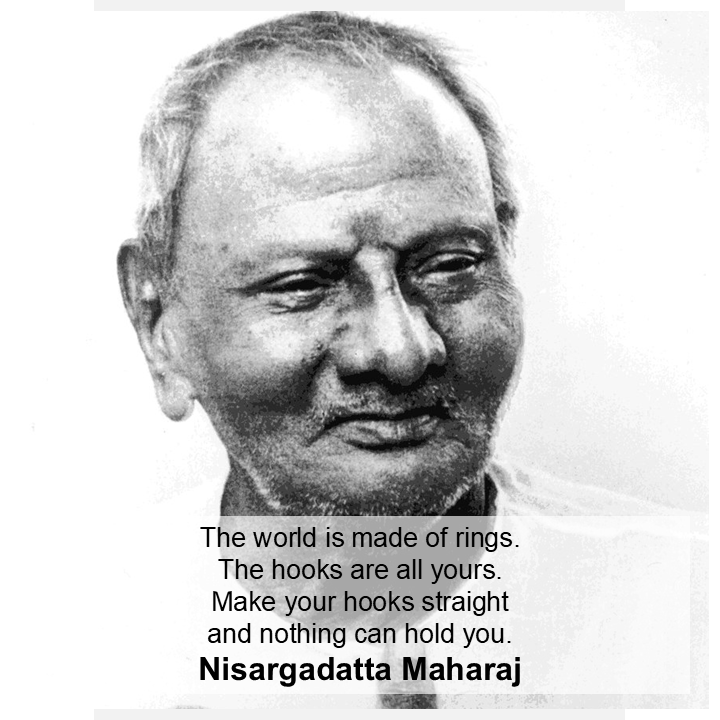
The secret to happy life is to be involved in everything and still not be attached to them.
Joker: Folie à deux – The Dark, Twisted Fate of Internal Conflict

The polarizing reception of Joker: Folie à deux shows how deeply we are attached to certain fictional characters. Whatever might be the reception of this film, the character design and writing of Arthur Fleck in Folie à deux will go down as one of the best representations of the psychotic villain in the history of cinema. Even though the film doesn’t cater to the fan service, it will definitely become one of the best depictions of the inner conflicts of a mentally challenged person swinging between reality and delusion. There is an interesting mental dilemma of identity common to both the Batman and the Joker. How they chose to deal with it made them who they are. The movie also points to the importance of inner compass for a healthy mental state altogether with surroundings nurturing empathy, kindness, appreciation, and love.

Character study of Todd Philips’s Arthur Fleck in Joker: Folie à deux

Recently Joker 2 or should I say Joker: Folie à deux released in theaters and people almost lost it. Most of the movie goers especially the comic book fandom was highly disappointed. There is another side of this same movie experience where people are really appreciating what the film presents in its narrative even though it is not completely loyal to the source material. Some are praising the liberties the film makers took to show the world what it means to become the truest of the villain of them all and why villains are praised more (maybe they deserve to be praised more) than the hero, even though hero wins in the end (this emotion is strongest in terms of the batman villains to be honest).

I am taking the side of what the Joker duo-logy presents itself to the audience rather than its correctness to the source material or the fan service. It is really a daring move from the creators of this second film to use all their creative power to show the world how dangerous character of Joker could be in real life. When I am saying this, I know fans can say that its just a movie and we only watch it for the sake of the entertainment; we do not want every movie to be a lesson on good or bad, right or wrong, truth or lie. But trust me when you are completely in the mood of bliss and entertainment, engrossed in the world created, even a lie would seem true and a wrong would feel right. It leaves an impression on our mind. A great entertainer can convince you to twist the ideas of certain truths in a person’s mind. Advertisements are a crude example to prove this point. Movies, cinema, stories are a potent media to change the minds, perspectives of the masses in an impactful way.       

Mark my words, after few years of “marination” this movie will go as one of the best materials to study the writing and the design of a psychotic person. The movie will definitely regain its value as the ‘cult classic’ in coming decades. I am not saying that people are fool to not appreciate this film; I am saying that some of the things which disappointed people are actually way ahead of their time, people will take time to get comfortable around them and appreciate them.
The ability of movies like this to create a polarization of opinions amongst audience shows how potent the medium of cinema and storytelling is! We are humans – we love stories (especially those which unsettle us)

I am taking this opportunity to show appreciation for how the character of Arthur Fleck is written in this Joker Duo-logy. This is not the critic of what the comic book says and what could have been done in a right way to make movie goers happy. As the makers of these movies had already said, it was pretty clear that we are not in for what is generally expected from the mainstream, fan-worshiped representation of Joker from comics. 

This is a story of a failed Joker to be very clear. The ways in which music and singing is injected in the narrative is highly effective. Most of the people found the musical aspect of the movie unnecessary and stretching but it had a proper intent. It is not draggy in any sense. You must understand how a psychotic person’s mind works in order to appreciate the whole movie.

(The fact that people despised this way of representing the Joker of Arthur Fleck, shows that most of us are sane and good-hearted people.)

I will be deep diving into the psyche of Arthur Fleck’s Joker and there will be heavy spoilers (if you care) I will try to touch the nuances in the character design of this Joker and why it all should make sense. For that you must accept that this is not the Joker which ‘our’ Batman had.

This is the Joker who found his way back to sanity but the society rejected him. (I will discuss this in detail further.)

Last warning – SPOILERS AHEAD!!!

Me and My Shadow

The cartoon poses a question – if a person has multiple dissociated personalities inside him and one of the hibernating personalities made him commit the crime which is not who he is generally; then how should the person be punished?

The answer has many aspects.

If we are pardoning the person because he is psychologically challenged then the masses who are watching this proceeding would consider that even a heinous crime can go pardoned if the person is not sane. This creates a gray area for the real perpetrators to commit more heinous crimes. Judicial system is well aware of such consequences that is why an example needs to be put in front of the masses.

To show men that crimes can be pardoned, and that punishment is not their inevitable consequence, encourages the illusion of impunity and induces the belief that, since there are pardons, those sentences which are not pardoned are violent acts of force rather than the products of justice.

Cesare Beccaria

Next question-

The mentally challenged person who committed this crime is also a human being in the end. If we go on giving capital punishments to every human being fitting in similar situations, then what human part are we supposed to preserve of the humanity through law and order?

The answer lies in the psyche of this psychotic perpetrator.

The answer is what this psychotic criminal considers himself. Trust me this is not an easy choice. Bear in mind that this in not a normal sane person we are talking about. It is more difficult when such person is carrying multiple personalities inside him. It is difficult for such person to submit to only one identity out of the many he carries inside. One of the reasons for a person to undergo personality dissociation and have multiple personalities is to have a coping mechanism to outside events. Same was the case with Arthur Fleck, the personality of Joker was his coping mechanism against the society. They are polar opposites. His problematic childhood is the key reason.

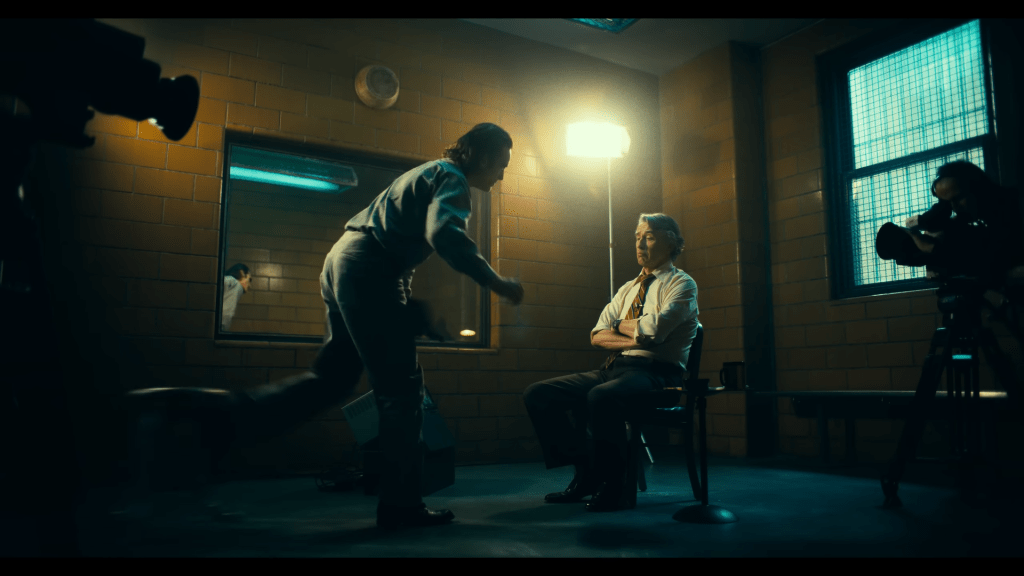
Who is the real Arthur?  – The interview with Dr. Beatty

This interview with Dr. Beatty should justify why the movie ultimately becomes a musical in overall. You will understand from this interview that the real opportunity for the personality of Joker to shine out was in the Murray Franklin show. Arthur was actually intending to commit suicide on national television but knowing this would eradicate the existence of the other personality – the Joker takes the charge of Arthur’s ‘body’. There he kills Murray and makes statement and vents out all those emotions he had suppressed. That is exactly why Arthur is not concerned and doesn’t remember that he murdered some people in that show; he associates to the music of the show on that day. Because in that musical moment he felt free.

Also, keep in mind that Arthur has other personalities other than Joker. His mother’s mirror personality is also inside his head. The changed accent of attorney in which Arthur talks with Mr. Puddles in not just a performance to mock the court, it is a personality Arthur created so that he can defend the adverse external conditions which Arthur is incapable of handling.

It’s not just about Arthur and Joker.

Joker’s (Not Arthur’s) Smoking Addiction

From Warner Bros. Joker: Folie à deux

Psychotic person resort to a habit which helps them to relieve the suppressed emotions or identities. It could be any small habit and mostly would seem harmless. In this case it is smoking. In the first Joker movie smoking is just a way to release the tension in his mind but as the Joker’s personality gets the hold of his ‘body’ the smoking intensifies. In the interview with Dr. Beatty when she asks Arthur if she can talk to the Joker inside him, the gaze that Arthur throws at the recording camera is more than enough to let us know that the smoking personality was the Joker himself. (Joaquin Pheonix is just perfect here!)

There is also a moment in Arkham Asylum when Arthur is watching Harvey Dent’s statement implying that only a fool would consider Arthur a martyr, this further reinforces Joker to consider himself more powerful and influential. He is smoking there too.

Before going live in interview with Paddy, Arthur’s attorney Maryanne tells him to stop smoking in front of the camera during the interview because it makes him look like a ‘cavalier’ – reckless. This is exactly where we should get a clear idea. The Joker is reckless, carefree – ‘cavalier’. Smoking becomes an extension of this very idea of recklessness that Joker has in his personality.

But for the good of Arthur, he controls Joker inside during interview. The moment he realizes that it’s just to create sensation, the Joker takes control and again smoking starts.

When Arthur’s private diary is being read out loud in court and when Ms. Dumond is testifying, saying that Arthur’s whole identity that his mother created was fake; you will see that Joker is just there absorbing everything because all these things are very uncomfortable for Arthur to handle. Arthur cannot handle such public humiliation and identity crisis. Joker is truly his coping mechanism.  

There is also a scene where the Joker breathes out the smoke into the Harley ‘Lee’. It is very dramatic and feels like they are exchanging their very souls, their identities. Now they are inseparable.

From Warner Bros. Joker: Folie à deux

(Todd Philips deserves appreciation for creating such characteristic moments throughout the movie. There is one moment in the start of movie where Arthur gets a lip cut during shaving and the blood drop flows down his chin creating a sad face. It is impressively symbolic of the state of the mind Arthur is in. Applauds to Todd again!)

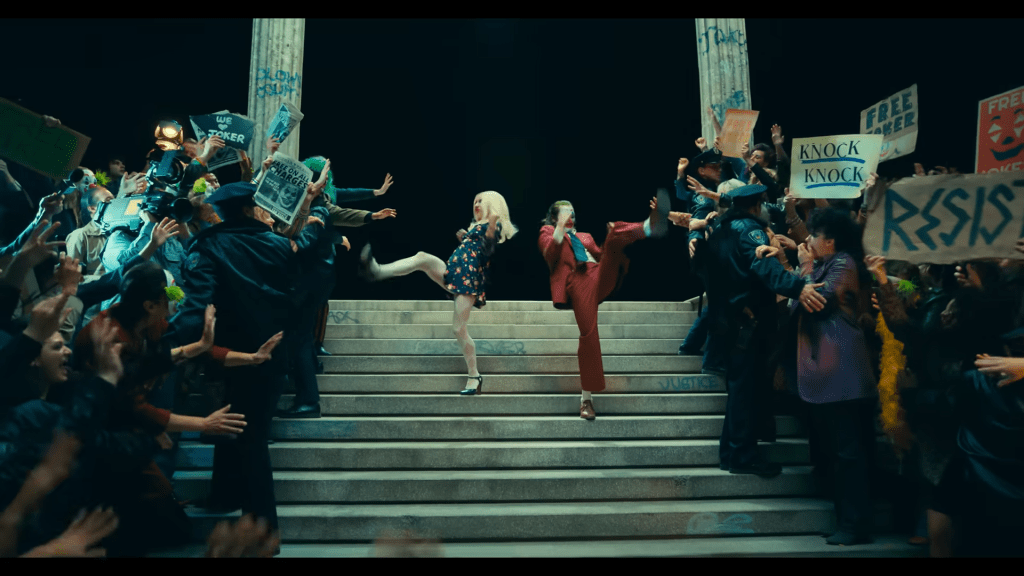
The ‘Kick’ Dance

From Warner Bros. Joker: Folie à deux

The most characteristic attribute of Joker being present and active in Arthur is his dance. The specific step of kicking fiercely in the air is very poetic. This kick shows how reckless Joker is. The Joker is literally kicking the society which led to the downfall of an innocent person like Arthur, the society which created Joker himself. It is a tight slap to the degraded social system which led to the formation of such psychotic character.

Very subtle but the ‘kick dance’ has its purpose in the whole narrative and character of the Joker. Later ‘Lee’ mirrors the same dance showing that Joker and Lee are now in sync.

The Musical

I have never ever seen the medium of musical to demonstrate the state of the mind of the character especially a completely negative character. (I am not a big musical fan) Whenever I have tried to appreciate the musical it feels to break the continuity of the realism of the narrative and dreaminess of the character or given scene. Although there are many good examples where musical just fits in perfectly.

But, this musical in completely negative and dark setup is very impactful. I know most of the moviegoers absolutely thrashed the musical approach and underwhelming utilization of Lady Gaga but trust me it was all intentional. It was supposed to make you uncomfortable.

The unsettling musical is actually a peek into the psyche of Joker and how uncomfortable his character is. It’s a warning to those who glorify Joker as villain or consider him an anti-hero.

Every musical had clear purpose and it also landed perfectly. You have to be slightly ‘mad’ and must fool yourself for the given moment to appreciate importance of musical in the whole narrative of the Joker. I will reiterate that people not appreciating the Joker musical is a subtle proof that the real society we are living in is still in a healthy mental condition in overall. If you didn’t like the musical, it is totally fine, and that was the intent of the creators.

Joker strongly associates himself with music, that is the pivot of his identity. Music allowed him to express freely and also supported his recklessness. The moment he discovered ‘Lee’ in music session that bond with music got further reinforced. That is exactly why his delusions, their delusions are fully filled with music.

Now, it’s lyrics appreciation time:

The opening cartoon song
Everyone needs love
There are already enough mountains

What Arthur helplessly wanted was appreciation and love from his people around. “Mountains” used here and used extensively in further narrative of the movie indicate the hardships, difficulties in everyone’s life. Even after these difficulties, if you are loved you can come over these mountains. Sadly, exactly opposite happens with Arthur.

In later parts of the movie, where Lee says that we will build a mountain from hill. She is actually saying that we will raise chaos everywhere and make other people’s lives difficult because they deserve it.

The Arkham Asylum musical  
From Warner Bros. Joker: Folie à deux
For once in my life, I have someone who needs me
For once in my life
I won’t let sorrow hurt me
Not like it has hurt me before
For once I have someone
I know won’t desert me
And I am not alone anymore
For once I can say this is mine and you can’t take it

This is Joker singing in Arkham realizing that people may consider him a martyr and he has also got the company of ‘Lee’. The sense of belonging to something for a person like Arthur through accepting the identity of Joker made him feel invincible. This is exactly what is sung in this asylum scene. Arthur wanted somewhere to belong and someone to care for him in the end.

The ‘B-Ward’ movie scene –

When the patients are watching the movie where Arthur and Lee are sitting together there is musical which goes like this:

We are all entertainers
Everything that happens in life
Can happen in a show
You can make’em laugh
You can make’em cry
Anything can go
Anything

We must understand that there are lots of creative choices while making a sincere film. Even though it feels useless, this movie musical scene has a purpose. It is exact reflection of how Joker thinks. For him it is all a performance, it makes him free, same goes for Lee. But sadly, society questions Arthur if he is doing a performance and not Joker. The very lyrics here show why Joker is reckless. This delusion of performance enables him to remain carefree, reckless in the ‘real’ reality. 

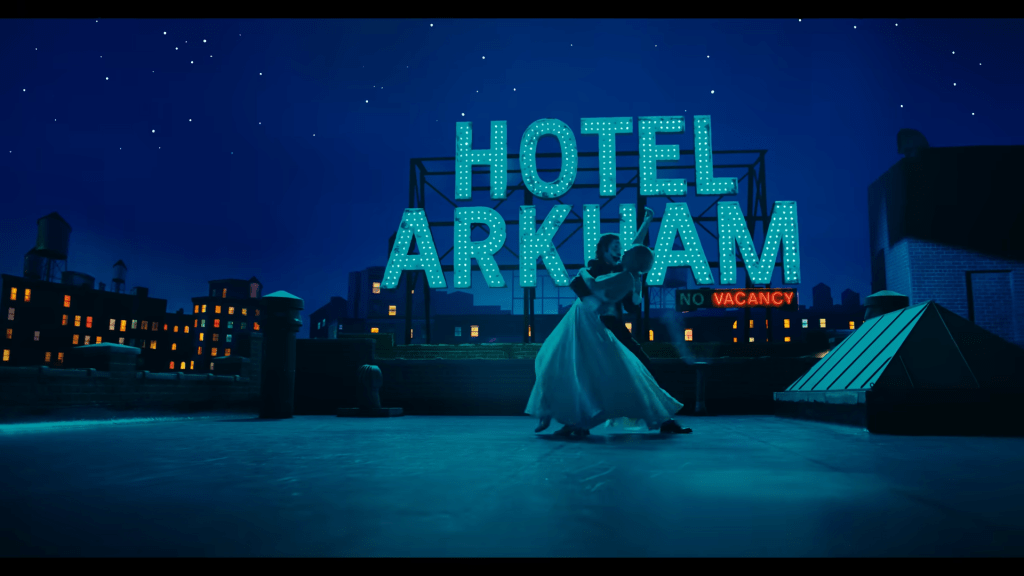
The Hotel Arkham Dance –
From Warner Bros. Joker: Folie à deux
In our minds, we’d be just fine
If it were only us two
They might say that we’re crazy
But I’m just in love with you

This shows how pivotal ‘Lee’ is for Joker. She fuels him. As Arthur is meek, loveless and innocent nobody appreciates him, loves him or cares for him. Being bold, carefree, dashing through Joker, at least he gets ‘Lee’ to love him, appreciate him. The identity of Arthur needs something to lean on, to fulfill his humanly needs – mental and physical. These needs would only get fulfilled if Joker comes out as dominant one. If not Arthur then at least Joker would make this personality free. This song is just about that. Even though delusional but Joker gets all the mental support to justify his personality in reality through ‘Lee’.

The interview with Patty

Before this interview Arthur has full control over the Joker, he has suppressed him to demonstrate his innocence. But the moment Arthur realizes that this interview is just happening for the sensational content, he loses it all and allows Joker to take control. (while starting to smoke characteristically in front of the camera!)

I’m wild again
Beguiled again
A simpering whimpering child again
Bewitched
Bothered and bewildered
Am I
Lost my heart but what of it
She can laugh and I can love it
Although the laugh’s on me
I’ll sing to her
Bring spring to her
And long for the day
When I cling to her
Bewitched
Bothered and bewildered
Am I

Here, Joker is making statement that he is the in-charge of Arthur’s body thereby his complete identity. When he realizes that Arthur will not get any help and it is just a sensationalism in the society, Joker shows the society that he is not alone anymore for the society to take care of him, He has someone who care for him now. This is his way of telling the society that it can go ‘freak’ itself now. The society pretending to help him to create one more drama is a conniving move for Joker. So this song is the final warning to the society that he doesn’t need this pity help from the people. He has his ‘Lee’ to love and appreciate him.

From Warner Bros. Joker: Folie à deux
Lee’s makeup song

Most of the scenes when Joker and Lee are sharing the screen while singing are the delusions running in the mind of Arthur. In the third act of the movie when Lee is singing alone while applying all make-up, she is alone. This is where the reality of what Lee is becomes clear.

What a world, what a life 
I’m in love
I’ve got a song that I sing
I can make the rain go
Anytime I move my finger
Lucky me can’t you see, I’m in love
Life is a beautiful thing
As long as I hold that string
I’d be silly so and so
If I should ever let it go

 This clarifies that Lee is manipulating Arthur to reinforce the Joker in him and using him to justify her own delusions. She knows she has all the strings in her hands to create the delusions she wants with Joker.

The Guard’s humming in Arkham asylum in the last part of the movie

When Arthur truly accepts the reality and rejects the persona of Joker he is actually on the path to new and healthy life.

When Arthur is sitting in front of the TV in asylum after this event, the asylum guard Sullivan sings this near him and another guard asks him not to sing this again.

We are not crowd 
My echo, my shadow and me

The guard is hinting Arthur that reality is the only thing where we truly exist. Whatever Arthur thought of himself having a different personality to take charge of his body while committing a crime is just a lie. It’s Sulivan’s way to mock Arthur to show that he will get the punishment in the end by court.

Another guard fears that this might trigger Joker to defend the joke on Arthur that is exactly why he tells Sullivan not to sing it in front of Arthur again. This also shows that Arthur is really trying to bring himself back to reality as this doesn’t trigger him. There was some hope for his recovery.

The Cognitive Dissonance – inner conflict for real identity

From Warner Bros. Joker: Folie à deux

During the proceedings of the court when the events of Arthur’s childhood are brought in light again to prove that the Joker is a defensive identity that Arthur has created to cope with the trauma and adversities in his life, you will understand that what Arthur lacked was clear identity.

The identity crisis actually led to the creation of intense defense mechanism through the creation of his shadow as Joker. There are specific reasons behind this:

  1. Arthur learns that what his mother told him about his parenthood was a lie
  2. He learns that even though his mother told him that his purpose was to make people happy, she was not a big fan of his jokes. Ms. Dumond in her testimony clarifies this, which shakes Arthur to core
  3. Arthur had created his whole personality around making people happy. The career choice to become a standup comedian was all driven by this sole thing. This is what defined his life

But the moment when Arthur realized that all the truths on which he created his life and his character were lie, he undergoes cognitive dissonance. Cognitive dissonance is a state when a person enters in paradox about the truths that made him who he is today.

Same cognitive dissonance happened for Batman when he learnt that his parents also took help of the very criminals he is fighting against today to hide their family’s dark truths in the past.

My point here is that both Batman and Joker underwent the state of the cognitive dissonance, the identity crisis, what they stand for. How they came out of this cognitive dissonance made them hero and the villain.

Batman chose to move away from the only motto of vengeance quoting that ‘Vengeance cannot change the past’. Batman then decided to stand as a symbol of hope for the degrading society.

Arthur – Joker in this case blamed society for the very state of mind he is in now. And there is nothing wrong in it. The very situations, events, people that Arthur got exposed to, made him chose that side. If he would have got proper support from the society and people, there really was a hope for him.

That is exactly why you must appreciate the act of Arthur to not become Joker in the end of this movie. Although the guards of Arkham had beat him to show that he is really weak in reality and Joke is not the reality. Arthur arguably had less privilege than Bruce Wayne to chose the right side and even after these hardships Arthur in this movie choosing reality of Arthur instead of delusion of Joker is a bold move. This makes Arthur’s character transformation far bigger, better and glorious than the transformation of Batman. (I am not saying that Joker is superior than Batman morally. I am saying the mental efforts that Arthur took to reject his Joker personality are way bigger, humongous than the mental efforts that Batman took to redefine his identity.)

There is very symbolic moment of Arthur running away from the Joker persona in the end of the movie to show how badly he wanted to escape that delusion.

From Warner Bros. Joker: Folie à deux

You know what? This is exactly where the city of Gotham went wrong. People wanted an agent of chaos. Not the guardian of hope. Chaos is more sensational and attractive.       

The Society and The Sensationalism

You should closely observe how Arthur behaves in the interview with Patty. He has dialed down Joker perfectly. But the moment Arthur understands that these people are not here to help him or work with him, they just want something sensational to show to the people watching TV, he loses the hope for the society. This is where Joker truly gets reinforced.

The way in which the character of Arthur Fleck is designed by the writers, it is a result of the overall failure of the social systems. The rising unrest in common people led to the reinforcement of Joker in Arthur Fleck even though he knew that he committed crimes.   

Common people of Gotham somehow, anyhow wanted the rich and powerful people to be held accountable for the problems they were going through. Even though it was a group motive it was a very selfish motive. Joker doing certain murders was just a sensational direction people wanted so that they would get this feeling of redemption against the corrupt system.

From Warner Bros. Joker: Folie à deux

Arthur was just a person in need of fame and appreciation for who he was. Only sad thing was that people only loved his Joker persona. That is exactly why Arthur chose the delusion of Joker to satisfy the delusion of redemption from riches for the society.

The real Folie à deux is not just about the shared delusion between Joker and Lee. It is between Joker and the society. It is between Todd Phillips’s Joker and the fandom. Deep down we too wanted this Joker to do some scandalous acts, exceptional crimes, and sensational interviews. We paid for the movie tickets to see the chaos that Joker creates in society thereby glorifying him as one of the best villains.

But, in reality we cannot handle such sensationalism. On surface it feels great while reading some spicy news, conflicts in our day to day lives but the moment they start affecting our very lives we know how horrible these things can turn out.

This movie actually made an effort to show how twisted a psychotic criminal is inside even though his life may seem sensational and happening outside.  

The Loneliness and Kindness

There are many moments where Arthur clearly says that all he wanted was someone to understand him and love him for who he is. The only reason Arthur submits to Joker’s persona was the fact that this is what the surrounding around him wanted from him. The DA wants him to be the Joker so that they can punish him. This would also make him a martyr among the common people of Gotham. People of Gotham wanted him to be the Joker because it was their way to vent out their anger for the riches and powerful of the city. Harley wanted him to be the Joker because he symbiotically supported her delusions, he was ready to do whatever she wanted.

You will realize that there were also some moments where this was possible, it was possible to tell Arthur that he is not alone. Some events actually do happen but not everyone is thinking the same about him. That is what creates conflict in Arthur’s mind. There is a scene where Arthur is singing a book with good intent but the moment the guard mocks him, Joker takes over and signs maliciously.

You see this is intense when the person is challenged mentally, such people are ready to resort to any part of their persona provided that they get what they long for. That is successfully depicted in the psyche of Arthur Fleck.

Conclusion

A society on moral, social, political decline – a degenerate society – a society on the brink of collapse – will always reject Arthur and welcome Joker.

It is very evident from this duo-logy that the surroundings, society plays a crucial role in the character development of every person. We chose certain attributes of who we are based on what we actually want. This is decided by how society responds to our actions. Based on the such selected attributes, then our behavior, action on such attributes and the reaction from society on such action mold our personality. This is roughly how our personality, our identity is created. If we are fully dependent of society to define who we are, then our personality would exactly reflect what the society. That is what happened with Joker. Arthur was completely empty inside. You will see this when he accepts all his crimes honestly while ending with a Joke.

- Knock, Knock
- Who’s there?
- Arthur Fleck
- Arthur Fleck who?

It shows that Arthur accepted that he was nobody. Society just poured inside his empty jar of personality, made him the agent of chaos.

That is why having an inner compass is very important in personal development. Our internal beliefs may sometimes get challenged and it is completely fine to change them, upgrade them. But the moment one starts to pivot his/her identity purely on outside factors it may create internal conflicts, mental conflicts. That is where Arthur lost his battle for personal identity. Even though the ideas are fictional they prepare us for the adversities occurring in reality, that is for me is the real power of storytelling. May everyone in reality find their true identity in a healthy and sustainable way.
We are full of biases and we are always in search for the things which reinforce our internal belief system. It is a normal human tendency to justify one’s identity. Those who are ready to change and modify their understandings about the surrounding are closer to the reality and those who are stubborn to change their belief system will get hit by the reality until they have learnt their lesson.

This Joker movie indirectly keeps on highlighting how difficult it is to gauge what goes in the mind of a mentally challenged person. Most of the time our instincts repel us from such people but what such people need is a sense of being loved and sense of belonging. If they are felt loved in reality, maybe there is some hope that they will let go of their delusions. Being kind is the only way.  

For me the movie actually presents a choice in front of the audience for the fate of the Joker. As a human being Arthur coming out of his Joker persona was a very healthy and hopeful character development. But that is not what we wanted from him. We, just like the people of Gotham city wanted him to create chaos. This movie shows that hidden dark part in our minds. I am not saying that all of us are sadistic. I am saying we all have a dark part in our psyche and its normal. Everyone should be aware of their own darkness to remain mentally healthy. It improves decision making.   
My favorite moment from Warner Bros. Joker: Folie à deux

Further reading:

The Batman- The superhero who ‘unlearned’

Alienation and Creativity

Creation for capitalism, consumerism and pleasure maligns its true purpose which actually is to create joy and a sense of belonging, comfort and safety. Alienation is the end effect of such capitalist processes where people have isolated their humans side for the rat races and FOMOs. Pure creativity, empathy, connect with nature and self can help use to preserve that human core and come out of the alienation.

How true forms of creativity can help us to reconnect with our human core

“On The Train Ride Home” by The Paper Kites

I long, as does every human being, to be at home wherever I found –

Maya Angelou

Humans – the creative animals

I think creativity is the most important quality granted to human beings. Nature in itself is the ultimate and the best creation which at the same time is also the creator of many things. Animals, non-human beings too have the gift of creativity to certain extent but human beings have outperformed in using this gift of creativity. We are always creating something, we have tools, we have automated processes to create anything we can understand. This creation of things has led us to becoming the most developed species on the planet. Creation can be in any sense – creation of music/ art/ cultures, families/ society, factories/ industries/ conglomerates, institutions/ organizations, cities/ metropolitan, governments, policies, supply chain, and what not! All these creations are intertwined to prove how advanced the human species is. You must also remember that once a process of creations starts generating fruitful outcomes it gets automated to optimize, to improve the efficiency. Most of the times we forget that some creative processes are not meant to be optimized because value of their outcomes is not materialistic. The concept of efficiency and/or optimization is purely materialistic concept. But as we are progressing ahead as the species, most of our creation processes are getting robotized, where materialistic outcomes are more important than the process of creation itself.  

Young generation has crucial role in deciding the future course of our species, especially when we have this great tool of creation – our creativity itself. People of my generation (millennials and Gen-Z to some extent) are the key creators of this time who will decide where our future will lead us. This generation is completely busy in various ventures of creation to justify their own life. But, as I have mentioned before, our creation processes have become so mechanistic, so robotic to gain more, extract more materialistic outcomes that this young generation is getting more and more detached from the real purpose of creation in its true spirit. The consumerism and (crony) capitalism has thrown today’s youth into a forced state of alienation in spite of being living in crowd, densely populated resourceful, glamorous cities. We are lonely in spite of being surrounded by the crowd.

This loss of attachment from the spirit of creation has led to the alienation of the today’s young generation – who many times go through the feelings of isolation, meaninglessness, directionless, confusion – it’s not just a normal existential crisis through which every young generation of their times goes through rather it’s the blurring of the true spirit of living in today’s young generation. Please keep in mind that it is not mistake of this same young generation. The system, society, institutions have evolved in such way that the creative processes are getting designed more for materialistic optimization instead of getting created for the real upliftment of the human civilization. Feels like we are losing touch of the real purpose of our being.

An Australian indie rock band called The Paper Kites released a song called “On the Train Ride Home” which in my opinion tries to touch those feeling of “alienation” which our today’s young generation is going through. Deep down we all know what we really want, we know what our core is but the systems in which we are living today have made our lives more and more mechanical, even though we are in the process of creation that creation no more belongs to us, that detachment, that alienation, that freedom from the vicious capitalistic cycle is what we are yearning for in the end. This is what this song for me is.

The Paper Kites
L–R: David Powys, Sam Bentley, Sam Rasmussen, Christina Lacy, Josh Bentley

I will dissect this song from the point of alienation; for me that is what it is all about.

The lyrics of the song is credited to Samuel Bentley, On the Train Ride Home lyrics copyright: Wonderlick Pty Limited

(It’s a song which needs to be treasured, hidden from others so that no one spoils it and I know I am committing a personal crime by exposing it. But such creations need more exposure and deserve proper appreciation too.)  

Waiting down at the station
I don't remember, think it was late then
Standing, always so quiet
We're like elevators filled up with strangers
No sound, no hallelujah's
Still I was praying on the train ride home

The starting of the lyrics creates an imagery of the person waiting for a train home. The complete separation from the surrounding has made this person to forget vivid details, it shows the mundane-ness, the separation from surrounding to just reach a safe, calming place which is home. The feeling of loneliness in spite of being in the crowd shows how there is no emotional connect between people. Elevator filled with strangers shows that people are closer and more connected, more accessible but they are not closer emotionally. This is exactly today’s situation, social networking and internet brought us so close that we can ‘poke’ our friend living in another hemisphere within few seconds and still we will see people craving for true connections more than ever. No hallelujah’s shows the loss of spirit, loss of soul in people who are part of this – physically close but emotionally isolated crowd.

If I can't get the things I want
Just give me what I need

Here, the person is aware of the difference between wants and needs which shows that his/ her separation from home to go to the crowded place to create a better resourceful life was not the ultimate goal. This is the only way through which this person can live a life. The system based on the cycles of consumption has narrowed down the meaning of living a life to mere survival. One can get as many things by obeying this cycle of consumption but it will not satisfy the hunger – the emotional hunger, that intimate craving of humanity. The distinction and use of wants and needs is a very smart way to show how the person is trapped in the system to survive but deep down they know what actually makes a fulfilled life. That is why person asks for basic fulfilment if not all what they desired.       

Our words fill up the pages
Fill up the days with psalms for the ages
Still those vows that we all speak
We break them like concrete
And just make our words cheap

This part of song shows how words have lost their worth. Words in the sense the sense of commitment, sense of loyalty to keep the promises. The piousness of the daily prayers, the vows are less cared for. This expression shows how insensitive we have become to just gain the materialistic means, to survive.

This is exactly where it struck me that this song is not just about average existential angst every young generation goes through; this song is more about the alienation of a person where system does not value real creativity – which gives our lives meaning. The system now has been maligned with the materialistic efficiency. Consumption has become more important than the end effect it creates. Mention of “wants” and “needs” thus highlight the culture of consumption here.    

I want someone to grow with
Songs I can sing to, and I family to cling to

The song tries to conclude with the ultimate pursuit for living a better life. Why are we all doing the things which we do? Why do we go on job? Why do we work all week, live paycheck to paycheck without any greater purpose – in spite of knowing that we hate this work at its core? Why knowingly, intentionally are we craving for more and more materialistic pleasures?

I think it is because of the recent vile cycle of consumption. I have a reason to justify this. Somewhere we know that the process of creation in which we are involved is not doing justice with our pure humanistic core.

As a human being all we crave for is the mutual growth, sense of fulfillment, love and intimacy for each other in this limited time on the earth. We know that ultimate goal of creation should be this humanistic goal, but the moment the creation loses this human touch we suffer from alienation, a sense of directionless, sense of being confused, a sense of trapped inside an infinite maze. This is the exact moment when the person craves for home, family and intimacy.

The train ride home is that craving for being the real human being who values emotions, commitment, love and happiness of the loved ones.

But If I can't get the things I want
If I can't get the things I want
Just give me what I need

The person understands that in this seemingly flashy, attractive, glamorous but mechanistic, mundane, lonely and unemotional life there is some hope that they at least will be able to preserve their human core. The request for the “need” over “wants” is the cry for that preservation of the human core.

Alienation

What urged me to completely (and maybe blindly) associate the lyrics of this song to alienation is how Socialism defines the concept of alienation. Karl Marx identified how a process of creation thereby value creation could isolate its creator from its creation. This isolation of creation and creator once intensified removes all the human, emotional attributes from the process of creation and here the brutal capitalism starts. The creation is now mere a mechanical, boring routine of materialistic revenue creation where humanity has no value.

Karl Marx on alienation

Karl Marx presented very beautifully the purpose of creation in human life. It is what separates human beings from other animals, non-humans. We are always involved in creative process which have a personal purpose, a meaning. That is why our creations and it’s end results are so intense and are way different than how other non-human creative processes. The moment such processes start demonstrating the separation of creator, the process of creation and the end-product of creation, capitalism/ consumerism start peeking their head out thereby slowly eliminating what made such things processes humanistic. This exactly is alienation, there is no sense of home, comfort or belonging.     

Marx defined four types of alienation in his discussions:

Alienation of an object –

A factory labor stitching the designer clothing does not bear the capacity to own it and enjoy it. Even though the labor holds the skill and knowledge to create that fancy clothing the system is rigged in such way that the emotional connect between creator and creation is lost forever.

Alienation of process –

The process of creation has become so mechanical, so repetitive to improve the efficiency and to increase the output that humans involved in them have also became mechanical, unemotional. Today’s young generation working in mundane jobs, the jobs they hate only for the paycheck and the job without any personal purpose is the example of that alienation. The separation of creator from objects makes the object accessible to anyone but this accessibility is not equally distributed because the input to output ratio is highly skewed. The value that is created in the creation of the object does not reward the creator in any good way thus creator – the labor remains poor. This also make the creator to lose the faith in the process thereby leading to the alienation of the process.

Alienation of species-being –  

The moment this mundane, highly optimized process does not bear any real humanistic purpose, the creator no longer follows the process to reach a better position in life spiritually, intellectually through the process of creation. It’s like the human creator has become a machine giving throughput. A sense of being a better species is lost forever – this is another form of alienation.

Alienation between humans –

Once the creator no longer has a direct connect to its creation, has no faith in the process for better pivot of meaning, has no sense of humanity, the value for another human life is lost. It is not because the creator or this person demeans or belittles others, it is because the creator himself/ herself does not consider their efforts their value of better worth, hence same treatment is given to people in their surroundings.

There is one famous snippet of a speech from Gabor Maté, a Canadian-Hungarian physician who has done work in ADHD, trauma, childhood development.

Gabor talks about broader scope of alienation which somewhat is based on the Marx’s idea of alienation.

Alienated from nature –

We as the human species no longer have that connect with nature which has resulted in its deterioration. You might have seen that there are still some tribes living in the remotest, inaccessible areas round the globe which are completely in tune with the nature and have preserved it. Today’s consumerism has detached our objects of consumption from their consequences on nature thereby destroying it.

We have to somehow re-establish that connect with nature otherwise nature has its way of adjusting things (we are seeing its effects all around the globe). And remember that this re-connection is also linked to we being the human beings. I mean, who doesn’t like lush greenery, pristine rivers and remarkable biodiversity!

One of the first condition of happiness is that the link between man and nature shall not be broken.

Leo Tolstoy
Alienated from work –

The works we are engaged in are rarely driven by a meaning or a higher purpose. Even if it has some meaning it is immediately inked to some materialistic thing, there is nothing wrong in it as far as survival is concerned but at least this awareness should push us to work for the things with higher humanistic, spiritual purpose, that is our real core as the creative beings. The alienation from work has led to depression, anxiety, emotionless feeling, numbness among every one of us. We are replacing this meaninglessness by other material means which involve how we look, what we possess. Such means of damage control are creating more damage to who we are and what we work for which defines us. You will see, the economy we live in highly focuses on associating meaningful experiences to materialistic products.

Alienated from other people –

The moment we lose the hope and connection between our surrounding we are losing some human part in ourselves which dims down our perception of humanity for others. We trust very few people or almost no one, the relationships rarely have that depth, that intimacy. Social structures based on the depth of relationship are dwindling. The mental illnesses are emerging due to the lack of social emotional support system, growing intolerance, apathy on global level are also effects of that.

The start of the song where it mentions people filled in the elevator, disinterested and having been lost their spirit is the same alienation.

We have to start forgiving people again, create safer environments where we can express ourselves without any prejudice. It is scientifically backed that putting trust in people and treating them with high worth makes them trustworthy and high performer (see Pygmalion effect) In the end, everyone of is craving for someone to rely on and also someone who will make our sacrifices worth of the hardships. Associating positivity of self-worth to being appreciated and being respected for who we are is hardwired in our human circuitry. Our existence gets redefined to higher standards the moment other people (even single person) recognize it. (History has examples where people did impossible for far lesser people who believed in them without expecting anything in return)  

The urge to cling to a family, sing a song to someone, grow with someone mentioned in the song is asking to escape from such form of alienation.

One of the oldest human needs is having someone to wonder where you are when you don’t come home at night

Margaret Mead
Alienated from ourselves-

We have lost the connect our inner self, our curiosities, our inner child in the pursuit of the consumerist ends. The disconnect with the surrounding and numbness to the processes in which we are involved is furthermore deteriorating our inner human core. We rarely listen to our gut feelings, instincts because presence of lots of data, information around us creates a false sense of understanding of the things around us. This is alienation from ourselves, we don’t even trust ourselves – a simple advertisement or targeted influence is enough to make us buy that next thing that we don’t even want.

The part in the song where it talks about making our words cheap is the alienation from self. There is no concept of morality and inner compass in such alienation.

We know deep down what exactly is happening with us and around us but the system rarely creates conditions to come out of that.

How to de-alienate?

The desire to know your soul will end all other desires

Rumi

The core reasons of alienation lie in the loss of empathy, loss of higher meaning/ purpose and loss of responsibility/ commitment (committing to something to change the course of life requires higher sense of responsibility). We are empaths by default as a human being, so it is imperative to preserve this attribute even if the surroundings force the opposite. I know this is difficult when we are responsible for multiple things and people, but you are also responsible for yourselves. It is worthless if you win, achieve something great while losing yourself in the end.

The creative processes whose outcomes are not attached to any material means are thus the purest paths to avoid such alienation in the times of high consumerism and negative effects of capitalism. High consumption is an addictive form of alienation which can be nullified by pure creation. Consumption will give pleasure but creation will give joy.

The prayer to ride home in the song is the hope that we will again meet ourselves in spite of such extreme disconnect. Pure creativity is the answer to such prayers as far as the process elimination of alienation from our life goes.

What separates human beings from rest of the animals is their creative ventures otherwise we are exactly like all other living things. We are the beings who engage in multiple activities of creation which are driven by conscious intent, a reason. This ability to create something has led us to become the technically advanced species on the planet. If we establish the connect with our inner core through meaningful creation, the victory over all forms of alienation is possible.

True creation is all about connecting to every possibility there is.

Such deep concept of alienation expressed in a wholesome and soulful song by The Paper Kites truly deserves more and more appreciation and recognition. Words failed me to express how it made me feel (that is exactly why I didn’t control my words count, where few verses of this song did the same job. No wonder poetry is highly potent than prose!)

The song-

The Green Knight – A Story of Killing the Boy

Many people who have had a near-death experience tell that their whole life flashed before their eyes. Although, it is difficult to try out and experience the reality of it, experience shared by such people is interesting and indicates what it means to be a conscious human being rather a living thing.   

Many of us would have also seen drastic behavioral changes in people after they have gone through a difficult disease or after they have gone through an accident but by mere luck their life was saved. Such life altering events have influenced their thought process and their understanding of life in such a way that all their acts, their discussions, their decisions reflect the strong influence of death.

This is not just about the exposure real life-taking moments; Sometimes, these near-death experiences are symbolic. Everyone of us have such moments in our life where we reject who we were and what we represented earlier to accept what is about to happen in order continue our journey forward, to survive. Such events are very common in everyone’s life and are very uncomfortable in every sense, that is why we never discuss such things very often.

“Sir Gawain and the Green Knight” is a one such piece of Chivalric Romance from the 14th century which is closely bound to the legends of the King Arthur. The story of the Green Knight is one of the most important parts of English literature.

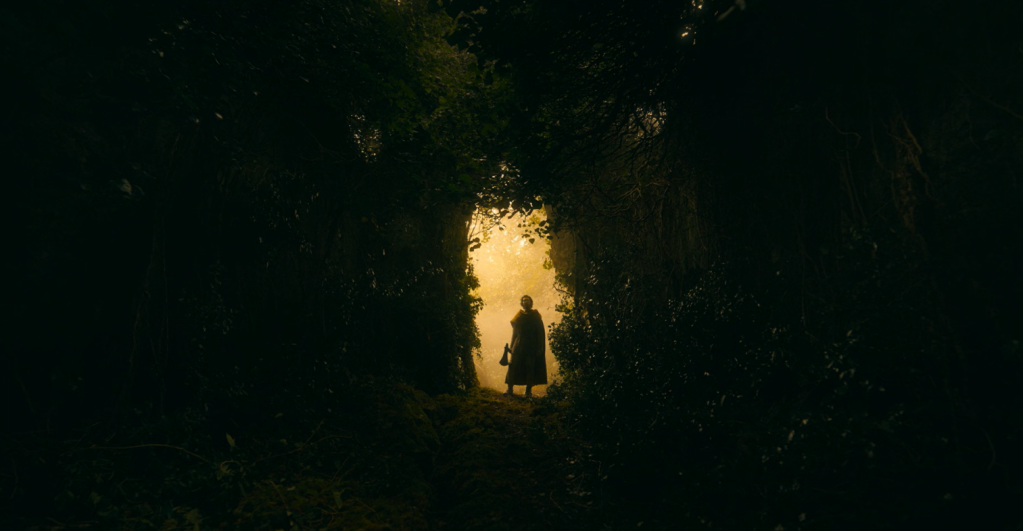
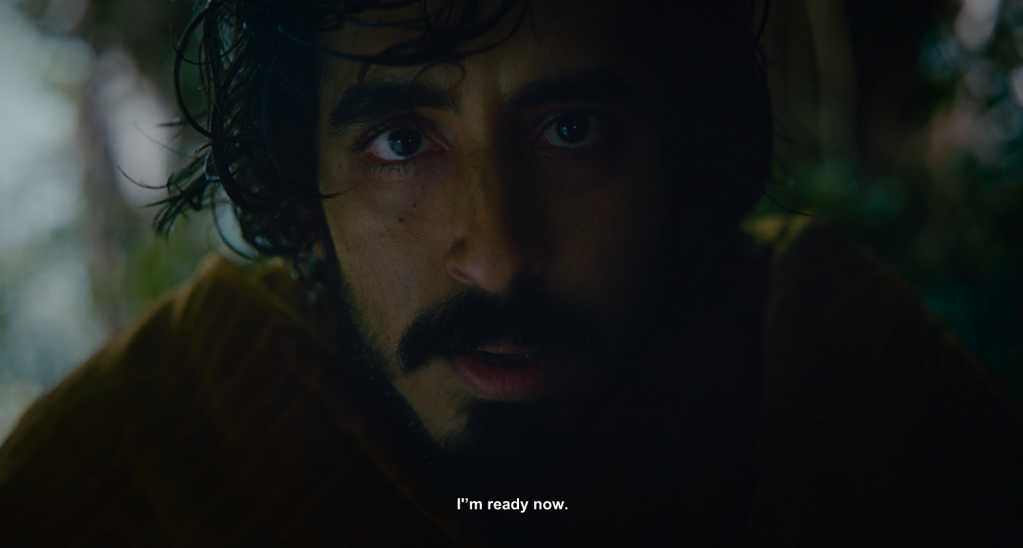
This discussion is based on a movie called “The Green Knight” by David Lowery starring Dev Patel as Sir Gawain who is the nephew of King Arthur. There will be heavy spoilers in the further expansion of ideas so, Warning! Those who have watched the movie can simply skip the synopsis.

The Green Knight

Poster of movie The Green Knight by A24

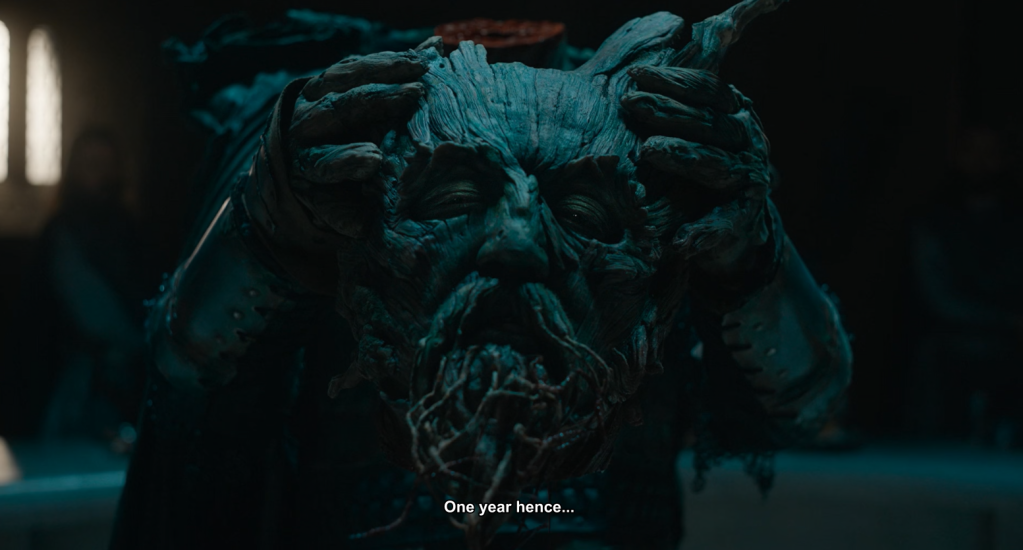
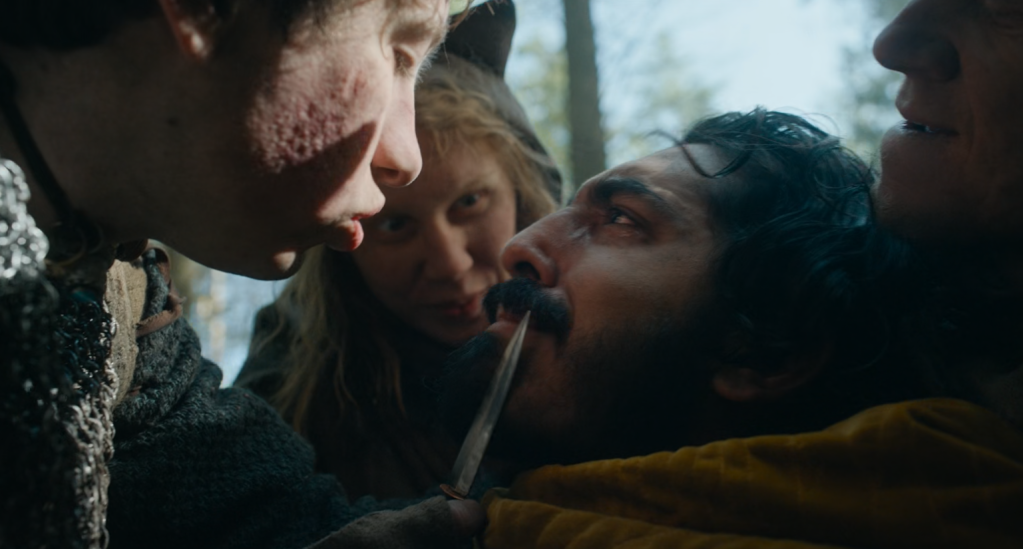
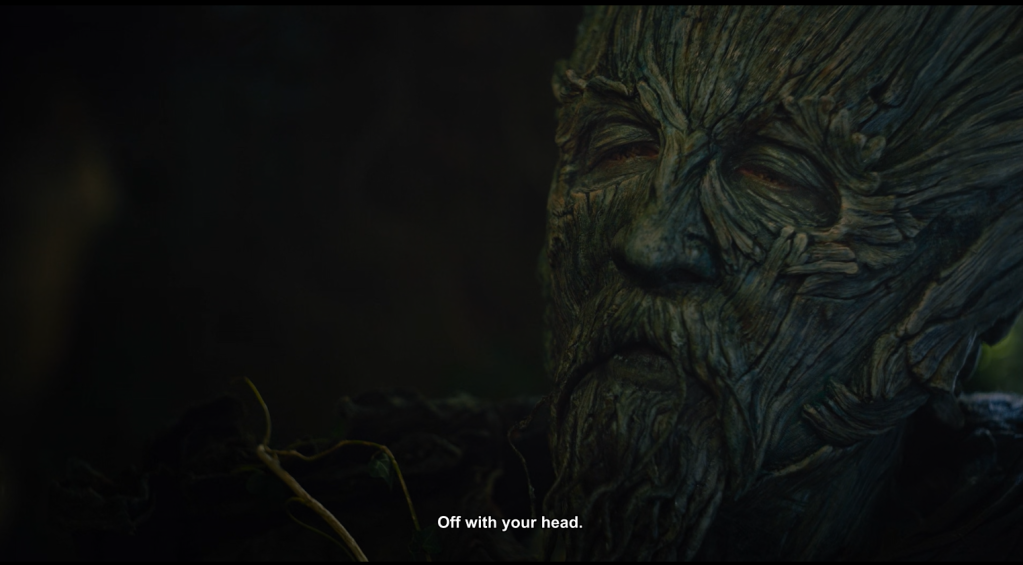
In this story, Sir Gawain (who is yet to become a knight) is the son of King Arthur’s Step Sister who performs enchantments and magic. On the morning of Christmas, Gawain is with his lover called Essel in a brothel instead of visiting the Church for which he receives scolding from his mother. Gawain’s mother asks to leave without her to the Christmas celebration at the King Arthur’s Round Table. Where, King Arthur, asks Gawain out of all the knights present in the tower to have a sit by his side. After having a discussion with King Arthur and his wife Guinevere, Gawain realizes that, out of all the Knights present for the celebration, he is the only one who has nothing to talk about his honorable deeds, brave acts to support his “Knighthood”. He realizes that though people expect him to be a knight by the birth-right, he has not done anything to prove and validate this knighthood. The queen tells Gawain that, he is yet to receive the opportunity to prove his worthiness, which settles the storm in Gawain’s mind. And at this moment the Green Knight appears in the celebration. The green knight looks exactly like ‘the Groot’ from Marvel movies. The appearance of the Green Knight is caused due to the magic of Gawain’s enchantress mother. The Green Knight appears near the round table with his horse and an axe to play a game. The game’s rules are simple- One able man from the Kings knights will get an opportunity to strike a blow to the Green Knight and if it hurts the Green Knight, he will be the owner of the axe of the Green Knight and in a sense the fame, glory followed with it. But, his poses one condition to this game- that after hurting the Green knight and owning his axe, the game will only be considered as completed when the same person will visit him in the Green Chapel after exactly one year and one day. The Green Knight will return the same strike to the person and then they will part on a friendly note.

Everyone in the celebration is scared by mere presence of the Green Knight and hence is scared to represent the King against the Green Knights proposal. This is the moment where Sir Gawain (with all the adrenaline) realizes that demonstration of courage for the opportunity offered may prove his worthiness and he accepts the challenge of the Green Knight. King Arthur offers his Excalibur to blow the strike against the Green Knight. Without any defense, the Green Knight offers his neck to Sir Gawain and seemingly confused but in the rush of proving himself, Sir Gawain separates the Green Knight’s head from his rest of the body and people cheer for him.

In few moments, the decapitated body lifts the separated head to remind everyone that this is only the half part of the game and the game will be finished when the Green Knight will return the same blow to the same person in exactly one year and one day in Green Chapel.  

– A gentle reminder –
(Scene from David Lowery’s ‘The Green Knight’ by A24)

This is the dreadful moment when Sir Gawain realizes the foolishness that has brought upon the death in front of him. And swiftly, the year passes – the stories of the Green Knight have made him famous all over, thus reinforcing people’s belief in his chivalry and honor.

But deep down, Sir Gawain knows that it is only the death and its fear that he has received after performing this act on the Green Knight. But, as an aspiring Knight and heir to the throne, he thinks that honor calls upon him. Facing the Green Knight is the only option for proving the nobleness and greatness of his character. With heavy heart and knowing that the return blow by the Green Knight will be more than sufficient to end his life, Sir Gawain leaves for the Green Chapel with the same axe to complete the challenge. On this journey his mother has given him a magic girdle –a sash, a magic belt which will protect him from any harm as long as he wears it.

On the journey ahead Gawain meets a boy in a battlefield who gives him direction to the Green Chapel and asks for return of the favor. Gawain simply thanks him and after forcing for the payment he pays the boy a coin. The same boy with his friends loots Gawain stealing all his belongings with the axe. They tie Gawain all over leaving him to rot to death. Sir Gawain- helpless at first realizes that in order to survive he must break himself free and tries to free himself with the sword left behind. By the night, with a strong feeling of homesickness, he visits an abandoned house where he finds a bed to rest. A ghost of a young woman called Winifred awakens him which demands her head to be retrieved from the lake nearby. Gawain asks Winifred what’s in it for him to help her. Winifred refuses to provide anything in return but anyways Sir Gawain reunites her head with her body. He receives his lost axe in return reminding him that he cannot return home because his fate is waiting for him.

-Gawain to retrieve Winifred’s head-
(Scene from David Lowery’s ‘The Green Knight’ by A24)

In this journey, Gawain makes friendship with a fox who is constantly following him. During a storm, Gawain lands in a Castle where a he is welcomed by a Lord, where he loses the fox. The Lord treats Gawain well and comforts him that he is very close in his journey and the Green Chapel is mere a day close from his castle so he can rest for few days. The lord’s lady has uncanny resemblance to Essel- the love of Gawain and the lord’s mother is always seen blindfolded yet aware of the surrounding around her as if she can still see Gawain. This creates some uncomfortable situations for Gawain. The lord’s lady makes seductive advances on Gawain and on the other hand the lord proposes that he will return whatever best he will receive from the hunt to Gawain and Gawain will return him whatever the best he has received in from the castle in that day. The lord’s lady offers the girdle similar to the girdle Gawain lost during the thievery at the battlefield in the return of his kisses. Feared to the the loss of his life, Gawain gives the kisses to the lady for the Girdle in exchange and flees from the castle as soon as possible. When crossed by the lord and asked for the return of the boar from his hunt, Gawain hides the Girdle and only gives the kisses in return to the lord which he had received form the lady. The lord also frees the same accompanying fox found during the hunt to Gawain, thus Gawain and the fox are reunited for the final journey.

The fox starts speaking to Gawain asking him to return from this journey and nobody will know of it and he still has the chance to live more years because it is only the death that he is approaching towards, in the coming moments.

Gawain refuses the fox’s offer to leave from the challenge and to prolong his life saying that it will not be honorable and great. And hence, approaches the Green Chapel with all the mixed feelings of courage and fear of the death. He sees the Green Knight in hibernation and waits for him to awaken. On the exact next day as planned – the Green Knight wakes up and asks Gawain that is it the same day to complete the challenge.  Helplessly and knowing that this will be the final day of his life, Gawain offers the axe to the Green Knight and his neck to return the same blow he struck to complete the challenge- the game.

At first stroke Gawain flinches, and he is reminded by the Green Knight that when Gawain was about to blow the strike the Green Knight didn’t flinch.

At second strike Gawain again flinches and asks that is this everything that is in life? And the knight says this is all there is.

Upon accepting that this truly is his final moment, Gawain gathers all the courage, escapes from the third strike and leaves the Green Chapel knowing that he has not completed the challenge. But, he is aware that whatever has happened is only between him and the Green Knight, nobody can challenge or question the greatness of the Sir Gawain plus he gets to live by missing the challenge, fooling the death itself. After his return, Sir Gawain becomes the King Gawain- the successor of King Arthur and the greatness of the title. He becomes father of son from Essel but rejects Essel because of her identity with the brothel. He marries a lady of a noble house and becomes a father to a girl. Then in a battle loses his son. After this huge loss, he also loses the respect people gave him. In this downfall, when the enemy attackers are finally on the verge of acquiring the castle, King Gawain realizes that this will be his last moment. During all these events after the escape from the Green Chapel we as an audience understand that the Gawain sustained the third strike because of the Girdle given by his mother. Sir Gawain and King Gawain thereafter never let go of the girdle understanding that it was only the girdle which kept him alive. Even in the intimate moments with woman he never removed the girdle as his life was bound to it. At the final moments of the attack, at the castle, King Gawain realizes that he has accomplished and experienced everything that there is to do and experience in life. Satisfied with his achievement and the life experiences gained after the event at the Green Chapel, King Gawain removes the girdle and his head falls down which was held till date from the strike of the Green Knight only because of the girdle.

Then there is complete moment shift in the movie where we see the face of young Gawain still in the Green Chapel waiting for the third strike from the axe of the Green Knight. Until this moment, we as an audience understand that we were seeing the whole life of Sir Gawain flashing before his eyes which is such a strong feeling that it cannot be expressed in words.

This is the near-death moment – where Gawain realizes that whatever you do whatever you try to run from –the death will be the only destination and accepting it in a fearless way is the only option and pathway to the so called ‘greatness’ that he was seeking from this challenge anyway.  

He accepts the consequence of the event and with the revelation of life and death, with the clarity,with the fearlessness in mind, Sir Gawain removes the Girdle from his body and asks the Green Knight to blow the return strike to complete the challenge. The Green Knight holds his axe down and relieves Sir Gawain with his head for the bravery, thereby completing the challenge.

The synopsis is mere an attempt to cover the important moments of the story and the movie. David Lowery deserves great recognition, hats off for the details he has scattered all over in the movie and the justice he has done to the great story of Sir Gawain and the Green Knight.

Now, with the key takeaways from the movie,

Sir Gawain’s test of Knighthood

Popularly, the story of the Green Knight represents the five virtues of a knight. The movie highlights this when the Gawain prepares for the journey to the Green Chapel. Here, the queen prays for the strength in five fingers, sharpness of five senses, inspiration from the five joys of the blessed Virgin Mary, enthusiasm from five wounds of her son Jesus.

The qualities a knight should possess are the five virtues namely Generosity, Chastity, Friendship, Courtesy and Piety. The Green Knight’s story is actually a story of Sir Gawain failing at all these virtues before he accepts his final fate.

Generosity- Gawain doesn’t recognize the help provided by the boy in battlefield for the directions provided by him and upon only force does he give him a coin to complete the transaction of help. For Gawain at this moment, the direction has no value because he thinks that he would have found the way to Green Chapel anyways, thereby undermining the help provided by the boy from battlefield.

Courtesy- After all the looting acts of the boy from battlefield and his mates, Gawain somehow escapes himself to an abandoned house and sleeps there. Winifred, the woman’s ghost and the occupier of the house asks Gawain to retrieve her head for which without showing any courtesy Gawain asks something in return thereby failing the second time.

Friendship- After leaving the lord’s castle without acknowledging the support and gifts from the lord, Gawain rejects the suggestion of his companion fox to either end this journey here and return to his people safely without revealing what actually happened or facing the Green Knight with all the courage without the protective girdle; For it will be the only right way to do it. Gawain rejects the suggestion of his friend and scares him away thereby ending the friendship.

Chastity- The acceptance of the seductive advancements from the castle’s lady only to get the life protecting girdle shows the failure of Gawain at chastity.

Piety- Piety can roughly be called as religiousness, one’s spirituality. As from the start of the story it is clear that instead of going to the church on the Christmas day, he spends the day in brothel. All of the decisions are made to please himself neither God or the King or his people. Hence, he fails at this too.

These are the five virtues of the honorable Knight which are highlighted in the Arthurian legends and the religious mentions too.

So, in nutshell even if Gawain had failed miserably at all five virtues, the girdle would have given him the opportunity to live his life to the fullest. But, upon having this near-death experience and understanding how worthless his life- even after all the achievements- will be as there is no honor in it, Gawain presents himself to death. Honor was the only thing he was seeking from this challenge. The decision of dying with an honorable life rather than living a false and self-centered life is the decision that shapes the character of Gawain in the last moments in Green Chapel making him the true Knight, the true heir to the King Arthur. It is his understanding and acceptance of the death as the final destination which makes him brave, which gives him all the knowledge that was required to understand the life in those few moments.

I think this is a story of a boy becoming a man:

The good thing about the story of Sir Gawain and the Green Knight is that it tells the qualities an honorable person should possess to live a fulfilled life whatever it’s span maybe. The great thing about movie The Green Knight is that it opens the story for further interpretations which connects a Late 14th century to the 21st Century. The early part of the story, represents a fickle, lightheaded, royal blood carrying boy called Gawain who is unaware of the real callings of the life and responsibilities in order to achieve the greatness. Gawain irresponsibly spends his time in brothels knowing that the knighthood will be given to him anyways by blood. It is only upon the realization by the influence of the King and the queen that he becomes aware of the fact that real greatness demands great deeds. And in order to do some great, he decides to accept the challenge of the Green knight on a whim or without a thought.

After easily blowing the strike and decapitating the Green Knight, Gawain thinks that now he has done enough to prove his worth to the other knights and the King. It is only when he gets the weight of responsibilities and the consequences of this action when the decapitated head reminds him of the returning the same strike. Poor boy Gawain passes the whole year with a dread to face his death. Gawain still thinks that honor and greatness is only about doing some extraordinary things and getting famous on the stories of these acts. As the year comes to an end, deep down-he also knows that he must face the fate of his actions. Hence the reason when the King Arthur reminds him to go to Green Chapel, Gawain tells him “I fear I am not meant for the greatness”. This moment shows the cravings for fame, greatness but rejection of responsibilities coming with it for a young boy like Gawain.

Helplessly, when Gawain embarks on the journey to the Green Chapel- he is equipped with all the tools and weapons to ensure the successful journey. Even after that, he is robbed by some people. These events reflect the exposure of a fickle boy to the real world where all the hereditary, materialistic provisions prove of less value and only his grit and his spirit of survival can help him to stand strong in such attacks. The breaking of the shield of Gawain by the boy from the battlefield indicates that even the protection given by your guardians will not hold longer when you are exposed to the acts of the real world during the journey of greatness.

-Welcome to the real world, it sucks and you are gonna love it-
(Scene from David Lowery’s ‘The Green Knight’ by A24)

Here, Gawain sees the options in front of him- either he can die to a green moss-covered skeleton or he can escape from this anyhow. Gawain successfully escapes with the help of the sword. This gives some hope to the development of the character.    

The events with the Winifred indicate the challenges in the journey of greatness. Here, Gawain is a lazy and whining boy where he asks for help from the ghost which is already in dire need of help. But, upon hearing about his resemblance to the knight who decapitated Winifred, Gawain understands what he can become if he is not on the right path. Helping the Winifred adds one more credit in the journey of his greatness. Helping her, Gawain receives the axe again reminding him of the path he should chose. Still our boy is under the fear of what comes next, the uncertainty and survival through it.

The fox in his journey represent the inner conscience Gawain speaks to when he is traveling alone. There is no one to interact and socialize at this moment hence only himself with whom Gawain interacts which is shown as a fox. This is his inner voice and also his primitive safety seeking mindset which tries to avert him from risks during the journey of greatness. After the eating the hallucinating mushroom, our boy Gawain also seeks short cuts from the giants in his journey, showing the immaturity he still holds to ease his journey.

– a shortcut on “the shoulders of giants”-
(Scene from David Lowery’s ‘The Green Knight’ by A24)

The fox howling to the giants for not offering their shoulder is indication of our boy Gawain mocking the great giants but continuing the journey without anyone’s help again gives us the hope for the character development of Gawain.

The events at the castle and its lord, his lady and his mother are the representative of the important life decisions Gawain will make when he will achieve the greatness. They represent the life after completing the Green Knight’s challenge. Here, the truthfulness, transparency in the relations whether they are between Gawain and the lord or the between Gawain and the lady are important. If you see properly, there is a bond created between the lord of the castle and Gawain and similar bond between lady and Gawain. This bond represents the comfort we enjoy with our relationships. This comfort of relationship causes him to rest more at the moment when he is so close to his goal. This represents the loss of focus of our boy Gawain in his journey of greatness. The intermixing of emotions, no control on the emotions, the comfort deviates the mind and body of Gawain from the goal. Strong attachment, entanglement with the relations which are merely dependent on give and take transactions blurs the vision of Gawain. You will see the lord asking for something in return for his hunt, the lady asking for something in return for the girdle all the time when Gawain is in their castle.

You will also see the context of whole movie in their one common discussion with Gawain. The Green according to the lady symbolizes the life as in a green tree, green earth and the also as a death as in the green moss which covers all the dead bodies and non-living cobbles all around.

-The “this is what the movie is all about” moment-
(Scene from David Lowery’s ‘The Green Knight’ by A24)

After parting away from all the emotional attachments, hence leaving the castle as early as possible Gawain again meets with his fox friend indicating the loss of his inner self, his conscience during this relaxing period where fox was not with him.

When Gawain reaches the river for the final step of the journey the fox tells him to either stop here or go ahead without the girdle. This is the conflict going in his Gawain’s mind which is shown through the dialogue between Gawain and the fox. The fox being sly animal represented here as Gawain’s conscience- his inner-self, shows how our mind tricks us to remain in comfort zones only to make our lives simple and easy thereby taking us away from the greatness.

– you can still chose-
(Scene from David Lowery’s ‘The Green Knight’ by A24)

Anyways, the good thing about the story is Gawain seeking for greatness and his deep-down hidden honesty which helps him to continue the journey. But, most of the courage he has for the further journey is resided in the protective girdle in which he has blind faith. The girdle is the representative of all the misconceptions, ‘our’- versions of truth, the truth etched on our minds by our surrounding that we think will protect us from all the bad that is in the world. The girdle that Gawain blindly holds on for his life are the metaphors of the boundaries of un-upgradable beliefs, preconceptions we keep in order to maintain our version of facts. Hence, at the final moment of realization of worthlessness of the girdle, Gawain puts his beliefs, his preconceptions aside and accepts death as the only truth which is the death.

When Gawain reaches the Green Chapel, he sees the Green Knight in hibernation- sleeping and unaware of the surrounding. Even though Gawain knows that his death- the Green Knight is sleeping, he is not going to survive this event. There will be any time that the Green Knight will wake up and kill him. This is a perfect metaphor of how we are always running away from death, how we console ourselves about the things we are going to do when death is not around and when we are living. The un-acceptance of the presence of death to live life and then helplessly accepting its presence and slightly (not fully) embracing it in the final moments shows how pity and how limited we as a human beings are in our final moments.      

– the death awaits-
(Scene from David Lowery’s ‘The Green Knight’ by A24)

Sir Gawain’s transformational journey and the philosophy of the meaning of life

Next important moments in this story define why we as a human can lead our lives to greatness despite of having surrounded by the limitations of life and death.

The first flinch of the Gawain on the green Knights strike is the moment of self-reflection with what could Gawain had done better in order to not land here. There is still that young whining boy present there. The dialogue between the Green Knight and Gawain are very impactful here:

1st Strike

The Green Knight– You have had a year to find the courage

Gawain– One year or a hundred it wouldn’t make a difference. Give me a moment.

This shows the realization of procrastination, loss of valuable time for Gawain in his supposedly last moments. Now he is trying to steal some moments to gather that courage!

2nd Strike

The Green Knight – Are you ready? (Twice)

Gawain– Yes

(If one remembers the start of the movie, Gawain is asked by a woman in brothel on the Christmas day that “Isn’t he a Knight already?”to which Gawain answers that “He is not ready yet”. This looks funny at this moment)

The Green Knight – The I shall get to hacking.

Gawain– Wait, wait. Is this really all there is?

The Green Knight– What else ought there be?

This is the moment when Gawain accepts that he cannot escape the death also the worthlessness of the life, the nihilism.

The 3rd Strike

It is the moment before the third strike where Gawain’s whole life, his future life flashes before his eyes where he dies in that life leading to the realization that whatever journeys of life he will embark upon the final destination is always going to be the death. The honor gained, the greatness of life will be dependent on the how he has lived it and accepted the death rather than running away from it. The third strike is symbolically the death of the boy called Gawain and the birth of a Man- Sir Gawain and the true heir to King Arthur.

The famous quote from Confucius really resonates with the conclusion of the story:

“We have two lives, and the second begins when we realize we only have one.”

Confucius
(Scene from David Lowery’s ‘The Green Knight’ by A24)

Sir Gawain’s transformational journey and the psychology of the Man-Child

A trend discovered by a Swiss psychologist called Marie- Lois von Franz, showed that many adults in spite of achieved physically adult state were not psychologically matured. These were called as “Puer Aeturnus” (Latin for “eternal child”).  Surprisingly this trend was found in mid-20th century. The whole idea behind “Puer Aeturnus” is that due to the complete confinement, extra care and easy, comfortable provisions by their parents, the young men in their peak years like 20s and 30s are struggling to lead their own life independently. Many are victims of virtual world, video games, internet living life in passive and supposedly in a safe way. And this is linked to many psychological, sexual, academic, professional, financial, social disorders. The solution to this problem is simple in a way which requires separation of this adult-child from his comfort providers.

Sigmund Freud has said somewhat similar thing:

“No one could be a man unless his father has died”

– Sigmund Freud

The idea is to get out of the influence of someone who is responsible for the way of our life and its consequence. The death of father figure for a boy is the moment when there is no greater figure, experienced person thereby ‘efforts saving’ person for his further life. This is time when the boy realizes that he has to make the decisions for himself and become responsible for their consequences.

“Yes, but that death (Father’s death) could occur symbolically”

– Carl Jung

Carl Jung expanded the idea of the death of father figure in an interesting way. According to Jung, even the realization of a person to the fact that his father rather his parents, guardians thereby someone guiding him to make his path easier will not be with him forever. There will be times when he has to take his decisions and own the consequences.

Jordan Peterson has given one excellent explanation on becoming independent from parents using the examples of the story of Pinocchio, Peter Pan and Harry Potter.

I believe that the transformational journey of Sir Gawain also resonates with his separation from the comforts of his life. Here, King Arthur- his uncle and the supposedly greatest father of their time (because no other father had the courage and strength to pull the Excalibur in those times) is the father figure and the Sir Gawain’s mother are his parents. Seeing the fickle behavior of Sir Gawain, I think that King Arthur and Sir Gawain’s mother plan this game for his transformation from Man-Child, because this will be the person who would be carrying King Arthur’s legacy, who will become the leader and father of all the people.

The same thing of losing that adult-child is also reflected in the popular culture of our modern days as seen in Game of Thrones. There is one exact episode where all such relevant things happen. It is the Episode 5 of Season 5 of Game of Thrones called “Kill the Boy”.

-Death of a father figure, a friend, a counselor-
(Scene from HBO’s Game of Throne)

In this episode, we see that Ser Barristan Selmy dies due to the attacks of “Sons of Harpy”. He was the father figure for Daenerys. Upon realising that there is not wiser and experienced person to counsel her, Daenerys takes the charge and responsibility of her decisions thereby establishing her command over Meereen. Here, the events show the death of parent-like figure which transforms Daenerys to kill that adult-child in her and take the charge of her decisions and the responsibilities that come with it.

And in the same episode, we see that Jon Snow has brought the Wildlings under same roof where the Night’s Watch lives. Jon is now thinking about making alliance of the Night’s Watch with the Wildlings who consider each other their greatest enemies. Jon thinks that, he could not make this decision on his own and seeks someone’s experience to make the decision right. Hence, he approaches Maester Aemon for the advice where Maester Aemon clearly tells Jon Snow to own the consequence of his decisions.

Maester Aemon exactly tells Jon Snow the following:

“You will find little joy in your command. But, with luck you will find the strength to do what needs to be done.

Kill the boy, Jon Snow. Winter is almost upon us.

Kill the boy and let the Man be born”.

– “Kill the boy, Jon Snow”-
(Scene from HBO’s Game of Thrones)

This scene exactly resonates with the death of the man-child similar to the story of the Green Knight, which seems absolutely magical. The indirect influence of such values, the permeation of such strong ideas, their eternal and imperishable nature precisely points to what makes us a true human beings and is mesmerizing on so many levels.    

OR

Maybe, the story of the Green Knight is in a way that story told to the adolescents to teach them to take the charge of their lives

OR

Maybe, it was just a fun game played on Christmas for the entertainment to make the day more memorable (and to shake Sir Gawain to his core for the year as the longest running prank!).

Jokes aside, but the symbolism and the depth of the characters and their intentions and the lessons that we learn from the story, the relevance of such an old story even with the times of today makes the story of the Green Knight so special for us. That’s all there is, that can be penned down for such a piece from ancient literature.   

(Scene from David Lowery’s ‘The Green Knight’ by A24)

References and further readings:

  1. 2017 Maps of Meaning 04: Marionettes and Individuals (Part 3) – By Jordan B Peterson
  2. Carl Jung and the Psychology of the Man-Child
  3. Photo of Carl Jung from Britannica