
Freedom = Courage (Now + Here)

When it comes to psychology – people consider Sigmund Freud and Carl Jung as the de facto rock-stars of the field of psychology. One unnoticed person whose findings deserve equal attention rather more attention was Alfred Adler. He introduced the Individual Psychology to the world which is relevant still today and is way more sophisticated to solve the “so called” troubles of our life. Individual psychology makes a successful attempt to reach to the roots of our suffering and allows us to become truly free.
Alfred Adler’s philosophy is beautifully explained in Ichiro Kishimi and Fumitake Koga’s book “The Courage To Be Disliked”. It talks about the feedback loop of self-acceptance, confidence in others and contribution to others to live a real and fulfilled life. The great thing about individual psychology is that it urges us to break the notion of causality and thereby determinism to come out of the painful, suffering inducing cycles of life & death, cause & effect. It shows us that we live in the universe with infinite possibilities and one needs courage to break the logic of determinism to truly appreciate themselves and the infinite possibilities universe has to offer. Individual psychology given by Alfred Adler thus asks us to bear the courage to lose the false-comfort given by causality – predictability and decide our life on our own terms fearlessly and with freedom. It teaches how one can be completely involved in everything but not attached to them at the same time.

On the book – The Courage to be disliked

‘The world is simple, and life is too.’

I have a question for you,

– How is life treating you right now?

Everyone knows that the responses to this question are diverse and dynamic. The answers obviously will be subjective and so it is normal to expect huge variety.

But you know what, deep down everyone (mostly the adults) know the most frequent type of the answer to this simple question. There is innate predictability about what the answer could be.

Life is not treating me fair

Life has become too complicated for me, life is suffering, there is no hope, why can’t I have a single moment of happiness to savor for some time? why do bad things happen to only me? what have I done wrong to someone that ‘everyone’ has turned against me? what should I do – now that I have not achieved what I was supposed to achieve in spite of putting all honest efforts? why is ‘everyone’ – the society always against me when all I have for others is good will?

Deep down we have this undeclared, unexpressed notion that something wrong happened to me which I didn’t deserve. I tried so hard but couldn’t achieve that thing. Trust me every one of us is an expert of hiding these unsettling feelings, overlooking them to move ahead. But it is important to understand that unknowingly they become part of who we are. When we truly and honestly would start inspecting ourselves, we will find these feelings being the reason for the bitterness we carry inside. That is why life is suffering for most of us, being free then is out of the question. First let me be happy for now!

Psychology has always been on the quest of resolving the model of how our mind works. A bigger portion of psychology directly or indirectly works towards understanding how we see happiness and suffering. Because, end goal of how we feel, how we think, how we decide, how we interact, how our personality is created is emerged from either a happy event or sad event which affect why our psyche is in a certain way.

When it comes to psychology – people consider Sigmund Freud and Carl Jung as the de facto rock-stars of the field of psychology. One unnoticed person whose findings deserve equal attention rather more attention was Alfred Adler. He introduced the Individual Psychology (Individualpsychologie) to the world which is relevant still today and is way more sophisticated to solve the “so called” troubles of our life. Individual psychology makes a successful attempt to reach to the roots of our suffering and allows us to become truly free.

I appreciated this in deeper sense when I came across a book called “The courage to be disliked”. A single book can change your life. Although I have been changed many times before, I couldn’t help but overstate the importance of this special book. 

This is my attempt to reorganize the ideas from the book to instantly simplify the core ideas. So, the next discussion may spoil the book for you. (Although it’s not a story book having a climax at the end but the ideas are written in a conversational – dialogue format so, you peel out one layer at a time to reach to the core ideas of individual psychology.)    

I am actually spoiling the whole book and my writing on the same heron with these few sentences:

The whole thing boils down how you honor this current moment and not let it be influenced by the fear of past and the anxiety of the future. This complete dedication to the current moment is only possible if you honor yourself first, because only you can experience how this current moment will turn out for you. The moment you start to respect this moment here and now – you will be free.

If you have the ability to love, love yourself first

Carl Jung

Now that I have already explained what life ultimately boils down to, it will be important to understand why these sentences hold some gravitas. So, thanks for continuing with me hereon.

Deny trauma – Deny the comfort of causality

The core of individual psychology is the rejection of the causality. Our complete understanding of ourselves and the world we live in is based on the notion of cause and effect. It does immediately feel silly to reject that exact notion thereby making individual psychology illogical.

You will appreciate that not everything in whole can completely be justified or predicted with complete precision using the logic of cause and effect. There will always be some information that cannot be completely known for the given system (Heisenberg’s uncertainty principal points in the same direction). Our mind always makes decision, assumptions based on the current information, experiences we have till date and every one know that it is impossible to have all the information and all experiences that are there in the world for a person to understand his/her own existence.

So, in simple words – ‘who we are’ goes beyond the logic of cause and effect. You can be free once you break the chains of cause and effect. In the universe filled with infinite possibilities, there will always be something wrong and illogical, totally disconnected justification to the things happening to you and around you. It will be an injustice if you let that illogical justification define your whole upcoming life.

When we say that I became a person like this because something happened to me in past where I learned my lesson and changed myself into something else, we are just trying to convince ourselves to do things in certain way so that we will have less resistance to get things done in our ways. That is exactly where problems start emerging.

We crave for causality because it grants value to past; because it taught us some valuable outcomes and same causality can help us to predict what would happen in future. We always crave for certainty. But all of us know this by experience that we are rarely good at predicting our future. This furthermore unsettles the mind.

So, trauma is the pre-side-effect of causality (the post-side-effect of causality is the anxiety of the uncertainty of the future). We carry our traumas as badges to flaunt because these traumas feel very personal thus exclusive. The ways in which we carve out our personality from these traumatic experiences gives us a sense of special-ness. These bad experiences, traumas are a big part of our personality maybe due to a survival mechanism implying ‘I should be able to cope up with similar thing if they happen to me in future.’

See, the point is that if we stick to our traumas and fixate our personality on the same, we will never be able to explore the concepts that had better potential to improve our personality (and probably not be traumatic, bitter). We will be stuck in that loop of experiences related to that causality. Given that there are infinite possibilities, there is fair chance than we can be even better than what we were and what happened to us in the past. We are just better at finding reasons to justify our current position because we know we are comfortable here.        

No matter what has occurred in your life up to this point, it should have no bearing at all on how you live from now on.

It might seem that when we are rejecting causality, we are choosing a non-nonsensical path. In reality, we are just avoiding the ways in which we are always fooling ourselves to remain in comfort of predictability. Using the excuse of causality, we are actually ‘inventing’ non-real reasons which hide the realest reality we can actually live.

The first principle is that you must not fool yourself and you are the easiest person to fool.

Richard P. Feynman

Once you deny this causality which you think made you who you are, you will immediately see who you really are. You will leave that burden behind. You will accept yourself for who you are. You will see that you can instantly detach yourselves from your past and your future too. The untapped possibilities open up.

This is self-acceptance in individual psychology.

Once you see how important you yourself are to live your own life, you will say –

“Before past and future let me at least appreciate my own current moment”.

That is now and here. Once you come to the terms with yourself you will realize how everyone is just like you even though we are separated by many aspects of life. Then you will appreciate how others have their own current moments to live and experience in their own ways.
All problems are interpersonal relationship problems – others have their own current moments to experience in their own ways

It is fundamentally impossible for a person to live life completely alone, and it is only in social contexts that the person becomes an ‘individual’.

Nobody can deny the fact that our surroundings make us who we are. Our baselines are our surroundings. A human being is the most basic unit of any society. Our understanding and awareness of self is impossible without a response from surrounding. How would you understand who you are if you never received any reaction, feedback from your surrounding? – It will be a delusional existence. You would have had an idea of who you are but would have been far from what is real.

Thus, when you start seeing that your surrounding will always be interacting with you, you will be able to see every reaction – feedback from surrounding especially people can never be completely cut off. This again feels senseless. If you are born alone, leave this world alone then why couldn’t me being alone throughout my existence be more justified? It is because we never had any sense of absoluteness right from our birth and this sense of absoluteness always remains un-achieved, it is just an ideal condition we are always trying to reach. Our core understandings are only possible with the relativeness, comparison of baselines.

That is exactly why even when you are trying to live your life alone, that ‘loneliness’ itself cannot be justified if there is no understanding of what being ‘together’ means. So, there will always be something connecting you to your surroundings. That is where relationship comes in picture. You cannot run away from interpersonal relationship. You will be surrounded by people (or at least what made them you even when you are sitting lonely).    

So, when you are appreciating your current moment, it is natural that others will be respecting their current moments. This understanding will make you appreciate the importance of everyone’s being.

This will make the world around you seem less hostile. You will be filled with kindness for others.

So, you must first accept yourself first otherwise you will not come out of the hideous cycle of comfort of predictability, once you accept yourself to remain in now and here you start seeing here and now of others. You start valuing their here and now. That is why you start allowing people to be who they are, you stop expecting from others. You stop expecting your recognition from others, you stop pleasing people for your own good in the end.

Now that you are free from the burden and pursuit of desirable and predictable, anticipated feedback from surrounding you become tolerant of criticism and even dislike from others. That is truly when you are free. I want to focus on my now and here and nobody can stop me from experiencing that. Then you see this as the basic requirement for others too. This is exactly here the person becomes tolerant towards others. People start putting confidence in each other to create that safe space – the real safe space. People start respecting each other’s boundaries because they themselves have understood that they have their own limitations. This creates the sense of camaraderie – society.   

It is precisely because we lay a foundation of unconditional confidence that it is possible for us to build a deep relationship.

This is confidence in others in individual psychology.

Discard other people’s tasks – reject the desire for recognition and accept that you being disliked is not in your hands

When you are appreciating your own now and here to its fullest, you will notice how important it is to reject all other distractions to honor this moment. You will limit these distractions to focus more on this moment. This is where you will see that even though we are molded by our society we have limitations and so do the others. So, it is better if one sets boundaries.

Setting such boundaries helps everyone to focus on their ‘now and here’ in deeper and richer ways.     

If you are not living your life for yourself, then who is going to live it for you?

When one develops this understanding, they will clearly see what lies immediately in their own control and what not. If you are busy in trying to control what cannot be controlled by you, how would you have enough resources to appreciate your ‘here and now’? That why it is important to not focus on what you can’t control. Those will be someone else’s to control, that is not you task. That is exactly why you cannot pressurize people to do things in your ways. People can have their own reasons, limitations to not do things in your ways. It has to come from their side.

Forcing change while ignoring the person’s intention will only lead to an intense reaction.

Building on this understanding, you will start appreciating how doing what you love and not expecting anything in return is more than enough. You did what you love. Whether to appreciate it and recognize it, praise it is in other’s control not yours. Now that you have accepted yourself, you do it for yourself, then you won’t crave for attention from others, then you don’t crave for superiority, dominance. You come on level to level with your surroundings. You appreciate that whatever one wants to become that journey has to be completed by only them. Then you appreciate how we are trying to please others to get things done in our way when they were never in our control. You let go of the things which you cannot control and start focusing on what you can. That is why it is normal that some people (who were trying to get things done from you in their ways) will dislike you for not doing them in their own ways. This shows that you are honoring your ‘now and here’   

The cost of freedom in interpersonal relationship is that one is disliked by other people

Once you understand that it’s normal to be disliked, rather that indicates that we are doing our own thing you will appreciate what it really means to be genuinely be appreciated by society. Then you will feel like transferring this feeling to others too. Now that you have experienced this feeling for yourself, you would genuinely want others to feel that to. The things then you will do for others will have no intent of return because you very well know that returning favor is other people’s task.

If one’s means for gaining a feeling of contribution turns out to be ‘being recognised by others’, in the long run, one will have no choice but to walk through life in accordance with other people’s wishes.

The feeling and act of contribution has to be selfless and this selflessness is possible only when you are valuing your ‘now and here’. If you still are not valuing your ‘now and here’, it is very easy for you to get swayed by the likes of others and then you will end up in pleasing others and whether others will be pleased by what you did for that recognition is not in your control. This means the most probable fate is misery.

So, self-acceptance builds courage to do it in your way whether others like it or not. This detachment from opinions of others pushes you to do the things which were impossible before – what else is freedom them?  Then you understand the value of self-acceptance. You will then have the selfless feeling to let others experience and understand this. This selfless act for others will feed back into your sense of own being. This will support your feeling of self-acceptance. Once you close this feed-back loop, you will see what others are missing. You will help others in the real way. This will create the sense of belonging for you which further creates the real sense of meaning in life.

 This is contribution to others in individual psychology.

Where the center of the world is – there is no absolute cause and effectthere is no such thing as the first start and the last end

If you are ‘the center of the world’, you will have no thoughts whatsoever regarding commitment to the community; because everyone else is ‘someone who will do something for me’, and there is no need for you to do things yourself.  But you are not the center of the universe and neither am I.

Adler’s individual psychology thus focuses on a feedback loop of three key things:

One – Self-acceptance – you are who you are ‘now and here’, not what made you who you are

Once you accept yourself you give yourself better chances to live an earnest life 

Two – Confidence in others – now that you have appreciated how valuable, irreplaceable and incomparable living in ‘now and here’ is, you let people do their own thing because they have their own ‘now and here’. You put confidence in others, you do it not because you want something in return because returning the favor is in their control. This builds the real sense of community, belonging, safe space.

Three – Contribution to others – Once you start believing in people just like the person you are you appreciate what it means to be felt accepted. You try to support this feeling by contributing back to your safe space. You want it to be done by yourself because you now know that contributing back is in your control – your task. This further crystallizes your sense of self-acceptance.

Now that you have appreciated what it means to become truly free, it is normal to reject the false sense of superiority, false sense of being special. Every moment becomes same to you. This does not mean that you become numb to sadness or happiness. It just means that you appreciate that this too shall pass, all I have to live and experience is ‘now’. You lose the idea of a goal to be achieved and accept the real goal, the real target is to become the process.

Life goes on

For a human being, the greatest unhappiness is not being able to like oneself.

Although our existence is bound by birth and death, cause and effect. The reality filled with infinite possibilities does not follow that logic and we fail to notice that difference. Just to make the sense of the infinite possibilities we resort to certain assumptions, prejudices, reasons, past events, future expectations. We never question them with complete honesty because questioning them will bring existential crisis. We all know that our foundations really are not pure or absolute. Once you accept this you will see that it is very easy and important to accept who you are now. This further induces kindness for others. This creates the community. This is called Holism in individual psychology.
You must appreciate how causality brings in determinism in our lives. This determinism is kind of responsible for the lack of freedom in our lives. When we are suffering it is this exact determinism imparted by causality that builds helplessness. One must carry the courage to break out of this determinism. The courage is necessary because we never want to let go the comfort of predictability which determinism offers.

We resort to certain version of our life story when we are completely aware that we can totally change our life story. We are always taking the support of ‘I am like this because this happened to me’. This is how everyone’s story is. There are very few people who have dared to say – ‘I have gone through this for long but not anymore.’ This requires for you to appreciate yourselves first, when you accept who you are you move on to the path of improvement whereas when you are trying to act according to the like of people around you, you are actually proving the point that you don’t like the version that you are that is why you are ready to become the one which people would like and tragedy of this path is that the task of being liked by others is not in your control.

That is why whining about why we didn’t reach there would never help us to reach there or even embark on journey in that direction. We are hesitating to make our own move.

As long as we postpone life, we can never go anywhere, and will only pass our days one after the next in dull monotony, because we think of here and now as just a preparatory period.

Be real, not a hypocrite

People want to like themselves. They want to feel that they have worth. In order to feel that, they want a feeling of contribution that tells them ‘I am of use to someone’. And they seek recognition from others as an easy means for gaining that feeling of contribution.

The main reason Adler’s individual psychology didn’t receive enough attention is because it feels completely self-contradicting and hypocritical on surface level.

You will find these seeming contradictions everywhere in Adler’s ideas. It will say that we are social animals and are defined by society but in next moment it will say that you need to have the courage to be disliked by the people around you.

One time it says that you should not interfere in other people’s tasks and next time it says that you need to have a feeling of contribution for the same people.

One time it will say that you have to sever the relationships where others are not realizing their own tasks and making life difficult for you and on the other hand it will say that you should be unconditionally confident in others endlessly.

One time it will say that you should completely focus on yourselves and then it will say that you are part of a bigger family, bigger universe and you will be happy when you contribute to this bigger community to create a sense of belonging.

If I am being disliked then how the hell would I be happy?!?

If you inspect each of these seemingly contradicting ideas you will find one simple fact – the fact that we are walking living paradoxes and in spite of that we demand sense and logic about who we are.

The sense of self or individual cannot be appreciated well if you never know what it means to be surrounded by people. And there is always some interchange happening between individuals which makes it a society. We often see society as a group which is everything minus ‘I’. We fail to recognize that if I fix myself in certain way the others around me will fix themselves in response to that way and then most of the individuals who constitute the society will fix themselves in certain way. Means even a single person can effectively change the society.

What people actually miss when they come across the ideas put forth by Alfred Adler is the possibility that we can truly reject causality. I would call this unawareness the curse for the humanity. Our sense of ‘being’ inherently originates from some non-absolute attributes, relative references that we have to accept them as the ultimate truth right from our birth to make the sense out of all these infinite possibilities.

We are so entangled in the suffering and happiness waving between the life and death that we ignore that we are born, dead and again reborn every moment. The trick that causality plays in our life is that it tries to preserve the previous step to justify our current stage thereby freezing our present. Whereas what we should do is to just be in now and here which needs courage because there is no guaranteed layout, map to guide you. You have to walk your path all by yourself.

What people fail to notice is that the comfort of predictability is just in this moment but this sense of comfort has no control over future rather it intensifies the pain due to the randomness of the unpredictable future.

The secret to happy life is to be involved in everything and still not be attached to them.
A Hindsight For Better Future

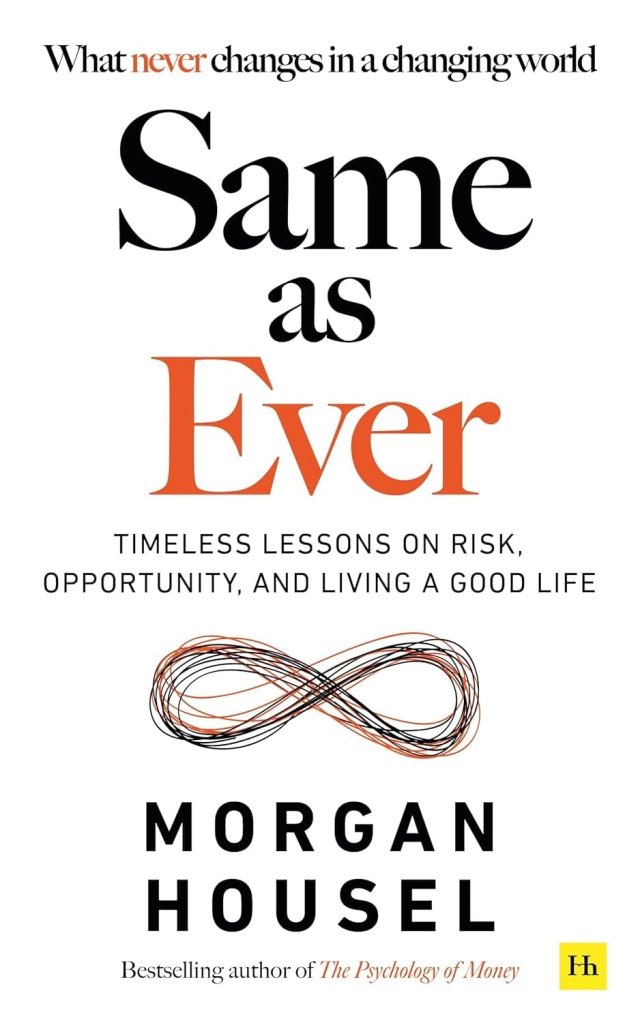
Morgan Housel – the famous author of ‘The Psychology of Money’ has another important book called “Same as Ever” which gives insight into things which have never changed over the course of time. Same as Ever drives the motto of objective flexibility and subjective awareness of every event happening around us and with us. It also highlights that our mind is the first and the easiest one to fool, which leads to false sense of superiority over others and creates biases. Once we accept that nothing is perfect, no one is perfect – it injects humility and forgiveness. It also makes us to be grateful for what we possess today. The ability to see every event at the same level is a superpower any one of us can have.

An important book from Morgan Housel called “Same as Ever”

Somebody, make me a time machine

Life would be easy if we had a way to accurately predict the consequences of the events/ actions.

Scenario 1 – what would be your reaction if some random person hands you a $1,000,000 lottery ticket and, in few moments, you realize that you just won that lottery?

Scenario 2 – what would happen if an ambitious project that you worked on tirelessly for many years while sacrificing your other priorities – ends into a big failure because of a seemingly impossible and insignificant event/ error?

For most of us these two scenarios are practically impossible but the odds are still non-zero. They can happen in reality.

How can we be sure that they selectively happen to certain person? Scenario 1 for ourselves and Scenario 2 for our enemies especially… (Just kidding)

If you closely observe the lives we are living right now, you will see that we are always oscillating between such events which demand certainty of outcomes even before the are realized. We have this innate urge to remain ready for such events; it is what we are always striving for.

Now, one question – are we living in a matrix? Is universe a simulation?

If the answer is ‘YES’, then it means that every outcome should be predetermined. If everything is predetermined then why things don’t happen the way we ‘want’? Does that mean that we lack the computational capabilities to precisely calculate the outcome? OR is what is destined to happen different from what we ‘want’?

If the answer is ‘NO’, then everything explodes into meaninglessness. The answers are nihilistic.

Looking at the both outcomes of this question we see that we need a baseline to make our decision making effective. Is there a formula to systematically put all the things happening around? What are somethings in nature whose knowledge will ensure our satisfactory existence. (I am being very optimistic while writing ‘satisfactory’ word here.)

In simple words, what is the formula to live a good life? whether it is predictable or not.

 Morgan Housel the famous author of the Psychology of Money wrote one important book called Same as Ever which tries to answer this same question. Same as Ever drives the motto of objective flexibility and subjective awareness of every event happening around us and with us.

This is a deep dive into Morgan Housel’s book “Same as Ever”.

I will try to keep this short. Here are some instructions:

Those who have read this book – each idea in this book is numbered in the sequence Morgan explains in the flow of the book. So, #1 is Hanging by a Thread as mentioned in book and #23 is Wounds heal, Scars last

Those who haven’t read the book – I have given short summary of what Morgan discusses in each of the 23 ideas. That should help you to wrap you head around my distilled down version of this book.

(I apologize for putting that part in the end and spoiling the conclusion/ discussion on this book.)

I would say this book has been one of the most important books I have come across. (I am an average book reader by the way. So, not sure if same would be the case for other people.) While going through each idea, you will realize that something keeps on repeating; and even though it repeats, it brings new perspective into that specific discussion. My attempt to summarize this book focuses on picking what is common but connected to all the facts mentioned in the book and also their connection to the reality we live in.

Discussions

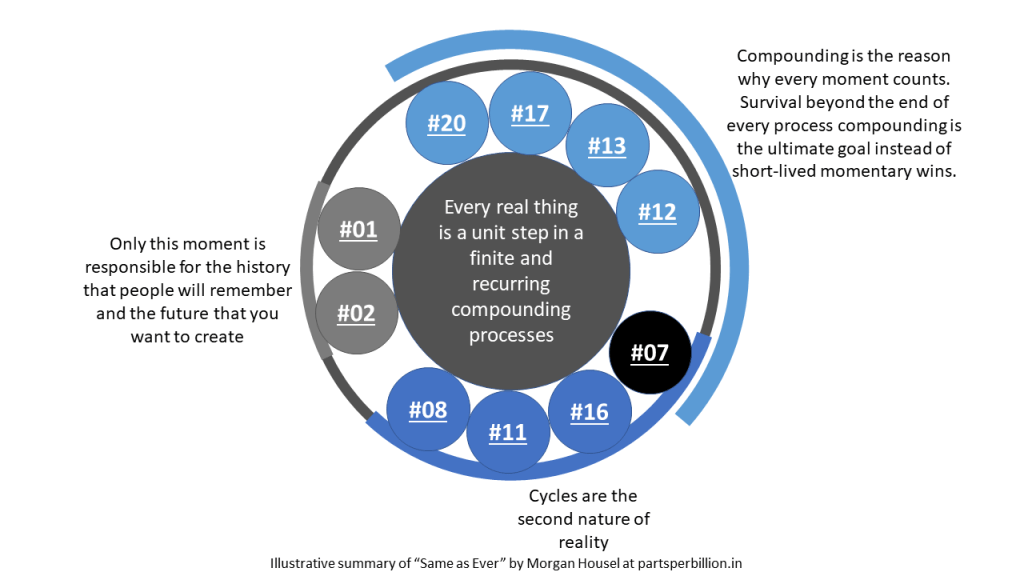
The discussion is in 3 steps, so adjusting our understanding to previous step is key to understand the next step. The illustrative images in each step of the discussion connects the ideas from the book to a common central idea. It will be handy if you read this with the book in your hand or you can jump to the point-to-point summary (the part after conclusion) in a neighboring tab of your web browser.

Step 1 discussion:
Figure 1. Finite and recurring cycle of compounding processes

You will see in the figure 1 that reality is ever changing process of infinite real events. The key to understand what is happening is to see every event containing same potential at first. Keep in mind – same potential – neither good nor bad. Once you assign every event with equal potential you will see that compounding accounts for that single event to build on and create the next event. Sometimes two big events will compound together to create an enormous event.

Now comes the fun part – the enormity of every compounded event will always be in favor of someone and against the favor of the complementary population. This makes that event good or bad for people. Some will suffer some will rejoice.

A person who knows how the world, nature or universe works will not have preferences, favor-ability towards such events. The answer lies in the cyclical nature of such events. Keeping a single event sustained for long duration demands to go many things to work in supporting ways and as every event has same potency in the infinite possibilities, it surely will lead to the downfall of that process. It’s just matter of time.

Talking about matter of time – the game of life is not about winning, rather it is about remaining in the game longer as the compounding pays off and decomposes into new start.

Our limited life span intuitively doesn’t allow us to wait till the compounding pays off. That is exactly where we make mistake. That is exactly why we are devastated by a single seeming insignificant event causing destruction of our favorite things.

Step 2 discussion:
Figure 2. Reality is far from perfect

Our urge to predict everything to ensure survival demands perfection in every entity considered for precision and accuracy of prediction. As reality is made up of many real possibilities, this count of possibilities and the errors associated with their measurements require huge resources which render the prediction process impractical for the possible outcomes.

(Keep in mind right now that we are only talking about those variables, events which we can understand; we haven’t even entered into those variables, events we don’t even understand or know in first place.)

The moment we introduce poorly known, immeasurable but significant variable – the whole game of predictability crumbles down.

That is exactly why instead of striving for better predictability, it is a smart choice to be prepared for everything. Knowing that this too shall end soon should comfort us to prepare for such things/ events. The rejection of the urge for perfection, absoluteness and full efficiency will immediately prepare us for everything that reality unfolds.     

Step 3 discussion:
Figure 3. In the end, we are only human.

Now that we know how every event is potent and can immediately contribute to a cyclical process of compounding, it is important to understand how we comprehend that compounding. As everything that we do is directly linked to our survival we are by default born with preferences. These preferences get eliminated or amplified based on the life experiences we have. Even though our urge for predictability demands objectivity we often forge the subjective parts of every narrative. The subjectivity is important, because the reasons to survive are different for different people.

Conclusion – Human behavior and laws of nature

Our mind rarely understands anything as a flow of entities. Almost all of the fundamental entities existing in nature are flow – continuum entities. But in order to understand them study them we break them into pieces which makes is practical to quantify and predict. For time as an example – we have past – present – future; we need this separation to comprehend the flow of time. This slight arrangement of separation of events just for the convenience of communication and comprehension for our minds has now become such a second nature of our realities that we could hardly come out of the idea of past and future. Past keeps on haunting and future creates anxiety due to the uncertainty. Nostalgia from past brings us joy and what advancements future will present inspires us to work harder today. We rarely notice that this works both ways.

It is really difficult and impractical for our mind to let go of this past-present-future mentality. This convenience of separation for the sake of improving our decision making and survival has imparted a sense of time being a set of discrete isolated events, independent events. This steals the feature of hyper-connectivity in our understanding of reality.

Once we come out of the discretization of time as past-present-future we will see that every event is equally important and highly interconnected and multidimensional (in the sense that it creates multiple real effects on multiple entities) Our mind being biased for survival and in energy optimization mode, it always focuses on what is required to remain alive. This sense of remaining alive now has evolved into intellectual survival – as in what things we define as our life. So, even though from objective point of view all events remain exactly the same, on our personal level certain events are highly important because they change the things we are attached to in a drastic way – in most cases our life. We are now scared to die intellectually – a mental death – the death of our truths – our identity. And trust me, this happens frequently.

Morgan in this book very beautifully noted down the factual version of the reality we live in; it is beautiful because it shows how our human nature is always affecting the seemingly objective reality of the most of the things.

This is my ultimate distilled down version of the book “Same as Ever” by Morgan Housel.  

One point summary of ‘Same as Ever’ by Morgan Housel

 It also highlights that our mind is the first and the easiest one to fool, which leads to false sense of superiority over others and creates biases. Once we accept that nothing is perfect, no one is perfect – it injects humility and forgiveness. It also makes us grateful for what we possess today. What else could be more important than this to be justified as a human being?

These points ask for detachment from predictions and end results. A sense of responsibility for the actions could be the best version of any person – this exactly is invoked when we are trying to prepare for the future instead of striving to predict it.

I think we need more ideas like this when we are fighting for survival for such unimportant things where we already know the real, practical answers but have decided to ignore them.

The ability to see every event at the same level is a superpower any one of us can have.

For those who haven’t read the book here is the point-to-point summary of the book “Same as Ever”:  

#1. If you know where we’ve been you realize, we have no idea where we’re going.

Here, Morgan gives many real-life events where a single decision led to catastrophic events causing loss of many lives and valuable resources.

When we study history even when we know what exactly happened, it is tricky to pinpoint the trigger for that event. There will be why and how behind every small-small event and when we will reach to its origin it becomes really difficult to wrap your mind around that petty thing which had led to such a big and historic event.

The absurdity of past connections should humble your confidence in predicting future ones.

#2. We are very good at predicting the future, except for the surprises – which tend to be all that matter

In very simple words, Morgan highlights the extents of our imagination and thinking. Even though they are infinite, the nature in which we are existing is equally or rather infinite in bigger and greater sense. That is exactly why even when we think we are prepared for everything, nature will always have something new in its pocket to reveal and not being ready for that exact new thing makes that event overwhelming for us because we were not ready for that exact new reveal.

It’s impossible to plan for what you can’t imagine, and the more you think you’ve imagined everything the more shocked you’ll be when something happens that you hadn’t considered.

This itself should humble us. That is why preparation is more important than forecasting.

Invest in preparedness, not in prediction

#3. The first rule of happiness is low expectations.

The most important observation Morgan puts here is in the ways we gauge our resourcefulness – it is always relative – material or immaterial – objects or emotions. We always have a baseline which is created by comparing ourselves with those around us. That is exactly why we rarely appreciate what we have at our hands.

We always crave for what ‘they’ seem to have instead of appreciating what we already and really have in our hands. Even when we are unsure about whether others actually have those things, still we crave those things for us, which is tragic!

Morgan expresses that almost all of the truly precious things in our life don’t come with a price tag that is why we never care to evaluate their importance – like good health, freedom. Same is the case with expectations.

When Morgan is asking for low expectations, it is not omission of the motivation to improve ourselves. Low expectations ask for realistic expectations. One must always be observant of the gap between what we wanted and what happened in reality.

#4. People who think about the world in unique ways you like also think about the world in unique ways you won’t like.

Here, Morgan talks about the role models, heroes, leaders we consider the best of us all. It is very important to understand that they are the best among us all because they did something in very exceptional manner which made them stand out of the well-defined ‘boring’ and ‘average’ structure of the society. If they would have followed the same paths that other followed, they would have been just like others.

In order to stand out of the masses they did something different.

Now be cautious! This different could be seen as good or bad as per the average crowd level. And keep in mind this specialty in that person is because others don’t have it in them. So, in order to create and develop something special out of the same average crowd one has to overcome a resistance of the masses where a trade-off is done with other aspects of their personality. Sometimes the exceptional conditions create exceptional personalities which many people fail to recognize.

Of course they [successful people] have abnormal characteristics. That’s why they’re successful! And there is no world in which we should assume that all those abnormal characteristics are positive, polite, endearing, or appealing.

Simple words, there is always some trade off to achieve something truly exceptional.

You gotta challenge all the assumptions. If you don’t, what is doctrine on day one becomes dogma forever after

#5. People don’t want accuracy. They want certainty.

A common trait of human behavior is the burning desire for certainty despite living in an uncertain and probabilistic world.

Morgan discusses how we are always trying to alleviate the bad results, pain in all life scenarios. The urge to survive supersedes everything. Our brain always wants a confirmed trigger on whether to fight or flight for given problem. It is always in energy optimization mode and in the uncertain world filled of infinite possibilities it wants something to act on immediately. Otherwise, brain knows that it won’t survive. The urge for certainty – that clarity of whether to fight or flight is the most important information than how precisely we are assessing the reality. It’s like brain takes a shortcut to ensure survival. That is exactly why huge load of information especially numbers overwhelm us.

The core is that people think they want an accurate view of the future but what they really crave is certainty.

#6. Stories are always more powerful than statistics.

If we continue the train of thoughts from previous point, soon we will appreciate how dearly we appreciate stories instead of boring numbers. Even when stories would tell a lie and numbers would tell the real, pure truth we would always choose a fake story over realistic numbers. Our brain doesn’t want to overwork itself to ensure survival.

Good stories tend to do that [evoking emotions and connecting the dots in millions of people’s heads]. They have extraordinary ability to inspire and evoke positive emotions, bringing insights and attention to topics that people tend to ignore when they’ve previously been presented with nothing but facts.

Stories create an emotional, empathic bridge between people which our brain already knows since the childhood. The very first think a baby does to start breathing is crying not counting. (I know the analogy is lame but it works here) we are implicitly trained to actively process emotions first and then numbers. Stories enhance this ability on next level.

That is exactly why emotional-ity will always be preferred over rationality.

We live in a world where people are bored, impatient, emotional, and need complicated things distilled into easy-to grasp scenes.

#7. The world is driven by forces that cannot be measured.

Morgan brings here more clarity on the objective nature of the numbers even when they are showing the truth, the reality. The point that our reality is made up of the infinite possibility itself shows that the sheer limitation of our computation capability will create a partial picture of the bigger reality. This happens because many of the factors which influence our reality are beyond quantification.  That is exactly why whenever we are making any decision based on objective and true data (like truest of true numbers) we should bear in mind that these numbers are not accounting for those unmeasured factors which also affect the reality we are trying to understand.

Some things are immeasurably important. They’re either impossible, or too elusive, to quantify. But they can make all the difference in the world, often because their lack of quantification causes people to discount their relevance or even their existence.

In simple words, our story loving brain is driven by intuition and safe/ familiar information which is unquantifiable most of the times.

#8 Crazy doesn’t mean broken. Crazy is normal; beyond the point of crazy is normal.

Morgan is trying to point out how we understand what is means to be at the top. He established that most of the tops we experience in life are to because we have experienced falling down from them and we would have never understood that we were at top unless we have had fall down from them.

The only way to discover the limits of what’s possible is to venture a little way past those limits.

We never appreciate summit of something unless we start climbing from down or fall down from that summit. That is exactly why what made you feel at the top will make you safe and that attachment to safety will lead to your fall, the pain of fall will motivate you to climb new heights and again the cycle will go on.

#9. A good idea on steroids quickly becomes a terrible idea.

Morgan here explains how evolution created the species around us. There was always some trade-off while evolving because of the forces of nature. In nature nothing has absolute competitive advantage otherwise a single species will take over everything that single species alone will lead to its downfall and destruction due to the lack of diversity.

Most things have a natural size and speed and backfire quickly when you push them beyond that.

In simple words, anything that is burns bright, goes out fast. Resources behind every process are limited and even if they would be available in surplus, extent of their utilization affects the outcome and overall integrity of that process.    

#10. Stress focuses your attention in ways that good times can’t.

The urge to survive makes our brain to push to its untested limits. These limits are there just for the optimum behavior so that our brain could actually use the reserve energy when it is the question of life and death. When it come down to do or die – people have always delivered in surprising and shocking ways.

The circumstances that tend to produce the biggest innovations are those that cause people to be worried, scared, and eager to move quickly because their future depends on it.

Morgan points out here that this stress should be healthy because there is always a natural size of everything as explained in point #9.

There is a delicate balance between helpful stress and crippling disaster.

#11. Good news comes from compounding, which always takes time, but bad news comes from a loss in confidence or a catastrophic error that can occur in a blink of an eye.

Growth always fights against competition that slows its rise.

Morgan here shows how things that exist today as our reality have gone through multiple iterations. They have already failed many times and started again long ago; its just that the compounding imparted grandeur and power to fight against the adversities of the life which made their realisation possible here in front of us. There will again be some simple, seemingly insignificant event which will destroy this creation and things will start again.

To enjoy peace, we need almost everyone to make good choices. By contrast, a poor choice by just one side can lead to war.

#12. When little things compound into extraordinary things.

Here Morgan points out from the examples of history how in order to avoid a big calamity people ignored some small incidents which led to even bigger calamities. It is ingrained in our mind to overlook big events because the smaller events which lead to their realization are “small and insignificant”.

Small risks weren’t the alternative to big risks; they were the trigger.

#13. Progress requires optimism and pessimism to coexist.

Morgan here talks about how our preferences for each and everything have stolen away the realism in our lives. Instead of favoring one side, life is more about appreciation of the spectrum. It was never about who wins or who loses because both are short lived. It is always about who survived and stayed in the game longer. (Simon Sinek calls it the infinite game as explained in Game theory.)

The trick in any field – from finance to careers to relationships – is being able to survive the short-run problems so you can stick around long enough to enjoy the long-term growth.

Whoever lives to see the end wins but that victory is just over those who couldn’t survive. There will always be some room at the top because conditions never remain the same.

#14. There is a huge advantage to being a little imperfect.

The more perfect you try to become, the more vulnerable you generally are

The idea of perfection immediately steals the flexibility from any given system. Because of the perfection the system is bound to certain thriving conditions and exactly when you expose this system to the reality of infinite possibilities there will always be some ‘seemingly’ trivial event which will take down that whole system.

A little imperfection makes the system to bend thereby giving place to perform in unimagined conditions and as we have already learnt that the reality is full of unimaginable but real events.

Morgan beautifully explains the ways in which natural evolution has worked out.

A species that evolves to become very good at one thing tends to become vulnerable at another.

…species rarely evolve to become perfect at anything, because perfecting one skill comes at the expense of another skill that will eventually be critical to survival.

Nature’s answer is a lot of good enough, below-potential traits across all species.

#15. Everything worth pursuing comes with a little pain. The trick is not minding that it hurts.

The really important and actually valuable things in life don’t come with a price tag and that is exactly why we are not ready to pay any price. This makes our minds to wish for such things because of the false sense of entitlement. This same entitlement blinds us from the real actions which can lead us to this achievement and we keep on whining about not achieving these things. A wishful thinking!

A unique skill, an underrated skill, is identifying the optimal amount of hassle and nonsense you should put up with to get ahead while getting along.

#16. Most competitive advantages eventually die.

A we have now already understood that even a small event can lead to collapse of any grand creation and how easy it is to undermine any event we must now accept that nothing big will stay as it is now. Same goes for any competitive advantage. As things keep changing the advantages which made their impact big will become irrelevant with the changing things. One has to keep on reinventing in order to remain relevant and effective with the changing times.

Evolution is ruthless and unforgiving – it doesn’t teach by showing you what works but by destroying what doesn’t.

#17. It always feels like we’re falling behind, and it’s easy to discount the potential of new technology.

Morgan highlights how the innovations which we consider ground-breaking, world-changing were result of multiple small-small events creating synergy to coexist.

It’s so easy to underestimate how two small things can compound into an enormous thing.

#18. The grass is greener on the side that’s fertilized with bullshit.

You never know what struggles people are hiding.

As we have already seen our urge to compare our conditions with the conditions of others and always consider ours to be the worst most of the times, it is evident that we are experts in judging everything in its entirety based on very little information. Our biases and basic mentality feed this tendency furthermore. But reality is always like the iceberg.

Most of the things are harder than they look and not as fun as they seem.

#19. When the incentives are crazy, the behavior is crazy. People can be led to justify and defend nearly anything.

Morgan here shows that beyond envy people are driven by incentives. You can make people do almost anything, make them believe them in almost any thing if their interests are aligned in that. This is strong when people are helpless and when it is about their survival.

One of the strongest pulls of incentives is the desire for the people to hear only what they want to hear and see only what they want to see.

The beauty that Morgan points out is that this can also be used to bring good out of people.

It’s easy to underestimate how much good people can do, how talented they can become, and what they can accomplish when they operate in a world where their incentives are aligned towards progress.

#20. Nothing is more persuasive than what you’ve experienced first-hand.

As we have emotional beings and we have already seen that we will always prefer emotional clarity of falsehood over the numerical, arithmetic truth it shows that every part of our understanding of life is tied to our own individual experiences. We rarely appreciate the foretold truth. But we will appreciate all those things which we experience on our own.

That is also why there are certain truths which very few people have experienced but are not generally accepted by the masses because there is no part to connect personally. We can only connect personally only when we have passed through those experiences.

That is exactly why it is difficult to convince people of something really exceptional and extraordinary personal experience, that also why it is also easy to fool people.

The next generation never learns anything from the previous one until it’s brought home with a hammer… I’ve wondered why the nest generation can’t profit from the generation before, but they never do until they get knocked in the head by experience.

#21. Saying “I’m in it for the long run” is a bit like standing at the base of Mount Everest, pointing to the top, and saying, “That’s where I’m heading.” Well, that’s nice. Now comes the test.

In simple words, Morgan shows us that we rarely will ever know what we have signed up for. Most of the times our simulative experiences and thoughts will be broken down by the unimaginable possibilities of the reality. Instead of craving for that summit one must try to stand strong while they have started this journey and remain faithful to this step they are taking ahead. This attitude has to be kept with every step which very few people maintain.

Long term is less about time horizon and more about flexibility.

#22. There are no points awarded for difficulty.

Almost all of the times people appreciate certain things, certain people because they couldn’t not have or become like them. This crates a mysticism. We are always attracted to mystical things because the urge to know better (to improve chances of survival against unknown) is our hidden trait.

Complexity creates this mysticism instantly. That is why we most of the time reject truths which are so obvious and in front of our eyes and accept that intellectually stimulating complicated lie. The complexity makes our brain to actively engage in that thing which creates an attachment just because our brain was invested in it.

Complexity gives a comforting impression of control while simplicity is hard to distinguish from cluelessness.

#23. What have you experienced that I haven’t that makes you believe what you do? And would I think about the world like you do if I experienced what you have?

Morgan points out that our lives even though we have common experiences, we associate ourselves to certain groups, certain ideologies on deeper levels and at core we are totally different and individual.

Many debates are not actual disagreements; they’re people with different experiences talking over each other.

References:

  1. Morgan Housel’s book “Same a s Ever”.
  2. Morgan Housel

The Last Lecture – How to break the cycle of birth and death?

Realization of the limitations of life

Here is a quick question-

“What will you do when you realize that you are going to die within few weeks, months?

The question is really difficult to answer for everyone but the most basic answer would be to live the moments you have to the fullest. I have realized through the experiences and examples around me that the awareness, the realization of death itself is a new birth. One would be never the same as he/she were after having this realization.

The realization brings in two basic questions (actually there would be infinite number of questions in such scenario but they all boil down to a few):

One – What should I do with the time that I have? and Two – What would/could happen after the end of my existence?

In most of the cases, the first part consumes most of the remaining life one has- as it is the part where the person has most of the control and there is nothing wrong with that. But those who conquer the second question kind of win with the first part of the question and the game of life and death itself to some extent.

This reflects the most important part of us being the human species. We always want to cheat the death. We always want to make sure that we will remain around even when we are not physically there. We want people – especially our loved ones to remember us in their lifetimes.     

It all boils down to your legacy.

The Last lecture by Randy Pausch – The lecture and the book

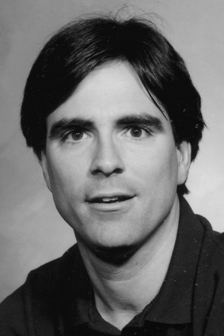
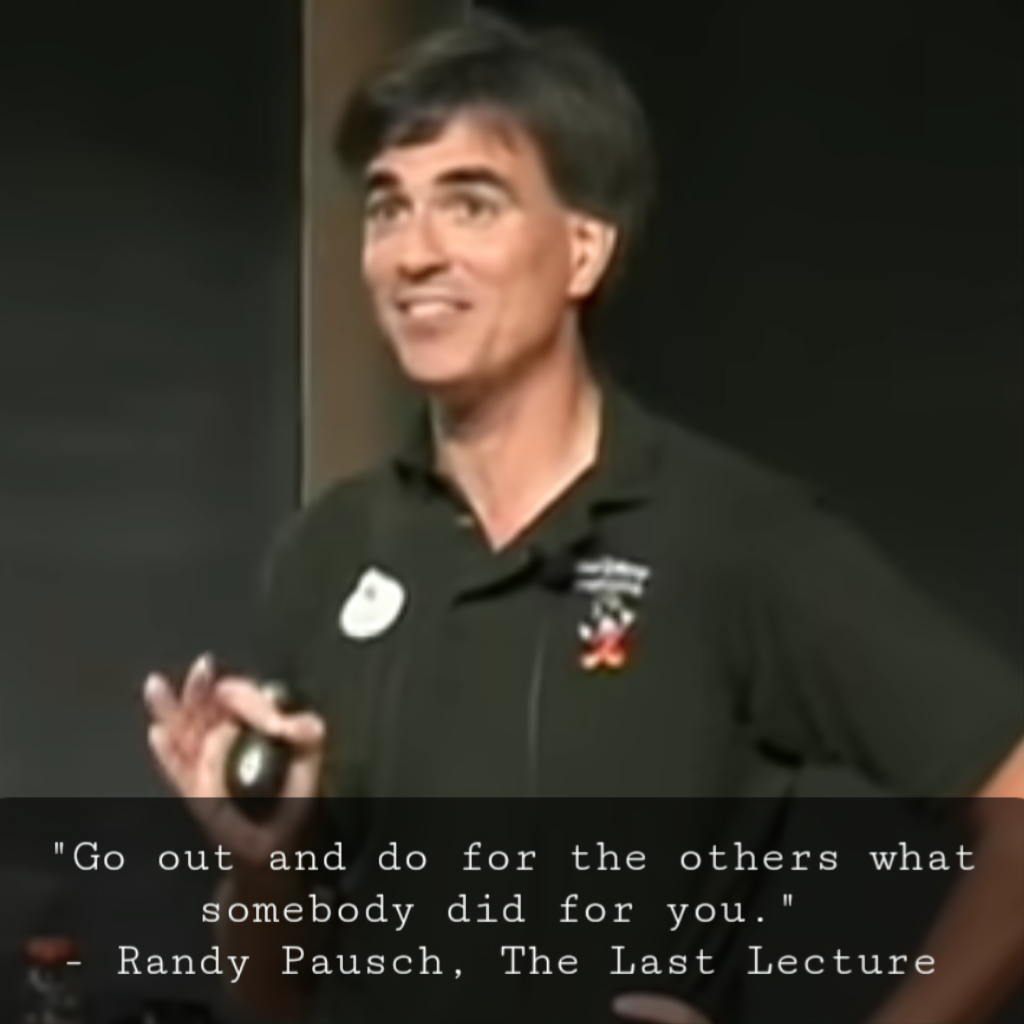
Randy Pausch

One smart person went through one such event which changed the way people around him and people who will be exposed to his legacy will remember him. Randy Pausch – a professor in Computer Science at Carnegie Mellon gave a lecture which is sufficient enough for every human to have a perspective towards life. The lecture soon turned into a book which has interesting ideas, events, thought processes from his life which show us why he thought so, what inspired him to say that exact line in his last lecture. It should be on every person’s read list, watch list.

Every simple thing becomes special when one becomes aware of its backstory, its origin. “The Last Lecture” by Randy was special not because it was his last one (supposedly), it was because of the ideas that inspired him to deliver that lecture. At the age of 45 in September 2006 Randy was diagnosed with pancreatic cancer and was told that he has time of only three to six months to live. Inspired by the ongoing lecture series in his university where he worked and being a teacher/lecturer to heart, he decided to deliver one such lecture that will help others to achieve their dreams. He named the lecture – “Achieving Your Childhood Dreams”. The lecture was Randy’s learnings and life experiences boiled down into some slides of a presentation.

The book called “The last Lecture” came after the lecture and became the bestseller. The lecture is a great phenomenon in itself but the book is more insightful and also dives deeper into Randy’s life events. The book has literally added more life to every word in Randy’s lecture. While reading the book you will understand the events and motivations held by Randy while he was delivering this last lecture.

The need for the lecture and the book

It became apparent that Randy has very less time left to spend with his family (his wife Jai and three children Dylan, Logan and Chloe). Randy realized that he won’t be there to experience the upcoming events with his children. That was one of the motivations to deliver this last lecture. This lecture is not just a one and half hour of knowledge or wisdom blurted out because he has very less time on earth. Randy could have done other valuable things than delivering the lecture but he didn’t. Actually, for Randy this was his masterpiece lecture and it truly is a masterpiece. This lecture by Randy Pausch is actually who we are as a true human being. We want to cheat death in some way. We want to create that legacy for the next generation, we want to fool the time and its flow.

The highlights of “The Last Lecture”

Every word in this book is a drop of the elixir of life. The lecture, the book, the very sentences are treasure chests of lifelong wisdom. There are many parts in this lecture which will make you reflect on your own motivations for life, dreams.    

The brick walls

You will find all types of brick walls in Randy’s lectures. Randy makes a point clear that there always will be brick walls, hurdles in your life. How you strongly want something will either make you break the wall or leave it as it was.

“The brick walls are there for a reason. They’re not there to keep us out. The brick walls are there to give us a chance to show how badly we want something.”

Randy Pausch

Randy also points a beautiful idea about the brick walls which I loved a lot. Randy says that the brick walls are there to actually help you have the seriousness for your real desires and reduce the distractions.

“The brick walls are there to stop the people who don’t want it badly enough. They’re there to stop the other people.”

Randy Pausch

There is one “Romantic brick wall” Randy discusses, which should be left for personal experiences of readers and listeners (believe me it is worth reading and contemplating) It makes a good point on lifelong love and relationship we develop with our partner.

The concept of head fake

Randy gives one interesting trick for lifelong teaching and learning. What is a gift of the greatest teacher? It is the ability to create the interest of students into his topic and make them aware of the magic this knowledge can do. Randy establishes with many examples that you can teach anyone anything if you divert there focus from the target/destination to the actual process/journey. Randy calls this trick of diversion as a head-fake. The student won’t even realize what they will be approaching while learning but when reached to the target – when learnt something, they will truly appreciate the process and the teacher himself. It is more enjoyable in the book. Randy makes sure that this head-fake keeps bringing its head up throughout the lecture and the book.

Intellectual Humility

Even if you are right all the time that does not mean that everyone will accept you all the time. While being intelligent we humans are emotional creatures too. Most of the time the emotional part is heavier than the intellectual part. Randy tells a story of his “Dutch uncle” who subtly pointed his arrogant behavior with the people even when he was smarter than them.

Value of time

One of the most interesting things about the last lecture is that how Randy thinks about time management. The ideas conveyed through the lecture are unconventional- like these are some of the most practical advices on time management. Questioning the things on which you are spending time, having a to-do list (even if you might think of changing it later), discipline of handling random things to save the time lost in searching them at the last hour, delegating the tasks and trusting people with these tasks can free your hands, taking breaks are some of the most practical and doable things Randy suggests about time management.   

Collaborate with different types of people

Not restricting yourselves to one stream, ideas, group of people can do a great value addition in your personality. Randy asks everyone to work in a team and not only in a team but in different types of teams, different types of people. In many parts of the book, you will realize how Randy’s teaching techniques always were connected to group learning and Randy gives some of the best examples on the success of this method. Working in teams and power of multidisciplinary learning is one key takeaway Randy provides.   

Sustainable and long-term thinking

Randy has also highlighted the importance of long-term benefit over a short-term pleasure. He makes everyone aware of the value of being earnest person – a person with a core rather than being a hip who is just on surface trying to impress everyone.

Contingency plan – “All you have is what you bring with you”

Randy gives optimism a different dimension called practical optimism. Even though he knows that he has to enjoy every moment in his life, Randy does not run away from the reality of disease and the death closing in and he proves that with many examples from his life events. Practical optimism is thinking about the limitations of the situation and getting ready handle those worse conditions. Randy gives a quick disaster management lesson through one such part in his lecture.

Get a feedback loop; and listen to it.

One important part of intellectual humility is feedback and taking actions on this feedback. Valuing the feedback can create wonders in your personality and help you to connect with other on deeper levels

Create a legacy, Cheat death

Randy wants everyone to have a sense of giving back to the society. On a personal level it becomes, your duty to put your trust in someone to transfer your wisdom in the development of that person. That is how humanity has evolved and made breakthroughs. Randy tells about many of his students and colleagues to prove his point and his motivation behind it.

The lecture, the book is the legacy that Randy wants to give to the society.

At the end of the lecture, Randy has kept a surprise for every reader, listener which will again prove the point that he is one of the greatest persons, teacher, father humanity has ever seen.

You will also realize that every human life is so special in different aspects when you closely inspect the life events from Randy’s Last lecture. These are life events which are common to every human being in every way. I think Randy’s thoughts, life events actually celebrate the meaning of being a human being.

Legacy- The cycle breaker

We are constantly chasing something over our entire lifetime- money, fame, peace, satisfaction and what not. We always have some goals even though they are not called as “goals” but they are always there in the form of our desires, wishes, expectations.

Either you achieve them or you don’t. So, there are always two possible outcomes for every pursuit of desire- goal:

You did something today. Things turned out to be great – Congratulations! Now move ahead with greater task to benefit yourselves and others.  

OR

You did something today. Things were not so good – Sorry for your loss (prepare for the punishment in worst case!) How will you work on things to cope with this and get out of it.

The thing which remains same in both cases is that you will show up on the next day. There is 100% chance that you will live tomorrow to celebrate/ build further or to work things out/solve the problem. The goals dictate this direction, the modus operandi for what should be done next, to achieve what you want. It tells you to have a vision, a future outlook.

But what happens when there is no future for you? Do your goals- short term, long term your true calling matter? What if someone tells you that you have only few days in your life. What will happen to your long term and short-term goals, your inner calling? For me dying in a blink of a moment would be far easier than going through such a dreadful time with the information that the death is waiting for you just in the next corner.

This becomes the moment when we realize the things which we were striving/ fighting for. We become aware of the worthlessness of the things thereby valuing the life experiences in a wider sense. And things that we were chasing become worthless in front of the life experiences we had Which actually inspires us to create an awareness, a sense of value in the eyes of people we love. That is when we become self-less and seek for a legacy. The purpose of legacy and even legacy itself can sometimes be selfish, but a true legacy is always self-less.

Even though Randy wanted to create this legacy for his children and he highlights same intentions through his last lecture, one should remember that the life events he shares in this last lecture actually show how self-lessness can impart greatness to a simple human being. Thus, even though Randy’s intentions were selfish, the legacy he created becomes the greatest legacy – the selfless legacy humanity can have forever.

The legacy is what makes others after our time to build upon something to advance further and which lives there even when you are not around. We humans have this gift of legacy which ultimately makes us aware about the worthlessness of the things in the cycle of life and death and actually helps us to value the experiences in our lives in a greater and deeper sense.    

For further exploration:

  1. Randy Pausch Last Lecture: Achieving Your Childhood Dreams
  2. The Last Lecture – by Randy Pausch with Jeffrey Zaslow

Image Reference- Death and Life by Gustav Klimt from Wikimedia

P.S. – One of the most important and experience shared by Randy that I loved was his quote in the early part as follows:

Every quote from hereon belong to The Last Lecture by Randy Pausch.

“If you dispense your own wisdom, others often dismiss it: if you offer wisdom from a third party, it seems less arrogant and more acceptable.”

Randy Pausch, The Last Lecture

This also reflects that even after being a great teacher/ educator, Randy practiced intellectual humility to the heart and he was really master of his art.

There are many great lines which deserve separate attention and they should inspire you to visit this lecture especially the book for once in your lifetime.    

“Engineering isn’t about perfect solutions; it’s about doing the best you can with limited resources.”

Randy Pausch, The Last Lecture

“If you can dream it, you can do it.”

Randy Pausch, The Last Lecture

“We cannot change the cards we are dealt, just how we play the hand.”

Randy Pausch, The Last Lecture

“If you dispense your own wisdom, others often dismiss it; if you offer your wisdom from a third party, it seems less arrogant and more acceptable.”

Randy Pausch, The Last Lecture

“Never make a decision until you have to.”

Randy Pausch, The Last Lecture

“Have something to bring to the table, because that will make you more welcome.”

Randy Pausch, The Last Lecture

“If you can find an opening, you can probably find a way to float through it.”

Randy Pausch, The Last Lecture

“You’ve got to get the fundamentals down, because the fancy stuff is not going to work”

Randy Pausch, The Last Lecture

When you’re screwing up and nobody says anything to you anymore, that means they’ve given up on you.

Randy Pausch, The Last Lecture

Tenacity is a virtue, but it’s not always crucial for everyone ho hard you work at something.

Randy Pausch, The Last Lecture

People are more important than things.

Randy Pausch, The Last Lecture

If she doesn’t really love you, then it’s over. And if she does love you, then love will win out.

Randy Pausch, The Last Lecture

Not everything needs to be fixed.

Randy Pausch, The Last Lecture

Don’t complain, just work harder.

Randy Pausch, The Last Lecture

Never lose the child-like wonder

Randy Pausch, The Last Lecture

Start by sitting together

Randy Pausch, The Last Lecture

Go out and do for the others what somebody did for you.

Randy Pausch, The Last Lecture

A good apology is like an antibiotic; a bad apology is like rubbing salt in the wound.

Randy Pausch, The Last Lecture

There is more than one way to measure sure profits and losses. On every level, institutions can and should have a heart.

Randy Pausch, The Last Lecture

If you can find your footing between two cultures, sometimes you can have the best of the both worlds.

Randy Pausch, The Last Lecture

When we’re connected to others, we become better people.

Randy Pausch, The Last Lecture

All you have to do is ask.

Randy Pausch, The Last Lecture

Be good at something: it makes you valuable.

Randy Pausch, The Last Lecture

Find the best in everybody; no matter how you have to wait for them to show it.

Randy Pausch, The Last Lecture

Food for thought only at $1

“Men imagine that thought can be kept secret, but it cannot; it rapidly crystallizes into habit, and habit solidifies into circumstance.

“A man cannot directly choose his circumstances, but he can choose his thoughts, and so indirectly, yet surely shape his circumstances.

– James Allen, As A Man Thinketh

The best thing about books is the value they provide compared to their cost. Books are the materialistic vessels which contain streams of the incomparable, unbound and unfathomable ocean of knowledge. I will discuss one such small- yet very impactful book by James Allen called “As A Man Thinketh”

The book is the epitome of common saying “good things come in small packages”. This book is mere collection of seven essay-like chapters which emphasizes on the importance of our thoughts /thinking and their impact on our life, circumstances, success/ failure, body. This small self-help book is the perfect distillate of the ideas in philosophy related to our thoughts – our thinking. Nobody should miss this book.

The author James Allen intended this book to remain concise, compact. James Allen was a British philosopher, poet and is called the pioneer of self-help movement. Buddha and his teachings – one of the influences on James Allen seem to reflect themselves in this book. He also calls this book “little volume (the result of meditation and experience)”. The book is also said to inspire one of the bestsellers called ‘The Secret’ which focuses on the Law of attraction.

Let us dive into the seven short yet insightful ideas explained in the book ‘As A Man Thinketh’.     

1. Thought and character

Act is the blossom of thought, and joy and suffering are its fruit.

James develops this idea from the logic of Cause and Effect. Anything we do will have a favorable or unfavorable outcome which decides whether it will make us happy or sad. If sweet or sour fruits are the effect then their cause is the action taken.

But what is the cause to the effect of taking an action?

James expresses ‘the thought’ as the cause for actions. We are what we think. Our every minuscule, insignificant seeming yet impactful thoughts and their collection make us who we are which thereby enables us to act in a specific way. Some may consider this as a behavior, the attitude of a person. James wants to make readers aware of the control they can have on their life by having control on their thoughts, thereby the actions they will take and the outcomes of these actions  

Man is always the master even in his weaker and most abandoned state; but in is weakness and degradation he is the foolish master who misgoverns his “household”

2. Effect of thought on circumstances

The soul attracts that which it secretly harbours; that which it loves, and also that which it fears; it reaches the height of its cherished aspirations; it falls to the level of its unchastened desires, – and circumstances are the means by which the soul receives its own.

Here, in the second part James expands the idea of cause and effect of our thoughts causing our “attitude” which causes our actions in a specific way giving us “our character”. This idea is also somewhat similar with the thought expressed by Carl Jung- Swiss psychiatrist and psychoanalyst as follows:

“You are what you do, not what you say you’ll do.”

– Carl Jung

This reinforces that the thoughts are responsible for every action we take. No matter how spontaneous they may seem but they are the outcomes of our deep, hidden thoughts and they may remain unconscious for us. That is why James says “soul attracts that which it secretly harbours”. These conscious, unconscious thoughts inspire actions in a specific manner and the outcomes are revealed as the mannerisms of the actions taken. Hence, our thoughts give birth to the circumstances around us.    

Justice

The idea of reaping what we sow is central here. James calls it ‘the exact justice’. Rather than circumstances shaping the person, James highlights that the person is the cause of his circumstances which are linked to his/her attitude which is ultimately linked to the thoughts.

Ignorance

James expands the idea of circumstances to the desires, wishes of every person. In almost every case a person has the solution for the problem right in front of her/him, but they chose to ignore because it will cost them to change themselves and the anxiety associated with changing themselves.

If one eliminates this ignorance of the obvious yet anxious seeming change/ improvement, then she/he will become free. This means that one has to sacrifice her/his current attitude, current thought to improve personally thereby to improve the circumstances.  

Good and Evil

James clears the idea of being good or being bad. In simple words, they are considered as a superficial tag or quick judgemental opinion of every person.

There are many examples in everyone of our lives when we feel that the dishonest man got the success and honest man failed greatly.  

According to James’s idea of “Exact Justice”, the person having complete and absolute knowledge would have gone beyond good and bad, success and failure. She/he would consider them as a part of their evolution, part of their ongoing experiences.  

Blessedness and Wretchedness

James discusses here the idea of suffering which seems to be influenced highly by the teachings of Buddha. Desires are the root of suffering. James calls the suffering as the effect of wrong thought. When one loses the harmony with her/his thoughts then only she/he suffers.

Blessedness hence is originated from the right thought, however materialistically poor a person may be and wretchedness is originated from the wrong thought, however materialistically a rich may be. Right thoughts meaning the harmony of a person with his doings and ultimately the thoughts responsible for them.  

Introspection

Again, based on the law of justice of the universe, James establishes that, once a man accepts that his thoughts are responsible for the conditions around him, he starts tuning his thought in a way to change the conditions, people and their behavior towards him. This is possible only by the power of Self analysis and introspection, James says.

This seems like the core inspiring idea behind the development of the book called “The Secret” which calls for the Law of attraction.

Good and bad Habits

The collection of continuous thoughts in certain way creates a channel of certain continuous actions thereby creation of routines leading to the formation of habits. Our thoughts even may seem untouchable, non-physical but they manifest themselves into our actions in a specific way thereby swiftly developing our habits. These then create the circumstance of certain outcome.

James calls it as the “crystallization” of thoughts into habits and further “solidification” of these habits into the circumstances.

3. Effect of thought on Health and The Body

The body is delicate and plastic instrument, which responds readily to the thoughts by which it is impressed, and habits of thoughts will produce their own effects, good or bad, upon it.

James considers the body as a servant of the mind. In simple words, the body is the materialistic extension of our untouchable, non-physical thoughts. Hence, thoughts drive the body and the health. That is why a healthy mind will always crave for healthy food, healthy and hygienic habits. The neat and healthy living is the effect of the neat and healthy thinking.

With those who have lived righteously, age is calm, peaceful, and softly mellowed, like the setting sun.

In one sentence – “Age is just a number”. It is all in the thought of ours which determines how young we are.

4. Thought and Purpose

Even if he (a man) fails again and again to accomplish his purpose (as he necessarily must until weakness is overcome), the strength of character will be the measure of his true success, and this will form a new starting point for future power and triumph

James wants to establish the concept of failures as a part of life and their contribution in the ultimate success. Overcoming the failures is only possible when a person has found the purpose. This purpose then makes him to accept the failure, strengthen himself to face the failure again and to finally become strong to overcome it.

In simple way- when a person accepts the fact that, in order to become successful, one will go through multiple failures, the first step towards success is taken. In the process of overcoming these failures he will become strong; he will gain the strength to ultimately achieve the true success.

Purpose will guide the person through the failures.  

5. The Thought-Factor in achievement

Intellectual achievements are the result of thought consecrated to the search for knowledge, or for the beautiful and true in life and nature.

Here, James follows the idea of strengthening oneself to overcome the failures. This will need sacrifice. The sacrifice intended here is of the selfishness. Because selfishness indicates attachment, attachment induces desires and failure to get these desires makes the person to lose the said harmony of thoughts and actions. The true achievement James establishes here is the freedom – what some may call as “Mukti” as mentioned in Hinduism. This needs upliftment of thoughts which is only possible by letting go of materialistic desires and acceptance of true knowledge, true purpose.

6. Visions and Ideals

Dreams are the seedlings of realities

James Allen calls the dreamers as the saviors of the world. The idea is that visions are one structured way of inspiring thoughts which go on accumulating to cause an action in a constructive way thereby manifesting a good habit. This good habit will be responsible for the harmonious circumstances which is the ultimate purpose of the life. James clarifies that the idle wish is not the Vision.

In all human affairs there are efforts, and there are results, and the strength of the effort is the measure of the result. Chance is not.

James denies the existence of chance, luck through the idea. It is therefore is established here that there are only thoughts conscious or unconscious they may be which are ultimately responsible for who we are and what is happening with us and how we accept and react to it.

Gifts, powers, material, intellectual, and spiritual possessions are the fruits of effort; They are thoughts completed, objects accomplished, visions realized.

This idea again focuses on actions thereby the thoughts responsible for these actions which are the key parts of human evolution in physical and non-physical ways. The vision brings thoughts into the reality of action, drives it or gives it a purpose.  

7. Serenity

Yes, humanity surges with uncontrolled passion, is tumultuous with ungoverned grief, is blown about by anxiety and doubt only the wise man, only he whose thoughts are controlled and purified, makes the winds and the storms of the soul obey him.

Serenity in the end is intended to calm ourselves our of all the thoughts we have. This demands to establish control on our thoughts thereby controlling the actions and circumstances.

These are the seven core ideas of James Allen’s intellectual and philosophical masterpiece. ‘As A Man Thinketh’ itself builds a bridge between eastern and western philosophies in an effective way. The ideas also bring religious thought processes from Christianity, Buddhism and Hinduism. The book being so small yet expressing such vast and exhaustive ideas definitely highlights the power of few pages bearing, single dollar costing book with such a strong thoughts and ideas. Definitely a must read.

How to fail? – Ankur Warikoo’s Failure résumé

“I’ve missed more than 9,000 shots in my career. I’ve lost almost 300 games. Twenty-six times, I’ve been trusted to take the game winning shot and missed. I’ve failed over and over and over again in my life. And that is why I succeed.”

– Michael Jordan

Recently, I came across a book called ‘Do Epic Shit’ by Ankur Warikoo. I actually bought the book for my younger brother so that he will get exposed to the ideas that Ankur shares with the youth through his online content. The book is a collection of all the online contents that Ankur has created and is organized in order to be consumed through a book and it does the job well. I love Ankur’s idea of playing a ‘book cricket’ with this one. That resonates and connects with the today’s youth on a personal and in a nostalgic way. The book covers 6 major aspects that are obviously Ankur’s key points of discussion in every content namely- Success and Failure, Habits, Awareness, Entrepreneurship, Money and Relationships. All these ideas are communicated with the reader in small bits and chunks of ideas with some good quote-worthy sentences. Overall, the book is designed to be not too complicated yet covers the most complicated subjects our young generation faces. Trust me, sometimes for the most confused and most energetic young people even though the things are too much apparent but it takes one experienced opinion to enforce that learning in this age of complete confusion.   

Dedicated to all the failures and the roadblocks I faced in life. We rarely wish for them, but upon reflection I realize they are the reason I am here today.

– Ankur Warikoo, DO EPIC SHIT

I will be discussing my most favorite part of this book. The part is ‘My failure résumé’. This part contains all the ways Ankur has failed in his life.

The résumé opens with dream of every Indian science student and apparently his/her parents called “getting in to an IIT”. Ankur’s father crying and the expectations of eradicating his financial ‘miseries’ through IIT for his son is an uncanny depiction of every middle-class parent. Ankur not asking his father the reason for his crying is nerve chilling enough to explain the complexity of emotions and the feeling of dreams crushing into nothingness as experienced by almost every typical Indian parent.

The urge to join IIT in masters even shows that there is that feeling, that guilt, that worthlessness of not getting into an IIT which becomes tied with the youth. They just want to calm this part of themselves by at least getting Masters from IIT where too Ankur failed. Being unable to answer in front of the great maestro Dr. H C Verma is the level of failure nobody could empathize with.

Event after getting somehow into PhD abroad, dropping out of it is a huge NO-NO. The first thing the whole world will be ready and equipped with is all the ways to call you a failure and bring you down. Ankur went through it.

Later on, Ankur shows his epic failures in his Consultancy jobs, Entrepreneurial ventures. The failures are on the level of management where your decisions will be affecting people, their lives, organization’s assets and most importantly investors. Ankur highlights the levels where he failed namely – delegation, leading from distance, getting the results from others, seeking feedback. Ankur also focuses on his “irrational optimism” while discussing these failures.

The next mistakes, failures are closely related to the mistakes in personal finance and personal relationships. They discuss about how his lifestyle suffered due to his larger expenses compared to his savings. The short but clear enough events of his sister’s wedding and his son’s birthday gift are more than enough to clarify the conditions he was in. Failure to connect with his son, parents, failing to not keep up with the expectations of the investors and colleagues are the worst scenarios everybody wishes not to have faced in their life. Ankur went through them too.

I believe, ‘we’ as a part of society are always going through all sorts of transactions. These transactions are personal, emotional, physical, intellectual, financial. In order to have ourselves a value, we never want to portray ourselves as an overall failure. After all, who going to buy you in these transactions then if you are not that valuable enough ! This value is associated with your success.

Everybody wants to project the good of themselves, the better part of themselves in order to maintain themselves in the everyone’s top priority list. That’s how rude and I would say- ‘practical’ the world is. After all, it is the survival of the fittest. The social media and the way we try to project ourselves and compare our lives with the feeds of others is the exact example of this. Hence, “one failure and you are down forever” is the projection of the world and it is imposed on you right from the moment you become aware of how the world works, when you are young and most of the time your parents’ opinions are a part of it.

Ankur’s résumé of failures invoked one idea in my mind that everybody is always going through her/his own battles and they face these failures too. But what prevents us from learning from them or clinging negatively to them is our acceptance of these failures. Nobody wants to ‘embody’ rather accept how they failed because that is sufficient enough to erase all your ‘transactional value’. We as human being have evolved to be attracted to negative things faster because they will compromise our survival right from the primitive times. In today’s age, these negative things are no longer vicious predators or hunters and the physical scars and physical pain they gave; they are the comparisons, mockery, taunting of the surrounding world which give mental scars and mental pain. It is the same reason, I believe Ankur calls these failures the scars which he wants us to be aware of.

 Ankur’s résumé of failures carries the core idea that the more you accept the failures, embody them, bring them into the real world the more you will learn from them. It is like having closure with your failed dreams, aspirations and again gearing up for new and better journey, better goals.

Even though Ankur calls himself lucky, if you go through the list of his failures- he has failed great and in an epic way (meaning he was in literally epic shit!) which made him successful in a great way.

I believe that ‘this’ Failure résumé will remove the stigma of failures from the minds youth and making them more open to try and fail at more and newer things. It is very important for people and especially our younger generation to understand that the failure is the way of life and success rarely comes out of it which needs efforts, internal motivation, skills, consistency and what not. It is important to highlight how successful people failed before they became successful. It is also important to control the glorification of failures too. Otherwise, the main purpose – which is to learn from the failures will be deviated (Glorification of failures is also a thing which should not be promoted)

In single sentence and to be more specific- I want ‘Ankur Warikoo’s Failure résumé’ to be included in the textbooks of every young student in India.

Don’t read success stories, you will only get a message. Read failure stories, you will get some ideas to get success.

– Dr. APJ Abdul Kalam

Featured Image Credit- Nicolas Nova -www.flickr.com

Metamorphosis- Anatomy of mental illness

Franz Kafka

Metamorphosis is about ‘Valuing a person for who they are’. The goal is not to understand him/her, the goal is to accept them for who they are. Metamorphosis shows what will go wrong when we lessen the value of everyone as an individual person for their motivations, drives, ambitions, expectations in any structure. It can be social, financial or personal. As a reader you will hate Gregor’s Family. This will also happen with every system where people are not valued.

Franz Kafka’s Metamorphosis is one of the 20th centuries greatest literary masterpieces. Originally written in German as ‘Die Verwandlung’, the novella has been the centre of discussion for many critics. Ever since I discovered Metamorphosis, there was this feeling inside me to bring this into words.

The story of Metamorphosis goes like this-

Gregor Samsa- a traveling cloth salesman finds himself woken up to be transformed into monstrous vermin (generally depicted as a cockroach). He is already late for his routine job which he hates by heart but cannot quit as he is bound to the employer by his father’s debt. He is the only source of income to the family. The absence of Gregor at job makes the Chief clerk from Office to have a check Gregor’s home. To convince his serious physical condition to the Chief clerk, Gregor comes out of his room with all his insect like avatar and irregular and scary vocals. This scares the clerk, and he leaves. The serious condition of Gregor scares his family especially his mother who is always helpless in front of his father. Gregor’s father- with whom he has no personal attachments, feelings already lash out on him to forcefully get him in his room thereby injuring him during the whole scene.

Gregor’s sister Grete whom he adores helps him in the start by feeding him, clearing his room of furniture to make him crawl freely. Due to the condition of Gregor, family has no income. Now Gregor accepts his condition and adjusts himself to this repulsive yet his ‘own’ identity. He crawls on the walls, floor; loves eating rotten food, doesn’t care about hygiene. One incident leads Gregor’s father to angrily shoot apples at him causing serious injuries to his sensitive parts. Suffering to injuries, Gregor loses his appetite, his family neglects him as he is of no use. The family decides to rent a room in their house to three people who are unaware of Gregor’s presence. One incidence leads to the exposure of Gregor’s presence to the tenants causing them to leave the room and not paying for the accommodation due to serious unhealthy living conditions. This upsets family especially his beloved sister who now considers him as a burden, she asks her parents to get rid of ‘it’ (Gregor is no more ‘a being’ for her). Upon realization of no worth to the family and no self-worth, Gregor dies of starvation. The dead body discovered by their house maid gives the family relief (!) and the family disposes off the dead body.

Now the family thinks of moving to a small house for saving money and getting Grete a husband.

Metamorphosis is the best example of written surrealism. The way Kafka develops the picture of a repulsive vermin (insect) through his writing is such an experience. Some think that it is the best representation feeling of alienation, powerlessness, public humiliation, the feeling being ashamed of ourselves, the strong influence of patriarchy. Most of the people strongly believe that the story is spitting image of the influence of Kafka’s father over his entire life and his life decisions. Kafka never liked the way his father treated him, this is consistently proven to be true over his important life events and his writings. Most of the Kafka’s written works were unfinished.

I think Metamorphosis is personification of Depression. Metamorphosis is a guidebook on how to not treat a person with depression, mental illness rather how to not treat every person.

The morphism of a human into a worthless repulsive insect clearly shows the feeling of separation, alienation from society. It represents the feeling of hopelessness- ‘self-disgust’ the person feels. Man is a social animal and the people around him are directly and indirectly are influencing his development- physically, mentally and spiritually. The person having self-disgust has lost all the hope for his development. Gregor finds himself in the same condition. This is the time when he really needs extra care and support. But Gregor’s family is beyond helping him, his sister helps him in the start thus comforting him for some time and accepting himself. But he still accepts himself as an insect, not a person which shows that there is no way he will be coming back.

Gregor’s insect like unhealthy eating habits, crawling on the floor, walls, lethargy, slowed body movements, change in speech show some of the highlighting features of a person with mental disorder.

The story has many moments where Gregor’s is consistently physically abused and injured which stay with him forever. The later scenes of his family especially his sister being despised of him depict the feelings of worthlessness, emptiness, self-blame a person with mental disorder goes through. This was the moment when Gregor was only needed to be accepted by his family for who he was. He doesn’t expect to be understood. Being rejected by that last person whom we have always rooted for is the worst feeling in the world.

Finally, Gregor loses hope and leaves the life by starvation. The reaction and decisions made by his family later show no attachment to him thus making the death of Gregor more pronounced and evident (which is wrong on so may levels!) The end of story cares more about nobody caring about him.

I will again highlight that Metamorphosis is a guidebook for every person on how to not treat a person going through mental conditions. They may be expressive about it to you, or they may not give even single hint of this condition which becomes a challenge. It’s not like every sad looking person going through it. History has some of the great examples where person who always used to look happy were victim of it.

The main takeaway from Metamorphosis is ‘Valuing a person for who they are’. The goal is not to understand him/her, the goal is to accept them for who they are. Metamorphosis shows what will go wrong when we lessen the value of everyone as an individual person for their motivations, drives, ambitions, expectations in any structure. It can be social, financial or personal. As a reader you will hate Gregor’s Family. This will also happen with every system where people are not valued.

Any system where people are kept first will always thrive and sustain till the end, because it is always about you and people around you.

On personal level it is more about treating people on same levels, being there when they are feeling low, caring for them, accepting them.

Metamorphosis- A must read for everyone.

Franz Kafka Monument in Prague- “Description of a Struggle”

Image Credits: Franz Kafka Monument in Prague by Myrabella