The Roadmap For A Creative & Fulfilled Life

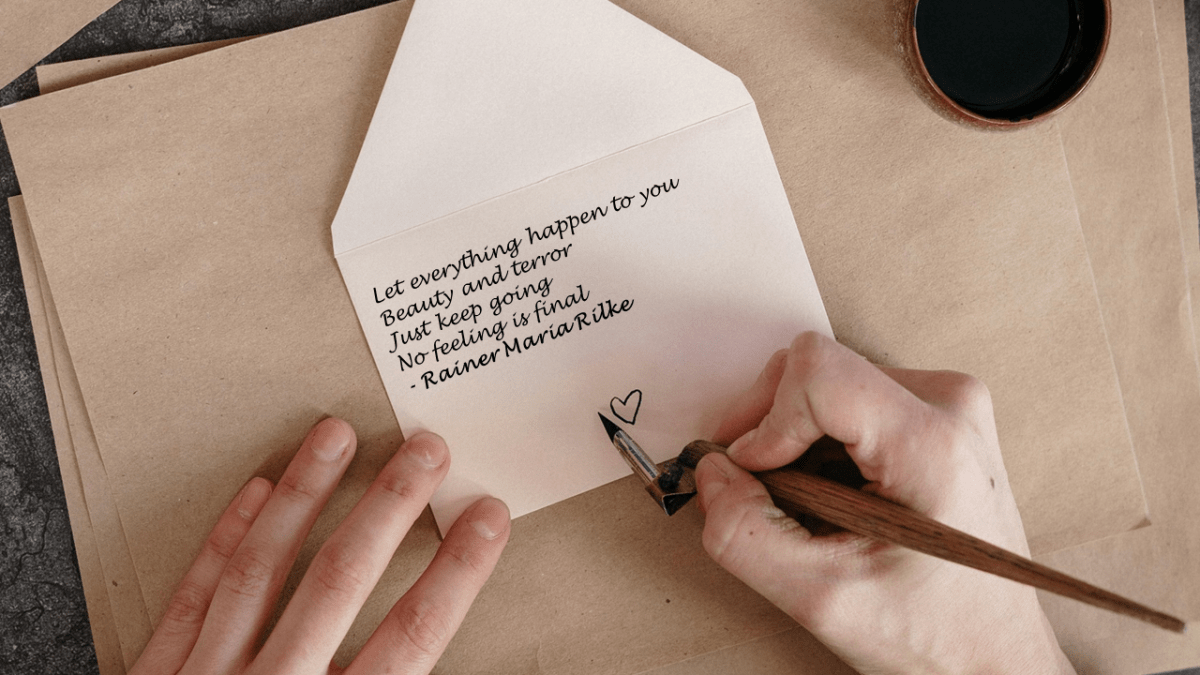
The ten letters from an Austrian poet, novelist – Rainer Maria Rilke to a young poet undergoing the fear of mediocrity and criticism laid down a roadmap for a successful artistic and creative life. The beauty of Rilke’s letters is that they are not limited to those strictly in the creative professions; rather it is a roadmap for every person who want to live a fulfilled life involving continuous transformation of inner and outer riches. That is also why art is important in our lives. Rilke through his ten letters, implores the reader to cultivate authenticity, empathy, and patience to pass through all events of their lives.

In today’s times the written communication has become so handy and easy that you can send millions of sentences from one end of the globe to the another within few milliseconds. This convenience of communication has stolen away the sanctity, sanity and strength of the words and emotions they invoke which were actually supposed to transform our worlds in better constructive ways. After reading these letters from Rilke you will appreciate how effectively he distilled down the divine wisdom of life in few pages. A book costing less than one time meal can transform your whole life. This is the power of a true artist.

Rainer Maria Rilke’s Letters to a Young Poet

One of the biggest fears any budding artist carries inside them is the fear of mediocrity and the fear of the criticism. Creative pursuits can be followed by anyone and everyone but very of few them are able to rise-up as the real artists. At the same time, it is also true that a great master was once a starting novice. This is where lies an ambiguity; how could an artist develop his art to the greatness when today he/she is unsure about its end fate? This may feel a complicated question but the answer is simple or at least someone has already simplified the answer for us. Rainer Maria Rilke, the poet is the one of the artists who truly understood what it means to create an art or become a true artist.  

The reason to mention Rilke out of the other artists is the way he provided that answer. Very few artists carry so much artistic power that even when they would sneeze or yawn, it feels artistic. Rilke was one of those effortless artists. Pardon my example of artistic yawn, for Rilke deserves far superior analogy for his works. A true artist’s life itself is an expression of art. This is only possible due to the authenticity. Authenticity is the core of great and true art.

The reason to choose Rilke to solve the riddle of the true artistry is the letters he wrote to a budding poet for giving feedback on his poetry. You will see the inner workings of Rilke’s genius artistic mind through these ten letters. You can call these ten letters as ten advises, ten rules to become a great artist rather a great human being. You would wish that someone would have given you exactly similar advises in your journey when you will read these letters. What strikes me the most in these letters it the relevance they still have today, that is what is an attribute of true art – it stands the test of time. I will throw some light on the key moments from these ten letters and would encourage you to read them for yourself. You will understand that very few pages of paper are enough to change the way you live your whole life.    

Letter 1 – Art should fill the gap between what is felt and what is expressed

Criticism of art

Franz Kappus – a recruit in military academy felt the need to have an opinion on his poetry which is why he wrote letters to Rilke asking for his feedback. Rilke once studied in the same academy. Rilke writes following in response to Kappus.

“Things are not all as graspable and sayable as on the whole we are led to believe; most events are unsayable, occur in a space that no word has ever penetrated, and most unsayable of all are works of art, mysterious existences whose life endured alongside ours, which passes away.”

– Rainer Maria Rilke, Letters to a Young Poet

It is very interesting to see how Rilke found out the gap between the expression of any art and the interpretation of its observer, admirer. And that is exactly why art should exist and function. That is also why it is very easy to criticize given art but difficult to replicate it. Most of the pure creations of art, however fictional they may be have somehow emerged from some real-life events and are very personal. This fuels the pure artistic creation but it may also steal the perspective from the observers who haven’t gone through that real life experience in their own lives. That is exactly why criticism is the easiest task in any artistic journey. Rilke thus encourages the new poet to not worry about the criticism of others in this journey. Actually, bringing the intangibility into tangibility, unsayable and unseeable into comprehensible reality is the exact job of the artist. He would anyways face the criticism as he is the first one to bring them into the reality; others are yet to pass through the same experiences on their own level. Fear of criticism should not stop the process of artistic expression. 

Artistic style is effect of the art not the cause behind it

“Nobody can advise you and help you, nobody. There is only one way. Go into yourself. Examine the reason that bids you to write; check whether it reaches its roots into the deep regions of your heart, admit to yourself whether you would die if it should be denied you to write.”

– Rainer Maria Rilke, Letters to a Young Poet

Many artists try to copy the style of other famous artists to create their own art because it is already proven technique that others are appreciating. It is the safest way. Some try to force things so that art would be created. Art should not force you to do certain things. The style created by these routes becomes pretentious and ‘cringy’. People will like it; it will become viral but it will be short lived.

Rilke thus advises the young poet to look for the reason he has chosen to walk this path. He wants the poet to make sure that the reason to go on this journey is to express the deep sayings of the heart. The art created from this deep urge of the heart will have its own style.

Rilke was very well aware that the emergence of style is directly linked to its uniqueness of expression which is very personal thing. Hence, he suggests to go inwards. Every one of us lives their life in unique ways and if the art reflects that uniqueness, then it can easily create its own style. This is possible only when one has the urge to honestly put his own life in his art instead of copying or imitating the lives of others. This is also why one cannot separate the biography of a true artist from his art. So, study of an art is in a way the study of that human who created it, his philosophy of life.

“A work of art is good if it has risen out of necessity.”

– Rainer Maria Rilke, Letters to a Young Poet

Letter 2 – Art is more about depth than its aesthetics

“For under the influence of serious things irony will either fall away (if it is something incidental) or on the contrary (if it really belongs to you in a native way) it will gain strength and so become a serious tool and take its place among the means with which you will be bound to create your art.”

– Rainer Maria Rilke, Letters to a Young Poet

Art most of the times is meant for pleasure or to stir up the emotions. That is why aesthetics are one important part of any art. So, it is natural for any artist to work on improving the materialistic attributes of his art, the way it looks, the way it sounds, the way it smells or the way it feels to the skin – the way it triggers the senses. Rilke wants the young poet to care less for such aesthetic attributes and focus more on what needs to be said which was not said by others before. This is possible only when the artist shows his personal depth, his honest intent while expressing his emotions, thoughts, ideas through his art. If there is depth in the expression, the aesthetics would be automatically be built around it to fulfill that honest expression.

This shows why Rilke’s simple writings feel so artistic and pure to the core. Even his normal letter communication has an intent and depth.   

Letter 3 – Solitude engenders the art

The solo journey of authenticity for the creation of true art has its shortcomings (I won’t use the word ‘disadvantage’ because Rilke explains the power of such solo journey many times in his future letters). The shortcoming is that as you are on your own, you may cross the paths which others have already passed, you may commit the same mistakes which others already committed. This wastes valuable time and resources. So, anyone would obviously think that at least if they start with some preconceptions of what others have already done, it would prevent them from potential failures in their own artistic journey. Rilke prohibits the young poet from embarking on such journey. There is a reason.

“Trust yourself and your instincts; even if you go wrong in your judgement, the natural growth of your inner life will gradually, over time lead you to other insights.”

– Rainer Maria Rilke, Letters to a Young Poet

The single most common attribute of any great artform which is the authenticity is possible when the artist successfully pours his/ her unique perspective into their art. This is only possible when they go on their own journey in their own ways even if others have already done that. Rilke focuses more on how you grew out of your failures, the failure which other have gone before but never learnt from them. For an artist, failures are less important than the personal journey of gathering personal unique perspectives and insights which world has never experienced before.  

Solitude is important in such journeys because it demands the artist to go in his own ways without getting influenced by others. This isolation from the surrounding ensures the true expression of what was suppressed by the very surrounding itself. Being a social animal, we try to suppress certain aspects of our identity to melt and fit into the corners and molds of the society. Rilke implores the importance of solitude so that those hidden, personal and unique aspect will bring out the authentic perspective out of the artist.   

“It is a lesson I learn every day amid hardships I am thankful for: patience is all!”

– Rainer Maria Rilke, Letters to a Young Poet

Rilke knew that failures shatter anyone completely and that is exactly why asks for patience in this journey.

Letter 4 – Artist must be careful about the limitations in the expression of art due to the tangibility of its materialistic media

Rilke cautioned the young poet about the media of the art. The media are purely materialistic which are expressing the immaterial, intangible ideas and emotions. So the chances are high that the limitations of the media will not successfully communicate the intangible expression of the artist. The art could immediately feel mediocre because the media failed even though the artist had an impeccable picture of that piece in his mind.

“…for even the best of us get the words wrong when we want them to express such intangible and almost unsayable things.”

– Rainer Maria Rilke, Letters to a Young Poet

Many of us are pursuing certain arts because it gives us certain type of pleasure, enjoyment, and entertainment. This is also one of the aspects of the materialistic limitation of the media of expression in art. The materialistic media excite our physical senses and also the intangible parts of our personality. Most of the times the goal is to excite the physical, materialistic aspects of our personality. Rilke advices to not focus on such materialistic pleasures during the creation of the art. Such art would excite physically but as physical things have materialistic limitations these limitations will restrict the expression of intangible and truly pure, authentic attributes of given artform.

“Physical desire is a sensual experience, no different from pure contemplation or the pure sensation with which a fine fruit sates the tongue; it is a great and endless feeling which is granted to us, a way of knowing the world, the fullness and the splendor of all knowledge. And that we receive this pleasure cannot be a bad thing; what is bad is the way almost all of us misuse the experience and waste it and apply it as a stimulus to the tired parts of our lives, as a distraction instead of as a concentration of ourselves into climactic points”

– Rainer Maria Rilke, Letters to a Young Poet

(It’s like even though loud music excites you that does not mean that you will keep on listening to it forever; it will surely feel boring after some time. This ‘boring’ feeling is due the material aspects like your eardrums getting tired after repeated exposure.)

That is why Rilke asks to ignore the materialistic pleasure while creating and expressing the art. The pleasure is the byproduct of authentic art, it should first invoke that which was not realized by the person who is consuming that art. Even though the person might have gone through that experience before but it was the artist who showed this person what the observer didn’t felt before.

Letter 5 – Art is one of the very few things which could last forever

“…and you slowly learn to recognize the very few things in which something everlasting can be felt, something you can love, something solitary in which you can take part in silence.”

– Rainer Maria Rilke, Letters to a Young Poet

Rilke here was writing about his time in Rome, Italy. You will see that he describes Rome with hot weather, empty, difficult to settle in, lifeless and museum-like dead and still feeling. But Rilke then pointed out the creations of Michaelangelo which are still beautiful in this dead stillness. In a smart way Rilke shows that the art which is created in pure solitude, silence and love could still remain relevant and still express that authentic expression of the artist. Even though Rome was boring for him that day, Michaelangelo’s art inspired Rilke to redefine the artistic venture to inspire his young poet. That artistic creation in Rome was alive and inspiring people around it like Rilke. It is true still today.    

Letter 6 – The ‘final’ destination is solitude and only solitude

“What is needed is this and this alone: solitude, the great inner loneliness. Going into oneself and not meeting anyone for hours – that is what one must arrive at.”

– Rainer Maria Rilke, Letters to a Young Poet

You will find Rilke reiterating the great importance of solitude in his every letter to the young poet. And there are important reasons behind it.

Solitude makes the artist to look inwards which prevents him from copying other styles, it prevents him from mediocrity.

If the artist would depend on other external techniques for artistic creations; once these techniques fail for any reason unknown to the artist the whole journey is futile and great failure.

Failing inwardly is way important to recover because artist would know each and every reason for its end fate into failure. This creates new opportunities for improvements and learnings which lead to unique style of artistic expressions.

Solitude makes the art more personal. Even though we are all same inside and outside on human level what separates us are our unique life experiences and the unique personal perspectives created from those experiences.

Solitude prevents the artist from the hesitation of expression thereby making his art more potent. Any artist who can shake the people to their core rarely hesitates, this is possible only when he has detached himself from the influence and opinions of others. This strength comes when one submits himself to solitude.     

Letter 7 – Only solitude can create ‘real’ love.

“I believe that love remains so strong and powerful in your memory because it was your first deep experience of solitariness and the first inner work that you undertook on your life.”

– Rainer Maria Rilke, Letters to a Young Poet

Most of the art is revolving around love. There is a reason why it is so. Love allows the person to appreciate the very reason of being himself. Many would say that love makes the person complete because his other half part in his lover empowers him but that is not the case in reality. You should appreciate how Rilke points out this fantastic observation about our human nature and its definition of love.

The love which we feel for others and consider it as a fulfilling in the form of the other person who loves us back is solely a result of – we carefully and intentionally working on ourselves inwardly. We consider love as a completing emotion not because others make us feel special through it; rather it is because love inspires us to willingly work on ourselves so that our lover would appreciate our love for them and love us back.

True love inspires a person to love themselves, to work on themselves, improve themselves so that their loved ones would love them back. This is only possible when one has completely appreciated solitude. Solitude is the ultimate and authentic form of love. When you would start loving yourself honestly you would appreciate what your loved ones are looking for when they are looking for love.

So, however paradoxical it may seem, our love for others starts with our love for ourselves and only ourselves. (bear in mind that we are not talking about selfishness) Rilke pointed out this observation.

Letter 8 – Sadness is the blessing in disguise

Letter 8 is my most favorite letter. Not because it glorifies sadness or pain which is a common tool for any great art. (Some newcomers, wannabes are ready to harm themselves mentally, physically to invoke such feelings for creating true expression of their art – I feel its too pretentious and inauthentic.)

I like this letter because it asks the artist to observe his sadness in greater depth instead of running away from it. The mere nature of life as a pursuit of happiness prevents us from appreciating its other lesser known but glorious aspects which are hiding in plain sight behind sadness and pain. Rilke knew this hence he implores the young poet to study and appreciate sad experiences constructively.

“If it were possible for us to see further than our knowledge reaches, and a little beyond the outworks of our intuitions, perhaps we should then bear our sadness with greater assurance than our joys. For they are the moments when something new enters into us, something unknown to us; our feelings shy and inhibited, fall silent, everything in us withdraws, a stillness settles on us, and at the center of it is the new presence that nobody knows, making no sound.”

– Rainer Maria Rilke, Letters to a Young Poet

What a pure and real thought!

Rilke beautifully convinced us that we learn more, develop better, create better if we let new and unknown things inside ourselves. Sadness is highly associated with unfamiliarity, uncertainty which is also why it is invoked in such conditions but that is the exact reason for an artist to explore the unexplored territories of humanity. These new, unknown experiences actually develop and amplify the artistic attributes in better ways than any happiness, joy or pleasure would.

“The quieter, the more patient and open we are in our sadness, the deeper and more unerringly the new will penetrate into us, the better we shall acquire it, the more it will be our fate, and when one day in the future it ‘takes place’ (that is, steps out of us towards others) we shall feel related and close to it in our inmost hearts”

– Rainer Maria Rilke, Letters to a Young Poet

Rilke strongly proposes the creative person to not be swayed by the sadness and get carried away with it. Rilke demands patience. For patience will make the person to study this feeling of sadness and what it is actually pointing to. As we are the creatures craving for happiness and running away from sadness it is natural to consider sadness as a hostile feeling. But this less acquainted sadness is actually carrying the gifts of our better futures for when we pass through them, we are transformed. A true artist is always looking for a new perspective towards the world we are living in. And transformation is a coal mine which holds the diamonds of creative, new, and radical artistic perspectives with immense depth. Rilke wants the young artist to capitalize the sadness with the tool of patience to learn a totally different perspective towards the world.

“Perhaps everything terrifying is deep down a helpless thing that needs our help.”

– Rainer Maria Rilke, Letters to a Young Poet

Rilke also showed that the very thing we are scared of is also scared of us for it too is clueless about the unknown. The way Rilke said this shows how important empathy is for any artist. Empathy will help any creative person rather any human being to make amends with the uncomfortable, sad feelings. So, patience and empathy are the most important tools to live a life full of transformations. These transformations, especially the inner transformations will fuel your art.

“Do not think that the person who is trying to console you lives effortlessly among the simple, quiet words that sometimes make you feel better. His life is full of troubles and sadness and falls short of them. But if it were any different, he could never have found the words that he did.”

– Rainer Maria Rilke, Letters to a Young Poet

Rilke then turns the face of inner patience and empathy outwards. If you are this much careful about your inner world in a creative pursuit, think how others are feeling when they pass through similar emotions, feelings. People in your surrounding world are also transformed by such events. Especially, people who are always nice to others, extend hand to others in need, create a safe space for others to get comfortable. They are not doing it because it is nice, it makes them look good or because they want that greatness of good deeds. They do it because they know what it means to be helpless, sad, being thrashed by the events out of their control. Only because they kept their inner world alive, they underwent this constructive transformation which made them a better human they are today.

Rilke wants the artist to appreciate such people living around him. I might be overstating here but only an empath with a strong inner compass can see these qualities in all people. He can look through the people for who they are. This is important aspect of any creative journey.

Letter 9 – Life is right, whatever happens

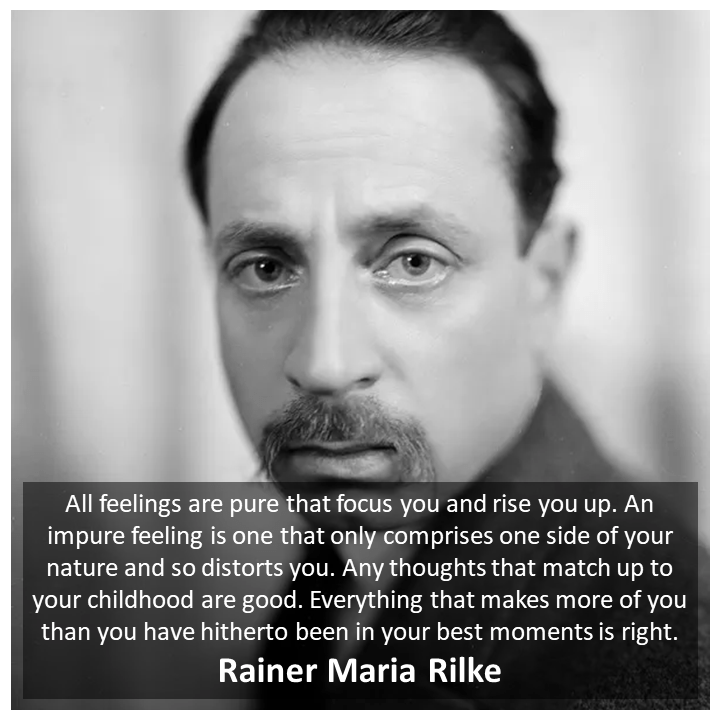
“All feelings are pure that focus you and rise you up. An impure feeling is one that only comprises one side of your nature and so distorts you. Any thoughts that match up to your childhood are good. Everything that makes more of you than you have hitherto been in your best moments is right.”

– Rainer Maria Rilke, Letters to a Young Poet

Rilke beautifully explains what is right and what is wrong. You have to appreciate that this idea of right and wrong is not based on some religious ideas or some scientific evidences. Although most of the times people resort to either of these given ideologies. What Rilke explains is the way of inner judgement born out of pure solitude. When you isolate your inner world from the external influences, you will realize that the inner child filled with all the curiosity, intrigue and innocence is still there waiting to explore the world. You will find that this is what you are actually but the outer influences made you to twist and morph your core. You will understand that you feel things differently when you are looking inwards. The feelings will remain the same but how you respond changes drastically.

In order to appreciate this I will pose an example: look out for the authors who wrote murder mysteries, psychopathic thrillers or some melodrama with tragedy. The thing to observe is how they are in real life; some actor who played a deadly sinister villain and then look how he/she is in real life. You will see that most of the times the gap between how they live and what they portray is totally different rather polar opposites. This way of artistic performance is only possible when one is aware of what emotions they are going through. They know why they are feeling this and are masters of artificially creating them too. This awareness is possible only if the person has cultivated his inner world deeply.  

Feelings are one inseparable part of this inner world. They could be of sadness, happiness, pleasure, anger, anxiety, or jealousy. On surface, it may seem that feelings emerge from external factors but what people always forget, is that one can consciously recognize those feelings and select a constructive response towards them; especially when the feelings are negative. Feelings if mishandled could be devastating and if recognized properly can bring about a revolution in the inner world and the external world thereafter. The very volatility of feelings is their strength and weakness simultaneously. What Rilke wanted is to acknowledge every such emotions for they are not there to remain forever. And that is exactly why he defines the right-ness and wrongness of feelings in completely radical ways. That is also why the childlike innocence is very important for there is no prejudice when one is passing through given emotions. Feelings are the response to reality and not a way to become sad or happy. Rilke wants every artist to use this in their creative pursuit. This is the secret of authenticity – to feel everything that you are feeling instead of getting flown away with it, let it pass but don’t get overwhelmed by them.

That is exactly why life filled with so many multitudes of emotions, feelings would make sense even when they are not on helping term with you. You will see that even such ‘bad’ feelings will open new portal to new creative journeys. For any artist cultivation of emotions especially the negative ones thus become highly important.
Letter 10 – Art is a part of life, life is bigger than art but at the same time, life is futile without art

“Art too is only a way of living, and it is possible, however one live, to prepare oneself for it without knowing; in every real situation we are nearer to it;…”

– Rainer Maria Rilke, Letters to a Young Poet

It is not compulsory to end your artistic journey into the creation of your magnum opus or the masterpiece of your life. What art should do is to make you appreciate the life around you on deeper and richer levels. Once one learns this, they will find art in every aspect of life, which by the way is also an artistic take on living life. The life you are living itself is a masterful creation. Rilke wants the creative person to honor that beautiful creation by remaining worthy of it. 

So, this is it. I would recommend every person to read through these 10 letters written by Rainer Maria Rilke to Mr. Kappus. They are not some letters intended to communicate with each other. These 10 letters are guidelines for the people on their creative journey whatever it may be.

In today’s times the written communication has become so handy and easy that you can send millions of sentences from one end of the globe to the another within few milliseconds. This convenience of communication has stolen away the sanctity, sanity and strength of the words and emotions they invoke which were actually supposed to transform our worlds in better constructive ways. After reading these letters from Rilke you will appreciate how effectively he distilled down the divine wisdom of life in few pages. A book costing less than one time meal can transform your whole life. This is the power of a true artist.

That is exactly how a simple scribble by true artist becomes a sermon to whole world. People worship it forever. Authenticity, empathy, and patience make it happen.      

The Model Millionaire – Attributes of True Wealth

Oscar Wilde’s short story “The Model Millionaire” is a story depicting the boomerang of kindness. It also tries to fuse the importance of tangible assets like money and intangible/ non-physical assets like kindness/ love/ art in our lives. It shows how the balance between these separate attributes can create a true rich life.

Oscar Wilde’s short story called “The Model Millionaire”

Fiction is the lie through which we tell the truth.

Albert Camus

Stories we cherish – especially short stories which tickle our brains have huge impact on our personality. The shortness of tightly woven multiple events inherently brings out the simplicity and invite intrigue in readers. All of us have such favorite stories which we would love to remember forever for the lessons they provide, the happiness they create. Most of such stories we love belong to the chapters in our textbooks, school books. There are many short stories which fall into exactly similar category of being a textbook chapters as if they are not that deep enough and simply convey what is to be conveyed. They get the job done within few pages thereby giving readers a worthy payoff.

It is a cakewalk for readers to enjoy such short stories and interpret the message which author/ writer is trying to convey. Sometimes there is nothing to learn or any hidden message to covey through the story, the intent is to invoke certain emotion in readers. It is a joy to appreciate such stories from readers’ perspective.

It is also crucial and highly underrated to understand what was going in the writers’ mind when they penned down such stories, especially for the of case short stories. This happens frequently in terms of short stories due to their simple, short presentation. You read, get entertained and move on to the next one. 

It is very important to understand the simplicity of such stories and so called- “entertaining” word-play. The writers of such stories make every conscious effort to simplify the narrative and convey the meaning. The simplicity is not inherent rather it is intentional and full of efforts – the hidden tediousness. If you are reading an interesting story, it’s not because writer just wrote what came to his mind showcasing his brilliance; it is interesting because writer had created multiple perspectives, personalities – I would say pseudo- readers to establish the narrative and remove the confusion from the story. Writers just wear this mask of the characters from their stories to fearlessly express what they feel about the reality.

Man is least himself when he talks in his own person. Give him a mask, and he will tell you the truth.

Oscar Wilde

We will see one such simple, high school textbook-worthy yet an interesting short story written by Oscar Wilde called “The Model Millionaire”. The story is flawless in such a way that the plot can be explained in 10-15 lines. The real beauty lies in how Oscar Wilde saw the world and expressed it through the characters in this story.

Plot

Hughie Erskin is a young, good looking but incompetent (according to the mainstream social standards) – a kind of below average man. As he has not proven his worth, has no money he is struggling to find the rhythm of life and marry his love of life – Laura Merton. One day he finds his painter friend – Alan Trevor – painting a life size beggar-man. Hughie feels very sad about how the beggar has to go through this sitting session where he won’t get just few shillings whereas the painter would earn in thousands by selling this painting. Feeling pity for the beggar-man Hughie gives him most of the money he has – to take care of the matters. Later, Hughie founds out that this beggar-man was actually an exceedingly rich “Baron”, an important person capable of influencing a continent. Hughie feels ashamed of his deeds because he thinks he has insulted the Baron by handing some petty alms.

In the climax, when Hughie feels the moment of confrontation, he prepares to apologize the Baron for what he did. Turns out that all that money, all that power had not polluted the Baron and rewards Hughie for his good deed by offering enough money to get married with Laura. The millionaire who earlier was a portrait model also proves his humble personality as a “model” millionaire.

Opening – Your love and charm will not fill your belly

“Unless one is really wealthy there is no use in being a charming fellow. Romance is the privilege of the rich, not the profession of the unemployed. The poor should be practical and prosaic. It is better to have a permanent income than to be fascinating.”

Oscar is trying to establish some pragmatic thoughts to intensify how big a failure his character is in real life. He uses this established foundation to create a contrasting climax of the story in the end

Oscar Wilde in first few lines depicts the contrast between the attitude of Hughie and how the world around him is constructed. As if Hughie was never meant to live in this world. In the opening of the story Oscar makes every effort to show Hughie’s futile attempts in making a pragmatic living. In every sense Hughie is a failure. Every venture, business (Stock Exchange, trading Tea and Dry Sherry) he tried ended in failure. The legacy of his ancestors (his father’s cavalry sword and 15 volumes of the History of the Peninsular War) is worthless in those modern times. (Even luck is not on his side!)

“Ultimately, he became nothing, a delightful, ineffectual young man with a perfect profile and no profession”

Oscar Wilde is trying to portray a very practical picture of life. One must understand that things are exactly the same today in 21st century. 

When one has not established themselves at least as an average earning independent man then every new luxury, wish is burden. Love is a luxury for a man who hasn’t established himself in society (at least financially).

“To make matters worse, he was in love”

Hughie’s lover’s (Laura’s) father – Retired Colonel Merton likes Hughie but is not ready to hand over his daughter to Hughie for the same practical reasons – Hughie cannot offer Laura a stable life.

“Come to me boy, my boy, when you have got ten thousand pounds of your own, and we will see about it”

Oscar Wilde is trying to show the brutal nature of reality which is extra brutal for daydreaming people like Hughie. (Please keep in mind that the opening is mere single dimension of Hughie’s character, more things about who he is at the core unfold in the later part of the story)

Post opening – Intangible things like art must surrender to physical/tangible media in order to remain relevant in practical world

Hughie has an artist friend called Alan Trevor who paints for living. Oscar shows us that Alan truly is a gifted artist and he earns well through his painting profession. He befriended Hughie (a real-life failure) because he liked his generous and reckless spirit. Being an artist Alan appreciates a kind-hearted and good-looking people irrespective of their social and practical status.

“The only people a painter should know are the people who are bête and beautiful, people who are an artistic pleasure to look at and an intellectual repose to talk to. Men who are dandies and who are darlings rule the world, at least they should do so.”

Whatever Alan thinks, we all know what the reality is.

Middle – An act of kindness

Hughie meets Alan in a session where he is painting a beggar. Hughie feels sad for the beggar for how life is treating him. He somewhere feels that the beggar is more helpless than himself. At least he is in a better condition than the beggar who is modelling for Alan’s painting. He argues with Alan that he should pay the beggar in percentage as Alan will earn a big chunk of money through selling this painting for thousands. The beggar deserves more. Alan argues that he definitely has to put more efforts to paint the beggar than the beggar by just standing still there.

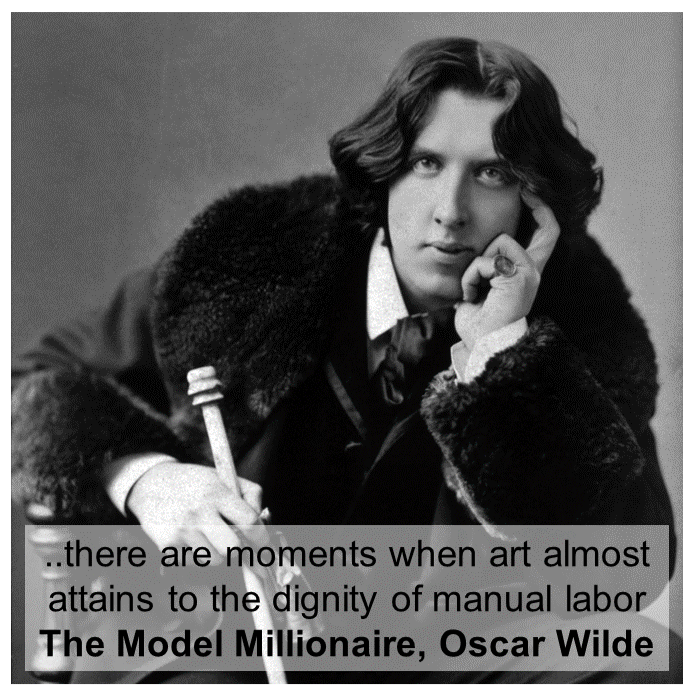
“…there are moments when Art almost attains to the dignity of manual labor…”

This expression by Alan shows that the art may just invoke intangible, non-real things in a person but the process of creation an art is very difficult as it tries to express things which know no bounds/limits through the physical media which have inherent real-life limitations.

Realizing the correctness of Alan’s opinion and at the same time feeling pity for the beggar Hughie gives whatever money he had to the beggar.

This shows another side of Hughie where he is sensitive, he is not just a naïve person who cannot handle the practicality of brutal real life thereby getting labelled as a failure as per the social norms.     

Climax – Kindness is a boomerang

Hughie through his friend Alan realizes that the beggar to whom he donated the money was actually a crazy rich person called Baron Hausberg. A rich person who holds potential, is powerful enough to change the course of every possible thing in society.  Now Hughie feels ashamed of his act. Even though his intent was pure it may get projected as an act of disrespect to Baron Hausberg.

But turns out that Baron Hausberg is a down to earth personality and he returns Hughie’s act of kindness by offering him 10000 pounds required to marry his love of life.

Closing – Artistic, Emotional and Materialistic wealth all can coexist; it narrows down to what kind of human being you are.

Alan expresses that despite having loads of money, Baron Hausberg understands the difference between “having lots of money/ power” and “being wealthy”. That is why this millionaire who was a model for a portrait was also an ideal millionaire – a rare “model millionaire”.     

Baron Hausberg is not the only “Model Millionaire” in this story

This might be my overthinking or over-analysis of the story but bear with me.

Oscar Wild through his cheeky narration and the expressions from his character tries to create a picture of a pragmatic life we human beings live. One must earn money to live in the society. But that is not the only thing which will define him as a model man as an ideal human being.

Baron Hausberg while having loads of money is rich in morals too. He appreciates Hughie’s act of kindness and returns that kindness with the same spirit. The materialistic wealth does not pollute his mindset. That is what makes him the “model” one. Baron Hausberg is the obvious model millionaire of the story, but you must appreciate that the word “millionaire” frees itself from its association with only money. That is exactly what the wordplay between “millionaire model” and “millionaire model” conveys. Being rich was never only associated with having loads of money and possessions.  

That is why Hughie is also a “model millionaire” thereby “a model rich” person. Hughie’s intent to help the helpless people even in the case of not possessing any basic wealth shows his richness in humanistic values. It is just that our mind is not ready to define Hughie as a rich person because the concept of being rich is mostly bound by the quantification of materialistic possessions. Emotional awareness, intellectual awareness, and proficiency in communicating the intangible things are also another versions of wealth.

Talking about the proficiency in communicating the intangibles – Alan is also another “model millionaire” of the story. He is rich in life. He knows how to identify a high spirited yet worthless (by societal definition) person like Alan and befriends him. He can also capitalize his intangible art through painting venture. He respects the labor he has to endure to translate intangible aspects of life into physical reality. (Imagine the reaction of an average art connoisseur when he/she sees a painting of beggar and finds out that the model was crazy rich person! At least from the description, that painting seems a masterpiece with an interesting backstory.) Even the last wordplay between “model” and “millionaire” portrays the artistic wealth that Alan carries.

Baron Hausberg despite being rich can only appreciate the art and is cannot create it (he can ask an artist to create it). Hughie too appreciates the worth of art but cannot create it. That is why I think Alan becomes the most balanced “model millionaire” of the story.

An “Aesthetic” Proof By Contradiction – Love, Kindness And Art Are As Important As Money.

Oscar Wilde in the writing of this short story’s opening establishes very practical aspects of life and the necessity to have enough materialistic possessions. In the beginning, Oscar makes it clear that intangible things like love, affection or good looks cannot solely help a person to meet the ends in this society. Hughie is a complete failure even though he is good looking and kind-hearted. Hughie has found true love and is ready to commit but that is not enough and practical for his future father-in-law. He knows that until and unless he does not get the hold of sufficient money, he will lose his love. Hughie also has two antiques as a legacy from his father but they are described as useless and non-liquid-able assets.

When we read through the event of Alan’s painting session with the beggar model, it is pretty much confirmed that even a seasoned artist like Alan (a person who is much closer to the art and similar intangible things than average masses) understands how important it is to sell the paintings to sustain his artistic profession. Oscar adds Hughie’s point of view in this scene to show that the sufferings of the beggar which brought him to this condition, his efforts to stand still for the painting despite being weak and old are as important as Alan’s painting skills, that is exactly why Hughie demands percentage share for the beggar model.

Alan is successful because he can translate his intangible skill of painting by selling paintings thereby into real money. It’s not because he is artistic or appreciates art. Hughie can appreciate a good art, knows what goes into the laborious process of its creation but doesn’t hold the skill that Alan has.  

Hughie also receives scolding for his extravagant charity from his love Laura. This also shows that pragmatism mostly prevails over intangible emotions.

And to comment on Baron Hausberg, he is the only person in the story who knows the importance of capital possessions, is capable of compounding them for the influence and power – I mean he is filthy rich and respects money. Otherwise, why would he commission a painting of himself as a beggar? He understands what he would become if he doesn’t have that money. If he truly wanted to mock the poverty and beggars, he would have paid some model for the painting assignment. He would not have wasted his valuable time in this assignment.    

Can you see it now?

Oscar Wilde first puts the mind of readers in the practical aspects of living a life. He establishes that emotions, art, love will not put food in your plate at the end of the day, you must go out and do something practical to earn money.

And then Oscar starts showing you the other side of the same people, same events which are fully in contradiction with what he had established as “practical and tangible”.

You will see Hughie getting rewarded for his emotions, kindness and act of charity. Only a fool who is poor will give all he has to another poor person but that does not happen here. Hughie knows what it means to be poor and helpless. It is Hughie’s empathy which makes him rich – a millionaire at heart. Oscar through Hughie’s character shows his readers that love and kindness are also the attributes of a true rich person. Hughie is wealthy by his character. (Hughie could have turned to some malpractices to get the money but Oscar does not inject this intent into the character of Hughie)

Alan Trevor is a kind of bridge in this story. Oscar Wilde developed Alan’s character in such way that he is a double-edged sword in this proof that there are other important things than only capital possessions. Alan can not only appreciate art but also create it and capitalize it. If we are to rank the millionaires by the balance between the possession of tangibles and intangibles in life, then Alan Trevor is the richest of them all. He also knows to identify and befriend kind people like Hughie. Alan has enough money, a skill in hands and company of good people like Hughie and Baron – the ideal and balanced wealth. (There are no ways in which Alan’s character would have become polluted – that is also why his character is the most balanced character of all- he knows ends of the both sides of the society)

Baron Hausberg intends to see himself as a beggar not because he is mocking the poor people, it is his attitude of attributing importance to things which are not money. Oscar Wilde attributes the wish of ‘a rich man to see himself as a beggar’ in a very conscious and artistic way. Baron wishing to picture himself as a beggar through a piece of art shows how much he values art when he is crazy rich. Again, the choice of modelling himself instead of some paid model is his artistic interest. He knows his reality and the depiction in painting will elevate the artistic value of the piece. Also, Baron doesn’t consider the Alan’s act of charity as an insult to his wealth which shows that monetary wealth has not touched his soul. (Baron Hausberg could have been an arrogant filthy rich old man, but Oscar did not projected him in that way)

It is funny how the story turns out in the end. The Model Millionaire is not just about how a good-hearted but helpless person like Hughie got rewarded for his act of kindness by a filthy rich person like Baron Hausberg. It also shows how different non-physical attributes like kindness, love and art equally contribute the a truly wealthy life.

That is where aestheticism come in picture and Oscar Wilde is hailed as ‘the Father of Aestheticism’.

The dictionary definition of aestheticism goes like this:

“A late 19th-century European arts movement which centered on the doctrine that art exists for the sake of its beauty alone, and that it need serve no political, didactic, or other purpose.”

There is this famous quote by Oscar Wilde

“All art is useless”

Oscar Wilde

I think it is an antiphrasis (the rhetorical device of saying the opposite of what is actually meant in such a way that it is obvious what the true intention is)

It’s not just art but its also about intangible things which the art tries to convey i.e., emotions of all sorts. You will realize that when we remove these art-like non-physical attributes from our lives even when we are materialistically filthy rich, that riches would be worthless. I think that is why he creates these contradictions in his story “The Model Millionaire” to show that the balance of tangible and intangible assets makes the person a truly wealthy person. Oscar Wilde fuses the importance of tangible assets like money and intangible assets like kindness/ love/ art through this story.

Oscar also makes a conscious effort to show this fusion through Alan Trevor’s comment on art and manual labor.

In simple words,

What good is being nice if the man has no money to achieve what he desires?

What good is money if the man is not nice?

An extremely emotional poor and an extremely insensitive rich person both are the wrong ends of the reality.

I mean, if Oscar really meant that art is useless then it is literally useless of him to contribute to the prosaic artistry through his writings. He was just messing with our head to prove the importance of the given thing by showing the effect after its absence. It is indeed one smart trick!    

Mr. Toot by Ylvis – What makes an art and its creator successful?

Even though “the best” art creations in the world are better than the average creations as in they stand out of the rest creations thereby making them highlighted, it is also very difficult to point out or to predict what makes these things stand out. It is some sort of paradox. But that is what also reveals what an art really is. This paradox actually restores the uniqueness of every creation. That is why you can never know whether your creation is going to be popular or crash like hell before revealing it to the society.

What makes a certain piece of art – “the art”?

One simple activity; think of your favorite song. The song that gives satisfaction to your ears. Now think why is this song your favorite song? It is very normal that some people (and most of the people) will get confused when asked for a particular song – they will generally have a set of songs in their favorites list, some people are really particular about the genre, some people prefer the singers, some people prefer certain musical instruments, some people love the song because they loved the movie, the game that song was in, some people like that song because they love the fashion sense of the artist. In nutshell, there is no hard and fast formula to a popular, successful song or any art that we love.

Now ask this to yourself – what would happen if you found out the artist that created your favorite song, your favorite painting, your favorite movie, your favorite series, your favorite book is accused of certain misconduct, misbehavior or some unconventional, antisocial, inhuman behavior? Would you still like that song, that piece of an art, that creation?

The answer to this question is somewhat complicated but you know what they say – “it is the poetry and music which have the power to communicate complicated feeling in simple words and melodies.” I have a song to recommend which was exactly created (maybe) for answering this question on our preferences with any creative ventures and their symbols.         

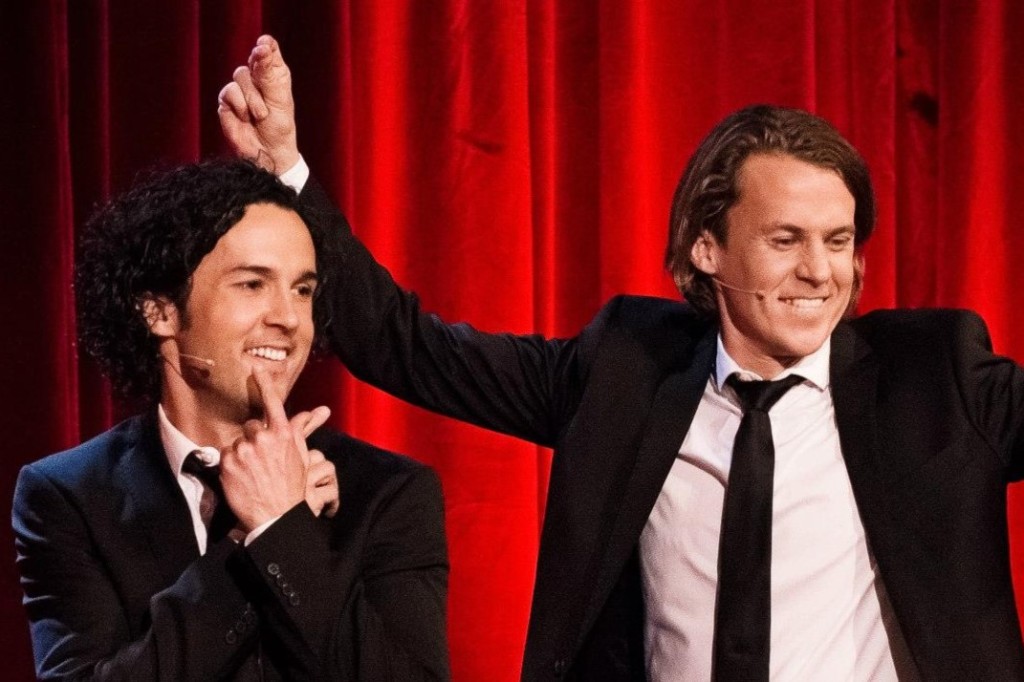
The song is called Mr. Toot by the famous creator duo called Ylvis (“What does the Fox Say?” fame duo). The song is so underrated and hidden in the abyss of at least 8 years from its creation. One would think that people have forgotten this song and make question why a song of such timelessness has not received the recognition it deserves. The vibe this song gives at first is like a silly ballad one sings to make children happy but it has some of the best and simple lyrics, musical hooks and also an impeccable visual story.

Let’s begin and dissect. It’s a simple story told through a song – 

The song and the lyrics

An musical feast from Ylvis called “Mr. Toot”

Come with me to Istanbul, 
Land of turbans, spice and carpets
This is the tale of Mr. Toot,
Legendary music man
Up on the roof he played the Toot,
No one could resist his rhythm
Slave and Sultan side by side,
Dancing dance of Mr. Toot
What’s that sound? Is it him?
Did you see a shadow moving?
Everybody - Quiet, quiet,
can you hear him? - Mr. Toot!
Play it, Mr. Toot!

So the out storyteller takes us to Istanbul where a Toot player is very famous for his instrument. People adore him for his command on this musical instrument “Toot”. This Mr. toot is such a  skillful and creative person that his music tempts everyone in the area to dance on his music. It is the equalizer in the city because Slaves and Master dance shoulder to shoulder on his music. People encourage him to play his toot.

Ladies kissed him on the belly, 
Children dressed like him in school
He ate caviar and jelly,
Bought a modern swimming pool

Soon Mr. Toot became popular, ladies always appreciated him. He became idol in the area, children admired him. He started enjoying exotic foods and did some “pool parties”.

Yes, Mr. Toot got greedy, 
Wanted even better Toot
Threw the Toot from highest tower,
Bought a fancy MIDI Toot
Then a poster in the city,
Mr. Ibanez tonight Modern show with modern music,
Smoke machine and laser light
Play it, Mr. Toot!

With this popularity, Mr. Toot became more ambitious. He wished for more advanced instrument where he could create new music and please his audience. He made all the publicity in the city with new name, new branding, new visuals of smoke and lasers. People came to listen to this new version of Mr. Toot as Mr. Ibanez but when he started playing with his “Fancy” MIDI Toot, people disliked him. Nobody liked what he evolved into. Turns out people actually loved the old version of Mr. Toot!

That was the end of Mr. Toot, 
He was never to return
Though you can kill the man,
You can never kill the Toot
Play it, Mr. Toot!

This is how the story of Mr. Toot (now greedy Mr. Toot) ends. From visuals of the song, you will see that someone from his admirers – a children in the city again picks the Toot and starts playing, people appreciate him. That is when we realize that it was the toot and not the toot player that people loved. So, play it Mr. Toot (the brand new Mr. Toot) People have assigned new king on the throne of their hearts now – that kid with Toot – the new Mr. Toot!

The background of the song

The sensational Ylvis bros

Ylvis is a duo of Norwegian brothers – Vegard and Bård Ylvisåker. They have very comedic presence in popular culture and are known for one of the weirdest but catchy song called “The Fox (What does the fox say?)” This “The Fox” song has such nonsensical lyrics and equally nonsensical music composition that one would really question their choices for a while but the same person will appreciate the “vibes” it creates. One cannot resist grooving to that song. Mr. Toot song’s musical composition is largely based on a song called Adir Adirim by Israeli music group Balkan Beat Box (BBB) with Victoria Hanna. Adir Adirim in simple words is the praise of the Lord Almighty (Link in references).

The song Mr. Toot adopts only the music from Adir Adirim and builds a story through its independent lyrics. When there is this moment of Mr. Toot experimenting with MIDI toot, the music gives some fantastic melody with improvisation which sounds good but, in the video, you will find that people disliked that improvised melody.

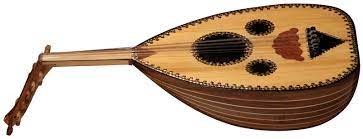
Toot world is derived from an actual musical instrument called Oud – one can call it the Arabic or Persian version of Lute.

the Oud

The hidden meanings

The song Mr. Toot may seem very simple while listening and an “ear candy” due to its catchy music but it is some sort of dark humor.

There could be multiple interpretations to this song and there is a reason to it.

  • First –

It is a story about how an artist suddenly becomes overconfident about his skills and under calculates the role of his/her followers in his overall success. The artist clearly forgets importance of the auxiliary supporters (in this case “the musical instrument toot”) in his journey to become a legend. You will find many real life examples in music industry or any art industry on this.

  • Second –

The other interpretation is about the labors of creating a piece of art. How risky is it? An artist has to always reinvent himself otherwise he/ she will become irrelevant in the time of change. This is extremely sensitive with the artist who are insanely famous. It is always unknown, ambiguous about the response of the public and their “die hard” followers to such reinvention. The artist misjudges what his target audience is expecting from him/her.

  • Third –

The artist clearly forgets his/her creative pursuit which was what his audience liked about him/her and indulges him/herself in distracting pleasures which actually do not contribute to his art in a constructive way

  • Fourth –

People don’t like the things they love to change drastically. The comfort that certain artist provides for certain art is what people actually love about it in totality. When an artist makes sudden creative change, people consider it no different that a betrayal or a personal attack

  • Fifth –

This one is actually the most distant interpretation but it deserves a mention here. When people realize that the artist whose creation they adore is actually a hollow person from inside or some commoner similar to a normal person among them (a person with no real talents) – do they reject that piece of art that he/ she created? That is where “boycott culture” or “cancel culture” comes in picture. We have many examples where artists, actors, creative people, production houses have behaved in a certain way to redefine the morality in the society. So, does that reduce the love we had for their creations? The answer is unsurprisingly unclear!

There is a reason why there are many interpretations to this song and why people will always have mixed opinions about their close to heart but immorally sourced/ created pieces of art. As if these are moral guilty pleasure for many of us.   

Experimental evidences from Sociology

One experiment was done by a Professor of Sociology from Princeton University – Prof. Matthew J. Salganik and his team on what make a popular creation “popular”? what makes a creative piece – “the creative masterpiece”? In this experiment, they created a website for downloading songs (exactly 48 songs from 18 bands) for some set of people (exactly 14,341 people). These songs were unknown to them, nobody had listened to them before. What they did next is that they created independent eight “worlds” in these groups where only specific information was provided to certain world while downloading the song.

The researchers point out in this study that the information from the “independent world” where no information regarding the songs and the bands where given would create a baseline reading about the quality of the song (Also songs are ordered randomly in this independent world). As nobody in this independent world knows – “what the band is?” or “what the song is?” They will have to actually listen to the songs and then rate it as good or bad. As the listeners of this specific independent world have rated the songs without any influence, this creates a good judgement about the quality of the song which is the baseline of the experiment.

Now researchers provided some preconception about the bands and the song for the other worlds. They included top chart lists, most downloaded lists, most popular bands list to other worlds, songs were ordered by downloads count. Then researchers asked the people to choose their favorite song. In some sense they influenced these people with some social opinions already established.

Upon comparing these top-charts from socially influenced worlds with the uninfluenced independent worlds researchers found out that social influence always plays important role in deciding the success of certain song, certain piece of art. In terms of popular arts, cultural markets –  our choices, preferences are always influenced by social influences. We are always driven by such choices of others while deciding the popularity of a creative piece.

Important thing to understand from this study is the randomness and unpredictability in determining the success of the song. When such social influences interfere, it becomes very difficult to find what made that certain song top in the charts. The opinion of every person is influenced by the last one which keeps on building. Researchers also comment here that it is not the inability or incompetence of judges that makes it difficult to find that “WOW!” factor in the popular song, it is the influence of surrounding society which randomizes their preferences.       

From this study one must also understand how important it becomes to create the story, the brand, the image for making anything popular and successful. How word of mouth can create an overnight success. No wonder the business of social media influencing and profession of influencers (aka Social Influenzas !!!) has became pivotal to built popularity.

It is also important to note that how the popular arts of certain era are actually the reflection of the social constructs of those times, which is fascinating on so many levels. Retro era’s, the 70s, the 80s, disco era are some best examples to prove this. Even in the history of art Renaissance Period – one notable revolutionary period reflects how society at that time was.

It also highlights the importance of popular arts as the cultural footprints in the history of humanity.

Philosophical implications of art and its creator

It is also important to understand that there were some popular pieces of art whose artists were famous for some really bad reasons. So, the moral question posed becomes important here – should society reject the popular art of a notorious artist? Can a great art be separated from its bad creator?

Plato in his famous book “the Republic” threw some light on the morality of the art. He argued that art is always influential; that is why it invokes certain feeling in people, it creates an imitation of reality which can be totally different from the reality sometimes. This makes the creation of art misleading to people and can inspire them in negative ways too.

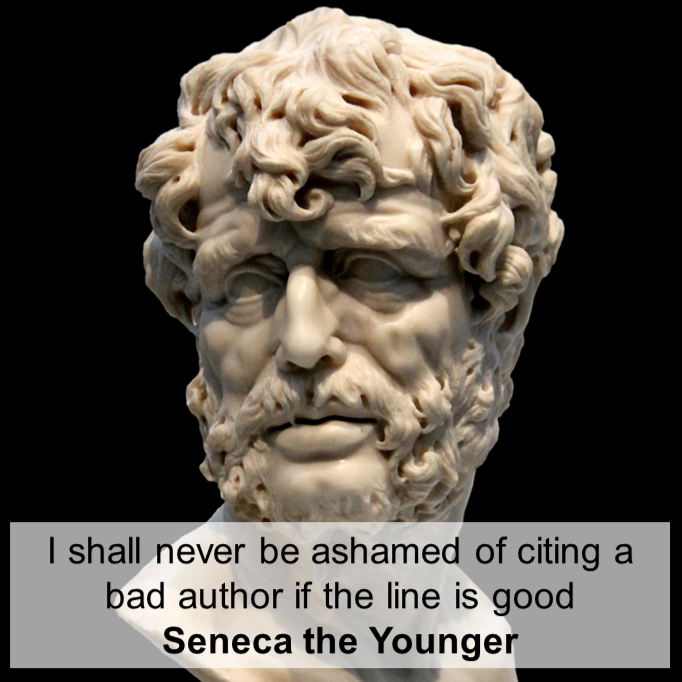
Seneca – a philosopher known for stoicism clearly establishes that it is the out-coming influence this art creates which will decide whether it is good or bad independent of its creator. It is always the end effect, last influence of art (which is unpredictable due to the randomness generated from social influences)

Conclusion

Important thing here is that there are many factors, many ways in which an art can influence people. As it is really difficult to pinpoint the “WOW” factor of the popular art; it is equally difficult to predict what part of an art would trigger the social construct.

In other words, there is no correlation between the person who created the art and the art itself even though it was created from him/her. (I know it is paradoxical.)

It becomes very difficult to predict whether people will accept a song, a painting, a book, a creative piece made by a hardcore criminal with really dark history which could shake humanity to its core. Sometimes the art itself becomes so self-reliant, self-supportive after its creation that people detach its creator from it, sometimes the art is truly worthy of recognition but people “cancel” it due to the character of its creator. (Again, I know it sounds counterintuitive.)   

This is one of the very hard nuts to crack which can be supported by the sociological experiment done by Prof. Salganik.

Even though “the best” art creations in the world are better than the average creations as in they stand out of the rest creations thereby making them highlighted, it is also very difficult to point out or to predict what makes these things stand out. It is some sort of paradox. But that is what also reveals what an art really is. This paradox actually restores the uniqueness of every creation. That is why you can never know whether your creation is going to be popular or crash like hell before revealing it to the society.

These ideas also highlight how unique, recurring and non repetitive it is to create a true and remarkable piece of art. How difficult it is to create a true piece of art due to the inherent ambiguity of perception after its reveal! You can never know what good is going to get presented through your art in front of the world. That is also why a true artist needs to believe in his intents, his delivery and his style. This rediscovery, redefining of a person as an artist on personal level with society as a unit of human history to a new definition, new perception through such “special/ popular/ famous art” maybe is the purpose of the art.

References and further reading –

  1. Mr. Toot by Ylvis – Fandom
  2. Adir Adirim by Balkan Beat Box (feat. Victoria Hanna)
  3. Salganik, M.J., Dodds, P.S. and Watts, D.J., 2006. Experimental study of inequality and unpredictability in an artificial cultural market. science, 311(5762), pp.854-856.
  4. Epstein, Z., Groh, M., Dubey, A. and Pentland, A., 2021. Social influence leads to the formation of diverse local trends. Proceedings of the ACM on Human-Computer Interaction, 5(CSCW2), pp.1-18. Massachusetts Institute of Technology, Media Lab USA
  5. Plato’s The Republic