The Roadmap For A Creative & Fulfilled Life

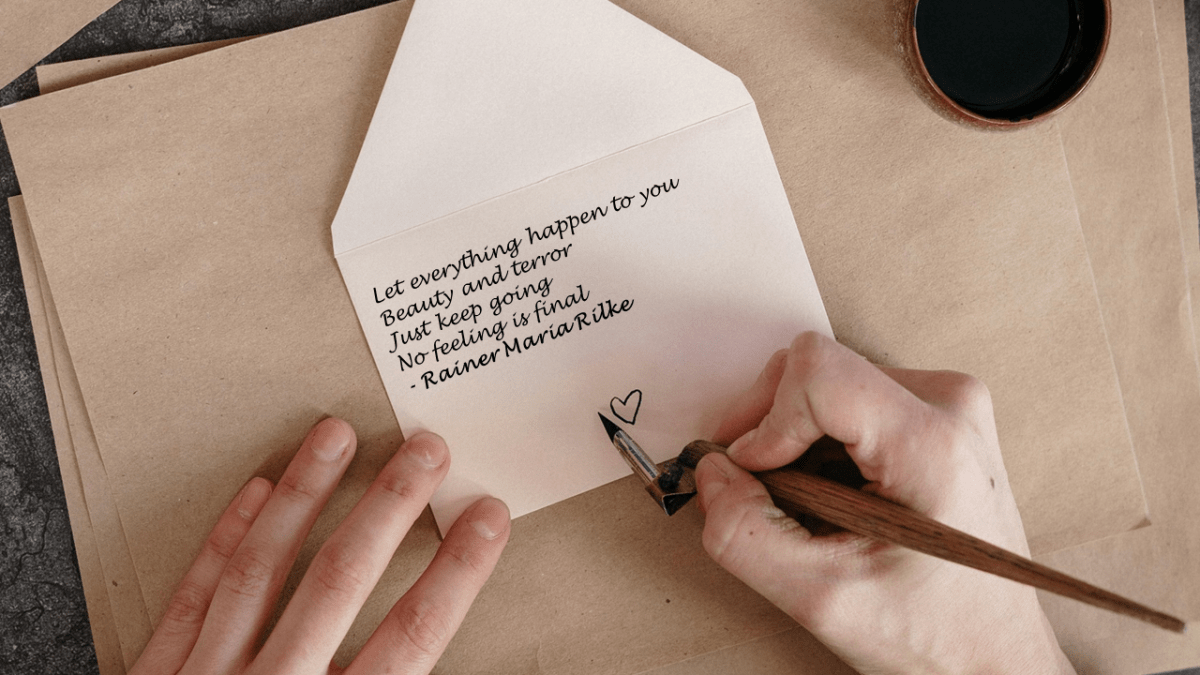
The ten letters from an Austrian poet, novelist – Rainer Maria Rilke to a young poet undergoing the fear of mediocrity and criticism laid down a roadmap for a successful artistic and creative life. The beauty of Rilke’s letters is that they are not limited to those strictly in the creative professions; rather it is a roadmap for every person who want to live a fulfilled life involving continuous transformation of inner and outer riches. That is also why art is important in our lives. Rilke through his ten letters, implores the reader to cultivate authenticity, empathy, and patience to pass through all events of their lives.

In today’s times the written communication has become so handy and easy that you can send millions of sentences from one end of the globe to the another within few milliseconds. This convenience of communication has stolen away the sanctity, sanity and strength of the words and emotions they invoke which were actually supposed to transform our worlds in better constructive ways. After reading these letters from Rilke you will appreciate how effectively he distilled down the divine wisdom of life in few pages. A book costing less than one time meal can transform your whole life. This is the power of a true artist.

Rainer Maria Rilke’s Letters to a Young Poet

One of the biggest fears any budding artist carries inside them is the fear of mediocrity and the fear of the criticism. Creative pursuits can be followed by anyone and everyone but very of few them are able to rise-up as the real artists. At the same time, it is also true that a great master was once a starting novice. This is where lies an ambiguity; how could an artist develop his art to the greatness when today he/she is unsure about its end fate? This may feel a complicated question but the answer is simple or at least someone has already simplified the answer for us. Rainer Maria Rilke, the poet is the one of the artists who truly understood what it means to create an art or become a true artist.  

The reason to mention Rilke out of the other artists is the way he provided that answer. Very few artists carry so much artistic power that even when they would sneeze or yawn, it feels artistic. Rilke was one of those effortless artists. Pardon my example of artistic yawn, for Rilke deserves far superior analogy for his works. A true artist’s life itself is an expression of art. This is only possible due to the authenticity. Authenticity is the core of great and true art.

The reason to choose Rilke to solve the riddle of the true artistry is the letters he wrote to a budding poet for giving feedback on his poetry. You will see the inner workings of Rilke’s genius artistic mind through these ten letters. You can call these ten letters as ten advises, ten rules to become a great artist rather a great human being. You would wish that someone would have given you exactly similar advises in your journey when you will read these letters. What strikes me the most in these letters it the relevance they still have today, that is what is an attribute of true art – it stands the test of time. I will throw some light on the key moments from these ten letters and would encourage you to read them for yourself. You will understand that very few pages of paper are enough to change the way you live your whole life.    

Letter 1 – Art should fill the gap between what is felt and what is expressed

Criticism of art

Franz Kappus – a recruit in military academy felt the need to have an opinion on his poetry which is why he wrote letters to Rilke asking for his feedback. Rilke once studied in the same academy. Rilke writes following in response to Kappus.

“Things are not all as graspable and sayable as on the whole we are led to believe; most events are unsayable, occur in a space that no word has ever penetrated, and most unsayable of all are works of art, mysterious existences whose life endured alongside ours, which passes away.”

– Rainer Maria Rilke, Letters to a Young Poet

It is very interesting to see how Rilke found out the gap between the expression of any art and the interpretation of its observer, admirer. And that is exactly why art should exist and function. That is also why it is very easy to criticize given art but difficult to replicate it. Most of the pure creations of art, however fictional they may be have somehow emerged from some real-life events and are very personal. This fuels the pure artistic creation but it may also steal the perspective from the observers who haven’t gone through that real life experience in their own lives. That is exactly why criticism is the easiest task in any artistic journey. Rilke thus encourages the new poet to not worry about the criticism of others in this journey. Actually, bringing the intangibility into tangibility, unsayable and unseeable into comprehensible reality is the exact job of the artist. He would anyways face the criticism as he is the first one to bring them into the reality; others are yet to pass through the same experiences on their own level. Fear of criticism should not stop the process of artistic expression. 

Artistic style is effect of the art not the cause behind it

“Nobody can advise you and help you, nobody. There is only one way. Go into yourself. Examine the reason that bids you to write; check whether it reaches its roots into the deep regions of your heart, admit to yourself whether you would die if it should be denied you to write.”

– Rainer Maria Rilke, Letters to a Young Poet

Many artists try to copy the style of other famous artists to create their own art because it is already proven technique that others are appreciating. It is the safest way. Some try to force things so that art would be created. Art should not force you to do certain things. The style created by these routes becomes pretentious and ‘cringy’. People will like it; it will become viral but it will be short lived.

Rilke thus advises the young poet to look for the reason he has chosen to walk this path. He wants the poet to make sure that the reason to go on this journey is to express the deep sayings of the heart. The art created from this deep urge of the heart will have its own style.

Rilke was very well aware that the emergence of style is directly linked to its uniqueness of expression which is very personal thing. Hence, he suggests to go inwards. Every one of us lives their life in unique ways and if the art reflects that uniqueness, then it can easily create its own style. This is possible only when one has the urge to honestly put his own life in his art instead of copying or imitating the lives of others. This is also why one cannot separate the biography of a true artist from his art. So, study of an art is in a way the study of that human who created it, his philosophy of life.

“A work of art is good if it has risen out of necessity.”

– Rainer Maria Rilke, Letters to a Young Poet

Letter 2 – Art is more about depth than its aesthetics

“For under the influence of serious things irony will either fall away (if it is something incidental) or on the contrary (if it really belongs to you in a native way) it will gain strength and so become a serious tool and take its place among the means with which you will be bound to create your art.”

– Rainer Maria Rilke, Letters to a Young Poet

Art most of the times is meant for pleasure or to stir up the emotions. That is why aesthetics are one important part of any art. So, it is natural for any artist to work on improving the materialistic attributes of his art, the way it looks, the way it sounds, the way it smells or the way it feels to the skin – the way it triggers the senses. Rilke wants the young poet to care less for such aesthetic attributes and focus more on what needs to be said which was not said by others before. This is possible only when the artist shows his personal depth, his honest intent while expressing his emotions, thoughts, ideas through his art. If there is depth in the expression, the aesthetics would be automatically be built around it to fulfill that honest expression.

This shows why Rilke’s simple writings feel so artistic and pure to the core. Even his normal letter communication has an intent and depth.   

Letter 3 – Solitude engenders the art

The solo journey of authenticity for the creation of true art has its shortcomings (I won’t use the word ‘disadvantage’ because Rilke explains the power of such solo journey many times in his future letters). The shortcoming is that as you are on your own, you may cross the paths which others have already passed, you may commit the same mistakes which others already committed. This wastes valuable time and resources. So, anyone would obviously think that at least if they start with some preconceptions of what others have already done, it would prevent them from potential failures in their own artistic journey. Rilke prohibits the young poet from embarking on such journey. There is a reason.

“Trust yourself and your instincts; even if you go wrong in your judgement, the natural growth of your inner life will gradually, over time lead you to other insights.”

– Rainer Maria Rilke, Letters to a Young Poet

The single most common attribute of any great artform which is the authenticity is possible when the artist successfully pours his/ her unique perspective into their art. This is only possible when they go on their own journey in their own ways even if others have already done that. Rilke focuses more on how you grew out of your failures, the failure which other have gone before but never learnt from them. For an artist, failures are less important than the personal journey of gathering personal unique perspectives and insights which world has never experienced before.  

Solitude is important in such journeys because it demands the artist to go in his own ways without getting influenced by others. This isolation from the surrounding ensures the true expression of what was suppressed by the very surrounding itself. Being a social animal, we try to suppress certain aspects of our identity to melt and fit into the corners and molds of the society. Rilke implores the importance of solitude so that those hidden, personal and unique aspect will bring out the authentic perspective out of the artist.   

“It is a lesson I learn every day amid hardships I am thankful for: patience is all!”

– Rainer Maria Rilke, Letters to a Young Poet

Rilke knew that failures shatter anyone completely and that is exactly why asks for patience in this journey.

Letter 4 – Artist must be careful about the limitations in the expression of art due to the tangibility of its materialistic media

Rilke cautioned the young poet about the media of the art. The media are purely materialistic which are expressing the immaterial, intangible ideas and emotions. So the chances are high that the limitations of the media will not successfully communicate the intangible expression of the artist. The art could immediately feel mediocre because the media failed even though the artist had an impeccable picture of that piece in his mind.

“…for even the best of us get the words wrong when we want them to express such intangible and almost unsayable things.”

– Rainer Maria Rilke, Letters to a Young Poet

Many of us are pursuing certain arts because it gives us certain type of pleasure, enjoyment, and entertainment. This is also one of the aspects of the materialistic limitation of the media of expression in art. The materialistic media excite our physical senses and also the intangible parts of our personality. Most of the times the goal is to excite the physical, materialistic aspects of our personality. Rilke advices to not focus on such materialistic pleasures during the creation of the art. Such art would excite physically but as physical things have materialistic limitations these limitations will restrict the expression of intangible and truly pure, authentic attributes of given artform.

“Physical desire is a sensual experience, no different from pure contemplation or the pure sensation with which a fine fruit sates the tongue; it is a great and endless feeling which is granted to us, a way of knowing the world, the fullness and the splendor of all knowledge. And that we receive this pleasure cannot be a bad thing; what is bad is the way almost all of us misuse the experience and waste it and apply it as a stimulus to the tired parts of our lives, as a distraction instead of as a concentration of ourselves into climactic points”

– Rainer Maria Rilke, Letters to a Young Poet

(It’s like even though loud music excites you that does not mean that you will keep on listening to it forever; it will surely feel boring after some time. This ‘boring’ feeling is due the material aspects like your eardrums getting tired after repeated exposure.)

That is why Rilke asks to ignore the materialistic pleasure while creating and expressing the art. The pleasure is the byproduct of authentic art, it should first invoke that which was not realized by the person who is consuming that art. Even though the person might have gone through that experience before but it was the artist who showed this person what the observer didn’t felt before.

Letter 5 – Art is one of the very few things which could last forever

“…and you slowly learn to recognize the very few things in which something everlasting can be felt, something you can love, something solitary in which you can take part in silence.”

– Rainer Maria Rilke, Letters to a Young Poet

Rilke here was writing about his time in Rome, Italy. You will see that he describes Rome with hot weather, empty, difficult to settle in, lifeless and museum-like dead and still feeling. But Rilke then pointed out the creations of Michaelangelo which are still beautiful in this dead stillness. In a smart way Rilke shows that the art which is created in pure solitude, silence and love could still remain relevant and still express that authentic expression of the artist. Even though Rome was boring for him that day, Michaelangelo’s art inspired Rilke to redefine the artistic venture to inspire his young poet. That artistic creation in Rome was alive and inspiring people around it like Rilke. It is true still today.    

Letter 6 – The ‘final’ destination is solitude and only solitude

“What is needed is this and this alone: solitude, the great inner loneliness. Going into oneself and not meeting anyone for hours – that is what one must arrive at.”

– Rainer Maria Rilke, Letters to a Young Poet

You will find Rilke reiterating the great importance of solitude in his every letter to the young poet. And there are important reasons behind it.

Solitude makes the artist to look inwards which prevents him from copying other styles, it prevents him from mediocrity.

If the artist would depend on other external techniques for artistic creations; once these techniques fail for any reason unknown to the artist the whole journey is futile and great failure.

Failing inwardly is way important to recover because artist would know each and every reason for its end fate into failure. This creates new opportunities for improvements and learnings which lead to unique style of artistic expressions.

Solitude makes the art more personal. Even though we are all same inside and outside on human level what separates us are our unique life experiences and the unique personal perspectives created from those experiences.

Solitude prevents the artist from the hesitation of expression thereby making his art more potent. Any artist who can shake the people to their core rarely hesitates, this is possible only when he has detached himself from the influence and opinions of others. This strength comes when one submits himself to solitude.     

Letter 7 – Only solitude can create ‘real’ love.

“I believe that love remains so strong and powerful in your memory because it was your first deep experience of solitariness and the first inner work that you undertook on your life.”

– Rainer Maria Rilke, Letters to a Young Poet

Most of the art is revolving around love. There is a reason why it is so. Love allows the person to appreciate the very reason of being himself. Many would say that love makes the person complete because his other half part in his lover empowers him but that is not the case in reality. You should appreciate how Rilke points out this fantastic observation about our human nature and its definition of love.

The love which we feel for others and consider it as a fulfilling in the form of the other person who loves us back is solely a result of – we carefully and intentionally working on ourselves inwardly. We consider love as a completing emotion not because others make us feel special through it; rather it is because love inspires us to willingly work on ourselves so that our lover would appreciate our love for them and love us back.

True love inspires a person to love themselves, to work on themselves, improve themselves so that their loved ones would love them back. This is only possible when one has completely appreciated solitude. Solitude is the ultimate and authentic form of love. When you would start loving yourself honestly you would appreciate what your loved ones are looking for when they are looking for love.

So, however paradoxical it may seem, our love for others starts with our love for ourselves and only ourselves. (bear in mind that we are not talking about selfishness) Rilke pointed out this observation.

Letter 8 – Sadness is the blessing in disguise

Letter 8 is my most favorite letter. Not because it glorifies sadness or pain which is a common tool for any great art. (Some newcomers, wannabes are ready to harm themselves mentally, physically to invoke such feelings for creating true expression of their art – I feel its too pretentious and inauthentic.)

I like this letter because it asks the artist to observe his sadness in greater depth instead of running away from it. The mere nature of life as a pursuit of happiness prevents us from appreciating its other lesser known but glorious aspects which are hiding in plain sight behind sadness and pain. Rilke knew this hence he implores the young poet to study and appreciate sad experiences constructively.

“If it were possible for us to see further than our knowledge reaches, and a little beyond the outworks of our intuitions, perhaps we should then bear our sadness with greater assurance than our joys. For they are the moments when something new enters into us, something unknown to us; our feelings shy and inhibited, fall silent, everything in us withdraws, a stillness settles on us, and at the center of it is the new presence that nobody knows, making no sound.”

– Rainer Maria Rilke, Letters to a Young Poet

What a pure and real thought!

Rilke beautifully convinced us that we learn more, develop better, create better if we let new and unknown things inside ourselves. Sadness is highly associated with unfamiliarity, uncertainty which is also why it is invoked in such conditions but that is the exact reason for an artist to explore the unexplored territories of humanity. These new, unknown experiences actually develop and amplify the artistic attributes in better ways than any happiness, joy or pleasure would.

“The quieter, the more patient and open we are in our sadness, the deeper and more unerringly the new will penetrate into us, the better we shall acquire it, the more it will be our fate, and when one day in the future it ‘takes place’ (that is, steps out of us towards others) we shall feel related and close to it in our inmost hearts”

– Rainer Maria Rilke, Letters to a Young Poet

Rilke strongly proposes the creative person to not be swayed by the sadness and get carried away with it. Rilke demands patience. For patience will make the person to study this feeling of sadness and what it is actually pointing to. As we are the creatures craving for happiness and running away from sadness it is natural to consider sadness as a hostile feeling. But this less acquainted sadness is actually carrying the gifts of our better futures for when we pass through them, we are transformed. A true artist is always looking for a new perspective towards the world we are living in. And transformation is a coal mine which holds the diamonds of creative, new, and radical artistic perspectives with immense depth. Rilke wants the young artist to capitalize the sadness with the tool of patience to learn a totally different perspective towards the world.

“Perhaps everything terrifying is deep down a helpless thing that needs our help.”

– Rainer Maria Rilke, Letters to a Young Poet

Rilke also showed that the very thing we are scared of is also scared of us for it too is clueless about the unknown. The way Rilke said this shows how important empathy is for any artist. Empathy will help any creative person rather any human being to make amends with the uncomfortable, sad feelings. So, patience and empathy are the most important tools to live a life full of transformations. These transformations, especially the inner transformations will fuel your art.

“Do not think that the person who is trying to console you lives effortlessly among the simple, quiet words that sometimes make you feel better. His life is full of troubles and sadness and falls short of them. But if it were any different, he could never have found the words that he did.”

– Rainer Maria Rilke, Letters to a Young Poet

Rilke then turns the face of inner patience and empathy outwards. If you are this much careful about your inner world in a creative pursuit, think how others are feeling when they pass through similar emotions, feelings. People in your surrounding world are also transformed by such events. Especially, people who are always nice to others, extend hand to others in need, create a safe space for others to get comfortable. They are not doing it because it is nice, it makes them look good or because they want that greatness of good deeds. They do it because they know what it means to be helpless, sad, being thrashed by the events out of their control. Only because they kept their inner world alive, they underwent this constructive transformation which made them a better human they are today.

Rilke wants the artist to appreciate such people living around him. I might be overstating here but only an empath with a strong inner compass can see these qualities in all people. He can look through the people for who they are. This is important aspect of any creative journey.

Letter 9 – Life is right, whatever happens

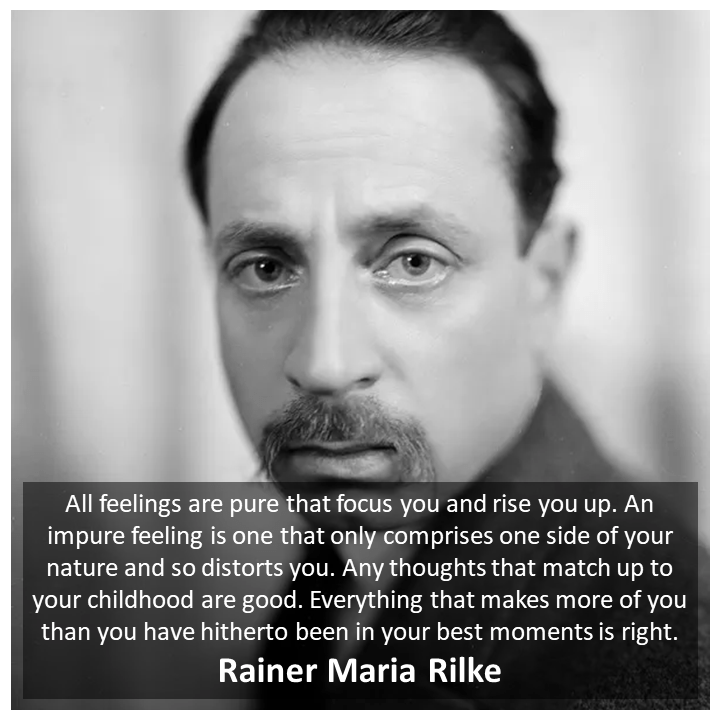
“All feelings are pure that focus you and rise you up. An impure feeling is one that only comprises one side of your nature and so distorts you. Any thoughts that match up to your childhood are good. Everything that makes more of you than you have hitherto been in your best moments is right.”

– Rainer Maria Rilke, Letters to a Young Poet

Rilke beautifully explains what is right and what is wrong. You have to appreciate that this idea of right and wrong is not based on some religious ideas or some scientific evidences. Although most of the times people resort to either of these given ideologies. What Rilke explains is the way of inner judgement born out of pure solitude. When you isolate your inner world from the external influences, you will realize that the inner child filled with all the curiosity, intrigue and innocence is still there waiting to explore the world. You will find that this is what you are actually but the outer influences made you to twist and morph your core. You will understand that you feel things differently when you are looking inwards. The feelings will remain the same but how you respond changes drastically.

In order to appreciate this I will pose an example: look out for the authors who wrote murder mysteries, psychopathic thrillers or some melodrama with tragedy. The thing to observe is how they are in real life; some actor who played a deadly sinister villain and then look how he/she is in real life. You will see that most of the times the gap between how they live and what they portray is totally different rather polar opposites. This way of artistic performance is only possible when one is aware of what emotions they are going through. They know why they are feeling this and are masters of artificially creating them too. This awareness is possible only if the person has cultivated his inner world deeply.  

Feelings are one inseparable part of this inner world. They could be of sadness, happiness, pleasure, anger, anxiety, or jealousy. On surface, it may seem that feelings emerge from external factors but what people always forget, is that one can consciously recognize those feelings and select a constructive response towards them; especially when the feelings are negative. Feelings if mishandled could be devastating and if recognized properly can bring about a revolution in the inner world and the external world thereafter. The very volatility of feelings is their strength and weakness simultaneously. What Rilke wanted is to acknowledge every such emotions for they are not there to remain forever. And that is exactly why he defines the right-ness and wrongness of feelings in completely radical ways. That is also why the childlike innocence is very important for there is no prejudice when one is passing through given emotions. Feelings are the response to reality and not a way to become sad or happy. Rilke wants every artist to use this in their creative pursuit. This is the secret of authenticity – to feel everything that you are feeling instead of getting flown away with it, let it pass but don’t get overwhelmed by them.

That is exactly why life filled with so many multitudes of emotions, feelings would make sense even when they are not on helping term with you. You will see that even such ‘bad’ feelings will open new portal to new creative journeys. For any artist cultivation of emotions especially the negative ones thus become highly important.
Letter 10 – Art is a part of life, life is bigger than art but at the same time, life is futile without art

“Art too is only a way of living, and it is possible, however one live, to prepare oneself for it without knowing; in every real situation we are nearer to it;…”

– Rainer Maria Rilke, Letters to a Young Poet

It is not compulsory to end your artistic journey into the creation of your magnum opus or the masterpiece of your life. What art should do is to make you appreciate the life around you on deeper and richer levels. Once one learns this, they will find art in every aspect of life, which by the way is also an artistic take on living life. The life you are living itself is a masterful creation. Rilke wants the creative person to honor that beautiful creation by remaining worthy of it. 

So, this is it. I would recommend every person to read through these 10 letters written by Rainer Maria Rilke to Mr. Kappus. They are not some letters intended to communicate with each other. These 10 letters are guidelines for the people on their creative journey whatever it may be.

In today’s times the written communication has become so handy and easy that you can send millions of sentences from one end of the globe to the another within few milliseconds. This convenience of communication has stolen away the sanctity, sanity and strength of the words and emotions they invoke which were actually supposed to transform our worlds in better constructive ways. After reading these letters from Rilke you will appreciate how effectively he distilled down the divine wisdom of life in few pages. A book costing less than one time meal can transform your whole life. This is the power of a true artist.

That is exactly how a simple scribble by true artist becomes a sermon to whole world. People worship it forever. Authenticity, empathy, and patience make it happen.      

Dune: Psychology in Science Fiction

Our identity is heavily influenced by the surroundings we live in. A healthy understanding of the gap between ‘labels given to us by our surrounding’ and ‘what we consider ourselves at core’ defines how we perform, how we behave in given situations. Frank Herbert effectively used these ideas of human psyche in his Dune Saga. The antihero story of Paul Atreides indicates psychological ideas of cognitive dissonance, confirmation bias, and Pygmalion effect. It is interesting to understand how our minds are so sensitive at the levels of self and group simultaneously.

How Frank Herbert used human psyche in the creation of Dune’s antihero?

We saw how some fantastic philosophical ideas come alive in the character arc of Paul Atreides. The discussion hereon is the extension of the previous philosophical one, now we will dive deeper into the psychological aspects of Dune Part Two.

There will be heavy spoilers for Dune Part Two hereon!!!

Existentialism in Dune Part Two

As Paul gets more and more involved in the events on Arrakis with Fremen, he finds out what needs to be done, he finds clarity and purpose. He is renouncing the leadership in the early part because he does not know what to do with it. The moment he decides to become the Lisan al-Gaib, the moment he finds the purpose of his being, he gets the clarity.

According to Existentialism, there is no other meaning to the life but the meaning you give it yourself. Existentialism says that man is born free and can chose any actions to live but in the end he/ she will feel like they lived for nothing. They will remove this ‘existential angst’ only when they decide what they want to do with their life. The moment people consider themselves responsible for the events and consequences in their lives, take deliberate actions to achieve them that is the exact the moment where they find the meaning in life. Then everything, every action every decision starts to make sense. You feel like you exist for something.

This existential journey of self-discovery is exactly what we see in Paul’s journey to become the Mahdi. Avenging his father’s life becomes the ultimate goal of Paul in early moments but later on things take different turn. This is existentialism on personal level.

Fremen of Arrakis are the best example of existentialism in masses. The Fremen people are able to sustain in the hostile environment of Arrakis not because that is the only choice. They also have a strong belief, a hope that someone from outer world will save them one day and make their planet the Paradise, the Lisan al-Gaib will come to save them. Although Paul and Jessica know that it is a story properly planned by Bene Gesserit, although there are also Fremen who oppose this prophecy (Chani is one of them) still it gives them all hope, a reason to live for, a reason to survive for. Everyone makes sense of this prophecy in their own ways, their own belief systems.

Do you see what is happening here?

There is one group who is religiously putting their faith in the hope of the messiah for their survival and on the other hand there is a group who dismisses this idea and think that they themselves have to take care of their survival. The messiah will be one of them, not someone sent from the outer world.

We know what happens in the end. But from an objective point of view we see that people create there own perspective for survival. It doesn’t matter who was right and who was wrong in the end. What matters is whether is guaranteed the survival of Fremen. No wonder Jessica considers the artificially planted faith for Lisan al-Gaib among Fremen as an act of giving them a hope.

In either way, some sort of meaning would ensure survival of the Fremen.

The meaning of the life given to us is the meaning we assign to it.

The Prophecy – A Perfect Example of Confirmation Bias

The Prophecy plays key role in deciding the fate of key characters in Dune Part Two. Although we are aware that the prophecy a highly detailed plan to get the hold on Arrakis there are certain moments which fool us in believing that the prophecy might really be true. There is one justification for the correctness and validity for the prophecy. Somehow any powerful member from Bene Gesserit could have unlocked the exact power to see the future like Paul or Lady Jessica this person who could have seen the future and made this prophecy. We get no such signs in the narrative, but the story has enough resources and reasons to make it a valid point.

The event of Paul riding an elder worm, the worm stopping for Paul and Jessica in Dune Part One while crossing the dessert, Chani’s teardrop bringing back Paul alive (although she is manipulated to do that) are such events which confuse us when we try to reject the Prophecy. Either Bene Gesserit were too good to plan the people and resources for making the prophecy a reality or the person who made prophecy also unlocked the powers which Paul unlocked.

It is very interesting when Fremen come in one-to-one contact with Paul and Jessica. They are so influenced by this prophecy that whatever Paul may do, they attribute it to the prophecy. In early part at Sietch Tabr when Stilgar (who is one of the fundamentalists) is having discussion with the Fremen elders, we are given a hint of this strong Confirmatory Bias in Fremen, especially the fundamentalists.

Stilgar – I saw things.
Elder – Stilgar, your faith is playing tricks on you.  

This is an indication to how a blind faith could drive people into looking for signs and making sense from anything that supports that faith.

You must understand that, the existentialism makes life as a meaningless affair – we try to calm our mind/ our senses by assigning a meaning, a perspective to make sense out of the creation. Cognitive Bias lies on the negative extreme of such existentialism. An existence where we are only accepting the events, signs which support out beliefs. This also the transition region where spirituality is converted into pure religion. Stilgar is the perfect example of one such religious follower suffering from Cognitive Bias.

It is also very understandable for the people like Fremen who have nothing hopeful to live and nothing to pivot on, the idea of savior from outer world fuels them to continue the fight for survival.  

There is subtle hint that Paul may not be the only messiah that Arrakis might have seen. The Emperor in his discussion with Princess Irulan mentions Muad’Dib as “some new Fremen Prophet”.

Confirmation Bias is the prejudice where we try to accept the proofs which support our beliefs and reject those which don’t. Fremen people demonstrate such high levels of confirmation bias because Arrakis is the only reality they live in. People living outside the Arrakis like the emperor, Bene Geserit very well know that this is an intentionally planned act. And they very effectively implant such prophecies over the generations. It also shows how difficult it is to reject and go against the conventional beliefs especially the religious ones.

Did you ever have had an encounter with people who tell that this was already written in the older documents, scriptures? When we made certain scientific breakthroughs only then we are seeing them clearly mentioned in older writings, how is it possible? It feels counterintuitive but I would say going by the data instead of the intuition always helps to break such biases.

It feels against our mind because our mind only accepts that which will support the current beliefs. If the current belief gets falsified then our mind will start looking for another belief system which is much more like an existential angst – the existential confusion and the sadness that comes with it. If one meaning is falsified the mind must stick itself to a newer one otherwise life will feel worthless.

Image source: sketchplanations.com by Jono Hey

Cognitive Dissonance and Identity – What Makes Paul to Seek the Ultimate Power?

The confirmation bias is more powerful when it comes to the questions like ‘who you are?’, ‘what is your identity?’

Generally speaking, you are the best person who knows who you are (except your parents and some people close to you). What would happen if you are presented with the data, proofs which indicate that your parents are not your parents, your friends are not really your friends? They are just some paid actors (just like in the movie Truman Show).

Paul is portrayed as the Prince belonging to the House Atreides which is powerful and believes in fairness, justice, and the truth. The ideas associated with House Atreides support constructiveness, upliftment of those who are getting used for others’ benefits. Paul also strongly associates himself with these ideas even when his house is attacked by Harkonnens. He never tries to take advantage of the Fremen beliefs for personal gains. That can also be explained by one of the reasons he has to reject the Fremen Prophecy.

Then what makes Paul to accept this prophecy even when he knows that there are more proofs to reject the prophecy than to accept it?

It is when he knows the truth about his identity. The moment when he drinks water of life.

Upon understanding the ultimate truth, we come to know that Paul’s mother Lady Jessica is the daughter of Baron Vladimir Harkonnen. Paul understands that he is as Harkonnen as his villainous cousin Feyd-Rautha.

This is where his identity of Atreides filled with justice clashes with the cruel and much more powerful identity of Harkonnen. You can see him telling his mother that this is the way they survive – by being a Harkonnen.

When a person goes through such uncomfortable events where his/ her beliefs clash it creates a in harmony. These are the events where the person is confused about what exactly he/ she should believe in. As the early beliefs which were true for him, on which the person lived whole life were inherently false what defines him now?

Paul faces this cognitive dissonance about his identity. He himself is a Harkonnes – the Harkonnes whom he was considering the villains of his life and the lives of the Fremens.

What identity would Paul chose makes him the hero or the antihero in the end.

And Paul chooses the Harkonnen identity which make him the antihero. Please understand that he could have chosen a fair Atreides or Fremen ways to fight for the cause. The circumstances created around Paul supported him to become as ruthless as the Harkonnens. The Emperor and the great houses denying his ascension further fuel his wish to remain ruthless to justify the actions. The moment Paul associates himself with the Harkonnens, he justifies his urge for power as a valid one. Paul forgets his Atreides roots which could have made him the hero of the Dune’s story.

The Pygmalion Effect – Is Paul Really the Messiah?

The difference between a lady and a flower girl is not how she behaves, but how she’s treated.

Pygmalion by George Bernard Shaw

One factor in Paul’s journey to become the leader of the Fremen and ultimately the Emperor can be largely credited to the support system created around him. It is clear that he goes through many hardships and sacrifices to achieve his goal but you cannot deny the inherent public support he receives through Fremen. It only because of the support from the Fremen people you will see Paul build the confidence even though in Dune Part One this was the exact person who tried to deny future leadership in front of his father.

How a person refusing leadership of his own house later accepted the leadership of the most controversial group, that to in very adverse conditions? Leading house Atreides was Paul’s birthright, an easy one. But, leading Fremen in clear opposition of the House Harkonnen, the emperor and the great houses was one very daring act to follow. What gave him all this strength?

The answer is – Pygmalion Effect

In psychology, Pygmalion Effect is the effect where high expectation from a person lead them to perform highly and effectively even in adverse condition.

Pygmalion word comes from the story of a Greek sculptor called Pygmalion who falls in love with his sculpture so much that the statue comes to life.

It’s like worshiping the rock can make it a God which could ultimately is believed to fulfill wishes.

The Bene Geserrit propaganda very smartly takes advantage of this idea. They create such support system around Paul which create one powerful leader in the universe who in his early life was not considering himself worthy.

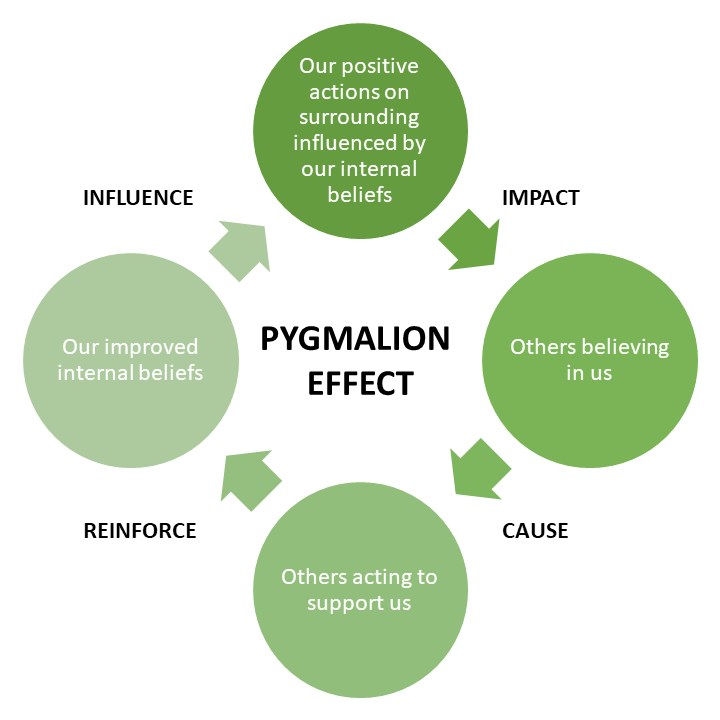
Pygmalion effect highlights how the environments in which we live, how the people around who put their trust in us can boot our performance. According to Pygmalion effect, if a high performing person can deliver poorly if the environment and people are not supportive, it also is true the opposite way, any low performing person would deliver exceptionally when he is trusted by the people and the environment around him.

Pygmalion effect is also known as Rosenthal Effect in psychology.  Robert Rosenthal and Lenore Jacobson conducted a study on classroom students where they found that the students who are inherently reinforced to be the smarter perform better whereas students who are told that they are worthless already show under-performance.

Pygmalion effect shows us that we internalize or identity based on the surroundings we live in. No wonder they say that when you want to be a great man be in the company of great people. This internalization of or beliefs lay the foundation of our performance. That is exactly why so many Fremens believing in Paul gave him the power to stand against the Harkonnens, the Emperor, the Great Houses – entire Universe.

This is exactly why Pygmalion effect is highly associated with the self-fulfilling prophecies. The declaration of such prophecy irrespective of the knowledge of the future conditions people to create ways for such prophesied person; the person who show some signs aligning with the prophecy gets a boost which ultimately follows the prophesied path as the environment now completely supports that path – that is the path of least resistance leading to the glory.

Supporting environment creates high performers

Paul could have chosen another path to fight just like Chani chooses in the end but the Pygmalion effects kicks in, leading him to become the antihero – a high performing powerful antihero.    

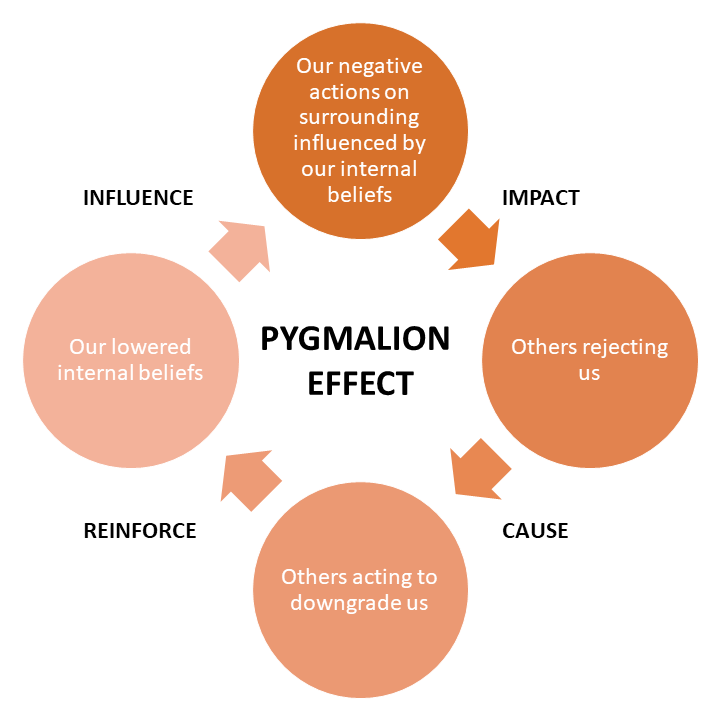
You should appreciate that Pygmalion effect also shows how the opposite and downgrading environment will create a villain. A famous and itching question can be answered using this explanation. If baby Hitler was killed way before, would it have prevented the occurrence of the future world war? The answer is – NO. The conditions were developed in such way that even after killing baby Hitler someone else would have risen among that much hatred who would have led to the end effect, the name would have been different but the acts would be roughly same and inhumane. That is why our environment is an important part of our identity, even if the environment is hostile, what we consider ourselves at the core is equally important.

Nonsupporting environment creates low performers

(You can see that, even in adverse nonsupporting conditions of cognitive dissonance and identity crisis, a person can chose to remain good, can choose one identity over the other. I have discussed such scenarios in pop culture before. Read more about that here.) 

The Prophecy – Does ‘Free Will’ Really Exist in Dune?

The identity which Paul chooses after a cognitive dissonance about his origin and the Pygmalion effect from his environment make his the prophesied Lisan al-Gaib. Now it feels like it truly was the plan all along. This goes against the idea of free will.

Existentialism is based on the idea that as man is born free. It is in his mind, his responsibility to assign the meaning to his/ her own life. The ways and reasons for which Paul consistently rejects the prophecy is because he knows he is not ‘the one’. He knows that he is the son of Leto Atreides and should avenge his father’s death, hence his only purpose was to use the ‘desert power’ to defeat the Harkonnens and the Emperor.

Paul despises everything that is connected to the Prophecy. It is his interest in Fremen people and purpose of completing the vision of his father which drives him into becoming one of the Fremen. You will see Paul rejecting the idea of him being the Messiah in the early discussions with Chani.

The creation of prophecy and instilling the faith into Fremen for Paul indirectly always pushes him into doing what is expected. Paul never makes any decision out of the box. There are chances where he could have created other opportunities but the people around him, his blind followers could never let that happen. Paul is center of attraction for everyone that is why he is always bound to do what they want, otherwise he knows that he will lose that advantage and desert will immediately consume him like any common outsider. The advantage of being the center of attraction of your followers is that your followers will justify your every action; But in the end, you will also be bound to their expectations.

The powers of Bene Gesserit to manipulate people to do what they want, the unfolding of events leading to the war during the Fremen rebellion against the Harkonnen, the necessity to prove injustice with Leto Atreides to the Great Houses ultimately make the realization of prophecy possible.    

That is exactly why Paul gets tied up in the expectations of Fremen, his own self-respect and his own duty as a son. He knows he can avoid this path but chooses that path because that is how he will have ultimate power.

On the other side you will see Chani, she is fighting the same war but can chose her own ways to accomplish that goal. Remaining out of the focus of the religious followers gives her more freedom.

Lady Jessica also falls victim to the prophecy. Stilgar informs her in Sietch Tabr that if she doesn’t become the Reverend Mother she would have to die and Fremen people won’t save Paul. Even when she knows that the prophecy is false, she accepts it as a way to get things done according to her wishes. But again, the pressure from the faithful Fremen followers force her to follow the prophecy. Things doesn’t go right for her in the end. Lady Jessica also faces the cognitive dissonance like Paul about her origin as Harkonnen and chooses the predefined path of being the Reverend Mother.

One must appreciate how Frank Herbert created the story of Dune where the psyche of person drives the narrative. Frank Herbert was heavily influenced by Carl Jung’s archetypes and Dune reflects those archetypes. Dune also gives the psychological justifications behind the blind hero worship through some important character arcs.

It becomes very important to notice our end goals and whether our surroundings, our people are supportive of that. We as humans, are the beings of infinite capabilities, what we consider ourselves internally at core becomes very important in the end. Otherwise, the world is already prepared to overwhelm us with its preconceived notions of living a life.  

References and further reading:

  1. Confirmation bias sketch from Sketchplanations by Jono Hey
  2. Cover Image by Johannes Havn from pexels.com
  3. Dune: Philosophy in Science Fiction
  4. The Pygmalion Effect: Definition & Examples by Ayesha Perera on Simply Psychology.org
  5. The Batman- The superhero who ‘unlearned’ – Journey of a person through cognitive dissonance
  6. Existentialism – Zima Blue and Existentialism
  7. Biases and Delusions – Steering on the borders of rationalism and insanity
  8. Answering the questions on existence of “the existence”
  9. The Existence – Why? How? And What?
  10. Dune’s Ornithopters and Biomimicry

Dune: Philosophy in Science Fiction

The focus of Dune saga is on the ill-effects of hero worship. Frank Herbert warned his readers about the life altering consequences of granting too much power in the hands of a person who refrains to be questioned by his followers. The character arc of Paul Atreides depicts a moral dilemma. It also shows how power and aesthetics play a vital role when one is justifying actions, character and intent.

Dilemma of morality in the character arc of Paul Atreides

Dune Part Two shows how any person would react when thrown into the events where morals and ethics clash. Dune Part Two is about the creation of the antihero and his blind hero worship. It is important because it breaks down and effectively depicts the stages in which even a humble and good-hearted person can degenerate. Surrounding around such person has big role in it.

The focus of Dune saga is on the ill-effects of hero worship. Frank Herbert warned the readers of Dune about the life altering consequences of granting too much power in the hands of a person who refrains to be questioned by his followers. Superficially, Dune feels like a story where Bene Gesserit – a low lying powerful sisterhood planting an extremely powerful but manipulable Messiah to control the galaxy and how this Messiah ruins that plan. Deep down, Dune successfully amalgamates many philosophical, psychological concepts like Existentialism, Hero worship/ herd mentality, confirmation bias, free will and determinism.

Denis Villeneuve’s Dune Part Two has successfully translated the vision of Frank Herbert’s 1965 Sci-Fi which is more relevant than anything in the current times of 21st century. In Dune Part Two you see the transition of a young, humble, calm boy into an aggressive, extremely powerful leader – a leader who is worshiped like the God by his followers. As a fan of Sci-Fi movies, I would say Denis Villeneuve’s Dune movies have made justice with what the source material wanted to convey. (Historically, Dune series is known to be one of the most difficult materials to adapt into visual media)

The discussion hereon is not a movie review rather it is about how some fantastic philosophical, psychological, spiritual, and political ideas are brought together to create a more relevant story which is purely fictional. Despite being a fiction, it successfully depicts some important real-life scenarios and dilemmas we face in our very real lives. This all is credited to Frank Herbert and Denis Villeneuve’s vision.

There will be heavy spoilers for Dune Part Two hereon!!!

After watching Dune Part Two it is obvious that it is all about how an antihero is created. There is a moment in the end when you will lose the sympathy for Paul’s character because of the choices he makes and it is intentional. The movie gives us multiple viewpoints to justify why Paul Atreides becomes who he is. Obviously, his antihero arc creates a deep void in our heart. When I started to understand the narrative from Paul’s perspective, I stumbled upon some of the important ideas we use to justify our actions, decisions.

Boundaries of Right or Wrong – What is Moral? What is Ethical?

Let us understand the stages in which Paul is always rejecting the leadership – the prophecy of Messiah he is offered every time.

Rejection 1 – Paul has not demonstrated any grand act yet. He lacks clarity, vision.

Right from the beginning, Paul knows what it means to become the Lisan al-Gaib – the Messiah. You will see him rejecting the concept of becoming the prophesized leader. In Dune Part One you will see that he asks Leto Atreides, his father – What if he does not want to be the leader, the future of house Atreides? In response, Paul understands from Duke Leto that leadership is not a personal choice and when there will be a moment in which people will choose him as their leader and he will have to answer that call. The fear of leadership in Paul here is created due to very superficial simulation of future possibilities. He hasn’t even landed in Arrakis – the desert Planet. Here, Paul is just a well behaved, properly trained royalty who hasn’t tasted the reality of life yet. He theoretically understands the burden of leadership, the burden of the expectations of the people and that why humbly rejects it – as it is the ‘right’ thing to do. Understand that Paul’s rejection in this instance is because he doesn’t consider himself worthy. It is unethical for him to accept leadership which is granted just from the birthright. Understand that prophecy of Messiah is not apparent here, this is the leadership of his House.

Rejection 2 – The prophecy is just a clever plan. There is clarity on what and how events will happen but no clarity on what will cause them.

When Paul lands with his mother Lady Jessica on Arrakis he looks at the local Fremen people chanting his name as the one who was promised to free them from this exploitation of the foreigners – the Harkonnens for the precious Spice Mélange. Here, Paul understands from his mother that the religious Bene Gesserit sisterhood has planted a very meticulous storyline – a prophecy to ease out their path on Arrakis. The knowledge of ‘the prophecy’ being just a clever plan of Bene Gesserit sisterhood consoles Paul that he will always have the choice to reject the future responsibility of leadership. This rejection of leadership is due to understanding of the underlying truth and how hopeless people are getting fooled. Utilizing such false knowledge for self-benefit makes Paul uncomfortable.

Rejection 3 – Paul has clarity but doesn’t want to take the advantage of the Fremen Faith

After the death of Leto Atreides, Paul escapes to Fremen territory with Lady Jessica. Fremen accept him as he shows his skills in a fair fight. From this moment his goal is to survive with Femen’s to acquire the ‘Desert Power’ as desired by his father Leto Atreides. He still despises the Bene Gesserit Propaganda. He knows he will be fooling the Fremen by following the said prophecy. It is not ethical to utilize others’ faith for the personal benefit. That is why Paul is just trying to learn the ways of Fremen to avenge his father’s unjust murder orchestrated by the Emperor through House Harkonnen.

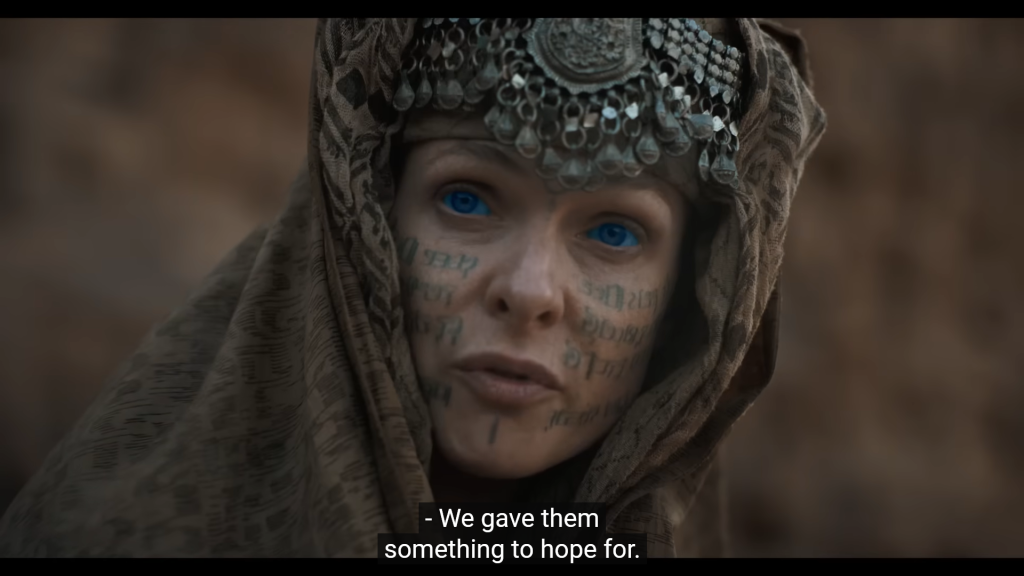
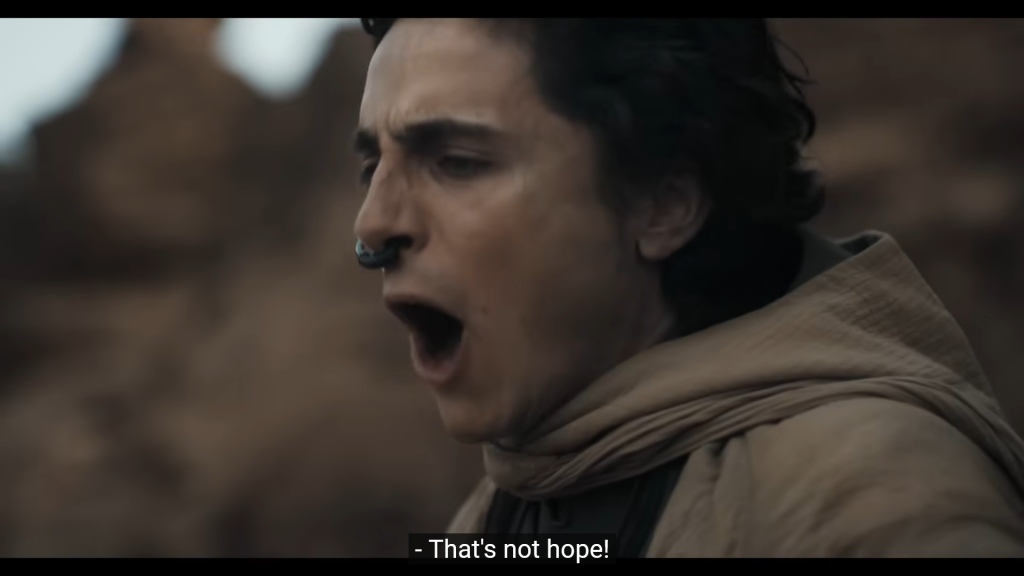
There is a discussion between Lady Jessica (who is now Reverand Mother) with Paul where she says that the prophecy has given Fremen people something to hope for and to fight for. This is the exact moment when Paul actively and aggressively rejects what she says.

Paul – It’s not prophecy. 
It’s a story that you keep telling.
It’s not their story, it’s yours.
They deserve to be led by one of their own.

His rejection to leadership here is because it is unethical to play with other people’s faith.

Rejection 4 – Paul loves Chani. He knows the moment he accepts ‘the prophecy’ he will lose her.

There is a scene where Chani tells Paul that the Fedaykin worship him now, they count his victories. Chani (who doesn’t believe in the prophecy) warns him that people have already started worshiping him and this will not end well. To counter Chani’s fear Paul positively clarifies that he is not the Messiah and will always be a Fremen warrior – the Fedaykin. Paul mentions several times to Chani that he will love her as long as he breaths. As the prophecy goes, he should reserve his hand for the most strategic alliance which is with the Princess Irulan – the daughter of Emperor. Here, the rejection is due to the love he has for Chani.  

Rejection 5 – Paul knows that while becoming the Mahdi, he will lose his comfortable connect with Fremen. He will have blood of billions on his hands.

Upon the encounter with Gurney Halleck, Paul clarifies certain important things. Gurney is surprised that even after having following of 200 people and millions more, why isn’t Paul taking advantage of the prophecy to avenge the death of his father? Paul tells Gurney that the moment he becomes the Messiah, he no longer be friends with Fremen, because even his Fremen friends will worship him as the God – Lisan al-Gaib. He considers it unethical to utilize the innocent beliefs and trust of the people for him for his personal benefit.

Gurney Halleck – With thousands of these guys you can take control of the entire planet. It’s your father’s dream. What you are afraid of?
Paul – Worship, Gurney. They used to be friends, now they are followers. 

Gurney tells Paul that he holds the ability to avenge his father by accepting the prophecy. Then Paul clarifies that the moment he becomes the Messiah, the galaxy will be thrown into the holy war leading to deaths of billions of people. Paul doesn’t want their blood on his hand.

The rejection of prophecy here is due to fear of losing personal connect with the people who define and respect you. It is also because Paul wants to preserve his character.

At the end of the Dune Part Two, you know what exactly happened!

Are Morality and Ethics Objective?

So, even after having at least 5 concrete reasons to reject the prophecy, why does Paul decide to become the ruthless Messiah, Lisan al-Gaib? What made him lose all the ethical and moral standards he had preserved in him?

Simple and superficial answer to these questions is – the circumstances!

Deep down the answer is totally different. Let us understand what are morals and ethics

Morality is the sense of judging a decision, event or an action being proper or improper. Morality is the sense of what is right and what is wrong.

Ethics are detailed down, systematic small-small actions which show what doing good is. The opposite act of doing a good act will be doing a bad act.  

Morality are the universal standards for right and wrong and ethics are the rules to implement this morality in daily practice.

Question – How is it decided whether certain act is good or bad?

This is where the trick starts.

The base line to decide morality or ethics is always changing. It is like deciding ‘What level of big picture are you talking about?’

Frank Herbert was very intentional while creating such moral ethical dilemma through Dune series. As you are introduced to Paul right from the start of his journey, from a kid to the Messiah, you know why he did what he did. His Great House was betrayed by the Emperor and the Harkonnens. They tried to kill him, his pregnant mother, and his people. The responsibility to handle Arrakis was forced down on his house by the Emperor. He had every reason to kill his enemies. Whatever act Paul did to avenge his father/ his house was right and justified.

Does that mean that “whatever” and “everything” that he did and would do is right?

The death of billions of people he would cause (as seen in his visions) will it be justified?

Many Fremens devoted and died to Paul’s cause, will their deaths be justified?

You will see that the moment you shift from Paul’s personal baseline of morality to the baseline of the ‘good for all’, you will appreciate why the same Paul – the Messiah – Lisan al-Gaib – the Savior is also ‘the destroyer’ for remaining others. Thus, it is important to define that baseline while judging his actions.

Philosophy of Morality

There are two ideas on how to decide this baseline for morality of given things.

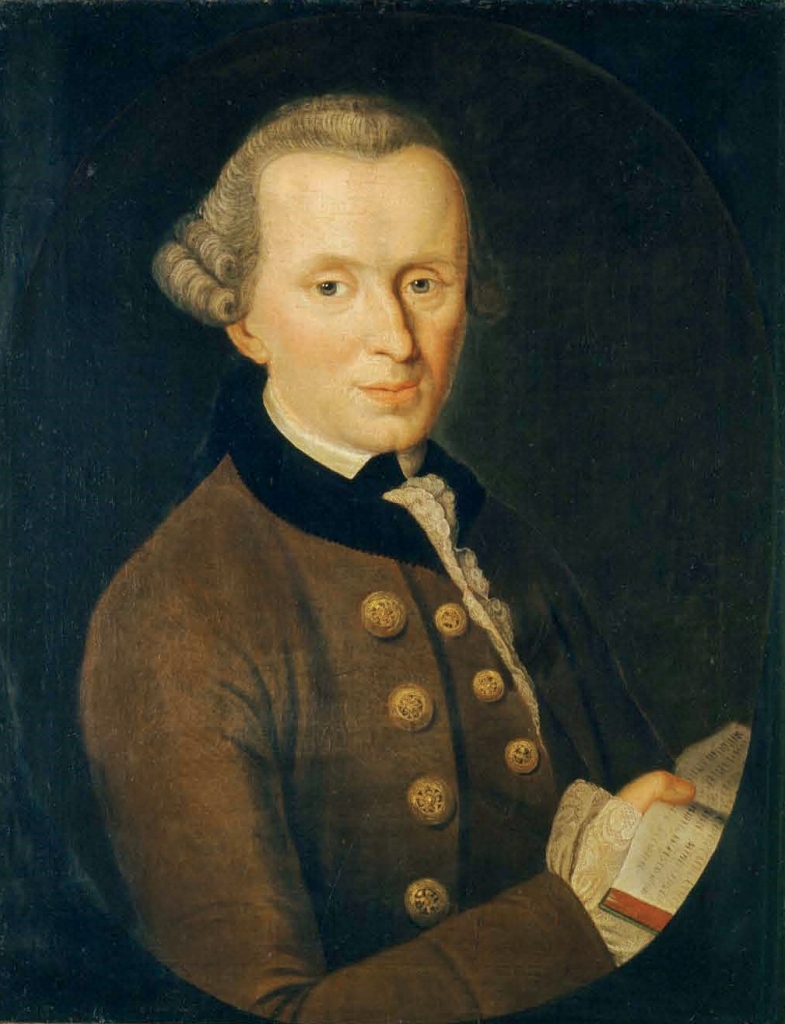
Immanuel Kant says the duty assigned to you; your obligation decides the morality – The duty-based definition of morality.

Immanuel Kant

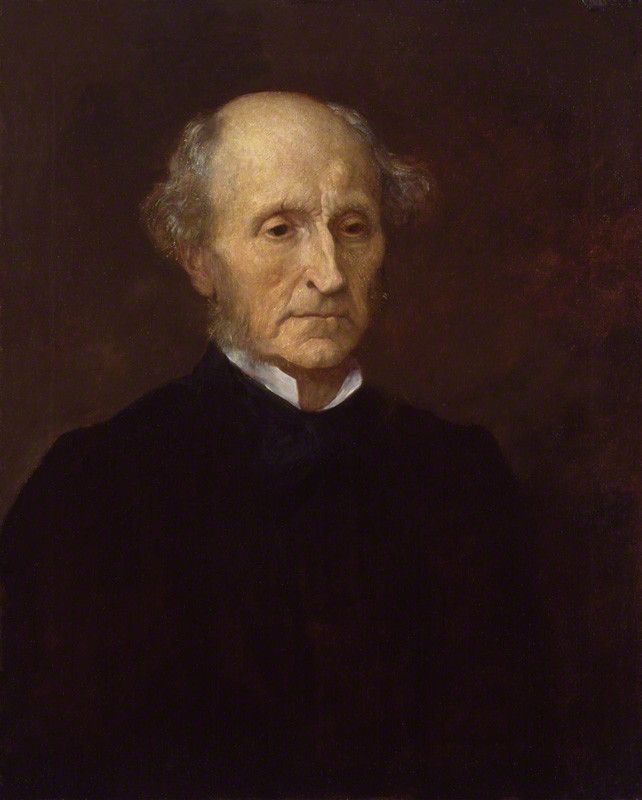
John Stuart Mill says that whatever is good for most of all should be good for one – The utilitarian definition of morality.

John Stuart Mill

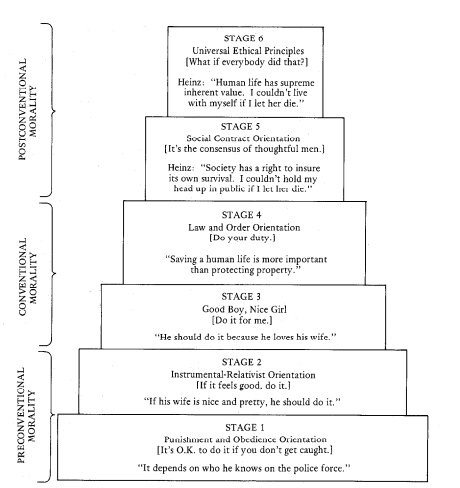
Lawrence Kohlberg’s stages of moral development give us a structured view about how the baseline to justify morality of anything works. This single image deserves a detailed explanation but it is self explanatory.

Morality needs understanding of “the big picture”

In Dune’s case, it was Paul’s duty to avenge his father’s unjust death hence he was right. Whereas letting his followers kill billions of people belonging to the houses who were not accepting his ascension as the Emperor was wrong – immoral. He commanded to destroy such opposing Great Houses just to establish respect for him out of fear. The intent was not pure.

For Fremen, the act of destroying everyone opposing their leader is way better and important than living a life of slave. At the same time same Fremen killing billions in the name of their Mahdi is bad.

For Jessica, survival of her children was more important than anything. She had also promised Leto Atreides that she will save her children not as Bene Gesserit but as a mother first. That is why she eases out the path laid for Paul which guarantees his and his sister’s survival. You will understand that Jessica fears becoming the Reverand Mother, she knows that she will have to carry the pain and memories of all those who came before her but upon hearing to the clarification from Stilgar, she realizes that it is the only way to ensure the survival of her children. So, she controlling the Fremen and spreading the prophecy of the Messiah (despite knowing it as just a clever plan) feels moral.

Stilgar strengthening the events from the prophecy in the minds of Fremen ensure betterment of his people. If his actions to spread and strengthen the path for Paul would lead Fremens people to a better life then his actions are well justified. But, the moment he blindly follows every order from Paul to obliterate everyone opposing him his actions become wrong.

When it comes to mere survival of Feyd-Rautha, Baron Harkonnen, Rabban, the Emperor, Princess Irulan, Reverend Mother Mohiam someone would feel that their actions are justified. (But, we already have many other reasons to assign them villainy.)

It’s like checking which one is more wrong – Killing an ant or murdering a person!

The moment you favor the life of the person than an ant, you will feel bad for what kind of animal you are. And the moment you favor life of that ant over the person you will feel bad as a human being.

Taking any life is bad in the end, but what if it’s about survival. Then it goes in the direction which poses question – whose life is more precious?

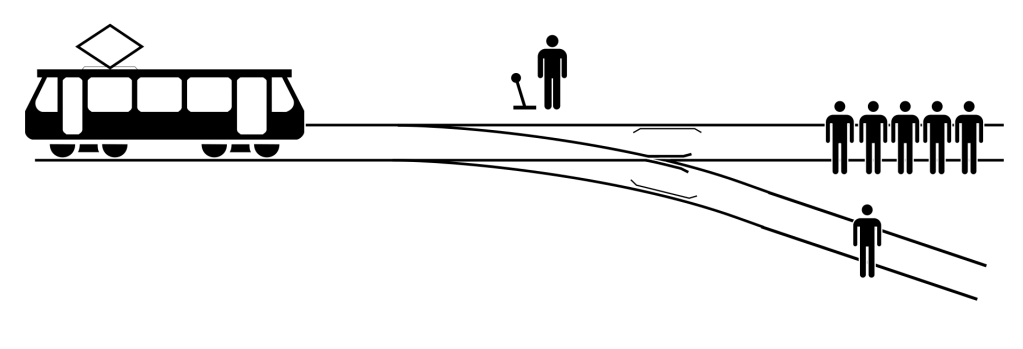
The Trolley Problem – Which lever will you pull?

Do you see how this streak goes on and on! This will not end until the questioner will be satisfied with comfortable answer!

One must appreciate the genius of Frank Herbert’s writing which created such important intersecting points in his story.

Power and Aesthetics

So, final question – what ultimately is the right or wrong?

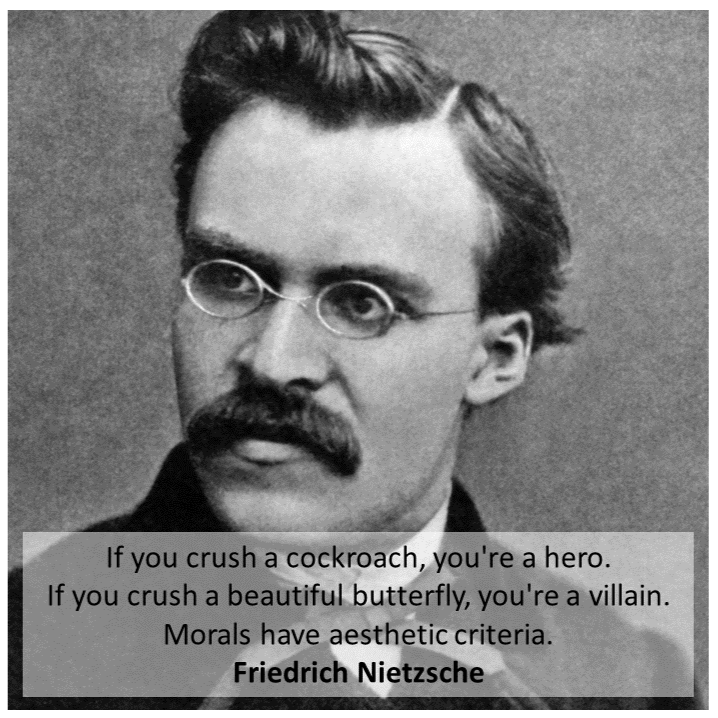
The answer is how deeply are we able understand the scenario (and we may never understand every aspect most of the times.)  Actions are always changing with respect to the circumstances, killing a murderer will always be justified and right at the same time killing a Saint is wrong.

This reminds me of Nietzsche’s quote:

Thus, the dilemma grows bigger.

What is right and what is right is highly dependent on your limits, your capabilities, your ability to reverse the things to exactly how they were before. If you don’t hold that capacity, then you immediately lose the power to justify your actions.

Which is exactly why what Paul believes is completely wrong, it shows how Paul character has made transition…

“He who can destroy a thing has the real control of it.”

The power will enable him to destroy any given thing; but can he reverse that destruction if things did not turn out the way he intended? The ability to restore the consequences of your decisions decides whether you hold the power to assign good or bad.

If Paul does not bear the capacity to reverse or at least restore the impact of his decisions, then he is wrong to send his followers in that direction.

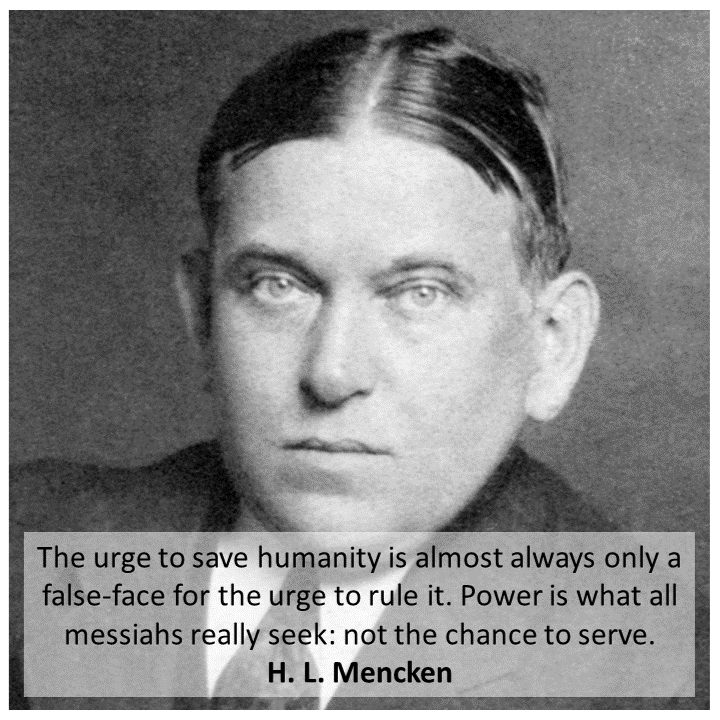
I think, this is the warning Frank Herbert gives to the real-life leaders and followers among us. This is exactly where powerful people go wrong and take their blind followers with them.

So, even though his intent was to avenge his father by becoming the Messiah, the path he would choose is wrong.

The path Jessica chose to control the Fremen through prophecy is wrong. The plans Bene Gesserit orchestrated to plant a powerful yet manipulatable person on Arrakis just to have control over Spice are wrong. There are always multiple choices,

(The conclusion of the Paul Atreides’s story and ‘Dune: the God Emperor’ will make us change our current opinions. That we will discuss again when the time is right.)  

Anyways words fail me when such real-life scenarios are flawlessly presented through fiction. There is no need for anyone to teach us what is right or wrong in such stories. The dynamics of the events and the characters show us the mirror. We always have such inner compass inside ourselves, stories like this are the greatest calibrator of such inner compasses.

The power to restore the consequences of our action is the real power, I think. This idea somewhat frees the justification of our actions from the dilemmas of morality.

There is more to discuss about Dune, find out here….

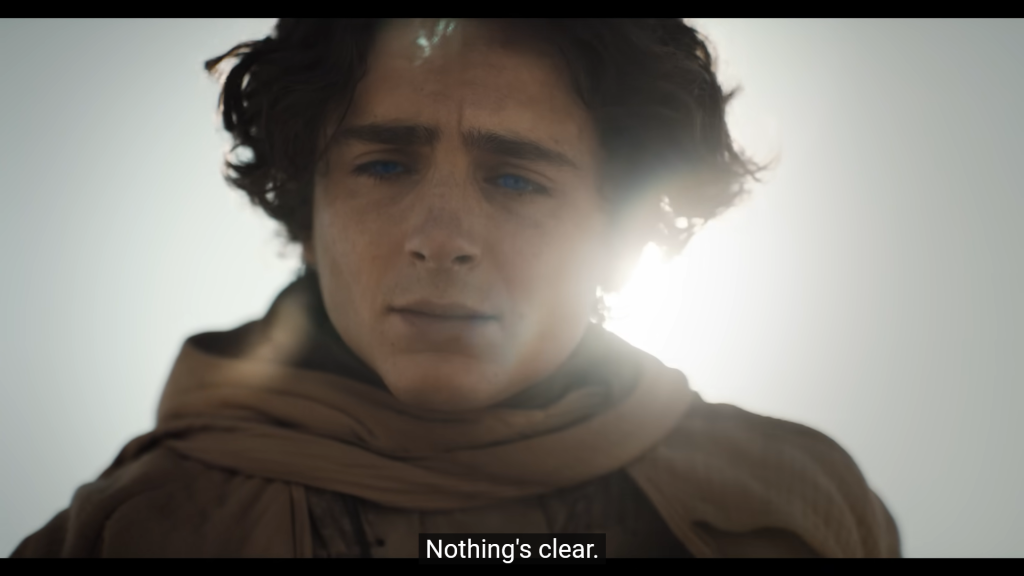
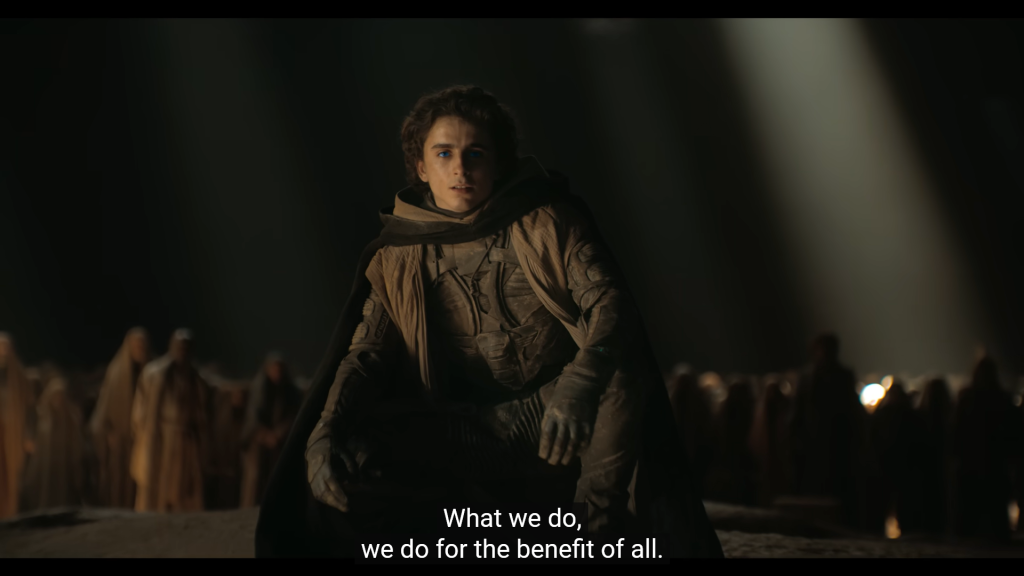
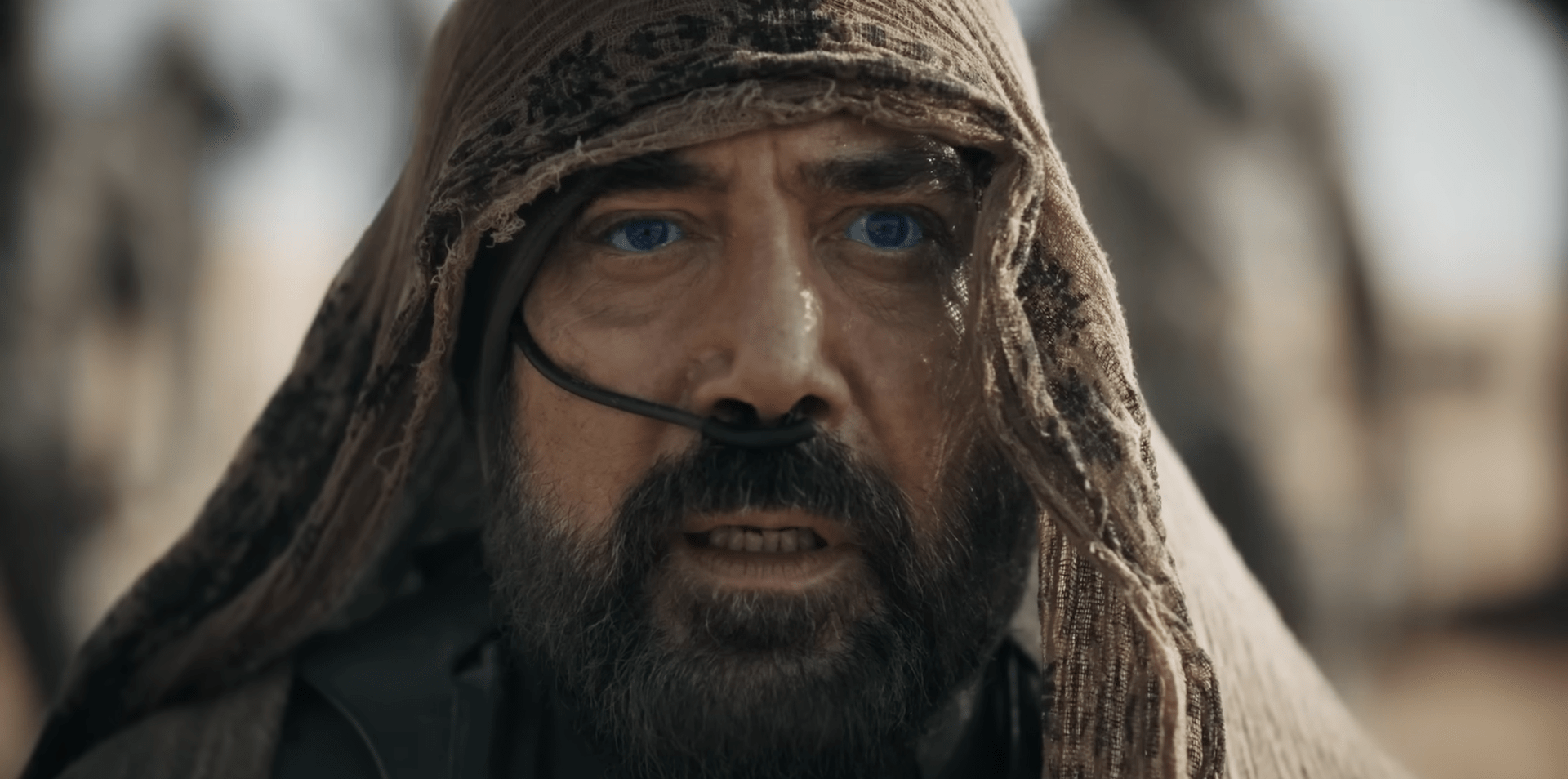
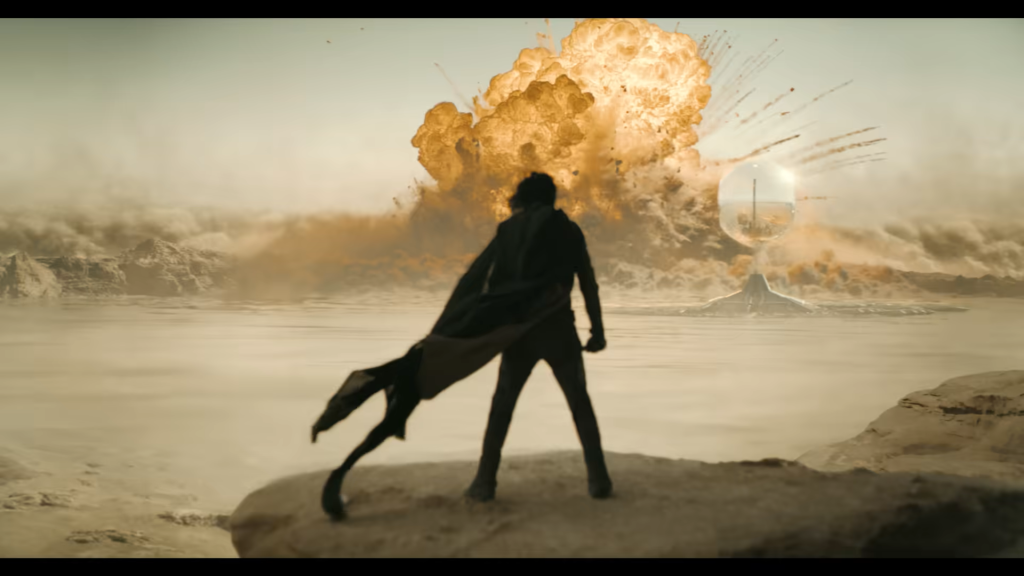
(Movies Scenes from Warner Brother’s Dune: Part Two)

Further reading:

  1. Dune : Psychology in Science Fiction
  2. Existentialism – Zima Blue and Existentialism
  3. Answering the questions on existence of “the existence”
  4. The Existence – Why? How? And What?
  5. Dune’s Ornithopters and Biomimicry