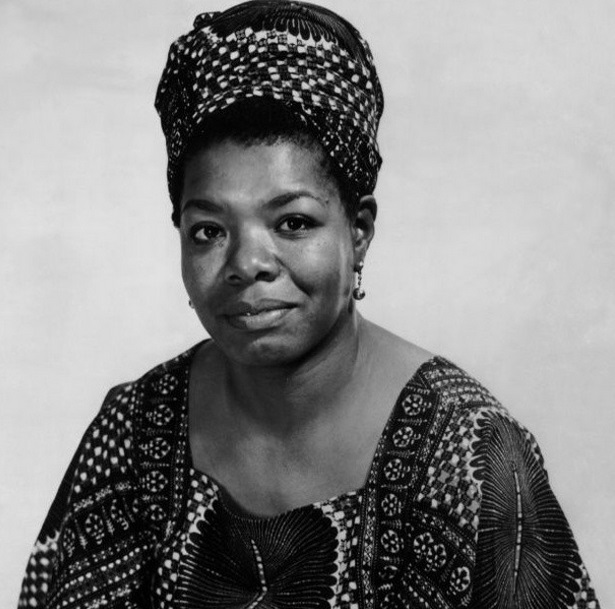
“Each time I write a book, every time I face that yellow pad, the challenge is so great. I have written eleven books, but each time I think, ‘Uh oh, they’re going to find out now. I’ve run a game on everybody and they’re going to find me out.”
– Maya Angelou
I remember our school time fun moment which used to happen during the declaration of test results. The response to the results declaration was hilariously different and characteristic for the party of boys and party of girls.
You will find that person (mostly in girls but boys are not exception to this too) who has got 90% (well above average but not as good as topper of the class) would be in a serious pressure and sad about his/her marks, on the other hand there is one person (definitely a boy here) who has secured just passing marks and is in cloud nine, seventh heaven and has already planned how he is going to celebrate this; To further add to this joy, he now knows that his best friend has passed ( by teacher’s and God’s grace!!!) with the grace marks. Now there is no space to contain such victorious joy. (One more funny thing which spices up this event is that the boy is confident and aware that his selectively written answers were sufficient enough for him to pass and girl/boy were shocked for not getting enough marks for such thorough answers!!) Man, those days were fun!
The sad thing was that those who had performed well enough were not considering themselves successful enough.
There are some moments in our lives as we grow up where people know that we are master of the art but we still think that this is only because of sheer luck, chance an anybody can easily replace you. It is just a matter of time.
Although you know that you are master of your art but still you think that there are somethings which can go wrong. These are the exact moments when you also think that if this is done right, it will be only because of the other external factors but not your competences or your hold on the art. You feel like at any moment someone will easily replace you and expose you as a fraudulent person who just pretended to have mastery over that art.
Albert Einstein, one of the smartest peoples the world has ever seen had following opinion about himself:
“The exaggerated esteem in which my lifework is held makes me very ill at ease. I feel compelled to think of myself as an involuntary swindler”
– Albert Einstein
The reality is that the lifework of Albert Einstein is so valuable and beyond the general comprehension of normal human brain. Even today, many years after his absence we are learning new things from his already established ideas.
Will you call this the humility of a scholar because of the achievement the ultimate knowledge?
Maybe Yes or maybe No.
There similar examples of great people who just consider themselves lucky to excel in their careers and consider themselves fraud. They are sure that sometimes this whole game will be exposed to the public and people will see that these people were just pretending to be successful. And master of their art. There is also one ideology called “Fake it, until you make it!” (Although further discussion on this will deviate from this topic)
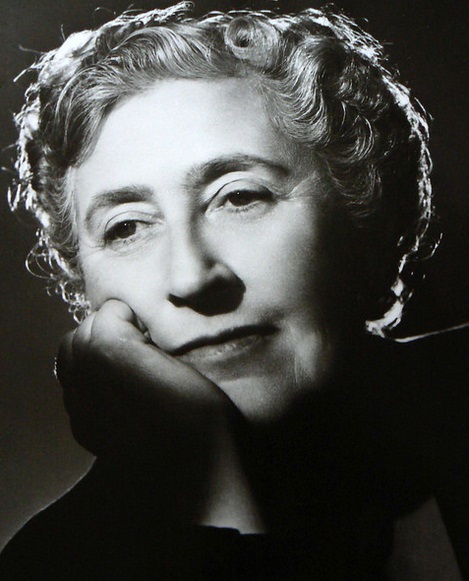
Agatha Christie- the best-selling author of detective novels, the novels which outsold even the bible and Shakespearean writings had following opinion about her penmanship:
“I don’t know whether other authors feel it, but I think quite a lot do- that I’m pretending to be something that I’m not, because even nowadays, I do not quite feel as though I am an author.”
– Agatha Christie
Will you still call this the humility of true knowledge, wisdom?
There is one interesting concept in psychology called the Imposter Syndrome which deals with such feelings. Imposter Syndrome loosely refers to a person’s feeling of not being worthy, undeserving of the accolades from the people.
Imposter Syndrome can be defined as a collection of feelings of inadequacy that persists despite evident success. Meaning even if there are many objective proofs, indicators for the success. Mastery of the person the person still thinks that it is not because of him/her ad discredits himself/herself. This person thinks that he/she she is just an impersonator, actor or some fraud acting of having the success or the skills. People with Imposter syndrome finds it difficult to accept their achievements, digesting people’s praise is difficult for them and always in a fear that maybe they will be exposed in a really bad way.
The Imposter syndrome was first identified by Dr. Pauline Rose Clance and Dr. Suzanne Imes in their study on successful women. Maybe that is why in many believe that Imposter syndrome is observed more in successful women which is wrong. Later on, after exhaustive studies on different groups, it is found that Imposter syndrome can be found everywhere and is somewhat strong in underrepresented groups.
There are two important things to understand about imposter syndrome:
1) Highly skilled, highly knowledgeable people think that the others already know what they know so there is nothing special about what they know hence anyone can replace them easily. They are “that special” in the way others perceive them.
2) It is not just observed in high achieving and successful people only; Every one of us doubts themselves in their minds.
Everyone of us thinks that we are always on people’s radar or some spotlight where we are the focal point of everyone’s attention.
It is actually due to the difference between what we know about ourselves by our thoughts, our ideas, our fantasies, our fetishes, our guilty pleasures and what people know about ourselves by looking at us, seeing us doing things.
There is Japanese Proverb saying that:
“You have three faces. The first face, you show to the world. The second face, you show to your close friends, and your family. The third face, you never show anyone.”
Nobody wants to portray themselves as failures, nobody wants to expose those awkward failures in front of everyone and hence they try to safeguard their “Dark Secrets”. Hence, consider themselves fraud. We are the only one who know how exactly dark and gory our character is, hence we under-calculate ourselves.
But, to put in simple words- “Nobody cares what you are doing”. The funny thing is that everyone else is also thinking themselves at the focal point of people around themselves. Everyone is in spotlight, under radar of their own worlds. The moment you realize that how deeply everyone is sunk in their own life that they don’t even care about or have time to look into other people’s lives is the moment when you understand that it happens with everyone.
Types of Imposter Syndrome
There are five different types of Imposter Syndrome
The Perfectionists – These are the people who are always aiming for perfection, setting excessively high goals thereby not achieving them and under-calculating themselves. They think that they could have done it better. This can be eliminated by accepting that it is not about perfection but about the process. Mistakes, imperfections are part of life and cannot be eliminated at once by “perfect” way, “perfect” technique, “perfect” timing.
The Expert– The expert type think that they will never know everything there is to know hence underestimate what they already know. This can be eliminated by realizing that there is always something new to learn, new perspective to develop in the learning, mastering.
The Natural Genius– This type of peoples feel exposed/ fraud if they think that they are taking longer time than normal to achieve something. They think that it in innate in them do easily complete this task, hence are ashamed of their incompetence. This can be eliminated by being the part of the ongoing process, understanding that not everything can be mastered in a day, realizing the importance of the journey, the process.
The Super wo/man– This type of super persons think that if you have not worked hard to achieve something then you don’t deserve it. (These are the people who will work extra office hours for that validation of promotion! Anyways jokes apart)
The Soloist– These are the ones who feel ashamed to ask for help while achieving something. They feel like, requirement of that external assistance has reduced their worthiness of that achievement.
The causes for the development of imposter syndrome can be found in the type of family upbringing, exposure or shift to completely new work, performance environments, personalities showing low self-esteems, perfectionism, neuroticism, social anxiety.
Eliminating the Imposter in you
The best way to deal with the imposter syndrome is knowing the fact that you are not the center of attention. When one understands that there is no such “spotlight” or radar over us to calculate our fraudulence, then one can become free from the judgements and metering of the achievement thereby accepting the process, the journey.
The other important part is to objectively check your abilities and their contribution to your achievements. The objective comparison will really give you the amount of your influence, your competence in that achievement.
Talk to others, open up, share what you feel. This will surprisingly show that the things you considered as awkward are happened with others too and realizing this will show you how common such things, such beliefs, such feelings are around us. Mistakes, imperfections are part of the process and happen all the time and are more common among people, everyone.
Last but not the least, know that everyone has their unique perspective about the same things which makes them to believe that the thing is special. What perspective helped you to easily understand the thing might be difficult for the other person because of lack of that perspective and its opposite is also true. Understand the perspectives of your peers, people around you and constructively have a feed-back in the process which will give you the awareness that you not the only one who thinks the way you think.
After all we are all the same but unique in a way.
(Also in later stages of life, nobody (including you) cares about how many marks you secured in tests, :D)
“It’s not what you are that holds you back, it’s what you think you are not.”
Many people who have had a near-death experience tell that their whole life flashed before their eyes. Although, it is difficult to try out and experience the reality of it, experience shared by such people is interesting and indicates what it means to be a conscious human being rather a living thing.
Many of us would have also seen drastic behavioral changes in people after they have gone through a difficult disease or after they have gone through an accident but by mere luck their life was saved. Such life altering events have influenced their thought process and their understanding of life in such a way that all their acts, their discussions, their decisions reflect the strong influence of death.
This is not just about the exposure real life-taking moments; Sometimes, these near-death experiences are symbolic. Everyone of us have such moments in our life where we reject who we were and what we represented earlier to accept what is about to happen in order continue our journey forward, to survive. Such events are very common in everyone’s life and are very uncomfortable in every sense, that is why we never discuss such things very often.
“Sir Gawain and the Green Knight” is a one such piece of Chivalric Romance from the 14th century which is closely bound to the legends of the King Arthur. The story of the Green Knight is one of the most important parts of English literature.
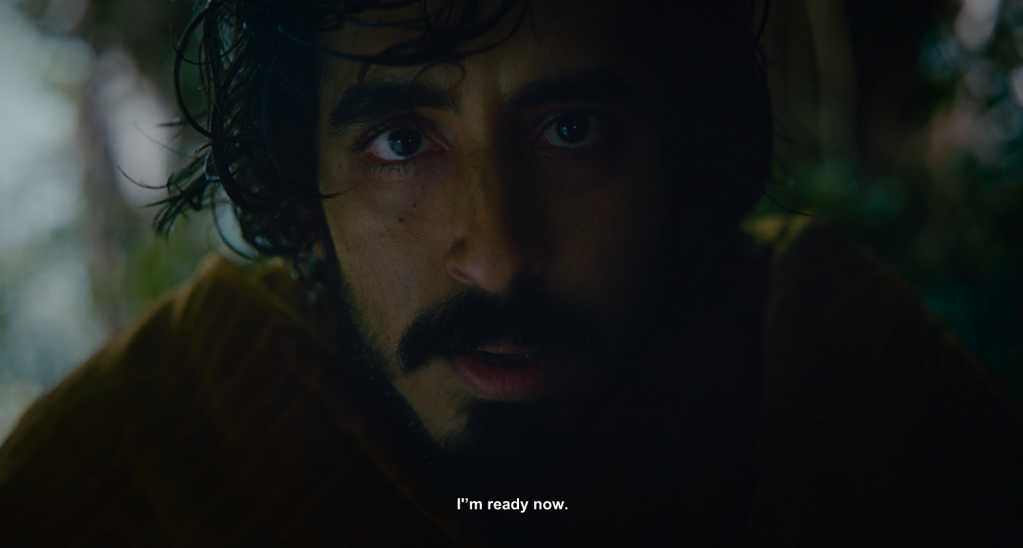
This discussion is based on a movie called “The Green Knight” by David Lowery starring Dev Patel as Sir Gawain who is the nephew of King Arthur. There will be heavy spoilers in the further expansion of ideas so, Warning! Those who have watched the movie can simply skip the synopsis.
The Green Knight
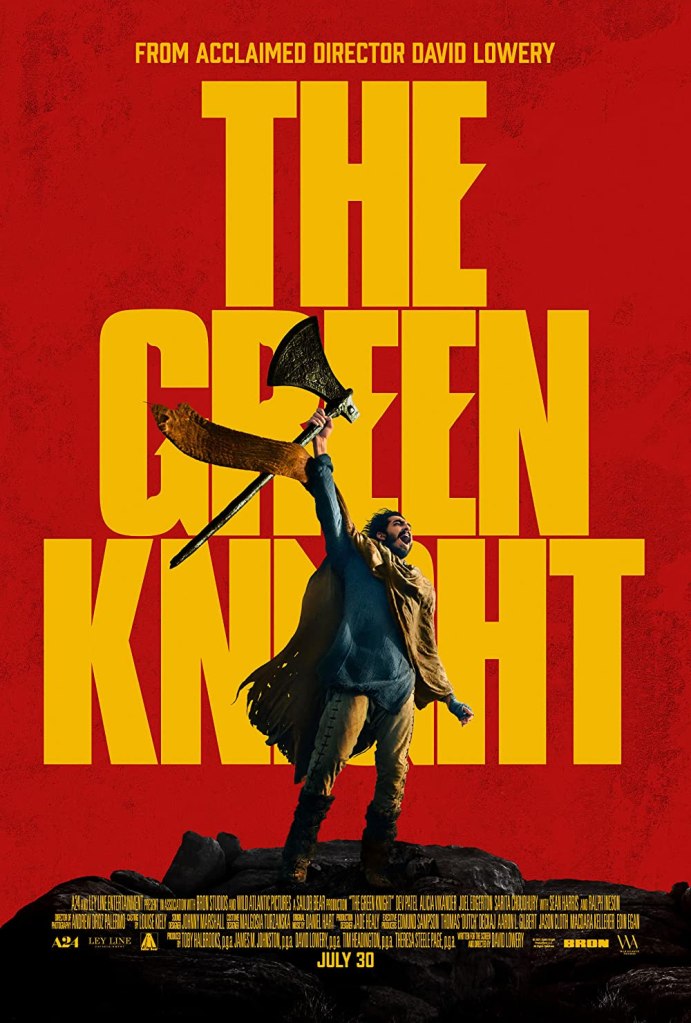
Poster of movie The Green Knight by A24
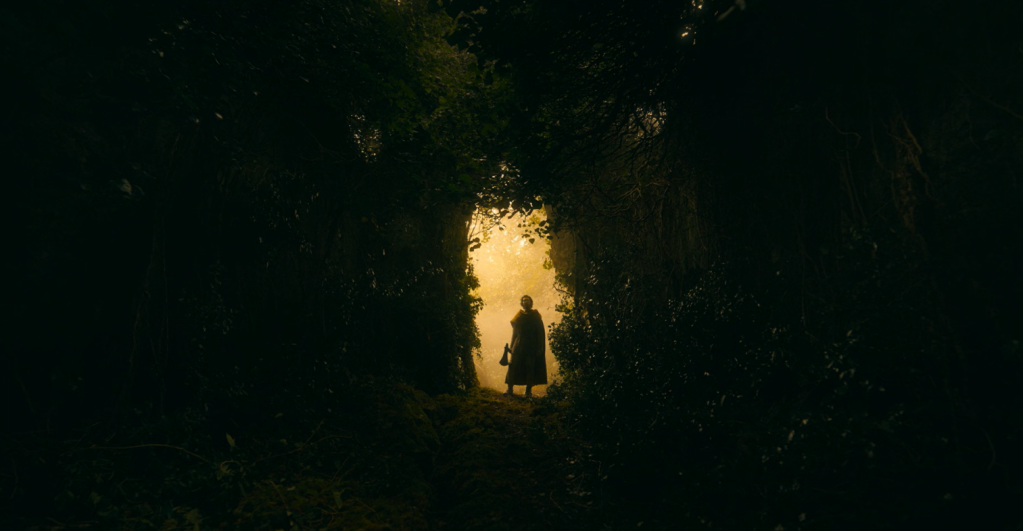
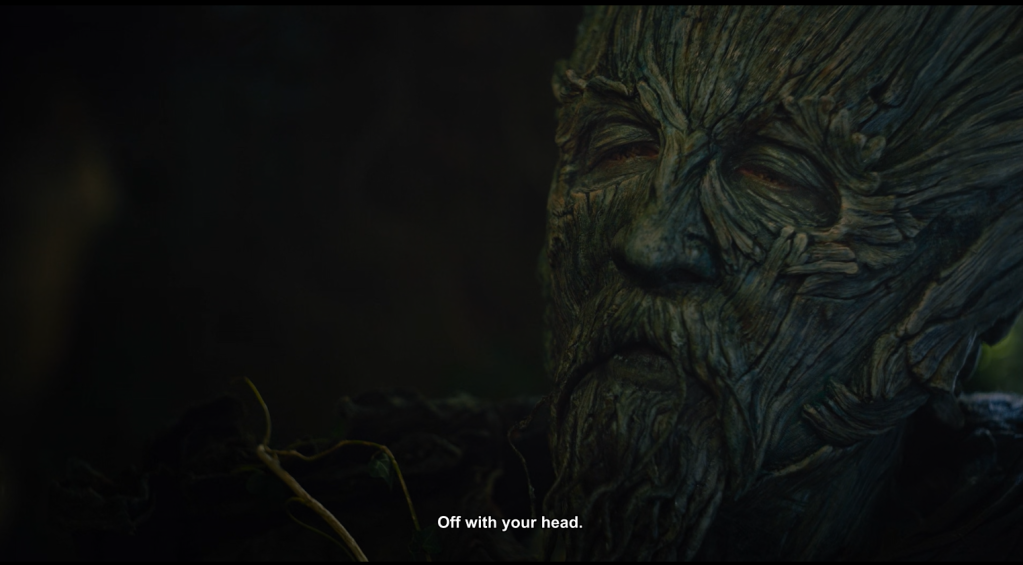
In this story, Sir Gawain (who is yet to become a knight) is the son of King Arthur’s Step Sister who performs enchantments and magic. On the morning of Christmas, Gawain is with his lover called Essel in a brothel instead of visiting the Church for which he receives scolding from his mother. Gawain’s mother asks to leave without her to the Christmas celebration at the King Arthur’s Round Table. Where, King Arthur, asks Gawain out of all the knights present in the tower to have a sit by his side. After having a discussion with King Arthur and his wife Guinevere, Gawain realizes that, out of all the Knights present for the celebration, he is the only one who has nothing to talk about his honorable deeds, brave acts to support his “Knighthood”. He realizes that though people expect him to be a knight by the birth-right, he has not done anything to prove and validate this knighthood. The queen tells Gawain that, he is yet to receive the opportunity to prove his worthiness, which settles the storm in Gawain’s mind. And at this moment the Green Knight appears in the celebration. The green knight looks exactly like ‘the Groot’ from Marvel movies. The appearance of the Green Knight is caused due to the magic of Gawain’s enchantress mother. The Green Knight appears near the round table with his horse and an axe to play a game. The game’s rules are simple- One able man from the Kings knights will get an opportunity to strike a blow to the Green Knight and if it hurts the Green Knight, he will be the owner of the axe of the Green Knight and in a sense the fame, glory followed with it. But, his poses one condition to this game- that after hurting the Green knight and owning his axe, the game will only be considered as completed when the same person will visit him in the Green Chapel after exactly one year and one day. The Green Knight will return the same strike to the person and then they will part on a friendly note.
Everyone in the celebration is scared by mere presence of the Green Knight and hence is scared to represent the King against the Green Knights proposal. This is the moment where Sir Gawain (with all the adrenaline) realizes that demonstration of courage for the opportunity offered may prove his worthiness and he accepts the challenge of the Green Knight. King Arthur offers his Excalibur to blow the strike against the Green Knight. Without any defense, the Green Knight offers his neck to Sir Gawain and seemingly confused but in the rush of proving himself, Sir Gawain separates the Green Knight’s head from his rest of the body and people cheer for him.
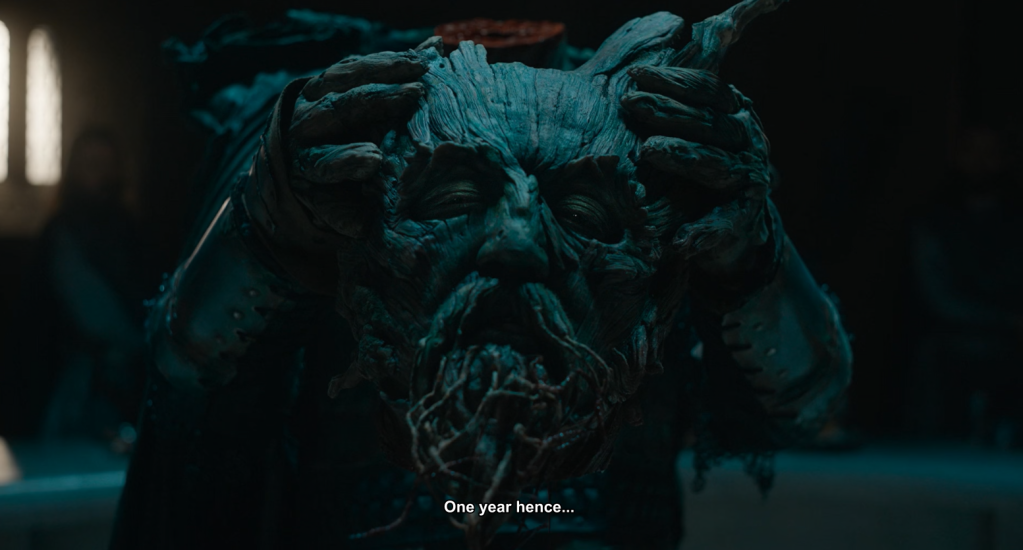
In few moments, the decapitated body lifts the separated head to remind everyone that this is only the half part of the game and the game will be finished when the Green Knight will return the same blow to the same person in exactly one year and one day in Green Chapel.
– A gentle reminder – (Scene from David Lowery’s ‘The Green Knight’ by A24)
This is the dreadful moment when Sir Gawain realizes the foolishness that has brought upon the death in front of him. And swiftly, the year passes – the stories of the Green Knight have made him famous all over, thus reinforcing people’s belief in his chivalry and honor.
But deep down, Sir Gawain knows that it is only the death and its fear that he has received after performing this act on the Green Knight. But, as an aspiring Knight and heir to the throne, he thinks that honor calls upon him. Facing the Green Knight is the only option for proving the nobleness and greatness of his character. With heavy heart and knowing that the return blow by the Green Knight will be more than sufficient to end his life, Sir Gawain leaves for the Green Chapel with the same axe to complete the challenge. On this journey his mother has given him a magic girdle –a sash, a magic belt which will protect him from any harm as long as he wears it.
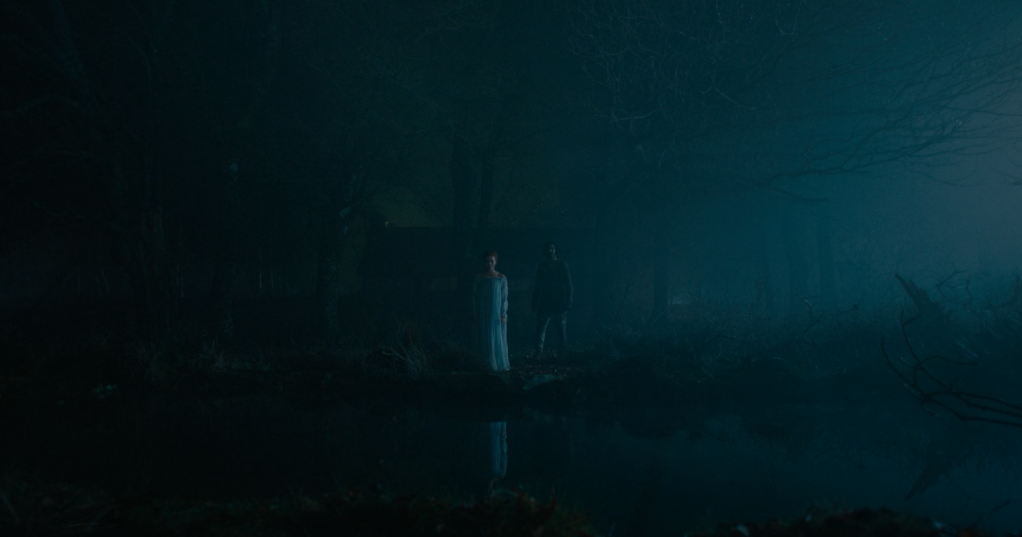
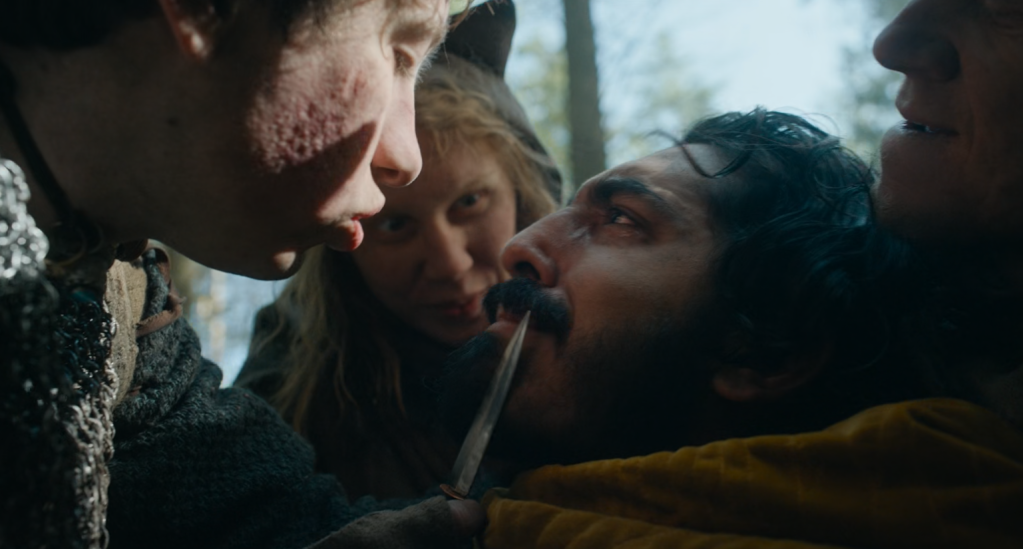
On the journey ahead Gawain meets a boy in a battlefield who gives him direction to the Green Chapel and asks for return of the favor. Gawain simply thanks him and after forcing for the payment he pays the boy a coin. The same boy with his friends loots Gawain stealing all his belongings with the axe. They tie Gawain all over leaving him to rot to death. Sir Gawain- helpless at first realizes that in order to survive he must break himself free and tries to free himself with the sword left behind. By the night, with a strong feeling of homesickness, he visits an abandoned house where he finds a bed to rest. A ghost of a young woman called Winifred awakens him which demands her head to be retrieved from the lake nearby. Gawain asks Winifred what’s in it for him to help her. Winifred refuses to provide anything in return but anyways Sir Gawain reunites her head with her body. He receives his lost axe in return reminding him that he cannot return home because his fate is waiting for him.
-Gawain to retrieve Winifred’s head- (Scene from David Lowery’s ‘The Green Knight’ by A24)
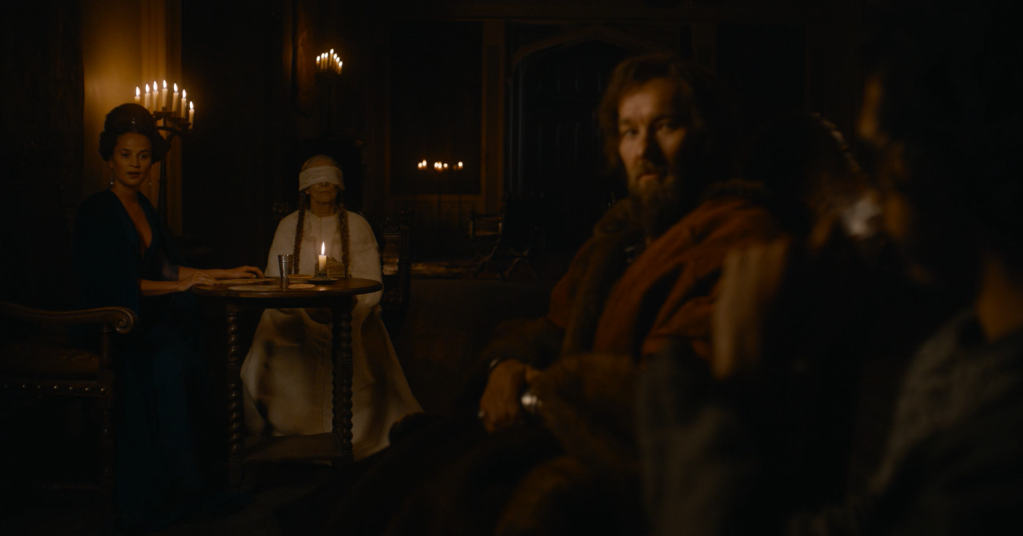
In this journey, Gawain makes friendship with a fox who is constantly following him. During a storm, Gawain lands in a Castle where a he is welcomed by a Lord, where he loses the fox. The Lord treats Gawain well and comforts him that he is very close in his journey and the Green Chapel is mere a day close from his castle so he can rest for few days. The lord’s lady has uncanny resemblance to Essel- the love of Gawain and the lord’s mother is always seen blindfolded yet aware of the surrounding around her as if she can still see Gawain. This creates some uncomfortable situations for Gawain. The lord’s lady makes seductive advances on Gawain and on the other hand the lord proposes that he will return whatever best he will receive from the hunt to Gawain and Gawain will return him whatever the best he has received in from the castle in that day. The lord’s lady offers the girdle similar to the girdle Gawain lost during the thievery at the battlefield in the return of his kisses. Feared to the the loss of his life, Gawain gives the kisses to the lady for the Girdle in exchange and flees from the castle as soon as possible. When crossed by the lord and asked for the return of the boar from his hunt, Gawain hides the Girdle and only gives the kisses in return to the lord which he had received form the lady. The lord also frees the same accompanying fox found during the hunt to Gawain, thus Gawain and the fox are reunited for the final journey.
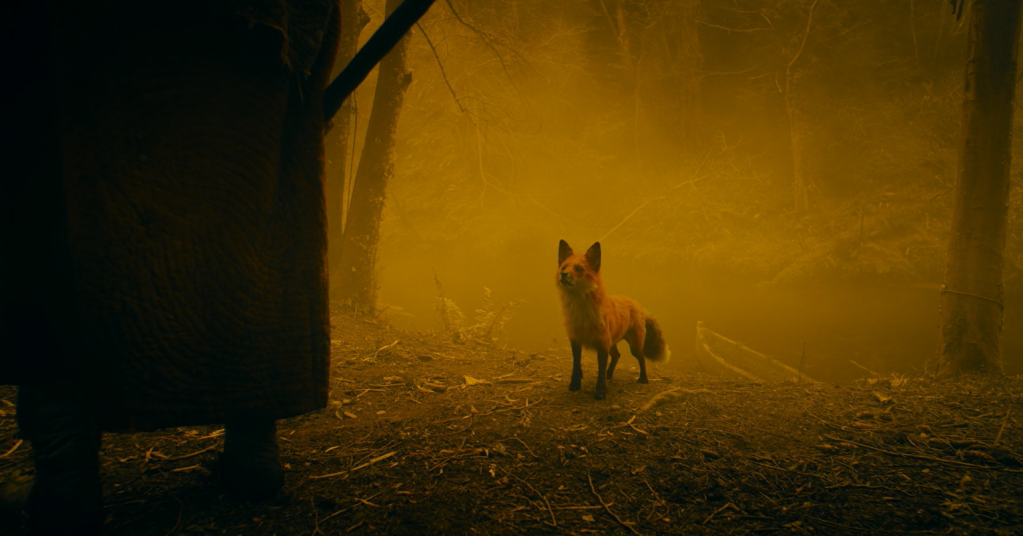
The fox starts speaking to Gawain asking him to return from this journey and nobody will know of it and he still has the chance to live more years because it is only the death that he is approaching towards, in the coming moments.
Gawain refuses the fox’s offer to leave from the challenge and to prolong his life saying that it will not be honorable and great. And hence, approaches the Green Chapel with all the mixed feelings of courage and fear of the death. He sees the Green Knight in hibernation and waits for him to awaken. On the exact next day as planned – the Green Knight wakes up and asks Gawain that is it the same day to complete the challenge. Helplessly and knowing that this will be the final day of his life, Gawain offers the axe to the Green Knight and his neck to return the same blow he struck to complete the challenge- the game.
At first stroke Gawain flinches, and he is reminded by the Green Knight that when Gawain was about to blow the strike the Green Knight didn’t flinch.
At second strike Gawain again flinches and asks that is this everything that is in life? And the knight says this is all there is.
Upon accepting that this truly is his final moment, Gawain gathers all the courage, escapes from the third strike and leaves the Green Chapel knowing that he has not completed the challenge. But, he is aware that whatever has happened is only between him and the Green Knight, nobody can challenge or question the greatness of the Sir Gawain plus he gets to live by missing the challenge, fooling the death itself. After his return, Sir Gawain becomes the King Gawain- the successor of King Arthur and the greatness of the title. He becomes father of son from Essel but rejects Essel because of her identity with the brothel. He marries a lady of a noble house and becomes a father to a girl. Then in a battle loses his son. After this huge loss, he also loses the respect people gave him. In this downfall, when the enemy attackers are finally on the verge of acquiring the castle, King Gawain realizes that this will be his last moment. During all these events after the escape from the Green Chapel we as an audience understand that the Gawain sustained the third strike because of the Girdle given by his mother. Sir Gawain and King Gawain thereafter never let go of the girdle understanding that it was only the girdle which kept him alive. Even in the intimate moments with woman he never removed the girdle as his life was bound to it. At the final moments of the attack, at the castle, King Gawain realizes that he has accomplished and experienced everything that there is to do and experience in life. Satisfied with his achievement and the life experiences gained after the event at the Green Chapel, King Gawain removes the girdle and his head falls down which was held till date from the strike of the Green Knight only because of the girdle.
Then there is complete moment shift in the movie where we see the face of young Gawain still in the Green Chapel waiting for the third strike from the axe of the Green Knight. Until this moment, we as an audience understand that we were seeing the whole life of Sir Gawain flashing before his eyes which is such a strong feeling that it cannot be expressed in words.
This is the near-death moment – where Gawain realizes that whatever you do whatever you try to run from –the death will be the only destination and accepting it in a fearless way is the only option and pathway to the so called ‘greatness’ that he was seeking from this challenge anyway.
He accepts the consequence of the event and with the revelation of life and death, with the clarity,with the fearlessness in mind, Sir Gawain removes the Girdle from his body and asks the Green Knight to blow the return strike to complete the challenge. The Green Knight holds his axe down and relieves Sir Gawain with his head for the bravery, thereby completing the challenge.
The synopsis is mere an attempt to cover the important moments of the story and the movie. David Lowery deserves great recognition, hats off for the details he has scattered all over in the movie and the justice he has done to the great story of Sir Gawain and the Green Knight.
Now, with the key takeaways from the movie,
Sir Gawain’s test of Knighthood
Popularly, the story of the Green Knight represents the five virtues of a knight. The movie highlights this when the Gawain prepares for the journey to the Green Chapel. Here, the queen prays for the strength in five fingers, sharpness of five senses, inspiration from the five joys of the blessed Virgin Mary, enthusiasm from five wounds of her son Jesus.
The qualities a knight should possess are the five virtues namely Generosity, Chastity, Friendship, Courtesy and Piety. The Green Knight’s story is actually a story of Sir Gawain failing at all these virtues before he accepts his final fate.
Generosity- Gawain doesn’t recognize the help provided by the boy in battlefield for the directions provided by him and upon only force does he give him a coin to complete the transaction of help. For Gawain at this moment, the direction has no value because he thinks that he would have found the way to Green Chapel anyways, thereby undermining the help provided by the boy from battlefield.
Courtesy- After all the looting acts of the boy from battlefield and his mates, Gawain somehow escapes himself to an abandoned house and sleeps there. Winifred, the woman’s ghost and the occupier of the house asks Gawain to retrieve her head for which without showing any courtesy Gawain asks something in return thereby failing the second time.
Friendship- After leaving the lord’s castle without acknowledging the support and gifts from the lord, Gawain rejects the suggestion of his companion fox to either end this journey here and return to his people safely without revealing what actually happened or facing the Green Knight with all the courage without the protective girdle; For it will be the only right way to do it. Gawain rejects the suggestion of his friend and scares him away thereby ending the friendship.
Chastity- The acceptance of the seductive advancements from the castle’s lady only to get the life protecting girdle shows the failure of Gawain at chastity.
Piety- Piety can roughly be called as religiousness, one’s spirituality. As from the start of the story it is clear that instead of going to the church on the Christmas day, he spends the day in brothel. All of the decisions are made to please himself neither God or the King or his people. Hence, he fails at this too.
These are the five virtues of the honorable Knight which are highlighted in the Arthurian legends and the religious mentions too.
So, in nutshell even if Gawain had failed miserably at all five virtues, the girdle would have given him the opportunity to live his life to the fullest. But, upon having this near-death experience and understanding how worthless his life- even after all the achievements- will be as there is no honor in it, Gawain presents himself to death. Honor was the only thing he was seeking from this challenge. The decision of dying with an honorable life rather than living a false and self-centered life is the decision that shapes the character of Gawain in the last moments in Green Chapel making him the true Knight, the true heir to the King Arthur. It is his understanding and acceptance of the death as the final destination which makes him brave, which gives him all the knowledge that was required to understand the life in those few moments.
I think this is a story of a boy becoming a man:
The good thing about the story of Sir Gawain and the Green Knight is that it tells the qualities an honorable person should possess to live a fulfilled life whatever it’s span maybe. The great thing about movie The Green Knight is that it opens the story for further interpretations which connects a Late 14th century to the 21st Century. The early part of the story, represents a fickle, lightheaded, royal blood carrying boy called Gawain who is unaware of the real callings of the life and responsibilities in order to achieve the greatness. Gawain irresponsibly spends his time in brothels knowing that the knighthood will be given to him anyways by blood. It is only upon the realization by the influence of the King and the queen that he becomes aware of the fact that real greatness demands great deeds. And in order to do some great, he decides to accept the challenge of the Green knight on a whim or without a thought.
After easily blowing the strike and decapitating the Green Knight, Gawain thinks that now he has done enough to prove his worth to the other knights and the King. It is only when he gets the weight of responsibilities and the consequences of this action when the decapitated head reminds him of the returning the same strike. Poor boy Gawain passes the whole year with a dread to face his death. Gawain still thinks that honor and greatness is only about doing some extraordinary things and getting famous on the stories of these acts. As the year comes to an end, deep down-he also knows that he must face the fate of his actions. Hence the reason when the King Arthur reminds him to go to Green Chapel, Gawain tells him “I fear I am not meant for the greatness”. This moment shows the cravings for fame, greatness but rejection of responsibilities coming with it for a young boy like Gawain.
Helplessly, when Gawain embarks on the journey to the Green Chapel- he is equipped with all the tools and weapons to ensure the successful journey. Even after that, he is robbed by some people. These events reflect the exposure of a fickle boy to the real world where all the hereditary, materialistic provisions prove of less value and only his grit and his spirit of survival can help him to stand strong in such attacks. The breaking of the shield of Gawain by the boy from the battlefield indicates that even the protection given by your guardians will not hold longer when you are exposed to the acts of the real world during the journey of greatness.
-Welcome to the real world, it sucks and you are gonna love it- (Scene from David Lowery’s ‘The Green Knight’ by A24)
Here, Gawain sees the options in front of him- either he can die to a green moss-covered skeleton or he can escape from this anyhow. Gawain successfully escapes with the help of the sword. This gives some hope to the development of the character.
The events with the Winifred indicate the challenges in the journey of greatness. Here, Gawain is a lazy and whining boy where he asks for help from the ghost which is already in dire need of help. But, upon hearing about his resemblance to the knight who decapitated Winifred, Gawain understands what he can become if he is not on the right path. Helping the Winifred adds one more credit in the journey of his greatness. Helping her, Gawain receives the axe again reminding him of the path he should chose. Still our boy is under the fear of what comes next, the uncertainty and survival through it.
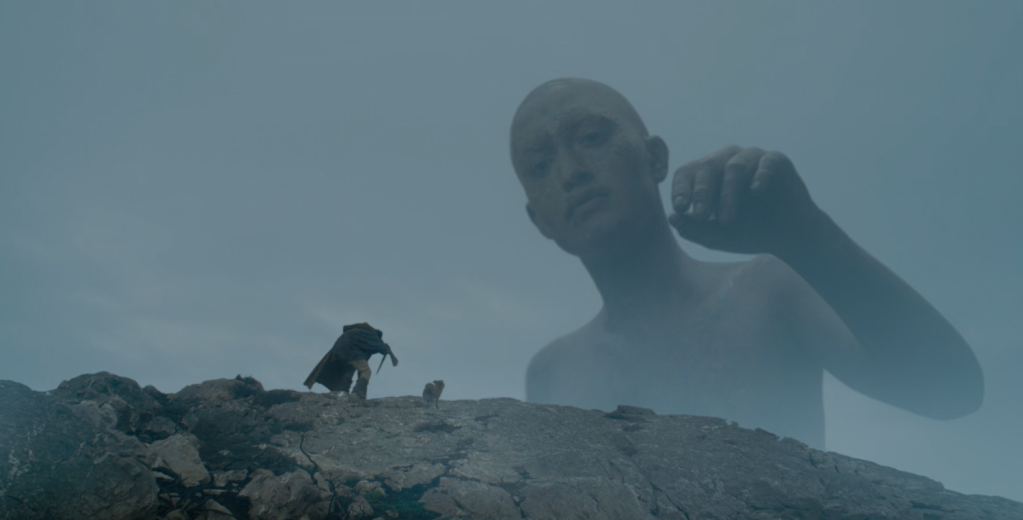
The fox in his journey represent the inner conscience Gawain speaks to when he is traveling alone. There is no one to interact and socialize at this moment hence only himself with whom Gawain interacts which is shown as a fox. This is his inner voice and also his primitive safety seeking mindset which tries to avert him from risks during the journey of greatness. After the eating the hallucinating mushroom, our boy Gawain also seeks short cuts from the giants in his journey, showing the immaturity he still holds to ease his journey.
– a shortcut on “the shoulders of giants”- (Scene from David Lowery’s ‘The Green Knight’ by A24)
The fox howling to the giants for not offering their shoulder is indication of our boy Gawain mocking the great giants but continuing the journey without anyone’s help again gives us the hope for the character development of Gawain.
The events at the castle and its lord, his lady and his mother are the representative of the important life decisions Gawain will make when he will achieve the greatness. They represent the life after completing the Green Knight’s challenge. Here, the truthfulness, transparency in the relations whether they are between Gawain and the lord or the between Gawain and the lady are important. If you see properly, there is a bond created between the lord of the castle and Gawain and similar bond between lady and Gawain. This bond represents the comfort we enjoy with our relationships. This comfort of relationship causes him to rest more at the moment when he is so close to his goal. This represents the loss of focus of our boy Gawain in his journey of greatness. The intermixing of emotions, no control on the emotions, the comfort deviates the mind and body of Gawain from the goal. Strong attachment, entanglement with the relations which are merely dependent on give and take transactions blurs the vision of Gawain. You will see the lord asking for something in return for his hunt, the lady asking for something in return for the girdle all the time when Gawain is in their castle.
You will also see the context of whole movie in their one common discussion with Gawain. The Green according to the lady symbolizes the life as in a green tree, green earth and the also as a death as in the green moss which covers all the dead bodies and non-living cobbles all around.
-The “this is what the movie is all about” moment- (Scene from David Lowery’s ‘The Green Knight’ by A24)
After parting away from all the emotional attachments, hence leaving the castle as early as possible Gawain again meets with his fox friend indicating the loss of his inner self, his conscience during this relaxing period where fox was not with him.
When Gawain reaches the river for the final step of the journey the fox tells him to either stop here or go ahead without the girdle. This is the conflict going in his Gawain’s mind which is shown through the dialogue between Gawain and the fox. The fox being sly animal represented here as Gawain’s conscience- his inner-self, shows how our mind tricks us to remain in comfort zones only to make our lives simple and easy thereby taking us away from the greatness.
– you can still chose- (Scene from David Lowery’s ‘The Green Knight’ by A24)
Anyways, the good thing about the story is Gawain seeking for greatness and his deep-down hidden honesty which helps him to continue the journey. But, most of the courage he has for the further journey is resided in the protective girdle in which he has blind faith. The girdle is the representative of all the misconceptions, ‘our’- versions of truth, the truth etched on our minds by our surrounding that we think will protect us from all the bad that is in the world. The girdle that Gawain blindly holds on for his life are the metaphors of the boundaries of un-upgradable beliefs, preconceptions we keep in order to maintain our version of facts. Hence, at the final moment of realization of worthlessness of the girdle, Gawain puts his beliefs, his preconceptions aside and accepts death as the only truth which is the death.
When Gawain reaches the Green Chapel, he sees the Green Knight in hibernation- sleeping and unaware of the surrounding. Even though Gawain knows that his death- the Green Knight is sleeping, he is not going to survive this event. There will be any time that the Green Knight will wake up and kill him. This is a perfect metaphor of how we are always running away from death, how we console ourselves about the things we are going to do when death is not around and when we are living. The un-acceptance of the presence of death to live life and then helplessly accepting its presence and slightly (not fully) embracing it in the final moments shows how pity and how limited we as a human beings are in our final moments.
– the death awaits- (Scene from David Lowery’s ‘The Green Knight’ by A24)
Sir Gawain’s transformational journey and the philosophy of the meaning of life
Next important moments in this story define why we as a human can lead our lives to greatness despite of having surrounded by the limitations of life and death.
The first flinch of the Gawain on the green Knights strike is the moment of self-reflection with what could Gawain had done better in order to not land here. There is still that young whining boy present there. The dialogue between the Green Knight and Gawain are very impactful here:
1st Strike
The Green Knight– You have had a year to find the courage
Gawain– One year or a hundred it wouldn’t make a difference. Give me a moment.
This shows the realization of procrastination, loss of valuable time for Gawain in his supposedly last moments. Now he is trying to steal some moments to gather that courage!
2nd Strike
The Green Knight – Are you ready? (Twice)
Gawain– Yes
(If one remembers the start of the movie, Gawain is asked by a woman in brothel on the Christmas day that “Isn’t he a Knight already?”to which Gawain answers that “He is not ready yet”. This looks funny at this moment)
The Green Knight – The I shall get to hacking.
Gawain– Wait, wait. Is this really all there is?
The Green Knight– What else ought there be?
This is the moment when Gawain accepts that he cannot escape the death also the worthlessness of the life, the nihilism.
The 3rd Strike
It is the moment before the third strike where Gawain’s whole life, his future life flashes before his eyes where he dies in that life leading to the realization that whatever journeys of life he will embark upon the final destination is always going to be the death. The honor gained, the greatness of life will be dependent on the how he has lived it and accepted the death rather than running away from it. The third strike is symbolically the death of the boy called Gawain and the birth of a Man- Sir Gawain and the true heir to King Arthur.
The famous quote from Confucius really resonates with the conclusion of the story:
“We have two lives, and the second begins when we realize we only have one.”
Confucius
(Scene from David Lowery’s ‘The Green Knight’ by A24)
Sir Gawain’s transformational journey and the psychology of the Man-Child
A trend discovered by a Swiss psychologist called Marie- Lois von Franz, showed that many adults in spite of achieved physically adult state were not psychologically matured. These were called as “Puer Aeturnus” (Latin for “eternal child”). Surprisingly this trend was found in mid-20th century. The whole idea behind “Puer Aeturnus” is that due to the complete confinement, extra care and easy, comfortable provisions by their parents, the young men in their peak years like 20s and 30s are struggling to lead their own life independently. Many are victims of virtual world, video games, internet living life in passive and supposedly in a safe way. And this is linked to many psychological, sexual, academic, professional, financial, social disorders. The solution to this problem is simple in a way which requires separation of this adult-child from his comfort providers.
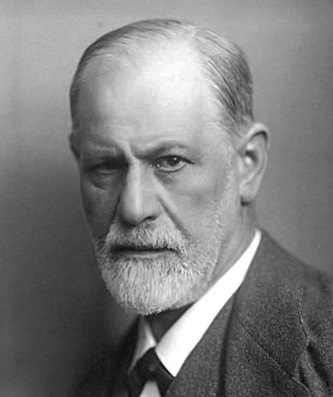
Sigmund Freud has said somewhat similar thing:
“No one could be a man unless his father has died”
– Sigmund Freud
The idea is to get out of the influence of someone who is responsible for the way of our life and its consequence. The death of father figure for a boy is the moment when there is no greater figure, experienced person thereby ‘efforts saving’ person for his further life. This is time when the boy realizes that he has to make the decisions for himself and become responsible for their consequences.
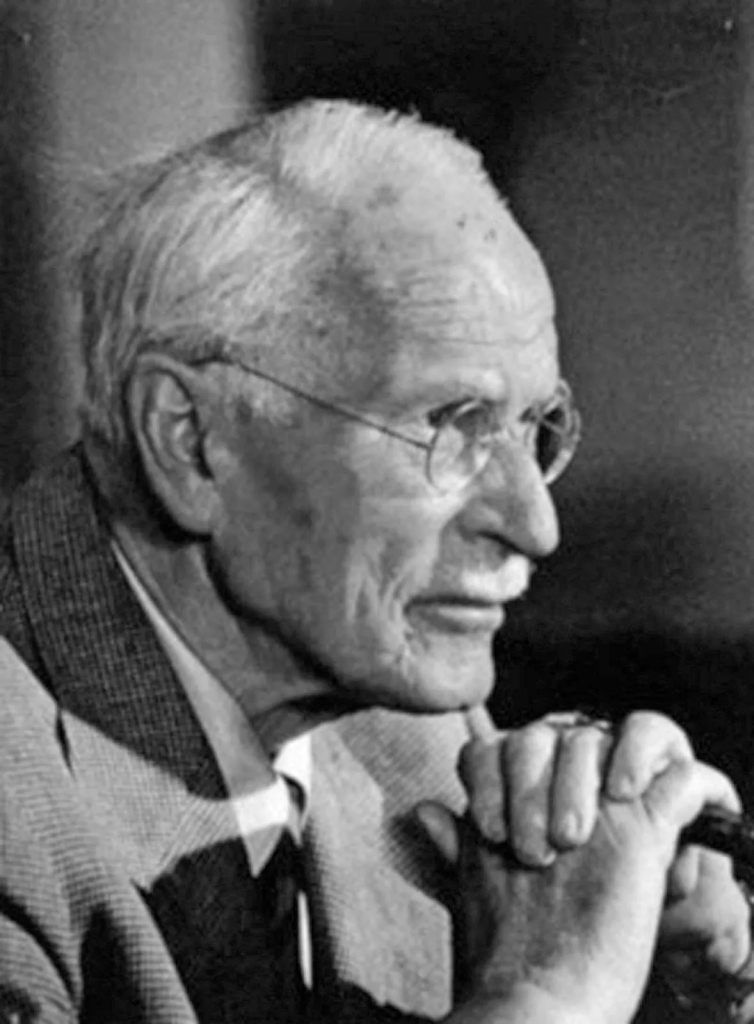
“Yes, but that death (Father’s death) could occur symbolically”
– Carl Jung
Carl Jung expanded the idea of the death of father figure in an interesting way. According to Jung, even the realization of a person to the fact that his father rather his parents, guardians thereby someone guiding him to make his path easier will not be with him forever. There will be times when he has to take his decisions and own the consequences.
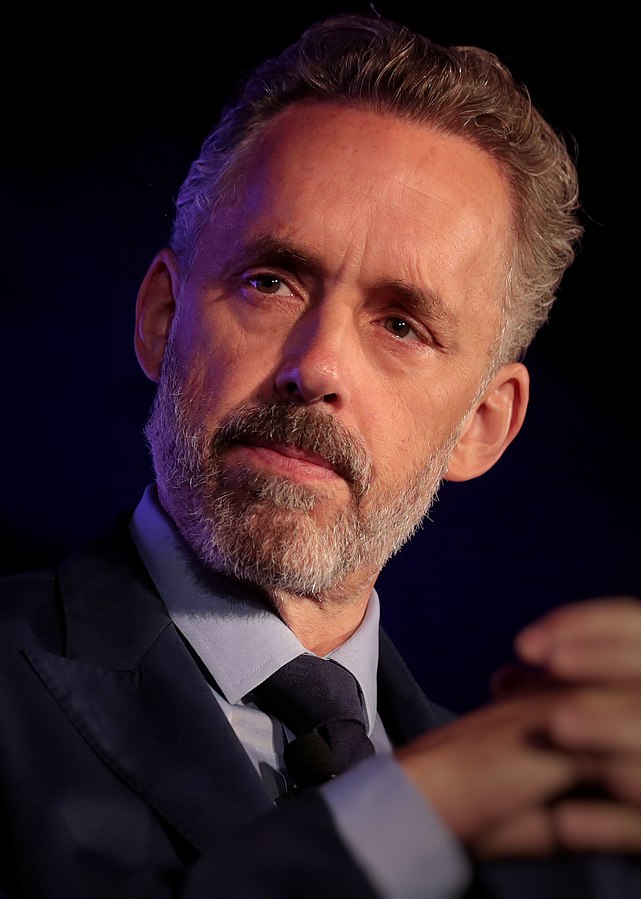
Jordan Peterson has given one excellent explanation on becoming independent from parents using the examples of the story of Pinocchio, Peter Pan and Harry Potter.
I believe that the transformational journey of Sir Gawain also resonates with his separation from the comforts of his life. Here, King Arthur- his uncle and the supposedly greatest father of their time (because no other father had the courage and strength to pull the Excalibur in those times) is the father figure and the Sir Gawain’s mother are his parents. Seeing the fickle behavior of Sir Gawain, I think that King Arthur and Sir Gawain’s mother plan this game for his transformation from Man-Child, because this will be the person who would be carrying King Arthur’s legacy, who will become the leader and father of all the people.
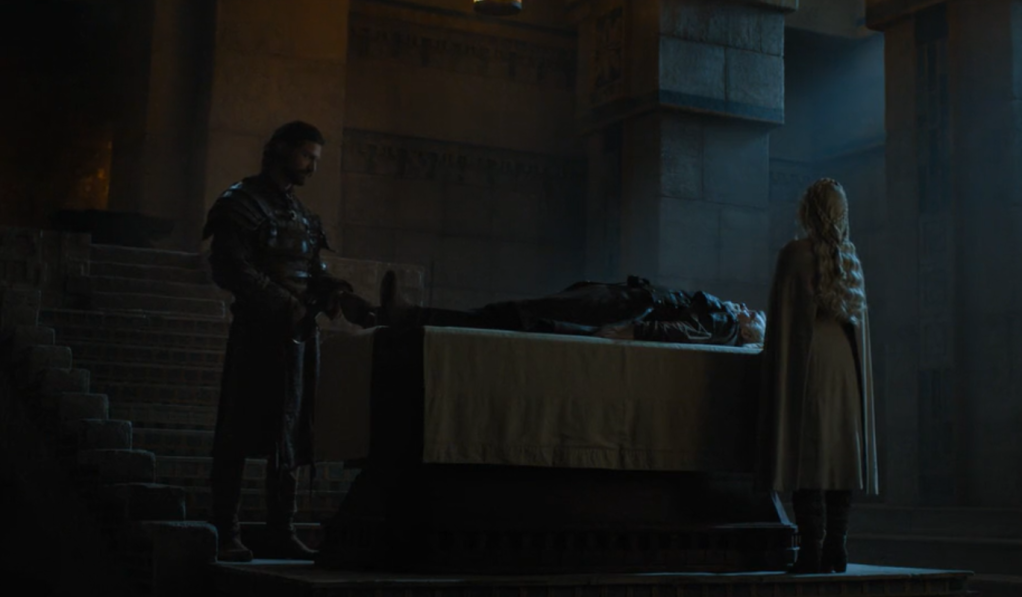
The same thing of losing that adult-child is also reflected in the popular culture of our modern days as seen in Game of Thrones. There is one exact episode where all such relevant things happen. It is the Episode 5 of Season 5 of Game of Thrones called “Kill the Boy”.
-Death of a father figure, a friend, a counselor- (Scene from HBO’s Game of Throne)
In this episode, we see that Ser Barristan Selmy dies due to the attacks of “Sons of Harpy”. He was the father figure for Daenerys. Upon realising that there is not wiser and experienced person to counsel her, Daenerys takes the charge and responsibility of her decisions thereby establishing her command over Meereen. Here, the events show the death of parent-like figure which transforms Daenerys to kill that adult-child in her and take the charge of her decisions and the responsibilities that come with it.
And in the same episode, we see that Jon Snow has brought the Wildlings under same roof where the Night’s Watch lives. Jon is now thinking about making alliance of the Night’s Watch with the Wildlings who consider each other their greatest enemies. Jon thinks that, he could not make this decision on his own and seeks someone’s experience to make the decision right. Hence, he approaches Maester Aemon for the advice where Maester Aemon clearly tells Jon Snow to own the consequence of his decisions.
Maester Aemon exactly tells Jon Snow the following:
“You will find little joy in your command. But, with luck you will find the strength to do what needs to be done.
Kill the boy, Jon Snow. Winter is almost upon us.
Kill the boy and let the Man be born”.
– “Kill the boy, Jon Snow”- (Scene from HBO’s Game of Thrones)
This scene exactly resonates with the death of the man-child similar to the story of the Green Knight, which seems absolutely magical. The indirect influence of such values, the permeation of such strong ideas, their eternal and imperishable nature precisely points to what makes us a true human beings and is mesmerizing on so many levels.
OR
Maybe, the story of the Green Knight is in a way that story told to the adolescents to teach them to take the charge of their lives
OR
Maybe, it was just a fun game played on Christmas for the entertainment to make the day more memorable (and to shake Sir Gawain to his core for the year as the longest running prank!).
Jokes aside, but the symbolism and the depth of the characters and their intentions and the lessons that we learn from the story, the relevance of such an old story even with the times of today makes the story of the Green Knight so special for us. That’s all there is, that can be penned down for such a piece from ancient literature.
(Scene from David Lowery’s ‘The Green Knight’ by A24)
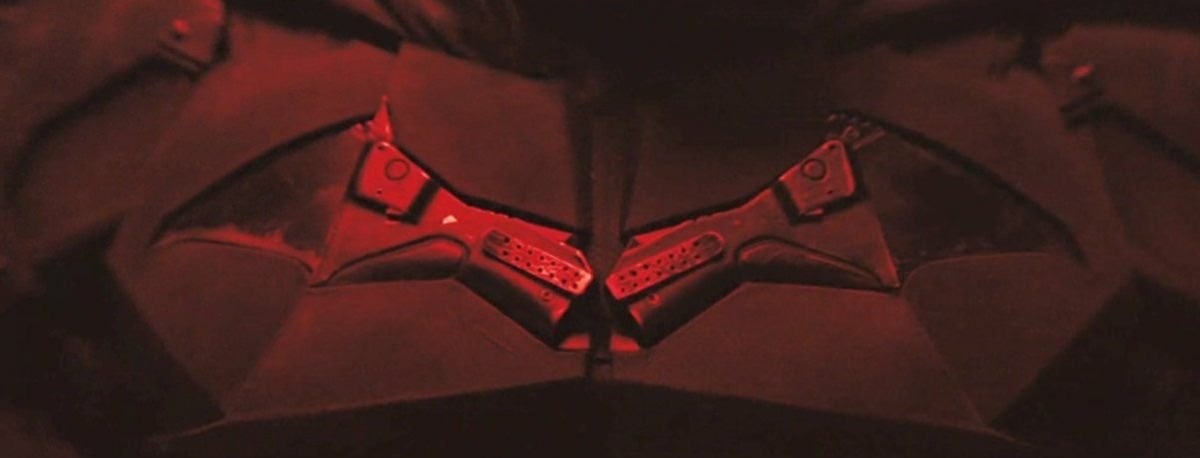
The Batman by Matt Reeves is one of the most important and influential movies. It is important not because some profit expecting comic book franchise is trying to reboot their most valuable asset in order to establish the character so as to drive the future narratives of the stories which will be getting introduced in the near future but it stands important because of the fact that it shows mirror to us as a human dealing with the nature of truths we are taught. The Batman by Matt Reeves is not a superhero movie, rather it tells the story of a person who discovers that all of his life decisions which made him who he is today were based on the lies and his journey out of these lies. It is the story of the batman ‘unlearning’ the facts he accepted throughout his life about his parents.
There will be some spoilers hereon in the discussion, WARNING! Watch the movie and get back again or never mind.
We all know the origin story of the Batman, the murder of his parents by a goon for few amount of money influenced his life decisions creating a strong hatred for the injustice and idea of punishing criminals with violence for their deeds. That is why he considers punishing the criminals and goons in the Gotham as a way to avenge the murder of his parents. Hence the reason the Batman of Matt Reeves always introduces himself as ‘Vengeance’ in the movie. Vengeance is the foundation of the Batman in this movie based on the fact that his parents were the innocents who fell victim to the disorder and crimes of the city. This is the truth of the Batman as a character. You will see the Batman and others (mostly Cat woman) calling him as vengeance throughout the movie.
The movie builds upon a series of murders done by the Riddler and sending one by one love letters to the Batman in each investigation to reveal various political, personal lies which were told to the people of Gotham city to maintain the power concentrated in the hands of bunch of people. These people used the power for personal gains only, thereby creating chaos and distress in the Gotham city. One-by-one murder of high-profile persons from the Gotham city administration and judiciary system finally reveal that the parents of Bruce Wayne- the Batman and especially his father was also one of the persons who was responsible for the downfall of the Gotham city.
The moment when the Bruce Wayne knows the truth that his father – Thomas Wayne was also one of the high-profile people who created the foundations of scams, frauds, unreliable charities, unreliable city renewal projects and fake drug raids in order to win the people of Gotham, the whole idea of him avenging the death of his parents, being ‘Batman’ seems useless to him. The truth reveal becomes an attack on his identity when he knows that his father- whom he used to consider the noblest of all- his role model was also trying to hide the truth about mental illness of his mother to maintain his political image during elections and his attempt to prefer illegal acts to control that ‘information’ completely shatters the idea of what made him the Batman.
There are two types of truths that the movie really focuses on- the white lies and the black lies. The white lies are meant to be harmless to the listeners like the parents telling a child not to misbehave otherwise the boogieman will come and get them. The black lies are the lies which are meant for the benefit of the person telling them. The company leaders telling investors misleading profit and false business models to get people invested more in their companies and thereby bubbling the company portfolio are the examples of black lies (read more about the Fyre Festival, the Theranos case).
The lies like the greatest drug raid GCPD carried out in Gotham city to eradicate the drug abuse in order to publicize the mayor-elect, the Gotham renewal fund which was meant to uplift the social infrastructure was actually a money laundering scheme- were the black lies for the story. Thomas Wayne having a clean family background was the black lie for the people of Gotham city.
But there comes a moment in the movie when Alfred confronts the Batman- Bruce Wayne for the reality of his parents that some lies are essential for the well-being of the person and the society. It was a sincere and innocent attempt of Thomas Wayne to hide the truth of Martha for the well-being of families and his love for her which created this ‘white lie’. The white lies with which Bruce Wayne grew up with, brought the best out of him – making him to fight for the ‘Justice of the people’.
As a human being we are what we believe in. Our personalities are built by the facts that our surroundings impose on us. It becomes really difficult to accept the that whatever was told to us our whole life was a lie. Humans do not accept these truths and try to find the ways to move away from such truths. People also try to find the groups of other people who support the similar ideas so as to run away from the truth. Our brains cannot handle such type of clashes because these lies (truths of us) are the foundations of our being. Psychologists call this as a ‘cognitive dissonance’. It refers to the mental conflict that occurs when a person’s behaviors and beliefs do not align. It may also happen when a person holds two beliefs that contradict each other. This is what suffering is. Our mind tries to avoid such sufferings and existential crises. Colin Stokes- a famous TED Speaker and writer in ‘the New Yorker Magazine’ discusses this in a very effective way in a TED talk.
But you know what, one cannot run away from the truth. The truth always finds its way. Jordan Peterson in his lecture has said the following about the nature of a lie-
“Problem with lying is (it’s) like hydra, it has one of the consequences that you expect you can get away with it but it has 3 or 4 others that you don’t expect so it grows some complexity then you have tackle lie on each of those ‘complexity-o-crops’ and then they grow three more complexities and soon this little lie turns into a great Ball of lies, and at some point, it becomes painfully evident to everyone.” -Jordan Peterson
Peterson also quotes Mark Twain about the advantages of telling the truth-
If you tell the truth, you don’t have to remember anything.
This is what roughly lies between the truth and the lie.
Now, let us have one reality check.
According to the scientific studies, a person lies twice a day on an average. The lies are innate part of our personal and social interactions. If a man doesn’t tell lies to his wife about that dress being beautiful on her or her hairdo looking stunning, how could he stay alive otherwise! – Jokes apart. There is one scientific study available in ‘arXiv’ maintained by Cornell Tech which implies that white lies can truly build the society, ‘glue’ it together while the black lies fragment- break the society. Same thing is seen in the Batman movie. The black lie actually leads to the chaos in the Gotham and increases the people’s following to the Riddler.
We humans have actually mastered the art of lying for the mere being of survival. If such small harmless lies are such inseparable part of our life, then how could one handle the real lies which have made him/her the way they are! How could they change the course of this ‘fundamental’ and ‘learned/ believed throughout my entire life’ thought process?
One lie leading to other one to ‘cover up’ creates a series of misinformation and chaos which has different impact on different people causing them to make different choices. This is the reason we can see that the same lies affect the decisions made by Batman and the Riddler. As Riddler tries to convince Batman that they both can enjoy ‘the reveal’ of truths as one group and purge the whole Gotham city off of all the criminals, he is also willing to accept the harm being done to the innocents as revealing the truth is more important for Riddler but Batman has different ideology.
This is the moment which sets differences between Riddler and Batman. Though having almost same backgrounds and same intentions, same fight to eradicate injustice- Batman doesn’t accept Riddler’s offer knowing that he is also part-victim of these lies.
There is this moment in the third act of the movie when one of the Riddler’s followers when asked about his identity calls himself as ‘Vengeance’. It is in the same fashion the Batman introduces himself. This is the moment when the Batman realizes the consequences of the white lie and how you cannot convince everyone for the white lie (it is a lie after all). He understands in this very moment that act of avenging his parents by punishing the criminals of Gotham is not only spreading the fear for him thereby the fear for ‘Justice being served or their moment of reckoning’ but it is also creating some bad examples for the people who are aware of only the black lies. They are not made aware of all the white lies and in some sense, even when someone tries to tell them the intentions of white lies, they won’t be in a position to understand it. This is the nature of lies. Black or white- a lie is a lie.
Then, what makes the Batman and Riddler or his followers differ?
I think that it is the process of unlearning and thereby accepting the truth.
Unlearning can simply mean discarding the false information which was till date responsible for the foundation of who you were and rediscovering the same things with new perspective, rediscovering what that lie was hiding. The batman unlearns ‘the truth about his parents’ told to him from his childhood. He understands that however bad/ugly it may seem, it cannot change what he is today. That is why our Batman in the third act accepts that the ‘Vengeance cannot change the past’, it will not change the fact about his parents, it won’t even bring them back. Hence the reason our Batman in the end of this movie expects himself to become a ray of hope for people (and not vengeance)
Batman clears off his mind of what is right and what is wrong. He makes the notion to save the people of Gotham as a primary goal rather than displaying himself as vengeance and punishing the criminals. He brings himself out of the shadows, it is greatly and symbolically highlighted in the moment when he sacrifices himself to save people from live electric cables and when he lights up the torch to bring the people out of the floods.
This process of unlearning of the Batman, the journey of Batman accepting the ugly truth of his past, his journey inwards in ‘this’ Matt Reeves adaptation makes the story so special. It is the reason why even though many villains share similar intentions, pasts, personal acts with the batman they cannot become the Batman.
We all have similar type of moments in our life – when the truths we were built upon, when the people we follow, the people we admire, the ideologies we accept as the ultimate truths prove out to be false, wrong. I think these are the perfect moments, perfect opportunities to redefine ourselves, to again question the nature of who we are and the purpose of our being and the influence, the example we are creating in the world. This is the chance to unlearn the same things around us. It is this suffering, the inner battle which we have to endure to learn the real truth. David Brooks, a famous Columnist says these sentences in his TED talk to highlight our dealings with the suffering of realization of the lies that made us- “Suffering’s great power is that it is the great interruption of life. It reminds you that you’re not the person you thought you were.”
This, I think is the power of storytelling for the Batman Movie. Even though he is a superhero, there is that connect between the Batman and we as a human beings which creates an emotional common ground for everyone to connect with each other.
Behavioral economics established that humans are humans, they have emotions. They make mistakes and misbehave.
Human beings are the epitome of what evolution has done with the earth. Starting from the stone age to the age of AI, we had a long journey of continuous adaptation. The development of various tools like weapons for hunting to the machinery for industrial development to the ginormous simulation engines to simulate space missions are to name the few. The common thing between all these tools is that these tools are made from the resources available around us. From developing the hunting spear from the stone and a stick of a tree to making the computer chips from the silicon from sand and stones, we have mastered the use of resources around us. This became possible only because of the development in our abilities to manage our resources, our techniques of handling the available materials which we can closely connect to economics. Barter system used for trading things, development of metal currency, then paper currency and now the cryptocurrency – the journey is phenomenal. Economics deals with how we manage the resources and we all are clear that these resources have one agreed medium of transaction called currency, money.
Most of the people perceive economics as a boring subject, where you develop some theories and mathematical models to predict money trends. The models may agree with some datasets, may break down at some points implying that the field is full of biases and assumptions which are far away from reality and understanding of common public. There is this joke about economists:
– Why did God create economists? – In order to make weather forecasters look good.
Though the joke is really good, many great economists have really shaped our perception of money thereby resources and prediction of the interactions on personal, social and global levels. Today we will be discussing one such stream of idea which revolutionized the perception of new economics though the idea was already present deep down in the older and starting ideas of economics and psychology. Before that we will need some foundation to start with.
Classical Economics
Adam Smith also known as father of Economics has this book called “the wealth of nations” responsible for the development of Classical economics. Classical economics has following ideas:
Competitive advantage – success of any industry depends on how efficiently it uses its resources
Free market – defining the prices of goods by negotiation between buyers and sellers in an open platform without any intervention of government and without any monopolies leading to equilibrium between supply and demand thereby establishing fair price
Division of labor– Defining and separation of tasks will lead to specialization thereby leading to the efficient use of resources to optimize people to enhance their skills and economic interdependence.
Then came the Neoclassical economics in 1900s which brought new school of thought which aligns with “the rational behavior theory” stating that people think rationally while making economic decisions. Hence, they are ready to pay the price of a thing/ resource based on the value it brings to them.
In simple words, the classical economics believes that the price of any product is dependent its cost of production. Whereas, neoclassical economics believes that the price of product is dependent upon the utility to the customers not its cost of production.
The conventional nature of economics – the problem
For many years the main idea behind the theories in the economics is that the people are rational while making any decision related to money. Every person exposed to a product/service has well defined preferences and unbiased ideas and expectations. These unbiased ideas make people to choose whatever is the best for them.
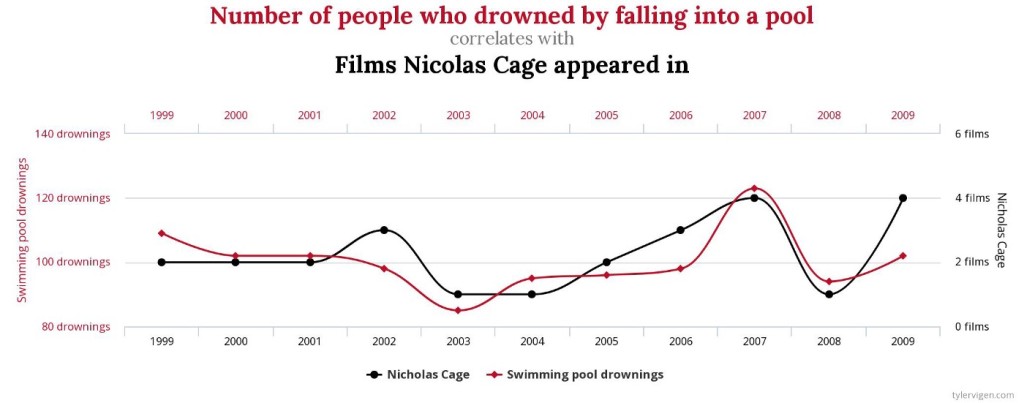
These ideas in the conventional economics lead the economists to formulate and study economics mathematically as inspired from the physicists. Physicists theorized an idea and based on the mathematical principles developed models which can predict the nature and behavior of objects- from a ball to the motion of planets around the sun. Hence, in economics you will find many complicated mathematical equations and wild correlations (a correlation is degree of dependence of two datasets). One funny representation is as follows, somebody found out that the there is strong positive correlation between the pool drowning deaths and movie releases of Nicolas cage. So does that mean that people were so fed up with nick’s movies so that they preferred drowning over his films. Definitely No! I am a fan here.
There was this funny correlation that the skirt length was related to the stock market movement called ‘the Hemline theory’. A theory saying that stocks prices move in the same direction as the hemlines of women’s dresses. For example, short skirts (1920s and 1960s) indicating bullish and long skirts (1930s and 1940s) indicating bearish markets.(!)
These are some of the reasons why the economists and their models remained part of funny discussions. This was one of the reasons why many economical models were applicable to limited datasets. The problem is not about the flaws in these ideas, the problem is that many big financial, political, life altering decisions were made based on such theories and models.
I mean these models were not completely wrong; nothing is perfect, there is always room for improvement.
Quest for establishing the correlation between human behavior and economic theories-
When economists were in the establishment of mathematical foundations of the subject causing their economics to reflect the equations and theorems, the psychologist directed their studies more towards experimental approach for the development of psychology. Their theories were more of verbal and theme based, that is also the reason why you can find psychology as a set of vocabulary itself.
Psychologists in some sense developed the ideas about how we interact with others and materials, resources around us. What affects out decision making when we interact with each other and things in our surroundings.
Some of the famous Psychologist had already tried to establish the connection between the ‘machine-like’ economic theories which strictly followed some equations and the real emotions, sentiments that make these economic models unfit with the reality. Their ideas helped us to find the reason why money does not strictly follow the strict optimized and high output giving trends. The reason does not lie in the money, it lies in the nature/ sentiments of the people who drive the money, the people who sometimes choose other things over money.
Richard Thaler, Daniel Kahneman, Amos Tversky, George Katona, Herbert A. Simon these are some of the notable names which have strongly influenced the ideas of behavioral economics.
The dawn (rather awakening) of the behavioral economics
The basic idea of behavioral economics establishes that we humans make mistakes and most of our decisions are emotion and influence driven. People are not always rational. After are we are humans. Humans are flawed (!) hence don’t follow machine-like strategies. People love to mis-behave; they love breaking the rules.
Expected utility and Prospect theory-
According to expected utility theory in conventional economics, people will choose gambles which give highest outputs whatever may be at stakes. It says that, people take money related decisions based on the maximum future value it will bring to them, whatever will be the conditions. It’s like a person buying a lottery ticket.
If a person buys a $1,000 lottery ticket with $10 and the probability of winning is 10% then he thinks that the utility or value it will bring to him will be $1000 x 10/100=$100.
But you know how lotteries work. If the same ticket has winning probability of 0.5% the expected value becomes $1,000 x 0.5/100=$1,000 x 5/1000= $5, which is already less than the money it takes to buy that ticket. Here the expected utility is far less so the person won’t buy the ticket.
The value of the lottery ticket became high due to the higher winning probabilities as the expected utility of that ticket is $200 over ticket price of $10.
In simple words, expected utility theory says that people take the chances and decide the value based on the its probability. More the probability of winning more it will be favored.
Kahneman and Tversky created ‘Prospect theory‘ which challenges the Expected utility theory. According to prospect theory it is not just about more probability and less probability of winning, it is also about the situation in which decision maker is; this called as a reference point. Other than winning or losing, a new condition is created which we can call as a reference condition. If the same lottery buying person is given the choice of
A. Getting $100 immediately
OR
B. Having 10% chance of winning the same $1000 thereby 90% chance of gaining nothing
The same person will choose to get $100 immediately and walk off. Here the person did not choose the expected value of $100 rather, the person chose the instant benefit that he got, the person saw less risk in option A although the person may have won $1000 from the lottery, but chose to avoid the risk.
This is also famously known as ‘Loss Aversion’.
In simple words, losing $100 hurts more than winning $100. We as a human always try to avoid higher risks options and make ourselves safer. We always try to make the decisions closer to the reference points created by out experiences, assumptions. We try to “break even”.
Exponential discounting and hyperbolic discounting
According to exponential discounting (in classical economics), the value of any gain declines equally with time period it is delayed.
Here are two cases:
P. Getting $100 today over getting $110 after a week
Q. Getting $100 in 10 weeks or getting $110 in 11 weeks
A rational person will behave like an adult and will chose to wait for 7 days to get $10 more- just like a sincere (!) person. Whatever is the case- either P or Q the wait is same (waiting for 7 days) and gain is same (gain of extra $10) both the Case P and Case Q have same discounting rates, same rate of losing the value. This is exponential discounting
But what would you have done when provided with case P and case Q?
Behavioral studies show that people always go for instant benefit and chose $100 today in case Q whereas they are also ready to wait for one extra week if they are provided with only second case (Q) where the time-frame of gain is expanded. Means, people are selfish! They want this and that too. We always seek immediate rewards, instant gratification. No doubt social media is the living proof of this.
Social Preferences
The behavioral economics says that people not only just care about what they are getting, they also care about what they are getting compared to others. (That might be the reason, your HR department instructs you not to ask for the salary details of your subordinates, colleagues, seniors!)
Consider a game where one person out of two people is said to divide $100 between them and they both will get those $100 if and only if the second person agrees to whatever share she/he receives otherwise, they both won’t receive anything. The rational choice for the second person is to accept whatever she/he would receive. Whether she/he gets $1 that too is acceptable because she/he had nothing ($0) before. Having something should be better than having nothing.
But in reality, and discovered from real life observations- people always try to reason with overall situations. People compare their gains with the gains of others, thus the above said second person in reality will only agree only if they both break even otherwise, she/he won’t accept the offer knowing that they both won’t get the money. This is really observed in studies and is funny.
Conventional economics considers people as a rational choice making machine. They always know what they are doing. It’s like for every human being is an economic optimization machine what economists call ‘Homo economicus’. Here people always make rational decisions, thus follow specific mathematical models based on a set of variables. Also, there is one idea called Becker conjecture which says that the people in the top management (politicians, leaders, chief directors, executives) always know what they are doing, they are always accurate on the probabilities of the outcomes. They always behave optimally.
In contrast, Behavioral economics established that humans are humans, they have emotions. They make mistakes and misbehave. They are not ‘Homo economicus’ implied as always thriving for optimizations. They are humans – ‘Homo sapiens’ implied as imperfect and prone to mistakes. There is no such human behavior where everything will cause to balance leading to establish equilibrium. There is always evolution when it comes to being human. They learn from their mistakes change themselves, adapt and evolve instead of being stagnant as in equilibrium.
(There are many interesting concepts in Behavioral economics like impact of Game theory, Supposedly Irrelevant Factors (SIFs), Difference between Equilibrium and Evolution, Roots of Behavioral economics in Classical economics, the endowment effect, social utility and those will be the topics for another day!)
PS: One should really try to compare the concepts discussed here with the characters Walter White (As Classical economics) and Jesse Pinkman (As Behavioral economics) from Breaking Bad. You will get the idea, plus it will be fun!
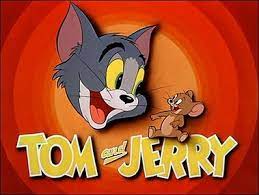
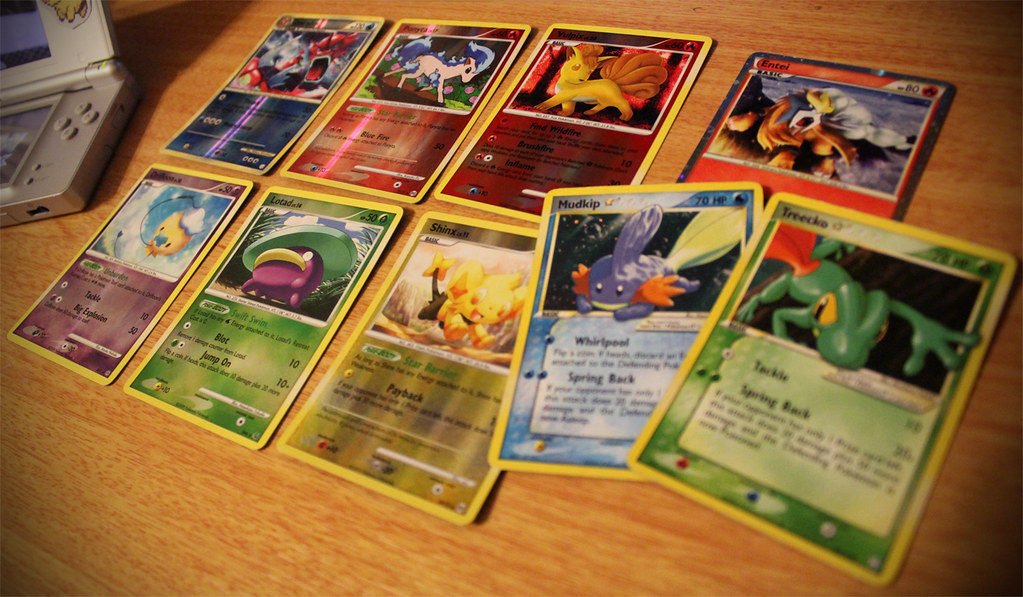
Remember the video game that you used to play in your childhood? The game cassette claimed 999999 in 1 but it was few games just repeated may times and you still enjoyed playing with them. The times were simple, we used to trade the Pokémon cards, WWF trump cards. Speaking of WWF- every boy in the school knew the story of rivalry between the Kane and the Undertaker still being brothers, how many times the Undertaker had reborn. We had that red-blue eraser which could supposedly erase both the pen and pencil writings. Everyone had played that pocket brick game bought from the local fair at least once. Tom and Jerry, Popeye, Looney Tuns, Beyblade- these were some of the favorite cartoons and who could forget the Power Rangers- they were the Avengers of our times. Spiderman was present on every possible school stationary that you could have- starting from the school bags, water bottles to the pencil boxes and textbook stickers. Those were the days! These days bring back all those fun we had, reminding us that even though they cannot be brought back, which is sad but still we are happy that we were able to experience them.
Nostalgia- The ride down the memory lane…
The concept of nostalgia has traces 3000 years back when it was related to a mental disease closer to depression or melancholy. Nostalgia is made up of Greek word νόστος (nóstos), meaning “homecoming”, and ἄλγος (álgos), meaning “pain”. The later stages when the psychology became more experimental the Nostalgia was less of a disease and more of a complex emotion.
The feeling of nostalgia is closely related the reminiscence of memories evoked by the stimulation of our senses. You smelled- tasted something good, listened to that catchy tune and suddenly remembered the days you used to enjoy the same feelings in the past. The memories we remember are the main media-vehicles for the nostalgia. You have this flood of emotion when you suddenly remember ‘the good old days’, ‘the fun you had’, ‘the pranks you pulled on each other’ on the last day of the college graduation.
The pop culture- Memes (90% of the meme empire is built on the nostalgia), Movie reboots (Star Wars, Spider-verse), Spin-offs (Again Star Wars!), Music industry (that catchy song present in every Instagram reel), Social Media, Advertisements are the best example of high intensity of engagement created using the Nostalgia.
Nostalgia is all about the memories you reminisce and recalling the good experiences you had. But it is proven by research that when we are remembering something from the past, we are not actually recalling the exact events which ‘happened then’ rather we are remembering how we felt, the emotions we went through, our reactions to the events. Meaning, one common event may create different feelings of nostalgia in different people because these experiences/ reactions are very personal. Hence, we can say that Nostalgia is relative. Roughly Nostalgia has been classified as Personal and Historical. Personal nostalgia we are all clearly aware of- these are highly connected to your own experiences. Historical nostalgia is one beautiful thing. It is the yearning for the past, times in history that you haven’t actually lived through. These are the times in history you are exposed to through reading, by listening to the stories from the people who lived through it- like your stories from the times of your grandparents, the media you consumed (the 80’s songs, Classic movies, Classic novels). There is a word for this called ‘Anemoia’ meaning nostalgia for a time you’ve never known. This clearly shows that nostalgia is not about the moments happened in your life it is about how you felt through them.
Nostalgia most of the time is observed to be a positive emotion but it can sometimes make you sad too (which was the backstory behind naming the emotion as ‘nostalgia’) Being a highly social emotion nostalgia is a double-edged sword, a boon and a curse. When you are with the group of people who shared common experiences- the nostalgia becomes the glue which will hold the group the together, strengthen the bond between your group. But if you do not share the experiences in a group then the nostalgia brings in the hostility and feeling of alienation. If you sat down with the group of seniors who went to this great adventure tour and you were not with them. When they will discuss the fun they had, you will instantly feel out of the zone and alienated. Because you hadn’t shared the experience with them. Here nostalgia creates a negative influence. These type of negative influence of nostalgia can be easily erased by involving the other- new person into the similar type of experiences, by asking her/him about same emotions they have experienced thereby creating a bridge between their experiences and your experiences, their nostalgia and your nostalgia.
Some nostalgia may wake the feelings of distaste, hatred within you. This is how most of the political campaigns are carried out. Remember the times the inflation, fuel prices were ‘this’ much high, remember the times ‘these’ inhumane acts happened. Most of the nostalgia brings back the feeling of good times this is how popular culture creates revenue. Those movie call backs, the ‘Easter eggs’ which can keep your conversations on and on are here to be mentioned.
Researchers indicate that the current times of social media have intensified the effects of nostalgia. Though the social media, internet has brought the world closer, we are always lacking the physical interactions between the world and the emotions generated by them. These very personal responses/emotions are the foundation, the seed of nostalgia. Hence the reason you can say why people are so much engrossed in the alternate realities, virtual experiences, virtual worlds. That is the reason people want to run away from the real world. Millennials are the best examples of this. So much that we have Thursdays (TBTs) assigned especially for the thing!
Does that mean we as a human enjoy dwelling in the past? Is Nostalgia a positive feeling or a negative feeling? The answer is both Yes and No.
We humans love patterns, repetitions. Patterns indicate familiarity, safety, predictability. The predictability gives us the feeling that we have control over things thereby comforting us, giving us the feeling of safety, which was an important aspect of our primitive brain considering the survival aspect. The change invites unpredictability, loss of control over things thereby invoking the restlessness, indecisiveness which consistently eats us. Here the role of Nostalgia becomes important. Because we are constantly changing, the feeling of nostalgia takes us back to our past and makes us realize who we were yesterday, who we are today and who we will become tomorrow. Nostalgia is that calibration our brain performs to somewhat adapt to the change happened and make us ready for the upcoming change. Remember the moment you achieved something and you go through all those hardships and fun you had- you are happy remembering them and you now know what they have made you and the things that will follow after this moment.
Nostalgia is that bittersweet emotion as researchers call it. It is the amalgamation of our past, present and future. It makes us aware of how far we have traveled and what the future will bring, which in some sense is the part of life where change is the only thing which is constant. Nostalgia is the emotion which easily creates a common ground for bringing people together, strengthening the feeling of trust.








 Parts Per Billion