The Book of Five Rings – The Ground Book

The Ground book is the foundation of living a life of focus to its full effectiveness, full potential. When Miyamoto Musashi is saying that the Ground Book is like road mapped on ground, one has to appreciate and understand that it is actually the roadmap to our whole life. It is not just about sword fighting and war strategies. The whole purpose of writing such a distilled and rather a short book is just to make the readers aware of the extreme and rewarding possibilities life provides.

Miyamoto Musashi’s philosophy for 21st century

Wisdom of the elders

Here is a short story. A young man heard some cracking noise in his car which was unexpected for him as he had taken good care of this car. After doing everything possible, visiting many of his mechanic friends, running tests, the problem was not getting solved completely. The noise would again start after some time. One of his friends suggested a senior mechanic to solve this problem. The senior mechanic came, asked the young man to start the car, listened to the noise for some time and tightened just a single screw on the drive mechanism and the noise disappeared. The problem was solved within few minutes and senior mechanic made sure that it will not happen again by revving to the extremes of the car with a test drive. The young man was happy seeing that the problem was solved instantly.

He asked, “How much for the job?”

The senior mechanic said, “that will be $200”.

The young man was shocked, “Who pays $200 for tightening single screw?”

Senior Mechanic, “$200 are for knowing exactly which screw to tighten which required the whole experience of my profession, tightening any screw is still free!”

The young man realized the value of the service from the senior mechanic, paid him accordingly and apologized for questioning his intent.

The story is contrived, but no one will disagree that we have faced such similar moments in our lives, especially in the times of youth. Some problems become unsolvable at a given moment. People try to implement the most modern of modern techniques to tackle this challenge but the efforts are futile, worthless. Then one “seasoned” senior and (obviously) old person enters the discussion and solves problem within few steps, rendering all the young and modern efforts useless. When the solution becomes visible to everyone, it becomes apparent that the answer was filled with such a common sense that any fool would have guessed that and still nobody could solve it.

The point of all this is that, wisdom of elders although remains less relevant with the current flows and fields of knowledge, they become of ultimate importance when any unconventional problem emerges. Because this wisdom is born out of many tests of such senior person’s knowledge in his/her life where every unnecessary part of the knowledge is stripped off to reach that point of true knowledge- the wisdom.

Today we will explore the ancient philosophy of one such seasoned person which has stood the test of the times, especially the modern times where the skill he worked with is on the brink of extinction. As the wisdom goes, it is still relevant and helpful for today’s generation and the generations to come.   

 Miyamoto Musashi and The Book of Five Rings 

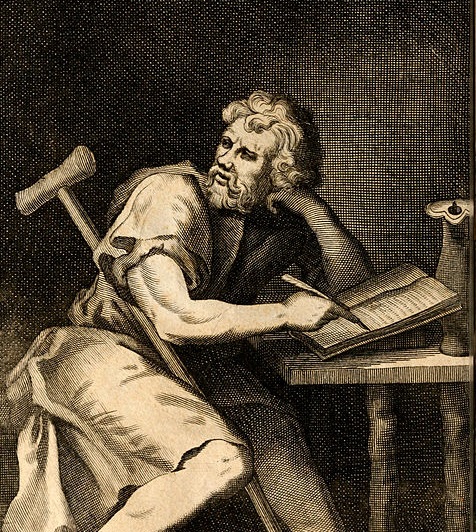
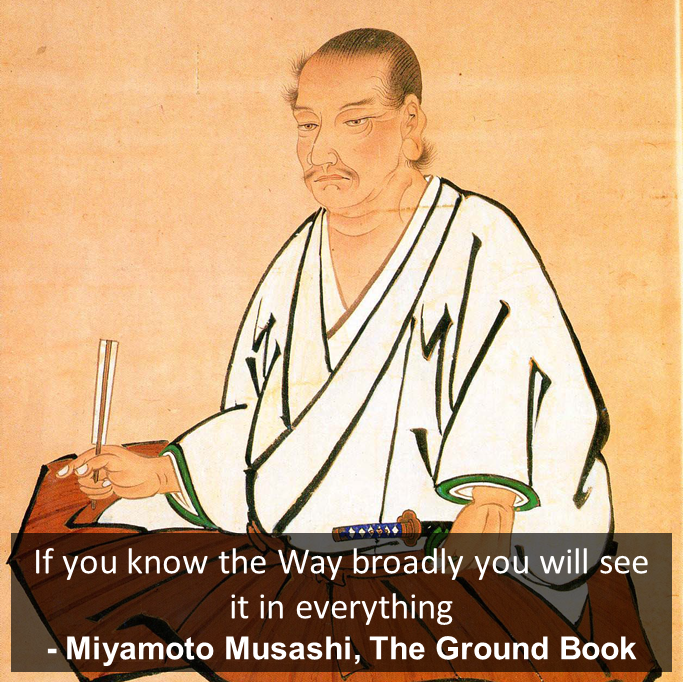
Miyamoto Musashi was the greatest Japanese swordsman that the history of humanity has ever witnessed. Miyamoto Musashi was known for his swordsmanship and remaining undefeated in 61 duels. He was so great and influential in his art that people call him Kensei, a sword-saint of Japan. Along with the greatest swordsman, Miyamoto Musashi was also a great penman. His writings, philosophies, strategies remained of great value in the respective times and are still important today.

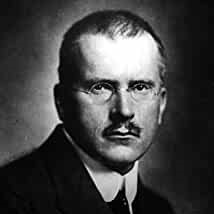
Miyamoto Musashi

Miyamoto Musashi wrote two books in the later years of his life – The Book of Five Rings (五輪の書, Go Rin No Sho) and The Path of Aloneness (獨行道, Dokkōdō). 

Miyamoto Musashi put all his wisdom of a warrior’s life into this “Book of Five Rings”. The five rings namely Ground, Water, Fire, Wind and Void represent the five aspects of his philosophy of a warrior.  The books are a collection of very limited paragraphs and believe me it is intentional. They are supposed to concise reflecting the focused intention of the writer Miyamoto-san.

The Ground Book

The book starts with the philosophy of the Ground. The book seems exclusively written for warriors and martial arts practitioners.

Each man practices as he feels inclined”

Miyamoto Musashi establishes that there are many fields of knowledge, ways of living life. Anyone can learn any way he fancies.

“The Way of the warrior is resolute acceptance of death

Even though every person has to face death in the end, for a warrior the acceptance of death as the ultimate truth creates that urgency for discipline, virtue and intent. Miyamoto-san intends a person to realize the limitedness of the life and the urgency to overcome the ways in which a common life lives the same life. He wants the reader, the warrior to have something that many commoners don’t have that is the victory at personal level and victory at a group level, in teams. And believe me it is not just about victory in sword-fight or a huge battle.

Even though Miyamoto-san clearly discusses the techniques of sword fight one must understand that they are the techniques of living the life, handling the situations in life, creating a fighter warrior’s attitude towards the challenges in life.

The Way of strategy

In simple words, it discusses the discipline to live a warrior’s life. For that Miyamoto-san starts with the function of major professions in the society – the gentlemen a.k.a. the warrior, the farmers, the artisans, the merchants. He clearly points out that these are just people extending themselves through some objects for living the life with some benefits and thereby their survival.    

If we look at the world, we see arts for sale. Men use equipment to sell their own selves.”

Musashi’s view towards life and world is still relevant and unchanged. Our jobs, professions, occupations are extensions of our personality. Some are doing it willingly; some are doing it unwillingly. Even when some people are hating their jobs that is still representing who they are.  

Miyamoto-san also explains how some masters, so called “Gurus”, trainers brag that their technique is the best and try to mislead people with that to gain profits. He highlights that how techniques, the strategies to live better life are being traded objectively for profits. In this chaos of trade of knowledge Miyamoto-san establishes how the value of true knowledge always remains superior irrespective of the show off of the immature people using it for their profit.

Even in today’s times the situation is not drastically different. The mainstream education is already destroyed by the backdated education system, degrees and diplomas are still less relevant for the actual professions, unnecessary and highly profit driven coaching add more to that. You will find every possible type of motivational trainer in every direction you throw the stone. Very few of them are actually doing the job of delivering true wisdom.

The teacher is as a needle, the disciple is as thread”

So, Miyamoto-san tells here that a true teacher only directs to the goal, the direction a needy disciple, true student follows that with proper faith and diligence.

The Carpenter and the Warrior

Miyamoto Musashi tries to establish that the basic ideas of wisdom are consistent everywhere. As every type and size of wood has its own characteristics, it makes sense to use those types and sizes of wood where they prove the most effective. It’s a common sense! Utilize things and manage people according to their type, size, skills and abilities. Not everything is supposed to fit everywhere, actually that withdraws the specialty of that object or that person. And thus Miyamoto-san delivers one of the most important management lessons, that is still relevant today.  

The foreman carpenter allots his men work according to their ability. The foreman should take into account the abilities and limitations of his men, circulating among them and asking nothing unreasonable. He should know their morale and spirit, and encourage them when necessary. This is the same a s the principle of the strategy.

If we try to force the object to fit in, the people to do the jobs they hate we won’t be able to utilize them to their fullest potential thereby lowering the purpose of their existence and even failing in the pursuit of our goals. A good leadership advice!

Body of the strategy

Note that Miyamoto-san uses words “the Way of Strategy” everywhere to highlight his philosophy of living an effective life.

It is difficult to realize the true way just through sword-fencing.

This should again make clear that the book not just about sword-fighting. The ways Miyamoto-san refers to are to understood in bigger aspects of life which is limitless.

Know the smallest thing and the biggest things, the shallowest things and the deepest things.

The inclusive and impartial perspective to look at life is the true way of gaining true wisdom. Only by knowing the extremes of the life one can have a grasp over what is actually happening. Only then one can bring that objectivity in their thoughts, otherwise people become followers of one side, blind worshipers of some great books and great people. The real and true way in in appreciating and understanding the whole spectrum of life. Only then one can live the life to its fullest.

This is a truth: when you sacrifice your life, you must make fullest use of your weaponry. It is false not to do so, and to die with a weapon yet undrawn.

One must make every possible attempt in the challenging situations in life to overcome them. In today’s world we call it as living life without any regrets of not making any attempt to achieve goals. If you are going for pass the last punch in your fight, make sure that you punch real hard, with all your focused intent!

It will seem difficult at first, but everything is difficult at first.

Miyamoto-san again is discussing about how to avoid wrong choices of weapons at wrong places. How you cannot use long sword in narrow places, how short sword is swift, the practicality of handling multiple weapons, the practicality of using the swords of different length based on the confinement, time and location. It becomes very detailed, confusing and overwhelming at a moment, but please know that it is not just about sword-fighting. It is about the common sense of knowing your tools, your behavior, your intent and using them to your full potential according top the situations, places and events.

If you know the Way broadly you will see it in everything

This single sentence is the gist of the whole books of the five rings (But that should not restrict us from exploring the remaining books and philosophies further and it will be an injustice with Miyamoto Musashi philosophy) This sentence is the only reason why one can say that it is not just about sword fighting. There are many ways to live a life. Even though there are infinite possibilities to our lives they make sense only when we have a broader view, a wide intent to make sense out of this chaos of possibilities. Its like changing your perspective of life opens new possibilities and new learnings, new insights from the same thing which earlier made less or no sense.

Why is the strategy only about swords even when there are some other good weapons like halberd, bow, spear and guns? Swords are extension of the warrior’s spirit both theoretically and practically. He explains that further in detail to prove why sword is the ultimate weapon.

Weapons should be hardy rather than decorative

The intent of tool is to get utilized effectively rest is just unnecessary baggage. Robustness of the weapon, your tool is more important than its appearance. In simple words, things, techniques should be designed for the function expected from them (I know it is common sense, but we many times we unnecessarily over-complicate our lives with many things thereby hiding the solution which was in plain sight) It is also about having only those resources which are actually required otherwise you will be spending unnecessary time, capital for managing that extra drag, which itself is a good management lesson.

You should not have a favorite weapon. To become over-familiar with one weapon is as much a fault as not knowing it sufficiently well. You should not copy others, but use weapons which you can handle properly.

In two words – John Wick and in single word – agility. Miyamoto expect the true life to be full of possibilities not some preferences. For that one themselves should be open to experience instead of having a narrow-minded attitude. This agility grants that specialty to the person which justifies his existence and also enables him to handle situation in novel and effective ways.  

Emphasis on originality – when one copies the other and by the chance of time if they face each other the one who has copied his opponent’s technique will not have any type of advantage of creativity. 

Timing

You win battles with timing in Void born of the timing of cunning by knowing the enemies’ timing, and thus using a timing which the enemy does not expect.

Importance of surprise attack or surprise move can be only highlighted once the person has overall understandings of the distance timing and the background timing. Distance timing is the awareness of what is happening with you and background timing means what is happening around you. By distance timing you can only handle yourselves, your moves but in order to anticipate your opponent’s attack you have to understand what is happening around you.

This may seem far stretched but Miyamoto-san is actually referring to different perceptions of times for you and your opponent- it’s always relative and there is a rhythm to it. (here, goes Albert Einstein) In today’s competitive world, it is more important to understand and anticipate the competitors moves and ways of working to defeat him. Excelling yourself won’t always work in non-zero-sum games (and here goes Game theory)

The roadmap to an effective and focused life   

The Ground book is about the outline of the discipline, philosophy and the path to follow it. These are the minimum basic requirements for any warrior seeking accomplishment and wisdom. Miyamoto-san is very specific here. This set of nine strategies/rules is the most discussed portion of the Book of Five Rings. (And yes, it is still relevant today)

  • Do not think dishonestly

Dishonesty removes the objectivity in the learning process. If you remove the objectivity from the learning then the comparison of the facts, object and the observations vary disproportionately with them. This creates wrong and biased observations and learnings thereby. So, if you are ready to call yourself fool when mistakes happen only then you can achieve good objectivity and real wisdom in the learning process.

The first principle is that you must not fool yourself and you are the easiest person to fool.

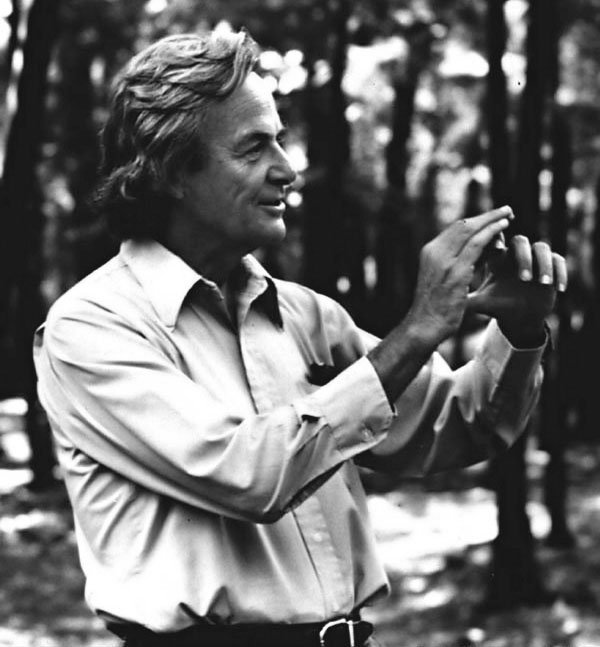
Richard P Feynman
  • The Way is in training

Training builds the feedback loop in the learning process. Reinforcement of this feedback loop creates extraordinary outcomes

I hated every minute of training but I said don’t quit suffer now and leave the rest of your life as a champion

Muhammad Ali
  • Become acquainted with every art

Don’t have preferences because in order to extract synergy from even a single skill, single tool you must know how it works with every other skill or other tool. When you will understand the rules of their working with everything possible you will be able to create something truly new and original. (And trust me it is very difficult to create some really unique and original. That internet post you thought is really personal to you has been already liked and shared by millions of people)

Learn the rules like pro so you can break them like an artist

Pablo Picasso
  • Know the Ways of all professions

In order to become a true leader, one must understand the ways of working of different people and allot the resources to them accordingly to extract the highest possible extraordinary outcome.  

Management is about persuading people to do things they do not want to do while leadership is about inspiring people to do things, they never thought

Steve jobs

If you pick the right people and give them the opportunity to spread their wings and put compensation as a carrier behind it you don’t have to manage them

Jack Welch
  • Distinguish between gain and loss in worldly matters

Have a sustainable decision-making attitude. A true leader considers the consequences of even a small decision based on the broad outcome it will generate. This leader understands that even a small decision can affect the system in a big way.

It is the smallest decision that can change your life forever

Gary Goodridge
  • Develop intuitive judgement and understanding for everything

Have your own perspective about the world, that is what justifies your existence in these infinite possibilities. Have an intent to connect he multiple and distant dots in your life, that is what will make you special and invincible.

Wisdom is not a product of schooling but of the lifelong attempt to acquire it

Albert Einstein
  • Perceive those things which cannot be seen

Understand that things are not what they always seem from their outside. This develops the sense of anticipation thereby an attitude to handle anything that is possible. It will also grant you the intellectual humility.

There are things known and there are things unknown and in between are the doors of perception

Aldous Huxley
  • Pay attention even to trifles

The secret to do things differently is to understanding every detail associated with them. Seasoned artists are best examples of this. They make things look really simple but when a commoner attempt to replicate that, people instantly notice something off in that performance. The secret is that the mastery is about understanding every nitty-gritty of your skill.

The difference between something good and something great is attention to detail

Charles R Swindoll
  • Do nothing which is of no use

Have absolute focus, clear intent in your efforts. (Even when you are having fun have complete fun) Learn to say No when it is of no use or value for you. It removes the drifts and deviations in your experiences.

It’s not the daily increase but daily decrease. Hack away at the unessential

Bruce Lee

One has to understand what Miyamoto Musashi intends while writing the Ground Book. You will notice each and every important moment in his writing he suggests reader to use their own sense and experiences, he wants the reader to appreciate what he is trying to convey and not just read and follow it literally.

You will see sentences like this scattered throughout all five books

…You ought to think deeply about this.

…You must do sufficient research.

…I cannot write in detail how this is done.

…The essence of this book is that you must train day and night in order to make quick decisions.

…You must appreciate this.

So, the Ground book is not just about the plans and ideas to handle the weapons, their timings or some management lessons for a warlord or a strategist or some sword fighter. And believe me it is not a plan or roadmap to clarify his remaining four books. Actually, any superficial reader rather a fool will have the knowledge of things mentioned here.

The Ground book is the foundation of living a life of focus to its full effectiveness, full potential. When Miyamoto Musashi is saying that the Ground Book is like road mapped on ground, one has to appreciate and understand that it is actually the roadmap to our whole life. Again, it is not just about sword fighting and war strategies. The whole purpose of writing such a distilled and rather a short book is just to make the readers aware of the extreme and rewarding possibilities life provides. Exploring and experimenting them with focus and intent is all up to them and that is actually the beauty of an elder’s wisdom. One really has to try it on their own, experiment on their own, practice diligently on their own to appreciate what is actually getting conveyed by the wisdom of the elders.      

There is more to such wisdom which will follow in the philosophies of the Water book, the Fire book, the Wind book, the Void book in upcoming posts.
Links for further reading:
  1. The Book of Five Rings – The Ground Book
  2. The Book of Five Rings – The Water Book
  3. The Book of Five Rings – The Fire Book
  4. The Book of Five Rings – The Wind Book
  5. The Book of Five Rings – The Book of the Void

Music of a painting and portrait of a song 

Can we extend our experiences beyond the limitations of our senses?

A picture is worth thousand words, they say. You try to explain something to your friends and they get confused then you show them the photo/ video of the same thing and the need to explain things disappears. Visual media is literally ruling over all other types of media. This also highlights our dominant way of consuming information, any information. Hence, we can definitely say that vision is the most important of all the senses we use to interact with our surroundings. Important thing to understand is that we can perceive only certain range of light obviously known as the visible spectrum. What if we could extend this sense of vision?

Extending human vision

There are already good attempts for us to see in ultraviolet and infrared region which lie on the both sides of visible spectrum. Special optical filters and thermal sensors can create visuals in ultraviolet and infrared which normal human vision cannot see. In a way, we have achieved UV, IR vision which can increase our understanding about surrounding. This story goes good for people with normal vision. But how does a blind person can understand this highly visual world? Many of us would have experienced and will agree that the lack of a sense for a long time elevates the other senses in such differently-abled persons which helps them to perceive same object with different attributes of senses. We will see one such interesting story of a person who is not completely blind but the way in which he solved the problems in his vision have created a totally different understanding about our ideas on vision and our senses.  

Neil Harbisson – the cyborg with antenna

Neil Harbisson has a condition called ‘Achromatopsia’ also known as ‘Total Color Blindness’ where he cannot perceive the color of objects. The whole world is like black and white television for him. There are some types of spectacles available in market for partially color-blind people which effectively help them to distinguish different colors but there is no such solution for people with total color blindness. Neil solved this problem in a different way.

Neil Harbisson
World’s First Cyborg

The problem of perception of different colors of objects was solved by converting the light into the sound. This simply means that certain sound frequency is assigned to certain color. When a digital camera scans such color, it will create auditory feedback which can be heard by the ears of the person. Now it becomes a learning for the color-blind person to differentiate between different sounds to understand the respective color. With the help of Adam Montadon, a computer scientist, Neil developed an antenna which is physically connected to his head – the rear part of skull – occipital bone. This antenna was further upgraded by Peter Kese and Matias Lizana. The early model of this eyeborg developed for Neil was like a headset with camera and later on it evolved to an antenna, reduced computer weight to computer integrated to a chip. Now, Neil has one tentacle-like antenna over his head.

The “eyeborg” and its feedback

Not only the design and evolution of eyeborg is fascinating but the feedback it provides is very interesting. As we know already that the different frequencies of color are converted to different sound frequencies. Whenever the camera in the antenna is pointed to any object, it gives sound feedback to Neil which enables him to distinguish and experience the color in a different way.

In the early version of eyeborg the sound was fed to Neil through the headphones to his ears. This blocked the ambient sounds for Neil making him unaware of the surroundings. It was like he sacrificed the ambient sound to understand the colors of surrounding objects. The smart update Neil did was to integrate the auditory feedback of eyeborg directly through his skull bones. This eliminated the over the ear feedback of eyeborg thereby freeing his ears for ambient sound. Now Neil hears ambient sound through his ears and the sound for color feedback is heard through bone conduction! Everyone can understand the difference between bone conducted sound and the ambient sound actually. When you hear your voice through a recording you always hate it (maybe this doesn’t happen with good singers!) because it sounds so weird and creepy. This happens because you have always heard your voice through bone conduction and others hear your voice as an ambient sound.

This doesn’t stop here. Neil was unable to understand the saturation in the color in the early versions so he assigned loudness of the frequency to the saturation of the color. The antenna containing camera serves as a Bluetooth/ Internet connection so that he can receive and transfer data to other devices.

Hearing music from a painting

Neuroplasticity of our brain has allowed Neil to understand the world in a different manner. The sonochromatic scale developed to understand the colors through the sound has elevated Neil’s understanding about colors to next level. First obvious thing is that his brain perceives the surrounding colors in terms of different sounds; this allows his brain to associate certain sound to certain objects. For normal humans when we say bus, we generally picture a red bus, when one says an airplane, we generally picture a white airplane, when someone says an ocean, we generally picture a blue ocean. Interestingly, Neil’s brain has developed itself to associate the objects to certain sounds which creates different synaptic feedback in his mind. His perception for general objects is totally different than all the people who can experience color.

We should understand how deeply colors are rooted into our fundamental understanding of nature. And when this understanding is changed to feedback of different sense which is a sound in Neil’s case the experiences are totally different and otherworldly. Even his dreams are filled of sounds for different colors, this is how deeply the ‘hybrid sense’ has been developed in Neil.

NASA released some images from James Webb Space Telescope where they assigned certain sounds to certain colors and tones to stars in the image. When tracked in a pattern you can experience the image in terms of sound which is on crude way of understanding the image through sound (crude way as in it is nowhere closer to the actual sound of the location, it is just conversion of image data to sound date with one to one replacement)

Sound from an image
Source:JWST, NASA

The colors from a song      

Turns out, that the reverse of feedback from the eyeborg is equally interesting. The process of association of sound to a color has gifted Neil to understand the sounds in different way. Though the initial purpose was to comprehend the color through different sensorial feedback, it has given Neil a different type of intellect. Now, when he listens to a song, sound or music he can picture some series of colors. In simple words, he can create a visual and colorful output of an audio array. Though we visualize the sounds or music through complicated waveform, they were never associated to colors to the scale that Neil has experienced before. According to Neil’s experiences now he has a color scheme for certain music pieces, world famous speeches, musical symphonies.

Neil’s Eyeborg and Synesthesia

Actually, there is one human condition which is much closer to the experiences of Neil. There is one condition where a person associates the feedback of a sense to a totally different sensorial experience. The feedback from a sense stimulates some different type of experience. For example, for people with a synesthesia, they may associate certain color to certain number, some people associate the sound to certain color. This stimulation of totally different cognitive pathway by the experience of a cognitive pathway is called as synesthesia. Synesthesia is a natural and rare condition. Neil has artificially developed this condition in him to heighten his awareness of the colors. There are different types of synesthesia based on the association of cognitive stimuli.  

In Grapheme–color synesthesia person associated a color for a letter as in A will stimulate the color red in his mind, in Spatial sequence synesthesia people associate events to certain stimuli so that they have exact memory of events as in with exact date and time, in  Auditory–tactile synesthesia people experience touch or sensation in certain body parts when they hear certain sounds, in Ordinal linguistic personification synesthesia the person associates some objects, sequences like number sequences, calendar months to certain people or genders,  in Misophonia synesthesia the person invokes certain emotions like anger, happiness, fear when certain sounds are heard, in Mirror-touch synesthesia the person are said to have heightened empathy so heightened that they experience the touches to the person in front of them as if someone has touched them actually, in Lexical–gustatory synesthesia the person experiences certain taste upon hearing certain words.

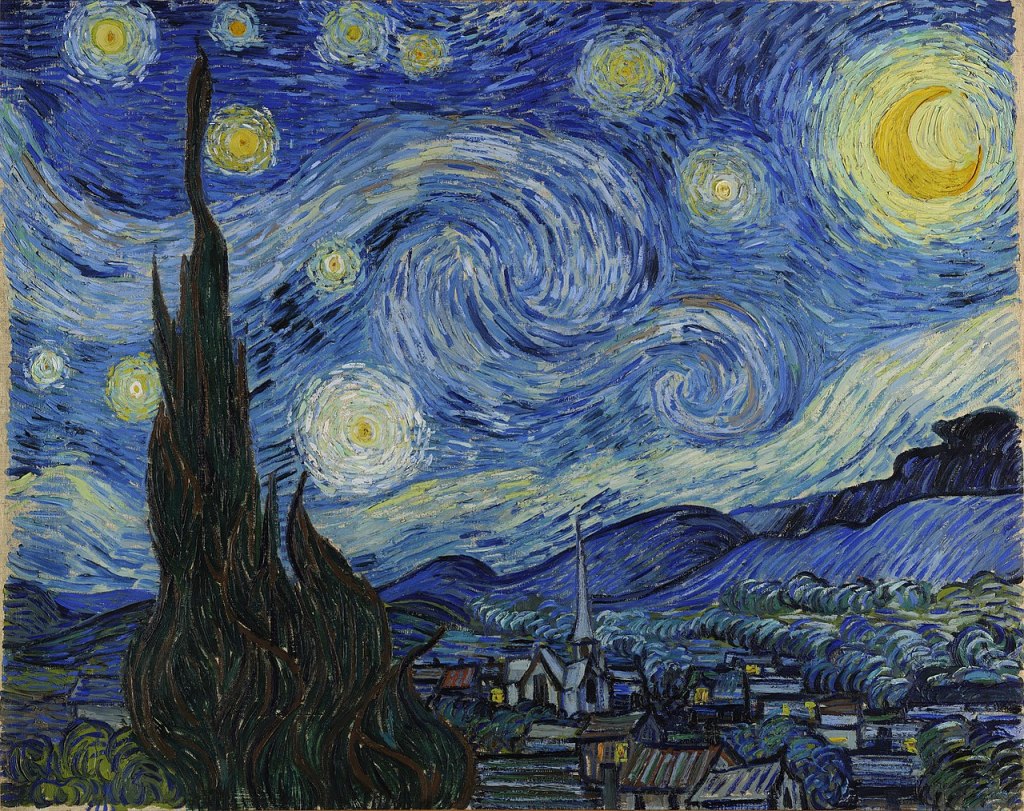
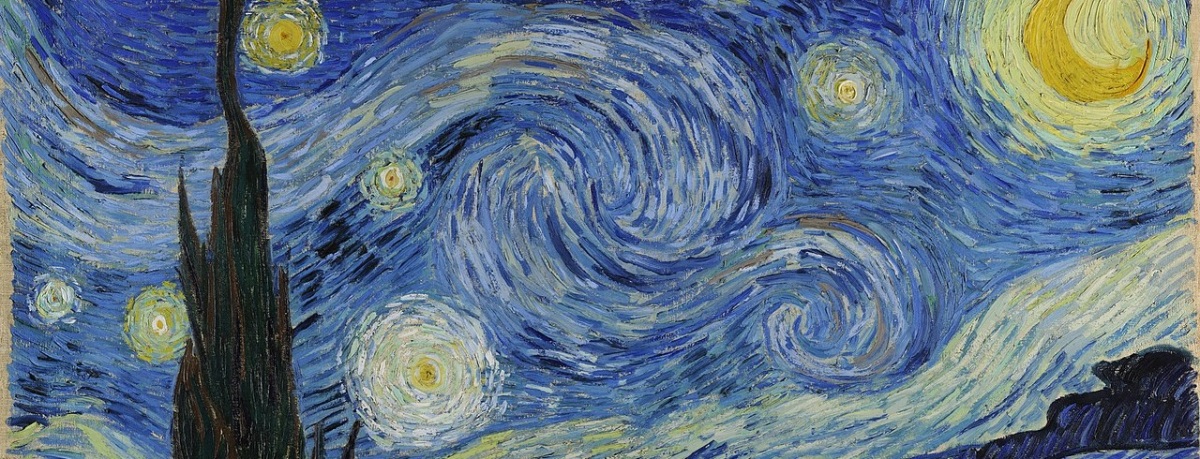
Chromesthesia is the synesthesia which deserves separate explanation for our discussion. In Chromesthesia, the person assigns a color to the sound they hear. Which exactly what is happening in the case of Neil but artificially. According to art historians the famous artist Vincent Van Gogh has   Chromesthesia which made his paintings so vibrant. According to one such comment Vincent tried to learn Piano but left it midway because the notes of piano invoked different colors in his mind thereby overwhelming him.

Van Gogh’s The Starry Night

Jack Coulter – one of the artists of our generation has Chromesthesia. He is known for his abstract art pieces which reflect the way he interprets the sounds and music. In simple words, he paints the songs. Jack’s paintings of are such an experience. You can find his paintings on some famous songs on his official Instagram page which includes ‘Love of My Life’ by Harry Styles, ‘The Best Day’ by Taylor Swift, ‘Running Up That Hill’ by Kate Bush, ‘Don’t Tell Me’ by Avril Lavigne, ‘Take me Home Country Roads’ by John Denver, ‘As It Was’ by Harry Styles. He even has created an art piece for the world famous ‘Cornfield Chase’ soundtrack from Christopher Nolan’s Interstellar.     

Jack Coulter’s ‘Mr. Bad Guy’ painting based on Freddie Mercury’s song of same name

A mix-tape of senses and the hidden reality – philosophical implications

This crisscross of our senses and the stimulus actually questions the nature of our reality. If we question the nature of evolution by question like why can only eyes see color and why can only ears hear the sound which are very fundamental philosophical questions (so fundamental that the person who poses them may be called a mental person), then we will understand that it is the nature of light to impart the color to the object, it is the nature of sound to impart the vibration of the object which developed such organs in a way.

But if we dig deeper and question the limitations of our perception of sound and light then we will realize that what we perceive or feel through our senses is just a sample or small piece of all the experiences presented by the reality. For simple example, though sound (mechanical) and light (electromagnetic) are all but vibrations, the extent of their experience or the ranges in which they exist or the things they are made up of cause them to collapse into two distinct sensorial experiences.

And when we are trying to resolve such questions about the senses, the conditions like Synesthesia or the cyborg movement created by people like Neil try to modify our understanding of the reality that we live in. If these people can interpret the colors into sounds and sounds into colors, are our senses limiting us from a different type of awareness? Are we missing some extra information from reality due the limitation of our senses? In simple words, even though there are many colors around us we cannot see in dark but most of the animals have awareness of infra-red spectrum or night vision which gives them extra information of the same surrounding where we all coexist. Bees, butterflies, insects can detect ultraviolet light to understand the pollen part of the flowers which we cannot see by or normal vision. This questions the reality and our experiences from it

For a no person with complete awareness of his/her senses, the cognitive stimulus and feedback is almost hardwired. This stimulus and feedback are what create reality for us. We cannot experience even a common thing without experiencing the interactions of our senses with the surrounding. And when we realize that there are other ways to experience the same reality by connecting it to totally different sense and stimulus, this opens a new chapter in our understanding of the nature. It’s like being aware of the ultrasonic sounds as same as owls experience it. This opens a totally different universe for all of us – the hidden one which was already there. Maybe this is the sixth sense many people talk about. Actually, our lives and the experiences that we have, are always being dictated by the five senses that we experience.

Bertrand Russel had made some attempts to crack such question in his world-famous book called ‘The Problems of Philosophy’. In the very first chapter called “Appearance and Reality” of this book Russel concludes that this can be a question which may remain unsolved forever. He uses a concept called ‘sense-data’ as in the information which we immediately know from our senses as in smell, color, sound. Russel clarifies based on a structured thought process that what we perceive as a reality is mere the what it appears to us based on the senses we experience (also known as sense-data). If our sense-data gets limited our understanding of reality will be limited. As the reality we experienced through our limited senses will be a reality for us, it will not be the complete reality as in “the reality” – “the ultimate/absolute reality”. (I know this gets confusing from hereon) And if the reality through our senses is not complete reality that how could we transcend to the realization of “the ultimate/absolute reality” by extending our senses? Or is it a completely different pathway? Russel leaves that idea to the power, need and importance of philosophy.

There is definitely much more information that we are missing only because of the limitation of our senses. So, the reality is not we experience through our senses only, it is more than that which maybe is impossible for us to grasp for now. Maybe in near or distant future we will be able to understand reality in different way like Neil, Jack and many people like them.

P.S. – Most of the artists have mastered this transcendence of senses in their own ways, which is what makes art so special for humanity. Maybe it is the only way we have right now to extend our senses.

References:

  1. “A picture is worth a thousand words” – image by ElizabethHudy from flickr
  2. Neil Harbisson: I listen to color – TED
  3. Neil Harbisson – Image by Don Walton
  4. Jack Coulter’s ‘Mr. Bad Guy’ painting -Photograph by Richard Gray for Freddie Mercury Estate
  5. jackcoulter.com/
  6. cyborgfoundation.com/

The Practicality of Philosophy

What is the purpose of Philosophy?
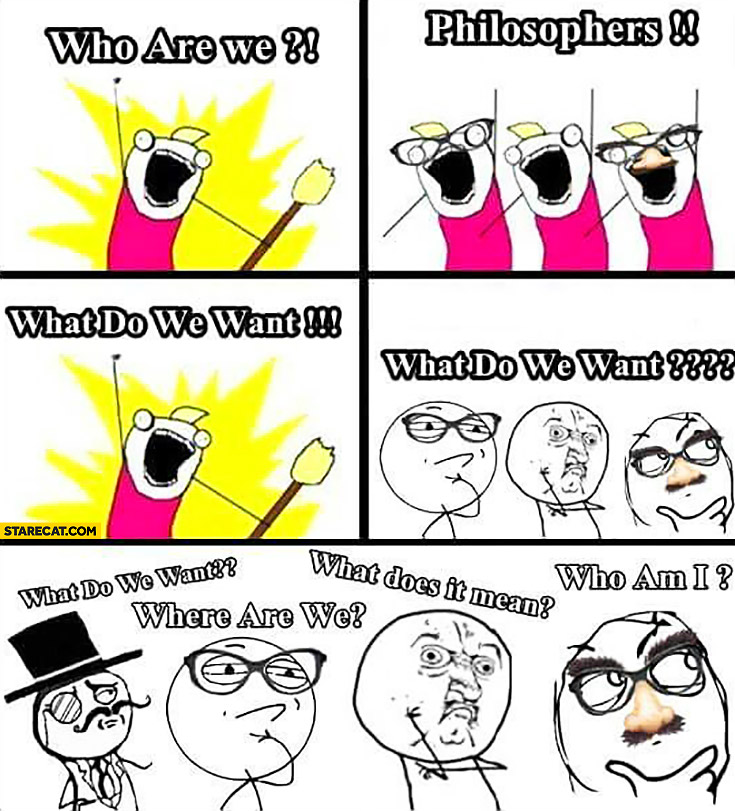
one of my favorite memes (Source: starecat.com)

We live in a competitive and fast-moving world where everything’s success depends on the outcomes and their value delivery. Take any example, if any movie release fails to entertain the major audiences, consider it flopped; if any project is not delivering the expected profits to the company consider it stopped; if any equipment is not working properly for the performance it promised, consider it a market failure; if any start-up is not built upon the actual market requirements, consider it a flop business; an employee fails to reach his targets, consider no promotion or even a pink slip. Whenever you are working on achieving anything and if your actions and thought process behind them are not directing you to the Goal, people will suggest you to change your strategy. In nutshell, everything you do, every thought you have is expected to have a fruitful outcome, value creation, profit, gain, benefit thereby there must be some utility. We now call these things, these thoughts “practical”. General thought process always suggests to have the practical way of life in order to succeed in a way.

I am of the same opinion, that doing certain things, acts, thinking (actually overthinking) about everything you stumble upon is expected to deliver some “practical” benefit in my life. If you studied enough and can’t get the job of specific salary then what good is your education? There must always be some definite value delivery from our actions otherwise we are just wasting time and getting nothing.

The situation worsens when you implement the same logic to the ways you think about anything and everything you stumble upon. It is like day dreaming as you are only thinking about some random things, are engrossed completely in the world of your own and there is no real-life benefit from it. Then, it becomes imperative to “Get Real” in life, sort your things and be practical and use your common sense.          

Now, here comes a short story-

In a fight, the flight attendant finds an elder person going through severe chest pain, she immediately asks for the expert help.
Flight Attendant- Attention all, we have an emergency. Is there any Doctor onboard?
(One person raises his hands)
The person- Yes, I am a doctor.
Flight Attendant- We need medical help.
The person- But, I am a doctor of Philosophy.
Flight Attendant- He is going to die
The person- Aren’t we all anyways?

One can only imagine the awkwardness and impractical response of philosopher to the situation in the flight.

I used to think that the philosophy and it’s ideas yet interesting and intriguing cannot handle the reality of life and solve practical problems.

And, (as usual) I was wrong.

Here it goes…

The question is-

Will thinking about every possible thing you are exposed to (and even about the things you may never get exposed to) and asking “unnecessary questions” about it add value to our life? Will thinking about things irrelevant to your job is going to increase your performance at your workplace? Is thinking about any random thing is going to put food on your table?

In short, what is the worth of the philosophical ideas, questions if they are not going to solve our practical problems? What is the practicality of philosophy?

This was the question I was stuck at; even though philosophical ideas have always intrigued me.

Then I found my answer in Bertrand Russel’s book called “The Problems of Philosophy” with the last essay called “the Value of Philosophy”. The ideas explained by Bertrand Russel in this writings answer the very basic question about the utility of philosophy.

Ends of life

Russel explains the idea of ends of life by distinguishing between the nature of Physical Sciences and the philosophy. The idea is that all the physical sciences that we as a human have established have contributed to the society in some ways. The developments in physics led to inventions of uncountable things like lasers, semiconductors, telescopes, machines and what not hence landing mankind into the modern world. The developments in virology, bio-technology, modern medicines helped us to come out of the global pandemic. The developments in geography helped us to explore the globe, share our trades, cultures, profits, save us from natural calamities. The psychology helped in maintaining the mental well-being, the social well being of the society there by controlling the sanity in the people. The economics helped to efficiently utilize and manage our resources in order strive as a species on a space floating rock. These physical sciences have mastered various ends of life and are continuously contributing ahead

What about philosophy? If we are going to discuss how certain philosophy has solved the world hunger or how a philosophy has cured the incurable diseases in history or how a philosophy has saved people from famine or how a philosophy landed us on another celestial body, then the answer is surely no. There are no practical ends of life which philosophy helps us to achieve.

Uncertainty of philosophy

Bertrand Russel has very beautifully established the difference between the nature of Physical Sciences and philosophy. The Physical Sciences have postulates, theories, formulae, a definite structure which builds the all knowledge they represent. There is a systematic path to be followed in order to answer the posed question. If you ask a physicist why the sky is blue? he will approach the problem from the branch of optics then thereby refraction and scattering and the spectrum of light. If you ask how the eclipses occur? to an astronomer, he will take you through solar system, to planets, their satellites and their rotations, orbits. It can go on and on.

In short, in all the physical sciences the truths established are definitive. There are definite answers to the questions posed. Such is not the case with philosophy. If you pose a philosophical question as in “What is the purpose of life?” every philosopher will have his own versions and there is no surety of definite answer. If you ask questions like, why was the world created?  Why was the universe created? Are we really body with a soul or a soul with a body?

See the pattern we can observe from the philosophical questions is that the truths they are giving are not certain. On contrary, the truths revealed in physical sciences are definite, their truth value is certain based on the truths they are derived from due to structured-ness. Bertrand Russel establishes that all the physical sciences are originated from philosophy. When the definitive-ness, certainties of truth extraction system, knowledge building system of these philosophies became strong, they separated from the philosophy and get independence.

Thus, the only thing certain in philosophy is that there are no certain answers to the questions posed. If the answers are getting definitive, certain then a new physical science gets established thereby separating from philosophy. Philosophy of mind became psychology; philosophy of heavenly bodies became astronomy.

What I found interesting in this idea of “genesis of physical sciences from philosophy” is that though upon certainty of truth/ knowledge physical sciences become free from philosophy, the next unanswered questions in physical sciences immediately start to redirect themselves to philosophy again until the certainty of answers are obtained thereby proving the presence of philosophical inheritance.  Our quest for understanding “the nature of reality” in the world of modern physics is one such strong example.

Richard Feynman in one of his famous lectures discussed about questioning the nature of reality as we understand:

“it’s a very strong tendency of people to say against some idea, if someone comes up with an idea, and says let’s suppose the world is this way.

And you say to him, well, what would you get for the answer for such and such a problem? And he says, I haven’t developed it far enough. And you say, well, we have already developed it much further. We can get the answers very accurately. So, it is a problem, as to whether or not to worry about philosophies behind ideas.”

Richard Feynman

Meaning is it not always compulsory to have structured-ness and definitive nature to any idea. There may be always some indefinitve-ness to the answers in philosophy.

Truth of the answers to the questions of philosophy

Now that it is clear that the answers to the questions in the philosophy are not definite, not certain; it is also important to understand that the answers don’t lose their value due to their indefinite or uncertain nature. Rather they bring us closer to the unrealizable, un-experienceable truth.

According to Russel, the confinement of knowledge is the major point which poses the question on “the practicality” of philosophy in our life.

I think what Russel is trying to say here is that as soon as the nature of the truth of knowledge starts following a pattern/ a trend, it gets confined in the structured-ness of certainty thereby getting its independence, self-reliance. The philosophy hence will always remain as a field (even the word “field” is so confined) rather expanse of uncertainty where there will always be some room for speculation.

In order to ask for value of philosophy, one has to confine it to some ideas and then compare these ideas to other ideas. But the game philosophy plays here is that the you lose the identity of philosophy once you confine it to some set of ideas in knowledge/ physical sciences. Thus, remains incomparable.

Funny thing is that the solution of such problem will start with – What is comparison? How to measure the worth of anything? (Which themselves are good philosophical questions!)

Philosophic Contemplation: the idea of Self and not-Self

Russel suggests that the value of philosophy will be only realized when the ends of the life are not limited to ‘Self’. I think what Russel is trying to convey is that the realization of something greater above ourselves itself is humbling. Understanding that the knowledge will still exist irrespective of our existence is one important part of we becoming free from our own identity.

When there will be search for knowledge for Self, the answers gained will be confined, they will always reflect the nature of the self or the seeker.

But, once one understands that the knowledge, philosophy is above himself i.e., once a person starts seeking questions to the answers not for the betterment of himself only but for the knowledge itself then the knowledge reveals itself. This knowledge will not be definitive, certain. This knowledge will not have concepts of good or bad, pure or impure, left or right, profit or loss, worthy or unworthy. It will be only the knowledge itself where truth is still uncertain, indefinite an innocent. Russel calls the philosophy as the union of Self with not-Self. That is in order to understand something greater than ourselves, we have to lose the idea of ourselves, our being.

The curse on humanity

The question of finding the worth of philosophy itself has its own limitations. The concept of being worthy brings in the ideas of comparison, tradable value, what one gets in return, replacement value, a sense of transaction, gap due to absence, appreciation due to presence. This transactional, tradable, replacement value itself is a very small part of materialistic ideology of our human life.

See, our existence, thereby we being alive is dependent on so many materialistic things/ resources which are inherently important for our existence. You will not find a beggar asking for the explanation of the ideas in stoicism or nihilism. Most of the times he will only think about the ways to get the next meal. (Although, a beggar can also question about nature of him being a beggar

instead of a king if he wants)

In short, what I am trying to establish here is that for us as a human being, we need materialistic objects and our interactions with them through our senses to become aware of our consciousness. To become sure that the materialistic world and the sensations from them are not the only bounds of the life that we live in. The curse to human life here, I would say is that the first step in awareness of “knowledge greater than Self” starts with the awareness of our materialistic nature. Our first dose of true knowledge is only possible from the establishment of truths from the material world and our interactions with them. The material worlds being born from higher level of “uncertain things” reveal these uncertainties, thereby making us question their fundamental nature. This leads us to understand that there are things greater that what we are experiencing but there is no surety of completely true, certain answer.

Lifting the curse

I have a thought that, there is also benediction for this curse, rather anti-curse which is “the Curiosity”. Curiosity itself is the definition of philosophy. The whole purpose of philosophy is not to find the definitive answers, truths to the questions rather it is asking the questions and keep asking the questions.

Satisfaction of the curiosity is I think the boundary of the truths. The extent of satisfaction of the curiosity will be dependent upon how real or practical you want to get (What is the extent of real and practical also needs definition thereby). Here, there is no place for value, worthiness rather it is about satisfying the purpose and truly implementing philosophy to solve some real problems.

Bruce Lee has one famous quote on the same front:

“…here is the natural instincts and here is control. You are to combine the two in harmony. If you have one to the extreme, you will be very unscientific. If you are another to the extreme, you become, all of a sudden ‘a mechanical man’- no longer a human being. So, it is a successful combination of both, so therefore it’s not pure naturalness, or unnaturalness. The ideal is unnatural naturalness or natural unnaturalness.”

Bruce Lee

It is about the union of Self and not-Self to find the knowledge as Russel explains. You need not to infuse your boundaries, your prejudices to the questions of philosophy while on the quest of knowledge. You have to again lose your identity to find the real knowledge.

Again, Bruce Lee’s philosophy about being water reflects similar ideas about the nature of true knowledge from philosophy.

“Empty your mind, be formless, shapeless, like water. Now you put water in cup, it becomes the cup. You put water in bottle, it becomes the bottle. You put it in a teapot, it becomes the teapot. Now water can flow, or it can crash. Be water my friend”

Bruce Lee

Be water my friend!

Bruce Lee

This also explains the innocent nature of knowledge. It takes shape of anything that it is in.

(That is the exact reason why we were forced to write the essay in our school on “Science: Curse or Boon”! OK, Jokes apart)

Having answers to the questions ends the quest thereby giving the boundary to the idea; asking the questions creates the possibilities. And creation of possibilities however uncertain they may be is the purpose thereby the worth of philosophy.

So, philosophy is not about finding definitive answers, it is about keeping on asking questions.

“I would rather have questions that can’t be answered than answers that can’t be questioned.”

Richard Feynman


“Through the greatness of the universe which philosophy contemplates, the mind is also rendered great, and becomes capable of the union with the universe which constitutes its highest good”

Bertrand Russel, The value of Philosophy from “The Problems of Philosophy”  


Further readings and references:

  1. The Problems of Philosophy by Bertrand Russel
  2. Richard Feynman– image from Wikimedia
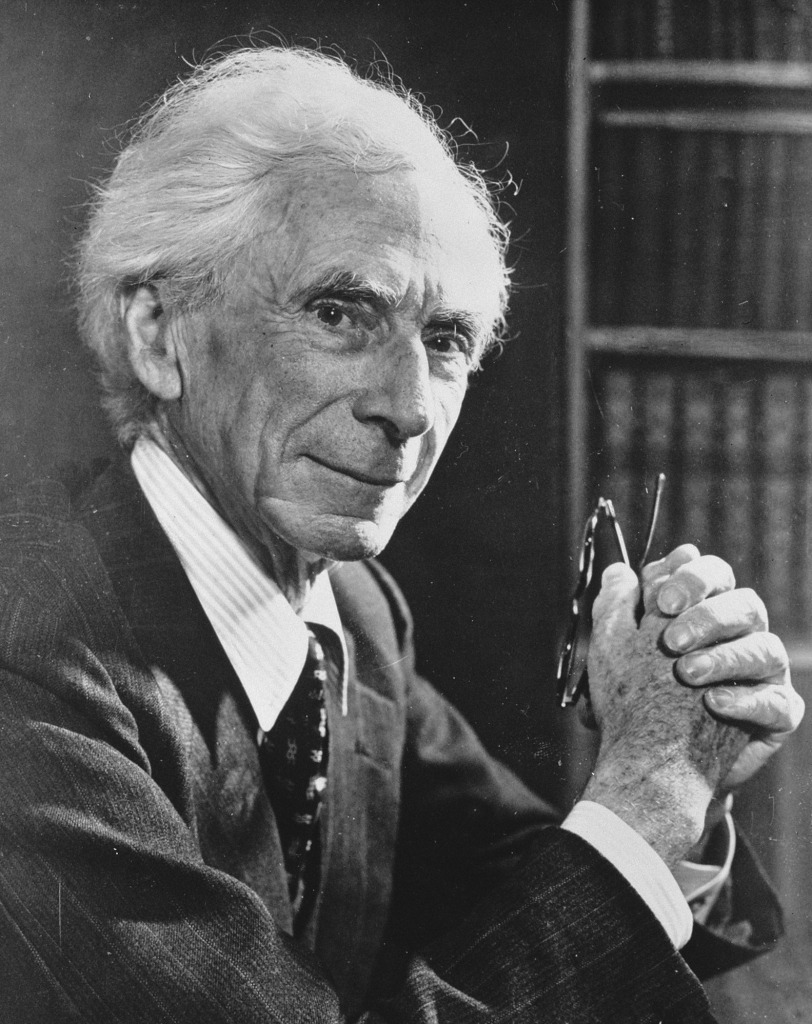
  3. Bertrand Russel– image from Wikimedia
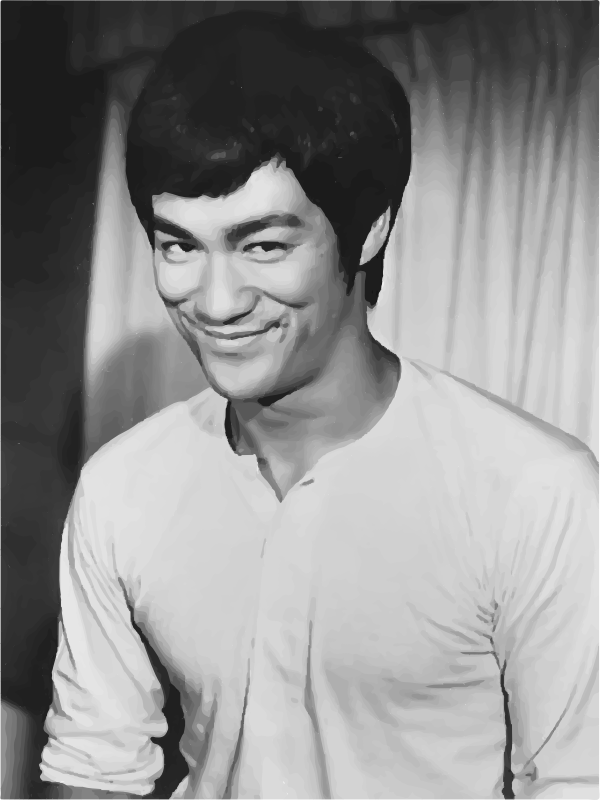
  4. Bruce Lee– image from Wikimedia
  5. Philosophers meme- Form starecat.com
  6. Clip from the lectures by Richard Feynman from youtube.com
  7. Clip on Bruce Lee’s Philosophy from Bruce Lee “The Lost Interview” from youtube.com

The Green Knight – A Story of Killing the Boy

Many people who have had a near-death experience tell that their whole life flashed before their eyes. Although, it is difficult to try out and experience the reality of it, experience shared by such people is interesting and indicates what it means to be a conscious human being rather a living thing.   

Many of us would have also seen drastic behavioral changes in people after they have gone through a difficult disease or after they have gone through an accident but by mere luck their life was saved. Such life altering events have influenced their thought process and their understanding of life in such a way that all their acts, their discussions, their decisions reflect the strong influence of death.

This is not just about the exposure real life-taking moments; Sometimes, these near-death experiences are symbolic. Everyone of us have such moments in our life where we reject who we were and what we represented earlier to accept what is about to happen in order continue our journey forward, to survive. Such events are very common in everyone’s life and are very uncomfortable in every sense, that is why we never discuss such things very often.

“Sir Gawain and the Green Knight” is a one such piece of Chivalric Romance from the 14th century which is closely bound to the legends of the King Arthur. The story of the Green Knight is one of the most important parts of English literature.

This discussion is based on a movie called “The Green Knight” by David Lowery starring Dev Patel as Sir Gawain who is the nephew of King Arthur. There will be heavy spoilers in the further expansion of ideas so, Warning! Those who have watched the movie can simply skip the synopsis.

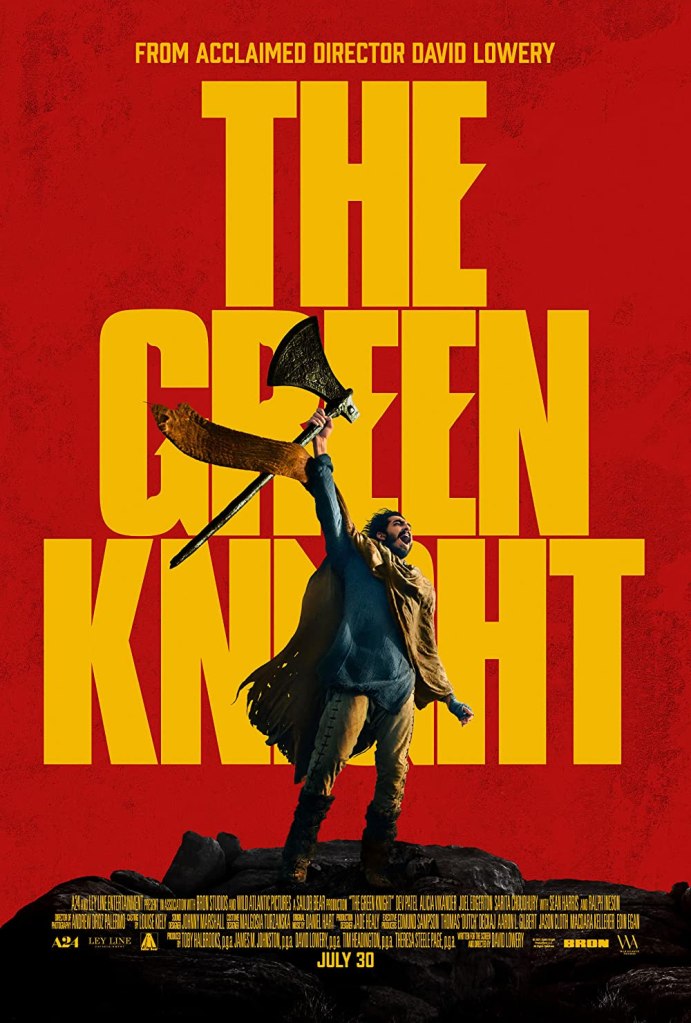
The Green Knight

Poster of movie The Green Knight by A24

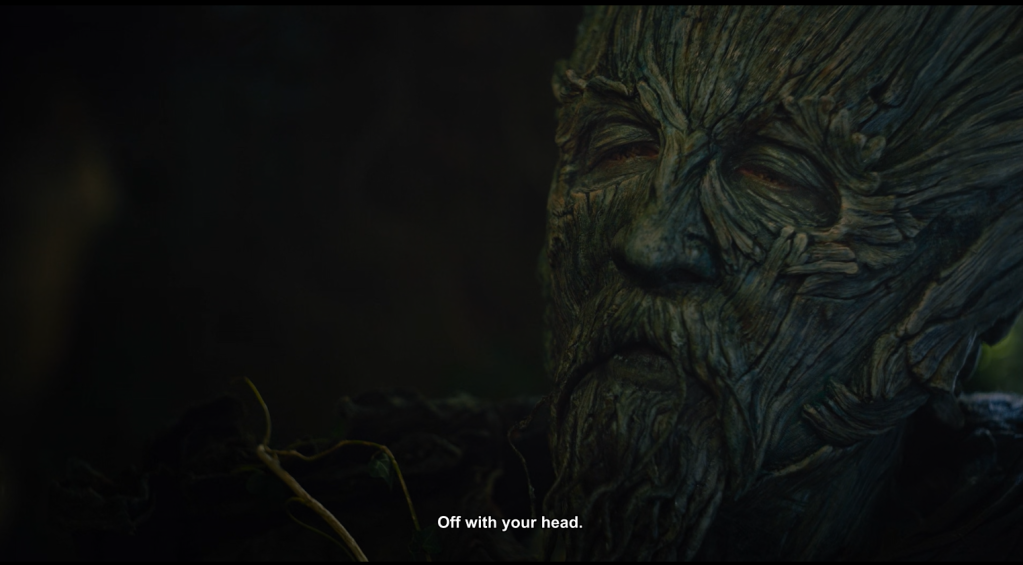
In this story, Sir Gawain (who is yet to become a knight) is the son of King Arthur’s Step Sister who performs enchantments and magic. On the morning of Christmas, Gawain is with his lover called Essel in a brothel instead of visiting the Church for which he receives scolding from his mother. Gawain’s mother asks to leave without her to the Christmas celebration at the King Arthur’s Round Table. Where, King Arthur, asks Gawain out of all the knights present in the tower to have a sit by his side. After having a discussion with King Arthur and his wife Guinevere, Gawain realizes that, out of all the Knights present for the celebration, he is the only one who has nothing to talk about his honorable deeds, brave acts to support his “Knighthood”. He realizes that though people expect him to be a knight by the birth-right, he has not done anything to prove and validate this knighthood. The queen tells Gawain that, he is yet to receive the opportunity to prove his worthiness, which settles the storm in Gawain’s mind. And at this moment the Green Knight appears in the celebration. The green knight looks exactly like ‘the Groot’ from Marvel movies. The appearance of the Green Knight is caused due to the magic of Gawain’s enchantress mother. The Green Knight appears near the round table with his horse and an axe to play a game. The game’s rules are simple- One able man from the Kings knights will get an opportunity to strike a blow to the Green Knight and if it hurts the Green Knight, he will be the owner of the axe of the Green Knight and in a sense the fame, glory followed with it. But, his poses one condition to this game- that after hurting the Green knight and owning his axe, the game will only be considered as completed when the same person will visit him in the Green Chapel after exactly one year and one day. The Green Knight will return the same strike to the person and then they will part on a friendly note.

Everyone in the celebration is scared by mere presence of the Green Knight and hence is scared to represent the King against the Green Knights proposal. This is the moment where Sir Gawain (with all the adrenaline) realizes that demonstration of courage for the opportunity offered may prove his worthiness and he accepts the challenge of the Green Knight. King Arthur offers his Excalibur to blow the strike against the Green Knight. Without any defense, the Green Knight offers his neck to Sir Gawain and seemingly confused but in the rush of proving himself, Sir Gawain separates the Green Knight’s head from his rest of the body and people cheer for him.

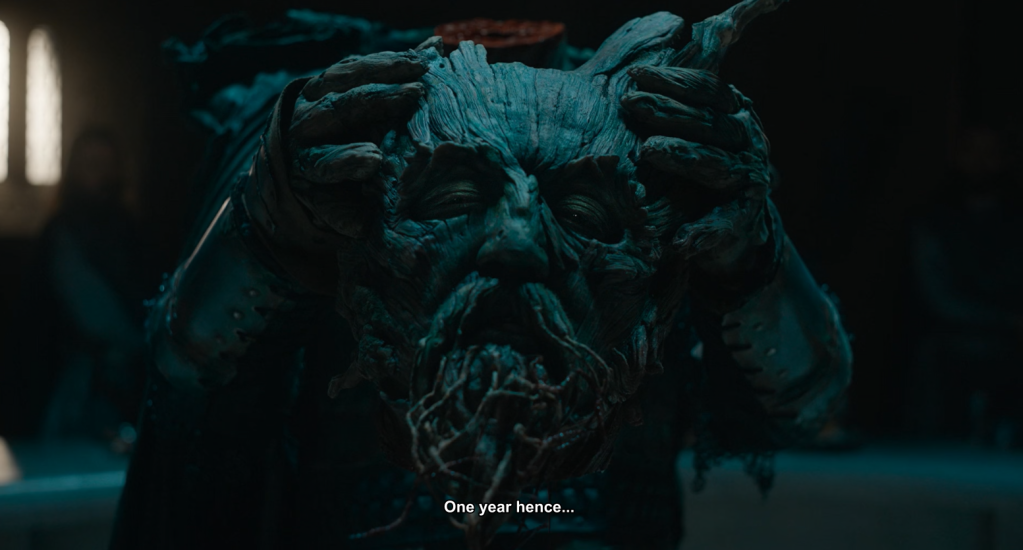
In few moments, the decapitated body lifts the separated head to remind everyone that this is only the half part of the game and the game will be finished when the Green Knight will return the same blow to the same person in exactly one year and one day in Green Chapel.  

– A gentle reminder –
(Scene from David Lowery’s ‘The Green Knight’ by A24)

This is the dreadful moment when Sir Gawain realizes the foolishness that has brought upon the death in front of him. And swiftly, the year passes – the stories of the Green Knight have made him famous all over, thus reinforcing people’s belief in his chivalry and honor.

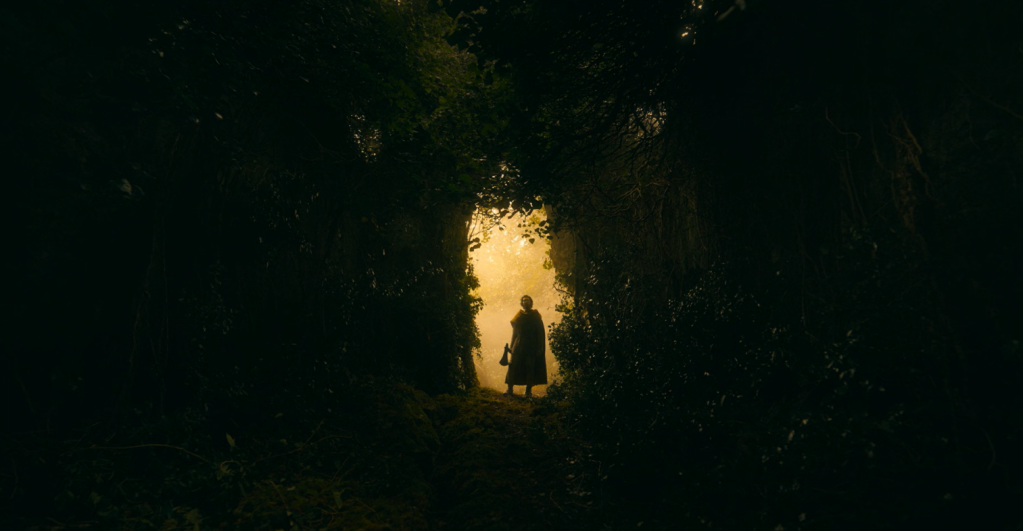
But deep down, Sir Gawain knows that it is only the death and its fear that he has received after performing this act on the Green Knight. But, as an aspiring Knight and heir to the throne, he thinks that honor calls upon him. Facing the Green Knight is the only option for proving the nobleness and greatness of his character. With heavy heart and knowing that the return blow by the Green Knight will be more than sufficient to end his life, Sir Gawain leaves for the Green Chapel with the same axe to complete the challenge. On this journey his mother has given him a magic girdle –a sash, a magic belt which will protect him from any harm as long as he wears it.

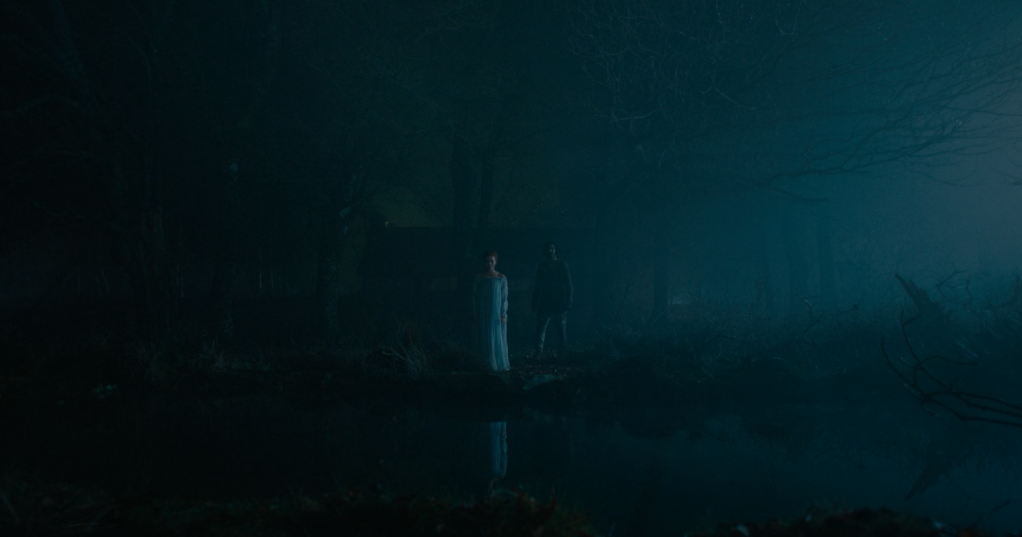
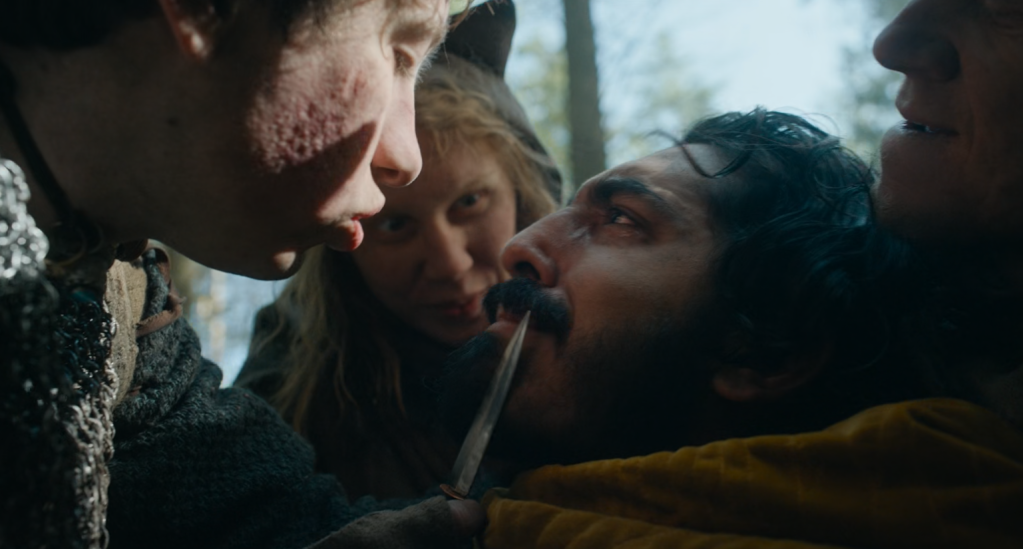
On the journey ahead Gawain meets a boy in a battlefield who gives him direction to the Green Chapel and asks for return of the favor. Gawain simply thanks him and after forcing for the payment he pays the boy a coin. The same boy with his friends loots Gawain stealing all his belongings with the axe. They tie Gawain all over leaving him to rot to death. Sir Gawain- helpless at first realizes that in order to survive he must break himself free and tries to free himself with the sword left behind. By the night, with a strong feeling of homesickness, he visits an abandoned house where he finds a bed to rest. A ghost of a young woman called Winifred awakens him which demands her head to be retrieved from the lake nearby. Gawain asks Winifred what’s in it for him to help her. Winifred refuses to provide anything in return but anyways Sir Gawain reunites her head with her body. He receives his lost axe in return reminding him that he cannot return home because his fate is waiting for him.

-Gawain to retrieve Winifred’s head-
(Scene from David Lowery’s ‘The Green Knight’ by A24)

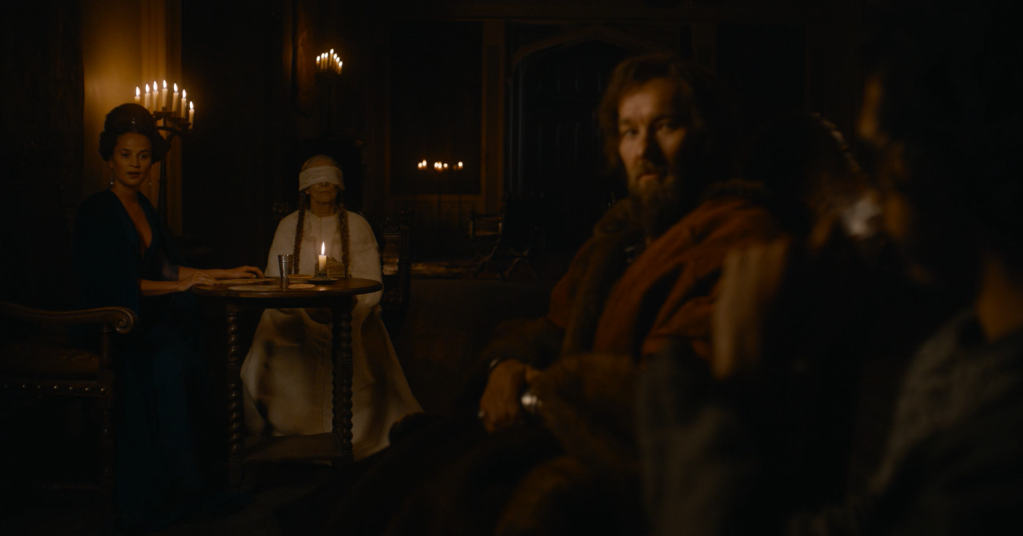
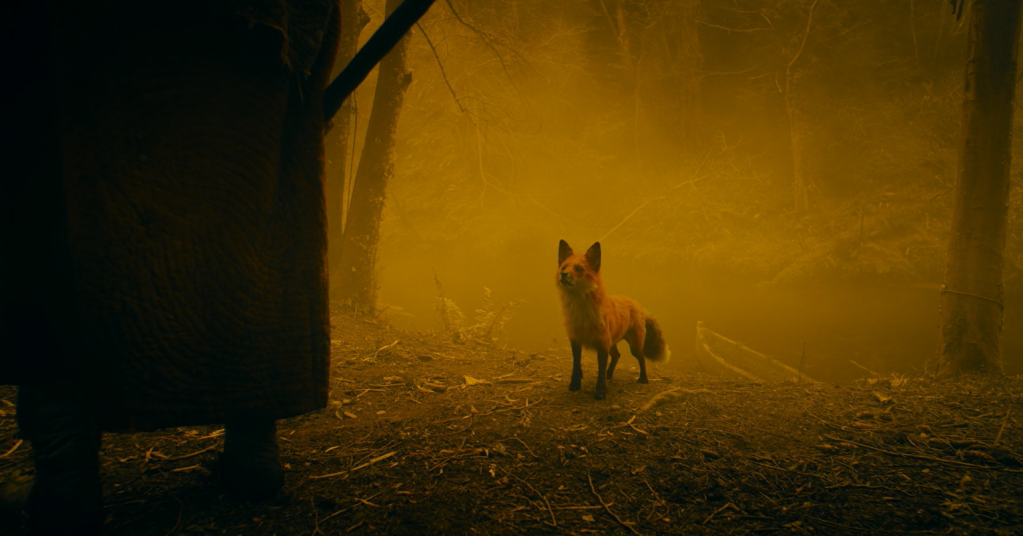
In this journey, Gawain makes friendship with a fox who is constantly following him. During a storm, Gawain lands in a Castle where a he is welcomed by a Lord, where he loses the fox. The Lord treats Gawain well and comforts him that he is very close in his journey and the Green Chapel is mere a day close from his castle so he can rest for few days. The lord’s lady has uncanny resemblance to Essel- the love of Gawain and the lord’s mother is always seen blindfolded yet aware of the surrounding around her as if she can still see Gawain. This creates some uncomfortable situations for Gawain. The lord’s lady makes seductive advances on Gawain and on the other hand the lord proposes that he will return whatever best he will receive from the hunt to Gawain and Gawain will return him whatever the best he has received in from the castle in that day. The lord’s lady offers the girdle similar to the girdle Gawain lost during the thievery at the battlefield in the return of his kisses. Feared to the the loss of his life, Gawain gives the kisses to the lady for the Girdle in exchange and flees from the castle as soon as possible. When crossed by the lord and asked for the return of the boar from his hunt, Gawain hides the Girdle and only gives the kisses in return to the lord which he had received form the lady. The lord also frees the same accompanying fox found during the hunt to Gawain, thus Gawain and the fox are reunited for the final journey.

The fox starts speaking to Gawain asking him to return from this journey and nobody will know of it and he still has the chance to live more years because it is only the death that he is approaching towards, in the coming moments.

Gawain refuses the fox’s offer to leave from the challenge and to prolong his life saying that it will not be honorable and great. And hence, approaches the Green Chapel with all the mixed feelings of courage and fear of the death. He sees the Green Knight in hibernation and waits for him to awaken. On the exact next day as planned – the Green Knight wakes up and asks Gawain that is it the same day to complete the challenge.  Helplessly and knowing that this will be the final day of his life, Gawain offers the axe to the Green Knight and his neck to return the same blow he struck to complete the challenge- the game.

At first stroke Gawain flinches, and he is reminded by the Green Knight that when Gawain was about to blow the strike the Green Knight didn’t flinch.

At second strike Gawain again flinches and asks that is this everything that is in life? And the knight says this is all there is.

Upon accepting that this truly is his final moment, Gawain gathers all the courage, escapes from the third strike and leaves the Green Chapel knowing that he has not completed the challenge. But, he is aware that whatever has happened is only between him and the Green Knight, nobody can challenge or question the greatness of the Sir Gawain plus he gets to live by missing the challenge, fooling the death itself. After his return, Sir Gawain becomes the King Gawain- the successor of King Arthur and the greatness of the title. He becomes father of son from Essel but rejects Essel because of her identity with the brothel. He marries a lady of a noble house and becomes a father to a girl. Then in a battle loses his son. After this huge loss, he also loses the respect people gave him. In this downfall, when the enemy attackers are finally on the verge of acquiring the castle, King Gawain realizes that this will be his last moment. During all these events after the escape from the Green Chapel we as an audience understand that the Gawain sustained the third strike because of the Girdle given by his mother. Sir Gawain and King Gawain thereafter never let go of the girdle understanding that it was only the girdle which kept him alive. Even in the intimate moments with woman he never removed the girdle as his life was bound to it. At the final moments of the attack, at the castle, King Gawain realizes that he has accomplished and experienced everything that there is to do and experience in life. Satisfied with his achievement and the life experiences gained after the event at the Green Chapel, King Gawain removes the girdle and his head falls down which was held till date from the strike of the Green Knight only because of the girdle.

Then there is complete moment shift in the movie where we see the face of young Gawain still in the Green Chapel waiting for the third strike from the axe of the Green Knight. Until this moment, we as an audience understand that we were seeing the whole life of Sir Gawain flashing before his eyes which is such a strong feeling that it cannot be expressed in words.

This is the near-death moment – where Gawain realizes that whatever you do whatever you try to run from –the death will be the only destination and accepting it in a fearless way is the only option and pathway to the so called ‘greatness’ that he was seeking from this challenge anyway.  

He accepts the consequence of the event and with the revelation of life and death, with the clarity,with the fearlessness in mind, Sir Gawain removes the Girdle from his body and asks the Green Knight to blow the return strike to complete the challenge. The Green Knight holds his axe down and relieves Sir Gawain with his head for the bravery, thereby completing the challenge.

The synopsis is mere an attempt to cover the important moments of the story and the movie. David Lowery deserves great recognition, hats off for the details he has scattered all over in the movie and the justice he has done to the great story of Sir Gawain and the Green Knight.

Now, with the key takeaways from the movie,

Sir Gawain’s test of Knighthood

Popularly, the story of the Green Knight represents the five virtues of a knight. The movie highlights this when the Gawain prepares for the journey to the Green Chapel. Here, the queen prays for the strength in five fingers, sharpness of five senses, inspiration from the five joys of the blessed Virgin Mary, enthusiasm from five wounds of her son Jesus.

The qualities a knight should possess are the five virtues namely Generosity, Chastity, Friendship, Courtesy and Piety. The Green Knight’s story is actually a story of Sir Gawain failing at all these virtues before he accepts his final fate.

Generosity- Gawain doesn’t recognize the help provided by the boy in battlefield for the directions provided by him and upon only force does he give him a coin to complete the transaction of help. For Gawain at this moment, the direction has no value because he thinks that he would have found the way to Green Chapel anyways, thereby undermining the help provided by the boy from battlefield.

Courtesy- After all the looting acts of the boy from battlefield and his mates, Gawain somehow escapes himself to an abandoned house and sleeps there. Winifred, the woman’s ghost and the occupier of the house asks Gawain to retrieve her head for which without showing any courtesy Gawain asks something in return thereby failing the second time.

Friendship- After leaving the lord’s castle without acknowledging the support and gifts from the lord, Gawain rejects the suggestion of his companion fox to either end this journey here and return to his people safely without revealing what actually happened or facing the Green Knight with all the courage without the protective girdle; For it will be the only right way to do it. Gawain rejects the suggestion of his friend and scares him away thereby ending the friendship.

Chastity- The acceptance of the seductive advancements from the castle’s lady only to get the life protecting girdle shows the failure of Gawain at chastity.

Piety- Piety can roughly be called as religiousness, one’s spirituality. As from the start of the story it is clear that instead of going to the church on the Christmas day, he spends the day in brothel. All of the decisions are made to please himself neither God or the King or his people. Hence, he fails at this too.

These are the five virtues of the honorable Knight which are highlighted in the Arthurian legends and the religious mentions too.

So, in nutshell even if Gawain had failed miserably at all five virtues, the girdle would have given him the opportunity to live his life to the fullest. But, upon having this near-death experience and understanding how worthless his life- even after all the achievements- will be as there is no honor in it, Gawain presents himself to death. Honor was the only thing he was seeking from this challenge. The decision of dying with an honorable life rather than living a false and self-centered life is the decision that shapes the character of Gawain in the last moments in Green Chapel making him the true Knight, the true heir to the King Arthur. It is his understanding and acceptance of the death as the final destination which makes him brave, which gives him all the knowledge that was required to understand the life in those few moments.

I think this is a story of a boy becoming a man:

The good thing about the story of Sir Gawain and the Green Knight is that it tells the qualities an honorable person should possess to live a fulfilled life whatever it’s span maybe. The great thing about movie The Green Knight is that it opens the story for further interpretations which connects a Late 14th century to the 21st Century. The early part of the story, represents a fickle, lightheaded, royal blood carrying boy called Gawain who is unaware of the real callings of the life and responsibilities in order to achieve the greatness. Gawain irresponsibly spends his time in brothels knowing that the knighthood will be given to him anyways by blood. It is only upon the realization by the influence of the King and the queen that he becomes aware of the fact that real greatness demands great deeds. And in order to do some great, he decides to accept the challenge of the Green knight on a whim or without a thought.

After easily blowing the strike and decapitating the Green Knight, Gawain thinks that now he has done enough to prove his worth to the other knights and the King. It is only when he gets the weight of responsibilities and the consequences of this action when the decapitated head reminds him of the returning the same strike. Poor boy Gawain passes the whole year with a dread to face his death. Gawain still thinks that honor and greatness is only about doing some extraordinary things and getting famous on the stories of these acts. As the year comes to an end, deep down-he also knows that he must face the fate of his actions. Hence the reason when the King Arthur reminds him to go to Green Chapel, Gawain tells him “I fear I am not meant for the greatness”. This moment shows the cravings for fame, greatness but rejection of responsibilities coming with it for a young boy like Gawain.

Helplessly, when Gawain embarks on the journey to the Green Chapel- he is equipped with all the tools and weapons to ensure the successful journey. Even after that, he is robbed by some people. These events reflect the exposure of a fickle boy to the real world where all the hereditary, materialistic provisions prove of less value and only his grit and his spirit of survival can help him to stand strong in such attacks. The breaking of the shield of Gawain by the boy from the battlefield indicates that even the protection given by your guardians will not hold longer when you are exposed to the acts of the real world during the journey of greatness.

-Welcome to the real world, it sucks and you are gonna love it-
(Scene from David Lowery’s ‘The Green Knight’ by A24)

Here, Gawain sees the options in front of him- either he can die to a green moss-covered skeleton or he can escape from this anyhow. Gawain successfully escapes with the help of the sword. This gives some hope to the development of the character.    

The events with the Winifred indicate the challenges in the journey of greatness. Here, Gawain is a lazy and whining boy where he asks for help from the ghost which is already in dire need of help. But, upon hearing about his resemblance to the knight who decapitated Winifred, Gawain understands what he can become if he is not on the right path. Helping the Winifred adds one more credit in the journey of his greatness. Helping her, Gawain receives the axe again reminding him of the path he should chose. Still our boy is under the fear of what comes next, the uncertainty and survival through it.

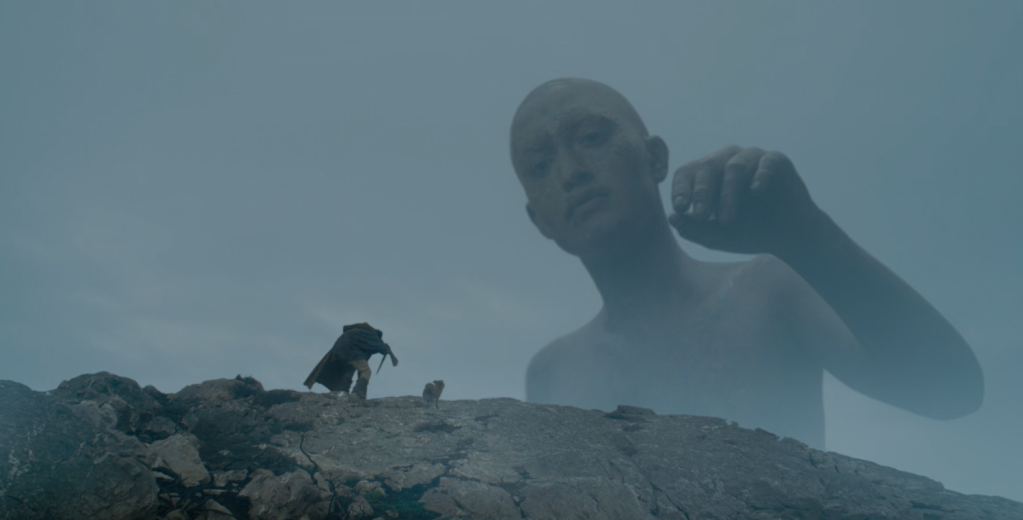
The fox in his journey represent the inner conscience Gawain speaks to when he is traveling alone. There is no one to interact and socialize at this moment hence only himself with whom Gawain interacts which is shown as a fox. This is his inner voice and also his primitive safety seeking mindset which tries to avert him from risks during the journey of greatness. After the eating the hallucinating mushroom, our boy Gawain also seeks short cuts from the giants in his journey, showing the immaturity he still holds to ease his journey.

– a shortcut on “the shoulders of giants”-
(Scene from David Lowery’s ‘The Green Knight’ by A24)

The fox howling to the giants for not offering their shoulder is indication of our boy Gawain mocking the great giants but continuing the journey without anyone’s help again gives us the hope for the character development of Gawain.

The events at the castle and its lord, his lady and his mother are the representative of the important life decisions Gawain will make when he will achieve the greatness. They represent the life after completing the Green Knight’s challenge. Here, the truthfulness, transparency in the relations whether they are between Gawain and the lord or the between Gawain and the lady are important. If you see properly, there is a bond created between the lord of the castle and Gawain and similar bond between lady and Gawain. This bond represents the comfort we enjoy with our relationships. This comfort of relationship causes him to rest more at the moment when he is so close to his goal. This represents the loss of focus of our boy Gawain in his journey of greatness. The intermixing of emotions, no control on the emotions, the comfort deviates the mind and body of Gawain from the goal. Strong attachment, entanglement with the relations which are merely dependent on give and take transactions blurs the vision of Gawain. You will see the lord asking for something in return for his hunt, the lady asking for something in return for the girdle all the time when Gawain is in their castle.

You will also see the context of whole movie in their one common discussion with Gawain. The Green according to the lady symbolizes the life as in a green tree, green earth and the also as a death as in the green moss which covers all the dead bodies and non-living cobbles all around.

-The “this is what the movie is all about” moment-
(Scene from David Lowery’s ‘The Green Knight’ by A24)

After parting away from all the emotional attachments, hence leaving the castle as early as possible Gawain again meets with his fox friend indicating the loss of his inner self, his conscience during this relaxing period where fox was not with him.

When Gawain reaches the river for the final step of the journey the fox tells him to either stop here or go ahead without the girdle. This is the conflict going in his Gawain’s mind which is shown through the dialogue between Gawain and the fox. The fox being sly animal represented here as Gawain’s conscience- his inner-self, shows how our mind tricks us to remain in comfort zones only to make our lives simple and easy thereby taking us away from the greatness.

– you can still chose-
(Scene from David Lowery’s ‘The Green Knight’ by A24)

Anyways, the good thing about the story is Gawain seeking for greatness and his deep-down hidden honesty which helps him to continue the journey. But, most of the courage he has for the further journey is resided in the protective girdle in which he has blind faith. The girdle is the representative of all the misconceptions, ‘our’- versions of truth, the truth etched on our minds by our surrounding that we think will protect us from all the bad that is in the world. The girdle that Gawain blindly holds on for his life are the metaphors of the boundaries of un-upgradable beliefs, preconceptions we keep in order to maintain our version of facts. Hence, at the final moment of realization of worthlessness of the girdle, Gawain puts his beliefs, his preconceptions aside and accepts death as the only truth which is the death.

When Gawain reaches the Green Chapel, he sees the Green Knight in hibernation- sleeping and unaware of the surrounding. Even though Gawain knows that his death- the Green Knight is sleeping, he is not going to survive this event. There will be any time that the Green Knight will wake up and kill him. This is a perfect metaphor of how we are always running away from death, how we console ourselves about the things we are going to do when death is not around and when we are living. The un-acceptance of the presence of death to live life and then helplessly accepting its presence and slightly (not fully) embracing it in the final moments shows how pity and how limited we as a human beings are in our final moments.      

– the death awaits-
(Scene from David Lowery’s ‘The Green Knight’ by A24)

Sir Gawain’s transformational journey and the philosophy of the meaning of life

Next important moments in this story define why we as a human can lead our lives to greatness despite of having surrounded by the limitations of life and death.

The first flinch of the Gawain on the green Knights strike is the moment of self-reflection with what could Gawain had done better in order to not land here. There is still that young whining boy present there. The dialogue between the Green Knight and Gawain are very impactful here:

1st Strike

The Green Knight– You have had a year to find the courage

Gawain– One year or a hundred it wouldn’t make a difference. Give me a moment.

This shows the realization of procrastination, loss of valuable time for Gawain in his supposedly last moments. Now he is trying to steal some moments to gather that courage!

2nd Strike

The Green Knight – Are you ready? (Twice)

Gawain– Yes

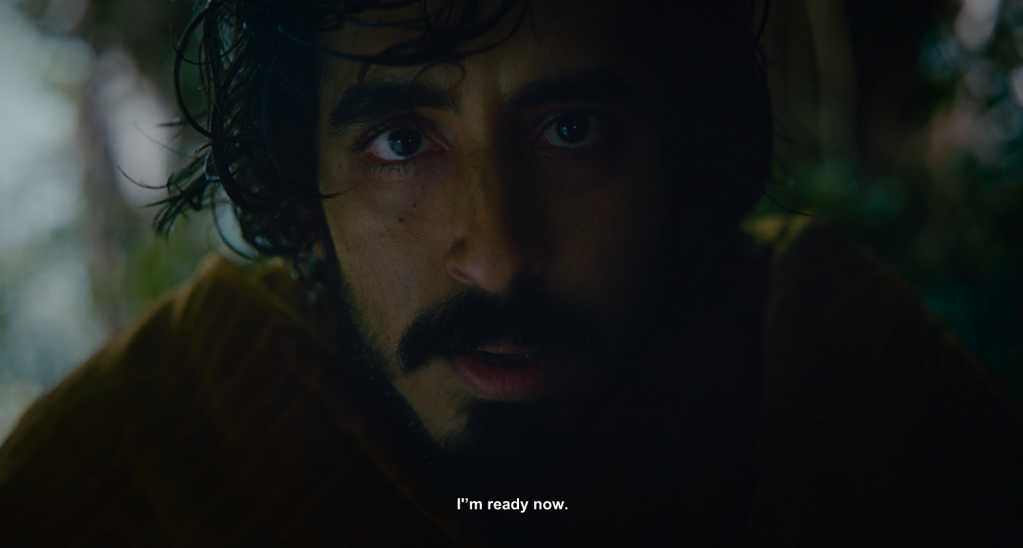
(If one remembers the start of the movie, Gawain is asked by a woman in brothel on the Christmas day that “Isn’t he a Knight already?”to which Gawain answers that “He is not ready yet”. This looks funny at this moment)

The Green Knight – The I shall get to hacking.

Gawain– Wait, wait. Is this really all there is?

The Green Knight– What else ought there be?

This is the moment when Gawain accepts that he cannot escape the death also the worthlessness of the life, the nihilism.

The 3rd Strike

It is the moment before the third strike where Gawain’s whole life, his future life flashes before his eyes where he dies in that life leading to the realization that whatever journeys of life he will embark upon the final destination is always going to be the death. The honor gained, the greatness of life will be dependent on the how he has lived it and accepted the death rather than running away from it. The third strike is symbolically the death of the boy called Gawain and the birth of a Man- Sir Gawain and the true heir to King Arthur.

The famous quote from Confucius really resonates with the conclusion of the story:

“We have two lives, and the second begins when we realize we only have one.”

Confucius
(Scene from David Lowery’s ‘The Green Knight’ by A24)

Sir Gawain’s transformational journey and the psychology of the Man-Child

A trend discovered by a Swiss psychologist called Marie- Lois von Franz, showed that many adults in spite of achieved physically adult state were not psychologically matured. These were called as “Puer Aeturnus” (Latin for “eternal child”).  Surprisingly this trend was found in mid-20th century. The whole idea behind “Puer Aeturnus” is that due to the complete confinement, extra care and easy, comfortable provisions by their parents, the young men in their peak years like 20s and 30s are struggling to lead their own life independently. Many are victims of virtual world, video games, internet living life in passive and supposedly in a safe way. And this is linked to many psychological, sexual, academic, professional, financial, social disorders. The solution to this problem is simple in a way which requires separation of this adult-child from his comfort providers.

Sigmund Freud has said somewhat similar thing:

“No one could be a man unless his father has died”

– Sigmund Freud

The idea is to get out of the influence of someone who is responsible for the way of our life and its consequence. The death of father figure for a boy is the moment when there is no greater figure, experienced person thereby ‘efforts saving’ person for his further life. This is time when the boy realizes that he has to make the decisions for himself and become responsible for their consequences.

“Yes, but that death (Father’s death) could occur symbolically”

– Carl Jung

Carl Jung expanded the idea of the death of father figure in an interesting way. According to Jung, even the realization of a person to the fact that his father rather his parents, guardians thereby someone guiding him to make his path easier will not be with him forever. There will be times when he has to take his decisions and own the consequences.

Jordan Peterson has given one excellent explanation on becoming independent from parents using the examples of the story of Pinocchio, Peter Pan and Harry Potter.

I believe that the transformational journey of Sir Gawain also resonates with his separation from the comforts of his life. Here, King Arthur- his uncle and the supposedly greatest father of their time (because no other father had the courage and strength to pull the Excalibur in those times) is the father figure and the Sir Gawain’s mother are his parents. Seeing the fickle behavior of Sir Gawain, I think that King Arthur and Sir Gawain’s mother plan this game for his transformation from Man-Child, because this will be the person who would be carrying King Arthur’s legacy, who will become the leader and father of all the people.

The same thing of losing that adult-child is also reflected in the popular culture of our modern days as seen in Game of Thrones. There is one exact episode where all such relevant things happen. It is the Episode 5 of Season 5 of Game of Thrones called “Kill the Boy”.

-Death of a father figure, a friend, a counselor-
(Scene from HBO’s Game of Throne)

In this episode, we see that Ser Barristan Selmy dies due to the attacks of “Sons of Harpy”. He was the father figure for Daenerys. Upon realising that there is not wiser and experienced person to counsel her, Daenerys takes the charge and responsibility of her decisions thereby establishing her command over Meereen. Here, the events show the death of parent-like figure which transforms Daenerys to kill that adult-child in her and take the charge of her decisions and the responsibilities that come with it.

And in the same episode, we see that Jon Snow has brought the Wildlings under same roof where the Night’s Watch lives. Jon is now thinking about making alliance of the Night’s Watch with the Wildlings who consider each other their greatest enemies. Jon thinks that, he could not make this decision on his own and seeks someone’s experience to make the decision right. Hence, he approaches Maester Aemon for the advice where Maester Aemon clearly tells Jon Snow to own the consequence of his decisions.

Maester Aemon exactly tells Jon Snow the following:

“You will find little joy in your command. But, with luck you will find the strength to do what needs to be done.

Kill the boy, Jon Snow. Winter is almost upon us.

Kill the boy and let the Man be born”.

– “Kill the boy, Jon Snow”-
(Scene from HBO’s Game of Thrones)

This scene exactly resonates with the death of the man-child similar to the story of the Green Knight, which seems absolutely magical. The indirect influence of such values, the permeation of such strong ideas, their eternal and imperishable nature precisely points to what makes us a true human beings and is mesmerizing on so many levels.    

OR

Maybe, the story of the Green Knight is in a way that story told to the adolescents to teach them to take the charge of their lives

OR

Maybe, it was just a fun game played on Christmas for the entertainment to make the day more memorable (and to shake Sir Gawain to his core for the year as the longest running prank!).

Jokes aside, but the symbolism and the depth of the characters and their intentions and the lessons that we learn from the story, the relevance of such an old story even with the times of today makes the story of the Green Knight so special for us. That’s all there is, that can be penned down for such a piece from ancient literature.   

(Scene from David Lowery’s ‘The Green Knight’ by A24)

References and further readings:

  1. 2017 Maps of Meaning 04: Marionettes and Individuals (Part 3) – By Jordan B Peterson
  2. Carl Jung and the Psychology of the Man-Child
  3. Photo of Carl Jung from Britannica

“If-” A Stoic Poetry by Rudyard Kipling

Rudyard Kipling is famously known for the creation of ‘The Jungle Book’. He is the youngest British Nobel Laureate (at the age of 41) till date.

Rudyard Kipling

Today we will be deep diving into Rudyard Kipling’s all time famous and many people’s favorite poem ‘If-‘. This poem written in 1895 was published in his famous historical fantasy book called ‘Rewards and Fairies’ in 1910.

This poem is all about a set of recommendations from poet to the reader (or his son) to become a person of greater values, virtues in order to handle every situation in life irrespective of its outcomes. The only motivation to act on something must be our intent of welfare of ourselves and the society around us as a human being and only thing we can control is our perception of things is the core idea of this poem.

If you can keep your head when all about you   
Are losing theirs and blaming it on you;
If you can trust yourself when all men doubt you,
But make allowance for their doubting too:

 This is about believing in ourselves and freeing ourselves from self-doubt. It is also about remaining content when everyone is against you. It focused on not losing sanity when everything around you seems to have lost the meaning, when everyone behaves like they have lost their minds, when chaos has surrounded you. This is the time which will demand you to remain confident of your intentions.

If you can wait and not be tired by waiting,
Or being lied about, don’t deal in lies,
Or being hated, don’t give way to hating,
And yet don’t look too good, nor talk too wise;

This is more about remaining calm, balanced and unaffected. There might be several times where the results won’t be immediate, one should deal it with patience. It is about the moving away from instant gratification and not doing things for immediate pleasures. Especially, in the times of Social-media instant gratification has become a very innate thing in the human behavior.

When you will be lied to or when you will be hated, a person’s behavior must not favor the idea of ‘tit for tat’ or ‘an eye for an eye’ indicating reactive behavior, retaliating behavior. Rather not dealing in lies, abiding to the truth even when lied to and not hating even when hated are the virtues poet wishes to have in the reader. The balanced behavior of humility in smart person and simplicity in good looking person will make him a desirable person. Otherwise, who values a smart but arrogant person anyways!

If you can dream—and not make dreams your master;   
If you can think—and not make thoughts your aim,
If you can meet with Triumph and Disaster
And treat those two impostors just the same:

This is about the what you do with your life and how you do it. It is about finding the purpose of your being in the life and envisioning yourself to fulfill that purpose. You should not be consumed by the dreams solely- thereby causing in-actions; the poet expects the reader to have actions for achieving these dreams and visions. Winning and losing are called imposters here because of the nature of our perception about them; one is desirable and the another one is not. The mere possibility of loss leads to inaction causes us to go deeper into the negative feeling of not achieving anything. The poet wants reader to not care about the consequences which are not in the hands of doer rather do the immediate things to get the consequences (whatever they may) which are always in the hands of doer.

The best way to come out of indecision is to act on things which are in our immediate control.

If you can bear to hear the truth you’ve spoken
Twisted by knaves to make a trap for fools,
Or watch the things you gave your life to, broken,
And stoop and build ’em up with worn-out tools;

This is about remaining committed and honest to your words, keeping your promises. This will demand a person to face the truth, make others aware of the truth when they are being fooled by some dishonest people and this requires courage. It is about remaining committed to the purpose even when things will fall down and you will feel that the virtues you are living with have worn-out and are of no value as they didn’t yield immediate favorable effects. This is some sort of test that you should go through to reach your ultimate pure desires.

If you can make one heap of all your winnings
And risk it on one turn of pitch-and-toss,
And lose, and start again at your beginnings
And never breathe a word about your loss;
If you can force your heart and nerve and sinew
To serve your turn long after they are gone,
And so hold on when there is nothing in you
Except the Will which says to them: ‘Hold on!’

Here, our poet wants the reader to have a really great goal in life whose purpose must be to leave an example or a legacy for others to follow as a light house. The greatness of this purpose will make him to sacrifice any great achievement, great possession for the greatness of purpose is the only thing that will not perish. All the great possessions or the biggest of big losses are valueless in front of a great purpose or a great legacy.  These can be the sacrifices in the great journey.

The loss of hard earned possessions, achievements may force a person to lose his interest in the journey; but the person’s resilience and the will to hold on to the greater purpose will define what is inside him, what he is made of !  

If you can talk with crowds and keep your virtue,   
Or walk with Kings—nor lose the common touch,
If neither foes nor loving friends can hurt you,
If all men count with you, but none too much:

The poet talks here about doing what you are saying, being aware of the reality and being humble and dependable yet remain unaffected by too much expectations of people around you- friends or enemies. It is about not getting flattered by the good opinions from the people loving you and not getting despised of the bad opinions of your haters or enemies. It is about being free from the opinions, projections of the people around you.

If you can fill the unforgiving minute
With sixty seconds’ worth of distance run,

Unforgiving nature of time indicates interaction of time with we as a humans. Time waits for no one. It is the most neutral entity in our life which is not affected by anything rather everything is under the influences of the time. The poet wants reader to fill a minute with sixty second means being aware of every moment we are going through and doing justice with it, investing it in doing good things.

Yours is the Earth and everything that’s in it,   
And—which is more—you’ll be a Man, my son!

Yep, after all of these conditions, all these ifs- one can achieve and enjoy everything that makes his/her life complete.

Stoicism in ‘If-‘

The poem is considered as one of the best depictions of the principles of Stoicism, the ‘Stoic’ philosophy. According to stoicism, a stoic person is one who remains unaffected by the things happening around him/her (It also does not mean that remaining dumb or numb) The Wikipedia definition is “someone who is indifferent to pain, pleasure, grief, or joy”.

Stoicism is based on the idea that all of the things happening around us are made up of cause and effect. Sometimes, we know the cause behind anything but it is practically impossible to know cause behind everything and after knowing that cause – change its effect to our desired results. There will always be something which will not be in our control. This idea of having rational structure of universe made up of cause and effect is called as ‘Logos’ in Stoicism.

The stoicism tries to establish that we cannot always know or remain aware of the logic behind everything happening with us and around us. ‘We’ – a person not being aware of ‘the cause’ of happening this ‘thing’ will not prevent the ‘thing’ from happening. It means that some things will always remain out of our control and our expectations. Hence the best you can do is to establish the control on things which are in immediate influence of you.

Hence,

Rather than expecting the world to be ‘ideal’ to anyone’s expectations – the stoic accepts the world ‘as it is’. In order to grow through this world, a stoic controls that thing which is in his/her immediate control. The poem ‘If-‘ by Rudyard Kipling does the excellent job of describing the virtues if a Stoic and what can be done and controlled to achieve greatness.

There are two pillars of Stoicism: Four cardinal Virtues and the dichotomy of control.

Pillar I- Four cardinal Virtues

Wisdom– the idea good and bad

Temperance– no overdoing and under doing things, doing the optimum, doing what is necessary

Justice– the awareness of what is right for given situation of a person or a society

Courage– the knowledge of justice and to standing for it

Pillar II-The dichotomy of control

This is the most important and the most famous idea in the stoicism. The dichotomy simply separates the things which are in our control and things which are not in our control.

The best way to deal with the things which are not in our control is to accept them as they are and the best thing to deal with the things that are in our control is to act on them immediately so as to eventually shape the reality we expect.

The best thing about the stoicism is that it was developed by people representing different levels of society. “Zeno of Cyprus” known as a father of Stoicism was a wealthy merchant in Athens who turned to the development of stoicism when he had lost all his possession in a shipwreck. With nothing in hand, he turned to a book shop and got influenced by the ideas of Socrates. Epictetus, the person who was a slave also contributed to the stoicism in a great way. Actually, the meaning of Greek word Epictetus (ἐπίκτητος) is “gained” or “acquired”. The real name of this slave is not known to anyone and there are no known writings by Epictetus available. All his knowledge was transcribed by his pupil Arrian and published as “Disclosures” and “Enchiridion

"Men are disturbed not by the things which happen, 
but by the opinions about the things."
- Epictetus, Enchiridion

The same idea Rudyard expresses in the poem when he asks reader to remain sane and confident when peoples are doubting him/her.

Marcus Aurelius who was a Roman Emperor and one of the greatest philosophers was also a stoic. Marcus Aurelius and emperor was influenced by the ideas of Epictetus- a slave. He wrote all his ideas in his famous book called Meditations. Nelson Mandela’s colleagues smuggled this book while he was in jail. This same book influenced Mandela to move away from the idea of revenge and think for the betterment of the society while he was in jail.

“It is not death that a man should fear, but he should fear never beginning to live.” 
- Marcus Aurelius, Meditations

Rudyard indicates the same philosophy about just getting consumed by the thoughts of the consequences and not acting on achieving something. Fear of failures is the real death, understanding that there is no such thing as success or failure will immediately lead to action which is in person’s hand.

“If someone is able to show me that what I think or do is not right, I will happily change, for I seek the truth, by which no one was ever truly harmed. It is the person who continues in his self-deception and ignorance who is harmed.” 
- Marcus Aurelius, Meditations

Rudyard Kipling discusses the same idea of remaining honest to your words, keeping you r promises for it is the only way to differentiate the right and wrong. If you understand that you were right- you will embrace it and if you understand and accept that you were wrong you will learn from it because seeking truth has never truly harmed anyone.  

Seneca, one of the famous and important contributors to stoicism was dramatist and satirist.

“We suffer more often in imagination than in reality” 
-Seneca

Kipling has also recommended to come out of indecision by doing the things in our immediate control.

In a whole way, when one understands the real meaning behind the poem, the expectations of poet and the philosophy of Stoicism, this gives a great moments of understanding rather enlightenment about the way of life.

‘If-‘ by Rudyard Kipling possibly one of the most important poem in the history of humanity.

Zeno, Epictetus, Seneca and Marcus Aurelius - The four important Stoics 

Image references:

  1. Zeno of Cyprus, Epictetus, Seneca, Marcus Aurelius

Zima Blue and Existentialism

The whole premise of the story Zima Blue is greatly aligned with finding the purpose of life, finding the meaning of life which are greatly the interests of the Existentialism. Almost all of the great personalities in the human history are the people who did one thing in a great way as they found their purpose, their meaning of life in that one thing. The purpose they found in that thing made them to endure anything in their life and this might the way in which we can find our meaning, our purpose in this chaos.

Love, Death and Robots is undoubtedly the most valuable gems of Netflix. This is an anthology series which consists of short animated stories and is intended as “animation series for adults”. Netflix proves its purpose of existence by supporting creation of series like Love, Death and Robots because such freedom of expression has yielded some unforgettable creations in the history of storytelling. There are many great and thought-provoking ideas expressed in Love, Death and Robots which will surely tingle your mind, one of them is called as Zima Blue and my #1 favorite. I will be discussing Zima Blue in detail so spoilers ahead.

The story of Zima Blue

Zima Blue is a story of an artist on the quest of creating the ultimate masterpiece of his life. He has invited a reporter – Claire to explain what his next demonstration will be. Through the narration of reporter, we understand that Zima was an ordinary portrait artist who in the search of greater meaning moved from portrait painting to large murals. The murals were filled with some great depictions of the universe and as the murals went on developing, they gradually had a geometric center piece of blue shaded shape which went on getting bigger and bigger with each iteration and finally occupied the whole canvas of the art. This blue was later identified as Zima blue by the people. Further on, the Zima Blue crossed the bounds of canvas to cover the whole sky; after that the Zima Blue creation became so big that it cast its blue shadow on the planet. The whole “planet painted blue” became Zima’s biggest creation which influenced even the people who were not interested in the art.

In order find the real meaning of life and to create such extraordinary masterpieces Claire tells us that Zima went through extreme physical transformations as in “cybernetic transformations”. Zima modified his eyes to see in any known spectrum, he got the polymeric skin to physically experience any worst environment in the universe, now he no longer needed oxygen to breath. Now that people were eager to see Zima’s next creation, he had invited Claire as a medium to the people for explaining what Zima did and the backstory of his ultimate masterpiece.

For the final reveal, Zima Jumps into a swimming pool and gradually disintegrates every part of his body finally revealing to the audience that he was nothing but just a ceramic tile cleaning robot designed by a lady. And audience are in awe. What they were thinking as a human responsible for creation of such thought-provoking arts pieces was actually a self-aware robot evolved from a “ceramic tile-cleaning robot for a swimming pool”.

Origin of Zima as a tile cleaning robot (From Zima Blue – Love, Death and Robots/ Netflix)

Before demonstrating this ultimate masterpiece, Zima explains his life journey to Claire. Zima was actually a robot created for simple tile cleaning job in a swimming pool by a smart robot loving lady. After being unsatisfied by its performance, the lady upgraded this robot with the color vision and a brain to define the cleaning strategies for the swimming pool. After the death of lady and being handed over to different owners and thereby its up-gradation, the robot became self-aware and more human-like so that it became impossible for even him to differentiate between him as a robot or human. His evolution in his awareness finally directed him in the search of the meaning of life thereby leading to the creation of such masterpieces.

The “Zima blue” what people had famously identified as his characteristic shade was the first color the robot had sensed which was simply the name given to that shade of ceramic tile in the swimming pool by its manufacturer. When we are looking at the disintegration of Zima into its most fundamental and primitive robotic form, we hear his final words:

“I will immerse myself. And as I do, I will slowly shut down my higher brain functions… unmaking myself… leaving just enough to appreciate my surroundings… to extract some simple pleasure from the execution of a task well done. My search for truth is finished at last. I am going home.”

The unfolding of Zima Blue story explained above is important as a personal experience for everyone. Somethings in Zima Blue cannot be experienced in the words. It is what makes the Zima Blue and its writer Alastair Reynolds so great.

Zima Blue points out the most important fact of any conscious being and that is- they are aware of their experiences. Even though nature has some of the physically strongest, fierce creatures already available, we humans are the most powerful beings in the world only because of our consciousness. We humans have relatively the largest footprint of our activities on the world only because we have become aware of what we do and experience and act accordingly.

But what Zima Blue story shows us is that, once the machines or any non-human entity will gain the consciousness, self-awareness, the awareness of the experiences it is having- it will eventually have the urge to search for the reason behind the actions it is doing.

Many people call it as “finding the purpose of life?” as in finding “why we are doing anything?”. We can also categorize similar questions as follows in the same group:

 “Is there any greater outcome from what we are doing right now?”

“Why am I doing this?”

“Am I going to get out of this?” or “When will this end?” (Especially, when the outcomes are not in our favor)

The very nature of we as a human being is that, we are never satisfied with what we have and hence are in constant search for what will bring more pleasure into our life. This search for pleasure has no end hence we remain unsatisfied every time.

Existentialism and Absurdism

The above discussion can be perfectly fitted into the idea of Existentialism. What Zima Blue does excellently is to close the gap between humans and robots through building a bridge of consciousness of existence. Anything that is aware of what it can do, feel and experience is going to think rather question about the ultimate purpose, meaning and value of the acts it is performing.

This question to find the meaning initially generates the confusion, anxiety, restlessness leading to conclude that maybe life is meaningless- that it has no meaning also known as “the existential angst”. There is one interesting concept in existentialism called “Absurdism” highlighting that the life is meaningless and it will get the meaning by the way we define what is the meaning of our life. It’s like saying that “we will be fulfilled with our existence only when we find or define what fulfills us and act on it?” (This may sound confusing as the definition of absurdism is made of paradox itself)

Absurdism says that life is “unfair” anyways (bad things may happen with good people too, rather there is no such thing as good happening or bad happening- whatever will happen will happen) and you just have to find what unfairness you are going to handle throughout your life which can be found out by what you really want to achieve in your life. This goal of achieving something will give you the purpose to go through that unfairness in your life.

There is also one interesting concept in Existentialism called “Authenticity” and a concept called “Existence precedes essence” which somewhat go hand in hand. In existentialism, authenticity is the extent to which a person’s actions align with his ideas, values then whatever may be his surroundings – adverse or supportive. The acts performed by the man define him thereby giving him the essence (defining his nature, explaining why he is so). “How he exists gives the meaning to his existence, how he acts defines who he is” can be the loose explanation of “Existence precedes essence”.

Existence precedes essence

There is a moment in Kung Fu Panda 2 where Po is defeated by Lord Shen and is completely in confusion, fear and anxiety that it was Lord Shen who killed Po’s parents thus he is more powerful than anyone in the world. Po as a Panda cannot defeat Lord Shen as Lord Shen has wiped entire population of Pandas ruthlessly in history. He, at this moment is far away from getting the inner peace.

And in contrast it is the same moment when Po finds inner peace as he learns that it is not the labels assigned to him already that define him so that he can’t defeat Lord Shen rather it is the course of actions he is going to take ahead which will define him. The essence of his being is in the actions he is going to take ahead indicating his ways of existence. He defines himself as fulfilled when he is in the present moment.

The moment Panda finds inner peace- Kung Fu Panda 2

“Your story may not have such a happy beginning, but that doesn’t make you who you are. It is the rest of your story. Who you chose to be!”

Soothsayer to Kung Fu Panda

This moment in Kung Fu Panda really gives meaning to the statement “Existence precedes essence” which is the core of existentialism.

In the infinitely infinite expanse of the universe where there are so many things to be done one may get overwhelmed and find themselves useless hence, leading to that restlessness of not achieving something. But, once you find that one thing to live for, once you find that one thing to achieve however small, absurd, funny or useless it may seem to others- you can fulfill your purpose in the life. Probably, this thing will not be that much great for others but your actions to achieve that thing will give it greatness it deserves.

Hence, you will finally find the Zima dismantling into the only thing it was at its start- a simple blue ceramic tile cleaning robot in a swimming pool.        

“I will immerse myself. And as I do, I will slowly shut down my higher brain functions… unmaking myself… leaving just enough to appreciate my surroundings… to extract some simple pleasure from the execution of a task well done. My search for truth is finished at last. I am going home.”

Zima in Zima Blue from Love, Death and Robots (Netflix)

Søren Kierkegaard a Danish theologian, philosopher, poet, social critic, and religious author is considered as the first existentialist philosopher, has following beautiful quote which also aligns with why Zima decides to go to its original form while entering into his ultimate moments of his life.

“Life can only be understood backwards; but it must be lived forwards.”

Søren Kierkegaard

There is a good TED talk by Shaolin Kung Fu Master Shi Heng Yi, who despite of having many great academic and personal achievements chose the way of life of a Shaolin Monk. This talk mostly focuses on how to achieve the purpose of your life and highlights the uniqueness of everyone’s purpose in the expanse of universe.   

“All of our lifetimes all of our lives are too unique to copy the path from someone else. To bring meaning to your life, to bring value into your life, you need to learn and master yourself and don’t let the hindrances stop you.”

Master Shi Heng Yi

Another good TED talk to explore is “How to know your life purpose in 5 minutes?” by Adam Leipzig. In short it is asking yourself these five questions:

 5 Question to Ask Yourself:

  1. Who are you?
  2. What do you love to do?
  3. Who do you do it for?
  4. What do those people want or need?
  5. How do they change as a result?

He says a good thing in his talk:

“If you make other people happy, life teaches us we will be taken care of, too.”

Adam Leipzig

The whole premise of the story Zima Blue is greatly aligned with finding the purpose of life, finding the meaning of life which are greatly the interests of the Existentialism. Existentialism also explains why many great people in the history of the humanity are not associated with greatness as an executioner of bunch of great things; Rather almost all of the great personalities in the human history are the people who did one thing in a great way as they found their purpose, their meaning of life in that one thing. The purpose they found in that thing made them to endure anything in their life and this might the way in which we can find our meaning, our purpose in this chaos.

Zima as and in his ultimate masterpiece – (From Zima Blue – Love, Death and Robots/ Netflix)

Further links and references:

  1. Pictures of Zima Blue from Love Death + Robots episode (season 1, episode 14)
  2. Søren Kierkegaard – Image credit –La Biblioteca Real de Dinamarca
  3. Master Shi Heng Yi – 5 hindrances to self-mastery | Shi Heng YI | TEDxVitosha
  4. Adam Leipzig – Image credit – Julia de Boer
  5. How to know your life purpose in 5 minutes | Adam Leipzig | TEDxMalibu
  6. Existentialism- Wikipedia
  7. Love Death + Robots by Netflix

Food for thought only at $1

“Men imagine that thought can be kept secret, but it cannot; it rapidly crystallizes into habit, and habit solidifies into circumstance.

“A man cannot directly choose his circumstances, but he can choose his thoughts, and so indirectly, yet surely shape his circumstances.

– James Allen, As A Man Thinketh

The best thing about books is the value they provide compared to their cost. Books are the materialistic vessels which contain streams of the incomparable, unbound and unfathomable ocean of knowledge. I will discuss one such small- yet very impactful book by James Allen called “As A Man Thinketh”

The book is the epitome of common saying “good things come in small packages”. This book is mere collection of seven essay-like chapters which emphasizes on the importance of our thoughts /thinking and their impact on our life, circumstances, success/ failure, body. This small self-help book is the perfect distillate of the ideas in philosophy related to our thoughts – our thinking. Nobody should miss this book.

The author James Allen intended this book to remain concise, compact. James Allen was a British philosopher, poet and is called the pioneer of self-help movement. Buddha and his teachings – one of the influences on James Allen seem to reflect themselves in this book. He also calls this book “little volume (the result of meditation and experience)”. The book is also said to inspire one of the bestsellers called ‘The Secret’ which focuses on the Law of attraction.

Let us dive into the seven short yet insightful ideas explained in the book ‘As A Man Thinketh’.     

1. Thought and character

Act is the blossom of thought, and joy and suffering are its fruit.

James develops this idea from the logic of Cause and Effect. Anything we do will have a favorable or unfavorable outcome which decides whether it will make us happy or sad. If sweet or sour fruits are the effect then their cause is the action taken.

But what is the cause to the effect of taking an action?

James expresses ‘the thought’ as the cause for actions. We are what we think. Our every minuscule, insignificant seeming yet impactful thoughts and their collection make us who we are which thereby enables us to act in a specific way. Some may consider this as a behavior, the attitude of a person. James wants to make readers aware of the control they can have on their life by having control on their thoughts, thereby the actions they will take and the outcomes of these actions  

Man is always the master even in his weaker and most abandoned state; but in is weakness and degradation he is the foolish master who misgoverns his “household”

2. Effect of thought on circumstances

The soul attracts that which it secretly harbours; that which it loves, and also that which it fears; it reaches the height of its cherished aspirations; it falls to the level of its unchastened desires, – and circumstances are the means by which the soul receives its own.

Here, in the second part James expands the idea of cause and effect of our thoughts causing our “attitude” which causes our actions in a specific way giving us “our character”. This idea is also somewhat similar with the thought expressed by Carl Jung- Swiss psychiatrist and psychoanalyst as follows:

“You are what you do, not what you say you’ll do.”

– Carl Jung

This reinforces that the thoughts are responsible for every action we take. No matter how spontaneous they may seem but they are the outcomes of our deep, hidden thoughts and they may remain unconscious for us. That is why James says “soul attracts that which it secretly harbours”. These conscious, unconscious thoughts inspire actions in a specific manner and the outcomes are revealed as the mannerisms of the actions taken. Hence, our thoughts give birth to the circumstances around us.    

Justice

The idea of reaping what we sow is central here. James calls it ‘the exact justice’. Rather than circumstances shaping the person, James highlights that the person is the cause of his circumstances which are linked to his/her attitude which is ultimately linked to the thoughts.

Ignorance

James expands the idea of circumstances to the desires, wishes of every person. In almost every case a person has the solution for the problem right in front of her/him, but they chose to ignore because it will cost them to change themselves and the anxiety associated with changing themselves.

If one eliminates this ignorance of the obvious yet anxious seeming change/ improvement, then she/he will become free. This means that one has to sacrifice her/his current attitude, current thought to improve personally thereby to improve the circumstances.  

Good and Evil

James clears the idea of being good or being bad. In simple words, they are considered as a superficial tag or quick judgemental opinion of every person.

There are many examples in everyone of our lives when we feel that the dishonest man got the success and honest man failed greatly.  

According to James’s idea of “Exact Justice”, the person having complete and absolute knowledge would have gone beyond good and bad, success and failure. She/he would consider them as a part of their evolution, part of their ongoing experiences.  

Blessedness and Wretchedness

James discusses here the idea of suffering which seems to be influenced highly by the teachings of Buddha. Desires are the root of suffering. James calls the suffering as the effect of wrong thought. When one loses the harmony with her/his thoughts then only she/he suffers.

Blessedness hence is originated from the right thought, however materialistically poor a person may be and wretchedness is originated from the wrong thought, however materialistically a rich may be. Right thoughts meaning the harmony of a person with his doings and ultimately the thoughts responsible for them.  

Introspection

Again, based on the law of justice of the universe, James establishes that, once a man accepts that his thoughts are responsible for the conditions around him, he starts tuning his thought in a way to change the conditions, people and their behavior towards him. This is possible only by the power of Self analysis and introspection, James says.

This seems like the core inspiring idea behind the development of the book called “The Secret” which calls for the Law of attraction.

Good and bad Habits

The collection of continuous thoughts in certain way creates a channel of certain continuous actions thereby creation of routines leading to the formation of habits. Our thoughts even may seem untouchable, non-physical but they manifest themselves into our actions in a specific way thereby swiftly developing our habits. These then create the circumstance of certain outcome.

James calls it as the “crystallization” of thoughts into habits and further “solidification” of these habits into the circumstances.

3. Effect of thought on Health and The Body

The body is delicate and plastic instrument, which responds readily to the thoughts by which it is impressed, and habits of thoughts will produce their own effects, good or bad, upon it.

James considers the body as a servant of the mind. In simple words, the body is the materialistic extension of our untouchable, non-physical thoughts. Hence, thoughts drive the body and the health. That is why a healthy mind will always crave for healthy food, healthy and hygienic habits. The neat and healthy living is the effect of the neat and healthy thinking.

With those who have lived righteously, age is calm, peaceful, and softly mellowed, like the setting sun.

In one sentence – “Age is just a number”. It is all in the thought of ours which determines how young we are.

4. Thought and Purpose

Even if he (a man) fails again and again to accomplish his purpose (as he necessarily must until weakness is overcome), the strength of character will be the measure of his true success, and this will form a new starting point for future power and triumph

James wants to establish the concept of failures as a part of life and their contribution in the ultimate success. Overcoming the failures is only possible when a person has found the purpose. This purpose then makes him to accept the failure, strengthen himself to face the failure again and to finally become strong to overcome it.

In simple way- when a person accepts the fact that, in order to become successful, one will go through multiple failures, the first step towards success is taken. In the process of overcoming these failures he will become strong; he will gain the strength to ultimately achieve the true success.

Purpose will guide the person through the failures.  

5. The Thought-Factor in achievement

Intellectual achievements are the result of thought consecrated to the search for knowledge, or for the beautiful and true in life and nature.

Here, James follows the idea of strengthening oneself to overcome the failures. This will need sacrifice. The sacrifice intended here is of the selfishness. Because selfishness indicates attachment, attachment induces desires and failure to get these desires makes the person to lose the said harmony of thoughts and actions. The true achievement James establishes here is the freedom – what some may call as “Mukti” as mentioned in Hinduism. This needs upliftment of thoughts which is only possible by letting go of materialistic desires and acceptance of true knowledge, true purpose.

6. Visions and Ideals

Dreams are the seedlings of realities

James Allen calls the dreamers as the saviors of the world. The idea is that visions are one structured way of inspiring thoughts which go on accumulating to cause an action in a constructive way thereby manifesting a good habit. This good habit will be responsible for the harmonious circumstances which is the ultimate purpose of the life. James clarifies that the idle wish is not the Vision.

In all human affairs there are efforts, and there are results, and the strength of the effort is the measure of the result. Chance is not.

James denies the existence of chance, luck through the idea. It is therefore is established here that there are only thoughts conscious or unconscious they may be which are ultimately responsible for who we are and what is happening with us and how we accept and react to it.

Gifts, powers, material, intellectual, and spiritual possessions are the fruits of effort; They are thoughts completed, objects accomplished, visions realized.

This idea again focuses on actions thereby the thoughts responsible for these actions which are the key parts of human evolution in physical and non-physical ways. The vision brings thoughts into the reality of action, drives it or gives it a purpose.  

7. Serenity

Yes, humanity surges with uncontrolled passion, is tumultuous with ungoverned grief, is blown about by anxiety and doubt only the wise man, only he whose thoughts are controlled and purified, makes the winds and the storms of the soul obey him.

Serenity in the end is intended to calm ourselves our of all the thoughts we have. This demands to establish control on our thoughts thereby controlling the actions and circumstances.

These are the seven core ideas of James Allen’s intellectual and philosophical masterpiece. ‘As A Man Thinketh’ itself builds a bridge between eastern and western philosophies in an effective way. The ideas also bring religious thought processes from Christianity, Buddhism and Hinduism. The book being so small yet expressing such vast and exhaustive ideas definitely highlights the power of few pages bearing, single dollar costing book with such a strong thoughts and ideas. Definitely a must read.

Two “long arms” of the law – The Principles of Natural Justice

According to Aristotle- the law means “a sort of order, and good law is good order” and “reason unaffected by desire”, and “the mean”. Many of us are unaware of how a law making system established itself, its inner workings and its vast expanse. “The Principles of Natural Justice” may help us to understand some of the workings, importance and purpose of the law and judicial system in Human Civilization.

“You can’t escape from long arms of the law”- is one of the most famous dialogues from the classic detective/ investigative/ crime-based movies. These movie plots have somewhat same structure under them; our villain has tried all the ways to destroy the evidences from the location of crime and the witnesses. Eventually, the smart protagonist who was unable to prove the innocence to the court due to the trickery of antagonist finds a clue, a loophole which leads to the final victory in the court. There are many real-life examples of these cases. Here, the court serves as a middle man or the independent decision maker to decide what is right or wrong. (Even though ‘we’ as an audience know that the hero of the movie is right, the director takes whole movie to prove the thing to the judge!)
A system to decide ‘what is fair and what is not’ as a Judicial system is one of the most important parts of being a stable human civilization. This is what separates us from animals in some ways- we have a system to resolve the conflicts without too much of a blood shed. A strong judicial system is one of the pillars of democracy for the reason.
This means that there are certain laws for deciding what actions have to promoted and what actions are to be penalized. But the law has its limitations too. You cannot go on making law for everything in the world to be correct (and may be that is why you can still put pineapple on the pizza).
Human conflicts are so much diverse in nature that you cannot frame all of them or categorize them in certain sets and furthermore establish a law system to all of them. That is the point maybe beyond the reach of the law. There are many moments in real life where time calls for the clarity of what is wrong and right in situations at your workplace or you might the one who will be responsible for deciding the fate of people you are leading. How will you make the fair decisions there? What if, there is no written law to decide what has been right and what has to be called wrong? How to be fair and just in such situations?
You know what- you can’t escape the long arms of the law!
There is a fantastic concept of Principles of Natural Justice which is used to decide the fairness of any judgement. Actually, the scope of Principles of Natural Justice is highly focused on and intended for the Administrative Laws where there might be instances for which specific laws are not established.
There are two important statements which are stated in the Principles of Natural Justice from Latin maxims-

Nemo judex in causa sua

no-one is judge in his own cause

Audi alteram partem

listen to the other side

Nemo judex in causa sua-
The intention of this maxim is to make the decisions without any prejudices. Being judge in owns case already establishes the polarity of decisions while doing justice. The decision will always be in the favor of party the judge personally prefers which will lead to unfair decision. The unfairness in decision will actually diminish the trust of people in the judiciary system thereby the foundations of a good civilization. Hence, the independence of judge/ decision makers becomes of high importance while performing justice.
The maxim tries to remove one of the biggest flaws of being a human which is the flaw of being biased. The biases are the favored truths, prejudices of people which for them are the bendable truths. The biases will make the decisions subjective hence it will be difficult to create a good example out of any situation. Biases are like tinted goggles which filter certain ideas and makes the decision maker unclear of what the facts really are.
There are many biases found in human behavior which are always creating the illusion of truth until someone comes and proves them wrong for us. The Natural Justice highlights on some of the following biases:
Personal biases- It is the favor made while making decisions which will affect us and our relatives, friendships in a bad way. Thus, there must not be any personal interest or relation between the parties and the judge.
Pecuniary bias- It is the favor of decisions made to achieve financial advantages. The decision-making authority/Judge must not have any financial interest between the parties demanding justice and the judge.
Subject matter bias- A person who has supported a subject or has following for the subject on which the proceeding is going on will not give the hearing for the case. Otherwise again the favor of judgement will occur.
Departmental bias- A bias which is highly observed in administrative cases. As the name indicates the judge must not be of the same departments to which the justice demanding parties belong.
Preconceived notion bias- There must not be any presumptions in the mind of the judge which will affect the unfairness of the case. This bias is the most difficult bias to challenge. We as person are developed for the choice of what is wrong and what is right based on some truths and their comparison with the situations. These are our personal truths which actually develop the tendency to give justice while making decisions and we must accept that some of them may not be actually true.

The cultural differences, the upbringing of a person, the financial and family background of person, the environment around the person, the life altering events in that person’s life, the impact of other peoples’ decisions on the person’s life and so on, there are many factors which make a person- not only person but we all as a human to have our version of truths.
Even Friedrich Nietzsche also quotes the following:

All things are subject to interpretation. Whichever interpretation prevails at a given time is a function of power and not truth.

Friedrich Nietzsche

Meaning that out of all the truths everyone has, some of them feel true only because of the conditions in which they were presented. When we say that “Only victors write the history”- it leaves that space to think whether the victors were good or bad. If they were really bad then we have been presented the dark parts of history with needless glorification which is the real injustice with the truth. Here, the role of science becomes of highest importance which looks for the proofs of the facts.
Anyways, biases are that one integral flaw in our nature as human beings which will always challenge the fairness of decisions we make while solving the conflicts.
The ‘Nemo judex in causa sua’ helps to build the trust in the intentions of person giving the judgements. Otherwise, what is the point of an order which will not be enforced by the people for the well-being of the system created for the people themselves.


Audi alteram partem-

The purpose of this maxim is to gather all the information to make the judgement as fair as possible. It provides the chance for both the parties to put forth their version of truth.
This is also known as ‘the right to notice’. Unless the party is aware of the facts presented in or against their favor one cannot truly defend themselves. This also brings the inherent image of fairness, a just decision-making procedure in the judicial system.
Listening to only one side already violates the first maxim related to bias. It highlights that judge her/himself are favoring to one side only. Hence, listening to the other side creates that common ground for people with different version of their truths in front of the judge.
It not only important for a judicial system to offer justice to the people the act of offering a fair, just decision must also be observed by the people. ‘There must always be someone watching the justice being granted’- is the essence of the second maxim. This also strengthens the belief of people in judicial systems.
Listening to other side is not just about giving opportunity to other side- it is also one way to collect more supporting information for decision making.

Reasoned Decisions
There is also a third part of the Principles of Natural Justice which highlights the importance of reason in the justice offered. Their must be some provable logic/ reasoning to strengthen the justice offered otherwise it will be further challenged and the loop will go on. The people who will be affected by the decision must know why they will be affected. This importance of logic and reason in any hearing must be a speaking order which brings the seriousness and responsibility in the people and eliminates randomness of decisions. Any randomly passed decision will create loophole in the system thereby leading to many bad decisions in future which are sufficient enough to bring the entire system down.


If any ideology proves that the Principle of Natural Justice were not followed during the judicial process, the order becomes void or null. It becomes of no value.
There are some exceptions where the principle of natural justice natural justice will not be followed. This can be decided by the apparent nature and intentions of the actions while giving justice. Some of the events are related to the importance of emergency (exclusion in terms of emergency), maintenance of secrecy (exclusion in terms of confidentiality), tedious nature of addressing everyone when a group of people is representing one side (exclusion in case of impracticality), exclusion in case of routine matters- where the routine evaluations are being made for deciding fairness, exclusion in case of interim decisions – where the final decision has not been given and the suspension order is in effect, exclusion in case of legislative action- where the actions are taken base on the law already established (otherwise the law would be challenging itself which will create paradox) and the cases where no human rights were violated.


In the essence of the Principles of Natural Justice, it is one integral yet independent part of any judicial system in the world. These principles have actually defined the image of we as humanity and the system which runs it.
Actually, the Principles of Natural Justice digs deeper into the nature of subjective thinking of human beings for the mere purpose of survival.
The principles being ancient also highlight the fact that though many years have passed since the existence of human beings, we still think in the same way, we still create our own versions of truths, we still make decisions in the same way our ancestors used to do. Though the path followed is same, the primitive brain used is the same- survival instincts used are the same, it’s the addition of new truths to the previous set of truths in the process which are making humans to adapt to new definitions of being human- what it means to be a human.

About the thought of ‘Reading for thinking’

Arthur Schopenhauer

A truth that has merely been learnt adheres to us only as an artificial limb, a false tooth, a wax nose does, or at most like a transplanted skin; but a truth won by thinking for ourself is like a natural limb: it alone really belongs to us. This is what determines the difference between a thinker and a mere scholar

Arthur Schopenhauer

New year represents new beginnings, a fresh start. Though recent years were filled with great challenges, we have adjusted ourselves to the new conditions, many things have changed. One of the things that are not changed are ‘the new year resolutions’. New year resolutions are one inseparable part from the new year celebrations. Whether one declares it publicly or keep it to themselves, everybody has thought of doing something new (consistently!) for upcoming year. Developing the habit of reading or reading ‘these’ many books is one of the famous new year resolutions (please note that joining the gym is still ranks the number one).

Being a bookworm, being bookish person (with spectacles for extra effects) has always been an indicator of studious, genius, mastermind, scholar personalities in popular culture. Having read lots of book is status symbol in the scholastic circles for years. But here is one thought – What if you are given all the resources, time, superpowers to read all the books in the world, will you be the wisest person in the world? Everybody knows the answer- the answer is ‘No’.

I came across this essay by the great German philosopher (and the most underrated one) called ‘Arthur Schopenhauer’. The title is ‘On Thinking for Oneself’. The essay is made up of mere 75-100 sentences but it has all the juice that will last forever if you really think over it. And this man has more essays like this.

‘On Thinking for Oneself’

Schopenhauer starts the essay with an example of two libraries- first where it has lots of books and you have read them all and second one has far lesser number of books, you have read them and have thought thoroughly over them. The second case will be of far more value- Schopenhauer says. The answer lies in the process of rearrangement of your experiences, their alignment with the truths/beliefs you have established, questioning your current beliefs, changing them if they are proven wrong after reading. That is how you not just gain the knowledge but this is how you acquire authority-mastery over it.

In simple words, reading a book is just feeding your brain with some words and collecting such sets of word again and again to call yourself a scholar. This is more of an artificial approach of gaining knowledge and will not last forever. Like, do you even remember what you read for that exam in the school where you scored the highest marks? In Schopenhauer’s words ‘It is like forcing a spring under continuous pressure so that it loses its elasticity’. I think this is what’s wrong with the current education system. Development of a train of thought for everything you read, is more organic. One can force people to read as much as possible but one cannot force anyone to think about them or anything forcefully. The thinking needs to be originated from inside only and once it starts flowing it will go on building itself. This is possible only when one has innate ‘Will’ to understand/ question what she/he has read. The act of reading must start with a purpose born from inside. Read whatever you wish not what others recommend.

Schopenhauer explains this ‘plain’ reading with the analogy of mouth and digestion/assimilation necessary for functioning of body. According to him reading is like chewing the food, splitting it into the pieces. But the real transfer of the nutrients from the food to the organs is only possible through the digestion and assimilation which is of far more importance. Thinking is like digestion and assimilation. People value mouth and eating more for remaining healthy, we consider reading in the same way; Staying healthy is also about digestion and metabolism.

Schopenhauer wants to focus on the importance of thinking over the things rather than just registering them, recalling them whenever demanded. He writes-

“Reading is merely a surrogate for thinking for yourself; It means letting someone else direct your thoughts”

Means it is very important to understand the intentions, background of the writer. When you are reading any book, your boat of imagination, thought is sailing by the winds of writer’s intentions. These intentions can be subjective, personal hence are of immense value to the writer but same might not be the case for the reader. There are many examples human history can provide, where people have stuck to the sayings, declarations, predictions from the books without even questioning, debating over them, accepting them as the ultimate truths and later they lead to disasters.

So, does that mean that you should stop reading?    

Schopenhauer has explanation for this too.

“You should read only when your own thought dry up, which will of course happen frequently enough even to the best heads; But to banish your own thoughts so as to take up a book is a sin against the Holy Ghost; it is like deserting untrammelled nature to look at herbarium or engravings of landscapes”

Books are very important when your thoughts are stuck in a place, when you are completely directionless. Even starting with wrong directions which the case most of the times can at least make you aware of where you are (provided that you are thinking on your own).

The roots of this all ‘thought process’ lies deep down into the Schopenhauer’s philosophy of Will. Schopenhauer’s famous book called ‘The World as Will and Representation’ elaborates this idea in far more detail (this deserves one separate discussion).  

It is not just about reading lots of books. It is about developing the habit of thinking over what you have read; it may be a small paragraph or even a quote. Questioning, debating, challenging and erasing the old beliefs thereby establishing newer ones and most importantly aligning them with your ‘personal’ experiences is what is of the highest value- that what being the smartest species on the earth means. I think this is what ‘critical thinking’ is and the gift of being a human.

In simple words, a ‘book smart’ person is the one who has gained the knowledge just by agreeing to the writings of the books, it may be in his/her imagination. On the other hand, a ‘street smart’ person is the person who has gained the knowledge by dealing with the things in real life, real experiences, by developing muscle memory. You will be a lethal combination of ‘book smart’ and ‘street smart’ if you could really connect your real-life experiences and the thoughts developed after questioning the readings from the books. But for all this, you really have to start think on your own without any external influence. Because, it is always easy to make people think based on the external influences. That is what advertisements do, one commercial and ‘poof’ you have already bought that unnecessary thing.

How can we start to really think over anything we have read? How can we make reading more effective? How can we extract value from reading a paragraph or mere sentence?

Actually, we already question many things, readings in daily activities- but these questions are not pronounced to the noticeable scale and get faded with the time. So, whenever you come across some readings and that makes you think over them, try to write it down and revisit it someday, you will get a new perspective to that thought. Maybe you will think for yourself and that will be the most natural, organic way of thinking- nobody has forced you to do it. So, I would say read once and small but think over it twice and big, maybe think again later (Overthinkers know that better :D) Whenever you are reading anything, just keep this small thought in the back of your mind. I know you have read all this to the last line, it will be great if you have thought over this for yourself too.

Image of Arthur Schopenhauer by Johann Schäfer

Further reading:
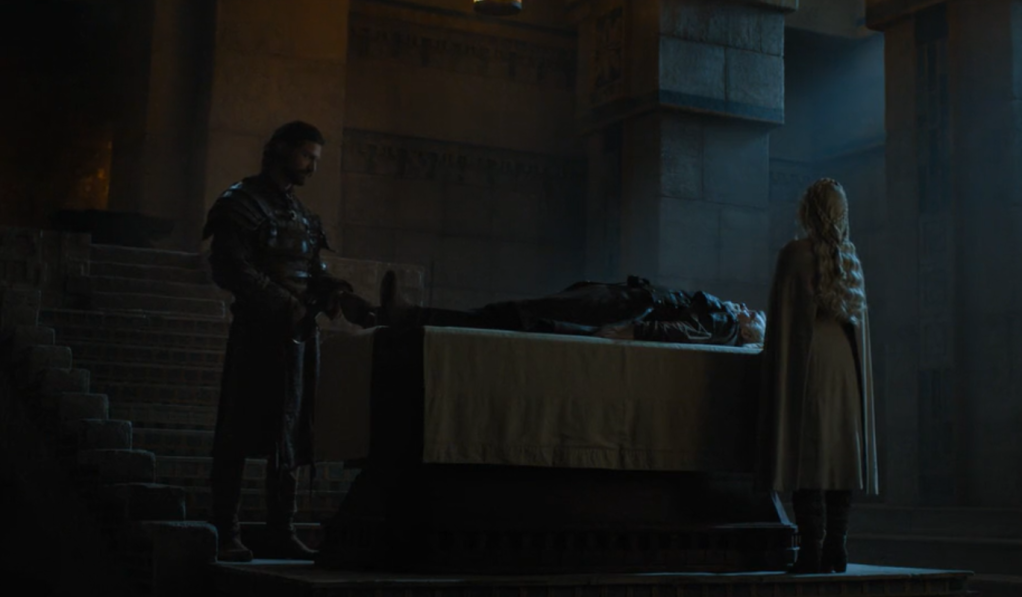
  1. On thinking for Oneself by Arthur Schopenhauer
  2. Arthur Schopenhauer– Wikipedia
  3. Arthur Schopenhauer– Stanford Encyclopedia of Philosophy

Language and Empathy

Remember the last time you pulled a prank on someone and imagine explaining it to your friends. You go on building the events and so the excitement level goes up and up. For the last sentence, all the purpose of events is resolved into a comic relief. You will notice the expressions of people listening to your story keep changing as the event unfolds. They are building the picture of the event in their mind as you are delivering the sentences.

 There are some moments in life when you do not have words to explain how you feel. Like first underwater diving experience, that joy and feeling of achievement of climbing up to one of the difficult summits, the thrill of skydiving. You could explain them to others, but still feel that the one must experience it to know it, understand it.

 The thought underlying below the ideas explained above state three important things-

  1. The connection between what you said and what happened
  2. What the listener understood by listening to your story, his interpretation
  3. The explanation of the experiences that cannot be explained(!?)

The answer to these mysteries lies in the theory of language and how we handle it.

Ludwig Wittgenstein

Ludwig Wittgenstein, known as one of the most influential philosopher of 20th century has done some work on what is famously known as ‘the picture theory of language’. According to Wittgenstein, the language and the world we live in has a structure. In simple words,the world is made up of objects which are related by names; language is made up of names. These names combine in a structure to form elementary propositions. The elementary propositions combine to form states of affairs. States of the affairs are the closest or equal to a fact.

Means we use different sets of words and propositions to establish relationship between them. This creates a base fact, and the combination of these base facts create picture of what could have happened in the event. For example, when somebody says we had fun last night at birthday party! – this makes us to picture birthday boy blowing the candles, a cake cutting event, everybody singing the song, eating and drinking, making jokes, playing fun games. We are picturing many objects and their different interactions to create an event which was fun. We created pictures of a cake being cut by a knife, colorful candles being blown, the tune of birthday song being sung to create the whole meaning.

There is one catch in the above explanation-

Not everyone will see same cake in their minds- some will see vanilla cake, some will see black forest, some will see lemon cake. Some people will have simple single-color candles, some will have colorful candles, some will cut the cake by plastic knife, some will cut the cake by a metal knife. The birthday songs may be in different language if your friend circle is multicultural (!) (Though the tune might remain the same!) This applies to every thing you say while communicating.

People can have very different pictures attached to the words and expressions. It is the superposition of the multiple propositions which creates a fact. The more precise, specific, and detailed your word choice will be the more will be the similarity between what you experienced, what you explained and what the person in front of you visualized.

Wittgenstein’s Picture theory of language was inspired by a Paris Traffic Accident case where the whole scene was enacted using objects to indicate how things happened. According to Wittgenstein, the reality is made up of various events or states of affairs which may or may not be true. The propositions are made up of elementary propositions (which are born from names, objects) and logical operators like ‘and’, ‘or’. The truth of events depends on the truth of the elementary propositions ultimately responsible for the formation of propositions thereby events.

The Picture theory of language helps us to understand the meaning of empathy in a deeper sense. The dictionary meaning of empathy is ‘the ability to understand and share the feelings of another’. In simple words- ‘the ability to put yourself into the shoes of other person’. The experiences of every person are very personal (!) this makes the association of many feelings and the objects unique in everyone’s mind. Ask fear to the Batman and he will see Bats, ask fear to the Superman and he will see Kryptonite. We have different pictures associated to every word and feeling. The things are simple when we are explaining an object, but it is not easy when we are explaining our feelings.

Hence, the empathy demands more focus on the listening abilities and trying to understand what others are saying instead of having prejudices and conclusions in advance. The more and more we create comfortable spaces for others to say- the clearer the picture we can build of how they really feel. The clearer the picture, the clearer and more personal will be our understanding. This will make us able to help people in a greater way, this will make the relationships more personal and more trust building.

” What can be said at all can be said clearly; and whereof one cannot speak thereof one must remain silent”

Ludwig Wittgenstein, Tractatus Logico-Philosophicus