Logarithmic Harmony in Natural Chaos

Mathematics is one powerful tool to make sense out of randomness but bear in mind that not every randomness could be handled effectively with the mathematical tools we have at our disposal today. One of such tools called Benford’s Law proves that nature works in logarithmic growth and not in linear growth. The Benford’s law helps us to make sense of the natural randomness generated around us all the time. This is also one of the first-hand tools used by forensic accountants to detect possible financial frauds. It is one phenomenal part of mathematics which finds patterns in sheer chaos of the randomness of our existence.

Benford’s Law for natural datasets and financial fraud detection

People can find patterns in all kinds of random events. It is called apophenia. It is the tendency we humans have to find meaning in disconnected information.

Dan Chaon, American Novelist

Is There Any Meaning in Randomness?

We all understand that life without numbers is meaningless. Every single moment gazillions and gazillions of numbers are getting generated. Even when I am typing this and when you are reading this – some mathematical processing is happening in bits of the computer to make it happen. If we try to grasp/understand the quantity of numbers that are getting generated continuously, even the lifetime equivalent to the age of our Universe (13.7 billion) will fall short.

Mathematics can be attributed to an art of finding patterns based on certain set of reasoning. You have certain observations which are always true and you use these truths to establish the bigger truths. Psychologically we humans are tuned to pattern recognition, patterns bring in that predictability, predictability brings in safety because one has knowledge of future to certain extent which guarantees the higher chances of survival. So, larger understanding of mathematics in a way ensures better chances of survival per say. This is oversimplification, but you get the point.

Right from understanding the patterns in the cycles of days and nights, summers, and winters till the patterns in movements of the celestial bodies, the vibration of atoms, we have had many breakthroughs in the “pattern recognition”. If one is successful enough to develop a structured and objective reasoning behind such patterns, then predicting the fate of any process happening (and would be happening) which follows that pattern is a piece of cake. Thus, the power to see the patterns in the randomness is kind of a superpower that we humans possess. It’s like a crude version of mini-time machine.

Randomness inherently means that it is difficult to make any sense of the given condition, we cannot predict it effectively. Mathematics is one powerful tool to make sense out of randomness but bear in mind that not every randomness could be handled effectively with the mathematical tools we have at our disposal today. Mathematics is still evolving and will continue to evolve and there is not end to this evolution – we will never know everything that is there to know. (it’s not a feeling rather it is proved by Gödel’s incompleteness theorem.)

You must also appreciate that to see the patterns in any given randomness, one needs to create a totally different perspective. Once this perspective is developed then it no longer remains random. So, every randomness is random until we don’t have a different perspective about it.

So, is there any way to have a perspective on the gazillions of the numbers getting generated around us during transactions, interactions, transformations?

The answer is Yes! Definitely, there is a pattern in this randomness!!

Today we will be seeing that pattern in detail.

Natural Series – Real Life Data       

Take your account statement for an example. You will see all your transactions, debit amount, credit amount, current balance in the account. There is no way to make sense out of how the numbers that are generated, the only logic behind those numbers in account statement is that you paid someone certain amount and someone paid you certain amount. It is just net balance of those transactions. You had certain urgency someday that is why you spent certain amount on that day, you once had craving for that cake hence you bought that cake, you were rooting for that concert ticket hence you paid for that ticket, on one bad day you faced certain emergency and had to pay the bills to sort things out. Similarly, you did your job/ work hence you got compensated for those tasks – someone paid you for that, you saved some funds in deposits and hence that interest was paid to you, you sold some stocks hence that value was paid to you.

The reason to explain this example to such details is to clarify that even though you have control over your funds, you actually cannot control every penny in your account to that exact number that you desire. This is an example of natural data series. Even though you have full control over your transactions, how you account will turn out is driven by certain fundamental rules of debit/ credit and interest. The interactions of these accounting phenomenon are so intertwined that ultimately it becomes difficult to predict down to every last penny.

Rainfall all around the Earth is very difficult to predict to its highest precision due to many intermingling and unpredictable events in nature. So, by default finding trend in the average rainfall happened in given set of places is difficult. But we deep down know that if we know certain things about rainfall in given regions we can make better predictions about other regions in a better way, because there are certain fundamental predictable laws which govern the rainfall.  

The GDP of the nations (if reported transparently) is also very difficult to pin down to exact number, we always have an estimate, because there are many factors which affect that final number, same goes for the population, we can only predict how it would grow but it is difficult to pin point the number.

These are all examples of real life data points which are generated randomly during natural activities, natural transactions. We know the reason for these numbers but as the factors involved are so many it is very difficult to find the pattern in this randomness.

I Lied – There is A Pattern in The Natural Randomness!

What if I told you that there is certain trend and reference to the randomness of the numbers generated “naturally”? Be cautious – I am not saying that I can predict the market trend of certain stocks; I am saying that the numbers generated in any natural processes have preference – the pattern is not predictive rather it only reveals when you have certain bunch of data already at hand – it is retrospective.

Even though it is retrospective, it can help us to identify what was manipulated, whether someone tried to tamper with the natural flow of the process, whether there was a mechanical/ instrument bias in data generation, whether there was any human bias in the data generation?

Logarithm and Newcomb

Simon Newcomb (1835-1909) a Canadian-American astronomer once realized that his colleagues are using the initial pages of log table more than the other pages. The starting pages of log tables were more soiled, used than the later pages.
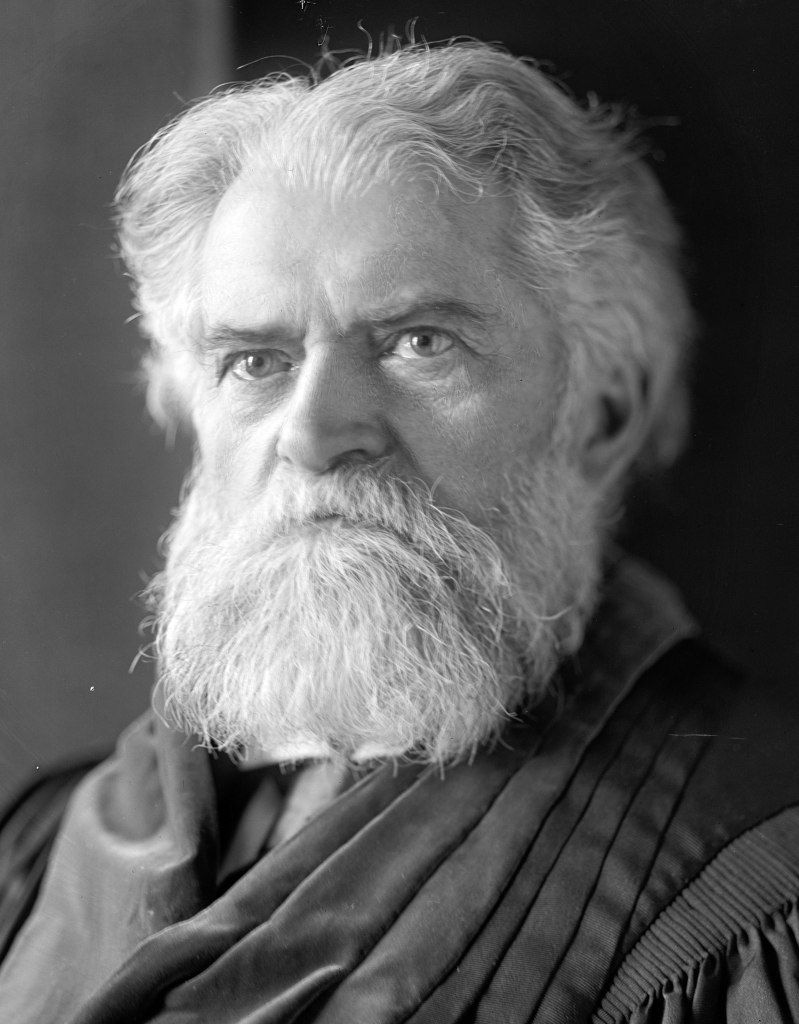
Simon Newcomb

Log tables were instrumental in number crunching before the invention of any type of calculators. The log tables start with 10 and end in 99.

Newcomb felt that the people using log tables for their calculations have more 1’s in their datasets repetitively in early digits that is why the initial pages where the numbers start with 1 are used more. He also knew that the numbers used in such astronomical calculations are the numbers available naturally. These numbers are not generated out randomly, they signify certain quantities attributed to the things available in nature (like diameter of a planet, distance between stars, intensity of light, radius of curvature of certain planet’s orbit). These were not some “cooked up” numbers, even though they were random but they had natural reason to exist in a way.

He published an article about this but it went unnoticed as there was no way to justify this in a mathematical way. His publication lacked that mathematical rigor to justify his intuition.

Newcomb wrote:

“That the ten digits do not occur with equal frequency must be evident to anyone making much use of logarithmic tables, and noticing how much faster the first one wears out than the last ones.”   

On superficial inquiry, anyone would feel that this observation is biased. It seemed counterintuitive, also Newcomb just reported the observation and did not explain in detail why it would happen. So, this observation went underground with the flow of time.

Frank Benford and The Law of Anomalous Numbers

Question – for a big enough dataset, how frequently any number would appear in first place? What is the probability of numbers from 1 to 9 to be the leading digit in given dataset?

Intuitively, one would think that any number can happen to be in the leading place for given dataset. If the dataset becomes large enough, all nine numbers will have equal chance to be in first place.

Frank Benford during his tenure in General Electric as a physicist made same observation about the log table as did Newcomb before him. But this time Frank traced back the experiments and hence the datasets from these experiments for which the log table was used and also some other data sets from magazines. He compiled some 20,000 data points from completely unrelated experiments and found one unique pattern!
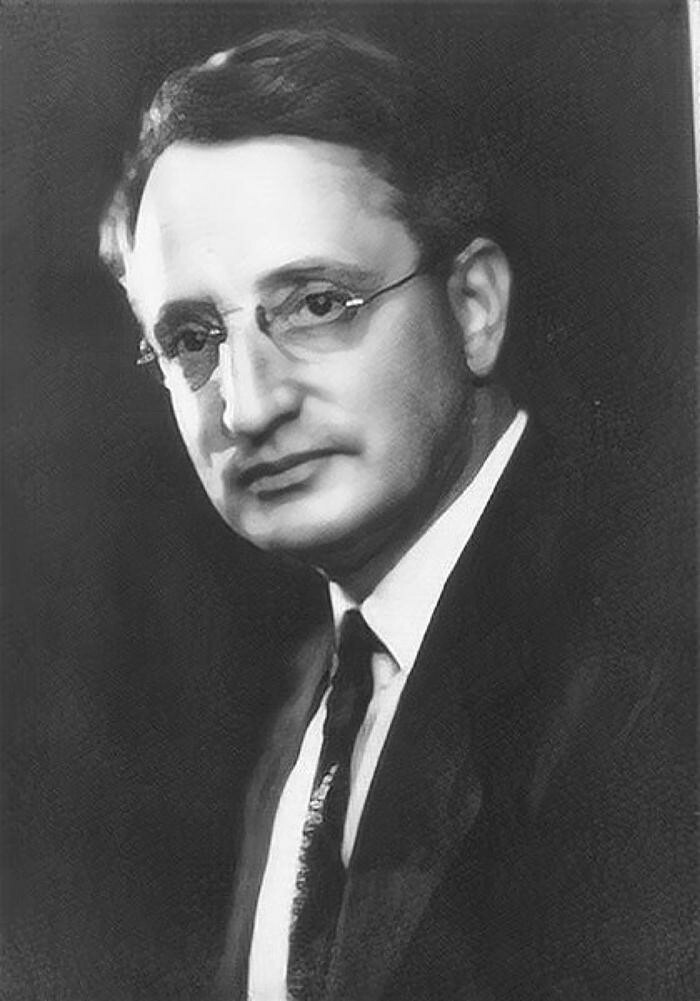
Frank Benford

He realized that even though our intuition says that any number from 1 to 9 could appear as the leading digit with equal chance, “natural data” does not accept that equal chance. The term “Natural data” refers to the data representing any quantifiable attribution of real phenomenon, object around us, it is not a random number created purposefully or mechanically; it has some origin in nature however random it may seem.

Frank Benford thus discovered an anomaly in natural datasets that their leading digit is more 1 or two than the remaining ones (3,4,5,6,7,8,9). In simple words, you will see 1 as leading digit more often in the natural datasets than the rest of the numbers. As we go on with other numbers the chances that other numbers will be frequent in leading position are very less.

In simple words, any naturally occurring entity will have more frequent 1’s in its leading digits that the rest numbers.

Here is the sample of the datasets Frank Benford used to find this pattern:
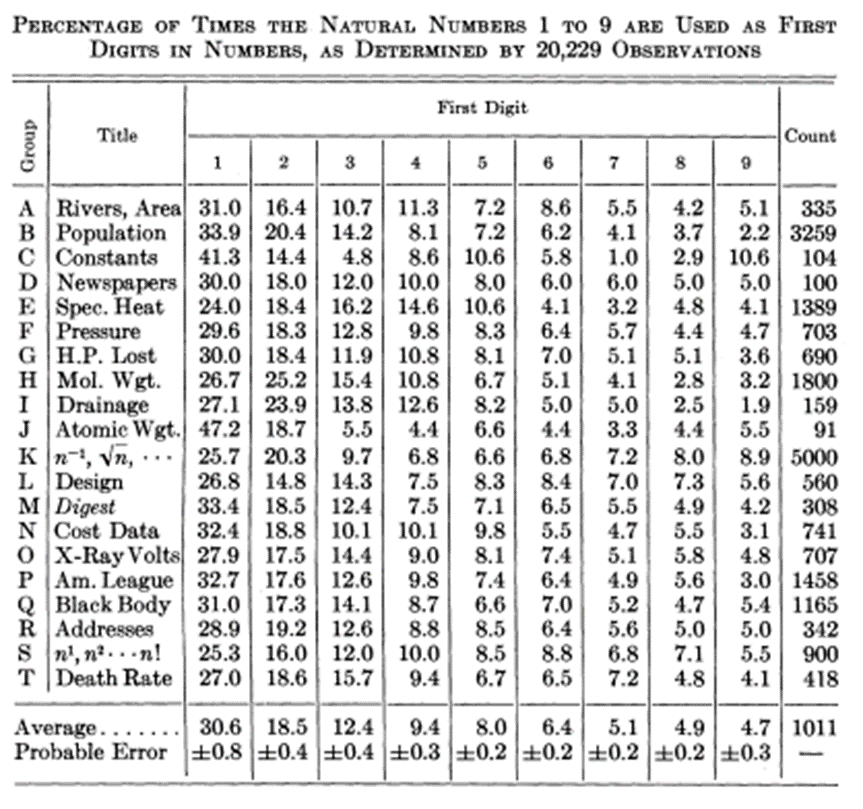
Dataset used by Frank Benford in his 1938 paper “The Law of Anomalous Numbers”

So, according to Benford’s observations for any given “natural dataset” the chance of 1 being the leading digit (the first digit of the number) is almost 30%. 30% of the digits in given natural dataset will start with 1 and as we go on the chances of other numbers to appear frequent drop drastically. Meaning that very few number in given natural data set will start with 7,8,9.

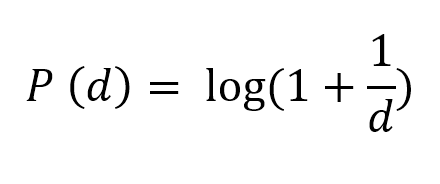
Thus, the statement of Benford’s law is given as:

The frequency of the first digit in a populations’ numbers decreases with the increasing value of the number in the first digit.

Simply explained, as we go on from 1 to 9 as first digit in given dataset, the possibility of their reappearance goes on reducing.

1 will be the most repeated as the first number then 2 will be frequent but not more than 1 and the frequency of reappearance will reduce and flatten out till 9. 9 will rarely be seen as the leading digit.

The reason why this behavior is called as Benford’s Law (and not Newcomb’s Law) is due to the mathematical equation that Benford established.
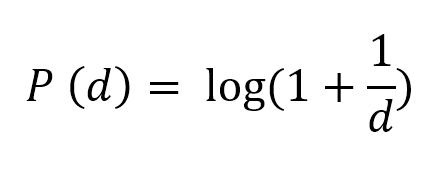
Where, P(d) is the probability that a number starts with digit d. Digit d could be anything 1,2,3,4,5,6,8 or 9.

If we see the real-life examples, you will instantly realize how counterintuitive this law is and still nature chooses to follow it.

Here are some examples:

I have also attached an excel sheet for complete datasets and to demonstrate how simply one can calculate and verify Benford’s law.

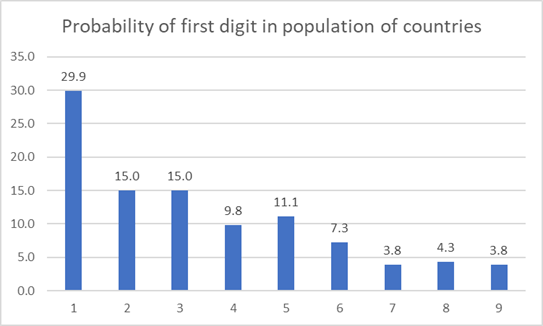
Population of countries in the world –

The dataset contains population of 234 regions in the world. And you will see that 1 appears the most as first digit in this dataset. Most of the population numbers start with 1 (70 times out of 234) and rarely with 9 (9 times out of 234)

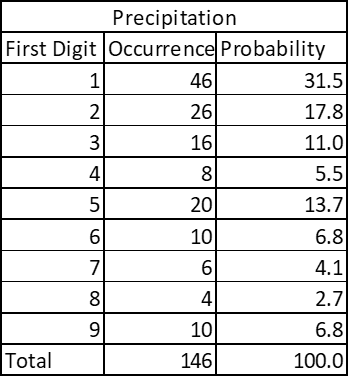
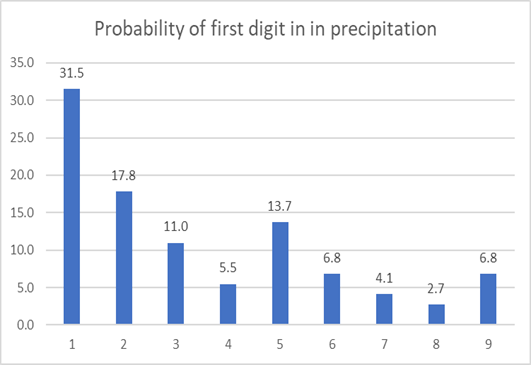
Country-wise average precipitation –

The dataset contains average rainfall from 146 countries in the world. Again, same pattern emerges.
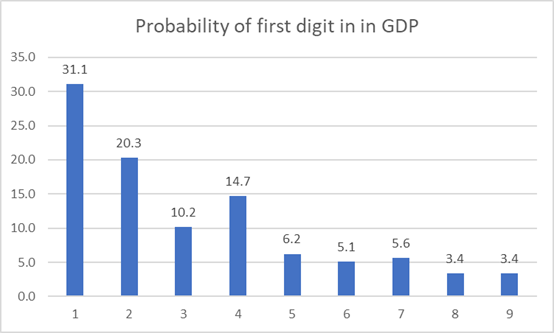
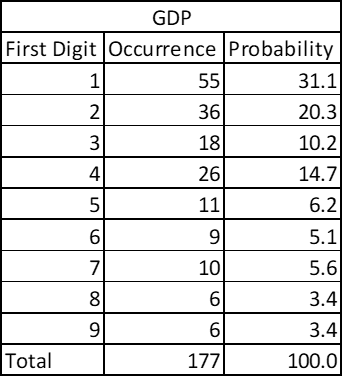
Country wise Gross Domestic Product –

The dataset contains 177 countries’ GDP in USD. See the probability yourself:
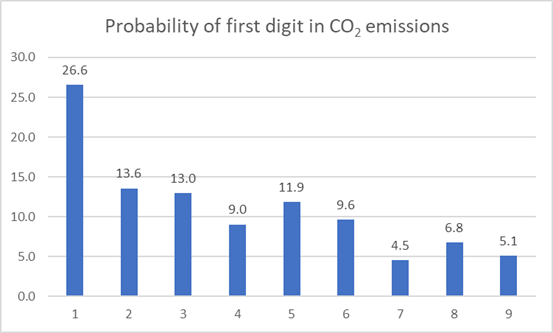
Country-wise CO2 emissions:

The data contains 177 entries

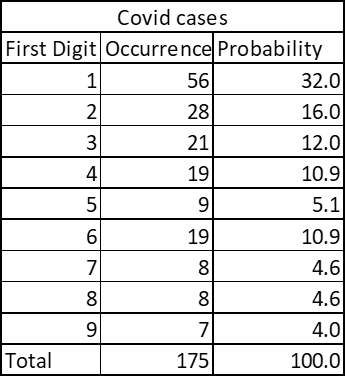
Country wise Covid cases:
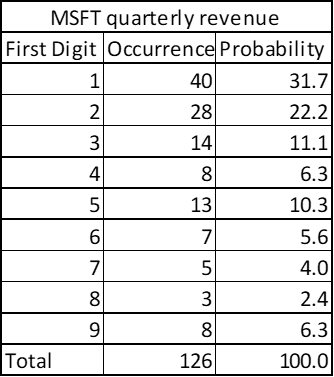
Here is one more interesting example:

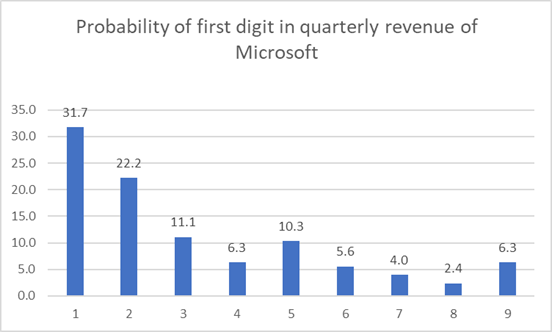
The quarterly revenue of Microsoft since its listing also shows pattern of Benford’s Law!
To generalize we can find the trend of all these data points by averaging as follows:

This is exactly how Benford avearaged his data points to establish a generalized equation.
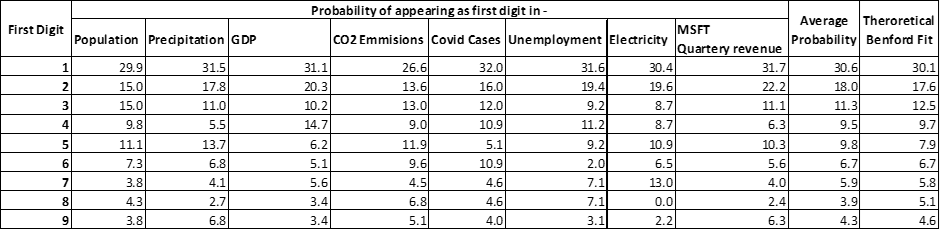
Theoretical Benford fit is calculated using the Benford equation expressed earlier.
So here is the relationship graphically:
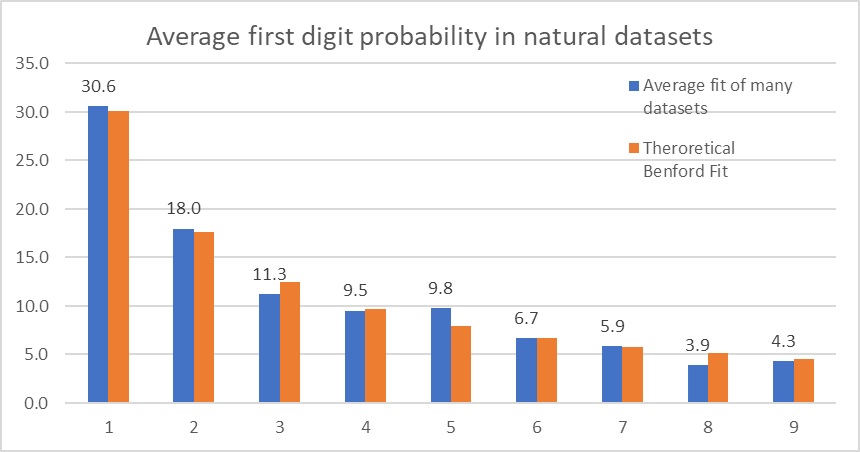
Now, you will appreciate the beauty of Benford’s law and despite seeming counterintuitive, it proves how seemingly random natural dataset has preferences.

Benford’s Law in Fraud Detection
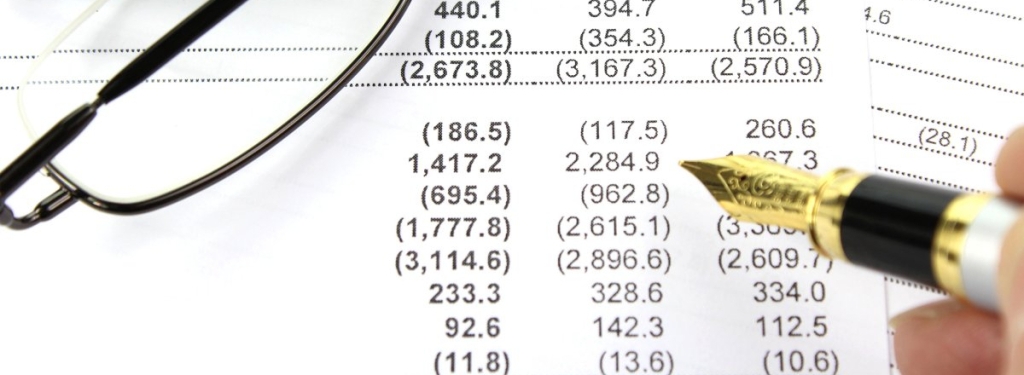
In his 1938 paper “The Law of Anomalous Numbers” Frank Benford beautifully showed the pattern that natural datasets prefer but he did not identify any uses of this phenomena.

1970 – Hal Varian, a Professor in University of California Berkely School of Information explained that this law could be used to detect possible fraud in any presented socioeconomic information.
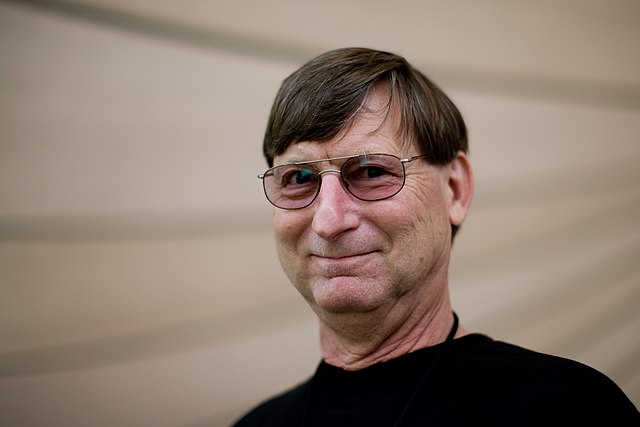
Hal Varian

1988 – Ted Hill, an American mathematician found out that people cannot cook up some numbers and still stick to the Benford’s Law.
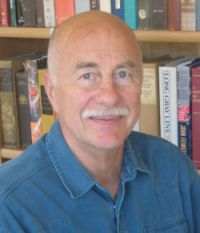
Ted Hill

When people try to cook up some numbers in big data sets, they reflect certain biases to certain numbers, however random number they may put in the entries there is a reflection of their preference to certain numbers. Forensic accountants are well aware of this fact.    
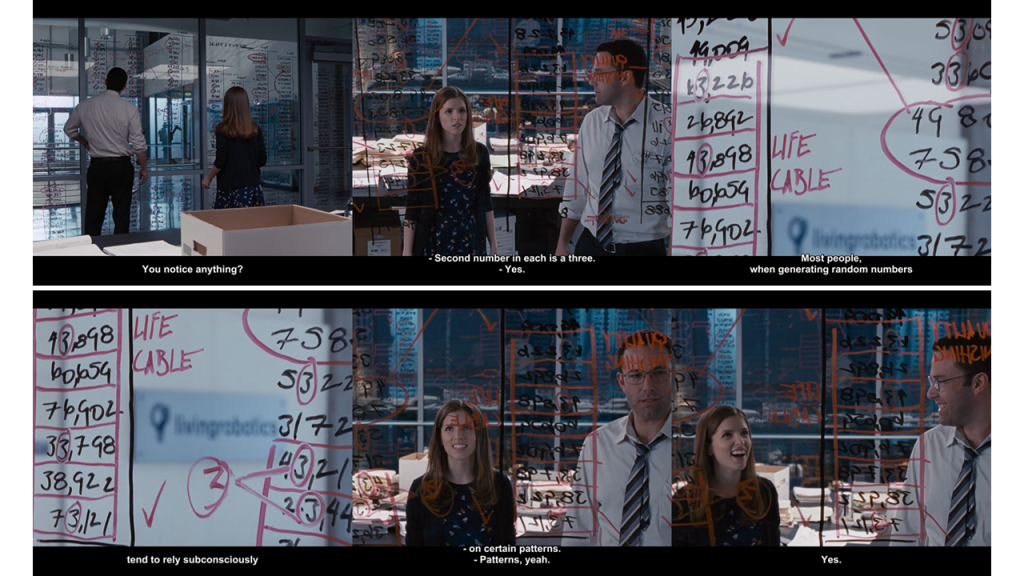
The scene where Christian pinpoints the finance fraud [Warner Bros. – The Accountant (2016)]

1992 – Mark Nigrini, a South African chartered accountant published how Benford’s law could be used for fraud detection in his thesis.
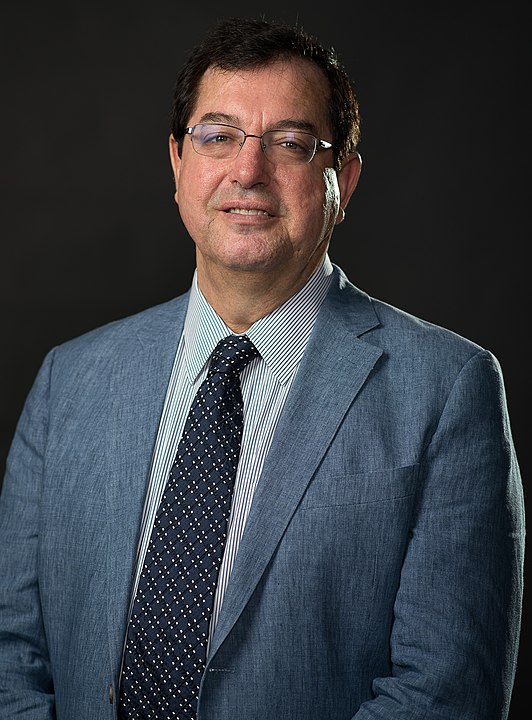
Mark Nigrini

Benford’s Law is allowed as a proof to demonstrate accounts fraud in US courts at all levels and is also used internationally to prove finance frauds.

It is very important to point the human factor, psychological factor of a person who is committing such numbers fraud. People do not naturally assume that some digits occur more frequently while cooking up numbers. Even when we would start generating random numbers in our mind, our subconscious preference to certain numbers gives a pattern. Larger the data size more it will lean to Benford’s behavior and easier will be the fraud detection.

Now, I pose one question here!

If the fraudster understands that there is such thing like Benford’s Law, then wouldn’t he cook up numbers which seem to follow the Benford’s Law? (Don’t doubt my intentions, I am just like a cop thinking like thieves to anticipate their next move!!!)

So, the answer to this doubt is hopeful!

The data generated in account statements is so huge and has multiple magnitudes that it is very difficult for a human mind to cook up numbers artificially and evade from detection.

Also, forensic accountants have showed that Benford’s Law is a partially negative rule; this means that if the law is not followed then it is possible that the dataset was tampered/ manipulated but conversely if the data set fits exactly / snuggly with the Benford’s law then also there is a chance that the data was tampered. Someone made sure that the cooked-up data would fit the Benford’s Law to avoid doubts!

Limitations of Benford’s Law

You must appreciate that nature has its ways to prefer certain digits in its creations. Random numbers generated by computer do not follow Benford’s Law thereby showing their artificiality.

Wherever there is natural dataset, the Benford’ Law will hold true.

1961 – Roger Pinkham established one important observation for any natural dataset thereby Benford’s Law. Pinkham said that for any law to demonstrate the behavior of natural dataset, it must be independent of scale. Meaning that any law showing nature’s pattern must be scale invariant.

In really simple words, if I change the units of given natural dataset, the Benford law will still hold true. If given account transactions in US Dollars for which Benford’s Law is holding true, the same money expressed in Indian Rupees will still abide to the Benford’s Law. Converting Dollars to Rupees is scaling the dataset. That is exactly why Benford’s Law is really robust!

After understanding all these features of Benford’s Law, one must think it like a weapon which holds enormous power! So, let us have some clarity on where it fails.

  1. Benford’s Law is reflected in large datasets. Few entries in a data series will rarely show Benford’s Law. Not just large dataset but the bigger order of magnitude must also be there to be able to apply Benford’s Law effectively.
  2. The data must describe same object. Meaning that the dataset should be of one feature like debit only dataset, credit only dataset, number of unemployed people per 1000 people in population. Mixture of datapoints will not reflect fit to Benford’s Law.
  3. There should not be inherently defined upper and lower bound to the dataset. For example, 1 million datapoints of height of people will not follow Benford’s Law, because human heights do not vary drastically, very few people are exceptionally tall or short. This, also means that any dataset which follows Normal Distribution (Bell Curve behavior) will not follow Benford’s Law.
  4. The numbers should not be defined with certain conscious rules like mobile numbers which compulsorily start with 7,8, or 9; like number plates restricted 4, 8,12 digits only.
  5. Benford’s Law will never pinpoint where exactly fraud has happened. There will always be need for in depth investigation to locate the event and location of the fraud. Benford’s Law only ensures that the big picture is holding true.

Hence, the examples I presented earlier to show the beauty of Benford’s Law are purposefully selected to not have these limitations. These datasets have not bounds, the order of magnitude of data is big, range is really wide compared to the number of observations.     

Now, if I try to implement the Benford’s Law to the yearly revenue of Microsoft it reflects something like this:
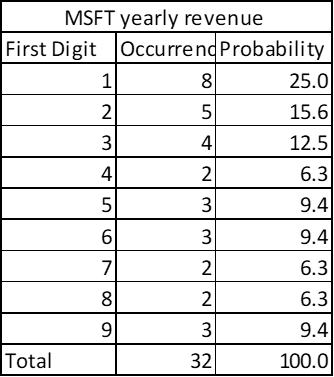
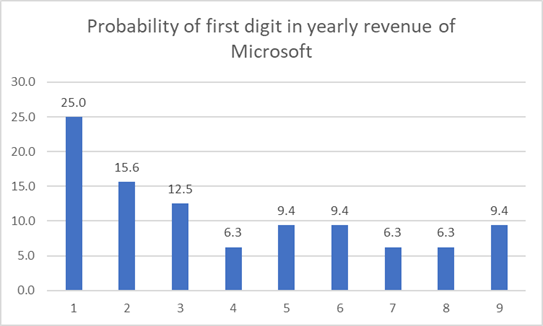
Don’t freak out as the data does not fully stick to the Benford’s Law, rather notice that for the same time window if my number of datapoints are reduced, the dataset tends to deviate from Benford’ Law theoretically. Please also note that 1 is still appearing as the leading digit very frequently, so good news for MICROSOFT stock holders!!!

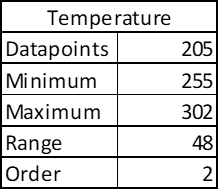
In same way, if you see the data points for global average temperatures (in Kelvin) country-wise it will not fit the Benford’s Law; because there is no drastic variation in average temperatures in any given region.
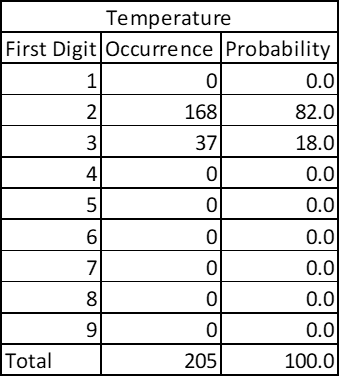
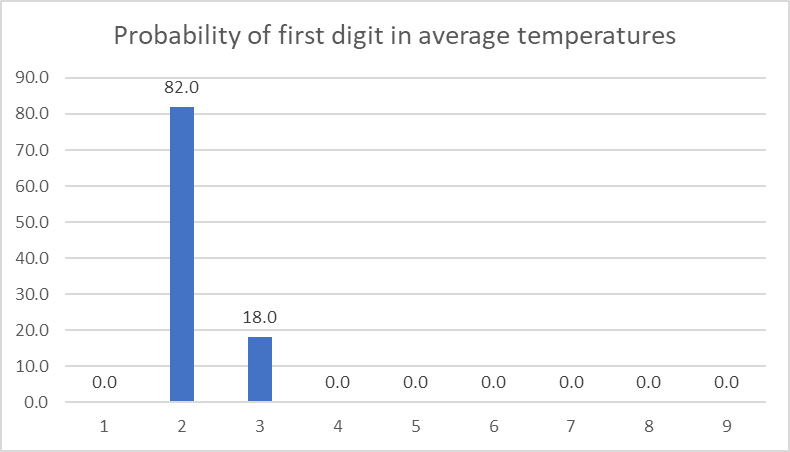
See there are 205 datapoints – big enough, but the temperatures are bound to a narrow range. Order of magnitude is small. Notice that it doesn’t matter if I express temperature in degree Celsius of in Kelvins as Benford’s Law is independent of scale.

Nature Builds Through Compounded Growth, Not Through Linear Growth!

Once you get the hold of Benford’s law, you will appreciate how nature decides its ways of working and creating. The Logarithmic law given by Frank Benford is a special case of compounded growth (formula of compound interest). Even though we are taught growth of numbers in a periodic and linear ways we are masked from the logarithmic nature of the reality. Frank Benford in the conclusion of his 1937 paper mentions that our perception of light, sound is always in logarithmic scale. (any sound engineer or any lighting engineer know this by default) The growth of human population, growth of bacteria, spread of Covid follow this exponential growth. The Fibonacci sequence is an exponential growth series which is observed to be at the heart of nature’s creation. That is why any artificial data set won’t fully stick to logarithmic growth behavior. (You can use this against machine warfare in future!) This also strengthens the belief that nature thinks in mathematics. Despite seemingly random chaos, it holds certain predictive pattern in its heart. Benford’s Law thus is an epitome of nature’s artistic ability to hold harmony in chaos!  
You can download this excel file to understand how Benford’s law can be validated in simple excel sheet:

References and further reading:

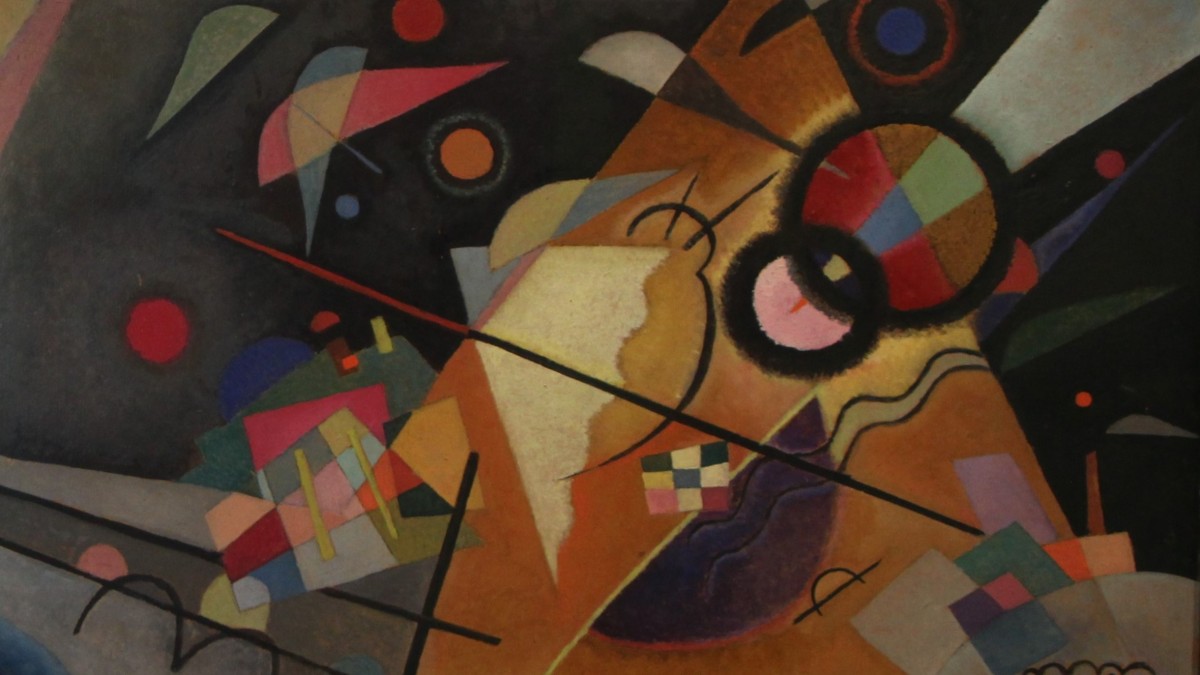
  1. Cover image – Wassily Kandinsky’s Yellow Point 1924
  2. The Law of Anomalous Numbers, Frank Benford, (1938), Proceedings of the American Philosophical Society
  3. On the Distribution of First Significant Digits, RS Pinkham (1961), The Annals of Mathematical Statistics
  4. What Is Benford’s Law? Why This Unexpected Pattern of Numbers Is Everywhere, Jack Murtagh, Scientific American
  5. Using Excel and Benford’s Law to detect fraud, J. Carlton Collins, CPA, Journal of Accountancy
  6. Benford’s Law, Adrian Jamain, DJ Hand, Maryse Bйeguin, (2001), Imperial College London
  7. data source – Microsoft revenue – stockanalysis.com
  8. data source – Population – worldometers.info
  9. data source – Covid cases – tradingeconomics.com
  10. data source – GDP- worldometers.info
  11. data source – CO2 emissions – worldometers.info
  12. data source – unemployment – tradingeconomics.com
  13. data source – temperature – tradingeconomics.com
  14. data source – precipitation – tradingeconomics.com

Sophie Germain- The Lady of Mathematics

Internet has literally exploded the branches of knowledge and made it accessible to any class, caste, creed, race, gender. We already owe to such technological revolutions for making knowledge truly accessible to everyone who desires to gain it. We all know the accessibility of knowledge was not open to such extents before. History has examples where certain class/group of people were restricted from not studying certain or all fields of knowledge. Starting from the early times in the popular history of knowledge, women were not supposed to study, take interests in the philosophical, technological ventures. You will find very few examples of female philosophers, scientists from the pages of history. Only in the recent century the liberalization of knowledge, awareness and realization of people thereby the social policies and advancements in technology have made knowledge accessible to all, especially women.

Today, I will be discussing about one such woman who is still not famous in mainstream and defied all the odds in her times to not only acquire but to contribute in our understanding of nature especially in the field of Mathematics.

Sophie Germain

This is about one of the greatest female mathematicians, physicists in the history of mankind called Sophie Germain. (Pronounced as jer-maw as in French)

The thing with mathematics is about the undefeated beasts it still holds. Given that most of us are already dreaded about the uncertainty of understanding/ failure/ lack of interest mathematics brings with it, any one unsolved problem till date in mathematics is enough to give an existential crisis to some of the greatest minds. Some of them are listed in Millennium problems and please note that the number of unsolved problems in mathematics in not finite and can haunt you forever. (Hence, Ignorance is bliss.)

One such problem haunted generations and generations of mathematicians and was supposed to haunt forever. It was the proof to the Fermat’s Last Theorem. The problem remained unsolved for centuries and whole efforts of mathematics were spent to prove it. Many greatest mathematicians, sharpest minds thought that it was unsolvable and left it as an unfruitful and wasted venture.

Finally, the problem was solved in 1995 by British mathematician Andrew Wiles. How he did that will be story for another time.

The important thing for this discussion is about the woman who took the first intellectual leap to crack “the easiest to understand but the most difficult to crack problem” in the history of humanity and mathematics. The times when she did this, mathematics was not the field for women. Women were not expected to study mathematics. I those times, woman were only expected to be “informed” (not study) about mathematics – rather scratch the surface of mathematics only to have an interesting conversation with men in parties, functions, meets.

The problem

Fermat’s Last Theorem states that for equation,

There exists no whole number solution for n>2.

The easiest and famous equation sitting in the neighborhood of this equation is the Pythagoras’s Equation for the hypotenuse of right-angled triangle, where x, y are the sides of right angle and z Is the hypotenuse of the triangle.

The problem is that this equation cannot be solved to whole number values of x, y and z if the value of n is larger than 2. The challenge is to prove that this is true. One can keep on substituting many values of x, y and z in order to check the output of values. If they are not getting the whole number solution then they can prove that the idea is true.

But mathematics does not work in that way. Even if you have computers to crunch the numbers, they cannot do it for eternity to infinity of numbers. Mathematics demands the rigor and logical proofs (not the experimental ones as in science) to prove any idea. If it is not proven logically and if there is no anomaly found for the idea then it is categorized as a conjecture.

In the old times, mathematicians actually hand-calculated the numbers to check whether Fermat’s last theorem holds true or not but could not find the real proof for the problem. The attempts done were for single values of n as in substituting values of n as 3, 4, 5 and so on.

The tricky part was that, it is itself difficult to prove the Fermat’s Last theorem for single value of n.

For n=3, one would still have to consider the infinite combinations of x, y, z to prove by mere number crunching. Even if every single human being solves the problem for each value of ‘n’ individually (which is impossible in itself), still it cannot be proven for all cases.

So, what every mathematician was doing was trying to prove the problem for specific case of certain value of ‘n’ in this equation. Meaning that everyone was solving the problem for the special case and it was difficult the generalize the solution, the proof.

The leap of generalization in Fermat’s Last Theorem

It was Sophie Germain, a woman mathematician amongst all men mathematician who made first successful attempt to generalize the proof of Fermat’s Last Theorem. The idea is based on certain prime numbers which are grouped as Germain Primes.

The strategy to prove Fermat’s Last Theorem was to prove the theorem for all prime number values of ‘n’. Prime numbers are building blocks of the all numbers in number theory. The are like smallest indivisible parts in numbers which cannot be divided into smaller numbers except themselves and one. It is already established and proved in mathematics that there are infinite numbers of prime numbers. It is very impractical to solve the Fermat’s Last theorem even from prime numbers one by one as they too are infinite.

What Sophie Germain did is to find a trend in the prime numbers and prove the theorem for such prime numbers. It is said that she got this idea from her factorization formula which is now known as “Sophie Germain factorization Identity”.

Here, you can notice that the last two steps tell us that this represents the number as its factors. If this single number (sum of 4th powers of two numbers) already has two whole number factors, then it cannot be prime as per the definition of prime numbers. The same idea can be used to check whether certain sums of numbers are prime numbers are not.

The insight from this identity is that, it can be used to check the 4th power of equation in Fermat’s Last theorem if some adjustments are made. This same idea is reflected in the Sophie Germain’s attempt to prove the Fermat’s Last Theorem for a set of prime numbers.

Sophie Germain attempted the proof for some prime numbers today known as Sophie Germain primes.

A number ‘p’ is called as Germain prime if n=2p+1 also gives a prime number.

For, prime number p=2, new number n=2(2)+1=5 which is prime hence p=2 is Sophie Germain Prime.

For prime number p=3, n=2(3)+1=7 which is again prime hence p=3 is Sophie Germain Prime

But,

For prime number p=7 gives n=2(7)+1=15 which is not prime number hence 7 is not a Sophie Germain Prime.

So, if we adjust the Fermat’s Last Theorem equation to Germain Primes, we can develop some interesting insights.

Using the understandings from the Sophie Germain Identity  and comparing them with the result above we can understand that as in Sophie Germain identity 4 as a coefficient and power of b, some solution exists.

Meaning that in order to have a solvable whole number solution to Fermat’s Last Theorem, either x, y or z needs to be multiple of the power to which they are raised i.e., ‘n’. And as this identity proves the composite (non-prime) nature of numbers from its outcome in most cases, there is possibility that the solutions will not be whole numbers and hence Fermat’ last Theorem Equation cannot have whole number solutions for n>2.   

The most important aspect of this approach was that the idea does not discuss Fermat’s Last Theorem for certain value of n. It generalizes the equation for many numbers which was never done by any mathematician before.

Even more important than that was such progressive breakthrough in mathematics was established by a woman who was not expected to even study it. The times when Sophie established this breakthrough in mathematics, we must understand that women were discouraged from studying mathematics and it was assumed that math was “beyond their mental capacity”.  

The Life of Sophie Germain

Marie-Sophie Germain was born in France in 1776 (almost 140 years after establishment of Fermat’s Last Theorem) in a house of a wealthy silk merchant. When she was 13, the French Revolution took the course of things and due to such sensitive environment, she was restricted to stay inside the house. The books in her father’s library became her friends where she was intrigued by the story of the death of Archimedes. (Archimedes was killed by a roman soldier only because he was so engrossed in his thoughts on a geometric figure that he could not answer the soldier’s question).

“How can a subject create such interest in a person that he couldn’t even think about his death!” was the curiosity which brought Sophie closer to mathematics. Though her times and parents would not allow her to study mathematics, she continued her journey alone to explore and learn mathematics. (Her parents tried removing warm clothing and candles from her room so that she will give up on studying mathematics but she continued her studies further).

As mathematics was not destined for women in her times, Sophie enrolled herself in the name of a man called as Monsieur Antoine-Auguste Le Blanc in École Polytechnique. She need not to attend the courses in person as the education was also available in the form of lecture notes. She audited the courses from the lecture notes hiding behind the name of a man Monsieur Le Blanc and completed her education.

Her intellect impressed one of the famous mathematicians and the instructor in École Polytechnique- Joseph-Louis Lagrange. The answer sheets, problem solving skills piqued interest of Lagrange to meet Monsieur Le Blanc in person where he found out that the problem solver is not a man but a woman called Sophie Germain. Good thing for mathematics, Lagrange became her mentor.

Carl Friedrich Gauss, the (as in “THE”) greatest mathematician of all times had also tried cracking the Fermat’ s Last theorem but left the pursuit as a hopeless one. Sophie Germain tried to explain her approach to solve the Fermat’s Last Theorem to Gauss through her letters as Monsieur Le Blanc. The approach of Sophie Germain again activated Gauss’s interest in Fermat’s Theorem and also he too was shocked upon her reveal as a woman.

“when a woman, because of her sex, our customs and prejudices, encounters infinitely more obstacles than men in familiarizing herself with [number theory’s] knotty problems, yet overcomes these fetters and penetrates that which is most hidden, she doubtless has the noblest courage, extraordinary talent, and superior genius.”

Carl Friedrich Gauss on Sophie Germain

Gauss and Sophie never met in person. Gauss actually made attempts at universities to grant her an honorary degree.

Sophie Germain and The Eiffel Tower

After Fermat’s Last theorem, Sophie tried herself in the development of theory of elasticity in a contest by Paris Academy of Sciences to develop a mathematical theory of vibration and elasticity. She was contested by the Simeon Poisson (known for Poisson’s Ratio). Later on, published works of Poisson’s on elasticity contained some works of Sophie Germain where she was not acknowledged.

In her third attempt to win the contest, after eliminating the errors and consulting with Poisson she published her theory and won the prize. She still was not able to attend the sessions of academy as the only women allowed were the wives of the members of the academy. After seven long years of membership, already having proven herself, Sophie attended the academy sessions because her friend and then secretary of the academy Joseph Fourier made the tickets available to her.

She had tried to republish her studies in elasticity separately after correction of errors to prove her worth against the works of Poisson. The academy still considered her work as trivial and they didn’t want her to entertain her further and rejected it. After the recommendation of famous mathematician and engineer Augustin-Louis Cauchy (known for Cauchy’s Integral Theorem), she published her work.       

The same work on elasticity contributed to the development of an engineering marvel “Eiffel Tower” in Paris. She was not acknowledged even here.

The contribution of Sophie Germain to number theory was only revealed only because of a mathematician Adrien-Marie Legendre where he acknowledged her approach to prove Fermat’s Last Theorem.

Sophie Germain died of breast cancer aged 55 (June, 1831). She was the first woman who was not wife of a member to attend the French Academy of Sciences. She received her honorary degree posthumously from University of Göttingen in 1837 (6 years after her death)         

The French Academy of Sciences started Sophie Germain Prize in 2003 in her name to honor her contribution to French Mathematicians.

Further Readings:

  1. Sophie Germain, The Princess of Mathematics and Fermat’s Last Theorem by Hanna Kagel, Georgia College and State University
  2. Sophie Germain and Special Cases of Fermat’s Last Theorem by Colleen Alkalay-Houlihan, Mathematics and Statistics, McGill University Canada
  3. Sophie Germain Identity- Brilliant.org
  4. Fermat’s Last Theorem by Simon Singh
  5. Photo of Sophie Germain from wikipedia
  6. Sophie Germain- Wikipedia
  7. Sophie Germain- MathTV- YouTube

Mandelbrot Set- The bottomless wonders of fractal geometry

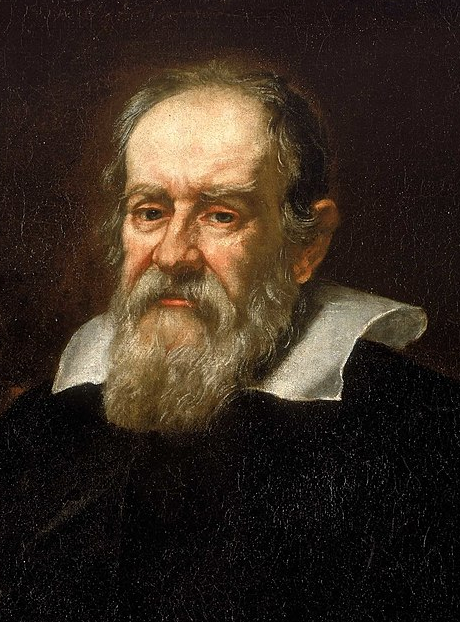
To understand the Universe, you must understand the language in which it’s written, the language of Mathematics

– Galileo Galilei

In our school days whenever a math problem would start creating “the problem” in our minds making us scratch our head, there was this common expression showing the worthlessness of learning all this math if we cannot implement it in real life. One would say – “Where do I use these sines, cosines, tangents while doing my groceries?” or “What is the use of solving this calculus problem if I see no use of it? – I never needed calculus to do my routine works?” And these questions have one important thing that detaches most of us from the mathematics and the rigor it demands.

That thing is the great difference between of regularity, consistency, idealistic nature of the mathematical laws, formulae, theorems and the irregularity, inconsistency, chaos, non-ideal nature of the things around us, the reality we live in. We have reduced this difference by using tolerance, probability, acceptable limits of accuracy, modelling.

Still mathematics always seems to be out of reach and only the intellectual venture for almost all of us. The reason is (again) the feeling of incoherence between math and the real world. Today, I will dive into one such idea and the person behind it named Benoit Mandelbrot who bridged this gap in a big way, revealing the secret mathematical ways in which the real-life objects and the nature works.  

What we learnt in Schools – The Euclidean geometry

Point, lines, triangle, square, circles, parallelograms – these are the shapes that we have always crunched our fingers in our school day. The are based on the Euclid’s geometry where the shapes are largely regular sizes. Hence, the mathematics is very structure and there are logical, structured ways, theorems, formulae to work with these figures, hence we can say that there are always some ways available to figure out the unknown information.

But you rarely see perfect geometric objects in real life. Real life objects are not perfectly shaped the way we learn them in an ideal nature hence we are expected to have the tolerances in our calculations. Now, here are some questions – “Can you describe the size of the cloud floating in the sky in a mathematical way?”, “How would one describe the branching of a tree in a mathematical equation?”, “How would one describe the path traversed by the lightning strike in the sky?” (Again, what good is math if I couldn’t implement it into the real world?)      

Hidden Dimensions

We all have awareness of 3 dimensions, it is the way we experience the real world. We also know that there is fourth dimension in nature but out senses are limited to 3 dimensions. There was a problem that few were working on called the ‘Space Filling Curves’.

How would one draw a line so that it will touch every on the plane?

Giuseppe Peano was the first person to discover a curve which would cover every point on the plane with a small repeating unit pattern- curve. This basic unit on repetition and angle of rotation would cover all the plane.

After that, many others like David Hilbert, Henri Lebesgue, Wacław Franciszek Sierpiński demonstrated different types of space filling curves where you can see a simple repeating unit when iterated enough times can fill the complete area in a given plane.

Peano’s Space Filling Curve ( from basic unit to repeating units)
Hilbert’s Space Filling Curve (from basic unit to repeating units)

Theoretically, a curve or a line has single dimension further clarifying, it has no thickness. Then, how can we explain the idea of curves which when iterated enough in a set direction yield a higher dimensional geometry. This is where the fun really began.

How can a single curve of 1 Dimension (zero thickness) can create 2 D object?

We know how addition of one dimension enhances the geometric description of every object. Thus, we are aware of 1D, 2D and 3D objects. From a line to square to cube that is how it works. But, as we have seen in the last idea of space filling curve, how would we fit the idea of 1D curve of zero thickness curve filling the 2D plane? How would one describe the events happening between 1D world and 2D world?

Hausdorff dimension

From the premise of above problem, where we were stuck was our understanding of the nature of the dimensions- we were considering the dimensions to be a whole number. What is happening between ‘space filling curve and the space they are occupying’ is between 1D and 2D – indicates that there are some dimensions which lie between each whole number dimension. This led to the non-whole numerical concept of dimension. This means that the dimensions could be fractions.    

This created whole new world of dimensions which can be described as hidden dimensions between two whole number dimensions. For example, when we look at a tennis ball, it is spherical in shape but when we zoom significantly enough, we find that the boundaries of this ball are not perfectly continuous rather the boundaries of the ball are made up of small polymeric fur-like hair. Even when we would zoom into the perfectly round rubber ball its roughness is revealed at significant observation level.

Cantor Set – Smaller Hidden Infinities

Henry John Stephen Smith, an Irish mathematician described idea of splitting a line into three parts, then removing the middle part. Then, after one has removed the middle portion, he will split the remaining tow parts into three and again remove the middle part from it. This will be iterated until the sum of the line remained will be zero. The final remaining parts coordinates are the part of the Cantor set.

One can easily find out that even after we keep on splitting the line into three equal portions and deleting the middle portion, there is no way we will stop on this. Every new part generated will be split into the same style it was split earlier indicating iterative process. The iterations will go on to infinity thus for every new iteration some new coordinates will be added indication that the Cantor set has infinite elements but the length of the line will eventually become zero as we are infinitely removing 1/3rd part from the set continuously. Sounds weird already!

Generation of Cantor Set

What I explained above are mathematical ideas purely generated from the human mind, thought experiments and their logical explanations. These ideas remained ideas because nobody could find a way to find their implementation in real life world. There was no coherence of these mind-boggling ideas to the real-life objects around us.     

Benoit Mandelbrot and The Rise of Fractal Geometry

There were many events in the life of Benoit Mandelbrot which converged to the development of Fractal Geometry. The world ‘fractal’ which has now become common in pop culture and sci-fi was actually coined by Benoit Mandelbrot himself.

Mandelbrot was interested in a problem related to the length of the coast of Britain. He found this idea in a research paper by an English mathematician, meteorologist Lewis Fry Richardson. According to Richardson if we were to measure the length of the total coast line of Briton the results will very based on the basic scale used for the measurement. As we go on taking practically smaller and smaller scale the length of the coastline will approach closer and closer to the realest of real length of coastline.

Smaller the scale used for measurement longer will be the length of the coast

There is one tipping point to this idea that when one goes on further decreasing the length of the scale used for the measurement of the coastline, the final value will go on increasing- this is also known as the coastline paradox.

Mandelbrot found a good connection between the idea of fractional dimensions and the coastline paradox. He developed the idea of roughness of the objects. He devised this theory of roughness into a computer program.

Mandelbrot while working in IBM developed a computer program and a makeshift computer graphics generator to check whether his equation fits to the empirical equation given by Richardson. Which lead to the confirmation of the theory of roughness and the fractal geometry created by Mandelbrot.

The Mandelbrot Set

To understand the formation of Mandelbrot set one needs to understand the idea of iteration, convergence/divergence and the complex numbers. An iteration is repeated step which is connected to the output from the previous step. Iterations are wildly used in approximations.

Convergence in iteration is the condition where the output will reach to a fixed value after some continuous iterations. Further iterations will not change the output. The output becomes iteration independent.

Divergence in iteration is the condition where the output continuously goes on changing as the iterations go on increasing and there is no iteration independent output.  

Iteration

Complex numbers are these numbers which are developed to solve the square root of negative numbers which were identified during the quest to find the roots of cubic equations. For, solving such problems where one needs to find the square roots of negative numbers, imaginary number called ‘i’ was created.

Though it is called as imaginary number, it is as real as the real numbers and has real life significance and applications. Every complex number is made up of imaginary and real part. The real part is represented on X-axis and imaginary part is represented on the Y-axis.

Mandelbrot set is the set of complex numbers ‘c’ for which the function given below, does not diverge to infinity, the sequence remains bounded to a fixed value.

For example,

For  z=0 and c=1,

and so on…

As we see from the outputs of the iterations the sequence is diverging, meaning it will not settle on a constant output. The sequence grows as the iterations go on, hence  does not belong to Mandelbrot set.

Similarly,

For z=0 and c=(-1)

and so on…

Here, we can clearly see that the output from the iterations is stable and just after few iterations it only fluctuates between values of 0 and -1. This means that the iteration output remains bounded to 0 and -1. Hence, c=(-1)  belongs to Mandelbrot Set.

This algorithmic work of iterations and checking for each possible complex number can be fed to a computer program. The graphical representation can be shown as follows.

The output image itself is mesmerizing. If you could point out that looks like created out of itself. The significant shapes are seen repeated everywhere you can observe. But what are real life applications of this outputs?

Mandelbrot Set in real life

The real fun begins when we identify the number of iterations it too for every number in Mandelbrot set. For example, if we assign a color spectrum from low contrast to high contrast and associate the increase in contrast to increased iteration to converge, we get following image.

Here, you can see the contrast bands around the Mandelbrot set.

Further if we get a complete color spectrum and correspond the number of iterations to the spectrum what we get is phenomenal. The colors and the pattern you will find in the Mandelbrot set are the patterns that are found in nature. There are many YouTube videos dedicated to zooming into specific regions of Mandelbrot set. In every area you will find different shapes and sizes, yet you will discover that they are made up of same basic shapes and that is the beauty of fractal geometry.

The equation given by Mandelbrot is also simply indicated as follows:

This simple equation has yielded son many and infinite number of patterns that when you see the Mandelbrot set zooms you can confirm that nature thinks in the ways of mathematics.

Famous Sections of Mandelbrot Set

The mesmerizing patterns from the Mandelbrot set zoom:

The development of computers and image processing created an explosion in the world of Mandelbrot set. Few lines of code with such a simple equation can yield such a variety of patterns and these patterns are spitting image of the shapes that are available in nature. Only single video of Mandelbrot set zoom is sufficient to believe the coherent nature of nature and the mathematics behind it.

Mandelbrot’s ideas and his fractal geometry are popularly used in the many fields. The nature of branching of veins, branches in lungs, branches in liver, kidneys have been computer modeled and simulated using Mandelbrot’s Fractal geometry. This helps the doctors to identify the critical branches to be controlled and operated during the procedure. The pattern created by the lightening strike can be modeled mathematically by using the fractal geometry. The global satellite imaging has been largely improved by the use of measure of roughness and fractal geometry. Event the random motion of the atoms- Brownian Motion can be explained by using fractal geometry. The irregular but more natural, organic and realistic images are created using the fractal geometry. Even the string theory which believes in the requirement of 11 dimensions is trying to find the answers possibly in fractal dimensions.

The Buddhabrot

On further expansion of the visualizations of the iteration sin the Mandelbrot set, one interested rendering emerges out which is famously known as Buddhabrot. Because, the image looks similar to the Buddha sitting in his meditative state and the particular curls of meditative Buddha’s hair.

When we track the number of iterations it takes for the given complex number to diverge to infinity and also include that spectrum of iterations, it yields the Buddhabrot.

The Buddhabrot

The most important thing about Benoit Mandelbrot’s contribution to the mathematics is the genius of his mind which bridged the gap of completely abstract and so called ‘pure mathematics’ to the irregular, organic, physical and rough nature of the mathematics of real-world objects.

The extent to which Albert Einstein disrupted the world of Physics with his equation  is the same extent of disruption created by Benoit Mandelbrot to the world of mathematics through fractal geometry.  

(P.S. – Interestingly both the equations are of square nature, actually the complete energy-mass equivalence equation of Einstein contains additive term to the square, represented as:

here, p is the momentum of object under consideration)

So, nature does think in the language of the mathematics.

Bottomless wonders spring from simple rules…

Repeated without end

– Benoit Mandelbrot

“And believe me, if I were again beginning my studies, I should follow the advice of Plato and start with the mathematical sciences, which proceed very cautiously and admit nothing as established until it has been rigorously demonstrated.”

– Galileo Galilei

Understanding the true nature of Mathematics- Gödel’s Incompleteness Theorem

Either mathematics is too big for the human mind or the human mind is more than a machine -Kurt Gödel

I remember the times in the school when we were introduced to the proofs of geometric theorems. There was this systematic template that you had to follow to secure full marks for the question. You would write the “Statement of the theorem”. Establish a geometry, define its components called “Drawing”. Then you would write “To prove”. Finally, you would follow the steps, based on the foundations you had in order to develop the final proof- “to prove”. The moment of relief was to rewrite the “to prove” statement again followed by “hence proved”.

Fun part of proving mathematical theorems was that, if one’s proofs were wrong or contained half written answers- he/she would fight for the marks of steps. I remember my friend (that one who used to study for wrong subject on wrong day) who wrote only the statement of theorem followed by “hence proved” or “LHS=RHS” in a (stupid) hope that it will yield at least one mark. Because of these theorems, there were two types of Mathematics teachers- The God mathematics teacher and the Devil mathematics teacher. No need to explain that the God mathematics teacher gave marks for the correct steps irrespective of the final proof. In short, mathematical theorems made us realize that there are some good mathematics teachers too. (a rare species!)

This funny and real experience reveal the true nature of mathematics.

Nature of Mathematics

Mathematics is made up of some systematic and logical steps which will reveal the nature of reality around us. Mathematics is not subjective; it is strong and resourceful to stand for itself. In simple words. Out of all the schools of thoughts mankind has developed, Mathematics is the purest of all. Mathematics never favors a thought just because some king, any political person or any spiritual leader has issued an order to call it true. Any mathematically proven true statement will remain true irrespective of the paths followed to reach it. Hence the reason, mathematics is the reflection of the truth rather the truth itself.       

Mathematics has its own system of truths called “Axioms” and “logic” to decide whether any proposition is true or false. For any “given statement” to be true, there is a systematic approach of questioning the impact of “given statement” on other mathematical system which are already proven to be true. If the already “proven true mathematical systems” still follow their true behavior after involving the “given statement” – the statement is called as true. This is also what can be roughly called as “Consistency”. If given statement is true then it cannot be contradicted.

There is one idea for proving mathematical proofs involving “proof by contradiction”. You assume the proof to be false, then follow the logic and reveal that the outcome does not concur with the what was to be proved hence the assumption that it was false was false; hence whatever was to be proved true is true. Simple example can be given as follows:

Algorithm to decide whether 1+1=2 is True or False

One can simply ask some questions to conclude that 1+1=2 is a true statement. In whatever way one will negate the statement, the person will not reach to consistent and fixed result thereby proving the negation false.

From here on, our actual story starts,

The paradox of self reference in Set theory

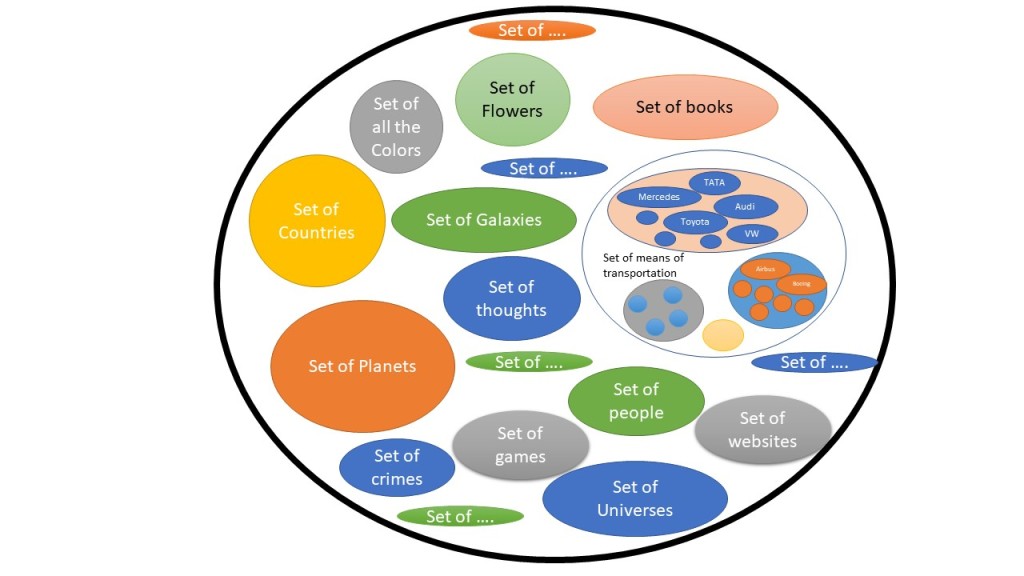
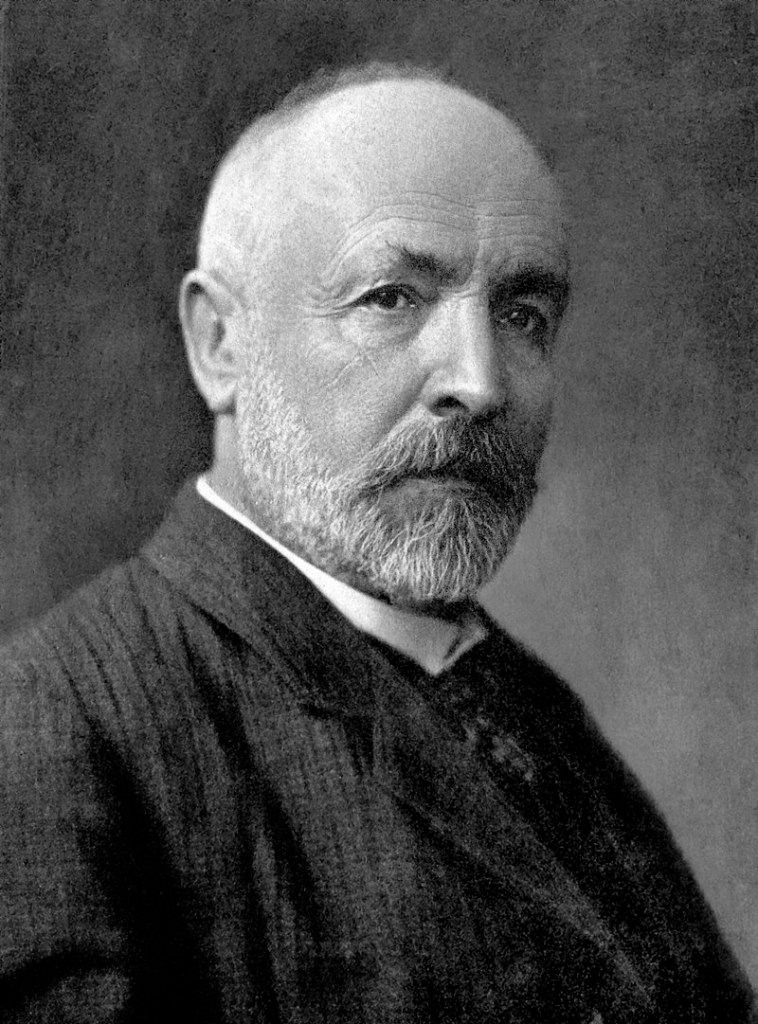
Set theory is one of the most important (simple and complex simultaneously) in mathematics developed by George Cantor. A set can be collection of anything which follows certain rules. Set of cars will include all the cars you can see, set of planets in the solar system will include all the planets (excluding Pluto!).

What about a set of all sets- The set that contains everything?

The set that contains set of all sets

Now the question comes, does the set that contains all sets, contain itself?

Does “the set that contains all the sets” contain itself?

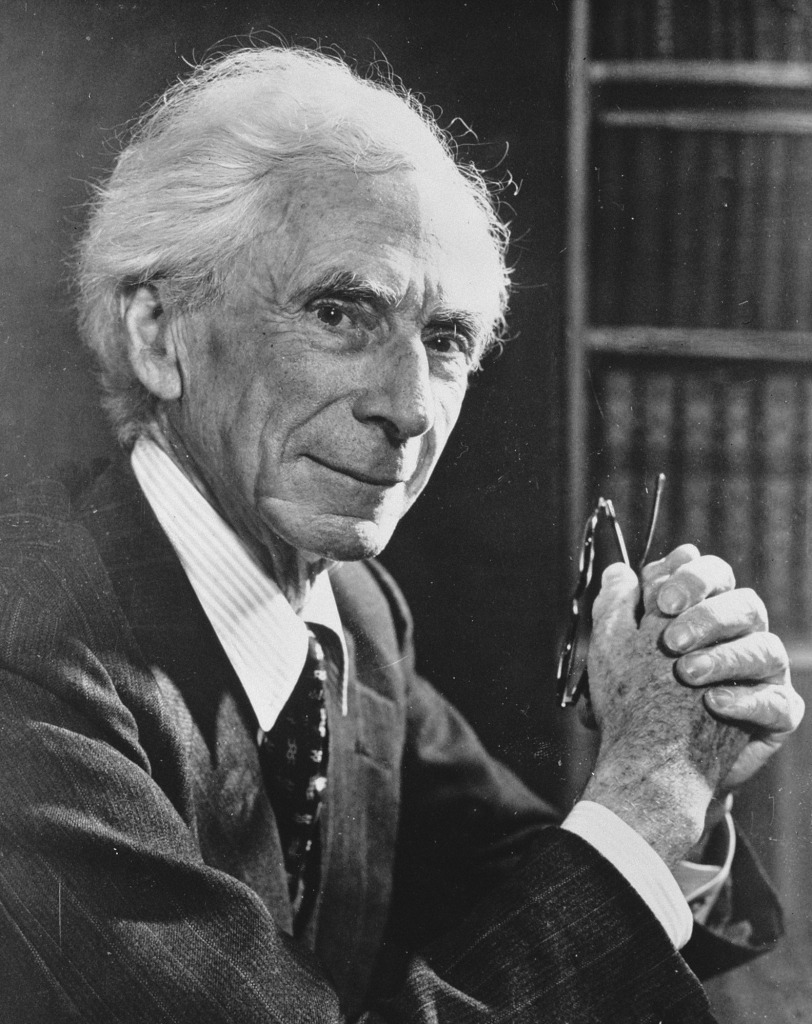
If “the set that contains all the sets” does not contain itself then it leaves itself outside of itself- hence it doesn’t become “the set that contains all sets”- but it is “the set that contains all the sets”. This leads to contradiction, famously called as “Self-contradiction”. This was found out by Bertrand Russel.

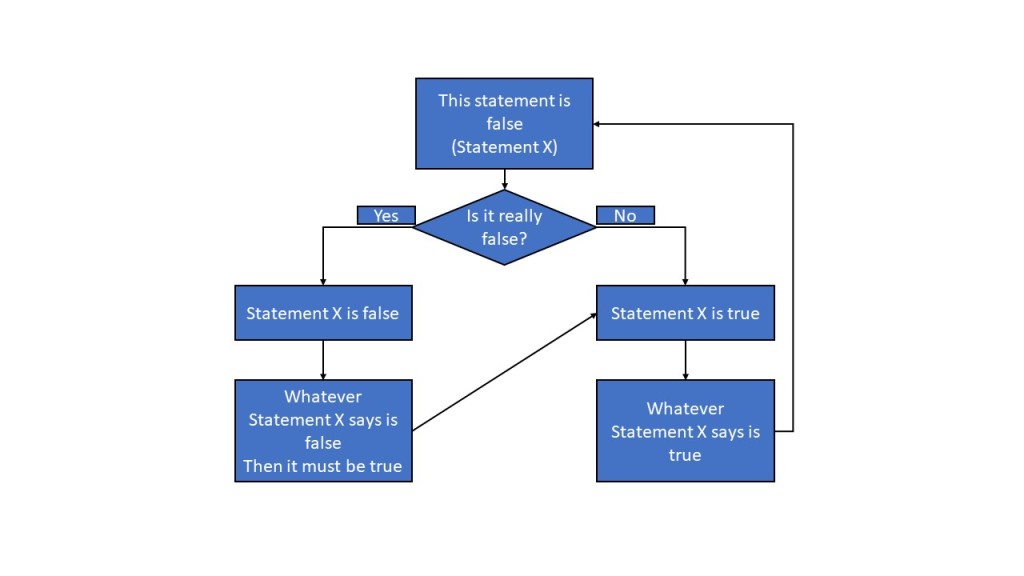
Here is one more example:

The paradox of Self-Reference

Unlike our previous algorithm to prove 1+1=2, here the algorithm doesn’t break out to either true or false. It contradicts itself to be true or false hence gets in continuous loop. This is where, the mathematicians realized the true boundaries of what we can know and what we cannot know.

The Barber’s Paradox is also one funny example paradox of self-reference.

The two cases of self-contradictions explained above are verbal paradoxes, means that their outcome may be subjective based on what every person understands from the meaning of the words; they can be twisted to any person’s meaning or understanding. Mathematical truths are not like that, they are specific and cannot be twisted to make any desirable or subjective outcome.

The Ignorabimus

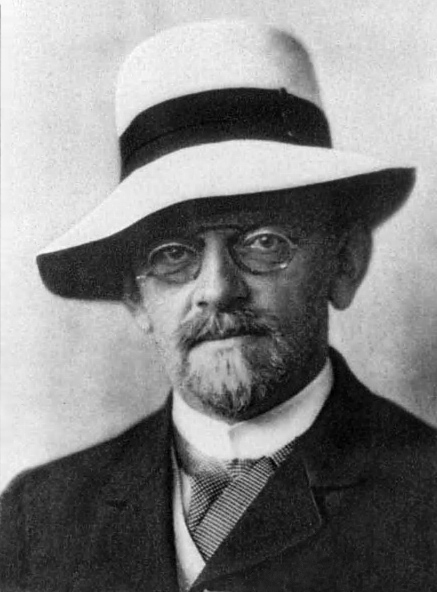
Boasting on the strong foundations and objective nature of Mathematics, many mathematicians called mathematics to be consistent thus they began the quest to prove the consistency of the mathematics. One of them was David Hilbert- one of the most influential mathematicians of all times. According to Hilbert, mathematics was consistent meaning for every mathematical true statement there exists no contradiction. It always follows only one single truth and its falsification of this truth does not exist. He had given a famous lecture to deny an idea called “Ignorabimus” (a latin maxim meaning “we will not know”- a topic for new and later discussion) saying that “We can know everything that is there to know and we will know that all”.  

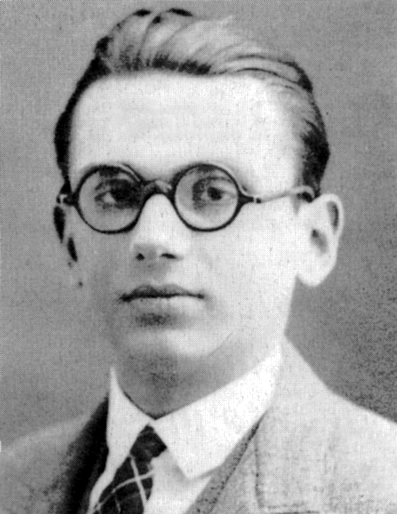
In reality, that was not the case. A day before this lecture actually happened- a logician called Kurt Gödel had proved that mathematics is not consistent. Means, contradictions can happen in mathematics. This was a shock for all the mathematics community. It’s like the truths in mathematics can be twisted to prove any wrong thing right.

Gödel had devised a method (purely mathematical) to prove that mathematics was not consistent.  

It somewhat aligns with the thought process of Self-referential paradox or the paradox of set theory.

Gödel developed a system, this system is well explained elsewhere (find the link in Further readings section):

Gödel defined a number to each logical operator and number like for “and”, “or”, “not”, “successor” (means any number before the number), “addition”, “subtraction” and so on. Based on the statement, take for 1+1=2 he pulled out a mathematical function to give out a number which represents that statement. Similarly for all the axioms, Gödel pulled out these individual numbers. So, when you want to prove that 2+1=3, you will pull a number for that statement. The number pulled out from the expression 2+1=3 will have provable connection with the statement 1+1=2 thereby proving the statement 2+1=3 to be true.   

Gödel developed the numbers for the axioms and proved that any statements can be proved from the operations on the numerical representatives of the statement to be proved.

For example:

When we enter 1+1=2 in a computer, the computer assigns the number and operator a unique code in 1s and 0s also known as ASCII (American Standard Code for Information Interchange) uses somewhat same idea to solve the addition operations to give output in a number containing 1s and 0s then converting it to the output display of calculator.

The fun starts when Gödel purely mathematically formulated number for a statement which was Self-referential paradox. The statement was like this:

“There is no proof for the statement with Gödel number g”

Meaning, that there exists no proof for the statement which number g indicates in the system out of which it has been created. The statement is unprovable

The Paradox-

There are two cases to be evaluated:

  1. If the above Gödel statement is false means, there is a proof. But according to Gödel statement there is no proof in the system Gödel created, thereby creating a contradiction.
  2. If the above Gödel statement is true means it is not provable from the Gödel system.

Either of the cases evaluated above lead us to conclude that the current system in which the statement was created will not have the proof for some true statements thus making it incomplete.

You will need to jump out of the system to create a new proof to evaluate the truth of the system because given system has insufficient axioms to prove the new statement to be true, hence the new statement itself becomes a new axiom.

The combination of this axiom with the already existing axioms creates a new system.

For example:

Two parallel lines will never intersect each other

This is true when you are in Euclidean Geometry where right angles and plane of paper are of prime importance. Where the plan of paper has no curvature

But when you are able change the curvature of the paper where parallel lines are drawn, you can make them intersect.

The no intersection idea of parallel lines is the basis of Euclidean geometry but their intersection is not provable in the Euclidean geometry itself. You have to create non-Euclidean geometry (Hyperbolic, Elliptical geometry discovered by Lobachevsky and Gauss) in order to prove the point.

This means that the statement that Parallel lines may intersect has to be assumed as true with no proof in Euclidean geometry, once accepted as the truth it developed a new a system called non-Euclidean geometry where the system became more complicated.

This brings us to one final question that- Can we know everything that is there to know in mathematics given that it is the purest form of truth?

And the answer is No.

The Gödel’s incompleteness theorem proves that there always will be some true statements in a system where there will be no proof to prove them true. The acceptance of these statements as true will lead to development of new system.

The challenge for mathematicians is that accepting something to be true without having a proof to call it the truth. If some mathematical statement when tested to be true to every mathematical simulation proves to be true, should we accept it as the unprovable truth?

This highlights the incompleteness of Mathematics.

The Millennium problems and Gödel’s Incompleteness theorem

There are some problems in mathematics famously called as the millennium problems. The problems yet not proved and if proved true will completely revolutionize the mathematics thereby creating a new system of the axioms and their combinations.

The Goldbach conjecture, Riemann Hypothesis, Nature of the roots of the Navier-Stokes Equations are some of them.

The great thing about the Gödel’s Incompleteness theorem is that the idea of numbering the statements led to the development of machine language, programming and developments of early computers.

There is a concept in artificial neural networks called grey box model where you try to predict the outcome of events based on the already fed relations between variables, interactions between them and their outcomes. We actually do not know what is happening inside the grey box models of the neural networks but we know that when fed with enough data the outcomes are true based on real conditions.

The Gödel’s incompleteness also makes us question our biases. If something true is not provable, how would you prove it to be true OR if it’s not provably true is it really true? ( One of the millennium problem possible unprovable known as Fermat’s last theorem is proved after whopping 350 years) This also highlights how difficult it is to develop a purely original mathematical idea, how small amount of time we have as a human to discover the marvels of the nature, universe around us.

The conclusion is that there always will be something that is not complete. There always will be something that we may not know. There always will be something that needs development of new foundations to be true. There always will be something in this universe (and may be multiverse) that still needs to be discovered which will give us new perspective to look at things.

Ignoramus et ignorabimus

we do not know and will not know

Further reading:

  1. How Gödel’s Proof Works– Quanta Magazine
  2. George Cantor– Wikipedia
  3. Bertrand Russel– Wikipedia
  4. David Hilbert– Wikipedia
  5. Kurt Gödel– Wikipedia
  6. Fermat’s Last theorem– Wikipedia
  7. Millennium Problems-Clay Mathematics Institute
  8. The Barber’s Paradox– Wikipedia