
Riding on the ‘Hype Wave’ of Technological Breakthroughs

Countless breakthroughs are happening around the globe everyday but very few hold the potential to change the world and the future. Due to our cognitive limitations and biases, we wrongly estimate the impact of the emerging innovations in near future and long-term future. Amara’s Law and ideas of Hype Cycle can provide insights into how a technology evolves over time from its emergence and how to spot the technology which truly holds the potential to change the future course of the humanity. Understanding the phases in the development of an innovation and its coherence to reality can help entrepreneurs, researchers, investors, policymakers and even a common man to have practical expectations from any technological breakthrough.

How to gauge the trend and acceptance of any emerging technology?
The Wheel and The Fire

One of the key differentiating factors that created a totally separate path for the evolution of humans from the apes and other species is the invention of tools. Right from the invention of the wheel and the fire to the invention of steam engines to the invention of the computers, smartphones to the invention of artificial intelligence – our tools to interact with the world around us keep on getting more and more sophisticated thereby uplifting our lifestyle. This is way different than how other species live, interact with the world around them and exist on the earth – our home, their home.

Any sufficiently advanced technology is equivalent to magic

Arthur C Clarke

Imagine if you traveled back in time and showed ancient Egyptians a smartphone? You may explain it to them as a tablet sitting in hands made up of the components built from sand which could show you the extremely detailed real-time pictures from the location far from their locations or you can send your voice and receive the voice from the other side. Given that Egyptians created some of the astounding engineering marvels that world has ever seen, even after that a smartphone will be equivalent of a pure magic for them.

Now coming back to the future- present times, if you are told that a company has built a device which can teleport you instantly to other planet, what would be your reaction? Though seemingly magical, it is just a fiction for us due to practical reasons. We haven’t even teleported an insect from point A to point B till date.

The Think Tanks For The Future

So, there is an limit to realize the practicality of every technology. Many technological breakthroughs are happening all around the world every day but very few of them actually change the course of the humanity. That is why it is very important to identify which technology really holds the true potential. The earlier one realizes potential of the technology, the faster and bigger will they have the grasp over the world, politics, economy and society thereby maybe the whole humanity.

Many think tanks around the worlds are always invested in the prediction of the future scenarios in global politics, war fares, technological breakthroughs, epidemics. These people are called as ‘the futurists’ who are striving to predict the long-term future obviously for the sake of readiness, survival and sometimes dominance. These futurists have certain tools in their kit which can help us to understand and point out which next technological revolution will change the course of the humanity in near future. Although we are not experts of all technologies and breakthroughs happening in the world daily, these tools can help us to understand which technology can actually benefit and uplift our daily lives. These tools can help an innovation manager to point out the technology which can create differentiation to his product in the market, these tools can help an entrepreneur to select the technology to boost his/her business or startup. This can also help a common man to gauge whether a technology claimed by a company can actually bring a difference in his life.

There are these questions we keep on asking ourselves when we are dealing with new technologies coming to our doorsteps, into our hands –  

Why Apple brings the technologies in their phones really late when every other device manufacturer has already made it mainstream and sometimes obsolete?

Why AI won’t actually take over the world in near future? Why EV’s may face a cold death? Why flying cars are still not practical and common product as predicted in back to the future? Why teleportation is not a reality and only a magical part of the today’s Science fiction?

What is the future of the innovations and breakthroughs we are making every day? Is there any way to predict the future value of certain emerging technology and built a product around it to create a fruitful venture/ business? How to be confident while investing in any technology based on its current condition or stage?

Amara’s Law from the futurist Roy Amara gives a deep insight into the phases every technology goes through and it also helps us to make any decision for given technology.

Influence Of Technological Breakthroughs On Humanity And Its Future

Roy Charles Amara was the president of Institute for the future (ITFT) an American non-profit think tank which works for the better prediction of long-term future. The prospects of ITFT include the exploration for the possible futures for the USA and the world, to figure out the preferences/desirability of these futures and to increase the chances to bring that future possibility into reality by finding out ways that support it.

Roy Amara gave a very important insight into how we as the human beings perceive future of any technological breakthrough and most of the times the masses are wrong about these technological breakthroughs.

Amara’s Law

“We overestimate the power and effects of the technology for a short period of time, while we underestimate the power of technology for a long period of time.”

Roy Charles Amara
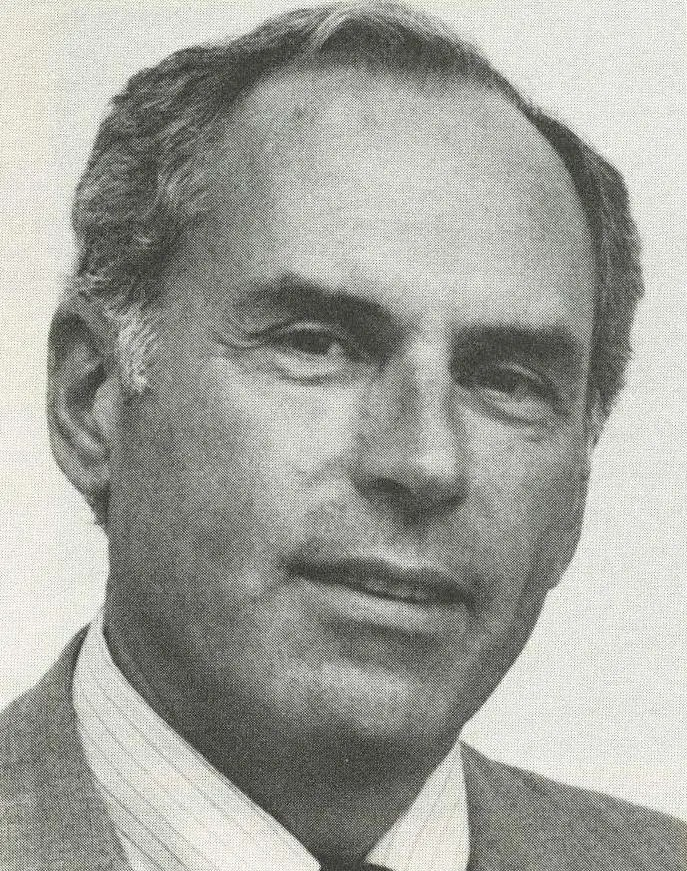
Roy Charles Amara

In simple words, our expectations (positive or negative) from recent technological breakthroughs are always high and we are very skeptical about already existing technologies to be revolutionary and mainstream in the future.
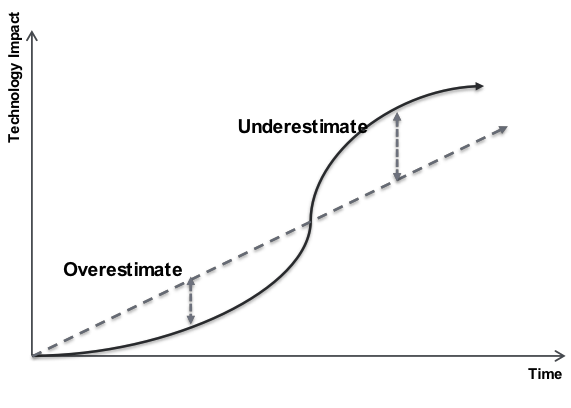
Graphical representation of Amara’s law

Take for example the LHC experiments which were started in CERN to better understand the subatomic particles. Some scientists predicted that there may be chances that some small black holes may form in this experiment which would engulf the whole earth into it. Same fear was lingering around the Trinity test, where many scientists thought that the Atomic Bomb test would initiate a chain reaction which could ionize the whole atmosphere of the earth thereby leading to the end of the humanity.

But, look what happened? Nothing dangerous happened during the LHC runs, the runs confirmed the presence of Higgs Boson. Although atom bomb proved to be really fatal and formidable invention of humanity, the Trinity test at Los Alamos didn’t ionize the earth’s atmosphere.

In our times, people are speculating that the AI will take over humanity and will rule over the world by enslaving everyone. Now look what ChatGPT responds when you ask some fundamental philosophical questions? (Although it is excellent in certain tasks but there is still long way to go in order take over the humanity!) There are some examples where the AI image generator could not create proper images of human hands as the orientation of fingers relative to each other is “confusing” for the AI image engine. It is also known that certain biases can be created in the AI engine based on the sample training data provided, so there is still a long way for the AI to catch up with the humanity and there is no doubt that AI will totally revolutionize our lives but, in the ways, we are yet to imagine or grasp. (although AI has already revolutionized some parts of our lives already)

Amara’s Law points out a cognitive limitation in us where it is really difficult for us to predict the non-linear behavior of technology in the coming future. We human beings are very great in predicting the linear incremental behavior, somewhat ideal and constant incremental behavior of things around us. The moment we infuse multiple variables and some non-ideality in these predictions, we make wrong decisions based on our survival instincts. We “overhype” the technology’s potentials. For given technology people may think that it will revolutionize the ways of doing things and uplift the society, some think that certain technology will take people’s jobs and push society into dystopia. Look what is happening with cryptocurrency and NFT – the technologies which were supposed to revolutionize the complete world economy. Although, blockchain is there to remain forever as an excellent invention it will change the world in totally different way than people actually predicted.   

Amara’s Law is famously explained by the S-shaped curve to represent the difference between anticipated impact and actual impact of the technological breakthroughs.

Gartner Hype Cycle

Gartner Hype Cycle also throws light on some interesting concepts on the actual non-linear impact of technologies over the time. This idea was developed by an American consultancy firm Gartner Inc. named after Gideon Gartner who is called as ‘the father of the modern analyst industry’.  Gartner Hype Cycle establishes certain phases in the implementation, growth and acceptance of any technology.  

These phases are given as follows:

  1. Innovation/ Technology trigger – A new technology is presented to the world which creates intrigue, sometimes fear in the minds of the masses. The competitors panic sometimes for the probable upcoming uncertainties in business
  2. Peak of inflated expectations – As the technology is something new, there are very few experts to truly understand it. The hype build around it due to the insufficient knowledge of the media and communicators. This builds unrealistic expectations among the masses.
  3. Trough of disillusionment – There comes a time when this hyped technology starts getting implemented into real life where practical limitations keep piling up. Not only practical but also some economical, social problems start peeking this pile of problems. The expectations were already high and when such failures start becoming apparent to the mass users, the technology enters the rock bottom, the cold death
  4. Slope of enlightenment – After remaining in the abyss of failures there comes a time when the exact technology finds a better purpose for implementations; it’s newer generation become more people relevant more practical which people accept properly, where the society is evolved enough to accept it as their way of life. From here on this technology enters ‘the plateau of productivity’. The true value and proper points to implement the technology are identified and widely accepted in this plateau.   
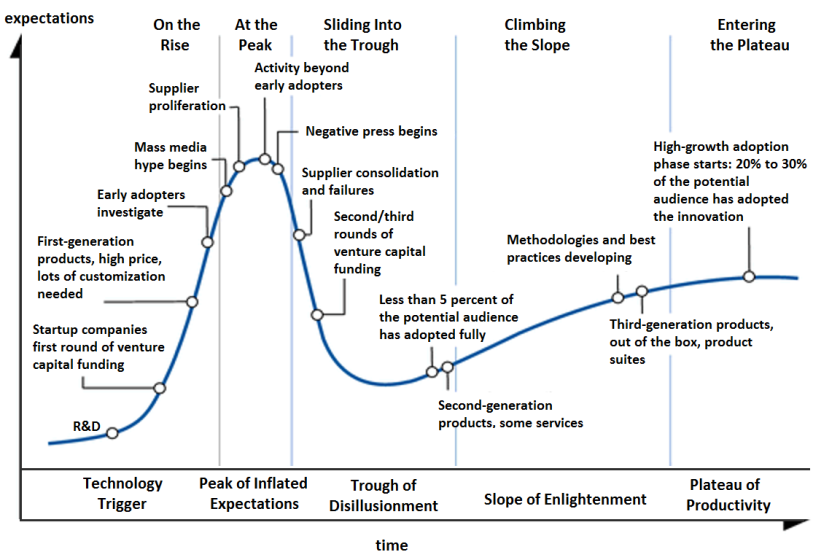
The Gartner Hype Cycle

Many experts in the industry critic Gartner hype cycle as it does not provide any instructions or actions to control these behaviors for any emerging or disruptive technological revolution. One can safely say that Gartner Hype Cycle gives a generalized view on acceptance of new technology.

There is also an Extended Gartner Hype Cycle where after the plateau of productivity, the technology loses its value to the reduced returns to the business over time which further ends into the obsolescence – “the cliff of obsolescence”.

Key Takeaways From The Hype Cycle

When a policy maker, an entrepreneur, a manager understands the Gartner Hype Cycle, it will definitely help them to make informed decisions which can reduce risks and maybe save many lives.

Being patient and not getting tempted to ride on the hype wave is the first important response.

Updating the knowledge and current trends regularly will help in creating fruitful strategies against the hype.

Change is the only thing that remains forever and embrace this. Adaptations to stay ahead in the practical technology is the optimum move for any leader/ policymaker.

Understanding the long-term viewpoint from a sustainable perspective with the closeness to reality/ practicality immediately breaks the illusion of hype.  

It is really important for a policymaker, a leader and even a common man to understand that creating a breakthrough does not guarantee the success in the practicality of the innovation/ technology. The innovation even though called as breakthrough has to be practical, relevant and realistic.  

The Gartner Hype Cycle can explain why some tech companies wait for the technology to evolve and establish in order to deliver complete consumer experience. The hype cycle also explains why many startups who have found breakthroughs initially, fail to deliver at the end as the hype wave builds unnecessary expectations among the investors. ‘Edison’ by ‘Theranos Inc.’ founded by Elizabeth Holmes is one such example. The company was expected to create revolution in the medical diagnostic industry and was touted to be ‘the iPhone’ of the medical and healthcare industry. Look what has happened after that!

Internet and GPS (Global Positioning System) are the examples which were supposed to remain military secrets for years eventually have become the walk and talk of everyday lives and influence every part of our life now. (There was a time called dot com bubble which reiterates the hype of internet companies!)

Once you understand the Amara’s Law and Gartner Hype Cycle you can clearly see how any new technology launched in the market will behave in near future. It is not just about creating disruptive innovation to the market; it is also about solving realistic problems and understanding the key pain points of the masses.

Roy Amara’s Futurist Legacy for Predicting Breakthroughs

Any innovation which will truly impact the future should be studied for three main parameters/ premises.

  1. The possible – as the breakthroughs are practically ‘the trend breakers’, the study for their possibility should involve unconventional approaches that defy formalization/ structured-ness. There should also be some human element of intuition which gives a personal touch to such innovations. For example, the Science Fiction authored by a well-versed scientist/ artist who understands its practical limitations for today but anticipates that it will get solved in near future. (The motion capture technology evolved during the creation of James Cameron’s Avatar is one such good example)  
  2. The probable – defining probability requires to understand ‘what is connected to what?’ What action will increase the chances of certain event? Thus, the process of quantifying the probability of the success of the breakthrough innovation immediately establishes the chain of reasoning to its future projection.
  3. The preferable – Even though the innovation is possible and most probable but if it is not required by the time and the society then it may surely face the cold death. So, prefer-ability anticipates the societal, economical, and humanistic aspects to accept the innovation. If the innovation has no net positive utility, then it won’t come out as the most probable future. (For example, even though we know that the Grade 5 Titanium is one of the lightest and the strongest materials in the mechanical world, we also know that people can’t afford the cars made out of it for daily use as the costs of manufacturing will be exceptionally high which ultimately will get transferred to end users who won’t pay for it – even when it comes to saving their lives for the amount they invest.)

This makes it very clear that an innovation needs to be realistically possible, the most probable and most preferable in order to be called as a breakthrough which holds the potential to change the course of humanity.

These are the exact reasons why people over-anticipated the trip to the Mars when Elon Musk expressed his SpaceX proposition. Now that we are seeing how difficult it is to create a rocket, how many resources, how many allied innovations need to happen, how many relevant financial, behavioral mindsets need to evolve in order to send few humans (alive!) to Mars then we are getting hold of the practicality behind sending humans to settle on Mars.

This also explains why the flying cars shown in Back to the Future are not a common reality or way of life today, it still will take time or maybe it won’t happen in future due to some other breakthroughs (like teleportation!). Back to the future successfully predicted 3D projections, Video calling, digital currency, smartwatch which were possible due to practicality and relevance.  

Once you understand the Amara’s Law you can grasp that creating many innovations is not important to change the course of future, a single innovation which is practical, relevant and realistic is sufficient enough to change the course of the humanity. One can also do so by making the innovations implementable in real life,not every breakthrough guarantees immediate revolution.

“Our nations rely on innovation to improve productivity and fuel economic growth.  But to be competitive, nations and organizations do not necessarily have to excel at originating innovation—they have to be able to apply innovation successfully.”

Mastering the Hype Cycle by Jakie Fenn and Mark Raskino

References and further reading:

  1. Mastering the Hype Cycle – How to choose the right innnovation the right time by Jakie Fenn and Mark Raskino, Harvard Business Press
  2. Here’s Why AI Is so Awful at Generating Pictures of Humans Hands
  3. Why Are AI-Generated Hands So Messed Up?
  4. Views on futures research methodology – An essay by Roy Amara, FUTURES July/August 1991
The Trilemma of the Truth and the Skepticism

Skepticism deals with the attitude of questioning our beliefs based on an idea that our perception of reality through our senses and personal experiences may totally different from “the actual reality”. The Münchhausen Trilemma and Agrippa’s Five Tropes from epistemology may guide us on how to suspend a judgement and how assign truth value to every belief in our lives.

Why the philosophical search for the ultimate universal truth is useless?

An Existential Meme Caption and Its Resolution

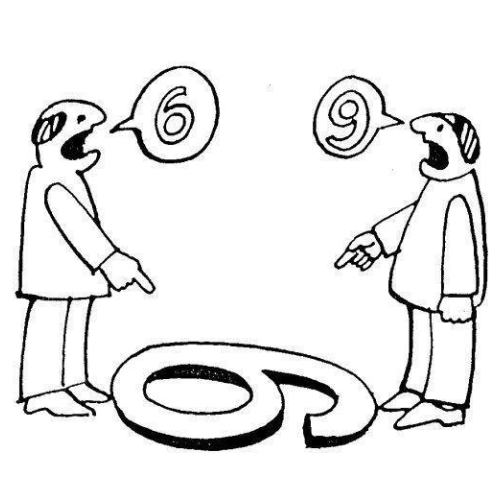
Since the invention of social media, some images (especially the certain classic meme templates) have stood the test of time. These images keep on circulating and there comes a moment when that image reinvents itself in new format, it brings some new argument with different type of humor. See the following image for example:

“Just because you are right, does not mean, I am wrong. You just haven’t seen life from my side”

Funnily enough, this image always comes with a thoughtful (supposedly) caption as follows:

“Just because you are right, does not mean, I am wrong. You just haven’t seen life from my side”

Given that the argument presented in this caption demonstrates the subjectivity of the everyone’s perspective, it is really futile to discuss what to exactly extract or understand from this caption.

For example, if this was the scenario where knowing the true value would save a person’s life then knowing the truth becomes the necessity and all of us know that this wouldn’t have saved that precious life which was dependent the true answer. There is no definite answer for this argument because it invokes subjectivity in the argument. People use this image and the said caption to express their inability to prove the truth value of their argument, especially their emotions.

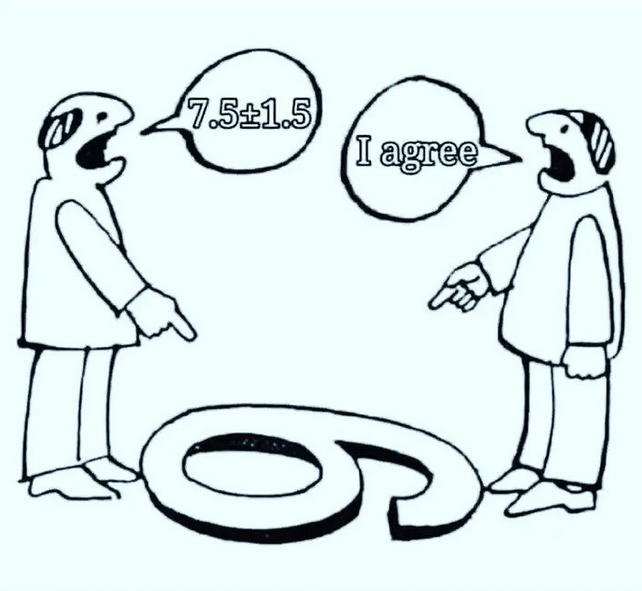
Now, in recent time this image resurfaced with a new argument which blew my mind the moment I saw it. The reinvented image looks like this:

“How a mathematician/ an engineer solved the conflict”

You must appreciate wit and sense of humor of the person who modified the argument presented in the original image.

There Is No Final Truth.

This simple evolution of a very common internet template invites a question. What is the real truth? What is the truest truth? What is that one answer that can answer all the questions? If something exists in truth, then how would I verify that it is “the truth”?

At first one might think that these are such foolish questions. Truth can be established by experimentation, demonstration, repeatability/ reproducibility, comparison, consistency, contradiction/ counterexamples.

Take for example,

Q1: how would one calculate the time taken by the ball dropped from certain height on the Earth to reach the ground?

A1: The answer is by using Newton’s kinematic equations.

Q2: How the kinematic equations were developed?

A2: By using Newton’s law of gravitation and the law of motion

Q3: How these laws were developed?

A3: Newton studied the motion of moon and earth, developed some mathematics to explain that behavior. That math remains consistent to explain the scenario of the motion of the ball dropped from certain height.

Now from here the real fun begins,

Q4: If Newton’s law of gravitation and laws of motion are consistent and hence true then why did they fail to explain the different/anomalous motion of the planet Mercury around the Sun?

A4: The truth presented in Newton’s laws of gravitation and motions are a special case of the higher and more inclusive, exhaustive truth of Einstein’s relativity.

Q5: Why Newton’s truth is not the complete/ ultimate truth?

A5: Newton assumed Gravitational as a universal force of attraction, inertia of every object in the universe, concepts of the balanced force.

Q6: Did Newton made mistake in “assuming” certain things for the sake of establishing the proof and its mathematics? Because, Einstein certainly didn’t assume those things and still his theory of relativity can prove the arguments covered by Newton.

A6:  Yes, looks like Newton assumed gravity as a force of attraction where things will get “pulled” towards heavier objects or fall into them. Whereas Einstein established this as wrong and proved that Gravity is actually a “push” created due the curvature in space-time.

Now from hereon, if one remains careful enough then that person can land into the territory of quantum mechanics to prove that Einstein was wrong (in a way). The failure that connect the Theory of relativity and quantum mechanics is why we are still uncertain what is the ultimate truth that will answer all the questions there exist. (Trust me the answer is definitely not “42”!)

So, if we keep on asking the question to each and every truth, will we reach the ultimate truth? Will that be the ultimate knowledge? Will that help us define the absoluteness of the knowledge?

Philosophers have argued (literally and figuratively) for centuries about the acceptability of any truth as “the truth”. Epistemology deals with the theory of knowledge, how a belief and opinion differ from the truth, if given argument is true then how it becomes the truth- what is its validity, justification?

So, when one starts to question things continuously there will be three possible cases explaining how the things will end into. This condition is famously known as Agrippa’s Trilemma or the Münchhausen trilemma in philosophy.

In really simple words, the trilemma says that it is impossible to prove whether certain truth is really true because at the last end of this truth there will always be some unjustified, non-contradictory fact which cannot be proved by using other proofs in existence.

Let see in detail what is this trilemma and the its legacy in epistemology.

The Münchhausen Trilemma

Baron Münchhausen is a fictional character created by German writer Rudolf Erich Raspe in his book “Baron Munchausen’s Narrative of his Marvelous Travels and Campaigns in Russia”. Münchhausen is a person who has done many impossible things like fighting a forty-foot crocodile, and traveling to the Moon. The book is a satire. (Baron Münchhausen is German Don Quixote per say!)

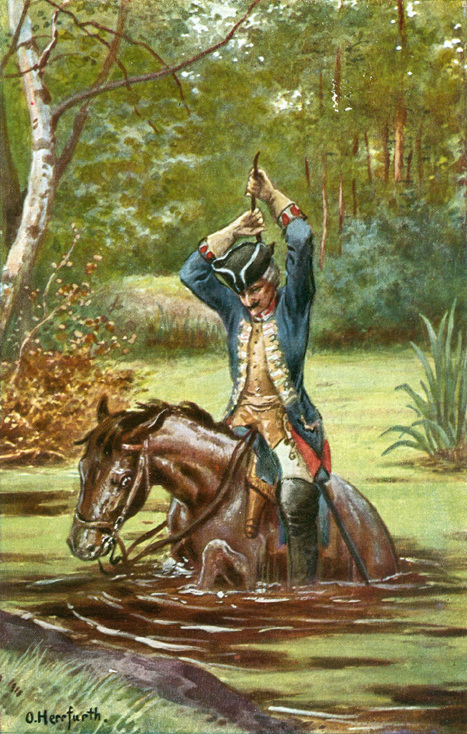
So, there is a story where Baron Münchhausen is drowning in the water while riding on his horse but soon he realizes that he can lift himself from the water just by pulling his hair. Hence, he pulls his hair and comes out of that mire/ quicksand with his horse.

Münchhausen saves himself along with the horse from drowning by pulling himself by his hair!

Do you understand how it worked? How could one pull himself out of an unsupported marshy land without any support? Where did Münchhausen pivot to rest himself? The story is foolish!

So, how did Münchhausen come out of mire without any support? If he was successful in his rescue, he would have definitely used some pivot, some support!

In the similar emotion, any argument to be proven true will need another supporting true argument. This “primary supporting true argument” will also need another “secondary supporting true argument”. You might have understood where we are going with this. If this keeps on progressing further and we keep questioning the complementary true arguments which are supporting the main truth then we will end up in three possible scenarios, which are “the trilemmas” as follows:

If we keep on questioning anything, the proofs will:

  1. Given proof will be followed by other distinct proofs which further will be proved by other more distinct proofs leading to infinite chain of proofs – The regressive argument
  2. A proof will be proved by another proof based on the prejudice that it is consistent in many cases so, as it is consistent then it must be true hence the main proof is true – The circular argument
  3. The proof will be accepted as the truth as there is no proven counterargument or any contradicting observation to falsify it – The dogmatic argument

Resolving the Trilemma

Explaining these trilemmas, we can say that these three trilemmas can be solved by following ways:

  • Infinitism: there will be an infinite chain of justifications for every truth. It will never end.

Remember that child who annoys their parents with a new question to every answer they give. That child indirectly knows infinite reasoning! (somehow!) A “patient” parent can go on answering that child’s each and every question!

  • Coherentism: there will be recurring loop of beliefs based on some other beliefs. These beliefs will prove each other.

You know your friend is telling you the truth because you have always seen him/her telling you the truth. It is consistent with his behavior. As you “believe” that he/ she tells the truth, whatever is told by them would also be true. (But who knows!)

  • Foundationalism: the chain of justifications will end at an argument which is accepted as the truth without any other proof and/or because there is no contraction available to this argument. It becomes accepted as an axiom which lies at the foundation of everything.

The matter was accepted to be made up of smallest invisible particle called atom and based on that many good theories explaining reaction stoichiometry, formation of molecules and thereby compounds was explained. We now know that atom can constitute further divisible particles thereby upgrading the theory further on to cover more generalized cases till quantum systems.

Similarly, Newton’s ideas which we discussed in the start rested on some foundation which proved many truths based on that foundation. It was the failure of that foundation which could not explain the motion of mercury. Einstein’s new foundation embraced wider foundation where Newton’s math becomes a special case. We will keep on upgrading our foundations.

Skepticism, Agrippa and the Suspension of the Judgement

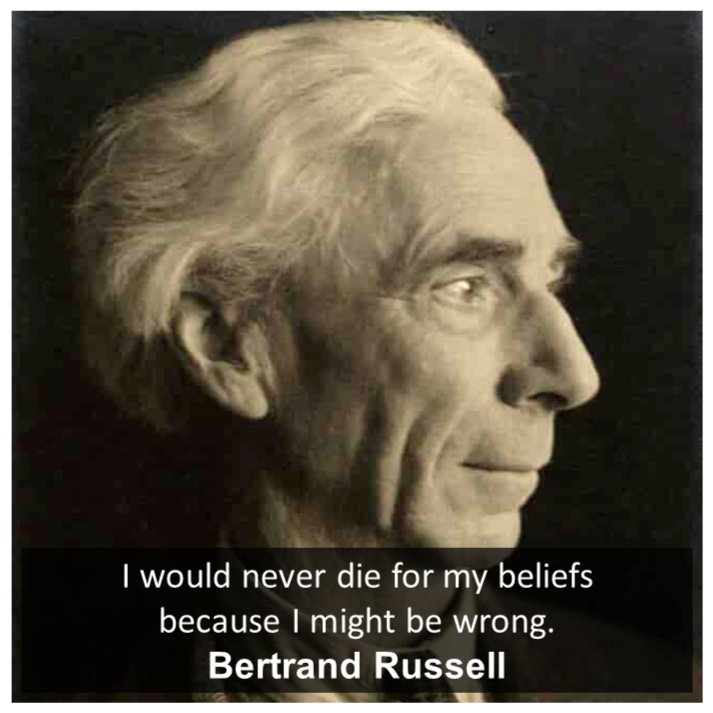
There was a school of Greek philosophers who questioned the very existence of the knowledge. They were “skeptical”, “doubtful” about everything thereby forming the school of Skepticism in philosophy. The reason to question everything available around us was due to the ways through which we understand these things. There is a gap between how we experience things around us through our senses and what these things really are. (What we see in desert looking like a lake is actually a mirage) There will always be some gap between appearance and reality. So, what we are believing to be true does not necessarily requires to remain true. The reality might be totally different. Not only different but reality can be subjective meaning that what a person has experienced from a thing can be totally different from what another person has experienced, and both stand true because of the individuality of their ways of experiencing the reality. Both sides will be true due to distinct and unprovable subjectivity. Bertrand Russel in his book the Problems of Philosophy has clearly discussed this as the limitations of our senses and the nature of reality. these limitations of our senses bring in that subjectivity in our truths hence they are our versions of truths which may be the truths for others. So, the early idea was to question everything to suspend both beliefs, experiences or the versions of the truth.

The problem which is created here is that if people become doubtful about everything around them, then they will end up in questioning their own existence. This question of existence will further lead to infinite chain thereby rendering useless, worthless, and futile venture. That is exactly why Socrates pursued ethics where “Why to live?” is not that much important and where “How to live?” is much more important.

One of the important philosophers called Pyrrho ((360-270 BCE) traveled with the army of Alexander to India where he met some “naked philosophers” (gymnosophists) who explained to him the reality of life. That there is no such thing as true or false, nothing is just or unjust, neither is honorable or dishonorable. No belief or experience is true or false. From these naked philosophers (I think these were the ancient groups of “Naga Sadhus” which exist even in our time today). These learnings focus on not having any judgement thereby rejecting any judgement, suspending any judgement.

This gave rise to the formation of five tropes for suspension of judgement which were developed by Agrippa who came later and expanded the understandings of Pyrrho.

These five tropes go like this:

  1. When the views are conflicting between common people and the philosophers then we must suspend that judgement – unacceptable due to inconsistency – Dissent
  2. When one is justifying a claim then that claim must be appealed by a prior claim which will end in infinite regress, so we must suspend that judgement – Progress ad infinitum
  3. Everything is relative, things appear right or wrong based on the condition in which they were observed and the environments in which they were judged, so we must suspend that judgement – Relation
  4. When a judgment is proved to be true based on an assumption and if that assumption itself is unsupported then we must suspend that judgement – Assumption
  5. When a truth invokes another proof which creates the circularity of justifications then we must suspend that judgement – Circularity

The beauty of the Agrippa’s five tropes is that it brings in the relativity in our process of understanding the truths of our lives. I would say that Agrippa solved the problem of establishing the truth by the process of elimination. In a very smart way, instead of proving something directly to be true, we can work around the facts surrounding given argument. Eliminating the arguments in the proof by implementing these five tropes can at least reduce the size of the problem thereby keeping all the possibilities of proving it to be true always open. The beauty is in the opportunities to upgrade the foundations!

This philosophy of skepticism created the foundation of modern philosophy and thereby modern science and mathematics. Some ideas explained in this trilemma remain consistent with the Kurt Gödel’s Incompleteness Theorem which explains why mathematics rather the reality itself is inconsistent. There will always be something unprovable in given domain of system which will demand to expand that system to a totally new system of knowledge thereby upgrading the existing foundations of our understanding of the nature and the reality and thereby our fields knowledge. That is exactly why Newton’s ideas even though were limited to some special cases are important because Einstein wouldn’t have had the foundation to build upon something. We will always be creating some general understanding of the universe which later will surely become a special case in our understanding. That is also why questioning everything is important in the process of developing fundamental understanding. It is the philosophy of skepticism which empowers us to stay humble and rediscover the reality in which we already exist.

Bedshaped by Keane – On Yearning, Melancholia and Intimacy

We are really great at understanding our happy, feel-good emotions and we are masters of enjoying such emotions but when it comes to the negative, grievous, melancholic emotions we fail to acknowledge them. Sad moments involving the loss of loved ones are incomparable to anything, anyone in the world. But awareness, acknowledgement, acceptance of such emotions can surely help one to justify meanings to their lives in newer ways.

The song – Bedshaped

Sometimes words fail to pinpoint the emotions one is going through where poetry and music are proven to be the strongest tools. Loss of the loved ones is one such feeling which is purely subjective thus is difficult to generalize. The melancholy from the loss of an intimate person, the feeling of a big void in existence and the irreplaceability of that person are such emotions that are very difficult to trade with other things. A song called “Bedshaped” written by Keane taps into such types of emotions.

“Bedshaped” is a song by English rock band Keane, released as the third single from Hopes and Fears. It became their third consecutive top-10 hit on the UK Singles Chart, after “Somewhere Only We Know” and “Everybody’s Changing”, peaking at number 10. The song also reached the top 20 in Denmark and the Netherlands.

For oversimplification, although not recommended for such a fine piece of art – this song highlights how we are always looking for that emotional pivot in our life and what happens when one loses that pivot. 

The Lyrics

The lyrics is written by James Keith Warnock Sanger / Richard David Hughes / Thomas Oliver Chaplin / Timothy James Rice-Oxley © CTM Publishing, Universal Music Publishing Group

Many's the time I ran with you down
The rainy roads of our old town
Many the lives we lived in each day
And buried altogether

The poet is reminiscing the days he has spent with the person he is missing right now. He wants to remind this person that he misses that they lived those day together to the fullest and in such a way that every new day was a new life, everyday brought something new with it. These memories are not limited to the liveliness of the experiences from each days start only. They are also connected to how those moments disappeared at the end of those days. Whatever the days were, they both were together to witness those moments. This remembrance by the poet shows his longing for that special person – man or woman whoever they were. It is about a vacuum created by the loss of this important person.

Don't laugh at me
Don't look away

The poet is scared that there is no one left who can understand his state of mind. Now that there is no person left who were closer to him, intimate with him, who could care for him – he fears that the world will make fun of his confusion, directionless condition. The poet pleading to not be laughed at, not be ignored indicates that he is aware of the bad condition which he is going through but is helpless as nobody closer to him now exists.

The poet has become so self-judgmental that he has surety of people making fun of him instead of consoling him for the loss. One must understand why the poet has this innate fear and strong surety for the reaction of world for his loss; it is because he knows that the person he lost only and truly knew his personality – rest of the world will draw some conclusions instead of understanding the reasons behind his behavior.

One may call this emotion as the feeling of self-loathing because there is no one left for the person to reflect on the emotions of loss he is going through. The person has started to hate himself.

But there is some hope!

You'll follow me back with the sun in your eyes
And on your own
Bed shaped
In legs of stone
You'll knock on my door and up we'll go
In white light

The poet is so much consumed by the feelings of loss that he expects that this lost person or here we can say his spirit will come back to retrieve our poet to the after-world where they can coexist. “Bedshaped” indicates that this loss has made the poet so sick, immobile that the bed on which he is lying has become an extension of his body. The “legs of stone” indicate the disinterest poet has developed. He does not want to go anywhere. One must understand that this was the same person – the poet who had lived every day as new life with his beloved and now lost person. These are the feelings of depression due to the loss of the loved ones, but the poet hopes that their spirit may come back to rescue him.

I don't think so
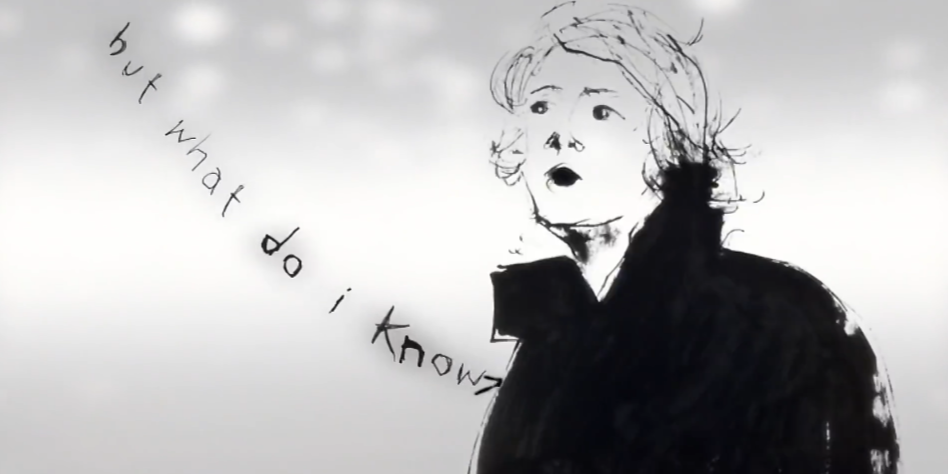
But what do I know
What do I know

The poet expects that the strong bond of love may truly help him to recover from this loss but he is now so lonely that there is this uncertainty that this might not actually happen. The poet now moves on the boundaries of reality and illusions.

I know you think I'm holding you down
And I've fallen by the wayside now
And I don't understand the same things as you
But I do

This explains how the presence of a having loved one, and intimacy with such person can boost the self-esteem, confidence rather the whole personality of that person.

Now that the poet has lost such loved ones, he knows that he may not be the same confident person he was before. This makes him feel that he is not worthy of what that person made him. This feeling of becoming worthless again points to the emotions of self-loathing.

Now you should also understand that the poet is somewhat aware of what is actually going wrong an has this urge to recover from all this grief. He still bears the hope to come out of this alive but there is very fine line between the meaninglessness of his life and mere survival.

The Video

The video is stop motion animation directed by Corin Hardy. Which itself is fine piece of art.

The story conveyed in the video of the song actually deepens the meaning behind the song and amplifies the mixed emotions of grief, loss, self-humiliation, meaninglessness and most importantly the hope for liberation.

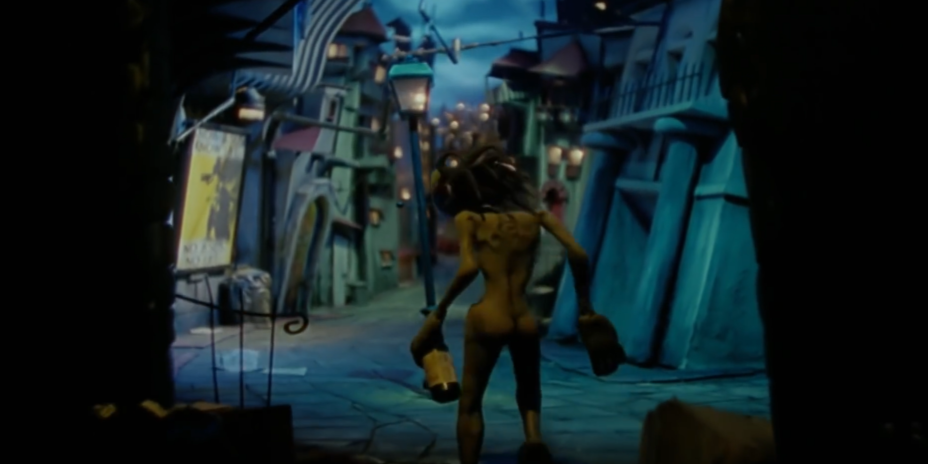
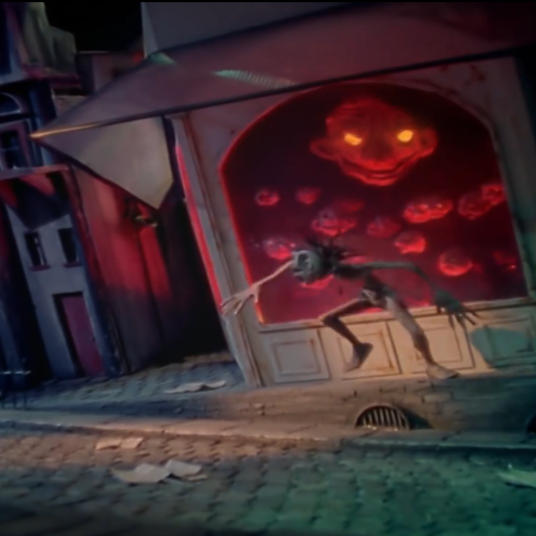
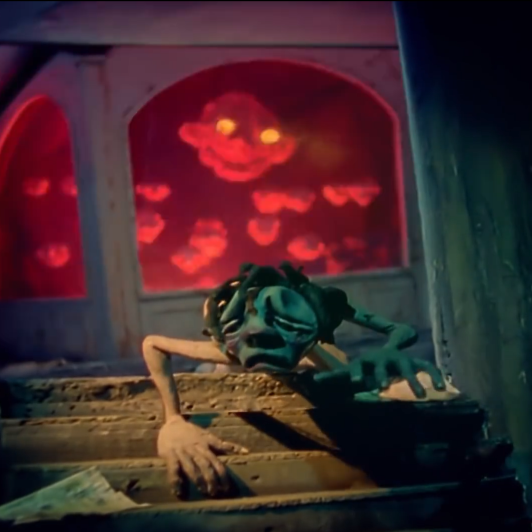
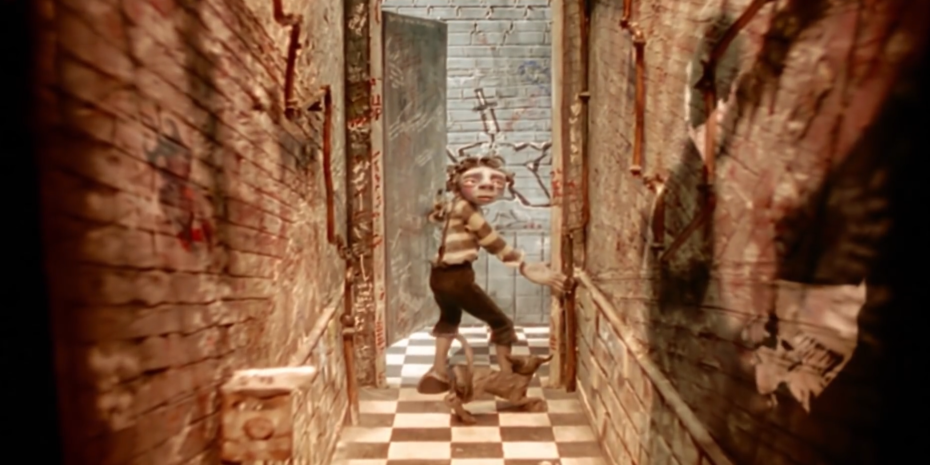
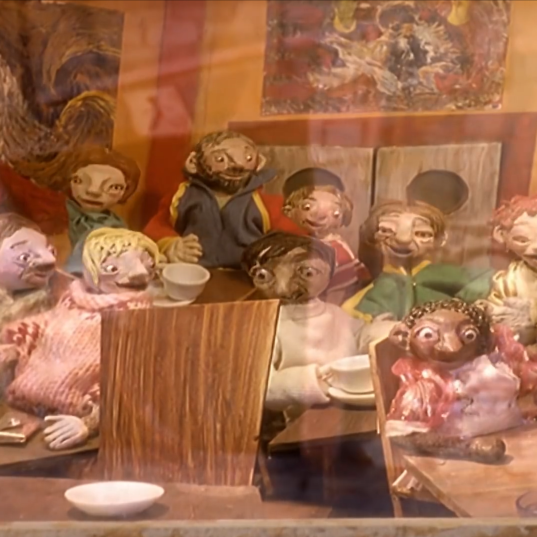
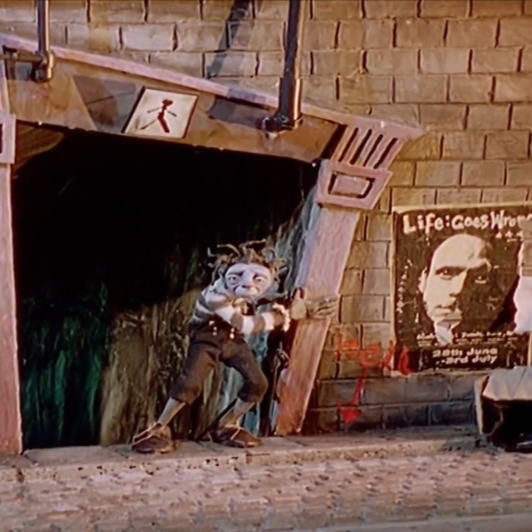
The video shows some short events in the day of a roadside naked drunkard who has lost the sense of his surroundings.

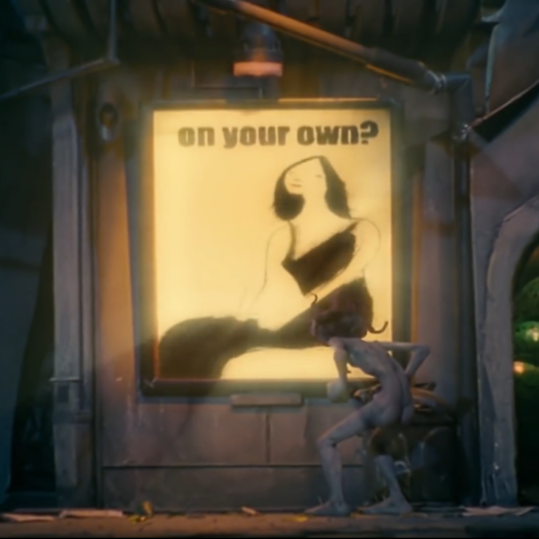
He misses the company of person he loved, the only person who truly understood him. He is miserable to pass this life on his own and alone.   

We can be sure of this meaning because the rest of the world is completely hostile environment for him now. He is running away from people. Hiding himself.

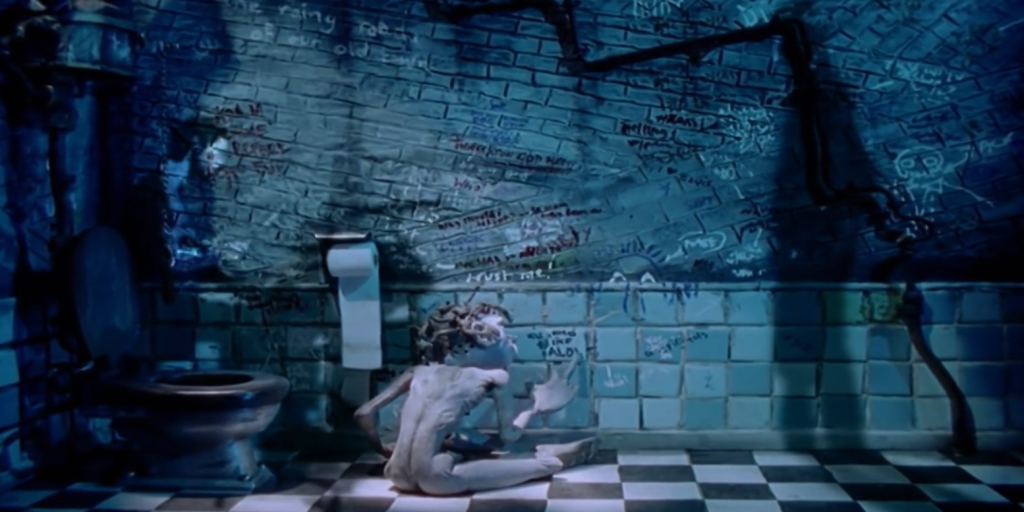
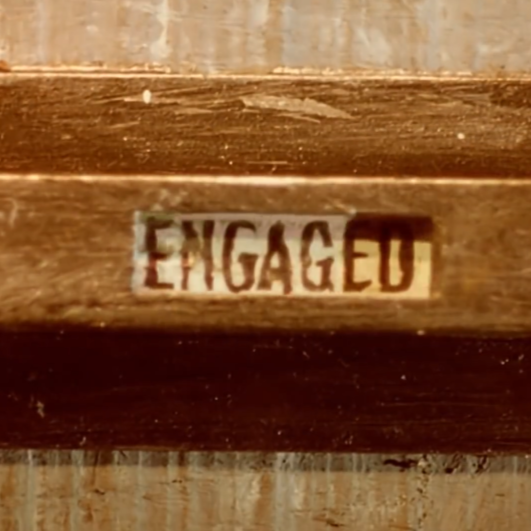
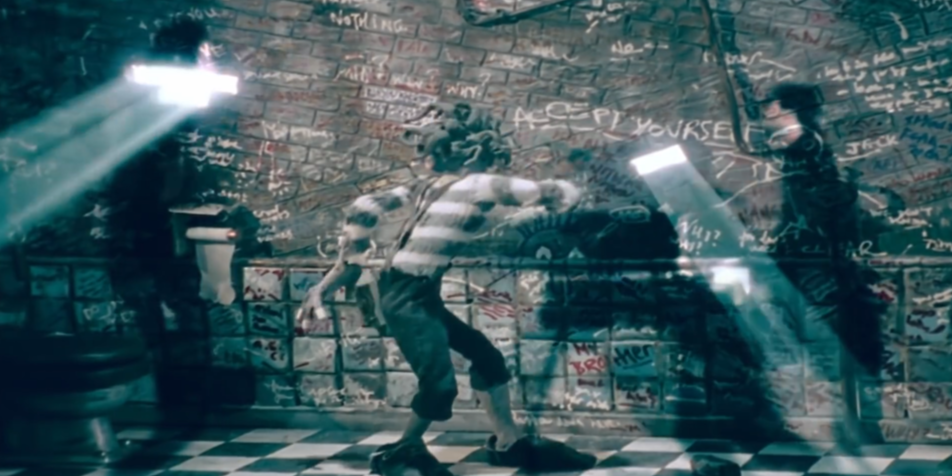
Running away from the people, he grieves in a restroom. The restroom here indicates the privacy he has, the shelter of some comfort with his intimate thoughts and the memories of his loved ones. We metaphorically, are inside his mind where he is trying to understand this loneliness. He wants to recover from this misery and feel liberated. Hope is the only thing that he relies on, hence we see him contemplating his ideas in this restroom.

The thoughts written on the wall indicate the chaos, the confusion that person has in his mind as he has no close person to show the direction, the ways. The isolation in the restroom with his thoughts with his degraded condition indicates the urge to find someone who truly cares for him and the meaninglessness in life created by the loss of the loved ones. 

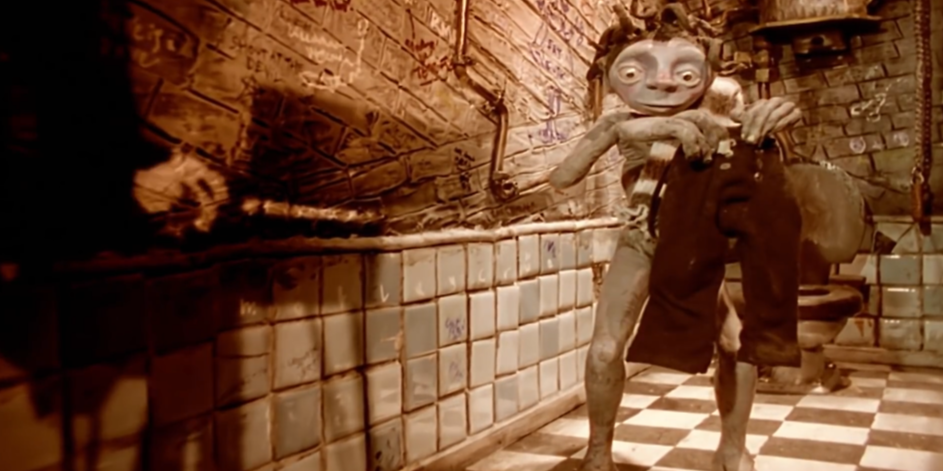
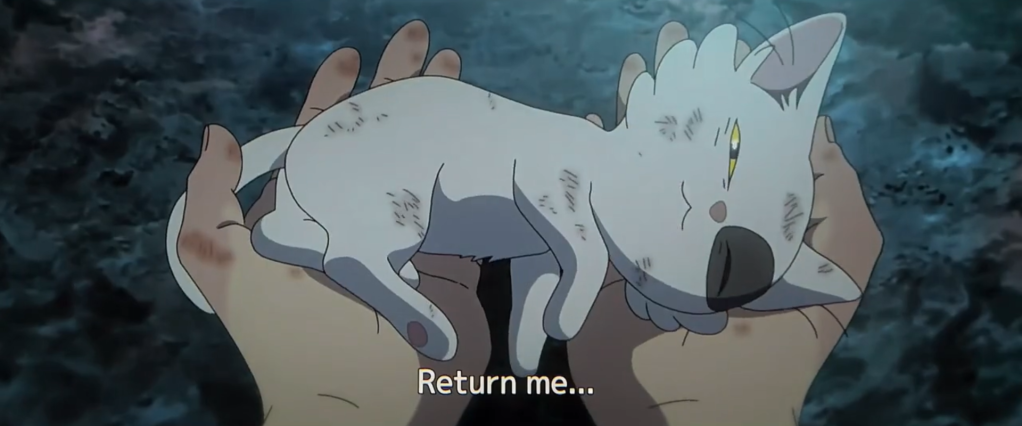
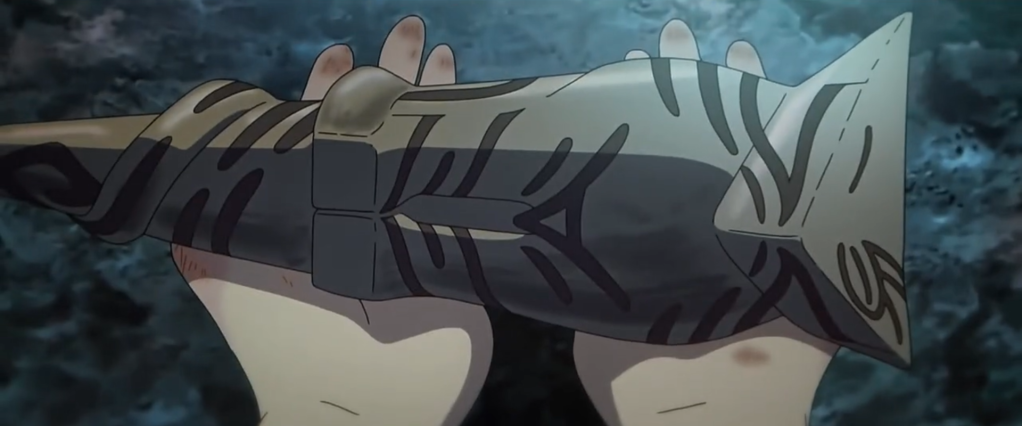
You will notice that a cat brings him clothes from somewhere which somewhat lifts him up and that is also why he gathers the courage to revisit the world and blend in with the people in it. He tries to free his mind by letting go off the thoughts of misery.

Imagine what could have happened if a person would have given him the clothes instead of the cat. If a person would have offered him the clothes, then the chances for his recovery from grief would have been extremely high. Simple support from a non-human being gave him the hope to come out of his grief. Which is powerfully conveyed in the music video.

When this guy wears the clothes and tries to face the world, tries to vacate his mind the stares of unknown people again haunt him thereby pushing him again into his now chaotic and directionless mind.

This shows how sensitive a person is when he is facing the loss of his loved ones. The urge for the longing of the person who can truly understand you is strong in most of the people and there is nothing wrong in it.

Closing remarks

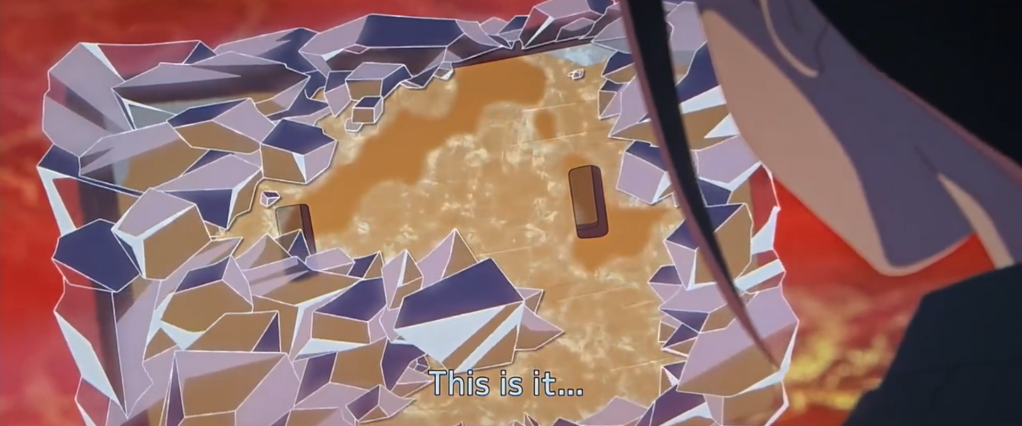
In the end of the music video, you will see the restroom the private room getting shattered and penetrated by ‘the white light’ this person was longing for. He is finally liberated. The song thus leaves at poignant and melancholic note where we are left to find out whether that liberation was his death or him losing all the control over his mind.

I would ask what’s the difference between them anyways? Does that difference really matter?

Longing for intimacy

Human beings are social animals not because they form some groups for mutual benefits so that everyone can survive, grow, prosper and leave something extra for the upcoming generations. A person cannot become aware about his existence without interacting with his surroundings. The crude awareness comes from the interaction with the materialistic things around the person but the core awareness of a person’s existence comes from their interactions with the people around them. That is why I think human beings are called social animals. We always assign our own value, our own worth (physical, financial, psychological, intellectual etc.,) relative to the things and people around us.  

It is also true that absolutely nothing is required to understand the existence of one’s being but that is only possible when one has understood what is means to exist relative to the things in their surroundings. You can say that the person who has achieved the topmost levels of spirituality won’t need anything to define themselves thereby becoming truly liberated, they are free from longing for anything but even these people have to go through the event of understanding their meaning for the existence through the relativity with the surrounding objects and most importantly people.

So, in every sense we as a human being always need some person with whom we can comfortably compare our worth – please understand that this comparison is not for competitiveness. Because when a person is actually seeking the meaning behind their existence – the words like competition, race and superiority have microscopic worth as if they don’t even exist. When the person understands where they actually stand with respect to this person then it justifies the purpose, the meaning of their being. This person becomes their pivot for the life lying ahead.

As the quote goes:

Being deeply loved by someone gives you strength, while loving someone deeply gives you courage.

Lao Tzu

Actually, it is not the power of love, it is the influence of having someone to justify our existence which brings out the best of the person. And who doesn’t want to be their best version? That is why love and its influence are powerful for human beings as social animals.

This is where intimacy comes in picture

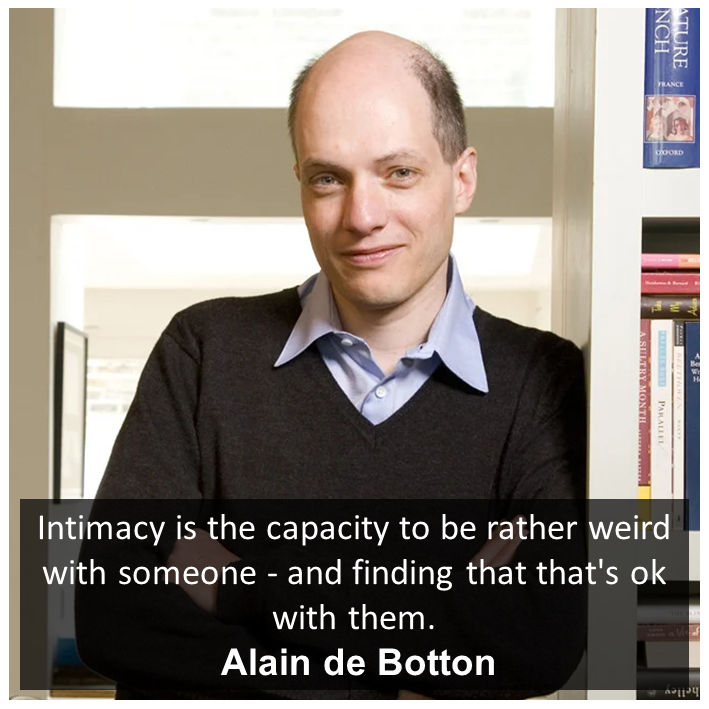
Please note that intimacy is not limited to what lies between two people madly in love and neither is it limited to physical one. It can exist between two best friends, between a teacher and his pupil, between a manager and his subordinate, between an old grandpa and a young boy who are not actually related. Some people may call them soulmates and in most cases these relations are far from the blood relations although such intimate relations are possible in blood relations too. Also, understand that the intimacy can also be limited the self only but general examples are uncommon.

In very simple words, intimacy is that place of comfort where the person can be who they are without any judgements, benchmarks, and comparisons (although the basic logic emerges from relative comparison but it is not a competitive comparison. This is like the comparison where one realizes the similarity and differences in constructive ways)

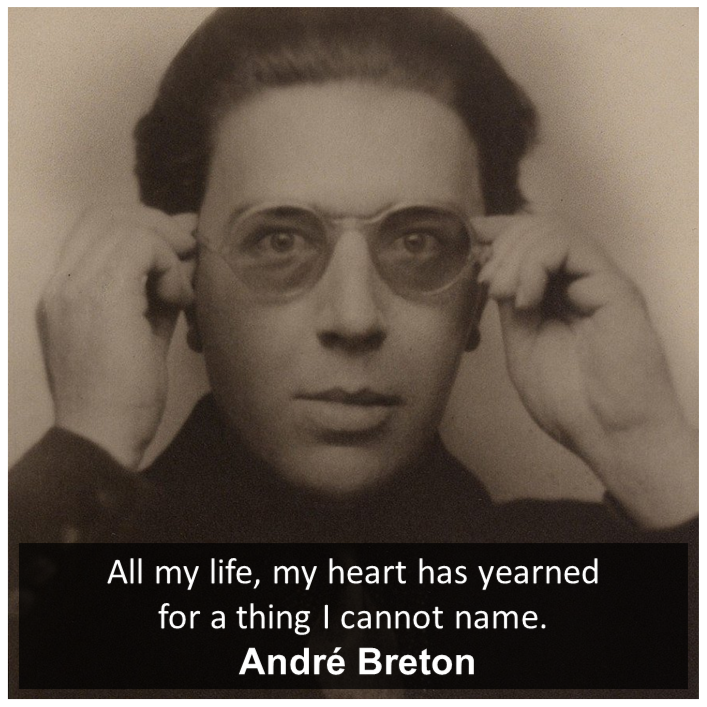
So, when a person loses such intimate person in their lives the whole pivot of life, the center of the meaningfulness of their life gets destroyed which brings this existential crisis, the chaotic void, the unfilled vacuum. This loss of person and the feelings which come after that loss are difficult to express to everyone as intimacy can never be generalized.

In the first place, even before finding their intimate person people are always searching for their ‘go to’ person, they long for such person. Now you must understand how one feels when they lose such person they already have; being alive without their person is already a burden for them.

This might be my overthinking on a good song which just expresses how one feels when they lose their loved ones and how they consider their life completely meaningless in such cases. As the ability of words to express the exact emotions is practically limited and very subjective; whatever I have written may be meaningless to many and meaningful to a few or no one.

I think we are very great at understanding our happy, feel-good emotions and we are masters of enjoying such emotions but when it comes to the negative, grievous, melancholic emotions we fail to acknowledge them many times. I understand that such very intimate and highly personal losses are incomparable to anything, anyone in the world but awareness, acknowledgement of such emotions surely helps the person to justify meanings to their lives in newer ways because life itself represents boundless ocean of opportunities/ possibilities. Who knows someone might be needing exactly the same person you are. That surely will help the both sides. And that truly justifies we – the human beings as social animals (in a way). That is why songs expressing such emotions are very important.  

Entrepreneurship and Poverty

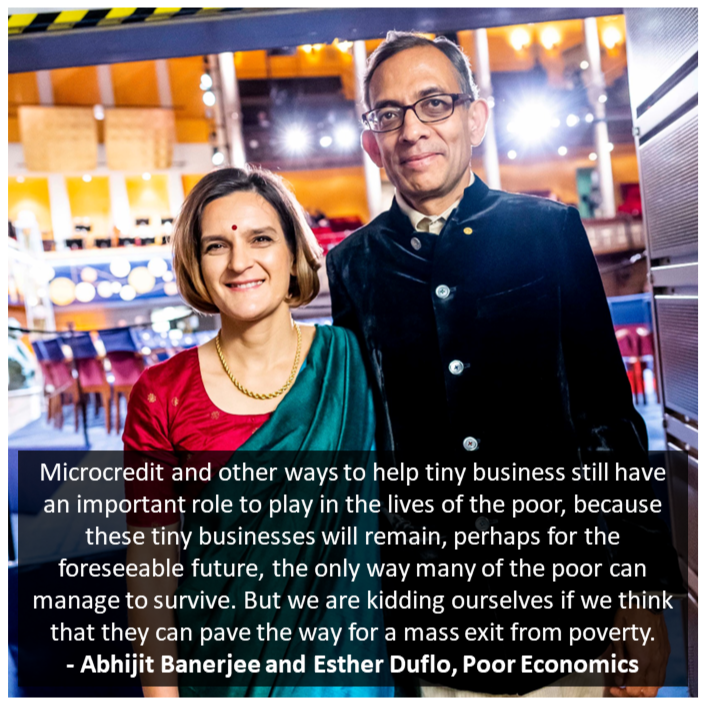
We are surrounded by many entrepreneurs which go unnoticed and have nothing to do with the keywords like technology, unicorn, angel investors. A high chunk of these unnoticed entrepreneurs are poor entrepreneurs, almost a billion around the world. Nobel laureate economists Abhijit Banerjee and Esther Duflo studied such poor entrepreneurs which has created deep insights and answered many questions. Providing supporting capital – microcredit to such poor entrepreneurs is not the final answer to this riddle.

Paying close attention to the larger fraction of the poor entrepreneurs

Monthly Revenue of a ‘Chai-wala’

It is very common discussion among group of youngsters to roughly estimate revenue of their “Snacks n’ Tea” seller while enjoying that short break. The discussion ends when the earnings estimate from that seller’s business reaches to a figure which is far bigger than what these “highly qualified” youngsters actually earn thereby inspiring them to think about pursuing their own business, start-up. What actually happens after such short surge of inspiration is also a common knowledge. Very few of such people actually work on entrepreneurship, their business idea and again very few of these truly taste the success. Social media, mainstream media have also positively affected and boosted the startup mentality, entrepreneur mentality among the youngsters through TV-series, reality shows, success stories, popular talk shows, podcasts and nonetheless video platforms like YouTube. The “F.I.R.E. culture” (Financially independent, Retire early) is also one wave of thought which inspires such entrepreneurs to create something of value, turn it into a business and sell it at higher valuation to gain financial independence early in life. (Although, FIRE is not limited to financial freedom through entrepreneurship only). Following their passion and working over it to create a start-up and then becoming a wealthy person is also one famous new career route for today’s youngsters.

In short, for our generation, entrepreneurship holds the key to financial independence thereby key to the freedom (materialistic freedom to be more specific) – life living on their own terms, without any terms and conditions.

When looked through “the pop-cultural” lens towards entrepreneurship one will see all the glamour, money, popularity, angel investors, “unicorn startup” funds and success stories. In reality there are very few practical examples in these enterprises which successfully fit to all such criterion, which really have created value in the society; most of them are actually just publicized bubbles rather black holes sucking in the attention, time and money of the investors.

The Reality of Entrepreneurship Around the World

Start-ups represent only the early developmental part of an entrepreneurship. Even though they represent such an early and small part of the concept of entrepreneurship, start-up stands as the biggest lamp, biggest fire attracting the youth like moths.

Here are some interesting facts:

9 out of 10 startups fail

7.5 out of 10 venture-backed startups fail

2 out of 10 new businesses fail in the first year of operations

Only 1% of startups become unicorn firms like Uber, Airbnb, Slack, Stripe, and Docker

The success percentage for first-time founders is 18%

20% start-ups fail before the end of their 1st year, and almost 70% start-ups end by their 10th year.

These facts are not presented to demean the value of stat-ups or to negatively criticize start-ups thereby idea of entrepreneurship (although there are some people who also try to capitalize their failure in both the good and bad ways). When you will look at the complementary positive data on start-ups you will realize that the successful start-ups even being low in numbers created value to the society in totally different ways, they changed the ways of working and doing things through the exploitation of technology.

The glamour while portraying the concept of entrepreneurship is actually overshadowing the key idea behind it which is “ingenuity”.

Poor Entrepreneurs

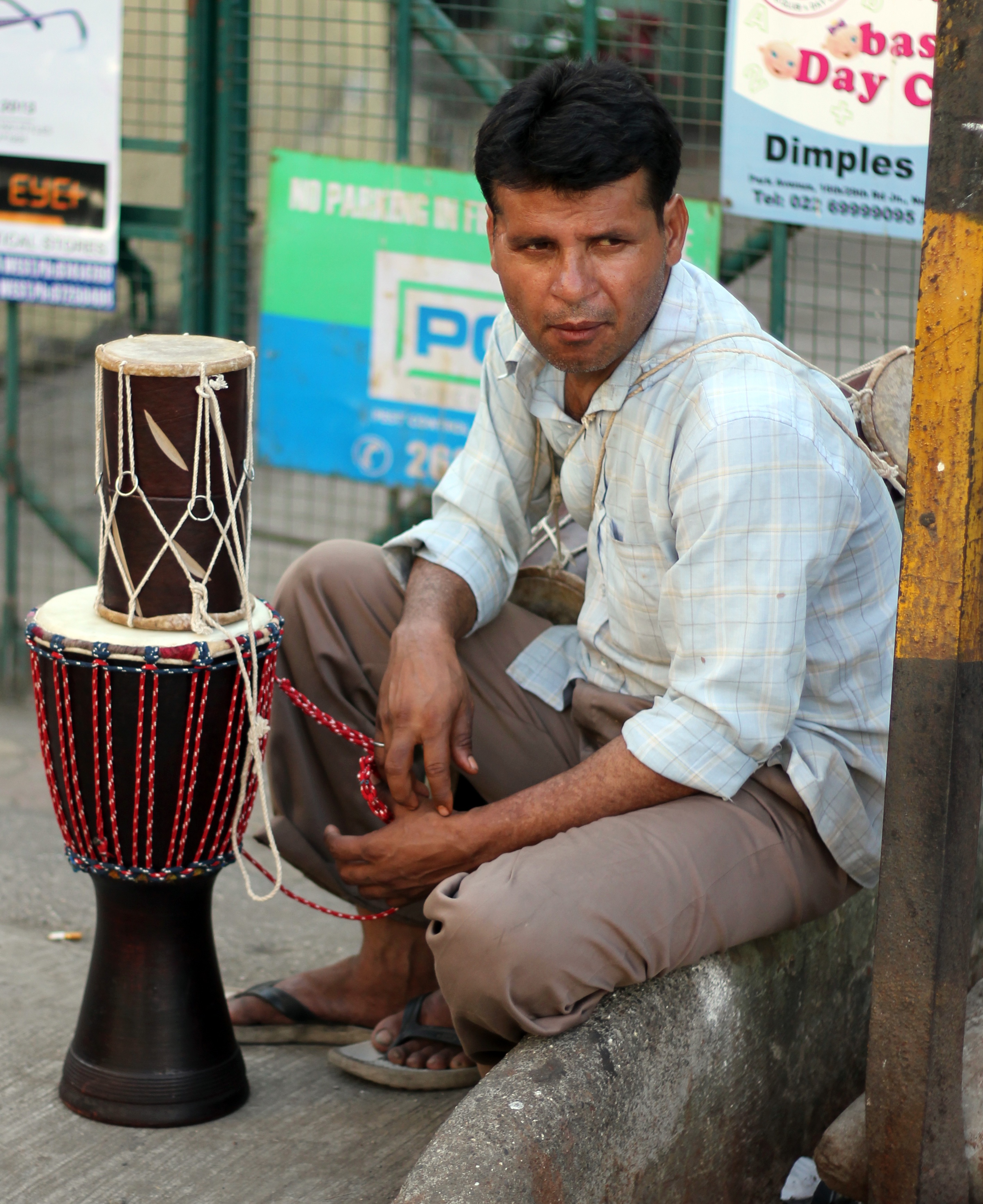
What is the definition of an entrepreneur? The dictionary definition goes like this- “a person who sets up a business or businesses, taking on financial risks in the hope of profit.” Literally, a person who runs an enterprise. Now look at the pictures above, can you tell which one of these is an entrepreneur?

This will make us realize that how the glamour built around the word entrepreneur is actually a mirage. The basic idea in entrepreneurship is the risk taking for the gaining profit. We are surrounded by such small entrepreneurs in our day-to-day life, most of these are poor entrepreneurs. World renowned Nobel laureate economists Abhijit Banerjee and Esther Duflo have contributed to uncover the reality of such poor entrepreneurs and many questions associated with such poverty.

Why should one be interested in poor entrepreneurs?

According to the data collected by Abhijit Banerjee and his team roughly 12% of the population in rich countries calls themselves as self-employed i.e., entrepreneurs. The interesting thing is that the poor countries have far higher percentage of self-employed people. Nearly 70% people call themselves entrepreneurs – self-employed in poor countries. These are the people who are mostly single person entrepreneurs like tailors, bricklayers, auto-drivers, street-vendors, shopkeepers.

“…most income groups in poor countries seem to be more entrepreneurial than their counterparts in the developed world-the poor no less so than others… ”

Abhijit Banerjee and Esther Duflo, Poor Economics – rethinking poverty and the ways to end it

Looks like bigger chunk of the entrepreneurial population of the world is not really glamorous and full of revenues, capital and resources. The intention to focus on this information is not to degrade entrepreneurship, rather it is to understand why the percentage of entrepreneurship is huge in poor countries where availability of resources and capital is already hitting rock bottom low? How do they manage such ventures in low margins? Do these entrepreneurial ventures bring them out of the poverty? If yes then, how? If not then why?

If entrepreneurship is supposed to give people freedom to operate on their own conditions, freedom to be their own boss, freedom to take control over their own lives, bring their ideas into the society then why poor countries where the entrepreneurial fraction is huge are not coming out of poverty? Why most of such poor entrepreneurs remain poor even after embarking on the journey of self-employment?

Trust me the answer is not related to ‘lower rates of returns’ only!

Ingenuity of the Poor Entrepreneurs

Let us understand the challenges faced by the poor entrepreneurs listed as below:

  1. Being poor, they are inherently low on capital (obviously)
  2. They have low or no access to formal financing institutions like banks, insurance companies
  3. As they have no access to formal finance, they approach local moneylenders and borrow with high rates of interest
  4. They have very low risk-taking capacity because any investment other than that for sustenance is a survival challenge
  5. They have very crude social support in terms of materialistic and emotional levels. They are surrounded by people having same difficult lives. They rarely have good connections with people who will trust them, people who will have access to better conditions capital-wise or relation-wise   

Even after having these challenges, the fraction of entrepreneurs in poor countries is surprisingly high. How is this possible?

As Abhijit Banerjee explains, the poor entrepreneurs have clever ideas to run their businesses even at low capital. The unavailability of resources, material/ capital means forces them to find out new creative ways to make living. You will see many such innovative entrepreneurs around who try to make living by using some really interesting ideas e.g., the human hair collectors roaming around town to exchange with utensils/toys, the scrap collectors who collect specific types of waste only and sell them to bigger scrap dealers in bulk, there are some dust collectors in the gold markets of many cities in India where poor people collect road dust around the gold shops and try to extract tiny amount of gold from such collected dust to sell it.

But how many of these innovative, creative and ventures with true ingenuity actually turn into a unicorn or a big company? In simple words, one knows how costly are the hair extensions/ wigs are then why the hair collectors are not getting rich with their business? If gold is that precious then why these dust collectors are not getting rich with this gold dust collection ventures?

This is where the insights created by Abhijit Banerjee play a very vital role. In his book “Poor Economics – rethinking poverty and ways to end it” co-authored by Esther Duflo, he has given very important insights into the world of poor people, the challenges they face and ways to uplift them.

Let us deep dive into the key concepts to understand the economics of such entrepreneurs.

Representation of the Poverty

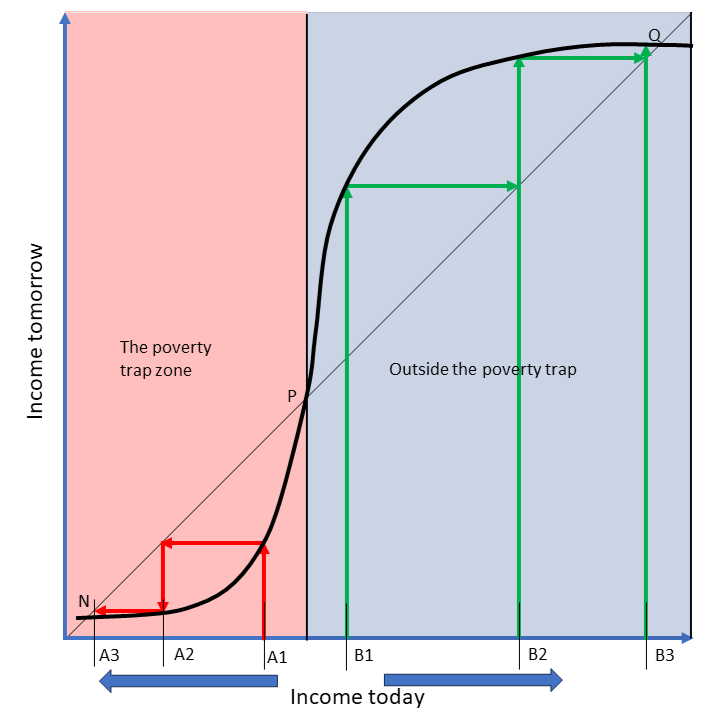
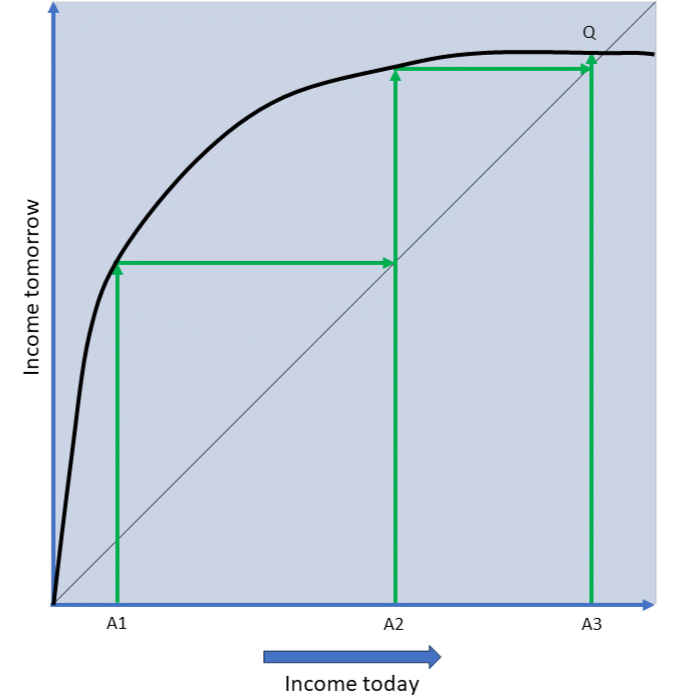
Figure 1 The S-shaped curve and the poverty trap

Source: Poor Economics – rethinking poverty and the ways to end it by Abhijit Banerjee and Esther Duflo

Economists use the diagram shown above to indicate the relation between income of today and the income a person will earn in the future. You will see an S -shaped curve forming. The red zone indicates the poverty trap zone where a poor person starts from A1 earns a meager amount which is not enough to sustain making the net income negative thereby proceeding to A2 which is backward directed/ decline in income. This reduced income restricts his/her freedom to choose (as the words go “beggars cannot be choosers”), risk-taking ability, reduction in available capital thereby scarcity of capital disposable to meet the daily basic requirements. So, the ventures in which poor people are engaged are down-valuing ventures according to this representation – which is used to represent “The Poverty Trap”. For those who think that the ventures of poor people always end up in losses thereby degrading their existing states, this curve in red zone represents that vicious cycle.

Most of the economists think that poverty is not a vicious cycle. By providing minimum enough capital/ resources to the lowermost group, their lives can be kick-started where the ventures will give net positive incomes, thereby gradually increasing their income over the time. That is why the world around us is explained by blue shaded part of the diagram, known as inverted L-shaped curve.

Figure 2 The inverted L-shaped curve
Source: Poor Economics – rethinking poverty and the ways to end it by Abhijit Banerjee and Esther Duflo

Please note one interesting detail in this diagram which we will bring further in our discussion. The initial slope of the curve is steep indicating substantial valuation increase in income but as the curve proceeds slope of the curve ends into flat thereby indicating less or no increase in valuation of the income over the longer period.

 In very simple words, a venture can only sustain over the time if there is some net gain over the time (always remaining net positive, even if it becomes smaller and stagnant over time). Very few people and actually no one would engage in a venture where they see their future valuation, future earnings dropping over the long-time horizon. That why most of the economist accept Figure 2 to represent the incomes of today and tomorrow for anyone.

Asking the Right Questions

Now that we have realized that it will take very small amount of effort and capital to uplift the poor entrepreneurs why doesn’t that help them immediately? Abhijit Banerjee in his studies asked some important questions which reveal why just giving poor enough money won’t solve the complete problem. Abhijit Banerjee clarifies that it is the inherent nature of the enterprises/ businesses, societal conditions and even the mindset of the poor entrepreneurs that makes them stagnant in their ventures. Even if they are running their small businesses successfully, they will always make just enough to sustain in long time horizon, very few will be the outliers which come out of this stagnancy.

Abhijit Banerjee pointed out that most of the poor entrepreneurs repay their loans on high interest rates. The high returns rates are attributed to the lending from informal financiers like local money lenders, relatives. If poor entrepreneurs are successfully repaying such high interest loans while sustaining through the business, then that means that their overall rate/ fraction of earning for the capital invested is also very high.

So, why don’t they become relatively wealthy even after running business with high rate of overall returns?  

Here we can take support of the inverted L-shaped curve for poor entrepreneurs and build on that further.

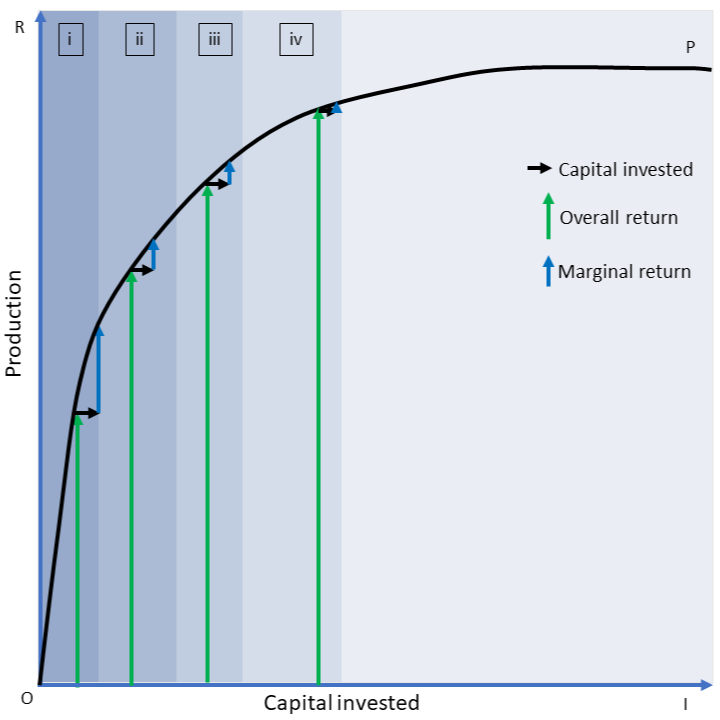
Figure 3 Diminishing marginal returns in poor enterprises
Figure created from the explanation in the book Poor Economics – rethinking poverty and the ways to end it by Abhijit Banerjee and Esther Duflo

Abhijit Banerjee explained the reasons for the stagnancy in poor enterprises in practical ways based on his field research. He explains the important behavior of marginal returns in terms of the poor enterprises. Marginal returns are the what left after an entrepreneur pays off everything – like payment on tools, payment of the wages to the workers, payment of the things bought to sell. Marginal return is take-home money after the business is done.

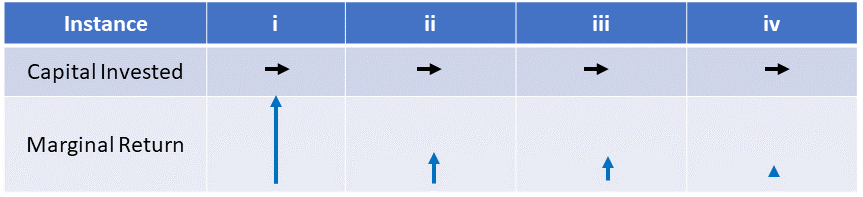
Now let us see the inverted L-shaped curve in figure 3 for poor enterprises. At the start of the business the marginal returns (shown as the height of the vertical blue arrow) are very high for the extra capital invested (shown as the length of the black horizontal arrow). The early investments in the business yields higher returns – higher marginal returns.

But, as the curve proceeds, due to the inherent nature of the businesses poor entrepreneurs are involved in as the capital investment goes on increasing, for every unit increase in such investment the marginal returns go on reducing and diminish further.

You can see in the figure 3, there are four different instances of extra capital investment in the poor enterprises. The L-shaped curve increases rapidly at early investment stage but as the capital investment goes on increasing the curve quickly flattens out, indicating the stagnancy.

In poor enterprises any new unit capital investment will give diminished marginal returns over the time

This behavior can be explained by the example of local fruits and vegetable vendors. First a person starts out with very few 2 or 3 vegetables (potato, tomato, onions for example). Being the commodity vegetables, they are sold very easily, fast and margins are also pretty good for the amount invested to buy them in wholesale. So, with those good returns he/she now buys different vegetables and now provide more options to his/ her customers. Now you will realize that not everyone buys every vegetable he/she has to offer, the sell of potato, tomato, onions may still remain good. But in order to expand he/she cannot depend on selling those only, and as he/ she expands into new varieties there comes the uncertainty of not everyone buying it. Perishable nature of these products is also one problem over which he/she has no control. The overall return may increase by incorporating more variety of items or by buying a cart to access many customers but for every new investment further done to grow this business, the guarantee of higher returns is very low.

So, the vegetable/ fruit vendor realizes this at a stage in his/her business that buying only those items which would sell, items which will not perish immediately with limited customer accessibility through cart is the only option to survive. You have to understand the limitations created by the nature of the businesses poor entrepreneurs are invested in.

That is exactly why only giving money to poor entrepreneurs won’t bring them out of the poverty. The businesses they can perform stagnate very rapidly.

Now, someone should ask the question for the case of the vegetable/ fruit vendor.

The questions could be asked as follows,

  1. The vendor should buy a vehicle so that he will contact more customers, why doesn’t he / she do so?
  2. The vendor should go to the wholesale market to buy the vegetables and fruits even at low rates to increase his margins, what stops him/ her?
  3. The vendor should rent a place in cold storage to maintain his items fresh till they are sold to the end customer, what is the hurdle?

Now, let us assume ourselves as this vendor and try to answer these questions.

  1. If the sell is stagnant even with a cart, why should one put exceedingly high amount in a vehicle purchase. This will be a big capital step. As the accessibility to formal lending is difficult, it brings capital in but the returns will be very low due to the borrowing at higher rates of interest.
  2. In order to buy at wholesale low rates connections with the wholesale tycoons are vital. Such connections are based on mutual benefits which the poor entrepreneurs hardly have access to.
  3. Cold storage rentals are significantly high for the amounts they earn so that goes there.

You must understand that these are not some contrived examples created to prove certain points. These are real life challenges and questions faced by poor entrepreneurs. It is only because of such challenges the poor entrepreneurs have that creative mindset, low cost, less capital-intensive problem-solving mindset. This also the reason economists found that poor entrepreneurs have very low number of people involved per business, they cannot afford to employ others due to the stagnancy.

As the study done by Abhijit Banerjee indicates, even if you provide some extra marginal income to the poor entrepreneurs so that they can access such options where extra capital is required, they will still choose to not invest that extra amount in the business because they know that for that extra investment the returns will not be that high over the longer period. (Abhijit Banerjee experimented with such extra capital provisions to poor entrepreneurs in Sri Lanka through lottery system, these entrepreneurs chose to invest that extra money in their livelihoods instead of businesses)  

The Big Gap to Fill

Now you should understand that even when extra capital is provided, that extra capital definitely won’t go into the growth of the poor enterprises. The question now comes that why poor entrepreneurs don’t have wide mindset? Why can’t they think big? Looks like the horizons and the mindset of poor entrepreneurs are so narrow that they are scared of risk taking. For the exact reasons the micro-financing institutions have tried to disseminate finance education, entrepreneurial education to the poor entrepreneur they lent money. But economists found that it is the inherent nature of the enterprises that poor can and are involved in, which makes them to think so.

Abhijit Banerjee here clarifies what exactly is the difference between the poor entrepreneurs and the rich entrepreneurs. For that let us look at the figure 4

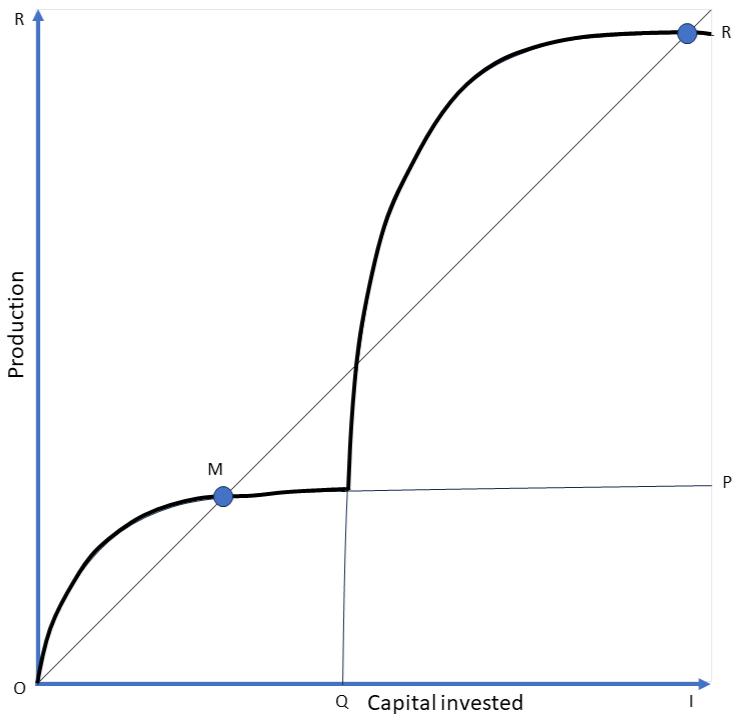
Figure 4 Combining technologies and S-shaped curve of entrepreneurship
Source: Poor Economics – rethinking poverty and the ways to end it by Abhijit Banerjee and Esther Duflo

You must appreciate the beauty with which Abhijit Banerjee has explained the difference between poor and rich entrepreneurs. Any incorporation of production technology in an enterprise will improve the productivity. Buying machinery, tools, infrastructures can largely boost the business performance. This boost due to production technology is shown as curve QR.

What does the curve OP represent?

As you have already seen, curve OP starts with no to less capital investment and flatten out immediately. It is the curve of poor entrepreneurship.

Now you must understand that in order to gain marginally/ exceptionally high returns one needs to start with high up-front capital in hand (Indicated as capital OQ). The big tech startups, the big supermarket chains start exactly from here where there are high chances of success (This is also why rich start-ups or any non-poor start-ups demand high funding).

In the case of high marginal returns in poor enterprises in their early stages of development we can easily think that high marginal returns should create the foundation of a successful long-term business. These high margins will allow the person to invest more in the same business, to employ more people to expand the workforce, to purchase new machinery, new tools. But these high marginal returns could never fill that capital gap for poor. This is what majorly differentiates between poor and rich entrepreneurs.

So, one has to really appreciate the gap lying between poor and rich entrepreneurs. This gap of capital to create production technology is too large for poor entrepreneurs and for the business they run. It is not just their narrow mindset, rather they are so close to the harsh reality that they prefer not to follow such seemingly “imaginary” paths.

Conclusion

Entrepreneurship for our young generation seems like a glamorous venture with big money, new technologies, new ideas, new technologies, “angel” investors and “unicorn” start-ups but we always forget that we are surrounded by many entrepreneurs which go unnoticed and have less to nothing to do with the keywords explained here.

A high chunk of these unnoticed entrepreneurs are poor entrepreneurs. They are part of our lives in a big way – you can think of the vendors of every small thing you use in your whole day.

Most of the people in poor countries are self-employed or entrepreneurs. This proportion is far less in developed nations.

Poor entrepreneurs seem to make high returns in their business but most of those high returns go to the repayment of the loans at high interest rates due to the inaccessibility to formal financial institutes which can lend at relatively lesser rates of interest. These businesses are very small and unprofitable over the time even though the rates of returns are exceptionally high.

Providing capital and opportunities to poor to start their business is not the solution to their improvement. Even after such provisions they will engage in the enterprises which rapidly stagnate over the time.

In order to come out of such stagnation they will need to fill that huge gap capital to incorporate production technologies which is impossible without the involvement of anti-poverty policies which will create opportunities and involvement of big formal institutes to provide no risk capital.    

“The idea of the entrepreneurial poor is helping to secure a place within the overall anti-poverty policy disclosure where big business and high finance feel comfortable getting involved.”

C. K Prahlad, taken from the book Poor Economics by Abhijit Banerjee and Esther Dulfo

Poor entrepreneurs have less risk-taking ability, no to less business connections, no credit/ loan capability when compared to their rich entrepreneur counterparts. They have to fill that huge gap of up-front capital which could have brought new production technology, employed more skilled labor. Filling this high capital gap is impossible for poor entrepreneurs. That is exactly why a smart, ingenuous street vendor even while having the best and the original ideas cannot expand his/ her business into big industries, companies and malls.

When we are understanding that poor enterprises rarely promote multiple employment/ connected employments, we should understand that supporting the poor entrepreneurship won’t drastically improve the employment rates of the nation, especially the poor nations. This is also why creation of good jobs is very important.

References:

  1. Poor Economics – rethinking poverty and the ways to end it by Abhijit Banerjee and Esther Duflo
  2. MIT OpenCourseWare – 22. Entrepreneurs and workers – Lecture by Abhijit Banerjee
  3. 106 Must-Know Startup Statistics for 2023
  4. 90% Of Startups Fail: Here’s What You Need To Know About The 10%
  5. News reference – Sifting through sludge for a sprinkle of gold – The Times of India

The Book of Five Rings – the Book of the Void

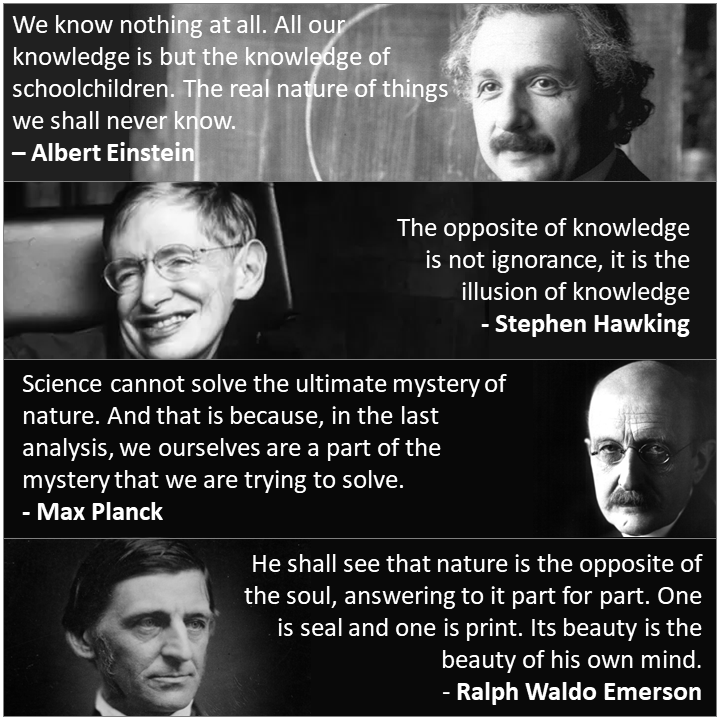
The final book from the Book of Five Rings by Miyamoto Musashi may seem like a last page reading with very few paragraphs but it gives deep insight into the knowledge that is yet to be gained by the person and the knowledge which lies beyond the limits of the humanity. The Book of the Void is the most concise treaty on the extent of our knowing, our ignorance and that knowledge which we would never know due to the mortal limitations. Miyamoto Musashi’s idea of the absolute wisdom through the concept Void transcends the boundaries of human life and time.

Miyamoto Musashi’s philosophy for 21st century

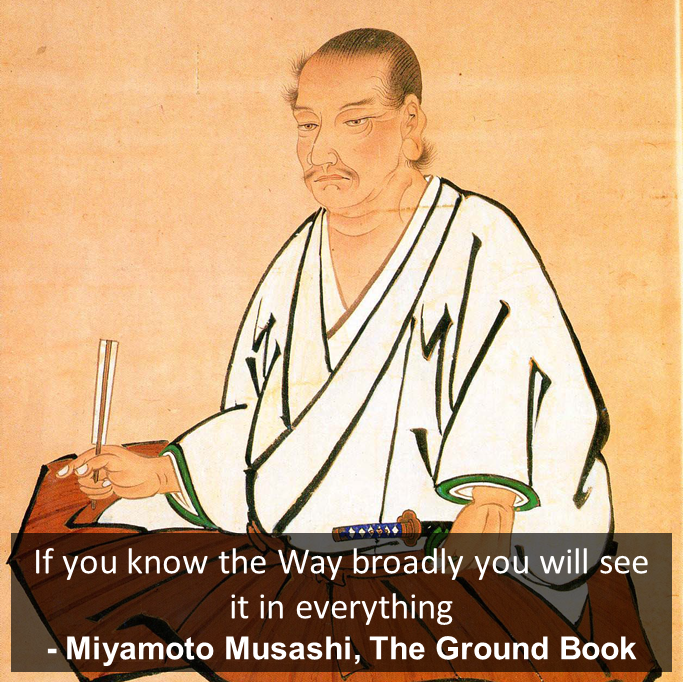
After disseminating his lifelong wisdom in a very systematic way through four books named as the Ground Book, the Water Book, the Fire Book, and the Wind Book representing the philosophies to fight the battles, wars and survive through the challenges of the life, Miyamoto Musashi concludes his learnings in last book – the Book of the Void. On the scale of writing, it is not even a book. The readers will feel like they are reading the last page of the book. This shortness of the last book – the book of Void is very intentional by Miyamoto-san. Again, as his suggestions go – one has to really appreciate what he is trying to communicate – the wisdom that which cannot be expressed, conveyed through words.

 The main purpose of the Book of the Void is to make the readers aware of the things and the wisdom that they can never know. There is one danger in this process especially for those who learn only by themselves (-without a real teacher always in front of them) which Miyamoto-san was very well aware of. He tries to complete this cyclical process of gaining wisdom through self-learning in this Book of the Void.

“What is called the spirit of the void is where there is nothing. It is not included in man’s knowledge.”

First, he clarifies what this is all about. Miyamoto-san first brings out the elephant in the room that there will always be something that you could never know.

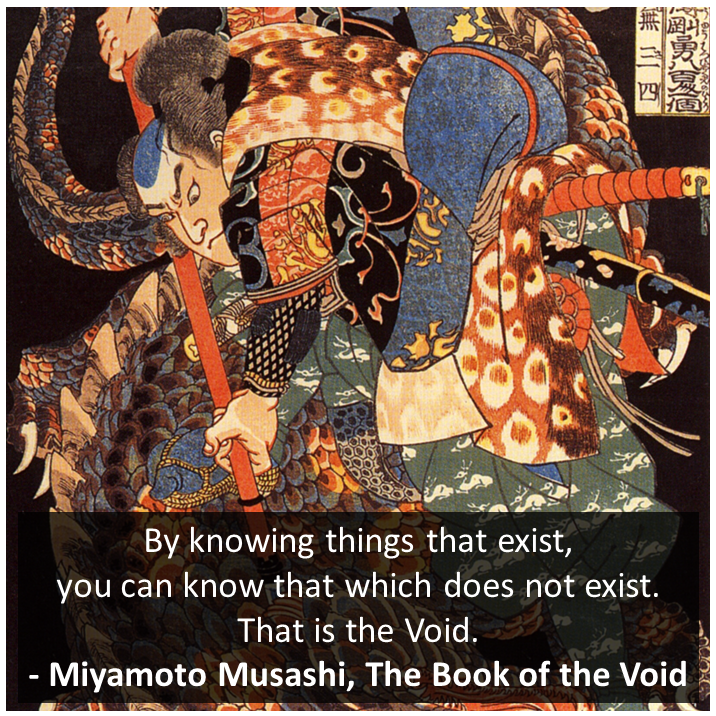
“By knowing things that exist, you can know that which does not exist. That is the Void.”

The Void thus represents the wisdom that lies beyond all that can be known by every human being. Now there is one catch in this idea. A normal person who has just started his journey on the path of wisdom will not know everything initially. So, whatever he/she does not know right now is new for him/her. Does this new wisdom which that person was unaware, which discovered during the journey represent the Void? The answer is – No. The Void is not the gap between your current understanding, current knowledge, and the knowledge you are yet to gain or understand. The Void is that which can never be known even when ‘everything that is there to know’ is known completely. And that itself is really humbling. It is about the limits of how we learn, understand the world around us. Miyamoto-san as the great teacher makes every reader aware of what the limitations of our understandings are. He wants everyone to understand that even when you know ‘everything that is there to know’, there still will be something left out because of the limitations of the ways we perceive the reality.    

“People in this world look at things mistakenly, and think that what they do not understand must be the void. This is not the true void. It is bewilderment.”

Here, Miyamoto-san very smartly makes the reader aware of what they call the Void may be and mostly will be the knowledge they are yet to gain. Again, as I explained earlier, the Void is not the gap between what you know and what all there is to be known by you. For every learner, whatever they haven’t experienced before will be new knowledge to them (which literally is the definition of ‘new’!) That will create the illusion of Void for them but the path is way long for the pursuit of true wisdom. We have this tendency of treating every new experience we come across as a very special experience and there is nothing wrong in it, but also creates an illusion of knowing the special wisdom in the person. This instigates the illusion of knowing something extraordinary, of knowing everything in the mind of that person.

Miyamoto-san thus advises the readers to recognize the confusion between the common knowledge and the real Void – the knowledge lying beyond everything that can be known.

In very simple and short words, Miyamoto-san is trying to show the expanse of the true ‘wisdom of life’ to the readers so that they will be humbled by what very small amount they know and they can know throughout their limited lifetime. Miyamoto-san idea of Void is intended to remain on the path of learning throughout the life with the awareness that there will always be something beyond our current understandings of the nature.    

Being aware of the infinite extents of that which can be never known, one creates the curiosity to know everything that is there to know; it also brings in the humility for what very little one knows.

The idea of Void by Miyamoto-san is about intellectual humility and the limitations of how we understand the world around us.

Let us keep the idea of the Void aside for now. The things that we can know, the wisdom that we can have themselves are so vast in their expanse that a single mortal life cannot be sufficient to learn and grasp each and everything that is there to know. This will easily overwhelm a new learner rather everyone on such journey. Miyamoto-san knew this hence he proceeds with the ways to clear this confusion and such overwhelming feelings. 

“To attain the Way of Strategy as a warrior you must study fully other martial arts and not deviate even a little from the Way of the warrior. With you spirit settled, accumulate practice day by day, and hour by hour. Polish the twofold spirit heart and mind, and sharpen the twofold gaze perception and sight. When your spirit is not in the least clouded, when the clouds of bewilderment clear away, there is the true void.”

In simple words, the way to get everything big is to start small and build over it, follow the truest path step by step instead of getting overwhelmed by the length of the journey. Once the person becomes aware of the process, the things built over the time will help him/her to distinguish between the that which is known, that which is yet to be known and that which can never be known.

You will notice in every part of the Book of the Five Rings especially in the Wind book, Miyamoto-san suggests to learn the techniques of the other schools from a broader perspective. Even after being the greatest swordsman of his time, he was completely aware that there will always be something which can improve his existing techniques. There will always be some better ways to do the same thing. This newer, creative, and out of the box thinking is only possible for the person who understands the limitations of his mind, who is truly humble even after gaining all the wisdom in the world. Only the idea of the Void can show a complete scholar the extents of what he/she knows.

Miyamoto-san mentions the spirit of heart and mind which are emotional and intellectual aspects of personality. He further mentions the perception and sight which are the abilities to see beyond what is shown and to see the bigger picture. The journey for the true wisdom is about development of our emotions, intellect, perception, and vision. That is what life actually is! What a thought by Miyamoto-san!  

“Until you realize the true Way, whether in Buddhism or in common sense, you may think that things are correct and in order. However, if we look at the things objectively, from the viewpoint of the laws of the world, we see various doctrines departing from the true Way. Know well this spirit, and with forthrightness as the foundation and the true spirit as the Way. Enact strategy broadly, correctly, and openly.”

Miyamoto Musashi holds the last but the most important (and the secret trick) in the journey for the wisdom of the life. Actually, he already hinted this secret in the early part of the Book of the Five Rings. Miyamoto-san explains that when the person on the journey for the wisdom will reach the ultimate spot (and not the end of the journey- the journey has no end – it continues in the Void) then he/she will realize that the vast expanse of knowledge that they were getting overwhelmed in the early part of their journey are actually created from the main true path of the absolute wisdom. The vast expanse of the knowledge was created due to many deviations from the ultimate path. The absolute wisdom will have that clarity as Miyamoto-san explains. That is the exact reason why he already said

“If you know the way broadly, you will see it in everything”

Once you get the absolute clarity of what you know then you will never feel the need to know each and everything. You are zero and infinity at the same time, you are nothing and everything at the same time. You will try to understand everything based on the absolute wisdom you already have as all the remaining knowledge is just a deviation from that absolute wisdom.

“In the void is virtue and no evil.”

The acceptance of that which can be never known will actually make the person humble. Many will think that the idea of not knowing everything will actually create maniacs due to that unsettling urge to know everything but the exactly opposite will happen. When one accepts that the journey for the wisdom is a never-ending, then the smartest choice is to embark on this journey with minimum possible baggage. The true scholar will get rid off every deviated knowledge from the path of the true wisdom to reduce their load in this journey, they will use their limited but ultimate wisdom in every possible and new way to understand the new knowledge and the knowledge which cannot be known.

You must appreciate how great thought Miyamoto-san put forward many years ago with close to zero resources. That is what is great about the Book of the Five Rings and especially the Book of the Void.

The Book of Void actually speaks about everything through the idea of nothing. This can be put down into some words only by the scholars like Miyamoto Musashi. That also the reason why the Book of Five Rings is not just a guide for war strategy and the ways of the warriors. The Book of Five Rings is more than that, it is about the ways to live a life full of true wisdom. True wisdom holds everything in the idea of the awareness of nothing.  

The Spirit of the Void for the modern world

“Real knowledge is to know the extent of one’s ignorance”

Confucius

The initial realizations of the idea of the Void are presented to make the readers aware of what small they actually know and what vast they are yet to know. When one accepts that there is still more to know and learn many things and even after knowing/learning everything, there will be something which can never be known due to the limitations of human life, at that exact moment the person becomes the container to the ultimate wisdom.

Void and the Incompleteness of the Mathematics

Modern mathematics and the development of completely new mathematical concepts are based on the world-famous Gödel’s incompleteness theorem. In simple worlds, certain truths in a system must be accepted true without a proof (and there are no contradictions to them till now) to prove all the remaining truths of the system. If in such system a new fact arises which cannot be proven by any existing truths and is never contradicted then such non-contradicted and unprovable truth will create bigger system of newer truths. (you can read in detail about this in my older post). The new uncontradicted, unprovable truth in the system lies out side the existing system of truths. It can be only understood by the person who is open to new possibilities outside the existing system.


The Void and The Dunning-Kruger Effect

Miyamoto-san even in his days was aware of this world-famous psychological effect now that we have a proper name for it. Miyamoto Musashi knew how half-knowledge – limited knowledge creates the illusion of knowing everything and can even blind the master of masters personality. He wanted the new learners to remain humble not get overconfident during the start of the long journey and he knew that the one who has traveled enough through this journey will have the humility for what great they have achieved. (see my older post to know more about the Dunning Kruger effect)

“The opposite of knowledge is not ignorance, it is the illusion of knowledge”

Stephen Hawking
The Void and Ralph Waldo Emerson’s Modern Scholar

Miyamoto-san’s idea of the Void also highlights how we are only able to learn what we are able to grasp. This actually creates a biased learning process, which is dominant in those who learn things on their own. Even for people who are masters of their fields and have proper guidance available externally, it is impossible to learn something new and groundbreaking unless they are receptive towards it. Ralph Waldo Emerson in his world-famous speech The American Scholar explained how exactly this learning works. (read in detail about the American scholar in my older post1, post 2, post 3)

The Void and Einstein

Einstein’s idea of relativity was rejected by many scholar scientists in the early stages because they were unable to accept and understand the ideas of higher dimensions in the fabric of the space-time. (That is exactly why Einstein is known as a peerless genius!) So, you can only learn what you are able to perceive and grasp. Miyamoto-san’s philosophy of Void encourages to become open to that which cannot be known which lies beyond our grasp.

The Void and The Quantum Mechanics

While we are on the cusp on the quantum mechanical revolution in modern world, it was Max Planck in quantum mechanics’ early emergence when he quoted about the nature of the reality we live in and our inability to understand such quantum mechanical reality. Upon understanding the mind-boggling nature of the quantum mechanics Max Planck maybe got a peek into the Void – that which can never be known due to our physical limitations. For a swordsman as Miyamoto Musashi, the philosophy of the Void stood the test of the time.

It also shows how absolute wisdom remains consistent throughout the times, branches of knowledge and generations. (find more about how we have realized the existence of Void through one interesting concept in QM in my older post)

Conclusion

Thus, the Book of Void by Miyamoto Musashi is about remaining humble about the extents of the knowledge we have right now, the knowledge that is yet to be known and the knowledge that is beyond the limits of our understanding which is the real Void.

The concept of Void clarifies three main points:

– 1 –

What you know is very small compared to what all there is which can be known.

– 2 –

You can know everything that is there to know and when you will know everything that can be known you will understand that everything that can be known is just the result of the many deviations from the absolute knowledge.

Knowing everything is not about understanding everything individually like a memory bank, rather it is knowing a thing in its entirety and every perspective

This clears one fundamental doubt which everyone has in their own learning journey. We think that if we know many things then we will have knowledge of everything. For the same reason we think that a wise man has many tools in his bag to deal with every problem.

But it is exactly opposite when it comes to the concept of wisdom through Void.

A wise man knows single concept which touches all that is there to know, this single concept brings in the clarity. A true wise man never carries a bag full of different tools to solve different problems, he carries the distilled understanding of how to develop the tools according to the problem.

Thus, once you are able to know everything that is there to know you will find a single thread connecting to all such fields of knowledge. You will never get overwhelmed by the amount of information and expanse of the various fields of the knowledge. That single thread of your wisdom will bring clarity, will bring in virtue in your life, will calm down your mind

– 3 –

When you will succeed in knowing everything then you will truly understand the boundaries of how you understand the universe. This will be the moment when you will accept the existence of the true Void. This acceptance will make you humble and even after knowing everything that is there to know you will embark on the new journey of that which can never be known. That will be your transcendence.

One has to very deeply think and understand and appreciate how Miyamoto Musashi in his very short but important “Book of the Void” distilled the fundamental wisdom of humanity. No wonder this concept of Void is always peeking its head out in different events, different lives, different breakthroughs, and different eras of the humanity. The truest wisdom always remains consistent throughout and it never fears to upgrade itself based on the new learnings. The Book of Void is about what small amount we actually know, what vast ocean that is there to know and what massive expanse lies beyond that ocean as the Void – the world beyond our understandings.   

Links for further reading:

  1. The Book of Five Rings – The Ground Book
  2. The Book of Five Rings – The Water Book
  3. The Book of Five Rings – The Fire Book
  4. The Book of Five Rings – The Wind Book
  5. The Book of Five Rings – The Book of the Void
  6. Understanding the true nature of Mathematics- Gödel’s Incompleteness Theorem
  7. Noticing Our Ignorance
  8. The American Scholar – The Scholar, the Nature, the Origins and the Legacy of Knowledge
  9. The American Scholar – The Books, The Actions, Intellectual Humility and The Dictionary of Life
  10. The American Scholar – Man as a University
  11. Chasing The Hidden Nature of Reality

The Book of Five Rings – The Wind Book

The Wind Book from Miyamoto Musashi’s The Book of Five Rings is about the changing traditions according to the lifestyle. The Wind Book focuses on multi-disciplinary ways of learning things and developing wisdom. Miyamoto-san through the Wind Book explains that there is no single secret way, no single formula, no single attacking style to solve an unconventional problem.

Miyamoto Musashi’s philosophy for 21st century

Ever Changing Nature of The Wind

Our personality is the outcome of the surroundings, the society we live in, the people we interact with. Our family is the immediate society for us and in most cases has larger impact on our conscious and subconscious choices. The influences from our family, our friends, our heroes/ idols/ role models, the villains we hate create certain set of preferences towards everything. And when stuck in some thin situations, our preferences may become our limitations which surely make life difficult. Miyamoto-san knew this very well and hence in his Wind Book from the Book of Five Rings he tries to throw light on these ideas of obsession and liking towards certain ways of living life.

Miyamoto Musashi while discussing his ‘Way of Strategy’, ‘Way of Life’ through the Book of Five Rings makes sure that the person absorbing all his philosophy will not develop that subconscious bias, preference, liking to his philosophy. For Miyamoto-san, any type of favorite-ism, preference, polarization, liking is instant death when we are faced with the ultimate challenges in the battle of life. We have already seen his philosophy through The Ground Book, The Water Book and The Fire Book. The Wind Book is about how to not follow these ideas blindly.

The Wind Book is about the ways to actually solve the problems, especially the unconventional problems. Unconventional problems have this “unconventional” nature only because they do not fit the “traditional” patterns of our understandings and knowledge. The Wind symbolizes the change. Humanity has gone through many generations, eras to reach to the present modern stage. It is important to notice that the traditions we had before are changing according to the challenges presented to them. Even though we hold on to the traditions symbolizing their preferential nature, inherently orthodox nature but at the same time the adaptability of the same traditions to change themselves to the newer lifestyles indicates how nothing is permanent in our lives. (The word tradition itself points to that which is being done, being carried repetitively over the course of time, mostly mindlessly-mechanically) The Wind Book is about making necessary changes in our Ways of Life. The Wind Book thus demands to do that which is necessary instead of doing that which one loves especially in challenging times in life.  It is about being multidisciplinary in the learning process throughout the life.  

It is Miyamoto-san’s way of saying “Modern problems require modern solution.” (Apologies for the oversimplification)

It is difficult to know yourself if you do not know others. To all ways there are side-tracks. If you study a way daily, and your spirit diverges, you may think you are obeying a Way but objectively it is not the true way. If you are following the true way and diverge a little, this will later become a large divergence.”

Miyamoto-san was very well aware that the wisdom he was trying to dispense through the Book of Five Rings is solely dependent on efforts the readers will take to implement in their own real, practical life. You will find sentences pointing to self-study, self-practice, self-realization scattered all over the book, rather in almost every paragraph he tells that “you must appreciate this”, “you must learn this on your level”, “you must understand this”. Miyamoto-san urges readers to explore his shared wisdom on their personal level. When a person starts to test and practice a part of technique on his own level without his master’s direct supervision, then there is high possibility that he will practice the technique he loves the most more and will not practice the technique which he does not like or finds difficult. This favor towards certain techniques limits the ability of the person thereby diverts him from the actual intent of the wisdom shared by his master. Many a times, when the pupil fails certain unconventional challenges even after fully practicing, he blames his master for not teaching him completely and properly. Miyamoto-san thus warns his pupil to not stick to a favorite technique, favorite philosophy. He knows that even a small preference towards a thing can drag the person completely back in the moments of challenge (just like the story of Achilles’ heel)

The story of Achilles heel implies that even a single insignificant weakness can cause downfall of great person in unconventional challenges. It is rooted in the myth of Achilles’ mother dipping him in the River Styx, making his entire body invulnerable except for the part of his foot where she held him—the proverbial Achilles heel.

The Wind Book

The Wind according to Miyamoto-san refers to the traditions- the old, the present day and the family traditions. The Wind book is about picking the best from the ongoing trends and not blindly sticking to certain favorite trends. For the trends, traditions keep on changing continuously like the Wind.

Without knowledge of the Ways of other schools, it is difficult to understand the essence of my Ichi school.”

In simple words, this is Miyamoto-san’s attempt to convince how his philosophy works by using practical and effective technique of comparison. It is his way to point out where other schools go wrong.

That none of these are the true Way I show clearly in the interior of this book – all he vices and virtues and rights and wrongs. My Ichi school, is different. Other schools make accomplishments their means of livelihood, growing flowers and decoratively, coloring articles in order to sell them. This is definitely not the way of strategy.

Wisdom is free from the material gains. And the wisdom of Miyamoto-san is not meant for the material gains rather it lies above all materialistic things. Even in the Ground book Miyamoto Musashi make is very clear that the real way to live a life is not about extending yourselves to some material gains, it is about discovering different possibilities the life offers and remaining open to such experiences. If you already have preferences towards certain ways of life then you won’t be able to experience the infinite possibilities of the life.

Many of us have such early preferences in our lives, especially while transitioning from the campus to professional life. Education system has further amplified such preferences. It is not imperative if one is an engineer then he/she should only follow that profession for life. There are other and many ways to discover life, this also does not mean that one should blindly follow the trend to achieve what others have achieved.    

Other Schools Using Extra-Long Swords

Miyamoto-san now focuses on how certain schools, idea of combat actually has a characteristic style, preferences towards certain move, certain weapon. This preference, this characteristic style actually limits the person in completely unconventional challenges which may lead to death.

I expect there is a case for the school in question liking extra-long sword as a part of its doctrine. But if we compare this to real life it is unreasonable.

Those people who consider themselves the expert of long sword will fall short when they are trapped and cornered in confined spaces – where free movements become restricted. The skills they practiced hard, the skills the bound their whole lives to – here the skill of long sword fighting will be of no use. Blindly following certain technique without an intent to understand it will be fatal in life altering scenarios.

From older times, it has been said: “Great and small go together.” So do not unconditionally dislike extra-long swords. What I dislike is the inclination towards the long sword.

Thus Miyamoto-san again makes his point clear. He has no problem with the people teaching these techniques, he has problem with students blindly sticking to these techniques and these techniques only because these are their favorite techniques. Your enemy won’t always see you your favorite moves and attack accordingly, rather he will attack with that moves which you do not like (obviously that is why he is your enemy in the end). Too much inclination towards certain things, certain ideologies, certain, styles, ways of thinking can narrow our field of perception and create biases.

“In my doctrine, I dislike preconceived narrow spirit.

The idea is to keep you mind open while diligently practicing certain technique, skill. A true teacher always wants his pupil to follow his teachings but also to develop his own personal style, his personal touch.

The Strong Long Sword Spirit in Other Schools

When Miyamoto-san explained how long sword can be problematic in a confined areas he is aware that a blind follower will call long sword a bad choice. That is why make it clear that it was never about the weapon, it is always about the attitude of the warrior, the intent of the warrior which is to kill the enemy. Whatever weapon you carry, whatever technique you use – do it with the intent to execute the job instead of showing off the weapon or technique.

Miyamoto-san explains that when you think of using long sword strongly your cuts will fall short and ineffective also you could not attack with lesser strength as it is already a foolish move. What you are trying to do while attacking with strength is to execute the style and weapon in a style, you want that move to happen in certain stylish way – that actually won’t kill the enemy. This gets even worse when enemy recognizes the style you are trying to demonstrate, thereby predicting your attack. Miyamoto-san calls such techniques of blindly using strength to win the battles a foolish move.

He says:

“The strongest hand wins.” has no meaning.

Even in big battles if your enemy is as strong as you, then using strength will only consume your valuable resources and there will be no favorable outcome. This is time when a warrior must think with the intent of winning instead of focusing of small details of how to execute certain style of attack on an enemy. The warrior must think in an unconventional way when strengths are equal.

The spirit of my school is to win through the wisdom of strategy, paying no attention to trifles.”

Use of the shorter long sword in other schools

Miaymoto-san again practically explains that for big people handling big sword i.e., Tachi will be very easy and for the same reason short sword i.e.; Katana will be least preferred to them. Big people already have such preferences. Some people will think that by using the Katana – Shorter Long Sword they can stab enemy by easily jumping over unguarded enemy.

Tachi – long sword and Katana – short sword

“To aim for the enemy’s unguarded movement is completely defensive and undesirable at close quarters with the enemy.

Miyamoto-san makes it clear that even preference towards Katana s ineffective for those who think that Shorter long sword – Katana is better that the Long sword – Tachi. When a warrior will be surrounded by many enemies, he will have to sweep his Katana multiple times in fight which will be difficult when simultaneously fighting many people. He will get “entangled” with the enemy, meaning that his moves will be predictable to the other enemies around him.

“The sure way to win thus is to chase the enemy around in confusing manner, causing him to jump aside, with your body held strongly and straight. You must chase the enemy around and make him obey your spirit.

So, Miyamoto-san says here that it is not only about executing a sword move or using either Tachi or Katana effectively in the battle. It is about confusing enemy to kill him and kill him only. Your enemy won’t fall for your technique and when he knows your technique it is already useless. You enemy will fall for the spirit of unpredictability you hold which cannot be gauged by certain techniques, styles.  

Other Schools with Many Methods of Using the Long Sword

It is very interesting how Miyamoto-san in his times understood what actually urges a person to like certain move, prefer certain weapon, prefer certain style. It is because the student thinks that this is the formula, the ultimate way to dominate the enemy. He thinks that ‘this’ style he likes will bring something special out of him. He thinks that this template guarantees his victory, because following certain set of style a template calms his mind through the illusion of predictability in chaotic situations. It is only when things don’t happen the way this person expected, then he realizes the illusion of style, illusion of ‘attitude’ he was carrying with him.

That is exactly why Miyamoto Musashi explain that the best style is to follow no style. The best secret is that there is not secret. (Classic Kung Fu Panda moment)

“Attitude – No attitude

“The Secret ingredient is that there is no secret ingredient”

Style brings in predictability which eases the mind of enemy and gives patterns t defeat you. By imbibing free spirit, a warrior becomes unpredictable and lethal. He dominates his enemy simply by confusing the enemy instead of using special technique, special resource or special weapon.

“Attitude is the spirit of awaiting an attack”

Attitudes are meant only when the warrior is practicing, when there is no enemy. Enemy will never wait for your style to get executed properly, rather he expects exactly opposite.

Fixing the Eyes in Other Schools

Miyamoto-san also explains how certain combat techniques teach the warrior to focus on certain parts weapons of the enemy. He knew that if the warrior only focuses on certain areas during the fight, then he eventually narrows down his vision. Narrowing vision immediately cascades into his own confusion if even a single move goes unpredictable.

If you fix the eyes on these places your spirit can become confused and your strategy thwarted.”

In simple words, if one only focuses on certain zones, areas of the enemy he can be easily fooled of confused when enemy discovers his areas of preferences.

In modern times, we have so much raw data, information available everywhere that is has started overwhelming us. It has created those unbreakable reward cycles, short term pleasure cycles which are difficult to break. Very few amongst us are able to actually make sense of the information we are being fed continuously. Thus Miyamoto-san talks here about developing a sense of intuition, insights and understanding about the information around us. He does not want a mechanical fighting machine executing techniques seamlessly, reacting to the attack effectively; he wants a thinking warrior who can end the battle with minimum resources and minimum damage.

When you become accustomed to something, you are not limited to the use of your eyes.”

When you perceive and feel surrounding around you, when you develop an intuition, you never react mechanically rather you react with an intent. When a seasoned musician is playing his instrument, he does not even feel the need to look at the positioning of his fingers, his limbs. He is so in-tune with the music that he can play certain improvisation even without physically looking at the instrument. That is what is the difference between seeing and perceiving.

When a warrior comes out of this mechanistic nature of styles, moves then he truly becomes visionary. He does not need physical eyes to understand the surroundings around him.

Use of the Feet in Other Schools

Miyamoto-san also talks about how a warrior should use his feet in combat. As his teachings go, there is no special way of walking to win any fight.

“In my strategy, the footwork does not change. I always walk as I usually do in the street. You must never lose control of your feet. According to the enemy’s rhythm, move fast or slowly, adjusting your body not too much and not too little.”

In simple words, if enemy notices that you are walking slow then you become predictable; you will again become predictable when enemy notices that you are running fast. So, the idea is to walk normally to demonstrate your calm spirit as if nothing is happening to you. This confuses the enemy who is so eager to understand your rhythm and attack accordingly.

Destroying the predictability in every possible sense is the idea of winning a neck-to-neck competitive game.

Speed in Other Schools

Miyamoto-san also clears one myth in combat that being fast guarantees victory.

“Speed implies that things seem fast or slow, according to whether or not they are in rhythm. Whatever the Way, the master of strategy does not appear fast.

Whenever a warrior thinks that it is the speed that actually killed the enemy, he is wrong. It was the unpredictability, out of rhythm move that killed him. If the enemy would have been as fast as you then that same move would be useless.

Speed in every combat is always relative as Miyamoto-san goes here. He wants the warrior to be full of intent and not speedy or swift. He wants the warrior to make the attack at the right time, with full intent and with full clarity.

“Interior” and “Surface” in other Schools

Miyamoto-san exclusively wrote the Wind Book to discuss the shortcomings of having certain favorite style of fighting. On superficial level and for a normal reader, it will feel like he is trying to brag about how and why only his technique is the best technique in the whole world. But deep down when Miyamoto-san clarifies the shortcomings of the other schools and people of those schools blindly following such teachings then it becomes very clear why there is never such thing like a single formula to victory or a single weapon to defeat them all or a single style to kill an enemy. In a way Miyamoto-san actually identified the concept of Black Swan in his ancient days. There will always be something which you cannot gauge, cannot predict which will completely contradict to what your previous beliefs were before. It will challenge you to change all the previous assumptions, styles, preferences you had.  

A Black Swan Effect is an event that comes as a surprise, has a major effect, and is often inappropriately rationalized after the fact with the benefit of hindsight-previous date to predict.
People used to think that there is no such thing as a Black Swan until they discovered one in Australia.

Hence, he instructs the readers about how to start learning something new. According to Miyamoto-san, the ways of learning are always changing like the wind, there is no style or no single style to achieve anything and everything in our lives. As a lifelong learner, you will start somewhere and build on it without having any prejudices, presumptions and keep your eyes open to everything beneficial in your knowledge building process. The idea is to start with what you like just to penetrate the topic but when you get the hold of it you must not limit it to your preferences, you should widen your perspectives to learn the new and unconventional.

“When I teach my way, I first teach by training in techniques which are easy for the pupil to understand, a doctrine which is easy to understand. I gradually endeavor to explain the deep principle, points, which it is hardly possible to comprehend, according to the pupil’s progress. In any event, because the way to understanding is through experience, I do not speak of “interior” and “gate”.

Richard Feynman was one such person who was known such unconventional critical thinking and problem solving, Pablo Picasso who is known for creating such out of the world and unconventional perspectives through his art. These are some examples of people who truly rediscovered what their domains of expertise were.

I could now continue by giving a specific account of these schools one by one, from the “gate” to the “interior”, but I have intentionally not named the schools or their main points. The reason for this is that different branches of schools give different interpretations of the doctrines. In as much as men’s opinion differ, so there must be differing ideas on the same matter. Thus no one man’s conception is valid for any school.

Miyamoto-san here explains why his teachings do not include the best of all, the first of all technique to fight the battle – one-to-one or in masses. He also makes it clear that why he didn’t even number his teachings, techniques, chapters or the books. He knew that our human mind is so perceptible of the patterns, rankings, preferences in everything that it immediately develops a bias, a preference towards everything. Miyamoto Musashi’s the Wind Book thus is all about understanding the traditions, changing them by challenging the bad aspects for the ultimate gain of true wisdom. This process itself is never ending, hence it is not a job of single person or a single ideology or a single philosophy. It is very important to understand the greatness of Miyamoto-san’s teachings for being open to new ideas, being open to up-gradation/ renewal for that is how you can win over every unconventional challenge.

The true wisdom is innocent yet lethal; It is free from the biases, prejudices and preferences. A true wisdom never holds onto something, it is not mechanical rather it morphs according to the challenge presented. When the true wisdom fails to overcome the challenge presented, then it is also ready to reject its previous identity only to be born into a newer and evolved wisdom. Miyamoto Musashi’s the Wind Book is all about such continuously changing, upgrading spirit of the wisdom of life.

You must simply keep your spirit true to realize the virtue of strategy.

“You keep on learning and learning, and pretty soon you learn something no one has learned before.”

Richard Feynman

Links for further readings:

  1. The Book of Five Rings – The Ground Book
  2. The Book of Five Rings – The Water Book
  3. The Book of Five Rings – The Fire Book
  4. The Book of Five Rings – The Wind Book
  5. The Book of Five Rings – The Book of the Void

The Book of Five Rings – The Fire Book

Miyamoto Musashi’s ‘The Fire Book’ from the Book of Five Rings focuses on detailed one-to-one combat strategies and warfare tactics. But, it is not limited to enemy warfare and combat. The Fire Book dives deep into the true grit, the consistency and the perseverance required to fight and win the greatest battle – the battle of life, the battle of survival.

Miyamoto Musashi’s philosophy for 21st century

Miyamoto-san in his ‘The Fire Book’ amongst the Book of Five Rings explains in detail about combat and war tactics. We already saw how he explained the importance of fundamentals, importance of managing skills and resources in the Ground Book; the importance of habits, behaviors, small steps and fluidity in the Water Book. The Fire Book explained hereafter is about the fierce attitude of living a life full of challenges. Although, initial reading gives the impression of clear fighting instructions but do not get fooled by the limited words/ sentence choices of Miyamoto Musashi. As he has already explained in the previous books, the reader has to see greater ways in the limited knowledge Miyamoto-san has presented in these books.

As the name goes, it is about keeping that fire of fierceness in you alive until you win your fight. On surface, it may seem like a set of clear instructions to adopt and implement combat and war strategies but it is important to understand that this is the wisdom to win the battle of life, battle of survival which the ultimate fight for every person.

By using only their fingertips, they only know the benefit of three of the five inches of the wrist.”

Miyamoto-san make the readers aware that how some people think that they can achieve everything when they know some set of the techniques. He wants readers to appreciate the vast expanse and extents of the true wisdom. He expects everyone to not cling to their favorite techniques only. Miyamoto-san thus highlights the fact that one should strive to understand and imbibe anything and everything that is there to know in order to perfect the art of survival. This is only possible when one has urge to deep dive into the things happening around them. Miyamoto-san in some sense, abhors the superficiality of learning process and knowledge involved in it.

“In my strategy, the training for killing enemies is by way of many contests, fighting for survival, discovering the meaning of life, learning the Way of the sword, judging the strength of attacks and understanding the Way of the “edge and the ridge” of the sword.”

There is no single and only way to your goal. Going into the depths of the techniques gives the real advantage over the enemy and also in your own development. 

“You cannot profit from small techniques particularly when full armor is worn.”

When you are at some disadvantage, only one technique won’t help. You need to have multiple skill set to confirm your victory.

Any man who wants to master the essence of my strategy must research this diligently, training morning and evening. Thus, can he polish his skill, become free from self, and realize extraordinary ability. “

Becoming ‘free from self’ actually refers to overcoming the physical limitations one has as a person, as a human being.

Then one by one Miyamoto dives deep into each and every combat technique and explains wherever required. As already seen in his previous books the Ground Book, the Water Book, Miyamoto-san always instructs readers to study and explore the wisdom presented on their own level and words will fail to explain the intricacies of the wisdom.

  • Depending on the Place

Stand in the sun; that is, take up an attitude with the sun behind you. If the situation does not allow this, you must try to keep the sun on your right side. In buildings, you must stand with the entrance behind you or to your right. Make sure that you rear us unobstructed and that there is free space on your left, your right side being occupied with your side attitude. At night, if the enemy can be seen, keep the fire behind you and the entrance to your right and otherwise take up your attitude as above. You must look down on the enemy, and take up you attitude on slightly higher places.

For what is written here, the idea is to clear the corners while entering any hostile environment. Taking the light source behind gives clear advantage of not getting overwhelmed by the intense light thus immediately giving you an edge over the enemy’s attack. It will be difficult for the enemy to understand your strokes if he is already overwhelmed by the intense light behind you. Furthermore, keeping the dominant side – right side ready for attack with space on the left will help to execute clean cut, clean attack. Keeping entrance to the right will help to counter the surprise attacks. Remaining on the top means always try to have as many as possible updates about the enemy moves. Top location will also help to plan surprise attack on the enemy.

When the fight comes, always endeavor to chase the enemy around you left side. Chase him towards awkward places and try to keep him with his back to awkward places.”

Keeping enemy on the left will help to strike with dominant hand effectively. Miyamoto-san very smartly instructs to get the enemy in awkward corners where his attacks, blows will definitely fail thereby crushing his confidence.   

“In houses chase the enemy into the thresholds, lintels, doors, verandas, pillars and so on, again not letting him see his situation.

  • Three Methods to Forestall the Enemy – 1) Ken No Sen 2) Tai No Sen 3) Tai Tai No Sen

Miyamoto-san very clearly establishes that when you will be in a combat there are only three possibilities. Either you will strike first or your enemy will strike first or you both will strike simultaneously. There is no other possibility. The idea is to forestall – to intentionally slow down and confuse enemy so that he can be dealt with easily. Miyamoto-san focuses on these ideas because one can win quickly by taking the lead. It’s like the first mover’s advantage.

Ken No Sen means to set the enemy up.

  1. When you attack the enemy first, make sure that you have one more intent to strike next- which is called as ‘reserved spirit’ by Miyamoto-san. Your first strike will be powerful but the next reserved strike will overwhelm your enemy, thereby crushing his confidence. 
  2. Or strike continuously to crush the enemy
  3. Or strike with a strong intent for once

The idea is to not let the enemy think of attacking you next, to overwhelm him

Tai No Sen means to wait for the initiative i.e., to let the enemy attack first. 

  1. When enemy attacks first, let him think that you are weak. Let him know that you don’t want to pursue this fight. When he becomes sure of such attitude from you then strike strongly on the moment the enemy relaxes
  2. Or when he attacks at first, counter it with even more strength thereby disturbing his rhythm and crushing his main planned intentions

Tai Tai No Sen means to accompany him and forestall him

  1. When enemy instantly starts attacking don’t stall in thinking the right attack; just attack strongly and then look out for the weak spot to attack
  2. Or if enemy is equivalent to you then let go with the flow. Accompany him to understand his movements, timings – float with him. When the rhythm is set then attack him strongly.

The intention to specially focus on these techniques is because, Miyamoto-san thinks that once you forestall the enemy it instantly crushes his spirit thereby making victory quick and possible.

  • To Hold Down a Pillow

This means not allowing enemy’s head to rise.

Miyamoto-san establishes that it is bad for you if the enemy leads you, controls your moves. In order to win you must always lead on either side. On one side, you will lead your people to correct moves and on the other side you will lead the enemy by promoting his mistakes.   

The important thing in strategy is to suppress the enemy’s useful actions but allow his useless actions.

There is one more beautiful line where Miyamoto-san plays the game of words to convey his message to the students.

The spirit is to check his attack at the syllable “at…,” when he jumps check his jump at the syllable “ju…” and check his cut at “cu…”

Simply meaning that if you see something wrong happening with you, make sure that you do something before it comes to its fruition, its completion. Try to predict things and get ready to respond at the moment they happen in a combat.

  • Crossing at a Ford

Miyamoto-san explicitly wants to give a life lesson here. He used the analogy of the vast sea and one’s journey through it. Even though you have your friends at harbor, even though you are aware of the travel routes, condition of your ship, you should go out to explore the expanses of the sea. The conditions will not be favorable sometimes but you should try to defeat the vastness of the sea to achieve that which nobody has achieved yet.

The vast sea can be easily crossed by crossing area where it narrows the area called “a strait”, “a ford”. “The ford” is the weakest, narrow part of the vast sea.

Similarly, when in combat against a far superior and stronger enemy, don’t focus on his capabilities rather focus on your capabilities and try to cross at his weak point by using your strengths.

If you succeed in crossing at the best place, you may take your ease. To cross at ford means to attack the enemy’s weak point and to put yourself in an advantageous position.

  • To Know the Times

The idea is to understand the mentality, the nature, the habits or the way of thinking of the enemy and his people. When you will understand how the enemy involuntarily behaves, responds, then it becomes very easy for you to gain the advantage of the predictability.

Even in duels Miyamoto-san urges to identify the fighting style of the opponent during the act of forestalling. Once his school of style is known, you can easily take over on his weaknesses. The nature or the habits of the enemy are the involuntary clue that even the enemy himself cannot control and they are the mirrors of his intentions, so the idea is to understand his intentions, find weak spots in them and attack there.

If you are thoroughly conversant with strategy, you will recognize the enemy’s intentions and thus have many opportunities to win.”

  • To Tread Down the Sword

The spirit is to attack quickly while the enemy is still shooting with bows and guns.”

Miyamoto-san very cleverly gives a warfare strategy here. When the opponent first attacks with the bows and arrows or with the guns and cannons, you should not waste your time in drawing the arrows or filling the barrels with gun powder to counterattack. Instead, you should react instantly treading down i.e., use your brute force to avoid your confidence from going down. If you waste your time in drawing the arrows and filing the barrels, most of the damage would already weaken you in the process. Treading down means using the swift reacting forces, you have to not let enemy come up with second attack. If he is unable to come up with second attack then definitely, he will count his first successful attack only as a lucky one and will start doubting himself already. 

You must achieve the spirit of not allowing the enemy to attack the second time this is the spirit of forestalling in every sense once at the enemy you should not aspire just to strike him but to cling after the attack.”

  • To Know “Collapse”

Everything can collapse – houses bodies and enemies collapse when their rhythm becomes deranged.”

The idea is to spot the chaos among the enemy and let that chaos increase further to defeat him without investing many resources and efforts.

Fix your eye on the enemy’s collapse and chase him attacking so that you do not let him recover.”

  • To Become the Enemy

Becoming the enemy is not only about thinking the way enemy thinks. Miyamoto-san wants the students to understand that if you see yourself as something you become that thing. So even if the enemy is practically strong and if you let yourself convince that you cannot defeat him then, surely you won’t be able to defeat him.

So, it is about your mindset to defeat the enemy.   

He who is shut inside is a peasant, he enters to arrest is a hawk.”

It is also one way to say that any type of confidence is good confidence in modern and more relevant sense.

“In large-scale strategy, people are always under the impression that the enemy is strong so tend to become cautious. But if you have good soldiers, and if you understand the principles of strategy, and if you know how to beat the enemy, there is nothing to worry about.”

Becoming the enemy is about considering the whole world against ourselves and then using all that you have to win over the world. It is a strong personal advice from Miyamoto-san.

If you think here is a master of the way who knows the principles of strategy then you will surely lose.”

  • To Release Four Hands

To release 4 hands is used when you and the enemy are contending with the same spirit and the issue cannot be decided abandon the spirit and win through an alternative resource.”

When you realize that the enemy you are fighting is exactly you or equivalent of you then think out of the box. Do things which you won’t do normally. Such abnormal and creative ways of attacks will break the rhythm of your equivalent enemy.

Immediately throw away the spirit and win with the technique the enemy does not expect.”

So, “releasing four hands” is the indication to create some unfair advantage through unconventional practices.

We must defeat the enemy by changing our mind and applying a suitable technique according to his condition.”

  • To Move the Shade

When you cannot see the enemy’s position, indicate that you are about to attack strongly to discover his resources. It is easy then to defeat him with a different method once you see his resources.”

This is one cunning and smart advice by Miyamoto-san. When you are unable to gauge the moves of the enemy or the enemy himself doesn’t want to leave any traces, you should create some fake opportunities of victory for the enemy so that he will expose all his capabilities to you. Once he is lured into such fake victories then you can gauge the strategies and plan a worthy surprise counterattack secretly.

  • To Hold Down a Shadow

When the enemy embarks on an attack, if you make a show of strongly suppressing his technique, he will change his mind. Then altering your spirit, defeat him by forestalling him with a Void spirit.

The idea is to embarrass the enemy if you are going for a strong counterattack. This saves you resources in next attack because the enemy would never come out to counterattack because of the embarrassment.

  • To Pass On

Miyamoto-san makes a very smart observation on some involuntary human habits like sleepiness, yawning. These can be passed on human to human. Even today’s neuroscience agrees that these are the habits which are easy to pass on because of the herd mentality, group behavior of humans.

Miyamoto-san advises as follows:

Make a show of complete calmness and the enemy will be taken by this and will become relaxed when you see that this. Has been passed on you can bring about the enemies defeat by attacking strongly with a Void spirit.

The idea is to pass on your careless, weak attitude on the surface to your enemy and once he is relaxed the bring out you real fierce attacking inner spirit to defeat him.

  • To Cause the Loss of Balance

Without allowing him space for breath to recover from the fluctuation of spirit you must grasp the opportunity to win.”

In simple words, not giving an opportunity to recover the enemy from last attack. The enemy can be made to lose his balance by bringing in danger, creating difficulties and bringing in the surprise. Miyamoto-san speaks here very clearly as an experienced and seasoned teacher.

  • To Frighten

“Fright often occurs, caused by the unexpected.”

Miyamoto-san knows very well about the basic human mentality. We don’t like uncomfortable situations. The enemy’s confidence, spirit can be easily crushed by making him uncomfortable, by scaring him. Scary, unnerving, unsettling and panicky battle cries/ battle drums/ battle horns are one great example of that.

  • To Soak In

When you have come to grips and are striving together with the enemy and you realize that you cannot advance you soak in and become one with the enemy.

It is simply remaining in touch with the enemy to understand his moves. The moment you draw apart from your enemy, you will lose the advantage of the predictability.

  • To Injure the Corners

“It is difficult to move strong things by pushing directly so you should injure the corners.”

When the enemy is big in size and strength, the best way to start is to injure his corners as in his extended and weak parts. Once you bring down his morale then, even the big things will collapse down.

“In large-scale strategy it is beneficial to strike at the corners of the enemy’s force”

In the same sense if the opponent has strong army, start attacks from the most beneficial and weak spots, facing the initial defeats from such “corners” can bring down the spirit of the remaining strong forces.

  • To Throw in Confusion

Victory is certain when the enemy is caught up in a rhythm which confuses his spirit

Creating confusion is all about not letting enemy think that he has understood you. When he will be confused about your intentions, he will be less focused and then it will be easy to take him down. Miyamoto-san smartly establishes this idea for both one on one combat and a large-scale war.

Feint a trust or cut or make the enemy think you are going to close with him and when he is confused you can easily win.

  • The Three Shouts

Earlier Miyamoto-san suggested to scare the enemy with voices. He again highlights how voice can be incorporated into the fights to create rhythm. He divides the shouts in three seemingly obvious but smart by implementations as shouts before, during and after.

“The voice shows energy

The attitude you want to present to the enemy can be easily demonstrated to the enemy simply just by your shouts instead of deploying valuable assets and resources into the battle or fights.

Shouting before the fight creates the rhythm, shouting during the battle in low pitch projects the effectiveness of our attack and the shouting at the end of the war can build instant morale boost and an escalating defeat of the enemy due to downgrading spirit.

  • To Mingle

Mingling is all about sticking and advancing into the enemy forces. If you are continuously stuck with the enemy forces and see that they are defeated at certain position then you attack their remaining sides with same strength thereby making space to advance through them. Once you see crushing at a location you build upon that to advance ahead.

What is meant by mingling if the spirit of advancing and becoming engaged with the enemy and not withdrawing even one step.

  • To Crush

Crushing is all about not giving even single opportunity to the enemy to recover from the last attack. When you sense his ultimate weakness getting exposed then crushing will ensure the last blow to get the victory in the battle.

When we see that enemy has few men or if he has many men but his spirit is weak and disordered, we knock the hat over his eyes crushing him utterly. If we crush lightly, he may recover.”

  • The Mountain-Sea Change

The mountain sea spirit means that it is bad to repeat the same thing several times when fighting the enemy there may be not hell but to do something twice but do not try it a third time.”

Miyamoto-san knows that every person, every fighter has preferences, comfortable, favorite moves. Playing such moves again and again can make the person predictable thereby vulnerable. He thus wants the warrior to demonstrate the spectrum of moves, moves of contradictions to effectively confuse the enemy.    

If the enemy thinks of mountains attack like the sea and if he thinks of a sea attack like the mountains.”

  • To Penetrate the Depths

If his spirit is not extinguished, he may be beaten superficially yet undefeated in spirit deeps inside.

Miyamoto-san very well knows the psychology of revenge and coming back with more preparedness to avenge the last fight. Thus, he wants the warrior to not only physically defeat the enemy but also to defeat them in their minds. 

“Penetrating the depths means penetrating with the long sword penetrating with the body and penetrating with the spirit.”

This shows how Miyamoto-san is serious about the mindset of warrior. He knows that you can easily defeat an enemy physically but if he is not defeated in his mind then surely, he will rise up again with possibly stronger counterattack.

If the enemy remains spirited it is difficult to crush him.

  • To Renew

““To renew” applies when we are fighting with the enemy and entangled spirit arises where there is no possible resolution, we must abandon our efforts, think of the situation in a fresh spirit then win the new rhythm.”

A great teacher with strongest techniques knows that there will be chances when his pupils may stand against each other. There may be chances when exactly same great techniques will be presented in front of each other. The great and smart teacher knows that such tie-making conditions will require new ways, new perspectives of thinking.

In simple words, when one feels stuck in repetition, the best way to solve such problems is to start from something new, unconventional and out of the box ideas.

This also shows how Miyamoto-san was open to accepting the idea that even his fool-proof, seasoned techniques will sometimes be challenged with equally potent different techniques. Thus, he demands creative thinking while solving such issues which is really smart for the times and personality he was.

  • Rat’s Head, Ox’s Neck

This is about leveraging the small details to bigger advantages in warfare. History has many examples where even a seemingly small thing changes the bigger course of the warfare, battles. Miyamoto-san here, similarly expects a warrior, a strategist to think with the ability of Rat to see at small levels and use that detail to strike back with the power of the Ox’s neck. One has to appreciate how Miyaomoto-san has distilled small-small details of everyday observations into his nectar of war strategies. 

Whenever we have become preoccupied with small detail, we must suddenly change into a large spirit, interchanging large with small.

  • The Commander Knows the Troops

Using the wisdom of strategy, think of the enemy as your own troops.

Miyamoto-san explains this idea in very few words, because he wants this idea to be understood only by those people who actually have grasped the thought process behind his Way of Strategy. Miyamoto-san implies here that if you understand the troops of the enemies well, then you can direct those troops in your ways thereby saving your resources. The various ideas explained before in the Fire Book relate to the human tendencies, psyche, group dynamics, group behavior. Using this knowledge if one becomes successful in understanding the mindset of his enemy troops, then is is impossible to defeat him.

  • To Let Go the Hilt

There is the spirit of winning without a sword. There is also the spirit of holding the long sword but not winning.

Hilt means the handle – the grip of the weapon. Here again Miyamoto-san is limiting his words but the message to be conveyed is precise. He implies that having the greatest weapon in your hands does not guarantee absolute victory. You can win the fight without the weapon too. It is all about the mindset. If you have that mindset of the fierceness of the fire in your fights then, it is nearly impossible to defeat you. Don’t become too much attached to your lavish, expensive, sophisticated equipment and tools. Understand that you can be easily defeated in exceptions when you won’t have these tools. So, accept that in order to win – sometimes you may have to let go of your priced possessions. It should be always you deciding the fate of your battles and not the tools, weapons that you use to win those battles. Detachments from such tools will bring out the real fighter within you.

  • The Body of a Rock

The body of rock is implied to the feeling of not getting disturbed by what is happening around you. This mindset will not only defeat one on one enemy but will also build the attitude of fierce fire when the warrior will face thousands of enemies alone. Again, it is all about mindset.

Conclusion

Miyamoto-san in the Fire Book gives almost 27 techniques to win in a one-to-one combat, in a battle or in a long-term, large scale warfare. The consistencies of these techniques and ideas with some real-world examples and practical advises show the true scholar of Miyamoto-san.

Creating breathing space to fight aggressively, rising on the top locations in the battle places, to engulf the enemy even from small advantages, to have the ability to spread swiftly and influence immediately, to have the ability to begin again even from a small spark or embers, to remain unpredictable, to remain attached to the enemy are the tendencies of the fire. These minute behaviors of the fire are closely studied and imbibed into the real life by Miyamoto Musashi, they are the key to the Fire Book.  

You must understand why this section is called the Fire Book. Obviously as the name goes the techniques are built around the behavior of the Fire. The important thing is that everyone would have seen a fire many times in their lives but it is the observant and thoughtful mind of the warrior like Miyamoto-san who extracted the wisdom of Combat and warfare from the Fire. Please bear in mind that these tactics are still relevant in modern warfare and battle strategies.

Of course, men who study in this way thing that they are training the body and spirit, but it is an obstacle to true Way, and its bad influence remains forever. Thus, the true way of strategy is becoming decadent and dying out.

Thus, the Fire Book is about the grit, the perseverance in fighting and winning the greatest battle – the battle of life, the battle of survival.

Links for further reading:

  1. The Book of Five Rings – The Ground Book
  2. The Book of Five Rings – The Water Book
  3. The Book of Five Rings – The Fire Book
  4. The Book of Five Rings – The Wind Book
  5. The Book of Five Rings – The Book of the Void

Suzume no Tojimari (すずめの戸締まり)- The Net Worth of Our Memories

Suzume no Tojimari (すずめの戸締まり) is a story carefully woven with the tales of memories and loss of loved ones, sacrifices, unconditional, selfless love and realistic optimism. Our memories – good and bad carry equal potential to cause either loss or profit.

Storytelling is one of the long lived arts that defines – ‘we as the human beings’ . Right from the cave drawings to writing novels to recent advances in film-making – storytelling will never seize to attract and strongly influence everyone. Storytelling conveys emotions, learnings, experiences on very personal level. Although the stories, anecdotes seem simple but they can carry deep meanings and eternal ideas. Developing such simple yet deep, intricate stories is a skill of the great storyteller. Japanese anime is already known for such distinctive storytelling and have that irreplaceable throne in their name for many years. On superficial observation it will seem like an intervention between some fictional and fantasy-based cartoon characters but deep down it is really emotional and closer to the heart ‘master storytelling’.

One such great movie I had pleasure to watch in theater was ‘Suzume no Tojimari’ directed by Makoto Shinkai (新津 誠). The movie is based on the ‘Tōhoku earthquake and tsunami’ happened in 2011 which was the most powerful earthquake in Japan and the fourth most powerful earthquake in the recorded history of the world. There were 19759 deaths, 6242 injured and 2553 people were missing due to this earthquake. Suzume no Tojimari is the story of a 17-year-old girl called Suzume (鈴芽) who tries to save Japan from a series of earthquakes with Souta (草太) who is an expert and responsible person to avoid such events. We will discuss this movie – so spoilers ahead. And I will suggest to watch the movie first to understand the ideas conveyed hereon.

Makoto Shinkai’s Suzume no Tojimari (すずめの戸締まり)

Many of us are trying to attribute this movie to ‘an animated fantasy adventure movie.’ But as the great stories go, this movie has so many hidden layers and details in the storytelling that it will be shame to categorize this movie only as a fantasy movie. I would say Suzume’s story is everyone of our story even though the events are not exactly the same. I have many points to prove so and that exactly might be the main intent of the storytellers of Suzume. So here it goes…

The Importance of Memories in Our Lives

One question –

What is the closest invention we have to the Time Machine?

I know many of us will have different answers but most of the answers converge to ‘the Camera.’ If one adds more sophistication to the thought then the camera points to ‘the Memories.’ It will be an understatement if we say that memories are one inseparable part of our lives. Rather we are our memories – some of those might be distant, old and unclear but we would never forget how they make us feel about something specific, something so special that it cannot be transferred to others through the experiences of mere physical senses.

You must appreciate that each and every learning, every skill, every habit that you have, everything – every person that you like, love or hate or do not even care about has some story, some event, some life experience attached to them. We are what we think our memories are and please note that not all the memories are crystal clear in our minds. Some are very clear and some are vague. In the end, memories are the most intimate format of emotions that we have. It is almost impossible to transfer them to other person one-to-one, unless the person was the part of the same experience (and even after that the memories won’t be exactly the same for either of the persons)

And the memories are double edged swords. Some of the memories have ability to invoke the darkest and the most depressed emotions which can haunt the person their whole life. At the same time some memories are far more powerful that can empower the person with positivity even when they are going through their toughest times in reality. We all have bad and good memories. How we handle them over the time and how we balance the good and bad memories is what our personality, our decision-making is. Even a single bad memory can turn one’s life upside down and a single good memory can make the same person survive through endless pain and suffering.

In the case of Suzume, you will realize that her whole personality is driven by the memories and the grieving emotions of loss of her mother when she was only 4-years-old (‘the dark/ black diary days’). Her mind is always subconsciously searching for her mother lost in the earthquake of 2011. (Which is how the movie opens) Suzume’s nursing skills for Souta are not mere accidental choice, it is the memory of her mother being a skilled nurse and a skilled craftsman which inspires her to become the same person.

When Souta is closing the doors for stopping the worm coming out of the gates, he always speaks about remembering the people who lived there. There is great message in such repeating events shown throughout the story. An earthquake causing demonic- destructive worm rises from the gates where some disasters were already happened and many lives were lost. The gates are closed by ‘the Closers’ like Souta who summon the power of the great gods and recall the life experiences of the people who lived there. Suzume gains the same ability when she unknowingly moves the keystone kept to hold the demonic worm on the gates. The demonic worm is actually the representation of the pain, grief and sad feelings all people are carrying in their hearts, when they lost their loved ones in those disasters. Closing the doors on such demonic worms of grief is actually the metaphor to keeping these bad memories, sad emotions at the gates.

One more beautiful idea conveyed in the events of stopping the worm on the gates, is the rainfall after the demon gets contained. When a person gets fully filled with some strong emotions and when the person truly could not hold upon them, when they are overwhelmed, these emotions are immediately translated into tears and cry. Crying relieves this load of overwhelming memories of loss and grief. The story of Suzume and Souta’s attempt to contain the worm translates exactly the same idea in a beautiful way. 

Daijin (ダイジン) – The Symbol of an Unconditional Love   

Daijin from Makoto Shinkai’s Suzume no Tojimari

The key point of attraction for whole story is how Daijin – the talking cat carries himself as a pivotal character. Daijin is actually one of the ‘keystones’ – a totem who is holding the worm and prevent the disasters thereby. You will notice that Daijin is an emaciated and thin, malnourished cat at first. When Suzume acknowledges her love for the Cat, he becomes really happy and magically gets healthy instantly. When Daijin understands the events between Suzume and Souta, he feels that Suzume’s love for him will fall short if Souta is always there. Thus, Daijin intentionally transfers his duties to Souta making him the keystone by transferring Souta’s Soul into Suzume’s three-legged kid’s chair. Daijin guides Suzume and Souta to every possible gate to stop the worm from causing the disasters at different locations. Throughout the story Diajin feels like a nuisance demi-god creating troubles for Suzume and Souta. In the end, Suzume realizes that Daijin saved her life many times when she was unconscious and also guided her to bring back Souta to the living world. There is a moment in the movie where Suzume has to lose Souta to stop the earthquake and she thinks that if Daijin would not have cursed Souta to a keystone, she would not have lost Souta. In the grief of Souta’s loss Suzume blames Daijin and disproves her love for Daijin; Daijin instantly loses his health when he realizes that Suzume no longer loves him. Furthermore, when Suzume embarks on the journey to bring back Souta from Ever-After Daijin still accompanies her. He also helps her to find the exact door to bring back Souta.

When Daijin realizes that Suzume can sacrifice her own life to bring back Souta to living world, he instantly sacrifices his life so that Suzume will not to sacrifice her life. Even after Suzume’s hate for him, Daijin stands up for her when Suzume’s aunt expresses her regret for spending important years of her youth to take care of Suzume after the loss of her sister in the earthquake.  

The exact moment when Daijin understands that he must sacrifice himself for Suzume
(From Makoto Shinkai’s Suzume no Tojimari)

The whole point to pick out these moments in the story is to highlight how some people in our lives are doing exactly the same for us and we are still unaware of their good deeds for us. Daijin is the symbolic representation of such people who actually exist in our real life. These people are always there to help us, even when they do a favor for us – they don’t care whether we notice them or whether we return the favor, they only care if we are in good condition. All they expect is our appreciation, our love for them. Daijin’s character is an epitome of such people who love us unconditionally. These people are present in every one of our lives; they help us, guide us, lead us to the right doors, love us, prevent us from known/ unknown problems without expecting anything but our love and appreciation in return. Try to find such ‘Daijin’ s in your lives as soon as possible and treasure them for your life forever.   

Materialism and The Intangibility of Memories

Suzume’s story is about the loss of the loved ones and coping with their non-existence. The only way through which we can experiences our lost loved ones is through their memories. Life of a person especially a loved one is profound and invaluable in such a way that it cannot be weighed down to some everyday object. It is also paradoxical that when we lose the contact with such people forever, the objects which these people were associated with become precious for us. People actually have such objects which remind them of certain person they appreciated, loved.

Suzume’s chair crafted by her mother is one such object which she loves with all her life. It is the immediate connection to her mother. The chair has lost one leg during the disaster in her childhood also indicates how she has lost some part of her life as her mother’s loss. The moment Souta’s soul gets transferred to this three-legged chair, in the exact moment Suzume gets attached to him on deeper level unknowingly.

The memory of Suzume’s mother
(From Makoto Shinkai’s Suzume no Tojimari)

It is really the best trick played by the writers to convey our attachment to certain everyday objects. Our memories for our loved ones are strong in such a way that they bear the potential to make a non-living object living through our memories. We all carry such objects which remind us of our loved ones. We cannot express and make others feel how strong emotions we have for such people hence we try to associate these emotions to certain objects. These totems are the physical objects which help us to get over the grieving memories of our loved ones. If these objects were not there, we would have been consumed by the sad memories of loss. These objects somehow mimic the presence of the people we love and/or loved. They might be a piece of trash for others but they are invaluable for us. Suzume’s story captures this in a beautiful way. It shows the softer side of materialism, rather it helps us to realize the worth of simple and everyday objects.

For the exact reason we are not that much attached when Daijin is represented as a keystone in the first act of the movie but we feel really sad when Daijin returns to his keystone form in the conclusion of the movie.

The Realization of Sacrifices

Suffering the loss of loved ones is only half part of the story. This suffering is apparent because it is experience-able through our senses. What cannot be experienced through our senses is the sacrifices our loved ones made for us. It really tragic that people hardly notice what sacrifices are being done to make their lives better every day. In Suzume’s story, her aunt Tamaki sacrifices her youth in order to take care of Suzume upon the death of her sister Tsubame. She remained unmarried and also faced the bad comments from people while she took care of Suzume. The sacrifice she made for the love of her sister made who Suzume really is – a caring and loving girl. Suzume is unaware of this in the start of the story. Suzume’s aunt’s concern for her makes Suzume think of her like a control freak but she forgets that it is genuine care for her and her well-being. There are such people especially people close to us who are fighting different battle for our well-being unknowingly. As they are really close to us and we see them every day their value for us lessens over the time. It is only when we are forced to lose their company then we realize the value of their presence.

The sacrifices Suzume’s aunt made for her
(From Makoto Shinkai’s Suzume no Tojimari)

Suzume realizes this when her aunt vents out all the frustration, she had for her. It also shows how the true relationships even after having some bitterness endure the test of tough times only because of the unconditional love.

Souta realizes that in order to save many lives of the city of Tokyo he will have to sacrifice his life. His life purpose is the major driver here which further evolves into his love for Suzume later. Suzume also realizes the sacrifice she has to do by letting go of Souta for the keystone. She, at first is unaware of the feelings for Souta as he was always accompanying her in every trouble on the journey, but when she is presented with the problem where she has to choose either many innocent lives or Souta then she realizes that how important Souta was for her.

Souta’s Sacrifice for Tokyo’s people
(From Makoto Shinkai’s Suzume no Tojimari)

Daijin in the end sacrifices his life for the love of Suzume knowing that she cannot live without Souta.

Daijin’s sacrifice for Suzume
(From Makoto Shinkai’s Suzume no Tojimari)

When we are saying that Suzume’s story is about the memories of loved ones it is also a story of great sacrifices our loved ones and some unrecognized faces make for all of us.         

Longing for Life and Intimacy

Souta’s character is one more selfless character who knows the ultimate purpose of his life as a ‘Closer.’ He knows that it is a thankless job but still carries proud in it because it has saved many lives. He knows that value of his life is very small compared to the lives he is saving hence he is ready to risk his life in any situation. This somehow tilts his persona to a practical nihilistic side. He knows that losing his life for a greater cause will be demanded sometimes and he should not get too much attached to his existence. That is also why he chooses to sacrifice his life for saving many lives of Tokyo when there is no other option.

When Suzume returns for Souta only then Souta realizes that there is someone out there in real world who longs for his existence. After that he really longs for life, to live a bit more, to experience life with Suzume. It is made very clear in Souta’s dialogues too. Souta knows that death is inevitable, in spite of that he wants to live more with Suzume.

When Souta’s understood the purpose of love and intimacy
(From Makoto Shinkai’s Suzume no Tojimari)

We as a person in the early and lonely phase of our life (especially in adolescence and youth following after that) think that our existence is just a coincidence, we stick to something “mindlessly” created systems in order to survive and call it a life. We follow the system holistically or try to break that system rebelliously just to have fun senselessly. We think that nothing really matters and it is just some trick played by powerful people and some forces beyond our control that drive our life. We become numb, nihilistic in a way towards the life.

But you know what, deep down we know that our existence is only of worth when others are capable of noticing it. We as a human being long for the appreciation of our sole existence. Until and unless we are not contacted by someone who appreciates our existence that longing does not present itself. When a person realizes the value of sharing an intimacy, sharing of the experiences with other person then he wishes for more from the life even when he knows that it is limited. This is one of the best idea Souta’s character arc presents in the story. We are nothing as a sole existence but when we long for attachment, long for intimacy that opens opportunity for us to understand the worth of other’s lives especially the lives of the people we love which make life meaningful. Otherwise, we are all mechanisms of flesh and bones.

When Suzume understood the mutual feelings
(From Makoto Shinkai’s Suzume no Tojimari)

Koi no Yokan (恋の予感) which is also known as ‘the premonition of love’ is one interesting idea in Japanese culture which is handled very smartly by the story writers here. Koi No Yokan is ‘the feeling upon first meeting someone that you will inevitably fall in love with them’. It is completely different from the concept of love at ‘first sight’. We can see same chemistry between Suzume and Souta.

Balancing the Impact of Memories On Our Personality

One has to appreciate that we are what we think we are. What we think we are can originate from inside or outside, which is also subjective. (It is better if that originates from inside) If we look at our past closely, we will find that we are the culmination of mistakes, lessons, learnings, preferences, likes/ dislikes, satisfaction, fulfillment obtained by the events that happened to us. Most of these experiences are stored as the memories and how they made us feel (some of the experiences are borrowed experiences like – reading a soul shaking book, listening to some really great song or other people’s experiences)

Thus, it will not be an overstatement if we say that ‘we are what we think we are’ and ‘what we think we are is defined by which memories we value the most, feed the most memories.’

Here is how that works. Some people have certain dark childhood memories which induce a psychosomatic disorder in them. There are many such disorders which only originate from certain shocks and traumas especially childhood traumas (like stuttering, anxiety, high blood pressure upon seeing some objects, people) Cognitive Behavioral Therapy helps to treat such conditions by changing the behavior and way of thinking towards such events.

The dark memories of childhood
(From Makoto Shinkai’s Suzume no Tojimari)

If you look closely at the story of Suzume and how her story concludes, you will immediately understand that the loss of her mother in her early childhood impacted her personality a lot. She learns nursing because it is what her mother used to do, she beholds that chair crafted by her mother close to her heart, it is the reason why she is always attracted to the doors from where the worm comes out. It is not mere young curiosity that attracts her to the job of closing and locking the doors on the demonic worms, subconsciously she is looking for the clues to meet her mother again in the world beyond those doors. She is still thinking that her mother is out there somewhere or indirectly she is literally and hopelessly hallucinating about meeting her mother. She dares to bring back Souta from the Ever-after not only for the love she develops for him but it is also because she holds the confidence that a person can be brought back from “the Ever-after” to the real world of living as she has met mother there in her childhood. That is the same reason why Souta’s ‘seasoned’ Grandpa also supports her courage to bring back Souta from the Ever-After.

Suzume’s memories of childhood with her mother have made her who she is today, but she is also anchored to the pain and grief from the memories when she lost her mother. Hence, in the conclusion of the story Suzume going back to her hometown and her home and to the exact same door where she thinks she will find her mother is actually the symbolic representation of a person facing the reality of the past traumatic memories. Actually, it is her love for Souta which encourages her to face her childhood trauma, sad memories. Ultimately, Suzume realizes that even though she lost her mother and carries that pain from her loss she was also blessed with the love and care from her aunt; she found many friends on her journey throughout the story and finally she found the purpose and love of her life through Souta.

Appreciating that which is already given to you
(From Makoto Shinkai’s Suzume no Tojimari)

The Conclusion

Again, our memories are one inseparable part of our personality, as if they are the log entries of how our preferences, habits, tendencies, traits, behaviors emerge out of us. If we cling on to our sad and depressing memories, no doubt it will reflect through our personality and same is with good memories. One important thing to understand is that, if one clings on to their happy memories, then they will surely end up into hopeless optimists. The optimism which always tries to mislead them. Such people will try to find happiness even when they are literally in the deep pits of delusions – they lose their connect with the reality.

So, if holding on to bad memories brings out bad and depressed character and holding on to happy memories makes us hopeless optimist then what should one do? The trick lies in balancing the both types and extracting maximum advantage from them. Instead of drowning down into the abyss of grief from bad memories, one should face them, make amends with them, accept them as the past – an inseparable part of their life and extract the learning and wisdom for the betterment of present and the future life.

That is what exactly Suzume does in the conclusion of the story. Meeting her younger version and sharing the wisdom of optimism is exactly the metaphor for Suzume making amends with her grievous past. She was a hopeless optimist where she is always under the impression that she will bring her dead mother back to real world till that moment. She tells her younger self that even though she has lost her loved one right now, there will be many people in her coming life who will love her, maybe love her more. She also understands that she was wrong when she thought that she lost everything with her mother in her childhood. Suzume here appreciates that she has been given everything that matters to her a long time ago through her aunt, her friends, Souta and sacrifice of Daijin and many more. Suzume learns the value of the good memories she got from all these characters. She creates that balance between the bad and good memories. She now becomes a realistic optimist.

Even in the darkest times there is a hope for bright future
(From Makoto Shinkai’s Suzume no Tojimari)

Memories, Realistic Optimism and Suzume

In single sentence (a long one with multiple clauses) the story of Suzume can be summarized as follows:

“Suzume’s story is the story of impact of memories on our life, character however good and bad they may be and the emergence of the person with realistic optimism from his/her depressing past with a new hope.”

Realistic optimist simultaneously hopes for the best and has full grasp of the boundaries of the reality through the anticipation of the worst-case scenarios (however less probable they may). There was and is a huge support for positivity and heightened optimism from past 15-25 years but people are now realizing that extreme optimism or extreme pessimism will drive the everyone mad. Manifestation is also one trend which has started to hold grip on people. Realistic optimism enables you to learn from bad experiences and implement that wisdom for the betterment of the new experiences – good or bad.

Our memories good and bad carry equal potential to cause either loss or profit. Either you can get depressed from bad memories or learn some tough lessons for future life. Similarly, you can get carried away in the pleasures of happy memories thereby also lose the touch of reality. It is how we balance the account of our happy and sad memories which makes us the person we are.

Anyways, words fail me to explain how intricate and soul-touching Suzume’s story has been woven by its creators. Experience it at an intimate level for once in your life!

The Book of Five Rings – The Water Book

Miyamoto Musashi’s Book of Water from the Book of Five Rings is about the ideas of form-ability, fluidity of water. The way we live and control our lives, the decisions we make, the actions we do are solely based on the behaviors and the routines we follow. It is really an understatement to call this book as a Guide for Sword-Fighters.

Miyamoto Musashi’s philosophy for 21st century

Ancient combat strategies for the modern competitions  

After understanding the Ground Book which builds the foundation of the Book of Five Rings by Miyamoto Musashi, we will deep dive into the next book called the Water Book. The general idea is to understand how water behaves, how it tries to bring in consistency throughout, how it tries to level even in disturbances, how a drop to drop creates an oceanic impact, how it flows and remains unobstructed of the challenges. The Water Book is about the the spirit of the warrior, the attitude, the way of looking at things and handling them, making decisions about them.  

“The principle of strategy is to have one thing, to know ten thousand things.

In short, know the ocean from single drop. Miyamoto Musashi wants to highlight the effectiveness of his strategy of Water by showing the consistency in these principles. Once a warrior understands a consistent idea, it becomes very easy for him to implement it everywhere effectively. Thus, by learning this consistent way of water if a warrior defeats his single enemy, he thereby also gains the ability to defeat the thousands of enemies singly. That is how effective these ideas from the Water Book are!

Language does not extend to explaining the Way in detail, but it can be grasped intuitively. Study this book; read a word and then ponder on it. If you interpret the meaning loosely you will mistake the Way.

This is exactly what has been already established in modern philosophy as the Language Theory of Philosophy by Ludwig Wittgenstein. An ancient, age-old warrior already understood this knowledge way ahead of his time. Miyamoto-san knew that a novice self-learner will take every word literally and hence will fail to actually grasp the depths of the wisdom he has shared. He wants readers to inculcate every word in their own lives. These are not ideas just for battling, killing and fighting. These are the ideas to handle any type of situations, people, systems in your everyday lives.    

The principles of strategy are written down here in terms of single combat, but you must think broadly so that you attain an understanding for ten-thousand-a-side battles.

The wisdom is so distilled and ubiquitous that it can be used in any battle, any problem solving.

If you merely read this book, you will not reach the Way of Strategy.

Again, this Book of Water rather the Book of Five Rings is not to be taken literally.

Spirituality – The Way of Life

In strategy your spiritual bearing must not be any different from normal. Both in fighting and in everyday life you should be determined though calm. Meet the situation without tenseness yet not recklessly, your spirit settled yet unbiased. Even when your spirit is calm do not let you spirit slacken. Do not let your spirit be influenced by your body, or your body be influenced by your spirit. Be neither insufficiently spirited nor over spirited. An elevated spirit is weak and a low spirit is weak. Do not let your enemy see your spirit.”

One has to now understand that Miyamoto-san even though explicitly talks about sword fights it is not only about sword fights. He wants readers to understand that the true greatness does not come from following special regime or following some trick or knowing some secrets. Actually, the secret to a great life is that there is no secret!

Miyamoto-san doesn’t want a warrior to force things. He wants everyone to be at their optimum, neither less nor more, neither in excess nor in scarce – just the perfect amount. Once this happens in a person’s daily routine then it becomes part of him, his way of life. Then even an extraordinary situation, a bad event doesn’t affect him. This is what discovering spirituality is!  

With your spirit open and un-constricted, look at things from a high point of view. You must cultivate your wisdom and spirit. Polish your wisdom: learn public justice, distinguish between good and evil, study the Ways of different arts one by one. When you cannot be deceived by men you will have realized the wisdom of strategy.

Miyamoto-san though promotes his “Way of Strategy” in the Book of Five Rings, he wants the readers to expand their vision, their perspectives to different arts too. The idea is that when you become aware of many things, many arts it becomes really difficult to fool you, to trick you. That is also a superpower in a way.    

Stance

Please mind that it is not just about how a warrior should stand in a fight. Stance here also means about your attitude in the situations of hardships and challenges. Here it goes:

  1. Adopt a stance with head erect, neither hanging down, nor looking up, nor twisted – Don’t project yourself as too proud or too peasant and helpless. Be at peace with yourself.
  2. Your forehead and the space between your eyes should not be wrinkled – Control and hide your anger and project it effectively when and where required
  3. Do not roll your eyes nor allow them to blink – Don’t fiddle, observe your surrounding with a calm and focused mind
  4. With your features composed, keep the line of your nose straight with a feeling of slightly flaring your nostrils – Be in the moment. Breath.
  5. Hold the line of the rare of the neck straight: instill your vigor into your hairline, and in the same way from the shoulders down through your entire body – Concentrate all your energy to your torso, your vital organs in order to handle what is to come next
  6. Lower both shoulders and, without the buttocks jutting out, put strength into your legs from the knees to the tips of your toes. Brace your abdomen so that you do not bend at the hips – Don’t tighten your body, don’t be stressed from the fear of your enemy. Loosen up your body to make it pliable to respond enemy attacks effectively.
  7. Wedge your companion sword in your belt against your abdomen, so that your belt s not slack – this is called “wedging in” – Prepare yourself to attack, tighten your core body, your weapons, your tools/ equipment to face any situation

“In all forms of strategy, it is necessary to maintain the combat stance in everyday life and make your everyday stance your combat stance.

Here you must understand that these are not the recommendations to warriors only. Miyamoto-san wants these to be the way of life. One has to really appreciate the depths of his wisdoms through these teaching.

Gaze – Don’t just look, have a vision

In strategy it is important to see distant things as if they were close and to take a distanced view of close things.

While doing all of these stances Miyamoto-san suggests to not get fooled by the appearances only. He recommended these mentioned stances in order to project strong warrior in front of his opponent. But what if the enemy also projects the same stances nevertheless, he is strong in reality? At these moments, Miyamoto-san guides to understand the big picture and the details to decide effective strategies based on the enemy’s behavior.  

Holding the Long Sword

Miyamoto-san beautifully explains the role of each finger on the grip of sword. It can only be experienced on personal level of reader and cannot be expressed in words only. But the overall idea is not just grab the sword with all five fingers rather make it an extension of your body which has its own reflexes.

Fixedness means a dead hand. Pliability is a living hand.

It is again a reminder to not blindly and mechanically follow the rule, tricks, or techniques. Become agile and formless, shapeless like water (..my friend!)

Be water my friend!
Footwork

Whether you move fast or slow, with large or small steps, your feet must always move as in normal walking.

Miyamoto-san here again says that there is nothing like “special technique” to defeat any enemy. When you are not forcing things to be there, you break the patterns, mechanical nature of your moves. Your moves, decisions become natural.   

You should not move on one foot preferentially.

If you have preferences, then it becomes easy to defeat you by attacking on your preferences, your preferences will make you more predictable.

“If you try to wield the long sword quickly you will mistake the Way. To wield the long sword well you must wield it calmly.

Any big responsibility, any big authority, any big decision, any big power should be handled wisely, calmly with a focused mind.

Way of the Long Sword

Miyamoto-san then exactly points out each and every technique to the student. The details with which everything is explained deserves great attention of every reader. The information is clear, concise and just enough.

a. The Five Attitudes

The great thing about a true master is that he is the ultimate simplifier. A true master knows how to teach complicated and intertwined knowledge points in simplified ways without losing the essence of the concept. Miyamoto-san thus incorporates his exact learning into small chunks of wisdom where every word is just enough to grasp the whole concept.

Miyamoto-san at the very beginning makes clear as to where exactly the sword is supposed to be used. The five attitudes he describes seem very simple. The five attitudes are:

  1. The Middle attitude – it is about hitting (and killing) the enemy by striking on torso and vital organs with sword against his face  
  2. The Upper attitude – it is about exactly striking upper blow of sword when enemy attacks and when he escapes this cut Miyamoto-san guides to follow the flow on line and scoop from below
  3. The Lower attitude – it is about hitting the hands of enemy from below, Miyamoto-san also suggests that this is the most encountered stance from enemy
  4. The Left-side attitude – it is about hitting the hands of enemy from below and parrying the same attack to cut from his left side
  5. The Right-side attitude – it is about crossing enemy’s sword attack from below and swinging it further and using upper strike from the right side

These are in simple and no-nonsense words, the five directions in which you can swing a sword to kill your enemy. You really have to understand that the reader of this book especially the pupil learning swordfight are supposed to have that innate natural excitement of learning something special from the great master – his tricks and secrets to become invincible. But the great Sword-master Miyamoto-san delivers his wisdom in the ways of common sense. And believe me it is not sarcasm, rather Miyamoto-san is very serious while discussing the five attitudes here. The whole idea of five attitudes is that, there are mere five vital regions where one has to focus to defeat his enemy. And in those five the Middle Attitude is the most vital. (Logically, the middle region, the torso of human body consists most of the vital organs in human body so it already makes more sense)

“To understand attitude, you must thoroughly understand the middle attitude. The middle attitude is the heart of the attitudes. If we look at strategy on a broad scale, the Middle attitude is the seat of the commander, with the other four attitudes following the commander. You must appreciate this.

The attitudes are not there only to explain the parts of human body, it also represents the whole organization of the enemy’s battalion. All the vital weaponry, the best of the best soldiers, the best diplomats, the best strategists are the middle part of every commander on battle-field. Miyamoto-san suggests to focus on this middle part while defeating enemies in masses. Such hidden and smart instructions are hidden and scattered all over the Book of the Five Rings.     

b. The “Attitude No-attitude” teaching

Miyamoto-san gives five attitudes to fight at first and then instructs to forget about them here.  Please understand that the five attitudes are not just “A Guide to Basic Human Anatomy” for the sword-fighters. There is deeper meaning in Miyamoto-san’s advice.

Whatever attitude you are in, do not be conscious of making the attitude; think only of cutting. Your attitude should be large or small according to the situation.

One can understand it like this – Do not get overwhelmed by the thought of deciding which approach to select to kill the enemy. Actually, if one gets tangled and confused in selecting the right approach, he will immediately loose his life to his opponent as the enemy has already stricken him.

One should only focus on intent to kill the enemy and let the right attitudes come out of those attitudes. Even though five attitudes are defined that does not mean that they are supposed to followed mechanically. This way of mechanistic selection and confusion from it disappears when one does enough practice which is what Miyamoto-san focuses and instructs everywhere.

Fixed formation is bad

Again, Miyamoto-san suggests to be fluid, non-fixated, agile, flowable like water.

c. To Hit the Enemy “In One Timing”

The idea is to not hesitate to act on right opportunity with the full intent of killing the enemy

d. The “Abdomen Timing of Two”

Don’t spare your enemy even when you see him retreating, when you see him relaxing follow him up with a cut

e. No Design, No Conception

Go fully “in” when you see enemy going fully “in”. Use everything you have, don’t follow the structuredness and rigidity of some tricks you learned elsewhere. Again, be fluid in nature, respond accordingly.

f. The Flowing Water Cut

When your strike fails, when you fail (in anything in your real life too) widen your perspective, expand your spirit and this time strike your next blow slowly but decisively, thoughtfully. Miyamoto-san understands that when the enemy sees his strike winning, the true warrior must make a conscious effort to not let his enemy’s morale raise high with this small win. Miyamoto-san call it like “Stagnant water”, when you blow fails, pause-think-come back with full intent of focus.

g. Continuous Cut

When you realize that the enemy- opponent is equivalent to you and it is difficult to defeat (kill) him; then you should attack in such way that it will harm the enemy at multiple locations. Try to hit as many birds as possible in single stone when you are fighting an equal opponent. It is about effectiveness and efficiency of your single stroke.

h. The Fire and Stones

When fight goes one-to-one make sure that it hits different parts of the enemy.

i. The Red Leaves Cut

Force the enemy to lose his sword, his vital and important tools, weapons like a falling and dying red leaf of fall. Disable the enemy by capturing his resources.

j. The Body in Place of the Long Sword

Don’t just be too focused on your weapon, your sword, your tools and resources. Use your body to attack the enemy. If you can focus on getting the control of enemy’s sword, he can think of you similarly. So, with sword use your body too.

k. Cut and Slash

Miyamoto-san here clarifies that cutting is about cutting with full intent of killing but slashing is just touching the enemy, injuring him.

Be decisive about your moves before attacking and be ready to accept the consequences.

Miyamoto-san explicitly clarifies additional thing here:

“Even if you slash strongly, and even if the enemy dies instantly, it is slashing.

I would like to highlight one very important bias that every learner every, student faces in their learning process, especially when they are leaning on their own which is the “Outcome Bias”. Many a times we make some hypothesis on the inner working of the things which we are trying to understand and it eventually happen in the end but in somewhat different ways- in a way we didn’t expect but it happens. Does that mean that we have completely understood everything? The answer is “No”. This is known as the “Outcome Bias” where you decide whether a certain action is right or wrong based on the outcome and the outcome might be just luck. So, it might be a possibility that your hypothesis is wrong.

The outcome bias is dominant in self-learners which Miymoto-san expertly points out here.

l. Chinese Monkey’s Body

Don’t extend yourself partially in enemy’s territory just like Chinese Monkey’s body in Miyamoto-san’s words. If you extend your arms towards the enemy, the enemy will grab you by your arms and pull you in completely.

m. Glue and Lacquer Emulsion Body

When you engage with the enemy make sure that you engage fully. As in do not lose the contact with your enemy when you are really in the fight. Otherwise, you will be unable to anticipate and react to your enemy’s next blows.

n. To Strive for Height

Once engaged with enemy in fight, establish dominance in every possible way, don’t let your enemy’s morale rise up and take the high ground. (That’s exactly what Obi-Wan Kenobi did)

o. To Apply Stickiness

When fully engaged, stick with the enemy; don’t lose touch of him and his sword. Reduce the strength of the strike but keep in touch with his blade, that will help you to gauge his moves immediately.

p. The Body Strike

Find the weakness of the armor and directly attack the body through that weakness.

q. Three Ways to Parry His Attack

When enemy blows attack, target his important areas first for counter attack. First way is to attack on his eyes-his vision; second on his neck, the part which connects the mind and the tools of any organization, any battalion; third on his face, on the image and perception of the organization, the battalion.

r. To Stab at the Face

Stabbing at face means to destroy the senses and the mind of the opponent. Face as in head is eyes, ears, nose, tongue, skin and mind all in single spot which is another vital region of the body. Once you drive the head, the complete body will follow thereby making enemy predictable to attack and kill effectively.

Try to control enemy’s moves by explicitly targeting his most important parts with full intent.

s. To Stab at the Heart

When you are tired, just blow single and focused strike on the vital part of the enemy.

t. To Scold “Tut-TUT!”  

Make sure that your enemy understands that your counterattack was intended to hurt, kill him. Try to bring down his morale. Don’t let him think that he has won.

u. The Smacking Parry

If you develop a rhythm of attacks in your fight, you can still handle the coming blows from enemy and simultaneously hurt him with counterattacks. It’s about developing a sense of timing.

v. There are Many Enemies

When you are alone and surrounded by many, don’t hesitate and wait; attack with the intent to kill many in single strikes. Don’t attack and strike from front or head on; approach and attack from sides.

Whatever you do, you must drive the enemy together, as if tying a line of fishes, and when they are seen to be piled up, cut them down strongly without giving them room to move.

w. The Advantage when Coming to Blows

Go out, practice, and implement your truths, your learnings in reality.

x. One Cut

Become a master in such way that it looks effortless to others. (like Saitama!!!)

While actually reading all these ways to kill the enemy with sword, you will feel like you are actually witnessing these iconic sword strikes in a sword fight or like an intense sword fight in an anime. Miyamoto-san creates a live picture of strokes of sword in his writing while writing all this, which itself is a great experience for readers.

Closing remarks of the Book of Water

In the closing remarks of the Book of Water, Miyamoto-san instructs to make these ideas the way of life. He wants these ideas to become part of your habits. When they will get reflected in your habits the body will react naturally to the challenges as if these techniques are second nature for it. Miyamoto-san expects a flow, a harmony like water in the rhythm, spirit of the readers while handling sword or any situation in their life.

“Step by step walk the thousand-mile road

Miyamoto-san is aware that the novice will get overwhelmed by the details and the number of the teachings from the Book of Water alone. He wants the student, the warrior, the reader to learn one by one, one at a time and imbibe it in their lives.

“Study strategy over the years and achieve the spirit of the warrior. Today is victory over yourself of yesterday; tomorrow is your victory over lesser men.

It is about practicing, relearning and distilling down the wisdom over the period. This is only possible by discipline. Only discipline will bring out the best version of you from your personality of times gone, once you become something different and greater from your previous version nobody can stop you. Discipline is the way.

Even if you kill an enemy, if it is not based on what you have learned – it is not the true Way.

In the end of the Book of Water, Miyamoto-san explains the only way to develop wisdom. Knowledge can be transferred, can be taught from one person to another but wisdom always develops from inside. And as it develops from inside, there is very high possibility that it will be full of biases as these are self-truths. Hence clearing the biases in your learning process by continuously practicing them with reality is the way. One must be always be sure about the hypotheses in their knowledge building process in order to create the real wisdom.

Miyamoto Musashi’s Book of Water from the Book of Five Rings is about the ideas of formability, fluidity of water. The way we live and control our lives, the decisions we make, the actions we do are solely based on the behaviors and the routines we follow. The ideas expressed in the Book of Water are can also be connected to Game theory, Corporate Strategies, Principles of War Strategies and Diplomacy, Human psyche, Competitiveness, Lifestyle, Resources and Manpower Management, Spirituality and nonetheless Philosophy of Life and Knowledge. It is really an understatement to call this book as a Guide for Sword-Fighters.

What is special about water? That it is so omnipresent that it is not that special. It is so formless, shapeless that it takes shape of anything. Water has ability to make impact even when it is in drop and even when it in the form of ocean. The specialty of water is that it is not special, or at least no specialty can be assigned to it. It is water’s fluidity, pliability to the situations which enables it to take their forms which is what makes water so special. That is exactly what Miyamoto-san establishes here for the ways to live life thereby with the battles and fights in it.  

Links for further Reading:

  1. The Book of Five Rings – The Ground Book
  2. The Book of Five Rings – The Water Book
  3. The Book of Five Rings – The Fire Book
  4. The Book of Five Rings – The Wind Book
  5. The Book of Five Rings – The Book of the Void

The Book of Five Rings – The Ground Book

The Ground book is the foundation of living a life of focus to its full effectiveness, full potential. When Miyamoto Musashi is saying that the Ground Book is like road mapped on ground, one has to appreciate and understand that it is actually the roadmap to our whole life. It is not just about sword fighting and war strategies. The whole purpose of writing such a distilled and rather a short book is just to make the readers aware of the extreme and rewarding possibilities life provides.

Miyamoto Musashi’s philosophy for 21st century

Wisdom of the elders

Here is a short story. A young man heard some cracking noise in his car which was unexpected for him as he had taken good care of this car. After doing everything possible, visiting many of his mechanic friends, running tests, the problem was not getting solved completely. The noise would again start after some time. One of his friends suggested a senior mechanic to solve this problem. The senior mechanic came, asked the young man to start the car, listened to the noise for some time and tightened just a single screw on the drive mechanism and the noise disappeared. The problem was solved within few minutes and senior mechanic made sure that it will not happen again by revving to the extremes of the car with a test drive. The young man was happy seeing that the problem was solved instantly.

He asked, “How much for the job?”

The senior mechanic said, “that will be $200”.

The young man was shocked, “Who pays $200 for tightening single screw?”

Senior Mechanic, “$200 are for knowing exactly which screw to tighten which required the whole experience of my profession, tightening any screw is still free!”

The young man realized the value of the service from the senior mechanic, paid him accordingly and apologized for questioning his intent.

The story is contrived, but no one will disagree that we have faced such similar moments in our lives, especially in the times of youth. Some problems become unsolvable at a given moment. People try to implement the most modern of modern techniques to tackle this challenge but the efforts are futile, worthless. Then one “seasoned” senior and (obviously) old person enters the discussion and solves problem within few steps, rendering all the young and modern efforts useless. When the solution becomes visible to everyone, it becomes apparent that the answer was filled with such a common sense that any fool would have guessed that and still nobody could solve it.

The point of all this is that, wisdom of elders although remains less relevant with the current flows and fields of knowledge, they become of ultimate importance when any unconventional problem emerges. Because this wisdom is born out of many tests of such senior person’s knowledge in his/her life where every unnecessary part of the knowledge is stripped off to reach that point of true knowledge- the wisdom.

Today we will explore the ancient philosophy of one such seasoned person which has stood the test of the times, especially the modern times where the skill he worked with is on the brink of extinction. As the wisdom goes, it is still relevant and helpful for today’s generation and the generations to come.   

 Miyamoto Musashi and The Book of Five Rings 

Miyamoto Musashi was the greatest Japanese swordsman that the history of humanity has ever witnessed. Miyamoto Musashi was known for his swordsmanship and remaining undefeated in 61 duels. He was so great and influential in his art that people call him Kensei, a sword-saint of Japan. Along with the greatest swordsman, Miyamoto Musashi was also a great penman. His writings, philosophies, strategies remained of great value in the respective times and are still important today.

Miyamoto Musashi

Miyamoto Musashi wrote two books in the later years of his life – The Book of Five Rings (五輪の書, Go Rin No Sho) and The Path of Aloneness (獨行道, Dokkōdō). 

Miyamoto Musashi put all his wisdom of a warrior’s life into this “Book of Five Rings”. The five rings namely Ground, Water, Fire, Wind and Void represent the five aspects of his philosophy of a warrior.  The books are a collection of very limited paragraphs and believe me it is intentional. They are supposed to concise reflecting the focused intention of the writer Miyamoto-san.

The Ground Book

The book starts with the philosophy of the Ground. The book seems exclusively written for warriors and martial arts practitioners.

Each man practices as he feels inclined”

Miyamoto Musashi establishes that there are many fields of knowledge, ways of living life. Anyone can learn any way he fancies.

“The Way of the warrior is resolute acceptance of death

Even though every person has to face death in the end, for a warrior the acceptance of death as the ultimate truth creates that urgency for discipline, virtue and intent. Miyamoto-san intends a person to realize the limitedness of the life and the urgency to overcome the ways in which a common life lives the same life. He wants the reader, the warrior to have something that many commoners don’t have that is the victory at personal level and victory at a group level, in teams. And believe me it is not just about victory in sword-fight or a huge battle.

Even though Miyamoto-san clearly discusses the techniques of sword fight one must understand that they are the techniques of living the life, handling the situations in life, creating a fighter warrior’s attitude towards the challenges in life.

The Way of strategy

In simple words, it discusses the discipline to live a warrior’s life. For that Miyamoto-san starts with the function of major professions in the society – the gentlemen a.k.a. the warrior, the farmers, the artisans, the merchants. He clearly points out that these are just people extending themselves through some objects for living the life with some benefits and thereby their survival.    

If we look at the world, we see arts for sale. Men use equipment to sell their own selves.”

Musashi’s view towards life and world is still relevant and unchanged. Our jobs, professions, occupations are extensions of our personality. Some are doing it willingly; some are doing it unwillingly. Even when some people are hating their jobs that is still representing who they are.  

Miyamoto-san also explains how some masters, so called “Gurus”, trainers brag that their technique is the best and try to mislead people with that to gain profits. He highlights that how techniques, the strategies to live better life are being traded objectively for profits. In this chaos of trade of knowledge Miyamoto-san establishes how the value of true knowledge always remains superior irrespective of the show off of the immature people using it for their profit.

Even in today’s times the situation is not drastically different. The mainstream education is already destroyed by the backdated education system, degrees and diplomas are still less relevant for the actual professions, unnecessary and highly profit driven coaching add more to that. You will find every possible type of motivational trainer in every direction you throw the stone. Very few of them are actually doing the job of delivering true wisdom.

The teacher is as a needle, the disciple is as thread”

So, Miyamoto-san tells here that a true teacher only directs to the goal, the direction a needy disciple, true student follows that with proper faith and diligence.

The Carpenter and the Warrior

Miyamoto Musashi tries to establish that the basic ideas of wisdom are consistent everywhere. As every type and size of wood has its own characteristics, it makes sense to use those types and sizes of wood where they prove the most effective. It’s a common sense! Utilize things and manage people according to their type, size, skills and abilities. Not everything is supposed to fit everywhere, actually that withdraws the specialty of that object or that person. And thus Miyamoto-san delivers one of the most important management lessons, that is still relevant today.  

The foreman carpenter allots his men work according to their ability. The foreman should take into account the abilities and limitations of his men, circulating among them and asking nothing unreasonable. He should know their morale and spirit, and encourage them when necessary. This is the same a s the principle of the strategy.

If we try to force the object to fit in, the people to do the jobs they hate we won’t be able to utilize them to their fullest potential thereby lowering the purpose of their existence and even failing in the pursuit of our goals. A good leadership advice!

Body of the strategy

Note that Miyamoto-san uses words “the Way of Strategy” everywhere to highlight his philosophy of living an effective life.

It is difficult to realize the true way just through sword-fencing.

This should again make clear that the book not just about sword-fighting. The ways Miyamoto-san refers to are to understood in bigger aspects of life which is limitless.

Know the smallest thing and the biggest things, the shallowest things and the deepest things.

The inclusive and impartial perspective to look at life is the true way of gaining true wisdom. Only by knowing the extremes of the life one can have a grasp over what is actually happening. Only then one can bring that objectivity in their thoughts, otherwise people become followers of one side, blind worshipers of some great books and great people. The real and true way in in appreciating and understanding the whole spectrum of life. Only then one can live the life to its fullest.

This is a truth: when you sacrifice your life, you must make fullest use of your weaponry. It is false not to do so, and to die with a weapon yet undrawn.

One must make every possible attempt in the challenging situations in life to overcome them. In today’s world we call it as living life without any regrets of not making any attempt to achieve goals. If you are going for pass the last punch in your fight, make sure that you punch real hard, with all your focused intent!

It will seem difficult at first, but everything is difficult at first.

Miyamoto-san again is discussing about how to avoid wrong choices of weapons at wrong places. How you cannot use long sword in narrow places, how short sword is swift, the practicality of handling multiple weapons, the practicality of using the swords of different length based on the confinement, time and location. It becomes very detailed, confusing and overwhelming at a moment, but please know that it is not just about sword-fighting. It is about the common sense of knowing your tools, your behavior, your intent and using them to your full potential according top the situations, places and events.

If you know the Way broadly you will see it in everything

This single sentence is the gist of the whole books of the five rings (But that should not restrict us from exploring the remaining books and philosophies further and it will be an injustice with Miyamoto Musashi philosophy) This sentence is the only reason why one can say that it is not just about sword fighting. There are many ways to live a life. Even though there are infinite possibilities to our lives they make sense only when we have a broader view, a wide intent to make sense out of this chaos of possibilities. Its like changing your perspective of life opens new possibilities and new learnings, new insights from the same thing which earlier made less or no sense.

Why is the strategy only about swords even when there are some other good weapons like halberd, bow, spear and guns? Swords are extension of the warrior’s spirit both theoretically and practically. He explains that further in detail to prove why sword is the ultimate weapon.

Weapons should be hardy rather than decorative

The intent of tool is to get utilized effectively rest is just unnecessary baggage. Robustness of the weapon, your tool is more important than its appearance. In simple words, things, techniques should be designed for the function expected from them (I know it is common sense, but we many times we unnecessarily over-complicate our lives with many things thereby hiding the solution which was in plain sight) It is also about having only those resources which are actually required otherwise you will be spending unnecessary time, capital for managing that extra drag, which itself is a good management lesson.

You should not have a favorite weapon. To become over-familiar with one weapon is as much a fault as not knowing it sufficiently well. You should not copy others, but use weapons which you can handle properly.

In two words – John Wick and in single word – agility. Miyamoto expect the true life to be full of possibilities not some preferences. For that one themselves should be open to experience instead of having a narrow-minded attitude. This agility grants that specialty to the person which justifies his existence and also enables him to handle situation in novel and effective ways.  

Emphasis on originality – when one copies the other and by the chance of time if they face each other the one who has copied his opponent’s technique will not have any type of advantage of creativity. 

Timing

You win battles with timing in Void born of the timing of cunning by knowing the enemies’ timing, and thus using a timing which the enemy does not expect.

Importance of surprise attack or surprise move can be only highlighted once the person has overall understandings of the distance timing and the background timing. Distance timing is the awareness of what is happening with you and background timing means what is happening around you. By distance timing you can only handle yourselves, your moves but in order to anticipate your opponent’s attack you have to understand what is happening around you.

This may seem far stretched but Miyamoto-san is actually referring to different perceptions of times for you and your opponent- it’s always relative and there is a rhythm to it. (here, goes Albert Einstein) In today’s competitive world, it is more important to understand and anticipate the competitors moves and ways of working to defeat him. Excelling yourself won’t always work in non-zero-sum games (and here goes Game theory)

The roadmap to an effective and focused life   

The Ground book is about the outline of the discipline, philosophy and the path to follow it. These are the minimum basic requirements for any warrior seeking accomplishment and wisdom. Miyamoto-san is very specific here. This set of nine strategies/rules is the most discussed portion of the Book of Five Rings. (And yes, it is still relevant today)

  • Do not think dishonestly

Dishonesty removes the objectivity in the learning process. If you remove the objectivity from the learning then the comparison of the facts, object and the observations vary disproportionately with them. This creates wrong and biased observations and learnings thereby. So, if you are ready to call yourself fool when mistakes happen only then you can achieve good objectivity and real wisdom in the learning process.

The first principle is that you must not fool yourself and you are the easiest person to fool.

Richard P Feynman
  • The Way is in training

Training builds the feedback loop in the learning process. Reinforcement of this feedback loop creates extraordinary outcomes

I hated every minute of training but I said don’t quit suffer now and leave the rest of your life as a champion

Muhammad Ali
  • Become acquainted with every art

Don’t have preferences because in order to extract synergy from even a single skill, single tool you must know how it works with every other skill or other tool. When you will understand the rules of their working with everything possible you will be able to create something truly new and original. (And trust me it is very difficult to create some really unique and original. That internet post you thought is really personal to you has been already liked and shared by millions of people)

Learn the rules like pro so you can break them like an artist

Pablo Picasso
  • Know the Ways of all professions

In order to become a true leader, one must understand the ways of working of different people and allot the resources to them accordingly to extract the highest possible extraordinary outcome.  

Management is about persuading people to do things they do not want to do while leadership is about inspiring people to do things, they never thought

Steve jobs

If you pick the right people and give them the opportunity to spread their wings and put compensation as a carrier behind it you don’t have to manage them

Jack Welch
  • Distinguish between gain and loss in worldly matters

Have a sustainable decision-making attitude. A true leader considers the consequences of even a small decision based on the broad outcome it will generate. This leader understands that even a small decision can affect the system in a big way.

It is the smallest decision that can change your life forever

Gary Goodridge
  • Develop intuitive judgement and understanding for everything

Have your own perspective about the world, that is what justifies your existence in these infinite possibilities. Have an intent to connect he multiple and distant dots in your life, that is what will make you special and invincible.

Wisdom is not a product of schooling but of the lifelong attempt to acquire it

Albert Einstein
  • Perceive those things which cannot be seen

Understand that things are not what they always seem from their outside. This develops the sense of anticipation thereby an attitude to handle anything that is possible. It will also grant you the intellectual humility.

There are things known and there are things unknown and in between are the doors of perception

Aldous Huxley
  • Pay attention even to trifles

The secret to do things differently is to understanding every detail associated with them. Seasoned artists are best examples of this. They make things look really simple but when a commoner attempt to replicate that, people instantly notice something off in that performance. The secret is that the mastery is about understanding every nitty-gritty of your skill.

The difference between something good and something great is attention to detail

Charles R Swindoll
  • Do nothing which is of no use

Have absolute focus, clear intent in your efforts. (Even when you are having fun have complete fun) Learn to say No when it is of no use or value for you. It removes the drifts and deviations in your experiences.

It’s not the daily increase but daily decrease. Hack away at the unessential

Bruce Lee

One has to understand what Miyamoto Musashi intends while writing the Ground Book. You will notice each and every important moment in his writing he suggests reader to use their own sense and experiences, he wants the reader to appreciate what he is trying to convey and not just read and follow it literally.

You will see sentences like this scattered throughout all five books

…You ought to think deeply about this.

…You must do sufficient research.

…I cannot write in detail how this is done.

…The essence of this book is that you must train day and night in order to make quick decisions.

…You must appreciate this.

So, the Ground book is not just about the plans and ideas to handle the weapons, their timings or some management lessons for a warlord or a strategist or some sword fighter. And believe me it is not a plan or roadmap to clarify his remaining four books. Actually, any superficial reader rather a fool will have the knowledge of things mentioned here.

The Ground book is the foundation of living a life of focus to its full effectiveness, full potential. When Miyamoto Musashi is saying that the Ground Book is like road mapped on ground, one has to appreciate and understand that it is actually the roadmap to our whole life. Again, it is not just about sword fighting and war strategies. The whole purpose of writing such a distilled and rather a short book is just to make the readers aware of the extreme and rewarding possibilities life provides. Exploring and experimenting them with focus and intent is all up to them and that is actually the beauty of an elder’s wisdom. One really has to try it on their own, experiment on their own, practice diligently on their own to appreciate what is actually getting conveyed by the wisdom of the elders.      

There is more to such wisdom which will follow in the philosophies of the Water book, the Fire book, the Wind book, the Void book in upcoming posts.

Links for further reading:

  1. The Book of Five Rings – The Ground Book
  2. The Book of Five Rings – The Water Book
  3. The Book of Five Rings – The Fire Book
  4. The Book of Five Rings – The Wind Book
  5. The Book of Five Rings – The Book of the Void