
Dune: Psychology in Science Fiction

Our identity is heavily influenced by the surroundings we live in. A healthy understanding of the gap between ‘labels given to us by our surrounding’ and ‘what we consider ourselves at core’ defines how we perform, how we behave in given situations. Frank Herbert effectively used these ideas of human psyche in his Dune Saga. The antihero story of Paul Atreides indicates psychological ideas of cognitive dissonance, confirmation bias, and Pygmalion effect. It is interesting to understand how our minds are so sensitive at the levels of self and group simultaneously.

How Frank Herbert used human psyche in the creation of Dune’s antihero?

We saw how some fantastic philosophical ideas come alive in the character arc of Paul Atreides. The discussion hereon is the extension of the previous philosophical one, now we will dive deeper into the psychological aspects of Dune Part Two.

There will be heavy spoilers for Dune Part Two hereon!!!

Existentialism in Dune Part Two

As Paul gets more and more involved in the events on Arrakis with Fremen, he finds out what needs to be done, he finds clarity and purpose. He is renouncing the leadership in the early part because he does not know what to do with it. The moment he decides to become the Lisan al-Gaib, the moment he finds the purpose of his being, he gets the clarity.

According to Existentialism, there is no other meaning to the life but the meaning you give it yourself. Existentialism says that man is born free and can chose any actions to live but in the end he/ she will feel like they lived for nothing. They will remove this ‘existential angst’ only when they decide what they want to do with their life. The moment people consider themselves responsible for the events and consequences in their lives, take deliberate actions to achieve them that is the exact the moment where they find the meaning in life. Then everything, every action every decision starts to make sense. You feel like you exist for something.

This existential journey of self-discovery is exactly what we see in Paul’s journey to become the Mahdi. Avenging his father’s life becomes the ultimate goal of Paul in early moments but later on things take different turn. This is existentialism on personal level.

Fremen of Arrakis are the best example of existentialism in masses. The Fremen people are able to sustain in the hostile environment of Arrakis not because that is the only choice. They also have a strong belief, a hope that someone from outer world will save them one day and make their planet the Paradise, the Lisan al-Gaib will come to save them. Although Paul and Jessica know that it is a story properly planned by Bene Gesserit, although there are also Fremen who oppose this prophecy (Chani is one of them) still it gives them all hope, a reason to live for, a reason to survive for. Everyone makes sense of this prophecy in their own ways, their own belief systems.

Do you see what is happening here?

There is one group who is religiously putting their faith in the hope of the messiah for their survival and on the other hand there is a group who dismisses this idea and think that they themselves have to take care of their survival. The messiah will be one of them, not someone sent from the outer world.

We know what happens in the end. But from an objective point of view we see that people create there own perspective for survival. It doesn’t matter who was right and who was wrong in the end. What matters is whether is guaranteed the survival of Fremen. No wonder Jessica considers the artificially planted faith for Lisan al-Gaib among Fremen as an act of giving them a hope.

In either way, some sort of meaning would ensure survival of the Fremen.

The meaning of the life given to us is the meaning we assign to it.

The Prophecy – A Perfect Example of Confirmation Bias

The Prophecy plays key role in deciding the fate of key characters in Dune Part Two. Although we are aware that the prophecy a highly detailed plan to get the hold on Arrakis there are certain moments which fool us in believing that the prophecy might really be true. There is one justification for the correctness and validity for the prophecy. Somehow any powerful member from Bene Gesserit could have unlocked the exact power to see the future like Paul or Lady Jessica this person who could have seen the future and made this prophecy. We get no such signs in the narrative, but the story has enough resources and reasons to make it a valid point.

The event of Paul riding an elder worm, the worm stopping for Paul and Jessica in Dune Part One while crossing the dessert, Chani’s teardrop bringing back Paul alive (although she is manipulated to do that) are such events which confuse us when we try to reject the Prophecy. Either Bene Gesserit were too good to plan the people and resources for making the prophecy a reality or the person who made prophecy also unlocked the powers which Paul unlocked.

It is very interesting when Fremen come in one-to-one contact with Paul and Jessica. They are so influenced by this prophecy that whatever Paul may do, they attribute it to the prophecy. In early part at Sietch Tabr when Stilgar (who is one of the fundamentalists) is having discussion with the Fremen elders, we are given a hint of this strong Confirmatory Bias in Fremen, especially the fundamentalists.

Stilgar – I saw things.
Elder – Stilgar, your faith is playing tricks on you.  

This is an indication to how a blind faith could drive people into looking for signs and making sense from anything that supports that faith.

You must understand that, the existentialism makes life as a meaningless affair – we try to calm our mind/ our senses by assigning a meaning, a perspective to make sense out of the creation. Cognitive Bias lies on the negative extreme of such existentialism. An existence where we are only accepting the events, signs which support out beliefs. This also the transition region where spirituality is converted into pure religion. Stilgar is the perfect example of one such religious follower suffering from Cognitive Bias.

It is also very understandable for the people like Fremen who have nothing hopeful to live and nothing to pivot on, the idea of savior from outer world fuels them to continue the fight for survival.  

There is subtle hint that Paul may not be the only messiah that Arrakis might have seen. The Emperor in his discussion with Princess Irulan mentions Muad’Dib as “some new Fremen Prophet”.

Confirmation Bias is the prejudice where we try to accept the proofs which support our beliefs and reject those which don’t. Fremen people demonstrate such high levels of confirmation bias because Arrakis is the only reality they live in. People living outside the Arrakis like the emperor, Bene Geserit very well know that this is an intentionally planned act. And they very effectively implant such prophecies over the generations. It also shows how difficult it is to reject and go against the conventional beliefs especially the religious ones.

Did you ever have had an encounter with people who tell that this was already written in the older documents, scriptures? When we made certain scientific breakthroughs only then we are seeing them clearly mentioned in older writings, how is it possible? It feels counterintuitive but I would say going by the data instead of the intuition always helps to break such biases.

It feels against our mind because our mind only accepts that which will support the current beliefs. If the current belief gets falsified then our mind will start looking for another belief system which is much more like an existential angst – the existential confusion and the sadness that comes with it. If one meaning is falsified the mind must stick itself to a newer one otherwise life will feel worthless.

Image source: sketchplanations.com by Jono Hey

Cognitive Dissonance and Identity – What Makes Paul to Seek the Ultimate Power?

The confirmation bias is more powerful when it comes to the questions like ‘who you are?’, ‘what is your identity?’

Generally speaking, you are the best person who knows who you are (except your parents and some people close to you). What would happen if you are presented with the data, proofs which indicate that your parents are not your parents, your friends are not really your friends? They are just some paid actors (just like in the movie Truman Show).

Paul is portrayed as the Prince belonging to the House Atreides which is powerful and believes in fairness, justice, and the truth. The ideas associated with House Atreides support constructiveness, upliftment of those who are getting used for others’ benefits. Paul also strongly associates himself with these ideas even when his house is attacked by Harkonnens. He never tries to take advantage of the Fremen beliefs for personal gains. That can also be explained by one of the reasons he has to reject the Fremen Prophecy.

Then what makes Paul to accept this prophecy even when he knows that there are more proofs to reject the prophecy than to accept it?

It is when he knows the truth about his identity. The moment when he drinks water of life.

Upon understanding the ultimate truth, we come to know that Paul’s mother Lady Jessica is the daughter of Baron Vladimir Harkonnen. Paul understands that he is as Harkonnen as his villainous cousin Feyd-Rautha.

This is where his identity of Atreides filled with justice clashes with the cruel and much more powerful identity of Harkonnen. You can see him telling his mother that this is the way they survive – by being a Harkonnen.

When a person goes through such uncomfortable events where his/ her beliefs clash it creates a in harmony. These are the events where the person is confused about what exactly he/ she should believe in. As the early beliefs which were true for him, on which the person lived whole life were inherently false what defines him now?

Paul faces this cognitive dissonance about his identity. He himself is a Harkonnes – the Harkonnes whom he was considering the villains of his life and the lives of the Fremens.

What identity would Paul chose makes him the hero or the antihero in the end.

And Paul chooses the Harkonnen identity which make him the antihero. Please understand that he could have chosen a fair Atreides or Fremen ways to fight for the cause. The circumstances created around Paul supported him to become as ruthless as the Harkonnens. The Emperor and the great houses denying his ascension further fuel his wish to remain ruthless to justify the actions. The moment Paul associates himself with the Harkonnens, he justifies his urge for power as a valid one. Paul forgets his Atreides roots which could have made him the hero of the Dune’s story.
The Pygmalion Effect – Is Paul Really the Messiah?

The difference between a lady and a flower girl is not how she behaves, but how she’s treated.

Pygmalion by George Bernard Shaw

One factor in Paul’s journey to become the leader of the Fremen and ultimately the Emperor can be largely credited to the support system created around him. It is clear that he goes through many hardships and sacrifices to achieve his goal but you cannot deny the inherent public support he receives through Fremen. It only because of the support from the Fremen people you will see Paul build the confidence even though in Dune Part One this was the exact person who tried to deny future leadership in front of his father.

How a person refusing leadership of his own house later accepted the leadership of the most controversial group, that to in very adverse conditions? Leading house Atreides was Paul’s birthright, an easy one. But, leading Fremen in clear opposition of the House Harkonnen, the emperor and the great houses was one very daring act to follow. What gave him all this strength?

The answer is – Pygmalion Effect

In psychology, Pygmalion Effect is the effect where high expectation from a person lead them to perform highly and effectively even in adverse condition.

Pygmalion word comes from the story of a Greek sculptor called Pygmalion who falls in love with his sculpture so much that the statue comes to life.

It’s like worshiping the rock can make it a God which could ultimately is believed to fulfill wishes.

The Bene Geserrit propaganda very smartly takes advantage of this idea. They create such support system around Paul which create one powerful leader in the universe who in his early life was not considering himself worthy.

Pygmalion effect highlights how the environments in which we live, how the people around who put their trust in us can boot our performance. According to Pygmalion effect, if a high performing person can deliver poorly if the environment and people are not supportive, it also is true the opposite way, any low performing person would deliver exceptionally when he is trusted by the people and the environment around him.

Pygmalion effect is also known as Rosenthal Effect in psychology.  Robert Rosenthal and Lenore Jacobson conducted a study on classroom students where they found that the students who are inherently reinforced to be the smarter perform better whereas students who are told that they are worthless already show under-performance.

Pygmalion effect shows us that we internalize or identity based on the surroundings we live in. No wonder they say that when you want to be a great man be in the company of great people. This internalization of or beliefs lay the foundation of our performance. That is exactly why so many Fremens believing in Paul gave him the power to stand against the Harkonnens, the Emperor, the Great Houses – entire Universe.

This is exactly why Pygmalion effect is highly associated with the self-fulfilling prophecies. The declaration of such prophecy irrespective of the knowledge of the future conditions people to create ways for such prophesied person; the person who show some signs aligning with the prophecy gets a boost which ultimately follows the prophesied path as the environment now completely supports that path – that is the path of least resistance leading to the glory.
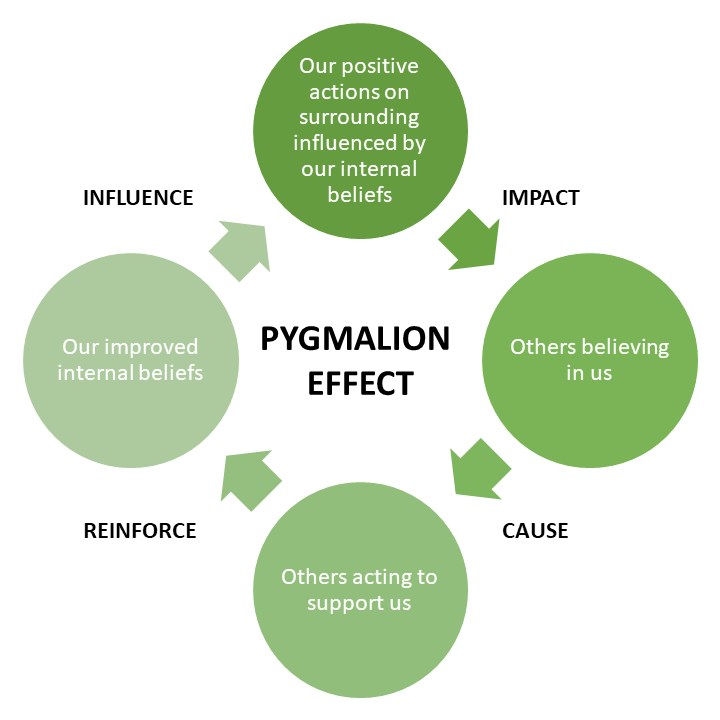
Supporting environment creates high performers

Paul could have chosen another path to fight just like Chani chooses in the end but the Pygmalion effects kicks in, leading him to become the antihero – a high performing powerful antihero.    

You should appreciate that Pygmalion effect also shows how the opposite and downgrading environment will create a villain. A famous and itching question can be answered using this explanation. If baby Hitler was killed way before, would it have prevented the occurrence of the future world war? The answer is – NO. The conditions were developed in such way that even after killing baby Hitler someone else would have risen among that much hatred who would have led to the end effect, the name would have been different but the acts would be roughly same and inhumane. That is why our environment is an important part of our identity, even if the environment is hostile, what we consider ourselves at the core is equally important.
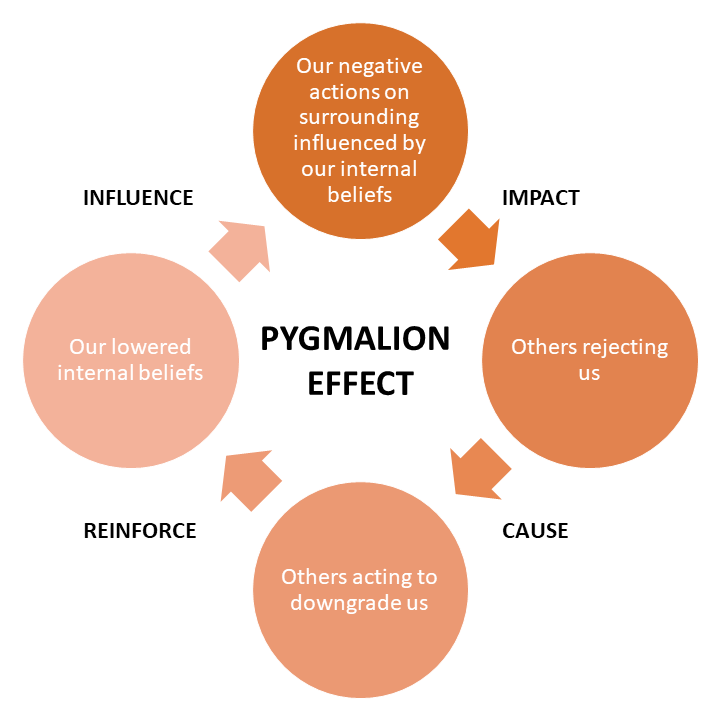
Nonsupporting environment creates low performers

(You can see that, even in adverse nonsupporting conditions of cognitive dissonance and identity crisis, a person can chose to remain good, can choose one identity over the other. I have discussed such scenarios in pop culture before. Read more about that here.) 

The Prophecy – Does ‘Free Will’ Really Exist in Dune?

The identity which Paul chooses after a cognitive dissonance about his origin and the Pygmalion effect from his environment make his the prophesied Lisan al-Gaib. Now it feels like it truly was the plan all along. This goes against the idea of free will.

Existentialism is based on the idea that as man is born free. It is in his mind, his responsibility to assign the meaning to his/ her own life. The ways and reasons for which Paul consistently rejects the prophecy is because he knows he is not ‘the one’. He knows that he is the son of Leto Atreides and should avenge his father’s death, hence his only purpose was to use the ‘desert power’ to defeat the Harkonnens and the Emperor.

Paul despises everything that is connected to the Prophecy. It is his interest in Fremen people and purpose of completing the vision of his father which drives him into becoming one of the Fremen. You will see Paul rejecting the idea of him being the Messiah in the early discussions with Chani.

The creation of prophecy and instilling the faith into Fremen for Paul indirectly always pushes him into doing what is expected. Paul never makes any decision out of the box. There are chances where he could have created other opportunities but the people around him, his blind followers could never let that happen. Paul is center of attraction for everyone that is why he is always bound to do what they want, otherwise he knows that he will lose that advantage and desert will immediately consume him like any common outsider. The advantage of being the center of attraction of your followers is that your followers will justify your every action; But in the end, you will also be bound to their expectations.

The powers of Bene Gesserit to manipulate people to do what they want, the unfolding of events leading to the war during the Fremen rebellion against the Harkonnen, the necessity to prove injustice with Leto Atreides to the Great Houses ultimately make the realization of prophecy possible.    

That is exactly why Paul gets tied up in the expectations of Fremen, his own self-respect and his own duty as a son. He knows he can avoid this path but chooses that path because that is how he will have ultimate power.

On the other side you will see Chani, she is fighting the same war but can chose her own ways to accomplish that goal. Remaining out of the focus of the religious followers gives her more freedom.

Lady Jessica also falls victim to the prophecy. Stilgar informs her in Sietch Tabr that if she doesn’t become the Reverend Mother she would have to die and Fremen people won’t save Paul. Even when she knows that the prophecy is false, she accepts it as a way to get things done according to her wishes. But again, the pressure from the faithful Fremen followers force her to follow the prophecy. Things doesn’t go right for her in the end. Lady Jessica also faces the cognitive dissonance like Paul about her origin as Harkonnen and chooses the predefined path of being the Reverend Mother.

One must appreciate how Frank Herbert created the story of Dune where the psyche of person drives the narrative. Frank Herbert was heavily influenced by Carl Jung’s archetypes and Dune reflects those archetypes. Dune also gives the psychological justifications behind the blind hero worship through some important character arcs.

It becomes very important to notice our end goals and whether our surroundings, our people are supportive of that. We as humans, are the beings of infinite capabilities, what we consider ourselves internally at core becomes very important in the end. Otherwise, the world is already prepared to overwhelm us with its preconceived notions of living a life.  
References and further reading:

  1. Confirmation bias sketch from Sketchplanations by Jono Hey
  2. Cover Image by Johannes Havn from pexels.com
  3. Dune: Philosophy in Science Fiction
  4. The Pygmalion Effect: Definition & Examples by Ayesha Perera on Simply Psychology.org
  5. The Batman- The superhero who ‘unlearned’ – Journey of a person through cognitive dissonance
  6. Existentialism – Zima Blue and Existentialism
  7. Biases and Delusions – Steering on the borders of rationalism and insanity
  8. Answering the questions on existence of “the existence”
  9. The Existence – Why? How? And What?
  10. Dune’s Ornithopters and Biomimicry
Dune: Philosophy in Science Fiction

The focus of Dune saga is on the ill-effects of hero worship. Frank Herbert warned his readers about the life altering consequences of granting too much power in the hands of a person who refrains to be questioned by his followers. The character arc of Paul Atreides depicts a moral dilemma. It also shows how power and aesthetics play a vital role when one is justifying actions, character and intent.

Dilemma of morality in the character arc of Paul Atreides

Dune Part Two shows how any person would react when thrown into the events where morals and ethics clash. Dune Part Two is about the creation of the antihero and his blind hero worship. It is important because it breaks down and effectively depicts the stages in which even a humble and good-hearted person can degenerate. Surrounding around such person has big role in it.

The focus of Dune saga is on the ill-effects of hero worship. Frank Herbert warned the readers of Dune about the life altering consequences of granting too much power in the hands of a person who refrains to be questioned by his followers. Superficially, Dune feels like a story where Bene Gesserit – a low lying powerful sisterhood planting an extremely powerful but manipulable Messiah to control the galaxy and how this Messiah ruins that plan. Deep down, Dune successfully amalgamates many philosophical, psychological concepts like Existentialism, Hero worship/ herd mentality, confirmation bias, free will and determinism.

Denis Villeneuve’s Dune Part Two has successfully translated the vision of Frank Herbert’s 1965 Sci-Fi which is more relevant than anything in the current times of 21st century. In Dune Part Two you see the transition of a young, humble, calm boy into an aggressive, extremely powerful leader – a leader who is worshiped like the God by his followers. As a fan of Sci-Fi movies, I would say Denis Villeneuve’s Dune movies have made justice with what the source material wanted to convey. (Historically, Dune series is known to be one of the most difficult materials to adapt into visual media)

The discussion hereon is not a movie review rather it is about how some fantastic philosophical, psychological, spiritual, and political ideas are brought together to create a more relevant story which is purely fictional. Despite being a fiction, it successfully depicts some important real-life scenarios and dilemmas we face in our very real lives. This all is credited to Frank Herbert and Denis Villeneuve’s vision.

There will be heavy spoilers for Dune Part Two hereon!!!

After watching Dune Part Two it is obvious that it is all about how an antihero is created. There is a moment in the end when you will lose the sympathy for Paul’s character because of the choices he makes and it is intentional. The movie gives us multiple viewpoints to justify why Paul Atreides becomes who he is. Obviously, his antihero arc creates a deep void in our heart. When I started to understand the narrative from Paul’s perspective, I stumbled upon some of the important ideas we use to justify our actions, decisions.

Boundaries of Right or Wrong – What is Moral? What is Ethical?

Let us understand the stages in which Paul is always rejecting the leadership – the prophecy of Messiah he is offered every time.

Rejection 1 – Paul has not demonstrated any grand act yet. He lacks clarity, vision.

Right from the beginning, Paul knows what it means to become the Lisan al-Gaib – the Messiah. You will see him rejecting the concept of becoming the prophesized leader. In Dune Part One you will see that he asks Leto Atreides, his father – What if he does not want to be the leader, the future of house Atreides? In response, Paul understands from Duke Leto that leadership is not a personal choice and when there will be a moment in which people will choose him as their leader and he will have to answer that call. The fear of leadership in Paul here is created due to very superficial simulation of future possibilities. He hasn’t even landed in Arrakis – the desert Planet. Here, Paul is just a well behaved, properly trained royalty who hasn’t tasted the reality of life yet. He theoretically understands the burden of leadership, the burden of the expectations of the people and that why humbly rejects it – as it is the ‘right’ thing to do. Understand that Paul’s rejection in this instance is because he doesn’t consider himself worthy. It is unethical for him to accept leadership which is granted just from the birthright. Understand that prophecy of Messiah is not apparent here, this is the leadership of his House.

Rejection 2 – The prophecy is just a clever plan. There is clarity on what and how events will happen but no clarity on what will cause them.

When Paul lands with his mother Lady Jessica on Arrakis he looks at the local Fremen people chanting his name as the one who was promised to free them from this exploitation of the foreigners – the Harkonnens for the precious Spice Mélange. Here, Paul understands from his mother that the religious Bene Gesserit sisterhood has planted a very meticulous storyline – a prophecy to ease out their path on Arrakis. The knowledge of ‘the prophecy’ being just a clever plan of Bene Gesserit sisterhood consoles Paul that he will always have the choice to reject the future responsibility of leadership. This rejection of leadership is due to understanding of the underlying truth and how hopeless people are getting fooled. Utilizing such false knowledge for self-benefit makes Paul uncomfortable.

Rejection 3 – Paul has clarity but doesn’t want to take the advantage of the Fremen Faith

After the death of Leto Atreides, Paul escapes to Fremen territory with Lady Jessica. Fremen accept him as he shows his skills in a fair fight. From this moment his goal is to survive with Femen’s to acquire the ‘Desert Power’ as desired by his father Leto Atreides. He still despises the Bene Gesserit Propaganda. He knows he will be fooling the Fremen by following the said prophecy. It is not ethical to utilize others’ faith for the personal benefit. That is why Paul is just trying to learn the ways of Fremen to avenge his father’s unjust murder orchestrated by the Emperor through House Harkonnen.

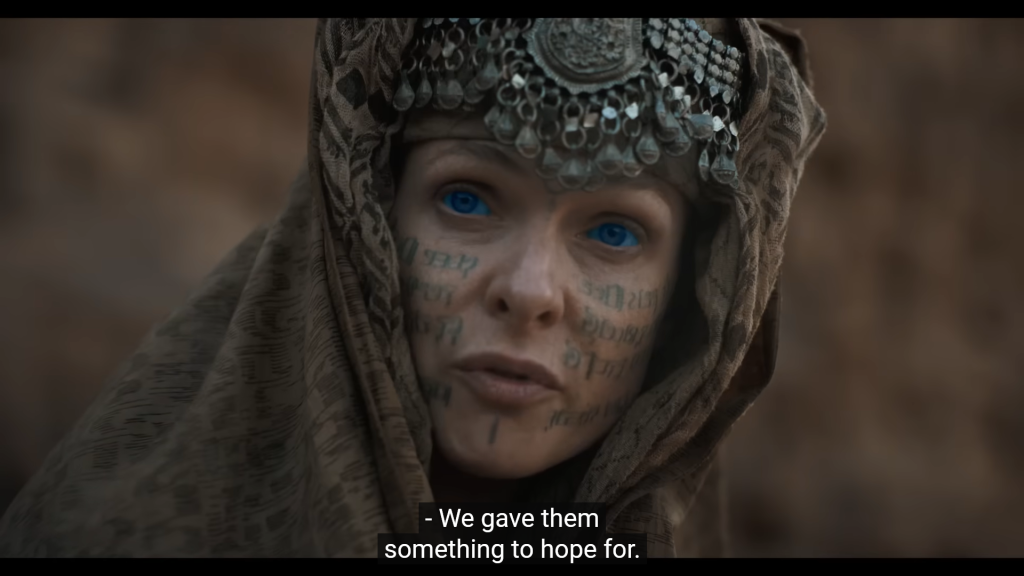
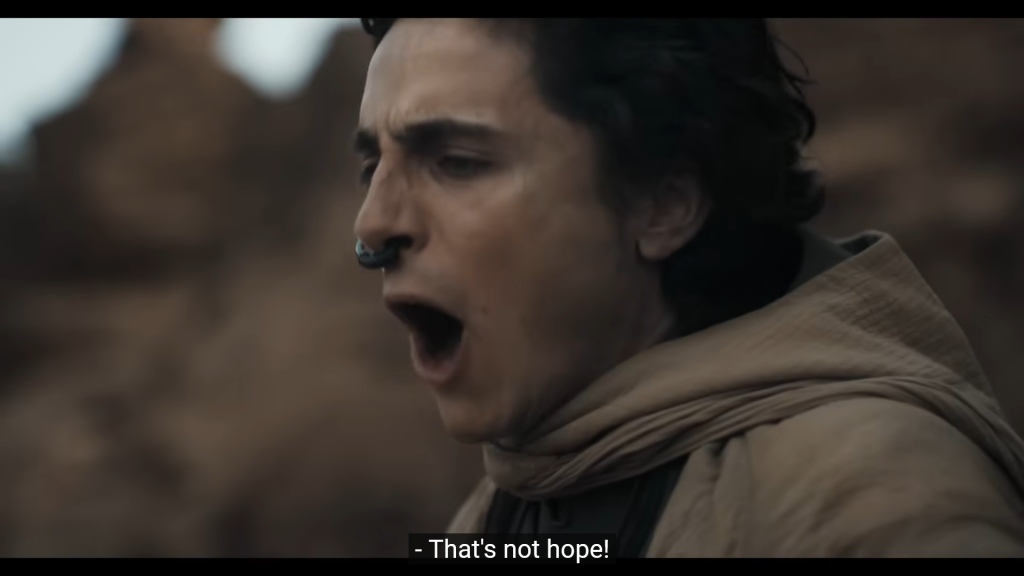
There is a discussion between Lady Jessica (who is now Reverand Mother) with Paul where she says that the prophecy has given Fremen people something to hope for and to fight for. This is the exact moment when Paul actively and aggressively rejects what she says.

Paul – It’s not prophecy. 
It’s a story that you keep telling.
It’s not their story, it’s yours.
They deserve to be led by one of their own.

His rejection to leadership here is because it is unethical to play with other people’s faith.

Rejection 4 – Paul loves Chani. He knows the moment he accepts ‘the prophecy’ he will lose her.

There is a scene where Chani tells Paul that the Fedaykin worship him now, they count his victories. Chani (who doesn’t believe in the prophecy) warns him that people have already started worshiping him and this will not end well. To counter Chani’s fear Paul positively clarifies that he is not the Messiah and will always be a Fremen warrior – the Fedaykin. Paul mentions several times to Chani that he will love her as long as he breaths. As the prophecy goes, he should reserve his hand for the most strategic alliance which is with the Princess Irulan – the daughter of Emperor. Here, the rejection is due to the love he has for Chani.  

Rejection 5 – Paul knows that while becoming the Mahdi, he will lose his comfortable connect with Fremen. He will have blood of billions on his hands.

Upon the encounter with Gurney Halleck, Paul clarifies certain important things. Gurney is surprised that even after having following of 200 people and millions more, why isn’t Paul taking advantage of the prophecy to avenge the death of his father? Paul tells Gurney that the moment he becomes the Messiah, he no longer be friends with Fremen, because even his Fremen friends will worship him as the God – Lisan al-Gaib. He considers it unethical to utilize the innocent beliefs and trust of the people for him for his personal benefit.

Gurney Halleck – With thousands of these guys you can take control of the entire planet. It’s your father’s dream. What you are afraid of?
Paul – Worship, Gurney. They used to be friends, now they are followers. 

Gurney tells Paul that he holds the ability to avenge his father by accepting the prophecy. Then Paul clarifies that the moment he becomes the Messiah, the galaxy will be thrown into the holy war leading to deaths of billions of people. Paul doesn’t want their blood on his hand.

The rejection of prophecy here is due to fear of losing personal connect with the people who define and respect you. It is also because Paul wants to preserve his character.

At the end of the Dune Part Two, you know what exactly happened!

Are Morality and Ethics Objective?

So, even after having at least 5 concrete reasons to reject the prophecy, why does Paul decide to become the ruthless Messiah, Lisan al-Gaib? What made him lose all the ethical and moral standards he had preserved in him?

Simple and superficial answer to these questions is – the circumstances!

Deep down the answer is totally different. Let us understand what are morals and ethics

Morality is the sense of judging a decision, event or an action being proper or improper. Morality is the sense of what is right and what is wrong.

Ethics are detailed down, systematic small-small actions which show what doing good is. The opposite act of doing a good act will be doing a bad act.  

Morality are the universal standards for right and wrong and ethics are the rules to implement this morality in daily practice.

Question – How is it decided whether certain act is good or bad?

This is where the trick starts.

The base line to decide morality or ethics is always changing. It is like deciding ‘What level of big picture are you talking about?’

Frank Herbert was very intentional while creating such moral ethical dilemma through Dune series. As you are introduced to Paul right from the start of his journey, from a kid to the Messiah, you know why he did what he did. His Great House was betrayed by the Emperor and the Harkonnens. They tried to kill him, his pregnant mother, and his people. The responsibility to handle Arrakis was forced down on his house by the Emperor. He had every reason to kill his enemies. Whatever act Paul did to avenge his father/ his house was right and justified.

Does that mean that “whatever” and “everything” that he did and would do is right?

The death of billions of people he would cause (as seen in his visions) will it be justified?

Many Fremens devoted and died to Paul’s cause, will their deaths be justified?

You will see that the moment you shift from Paul’s personal baseline of morality to the baseline of the ‘good for all’, you will appreciate why the same Paul – the Messiah – Lisan al-Gaib – the Savior is also ‘the destroyer’ for remaining others. Thus, it is important to define that baseline while judging his actions.

Philosophy of Morality

There are two ideas on how to decide this baseline for morality of given things.

Immanuel Kant says the duty assigned to you; your obligation decides the morality – The duty-based definition of morality.

Immanuel Kant

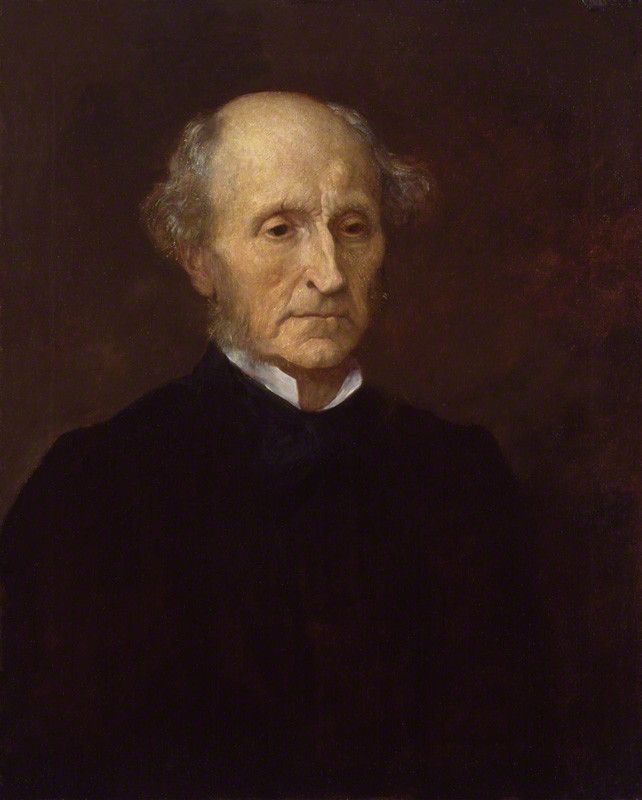
John Stuart Mill says that whatever is good for most of all should be good for one – The utilitarian definition of morality.

John Stuart Mill

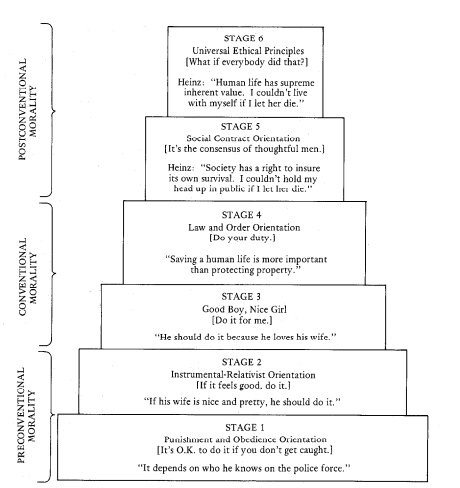
Lawrence Kohlberg’s stages of moral development give us a structured view about how the baseline to justify morality of anything works. This single image deserves a detailed explanation but it is self explanatory.

Morality needs understanding of “the big picture”

In Dune’s case, it was Paul’s duty to avenge his father’s unjust death hence he was right. Whereas letting his followers kill billions of people belonging to the houses who were not accepting his ascension as the Emperor was wrong – immoral. He commanded to destroy such opposing Great Houses just to establish respect for him out of fear. The intent was not pure.

For Fremen, the act of destroying everyone opposing their leader is way better and important than living a life of slave. At the same time same Fremen killing billions in the name of their Mahdi is bad.

For Jessica, survival of her children was more important than anything. She had also promised Leto Atreides that she will save her children not as Bene Gesserit but as a mother first. That is why she eases out the path laid for Paul which guarantees his and his sister’s survival. You will understand that Jessica fears becoming the Reverand Mother, she knows that she will have to carry the pain and memories of all those who came before her but upon hearing to the clarification from Stilgar, she realizes that it is the only way to ensure the survival of her children. So, she controlling the Fremen and spreading the prophecy of the Messiah (despite knowing it as just a clever plan) feels moral.

Stilgar strengthening the events from the prophecy in the minds of Fremen ensure betterment of his people. If his actions to spread and strengthen the path for Paul would lead Fremens people to a better life then his actions are well justified. But, the moment he blindly follows every order from Paul to obliterate everyone opposing him his actions become wrong.

When it comes to mere survival of Feyd-Rautha, Baron Harkonnen, Rabban, the Emperor, Princess Irulan, Reverend Mother Mohiam someone would feel that their actions are justified. (But, we already have many other reasons to assign them villainy.)

It’s like checking which one is more wrong – Killing an ant or murdering a person!

The moment you favor the life of the person than an ant, you will feel bad for what kind of animal you are. And the moment you favor life of that ant over the person you will feel bad as a human being.

Taking any life is bad in the end, but what if it’s about survival. Then it goes in the direction which poses question – whose life is more precious?

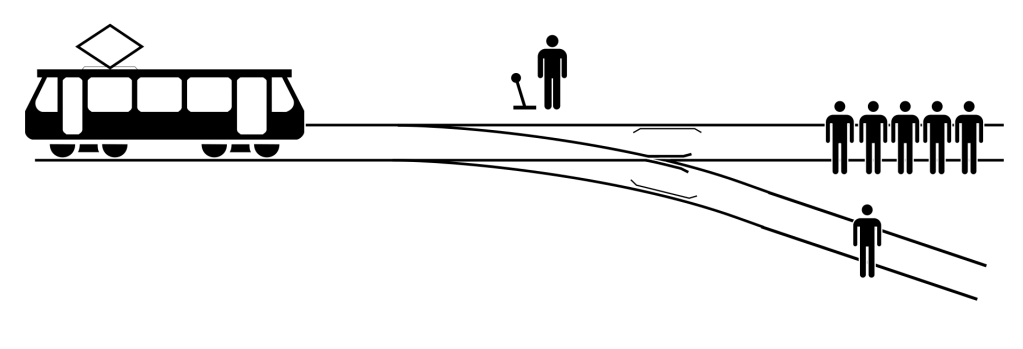
The Trolley Problem – Which lever will you pull?

Do you see how this streak goes on and on! This will not end until the questioner will be satisfied with comfortable answer!

One must appreciate the genius of Frank Herbert’s writing which created such important intersecting points in his story.

Power and Aesthetics

So, final question – what ultimately is the right or wrong?

The answer is how deeply are we able understand the scenario (and we may never understand every aspect most of the times.)  Actions are always changing with respect to the circumstances, killing a murderer will always be justified and right at the same time killing a Saint is wrong.

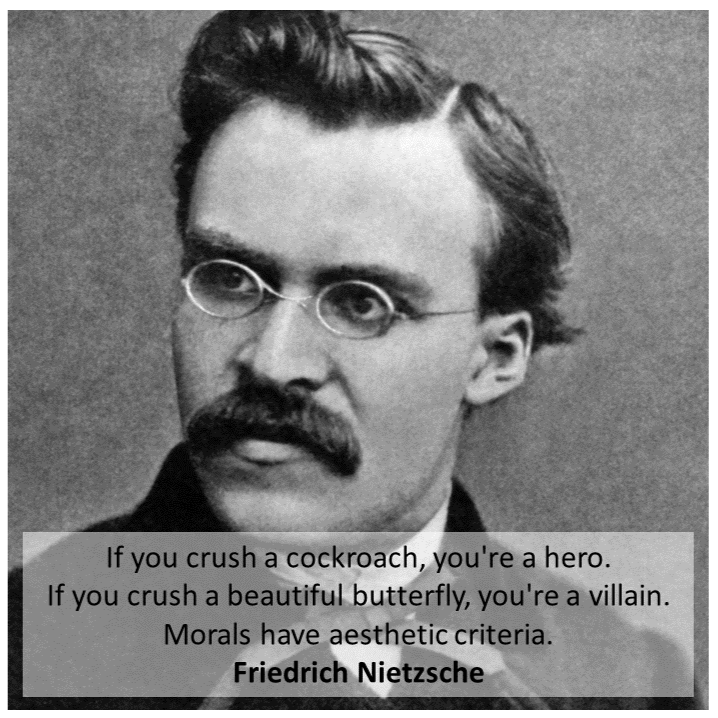
This reminds me of Nietzsche’s quote:

Thus, the dilemma grows bigger.

What is right and what is right is highly dependent on your limits, your capabilities, your ability to reverse the things to exactly how they were before. If you don’t hold that capacity, then you immediately lose the power to justify your actions.

Which is exactly why what Paul believes is completely wrong, it shows how Paul character has made transition…

“He who can destroy a thing has the real control of it.”

The power will enable him to destroy any given thing; but can he reverse that destruction if things did not turn out the way he intended? The ability to restore the consequences of your decisions decides whether you hold the power to assign good or bad.

If Paul does not bear the capacity to reverse or at least restore the impact of his decisions, then he is wrong to send his followers in that direction.

I think, this is the warning Frank Herbert gives to the real-life leaders and followers among us. This is exactly where powerful people go wrong and take their blind followers with them.

So, even though his intent was to avenge his father by becoming the Messiah, the path he would choose is wrong.

The path Jessica chose to control the Fremen through prophecy is wrong. The plans Bene Gesserit orchestrated to plant a powerful yet manipulatable person on Arrakis just to have control over Spice are wrong. There are always multiple choices,

(The conclusion of the Paul Atreides’s story and ‘Dune: the God Emperor’ will make us change our current opinions. That we will discuss again when the time is right.)  

Anyways words fail me when such real-life scenarios are flawlessly presented through fiction. There is no need for anyone to teach us what is right or wrong in such stories. The dynamics of the events and the characters show us the mirror. We always have such inner compass inside ourselves, stories like this are the greatest calibrator of such inner compasses.

The power to restore the consequences of our action is the real power, I think. This idea somewhat frees the justification of our actions from the dilemmas of morality.

There is more to discuss about Dune, find out here….

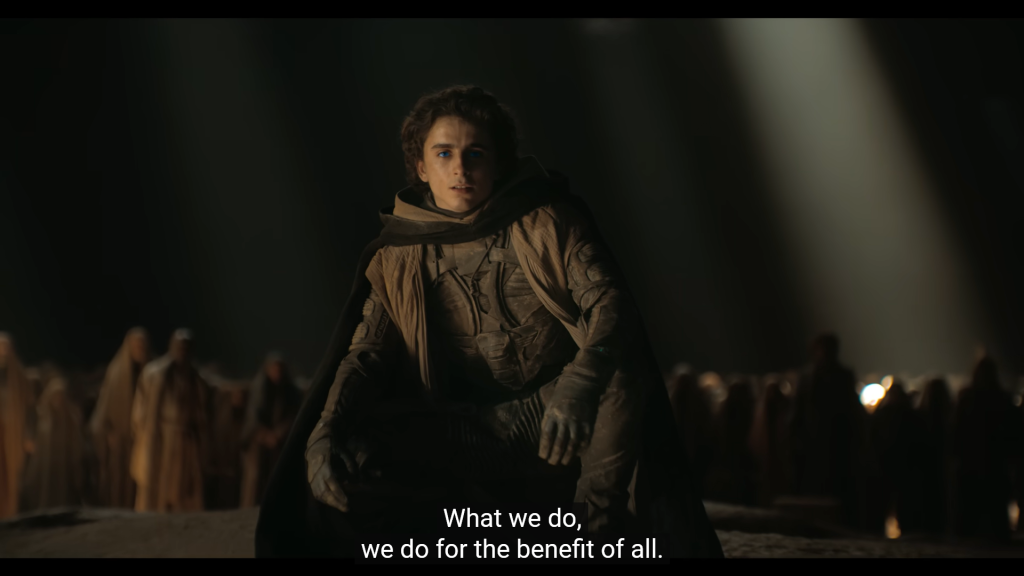
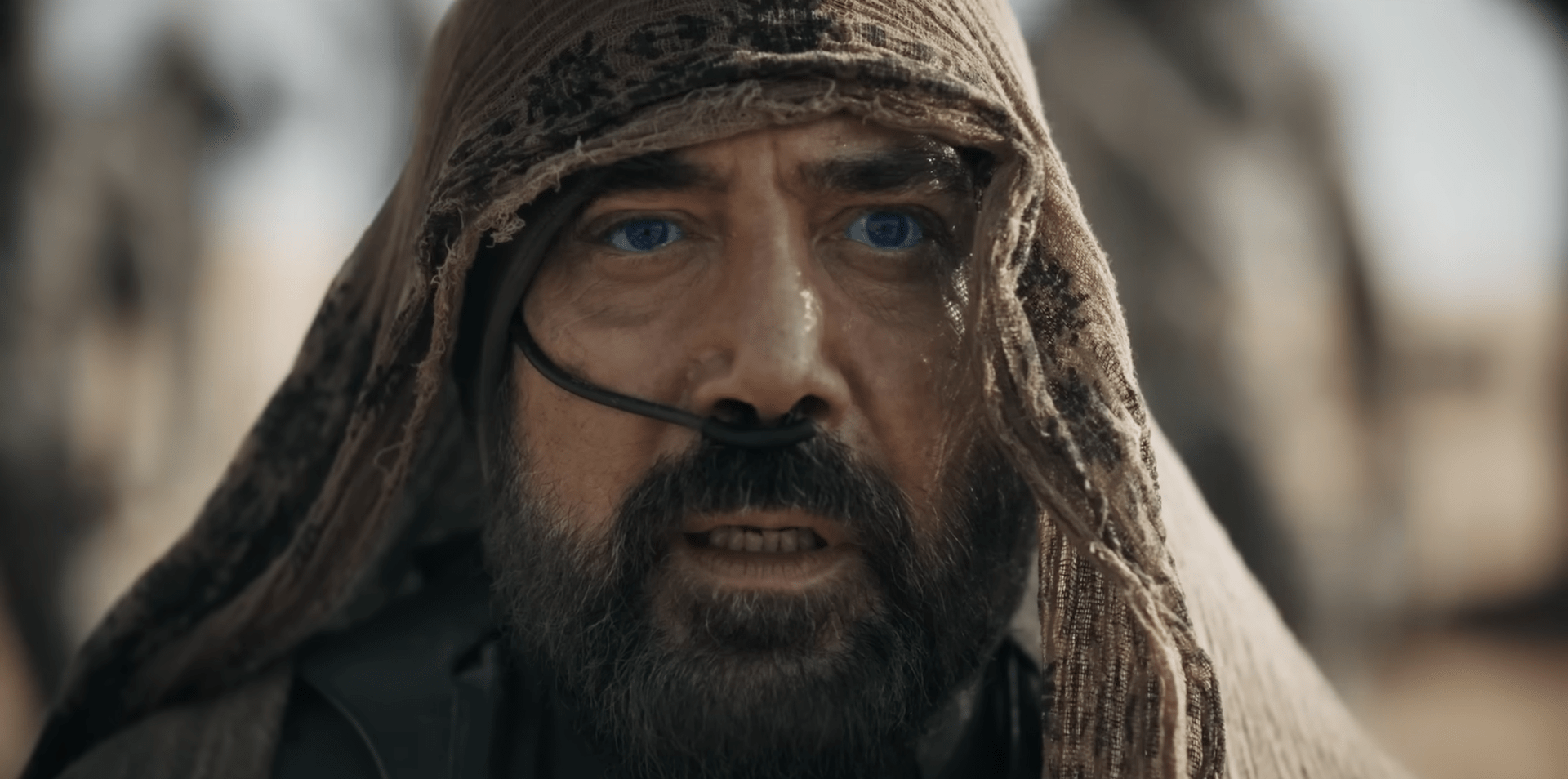
(Movies Scenes from Warner Brother’s Dune: Part Two)

Further reading:

  1. Dune : Psychology in Science Fiction
  2. Existentialism – Zima Blue and Existentialism
  3. Answering the questions on existence of “the existence”
  4. The Existence – Why? How? And What?
  5. Dune’s Ornithopters and Biomimicry
Motivation and Fulfillment – Sailing Through The OCEAN of Life for Self-Actualization

Abraham Maslow’s ideas of the hierarchy of needs lost its essence due to oversimplification into the famous pyramid of needs. Those who lacked happiness in their lives will prefer to be happy by trading all valuable objects they have, whereas those who never possessed basic things for survival will endure endless pain to get them. This creates a paradox of life. What was lost through Maslow’s pyramid came back into limelight due to modern theories in psychology like the Cybernetic Big Five Theory and Sail-Boat Model. They highlight a very important fact that stability and plasticity both are necessary for a person to become whole – a complete human being.

Abraham Maslow’s ‘Hierarchy of Needs’ for The Modern World

Psychology ~ Study of mental!?!

A big part of psychology is always associated with the mental disorders – a negative aspect of human psyche. It is a common (mis)conception that students of psychology largely associate themselves with the studies and treatments of such mental people. Maybe it is our human tendency (a defensive tendency) to get immediately attracted to negative aspects immediately which creates such conception about psychology. This is not limited to only psychology; it is applicable to everything we have initial opinions about. But this is not true, we are seeing only a half part of the psychology. The other half and the positive part – is more helpful to live a better life.

Talking about good and bad part of human psyche – where would you put a selfish person? For the sake of classification, a selfish person is the one who prioritizes himself/herself first when it comes to anything. He/ she would think of themselves first, for their own benefit first to make the best out of the circumstances. Isn’t that bad?

How could it be bad if survival is the only option in front of such people? Then the roles reverse immediately. When it comes down to survival of a person every virtue falls down. If a person did something for their own betterment and jeopardized others in the process, will they be called selfish? Now the answer to this question becomes subjective and quite tricky. Were the others evil? If yes, then being selfish for self-benefit by belittling the evil others makes you a hero. If the others were good then being selfish makes you the evil one. So, is selfishness subjective?

We will find the answers to this question soon in upcoming parts.

Have you ever felt that feeling of void after achieving something great you’ve been striving for? Have you felt that emotion of not being repaid for the many good you did for others? Have you felt jealous for that simpleton who while being less competent than you got more recognition? Have you felt bad for people who devoted all their life for the betterment of society got disrespected by the society? Do you think that the modern definition of love is closer to formal transaction of things, physical acts and emotions?

Do our answers to all the questions above in a “Yes” mean that we are bad humans?

This is exactly the part where the positive aspect of psychology plays a crucial role.

Humanistic Psychology – What Makes Someone “A Whole Human”?

The humanistic psychology popularized by the ideas of an American Psychologist Abraham Maslow is also coined as the third force in psychology. (After Freud’s Psychoanalysis and Skinner’s Behaviorism)

“It is as if Sigmund Freud supplied us the sick half of psychology and now, we must fill is out with healthy half.”

-Abraham Maslow

So, simply put, Maslow asked opposite question about human psyche. What if things go right? What happens when a human mind is completely healthy? What changes can be seen in a healthy human psyche?  What are the characteristics of “a whole human”?

The ideas of humanistic psychology hence bring one spiritual aspect in the understanding of the human psyche. Maslow’s ideas from the Theory of Motivation show us that psychology is also about what good is in humans and how everyone can achieve it.

Self-Actualization – The Classical View on Being the Best Version of You

In 1938 Abraham Maslow spent six weeks with Siksika Blackfoot, the first nation (Indigenous people) in Alberta, Canada. Maslow was trying to understand the social hierarchy and dominance within these people and surprisingly he found something totally different. Siksika people ever fought for dominance or power, the definition of wealth for Siksika was sharing – the more you share the wealthier you are, children were treated same as the adults were – they had chance to put their own opinion in front of others, Siksika people were highly cooperative. Instead of a single dominant person forcing others for power, the Siksika Blackfoot society left no one behind. Even the people who committed wrong work had option to lose that attitude and join back. It was like the Siksika were highly aware of how one should behave for the betterment of everyone without compromising the personal well-being. Maslow realized that this is the highest form of being a human being.

Maslow understood that if certain basic criterion, basic needs are fulfilled for every human being, then they can immediately strive for self-betterment and also for the betterment of society. They will not exploit society for their personal betterment. Such person would be a person who has achieved self-realization where he/ she knows what is good for him/ her and how they can benefit others in the process.       

So, Maslow’s Theory of Motivation talks about achieving human potential to it’s fullest. How we can bring about the best of ourselves which will satisfy us and will also benefit others around us thereby uplifting the whole society. This theory of motivation struck hard against the individualistic ideas which were strong in capitalist America.    

The (Controversial) Pyramid

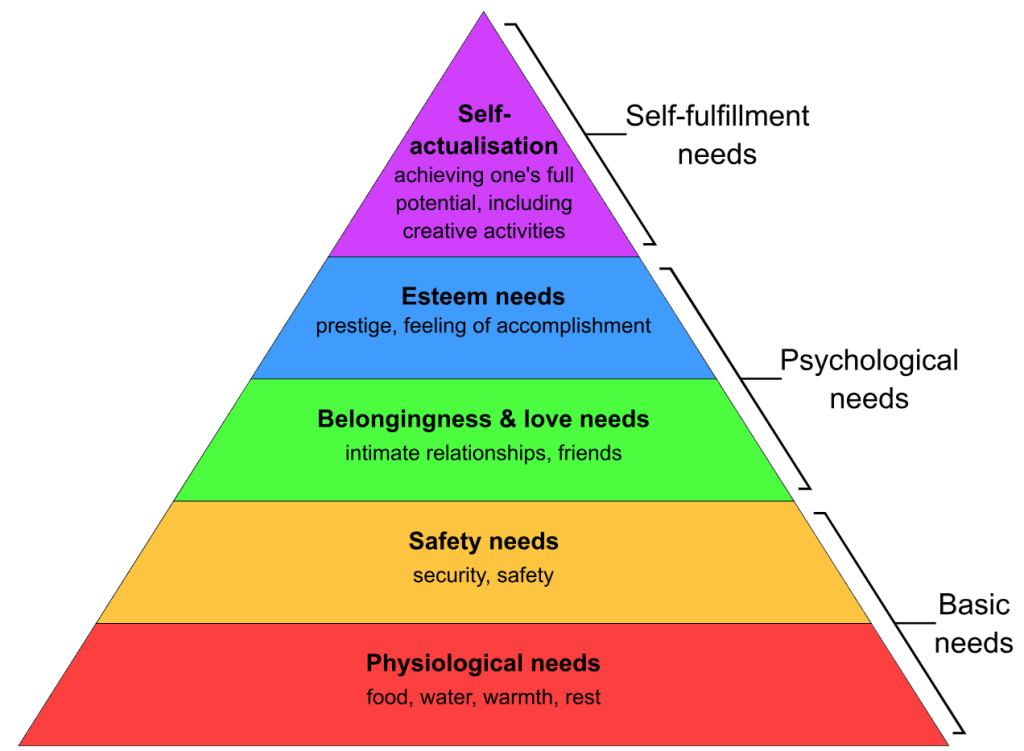
We all would have seen the famous pyramid of needs in certain forms somewhere. This pyramid is known to represent Maslow’s Hierarchy of Needs. Although the concept of hierarchy of needs is originated from Abraham Maslow, the pyramid was never drawn by him. A consulting psychologist Charles McDermid came up with this pyramid to oversimplify Maslow’s ideas and this is where the core of Theory of Motivation was lost.

Oversimplification of Maslow’s theory caused the loss of its very fundamental ideas

Theory of Motivation and Self-Actualization

According to this theory, humans need an integrated hierarchy where basic survival needs must be satisfied to realize their full potential – to become a self-actualized being.

Theory of motivation deals with what motivates people to achieve certain goal or expected outcome. The most primary theory here is Maslow’s hierarchy of Needs.

Maslow attributed 5 hierarchies for the any person to achieve their full potential:

  1. Physiological needs – Things required for survival like air, water, food, clothing, and shelter
  2. Safety needs – personal protection from surrounding hostile conditions, a safe society, secure job/ income, health
  3. Belonging needs – people who appreciate your presence in their lives, love, friendship, companionship, sense of connection/ belonging
  4. Esteem needs – respect, loyalty, status, recognition
  5. Self-actualization – the ability to reach the highest potential

Before moving on with the discussion with these hierarchy it is very important that Maslow never intended these to be linear. The mistranslation of the concept of hierarchy into pyramid lost the whole basics of Maslow’s theory of motivation. Maslow always clarified that these are not sequential.

Maslow’s classified the first four needs namely physiological, safety, belonging, and esteem as the existential motivators. These are the necessities for a person to exist in this world and are completely dependent upon external factors.

The last need for self-actualization is completely intrinsic motivator. Unless and until you feel that drive to understand the purpose of you your being, you won’t reach the stage of self-realization. The person who has satisfied all first four but not the self-actualization will feel directionless even after achieving what he/ she desired. That is exactly why doing things to prove your worth to the world mostly ends in existential confusion, such people question the void which is created after achieving everything they wanted.

That is why inner motivation is important for bringing out the best of you. So, the last need namely Self-actualization is attributed as the intrinsic motivator. This intrinsic urge will drive the person to make the sense of his/ her conditions improve further.

In this further improvement the person achieves self-transcendence. This is the purest form of the happiness. Spirituality calls it the enlightenment.

The Characteristics of Self-Actualizers

It is very important to reiterate that Maslow never intended the hierarchy of needs to be linear and always clarified that you can work of these needs simultaneously. It is not like leveling up in a game one by one. The more you satisfy lower needs, the more you are concerned with the higher needs.

Maslow’s studied such people who have achieved self-realization and found some special common traits. Some of them are listed below:

  1. They have high level humor – Low level humor is when you belittle others to create laughter. The self-actualizers will make fun of themselves to create this laughter.
  2. Self-realizers have high sense of reality – Self realizers exhibit a healthy self-esteem. A person with toxic self-esteem will feel jealous for other people’s success. They feel entitled as they were the worthier than others. But the self-actualizers appreciate other people’s success and befriend them to learn the ways to succeed.
  3. Continuous appreciation – Self-realizers are able to find joy in even the routine tasks, mundane activities. Even though they are excited for something new and challenging they equally value the mundane-ness of the events in life. It is because they carry highest sense of gratitude for everything.
  4. Problem centered – Self-actualizers understand that whatever mission they have whatever purpose they have to fulfill must always lie beyond themselves and consider the big picture and long-term vision. They are aware that once the goal is achieved, they will get exposed to that existential confusion, once you have higher and wider sense of goal it is very rare that you will end up in existential angst. These types of people are not building an empire to become billionaire, they are on a mission to contribute to the world. Most importantly this urge to contribute to the society is not to make themselves feel worthy, it is because they understand that it is what the world desperately needs. Thus, self-actualizers select their goals in such ways so that they strengthen the personal skills and contribute to the betterment of the society simultaneously.
  5. Self-realizers enjoy privacy – Solitude resonates more with such people than loneliness.
  6. Self-realizers demonstrate these values: Wholeness, perfection, completion, justice, effortlessness, aliveness, richness, simplicity, beauty, self-sufficiency, goodness, uniqueness, order, playfulness, truth
  7. Self-realizers are accepting towards oneself and others – they know that a perfect human is not the one without flaws. They understand that imperfections, sadness, grief, jealousy are also important aspect of being a human and thus try to uplift others going through same conditions instead of belittling them.
  8. Self-actualizers are more spontaneous and strive to become more natural
  9. Self-actualizers intensely look out for autonomy. It’s like micromanaging will kill their motivation to do the task.
  10. Self-actualizers have more profound relationships. The relationships are not transactional.
  11. Self-actualizers have high sense of Gemeinschaftsgefühl – meaning heightened sense of being connected to humanity.
  12. Self-actualizers always strive to create win-win situations. That is exactly what helps them to find the goals which will benefit them personally and also the society on grand scale.
  13. Self-actualizers have peak experiences. Self-actualizers are not always happy (otherwise one would surely attribute such people mental!) Instead of remaining happy with everything irrespective of is valence – intensity, self-actualizers have these small moments which make them appreciate their purpose on even higher level. They are not always drenched in the rains of happiness instead a small shower of joy elevates their sense of purposeful existence.

After going through such detailed characteristics explained by Maslow, it is tempting to ask one question. Do Self-actualizers settle for what they are given?

Self-actualization is a journey

What majorly got lost in translation due to the creation of this controversial pyramid of hierarchy of needs was Maslow’s attribution to continuous improvement in Self-actualizers.

“It is not a state of being but a process, It’s a direction, not destination. This process won’t always bring the feelings of happiness, contentment, and bliss, and it may even sometimes cause pain and heartache. It’s not for the “faint-hearted”. It requires continually stretching outside your comfort zone. It takes a lot of courage to be the best version of yourself.”           

This is the part where the theory of motivation truly becomes humanistic. That is exactly what I love about self-actualization. It is not creating a paradise free from suffering, rather it accepts the presence of negative ideas of humanity at the same level as positive ideas. That is what makes us a complete human. It is sad that in general understanding we miss this part of the theory of motivation.

Maslow’s theory of motivation for the modern world

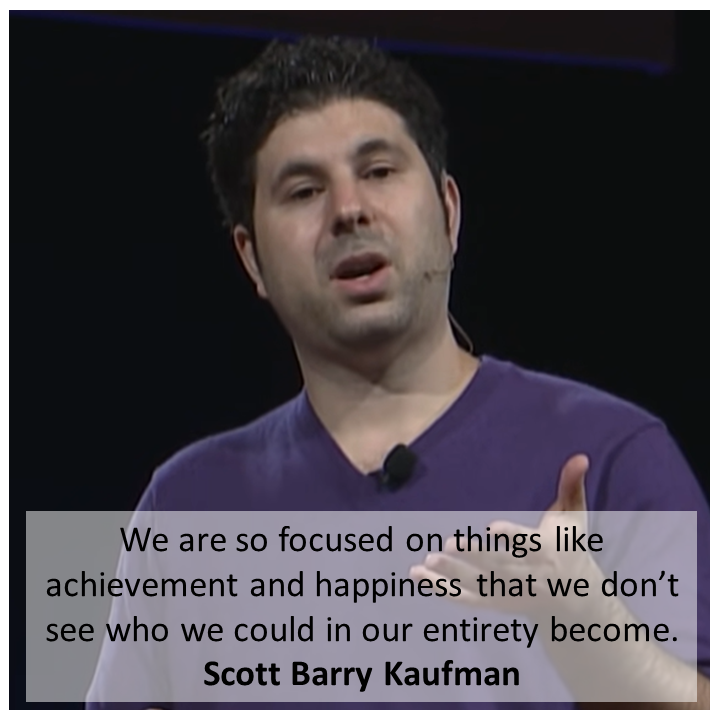
Scott Barry Kaufman – an American psychologist conducted an experiment to fit Maslow’s theory of motivation which is more relevant in this modern world and also doesn’t mistranslate the original theory during oversimplification. I would say it is not oversimplification of the theory of motivation rather it augments the same theory to remain more relevant in modern times.  

Scott Kaufman in his famous paper discusses that the as Abraham Maslow’s ideas go, the lack of satisfaction motivates people to fill that existential i.e., external, and emotional i.e., intrinsic deficiency. This deficiency is primarily about physical existence and then about mental/ emotional existence. It can also be deficient in both aspects (external and internal simultaneously). The people who lack motivation are also very defensive when they feel danger to their basic needs – survival needs.

Scott explains that motivated people are driven more by exploration, creativity and love not for themselves but also for the humankind.

The Cybernetic Big Five Theory

Scott Kaufman bridged the concepts of cybernetic big five theory with the characteristics of self-actualized human beings as explained by Abraham Maslow through an experiment consisting of a psychrometric test. (A psychrometric test is a questionnaire to assess intelligence, abilities, potential and personality.)

The big five theory of cybernetics identifies five factors which helps to define the person’s overall personality. Cybernetics here indicates the study of systems which work with a feedback loop. After all motivation is a type of feedback loop. Any mechanism which changes its response based on the outcome can be studied under cybernetics. So, the cybernetic system we are interested here are human beings. There are five factors which indicate the major habits – traits of the person. The varying contribution from each attribute can help us to understand what motivates, influences the given person and how his/ her life can be improved.

Following are the big five:

  1. Openness to experiences – as the words themselves explains – it’s the way – the trait in which one accepts or molds/ changes to the new experiences. The more open one is to experiences the less they are susceptible to mental disorder
  2. Conscientiousness – it is the ability to care, to take things/ consequences seriously, being diligent. More conscientious a person is more he/ she is reliable; extremes would be attribute to workaholics, perfectionists.   
  3. Extraversion/ Extroversion – is related to how a person draws energy to exist. Introverts feel energetic in solitude whereas extroverts seek company to feel energetic. This is inspired from Carl Jung’s ideas.
  4. Agreeableness – it measures how considerate you are. People with low agreeableness are selfish, people with high agreeableness are kinder, sympathetic.
  5. Neuroticism – is related to how one handles negative emotions and stress. More neurotic a person more negatively they behave.

This theory is also commonly known as the OCEAN theory. But, why did we try to understand the cybernetic big five theory? What motivates people is immediately related to how people behave and what are their “traits”; So, understanding the OCEAN aspects of the personality creates a model where you can understand what motivates them.

The Metatraits – Bridging the Classical and Modern Theory of Motivation

Scott Kaufman linked the big five facets of human personality to Maslow’s theory of motivation through the bridge of Metatraits.

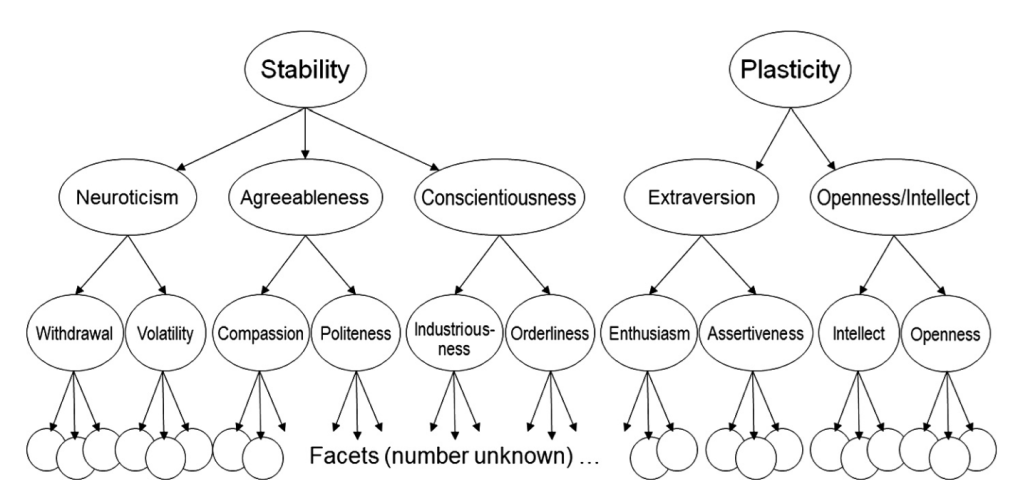
The five facets of human psyche – the five traits namely Openness to experiences, Conscientiousness, Extraversion, Agreeableness, and Neuroticism can be grouped into two major categories. One is Stability and the another is Plasticity.

Stability is defined through the contributions from traits of Neuroticism, Agreeableness, and Conscientiousness.

Plasticity is defined through the contributions from the traits of Openness to experiences and Extraversion.

The personality trait hierarchy
(Source: Cybernetic Big Five Theory, Colin G. DeYoung, 2014, Journal of Research in Personality)

Now, the magic starts happening.           

It’s Not A Pyramid, Rather It’s A Sail Boat

Remember that the theory of motivation had two aspects. One is the security, safety and the another one is sense of existence, meaning.

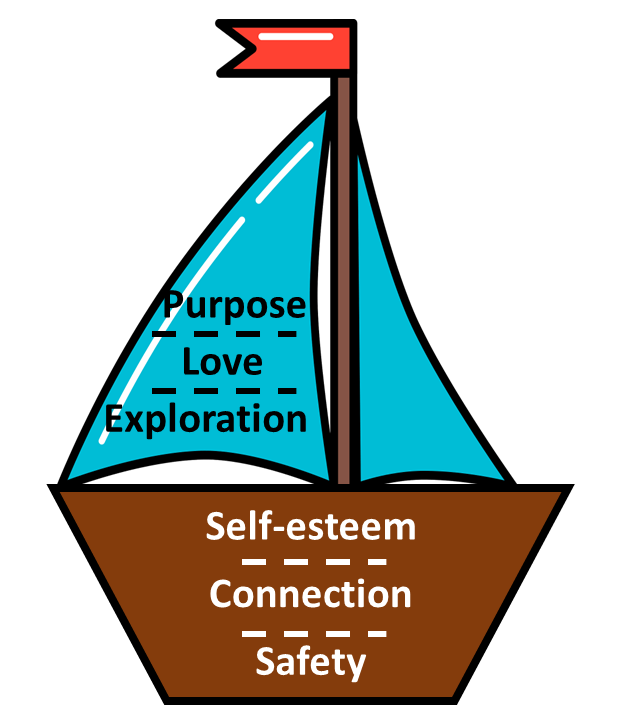
Scott Kaufman through his experiment clarified almost all aspects of Maslow’s theory of motivation. Unlike the popular mistranslated pyramidal structure of hierarchy of needs, Scott smartly utilized the fundamental idea of simultaneity of all needs into his new model. According to Scott Kaufmanns model the hierarchy of need is best represented by the Sail Boat.

Scott Barry Kaufman’s Sail Boat Model of Self Actualization

It is very wonderful to appreciate what this Sail Boat model communicates. Its beauty is that is brings the lost ideas from the classical theory of motivation into limelight and at the same time it removes that false linearity from the hierarchy. The word ‘hierarchy’ reflects that interdependence and complementary nature of the needs. The more you satisfy the lower needs, the more you will try to fulfill the higher need.

Scott presents that we are never leveling up from one need to higher one, rather we are trying to fulfill every type of need to certain extent simultaneously. Once we fill like certain need is fulfilled to a safer extent, we can fulfill other multiple need simultaneously.

We are continuously changing our needs based on the experiences we have while fulfilling other needs. Once you achieve certain goal in your life you may feel the need to upgrade you living standards, social status. If you get one life changing spiritual experience you may feel to downgrade your living standards because you feel that this is materialistic obsession.

Scotts Sail Boat model thus can be represented as follows:

The Boat is the security aspect necessary for the survival of a person. It is both physiological and psychological. Safety, Connection and Self-esteem create the boat; once you fulfill these aspects your life will be secured, your physical existence is guaranteed but this will not fill the spiritual existential void, the urge for purpose and meaning in you. You will have to attach a sail of being open to uncertainty, daring to love, daring to find the purpose which will drive that boat into the “OCEAN” of the life. (Look what I did their, actually this is how Scott explains it, you get it!)

Having a boat with holes – the lack of safety, connections, and self esteem will surely jeopardize your materialistic existence. After that having only a boat – fulfillment of safety, connections and self-esteem will give you proper survival. But only survival will instantly demotivate you to even live. Its like a boat which has taken halt, has no purpose and may collapse when a big wave collapses. Basic fulfillment of survival need does not guaranty long term sustenance, any big challenge in life, any negative event will tear down this boat of existence into pieces. You must appreciate that the boat here indicates the metatrait of stability which is supposed to the rigid trait of the personality, rigid int terms of the fundamental support to the whole being.

In order to handle the challenges, the big collapsing waves one need to explore the OCEAN, the challenges for that the motivation will be drawn from the openness to new experiences, learnability, curiosity. This learnability, urge for growth is attributed to the sails of the boat. The sails will ensure that you will move faster when you sense collapsing waves, sails will ensure that your boat will reach the destinations you want, sails will ensure that you have the goal, the purpose, the meaning to your existence. Thus, the sails represent the metatrait of Plasticity.

You must understand that Stability metatrait is how you fulfill your deficiencies in the fundamental needs for existence whereas Plasticity metatrait is about how you make sense of what existence you have established.

How strongly you will live is defined by stability, it is about how you protect your goals, its is about how you handle your impulses, how you strategize and understand the events to remain stable.

How purposeful, focused you will remain will be defined by plasticity. What new goals you create, how you learn new things to achieve these goals, hoe you strategize you r actions to demonstrate understanding, create meaning is what plasticity is.

Conclusion

Life, our existence is always proven to be filled with paradoxes and contradictions. You will see a smiling beggar lying on the roadside – begging for the food of one time and you will also see a billionaire crying in his Lamborghini because he/she lost their loved ones. Different people will weigh out these events based on what type of life they were exposed to. Those who lacked happiness in their lives will prefer to be happy by trading all valuable objects they have, whereas those who never possessed basic things for survival will endure endless pain to get them. These types of paradoxical lives are the origins to a completely different world view and most importantly what motivates human beings.

What was lost through Maslow’s pyramid of hierarchy of needs came back into limelight due to modern theories in psychology like the Cybernetic Big Five Theory and Sail-Boat Model. They highlight a very important fact that stability and plasticity both are necessary for a person to become whole – a complete human being. Scott Barry Kaufmann also found out in his study that self-actualization was more strongly related to plasticity than the mere absence of stability. It shows how intrinsic motivation weighs heavier than the materialistic stability. It is a big concept to grasp but all of us are always passing through this experience but seldom are aware of that. You will realize that this is the theory which could also join the western and eastern concepts of enlightenment and self-transcendence.

P.S. – Iron Man’s character from MCU in every sense is the best pop-cultural representation of both the classical and modern ideas of the theory of motivation.

The most selfish character in a story got motivated to sacrifice himself for the greater good

References and for further reading:

  1. A Theory of Human Motivation, A. H. Maslow (1943), Originally Published in Psychological Review, 50, 370-396
  2. Kaufman, Scott Barry. “Self-Actualizing People in the 21st Century: Integration With Contemporary Theory and Research on Personality and Well-Being.Journal of Humanistic Psychology 63 (2018): 51 – 83.
  3. https://scottbarrykaufman.com/
  4. DeYoung, Colin G. “Cybernetic big five theory.Journal of research in personality 56 (2015): 33-58.
  5. What Does It Mean to Be Self-Actualized in the 21st Century? – Beautiful Minds – by Scott Barry Kaufman in Scientific American
  6. The Untold Science of Self-Actualization by Marco Sander
  7. Featured image – A man looks at the painting Not to be Reproduced by René Magritte by Daniel Reinhardt

Love is in the Brain

The heart always gets credited for the feelings of love but it is the brain which plays the most significant role. Neuroscientists have made attempts to interpret the emotions of love by closely studying the events in the brains of lovers. A study in neuroscience shows how acts of expressing love through embracing, kissing, and conversing about common experiences positively influences our brains. It also indicates why and how men may feel embraces deeper and more emotional than women, how an emotional speech creates similar neural effects as the neural effects during kissing.

Neuroscience of the languages of love
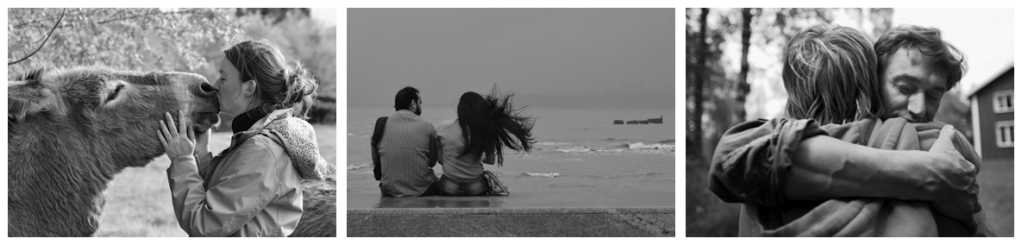
Kiss, speech and embrace are the most common languages of love

Background – What is love? What is an emotion?

Emotions are one inseparable part of human life rather every living thing. They can be attributed as the response we generate for the interactions we have with our surrounding – a response to various stimuli. Responding to the events/ interactions is one important way of communication for living things. Out of these responses, physical responses are generally very easy to notice and interpret but at the same time the emotional responses are more complicated, sometimes difficult to even notice and interpret. Body language mostly gives away the what’s going  in a person’s head, what they are thinking (like most of us have a tell when we are uncomfortable/ nervous or are lying). Understanding body language can give straightforward answers about person’s condition and personality but it is always difficult to gauge what exactly the person is feeling in given condition.         

Love is one of the most important and at the same time the most exploited feelings we living things have. Love is the feeling which we can connect with anything real and imaginary that is there in the universe (trust me, this is not inferred from the pop culture philosophy) There are more things to love than to hate for everyone of us. For the sake of generalization, love brings in the comfort, safety and hope for the survival of every species. Love for certain things can push the individual to do something extraordinary – good (because it can create purpose irrespective of the situations and challenges in life) or bad (that is exactly why love is the most exploited emotion, you can make people do wrong things just for the sake of love).

Love language

Even though love is the most general emotion all of us have (like love for something, some person, some song, some place, some season, some animal, love for everything); the love between couples – romantic couples remain always at the focal point. The love between couples is not important because pop culture, poets, painters, singers, saints mentioned it repeatedly everywhere; it is important because it is what makes our lives less artificial. The love romantic couple can have, affects the future of society in every possible and productive way – it also ensures diversity – randomness in species. As we are highly expressive and responsive species, communication is the most important part of our life especially the love life. When two people from different backgrounds come together in the name of love it becomes very important as how they express their love for each other. Today we call it “the love language”. Some couples love to talk a lot with each other, some like to sit in silence together, some always feel cuddly, some would be always staring into each other’s eyes, some would travel together, some like to cook together or for other, some like to eat together, some are always pulling pranks, some would peel orange for the others, some would send flowers, some would be writing poems, singing songs, some would always fight (yes…, you read that and accepted it). You get it; every couple has their own (sometimes weird) love language and communicating in this certain language deepens the relationship.    

Brain vs heart – Neuroscience of love

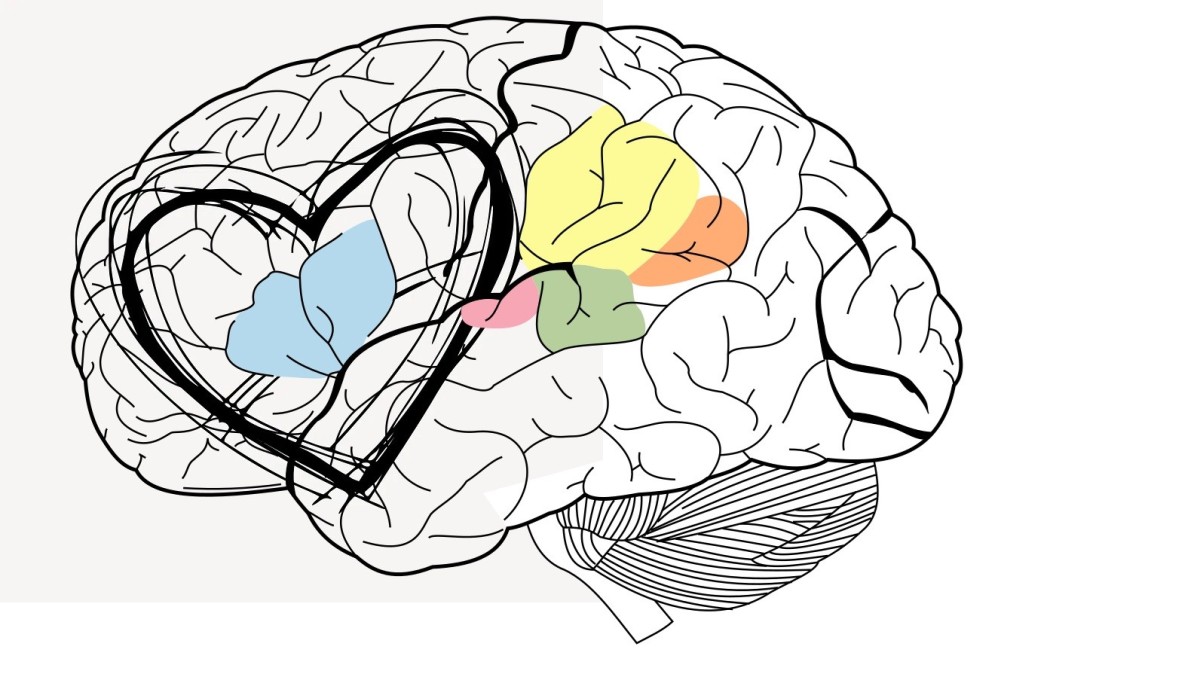
Even though heart has been attributed to the origin of the feeling of love due to various reason, its original job is to just pump the blood. Nothing interesting happens in the heart of a person in love than in their brain. Brain surely is the epicenter for the study of love and how we feel when we are in love. Just like love, our brain is the most complicated thing we are yet to understand fully. Neuroscientists are always trying to figure out what generates certain set of emotions and responses. Love is one such important emotion which is also an attractive subject for them. Its association with every aspect of our life, its complexity and simplicity at the same time has always attracted scientists who are trying to understand human behavior. (love hasn’t spared the brainiacs too.)

Modern neuroscience is blurring the lines between the intangibility of emotions especially love and the tangible – physical parameters like electricity (synapse, wave-forms), chemicals (hormones, neurotransmitters). From providing shock to certain part of the brain to see which muscle it twitches to enabling the paralyzed people to walk again through brain implants, neuroscience has had many quantum leaps.

How does a neuroscientist interpret love?

I think every person who is in love can tell what it is but it will always have a touch of subjectivity, thus a neuroscientist is always the most qualified person to create an objective fact on the emotion of love.

Today we will see an interesting study in neuroscience about the emotions in romantic couples. Before going into the details and the conclusions of the study, it is important to roughly get the hold of some concepts neuroscientists used to interpret their results.  

Our brain is made of approximately 100 billion neurons whose network is always firing some electrical signals to generate responses and create memories. The measurement of such electrical signals and their interpretation is important aspect of studying brain.   

fMRI – functional Magnetic Resonance Imaging

It is found that when there is a neural activation in brain, the blood flow increases in that region. This change in blood flow can be monitored using functional Magnetic Resonance Imaging.

De-oxygenated hemoglobin in blood is paramagnetic (attracted by external magnetic field) and oxygenated hemoglobin in blood is diamagnetic (repelled by external magnetic field). Producing a strong magnetic field around brain and monitoring their interactions with the magnetic fields generated during blood flow are measured in MRI. Such measurements require bulky and specialized instruments with controlled conditions.

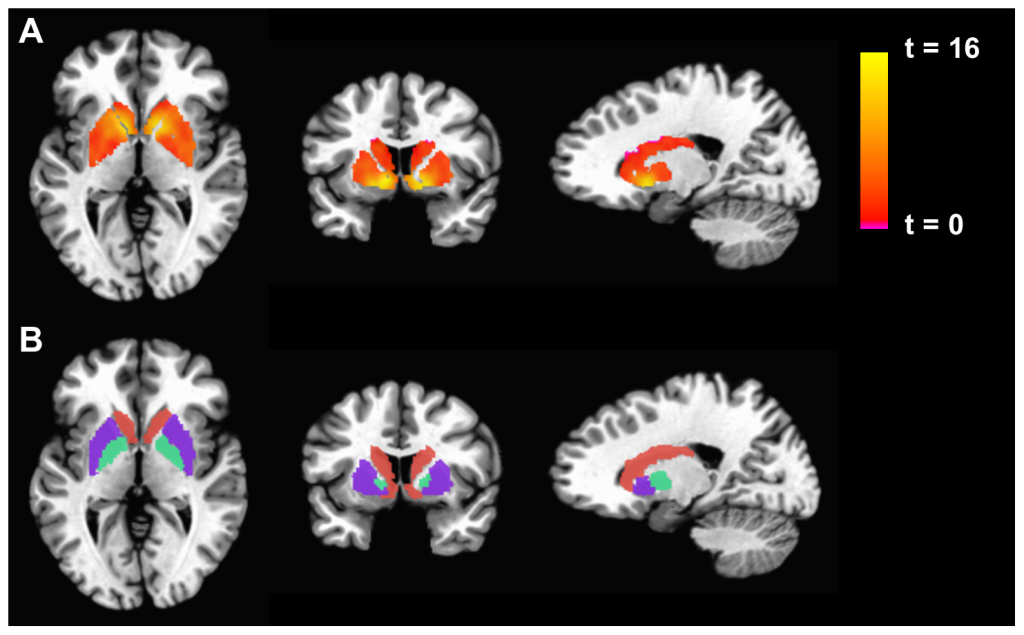
fMRI shows what part of brain gets activated from increased blood flow
fMRI machine is huge thus creates limited experimental environments

Electroencephalography (EEG) – it is a method to record an electrogram of the spontaneous electrical activity of the brain. It monitors the electrical signals from brain using electrodes on scalp instead of measuring the changes in magnetic fields. The EEG devices are now very lightweight and portable thus they have less influence on the neural activity of the subject under observation. The portability also widens the test environments for the subjects under observation.  

EEG can be used to interpret the signals from the outer surface (cerebral cortex) of the brain as the electrodes are put on the scalp. It is difficult to understand what is happening inside the brain from the signals of EEG although they will always be interfering with the overall signals sensed by the electrode at the scalp.

An EEG system is highly portable to collect neural data

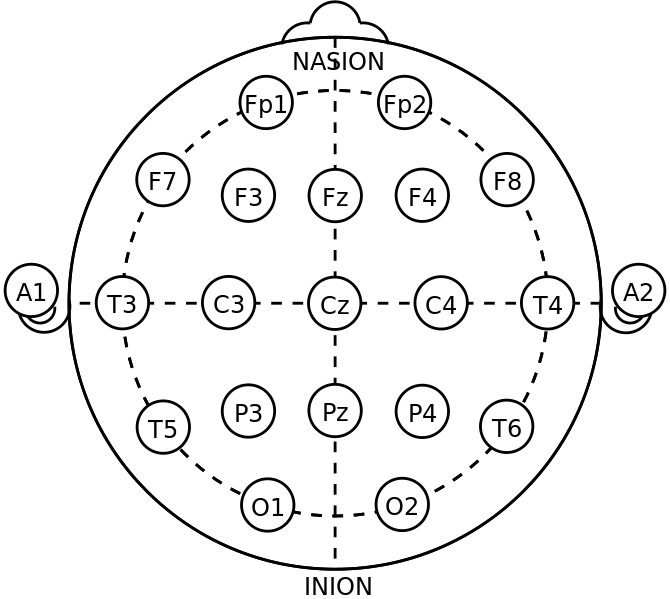
International 10-20 system – It is an internationally accepted template for putting electrodes proportionately on the scalp of head. This ensures homogeneous observations and reproducibility of the results during EEG. 10 and 20 refer to the percentage of the gap between the electrodes meaning the electrodes are placed at 10% or 20% of the total distance between front – back of the skull (called as nasion and inion respectively) or total left-right distance.

International 10-20 system to locate the electrodes of EEG system

A good, healthy person will show waves of certain frequencies according to their conditions. These frequencies are between 1 to 30 Hz and the amplitude varies between 20 to 100 micro volt. The frequencies are divided as follows:  

Alpha waves – alpha waves have frequency between 8-12 Hz and are observed when a person is relaxed in a wakeful condition. These are mainly attributed to activity in parietal and occipital lobe of the brain. When a relaxed person opens their eyes, it is observed that their alpha activity reduces and beta activity increases. Alpha waves are produced when you’re awake but your mind is in a resting state.

Beta waves – beta waves have frequency above 12 till 30 Hz. Beta waves are associated with intense mental activity like doing some arithmetic calculations, making inferences from given data, being busy, focused on something. The frontal area of brain shows significant beta activity in such wakeful instances.    

Gamma waves – these are the fastest brain waves with frequency between 30-80 Hz. They are attributed to deep thinking and state of high focus. Generally, people with high IQ show more gamma activity; lower gamma activity is attributed to memory and learning problems, short attention span.

Delta waves – delta waves are associated with frequencies between 0.5 – 4 Hz

Theta waves – theta waves are associated with frequencies between 4-7 Hz

Theta and delta waves are not observed in wakeful state. If delta and theta waves are observed in wakefulness then it indicates brain dysfunction.

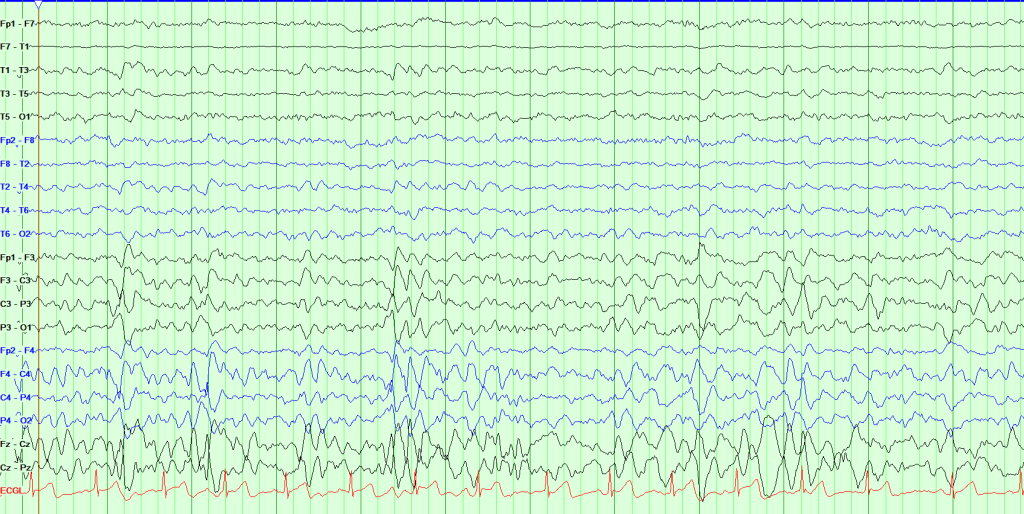
Output wave-forms from the electrodes of an EEG system

Lateralization of brain – We have come across one misleading fact that we only use certain fraction/ percentage of our brain in routine activities. (the popular number is 5-20%) This popular but wrong fact could be attributed to the idea of lateralization of brain. (Sci-Fi movies have exploited this wrong fact already)

Generally, almost all areas of every healthy person’s brain are always active. But, certain cognitive functions or neural functions (like movement of body parts, thinking, calculating, watching, tasting) are associated to either of the hemisphere of the brain (left or right hemisphere). Although brain as a whole is always active, certain activities/ functions activate one hemisphere more that the another one. Simply put, there is difference in brain signals between right and left hemisphere during a cognitive function. This dominance of brain signal from one “side” shows lateralization of brain. One side will be more activated in brain for given activity.

Asymmetry indices (AI) – So, this heightened activity from one side of brain is measured by taking difference of the signal power of the brain waves from left and right hemisphere.

Increased asymmetry index indicates that the signals in right hemisphere are getting inhibited, restricted. Thus, left hemisphere especially left frontal activity in brain is increased.  

Decreased asymmetry index means that the signals in left hemisphere are getting inhibited and thereby right hemisphere is more activated.

Simply put, more the asymmetry index more is the activity in left part of the brain.

There are two main theories on how our brain is lateralized. One is Valence Model (VM) and another is Right Hemisphere Hypothesis (RHH).  

VM – According to valence model, every emotion has a valence meaning a tendency to be preferable – positive and rewarding or not preferable – negative and aversion inducing. The positive, rewarding emotions are processed in left hemisphere and negative, punishing emotions are processed in right hemisphere of the brain. 

RHH – Right Hemispherical Hypothesis says that whatever may the emotions be – positive or negative, rewarding or punishing – all are processed in right hemisphere of the brain.

Neuroscientists are yet to reach a consensus on which of these two ideas are right. Certain observations are supported by VM and others are supported by RHH. It’s not about what is wrong and what is right, it is about which model explains given dataset better and predicts better.  

Gamma-aminobutyric acid (GABA) – this is one of the chemicals – a neurotransmitter which inhibits/ blocks certain neural signals thereby is responsible for creating calmness. If GABA is released more, we feel calmer and more relaxed. The opposite effect i.e. restlessness, excitement is generated by glutamate. For a healthy brain balance between GABA and Glutamate is important.

gamma-aminobutyric acid – neurotransmitter of calmness

Glutamate is the main excitatory and GABA the main inhibitory neurotransmitter in the mammalian cortex. The prescription drugs for reducing restlessness/ improving calmness ensure high levels of GABA in our central nervous system.  

Glutamic acid aka glutamate – neurotransmitter of excitement

Now that we have understood certain basic ideas to understand the experiment, let us see how certain languages of love in romantic couples affect their neural responses.

The Experiment

The neuroscientists studied three conditions in romantic couples namely – speech, hug and kiss.

The participating romantic partners were asked to wear the EEG system to record the brain signal during the experiment. Scientists recorded a baseline – a neutral state for speech, hug and kiss. Then the emotional states were recorded through certain assigned tasks.

In neutral state for speech, one of the partners listened to a generic weather report, whereas in the emotional state for speech the partner listened to a recording of their partner reading an emotional shared life experience.

In neutral state for hugging/ embracing the partner hugged a pillow while the another being absent and in emotional embrace, they hugged each other.

In neutral state for kissing one partner kissed their hand and in emotional state the partners kissed each other.

Why this experimental setup is important?

According to the authors of this paper, most of the studies to understand the brain activities are always performed in controlled setup which conditions the brain signals in a set template. The observations may create certain insights but are less close to the reality as they were not observed in real life conditions. Authors claim that this method to actually measure the brain signals in real life scenarios creates more relevant, closer to real life dataset. The responses in such setup are more natural. That is why they claim this experiment having more “ecological validity”

The authors make a great attempt to understand the main and most preferred language of love in romantic couples i.e., kissing, embracing, speaking shared experiences. It will be really interesting to see what “flashes” we have when we are experiencing such events.  

Observations – looking from a neuroscientist’s perspective

Following are the key observations authors present in this paper:

  1. Participants were more positive after executing the behavioral tasks.
  2. Brain gets lateralized during emotional processing.
  3. High asymmetry index in front lobe electrodes was found during emotional kissing compared to neutral kissing. Researchers found high alpha AI during emotional (real/ organic) kissing than neutral (artificial) kissing baseline.
  4. Found lower alpha AI during speech.
  5. Higher AI in kissing and emotional speech.
  6. Researchers didn’t find overall effects in alpha or beta for embracing. Only males showed higher beta AI in the embracing condition.

Conclusions

Pardon my oversimplification for the sake of understanding.

  1. The first observation is the easiest to understand. Kissing, hugging, and telling a shared memory/ experience of love surely makes the romance to flourish more (duh!)
  2. The lateralization of brain means that certain emotions are flagged in one of the hemispheres of the brain. It’s not like all the emotions activate only one side of the brain.
  3. This one is interesting. High alpha asymmetry index during kissing means that left brain is more activated during kissing. The authors put forward that this is related to release of GABA molecules in right hemisphere which inhibit the neural signals thereby create a calming effect. Valence model says that left hemisphere processes positive and rewarding emotions. So, this observation shows that kissing surely creates a positive effect in the brain of the romantic couples. Higher left hemispherical activity is attributed to more positivity in a study. It is important observation of high alpha asymmetry because its opposite i.e., lower alpha activity is linked with suicidal tendencies in depression as observed in a study.
  4. The authors found that the VM theory holds best to explain events in frontal part of the brain whereas the RHH theory can explain the posterior events in brain. That is exactly why low alpha AI in romantic/ emotional speech cannot be directly correlated negative emotions which the Valence Model says. Rather according to the RHH theory the speech invokes strong right hemispherical activity. The authors found an observation to link VM and RHH theories according to the regions of brain considered for discussion. Both theories are not completely wrong but are successful when implemented to specific region of the brain. Simply put, it is not just about preference to left or right hemisphere – it is also about whether the activity is in front or back portion of the brain.
  5. High asymmetry indices during kissing and emotional speech show how strongly they affect the lovers. Emotional speech is as effective as kissing. (it’s like kissing your lover’s brain with your emotional words!)
  6. This one is also one more interesting observation. As there are no significant effects in alpha or beta asymmetries during hugging activity, it means the hugging is less effective than kissing or emotional speech. But the authors present a catch here! They found a sex specific observation. It says, high beta AI in males during embracing. High beta AI is linked with increased emotional, cognitive processing. This means that men consider hugging more emotional than women. Women process hugging as a casual act but men consider it more thoughtful especially when they are hugging the existing and well-familiar female partner. Authors attribute this to the fact that women generally hug each other (female-female hug) more than men do (male-male hug).

What does this mean to common person?  

The experiment authors performed was really interesting and was closer to the real-life conditions. If you want more interesting details on how what and why the experiment was designed in a certain way and how the results were interpreted, I have provided the link at the end. Going through this article puts front some really deep insights on how love, romance affects our brain. How these languages to express love create a deep connection between lovers.

The authors have tried to remain as objective as possible. But, again pardon my oversimplification, here is what one can understand from this experiment:

Having emotional discussions with your partner is as effective as kissing your partner. No wonder people resort to poetry, music, and literature to express their love. The more you are able to express your love for your partner the more positively it is going to influence your brain thereby you. You also feel better for yourself if you can express your love to your partner. It is like the act loving your partner is providing strength to yourself. Maybe this is how lovers become strong mentally. (No wonder couples madly in love are ready to fight the whole world!) Kissing your romantic partner has calming effect on you mental state. (I think almost no one needs explanation on that! But don’t forget that speech is equally potent)

And finally, men need more hugs compared to women! Although hugging is a common act in society, men are highly emotional when it comes to hugging. So, this is an advice not only for women but also for men and especially for men that you hug your bro, your buddy whenever you feel like expressing your love for them.

Our brain being one of the least understood wonders of the universe has always tricked us in spite of being the most vital part of our existence. The insights from such experiments in neuroscience with this closeness to reality bring more clarity in the ways we handle our relationships. We definitely owe thanks to the authors/ researchers involved in such studies for their valuable insights.   


Reference article –

  1. Investigating real-life emotions in romantic couples: a mobile EEG study – Packheiser, J., Berretz, G., Rook, N. et al.

Further reading –

  1. Frontal Alpha Asymmetry and Negative Mood: A Cross-Sectional Study in Older and Younger Adults -Barros, C.; Pereira, A.R.; Sampaio, A.; Buján, A.; Pinal, D.
  2. Frontal Alpha Asymmetry Correlates with Suicidal Behavior in Major Depressive Disorder – Park Y, Jung W, Kim S, Jeon H, Lee SH.

Questioning Our Consciousness – Solipsism

Solipsism warns about the impossibility to know everything in absolute manner but if appreciated in a proper way it guides us to seek for continuous up-gradation from existing lesser absolute truths to newer and better absolute truths. A pure solipsist would be delusional, neurotic but a practical solipsist would bring about a revolution in his own world thereby in the worlds of the others and even in the whole world altogether!

The problem of other minds – do they exist in reality or the reality just exists in my mind?

Have you ever felt that words are failing to express the joy you have? Do you feel uncomfortable when you are unable to understand the vibe of your environment? Is it just you or is it the surrounding? Do you sometimes feel that everyone is treating you in a certain way and then you realize that actually it was you who was behaving differently? Do you get the feeling that someone is behaving in a way but thinking in a completely different way? Am I unable to get early in the bed because I don’t wish so or the weather is cozy?  As if they are hiding something and you would never know what and how they feel? Could you make others feel your exact experiences in the exactly the same way? If yes, then how? If not, then why is impossible? How come our senses have practical limitations? Are those the limitations of our mind? Is empathy a real thing or is it just the construct of my mind to mirror the people in front of me? Why my experiences are so private?

The questions posed through Solipsism may clarify the origin of these ideas.      

Where solus means “alone” and ipse means “self” in Latin

A philosophical idea that only one’s mind is sure to exist

Origin of Philosophy – Knowledge is power

Everyone of us is born with a tendency to have control over the surrounding. This is closely connected to our survival instincts. Though our survival instincts are mainly primitive what differentiates us from rest of the animals is our reasoning ability. Almost every animal is proven to have emotions, many of them can think logically at least from survival perspective, some of these animals have shown signs of intelligence closer to humans when trained properly. Our reasoning ability is some sort of highly evolved survival instinct. Reasoning introduces understanding, awareness of the surrounding in which we live, this understanding increases the predictability of the future thereby increasing the chances of the survival of the species. So, we can say that the better we understand the system which w are part of the better will be our chances of anticipating the risks of the environment; the better we anticipate the upcoming risks the better we can be prepared for to handle them to procreate further thereby ensuring the survival.

That is why we have many fields of knowledge to understand the establish different aspects of the reality we live in. When there were no boundaries between different fields of knowledge everything would start from simple question (even today single important and specific question can establish a completely independent field of knowledge) We are always one question away from a completely new perspective towards reality. (See Gödel’s Incompleteness theorem if you are interested in this idea)

Philosophy could be attributed to the most primitive, original, and the crudest field of knowledge. Although most part of philosophy is properly structured, it is crude due to the plethora of unanswered questions it has. Once the fundamental questions in any domain of understanding are answered, once the paradoxes lying at the end of an established field of knowledge are solved then a new field gets created and separates from the fundamental philosophy.

(The primitive man survived on whatever nature provided then the humans realized that one can sow the seeds to get certain crop from certain soil in certain season in this much quantity thus came farming – Botany, Geography, Mathematics and many more. When we were unable to understand the Newton’s theory of gravitation to some heavenly bodies (the perihelion of Mercury) then Einstein’s theory of relativity disrupted our existing understanding of the universe. It has literally affected every field of modern knowledge.)

Skepticism – Keep on questioning until you get consistency in understanding

So, in nutshell, the job of philosophy is to ask those questions which would challenge the complete domain of a certain field of knowledge, once you get the proof of this question then it becomes the part of that field of knowledge or a completely independent field of knowledge. They detach from the Philosophy. Philosophy was never meant to provide answers, if certain philosophy is providing proper answers, proper predictability then it is a field of knowledge.  

What happens to the questions which remain unanswered?

What if there are unresolved paradoxes at the end of the a fully established field of knowledge?

I would say the philosophy carries the unanswerable, paradoxical nature – the imperfections in our understanding until they are formally, satisfactorily, and most importantly – coherently answered. That is exactly why philosophy always seems crude, as if it is carrying all the imperfections in our understanding of the reality.       

Skepticism lies at the base of the philosophy. Once you get consistent answers to the questions posed, you keep on questioning that consistency. Everything (and I mean it) will end at a point of paradox or inconsistency. (If one finds exceptions then it is better to upgrade that theory otherwise soon it will get replaced with better theory.) There are ways to deal with such paradoxes/ inconsistencies (See Agrippa’s Trilemma if it interests you.)

Solipsism – Extreme skepticism – Questioning the existence of the question and the questioner!

So now we that we are familiar with the nature of questioning everything to establish consistent answers thereby to create knowledge, it is important to know how we do so. What make us answer these questions in a consistent manner. Our experiences, observations of the surrounding, our interaction with one another and the results of these interactions give us the fundamental model of reality. This model is developed by our minds – bunch of neuron connections physically per say – the collection of the sensorial feedback from the body.

Now the question is, as we go on questioning the reality, the final question is come like this –

If there are still some gaps in my absolute understanding of the reality which are creating this uncertainty somewhere, which is creating paradoxes, inconsistencies; what exactly is absolute? What exactly is the most certain thing in the world? What is the most real thing, real measuring scale with which I could measure and understand my surrounding?

Solipsism says that only the existence of your mind is certain, the existence of other minds will always be uncertain. As the presence of other minds is uncertain, you can be sure of only what you experience as “the reality”. As only you absolutely and fully realize the reality through your mind, the reality is just mere figment of your mind and imagination (when stretched too far!) When you try to transfer your minds realization of the reality to others you will always see that something got lost in translation. If reality is just the construct of my mind, then what exactly is existence?

Why Solipsism stands strong? – Why idea of living in the Matrix fascinates us?

Is the creator playing with my mind to show me a false reality for something different which is beyond my access?

The earliest evidence to ask such question is found in the writing of a Roman skeptic Sextus Empiricus quoting Gorgias (c. 483–375 BC) as follows:

  1. Nothing exists
  2. Even if something exists, nothing can be known about it
  3. Even if something could be known about it, knowledge about it cannot be communicated to others.

Then René Descartes (the one who established Cartesian coordinates) came up with one of the famous quotes/ ideas about the absoluteness of the reality.

Cogito, ergo sum.  

I think, therefore I am.

René Descartes

Simply put, Descartes argued that, the most certain knowledge one can have is through personal experiences because knowledge transferred from others are never perfect also there is no way to measure where the translation was perfect. The existence and experience will always be discrete – separate; it will vary mind to mind, so what is reality for you is the only absolute reality; that is why absolute knowledge is private property. As you can be only certain of your experiences only your mind is the reality, everyone else’s minds don’t exist. (OR should I say others are mindless! Jokes apart!)

George Berkeley – Bishop Berkeley is also one famous philosopher who developed the ideas of immaterial-ism. He is known for the famous analogy of “a falling tree” although his writings never explicitly mentioned such analogy but let us say in a crude way, he pointed towards it. (See, even here we can see the gap that is created during the communication of an idea, a simple analogy someone established before us!)

So, the idea is, if a tree falls in a forest and nobody saw it falling, nobody heard it falling, nobody felt the vibrations of fall how come we be sure that a tree fell down somewhere? Unless and until someone observes the fall through their senses one can never be sure that the really fell. So, if no one noticed it and in the end even you didn’t notice the fall, then the tree never fell down!

Your mind, you consciousness and you had to exist absolutely to observe, experience the fall of the tree. If you weren’t there to see and experience the fall, how could you be so absolutely sure that the tree fell?

Solipsism – Trust no one but yourself!

Now, you would have understood what may be going wrong with Solipsism!

Modern day answers would be like “I would have been presented with a video to prove the fall.” OR “I would have been presented with the person who cut down the tree”

But the counterargument would go like this “What if the video was faked? (by using deepfake!!!)” OR the witness found to be forged – I wouldn’t know if the person is lying with confidence (even polygraphs tests can be fooled, false alibis can be created!!!)

Jokes aside, these are mere representative examples to demonstrate the point. When you start formally questioning the nature of reality by using the most consistent tools that we have in modern science, then this question again peeks out in a bizarre way!!!

According to quantum mechanics, the moment we measure the state of a quantum object, its state changes. So, the measurement of that instance will never refer to the actual state of the quantum object. Meaning that you could never be sure of what actually happened before or at the instance of measurement. You can have a probability but you will never be sure.

Your observation had to exist to define the state of the quantum object, if you weren’t there were infinite state of the quantum object to exist. Your observation assigned it a definite, objective, absolute state. Your observation made it a real “reality” otherwise it was always possibility rather probability of many events. Please note that these are not just the flights of minds by the most compelling specimens of humanity, these are actually mathematically, experimentally proven ideas.

The one liner to understand solipsism is –

Your personal experience is more dependable than common sense!

I understand that how is it even possible to question common sense, common experiences. Solipsism is such a foolish idea rather the most foolish idea one can have! But, bare with me when we try to answer the paradoxes which lie in solipsism. Any person who is having existential crisis has been warned hereon!

Different ideologies in Solipsism

Metaphysical solipsism – the most extreme solipsism – the external world doesn’t exist. My mind creates the reality for me. (A rude adamant philosopher made it clear!)

Quick Joke – Unless I didn’t observe the tree falling, it is still there (and maybe giving fruits if it is a Mango tree!)

Epistemological solipsism – The reality around me is absolute and objective, but we cannot know it directly as it is through our sense and experiences. It is the limitation of my senses which inhibit my understanding of the reality. (This is a humble approach I would say!)

Sensory organs are not the experiences from the reality rather they are just the interpreters of the reality with practical limitations. There is no direct agency to experience what others are experiencing, to know other minds.

Quick Joke – A person drinking tea finds a fly in his tea asks the waiter to replace the tea. Waiter helplessly trying to convince his of not having any fly in that tea gives up and replaces the tea. After few same complaints from same person and replacing many cups, it is discovered that the fly was in the guest’s spectacles!

It’s like I cannot hear certain sound frequencies but certain animals can hear those frequencies. I can see only the light in visible spectrum, but other animals can see in another spectrum. It’s the limitation of my senses which dulls down the objectivity of the reality. You have to be ‘the God’ to understand all the spectrum of the reality! (excuse my introduction of some spiritual power here but we will come back to this again!)

This is the most practical, plausible and calming version of solipsism.

Methodological solipsism – Every logic is fallible, that is why you could never know what the absolute looks like. There is nothing like ‘the God’, if there is something supreme you won’t even understand how supreme it is and why it is so! (I know we are getting spiritual to go away from early religious epistemological solipsism but that is how it works)

It says that even our brain, our mind is the part of external reality. (I am feeling uncomfortable here.)

Quick Joke – A criminal was convicted for murder. He went scot-free because he didn’t do that murder, his had hand – rather the knife did the murder.

Jokes apart, but consider cognitive dissonance. Many things which we learned in our childhood as the absolute concept, as the ultimate truth gets replaced by something life changing and even more true and absolute. So, what is real truth is beyond our understanding.

Paradoxes at the end – Where Solipsism would break down!

The paradoxes of the solipsism are the most fun part which explain why solipsism deserves any explanation.

Here are some doubts,

1

If my mind is the absolute reality I live in, then why can’t I convince myself to survive by just imagining that I have eaten a lot today (while not eating even single crumb!)

I could just survive by thinking of eating the best food I could “think” of.

Everyone knows that this is not the real case. A person with that much will power and fasting will barely survive.

Now, the counterargument for this (and I love this part due to pop-culture reference!) –

What if your brain is kept in a container giving some electrical impulses exactly like in movie The Matrix. The matrix is programmed in such way that not eating will kill you definitely.

Solipsism ends in a matrix, a simulated reality beyond our experiences!

2

If there no such thing like matrix then how come all of us would die if we face the same degree of starvation? How come the experiences (even though not purely translatable to others but still the same based on the objective, consistent observations) we have in such cases match?

Many of the knowledge established as the most absolute, consistent and closer to the reality is developed because all of us had same experience (at least objective experience, ideally fully efficient translatable experience) in every one of our lives.

The answer is that we all share a common consciousness which enable us to experience the same scenario. We all are living a common and shared dream.

Our reality is a shared dream! Our consciousness is a shared dream! We all are connected by something so common and absolute thing. A spiritual person would call it the soul, a scientist would call it the energy.

This is technically known as the Solipsistic idealism – the best answer we have which will not blow our brains and will not give us the existential crisis!

3

The bizarre one comes here –

Even if the matrix is real, you would never be able to get the absolute understanding of it. Existence of external absolute reality is uncertain. You won’t even know if it is called matrix or a chewing gum or something else!   

Pro tip – don’t over-love solipsism

You must understand that the arguments in solipsism are quite good. (It is just my failure of communicating those to you if you are not convinced till this point. I apologize for that.)

If the reality is just created by my mind/ in my mind then there is no way to verify that from external agency.

But, our experiences, emotions (at least some of them) always feel common. René Descartes Descartes posed that the experiences, sensory feed-backs are purely created by our mind but modern science proves that babies are not born with absolute ideas of reality (it is possible that they are exposed to certain sensorial experiences from their mother right from the conception) The absolute experiences they get are from their interaction with the surrounding objects and people. Our personalities, identities are created from mutual interactions. We cannot be ourselves without the people around us and the environments we are exposed to.

Only a completely isolated person would have the polarized inclination towards solipsism.

But again, what if it is just a construct beyond our understanding? There is no way for us to know that.     

Even if there lies a construct beyond our understanding, there are some practical ways to purposefully ignore extreme ideas of solipsism rather leverage the ideas of solipsism.

If you are bound to the existing construct of reality which is practically within the reach of your experiences, your mind then you must abide by the laws of that reality. If you only stick to only the reality of your mind, then your so called “absolute truths” will immediately be challenged by the truth of others. It will be a blood bath but let your older absolute truths die to let the newer ones be born. They won’t be ideally absolute but at least they will be better than the previous one.

Even if the illusion of reality is shared among all of us as a common dream, we would never be able to escape that. Meaning, again play by the laws of the land. Ignore the existential crisis on the absoluteness of reality. At least try to get closer to the reality.

I think this is exactly why even though the pursuit of solipsism may feel worthless in the end but it’s understanding and appreciation gives us a hope to continuously keep on improving our version of the reality – private or shared whatever they may be.

Solipsism warns about the impossibility to know everything in absolute manner but if appreciated in a proper way it guides us to seek for continuous up-gradation from existing lesser absolute truths to newer and better absolute truths.

Learn the rules to break them in a better and glorious way!  

The acceptance of Solipsism (in a positive way) can also create an urge in person to seek for the real freedom. Solipsism in positive way urges the person to take that inner route in order to create the world of their desires through disciplined thinking (in a healthy way and not in a delusional way!) A pure solipsist would be delusional, neurotic but a practical solipsist would bring about a revolution in his own world thereby in the worlds of the others and even in the whole world altogether!

The Model Millionaire – Attributes of True Wealth

Oscar Wilde’s short story “The Model Millionaire” is a story depicting the boomerang of kindness. It also tries to fuse the importance of tangible assets like money and intangible/ non-physical assets like kindness/ love/ art in our lives. It shows how the balance between these separate attributes can create a true rich life.

Oscar Wilde’s short story called “The Model Millionaire”

Fiction is the lie through which we tell the truth.

Albert Camus

Stories we cherish – especially short stories which tickle our brains have huge impact on our personality. The shortness of tightly woven multiple events inherently brings out the simplicity and invite intrigue in readers. All of us have such favorite stories which we would love to remember forever for the lessons they provide, the happiness they create. Most of such stories we love belong to the chapters in our textbooks, school books. There are many short stories which fall into exactly similar category of being a textbook chapters as if they are not that deep enough and simply convey what is to be conveyed. They get the job done within few pages thereby giving readers a worthy payoff.

It is a cakewalk for readers to enjoy such short stories and interpret the message which author/ writer is trying to convey. Sometimes there is nothing to learn or any hidden message to covey through the story, the intent is to invoke certain emotion in readers. It is a joy to appreciate such stories from readers’ perspective.

It is also crucial and highly underrated to understand what was going in the writers’ mind when they penned down such stories, especially for the of case short stories. This happens frequently in terms of short stories due to their simple, short presentation. You read, get entertained and move on to the next one. 

It is very important to understand the simplicity of such stories and so called- “entertaining” word-play. The writers of such stories make every conscious effort to simplify the narrative and convey the meaning. The simplicity is not inherent rather it is intentional and full of efforts – the hidden tediousness. If you are reading an interesting story, it’s not because writer just wrote what came to his mind showcasing his brilliance; it is interesting because writer had created multiple perspectives, personalities – I would say pseudo- readers to establish the narrative and remove the confusion from the story. Writers just wear this mask of the characters from their stories to fearlessly express what they feel about the reality.

Man is least himself when he talks in his own person. Give him a mask, and he will tell you the truth.

Oscar Wilde

We will see one such simple, high school textbook-worthy yet an interesting short story written by Oscar Wilde called “The Model Millionaire”. The story is flawless in such a way that the plot can be explained in 10-15 lines. The real beauty lies in how Oscar Wilde saw the world and expressed it through the characters in this story.

Plot

Hughie Erskin is a young, good looking but incompetent (according to the mainstream social standards) – a kind of below average man. As he has not proven his worth, has no money he is struggling to find the rhythm of life and marry his love of life – Laura Merton. One day he finds his painter friend – Alan Trevor – painting a life size beggar-man. Hughie feels very sad about how the beggar has to go through this sitting session where he won’t get just few shillings whereas the painter would earn in thousands by selling this painting. Feeling pity for the beggar-man Hughie gives him most of the money he has – to take care of the matters. Later, Hughie founds out that this beggar-man was actually an exceedingly rich “Baron”, an important person capable of influencing a continent. Hughie feels ashamed of his deeds because he thinks he has insulted the Baron by handing some petty alms.

In the climax, when Hughie feels the moment of confrontation, he prepares to apologize the Baron for what he did. Turns out that all that money, all that power had not polluted the Baron and rewards Hughie for his good deed by offering enough money to get married with Laura. The millionaire who earlier was a portrait model also proves his humble personality as a “model” millionaire.

Opening – Your love and charm will not fill your belly

“Unless one is really wealthy there is no use in being a charming fellow. Romance is the privilege of the rich, not the profession of the unemployed. The poor should be practical and prosaic. It is better to have a permanent income than to be fascinating.”

Oscar is trying to establish some pragmatic thoughts to intensify how big a failure his character is in real life. He uses this established foundation to create a contrasting climax of the story in the end

Oscar Wilde in first few lines depicts the contrast between the attitude of Hughie and how the world around him is constructed. As if Hughie was never meant to live in this world. In the opening of the story Oscar makes every effort to show Hughie’s futile attempts in making a pragmatic living. In every sense Hughie is a failure. Every venture, business (Stock Exchange, trading Tea and Dry Sherry) he tried ended in failure. The legacy of his ancestors (his father’s cavalry sword and 15 volumes of the History of the Peninsular War) is worthless in those modern times. (Even luck is not on his side!)

“Ultimately, he became nothing, a delightful, ineffectual young man with a perfect profile and no profession”

Oscar Wilde is trying to portray a very practical picture of life. One must understand that things are exactly the same today in 21st century. 

When one has not established themselves at least as an average earning independent man then every new luxury, wish is burden. Love is a luxury for a man who hasn’t established himself in society (at least financially).

“To make matters worse, he was in love”

Hughie’s lover’s (Laura’s) father – Retired Colonel Merton likes Hughie but is not ready to hand over his daughter to Hughie for the same practical reasons – Hughie cannot offer Laura a stable life.

“Come to me boy, my boy, when you have got ten thousand pounds of your own, and we will see about it”

Oscar Wilde is trying to show the brutal nature of reality which is extra brutal for daydreaming people like Hughie. (Please keep in mind that the opening is mere single dimension of Hughie’s character, more things about who he is at the core unfold in the later part of the story)

Post opening – Intangible things like art must surrender to physical/tangible media in order to remain relevant in practical world

Hughie has an artist friend called Alan Trevor who paints for living. Oscar shows us that Alan truly is a gifted artist and he earns well through his painting profession. He befriended Hughie (a real-life failure) because he liked his generous and reckless spirit. Being an artist Alan appreciates a kind-hearted and good-looking people irrespective of their social and practical status.

“The only people a painter should know are the people who are bête and beautiful, people who are an artistic pleasure to look at and an intellectual repose to talk to. Men who are dandies and who are darlings rule the world, at least they should do so.”

Whatever Alan thinks, we all know what the reality is.

Middle – An act of kindness

Hughie meets Alan in a session where he is painting a beggar. Hughie feels sad for the beggar for how life is treating him. He somewhere feels that the beggar is more helpless than himself. At least he is in a better condition than the beggar who is modelling for Alan’s painting. He argues with Alan that he should pay the beggar in percentage as Alan will earn a big chunk of money through selling this painting for thousands. The beggar deserves more. Alan argues that he definitely has to put more efforts to paint the beggar than the beggar by just standing still there.

“…there are moments when Art almost attains to the dignity of manual labor…”

This expression by Alan shows that the art may just invoke intangible, non-real things in a person but the process of creation an art is very difficult as it tries to express things which know no bounds/limits through the physical media which have inherent real-life limitations.

Realizing the correctness of Alan’s opinion and at the same time feeling pity for the beggar Hughie gives whatever money he had to the beggar.

This shows another side of Hughie where he is sensitive, he is not just a naïve person who cannot handle the practicality of brutal real life thereby getting labelled as a failure as per the social norms.     

Climax – Kindness is a boomerang

Hughie through his friend Alan realizes that the beggar to whom he donated the money was actually a crazy rich person called Baron Hausberg. A rich person who holds potential, is powerful enough to change the course of every possible thing in society.  Now Hughie feels ashamed of his act. Even though his intent was pure it may get projected as an act of disrespect to Baron Hausberg.

But turns out that Baron Hausberg is a down to earth personality and he returns Hughie’s act of kindness by offering him 10000 pounds required to marry his love of life.

Closing – Artistic, Emotional and Materialistic wealth all can coexist; it narrows down to what kind of human being you are.

Alan expresses that despite having loads of money, Baron Hausberg understands the difference between “having lots of money/ power” and “being wealthy”. That is why this millionaire who was a model for a portrait was also an ideal millionaire – a rare “model millionaire”.     

Baron Hausberg is not the only “Model Millionaire” in this story

This might be my overthinking or over-analysis of the story but bear with me.

Oscar Wild through his cheeky narration and the expressions from his character tries to create a picture of a pragmatic life we human beings live. One must earn money to live in the society. But that is not the only thing which will define him as a model man as an ideal human being.

Baron Hausberg while having loads of money is rich in morals too. He appreciates Hughie’s act of kindness and returns that kindness with the same spirit. The materialistic wealth does not pollute his mindset. That is what makes him the “model” one. Baron Hausberg is the obvious model millionaire of the story, but you must appreciate that the word “millionaire” frees itself from its association with only money. That is exactly what the wordplay between “millionaire model” and “millionaire model” conveys. Being rich was never only associated with having loads of money and possessions.  

That is why Hughie is also a “model millionaire” thereby “a model rich” person. Hughie’s intent to help the helpless people even in the case of not possessing any basic wealth shows his richness in humanistic values. It is just that our mind is not ready to define Hughie as a rich person because the concept of being rich is mostly bound by the quantification of materialistic possessions. Emotional awareness, intellectual awareness, and proficiency in communicating the intangible things are also another versions of wealth.

Talking about the proficiency in communicating the intangibles – Alan is also another “model millionaire” of the story. He is rich in life. He knows how to identify a high spirited yet worthless (by societal definition) person like Alan and befriends him. He can also capitalize his intangible art through painting venture. He respects the labor he has to endure to translate intangible aspects of life into physical reality. (Imagine the reaction of an average art connoisseur when he/she sees a painting of beggar and finds out that the model was crazy rich person! At least from the description, that painting seems a masterpiece with an interesting backstory.) Even the last wordplay between “model” and “millionaire” portrays the artistic wealth that Alan carries.

Baron Hausberg despite being rich can only appreciate the art and is cannot create it (he can ask an artist to create it). Hughie too appreciates the worth of art but cannot create it. That is why I think Alan becomes the most balanced “model millionaire” of the story.

An “Aesthetic” Proof By Contradiction – Love, Kindness And Art Are As Important As Money.

Oscar Wilde in the writing of this short story’s opening establishes very practical aspects of life and the necessity to have enough materialistic possessions. In the beginning, Oscar makes it clear that intangible things like love, affection or good looks cannot solely help a person to meet the ends in this society. Hughie is a complete failure even though he is good looking and kind-hearted. Hughie has found true love and is ready to commit but that is not enough and practical for his future father-in-law. He knows that until and unless he does not get the hold of sufficient money, he will lose his love. Hughie also has two antiques as a legacy from his father but they are described as useless and non-liquid-able assets.

When we read through the event of Alan’s painting session with the beggar model, it is pretty much confirmed that even a seasoned artist like Alan (a person who is much closer to the art and similar intangible things than average masses) understands how important it is to sell the paintings to sustain his artistic profession. Oscar adds Hughie’s point of view in this scene to show that the sufferings of the beggar which brought him to this condition, his efforts to stand still for the painting despite being weak and old are as important as Alan’s painting skills, that is exactly why Hughie demands percentage share for the beggar model.

Alan is successful because he can translate his intangible skill of painting by selling paintings thereby into real money. It’s not because he is artistic or appreciates art. Hughie can appreciate a good art, knows what goes into the laborious process of its creation but doesn’t hold the skill that Alan has.  

Hughie also receives scolding for his extravagant charity from his love Laura. This also shows that pragmatism mostly prevails over intangible emotions.

And to comment on Baron Hausberg, he is the only person in the story who knows the importance of capital possessions, is capable of compounding them for the influence and power – I mean he is filthy rich and respects money. Otherwise, why would he commission a painting of himself as a beggar? He understands what he would become if he doesn’t have that money. If he truly wanted to mock the poverty and beggars, he would have paid some model for the painting assignment. He would not have wasted his valuable time in this assignment.    

Can you see it now?

Oscar Wilde first puts the mind of readers in the practical aspects of living a life. He establishes that emotions, art, love will not put food in your plate at the end of the day, you must go out and do something practical to earn money.

And then Oscar starts showing you the other side of the same people, same events which are fully in contradiction with what he had established as “practical and tangible”.

You will see Hughie getting rewarded for his emotions, kindness and act of charity. Only a fool who is poor will give all he has to another poor person but that does not happen here. Hughie knows what it means to be poor and helpless. It is Hughie’s empathy which makes him rich – a millionaire at heart. Oscar through Hughie’s character shows his readers that love and kindness are also the attributes of a true rich person. Hughie is wealthy by his character. (Hughie could have turned to some malpractices to get the money but Oscar does not inject this intent into the character of Hughie)

Alan Trevor is a kind of bridge in this story. Oscar Wilde developed Alan’s character in such way that he is a double-edged sword in this proof that there are other important things than only capital possessions. Alan can not only appreciate art but also create it and capitalize it. If we are to rank the millionaires by the balance between the possession of tangibles and intangibles in life, then Alan Trevor is the richest of them all. He also knows to identify and befriend kind people like Hughie. Alan has enough money, a skill in hands and company of good people like Hughie and Baron – the ideal and balanced wealth. (There are no ways in which Alan’s character would have become polluted – that is also why his character is the most balanced character of all- he knows ends of the both sides of the society)

Baron Hausberg intends to see himself as a beggar not because he is mocking the poor people, it is his attitude of attributing importance to things which are not money. Oscar Wilde attributes the wish of ‘a rich man to see himself as a beggar’ in a very conscious and artistic way. Baron wishing to picture himself as a beggar through a piece of art shows how much he values art when he is crazy rich. Again, the choice of modelling himself instead of some paid model is his artistic interest. He knows his reality and the depiction in painting will elevate the artistic value of the piece. Also, Baron doesn’t consider the Alan’s act of charity as an insult to his wealth which shows that monetary wealth has not touched his soul. (Baron Hausberg could have been an arrogant filthy rich old man, but Oscar did not projected him in that way)

It is funny how the story turns out in the end. The Model Millionaire is not just about how a good-hearted but helpless person like Hughie got rewarded for his act of kindness by a filthy rich person like Baron Hausberg. It also shows how different non-physical attributes like kindness, love and art equally contribute the a truly wealthy life.

That is where aestheticism come in picture and Oscar Wilde is hailed as ‘the Father of Aestheticism’.

The dictionary definition of aestheticism goes like this:

“A late 19th-century European arts movement which centered on the doctrine that art exists for the sake of its beauty alone, and that it need serve no political, didactic, or other purpose.”

There is this famous quote by Oscar Wilde

“All art is useless”

Oscar Wilde

I think it is an antiphrasis (the rhetorical device of saying the opposite of what is actually meant in such a way that it is obvious what the true intention is)

It’s not just art but its also about intangible things which the art tries to convey i.e., emotions of all sorts. You will realize that when we remove these art-like non-physical attributes from our lives even when we are materialistically filthy rich, that riches would be worthless. I think that is why he creates these contradictions in his story “The Model Millionaire” to show that the balance of tangible and intangible assets makes the person a truly wealthy person. Oscar Wilde fuses the importance of tangible assets like money and intangible assets like kindness/ love/ art through this story.

Oscar also makes a conscious effort to show this fusion through Alan Trevor’s comment on art and manual labor.

In simple words,

What good is being nice if the man has no money to achieve what he desires?

What good is money if the man is not nice?

An extremely emotional poor and an extremely insensitive rich person both are the wrong ends of the reality.

I mean, if Oscar really meant that art is useless then it is literally useless of him to contribute to the prosaic artistry through his writings. He was just messing with our head to prove the importance of the given thing by showing the effect after its absence. It is indeed one smart trick!    

Lifelong freedom for an hour

The societal construct, the men and even the women in society have created certain conditions where other women receive false freedom. This false freedom facilitates women to deliver benefits to society but somehow the society is not liable to return the favor back to these women. That is exactly where feminism becomes important. Kate Chopin’s short story called “The Story of an Hour” gives us a glimpse into what sacrifice and freedom means for a woman. This short story is summoned to be one of the important and earliest pieces of the feminist literature.

The ideas of feminism from Kate Chopin’s short story “The Story of an Hour”

Inception of feminism

Kate Chopin’s short story called “The Story of an Hour” gives us a glimpse into what sacrifice and freedom means for a woman. This short story is called as one of the most influential and early parts of feminist literature. It shows how women in those times sacrificed their freedom under the influence of the society just to maintain and continue the system as it was. People (still today) say that ‘it is very difficult to gauge what is going on in a woman’s head’ or ‘it is very difficult to know what a woman is thinking’. Kate Chopin’s ‘The Story of an Hour’ gives us a peek into a woman’s mind when she is allowed to think what she wants to think. Physical freedom is one part of freedom but mental freedom is the truest form of the freedom, I would say.  

The story of an hour was first published titled ‘the Dream of an Hour’ in Vogue magazine on 1894 later it was republished as ‘the Story of an Hour’ in 1895. We will see why and how this short story represents feminism in its truest form and possibly in the most misunderstood (compared to the modern interpretations of feminism) ways.

Summary

We come to know that Mrs. Mallard is a heart patient who is about to be informed about the news of the death of her husband in a railroad accident. Her sister Josephine and Mr. Mallard’s close friend share this news with her. Mrs. Mallard is obviously sad hearing the news of the demise of her beloved husband. She then teams with some moments of solitude to handle this sorrow. Where she suddenly realizes that she could be free now as she won’t be under any obligations from society and her husband. She feels her rebirth and onset of new life with absolute freedom approaching towards her. She wants to cherish this realization of freedom in her room alone for some moments but suddenly she notices that some person has arrived on door. Upon the request of her sister, Mrs. Mallard goes to see the person at the door and founds that the person is Mr. Mallard – unharmed and alive. She dies in the shock. Doctors diagnose her death due to the heart attack from extreme joy.

Life of the author – Kate Chopin

Kate Chopin was born on 8 February 1850. When she was just five years old, her father died in a rail accident. Her mother was the second wife of her father. In 1870, she got married and had six children in the period of 1871 to 1879. Her husband died in 1882 from malaria and left a huge debt on her head equivalent to $1.27 million in today’s valuation. She worked her ways out to bring the business back to life which she sold after two years. Her mother died in 1885.

Kate became depressed with sudden loss of her husband followed by her mother. Her friend Dr. Kolbenheyer suggested her to use writing as a therapy, a way to vent out and express her emotions and as a way to sustain income.

The most important novel published in 1899 by Kate called “the Awakening” was very controversial and scandalous to those times due to unacceptable feminine point of views.

As her writings were considered controversial, Kate much more resorted to short story writing. She died on 22nd August 1904 due to stroke.

Realistic fiction

The genre of Kate’s writing is a realistic fiction. Where the setting of the story is intended to feel realistic. The characters have all human limitations, practical interactions and nothing is stretched out of imagination to feel unreal, inorganic or magical. You will see Kate’s own life is reflected in her writings. People say that one can trace out her whole biography through her writings.

Now let us understand the Story of an Hour.

A woman’s whole world – her husband (?…)

Mr. Mallard’s death in railroad accident is drawn from the death of Kate’s father who exactly died in rail accident. She starts the events in this story from the point of view of her mother in a way. Kate was one of five children her father had and she too had six children. In a way, she resonated with her mother who was responsible for taking care of children. That is why she starts the story with the death of the husband in a rail accident to establish the connect between how her mother would have felt when she heard the death about her husband – Kate’s father.

She thus considers her mother as one powerful woman. Please note that after her father’s death Kate spent her days with her widowed mother, widowed grand mother and also widowed great grandmother who never remarried. Her use of the father’s death in rail accident is actually a setup used to link the emotions of her mother in this story.

“She did not hear the story as many women have heard the same, with a paralyzed inability to accept its significance.”

One will only appreciate the depth of this sentence when they are told about the situation of three generational widows Kate grew up with. The ability of Mrs. Mallard to accept the consequences of the death of her husband is thus the reflection of how her maternal side handled the consequences of the death of the man of their house.

A woman feeling helpless after the death of her husband is the most acceptable reaction even today but Kate’s protagonist not reacting in that way was the first shock to the society of those times. It’s not like she went paranoid and numb due to shock from the news of her husband’s death. Kate’s choice of words in this sentence hence is very deliberate.

Please understand that there is no way to indicate that she hated her husband throughout the story.

So, the initial setup and reactions of the protagonist are Kate’s ways to show that a woman’s life was never only limited to her husband. You should also understand that after her own husband’s death, Kate was burdened with huge death incurred from him. Getting out of such death surely might have made her more practical and objective. That is also an important reason which shows how her protagonist reacts to such news in a practical way.  She understands that it’s huge loss but she also knows that her remaining life is standing in front of her.

Painting the scenery of freedom

The elements used in the early setting of the story ensure the successful impact Kate leaves on the minds of the readers. She gives just enough information about the weak heart condition of Mrs. Mallard and surety of sources for Mr. Mallard’s death in the rail accident.

Then the story solely focuses on the protagonist of the story – Mrs. Mallard.

Mrs. Mallard now submits to solitude in her room. Each and every description of events and objects used hereon by Kate are very deliberate to reflect how the mind of Mrs. Mallard is reacting to the realization of the loss of her husband. She is yet to understand the freedom she is about to enjoy but how she come to that realization of freedom is one such “brain-candy” for the readers. They are not given direct explanation on how the protagonist is feeling rather they are made to feel the exact emotions of the protagonist. That is the beauty of Kate’s writing. She creates a portrait of a scene which readers enjoy interpreting.

So, here goes the scene, every sentence in this story hereon is one hidden urge of every normal human being but especially a woman here:

“She would have no one to follow her”

– indicates a person’s longing to leave life on their terms and without the judgments and prejudices of the society.

“- trees (in the open square) that were all aquiver with the new spring life” 

– indicates a new beginning full of hope, a restart to living life without restrictions

“- the delicious breath of rain was in the air”

– indicates that even air was seeming tasty and ready to sow new beginnings. It is that extreme joy which was buried deep down which got the chance to come out which is making even the air “delicious”.

Please understand that this joy is not the effect of the death of her husband and many readers always connect wrongly. It is innocent joy of the upcoming realization of freedom – just realization -the real freedom has not achieved yet. Just its realization is joyous, imagine what would real freedom would do to our protagonist!

“a peddler was crying his wares”

– indicates high importance given to general and normal phenomenon.

What does a street seller do? He screams, calls out the items he sells. There nothing exciting in it.

But when you are full of joy and excitement, even a mundane, normal thing feels like a happy, jolly event.

Mrs. Mallard noticing such normal activity out of all the beautiful things is the indication of what it really means for her to realize freedom. Kate would have dropped the moment of Mrs. Mallard noticing the peddler but she injects the realism in the fantastical, fanciful feeling of freedom for a woman. (Kate would have made unicorns dance on the streets for Mrs. Mallard but that totally destroys the realism and sincerity and thereby seriousness of the emotions of the woman. That is Kate Chopin for you! It is cinematic – feeling-wise but completely real from observational POV)

Mrs. Mallard noticing a distant, faint son with twitter of sparrow shows how she is now receptive to even a small joyous event. You should understand that when a person is sad especially depressed even the happiest thing in the world can’t make them happy easily and reverse is also true. When you are truly happy your brain will notice even the minuscule events of joy around you.

“The clouds piling up in the sky” is used to show the readers that the emotions Mrs. Mallard had seemed like her life itself had become a beautiful scene nature has painted itself.  

The objects and emotions used to express emotions of the protagonist in this scene by Kate Chopin actually show the innocent nature of freedom the woman was longing for. The happiness is not due to the death of her husband. Only a fool will assign this happiness of Mrs. Mallard to a devilish attribute as the protagonist had no hatred towards her husband. Just for a moment the woman has detached herself from the definitions of the society, she got to experience this moment only when the news of Mr. Mallard actually detached her from the obligations of the society.

The readers will clearly appreciate this in the next moments of the story.

Repression and Sacrifice

Kate Chopin very carefully presents the emotions of her protagonist. She has made every attempt to clarify the feelings of freedom Mrs. Mallard are not devilish. She justifies feelings of happiness for the freedom and the feelings of regaining the control over the course her life for a woman in a pretty convincing and real way. The efforts made are sincere and pious.

 “-as a child who has cried itself to sleep continues to sob in its dreams”

It shows that the sorrow has impacted Mrs. Mallard very deeply. She is surrounded by various types of feelings. It is this turmoil of different emotions and you are confused about how to label certain type of emotion you are trying to feel out of it.

What happens next is – I would say – the core of every woman’s multifaceted feeling. The beauty of Kate’s writing here is the ways in which she tries to portray the innocent longing of a woman for her freedom. The readers should think with clear intent with no prejudices to judge the feelings of Mrs. Mallard here.   

“There was something coming to her and she was waiting for it, fearfully. What was it? She did not know; it was too subtle and elusive to name. But she felt it, creeping out of the sky, reaching toward her through the sounds, the scents, the color that filled the air.”

The cautious use of words here is phenomenal! She describes the feeling approaching the protagonist. Its like it was not born from inside, its like the protagonists didn’t intend to “feel” that feeling. The sounds, scents and the colors portrayed in the painting of happiness that Mrs. Mallard was experiencing were just the surface. Something different was hidden behind, buried deep down in that happiness. The sounds, scents and colors were just the mediators of these emotions she intentionally didn’t want to feel. The sentences presented here by Kate to the readers are meant to show the feelings intentionally buried deep by her protagonist.

The protagonist had killed her ambitions wishes so deep that now these feelings were completely strange for her. She had denied these feelings initially just for the sake of the betterment of her family and society. What society considered as wrong, she silently accepted it as wrong even though it may compromise her ambitions and wishes. This is a subtle reference to how a woman suppresses her emotions for the betterment of her loved ones.     

“She was beginning to recognize this thing that was approaching to possess her and she was striving to beat it back with her will – as powerless as her two white slender hands would have been.”

The feeling approaching Mrs. Mallard is explained in a way as if some devil is trying to conjure her. It is very important decision taken by Kate Chopin to indicate that how even the fundamental feeling of freedom for a woman of that time was considered as a sin. She tries to reject the freedom for the betterment of the society, she sacrifices, kills her growth, aspirations and toils for the success of the others on such an extreme devotion so that it becomes her second nature. That is why when she thinks for her well-being, society labels it as a crime. Then she also accepts that reality and remaining powerless she succumbs to this monstrous way of the society.

The third person characterization of the feeling of freedom in the form of devil is intentionally used to show how the society has devalued even the fundamental emotion of freedom for a normal woman to rock bottom.

Today this will not seem like a big deal, but the time when this story was published Kate Chopin made an attempt for women to feel free from the deep rooted traditional patriarchal setup. It makes others understand how women were forced to suppress their wills and wishes, how the societal structures undervalued them and at the same times it makes the women realize that what feeling they are having are in no way bad, there is no way to suppress such feelings of freedom.

“free, free, free!”

Kate points directly to what a woman actually misses when she has lost her true identity. She misses her freedom. Freedom to decide the course of their own lives is the fundamental right of every person. Its not just about women, but Kate’s attempt here is to make others understand how women were more exploited due to the societal setup of that times. As she herself had gone through such experiences she was successful to pen down these feelings to her readers.

“She knew that she would weep again when she saw the kind, tender hands folded in death; the face that had never looked save with love upon her, fixed and grey and dead. But she saw beyond that bitter moment a long procession of years to come that would belong to her absolutely. And she opened and spread her arms out to them in welcome.”

Kate wants readers to understand the purity and innocence of the emotions her protagonist has. It’s not like she longed for freedom because her husband treated her badly or tortured her. Rather Mr. Mallard is shown as a kind and loving husband here. His own wife thinks so; what other proof do you need?

Mrs. Mallard was sad for the loss of her loved husband. But at the same time, it was the societal construct which restricted her from deciding the course of her own life. Death of her husband exposed this flaw in front of everyone. That is exactly why she misses her husband but also understand that this is the how she can be truly free – the pressure from society is released through the death of her husband. It’s not like she despised her husband but his death definitely exposed the cruel construct of the society created to limit the feminine potential.      

It is human nature, we always need a pivot to judge something, understand something. When we are shown a picture as a good, we love to interpret exactly opposite of this picture as the bad one. It is basic flaw in our general thinking to attribute opposites two separate parts, good and bad. In alignment of same thought, if a woman desires to become free general thought goes like this: if she wants freedom then she would not need support of others, she can do things on her own, it is just the society that is suppressing her, she can do all things just like men do. This is the moment where the modern feminism starts losing its core – the tender yet powerful feminine emotions. There are countless examples in modern feminism where women are trying to prove the point by doing exactly what men do. This is the part from where the feminism starts losing its real meaning.

Kate made a successful attempt to define what is the meaning of freedom for a woman. Giving woman her freedom will surely not make her not care for her loved ones – especially the male loved ones. In the end, women are more capable to nurture love and affection. Freedom to do anything in their ways will not steal the femininity from women – that is where their real advantage lies. That is the core of feminism lies I would say. It is not about doing what exactly men do to prove the point. It is about equal exposure of both men and women to everything the nature, the life has to offer. Feminism was never about competition to catch up with the privileged masculine gender. It is about the freedom to decide and preserve one’s identity especially women.       

“There would be no one to live for during those coming years; she would live for herself. There would be no powerful will bending hers in that blind persistence with which men and women believe they have a right to impose a private will upon a fellow-creature.”

“She would love for herself” is not just a simple set of word to describe the value of freedom for a woman. It also shows how many sacrifices women make to let others around them grow. Please note that it’s not only the men who keep on impose their own will to suppress women, there are other women too who try to force their wishes on such women. That is exactly why Kate has both men and women for the down fall of such women. So, it’s not fully about patriarchy only, it is about whole societal construct. There are many good examples where women themselves were responsible for the suppression another woman. Kate consciously, deliberately wrote these sentences along with the concept of “a private will” to show that only men are not to blame. Many people especially highly celebrated feminists miss this point. But there is still hope given that this clarity was already there when the concept of feminism was in its inception which is somewhat comforting for humanity. Kate is not pointing towards certain gender for the downfall of a woman, she is suggesting a reform in the mentality of both men and women thereby whole society.

“And yet she had loved him – sometimes. Often she had not. What did it matter! What could love, the unsolved mystery count for in the face of the possession of self-assertion which she suddenly recognized as the strongest impulse of her being!”

“Free! Body and soul free!” she kept whispering.

This is the most important part of the Kate Chopin’s story. It is the moment when her protagonist understands what she gave up when she loved her husband. She gave up her true identity, her freedom. It’s not like she received something in return for such sacrifice of her identity. That is why the gain of fundamental right to freedom becomes more important to a woman rather every human being. Kate thus also establishes that the real love will not demand the challenge the fundamental nature/ identity of a person, rather it should elevate such aspects. That is why the freedom after her husband’s death becomes heavier than the love she had for him, because she lost her identity in that process. Please understand that it’s not limited to women, men may also go through similar emotions. It is just that women are more exploited in such emotions.

The tragedy

After going through all these feelings of freedom, Kate decided that she will trick her readers into a tragic end for her protagonist Mrs. Louise Mallard. The confidence she built in reader of this story in the early part of the story is revealed to be a misinformation. Mr. Mallard knocks on the door unhurt, showing no sign of going through a deadly accident. In that shock Mrs. Mallard dies from the heart attack (a heart attack due to an uncontrollable joy as the doctors in the story diagnose)

It is the magic of Kate’s story telling which shows what she actually thinks for the women in society especially women of her generation. She has very less hope for the empowerment of women, women like her to be very specific. That is why she has inserted this tragedy in her story. This tragedy is a metaphor for her low hopes for society to change to grant women their fundamental right to freedom. (Luckily that is not the reality today)

The death of Louise is in a way the indication that if society denies the freedom for a woman, then the only way she can have her freedom is by embracing death. Death is better that such societal imprisonment and repression. This is very serious but goes unnoticed many times in this story because there is no way everyone will understand and appreciate the seriousness of this tragedy. One has to either go through or closely observe such instances. For the times of Kate death was the true freedom for women.

Whether Louise died from happiness or not is also the most misinterpreted part of this short story. There is no medical evidence to prove whether a person’s heart attack was a result of extreme joy or sadness. At least there wasn’t any at that time. The doctors in the story might have guessed joy as the reason for heart attack due to the happiness Louise was experiencing when she realized her freedom. The joy was so certain and long lasting for her that she had no time to react to the shock of the news of Mr. Mallard being alive. It shows how feminine emotions, ambitions will always remain misunderstood to the mainstream society. That is the real tragedy of the story.

Feminism – Freedom and respect for everyone in the end     

Man is born free. Freedom and human being are two inseparable concepts. Many great people in history have sacrificed their lives, spent their precious lives to make others free. Freedom both physical and mental is one important aspect of every person’s identity. Freedom enables a person to have their own way of living the life, nobody can force others to live their life in certain way.

So, when we define freedom as the ability of people to do anything they want in the ways they want, we end up in a peculiar dilemma – a paradox. If a person is ‘influenced’ by his surroundings to make a choice in certain ways, will it be called as the true freedom? On surface you will see that the person him/herself is the one making decisions and taking actions in their own ways; So, it seems to represent the freedom. But when you understand that so called ‘free’ person was influenced by his/her surrounding to take certain course of action in a certain way the word ‘freedom’ feels like a misnomer. Even though the person was free to take any action, the action he/she took was under an influence rendering the meaning behind “to take any action” useless.

When such freedom to take actions is unknowingly influencing the subject, it can be called as a false-freedom but when the person knowingly takes the same action even when they know that they are taken due to the influence of the society then it becomes a sacrifice, the person undergoes repression. This is a conscious sacrifice made by the person to maintain the order in the system. A sacrifice made by this person of his/her own freedom. When this sacrifice is fully voluntary decision, it is rarely accounted to be valuable because very few people truly understand what it means to be free. The more indirect the influence the more people feel free.

That is exactly where feminism becomes important. The societal construct, the men and even the women in society created certain conditions where other women receive false freedom. This false freedom facilitates women to deliver benefits to society but somehow the society is not liable to return the favor back to these women. This exactly what is wrong with the conventional societal construct. This renders the sacrifices made by women useless. No wonder why modern feminism sometimes focuses on doing exactly what men do to prove the point. That is why the ideas, emotions presented by Kate Chopin through her short story ‘The Story of an Hour’ are very important.

A Story of the Fly and the Grieving Men

Katherine Mansfield’s short story called ‘The Fly’ shows how the loss of loved ones, especially young men in World War created a deep feeling of grief and loss among the surviving people. On surface the story may portray the melancholy of the loss of young generation but deep down it is the story of how ‘manly’ men always bypass the stage of crying out loud to express that grief. This grief brewing inside men is carried over to next generations in the form of cruelty and oppression.

Katherine Mansfield’s short story The Fly

Loss of the loved ones

Loss of loved ones is one emotion which is very difficult to articulate, express. It is very personal, subjective. Every person is a world in themselves and when such a person is lost a complete world is lost. Now the memories, moments associated with that person is the only real link which remains. It is this sad emotion created where most of us are clueless as to how to fill this void. People express these complex emotions of loss in many ways. Expression, communication is one important part of how we interact with each other and help, support each other during such difficult times. Even though other person’s sadness due to loss of their beloved is difficult to comprehend we know when to support them by understanding their behavior and expression, the way they communicate this grief, the way they behave.

But what about the people who very skillfully hide such sadness of loss of their beloved ones? If a person who is deeply hurt by the loss of their loved ones is not even crying or showing any signs of misery, anguish, hatred how would people console them, how would you console them? Superficially it looks completely non-human behavior as emotions and human are two inseparable words. People having such deep inexpressible grief have different way of coping mechanism which eats them from inside and may also affect the world and people around them negatively unknowingly.

Katherine Mansfield’s short story called “The Fly” focuses on an age-old father’s strong grieving emotion of loss of his beloved son in World War 1. The story is very symbolic and different readers have different takes on the central idea of the story hence the story has become highly important short story in modern times. People attribute the fly to the story of war, death, loss of young generation and the demonstration of cruelty which lead to the loss of innocent young people pushed in such wars who actually had nothing to do with it directly. What this short story delivers in the end is very poignant.

The Fly – The story

The story shows two old friends discussing general events in their life over a whisky. Mr. Woodifield is a person who has suffered a stroke and is retired – delicate health-wise. The Boss – 5 years older than Mr. Woodifield is a rich person handling a big business. The Boss is bragging about the renovation of his office to his friend Mr. Woodifield. Mr. Woodifield is happy that he got to drink the whisky as his wife and daughters would not have allowed him to do so. The Boss is showing him all new carpet, furniture, electric heating system and decoration. While showing this, the Boss has made sure that Mr. Woodifield’s attention would not linger over the photograph of a boy in the uniform. (Later readers understand that the it is the photograph of the Boss’s son who died in a war six years ago) Feels like even the Boss is purposefully ignoring his late son’s photo.

In the heat of discussions and drinks Mr. Woodifield brings the topic of his daughters’ visit to the World war soldiers’ cemetery in Belgium. He tells the Boss that his son and the Boss’s son both are buried quite closer to each other. Mr. Woodifield expresses a happiness of relief as expressed by his girls that at least the places where these sons are buried are well maintained, full of flowers and have broad path. It is way of saying that they were resting in peace.

The readers are made aware that the Boss had planned and made every effort to handover his big business to his son. He was very proud of how his son was capable to continue his legacy and his son was also appreciated among his business people. But the war snatched his son away and all his dreams shattered.

The moment the Boss hears the information about his son’s burial place he gets disturbed internally, as if he has lost the track of his surroundings. And before coming back to the reality Mr. Woodifield has already left the office. Now the Boss is alone in his cabin, he tries to express his grief which he had dumped deep below but is surprised that he couldn’t shed single tear.

In this moment the Boss sees a fly trying to escape from the pond of ink bottle kept on his table. The fly is trying hard to escape from the slippery bottle but is failing repeatedly. The Boss picked up the struggling fly with a pen and put it in the blotting paper. He sees the fly making efforts to dry itself to fly away and at this exact moment he becomes curious about the fly’s attempt to remain alive. He drops an ink-drop on the fly just to see what the fly does next. The fly doesn’t stop its efforts and tries to dry itself and fly away. As the boss goes to drop the third ink-drop while ordering the fly like a military officer to “Look sharp!” the fly gives up and dies.    

The moment boss throws away this dead fly out of window he feels a deep void in himself but soon overcomes that feeling and orders his assistant to bring more blotting paper like a military general. The old assistant is confused about this extreme change in the behavior of the Boss.

Things War Offers

Katherine Mansfield – the writer of this short story lost her brother in World War 1. This loss of her brother is supposed to be the main inspiration behind her short story ‘The Fly’. The readers will notice that Mr. Woodifield’s stroke can be attributed to the shock due to loss of his son in the war. He is not shown openly verbal about his loss but the internal grief became so dark that it took toll over his physical condition. The highly ambitious Boss looking forward to introduce his son to his business also lost his son. Katherine has incorporated the characters in story very consciously. There are no young characters who are alive in the story except Mr. Woodifield’s daughters. Even the assistant to the Boss – the office messenger – Mr. Macey is portrayed as a grey-haired old person.

Thus, it is a way to show what was left after the World War ended. The youth was lost. Only helpless mothers and daughters, sisters and age-old fathers were left grieving for the loss of their love sons, brothers.  

The war may offer the victory and pride to the nation but it snatches the youth of the nation and the hope for the better future. It also takes away the meaning from the lives of its age-old population.

Readers will notice that Mr. Woodifield describes the grave of the soldiers in Belgian war cemetery having graves lines in “miles”. It shows the scale on which World war wiped out the youth.

The Struggles of The Fly – How Wars Destroy Invaluable Lives

Many readers and analyzers of the story attribute the struggle of the fly to escape from the ink-pot and ink-drop to the struggle of the Boss’s son in the world war. The Boss’s perspective for how his son suffered is representative of all the young soldiers died in the war. War leaders lifted these soldiers from one slippery pit and threw them to another one, while the bombs were continuously bombarded on them until they eventually died on the battlefields. The struggles of the fly to dry itself and escape are the struggle of the young soldiers on the battlefield.  

Real Men Don’t Cry – How Men Cope with Melancholy and Deep Feelings of Grief

On a first reading, everyone will understand that Katherine Mansfield tried to convey the concepts of friendship, loss of loved ones, dangers of wars through the short story The Fly.

 Another most important and least noticed dimension of this story is how men handle their emotions of sadness. Trust me the Fly is not just about the dangers of the War. It is also about how men always suppress their sad emotions just to portray their masculinity to the outside world and how these suppressed emotions get transferred onto the next person, object or entity as a completely cruel and oppressive behavior.

If your read the story twice, thrice and notice the gaps in the conversations between Mr. Woodifield and the Boss and the actions, expressions they are portraying in these gaps, then you will start to perceive the inner turmoil these two people carry in themselves for their deep melancholy.

Mr. Woodifield has already suffered a stroke which is the effect of him being unable to share his grief from the loss of his son. As the only remaining man of the family now, he should demonstrate strength to the society and his family. Crying out loud is not the solution, thus his is getting eaten from inside with his old age.

To portray that he has come out the grief of the loss of his son Reggie, Mr. Woodifield explains the visit of his girls to the Belgian War Cemetery like it was just a simple visit to some normal location in foreign. As if there was nothing special about it. Furthermore, to mask his grief he describes this graveyard as full of flowers and spacious. He is trying to tell the Boss that at least in afterlife their sons are in good place and closer to each other, but he is actually trying to console himself unknowingly. It is his mind that he wants to assure that his son is resting in peace.

You will notice the depth of his grief when Mr. Woodifield immediately changes this topic of War cemetery to the topic of high costs for a pot of jam in Belgium where his girls were staying during their visit.

Many men use same technique of instantly changing topic in the fear that the grief will break out in some way which others may take as a weakness. Trust me, men are masters of such drifts in their conversation especially in a man to man or friend to friend-to-friend conversations. Very rarely male friends will share the problems or feelings of grief with each other. They will talk about the whole world but not explicitly about their sadness. I think Katherine succeeded in portraying these minuscule yet significantly impactful but unnoticed behavior of men. A tornado is always building up in such grievous men but they are masters of hiding that too. No wonder people are surprised when they hear a lively and happy man taking his own life, who is later revealed to be very depressed.

The Boss’s handles his grief in totally opposite way. We see him as more powerful and influential than Mr. Woodifield and he thinks the same about himself too. You should notice that the event when he is showing the renovation of his office to Mr. Woodifield is the moment which he had planned for his son actually. The carpet, the furniture and the electric heater were all for his son. He purposefully ignored his dead son’s photograph during conversations. He was trying to hide the reality that his son died and renovating the office was one way to get closer to this illusion that his son lives. The illusion that at any moment his son will return to this renovated office and take over his father’s business. This breaks my heart. In a corner of his heart, the Boss knew that his son will never return but he still renovated the place in a hope of return. No wonder they say that hope is a dangerous thing.

The boss is so used to hiding his feeling and vent it out through crying. You can see this in the moment just after Mr. Woodifield leaves the office, when the Boss tries to cry but is unable to shed a tear.

The use of exclusively accessible whisky for enjoyment with his friend Mr. Woodifield is also a masking mechanism, a distraction cleverly used by the Boss to portray that nothing has affected him. Men will resort to infinitely many distractions than to explicitly express their sadness just to show that they are manly men.

The Brewing of the Inner Dark Storm

As the name of the story is ‘The Fly’ many think that the pivot of the story is how the Fly underwent death as the representation of how young people died in war and how their relatives got badly affected because of that. I have additional input on this point. The pivot of the story is the Boss. The death of the fly is just what he wants to happen with the other people around him as a helpless revenge for the loss of his son. What Katherine showed in the closing encounters between the Boss and the Fly are actually the depictions of how the suppressed and hidden grief, melancholy, depression in men actually gets projected out as a behavior of inhumane cruelty and unjustified- unending anger, anguish. They will never cry and release this grief but would choose cruelty to channel this anguish. That is how every war in history created new generation full of people hating each other. People especially men are really bad about sharing their sadness, feelings of grief and in many such cases they choose violence to channel out these feelings.
The way the Boss orders the fly like a military officer like “Look Sharp” or “Come on” is not addressed to the fly or not even as the reminiscence of how his son was ordered to fight in war while death dropping on him; actually, it is addressed to himself to remain composed while hiding his pain. The death of the fly here is not the representation of how his son died, it is actually how a part of the Boss himself has died – it is the death of the emotional and humane side of the Boss.

When men find it difficult to channel their grief into an emotional outburst, history has examples where we have seen them choosing the side of anger, cruelty and oppression.

Please understand that there are three different destinations where such grievous men end into. The first are already helpless so the grief eat them from inside, the second one and the majority choose the cruelty for expression and the third but very few succeed in expressing such emotions without guilt and receive help from the outside world.  

Melancholy in Men

Sadness is one important aspect of human emotions. In very crude way, sadness is an emotion expressed when things are not working according to one’s expectations. The word simply goes as ‘sad’ but the emotions which it represents are not that simple, crude actually. There are many reasons for a person to be sad and I see two different types of this emotion. When things are not happening up to your expectations, you become sad; you are sad that its not happening for you – I will call it “a selfish sadness”. You are sad because you didn’t win, you are sad because you lost that train and now, you’ll be late to your destination.

The second type is the sadness you have when the things don’t happen for the people you love, when the people you love are sad. You are sad because your people are sad. You want them to be happy. This sadness I would call as “a selfless sadness”.

A selfish sadness starts and ends with you so it is always in your control to get over this sadness. But, for selfless sadness the situation is tricky. It starts from you and it is always connected to the people you love, outside of you. When things are not in your control in such cases this type of sadness is deepest and the darkest one. Exposure to such selfless sadness in addition to the grief from the loss of loved one is a dangerous combination.

Katherine Mansfield, despite being a woman portrayed the details of how ‘manly’ men try to cope with the loss of their loved ones. They either succumb to the dark feeling and give up or they channel this extreme sadness into aggression and oppression of the weaklings, very few men successfully share their feelings and come out of it.

For me the condition of the fly is exactly how the world will be – oppressed and full of hatred if men won’t cry when they are grieving.  

Source for reading:

The Fly by Katherine Mansfield

A Bet Called Life

Anton Chekhov through his short story called ‘the Bet’ establishes important gifts life grants us. The real freedom is to neither let go of life with an escapism/nihilism nor degrade it through materialistic exploitation. The real freedom is the harmony between time, resources, practical curiosity and most importantly people around us. Life has possibilities to offer, it is up to us to live our lives on the spectrum rather than polarizing them to an ideology.

Anton Chekhov’s famous short story called “the Bet”

The good life is a direction, not a destination

Bruce Lee

Quick question! Would you trade 10 years of life for 10 million? There are two important parts of this question before looking for the right answer and only a fool would think that there truly is one good answer to this question.

The first part of this question is – what is the value of time we live through our lifetime? Say, a millionaire who is bedridden in his last moments of life is still unsatisfied with the plans he had for his life. Would he trade his money with extra time?

The second part is – if we live a life with no resources – money to meet the ends then what good is to live such life?

Now if we look out for subjective answers, the diversity in answers would surprise us (and that part is not surprising, because everyone has their own definition of a good life and a bad life based on the experiences they had)

Anton Chekhov – one of the most important short story writers wrote one interesting story called “The Bet” which makes the readers question the real intent of having a life and living through it till death. What kind of life is a good life – a short but resourceful life or a long but painful life?

Synopsis

The Bet is a story of two people – A Banker and a lawyer who in their young age fix a bet to decide who among them is right. The argument of the bet is based on the morality of a death penalty. Banker thinks that instead of making the convicted suffer for a long time through lifetime imprisonment, he should be sentenced to instant- immediate death. Life – long but with suffering is inhumane punishment. Whereas the lawyer thinks that taking life in any way is inhumane as humans do not have any power to restore the life back. Taking life slowly or instantly – both are inhumane but if these two are the only options, then the best punishment is to let the convict live; even though it will be painful but he still lives.

In order to prove validity of their arguments they decide a bet where the banker agrees to pay the lawyer 2 million if the lawyer undergoes solitary confinement for five years. In the excitement of the argument the lawyer agrees to 15 years of solitary confinement for 2 million. If by any means the lawyer escapes this confinement or tries to connect with any human being, he will lose the bet and banker won’t have to pay anything to him. The lawyer would get wine, smoke, books and a musical instrument but no human contact or newspaper or a letter from someone. There was only a small window to receive anything from outer world.

As the confinement proceeds the bankers becomes more and more nervous. He anticipated that the lawyer won’t even last for 2-3 years but the bet truly goes till its completion and in the meantime the baker loses most of his money where the 2 million he pledged is the only amount he has. He now knows that the lawyer – seemingly successful to survive through the bet will now have 2 million while living out of the confinement and the banker himself would be poor. He tries to kill the lawyer on the last day of his confinement where he discovers that the lawyer has actually renounced what he was about to win from the bet, he even distastes the life itself and seeks the ultimate salvation, freedom from life. The lawyer understands that even after reading these many books, these many stories, learning many languages the death in an instant can wipe out everything that can be created.

Next day, the baker finds out that the lawyer escaped the confinement as he had planned in his letter to purposefully lose the bet. The banker is relieved knowing that he still has hold over the 2 million which was his last capital for survival. To not let discussions catch fire he locks the letter of renouncement of the prize from lawyer in a safe.

Life – granted to everyone has majorly two aspects which are continuously deciding the course everyone’s life. One is time and another is resources.

Anton Chekhov can be called as the king of short stories where his philosophy of writing was focused on to present only what is necessary to convey the intent to drive the story further, nothing seems extra in his stories which make them highly effective short stories. All of Chekhov’s stories are based on common scenarios happening with common people, there is always some realism and non-fictional touch to his stories. And hence they always deliver a profound idea about what a life really is, what it means to be a human. You will rarely find a direct message in his stories, the natural reactions of his characters will show you the mirror. Anton Chekhov truly mastered the skill of mirroring the life through is short but highly effective stories. The Bet is one such masterpiece. Let us dive deeper into this story.

The Abundance

The Bet is a story of how one values their own life and other people’s lives. Chekhov smartly shows how abundance dulls, narrows and blinds the vision and opinions one has. The banker and the lawyer in their young age while arguing over the justification to punish someone by death of life-long imprisonment are indicated to be full of adrenaline and excitement. Even though they have not gone through such experiences they have firm opinions on such experiences. The lawyer and banker both have many years of life still left to spare which leads to such an absurd bet. The banker thinks that he has enough wealth just to spare for such a silly bet. Almost all the times, we are ready to stake things we have in abundance for a silly thing which would prove our beliefs to be either right or wrong. Abundance reduces the perception of value for things, time and even life. Lawyer and banker both were young when the bet was established. Great thing about Chekhov to appreciate is how he points out the behaviour and opinions of youth on almost anything. The youth seem to have strong opinions on everything even when they haven’t gone through those experiences or lived with the people closer to such experiences. The so called “hormones” make the youth think themselves as invincible – there is nothing wrong with that as it is what makes young people turn impossible things into possible but being in a simulation where there is no relevance to the reality makes the youth delusional where they take negative and life-altering decisions carelessly. Consider if this bet was set up between two beggars or two old men, its an impossibility. In both cases they are lacking time and resources/ money.

So, the starting set up for bet shows how in early young years abundance can blindfold the person from reality.

Banker wanted the punishment to be instant as it involves no suffering also shows how greatly he values pleasures and happiness in life. A painful life is equivalent to death for him. At the same time for the lawyer morality is more important, that is why he prefers gift of life in any form rather than the instant death.

“To live anyhow is better than not at all”

The Bet

And funnily or ironically, in the end after 15 years you will see the lawyer longing for the true salvation, you will see this in his letter when the bet is about to end where he establishes that whatever knowledge, experiences, money, resources one could have in their lives – the death will render all of those useless – a more nihilistic opinion.

“You may be proud, wise, and fine, but death will wipe you off the face of the earth as though you were no more than mice burrowing under the floor, and your history, your immortal geniuses will burn or freeze together with the earthly globe”

The Bet

The Solitude – Curse or Boon?

It is really interesting how Chekhov describes the lawyer’s voluntary solitary confinement. It’s like mirroring of how we as human beings go on the quest of understanding the surroundings, the nature and the society around us when we are left alone.

As the lawyer was alone and confined to himself only, in early years of imprisonment the lawyer felt lonely and depressed. This shows how we are mostly created by our surroundings. Most of the time we are what our surroundings are. We only start understanding ourselves when we try to define our existence from inside and not outside. This becomes accelerated and intense when one accepts the solitude in the place of loneliness. The journey to solitude for lawyer started with music and romantic, thriller fiction.

It is impressive of Chekhov’s writing to highlight how our mind tries to fill in the gaps when we are alone. When people are on their own with no outward person to person interaction or person to object interaction, they try to fill that gap of loneliness with entertainment, music, poetry, literature, addiction and what not. People who are unable to fill this gap are the truest lonely people, they always will long for company of other people to fill the void.

In second year, the lawyer became more silent and started writing for long hours instead of reading anything. He is angry with what he accepted just to prove his point but is helpless to change the course of the things. This is the stage where Chekhov sneakily establishes that even though entertainment may fill the void of solitude to some extend for a person, it will not stand the test of the time. The solitude makes the person to have thoughts inside them engulf themselves. Writing is one way to blurt out all that is going inside the mind of the person thereby consoling them that whatever was inside them is now physically outside, on paper. One peculiar observation about writers inserted by Chekhov here! When your thoughts try to eat you, devour you from inside, it is good to channel them outside through your creations, that is what is the basic characteristic of the greatest artists the world has ever seen.

Chekhov then describes the sixth year of the lawyer in confinement as the seeker of the knowledge. Again, the credit goes to the genius of Chekhov where he shows that when a person rises above his own materialistic existence, he seeks the understanding of the nature that he emerged from. When the person accepts his solitude then only his search for real truth begins. It’s like this solitude removed all the noise from his existence. The lawyer in solitude studying philosophy, languages and history shows the curiosity to know oneself better. Study of languages show the curiosity to understand and comprehend that which others had already said but your inability to hear restricted you to access that knowledge. Studying philosophy shows the urge to clear the clutter of thoughts going in the head, philosophy to some extent is the re-organization of what we think, how we think and how we decide our actions accordingly. Studying history indicates the ways to understand the reasons behind the present order of things, everything that exists in present has traceability to history which justifies the way things – traditions are perceived, handled in present.

From sixth to tenth year the lawyer studied the languages and mastered them like a commoner. It is very interesting choice from Chekhov to make his character study languages after studying some heavy fields like philosophy, history. It could have been science and technology but no, all the lawyer was interested in were the languages. Please understand that this is one of the most important creative choices made by Anton Chekhov.

When a person finds the truest, purest reservoir of knowledge, his search for anything greater than that ends there (obviously), the next stage for such enlightened person is to understand and find different interpretations of this pure knowledge.

“The geniuses of all ages and of all lands speak different languages but the same flame burns in them all”

The Bet

After completing ten years, the lawyer surprisingly moved to theology and gospels – the study of religion. It is surprising for a scholar who mastered six languages and deeply understood philosophy, history of humanity. Chekhov wants to highlight one important aspect of humans and their obsession with certain goals – destinations in life. When the destination people considered the most important thing of their life are reached, at that exact moment they become meaningless. The human mind becomes clueless after this event, whatever efforts they took to reach their feel worthless as if nothing in life was worth that or was worth that value. That is the moment when the person tries to detach themselves from all these theories, logics and philosophies. This is the moment when a person realises that there is totally different order and the entity which has designed this current order in which he exists. This is the person resorting to spirituality. When a person feels hopeless during continuous sufferings, purposeless even after achieving that important goal he desired for his whole life, spirituality becomes the last stop.

“A little philosophy inclineth man’s mind to atheism: but depth in philosophy bringeth men’s minds about to religion.”

Sir Francis Bacon

In the last two years Chekhov portrays the lawyer in solitary confinement as a the one who is drifting in the ocean of existence, he is on the verge of breakdown, he is sinking thus wherever he will find support he will cling to it. It is some sort of neurosis, especially the neurosis of the genius mind.

It is the true genius of Anton Chekhov where he shows his readers the journey to find the meaning of our existence, solitude intensifies the speed of this journey. And in the end, if one forces himself to understand the meaning of life in an absolute way, then he will definitely end up being the fool – the smartest and greatest fool the world has ever seen! Too much analysis, too much knowledge and too much logic can drain humanity from the person in a very tragic way. Even nihilism will look petty in front of such condition.

“A mind all logic is like a knife all blade. It makes the hand bleed that uses it.”

Rabindranath Tagore

The Time Vs The Resources

Please understand that major events in the Bet are flashbacks of the banker. And Chekhov has written these flashbacks as if the banker is regretting his decision of setting this bet. The banker knows that he has already lost the bet. He lost all his wealth during this time of 15 year and in addition to that peace of his mind just to prove some foolish point to some group of people.

You must appreciate how Chekhov manipulates the effect of time and resources in the bet. Through this manipulation, he shows significance of both time and resource/ money in human life and also the interplay between them. You will see that the lawyer had 15 years to build his upcoming life after successfully completing the bet. He was the victorious who would have had wisdom and wealth – he would have become practically invincible. But too much knowledge and time spent with books made him think about the worthlessness of life, as his mind was always fed with the simulations, experiences from the books he never got the hold of real-life experiences. This created a detachment from reality in his life experiences. Thus, it is not surprising that he considers the gift of life (which he was ready to live anyhow in the early time of the bet) as a worthless one as death can wipe it out in no time.

For banker it is totally different story. He was the one who was so sure about the future abundance of the wealth he would have had that the pledged money was nothing for him in the early years. The lack of knowledge and the abundance created illusion for him. When the bet was about to end, he was consumed by the idea of loss of his dearly 2 million. The banker even makes an attempt to kill the lawyer in secret to win the bet. The character of banker seems shallow right from the beginning of the story but we must not forget that he too is a human being. Before the setup of bet, the banker was of the opinion that a good life must be painless life otherwise the life should not be lived. But as the bet proceeds you will find the banker in the continuous pain and fear for the loss of his money. Even with this pain he prefers living though it. He chooses painful life now.

Let us understand one scenario, what if the banker went on to become wealthier and wealthier as the bet went on to completion. He would not have felt a single regret to let the lawyer win the bet. Rather the character of the banker would have definitely honored the lawyer for his willpower and genius that he had become during his solitary confinement. The “supposedly” wealthy banker would have humbly sponsored the lawyer for the rest of his life. But Chekhov did not let that happen with the banker’s character. This shows how we human beings set our ideals, our philosophy of life, our way of making decisions, our way of thinking and our motivations based on how we feel about ourselves. Our ideals or philosophy of life never take a moral guidance system – it rather follows the pathways of how we experience life around us and how we feel about it. A cold-blooded criminal will never feel regret for killing another human being and at the same time a sage will punish himself for losing his temper on a child who broke his meditation practice. Your calls for right or wrong are heavily influenced by how you feel about yourself, others come later.

So, it is really important to understand how we decide right or wrong. Most of the time these decisions are influenced by how we were feeling in that decision making moment.  

No wonder Chekhov shows mirror to his readers through his short yet highly effective writing.

 The Conclusion

So, we will again come back to the question we asked at the start of this discussion. Can 10 years be traded for the 10 million? If these 10 years were full of pain and suffering, one would surely trade them for the money. If these 10 years were filled with happiness, joy and fulfillment then 10 million would look worthless in front of them. This shows how foolishly we are trying to justify our lives by attaching it to a single defined destination. We are always forgetting the multitudes of spectrum our lives have. We always try to justify our life with a single event – good or bad and forget that this too shall pass. The profoundness of life allows us to define the life in every possible way, that is actually a curse and a boon. That is exactly why living life with the decisions we take is the biggest bet a person can play. Anton Chekhov shows this side of life through a simple bet between a lawyer and a banker.

Life will never be a single conclusion, it will always remain multifaceted, full of possibilities. That is why whatever call we take for the life to become something ahead is going to be new trick every time. When we discuss the quality and quantity of life, we are again ignoring the spectrum of endless possibilities life has.

Salvation either through the pursuit of knowledge or through the pursuit of resources – both are foolish moves to live a fulfilled life. Life will never associate itself to single adjective, single attribute, single absolute ideology, philosophy – otherwise it will become monotonous- mechanical – lifeless. You will see that so called “enlightened” genius lawyer in the end literally becomes mad and despises everything that life can offer – the same lawyer who considered living life in any condition is good than death when the bet was to start.

“To be overly conscious is a sickness, a real, thorough sickness”

Fyodor Dostoevsky

Anton Chekhov was the master of bringing two exactly contrasting ideas through the portrayal of realistic life. That is exactly how real life is – full of paradoxes. That is what makes Chekhov’s stories so special.

“What a fine weather today! Can’t choose whether to drink tea or to hang myself.”

Anton Chekhov

Chekhov establishes these important aspects life granted us like the abundance of time and resources, the knowledge, the possibilities and pathways to self-discovery. The real freedom is neither to let go of life with an escapism/nihilism nor degrade it through materialistic exploitation. The real freedom is the harmony between time, resources, practical curiosity and most importantly people around us. Life has possibilities to offer, let us live our lives on the spectrum rather than polarizing them to an ideology. It is crime to let life take a side on a shore than to let it flow through the vast ocean of possibilities.

(There is a third part of this story which was not known to public for many years. In this newly revealed ending, the banker remained in guilt even when the lawyer had technically renounced the prize money by losing the bet. One day, the lawyer returned to the banker and asked for the money he won. The banker gave the lawyer the prize money in order to bring his mind at peace.)

Source for reading:

The Project Gutenberg eBook of The Bet, and other stories

Time in a Bottle – Making The Finite Life Last Forever

The moment we realize that we are in a possession of something truly valuable is the moment when we start fearing for its loss, even the idea of losing it haunts us. The urgency created by the finiteness of our lives is the reason why we could and should truly appreciate the people and things around us, it is the same urgency which pushes us to dare to live the life we want. Jim Croce’s Time in a Bottle exposes this vulnerability as well as the strength of human beings in his song “Time in a Bottle”.

Remembering one the soulful artists – Jim Croce

Sometimes what poets, writers wish for is weird, quirky. Through this weirdness they are trying to overcome the realistic limitations we have as the human beings. Poets, songwriters are very well known to express their flights of imagination through their writings. They can make a man walk barefoot on the surface of the sun or make an elephant fly in the air making it light as feather or make a wild beast fall in love or make donkey sing like a tenor and list goes on. What makes these imaginations or these wishes special is that the imperfection these wishes’ originator wants to remove from the reality. When the poet makes a person walk barefoot on the sun, he/she wants that person to be able to tolerate and experience that hotness of the sun, when the poet makes the elephants fly, he/she wants them to have the bird’s perspective towards the world and there can be many interpretations depending on the core idea to be conveyed.

Wishes are one integral part of every person’s existence. Facts represent what the reality actually is and the wishes represent how we expect the reality to be. That is why every fact can be a wish but every wish cannot be a reality – a fact. That is where ideas like wishful thinking, false hope originate from. Even though wishes might not be the exact representation of reality – sometimes really far or exactly opposite it, they represent a hidden dimension of how we think and manage our expectations in day-to-day life. In simple words, we always wish everything to happen according to our ways but at the same time, we are also aware that “That’s not how things work in reality!”. And funny enough or given that our stubbornness to have control over the course of our lives, we still keep on wishing things to happen in certain way – our way.  Wishes represent the bridge between how we understand the world and how the world really is (and trust me very few or almost none of us have real understanding of how the world is!) You wish a thing to be like this and exactly that happens, now that reality originated from your wish is your understanding of how the world is. When this wish does not come to fruition, the exact opposite of that wish is how the world is for you.

In simple words, a wish is the most powerful tool of how we want our world to be; practical or impractical, it still exists for us through our wishes. Even when it does not come to fruition, it the only existent and personal thing that brings us calmness, peace in the world full of uncertainties. Having too many unrealistic wishes makes one delusional and having too much realism makes one emotionless, mechanical; so there exists a spectrum of how we manage our expectations.

Now that we have established what wishes mean and what should be their dosage in our daily life. Let us move on to a special wish a man had for his loved ones – especially for his baby and his wife. This guy was Jim Croce, an American folk and rock singer-songwriter. The date 20 September 2023 marks 50 years since we lost one of the most original and soulful artists and human beings. Jim’s “Time in a Bottle” song is the embodiment of the tragedy of his life which also point towards the tragedy of being a human; furthermore, it also shows an optimistic and truly important perspective towards living a limited, fragile but fulfilled life. Jim’s words – Jim’s wishes in this song are simple, just in exactly enough quantity but the ideas and thoughts expressed transcend the borders of the infinity.

If I could save time in a bottle 

The first thing that I'd like to do

Is to save every day 'til eternity passes away

Just to spend them with you

Jim wants to have total control over the time he can have. The moment he will have hold over time of his life he wishes all that time to be with his loved ones. Using as simple object as a bottle to contain such an intangible, uncapturable and extremely powerful object like the time shows how desperately he wishes to have control over the time just to have the company of his loved ones – his wife and his son.

It is only the daring of the songwriter’s imagination to make the concept of time as the ‘one with ends of start and finish’ thereby making it finite and “contain”-able in a bottle even after knowing that it is impossible.

The wish to save every day, to have hold over the time to spend shows how time is the most valuable currency we have as the mortal beings. Jim’s wish to transcend even the eternity furthermore intensifies his wish ‘to spend the life with loved ones’.

They say time is an illusion, but we know how treating time as an illusion or as an expendable item can make our mortal lives suffer even more. Even though we have a grasp on the theory of time travel, we have barely scratched on the surface of how to perceive time and control it. This inseparable and highly influential impact of time on our lives make them fragile and irreplaceable too. Jim knew this; that is exactly why when he says that he wants to contain time and eternity to spend them with his loved ones. He is realistically implying that he does not want to waste even a single moment of his life. It’s a good advice for every one of us too. 

If I could make days last forever

If words could make wishes come true

I'd save every day like a treasure, and then

Again, I would spend them with you

When Jim will get complete hold on eternity, he would still use that time fully with his family. The repetition of the idea expresses the urgency to not even waste the immediate next moment.

There is innate purpose in Jim’s wish to get hold on the things like eternity and time; things which do not have any boundaries or limits, things which cannot be contained into finiteness. The intent is to signify the incomparable value of the finite time we have in everyone’s life. Spending these moments in doing things we love, have passion for, and with our loved ones is the highest value one can extract from such an incomparable asset. This also a simple way to express how intensely and passionately Jim loves and cares for his family.

But there never seems to be enough time

To do the things you want to do once you find them

The wishes and imagination expressed by Jim show how immediately he wants to live his life lying ahead. The moment he introduces the word “but” here brings all of us from his imaginary world into the harsh reality of life that we live in. He expresses a common yet unexpressed feeling all of us carry inside every one of us.

We are always trying to find the perfect timing, perfect moment until we realize that the time we have here, is finite. There is no option but to make every moment count. If you look at the words of people who have realized that the time they have on this earth is really limited, you will understand how the value of time for them shoots up exponentially.

The moment we realize that we are in a possession of something truly valuable – the moment when we appreciate what an important thing we own, is the moment when we start fearing for its loss, even the idea of losing it haunts us. The moment we find the true happiness is the exact moment when we start doubting that this happiness will instantly perish and something bad will start happening. This is human nature, there is nothing wrong in it. It also highlights how loss of certain thing actually makes us appreciate the true value of that lost thing.

“Remembering that I’ll be dead soon is the most important tool I’ve ever encountered to help me make the big choices in life. Because almost everything — all external expectations, all pride, all fear of embarrassment or failure — these things just fall away in the face of death, leaving only what is truly important. Remembering that you are going to die is the best way I know to avoid the trap of thinking you have something to lose. You are already naked. There is no reason not to follow your heart.”

Steve jobs, Stanford Commencement Address, 2005

A true artist is an expert of bringing out such very common yet unexpressed emotions out to the masses through his /her creations. It creates this common ground where people from different walks of life – different levels of life share their common personal, intimate experiences. Jim beautifully puts down the tragedy of the finiteness of life and the urgency to live it, experience it thoroughly, inside -out. It is really heartbreaking to know that you won’t be there around your loved ones forever. And most importantly, the feeling of loss is more intense, dreadful than actual loss itself but that is what the reality is.

I've looked around enough to know

That you're the one I want to go through time with

Now what Jim says here is about how you can express your intense love, passion with practicality. He assures his loved ones that even though the time he has, the time all of us have is finite, we can still make it worth of our life by being with the people we love, by valuing them. This finiteness of our existence pushes us to appreciate everything, every person we have close to us.

You can see in the early part of the song, Jim expresses naïve, highly romanticized and somewhat foolish thoughts of being eternal forever to express the passionate love, affection towards his love. This early part of the song also indirectly reveals how carelessly we handle some important aspects and important people in our life, in our youth where we literally feel like immortals with infinite energy.

There comes a moment when we have to actually make decisions solely by ourselves which would alter the upcoming course of our very own life and there is no escape from these choices, at that same moment we understand what we hold dear to us, what actually matters, what is noise and what illusions we were following till that moment. Some would say that we become mature and more realistic. The perfect veil of illusions drops down showing the imperfect, crude reality. This is the moment we understand that even though the illusion was pleasing, the reality is where we actually exist and what could be more worthwhile than being with those who are special to us in this good and real time even though it is finite.

If I had a box just for wishes

And dreams that had never come true

The box would be empty

Except for the memory of how they were answered by you

The realization of the value of people, things, and moments in which we interacted with them makes us appreciate their real beauty. The time we must live may not be infinite but even in this limited time the memories we create with our loved ones make us truly immortal. These memories are the linkages which get carried on from one person to another sometimes from one generation to the next one.

When a person is granted with immortality but if he/she has no one to love, to care for or nobody cares for or loves him/her, then what realistic purpose does this eternal life serve? It is exactly equivalent to death.

Our existence is valid and real only when other people recognize it. It is a tough pill to swallow. Many would argue that the life comes from within, you are a whole universe existing inside you, you don’t need others to validate your life – your existence but please understand that these statements are valid only for the people whose value of life lies with the opinions of others. When I am expressing about the validity of our own life upon the recognition of others, it is the value creation and upliftment of the humanity inside of us due to the interactions we get involved into. You are a universe into yourselves but if you are not making other people’s lives better, affecting the objects, people in a constructive way you are an isolated universe which is exactly equivalent to living in your own imaginary world. It will still exist as a sole but that is one selfish way to live. Many undiscovered wonders are revealed when things interact with each other.

It might seem overly philosophical but when faced with the “existential crisis”, “existential angst”, “chaos of the reality and its imperfections” everyone needs an identity, a pivot to stick to make this life worthwhile. This feeling of making our life worthwhile is created only because of the urgency to live. And this urgency to live to its fullest is created due to the finiteness of the life.

Jim expressed this philosophy in his very simple yet powerful song. He appreciates that every purpose of his life found a direction towards completion, every wish he had was fulfilled at the exact moment when he decided to create memories with his loved ones. You must appreciate that most of the times our wishes create an illusive, deceptive reality in our head where everything is perfect, it is only upon exposure of these wishes to reality when the facts are revealed. These facts may not be perfect but they are the only real thing. That why memories are really very important.

Memories have similar nature to the imagination and wishes we have but they are the outcomes of we passing through the time. So, our memories are the next best things we have to the reality in which we live and not our imagination or wishes. Memories are the embodiment of the realistic imagination and wished realized. That is why we can make these memories eternal by creating them with our loved ones and engaging in the doing thing we love.     

But there never seems to be enough time

To do the things you want to do once you find them

I've looked around enough to know

That you're the one I want to go through time with

The needs and wants are less important than the moments we have with our loved ones. It is this irreplaceability of any other materialistic thing with the memories and moments in the company of the loved ones which Jim wants to highlight through his song.

There is one important story attached with the song “Time in a bottle”.  Jim wrote this song when he came to know that he was going to be a father. He was a struggling artist enjoying the artwork he created with the support of his wife. You can say that he was in the bliss of his artistic creations which he loved creating. When he understood the start of his fatherhood, he came to truly know and appreciate the reality of life and the finiteness it has. This made him serious about his art which inspired him to create his world-famous album “You don’t mess around with Jim”. Next time when you will listen to this song with the knowledge of what actually inspired him to write this song, then you will appreciate how deeply he loved his son and his wife. He wanted every moment from thereon to be filled with their memories and that was enough to justify his finite life, finite yet truly invaluable. One can call it poetic, sad, tragic or poignant- Jim died in a plane crash aged 30. It feels like Jim had some foresight about his upcoming life when he wrote “Time in a bottle”. Even with the lifespan of mere 30 years, you will appreciate his life through this song “Time in a Bottle”. His life, thus becomes an example of creating a long-lasting life – finite yet long lasting, eternal and irreplaceable life.   

The urgency created by the finiteness of our lives is the reason why we could and should truly appreciate the people and things around us.    

Who knows, in coming eon or maybe in coming millennium we might actually be able to contain time in a bottle, then Jim’s all wishes might become a reality. Until then let us appreciate what we have as this incomparable precious life.