The Utility of Human Life and Morality

Why doesn’t Batman kill all his villains once for all? Why the sentence passed by judicial systems in certain heinous and extraordinary crimes feel unjust for the pain victim went through? How one can tell that given person was right or wrong when he/she had no intent of doing it? Can you just look at the end consequences of the actions and decide right or wrong for such scenes? Jeremy Bentham’s philosophy of Utilitarianism tried to answer some of these questions but it revealed certain flaws in our ways of judgement. Even though hedonism and utilitarian philosophy create an objective model of morality, they fail to address the subjective and human aspect of any moral discussion. It reveals that the purpose of living is not mere happiness but self-improvement thereby mutual and overall improvement.

How to judge morality and its impact on human life?

The Moral Dilemma

A healthy sense of good and bad makes a society livable. There are some special, rare events that happen in the society we live which challenge our idea of what is good and what is bad. There are uncountable offenses and also in varying types which create problem of who should actually be punished and what should be the punishment.

An eye for an eye will make the whole world blind.

Mahatma Gandhi

If this is really the case, the law and order should punish the victim in such a way that it prohibits the future perpetrators to not do such crimes again. But again, as this above mentioned quote goes if the punishment given for the crime is equally dangerous then what exactly are we trying to establish through such punishment?

It’s like that scenario where murdering a murderer creates a new murderer so the net number of murderers in the society remain the same. An Italian philosopher called Cesare Bonesana di Beccaria had given a thought on this. In his book ‘Of Crimes and Punishments’ he discusses that if the punishments grow on crueler and crueler the net mindset of people also grows crueler. It’s like how water levels itself irrespective of the depths. The baseline of what is right and wrong furthermore what is more wrong and what is more right shifts up. Crueler and crueler crimes reduce the sensibility of people of that society. This could be one reason why people always argue that the judicial system does not provide equivalent punishment as a justice to the victims of certain heinous, exceptional cases of crimes. (Although there are many other factors to make such decisions.)

“In proportion as punishments become crueler, the minds of men, as a fluid rises to the same height with that which surrounds it, grow hardened and insensible; and the force of the passions still continuing, in the space of a hundred years the wheel terrifies no more than formerly the prison. That a punishment may produce the effect required, it is sufficient that the evil it occasions should exceed the good expected from the crime, including in the calculation the certainty of the punishment, and the privation of the expected advantage. All severity beyond this is superfluous, and therefore tyrannical.”

Cesare Beccaria, Of the Mildness of Punishments from ‘Of Crimes and Punishments’

In similar spirit, the relationship between Batman and Joker can be understood. Joker never cares about killing people he will try to stretch the limits of batman in every possible sense where innocent lives are at stake. Batman has one solution to stop all this – to kill the Joker. But with a high moral ground Batman would never kill Joker. What is the motivation behind such character design of Batman. Batman knows that killing Joker would solve the problem once for all. Believe me, this is not just a fictional comic book scenario. The reality that we live in has uncountable such scenarios where exactly same decision dilemmas occur.  

The famous trolley problem also points to somewhat similar moral dilemma. Where should the trolley be directed if one track has single person and another has 5 people tied to the track? Nobody wants blood on their hands.

But the same trolley problem becomes interesting if you start adding additional attributes to the people who are on track.

What if the single person tied to the track is a scientist with the cure for cancer and the track with five people are criminals? Then definitely you would kill the five criminals instead of the single scientist.

Did you notice what change made us to decide faster? The moment we understood the consequences of our actions we had the clarity of what is right and what is wrong. Our moral compass pointed to North the moment we foresaw the consequences of our actions.

The foundation of some of the principles of morality are based on similar ideas. Utilitarianism and Jeremy Bentham’s an English Philosophers ideas have contributed to the ideas of morality for humanity, especially when we are talking about the human society as a whole. The ideas put by Jeremy Bentham also faced severe criticism, we will see those in detail too. But the key intention of my exploration is to understand how we create the meaning of Morality and how subjectivity, objectivity totally change the way we perceive morality. In the end we may reach to rock bottom questioning the morality itself to be nonexistent – and if morality is non-existent then what separates human beings from animals? (I hope to enter in this territory with some optimism, I don’t know where will it end.)

Utilitarianism

As I already explained in the trolley problem that by adding one simple, short part of information shifted our moral compass in (supposedly) proper direction. What did this information add in the dilemma to make it solvable?

The answer is the foresight of consequence. Once you saw the consequence it leads to you got the hold of what is right and what is wrong. You decided one side to be right and other one to be wrong. This foresight of consequence helped you to weigh the ‘right’-ness of your decision.

Utilitarianism is based on the measurement of morals based on the consequences of the actions you take. What is the other side of taking actions? It is ‘the intent’. This is where the fun game begins.

Many philosophers are always fighting over morals based on the intent of the person and the consequences of the actions they take. For example, thinking of murder (pardon my thinking) makes me less of convict than really murdering someone. My thinking has not led to the loss of the person I hate. Utilitarianism thus calls out for the construct of morality based on the actual actions and their consequences; it’s like saying ‘what a man is more about what he does instead of what he thinks’.

Hedonism, Utilitarianism and Jeremy Bentham

Happiness is a very pretty thing to feel, but very dry to talk about.

Jeremy Bentham

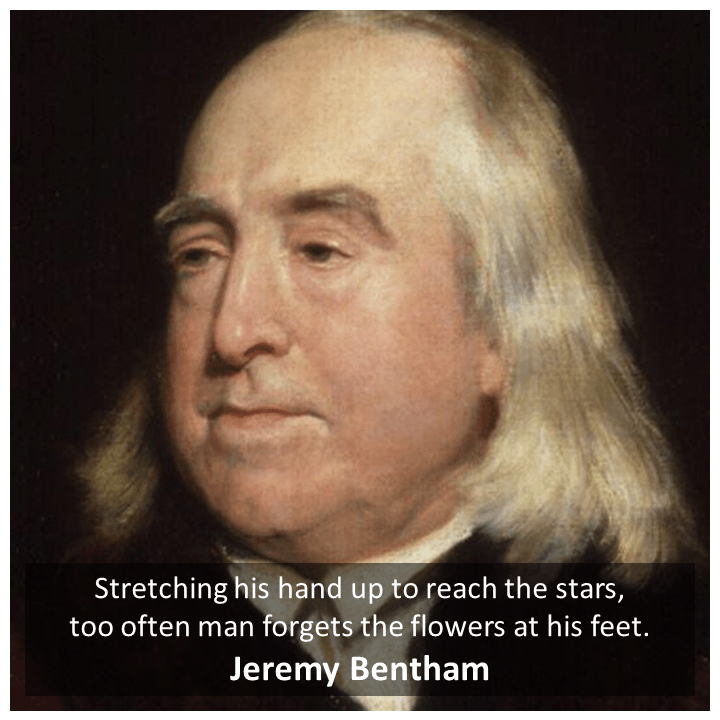
Jeremy Bentham an English philosopher contributed to the utilitarian ideas of morality. He was not well appreciated in his home country due to the misalignment of his ideas of socio-political reforms with the British sovereignty of those times. The French translation of his works on law, governance gave him popularity in Frenchmen. Bentham was one of the people who pushed the political reforms during French revolution.

While reading Joseph Priestly’s Essay on the First Principles of Government, Bentham came across the idea of “greatest happiness for the greatest number” which motivated him to expand the ideas of utilitarianism.

Priestly brought the idea of “Laissez-faire” (‘allow to do’ in French)- a policy of minimum governmental interference in the economic affairs of individuals and society. Joseph Priestly developed his ideas of politics, economics and government based on the ideas created by Adam Smith (Author of the Wealth of Nations – the holy grail of classical Economics).

The Greek philosopher called Epicurus was the supporter, creator of hedonism. Hedonism defines ethics to pleasure or pain. According to hedonism that which gives pleasure is morally good and that which give pain is morally wrong. The idea behind hedonism is the aversion of pain to live an undisturbed life because anyways this all won’t make sense once you are dead. According to Epicurus – fear of death, retribution is pushing people to collect more wealth, more power thereby causing more painful life. The collection of wealth, power is done thinking that they can avert the death but that is not the reality. So, worrying about the death sucks out the pleasure of living the life which itself is equivalent of death.

Non fui, fui, non-sum, non-curo
(“I was not; I was; I am not; I do not care”)

Epicurus

So, epicurean hedonistic morality tries to maximize the pleasure. The other end of this idea is that if everyone tries to maximize their own pleasure (egoistic hedonism) wouldn’t it disturb others?

If I want to listen to a song on loud speaker while bothering my neighbors, what is the moral standpoint here?

The answer is the overall good of the system. So, if you neighbor also wants to listen music loud and overall loud music is good for the group then we are morally right to play loud music. (Just pray that the group has same music interests!)

So, Jeremy Bentham is known to rejuvenate this ancient philosophy of egoistic hedonism through his philosophy of utilitarianism.

The basic idea behind Utilitarianism is to maximize the utility of anything, value of anything. The utility can be increased by doing what is right which can be done by doing what gives more pleasure or by avoiding those things which increase or give pain.

Utility is a property which tends

  1. To produce benefit, advantage, pleasure, good or happiness
  2. To prevent happening of mischief, pain, evil or happiness

So, the right action is the one that produces and/ or maximizes overall happiness. Please understand that the word “overall” is important for Jeremy Bentham’s philosophy of Utilitarianism. Because from selfish point of views, what is pleasurable for one may not be pleasurable for others. (This is also where the certain philosophical problems of Utilitarianism are hiding, save this point for later.)

To solve this bottleneck of clarity, there are two types of pleasure in human life – one is happiness from senses, physical experiences and one is from intellect. The intellectual happiness is higher than the pleasure from senses. So, on personal moral dilemmas these two attributes can solve the problem.

All good on personal level but what about the moral decisions for the group, for society? Here, Bentham solved the moral dilemma by using the idea of “greater good for all”. When we don’t agree on what makes us happy together, making sacrifices in your happiness to make others happy is the solution. (Keep this idea parked in your mind.)

“Nature has placed mankind under the governance of two sovereign masters – pain and pleasure. They govern us in all we do, all we say and all we think.”  

Jeremy Bentham

Felicific Calculus – Measuring happiness

Jeremy Bentham is known as the Issac Newton of the Morality for developing the felicific calculus/ hedonistic calculus. Bentham pointed out the key factors which affect the net happiness and using this factors’ effect as a whole, one can quantify the happiness.

Following are the factors which affect the happiness:

  1. Intensity – how strong is the pleasure from the given action?
  2. Duration – how long does the happiness remain from given action?
  3. Certainty – what is the likelihood of given pleasure to occur?
  4. Propinquity – how soon/ immediate is the occurrence of the pleasure?
  5. Fecundity – what is the possibility that this pleasure will also lead to the newer pleasure(s)?
  6. Purity – what is the change that this pleasure will not bring some opposite sensation?
  7. Extent – how many people are affected?

If one considers these factors and the principle to maximize the communal happiness, most of the social moral dilemmas can be effectively solved.

So, according to this felicific calculus,

  1. Batman should kill the Joker for the greater good of the Gotham
  2. The trolley should go over the group/ person which creates more pain for the society
  3. Baby Hitler should be killed once we get the chance to travel back in time

You must appreciate the clarity which the felicific calculus brings. This clarity is very important for the policymakers, politicians while deciding the fate of the group, state, nation as a whole.

Now a simple question –

If batman keeps on killing the villains, won’t he become the greatest killer of them all? What would differentiate Batman from other villains?

What would happen if you were given false information about the nature of the people tied on track while riding that trolley? Could your wrong decision be undone? If it was the wrong decision then now ‘you’ are morally wrong, with the blood of the innocents.

You would kill baby Hitler only because you have vision that this baby will grow up to be the mass murderer tyrant. The mass murder hasn’t happened yet. So, now you are the killer of a ‘now’ innocent baby.

Maintaining same emotion, now you would appreciate why even for a strong judicial system giving capital punishment for rapists, terrorists is difficult morally. You would solve the problem for now because the act has been already done, the consequences have already happened (which is why moral judgement is effective as it relies on the consequences). Killing the perpetrators or punishing them with equal pain would definitely bring peace of mind using the principles of morality but that also degrades the morality of innocents who fell down from that morality. It is not matter of what one deserves because what bad happened to them, it is about how less human you will become once you perform that act of punishment.

Recall the quote of Beccaria in the early part of my discussion.

Killing joker will create fear among other villains but it also creates chance for the creation of even dangerous villain in future.

Killing baby Hitler doesn’t guarantee prevention of World War and mass murders, as our personalities are the result of our surroundings – another Hitler-like person would have emerged in such given circumstances. (I honestly don’t know if he/she would be worse or less harsh than the original one but you get the point – conditions anyways would have created another cruel person.)

Jumping out of the trolley seems the best way to run away from the pain of murder of other unknown people (joking). The trolley dilemma remains dilemma.

Also, the felicific calculus allows pain for small groups for the betterment/ pleasure of the bigger society. For example, according to this utilitarian idea killing few healthy convicted prisoners to save lives of many innocent people by harvesting the prisoners’ organ is justified. It is for the good in the end.

You see where this goes?

See the level to which any human or a group could go if they start justifying their moral rightness using these ideas. Using these principles any big group can overpower the minorities in morally right way. It is just a matter of time that the felicific calculus principles would get exploited for other “immoral” gains.

That is exactly why many people criticized the felicific calculus saying that a pig laying in the mud for his whole life would be happiest than a human being (Socrates to be specific) if Bentham’s calculus is used to decide morality.

In a crude way, there are two type of Utilitarianism which help to solve the problem to certain extent, but it is not a complete solution:

  1. Act Utilitarianism – to act for the greater good of all
  2. Rule Utilitarianism – to set rules in such way that no one inherently gets the pain or everyone is happy because actions and their consequences are bound by certain set rules in first place now

Happiness is not the ‘only’ and the ultimate goal – the limitations of Jeremy Bentham’s Utilitarian Philosophy

What people were not ‘happy’ with Jeremy Bentham’s felicific calculus was that it made humans more like machines and very objective. People don’t always want happiness for their or the group’s greater good. Exercising daily, reducing fat-sugar maybe painful but that guarantees healthy, illness free long life. Doing drugs isolates the person from pain but it impacts the long-term physical and mental health of the person. Hardships and pain make people to reach their difficult goals which is what is the real and ultimate happiness for them.       

Happiness is not always the goal of life, if one is completely tangled in the pleasures of life and if everyone is having same mentality then in the end no one will be happy, because as a group we all would never agree on what makes us happy; different environments in which we grew, our personal experiences, our upbringing, our motivations prevent us from creating a common definition of happiness.

The subjective factor of pleasure or pain is not present in Bentham’s philosophy of Utilitarianism. Building further upon that, the victim who has suffered from the morally wrong action will only be satisfied when he/she gets justice, not when they are made happier than their perpetrators. (This justice must again not be mechanical and objective like the felicific calculus.)

One more flaw of the Bentham’s utilitarianism is the imbalance between personal scenarios and the communal scenarios. In most cases, it demands personal sacrifice irrespective of their subjective morality for the betterment of the group. (that is exactly how many past cruel dictators have justified their moral correctness on their acts against the minorities.)
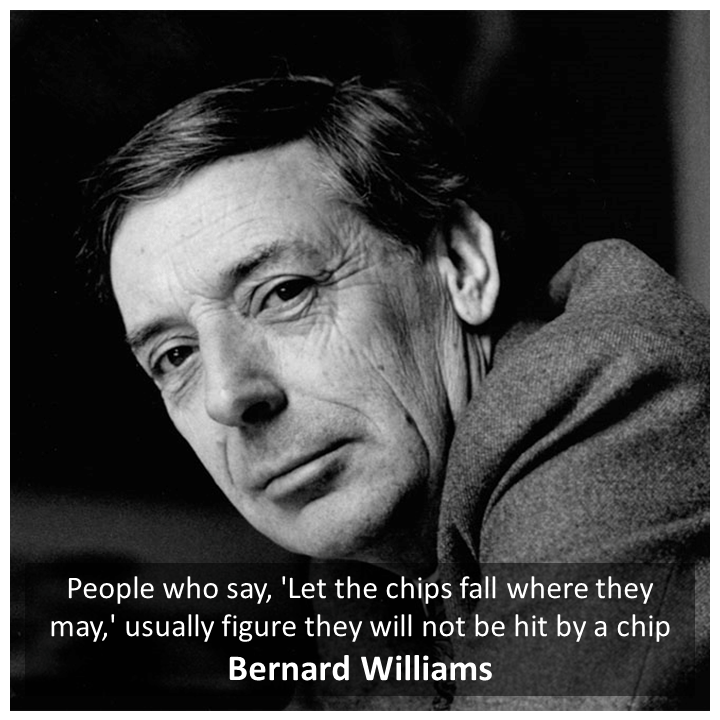
A British philosopher, Bernard Williams presented a thought experiment to highlight such flaw of the Utilitarianism.

In this thought experiment:

A botanist on his South American expedition is ordered by the cruel regime soldiers to kill one of the Indian tribe people. If the botanist fails to kill one Indian the soldiers would execute all of the tribe members.

So, if we implement utilitarian principles, then the botanist should kill one Indian to save the remaining all. That is morally right.

But on the other hand, one must also understand that the botanist has nothing to do with the cruel regime and even with the indigenous tribe members. He is under no moral obligation to do anything. The consequences are in such a way that whatever he will do he will be called morally wrong. Which in the end is wrong.

The utilitarian philosophy neglects this subjectivity and consequentialism while we are deciding morality of anything.

Maybe that is also why even when we have all the rules in place, penal code in place for all types of offenses, similar crimes – we have a judge – a subjective, consequential observer to grant the final justice.

You must understand that the discussion does not want to pose Utilitarianism as completely wrong idea. The intent of this discussion is to understand how to de-clutter a complex moral scenario and how to inject subjectivity in it so that the correct person will get the justice in the end. As we are human beings and not machines, every day brings new subjective scenarios with new subjective moral dilemmas. Direct implementation of utilitarianism may bring in the transparency in the moral puzzle but it is at the expense of oversimplification and loss of personal subjectivity, consequential personal point of view and also freedom of person to exist.

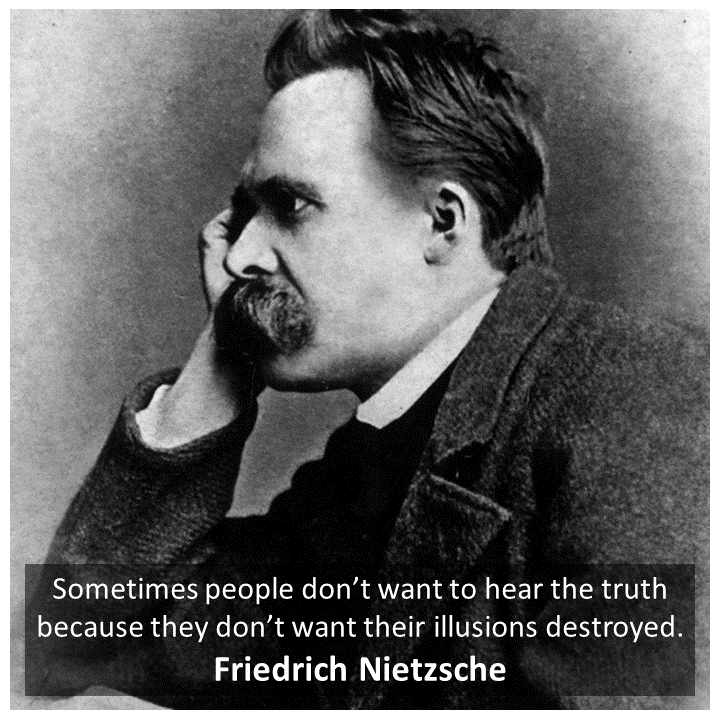
The ways in which Utilitarianism brings immediate clarity by elimination of some important subjective aspects is dangerous and limits the judgement of real morality. Friedrich Nietzsche had warned new philosophers in his book beyond good and evil about the philosophies which create such “immediate certainties” like Utilitarian philosophy creates-

“The belief in “immediate certainties” is a moral naivete which does honor to us philosophers; but – we have now to cease being “merely moral” men!”

Friedrich Nietzsche

Conclusion – If not happiness then what is the goal of being human?

Jeremy Bentham’s philosophy of Utilitarianism and the felicific calculus can help to decide the morality of what is good for all but it ignores the presence and worth of personal integrity, the well being of the minorities, subjectivity of the person in given consequences. It by default eliminates the possibility of humans remaining human beings instead it attributes them as the machine maximizing a targeted outcome (which is pleasure here).

So, the question remains – If we are not meant to maximize pleasure during our tenure in life because in the end after death there will not be anything to experience or gain happiness – if our existence and final purpose does not align with being happy then what exactly is the purpose of being a human being?

Based on my understanding on what many great people have commented about the purpose of life, I found that most of them point to remaining the human being you always were. I am not saying that the personality should remain the same, rather it should change and keep on upgrading itself till the end but the core should remain same or it should not degrade at least.

Some wrong events, injustice, oppression, cruelty will make you suffer, but that should also not vilify your human spirit. Once we let go the pursuit of happiness and chase the goal of being a better human being (or at least remain the human being you are) we can fulfill the purpose of our lives and also make other people’s lives better.

Once you will let go of such utilitarian, mechanistic setups of morality you will realize that people don’t need gods, religions, governments, judicial systems to keep in the check of right and wrong. Our inner compass is more than enough to take care of what makes us human beings, this inner compass is not about what is right and wrong, for me it is about what better version of yourself you would become if you act in that certain way. It takes care of what you are thinking and what would be the consequences of actions thereby resolving the dilemma of morality which got separated on the basis of either intent or the consequences.

I am highlighting the importance of inner personal human compass because the rules designed to keep morality in check would always need revision and the utilitarian philosophy would wait for the consequences to happen to decide the morality. The goal of human struggle to improve their current version to a better one does not need either of the metrics to decide the morality.

Imagine what the world would become if everyone started appreciating this inner human compass!

(For now, we can only imagine, but I am optimistic on this.)        

P.S. –

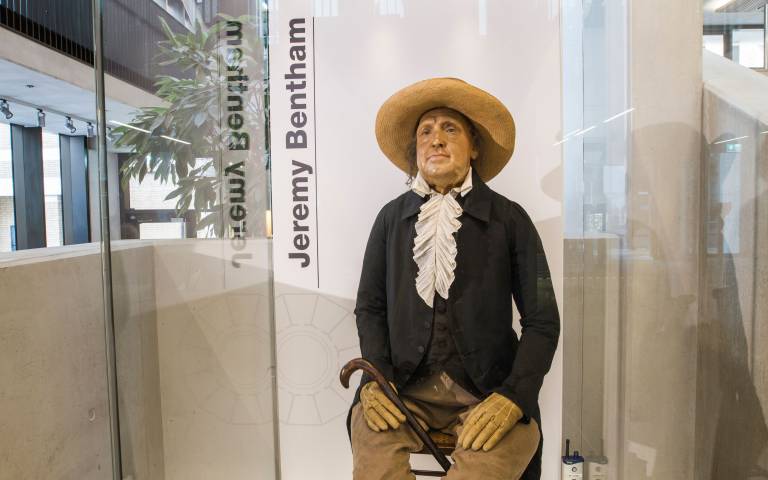
Even though the Utilitarian philosophy had many flaws, Jeremy Bentham contributed largely to bring in new political reforms, improve governance, establish penal codes in judicial systems, define sovereignty, reduce the influence of religious institutions on the lives of people and governments. His works were strategically maligned by some lobbies to lessen the impact of his other notable works. He was the proponent of liberty and freedom from religious influences on lives of people. The pushed for the establishment of a secular educational institute in London – now famously known as University College London. Jeremy Betham’s fully clothed wax statue containing his original skeleton remains in the entrance hall of the University main building upon his request.
The Free Spirit – Beyond Good and Evil

The journey to the freedom demands solitude thereby making man responsible, accountable for the consequences of his every thought and action. Friedrich Nietzsche in his book Beyond Good and Evil paved a way for future philosophers to establish their own new perspectives about the truth where there are no two sides – good-bad, sad-happy, moral-immoral, beautiful-ugly, calm-disturbing but a revised and better version of the older truth. Nietzsche in this book focused on the refinement of our perspectives, our versions of truths for the real freedom because immediately surrendering to already established versions of ideologies is the worst imprisonment any man can have. Nietzsche showed how badly our ignorance creates an illusion of freedom and how to come out of it. This is to remember Friedrich Nietzsche on his death anniversary.

Remembering Friedrich Nietzsche on his death anniversary

Friedrich Nietzsche is one of the most impactful philosophers we as a humanity have ever seen. Reading Nietzsche is a task in itself. But the moment you start getting hold of the things that Nietzsche is trying point to, you will literally undergo transformation. The path that Nietzsche paved inspired many modern philosophers, thinkers, writers. To not mention Nietzsche is to do injustice with our understanding of ourselves as the human beings. This is one attempt to revisit Nietzsche’s ideas in his famous book called “Beyond Good and Evil”, especially his ideas on free Spirit.

Nietzsche in his special style clarified what it means to be really free and how we develop our perceptions, philosophies about the world around us and ourselves.

This is me remembering Nietzsche on his death anniversary. His ideas will keep on living forever.

Oversimplification kills the nuances thereby changing the big picture

Nietzsche strikes powerfully on the idea of understanding the life as simple and easy. It’s a humorous way in which he tried to convey how we consider living life as way to goodness, happiness, pleasure and freedom. The sentences that Nietzsche used to put his ideas about life are built in such a way that you will start questioning the happy nature of the life we desire. You will realize that during the process of understanding life as a pleasurable, happy experience we have submitted our thought process only to the side of pleasure, happiness, and truth. This presumption about life always deviates our search for the truth – “the happiness” that we lookout for as a biased pursuit. Here Nietzsche is not saying that if ‘this’ which you are trying to justify life with is true then it’s opposite is wrong; he is trying to point us towards the idea that as we have attributed life to a happy and pleasurable experience, this attribution has oversimplified what life actually is. Oversimplification has happened because not everyone can understand complex ideas on equal level. It’s not because people are dumb, it is because we have our own ways of interpreting the world around us and the ways through which we interpret the world are totally subjective. Thus, the truth if it exists, it will never be absolute but based on perspectives one has.

“We have contrived to retain our ignorance in order to enjoy an almost inconceivable freedom, thoughtlessness, imprudence, heartiness, and gaiety – in order to enjoy life!”

In order to make everyone appreciate given idea of life on same level we have oversimplified what life is and such oversimplified foundation has led to building even more oversimplified versions of so-called truth. In the pursuit of clarity and ease of interpretation and communication our lives have become false!

That is why Nietzsche here tried to attack the very fundamental way in which we try to break down the things we come across when we live through them. See it in this way, if life by default was supposed to be simple then it is implied that we would have grip on every aspect of life and existence. We know that’s is not the reality. So, if it is not simple then it must be complicated is our next thought. Thus, if life is complicated in reality then oversimplification eliminates certain aspects of life which we keep on missing in the search of truth.

You know what, Nietzsche further explains that when we are denying that life is not simple and happy that also should not invite it being opposite of what was earlier thought i.e., sad and complicated. Nietzsche rejects the idea of polar opposite to portray the lives we live. He calls life, knowledge as the process of “refinement”.

It’s not duality of any aspect of the philosophy, good and bad side of life but the ways and times they have refined themselves which should be the parameter of their worth.

The Death of Philosopher

Nietzsche had his way to express verbal anguish. The sentences are so dense that the prose feels literally repulsive. I think it was intentional. His writings were never meant to be read while sipping coffee or to romanticize the philosophy or the idea of life. They will make sense to those who really want to understand what he is trying to say. Nietzsche in his next idea talks about how every philosopher is trying to find the meaning of life and thereby his/her truth of life. He despises the idea of life or philosophy being explained with a single idea. That is why he sarcastically calls philosophers as the protectors of truth, the thing which itself doesn’t need protection in first place!

Nietzsche thus calls out to the philosopher to get ready accept the martyrdom, the death of their idea of philosophy. The philosopher can only carry his point forward for further refinement but he/she must not – cannot define the life in whole with that simple idea. That idea has to die in the process so that newer refined ideas can be built out of its broken pieces.

In order for philosophy to exist it has to end, it has to kill its older version – that is what is the tragedy of philosophy is as Nietzsche goes.

The Freedom Paradox

When Nietzsche is trying to initiate treatise on freedom, he starts with what it means to be free for any person. One important observation he puts in front is how we get freedom on personal level. On surface it feels if the person is free on personal level, then it is easy to be free in society as a whole. But Nietzsche shows that these ideas of freedom are paradoxical! Man goes inward for the freedom because he/she knows that there is no one else to tie, bound him/her inside his privacy. The man seeking freedom when interacts with the crowd soon realizes that his experiences of life are bound to how crowd handles him, reacts to him, treats him, shapes him. That is unsettling, the burden is difficult to carry for single person hence the man again resorts to privacy, in order to do that he has to let go of certain truths and create his own little lies so that the external crowd won’t disturb his “freedom”.     

(the man) he was not made, he was not predestined for knowledge”

The point Nietzsche is trying to make here is that the taste of freedom comes with the unsettling feeling of existence. But as a man we are not seeking that freedom for us; freedom is some citadel, a happy place where we expect to have control over course of things. The real freedom as Nietzsche explains will be gained by being in touch with crowd (which sounds paradoxical again) It’s like saying you will understand what you real singular identity is when you start mixing yourselves with the crowd!

Nietzsche further advises philosophers of the future to not turn away from the unsettling ideas about philosophy. He takes support of cynicism to make his point. Cynicism bases itself on the idea that people are selfish, self-interested (so in simple words if anything doesn’t go the way a cynic wants, they would whine and create reasons to justify it.) Nietzsche expects the future philosophers to understand the difference between ill-speaker and bad speaker. The lovers of knowledge should also be able to understand what is unsettling, maybe their lies the next opportunity for better version of their philosophy.

The Freedom of Expression

Nietzsche had already explained how things lose their essence in oversimplification. In same fashion it becomes difficult to interpret what a fast thinker is thinking and then explain it to the relatively slow thinkers and make them appreciate the same idea on same level. Even in our thinking we are not free. You can create an explanation for others to understand what you are thinking but they themselves have to climb up (or climb down sometimes) to your level to appreciate what you are thinking, you may succeed in expression but interpretation, comprehension and its appreciation gets limited by the levels on which others are thinking. (My question, if this is the case then even if you are a free thinker, are you truly a free thinker? I know Nietzsche is paradoxical most of the times)

“What is most difficult to render from one language into another is the tempo of its style, which has its basis in the character of the race, or to speak more physiologically, in the average tempo of the assimilation of its nutriment.”

Nietzsche further builds this “so called” freedom of expression using the limitations of the language. Language is the culmination and mirror of the culture it originated from. So, naturally each language has its own style, flow, breaks, rules and ways to highlight certain aspects of narration. When such languages is used to express an individual’s ideas, the speaker has to let go of the nuances of his culture, his primary way of life so that others having another culture, another way of life can appreciate and understand what he is trying to convey, but what if the nuances were the only thing which made that idea influential? Then the influence of the idea would be lost because of the translation. (This is Nietzsche’s way saying lost in translation!)

The Tragedy of Independence

Another way to become free is to become independent. The very few lines Nietzsche uses to explain independence are equivalent of an atomic bomb! (trust me it is still not an overstatement!!!)

People who become independent are few as Nietzsche says and those who are strong can easily achieve it. This independence is also one way to be free. When a man becomes independent, he is on his own, there is no one like him – he is alone. Nothing is anything alike him – he is alone. Thus the whole world becomes a puzzle for him as he is on his own. Any direction becomes new path for him. As he is the only one like himself, there is no one who would reach to his level and match his thinking. And in such case if he needs sympathy, people cannot even sympathize with him because they are not on his level. What a tragedy! The sadness he has in his heart, mind is rendered useless because others around him are not able to comprehend it – sympathizing gets ruled out automatically.

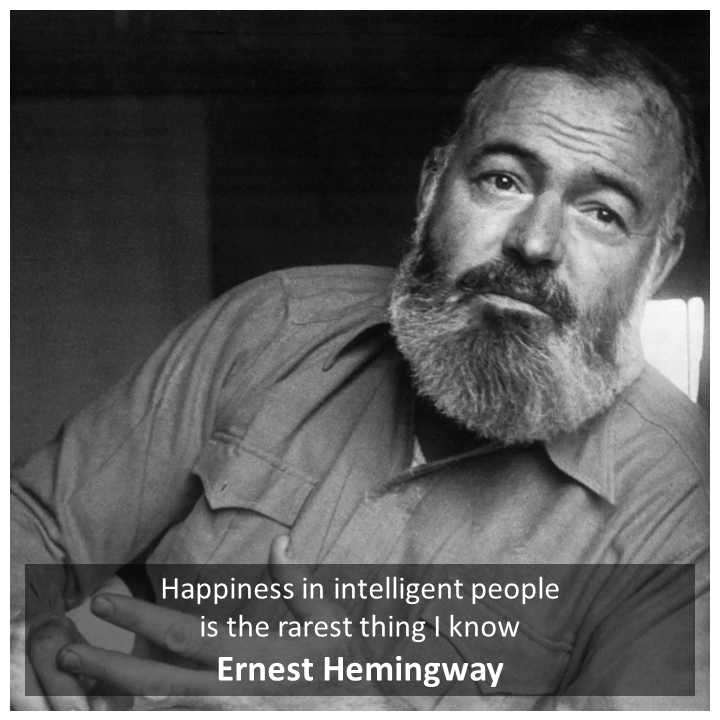
This is Nietzsche’s way of saying what Hemingway said. (I mean both meant the same although Hemingway came later, but you get the point) You must understand that happiness is not the real pursuit of life, then you won’t feel tragic about what Hemingway is trying to convey here, same is what Nietzsche trying to convey here. Freedom by independence can be a tragedy for the person who was expecting glory out of it.

Foolishness Hides Chances For New Insights

Nietzsche here is trying to remove the lines between what is good and what is bad, what is allowed and what is forbidden.

“That which serves the higher class of men for nourishment or refreshment, must be almost poison to an entirely different and lower order of human beings”

In modern crude sense, Nietzsche says “one man’s trash is another man’s treasure”!

Same idea, same act will have different perception of morality, scale of right and wrong. A rebel thinker in common poor public could be attributed to a philosopher amongst the riches. A murderer who killed an evil landlord could become a saint among the people who were victims of this landlord’s oppression.

So, Nietzsche’s attribution of foolishness is a way to point out the exceptional, outlier acts, prohibited acts, crimes to find the better truths. That will make you freer than others.

The Freedom of Youth   

 The stage of youth feels like the freest stage of all the stages of life and it is so because it has let go of the nuances. It also feels free because the youth in the stage of exploration never submits to right or wrong, yes or no to the life as Nietzsche says. But as the time passes when the youth is exposed to disillusions, broken expectations they try to modify themselves in a way that will get things done the way they wanted – the compromise starts to enter. The moment this happens the same youth tries to punish themselves as Nietzsche says. The freedom exists no more, so is the youth.

The Freedom of Actions

(Again, this a hydrogen bomb on morality!!!)

How can we say that the given action is right or wrong?

Nietzsche has very interesting thought process on this question. In the starting times the action was right or wrong based on what it led to – its consequences – the effect. The problem with this thinking is that one has to wait to let the action happen to decide its rightness or wrongness. If the stakes are high, such attribution of right or wrong can be devastating.

So, Nietzsche takes support of Chinese idea where the parents are responsible for the betterment of their child. Meaning that the origin of the thought which led to that action should be the decider of whether the action is right or wrong. Nietzsche called this pre-moral period of mankind. And sarcastically he points out that we have made a total turn around the idea of right or wrong action. Earlier it was what happened after the action i.e., consequences; now it is what led to that action, meaning what was happening before that action i.e., the origin which is the decider of right and wrong of any action!

This is where the origin of action gets named as ‘moral’ which is generated from self- knowledge. Later these morals evolved into “intentions”. As Nietzsche says, intentions serve as the origin of any action.

“people were agreed in the belief that the value of an action lay in the value of its intention. The intention as the sole origin and antecedent history of an action: under the influence of this prejudice moral praise and blame have been bestowed, and men have judged and even philosophized almost up to the present day”

Nietzsche then drops another bomb called – unintentional actions. We are clear that whether action is right or wrong can be decided by the intent. But what if there was no intent or there are no other ways to pinpoint the intent behind certain actions? There is a possibility that the intent may get mistranslated, misinterpreted during the unfolding of events, then how would you decide the attribution of given action.

In such case we would again go to the effect- the consequences of that action!!! You see what is happening here? We might have to resort to that older measuring system of action based on their consequences.

This is Nietzsche’s style to question how we think of morality in general and also on deeper level.

(I can’t resist praising Nietzsche lesser but deep down I know he would question his own worship too!)

The next attack Nietzsche does by using morality is the sentiment of sacrifice. The basis of his thought process is that you should question everything that gives you pleasure at least once. Here, he shows how fake the feeling of sacrifice for others, surrender could be if it is intended to display how moral and virtuous you are!

“There is far too much witchery and sugar in the sentiments “for others” and “not for myself””

In simple words, you are saying that I like to help others because it makes me happy. So, in order to help others you have to become selfless, but if becoming selfless to help others makes you happy, doesn’t that make you selfish? You are selfless because you are selfish!!! (Disclaimer: Nietzsche is paradoxical.) The paradox is resolved when you accept that you are just taking support of morality to display you higher value. Being selfless is just a better excuse to display your high morality. It there was any cruel way to display your high morality no wonder you would have gone for that!!!

In modern ways, it’s fox’s way to say the grapes are sour or I am a virgin because I am waiting for someone special (In reality fox cannot reach the grapes and the person is not able to appreciate other person or people rejected that person continuously – please note that I am not blaming someone’s character – it’s the limitation of language that prevents me from expressing what I am thinking for oversimplification. As Nietzsche has already shown that oversimplification kills the nuances. You get the point!)

The Immoral Philosopher – The Free Philosopher

Building upon the ideas of nuances lost in translation, right and wrong in morality Nietzsche calls the future philosophers to go beyond the dichotomy of philosophy and also distrust the morality in the development of new philosophy, new truth.

“In all seriousness the innocence of thinkers has something touching and respect-inspiring in it, which even nowadays permits them to wait upon the consciousness with the request that it will give them honest answers”

This is Nietzsche’s way to show that in order to find the new truth new philosophy, new philosophers have submitted themselves childishly and blindly to the principles of morality hoping that morality will give them new answers. But it is the same tinted glass of morality that prevents them from getting new perspectives. Hence, he calls them naïve here. They must let go of this childishness.

“The belief in “immediate certainties” is a moral naivete which does honor to us philosophers; but – we have now to cease being “merely moral” men!”

This is Nietzsche’s way of saying it’s good to be bad!

For Nietzsche, morality shows only two sides of reality- right or wrong, this works fine if reality is really dichotomized. But we know there is no such thing as right or wrong for every real-life scenario. So, in order to find the real truth, you have to let go of morality, then you will see that reality has its spectrum and people residing on different biases of such reality have their own attribution of right and wrong for the same action. Morality is the subset of newer truth, not the other way around.

‘il ne cherche le vrai que pour faire le bien

(he who searches truth to do good) – I wager he finds nothing!

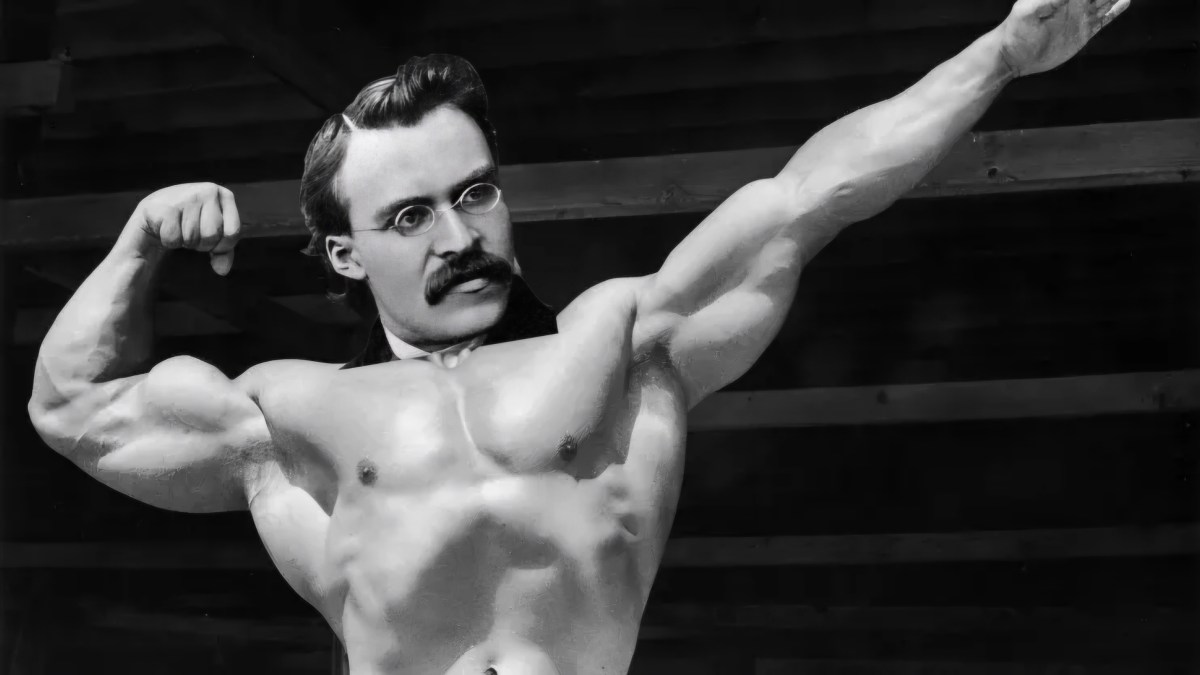
 Nietzsche make his point by him being the first bad-philosopher!!! (This is why I am loving him more and more. It’s like a brainiac with full grown muscles if you want to picture him thematically!)

The Freedom From Passions and Reality – Will to Power

Nietzsche makes an attempt to show that the reality could also be made up of something totally different that we can even comprehend. What if the world is more real than what we can experience? And if such reality exists, our senses will limit us from experiencing it. So, in order to be free in such reality we have to rise above our senses. That would be the new freedom. Our senses are bound to desires and passions whose interactions – impulses are creating thoughts.  

So, building on these impulses Nietzsche says that many emotions, processes are created in “our reality”. What would make any of such impulses, process free from others? He introduces the idea of causality to show the flow and root of everything. If cause leads to an effect and further that effect becomes cause to newer effect then it is possible that the root cause of all would make us really free. Nietzsche further explains that it can also be one of the processes which would overpower others to become free and not the root one. (For example, the first unicellular organisms would be the most powerful organisms on earth today, that is not the case.)

Here Nietzsche introduces the concept of Will to Power. Whatever overpowers the other processes has the potential to remain in the big game and thus has real chance to be free. Will to power in any process allows it to gain more freedom.

This is Nietzsche’s Darwinian theory of evolution – the survival of the fittest. (I know it is a bastardized translation, but again I summon the loss of nuances during translation.)   
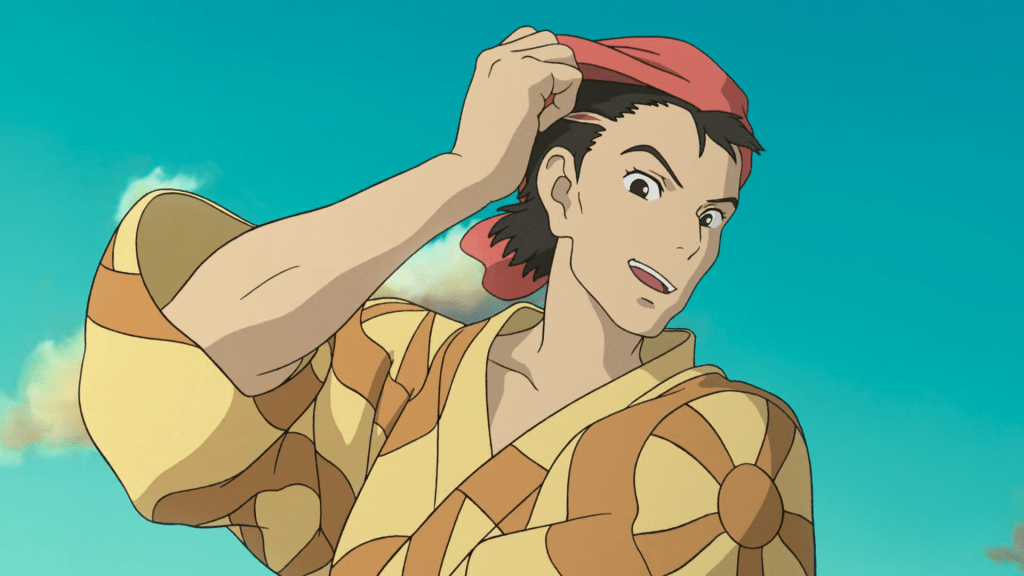
Then Nietzsche puts the idea that by this way of thinking the originator does not necessarily be the most powerful one, thereby questioning the existence of the God! Because if the God was the originator, then then he/she would exist only if he/she has the highest Will to Power. That also does not mean that if God does not exist then devil exists or has the highest Will to Power. It could be anything! We are not sure for now. (typical philosophical answer!)

Using causality, Nietzsche also questions the morality of French revolution. If for the locals the royalty was cruel that is why the revolution happened then why didn’t the remotely located people who considered them noble in first place considered them cruel too? In the eyes of remotely located people the French royalty had a noble past. (The question is intended to think on it not to find the right and wrong. It shows how flawed our thinking becomes when we stick to morality blindly.) Whoever came in power overthrew the less powerful. That is one way to explain Nietzsche’s Will to Power. According to Nietzsche, if Napoleon would have been continuously invested in the morality of his actions he wouldn’t have become the great emperor.

Freedom From Truth

Here Nietzsche starts with the very obvious and common fact that some truths are unsettling. Not every truth ensures happiness. Only an idealist, as Nietzsche says would submit the idea of truth that brings joy, happiness, and beauty.

Here comes Nietzsche’s biggest drop-

“the strength of a mind might be measured by the amount of “truth” it could endure – or to speak more plainly, by the extent to which it required truth attenuated, veiled, sweetened, damped, and falsified”

This is self-explanatory. It is just our unsettlement that we need to take care of while looking for the truth. We are thinking animals and thinking is a result of our impulses, desires, and passions. So, not every truth is destined to bring us peace. ‘We would die if we eat poison’ – is a truth which unsettles everyone but that is not how we react to such truths, we prepare for such bad events, that is the wisdom what Nietzsche is talking about in a crude way here.

“There is no doubt that for the discovery of certain portions of truth the wicked and unfortunate are more favorably situated and have greater likelihood of success; not to speak wicked of who are happy- a species about whom moralist are silent. Perhaps severity and craft are more favorable conditions for the development of strong, independent spirits and philosophers than gentle, refined, yielding good-nature, and habit of taking things easily, which are prized, and rightly prized in a learned man.”

Nietzsche prefers learned man more than the moralistic or the virtuous one. A learned man knows the consequences of learning new truth, or sometimes even unaware of it but he does not pivot his happiness on the discovery of new truth. What else could you make freer when you are ready to accept the truth in its crude and real form! This freedom will bring clarity, new perspective and not happiness or sadness or chaos or calmness.

Truth will not decide how and what you are. You just will have added new tinted glass in your collection of perspectives towards life and reality and the philosophy behind all of them.  If your Will to Power is good your truth may become the truth for all others.

Freedom From Identity

The profoundness demands the rejection of submission to any side of existence. If one promotes certain ideology the people around him/ her will try to comprehend that person using the tags they have in their own minds for that idea. The mask thus brings in that ambiguity where people are not associating, tagging you to one definite truth. Even your mind can start creating bias if you let it. That is why Nietzsche focuses on mask in profoundness.

“A man who has depths in his shame meets his destiny and his delicate decisions upon paths which few ever reach, and with regard to the existence of which his nearest and most intimate friends may be ignorant; his mortal danger conceals itself from their eyes, and equally so his regained security.”

The mask frees you from attribution thereby biases and even the socio-economical influences. You will never let honor or shame, right or wrong, good or bad, happy or sad justify the events in your life. You will never ever flinch to enter an unsettling adventure which guarantees your growth personally. Embarrassment, failure will just be another emotional response for you (please note that this does not mean that you will be emotionless, it means that you will be able to recognize your emotions and let them pass.)

This is exactly why I would force everyone to understand Nietzsche on their own level!!!    

“Every profound spirit needs a mask; nay, more, around every profound spirit there continually grows a mask, owing to the constantly false, that is to say, superficial interpretation of every word he utters, every step he takes, every sign of life he manifests”

This could also be one reason why some the greatest personality humanity has ever seen had a layer of controversial ambiguity around them.

From the idea of mask, Nietzsche moves to the idea of its conservation. The conservation is meant to define the philosophy of containing who you are rather that you submitting to some ideology. Whatever you have collected as an individual, whatever you are on philosophical level personally, how you have upgraded – refined your philosophy you must conserve that instead of giving to some ideology. The mask helps to conserve who you are.

“One must know how to conserve oneself – the best test of independence”

(this could be the reason why superheroes wear masks!!!  Joke aside but it is one powerful thought)   

Further Nietzsche warns new future philosophers to not be people pleaser or submitter to temptations. That will steal them of their judgement and independence.

Freedom From Your Version of Truth

The ways in which Nietzsche is trying to close his arguments are really beautiful. He knows that when the future philosophers will have discovered their new truths in their journey of blood, sweat and tears, it is natural that they will get attached to it. Such is the human tendency. He wants us to get rid of the obsession with this new truth. This truth even if it’s the newer one will create boundaries in your perception, you won’t be free anymore! Nietzsche wants to let the future philosophers let go of the dogma.

“In the end things must be as they are and have always been – the great things remain for the great, the abysses for the profound, the delicacies and thrills for the refined, and, to sum up shortly, everything rare for the rare”

Freedom From Illusion of Freedom

On closing notes Nietzsche has advised new philosophers to be careful of the “freedom” they are being offered under new socio-political ideas. Nietzsche focuses here on the ways new philosophers are embarking on the journey to new truths. He tells that having fluency in speech and effective grip on written communication will not define you as the new philosophers, even though they are one aspect of it. But the systems having higher Will to Power will use same tools to control new philosophers and change the course to their versions of truth.

New philosophers will be misled with words like “Equality of Rights”, “Sympathy with All Sufferers”, “Modern Ideas” but they should be careful about them. They should be aware that the moment they create a thought process the people on different levels with different Will to Power will interpret these same ideas for their own benefit especially the ideas which are polar opposites of your ideas. Once such separation happens nobody, not even you cannot get the real freedom.  

Nietzsche offers the rule of solitude while embarking on such journey. Only you can free yourself.  

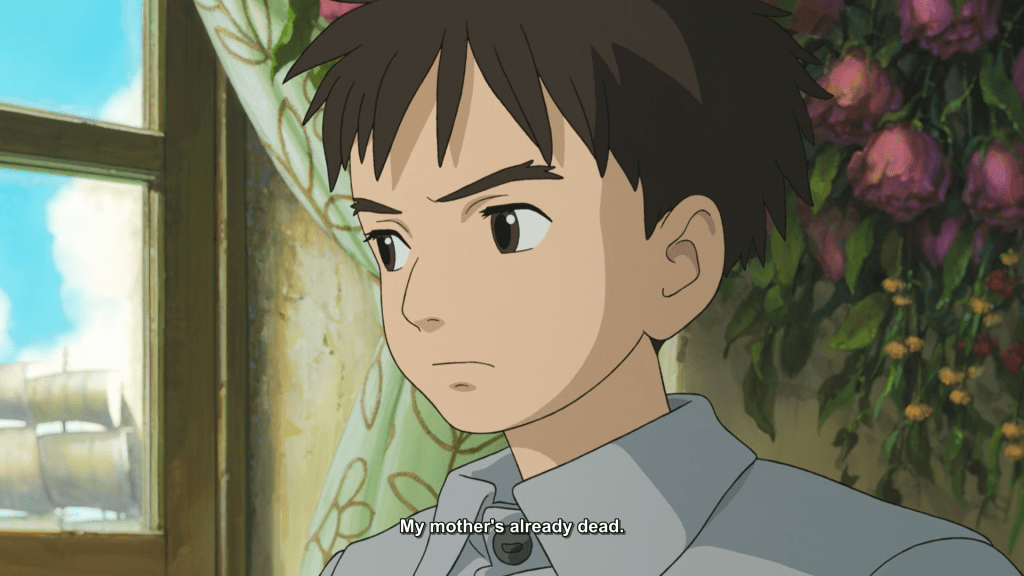
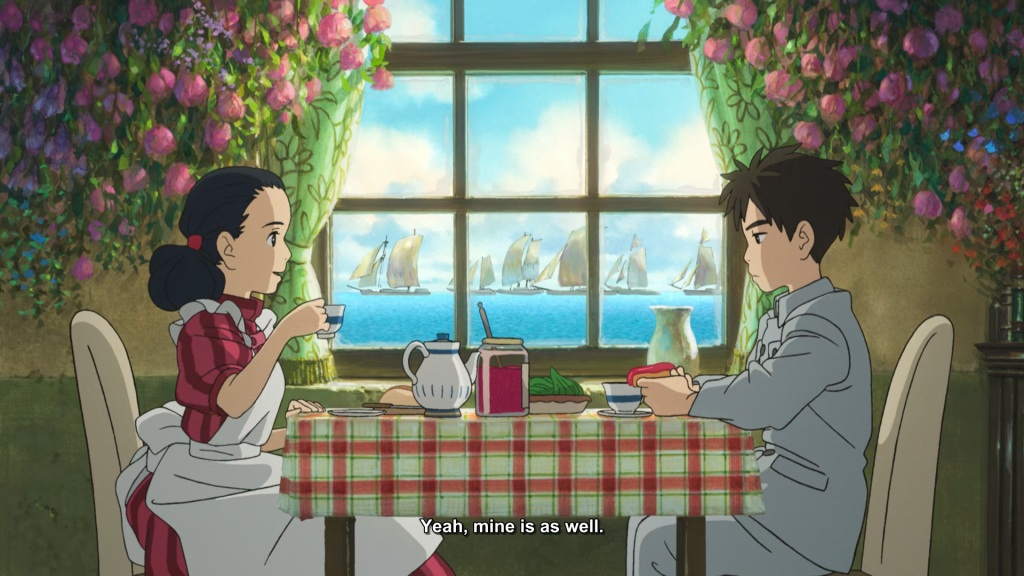
The Boy and the Heron (君たちはどう生きるか) – Bittersweet Reality of the Artistic Legacy

Studio Ghibli’s masterpiece The Boy and the Heron (君たちはどう生きるか, How do you live?) tries to answer one complicated question on artistic legacy. On surface, it is a story of boy coming out of the melancholy of his mother’s death and his new beginnings. Deep down it is a love letter from a creative father on his creative legacy to his son who wants to go on his own journey. It shows how difficult it is to make others appreciate a personal piece of creation, emotion and how to leave a truly influential legacy behind.

A creative father’s love-letter on his legacy to his beloved son

We are always in a pursuit of creation of something to ensure better coming days. Survival is one aspect of it but as the time moved on, we have comfortably brought ourselves to ensure our sustenance. Most of us can live a basic life and rarely worry about what to eat tomorrow. Once such stage is achieved, you will see that our efforts to create and accumulate still have never stopped. Now we are creating and accumulating for even better days than other, once this is achieved, we continue creating and accumulating so that our new generation will see better days. This act of creating a legacy is not just a matter of survival, it is also matter of preserving some part of ourselves even when we won’t physically exist in this world.

It is easy to see what happens to the materialistic legacy like wealth, but it becomes very tricky to handover the moralistic, value based, character-based legacy to the next generation because of the differences in the ways to live and understand the life. The passage of time alters some truths to the new generations thereby changing their mindsets and moral compasses. Even though our animal drives, emotions are exactly the same the motivations behind them change over time.

Now, imagine that you created such precious legacy which is close to you, which defines you, people appreciate it adore it but your next generation is unable to carry it forward. How do you handle such rejections? what is the resolution? Is it good? Is it bad? Is there any way around? As you love your legacy, should you force them to see the value in your legacy? And if you truly love them, should you force them in the first place to carry that legacy?

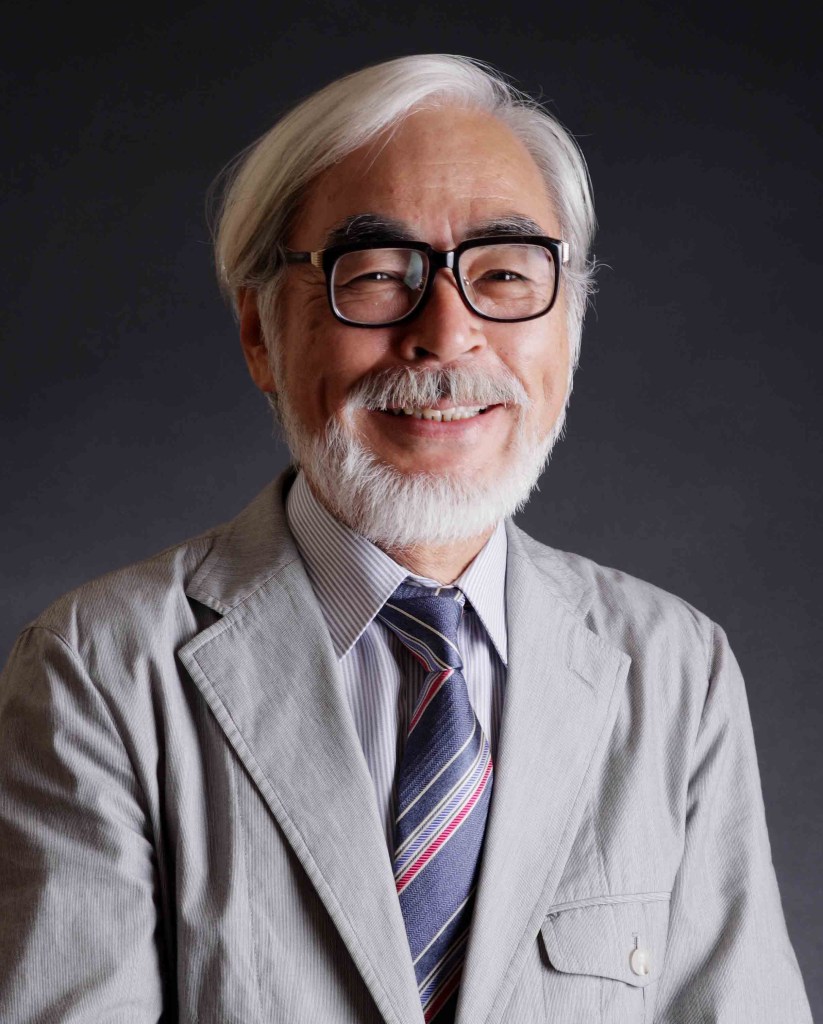
Studio Ghibli’s recent movie The Boy and the Heron (君たちはどう生きるか, How do you live?) is an attempt to answer one such complicated question on artistic legacy. Hayao Miyazaki-san has again given a masterstroke by creating a very personal yet relatable artistic narrative.

I have tried to explain the overall purpose of the narrative in this movie and will try to uncover what was the real core of movie based on the events in the life of Hayao Miyazaki-san.

The story and the meanings behind it

You will find megatons of explanations on the symbolism, personal connection of Hayao Miyazaki-san, his life, his childhood, his parents, and his colleagues from Studio Ghibli in this movie. There are many theories and cross references between the previous Ghibli movies too. I will not go into those details. I will focus on what the narrative stands as a whole.

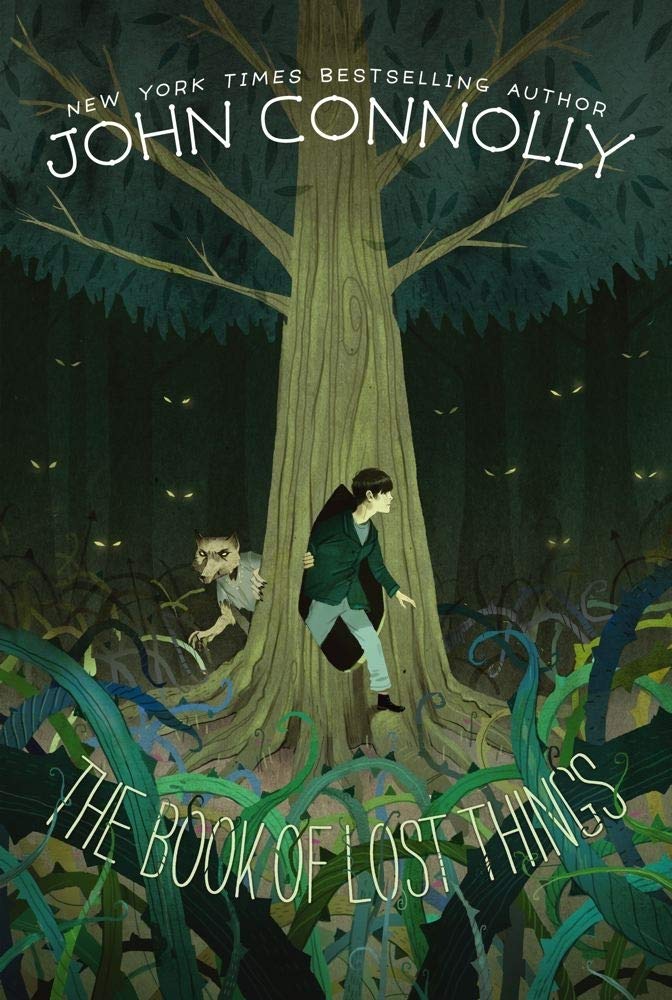
It is obvious that it is a story of a boy who lost his mother and his journey of getting over that melancholia of her loss and acceptance of his new mother. You will also notice in the end credits that the creators have thanked a book called “The book of lost things” by John Conolly. Once you check out what this book is all about, I think you will get new perspective beyond the symbolism and references in the movie. Miyasaki leveraged the narrative of this book to create the structure of his narrative. The book also draws inspiration from Genzaburo Yoshino’s book “How Do You Live?” (君たちはどう生きるか, Kimi-tachi wa Dō Ikiru ka)

Two books which inspired ‘The Boy and The Heron’

This is the story of the all emotions that are invoked when a person loses their loved ones. The first question that comes in mind when such loss happens is “How Do You Live?”

This is how the story is built –

The tower created around the rock is a portal where you can physically access your emotions. Just like in Interstellar how Astronaut Cooper was able to physically access the dimension of time.

Birds are representation of the free flying feelings, emotions we have.

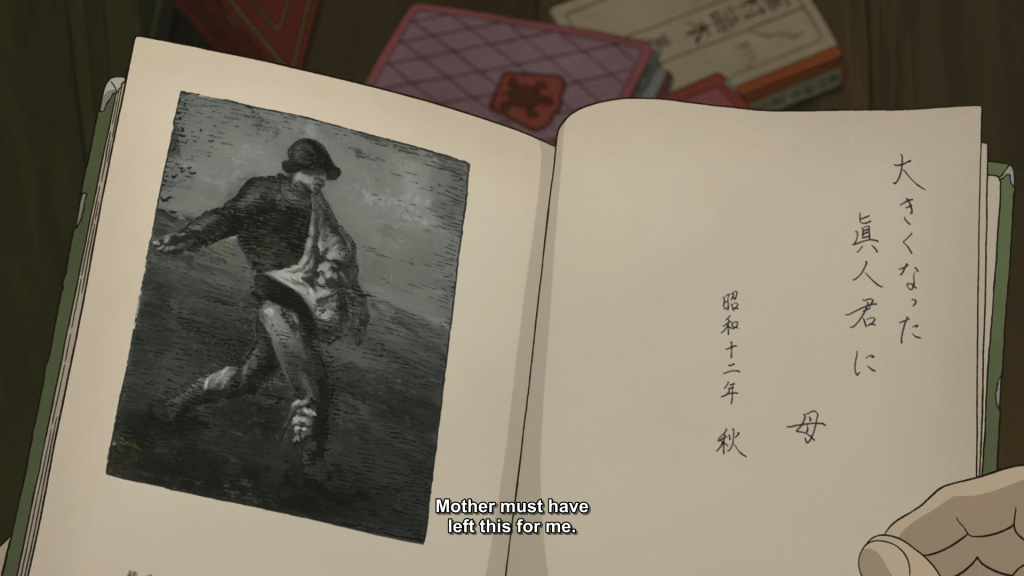
The book that the great granduncle left unread is the same book Mahito’s mother read and then it got handed over to Mahito, which is the book called “How do you live?” The book is about the conversations of a boy who lost his father and the boy’s uncle.

The great granduncle already knew that the rock from space can allow him to create the world of his dreams. That is exactly why he built a tower around it for protection. Upon going through the loss of loved person in his life, he saw himself in the role of the person who will lead and help his descendants to handle their own pain of loss. But as the great grand uncle was always into books and had his own internal dreamy world, he used the powers of the rock from space to create his own world.

The act of leaving the book unread to disappearing into something is pointing towards that intense moment when you have to act on things because the author said exactly what you believe in. You feel this urge to act and create that thing because the author, the person who you don’t even know feels exactly the same. You feel an unexplained deep connection.

So, the rock from space and tower built around it is a portal where things can enter and exit in space, time. The moment when Himi lost her mother, she accessed the portal, confronted her emotions but also met her future son Mahito.

She realized that even though she lost her beloved mother, she will have an opportunity to have her own son who will love her deeply. Even when she will not be there with Mahito, her sister will love him equally. This gives her peace. That is exactly why when grannies are telling the story from Himiko’s childhood to Shoichi (Himiko’s husband and Mahito’s father) they say that she was grinning to ears – happy like anything when she came out of the mysterious tower.

The great grand uncle can call anyone to enter the tower. That is why grannies are scared if Mahito gets taken by the tower in the start of the story.

Kiriko has also accessed the portal in the search for young Himi before, that is why her younger version is available in this dreamy world and knows the ways of this world. Her older version entering into the portal along with Mahito closes the loop of time paradox if you think it through.

Natsuko is called into the portal to make young Himi aware that her future son will have a caretaker and lover when she will not be there for him. This helps young Himi to get over her own loss of mother. It’s that feeling of love you create for your people when you realize how deeply you loved the person you lost. You realize that your people also deserve to get the love that you received from your lost loved ones. That brings the person out of the melancholy of the loss of loved ones.

Natsuko is called into the portal to make up her mind that Mahito is also her son. She is also called into the portal to make Mahito accept that his step mother also deserves the same love that he has for his own mother. The great grand uncle is the orchestrater of all these events.

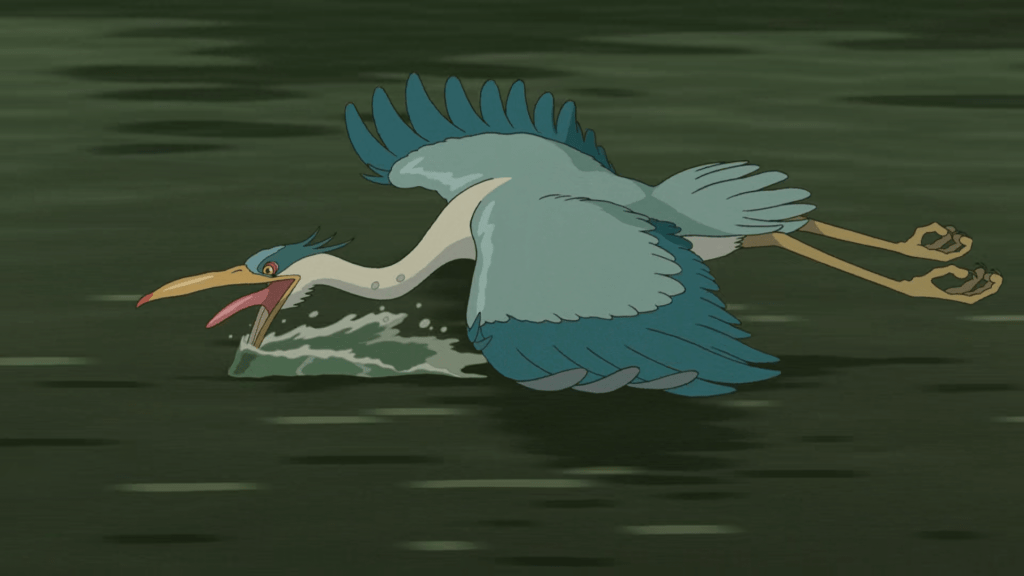
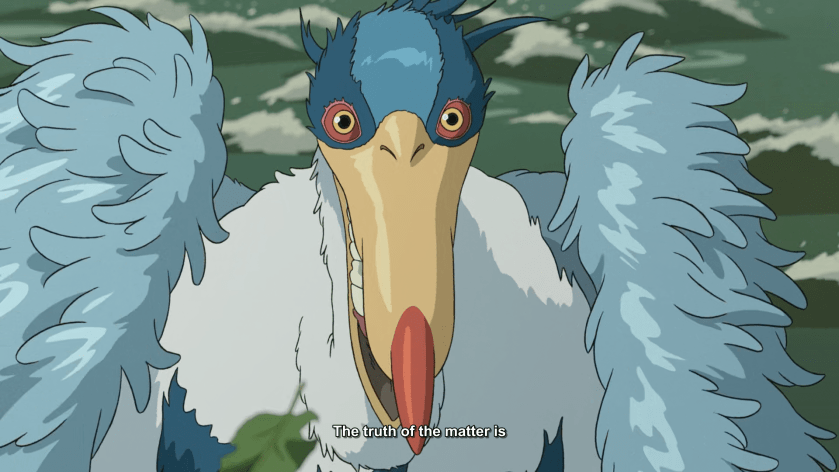
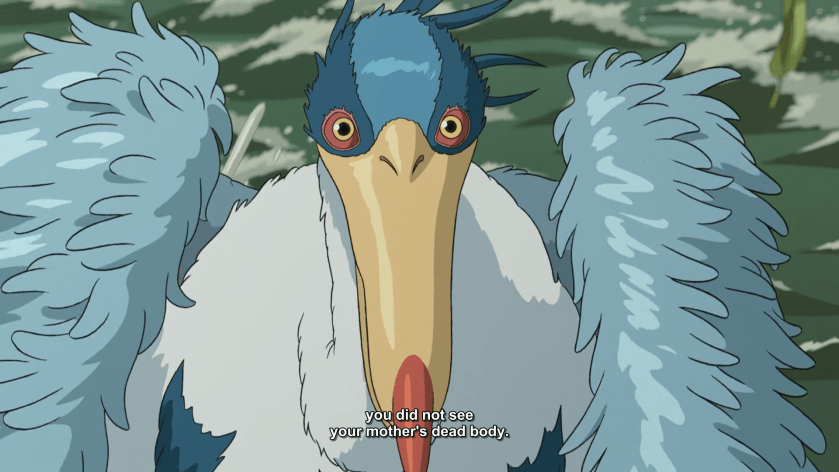
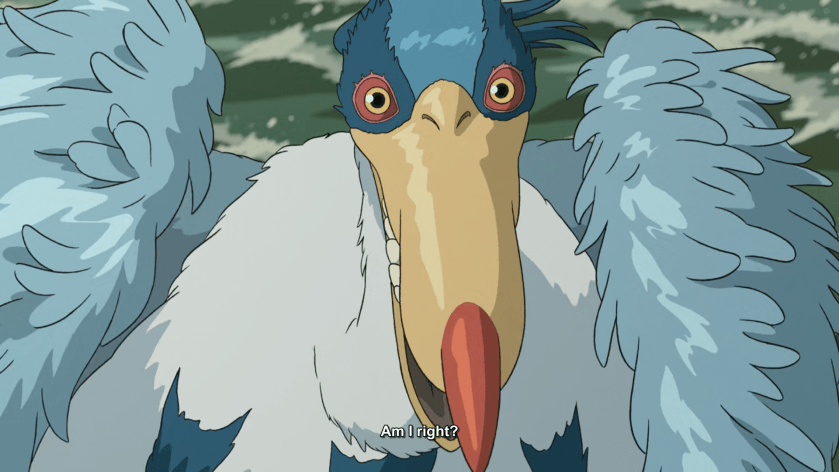
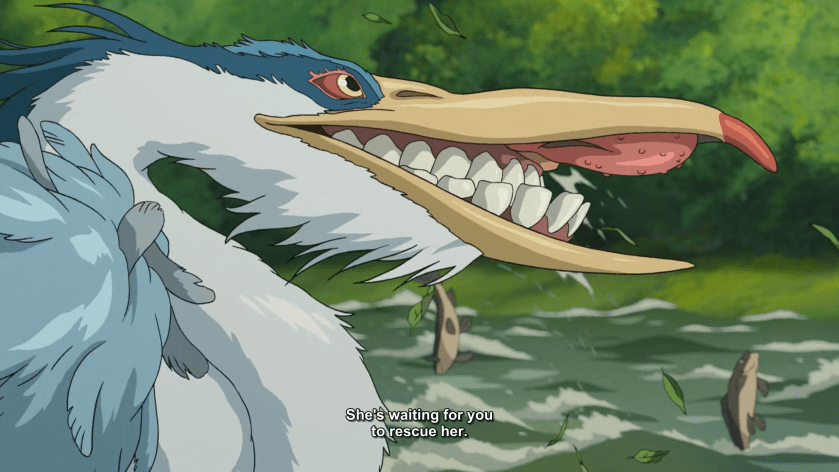
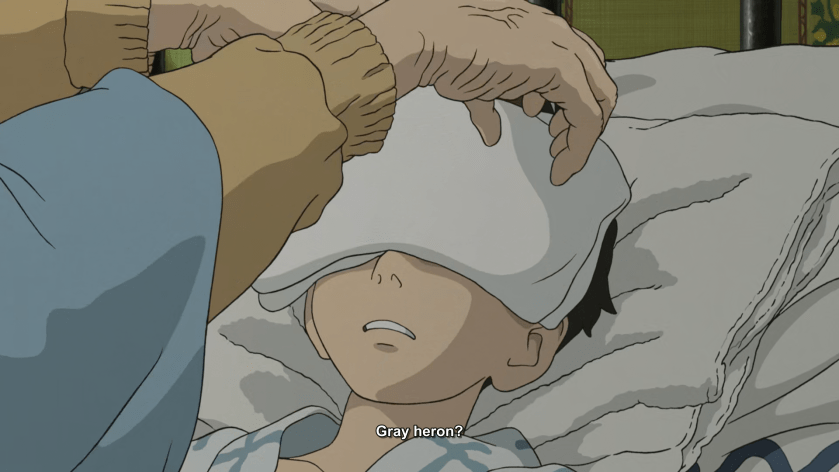
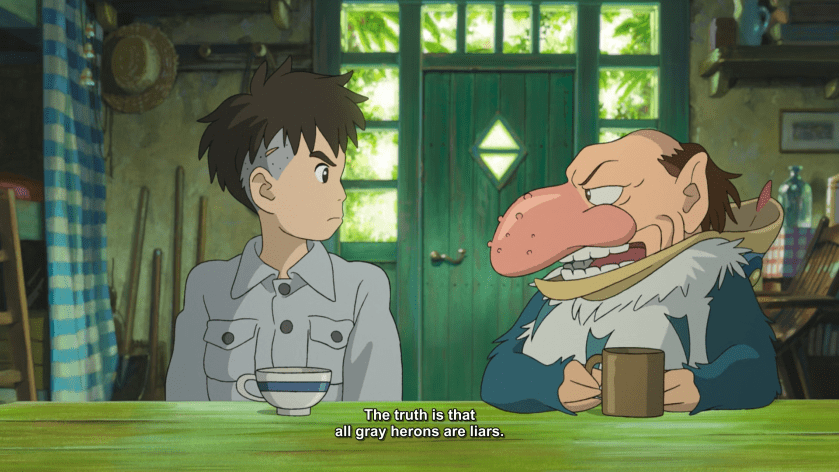
The grey heron is Mahito’s mind personified, his conscience. Heron is always guiding, helping Mahito. Mahito has this feeling that his mother is alive somewhere because he never saw her dead body. Heron attracts, teases Mahito using same understanding. Somewhere in a hidden corner of Mahito’s mind he thinks that there is still a chance to save his mother and bring her back. He is just looking out for an opportunity. Heron teases this opportunity to Mahito.

Heron like every person’s mind is paradoxical in nature. Heron is equivalent of Jiminy Cricket from the story of Pinocchio.

Most of the events between Mahito and the grey heron are Mahito’s dreams until he personally enters the tower where all his emotions can be accessed physically. That is where he is able to get the hold of the Heron, that is where the power of the seventh feather is functional, because Mahito has heightened awareness and access to his emotions.

The illusion of his mother in bed is a reminder to Mahito that she only exists in his dreams not in reality.

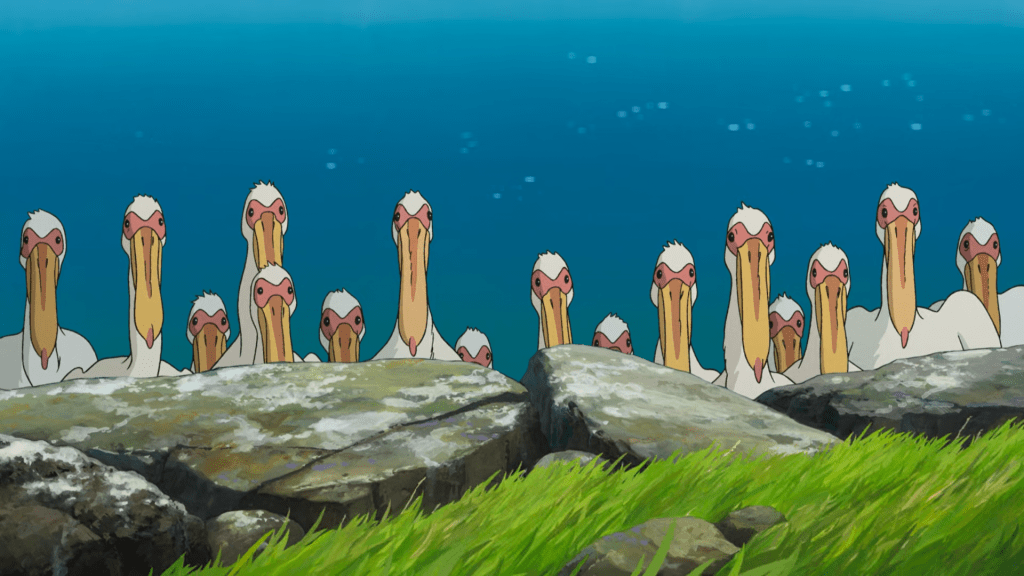
The starving Pelicans are the feeling one gets when they realize that they won’t be loved in the ways and to levels they used to before because of the loss of loved ones. These feeling to be loved, the huger to be loved by that person pushes the person to meet his loved one in afterlife. You will see the pelicans pushing Mahito in graveyard so that he can meet his mother. Pelicans are his feelings from the void of love which are pushing him to die to meet his mother in afterlife.  

Kiriko saves Mahito from his urge to die, maybe she has done same to Himi in past too. The mark left on Kiriko’s head by swamp thrasher is intentional creation to make Mahito comfortable. The fact that they both share some common pain brings comfort to Mahito. The thrasher bird is a symbol of self-reflection, it is like upon getting settled and being calm Mahito realizes that dying is not the solution to meet his mother – Himi.

Warawara and the phantoms are the attempts of great grand uncle to show everyone entering this world that life and death are part of existence. The person must accept and will have to support both, feed both to ensure that the reality remains ‘real’.

The event of giving proper burial to the dead severely injured pelican is Mahito’s acceptance to detach himself from the urge to be loved by his dead mother. This is him making amends with death and urge of being loved.

The moment Mahito accepts the weird and paradoxical nature of heron is the moment when he gets a clear direction to meet Natsuko. He literally repairs his conscience to get the clarity.

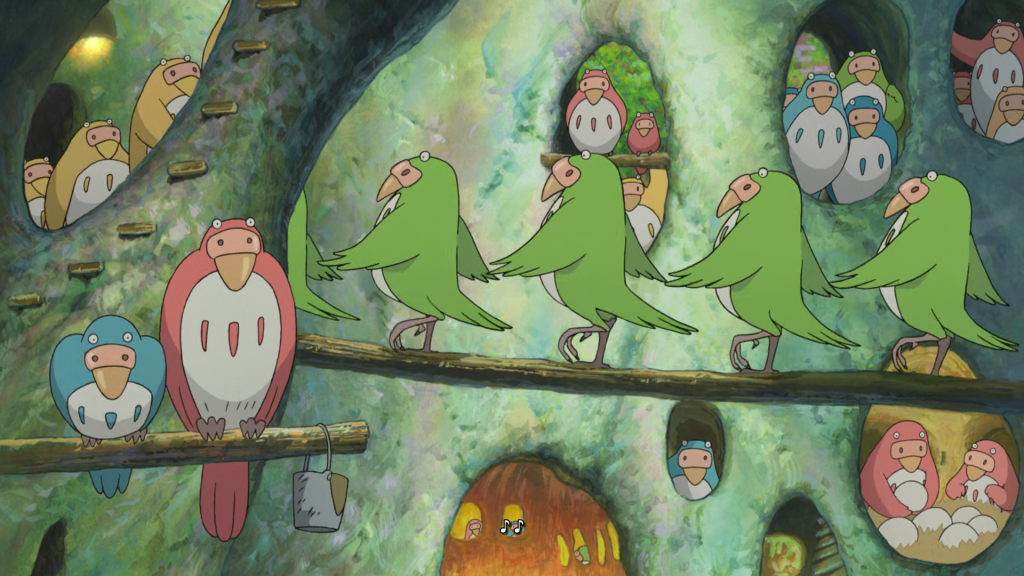
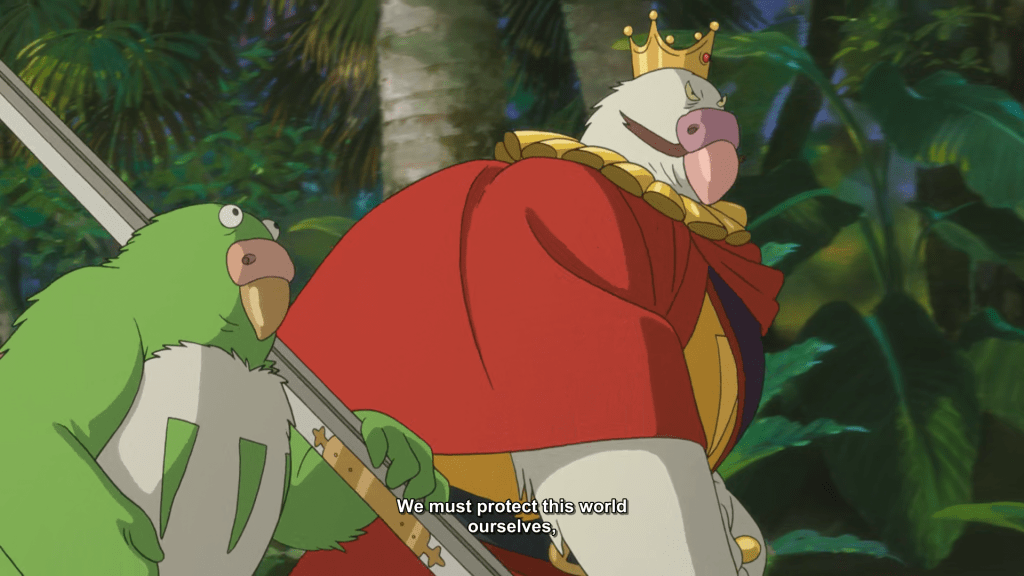
The Parakeets are the defense system of mind. They are the logical emotions, feelings that we use to defend from the sad feelings, they make sure that the system of our mind remains intact. Parakeets are the indicators of love and colors in life, when we are deeply saddened these emotions of love and colors become intense, defensive to save our mind. Here in the extreme case, they have become so strong, disciplined, and militarized that they are ready to consume their own host – Mahito. Parakeets show life, colors, happiness, anti-sad emotions, and the defense mechanism to create good for everything. That is why they have rules, moral values – the indication of what is allowed and what is not for the betterment of the host. They make sure that the person remains sane by choosing what is best for him instead of getting overwhelmed by all other emotions.

Parakeet king is the ultimate personification of such defense mechanism, he just wants to make sure that the world inside the host’s mind remains intact otherwise the host will go mad, this world will collapse.

The important conflict Mahito must resolve is to find his mother. Where the great grand uncle gives him the test. You should appreciate the role of great grand uncle in this whole narrative. The very first time when Mahito is inside the tower with Kiriko, the great grand uncle could have immediately met him and resolved everything in his mind.

But he makes Mahito to go through whole journey because you cannot force any emotion on the person just by telling the truth. His/ her defense mechanism will strongly and willfully reject that truth. Only when that person will go through personal experience, then only he/ she can appreciate the value of truth. Uncle thus gives Mahito this final test of truth once he overcomes the obstacles in his mind.

Mahito is given the taste of truth by showing him that even though he could not save his mother Himi he can now save another mother Natsuko. This is the Natsuko who enters the portal with a feeling if she would ever truly be able to love Mahito while having her own baby. This is conflict resolution for Natsuko too. She develops true love for Mahito when Mahito lets go of his attachment to mother Himi to save Natsuko because he doesn’t want that to happen again. And Natsuko also realizes that it’s her loving sister’s son in the end who deserves the same love like her coming baby deserves.

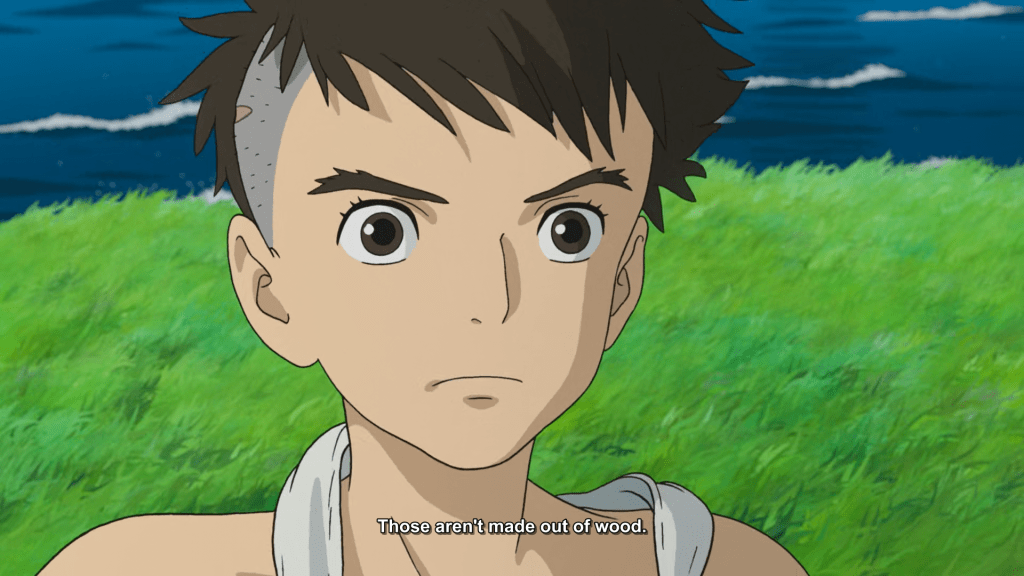
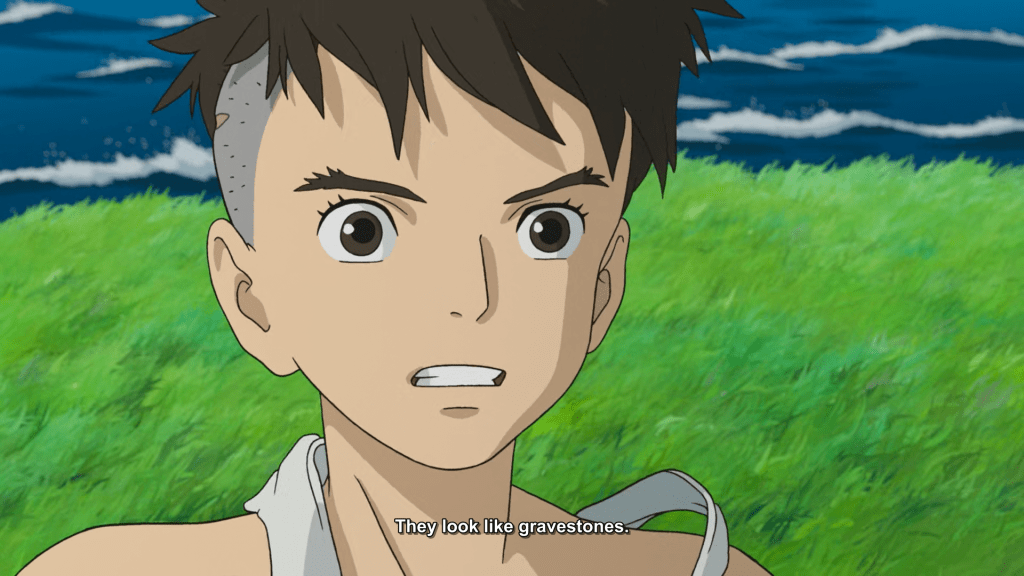
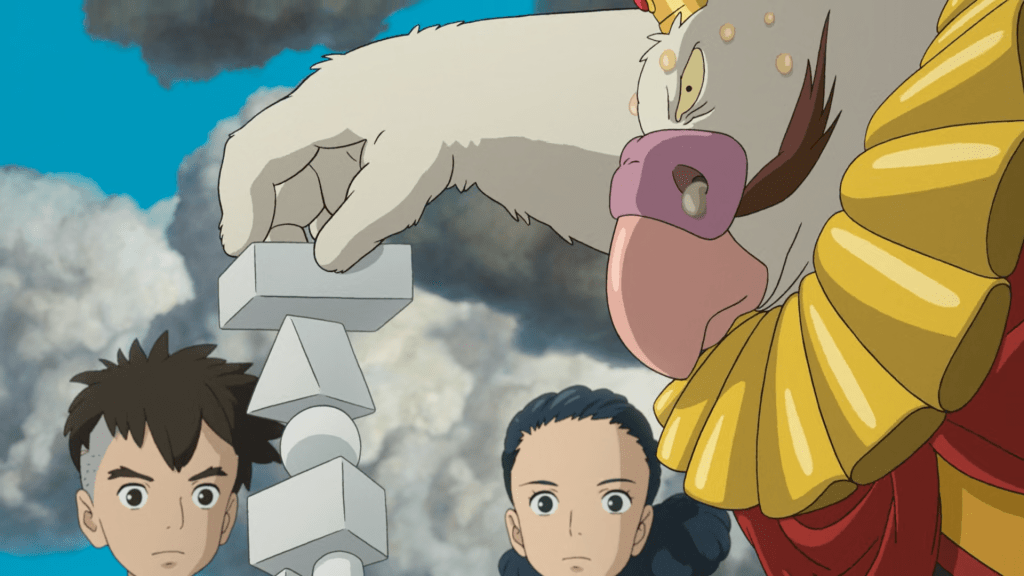
Only upon the resolution of this conflict when Mahito gets the access to the portal to meet the great grand uncle. 13 grave stones are the 13 movies created by Hayao Miyazaki-san. Which arranged in many styles create different world. They create an escape to different reality where people can manifest and physically live their dreams. For uncle these 13 gravestones are the purpose of his life, they define who he is and are his legacy. Great grand uncle asking Mahito to arrange these 13 gravestones is Miyazaki-san’s way to order his son Goro-san to carry his legacy in the exact ways Miyazaki-san intended. Mahito noticing the difference between wooden blocks and the gravestones is an indication that his life interests do not lie there, wood here as a part of tree – the life against the gravestones show that this is not how Mahito would live his life.

As a punishment uncle sends Mahito to parakeets. Parakeets are the structured constructs, rule, laws which ensure that the world has order even though the person may hate them. Goro Miyazaki-san chose the career of an architect because he wanted to do something different from his father. Hayao Miyazaki-san asked Goro-san to create artistic movies exactly in his “Ghibli” style but Goro-san’s artistic creations never matched the Hayao Miyazaki-san’s Ghibli vibes. It’s like his creative powers were restricted due to the parakeet like strict construct, high expectations and extreme criticism of Hayao Miyazaki-san. The great grand uncle had some hope that Mahito will accept what he wants him to appreciate.   

Mahito’s own conscience – the Heron comes to rescue him in the end. Grand uncle asks Himi to leave this world and also tells that Mahito should also leave with her. He is hoping that there is one more chance to convince Mahito to take care of what he had created. When Mahito and Himi meet the great grand uncle to bid goodbye the uncle presents Mahito some stone without malice. It is uncle’s attempt to show Mahito that even though his creations have their challenges, rules, restrictions Mahito still has freedom to do anything with these new stones free from Malice. It’s uncle’s attempt to convince Mahito to not lose the grip on the legacy. It is Hayao Miyazaki-san’s desperate way to reconvince his son Goro-san that he just needs to create for the studio Ghibli by using some new things – new experiments but just keep studio Ghibli alive. He wants Goro-san to create so that the world of Ghibli will bring bounty, peace and beauty into people’s lives. It’s not just a selfish request for continuing the legacy. It is a request to maintain the core of his legacy – Miyazaki-san’s legacy.

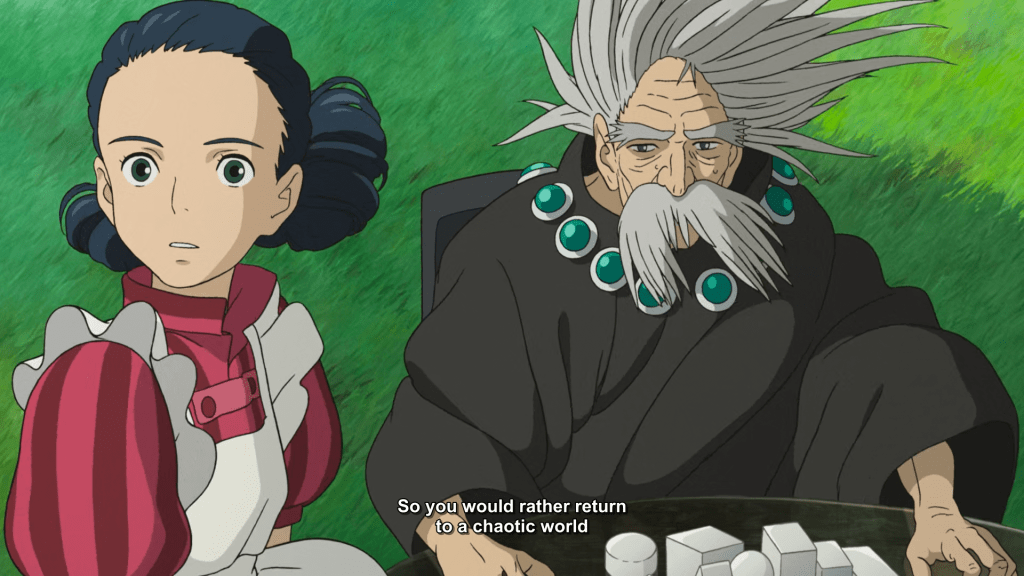
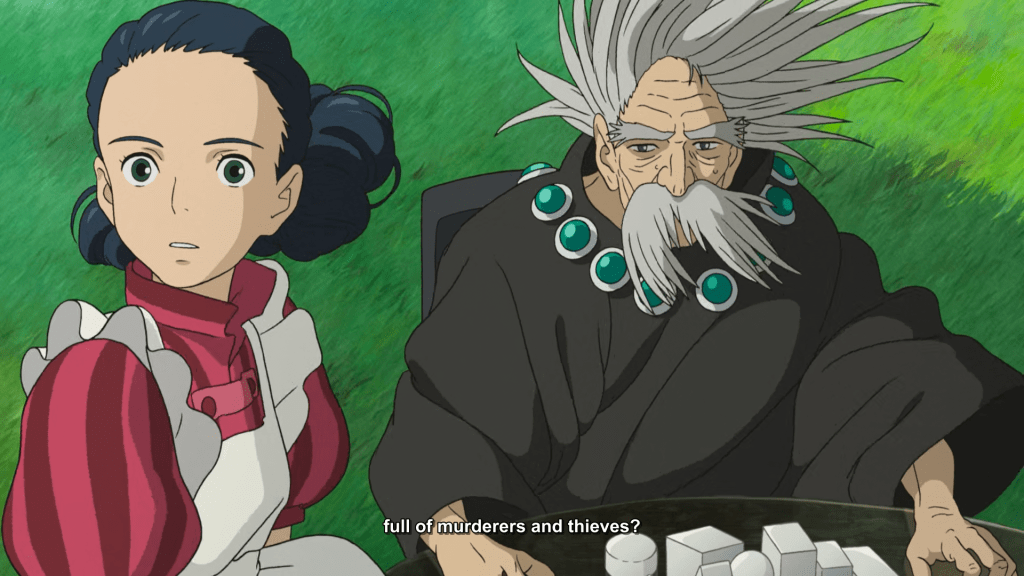
Mahito responds to great grand uncle by saying that he has his own challenges, his own malice, his own limitations which make it difficult to carry this legacy. Mahito wants to return to his own real world even when it has some darkness, bad things. When uncle asks him that Mahito’s reality is a chaotic world full of murderers and thieves Mahito responds by showing that he has good, caring, and loving people along with the heron – his conscience to support him there.

This is also important moment for Himi where she is relieved that even when her son will lose her, Mahito will have enough support system to take care of him. This is one more reason for young Himi to return happy to her reality.

Uncle then ordering Mahito to just stack the stones for last time would be equivalent of the discussion happened between Hayao Miyazaki-san and Goro-san on the creation of one last project for Miyazaki-san’s peace of mind. Maybe Miyazaki-san just like the great grand uncle wanted to play a trick on Mahito – Goro-san to convince him to continue the legacy.

Finally, the Parakeet king trying to arrange the blocks by himself is the futile attempts of the admirer of great grand uncle’s creation to ensure their own survival. But as there is no personal connect between them, the Parakeet king doesn’t know the ‘art’ of arranging the stones. When the attempt fails and the world collapses as the great grand uncle had already expected, he instructs everyone to leave the tower and return to their respective reality.   

You must appreciate that there would have been a proper intimate discussion between Hayao Miyazaki-san and Goro-san on how to take over this legacy and continue the future of studio Ghibli. Rearrangement of 13 blocks shows advice to use the styles and ideas of Hayao Miyazaki-san’s movies to create further new stories.

The resolution of Mahito returning to reality is Hayao Miyazaki-san’s way to show that the path has already been chosen and good thing is that it is more real than anything possible. It could be ugly, full of malice, murderers, death, grief and detachment but is far better than dreamy and perfect world. Looks like Goro-san successfully convinced his father Hayao Miyazaki-san that his father’s reality of Studio Ghibli is not the only reality, only legacy which deserves to exist. Hayao Miyazaki-san also realized that if he truly loves his son, he would let him go on his own path, to create his own art. Just because he is too attached to his creation does not entitle his son to carry it forward, especially as a burden.

It’s poignant to come to this fact but it is what it is. That also doesn’t stop either Hayao or Goro-san to create the world they want. (there is a rumor that Miyazaki-san is working on his next film.)  

The Curse of the Intangible Value of an Artistic Creation

For any true artist, it is the expression through creation which matters him/ her the most. The art they create is exactly who they are, it is a part of who they are. For such artist who has realized that they will have to leave all this creation behind in the end, search for the true successor who can appreciate their creation is crucial.

And the problem with artistic creation is that they are very intimately connected to the person who created them – the artist. It’s like the bond of a mother and child – she has carried that child for 9 months in her belly, it’s a piece of her body and soul. In similar sense, that art held its root in the artist’s mind and the artist kindled it in his mind to finally bring it into the reality. The fundamental problem with emotions is that you have to pass through those feelings to appreciate them in true sense. You can intellectualize other person’s emotions, write about them, create narratives/ stories out of them. You can make philosophies about how and why people have certain emotions, why they feel sad, happy, melancholic. You can also simulate pain to induce the feelings of emotions in a person, you can simulate happiness by triggering certain chemicals and suppressing others. But, you must accept that unless and until you yourself don’t pass through that real-life emotional experience, you will never be able to appreciate and understand how others felt when they had similar feelings. You can be highly empathetic, sympathetic but they too are bound by the limitations of you own mind. You can be a highly intellectual person who has already figured out what action would lead to what emotion, what is good for your mind, what is bad for you, you may create a whole internal defense system to handle the anticipated emotional responses but the experience you will have when you pass through that emotion will be very personal and the art created after the passage through such emotions cannot be attributed to any tangible value.

Now think of handing over such a creative legacy to you descendants. You are confident about this handover to your children because they are your immediate physical extension and if you are lucky then maybe your immediate mental extension too. But, as I already clarified in previous paragraph about the curse of intangibility, the intangible subjectivity of any artistic creation, there is no guaranty that you descendants will resonate with what you believed that art to represent.

It feels cruel to realize this fact but believe me it is the reality. Others, especially the people you call yours are not entitled to appreciate the things exactly to the levels you appreciate. I agree that they should at least not disrespect it but you can never force other people to appreciate ‘your’ valuable things at your exact same level. This journey has to be made solely by themselves which will never be in your control. You may force them, influence them, punish them- abuse them mentally, physically but you cannot force others to generate the same respect, same value for the things you love. It’s purely an internal and voluntary journey.

That is why having people who resonate with how you appreciate certain common objects and common emotions is a blessing. This also does not mean that people who perceive something different for the same objects are bad. There can be cases where they perceive something even better than what you perceive and where they do not even care but that’s not your fault. In order to find clarity in these cases you have to accept that emotions are double edged sword. It will cut both ways. Even when you have anticipated, planned, intellectualized them, you cannot escape your emotional responses. What you can do is to observe them sincerely and let them pass. You are not your selective emotions; you are above them. Emotions are not your creator rather you are the creator of your emotions. The moment you accept this you will see the truth that not everyone, not even your own blood is bound to experience the life around you in the exact ways you want them to. The moment you will appreciate what I am trying to put down in words, I think you will feel liberated. Please understand that this is not just about any artistic creation, it is about everything you call your life – mental, physical, tangible, intangible. To live a life with this intensity could be a blessing (on personal level if this intensity is not anticipated well in advance or not controlled then it is one cruel curse to carry.)

I think this is exactly what Hayao Miyazaki-san was struggling with. But as the movie resolves I think there is still hope for him, for the studio and in the end for all of us rooting for his next movies. It definitely is not a sad ending and even if it is a sad one we know what great things they made us feel about ourselves, how they gave us better perspectives towards life. I think that his true legacy is all his admirer, we people altogether whose lives he changed through his creation. Even though his movies won’t be there, what they have made us feel – that legacy of having a perspective towards life will keep on affecting new generation through us.   

To be honest, for me it’s a love letter of a father to his son who doesn’t want to follow his father’s legacy and wishes to go on his own journey.       

The Father Son – Hayao Miyazaki and Goro Miyazaki

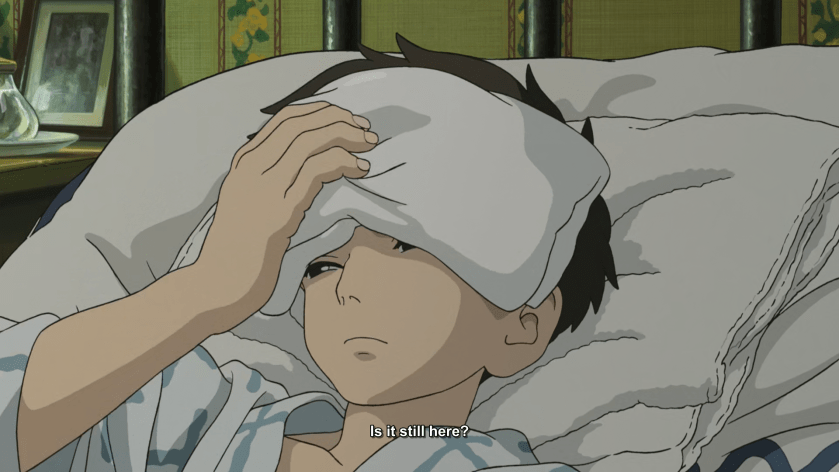
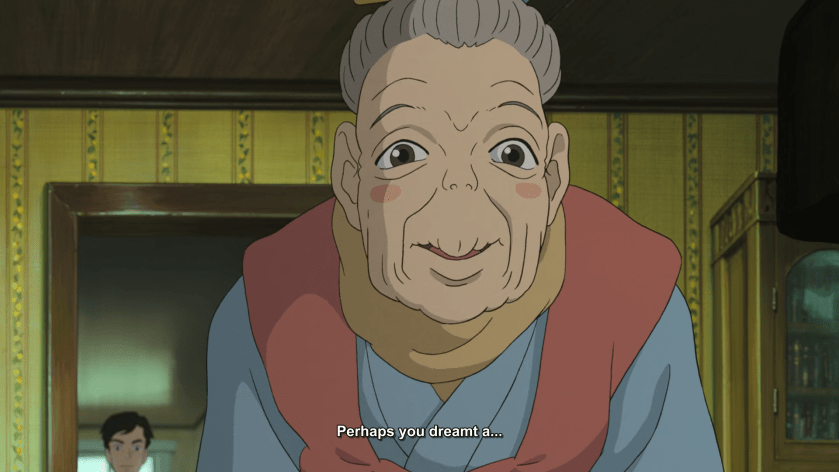
  • All movie scenes from Studio Ghibli – Hayao Miyazaki’s movie The Boy and the Heron

Losing the ‘Grip’ on Escapism

Escapism creates a void in our perception of reality so that new ideas, creative ideas would populate this void for living life with a new perspective, new approach. The healthy escapism is the most important tool, a therapy for many successful creative people our world has ever seen. Once this escapism takes extreme side it may lead to addiction, procrastination and delusion. Freud’s ‘desire to destruction’ and René Girard’s theory of mimetic desire help us to understand escapism in better ways to face the reality head on.

Reality is merely an illusion, albeit a very persistent one

Albert Einstein

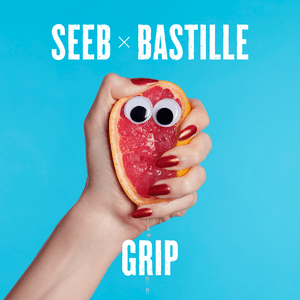
It is very interesting when we start questioning how we understand, feel and interpret the reality. The reality in which we live in has infinitely many facets which we experience through equally diverse emotions. We as human beings are hardwired for seeking happiness, happiness creates the environment to nurture, grow and multiply. Bear in mind that only growing and multiplying is not enough to guaranty the survival of our species. Adaptation is one aspect to ensure the sustenance over the course of time. Adaptation means getting exposed to adversities, sadness, imperfections of reality to create the strong enough coping mechanisms. What would happen if are continuously in the phase of seeking pleasure and turning our faces away from the challenges of the reality? How we justify our own death (figurative) by our own hands when we submit ourselves to such dark pleasures, addictions, dark temptations in spite of knowing that they are harming us? There is just one perfect song to point us towards such emotions.  The song is called “Grip” by Seeb and Bastille.

The song was written by Espen Berg, Dan Smith, Thomas Eriksen, Mark Crew, Simen Eriksrud and Joakim Haukaas.

Album art for Grip by Seeb, Bastille

Grip – The Lyrics

As the night time leads into the day
And tomorrow spills across the sky
While the sun's a harsh reminder why
We are feeling barely human

The overall emotions this person is experiencing are the emotions of distaste and hatred towards the things which are inevitable. He knows already that it is going to be day after this night, the sun will rise up and he will have to face the day helplessly. The “harsh reminder” here highlights that the person doesn’t want to face the day, the reality, the responsibility and wants to escape to the night where he was someone better than human – someone invincible.

 ‘Tomorrow spills’ shows that the thing/s which this person was trying to postpone, avoid has finally come. The spilling action shows the unwanted eventuality. The things which the person is trying to avoid are the sufferings and problems which for this person are mocking him for his humanistic limitations.  

This rise of the day is a reminder of his humanly limitations and the sufferings which never end. The person is well aware of the sufferings and hence is cursing the Sun for reminding him about his limitations as a human being. The transition of night into a sunny day is also a metaphor for the veil falling down. The veil of enjoyment which was masking the suffering, imperfections, sorrows, problems of the reality.

I really loved the word play to show how the person hates the day which never comes – ‘tomorrow’. It kind of points towards the ‘procrastination’ to avoid the pain of imperfections and the pain, the suffering accompanying with the life itself.

We don't know what's good for us
'Cause if we did, we might not do it
Who knows where our limits lie?
We won't discover 'til we push it

These lines explain the expression “Ignorance is a bliss” in the most perfect way. The person wants to ignore the things which are good because deep down he knows that they come with hardships. That is exactly why he says that even if he knew what is really good for him, he won’t do it; he knows doing the right is always the most difficult path. It’s like running away from the reality and reject it because it is full of pain, problems, unsettling consequences and imperfect.

The next lines show that the person is not completely delusional and detached from the reality. He knows that being a human being with unlimited capacity in the world of infinite possibilities, he can do anything and succeed at it. He is aware of the fact that he just has to expand his boundary to make impossible things possible. This is the moment when you will appreciate that the person expressing his feelings here is aware of everything that is right and wrong. It’s just that he just wants to be happy and maintain that state by rejecting the painful reality.    

I should just walk away, walk away
But it grips me, it grips me
But I should call it a day
And make my way
Oh, it grips me
'Cause the devil's got my arms
And it pulls me back into the dark
But I should just walk away
Walk away, oh it grips me
Cause the devil's got my arms

The person knows that he should completely let go of the things which are deviating his life from reality but now he has found one pity excuse. The person thinks that it is difficult to lose the hold of joyous, illusive but pleasurable darkness. He is ready to ‘call it a day’ get over with this pleasurable but illusive, dreamy life but somehow his mind has found an excuse of the devil which holds him back. It shows how addictive the dreamy, pleasurable alternate reality which is far from the ‘real’ reality, the life his mind has created which is full of pleasure, happiness and he is whatever he wants to be in this dreamy world. Grip of the Devil is just an excuse for him to tell others that he is not solely responsible to stay in this ‘unreal’ illusive life, this shows his lack of accountability. He is blaming the devil for him not facing the reality and taking charge of the course of his life.   

We got drunk on this unholy wine
To deliver us from our old minds
A promise of a better time
'Til we're feeling barely human

Wine in Christianity is a symbol of abundance, enlightenment, celebration, and blessings of the God. The ‘unholiness’ of the wine shows the overuse of this abundance which points to the addiction. Addiction is the worst use of the means preferred to gain pleasure. That is why the holy wine once intended for enlightenment becomes unholy when exploited and overused unnecessarily. The promise of better time is the reflection of what a person suffering from addiction feels, he tries to repeat the act to extract the pleasure – a short lived one. This short-lived pleasure makes him feel something better than human. Once the effect starts to fade out and the person regain the consciousness of weakness of human nature, he again resorts to this short-lived pleasure to regain the better humanly experience.

These are the exact emotions an addictive person goes through – this could be any addiction.

I would rather forget
And wash my memory clean
Oh, I would rather forget
And wash my memory clean

The person knows what mess he is in and the escape is also difficult. He just wants to remove all the traces of what he really is and surrender to the world of the devil.  (‘Cause the devil’s got his arms). He is helpless and just want to reject the painful reality while remaining into dark but pleasurable devil’s night. It an intentional submission the “dark side” to avert the pain of reality brightened with the Sun.

Escapism – Sadness, pain, procrastination and addiction

Escapism lies as the core theme of this song. We humans are pleasure-seeking animals. Remaining in joyful conditions promotes safety, continuation of the species from the evolutionary point of view. That is why we are hardwired to escape from adverse, life threatening, sadness inducing, fear inducing events. Fortunately, we are rarely exposed to wild animals and life-threatening situations as our primal ancestors did. But this instinct has not left us completely. Any event which simulates sadness, fear, great challenge – our response is somewhat still primitive. But as the technology as progressed so much, our ways to escape the hardships of the real, imperfect life have evolved drastically.

Please understand that escapism is not a bad word. But once it shifts to extreme use, abuse then addiction takes over and the person starts hating reality and submits to dreamy, delusional world created by him or someone else.

Reading, writing, painting, doing some happiness inducing activities/ tasks are simple examples of a “healthy escapism”. Such escapism creates a void in our perception of reality so that new ideas, creative ideas would populate this void for living life with a new perspective, new approach. The healthy escapism is the most important tool, a therapy for many successful creative people our world has ever seen.

Now coming to the other (dark) side of escapism – it’s a highway to addiction and constant search for dopamine hits. Deep down we know how we are all addicted to something. It’s just matter of who is affected by them in worse ways. Social media, their algorithms, the culture of overconsumption, the capitalistic urge to prioritize wants for getting social approval, submission to addiction to escape the problems are the real-life challenges that we are facing today due to the technology.  Technology is meant to provide an exoskeleton, an augmentation to improve our lifestyle but this same exoskeleton is weakening our muscles thereby crippling us. (The crippling of our minds.)

Escapism is not a new phenomenon, rather is has an age-old history only the ways in which we try to escape the reality have changed over the course of the time. Creating an alternate reality was always one way to alleviate the painful effects of reality. But, the tools that we have today are more potent and can immediately lead to the state of addiction.

You will see in the lyrics of the song the that the person is well aware of what wrong choices he is making, that it is not good to submit to the devil and the night but now he is so addicted to this alternate reality that he has started hating the reality and don’t want to experience it.

Such is also the way of procrastination. We try to delay the activities knowing that the had to be done anyways but won’t yield the perfect, beautiful results that you want. Procrastination thus creates an illusion of safety until the threat becomes imminent. Procrastination is also healthy unto certain limits to create a space of new approaches but if your fear of creation, action is preventing yourself to postpone their impact on reality thereby residing yourself into your dreamy world then such alternate reality is useless.

Reality is painful – but that is not the only thing it is!

We escape from reality so that we can come back to fight the reality with better tools and ideas not to completely run away from it because in the end reality will catch up with us with far gruesome, dreadful face and consequences.

We are highly prone to our conscious submission to the alternate reality because it creates a potent illusion of safety and comfort. This is because we think that living a fulfilled life means living a life of happiness, whereas upon close inspection you will appreciate that life has never given itself to either sides of the existence – neither good nor bad. Life keeps oscillating between these two and creation, destruction, growth, adaptation happens in between those waves. Buddhism talks about the roots of suffering in attachment. We humans are highly susceptible to immediate attachment to any living or non-living things (which are the parts of reality). Our attachment to such things then leads to the fear of their loss and thereby loss of familiarity and comfort which projects the ultimate fate of the reality as imperfect, painful and hostile one. Once we let of such attachments, we can have a full control on the escapism in our lives.

Once we start to see happiness as a process instead of a stage, we will truly appreciate the beauty in the prima facie unsettling imperfection of reality – this is the same real life, the reality where we actually exist and can truly contribute to affect our and other lives in better ways. It is not that painful as we have thought in our minds.

Also, even when you have achieved that only goal in your life, that full happiness, in the end you will again be miserable because you are going to be clueless about what comes next, what to do next!

I think confrontation is the opposite of the escapism because of the same reasons. Instead of the escaping from unsettling reality for short time again and again, and it catching up with us in the end, why not face it in first place and be done with it! This requires the attitude of rejecting the ultimate purpose of life attributed to the search for happiness. The reality is neither happy nor sad.   

Sigmund Freud – Beyond Pleasure and Desire to Destruction

Sigmund Freud in his early developments of psychanalysis was the strong proponent of the ideas of human beings as the pleasure-seeking animals. Freud actively promoted his ideas of psychology based on the thought that our actions are always intended to maximize pleasure, procreation, and preservation and avoiding pain. He called this force as “Eros”

Freud’s early ideas hence are always pointing towards that continuous search for pleasure (Lustprinzip). But once the world war started Freud went under immense emotional pressure as his two sons were soldiers in war, he also saw soldiers residing to traumatic war experiences. In coming years, Freud lost his beloved daughter to Spanish flue. Here he felt really miserable, guilty and painful that he is able to survive while his daughter died.   

This is where Freud brought in the idea that humans also have a death drive, destruction (Thanatos) where doing nothing helps to cope up with the intense sadness of the reality. This idea was introduced by Sabina Nikolayevna Spielrein – one of the first female psychoanalysts. Under extreme pressure humans may chose to do nothing as doing anything will end in pain.

So, Freud evolved his idea of human psyche as an interplay between the urge to live and urge to die.

The person in the song submitting to the dark, harrowing addictive pleasures shows this same urge to destruction even though he knows that they are not good. We are ready to submit ourselves to darker illusions because of this same desire to die, to destruct ourselves because sometimes reality feels more brutal than death.

When one is exposed to unknown events in life, the urge to pleasure will seek excitement, adventure and adrenaline, dopamine, knowledge from it while for same life event the urge to destruction will resort to confusion, danger, fear and submission to familiar, warm and comfortable environments.

Freud received huge criticism for these ideas too. Freud also mentioned that this death could also be figurative – as the complete distaste towards everything in life and becoming inanimate – a living dead body.

The idea of clearing memory in the end of the song shows this side of desire to destruction to me.

Important thing to come out of these ideas is to appreciate that life never favored any side – good or bad. Life is always multifaceted. There is always something good in bad and bad in something good. Good and bad always coexist.       

Mimetic Desire – Responsibility and accountability

René Girard a French philosopher of social science pointed towards a very innate pattern in human thinking which is called as “Mimetic Desire” in philosophy of social science. He pointed out that even though we may think that our drives are totally created from inside and we are the sole, absolute creator of such desires (like calling ourselves God, the Creator) these are mere effect of our surrounding, they are not created from something absolute. We are always sorting people, things around us to create a place where we say that “we belong”. This helps us to create and justify our identity. The moment someone creates and points towards something as problematic, unsettling then rest of the people also use it as a “scapegoat” to put the blame of anything bad, wrong happening with them.   

We as human beings and social animals are always looking for something to blame which creates an object to blame for difficulties in our life. This grows faster when it happens in group.

According to the ideas of Mimetic Desire given by René Girard, people make scapegoats when the truth, the reality makes them uncomfortable – the reality they don’t want to acknowledge. They desperately lookout for things, groups, people to put blame and make this illusion their reality where they find comfort. People do this because they somehow want to release their anger, tension.

The creation of devil is the same thought. The person in this song is well aware of the truth of reality but as his desires are to always seek pleasure in any possible ways, he finds a scapegoat of “the grip of the devil” to justify his addiction and bad actions. Religious, political beliefs have many examples of such scapegoats.

Responsibility and accountability are very important aspects when we are talking of such ideas. That is why it is very important to rethink our ideas when we are trying to justify them with something delusional.

Conclusion

The key idea to tackle extreme escapism is to accept the imperfect nature of reality. The reality may be fearsome, difficult and unsettling but it is also hopeful, happy and comfortable. Your actions in reality will bring you closer to good experiences rather than submitting to unreal, delusional short acts of pleasure. It’s not the grip of the devil that is holding you in the night, it is you yourself who contain this devil inside who is holding you back. Let your angel overpower your devil to bring you back into the reality. May you grow with every pain inflicted upon you to make you even stronger than you were before. May the creation provide you the physical and especially mental adaptability to handle and appreciate the reality – the only real place where you truly exist.     

Official video shows the transitory phase of a teenage boy who is trying multiple ways to gain pleasure thereby moving away from the awkwardness of reality to become “cool”. But once the balance of pleasurable acts tips to the wrong side, he submits to the pleasurable but dark and devilish side of his personality. This is where he submits himself to the devil.

The video intricately shows the fragile nature of adolescence and the high impact of the choices made in this phase which could have lifelong effect of the personality.   

There a also one lyrical video for this song where you will see fruit butchering (I don’t know why but the producers have made it look very tempting!)

Also, the credit goes to SeeB for adding their iconic style of falsettos to make the listeners feel the grip of the devil in a fantastic way.

The creators of “Grip” Seeb and Dan Smith from Bastille

The song video

Lyrical “fruity and juicy” video

Listen on spotify

Anxiety – Ugly (But Precious) Gift From Evolution

Anxiety serves to prepare a person for threats. Anxiety just like pain is one uncomfortable but effective way to cope up with the adversities in life, that’s how we build strength, resistance and deeper understanding of the surrounding for better and more precisely predictable future.
The remarkable concepts like smoke detector principal and optimal threshold in signal detection theory developed by modern psychologists/ psychiatrists help us to draw a line between a healthy anxiety (adaptive function) and unhealthy anxiety (pathology) and show ways to handle/treat them effectively.

Anxiety’s like a rocking chair. It gives you something to do, but it doesn’t get you very far

Jodi Picoult

Survival, Fear, and Anxiety

Every living thing if not have any goal in their lifetime would at least have sole goal of existing, surviving. Nobody wants to die and all of us always yearn to live forever but we know our limitations and hence are always on the quest of justifying the finite existence granted to us. Even if we are certain of the end closing in, our instincts are evolved in such way that many of the times, we bear the ability to cheat death. Humans have further extended cheating the death using science and technology.  Technology augmented our lives, reduced the risks of death, created a safe environment to grow, increased our chances of survival.

The fear of death and uncertainty of future is the key driver in our improved survival instincts and excessive use of technology to achieve it. We plan for things in advance, create backup plans if something would go wrong, have risk assessments before the execution, understand and decide according to the cost benefit analysis. That is what makes us humans and also separates from other species (although rest of the surviving species are also smart in their own ways to increase their chances of survival like viruses – but hopefully humans have other ways to overcome them)      

So, fear in a way triggers the actions to ensure survival. Anxiety – a sophisticated form of fear which prepares us in advance even before the fear causing scenario is supposed to happen. Simply put anxiety is an anticipatory type of fear to increase the chances of survival.

I am talking about fear and anxiety because they are bugging my mind for many days. Recently I watched Inside Out 2 movie and the it really delivers. The narrative has successfully presented how all emotions play a vital role in creating our personality in whole. Anxiety was new and important emotion presented in this movie. Every moment where anxiety came in focus it was fully relatable to me. Once I was done crying in the end the anxiety never left me (figuratively!), I felt a strong urge to understand the anxiety on deeper levels and what the domain experts have to say about anxiety.

The discussion heron is not a movie review rather I have made some attempt to summarize what the real-world scientists have to say about anxiety. I won’t be giving you the tricks, counseling and recommending any medicines to cure anxiety disorders. (Trained professional, experts are the best people to do that – “I AM NO EXPERT”)

My focus of the discussion is to question why anxiety exists in first place when we have an emotion called fear, another question is how to interpret the anxious emotions and what leads to anxiety disorder, where does the root of anxiety lie and is anxiety a bad or negative emotion? If it is so then why? and if not – then why?

While posing such questions and researching articles I came across some beautiful ideas, experiments and theories established by professionals in the field. I will throw light on these ideas in the coming discussion.    

The fear is real! – is it? – Defining anxiety

As I already mentioned that fear of death, the unknown and urge to live long are always fighting with each other. Humans rather every species existing today in nature mastered this battle to some extent and have ridden on chariots of evolution to augment – change themselves to adapt with the surroundings and improve the chances of survival.

A deer completely aware of its surrounding, grazing in the open grass fields can distinguish the rusting of leaves due to winds and rustling due to sudden movements of an apex predator like tiger. When the exams are on top of tomorrow, we are ready to sacrifice the night sleep to crack them (engineers would resonate more with this!) We know that the pain of failing, fear of failing is worse than painfully covering syllabus overnight! The fear is there and the anticipatory response is also there, only the level of sophistication is different.

Why I say sophistication? It is because due to the advancements in our lifestyles humans are rarely exposed to the real life-threatening scenarios like animal do (still today). Our fears are now more anticipatory. I would say most of our fears are now classified as anxiety.

Wikipedia goes like this for anxiety –

“Anxiety is an emotion which is characterized by an unpleasant state of inner turmoil and includes feelings of dread over anticipated events.”

So, the key differentiating aspect between fear and anxiety is the anticipation. Anxiety is a prospective emotion and a forward-looking emotion. Whereas fear is the emotional response to current threat. Fear makes us act immediately; anxiety keeps us ready for future threats. Fear will immediately decide fight or flight whereas anxiety will create plans, strategies for both and also calculate which one is more probable. (now you can appreciate why anxiety is more intense in over-thinkers, the analysis paralysis is one mild example of this.)

Anxiety is also an emotion important from evolutionary perspective as it has helped the current existing species to remain existent. The ability to anticipate future and preparing for it in advance gives competitive edge in survival.  

Why Is Anxiety Good?

While reading about anxiety I came across a very good paper by Dr. Randolph M. Nesse.

Dr. Randolph M. Nesse, UoM

Randolph M. Nesse is a Professor Emeritus of Psychiatry and Psychology in University of Michigan. The ideas and theory he created to understand and identify anxiety and its intensity are very important and interesting.  

Dr. Ness developed the smoke detector principle to control and quantify the medication used to fight with anxiety disorder. (He poses very simple but important question the opening of the paper that “Is he medicating his patients too much? is he harming them?”) The fundamental doubt Dr. Ness had was if the anxiety is evolved during evolution to improve our chances of survival, then why are we forced to reduce its symptoms and effects? Why are we using medications, therapies to reduce these symptoms, effects of anxiety. What if the patient is too anxious for given thing and that thing is too real to happen but the doctor dumbed that emotion down? (Dr. Ness calls it down-regulating the mechanisms causing anxiety)

The core of his thinking is that if we keep on “down-regulating” our anxiety which is an evolutionary gift to us, we might never be able to gauge the future in better way and prepare for it in advance to improve our chances of survival. (this is an exaggeration of the scenario but it proves a point)  

This calls for the quantification of anxiety. Which Dr. Ness did through the smoke detector principle.

The Smoke Detector Principle – How Much Anxiety Is Too Much?

Dr. Ness in another paper talks about the mechanism which is a feed-back system between the animal and its surroundings, which selects the emotional response to improve the chances of survival. The emotions we have today are the result of such evolution to maintain “homeostasis” – the balance among our bodily system to survive and function properly.

According to his ideas, anxiety works like a smoke detector.

The anxiety response is always trying to maximize the chances of survival and escape from a life-threatening situation. When we set a smoke detector it will go off even when the fire is not that extreme or if there is just some smoke which can be a controllable one. The smoke detector is designed to never miss a single fire causing situation. This ensures complete confidence in smoke detector that it will save people from every life taking fire scenario. But, it’s the same mechanism of smoke detector which forces people to evacuate frequently even when the fire or smoke where controllable or life threatening.

The frequent emergency evacuation even when it is not required is the same problem with the extreme intensity cases of anxiety. Always having armor ready for combat may sometimes make the soldier to lose the agility.

The patients with anxiety disorder have lowered sense of real threat. Their system triggers too many false alarms.

Dr. Ness established various techniques to quantify the levels of anxiety. The responses from anxiety include increased heart rate, rise in certain bodily chemicals – stress hormone secretion which can be easily measured as signals using instruments. Thus, the smoke detector principal paved a way to quantify the anxiety and understand what triggers the anxiety disorders in patients. It helps to understand how and why a level of anxiety is healthy in normal person and what level of anxiety is unhealthy and needs drug administration, therapy, how it can be administered by altering the setting within and around the person.

The core reasons why we need not to be intensely anxious about common life threats are as follows as Dr. Ness explains in his papers:

  1. Regulatory mechanisms have tendency to make errors and be extra defensive about situations
  2. We do not need to always be extra defensive to avoid given threat. (A machine gun in a bulletproof enclosure is not required to kill a mosquito.)
  3. Our body and surroundings have multiple layers of defense for almost all common threats. We are evolved and have survived in that way.
  4. Our environment is much safer than it was at the time we evolved

Types of Anxiety Disorders

Now that we have understood what is the nature of anxiety and what is its mechanism. Here are some important anxiety disorders to outline. Huge amount of information is available in literature, internet websites on these:  

  1. Generalized anxiety disorder (GAD) – too much worrying about ordinary things, problems like money, work, health, relations, family, and anything possible or imaginable, it may not exist in reality.
  2. Hypochondriasis – People suffering from this often worry about the health condition when nothing is wrong with their body. The word comes from feeling of stomach pain the person experiences even when everything is alright.
  3. Specific phobia – fear of anything but specific without any reason. It’s the fear for certain thing even when it does not pose threat.
  4. Social anxiety disorder (SAD) – In this scenario people intensely fear the public situations, humiliations, embarrassments, criticisms.
  5. Separation anxiety disorder (SepAD) – People in this case intensely fear the loss of person or a place
  6. Agoraphobia – it is fear of being in situation where there is no exit door, or escape strategy. Fear of using public transportation, being in large crowds are some examples.
  7. Panic disorder – these are outburst of all the collective or intensive fears, they come quickly and last for short time.
  8. Selective mutism (SM) – in this case the person is extremely fearful of initiating a conversation, does not speak to specific people or in specific situations or conditions even when they are forced to talk by humiliation or mocking.  

Post traumatic syndrome disorder (PTSD) and Obsessive-compulsive disorder (OCD) were once classified under anxiety disorders (now not under anxiety disorder in DSM – Diagnostic and Statistical Manual of mental disorders)

Signal Detection Theory For Interpreting ‘Anxiety Like Responses’

One good paper in the Canadian Journal of Psychiatry by Bateson et al. shows how the smoke detector principal can be used to decide the boundaries of different levels of “anxiety like-responses”. This paper talks about signal detection theory and optimal threshold. The beauty of this paper for me is the mathematical model it establishes to explain psychological events. A single formula will help you understand the difference between normal anxiety and anxiety disorder.  

With the smoke detector principal, we can now appreciate that not every common threat needs full armored protection. The signal detection theory in this paper shows where a person draws line when they overestimate or underestimate anxiety.

It talks about “optimal threshold” to show a threat response in given situation. Optimal threshold is a mathematical parameter which is function of probability of the occurrence real event and vulnerability of the individual.

The signal detection theory says that the superposition of response signals for given background noise and response signal from real threat give us the quantified judgement of how intensely the anxiety is triggered compared to the practicality of the threat – this quantified judgement is called optimal threshold (λ). Lower the threshold more intensely the anxiety will be triggered for given disturbance – background noise.

Figure 1 : Signal detection problem, how the optimal threshold can be calculated. (Credit: Anxiety: An Evolutionary Approach, 2011, Bateson et al., Canadian Journal of Psychiatry)

Equation 1: optimum threshold (Credit: Anxiety: An Evolutionary Approach, 2011, Bateson et al.,Canadian Journal of Psychiatry)

Here,

 λ = optimal threshold

 pnt= probability that there is no threat

 pt= probability that there is real threat

wfa= cost of false alarm

wmiss = cost of a miss

Once this equation comes in focus the discussion becomes interesting. The ratio of pnt to pt mathematically quantifies how practical the threat is. The ratio of wfa to wmiss mathematically quantifies what will be the cost if the anxiety trigger is accepted or rejected – will the subject live or die. This ratio shows how we trigger anxiety response. If the cost of responding is nothing for even a simple threat scenario, we will choose to trigger that response, same would happen if the cost of losing is ultimately the loss of life, we would trigger any possible anxiety response to avoid it. The authors call this ratio as individual’s vulnerability.

The ratio (pnt/pt) can be seen like this. If the surrounding really is hostile and consists of events which cause many life altering events than the safety ensuring events then the pt (probability of threat) will be way higher than pnt (probability of no threat and safer environment). In war situation where multiple bombings, gun firings are happening around you the probability of threat happening (pt) is way high than it not happening (pnt). The optimal threshold will drop immediately and anxiety triggered will be very high.

The ratio (wfa / wmiss) can be seen like this. If the person is way stronger to handle given threat, then the person will need no effort, investment or cost to trigger any reaction alarm to even a false threat. Consider the example where you are about to be bit by mosquito, you know the efforts to slap many times until the mosquito dies are not worthless, you will try many times to kill it even when you know it will swiftly escape, you are less vulnerable in this scenario. But now when you are about to be killed by John Wick (!?) you know for sure that even a pencil will do the job for him, any environment is hostile for you, you are vulnerable here, the value of losing life (wmiss)is way high than the cost of attempts to save it (wfa). Your optimal threshold will immediately drop down thus triggering intense anxiety.

Once you generate enough data for such optimal frequencies you can easily distinguish the healthy anxiety responses and anxiety disorders. I loved how these two factors (probability of threat and vulnerability of an individual) can predict the levels of anxiety in a person. This equation explains and can also quantify why pregnant women have heightened awareness of their surroundings, why people get insomniac after constant mental stress, why restless people are always in the mode of action and fight, why reclusive people hesitate to visit foreign, unknown places.    

Your Surroundings and Mindset Matter!

Figure 2 : Three levels of vulnerability, here optimal threshold and probability of event can be correlated for difference in the anxiety responses (Credit: Anxiety: An Evolutionary Approach, 2011, Bateson et al., Canadian Journal of Psychiatry)

It is really interesting what the authors have achieved and established in this research. They compared three different levels of vulnerability and explained them using given plot.  The thing to highlight here for anxiety disorders is that they emerge from the environments which always keep on presenting high probabilistic practically threatening scenarios. The anxiety disorders also emerge when the individual feels more vulnerable.

Higher the vulnerability lower will be the optimal threshold and intense will be the anxiety response.

As shown in research, in the uncertain times of Covid-19 people who were locked in their home had no disorders, were not exposed to the virus also felt anxious and faced some anxiety disorders because of the environment they were in.

If the person feels less vulnerable and stronger then even for given strong life-threatening events the optimal threshold will be higher thus the anxiety triggered will be lower.

Are you noticing where this is going?

This is a mathematical model which shows how a healthy, supportive, and safe environment and also a strong mindset and better judgment of reality is important for handling challenging situations.

For a person suffering from anxiety disorder, it becomes very important to make sure that they know that they are in a safer environment and are cared for. It is very important to make them feel safe and understood. Creating a system of critical thinking and reasoning can also help the person to have a sense of strength and high resistance to vulnerability, this also goes for physical strength. The vulnerability is not only mental it is also physical when it comes to reality.

You will now appreciate why teenagers and trauma patients are more exposed to anxiety disorders. Mostly and generally in teenagers it is due to the uncertainty of many new things happening with them simultaneously and in trauma patients it’s the constant bombardment of life-threatening events in hostile environments.

Conclusion

Anxiety serves to prepare a person for threats. The emotion called anxiety is an evolutionary gift to ensure long survival of our species but as it is also related to our primitive instincts, we mostly let anxiety overpower other emotions in seemingly safer scenarios. Strategy and anticipation are the gifts of anxiety but if overused they will end up in imparting unnecessary caution and overprotective attitude which inhibits adaptation to changes there by slowing evolution of our species. Anxiety just like pain is one uncomfortable but effective way to cope up with the adversities in life, that’s how we build strength, resistance and deeper understanding of the surrounding for better and more precisely predictable future.   

The remarkable concepts like smoke detector principal and optimal threshold in signal detection theory developed by modern psychologists/ psychiatrists help us to draw a line between a healthy anxiety (adaptive function) and unhealthy anxiety (pathology) and ways to handle/ treat them effectively.      

These theories show how we can quantify seemingly intangible emotions like anxiety and way to handle them. If you can measure something effectively you can control and predict it effectively. All credit goes to such brilliant minds!

References, Image sources and further reading:

  1. Fear of the unknown: One fear to rule them all?, 2016, R. Nicholas Carleton, Journal of Anxiety Disorders
  2. Natural selection and the regulation of defenses: A signal detection analysis of the smoke detector principle, 2005, Randolph M. Nesse,Evolution and Human Behavior
  3. Natural Selection and the Regulation of Defensive Responses, ANNALS NEW YORK ACADEMY OF SCIENCES, Randolph M. Nesse
  4. Anxiety: An Evolutionary Approach, 2011, Bateson et al., Canadian Journal of Psychiatry
  5. The relationship between perceived stress and emotional distress during the COVID-19 outbreak: Effects of boredom proneness and coping style, 2021, Yan et al., Journal of Anxiety Disorders
  6. Long-term effectiveness of cognitive behavioral therapy for youth with anxiety disorders, 2018, Kodal et al., Journal of Anxiety Disorders
  7. Anxiety, National Library of Medicine, www.medlineplus.gov
  8. Anxiety Disorders, National Institute of Mental Health
  9. What are Anxiety Disorders?, American Psychiatric Association
  10. Anxiety – Wikipedia
  11. Randolph M. Nesse, M.D., Professor Emeritus of Psychiatry, Professor Emeritus of Psychology, Department of Psychiatry, University of Michigan
  12. Everything You Need to Know About Anxiety – www.healthline.com

Alienation and Creativity

Creation for capitalism, consumerism and pleasure maligns its true purpose which actually is to create joy and a sense of belonging, comfort and safety. Alienation is the end effect of such capitalist processes where people have isolated their humans side for the rat races and FOMOs. Pure creativity, empathy, connect with nature and self can help use to preserve that human core and come out of the alienation.

How true forms of creativity can help us to reconnect with our human core

“On The Train Ride Home” by The Paper Kites

I long, as does every human being, to be at home wherever I found –

Maya Angelou

Humans – the creative animals

I think creativity is the most important quality granted to human beings. Nature in itself is the ultimate and the best creation which at the same time is also the creator of many things. Animals, non-human beings too have the gift of creativity to certain extent but human beings have outperformed in using this gift of creativity. We are always creating something, we have tools, we have automated processes to create anything we can understand. This creation of things has led us to becoming the most developed species on the planet. Creation can be in any sense – creation of music/ art/ cultures, families/ society, factories/ industries/ conglomerates, institutions/ organizations, cities/ metropolitan, governments, policies, supply chain, and what not! All these creations are intertwined to prove how advanced the human species is. You must also remember that once a process of creations starts generating fruitful outcomes it gets automated to optimize, to improve the efficiency. Most of the times we forget that some creative processes are not meant to be optimized because value of their outcomes is not materialistic. The concept of efficiency and/or optimization is purely materialistic concept. But as we are progressing ahead as the species, most of our creation processes are getting robotized, where materialistic outcomes are more important than the process of creation itself.  

Young generation has crucial role in deciding the future course of our species, especially when we have this great tool of creation – our creativity itself. People of my generation (millennials and Gen-Z to some extent) are the key creators of this time who will decide where our future will lead us. This generation is completely busy in various ventures of creation to justify their own life. But, as I have mentioned before, our creation processes have become so mechanistic, so robotic to gain more, extract more materialistic outcomes that this young generation is getting more and more detached from the real purpose of creation in its true spirit. The consumerism and (crony) capitalism has thrown today’s youth into a forced state of alienation in spite of being living in crowd, densely populated resourceful, glamorous cities. We are lonely in spite of being surrounded by the crowd.

This loss of attachment from the spirit of creation has led to the alienation of the today’s young generation – who many times go through the feelings of isolation, meaninglessness, directionless, confusion – it’s not just a normal existential crisis through which every young generation of their times goes through rather it’s the blurring of the true spirit of living in today’s young generation. Please keep in mind that it is not mistake of this same young generation. The system, society, institutions have evolved in such way that the creative processes are getting designed more for materialistic optimization instead of getting created for the real upliftment of the human civilization. Feels like we are losing touch of the real purpose of our being.

An Australian indie rock band called The Paper Kites released a song called “On the Train Ride Home” which in my opinion tries to touch those feeling of “alienation” which our today’s young generation is going through. Deep down we all know what we really want, we know what our core is but the systems in which we are living today have made our lives more and more mechanical, even though we are in the process of creation that creation no more belongs to us, that detachment, that alienation, that freedom from the vicious capitalistic cycle is what we are yearning for in the end. This is what this song for me is.

The Paper Kites
L–R: David Powys, Sam Bentley, Sam Rasmussen, Christina Lacy, Josh Bentley

I will dissect this song from the point of alienation; for me that is what it is all about.

The lyrics of the song is credited to Samuel Bentley, On the Train Ride Home lyrics copyright: Wonderlick Pty Limited

(It’s a song which needs to be treasured, hidden from others so that no one spoils it and I know I am committing a personal crime by exposing it. But such creations need more exposure and deserve proper appreciation too.)  

Waiting down at the station
I don't remember, think it was late then
Standing, always so quiet
We're like elevators filled up with strangers
No sound, no hallelujah's
Still I was praying on the train ride home

The starting of the lyrics creates an imagery of the person waiting for a train home. The complete separation from the surrounding has made this person to forget vivid details, it shows the mundane-ness, the separation from surrounding to just reach a safe, calming place which is home. The feeling of loneliness in spite of being in the crowd shows how there is no emotional connect between people. Elevator filled with strangers shows that people are closer and more connected, more accessible but they are not closer emotionally. This is exactly today’s situation, social networking and internet brought us so close that we can ‘poke’ our friend living in another hemisphere within few seconds and still we will see people craving for true connections more than ever. No hallelujah’s shows the loss of spirit, loss of soul in people who are part of this – physically close but emotionally isolated crowd.

If I can't get the things I want
Just give me what I need

Here, the person is aware of the difference between wants and needs which shows that his/ her separation from home to go to the crowded place to create a better resourceful life was not the ultimate goal. This is the only way through which this person can live a life. The system based on the cycles of consumption has narrowed down the meaning of living a life to mere survival. One can get as many things by obeying this cycle of consumption but it will not satisfy the hunger – the emotional hunger, that intimate craving of humanity. The distinction and use of wants and needs is a very smart way to show how the person is trapped in the system to survive but deep down they know what actually makes a fulfilled life. That is why person asks for basic fulfilment if not all what they desired.       

Our words fill up the pages
Fill up the days with psalms for the ages
Still those vows that we all speak
We break them like concrete
And just make our words cheap

This part of song shows how words have lost their worth. Words in the sense the sense of commitment, sense of loyalty to keep the promises. The piousness of the daily prayers, the vows are less cared for. This expression shows how insensitive we have become to just gain the materialistic means, to survive.

This is exactly where it struck me that this song is not just about average existential angst every young generation goes through; this song is more about the alienation of a person where system does not value real creativity – which gives our lives meaning. The system now has been maligned with the materialistic efficiency. Consumption has become more important than the end effect it creates. Mention of “wants” and “needs” thus highlight the culture of consumption here.    

I want someone to grow with
Songs I can sing to, and I family to cling to

The song tries to conclude with the ultimate pursuit for living a better life. Why are we all doing the things which we do? Why do we go on job? Why do we work all week, live paycheck to paycheck without any greater purpose – in spite of knowing that we hate this work at its core? Why knowingly, intentionally are we craving for more and more materialistic pleasures?

I think it is because of the recent vile cycle of consumption. I have a reason to justify this. Somewhere we know that the process of creation in which we are involved is not doing justice with our pure humanistic core.

As a human being all we crave for is the mutual growth, sense of fulfillment, love and intimacy for each other in this limited time on the earth. We know that ultimate goal of creation should be this humanistic goal, but the moment the creation loses this human touch we suffer from alienation, a sense of directionless, sense of being confused, a sense of trapped inside an infinite maze. This is the exact moment when the person craves for home, family and intimacy.

The train ride home is that craving for being the real human being who values emotions, commitment, love and happiness of the loved ones.

But If I can't get the things I want
If I can't get the things I want
Just give me what I need

The person understands that in this seemingly flashy, attractive, glamorous but mechanistic, mundane, lonely and unemotional life there is some hope that they at least will be able to preserve their human core. The request for the “need” over “wants” is the cry for that preservation of the human core.

Alienation

What urged me to completely (and maybe blindly) associate the lyrics of this song to alienation is how Socialism defines the concept of alienation. Karl Marx identified how a process of creation thereby value creation could isolate its creator from its creation. This isolation of creation and creator once intensified removes all the human, emotional attributes from the process of creation and here the brutal capitalism starts. The creation is now mere a mechanical, boring routine of materialistic revenue creation where humanity has no value.

Karl Marx on alienation

Karl Marx presented very beautifully the purpose of creation in human life. It is what separates human beings from other animals, non-humans. We are always involved in creative process which have a personal purpose, a meaning. That is why our creations and it’s end results are so intense and are way different than how other non-human creative processes. The moment such processes start demonstrating the separation of creator, the process of creation and the end-product of creation, capitalism/ consumerism start peeking their head out thereby slowly eliminating what made such things processes humanistic. This exactly is alienation, there is no sense of home, comfort or belonging.     

Marx defined four types of alienation in his discussions:

Alienation of an object –

A factory labor stitching the designer clothing does not bear the capacity to own it and enjoy it. Even though the labor holds the skill and knowledge to create that fancy clothing the system is rigged in such way that the emotional connect between creator and creation is lost forever.

Alienation of process –

The process of creation has become so mechanical, so repetitive to improve the efficiency and to increase the output that humans involved in them have also became mechanical, unemotional. Today’s young generation working in mundane jobs, the jobs they hate only for the paycheck and the job without any personal purpose is the example of that alienation. The separation of creator from objects makes the object accessible to anyone but this accessibility is not equally distributed because the input to output ratio is highly skewed. The value that is created in the creation of the object does not reward the creator in any good way thus creator – the labor remains poor. This also make the creator to lose the faith in the process thereby leading to the alienation of the process.

Alienation of species-being –  

The moment this mundane, highly optimized process does not bear any real humanistic purpose, the creator no longer follows the process to reach a better position in life spiritually, intellectually through the process of creation. It’s like the human creator has become a machine giving throughput. A sense of being a better species is lost forever – this is another form of alienation.

Alienation between humans –

Once the creator no longer has a direct connect to its creation, has no faith in the process for better pivot of meaning, has no sense of humanity, the value for another human life is lost. It is not because the creator or this person demeans or belittles others, it is because the creator himself/ herself does not consider their efforts their value of better worth, hence same treatment is given to people in their surroundings.

There is one famous snippet of a speech from Gabor Maté, a Canadian-Hungarian physician who has done work in ADHD, trauma, childhood development.

Gabor talks about broader scope of alienation which somewhat is based on the Marx’s idea of alienation.

Alienated from nature –

We as the human species no longer have that connect with nature which has resulted in its deterioration. You might have seen that there are still some tribes living in the remotest, inaccessible areas round the globe which are completely in tune with the nature and have preserved it. Today’s consumerism has detached our objects of consumption from their consequences on nature thereby destroying it.

We have to somehow re-establish that connect with nature otherwise nature has its way of adjusting things (we are seeing its effects all around the globe). And remember that this re-connection is also linked to we being the human beings. I mean, who doesn’t like lush greenery, pristine rivers and remarkable biodiversity!

One of the first condition of happiness is that the link between man and nature shall not be broken.

Leo Tolstoy
Alienated from work –

The works we are engaged in are rarely driven by a meaning or a higher purpose. Even if it has some meaning it is immediately inked to some materialistic thing, there is nothing wrong in it as far as survival is concerned but at least this awareness should push us to work for the things with higher humanistic, spiritual purpose, that is our real core as the creative beings. The alienation from work has led to depression, anxiety, emotionless feeling, numbness among every one of us. We are replacing this meaninglessness by other material means which involve how we look, what we possess. Such means of damage control are creating more damage to who we are and what we work for which defines us. You will see, the economy we live in highly focuses on associating meaningful experiences to materialistic products.

Alienated from other people –

The moment we lose the hope and connection between our surrounding we are losing some human part in ourselves which dims down our perception of humanity for others. We trust very few people or almost no one, the relationships rarely have that depth, that intimacy. Social structures based on the depth of relationship are dwindling. The mental illnesses are emerging due to the lack of social emotional support system, growing intolerance, apathy on global level are also effects of that.

The start of the song where it mentions people filled in the elevator, disinterested and having been lost their spirit is the same alienation.

We have to start forgiving people again, create safer environments where we can express ourselves without any prejudice. It is scientifically backed that putting trust in people and treating them with high worth makes them trustworthy and high performer (see Pygmalion effect) In the end, everyone of is craving for someone to rely on and also someone who will make our sacrifices worth of the hardships. Associating positivity of self-worth to being appreciated and being respected for who we are is hardwired in our human circuitry. Our existence gets redefined to higher standards the moment other people (even single person) recognize it. (History has examples where people did impossible for far lesser people who believed in them without expecting anything in return)  

The urge to cling to a family, sing a song to someone, grow with someone mentioned in the song is asking to escape from such form of alienation.

One of the oldest human needs is having someone to wonder where you are when you don’t come home at night

Margaret Mead
Alienated from ourselves-

We have lost the connect our inner self, our curiosities, our inner child in the pursuit of the consumerist ends. The disconnect with the surrounding and numbness to the processes in which we are involved is furthermore deteriorating our inner human core. We rarely listen to our gut feelings, instincts because presence of lots of data, information around us creates a false sense of understanding of the things around us. This is alienation from ourselves, we don’t even trust ourselves – a simple advertisement or targeted influence is enough to make us buy that next thing that we don’t even want.

The part in the song where it talks about making our words cheap is the alienation from self. There is no concept of morality and inner compass in such alienation.

We know deep down what exactly is happening with us and around us but the system rarely creates conditions to come out of that.

How to de-alienate?

The desire to know your soul will end all other desires

Rumi

The core reasons of alienation lie in the loss of empathy, loss of higher meaning/ purpose and loss of responsibility/ commitment (committing to something to change the course of life requires higher sense of responsibility). We are empaths by default as a human being, so it is imperative to preserve this attribute even if the surroundings force the opposite. I know this is difficult when we are responsible for multiple things and people, but you are also responsible for yourselves. It is worthless if you win, achieve something great while losing yourself in the end.

The creative processes whose outcomes are not attached to any material means are thus the purest paths to avoid such alienation in the times of high consumerism and negative effects of capitalism. High consumption is an addictive form of alienation which can be nullified by pure creation. Consumption will give pleasure but creation will give joy.

The prayer to ride home in the song is the hope that we will again meet ourselves in spite of such extreme disconnect. Pure creativity is the answer to such prayers as far as the process elimination of alienation from our life goes.

What separates human beings from rest of the animals is their creative ventures otherwise we are exactly like all other living things. We are the beings who engage in multiple activities of creation which are driven by conscious intent, a reason. This ability to create something has led us to become the technically advanced species on the planet. If we establish the connect with our inner core through meaningful creation, the victory over all forms of alienation is possible.

True creation is all about connecting to every possibility there is.

Such deep concept of alienation expressed in a wholesome and soulful song by The Paper Kites truly deserves more and more appreciation and recognition. Words failed me to express how it made me feel (that is exactly why I didn’t control my words count, where few verses of this song did the same job. No wonder poetry is highly potent than prose!)

The song-

Deconstruction – reading between the lines

Logic always talks about ones and zeros. But when logical, philosophical arguments end up in a paradox we discover a totally new understanding about reality which is neither one nor zero but a spectrum. Jacques Derrida’s basic urge through deconstruction is the rejection of the duality or presumption, and seeing beyond what is shown using the limitations of language. Deconstruction helps to come out of the duality of any argument by putting relative meaning at the center instead of loyalty towards the signs used to show the meaning.

Jacques Derrida’s philosophy for the better understanding of the reality

Language and its purpose

Questioning is at the core of philosophy. Philosophy’s main pursuit is always to create an understanding about the subject of interest. It provides a way to create a basic and concrete understanding of the subject. It is a way to understand the creation and things that are beyond creation. Philosophy is the process of formalizing any concrete understanding so that a new evolved, more absolute understanding could be built upon that foundation.

The means to create such understandings are languages; it could be any language, of symbols, pictures, sounds, geometries, etc. Language serves as the most important tool to formalize any thought, idea, proof, postulate. So, every component of the language has to mean something to create a bigger meaning; like in speech, every word means something. When I say ‘child’ you will see a human young-ling, when I say ‘apple’ you see a red fruit of that particular shape, and when I am saying apple, you are sure that I am not talking about ‘oranges’, because orange is associated with something different looking ‘fruit’ (some would even think of an iphone when I say apple!). This shows that just like how atoms create molecules thereby the object, in similar sense, words of basic meaning create an expression and thereby some context which shows what we mean when we are saying them together to convey a bigger meaning.

Just like atoms of different elements from the periodic table come together in different permutations and combinations to create variety of compounds and infinite objects rather the whole universe, in the same sense every component of given language carries a value – a meaning which builds a narrative, an expression to create a context, a logical statement; a set of such logical statements together can point to some truth, some fact. If used in smart ways, it can help us to discover the hidden sides of our understanding. That is roughly how science and mathematics work.

But you know what? When we are investigating the boundaries of our understanding, we see that they all end in paradoxes, some self-referential paradoxes. Take for example, Epimenides paradox (the Cretan philosopher Epimenides of Knossos) as follows:

Epimenides, a Cretan says, “All Cretans are liars”.

Now what does this convey? Prima facie it feels like all Cretan people are liars, but then you see that person who is saying this is also a Cretan that makes him a liar, so he too is a liar. But if Epimenides himself is liar then what he said is also a lie, meaning that Cretans are not liars rather they are veracious. If Cretan’s are veracious then what Epimenides says is truth meaning that all Cretan’s are liars and this means Epimenides is also a liar. We end up in a loop, a self-referential paradox.

In the end, the sentence does not make sense, logic, the sentence is meaningless.

What happened here?

We used a language medium to create a meaning which helped to create newer understanding but that new understanding led us to bigger confusion, meaninglessness.

Here, I pose a very important question –

if the context of the sentence is meaningless does that mean that the words from which that sentence is made – words which have their own individual identity, their own absolute meaning a context are also absolutely meaningless?

What if we encounter same situation in the philosophical endeavors? as they are the building blocks our overall understanding of the creation and things beyond creation.

This is where the philosophy of deconstruction given by Jacques Derrida comes into light. I will try to explain deconstruction by building on some ideas. (you will see in the end that nothing “absolute” makes any sense or doesn’t even exist. That is also why deconstruction was rejected by many great philosophers but it has a valid point to prove.)

The flow of thought presented hereon is roughly like building an understanding and then challenging that idea because it does not present the best model of how our reality, our consciousness work.

Logocentrism

Western philosophy is based on the foundations of ‘the reason’. The Greek word logos (λόγος) literally means word, discourse, or reason. So, logocentrism considers language as the expression of reality and hence stands as a mediator between conscious and reality.

It is very important to understand that every type of understanding, knowledge building, sharing, communicating activity is associated with language. You need a medium to give a proper structure to what you are thinking and let others comprehend it. Logocentrism focuses on that.

As we have seen already that use of language in certain way could create meaninglessness, self-referential paradox, does that mean language is failing to create better truths? What exactly is happening? If language and logic is paradoxical then the reality which they are explaining must also be paradoxical but that is not the reality we live in (if it would be paradoxical, then reality would not exist, the paradoxical elements would annihilate each other)

This means that there is something lying beyond the territories of language which we are not able to comprehend and translate which could solve this paradox of language.

(Park this first thought in your mind for some time)

Plato’s definition of reality – Platonism and The theory of forms

Plato called out for “essence” of everything that exists. Essence represents that absolute truth which we try to define using ‘forms’, the forms are ideas which are non-physical, timeless, absolute. The forms create reality but they are beyond our grasp because of our physical limitations.

So, building on the theory of forms Platonism believes that in surety that there is something truly pure and absolute at the bottom – at the root of existence. It supports the existence of abstract objects which are believed to exist in the realm which is different from sensible external world and our internal consciousness.

So, when you try to comprehend the Platonism and logocentrism together, you will appreciate that language and the logic it conveys, the meaning, the context it conveys is the foundation of how we understand the creation, the philosophy itself and the products of philosophy.

Language creates an objective pivot to create absolute ideas whose correlation yields into higher truths. Language creates ‘meaning’, ‘context’, ‘logic’ according to the Platonism.

(Park this second thought)

Semiotics – Language as signs

If language is so important to understand the true reality, it becomes very important to create a structure, rules, grammar to use it effectively. Semiotics deals with these ideas.

A sign is an important part of any language, one can say that any language is made up of signs. Ferdinand de Saussure, one of the two founders of Semiology established the two components of sign as signified and signifier. As these both words are self-explanatory – signified is the one which is of interest (also known as the ‘plane of content’) and signifier is how we are observing thereby expressing the object of interest (also known as the ‘plane of expression’).

So, in written language when I am saying apple, you know I am talking about the fruit called apple which looks red, tastes tart-sweet, is crispy-crunchy in texture when one takes its bite.

(This is the third thought to be parked)

Aufhebung – the sublation

In the modern western philosophy, which considered the language as the path leading to ultimate truth the idea of sublation created ‘logical’ revolution. The language as a tool to develop logic and this logic then leading to the investigation and discovery of the ultimate truth became really vital. For logic to remain ‘logical’ one needs to define the basic objective sides like right or wrong. A given idea must be right to exist in reality otherwise, it is wrong and is invalid. We build many arguments of right and wrong to lead us to the absolute understanding. Georg Wilhelm Friedrich Hegel is known to develop the idea of sublation. Aufhebung literally means ‘to suspend’, ‘to abolish’.

For example, darkness is the condition when there is no light. If a place is called ‘lit’ it means that there is no darkness. So, this dualism created through sublation gave the greatest philosophical power to language and thereby logocentrism. When something is not good it is called as bad, when there are enough logical arguments like such ‘binary oppositions’, one can reach to the absolute truth as far the logocentrism goes. The process almost becomes objective, self-sufficient, and mechanical, there are no chances of human error when we are handling philosophical treatise; this is the same foundation through which judicial systems created the structure of law.

(the fourth thought to be parked)

Deconstruction

What came first – chicken or the egg? meaning or language?

Just recall the four ideas which we parked before.

Jacques Derrida is the philosopher who developed the ideas of deconstruction who solved the paradox of the logic in the logocentric philosophy.

It is important to accept that wherever a paradox arises there lies an opportunity of the creation of a new branch in our knowledge system. The deconstruction is that new branch which got created here. Derrida rejected the idea of Platonism. His work in deconstruction is highly inspired from the philosophy of phenomenology. Phenomenology is the study of fundamental nature of subjective consciousness and experience.

One would get confused to appreciate the matter of subjectivity in a philosophical discourse but phenomenology presents some valid points when we are questioning the reality and developing its understanding. How can subjectivity guarantee absolute truth?

Life was always there even before chicken and egg and also in both of them

Did you get my point?

The moment we separated egg from chicken and posed them as two distinct objects the famous question about their existence in timeline becomes meaningless. In the same sense, other similar questions have exactly same meaningless fate – what is life and death? what is good and bad? what is right and wrong? what is truth and lie?

Derrida pointed out that the moment we create duality in any argument we are losing some important information which could have showed us the ‘real’ reality. Maybe reality is not just two sides of the coin, maybe absoluteness itself is not ‘absolute’. In the attempt to create purely logical arguments, we lost the possibilities to see the real context behind the existence of these arguments.

Derrida strongly promoted the idea that meaning was always there, language is just a way to convey that meaning. Using language to find out new meaning does not lead to newer meaning because this ‘structured’, ‘logical’ language has already submitted itself to the already established two sides of the result – it will either be ‘right’ and if it is not right it will be ‘wrong’.

(Now bring that first parked thought of logocentrism – idea that language is the expression of the reality)

As the logocentrism goes, language is the mediator between consciousness and reality.     

Now read the lines below:

This is an example taken from internet. Fact is that every average, normal person can read and understand this. Our brain is always on energy optimization mode. It never reads each and every letter to make a meaning out of the given word, it looks at the bunch of symbols to make sense out of it. This is small example to show that meaning is more important than the symbols, signs used to convey that meaning.

If we were to strictly submit to the rules of English vocabulary and grammar, this presented sentence is senseless to all of us. That is why complete loyalty to language instead of meaning is of no use as Derrida says while explaining deconstruction.

(now bring the remaining thoughts parked in your mind)

Meaning is relative

In deconstruction, Derrida talks about how we understand anything, any idea and how logocentrism, structuralism limited our understanding. The example of scrambled words helps to identify the idea of difference – Derrida called it Différence (as in French pronunciation). Whether I call it difference in english or différence in french, you understand what I am talking about because you get the context (that we are comparing something and this is the word to establish the gap between that comparison)

When I say apple how do you know what I am talking about?

You understand that I am talking about a fruit based on the context of my speech. Otherwise, there are definitely some people who would thing of an apple as an iPhone. So, when I say an apple, you think of a class of fruits, compare other fruits with ‘this’ one, this happens really fast and we are unaware of it after some time. This is true because when I am saying apple you are sure that I am not talking about oranges or any other fruits.

When I am saying dog, you know it is dog because it is different from cats, cows, horses. You are sure of the dog ‘animal’ because it is different in some sense than other animals.

Do you see what is happening here?

Our association of given word to any object whether it may be tangible or intangible is not absolute and self-reliant. It is relative. It is built based on how it differs from another objects. This is really important to understand and appreciate when one is trying to understand deconstruction.

The logocentric and linguistic tool that we are tying to use to understand the absolute truth has its limitations of preconception. The logic has already defined its two states of existence. That is why the language based on such logic will be filled with paradoxes and will never yield newer truths.

Derrida posed validity of his idea of deconstruction by showing the limitations of semiotics.

Take speech as the language of philosophy to find the absolute truth. There is a moment in Christopher Nolan’s movie inception.

We always initiate our thinking by creating certain arbitrary point as a pivot to build logic upon it. Here, the person was told to not think about elephants and in order to not think about elephants he had first defined what elephants are – where he paradoxically first thinks about elephants – to not think about them! Did you see what happened here?

Derrida says that even though the ‘sign’ which goes as the fundamental block of language as semiotics show, it is not self-reliant, self-established. For a sign to signify something specific, it has to differ from the other objects on certain attributes, the meaning of that sign will be relative.

The Swastika used by Nazi is a holy symbol in Hindu culture which signifies well-being. (you definitely are aware of its meaning in western civilizations)

Meaning of signs is always relative, contextual.

It is our complete loyalty to symbols which misleads us, where in reality the symbols are mere media to convey the meaning, context and not the other way around. Meaning created signs, language, language does not create meaning. That is exactly why complete and blind submission to language in the pursuit of truth leads to dead end.

The purpose of language/ signs in deconstruction

(recall the fourth idea of sublation, duality in logic)

Derrida attacked the semiotics by showing its limitations.

Now, we already understand what is signifier and signified. Derrida argued that if there was no difference between signifier and signified there would not be any purpose of existence of the ‘sign’.

To explain this argument in simple words, if you are not told about the varieties in the citrus fruits, you cannot tell which one is Lemon, which one is Mandarin, which one is Lime, Pomelo, Kumquat, Grapefruit, Bergamot and Citron.    

If you don’t know the difference, everything would be lemon and orange

The relative difference between objects and ideas gives them their meaning. That is exactly why surrendering to strictly assigned meaning would steal the idea of its real nature. The idea would lose its other aspect due to the loss of information during formalization.   

So, deconstruction shows that meaning is relative. When a sign is presented, a language is used to build an idea,  it invites all its attributes and its contradictions. Again, Derrida says that blind surrender to formal attribute would never help in revealing the true nature of reality.

That is exactly why deconstruction also challenges sublation. According to deconstruction, there are never two extremes of any idea, attribute, sign. If we give into the idea of good-bad, black white, right-wrong we are losing the crucial information which lies in the spectrum that exists between these two ends. If we are able to create different levels in between these extremes of sublation we will discover new ideas.

When we talk about darkness, we know what brightness is, the relation between these two extremes helps us to understand each other. It is also true that there is some limitation in our vision which makes it impossible to perceive the constituents of the darkness, darkness is not darkness in itself, it is made up of other spectrums of light like infrared, ultraviolet. (This is just a scientific example but same can be implemented in purely philosophical treatise)

Deconstruction

So, Jacques Derrida’s deconstruction challenges the logical dualism and the purity, absoluteness of language – a powerful tool and foundation of the philosophy.

Derrida attacked logocentrism by showing the flaws in the structuralism, Derrida showed that language is actually fluid while conveying the meaning instead of being completely static.

Derrida proved his point by showing our preferences for the languages. For discussion he took preference of speech over writing.

Speech involves various modulation while expression which is not possible through writing. Even though writing has certain symbols to signify those periodic gaps they cannot replace the advantages of speech.

Now, when an overly complex idea is to be presented, in order to review the train of thoughts again and again, written language is more effective than speech. Wherever you have to ‘technically’ present a thought, written communication is better, when you want to preserve an idea forever written communication is better than speech.

This is where we realize that there is nothing like the best and the worst. Each language has its own characteristics which can be only understood and appreciated once we see the difference between them. The differences between them show that there is no hierarchy among them. There value proposition is relative.

Now the moment I bring in today’s recorded audio-visual medium which is the most popular language of documentation, writing and speech will seem trivial, but they still hold their value in certain aspects.

The meaning of deconstruction as Derrida says is to break down the language to understand what is also does not mean. Our human instinct and training in language pushes us to stick to the predefined notion of the language whereas we forget that our understanding of that very notion emerged from its comparison to other parts. Derrida through deconstruction urged that while looking at something to understand seeing what lies beyond its appearance will give you the real understanding.

Why seeing beyond what is shown is important? Because the understanding with which we are trying to interpret what is shown was never absolute, it was created only because of the difference between what it is and what it is not.

This is where deconstruction starts to confuse everyone. Derrida called this puzzlement “Aporia”.

Why the idea of deconstruction felt wrong? And is it really wrong?

The tool Derrida used to explain the notion called deconstruction itself becomes the weapon to destroy that same idea.

The very first thing to understand deconstruction is to remove the presumption which logical language, logocentrism gives that these are fully defined, singular objects which are being discussed. The moment object of discussion becomes singular, we lose the possibilities to see its other attributes. To deconstruct is to remove the preconception that there is something really absolute that we are trying to discover.

It’s like searching for star emitting only infrared light by using the camera which only works in the visible spectrum of light, because you assumed that there is only visible light and where the light is not there it is only dark. You won’t even be able to appreciate that there are some stars which emit different type of light. You presumption of duality of dark and light prevented that different knowledge of your reality. Only relative understanding of the light waves can help you appreciate that there are some waves which are different from others, which are on a ‘spectrum’.   

Derrida’s ideas were controversial because most of the critical ideas in philosophy, mathematics are built upon clear distinction between objects and their fixated meaning and attribution.

Even for the word deconstruction, people attributed it to rejecting what the language conveys and accepting rather its opposite.

Deconstruction is not just breaking down any idea to expose its flaws. Deconstruction rejects the complete loyalty to the focal point of discussion while inviting the references which created our so called ‘focal point’. Most of the times our trained brain seeks for exact opposite which is where deconstruction gets misinterpreted.

Conclusion

Derrida’s basic urge through deconstruction is the rejection of the duality or presumption, and seeing beyond what is shown through the language. When we are talking about something we interpret what is our ‘subject matter’ because we know the differences between other subjects and ‘this’ subject. When we appreciate such differences the meaning becomes fluid instead of static, the thinking becomes analogue instead of digital ones and zeros. Possibilities open-up instead on being ended in the paradoxes. Whatever we are thinking about and establishing as the singular truth is inherently non-singular because it always needs its other counterparts to justify its position.

Many religious wars were waged because of remaining loyal to the religious languages, script and not understanding what they actually meant, many laws were exploited because the loopholes were discovered based on understanding only what they meant. This keeps on happening.

Deconstruction becomes very important tool to critique the ideas given in any discussion where the final pursuit is meaning and not the formality.

For Derrida’s deconstruction the ‘Aporia’, the puzzlement is not a sign of weakness rather it is the sign of maturity.

Derrida’s deconstruction thus showed that only fancy formalization of philosophy will not help us to understand the reality. We have to get rid of our loyalty to the idea that there is something really singular out there which would define everything in the end. Meaning is not what the language is conveying structurally, it is also what lies beyond that which is not conveyed.  The things which are not conveyed are the line of comparison to define the worth of the things being conveyed.  

“The fish trap exists because of the fish. Once you’ve gotten the fish you can forget the trap. The rabbit snare exists because of the rabbit. Once you’ve gotten the rabbit, you can forget the snare. Words exist because of meaning. Once you’ve gotten the meaning, you can forget the words. Where can I find a man who has forgotten words so I can talk with him?”

Zhuangzi, Chuang Tsu: Inner Chapters

P.S. You will appreciate the ideas of deconstruction more if you watch Denis Villeneuve’s movie Arrival (2016). The movie beautifully shows the gap between language and meaning and also how potent the ideas of deconstruction are!

Undone – the hymn of Sisyphus for modern times

There are certain moments in life where everything seems meaningless while we take a look at the final fate of all things and nihilism takes over, especially in the times of great unexpected failure. A crystal-clear philosophy of absurdism can come to rescue in such unsettling moments of existential confusion. When such complicated ideas reveal themselves through a simple, soulful yet philosophical song spanning few minutes, the impact is immense. ODESZA & Yellow House’s song called ‘Undone’ from their collaborative album called ‘the flaws in our design’ is one such song which treasures the ideas from the myth of Sisyphus and the philosophy of existentialism, absurdism given by Albert Camus. Absurdism focuses on giving life our meaning through revolt, passion and freedom.

A simple, soulful song pointing towards the philosophy of Absurdism

“Man stands face to face with the irrational. He feels within him his longing for happiness and for reason. The absurd is born of this confrontation between the human need and the unreasonable silence of the world.”

Albert Camus, The Myth of Sisyphus and Other Essays

Some songs have this magic where you instantly get hooked to them, you cannot put it in words but it makes you feel good. You love the feeling this song creates, but don’t know why. Now it’s in your mind on loop and you brain is completely saturated with it.

Now, there comes a moment when you are busy with something and the same song is playing in background like an ambient noise, like a filler and suddenly you have this epiphany, a revelation about what the song really means. Has this happened with you?

I came across a song in 2023 and thought that I have checked out every corner of this song in my mind, but I was wrong. This song was on loop for almost 10 months (believe me on loop means hardcore omnipresent music) and recently I found something revelatory about this song. It was beyond my superficial interpretation of this song (as this is subjective, maybe I should consider myself a dumb fool to not recognize that important side of the song – someone might have found out that thing, that meaning in their early listening of the same song or maybe I am surely hallucinating in the lands of overthinking! – only the creators know!)

The song I am talking about is from the ODESZA and Yellow House’s EP album “The flaws in our design” called “Undone”. (Written by Clayton Joseph Knight / Harrison Gordon Mills / Emile Van Staden, © Foreign Family Collective Publishing, Gmr Foreign Family Collective)

Flaws in our design by ODESZA and Yellow House

Allow me to take you on a mind trip (what it meant for me actually and what it revealed to me recently)

There’s no time to hide from the sun
There’s no time to come undone
That’s easier said than done
Just pick your poison and run

The song starts with certain urgency – “there is no time”.

The song-writer wants you to face the day and don’t give up. The writer understands that it is difficult to start fresh when every hope is lost, the path you were on, the things you were striving for didn’t come to fruition or didn’t go the ways you wanted. The urgency to exist is far more dominating than what great things you lost. So, writer asks us to start again even though is will be painful. Whatever you will be doing, in the end you are going to die, that finiteness of life brings in the urgency to live, to survive. That is why the song-writer says that even though the poison of existence is painful you must do something stick to something because when the time of departure will come you will fill empty that you didn’t appreciate what existence had to offer. You will call your existence worthless. At least sticking to something will give a meaning to the life – your life – whatever it may be but that will be “your” meaningful life in the end.

I’m struggling to find out where I stand
I keep wrestling with God and with man
Tryna forge a little life in-between
A man can only but dream

The writers are trying to show how the person is going through tough times, this person is trapped in a fight between the natural forces and the people around him/ her.

This is about where do we stand in this grand existence. On a personal level if someone comes to attack me or my loved ones, I consider these lives so precious that I would go beyond limits to save them and yet in the grandiose of all this creation our planet is just a speck of dust. Even if the whole earth is engulfed into some giant star, black hole or is crumbled to dust or vaporized due to a man-made nuclear calamity, nothing in the universe is going to change.

So, how do I justify my worth in this grand existence? It’s somewhat philosophical interpretation of given lines in the song but even on societal level it shows a conflict of the mind. This is a struggle to justify the position of a person in this complicated and chaotic society.

This could also be called as an existential angst; one has to fight with the natural forces of creation and the people around them to create a life they desire. There is always this innate resistance to survive, anything small or large could be responsible for the termination of your existence.     

This resistance to survive and create the life we desire gets converted to the existential angst when all our attempts fail, when we lose hope, these are the difficult times of directionless-ness where we try to question our existence. It’s this confusion, this question that “even when we tried all the possible things why didn’t the come to fruition?”

Forging a little life indicates how small is the success rate when one tries to create their own perfect life. A ‘dream-like’ perfect life.

The time’s come to lay it on the line
When meaning seems so hard to find
It all weighs heavy on the mind
It’s easier to leave it behind

Writers are trying to reiterate the urgency through the finiteness of the life. When the right time comes it reveals everything and when you are facing multiple failures, tremendous hardships it leads to breakdown. This breakdown, this hopelessness puts gasoline in the fire of the existential confusion. It feels like there is no way out. The writers feel the same but they advise to leave this weight behind. This is the weight which is actually holding us back in hard times. Acceptance of the failures is the only way to calm down the mind, learn something new. Sometimes it’s not just about failures, its also about the way we wanted our life to be, even after making many attempts if the things are not turning out the way you want, its better to leave that weight behind and move on.   

There’s no time to hide from the sun
There’s no time to come undone
That’s easier said than done
Just pick your poison and run

Again, the same advice, whatever you will struggle at will eventually make you feel hopeless, directionless but you should stick to something hopeful and move on.

Life can’t be won, can’t be tamed
The point of it all goes unnamed
The lost and the gained weigh the same
When returned to dust or to flame

There is no way to justify life in certain definitive way. It’s the grandeur of life and the infinite possibilities it provides which are more than enough to confuse anyone, especially those who have faced big failures or totally lost hope. There are these moments when you feel that you are not living a better life than your peers are living, when you feel like others’ lives are more happening and interesting than yours – this is the moment when you must appreciate that many people ready to die for the life you currently have.

And in the end, nothing will matter, everything will return to dust – to nothingness. Every transaction you had during your existence will be balanced to null, Nada.

I’m struggling to find out where I stand
I keep wrestling with God and with man
Trynna forge a little life in-between
A man can only but dream

Living is a struggle, living with failures is even worse but that doesn’t stop us to create those little lively moments in difficult times because our time here is finite.  We cannot waste this limited thus precious conscious existence on things which are resisting us from living the lives to the fullest.

The time’s come to lay it on the line
When meaning seems so hard to find
It all weighs heavy on the mind
It’s easier to leave it behind

When you receive the clarity of failure and the reasons behind it, it is always better to leave that weight of guilt, confusion, hopelessness behind to begin a new journey.

There’s no time to hide from the sun
There’s no time to come undone
That’s easier said than done
Just pick your poison and run

Show up, keep your head up, do something and stick to it, you are going to die anyways but make sure that when you die you won’t regret even a single thing, look alive and live your life.

Undone and its (deep) philosophical consequences!

You can call the things mentioned hereon as the garbage generated from my overthinking but bear with me, I have a point. This exactly might be the point of the song-writers while creating this song or this is just my brain connecting some random dots to make sense out of nothingness (that is how trickster our existence and the creation is – again according to my overthinking!)

OK, enough, now to the point!

In single simple line it philosophically goes like this and you can stop reading if you don’t like it!?!!

The recent revelation I had with the song Undone by ODESZA & Yellow House is the philosophy of Absurdism by Albert Camus, so the Myth of Sisyphus comes into picture. This song has uncanny resemblance to the philosophical ideas in absurdism.

Myth of Sisyphus

In Greek mythology, Sisyphus was the king of Ephyra who was known to trick death, escape it and even trap it in its own chains. Sisyphus had tricked the Gods many times and gods were running out of the punishments to make a statement. In their one attempt Gods assigned Sisyphus a simple task – to roll a big boulder up the hill. When Sisyphus started rolling the boulder uphill and once it reached the top of the hill the boulder would roll down and again Sisyphus had to roll it uphill. This went on and on and Sisyphus got trapped in this meaningless task. Gods were relieved in the end.

Nihilism and Sisyphus

Albert Camus’s work on the philosophy of the absurd is one importance aspect of how we justify our existence in this seemingly meaningless existence. 

The meaningless task of Sisyphus is an analogous our daily mundane routines – sleep, wake up, go to job, come home, eat, sleep (then wait for weekend!). EAT, SLEEP & REPEAT. But even after this repetition, even after this boring routine when it comes to dying, we are always more scared to die than to live this meaningless, mundane life. I mean in the end it is all about coming from and returning to the dirt, even after that we crave for this conscious but repetitive, painful and “poisonous” existence.  

The lives we live are full of many small and big cycles, these cycles keep on repeating and we keep on following them. Remember the moment when you achieved something really great and in the next immediate moment you felt empty and directionless? Now that this great feat is achieved what lies next? And you become clueless, then you move on to achieving something far bigger and better and the cycle goes till you eventually die. In the end you weren’t even able to take your body with which you realized your conscious existence. What’s the purpose of all this if it is meant to end into dirt again?

Nihilism – nothingness thus rejects all the ideas which justify conscious human existence rather the existence in totality. Nothing really matters because everything starts and ends into the same worthless things. All this knowledge, all this kindness, all those relationships, all those friendships, all that discipline means nothing, there is no sense in following rules, routines, morality doesn’t make any sense, winners or losers – all end in coffins buried underground.

You must understand that these are the exact feelings many of us go through when we face some great challenges, great failures in our lives. The ideas from Nihilism may get associated to such feelings of meaninglessness. One might think that Nihilism is totally negative way for philosophy of existence but that is not the case. Nihilism also talks about non-attachment, non-possession which are the roots of suffering in life as explained in Buddhism. So, it’s not chalk and cheese scenario to be honest. Life may feel meaningless, filled of mundane routines like the task of Sisyphus and in this life, we are struggling to achieve something to realize in the end that we have to leave all that behind – what a cruel joke!

Existentialism, Absurdism and Sisyphus

What Albert Camus presented in his essays of the Myth of Sisyphus was the philosophy of the absurd.

The tendency of Sisyphus to always play tricks with death is exactly who we are. We are always trying to trick death, reject the death in many ways. Sisyphus shown as the king and having all the enjoyments of the life is who we are; everyone of us wants to live life to its fullest. Like Sisyphus, we all are tied to our routines.  

So, the philosophy of absurdism believes that the universe is meaningless and if people will try to find the meaning of the universe, then they will end up in a conflict. Absurdism calls out to the cycles we keep on repeating throughout our existence achieving nothing in the end; what came in, it went out leaving no trace behind.

The key difference between Nihilism and Absurdism is the extent of acknowledgement. Nihilism completely rejects any attribution or meaning to all aspects of life thereby rejecting the worth of life, whereas absurdism is more open ended. Absurdism believes that whatever the creation, the universe is we are not in sync with it to understand it completely. Absurdism thus is humbler and better ready to upgrade its ideology compared to nihilism.

“I don’t know whether this world has a meaning that transcends it. But I know that I cannot know that meaning and that its impossible for me just now to know it”      

Albert Camus, The Myth of Sisyphus and Other Essays

What Camus beautifully did is provide a justification for such “absurd” nature of existence.

This is exactly why the philosophy of absurdism is in sync with the ideas presented in the song Undone.

Absurdism and Undone

Camus in absurdism explains that when people face scenarios of meaninglessness, scenes of existential crisis they reject the very life they possess – thus suicide.

This suicide could be physical or philosophical.

No need to explain physical suicide in detail, the core is that continuous sufferings reduce the perception of the worth of life, what life offers for the sufferings one goes through.

Philosophical suicide is more interesting (!) people kill their own conscience and submit to some ready-made belief system in order to brutally terminate their own existential confusion. (Now you must appreciate what this philosophical suicide is pointing to – the religions spread across he world and the hatred they create is the best example)

Camus says that our urge to live the life (physically and philosophically) is much more overpowering and influential than our whining, crying excuses to reject life. We value our conscious life more than our submission to death, even if it is mundane.

“What is called a reason for living is also an excellent reason for dying.”

Albert Camus, The Myth of Sisyphus and Other Essays

As Camus says, man is condemned to death and the opposite of suicide is to revolt.

Since we cannot evade death, we must entertain death, keep it busy.

So, Albert Camus gave three possibilities of how one could make sense out of all this absurd life – Revolt, Freedom, and Passion.

– Revolt –

We must not accept any ‘final’ or ‘ultimate’ conclusion or calming justification in our unsettling struggles. Because the moment we get a proper justification to our existential angst, we surrender to that way of life (that is how extreme cases of religion work) and the process of learning and curiosity stops there.

The notion of ‘not hiding from the Sun’ in the song thus signify showing up even when the situations are difficult and unsettling. Sun indicating new day (even though being part of the routine) but with new way to look at it.

‘There is no time to come undone’ creates the urgency. Because, when a person is said to be undone – it means that the person has fallen apart, disintegrated, there is no meaningful attribution, purpose to the life they are living. The urgency to live life in spite of seeming meaningless and in spite of ending into death is a call to follow our instinct of living over suicide (philosophical). The absurdism thus focuses the subjective value of life; even though from outside our routines are mundane, only we know what exactly is happening with our lives and that surely is greatly unique; the way we experience our own life and the way other experience it is very special.

That is exactly why you must not waste your time on whining about the problems, losing hope, giving up on something.

The revolt is appreciating the meaninglessness and is also creating space to grow. Even when in final evaluation when we discover that the life is truly meaningless that should not stop us from giving it our own meaning.

That meaning could be anything, that is why ‘picking “your” poison and run’ becomes extremely powerful in the song and it is scattered throughout the song.

– Passion –

Talking about poison, absurdism talks about Passion.    

Passion calls for living life full of rich and diverse experiences. Again, just because nihilism reveals the meaningless view of life and creation, it should not stop us from appreciating what the life and creation provide us. Just because you know that you will die ultimately that does not stop you from breathing and waking up in the morning hoping that you will live another day.

Passion could be anything, that is why the songwriters figuratively attributed is as a poison. Whatever makes you feel free, liberated is your poison (bear in mind that this is philosophical). Do things that make you feel alive (again philosophically), run, sing, dance, write, fight, curse, play, work but look alive. You will appreciate that every thing you do, every passion you follow, every poison you consume have their own consequences, the moment you face these consequences of your acts – your life will have meaning. That is why this figurative poison in this song is very important.

“Creating is living doubly. The groping, anxious quest of a Proust, his meticulous collecting of flowers, of wallpapers, and of anxieties, signifies nothing else.”

Albert Camus, The Myth of Sisyphus and Other Essays

– Freedom –

Third possibility is the freedom. We are absolutely free to think and behave as we decide. The perspective of life being free is more optimistic take on nihilism. If the creation means nothing that it is exactly what we call it! We can call it whatever we want, that is what freedom is. When you think that you are free, you do whatever you want and at that very instance you will realize that even freedom has constraints.

But, as the creation is infinitely meaningless it is open to up-gradation and rebooting. A truth which holds the capacity to upgrade itself is the real ultimate truth I would say; and in the same sense the freedom which knows its boundaries truly knows the real freedom and hence is the real, pure freedom.

“Thinking is learning all over again how to see, directing one’s consciousness, making of every image a privileged place.”

Albert Camus, The Myth of Sisyphus and Other Essays

(Mathematically Godel’s incompleteness theorem, Spiritually Miyamoto Musashi’s the book of Void talk this exact freedom).

“I know simply that the sky will last longer than I.”

Albert Camus, The Myth of Sisyphus and Other Essays

‘The struggle with Gods and men to create a dreamy life in between’ is the expression where I associate this song with the Myth of Sisyphus – his actions were exactly like some Greek demigod who challenged both humans and Gods.

‘The heavy weight of meaninglessness in the moment of reckoning’ expressed in the song point towards the that nihilistic and hopeless situations in the struggles of our life. Its better to not cling to such nihilistic thought. Passion explained in absurdism thus becomes the savior in such hard times.

‘The wildness of life’ in the song thus shows the ability of our freedom to upgrade itself in the ocean of infinite possibilities.  

“The struggle itself towards the heights is enough to fill a man’s heart. One must imagine Sisyphus happy.”

Albert Camus, The Myth of Sisyphus and Other Essays

Listen to this song again with these thoughts of absurdism in the back of your mind, I am sure you will appreciate the song and its creators more. (‘The flaws in our design’ is a well justified name to this album and each song carries its own philosophy. Also pardon my over-explanation in certain places but you get the point (I hope))

You can listen to the song Undone using following links:

References

  1. ODESZA & Yellow House Team Up For New EP “Flaws in Our Design”
  2. The Myth of Sisyphus and other essays – Albert Camus

Appreciation For the Flow of Life

We, the population of billions round the globe are always trying to create our own version perfect life. What is perfect is purely subjective and thereby has infinite interpretations but there is something very fundamental – common which flows through all of us. It can help us to find the real perfect life. Wim Wender’s masterpiece “Perfect Days” shows how we can appreciate the inherent imperfections that life has and how to appreciate the life and the consciousness to experience it in better ways.

Wim Wender’s Masterpiece – Perfect Days

Seeing life through the lens of practical optimism

What Is a Perfect Life?

The answer is very personal and subjective. Someone (rather most of us) wants to retire with huge corpus, someone wants true love, someone wants their dream job in that dream company, someone wants to travel the whole world, someone wants to follow their passion, someone wants to create something, someone wants the ultimate power/ strength, someone just wants happiness, someone wants knowledge of everything, someone just want their neighbor to turn down that noisy speaker, someone wants to spend time with their loved ones, someone just wants to be left alone, someone wants a fixed routine where there is predictability , someone wants surprises every day, someone just want to lay down in the bed for the whole day, someone wants to eat whatever they want (without gaining weight!), someone wants a healthy body, someone wants to remain young forever. Billions of people and their infinite definitions of perfect life!

In short, even though we have our associations of a perfect life with certain objects, things, qualities, people in life, the common thing about them is that we want them in the way we desire.

So, a perfect life for anyone is a life on their own terms, things would happen in the way they want.

Is your life perfect? I am sure that there are very few people (rather gods, saints, sages, divine people) who would agree that they have perfect life.

Wim Wender’s Perfect Days Movie

From Wim Wenders’ Perfect Days

This Japanese masterpiece led by Kōji Yakusho as Hirayama-san is the perfect depiction of how we try to define our life as a perfect life in our own ways. The personalities, the characters, their choices, and the life they have is designed, intertwined in the narrative in such subtle ways that the whole movie could be discussed as a philosophy of life and the time will fall short. And even after that you would think that it is just a documentation of a normal life of a public toilet cleaner.

Even though the movie is multifaceted like life and can be discussed in greater depths, I will try to touch on the core and simple idea of the perfection in life in the forthcoming discussion.

The discussion will make more sense if you have watched the movie before, this is not a movie synopsis. Even though there will be spoilers ahead, the movie is all about how it made you feel, rather than what you knew about it. (Which is also why movies/ stories are so important, they make us feel that part in us which we never knew we had already)

The discussion will be driven by the major noticeable events in Hirayama-san’s life. 

What We See From Surface? – A Life of Complete Failure

The (Mundane) Routine and the (most) Disgusting Job

Hirayama-san works as a public toilet cleaner in Tokyo. There is nothing else to describe anything exciting about this job! He travels from location to location to clean the toilets where you will see the interaction between Hirayama-san and the people around him in such ‘workplaces’ as belittling, demeaning. It’s a job that no one appreciates. 

When we understand that Hirayama-san lives alone, you will find this routine more boring, mundane; being a toilet cleaner adds another weirdness to it. It’s a low paying, thankless job where you will never get recognized for the job you do.

There comes a moment when his junior, his subordinate – Takashi resigns from his job without giving any notice and Hirayama-san has to cover all his locations that day. It’s a disgusting low paying job with possible non-rewarding overwork.        

Low on Money

Money-wise Hirayama-san looks like a person with below average necessities and below average job to fulfill them. Even though he is not poor, he is not hopelessly broke; it is just a very basic life lived on basic income. But you will see that his life is just on the edge of poverty the day when he pays his junior – Takashi to go on a date with his love interest – Aya-chan. As Hirayama-san pays Takashi all the amount he has and when his car stops in the middle of the road due to low gas, he has to sell his cassette to get some money to reach home. On the same evening he eats the cup noodles as he has no money. He stays in the low lying, cheap house, the only coffee he drinks is the regular vending machine coffee.

Failed Relationships

Hirayama-san is a loner. There is nothing exciting about his life from the relationships point of view. No wife, no children, no one to take care of him if something goes wrong. There is a moment when we realize that his father suffering from dementia is in nursing home and he never pays him a visit. Hirayama-san also doesn’t go well with his sister – Kieko. There is certain disagreement (probably the toilet cleaning job) between him and his sister which is why his niece – Niko is prohibited to meet him.

There comes a moment when Hirayama-san sees his (supposedly) love interest – the owner of the restaurant – Mama hugging some man affectionately. Hirayama-san is not shown openly in love with Mama but the interactions between them show that they have some deep connection, deep affection for each other. Hirayama-san’s heart gets broken when he sees that there is already a man in her life. Heartbroken Hirayama-san buys beer and cigarettes that day to numb that pain.

If you go by the standard definition of a perfect life – Hirayama-san’s life is not perfect. It is not even a good life per say.

What is the Reality? – A Life filled with Richness in Every Experience
The Discipline and The Dedication

You will notice that Hirayama-san is a very diligent and disciplined person who cleans the public toilets in Tokyo. Even though he is a toilet cleaner he has a discipline and routine like an army general. Whatever may happen he always sticks to his routine, even on holidays. His van is equipped with every possible cleaning equipment to make sure that he does his job with perfection. There is same level of dedication for every cleaning job he does. He is never ashamed of the job he is doing.

You will appreciate this more when Takashi asks him that even if the toilet is getting cleaned now it will eventually get dirty. You must note that this is the same discipline why Takashi respects Hirayama-san and considers him dependable (although Takashi himself is reluctant to remain in that job)

From Wim Wenders’ Perfect Days

But, imagine if no one cleans the toilet regularly, how dirty will it get. Same is about life. Pardon my analogy of toilet with life but even though seemingly full of randomness our life needs a routine diligence, a routine discipline to take care of our overall health – mental, physical and/or materialistic. These seemingly small, insignificant routines decide our habits and these habits eventually decide who we are – especially when the times are difficult. Our responses to random, unplanned, unfavorable events in life are completely dependent on the how we react to routines. Our habits are the baselines to decide the reaction to unfavorable events.

You must appreciate that even when there are many sad moments in Hirayama-san’s life he always sticks to his routine. This ‘boring’ routine ensures the mental peace that even though many things in life are going wrong there are certain things which have gone perfectly in the given day.

You know what they say, “If you want to change the world, start by making your bed.”

That is why routine is very important psychologically, it is like a subconscious support system to tell our brain that at least some things are going well.   

The Hobbies

Even when Hirayama-san is continuously busy in his toilet cleaning job, he is always in sync with his surroundings. He has that eye of a professional photographer where he is always trying to capture a perfect moment of light and shadows and reflections around him. His job is not preventing him from pursuing his passion.

What this shows is that one must have access to certain intangible experiences which are present all around us to have a healthy living.

So, an ideal hobby is the activity which is accessible to us in any form to elevate our perspective about the world we live in. If listening to music is your hobby, even when you lose your music player, or you have to lose your cassettes (like when Hirayama-sells his cassette for gas) the music in you cannot be sold, you can still reminisce that tune and hum to it.

Even when you have the cheap, outdated camera you can still appreciate the picturesque beauty of nature and the interplay of things in it with your eyes and creativity.    

Hirayama-san’s cassette collection is not an outdated relic, rather it is shown as a valuable classic item. It is wonderful because our hobbies provide this unfair advantage through their intangible nature to outweigh the tangible, materialistic possession. (it’s like as seemingly nonsensical painting made from paints and canvas worth some hundred bucks becomes invaluable because how it touches that intangible aspect of your life.)

Hobbies thus are a powerful tool to bring real wealth in life – this wealth can also create materialistic advantages if used in proper ways. (Some people turn their passions into a career)

Please note that hobbies are not always meant to bring in some materialistic benefit. In Hirayama-san’s case collecting saplings, watering plants is just for his mental satisfaction, it also shows his caring – nurturing side. Some hobbies, most hobbies are meant to carve out your best version. This best version can take care of everything materialistic and non-materialistic.   

Hobbies also help you to create a deep meaningful relationship with the people from different walks of life. You will see young Aya-chan’s appreciation for Hirayama-san on his taste in music. His niece truly values her uncle for making her aware about photography, reading and music, the restaurant owner Mama appreciates his intelligence for his reading habit.

Hobbies provide an access to the pleasures – priceless pleasures which are difficult to trade with anything that is materialistic in nature. Habits make you passionate about something, anything. We are human beings because we are passionate.

Routines bring in that predictability, certainty and thereby comfort in difficult times whereas hobbies ensure that we are always open to appreciate the beauty in novelty, randomness when our routines become mundane. 

Meaningful Connections – Loneliness vs Solitude

A relationship can be predetermined or could be in our hand. And both are equally important in life.

Even though Hirayama-san does not go well with his sister he knows that their worlds are totally different. It does not become a reason to envy his sister. (His sister is shown having a car with Chauffeur) He also teaches his niece about the closeness of relationships despite having differences very well.

Hirayama-san is depicted as lonely person but there are many relationships which are an integral part of his life. The restaurant owner – Mama who is always appreciating him for his intellectual ways despite knowing that he is a toilet cleaner, his deep connection with his niece who hasn’t met him for many years (he almost finds it difficult to recognize her when they first meet)

You must appreciate that despite being a complete introvert, a lonesome person – Hirayama is very effective in establishing immediate and intimate connections with unknown people. Being an introvert does not mean that the person is shy, it just means that they are highly selective and they mean it when they do or say it. (hence, this is one of the most consistent depiction of introverts in movies.)

You will see Hirayama-san immediately comforting the lost boy in garden (even though the boy’s mom treats him badly indirectly), playing tic-tac-toe with some unknown person, recognizing the homeless person whenever he appears, having good relations with the caretaker of the garden where his has his routine work time lunch, the bookshop lady appreciating him for his taste while selecting the books, he is also able to bring calmness to the cancer diagnosed Tomoyama – the ex-husband of Mama –  the restaurant lady.

This shows that you can remain as a single existent person and still you won’t miss life. You will not miss life because you are at peace with who you are and what you want to do with your life, otherwise this same single existent person is engulfed into loneliness. 

Hints of Stoicism

There are many instances in the character of Hirayama-san where you will find the principles of stoicism. Stoicism appreciates the order of nature and not resisting that order. One must be flexible to appreciate the ebb and the flow of the life which is the core of stoicism. If it is in the nature of the given thing, it will eventually happen, how you respond to such things is the only thing in your control.

Conclusion

As the life is multifaceted so is the interpretation of the movie perfect days, but I will try to highlight certain important takeaways.

A River will eventually end into the vast sea, but that doesn’t stop it from flowing

From Wim Wenders’ Perfect Days

When Hirayama-san is talking to Niko about the difference in his and his sister’s world, he gives Niko a life lesson. This simple message has become the popular highlight of the movies all over.

Next time is next time. Now is now.

But this statement comes from the following discussion where Niko is trying to find her place in the world of her uncle and her mother.

The world is made up of many worlds. Some are connected some are not.

And the analogy of river and the sea/ocean is used to justify this scene.

So, even though our lives, our worlds are sometimes connected and sometimes not they are eventually meant to end into the vastness of the overall one existence thereby losing their own identity. But that should also not bring in the fear for the end of our distinct existence. Because even when the destiny of the river is to meet the ocean in the end that does not stop it from flowing.

That is exactly why Hirayama-san tells Niko that you will eventually find the world where you belong and maybe you will have you own isolated world but that should not remain your concern, your concern should be – “are you living in the current moment?” that is where you belong.  

If you keep on justifying your life based on how and where it started from and how and where it will end you will miss many precious things, unnoticed and underrated things, moments, people in current reality which would have made your life actually beautiful.  

Instead of fearing for the end in the future, let us first appreciate the current moment.

One Suffering is equal to many sufferings and many sufferings combined is one suffering

The discussions that happened between the ex-husband of Mama called Tomoyama and Hirayama-san is the most unnoticed message of the movie I would say. Actually, the movie is filled with so many messages that this is normal.

Tomoyama tells Hirayama that he regrets that the terminal cancer he has will prohibit him to live the life to the fullest. There were so many things Tomoyama wanted to know but won’t be able to know only because of this cancer. He also feels sorry that he left Mama and come to realize her worth only when he is diagnosed with terminal cancer. It’s like only when the life is getting snatched away from us is then we start appreciating life of others especially the people we loved.

The doubt Tomoyama presents to Hirayama hence is very symbolic here.

Tomoyama - Shadows...
Do they get darker when they overlap?
From Wim Wenders’ Perfect Days

I think the gist of whole narrative of the movie lies in this moment, where they both find out that even when the shadows overlap the darkness remains the same!

Do you see what is happening here? It is like ‘even the darkest clouds have silver lining’ – type message that is portrayed here.

The shadows represent the suffering in our life.

You will feel sad when you have a problem in your life, you will be sad on the same level when you are having multiple sufferings/ problems. I have a proof for this.

You cry on one problem as the biggest problem of your life and then you see another person having practically bigger problem than yours which pushes you to think that yours was nothing given to the suffering that person has right now. It is all about how we define abundance, how we define satisfaction where the life itself is infinitely abundant like the light.  Any single shadow of suffering or many shadows of suffering will create same darkness when they overlap but the light of life is far brighter than that.

And where there is light of life there will be shadows of suffering.  

So, this works both ways,

When you have one suffering it will affect only this current moment. If you remain in this moment, you can certainly work over it. 

And when there are many sufferings combined together, they too can affect only this current moment. If you act on the current moment then only can you pass to the next one. It’s one moment at a time. That’s how you live. There will always be many problems, shadows while we live but to live is the highest privilege, the light of our existence.

This is why the movie ends with the term:

KOMOREBI – the shimmering of light and shadows that is created by the leaves swaying in the wind. It only exists once, at that moment.

From Wim Wenders’ Perfect Days

Whatever big problem/suffering, whatever big victory/ happiness/ fulfillment/ satisfaction there is, they both exist only in that moment. You just have to pass through them all the time and appreciate the life granted to you.

This too shall pass.

Nobody can steal from you how you experience life

When we say that many sufferings and one suffering actually impact our lives similarly, we are allowing infinite possibilities, infinite perspectives to take action which are far more positive than these tiny, petty problems.

The problems seem big than the infinite possibilities because we try to limit our lives to remain in our defined ways, our own set standards which we create by comparing ours with the lives of others.

We try to fit the aspects of life on some measuring scales defined by this materialistic society where many beautiful dimensions of life are lost forever.

That is why you must try to create the places, moments, people, habits of your own choices which are not soiled, stained by the comparisons with other lives. Try to connect you moments with something intangible using your hobbies, routines, relationships. You will lose things associated with them but you will never lose how they made you feel. You can share that, amplify that with others but nobody can steal it from you, because you were the originator of that experience.      

Any type of Life and the consciousness of it being granted to us is a privilege

We are always trying to justify our pain as the bigger pain than others and glorify our own best experiences over the experiences of the others but we keep on forgetting that it is the same life flowing through all of us.

A perfect life is a life of appreciation for the privilege of getting a passage through life and its awareness instead of valuing the materialistic privileges like money, fame, career, relationships, lifestyles, possessions.

The life is a spectrum not a side.

We will always have many reasons to cry about our lives over other people’s seemingly better lives but believe me only one reason is enough to justify the grandeur of the life that is granted to you and through you. The so-called imperfections assigned by us to our own life look really petty in front of the infinite possibilities that the same life has to offer.

That is exactly why, appreciation of what good life has offered and the courage to deal with what bad there is in the life is important. Appreciating the imperfections of life is the perfect life. You live it through moments one by one thereby creating your perfect days.   

Cover image from Wim Wenders’ Perfect Days

Logarithmic Harmony in Natural Chaos

Mathematics is one powerful tool to make sense out of randomness but bear in mind that not every randomness could be handled effectively with the mathematical tools we have at our disposal today. One of such tools called Benford’s Law proves that nature works in logarithmic growth and not in linear growth. The Benford’s law helps us to make sense of the natural randomness generated around us all the time. This is also one of the first-hand tools used by forensic accountants to detect possible financial frauds. It is one phenomenal part of mathematics which finds patterns in sheer chaos of the randomness of our existence.

Benford’s Law for natural datasets and financial fraud detection

People can find patterns in all kinds of random events. It is called apophenia. It is the tendency we humans have to find meaning in disconnected information.

Dan Chaon, American Novelist

Is There Any Meaning in Randomness?

We all understand that life without numbers is meaningless. Every single moment gazillions and gazillions of numbers are getting generated. Even when I am typing this and when you are reading this – some mathematical processing is happening in bits of the computer to make it happen. If we try to grasp/understand the quantity of numbers that are getting generated continuously, even the lifetime equivalent to the age of our Universe (13.7 billion) will fall short.

Mathematics can be attributed to an art of finding patterns based on certain set of reasoning. You have certain observations which are always true and you use these truths to establish the bigger truths. Psychologically we humans are tuned to pattern recognition, patterns bring in that predictability, predictability brings in safety because one has knowledge of future to certain extent which guarantees the higher chances of survival. So, larger understanding of mathematics in a way ensures better chances of survival per say. This is oversimplification, but you get the point.

Right from understanding the patterns in the cycles of days and nights, summers, and winters till the patterns in movements of the celestial bodies, the vibration of atoms, we have had many breakthroughs in the “pattern recognition”. If one is successful enough to develop a structured and objective reasoning behind such patterns, then predicting the fate of any process happening (and would be happening) which follows that pattern is a piece of cake. Thus, the power to see the patterns in the randomness is kind of a superpower that we humans possess. It’s like a crude version of mini-time machine.

Randomness inherently means that it is difficult to make any sense of the given condition, we cannot predict it effectively. Mathematics is one powerful tool to make sense out of randomness but bear in mind that not every randomness could be handled effectively with the mathematical tools we have at our disposal today. Mathematics is still evolving and will continue to evolve and there is not end to this evolution – we will never know everything that is there to know. (it’s not a feeling rather it is proved by Gödel’s incompleteness theorem.)

You must also appreciate that to see the patterns in any given randomness, one needs to create a totally different perspective. Once this perspective is developed then it no longer remains random. So, every randomness is random until we don’t have a different perspective about it.

So, is there any way to have a perspective on the gazillions of the numbers getting generated around us during transactions, interactions, transformations?

The answer is Yes! Definitely, there is a pattern in this randomness!!

Today we will be seeing that pattern in detail.

Natural Series – Real Life Data       

Take your account statement for an example. You will see all your transactions, debit amount, credit amount, current balance in the account. There is no way to make sense out of how the numbers that are generated, the only logic behind those numbers in account statement is that you paid someone certain amount and someone paid you certain amount. It is just net balance of those transactions. You had certain urgency someday that is why you spent certain amount on that day, you once had craving for that cake hence you bought that cake, you were rooting for that concert ticket hence you paid for that ticket, on one bad day you faced certain emergency and had to pay the bills to sort things out. Similarly, you did your job/ work hence you got compensated for those tasks – someone paid you for that, you saved some funds in deposits and hence that interest was paid to you, you sold some stocks hence that value was paid to you.

The reason to explain this example to such details is to clarify that even though you have control over your funds, you actually cannot control every penny in your account to that exact number that you desire. This is an example of natural data series. Even though you have full control over your transactions, how you account will turn out is driven by certain fundamental rules of debit/ credit and interest. The interactions of these accounting phenomenon are so intertwined that ultimately it becomes difficult to predict down to every last penny.

Rainfall all around the Earth is very difficult to predict to its highest precision due to many intermingling and unpredictable events in nature. So, by default finding trend in the average rainfall happened in given set of places is difficult. But we deep down know that if we know certain things about rainfall in given regions we can make better predictions about other regions in a better way, because there are certain fundamental predictable laws which govern the rainfall.  

The GDP of the nations (if reported transparently) is also very difficult to pin down to exact number, we always have an estimate, because there are many factors which affect that final number, same goes for the population, we can only predict how it would grow but it is difficult to pin point the number.

These are all examples of real life data points which are generated randomly during natural activities, natural transactions. We know the reason for these numbers but as the factors involved are so many it is very difficult to find the pattern in this randomness.

I Lied – There is A Pattern in The Natural Randomness!

What if I told you that there is certain trend and reference to the randomness of the numbers generated “naturally”? Be cautious – I am not saying that I can predict the market trend of certain stocks; I am saying that the numbers generated in any natural processes have preference – the pattern is not predictive rather it only reveals when you have certain bunch of data already at hand – it is retrospective.

Even though it is retrospective, it can help us to identify what was manipulated, whether someone tried to tamper with the natural flow of the process, whether there was a mechanical/ instrument bias in data generation, whether there was any human bias in the data generation?

Logarithm and Newcomb

Simon Newcomb (1835-1909) a Canadian-American astronomer once realized that his colleagues are using the initial pages of log table more than the other pages. The starting pages of log tables were more soiled, used than the later pages.

Simon Newcomb

Log tables were instrumental in number crunching before the invention of any type of calculators. The log tables start with 10 and end in 99.

Newcomb felt that the people using log tables for their calculations have more 1’s in their datasets repetitively in early digits that is why the initial pages where the numbers start with 1 are used more. He also knew that the numbers used in such astronomical calculations are the numbers available naturally. These numbers are not generated out randomly, they signify certain quantities attributed to the things available in nature (like diameter of a planet, distance between stars, intensity of light, radius of curvature of certain planet’s orbit). These were not some “cooked up” numbers, even though they were random but they had natural reason to exist in a way.

He published an article about this but it went unnoticed as there was no way to justify this in a mathematical way. His publication lacked that mathematical rigor to justify his intuition.

Newcomb wrote:

“That the ten digits do not occur with equal frequency must be evident to anyone making much use of logarithmic tables, and noticing how much faster the first one wears out than the last ones.”   

On superficial inquiry, anyone would feel that this observation is biased. It seemed counterintuitive, also Newcomb just reported the observation and did not explain in detail why it would happen. So, this observation went underground with the flow of time.

Frank Benford and The Law of Anomalous Numbers

Question – for a big enough dataset, how frequently any number would appear in first place? What is the probability of numbers from 1 to 9 to be the leading digit in given dataset?

Intuitively, one would think that any number can happen to be in the leading place for given dataset. If the dataset becomes large enough, all nine numbers will have equal chance to be in first place.

Frank Benford during his tenure in General Electric as a physicist made same observation about the log table as did Newcomb before him. But this time Frank traced back the experiments and hence the datasets from these experiments for which the log table was used and also some other data sets from magazines. He compiled some 20,000 data points from completely unrelated experiments and found one unique pattern!

Frank Benford

He realized that even though our intuition says that any number from 1 to 9 could appear as the leading digit with equal chance, “natural data” does not accept that equal chance. The term “Natural data” refers to the data representing any quantifiable attribution of real phenomenon, object around us, it is not a random number created purposefully or mechanically; it has some origin in nature however random it may seem.

Frank Benford thus discovered an anomaly in natural datasets that their leading digit is more 1 or two than the remaining ones (3,4,5,6,7,8,9). In simple words, you will see 1 as leading digit more often in the natural datasets than the rest of the numbers. As we go on with other numbers the chances that other numbers will be frequent in leading position are very less.

In simple words, any naturally occurring entity will have more frequent 1’s in its leading digits that the rest numbers.

Here is the sample of the datasets Frank Benford used to find this pattern:

Dataset used by Frank Benford in his 1938 paper “The Law of Anomalous Numbers”

So, according to Benford’s observations for any given “natural dataset” the chance of 1 being the leading digit (the first digit of the number) is almost 30%. 30% of the digits in given natural dataset will start with 1 and as we go on the chances of other numbers to appear frequent drop drastically. Meaning that very few number in given natural data set will start with 7,8,9.

Thus, the statement of Benford’s law is given as:

The frequency of the first digit in a populations’ numbers decreases with the increasing value of the number in the first digit.

Simply explained, as we go on from 1 to 9 as first digit in given dataset, the possibility of their reappearance goes on reducing.

1 will be the most repeated as the first number then 2 will be frequent but not more than 1 and the frequency of reappearance will reduce and flatten out till 9. 9 will rarely be seen as the leading digit.

The reason why this behavior is called as Benford’s Law (and not Newcomb’s Law) is due to the mathematical equation that Benford established.

Where, P(d) is the probability that a number starts with digit d. Digit d could be anything 1,2,3,4,5,6,8 or 9.

If we see the real-life examples, you will instantly realize how counterintuitive this law is and still nature chooses to follow it.

Here are some examples:

I have also attached an excel sheet for complete datasets and to demonstrate how simply one can calculate and verify Benford’s law.

Population of countries in the world –

The dataset contains population of 234 regions in the world. And you will see that 1 appears the most as first digit in this dataset. Most of the population numbers start with 1 (70 times out of 234) and rarely with 9 (9 times out of 234)

Country-wise average precipitation –

The dataset contains average rainfall from 146 countries in the world. Again, same pattern emerges.

Country wise Gross Domestic Product –

The dataset contains 177 countries’ GDP in USD. See the probability yourself:

Country-wise CO2 emissions:

The data contains 177 entries

Country wise Covid cases:

Here is one more interesting example:

The quarterly revenue of Microsoft since its listing also shows pattern of Benford’s Law!

To generalize we can find the trend of all these data points by averaging as follows:

This is exactly how Benford avearaged his data points to establish a generalized equation.

Theoretical Benford fit is calculated using the Benford equation expressed earlier.

So here is the relationship graphically:

Now, you will appreciate the beauty of Benford’s law and despite seeming counterintuitive, it proves how seemingly random natural dataset has preferences.

Benford’s Law in Fraud Detection

In his 1938 paper “The Law of Anomalous Numbers” Frank Benford beautifully showed the pattern that natural datasets prefer but he did not identify any uses of this phenomena.

1970 – Hal Varian, a Professor in University of California Berkely School of Information explained that this law could be used to detect possible fraud in any presented socioeconomic information.

Hal Varian

1988 – Ted Hill, an American mathematician found out that people cannot cook up some numbers and still stick to the Benford’s Law.

Ted Hill

When people try to cook up some numbers in big data sets, they reflect certain biases to certain numbers, however random number they may put in the entries there is a reflection of their preference to certain numbers. Forensic accountants are well aware of this fact.    

The scene where Christian pinpoints the finance fraud [Warner Bros. – The Accountant (2016)]

1992 – Mark Nigrini, a South African chartered accountant published how Benford’s law could be used for fraud detection in his thesis.

Mark Nigrini

Benford’s Law is allowed as a proof to demonstrate accounts fraud in US courts at all levels and is also used internationally to prove finance frauds.

It is very important to point the human factor, psychological factor of a person who is committing such numbers fraud. People do not naturally assume that some digits occur more frequently while cooking up numbers. Even when we would start generating random numbers in our mind, our subconscious preference to certain numbers gives a pattern. Larger the data size more it will lean to Benford’s behavior and easier will be the fraud detection.

Now, I pose one question here!

If the fraudster understands that there is such thing like Benford’s Law, then wouldn’t he cook up numbers which seem to follow the Benford’s Law? (Don’t doubt my intentions, I am just like a cop thinking like thieves to anticipate their next move!!!)

So, the answer to this doubt is hopeful!

The data generated in account statements is so huge and has multiple magnitudes that it is very difficult for a human mind to cook up numbers artificially and evade from detection.

Also, forensic accountants have showed that Benford’s Law is a partially negative rule; this means that if the law is not followed then it is possible that the dataset was tampered/ manipulated but conversely if the data set fits exactly / snuggly with the Benford’s law then also there is a chance that the data was tampered. Someone made sure that the cooked-up data would fit the Benford’s Law to avoid doubts!

Limitations of Benford’s Law

You must appreciate that nature has its ways to prefer certain digits in its creations. Random numbers generated by computer do not follow Benford’s Law thereby showing their artificiality.

Wherever there is natural dataset, the Benford’ Law will hold true.

1961 – Roger Pinkham established one important observation for any natural dataset thereby Benford’s Law. Pinkham said that for any law to demonstrate the behavior of natural dataset, it must be independent of scale. Meaning that any law showing nature’s pattern must be scale invariant.

In really simple words, if I change the units of given natural dataset, the Benford law will still hold true. If given account transactions in US Dollars for which Benford’s Law is holding true, the same money expressed in Indian Rupees will still abide to the Benford’s Law. Converting Dollars to Rupees is scaling the dataset. That is exactly why Benford’s Law is really robust!

After understanding all these features of Benford’s Law, one must think it like a weapon which holds enormous power! So, let us have some clarity on where it fails.

  1. Benford’s Law is reflected in large datasets. Few entries in a data series will rarely show Benford’s Law. Not just large dataset but the bigger order of magnitude must also be there to be able to apply Benford’s Law effectively.
  2. The data must describe same object. Meaning that the dataset should be of one feature like debit only dataset, credit only dataset, number of unemployed people per 1000 people in population. Mixture of datapoints will not reflect fit to Benford’s Law.
  3. There should not be inherently defined upper and lower bound to the dataset. For example, 1 million datapoints of height of people will not follow Benford’s Law, because human heights do not vary drastically, very few people are exceptionally tall or short. This, also means that any dataset which follows Normal Distribution (Bell Curve behavior) will not follow Benford’s Law.
  4. The numbers should not be defined with certain conscious rules like mobile numbers which compulsorily start with 7,8, or 9; like number plates restricted 4, 8,12 digits only.
  5. Benford’s Law will never pinpoint where exactly fraud has happened. There will always be need for in depth investigation to locate the event and location of the fraud. Benford’s Law only ensures that the big picture is holding true.

Hence, the examples I presented earlier to show the beauty of Benford’s Law are purposefully selected to not have these limitations. These datasets have not bounds, the order of magnitude of data is big, range is really wide compared to the number of observations.     

Now, if I try to implement the Benford’s Law to the yearly revenue of Microsoft it reflects something like this:

Don’t freak out as the data does not fully stick to the Benford’s Law, rather notice that for the same time window if my number of datapoints are reduced, the dataset tends to deviate from Benford’ Law theoretically. Please also note that 1 is still appearing as the leading digit very frequently, so good news for MICROSOFT stock holders!!!

In same way, if you see the data points for global average temperatures (in Kelvin) country-wise it will not fit the Benford’s Law; because there is no drastic variation in average temperatures in any given region.

See there are 205 datapoints – big enough, but the temperatures are bound to a narrow range. Order of magnitude is small. Notice that it doesn’t matter if I express temperature in degree Celsius of in Kelvins as Benford’s Law is independent of scale.

Nature Builds Through Compounded Growth, Not Through Linear Growth!

Once you get the hold of Benford’s law, you will appreciate how nature decides its ways of working and creating. The Logarithmic law given by Frank Benford is a special case of compounded growth (formula of compound interest). Even though we are taught growth of numbers in a periodic and linear ways we are masked from the logarithmic nature of the reality. Frank Benford in the conclusion of his 1937 paper mentions that our perception of light, sound is always in logarithmic scale. (any sound engineer or any lighting engineer know this by default) The growth of human population, growth of bacteria, spread of Covid follow this exponential growth. The Fibonacci sequence is an exponential growth series which is observed to be at the heart of nature’s creation. That is why any artificial data set won’t fully stick to logarithmic growth behavior. (You can use this against machine warfare in future!) This also strengthens the belief that nature thinks in mathematics. Despite seemingly random chaos, it holds certain predictive pattern in its heart. Benford’s Law thus is an epitome of nature’s artistic ability to hold harmony in chaos!  

You can download this excel file to understand how Benford’s law can be validated in simple excel sheet:

References and further reading:

  1. Cover image – Wassily Kandinsky’s Yellow Point 1924
  2. The Law of Anomalous Numbers, Frank Benford, (1938), Proceedings of the American Philosophical Society
  3. On the Distribution of First Significant Digits, RS Pinkham (1961), The Annals of Mathematical Statistics
  4. What Is Benford’s Law? Why This Unexpected Pattern of Numbers Is Everywhere, Jack Murtagh, Scientific American
  5. Using Excel and Benford’s Law to detect fraud, J. Carlton Collins, CPA, Journal of Accountancy
  6. Benford’s Law, Adrian Jamain, DJ Hand, Maryse Bйeguin, (2001), Imperial College London
  7. data source – Microsoft revenue – stockanalysis.com
  8. data source – Population – worldometers.info
  9. data source – Covid cases – tradingeconomics.com
  10. data source – GDP- worldometers.info
  11. data source – CO2 emissions – worldometers.info
  12. data source – unemployment – tradingeconomics.com
  13. data source – temperature – tradingeconomics.com
  14. data source – precipitation – tradingeconomics.com