
Part 2- Jiddu Krishnamurti’s Legacy Of Self-Knowledge
Because I am free, unconditioned, whole – not the part, not the relative, but the whole Truth that is eternal – I desire those, who seek to understand me to be free; not to follow me, not to make out of me a cage which will become a religion, a sect. Rather should they be free from all fears – from the fear of religion, from fear of salvation from the fear of spirituality, from the fear of love, from the fear of death, the fear of life itself.
– J Krishnamurti, Truth Is A Pathless Land
Jiddu Krishnamurti – one of the greatest philosophers, one of the greatest humans paved a pathway to the modern worldview of the real truth, the real freedom, the real meaning of life, real love and the real life itself. His life story talks for his legacy.
Krishnamurti for me is the perfect person at perfect time to ask the perfect question.
I will focus on how Krishnamurti’s teachings – how his ways to dissect our curiosity paves way to understand what it means to be a conscious human being. The further writing is an attempt to address what is thinking and why we think and if not thinking then what makes us real human beings.
In Part 1 on Krishnamurti’s teachings, we touched on following important aspects of what it means to be a human and how distracted we are from our human side:
Krishnamurti most importantly taught how we are trying to bring peace to our lives by associating it with some meaning or purpose. Those who have fair understanding of the gap between what is thought and what is real, they can understand that the world in which we live – the reality in which we exist is constantly changing. Whereas we as human animals are always in the search of stability, that is how we will be able to optimize our energy and efforts to maximize the chances of survival. We crave for longer and peaceful existence in the continuously changing world.
The very continuously changing nature of the reality goes against our wish to live a peaceful, safe and predictable thereby fully controllable, maneuverable life. This resistance between wish and reality splits our thinking, our thoughts from ourselves. This split of ‘we’ – ourselves and our thoughts is the root of all the existential confusion and false sense of happiness – the gratification.
First, we realize that reality will not bend to our wishes, then we give up on real happiness and create our own world of thoughts filled with our facts, our knowledge, personal point of views, prejudices to create certain worldview. This worldview then keeps on feeding itself to grant us gratification. But there comes a point when we see – confront the reality we were masking and running away from, it brings more pain than ever before. It is painful because we distracted ourselves from it, because it never guaranteed eternal happiness – our thoughts granted that eternal happiness while wearing the coat of wishful thinking – gratification. We have separated ourselves from our thoughts in such way that whenever something bad, wrong, unpleasant happens, the blame can be immediately thrown on these thoughts. Thought which we have assumed to be the result of our upbringing, our culture, the unfairness happened to us. We use our thoughts as a separate entity just because we can conveniently find an escape from reality to create a newer one. it has become a tool to find a justification for everything that is unfair to us.
Once we accept how effectively we are deceiving ourselves we come to know that we ourselves are the thoughts, then responsibility follows. We see however painful it may be, this too shall never be constant. We reject the convenience of self-deception, accept who we are and observe the reality for what it is and not how we want it to be.
The moment we become responsible for our thoughts is when we start to see the reality, we start to see the world for what it is, without prejudices. All deceptions are stripped off. We also realise that thinking was mere swaying between acceptance and rejection of two ends – happiness or sadness. We see how much we were bounded due to this swaying – due to this isolation.
The moment we let go the urge to become happy, we let go urge for gratification, then we let go the wishful thinking, then the self-deception dissolves. Once self-deception dissolves, we start to accept our thoughts are our own, then we start to improve ourselves just for the sake of the real truth not for happiness. The life is unshackled from two possibilities of happy or sad into the infinitely many possibilities the reality can offer.
Touching to these ideas we saw in Part 1, how we assign the purpose of our lives just for the sake of gratification, how we separate thinker and thought to reject responsibility, then how the self-deception keeps this cycle going.
Now moving on to the other teachings by J Krishnamurti, I felt a need to understand the quest for happiness. I mean there is nothing wrong in people wishing to feel happy, safe in their lives.
Then I realized what the real problem is; it’s not the wish to become happy, it is the acceptance of certain illusions to become happy. I will throw light on how that happens unknowingly and then we will again come back to Krishnamurti’s ideas on those areas.
The Curious Animal
I think what separates humans from animals is the incessant curiosity for anything and everything that is there to experience; sometimes we are curious about non-existent things too. The extent of curiosity might be different in everyone but it is safe to say that we are way more curious than animals. This curiosity always needs the food of thoughts and reality checks to arrive at a conclusion – that is how we are always reinforcing our consciousness. I think one cannot maintain their conscience or consciousness (call it what you want) if you cannot maintain at least small amount of curiosity in life. Animals have natural routines for survival exactly like we do but I think we are more aware of our own being than the animals do. (might be an overstatement, but you get the point)
Curiosity is not just about some sophisticated questioning to certain sophisticated, complicated part of philosophy, it can be rather very simple. A person thinking about what should be done to get the next meal? – is also one type of curiosity – let us call it the curiosity of ways to get the next meal. This curiosity to get next meal is common for both human and rest of the animals but over the time we have found totally innovative ways, the ways in which animals have not found how to address the same curiosity. So much that now we don’t even consider the curiosity of getting the next meal as a curious problem. Being human thus means that our curiosities also keep on evolving faster than the animals. What was peak curiosity for a primitive man is now a low-level curiosity, we now have much high level and more complicated – sophisticated curiosities.
Starting right from birth till death we carry many curiosities – some of them get answered some remain mysterious, unanswered. The key attribute which remains common in all of us is how satisfied are we when it comes to our curiosities, our personal curiosities? The more curiosities you have found answers to, the more satisfied you will feel. You will have sense of fulfilment; your wishes, ambitions, wants all are connected to your own curiosities. Take one simple example – why do you want that specific job? For some people their curiosity was why some people are happier than others? They see that doing this job gives more money, for some people they see that doing this job will give them happiness, for others this job will wipe away their sorrows. In every possible sense, you can link the curiosity to the very reason of our being.
The Conscious Thinker
If you look closely to the curiosity, you will immediately accept that thoughts are the most important aspect of who we are. We keep on thinking to address our curiosities until they are addressed satisfactorily. That is exactly why thinking is crucial for humans; it shapes our character, our lives and then the lives of everyone around. Now that I have brought in the point of “thinking” you will feel that thoughts play bigger role than curiosity in our lives. And it is right to feel so. But I have reason to weigh curiosity heavier than thoughts or thinking. You will see that smartness can be found in good spirited people and evil people too. When we can develop technologies to save lives, we have developed technologies to bring about mass destruction too. Looking at the current situations the later look more sophisticated. So, if the good person has better curiosities, he will have his curiosities answered in better ways than the lower curiosities of the evil person. See, both sides can have same curiosities as the purpose of their lives but the ways in which their individual thoughts answer that common curiosity gives us either godly men or evil men. So, curiosity supersedes thinking. How you will address that curiosity is how you will be. That is exactly why thoughts are so important. How consciously you think is how you will have your curiosity answered.
Thinking Is Useless
(Just now that we said that thoughts are important.)
The self is a problem that thought cannot solve.
– J Krishnamurti, Can thinking solve our problems?
When you will appreciate different ways of thinking; the process to create thoughts to answer same type of curiosity and the ways that can create totally different human beings you will see that curiosity is mostly the innocent aspect of who we are but the thoughts take shape, color, aspect of who we are, what our experiences are, how we are treated by the people around us, how we treat others. It is not an understatement when I say that thoughts rarely create the true understanding of the reality. And the farther our thoughts are from the reality the more we experience failure and unfulfillment of expectations, sadder we are. Thoughts can create an excellent sense of reality but if not built properly can make people despise the very reality they live in. The closer you are to reality realer will be your curiosities, the realer will be your thoughts and faster will be your satisfaction to the curiosities. Otherwise, we will keep on playing the games of thinking in certain ways and would never be able to satisfactorily answer the greater curiosities of our lives. Every illusion will create next illusion.
Krishnamurti advises to let go of this game of thinking where every illusion reaps newer and more potent illusion, dragging us away from reality.
Thought has not solved our problems and I don’t think it ever will. We have relied on the intellect to show us the way out of our complexity. The more cunning, the more hideous, the more subtle the intellect is, the greater the variety of systems, of theories, of ideas. And ideas do not solve any of our human problems; they never have and they never will.
– J Krishnamurti, Can thinking solve our problems?
The main intent is to understand how self-protecting our thoughts and thinking are. You must appreciate this. The essence is to understand the fact that if thinking would have really solved our problems, we would have immediately stopped the process of thinking. We would have stopped it because it gave us the final solution to the real problem.
You may in thinking out certain facets of the problem, see more clearly another person’s point of view, but thought cannot see the completeness and fullness of the problem – it can only see partially and a partial answer is not a complete answer, therefore it is not a solution
-J Krishnamurti, Can thinking solve our problems?
Thinking can create false sense of solution but to certain extent, the reality holds more possibilities than that.
We would see that the more we think about something even fundamental the more complicated it becomes. Thinking may help us to understand perspectives but it never serves us the truth of reality as a whole rather it always gives certain dimensional information. Now this certain dimensional information can be easily poisoned with prejudices and not the facts. Thinking actually steals us from the multiple possibilities of the reality. As the problems from thinking multiply themselves, we are now entangled in the problems which are not even there in reality. We are just multiplying thoughts and problems because we know they give instant happiness for reality doesn’t guarantee eternal happiness. We are running away from truth by treating thoughts in superior ways.
Does that mean that thinking steals away the creativity? It seems counterintuitive! Thinking is the reason why we are creative. So, what exactly is going wrong?
The thing that is going wrong is our habit of separating things and comparing them with our previous knowledge; it’s our habit of grouping things in our old understandings. We try to understand newer things with our older understandings. We keep on filling our knowledge bank. We rarely unlearn anything with completely new perspective.
We fail to unlearn, because of our urge to happen things in certain ways. If you want the reality to happen in certain way, you will always be blinded to the reality which could have had better possibilities, better and beyond the limits of your thoughts.
This is why Krishnamurti focused on self-knowledge. Your pivot becomes you rather that the ways in which you want things to be. Once you understand who you are, you see how cunning your mind is, it always tries to create justifications to escape through a never-ending chain of illusive thoughts.
Once you accept who you are, you will see how the reactive thought got generated from you, that thought is you yourself. Now you see who you are. Once you see who you are, you don’t rely on thoughts to understand the reality. This is what builds the bridge between thinker and thought. This is where thinking is no longer required. You see reality for what it is. You become fearless, free from expectations and free from thoughts. Your actions now have intent instead of a wish.
Now, let us see how to maintain the awareness of self and be free from the illusion of never-ending chain of thoughts.
The Real Baseline – Non-Isolation
It seems to me that before we set out on a journey to find reality, to find God, before we can act, before we can have any relationship with another, which is society, it is essential that we begin to understand ourselves first.
… And it does not mean obviously, that self-knowledge is opposed to, or isolated from relationship. It does not mean, obviously, emphasis on the individual, the me, as opposed to the mass, as opposed to another.
-J Krishnamurti, What are we seeking?
Krishnamurti paved the way to break out of the vicious cycle of self-deception. When ending up in self-referential paradox the basic question one can ask is how the reference is getting created. We see that we do not actually have an eternal, unchanging baseline. The baseline keeps evolving as our beliefs, experiences keep on changing. To understand ourselves is thus one difficult task. It’s like aiming a moving target, a target which keeps on changing all of its attributes. We realize that what we were calling our baseline – our core was just our thought conditioned by our urge for safety, peace and happiness.
Many think that in order to understand self, one has to isolate themselves from others. The rejection of isolation itself is the purpose of understanding self. Rather the more isolated you will be from others more your thoughts and mind would dominate you. The real purpose of self-knowledge is understanding of ourselves as the whole not as the isolated one.
Self-knowledge thus means the rejection of selfishness and the sense of ego. Then the person starts to understand what it means to think about the events and what it means to see the event. Former is limited because we are wishing for it to happen in certain way, latter hold any possibilities because we are not expecting or imposing what should happen.
Because we are craving for certain anticipation, trying to have certain expectation – we try to isolate our experiences to only those expectation. We blind ourselves by isolation. We see that our experiences create a reaction in us which we try to connect with certain memories, feelings. Then they lead to acceptance or rejection based on the sad or happy feeling generated. Then if that feeling is happy, we crave for more of it; if that feeling is bad, we try to suppress it. And the cycle keeps on going. We get tangled in our own thoughts.
Until and unless I don’t accept that ‘I’ am the originator of my thought I can’t really find that which lies beyond that thought. My thought will create another thought based on my urge to find the sense of security. The thinker has to just observe the thought and not expect it to be desirable or undesirable. This is one difficult task. But it guarantees eternal truth.
So long as effort is divided into the experiencer and the experience, there must be deterioration. Integration is only possible when the thinker is no longer the observer. That is, we know at present there are the thinker and the thought. The observer and the observed, the experiencer and the experienced; there are two different states. Our effort is to bridge the two.
– J Krishnamurti, Can thinking solve our problems?
Krishnamurti explained why our thoughts do so and why we refuse to let go of our thoughts (even though deep down we use our thoughts as a way to justify anything to our convenience, security and peace.) In the pursuit to bring “peace of mind”, the mind created two ends of every thought. The thinker who has already considered himself different from the thought now assumes one side of that thought and then measures his/her worth, goodness/badness by the extent of deterioration from that assumed baseline.
In reality, the very assumptions of either one of the ends of the thought prevents the person to have exposure to the real possibilities lying on the other end rather beyond the whole horizon.
The answer to come out of such bias is to observe that the originator of the thought is the thought itself. There are no two entities – thinker and thought are exactly same. This is where the observer and observed stare into each other’s eyes. Now the observer is not expecting the observed to become a certain way. Observer is now just observing that what it is. There is no need to move to next thought. Only thing that remains is to observe things for what they are.
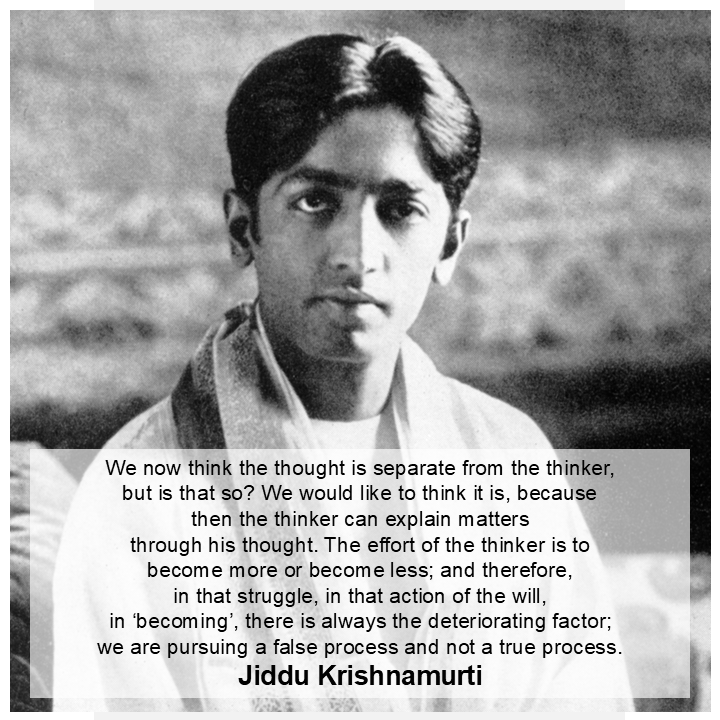
We now think the thought is separate from the thinker, but is that so? We would like to think it is, because then the thinker can explain matters through his thought. The effort of the thinker is to become more or become less; and therefore, in that struggle, in that action of the will, in ‘becoming’, there is always the deteriorating factor; we are pursuing a false process and not a true process.
-J Krishnamurti, The thinker and the thought
When one starts truly observing there is no need to select one side of a thought, so there is no urge to favor one outcome, rather there is no wish to have certain expectation. As there is no wish to a certain way the mind does not work towards cultivation of one side and deterioration of the another one. Now mind just sees that which is there.
I divide myself into the high and the low in order to continue.
-J Krishnamurti, The thinker and the thought
Earlier there were only two possibilities – either cultivation of that which is desired and suppression/ deterioration of that which was undesirable. But now that when thinker and thought are bridged there are no side, no prejudices, no expectations. This opens totally new possibilities, and these possibilities are as real as the reality we are observing, the reality we are trying to understand.
You will realize how limited we were by our thoughts.
You will see how illusive the thinking loop seems, even though you “thought” your imagination was infinite. Your imagination now feels limited because of your prejudices, biases, memories, culture, knowledge.
Our imagination is way more limited than we think. That is exactly why observing without any prejudice becomes more important. We just refuse to do it because we don’t want to get overwhelmed by the infinite seemingly life-threatening possibilities. We are fearful. We think we are not ready.
Be Watchful Of The Isolation – The division
If I am aware that I am greedy, what happens? I make an effort not to be greedy, either for sociological reasons or for religious reasons; that effort will always be in a small limited circle; I may extend the circle but it is always limited. Therefore, the deteriorating factor is there. But when I look a little more deeply ad closely, I see that the maker of the effort is the cause of greed and he is greed itself; and I also see that there is no ‘me’ and greed, existing separately, but that there is only greed. If I realize that I am greedy, that there is not the observer who is greedy but I am myself greed, then our whole question is entirely different; our response to it is entirely different; then our effort is not destructive.
-J Krishnamurti, The thinker and the thought
This is revolutionary in many senses. As we are dependent on thoughts to understand reality. This dependence is filled with preconditioning right from the moment we are born. Therefore, we always try to mold our observation in the shapes of what we wish to become. If I wish to become a world known robber, I will see the act of stealing as a good one – a stepping stone in my “career”, if I wish to become a world known cop/detective I will see the act of stealing as a wrong one.
But if I have no wish to either become a robber or a cop, I now will have totally new concept of what stealing is. If I am observing a robbery right now with no prejudices, I am seeing the desperation, fear of getting caught in the eyes of the robber. I am seeing the mental stress that cop is going through to solve the case; if the cop is a smart one, I am seeing how he feels sorry for the robbers and how happy he feels that he can easily catch them.
Without prejudices you see that the reality morphs according to the wishes of its observers – the observers having certain expectations from it, certain prejudices.
It is that problem which is creative, in which there is no sense of ‘I’ dominating, becoming, positively or negatively. We must come to that state if we would be creative.
-J Krishnamurti, The thinker and the thought
You have to thus let go of the what is expected and observe what is happening without any preconditions. Then you will see that the negativity or positivity of the same reality became in that certain way because you had already picked either one of the sides. If you wanted to behave like a cop – a successful robbery is nightmare for you; if you wanted to behave life a thief same is the happiest moment of your life.
But if you just want to observe what is there in reality, you will see the desperation in the eyes of the robber and the ways cop chooses to hunt the thief down – even if it would steal his ideals.
You see people degrading themselves to have an illusion of the life they desire. You will feel like helping both of them. You will not feel of favoring either one of them.
This may seem like a person who has let go of life or like a sage, but trust me once you have this real worldview, you will see that you are more than yourself. You will see yourself extending to others, you will have this innate urge to reach out to others, to help them to come out of the illusion of happiness and sadness. You will help people in surprisingly different ways – not just right or wrong ways.
What is important is to see that the maker of effort and the object towards which he is making effort are the same. That requires enormously great understanding, watchfulness, to see how the mind divides itself into the high and the low – the high being the security, the permanent entity – but still remaining a process of thought and therefore of time.
-J Krishnamurti, The thinker and the thought
Once you accept yourself in such way you no longer have craving for happiness and aversion towards sadness. You will see that this current happiness is short lived and so will be the sadness arriving after it. You will see that reality is just a tide of happiness and sadness, we are just swaying in between.
Rather you will start seeing that reality is not just a wave between sadness and happiness – it has other attributes for which words like happiness or sadness would fall short to describe them. You are existing between the superposition of many such waves. This is the real journey towards a creative and realest real life.
You will see that you are not affected by these waves. Not affected does not mean that you are insensitive or numb to these aspects of life, rather now you are more sensitive and open to infinite possibilities of life. You don’t get tangled in thoughts, you now act to pass through the life, instead of attempting to control it. You become fearless. You don’t start any journey to achieve freedom in the end. You become free in the first place before you start the journey to experience the life lying ahead. You truly become free in reality.
We will see in detail why Krishnamurti said that freedom is at the beginning in next part.
“Until we understand how to transcend this separative thinking, this process of giving emphasis to the ‘me’ and the ‘mine’, whether in the collective form or in individual form, we shall not have peace”
J Krishnamurti
References and further reading:
- Truth is a pathless land – J Krishnamurti
- The First and Last Freedom – J Krishnamurti
- Jiddu Krishnamurti’s Legacy Of Self-Knowledge : Part 1 – The Liberation From Thinking and Thoughts
- Jiddu Krishnamurti’s Legacy Of Self-Knowledge : Part 3 – Minding The Gap Between Ego & Reality

 Parts Per Billion
2 thoughts on “Being Watchful Of The Ebb And Flow Of Life”