

Part-1 Ralph Waldo Emerson’s Ideas of a True Scholar for the Modern World
The success of any society can be easily attributed to the success of its young generation thereby the institutions that develop them. There will be some moments in everyone’s life where we might have questioned the failure of the education systems from where we “passed out”. We realize at these moments how mechanical the systems have become. Even after realizing this fact, we are always on a search for a tag, a dream career, a dream job to which we wish stick forever till death (sadly, in some cases that is the only option). There are many examples where people in their last moments wished that they would have done things differently, explored some new ventures, dared for some things and would have taken that risk but now they don’t have enough time to do so. The idea of a death with no regrets is strong in today’s times; ideas like YOLO (You Only Live Once), FOMO (Fear of Missing Out), FIRE (Financially Independent to Retire Early) are the examples of this ideology, there is nothing wrong in it. It is the result of what recent generations have experienced. Also, this is not new in history. After a horrible black death in Europe people appreciated the value of life and their body which is always reflected through the arts, literature and creative ventures from the renaissance era.
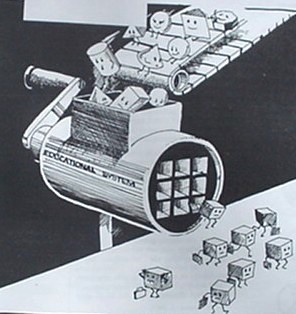
The thing is that when a large group of people try to follow an ideology on a significantly larger scale, there comes a time of saturation, a plateau of losing momentum which sustains forever and becomes the habit of generation, a trait of that generation. We lose the sense of the processes in order to achieve some short-lived pleasures, short living achievements. And after achieving that thing we lose the sense of our being, although there are many exceptions, there always are. The main feeling of clueless-ness after achieving something is the exact reflection of our one-dimensional pursuits for something, it is the proof that in the pursuit of something valuable to us we lose the importance and intricacies of the process we are going through. Ralph Waldo Emerson’s essay called “The American Scholar” made an attempt to move people out of their immediate achievements of separation from the English Government and inspired them to create something new, create and value the processes for building strong future generations and deep knowledge of nature. Even though this essay was more relevant for the American generation which was largely dependent on their English legacy – the one from which they were newly separated, it still remains relevant because of the crispness of truth it holds for every new generation of humanity. The speech/ essay will always transcend the understandings of every generation.
Ralph Waldo Emerson- one of the greatest philosophers, essayists, writer once gave a lecture in an American University which still seems relevant even after the passage of almost 185 years. The thoughts are so absolute that they have stood the test of time. The lecture or speech called “The American Scholar” by Ralph Waldo Emerson is one of the important parts of English literature which highly focuses on the necessity and importance of originality of thoughts, their implementations through actions and the legacy/ virtues a person should leave behind for future generations.
The lecture is famously segregated into three parts. Students of literature follow following partitions to understand this essay.
- The origin of knowledge, science and the influences on a scholar
- The responsibilities/ duties of a scholar
- The daring to create the knowledge relevant to the time
Instead of splitting this into conventional parts I will try to touch the core of Emerson’s ideas for its relevance and importance for our generation.
Origins of “the jobs” in society and The Man of Thinking
Emerson in the starting immediately establishes how the youth has become comfortable on the older foundations, infrastructures left behind by their rulers. They are just feasting on the remains of what has been left behind after victory. Emerson uses the words as “Sluggard intellect” as in the intellectuals who have become comfortable with what they have to highlight this fact. He further calls their jobs as “the apprenticeship to the leanings of the other land” to signify how there is no excitement for the breakthroughs throughout this new born nation. Every scholar has assigned themselves a tag of their “jobs” – the scholar word is not limited to the students only. Emerson is calling scholar to everyone performing their skills in a mechanical way – with some donated, left-over resources from their rulers. The message is not restricted to students only, Emerson is actually summoning every working class of people. He wants the youth of the nation to come out of the mundane tasks and the mechanical nature of the work they are doing as a scholar. Emerson wants the youth to come out of this calmness, boring mentality of doing what is assigned to venture into the endless possibilities the nature provides. He explains the unbounded nature of “The Nature”, the origin of society existing in it and the ways to come out of the mundane-ness of the jobs in this society to evolve further. For this, he starts with the origin of society and “the jobs”, “the tags” and dehumanizing, “mechanicalizing” of the field of knowledge.
Emerson puts some light on the purpose of creation of different labors, different fields of knowledge. Emerson explains that in order to function properly a man was divided into many men with certain skills, domain expertise which made the society multifaceted. But, the process of separation was exploited to extreme where it lost its real purpose. The purpose was to handle and comprehend the boundless nature but it was lost to mere sustenance and separation of humanity into materialistic classes.
“…Man is not a farmer, or a professor, or an engineer, but he is all.”
The American Scholar, Ralph Waldo Emerson
“The fable implies that the individual, to possess himself, must sometimes return from his own labor to embrace all the other laborers. But, unfortunately, this original unit, this fountain of power, has been so distributed to multitudes, has been so minutely subdivided and peddled out, that it is spilled into drops, and cannot be gathered. The state of society is one in which the members have suffered amputation from the trunk and strut about so many walking monsters, -a good finger, a neck, a stomach, an elbow, but never a man.”
The American Scholar, Ralph Waldo Emerson
The division and high focus on labor has divided society into so many parts that it has become difficult to bring them together to unite the society, the humanity. Emerson’s analogy of fountain is so powerful here. Not just American society but the whole world now has separated to such extent of cultures, borders, colors, races, histories, faiths, religions, ideologies, prejudices, resources that it is really difficult to bring them together for a greater common cause. Emerson wants everyone to lose these borders, these tags mentally in order to understand the boundless nature.
Emerson expects every person who is actually a scholar but associated themselves to a tag, a job a profession to strip off of their titles and expand their vision beyond their assigned skill. He wants everyone to transcend their own designated skill.
In today’s world, jobs, titles, posts are killing the people for who they are. No wonder we worry of AI taking over our future jobs. As AI is efficient and fast in doing such “tagged” jobs, the “repetitive” jobs many people who are doing these mundane jobs fear that AI will take over the humanity and before humanity their jobs in future. We forget that the knowledge from which we created these boring jobs is actually boundless. It is our over-simplification of life journeys and our negligence towards the process of living for the sake of the comforts of life that we decided to stick to such mechanical nature of our jobs. He gives very simple example of a farmer – how a man with knowledge of different fields of knowledge like hydrology, geography, meteorology, biology, economics, finance, mechanics, technology got converted to mere a man of profession.
“He sees his bushel and his cart, and nothing beyond, and sinks into the farmer, instead of Man on the farm.”
The American Scholar, Ralph Waldo Emerson
He calls this process as “the Metamorphosis” with similar cases with trader, priest, attorney, mechanic, sailor.
“In this distribution of functions, the scholar is the delegated intellect. In the right state he is Man Thinking. In the degenerate state, when the victim of society, he tends to become a mere thinker, or, still worse, the parrot of other men’s thinking.”
The American Scholar, Ralph Waldo Emerson
Emerson wants for everyone to come out of this oversimplification of our lives. Hence, he establishes the difference between “a thinker” and “a Man thinking”. Before becoming anything possible every scholar must understand that they are a man first, a man from the boundless nature.
“Is not indeed every man a student, and do not all things exist for the student’s behoof?”
The American Scholar, Ralph Waldo Emerson
You should understand that though at the very start of his speech Emerson addresses the American Scholars by calling them so, it is very wise of him to state every man a student, a scholar at this exact moment. This is where his speech becomes open to every man. Though the address was given to the American students, Emerson wants every man to understand what he is trying to convey through this speech. Here, Emerson’s speech has actually transcended the boundaries of a country and time. Emerson worries that during this powerful time of every person as a scholar, the scholar mostly chooses the wrong side of knowledge that is to stick to some tag, profession and loses the privilege of vast possibilities which might have granted by the same multifaceted knowledge from its source “the Nature”.
The Nature- The idea of classification and the origin of knowledge
The curiosity to understand the nature is the origin of knowledge. Every person wants to assign some value to the things happening around him which are reflected through nature around him.
“There is never a beginning, there is never an end, to the inexplicable continuity of this web of God, but always circular power returning into itself.”
The American Scholar, Ralph Waldo Emerson
“…Nature hastens to render account of herself to the mind.”
The American Scholar, Ralph Waldo Emerson
In order to understand each and every phenomenon, the “young mind” assigned some value to them and then classified them; Joined things into one when seemed similar. The concept of “individuality” in the early scholar actually segregated knowledge into different parts. The words “Diminishing anomalies” by Emerson explain how a paradox at the end of every branch of knowledge gave rise to completely new field of knowledge. This development of new field of knowledge helped to connect some really remote fields of knowledge. For example, see the revolution in physics happened after Einstein explained and proved the theory of relativity. Also, most importantly the quantum mechanics and the problems about the nature of our reality which itself is paradoxical in its behavior for us today, when solved will connect many dots, far more and completely different fields of knowledge which seem very distant today.
“…science is nothing but the finding of analogy, identity, in the most remote parts”
The American Scholar, Ralph Waldo Emerson
Emerson highlights the purpose of classifying things in nature was to handle the chaos of the events. Classification created a pivot around the human mind which enabled systematic segregation and relationship development to understand the nature. Use of the term “The law of human mind” actually shows that we have never understood the nature for what it is, we have developed a system of knowledge to organize the chaos where some of the things are making sense to us and the things which don’t make sense is the challenge for today and tomorrow. The challenge is being handed over to the men of science who will try to connect these remote dots.
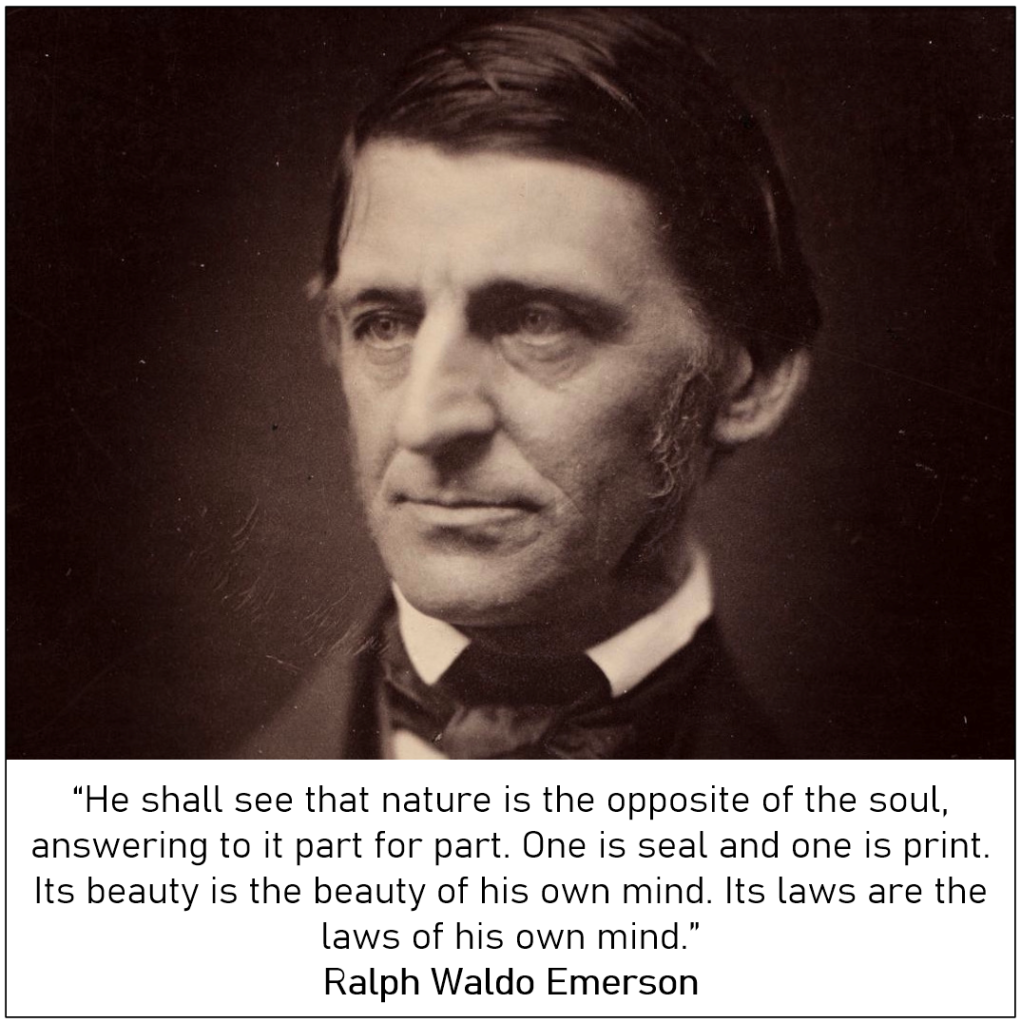
“He shall see that nature is the opposite of the soul, answering to it part for part. One is seal and one is print. Its beauty is the beauty of his own mind. Its laws are the laws of his own mind.”
The American Scholar, Ralph Waldo Emerson
The analogy of the seal and print is such a beautiful analogy given by Emerson to the nature and the soul. Emerson takes a spiritual point of view to understand the nature. He explains that though the soul and nature are “boundless/ center-less”, the nature becomes limited and bounded to the extent of the bounds of the mind. Emerson says indirectly that certain thing won’t exist in nature until you ask nature for its existence. Thus, if it is created by your mind, if it is present in your mind and you try to establish it by studying yourselves then you will definitely establish the same thing in the nature. If it is not in you then it definitely is not existing in nature. Your limitations of the understanding of yourselves will be the limitations of the nature around you. Hence, if you widen your understanding, become limitless then only you will understand the limitless form of the nature.
Max Planck one of the greatest physicists of all times and who came far later after Emerson had similar opinions about the nature of our reality and the limits of our understanding about it.
“Science cannot solve the ultimate mystery of nature. And that is because, in the last analysis, we ourselves are part of nature and therefore part of the mystery that we are trying to solve.”
Max Planck
Emerson thus fuses the two distant dots called “Know Thyself” and “Study nature” into one based on this spiritual foundation. Reading, listening these sentences and realizing this idea itself is so powerful. This also shows that Emerson himself was a master of connecting different and distant dots in the fields of knowledge. No wonder he was successful in actually defining the origin of human understanding. In this way he recalls the importance and significance of nature on a mind of a scholar.
-End of Part 1 –
There is a Part 2 to understand how Emerson further suggests the “potent” tools, “the weapons” and responsibilities which come with them to really transcend the boundaries of our existence and become a true scholar. We will see that in next post.
Our identity is one inseparable part of our existence. It is the very first pivot that we have in this boundless existence. The name given by our parents/relatives symbolizes the very first dimension of our identity. Then we build upon it as we grow. Many factors like our family, the people around us, their and our financial conditions, their and our emotional states, their and our habits, inspirations and what not directly and indirectly gives us many facets. They become part of our identity. As we grow up in most of the cases our jobs, professions become our identity. Actually, we are conditioned right from our childhood to become doctors, engineers, social workers, bankers, brokers, pilots, writers, dancers, teachers, firefighters and what not. Our job becomes the largest chunk of our life and our identity. These identities which we hold for our lives are mostly rooted in our young times, college days and the immediate days after we leave the educational institutions. No doubt that these are the turning points for most of us. That is why the success of educational systems and institutions is very important in the development of the whole society. And, Emerson tried to question the materialistic identity these systems granted at such turning points to the young scholars of his time. But as history repeats itself same is the case with our recent generations. This is where the absolute ideas, the great wisdom of Ralph waldo Emerson stand the test of time.
There is more to come…
Read Part 1 Ralph Waldo Emerson’s Ideas of a True Scholar for the Modern World from here.
Read Part 2 Ralph Waldo Emerson’s Ideas of a True Scholar for the Modern World from here.
Read Part 3 Ralph Waldo Emerson’s Ideas of a True Scholar for the Modern World from here.

 Parts Per Billion
One thought on “The American Scholar – The Scholar, the Nature, the Origins and the Legacy of Knowledge”